Disney, Music, Pop Culture, The Beatles

The Beatles Hit the Brakes at Walt Disney World.

Original Publish Date: December 19, 2024. https://weeklyview.net/2024/12/19/the-beatles-hit-the-brakes-at-walt-disney-world/
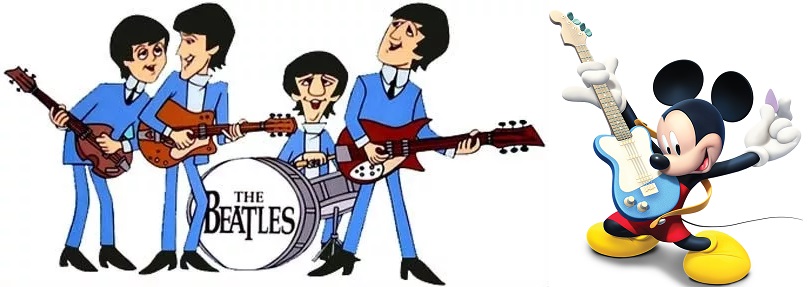
Quick, who broke up The Beatles? Which one of the Fab Four was the first to quit the group? And who was the last Beatle standing? Throw away all you thought you knew about the breakup of The Beatles and settle in for a Beatles Christmas story like you have never heard before. This Beatles breakup story involves John Lennon’s famous “Lost Weekend”, the Sopranos, Al Capone, and Mickey Mouse.


On August 20, 1969, The Beatles met for the last time at Abbey Road Studios to record what was to be the last song on their last studio album: The End. The song, which features the only song Ringo performed a drum solo on, was initially intended to be the final track on Abbey Road, but it ended up being followed by “Her Majesty” a brief tongue-in-cheek music hall song. “Her Majesty” appears 14 seconds after the The End, but was not listed on the original sleeve. Paul McCartney is the only musician to appear on the track. Some observers consider it the first example of a hidden track. The song credited to the “Lennon-McCartney” songwriting partnership brought forth a rare compliment from Lennon when he credited Paul with the line, ‘And in the end, the love you take is equal to the love you make.’ The ever-increasing acerbic Lennon offered a back-handed compliment to his songwriting partner by saying, “it is a very cosmic, philosophical line. Which again proves that if he wants to, he can think.” Thus, The End stands as the last known new recording involving all four of the Beatles during the band’s existence. And before you say it, the album Let It Be, was recorded in January 1970 ON TOP of Abbey Road Studios, NOT inside of it.
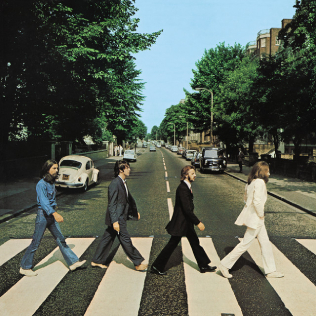
The final gathering of all four Beatles came two days later at a photo session held at John Lennon’s Tittenhurst estate. On September 20th, Lennon privately informed his bandmates at a meeting at Apple, without George Harrison present, that he was leaving the Beatles. However, it was unclear to the other members whether John just wanted a break or if his departure was permanent. Legend has it that John Lennon walked out of that 1969 meeting at Apple headquarters screaming “I want a divorce” and four years later, he would get his wish at the “Happiest Place On Earth”. Meantime, on April 10, 1970, McCartney settled the issue in a press release declaring, “I’m quitting The Beatles.” It would take another four years for the breakup to be formalized.
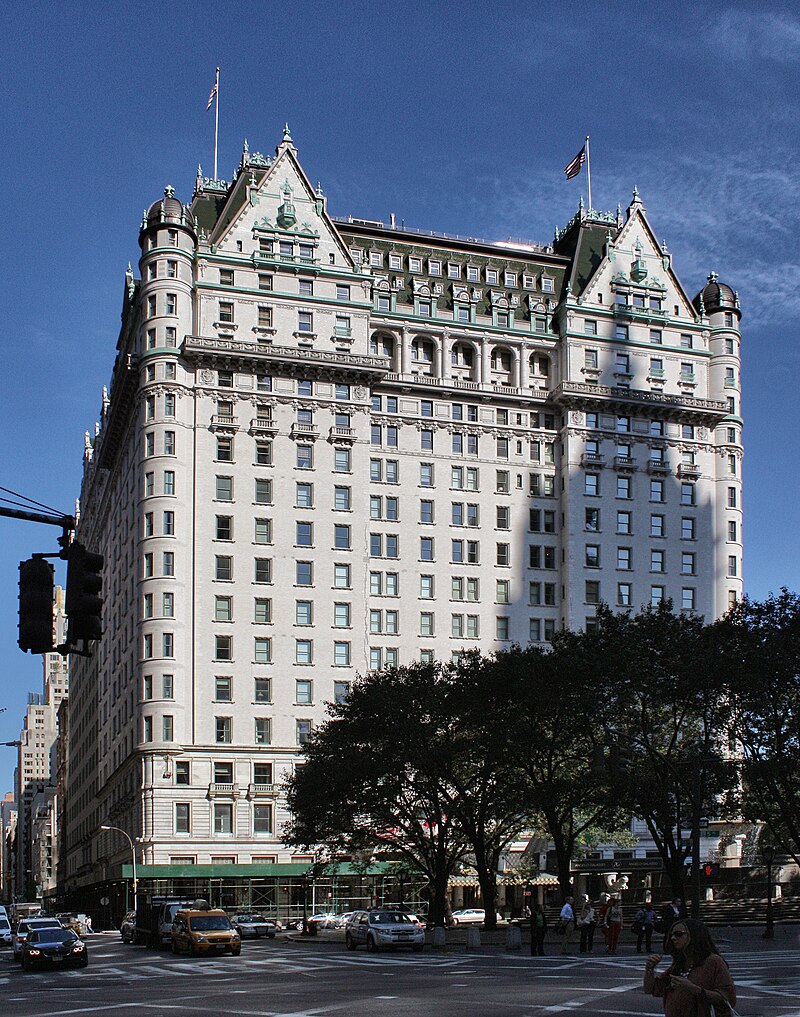
The Plaza Hotel in Manhattan, New York City.

After three years of court battles and ever-increasing acrimony amongst the Fab Four, the final dissolution of The Beatles was set to happen. The meeting was scheduled for December 19, 1974. Ironically it to happened at New York’s Plaza Hotel, the first place The Beatles stayed in America a decade before. As it happened, George Harrison was at Madison Square for two nights on his Dark Horse tour and Paul and Linda McCartney flew in for the signing. Ringo had already signed the documents in England. So, as George, and Paul sat around a large table ready to dissolve the partnership alongside Apple lawyers and business managers, Ringo listened in on the telephone to confirm that he was alive. Everyone present was wondering where John was. Keep in mind, Lennon lived within walking distance of the Plaza Hotel. George Harrison’s lawyer telephoned Lennon for an explanation. May Pang answered and from the background, John’s voice bellowed out, “The stars aren’t right,” to the lawyer’s query. When John’s response came across the speakerphone, everyone present was furious. John explained that he was going to follow his astrological signs and he wasn’t coming to the meeting.
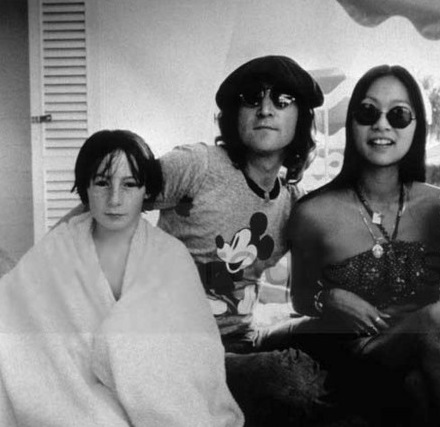
Julian & John Lennon with May Pang.

Instead, John decided that he wanted to give his 11-year-old son Julian a special Christmas holiday by taking him someplace warm. Mobster Mo Levy offered to have John, May, and Julian stay at his Palm Beach Florida condominium, not far from the former mansion of gangster Al Capone. So, Levy grabbed his son Adam and together with the wayward Beatle brood, they all flew down to Levy’s West Palm Beach estate to spend Christmas in the sunny shores of Florida. Wait, you say, where was Yoko? Well, John Lennon was in the midst of his self-described Long Weekend “sowing his oats” with May Pang, Yoko Ono’s assistant and the couple’s production coordinator. In mid-1973, while Lennon was busy working on his classic Mind Games album John and Yoko were having marital problems. Ono suggested to Pang that she become Lennon’s companion, and with Yoko’s permission, John and May began a relationship that lasted more than 18 months.
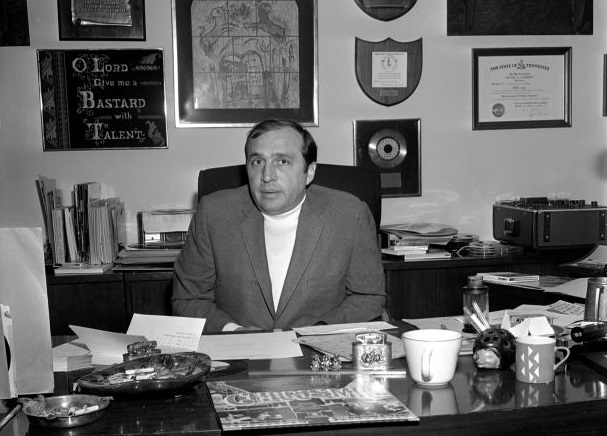
Morris Levy in his office at Roulette Records.

And that private jet-owning mobster, who was that guy? His name was Morris Levy, a music executive from Harlem with alleged mob ties to Vincent Gigante, boss of the Genovese crime family. “Moishe” or “Mo” as friends and associates called him, was known to sign up-and-coming artists to lop-sided contracts that often left the artists owing him money for touring expenses and studio time. Mo Levy would often sign his name to contracts as a song’s co-writer without the artist’s consent. Robbie Robertson of The Band was reportedly one of his victims and a witness to Mo’s henchmen holding a fellow performer by his ankles out the window of Levy’s Park Avenue apartment to get his point across. Levy, who died in 1990, was the inspiration for the HBO television series The Sopranos (1999–2007) character Hesh Rabkin, Tony Soprano’s friend who made a fortune defrauding performers, underpaying royalties, and pressing unauthorized records. Tommy James, Frankie Lymon, and Tito Puente were among his most prominent victims.

Once in South Florida, they spent their time walking on the beach, lounging by the pool and amusing themselves by throwing firecrackers at palm trees. The pinnacle of the trip came when the Lennon trio spent a day at Disney World. There one of the most famous men in the world went mostly unrecognized. At that time Disney’s Magic Kingdom was only one park on the property. They stayed at the Polynesian Hotel. To get from the Polynesian (both then and today) to the Magic Kingdom, the easiest way to travel is by Monorail. The train stops inside the hotel so guests do not have to venture outside the building. Making the Polynesian the obvious choice for John and his crew to stay.
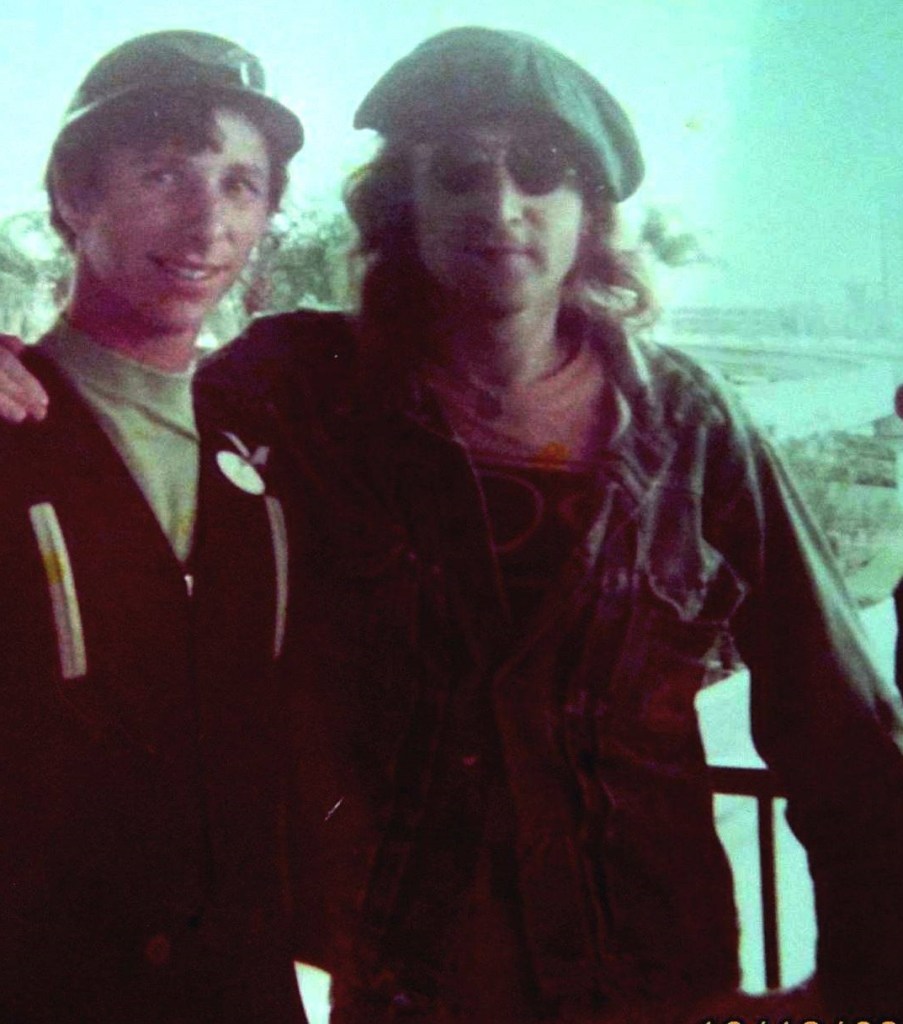
Disney monorail operator / castmember Hal East with John Lennon.

Years later, Disney monorail operator (castmember Hal East) confirmed that John, May Pang, and Julian made a few trips to the Magic Kingdom via the Monorail and were allowed to ride up front apart from the crowd. It was during these trips where John and Julian experienced the rare treat of driving the Monorail. In her book May shared an interesting memory from one of the rides: “I overheard a father tell his son [on the Monorsail] he had heard a Beatle was visiting. “Which Beatle?” The father said, “George Harrison.” I burst out laughing. John asked why. We then all started laughing so hard that the Dad turned around. It then registered which Beatle was at the park that day – and why we were laughing. “It’s O.K.,” John jokingly said, “we all look alike.” On December 29, 1974, one of Apple Corp’s lawyers hand-delivered the official documents to the House of the Mouse in Florida and John Lennon became the last of the four to sign off on the contract.
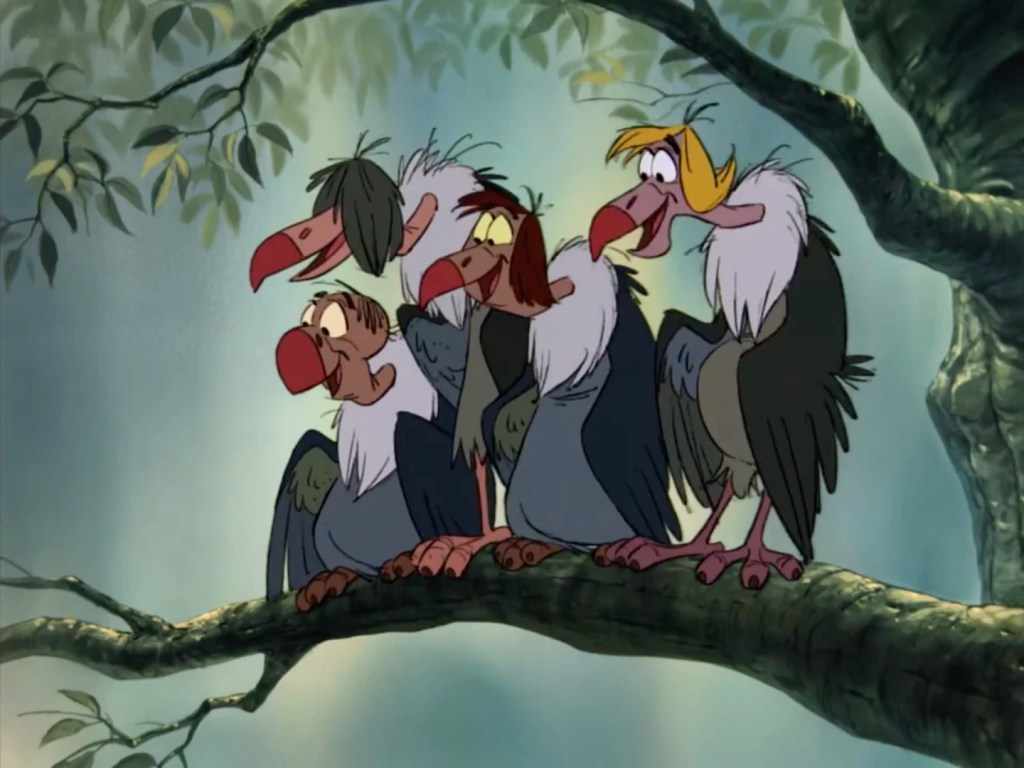
Disney’s Beatles inspired Vultures: Buzzie, Flaps, Ziggy, and Dizzy.

Ironically, the Beatles and Disney never really had much of a working relationship, but Disney did reference The Beatles in at least one of its productions: the vultures in The Jungle Book are based on the Fab Four. Disney also made plans to remake 1968’s Yellow Submarine, but the project never broke the surface. In 2020, Disney bought distribution rights for the docuseries The Beatles: Get Back from Peter Jackson and that three-part series is still streaming on Disney.
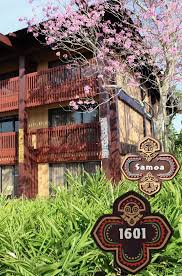

Samoa Longhouse 1601.
Samoa longhouse Building at Disney World’s Polynesian Resort.

While Disney won’t confirm the exact room where it happened, dedicated Beatles / Disney fans have pinpointed the location: Room 1601 in the Samoa longhouse Building at the Polynesian Resort at Walt Disney World, Orlando. Room 1601 looks out at the Seven Seas Lagoon and it was this scene at which John gazed as he paused briefly before officially dissolving his performing relationship with the Beatles. Room 1601 is a ground-floor corner room in the Samoa longhouse that looks out on the Seven Seas Lagoon with the Cinderella Castle visible in the distance.
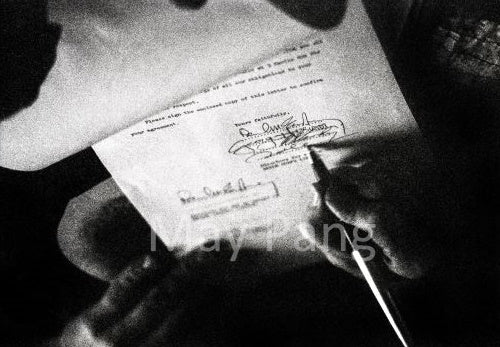
May Pang’s Photo of Lennon’s dissolution signing.

Here, with the Magic Kingdom as his backdrop, John Lennon picked up his pen and officially finished off the Beatles, once and for all. Years later May Pang remembered that John told her to “Take out your camera…He looked wistfully out the window. I could almost see him replaying the entire Beatles experience in his mind. He finally picked up his pen and, in the unlikely backdrop of the Polynesian Village Hotel at Disney World, ended the greatest rock ‘n’ roll band in history by simply scrawling ‘John Lennon’ at the bottom of the page.”
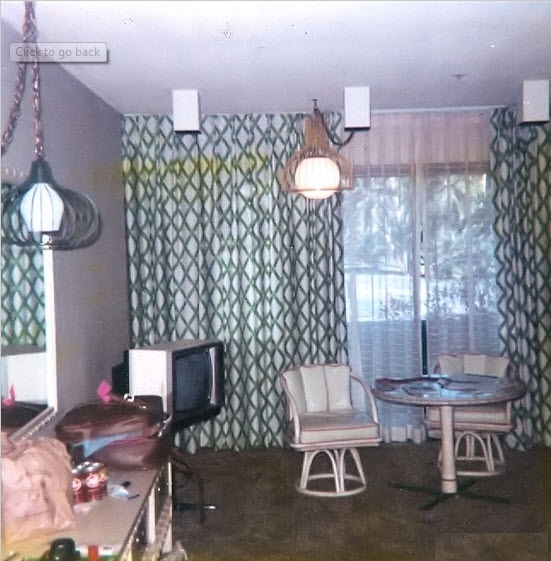
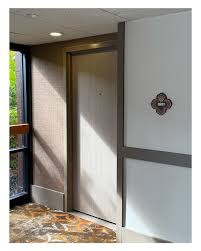
Room 1601.

In Pang’s book “Instamatic Karma: Photographs of John Lennon” (St. Martins Press 2008), there are several photos of Lennon at Disney World wearing a stylish newsboy cap and Micky Mouse ringer t-shirt posed anonymously in the park among the crowd, alongside Monorail driver Hal East, in front of Cinderella Castle and outside room 1601 at the Polynesian. Most importantly, Pang snapped a photo of Lennon’s signature on the dissolution papers. A literal snapshot of music history, Disney style. And today, if you’re lucky, you can stay in Room 1601 where the Beatles long and winding road came to an end. And then, go ride the Monorail.

Indianapolis, Music, Pop Culture, The Beatles

The Beatles, John Lennon, WIFE… and Irvington. Part III

Original Publish Date May 20, 2021.

In the John Lennon film “Above Us Only Sky” (a segment from the larger film “Imagine”) there’s a scene from a 1971 encounter with a young man who shows up at Lennon’s house in England. Lennon talks with him and eventually invites him in to eat some food. In the clip, Lennon’s Mini Cooper car (parked outside the house) has a WIFE Good Guys radio sticker in the back window. How in the world did a sticker from a local Indianapolis radio station end up on a car in John Lennon’s driveway in England? The mystery was uncovered by Irvingtonian Bill Price in part I of this article and solved by Irvingtonian Stephen Bruce Smith in part II. Part III reveals another Irvington connection.
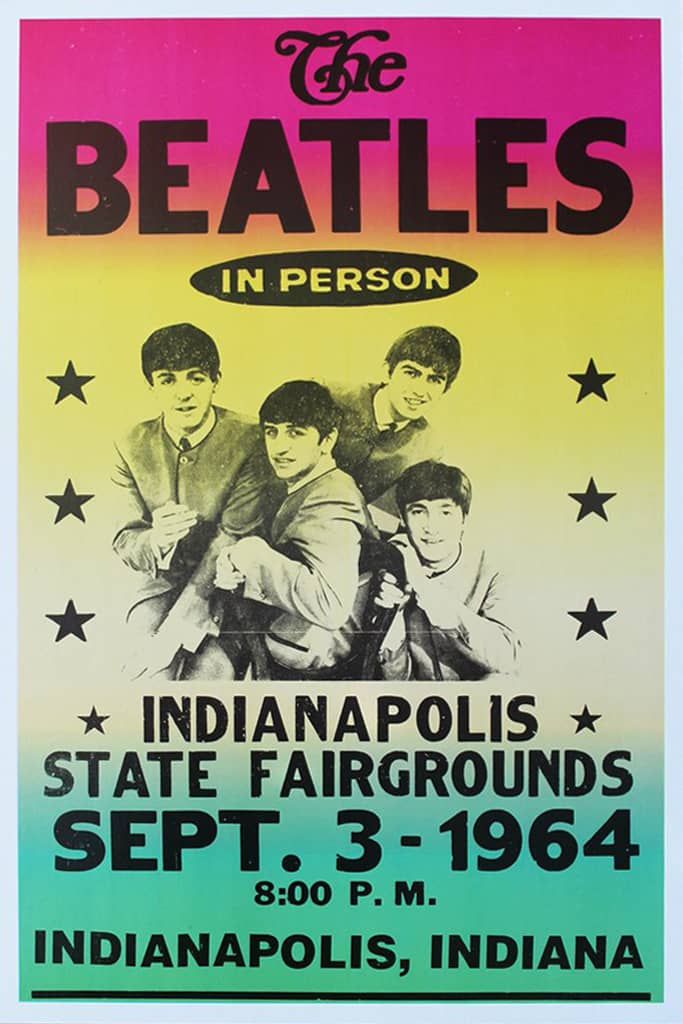
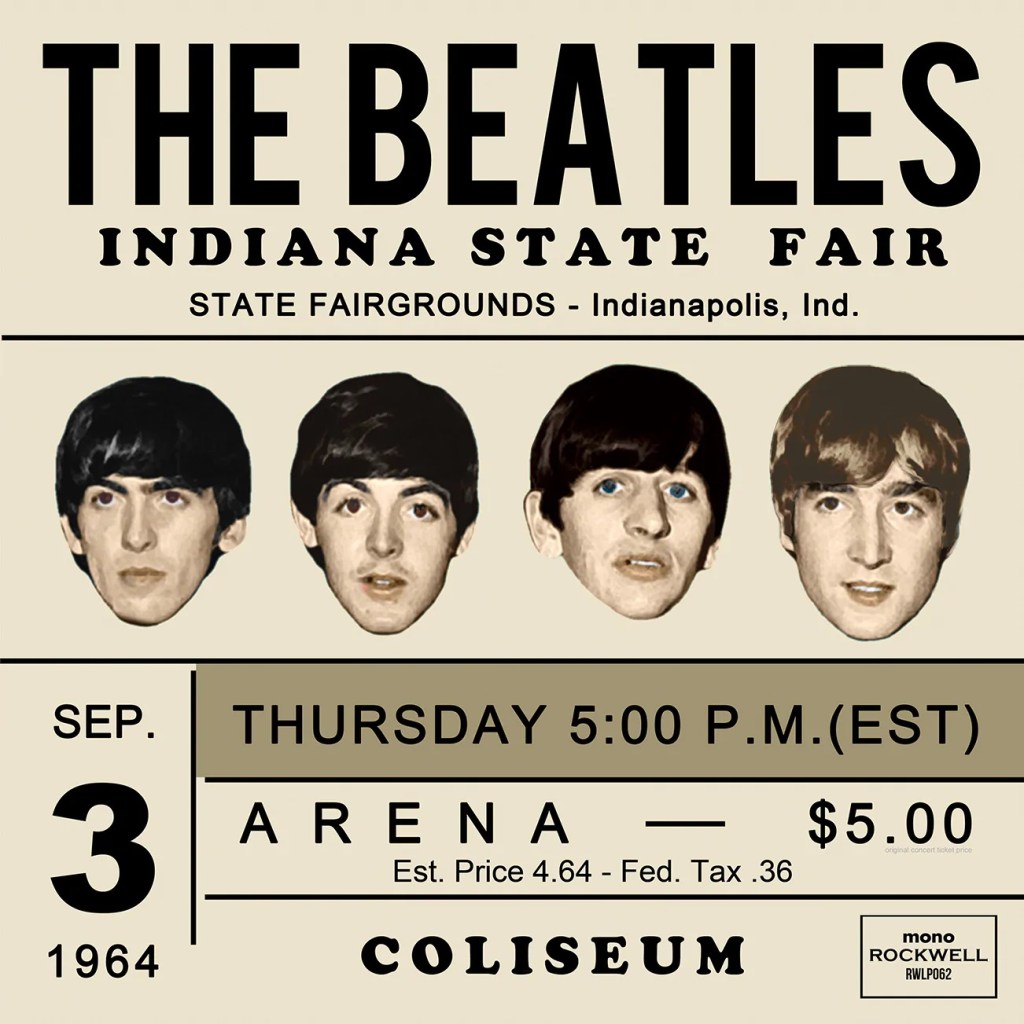
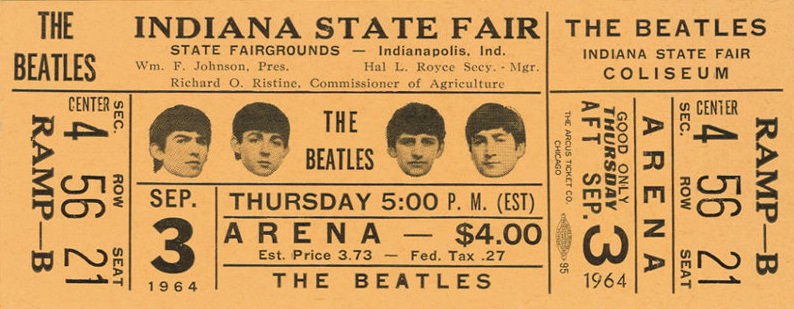
When the Beatles played two shows at the Indiana State Fair in September of 1964, Radio station WIFE 1310 sponsored the show in the Coliseum, and WIBC sponsored the show in the grandstand. In 1963, WIFE-310 AM signed on the air with a rock-heavy playlist. And by the time The Beatles arrived, the station had rapidly surged to the top of the ratings race, bringing an end to radio station WIBC-1070 AM’s reign as the champion of Indianapolis’ airwaves. In 1964, programming on WIFE largely focused on top 40 hits and bubblegum rock including The Beatles.


The Beatles concerts have been detailed by this writer in past columns and the specifics of those shows are well-known to all Circle City Beatles fans. Stephen Bruce Smith added more details to that story and revealed that Lennon “got the bumper sticker in 1964 at the station when The Beatles awarded tickets to a lucky high school girl who won a contest. I knew her brother at Howe High School. John got that sticker at the station from either Jay Reynolds or Jack Sunday (Jerry Baker).”
Turns out Smith, who knows everybody, rediscovered that lucky ticket-winning girl too. Did I mention Stephen Bruce Smith knows EVERYBODY? Her name is Elaine Conly and she is a Howe graduate, class of 1966. She was Elaine May when she won that contest back in 1964. Elaine’s mother, Virginia Casey May, who passed in 2002, was active in the Irvington Women’s Club as past chairwoman and past president of the Irvington Music Study Group. She was also a pioneer member of the neighborhood CrimeWatch program and Human Rights Commission, retiring from the Indianapolis Mayor’s office in 1977. Virginia was also a former chairwoman for the Junior Civic Theatre and scriptwriter for the “Time for Timothy (Churchmouse)” program. So Elaine, who performed in some of those productions for her mother’s Civic Theatre, knew a thing or two about the entertainment business.

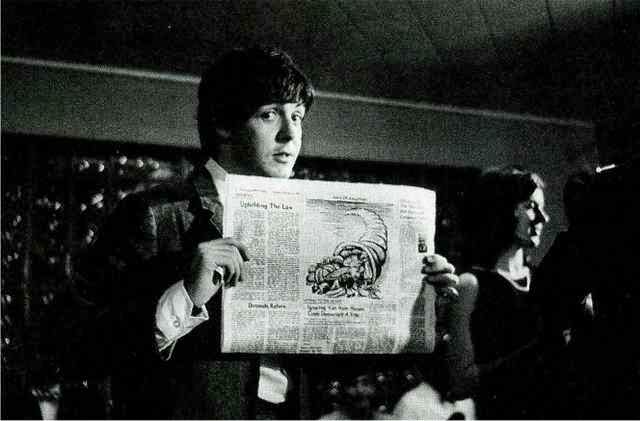
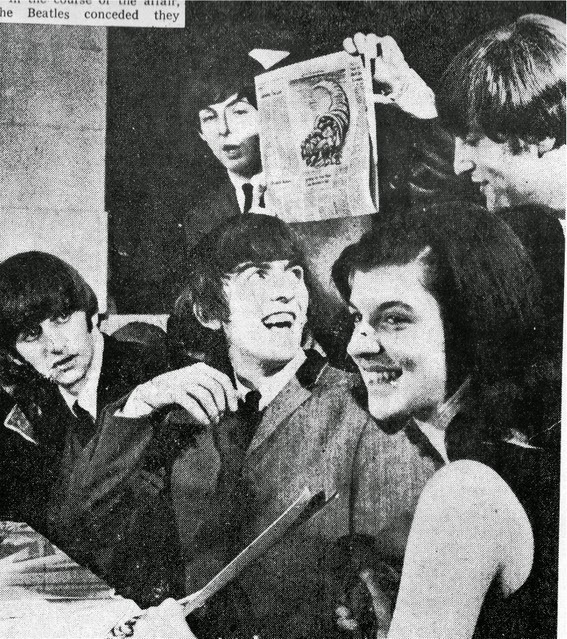
Elaine May Conly With Paul, Ringo, George & John at the Concert Press Conference.

15-year-old Elaine entered a 50-word or less summertime essay contest by the Indianapolis News titled “I want to meet the Beatles because…” Elaine entered (without telling her parents) and her 47-word essay was selected as the winner from more than 3000 entries. Her winning entry read: “I want to meet the Beatles because they have a special magic. When they perform, the oppressing world crisis and other problems can be temporarily forgotten. They sing happy, swinging songs. I’d love to meet the four young men who can make everything seem a little brighter.” Just like in the movie Bye-Bye Birdie, Elaine supplants Ann-Margret who likewise wins a contest to meet her Elvis-like hero, Conrad Birdie.
“I had to keep it a secret though, that was hard to do,” Elaine says. When her picture appeared on the front page of the newspaper announcing her victory, “The phone rang off the hook, it was pandemonium.” Elaine, the daughter of Harry A. May, grew up at 1134 N. Butler Ave., “Butler Avenue North of 10th, Two blocks from the Steer Inn,” she states.
“I was worried that they (The Beatles) would not want to meet a teen-aged kid and that they might poke fun at me. I expected to get a cold reception.” Elaine recalls, “But they were perfect gentlemen and very nice to me. I shook all of their hands and when I entered the room, John stood up an offered me his seat.” Which was a good thing because John Lennon was her chosen Beatle. “He had written a book of poetry and he was my favorite. They were all very nice and gentlemanly but John was the nicest of the four.” Elaine recalls. “I went out and bought a special black crepe dress because I heard that John liked black.”

Paul McCartney with Elaine in the background.

The whole encounter, which took place in the communications building at the State Fairgrounds across from the Coliseum, took less than five minutes. Elaine reveals, “I wore the class rings of four of my classmates to the meeting. They belonged to my friends. They all wanted their ring to touch a Beatle.” When I asked if she got any souvenirs or autographs, she responds, “No, I was told (by the Indy News) that I couldn’t ask for autographs or take photographs of my own. I wish I would have because I probably could have paid for my college tuition with that money now.”
Elaine states that the newspapers followed up on Elaine’s story every few years. As for the Fab Four, “They were very funny but very polite.” she recalled. Part of Elaine’s duties that day, aside from the obvious photo op for the news, was to deliver an original editorial cartoon from the News to the Lads from Liverpool. “Then I just stood to the side for the rest of the Press Conference”, Elaine says. When she left the building, she was bombarded with questions from local reporters.

Elaine May Conly with the Beatles.
Elaine May Conly

Part of her prize package included tickets to the show. When asked what memories she had of the concert, Elaine says, “Security was very tight. It was very dark and very hard to hear them. But it was great to look at them, they were so handsome.” Her tickets? “Oh, they were very close, first 10 rows or so.” Did anyone recognize her as the contest winner? “Yes, a few people picked me out right away, but then the Beatles came out and that was that.” Elaine is still saddened by the death of her favorite Beatle. “I was watching Monday Night Football (December 8, 1980) when they broke in to announce that John Lennon had been shot. I cried. I cried a lot.”

And what about that little black dress, the only physical souvenir she has left from that encounter? “That dress was good luck.” she says, “I was wearing that dress a year later when I walked a friend to the bus station. A friend of a friend, University of Cincinnati architecture student Michael Conly, was on the bus and kept asking, “Who’s that girl in the black dress?” Long story short, Elaine and Michael Conly have been married for 51 years. And her engagement ring? Michael purchased it for her in Beatles Country: England, where he was studying in Europe.
Several years ago, Michael had a special print of his wife’s brush with the Beatles enlarged and the poster-sized photo hangs on the couple’s wall inside their Fishers home. “That’s my claim to fame I guess. Over the years it (the photo) was a big hit with our babysitters who would gasp and ask me about the encounter. I was always amazed because most of them were not even born when that meeting took place. The Beatles still have that power though, after all these years.”

Indianapolis, Music, Pop Culture, The Beatles

The Beatles, John Lennon, WIFE… and Irvington. Part II

Original Publish Date May 13, 2021.

In part I of this series, I told you about an obscure episode involving The Beatles John Lennon and the Indianapolis radio station WIFE. In the film “Above Us Only Sky” there is a car parked outside Lennon’s house that has a WIFE Good Guys radio sticker on the back window. How did a sticker from a Circle City radio station end up on a car 3,947 miles away in John Lennon’s driveway?
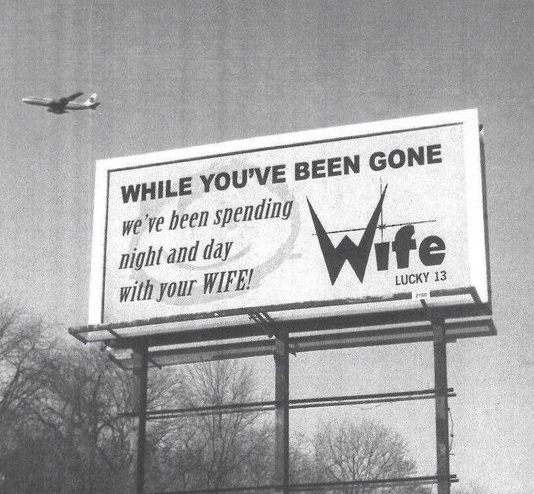
Anyone over the age of 50 should remember WIFE AM 1310 in Indianapolis. How can you forget those Coppertone commercials in the summertime: “Time to turn so you won’t burn.” Or the WIFE Lucky 13? Or the billboard near Indianapolis’ Weir Cook Airport (later Indianapolis International Airport) which amused passing motorists with the message, “While you’ve been gone we’ve been spending night and day with you WIFE!” Or even the “window on the world” of the WIFE studios at 1440 N. Meridian Street where pedestrians and downtown shoppers could walk past the window and see one of the “WIFE Good Guy” DJs in action?
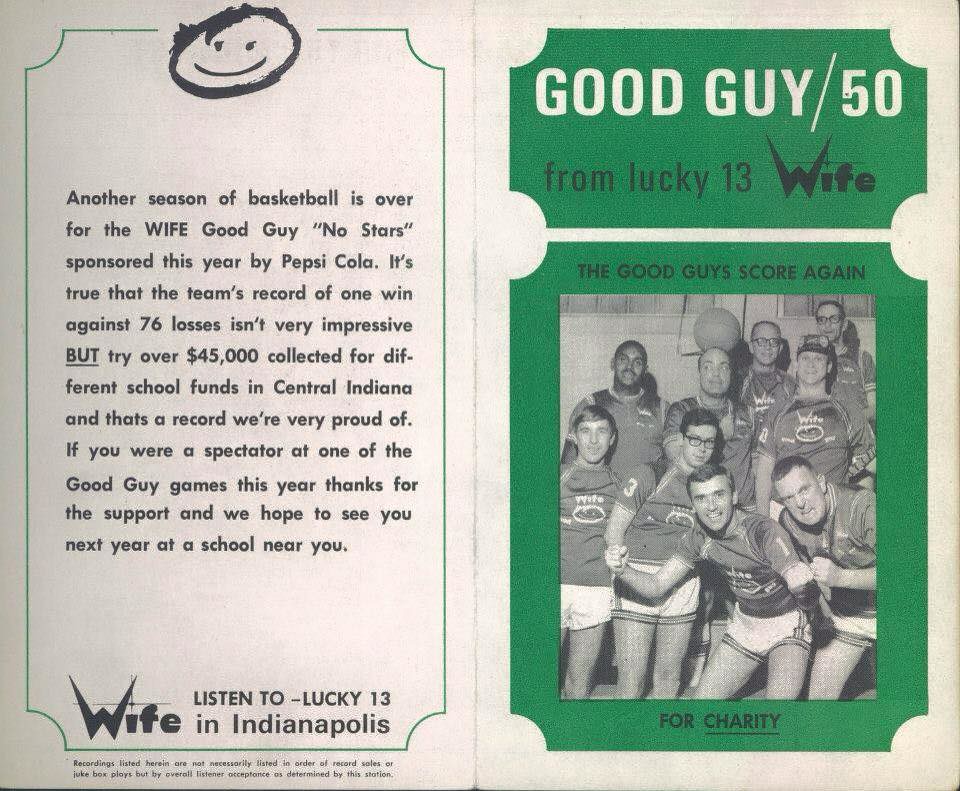
WIFE was the top 40 giant of Indy for years and the only real AM radio rockers in town during the mid to late sixties (sometimes garnering as much as a 40% share of the Indy radio audience). WIFE is remembered for their endless contests (“The 100 Thousand Dollar Dream Home” or “The 100 Thousand Dollar Cash and Car Give-A-Way”), ear-worm jingles pounding the call letters and station numbers ad nauseam, and, maybe worst of all, the station sped up the records to cram more music in between the ads, witty banter, and promos. This last practice confounded pre-teens who wondered why the songs sounded so much different on WIFE than on the 45s. Most of all, radio fans remember the “WIFE Good Guys”: Big Jack Armstrong, Roger W. Morgan, Reb Porter, Jay Reynolds, Joe Light, Jay Hawkins, Buddy Scott, Jim Fox, T.J. Byers, Scott Wheeler, Mike O’Brien, Dan Summers, and Steve Miller.


And who can forget Jack Sunday: aka ABA / NBA Indiana Pacers radio voice Jerry Baker. Jerry handled the noon to 3:00 shift for a couple of years at WIFE chanting “Hey, this is Jack Sunday” every break and intro and while hosting the “Pool Party” segments. It was Jerry Baker who introduced the Beatles during their two concert stops at the Indiana State Fairgrounds. For years, WIFE would replay Jerry’s Beatles intro from the fairgrounds every time they played one of the Fab Four’s songs: “On behalf of the Indiana State Fair Board and WIFE Good Guys…The Beatles!” No doubt about it, WIFE 1310 is an Indiana institution. And somehow, a bumper sticker from the station ended up on John Lennon’s car in England.
I found the answer, where else? On Facebook, which led me right back here to Irvington. I started by joining the WIFE RADIO ALUMS & FANS Facebook page. It was there that I found Irvingtonian Stephen Bruce Smith. That name should be familiar to many Irvintonians. Smith is a former Irvington Council President (1997-99), 1975 Howe high school alumni, and 1980 Butler grad. Smith, who grew up on the corner of Brookville and Grand (421 So. Grand), is a Beatles superfan, authority and collector. And he knows EVERYONE in Irvington. I called Smith on a Saturday afternoon. When he answered the phone I could hear that he was spinning Beatles vinyl on the turntable in the background. EXACTLY what you might expect from an Irvington Beatles guy.
Smith unraveled the mystery of the bumper sticker quite succinctly. “The Beatles came to Indy in September 1964 to do two concerts at The State Fair on the 3rd. WIFE sponsored the concert and had various contests surrounding the concert. The Beatles visited the WIFE studio earlier that day and were given various gifts to remember their visit to Indianapolis. They were greeted by Miss Indiana State Fair as well as meeting a girl who won the Meet The Beatles Contest. She happened to be a Howe High School girl. The WIFE Good Guy sticker on John’s Mini Cooper in the 1971 film came from that studio appearance that morning at WIFE 1330 North Meridian. John loved stickers and t-shirts so I’m sure he just stuck it on there many years later.”


However, the story doesn’t end there. Stephen went to the first Beatles concert at the Fairgrounds. There were two, one inside the Coliseum and the other on the stage/grandstands outside. “I went with my father, Stephen Smith Sr., in exchange for punishment to see Andy Williams and the Osmond Brothers,” Stephen jokingly says. “My dad was shipping supervisor at Atkomatic Valve Co. at 141 S. Sherman Drive at Brookville and Sherman. They produced valves used in the NASA space program. He passed away in November of 1967. He got the tickets for free from a coworker.”
Smith remembers actually being excused from school to go to the concert. “It was a weekday, a Thursday I think. I was 8 years old and I was worried my teacher, Mrs. Cunningham, wouldn’t agree. I went to Orchard Park School and I think I got on her bad side because I had dressed up as Vic Morrow from the Combat TV show for Halloween. She gave me a frown as she lifted my mask. Everyone else was dressed as princesses, ghosts, and cartoon characters and my costume was a little rough looking, but she let me go.” Smith found out later that several other kids in school went to the concert too.
I asked what he remembered about the concert, and he stated, “It was about 35 minutes long and they played maybe 6 songs. You couldn’t hear anything.” Smith adds that, years later, he became good friends with WIFE Good Guy DJ Jay Reynolds and they often talked about that concert. “I remember Jay gave me the greatest quote about the noise. He said, “it got so loud that it got quiet.” And he was right.” Smith recalls that the Coliseum was “remodeled and brand new after the explosion.” (On October 31, 1963, during a Holiday on Ice show, a propane leak at a concession stand caused an explosion that killed 74 people and injured around 400 others. A subject I’ve written about in past columns.)


Smith continues, “Even at that young age, I could see that the security seemed unprepared for what was happening. Girls were screaming, fainting, and crying and there was even a rumor that one girl died from an asthma attack during the concert. Girls were all peeing themselves and getting hurt jumping from seat to seat. There were 16 Marion County deputies around the stage and they were all scared to death. You could not hear a word.” Stephen continues, “My dad was a pilot in World War II and he said he hadn’t seen that kind of crazy since wartime.”
One image that sticks with Smith is that of a smashed golf cart he and his father walked past after the show. “I remember staring at that thing for a long time. It was totally destroyed. After the concert, they used it as a diversion to get the girls away from the band. These screaming girls chased it down and literally tore it apart. I can still see that trashed golf cart in my mind.”


As an adult, Stephen Bruce Smith also encountered Jerry Baker, aka WIFE Good Guy “Jack Sunday”. Smith relates, “Jerry told me that the Beatles were each given goody packs that included Bibles in each bag. And the only thing they requested was a black and white TV, coca-colas, hamburgers, French fries, and Marlboro cigarettes. Also in those goody bags were t-shirts and stickers from WIFE. John loved trinkets and collected all that stuff, t-shirts, patches, and stickers of any kind; anything American. John had stickers on everything in his house.”
It makes sense that Lennon, fresh on the heels of The Beatles’ 1970 break-up (which many attribute to Yoko Ono), chose the WIFE sticker, with its slogan “WIFE Good Guy”, as a wry contrary comment on his relationship with Yoko. The Indianapolis connection was purely coincidental.
Many years later, Smith won a contest to meet Paul McCartney backstage in Chicago in 2005. “I was ushered in to meet him with a group of reporters. It was only 6 minutes, but it seemed like 6 hours. The reporters were stunned and really weren’t talking to him. I asked him if he remembered the concerts in Indianapolis. He said, “Oh yes, I remember Ringo went drinking with the cops.” Smith adds the little-known detail that Ringo traveled up to Noblesville where one of the police security officers (State Trooper Jack Marks) owned a horse farm. “When word got out about that visit, those poor people were invaded by teenage girls wanting details.”
Smith continues, “knowing Paul owned a sheepdog, I told him I had a sheepdog myself. He asked, “Oh really, what is the dog’s name?” I answered, “Jack the Moose” and Paul said hmmm, “Jack the Moose, Jack the Moose” over and over a few times. I was hoping he was gonna use it in a song, but that never happened.” Smith, who lives next to Pleasant Run Golf Course, ran into Paul’s assistant at another McCartney concert later. “He recognized me and said as we parted, “Cool, Paul will see you after the show.” Smith says, “It never happened. But the concert was great.”


Next week, Part III


The Beatles, John Lennon, WIFE… and Irvington.

Music, Pop Culture, The Beatles

Paul is Dead. The rumor revisited. Part IV

Part four abbey-road-album-cover-the-beatles

Original publish date:  June 29, 2015

Reissue date:  May 9, 2019

By the time The Beatles released their eleventh, and ultimately last, studio album Abbey Road on September 26, 1969, the “Paul is dead” rumor had developed a life of it’s own. Although Let It Be was the last album released before the band’s dissolution in 1970, work on Abbey Road began in April 1969. Although the band was barely speaking to each other at the time, Abbey Road is widely regarded as one of The Beatles’ best albums. Rolling Stone placed it at number 14 on its list of “The 500 Greatest Albums of All Time”. In 2009, readers of the magazine also named Abbey Road the greatest Beatles album. But in the fall of 1969, many Beatle fans were in the throes of mourning for what they believed was their dearly departed bass player, Paul McCartney. And the cover of Abbey Road did little to quell the controversy.
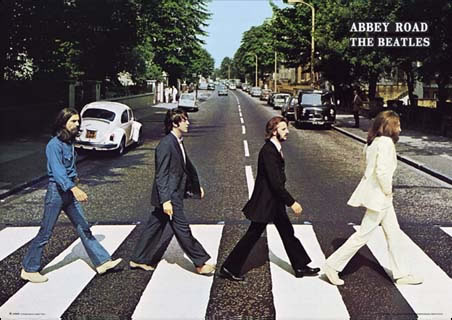
z Beatles-696x464Almost immediately conspiratorialists saw the Abbey Road album cover as a funeral procession. Leading the procession is John dressed in white, symbolizing the clergy. Next comes Ringo, dressed in black like an undertaker. Paul, the presumed corpse, is third in line and walks out of step with the other Beatles, he is barefoot and his eyes are closed. George brings up the rear, dressed in work clothes the supposed gravedigger. Also, Paul is smoking a cigarette, also known as a “coffin nail”. The fact that he is holding the cigarette in his right hand, even though the “real” Paul McCartney was left handed, only added to the belief that this was an impostor posing as the dead bassist. z 995528_522730157803684_710584043_n
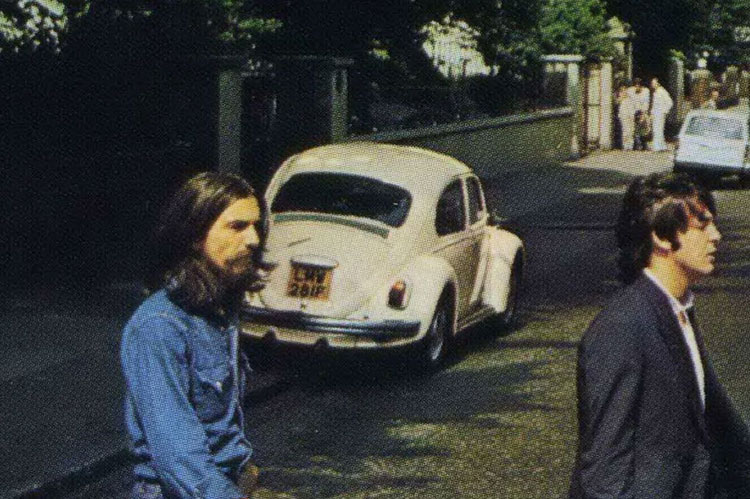
z Abbey-Road-facts-the-beetle-carThe death clues were not confined to the image of the lads in the crosswalk however. For behind the Beatles on the left side of the street is a Volkswagen Beetle with a license plate reading “LMW 28IF”, suggesting that Paul would have been 28 if he were still alive. Actually Paul would have been 27 when Abbey Road was released. This seeming miscalculation was explained away by the rumorists with the fact that Paul studied mysticism in the Near East. Most mystics believe we are all one year old at birth (counting the nine months of pregnancy) confirming that Paul would have been 28 IF he had lived!.” The first three letters on the license place, “LMW,” were interpreted as “Linda McCartney Weeps”. On the right side of the road is a police van, seen as a reference to the cover up of Paul’s death by police.
z IMG_1561-Version-3Perhaps as expected, the clues are not only confined to the front cover, for devoted clueseekers, many hidden secrets can be found on the back cover as well. To the left of the tiles spelling out “Beatles” are eight dots, which when connected form the number “3”, so the back cover actually reads “3 Beatles”. Also, there is a crack in the “S” at the end of “Beatles”. Some say that to the right of the tiles is an odd shadow that looks like a skull.
The woman walking by is supposedly Jane Asher, Paul’s girlfriend at the time of the accident, who was supposedly paid to keep quiet about the whole matter. The rumor also states that if you look at her elbow from a distance, the silhouette of Paul McCartney’s profile appears. The songs themselves of course hold clues to Paul’s demise in the lyrics. In “Come Together” the line “One and one and one is three” hints that there are three Beatles instead of four. And of course, “Golden Slumbers” and “The End” are easily open to macabre interpretation.
As previously stated, although recorded before Abbey Road, the last album the Beatles released was Let It Be. In the track “The Long and Winding Road” on Let It Be, Paul can be heard singing tearfully, as if he knows he is already dead. In the lyrics of the title song, “Let It Be”, Paul’s lyrics allegedly hint that everyone should “let it be” and accept the fact that is he dead once and for all. The mention of “Mother Mary” in the song confirms that Paul is dead, as the Bible indicates the she stands at the gates of heaven beside St. Peter. Lastly, the track “The Long and Winding Road” is said to be a reference to the road that led to Paul’s decapitation.
z letitbe-500x500Finally, on the “Let It Be” cover, the album cover is black. Said to symbolize the end, or death, of the Beatles. Or maybe it was to symbolize the death of a Beatle? The background squares of John, George, and Ringo’s photos are all adorned in white. While Paul’s square is depicted with a blood red background. Also, Paul is shown facing forward rather than in three-quarter profile. Another indication of Paul’s death is seen by the fact that he grew a beard, seen by some religions as a sign of death and mourning. The rest of The Beatles’ beards are clues as well, as they all indicate that the three surviving members are in mourning for their lost bandmate.
z $(KGrHqF,!hcE1iIvgPizBNmqBFT)7!___32
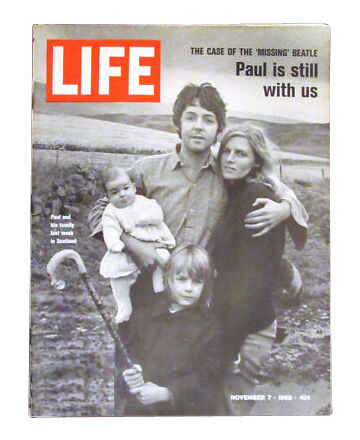
On November 7th, 1969 Life Magazine ran an interview with Paul McCartney at his Scottish farm. Paul spoke about the various “death clues” including the OPD badge on his Pepper suit (which fans took to mean “Officially Pronounced Dead”), his black flower in Magical Mystery Tour, and his barefooted appearance on the Abbey Road album cover. Paul was quoted as saying, “It is all bloody stupid. I picked up that OPD badge in Canada. It was a police badge. Perhaps it means Ontario Police Department or something. I was wearing a black flower because they ran out of red ones. It is John, not me, dressed in black on the cover and inside of Magical Mystery Tour. On Abbey Road we were wearing our ordinary clothes. I was walking barefoot because it was a hot day. The Volkswagen just happened to be parked there.”
Paul continued, “Perhaps the rumor started because I haven’t been much in the press lately. I have done enough press for a lifetime, and I don’t have anything to say these days. I am happy to be with my family and I will work when I work. I was switched on for ten years and I never switched off. Now I am switching off whenever I can. I would rather be a little less famous these days. I would rather do what I began by doing, which is making music. We make good music and we want to go on making good music. But the Beatle thing is over. It has been exploded, partly by what we have done, and partly by other people. We are individuals – all different. John married Yoko, I married Linda. We didn’t marry the same girl. The people who are making up these rumors should look to themselves a little more. There is not enough time in life. They should worry about themselves instead of worrying whether I am dead or not. What I have to say is all in the music. If I want to say anything I write a song. Can you spread it around that I am just an ordinary person and want to live in peace? We have to go now. We have two children at home.”
Ringo dismissed the rumors as “a load of crap.” George never publicly spoke about the PID rumors. John proclaimed, “No. That was bullsh*t, the whole thing was made up.” But Paul had the last word on the rumors of his death. The cover of McCartney’s 1993 album “Paul Is Live” shows him with his dog on the famous Abbey Road crosswalk, obviously poking fun at the rumored funeral procession of nearly a quarter century before. In the background, once again, a Volkswagen Beetle is parked at the side with the license plate reading “51 IS”. Rather than being dead in his twenties, Paul was still alive and making music at age 51.

z tegning
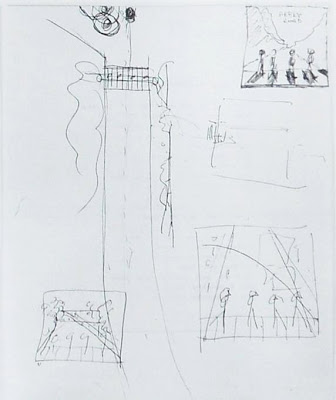
Paul McCartney’s original Abbey Road album cover concept sketch.

As for the Abbey Road cover design, a photograph of The Beatles traversing a zebra crossing; it was based on sketched ideas by McCartney himself. The photo was taken from atop a step-ladder on August 8, 1969 outside EMI Studios on Abbey Road at 11:30 in the morning. Photographer Iain Macmillan was given only ten minutes to take the photo while policeman held up oncoming traffic.
The white Volkswagen Beetle belonged to one of the people living in the block of flats across from the recording studio. After the album was released, the car’s license plate (LMW 281F) was stolen repeatedly by adoring fans. In 1986, the car was sold at auction for $ 3,795.00 and in 2001 the VW Beetle was put on display in a German museum. The man standing on the pavement to the right of the picture is Paul Cole (1911-2008), an American tourist unaware he had been photographed until he saw the album cover months later.
z paul-coleCole, a Florida salesman, was on vacation with his wife, who wanted to go see “yet another museum.” Mr. Cole decided to wait outside on the north London thoroughfare. Cole watched as photographer Iain McMillan stood on a stepladder in the middle of the street, photographing the four Beatles as they walked, single-file, across Abbey Road. The entire shoot lasted 10 minutes. “I just happened to look up, and I saw those guys walking across the street like a line of ducks,” Cole remembered. “A bunch of kooks, I called them, because they were rather radical-looking at that time. You didn’t walk around in London barefoot.”
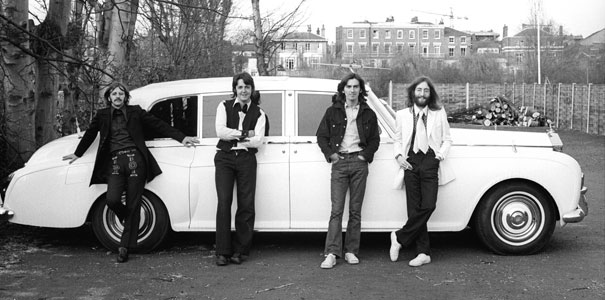
The image of the Beatles on the crossing has become one of the most famous and imitated in recording history. The crossing is a popular destination for Beatles fans and there is a 24-hour-a-day webcam aimed at it. Undoubtedly, in years to come some ghost group or spiritual investigation team will claim to see the ghost of John or George trodding across the stripes once more. As for Sir Paul McCartney, he’ll do his best to delay that walk for as long as he can.

z Beatles_1969_AppleCorpsLtd2009

Music, Pop Culture, The Beatles

Paul is Dead. The rumor revisited. Part III

Part three White Album Poster

Original publish date:  June 22, 2015

Reissue date:  May 2, 2019

Last week, we once again visited the famous “Paul is Dead” rumor that haunted the Beatles rock band for many years. Obviously, the rumor that Paul McCartney died in a November 1966 car accident was just a rumor, to many Beatlemaniacs during the final years of the turbulent sixties decade, it was very real. It had become a national pastime to search for clues to Paul’s death in the music and artwork produced by the band. The albums Sgt. Pepper’s Lonely Hearts Club Band and Magical Mystery tour were allegedly rife with references to Sir Paul’s demise.
The band’s next album, a self-titled work known as “The White Album”, was released on November 22, 1968, prophetically 5-years to the day after the assassination of President John F. Kennedy. The death reference is not overstated, as soon, the “Paul is Dead” theorists would dissect the music and its accompanying poster for further clues of McCartney’s death. The death connection continued as, in time, the album would be blamed for inspiring Charles Manson and his “family” during their murder spree. Much of which was aimed at the music industry itself through the Beach Boys drummer Dennis Wilson and the band’s record producer Terry Melcher. But that’s another story.
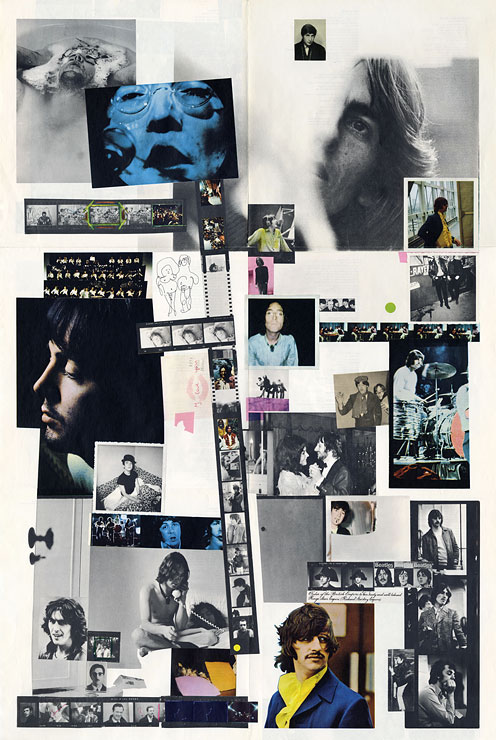
z 316GrhxGleL._SY355_The stark snow white album cover was seen as an obvious reference to the white light of heaven, where Paul was supposed to be at its release. But it was the poster issued inside the white album (a collage featuring a number of random images of the Fab Four) that came under the scrutiny of those looking for “Paul is Dead” clues. In the lower right hand corner of the poster (page 7 of the CD booklet) is a grainy B&W photo of Paul dancing. Upon close examination, a pair of ghostly hands can be seen reaching toward Paul from behind.
In the lower left hand corner of the poster (page 18 of the CD booklet) is a cold war inspired passport photograph of Paul in disguise. Conspiracy theorists suggested that this image was actually of Paul’s replacement in the band, William Campbell Shears, taken prior to the plastic surgery that made him look more the “the late” Paul McCartney.
In the upper left hand corner of the poster (page 3 of the CD booklet) is a picture of Paul with his head partially submerged in a bathtub. The position of Paul’s head and the suds around him suggest the grisly accident scene of his fatal accident or perhaps the aftermath in the morgue. One version of the “Paul is dead” story claims that Paul left the recording studio after arguing with drummer Ringo Starr. In his song “Don’t Pass Me By”, Ringo is said to express his regret at the tragic turn of events after Paul’s angry departure from the studio: “I listen for your footsteps coming up the drive…I listen for your footsteps but they don’t arrive.” At the end of “While My Guitar Gently Weeps”, George Harrison is thought to moan the words “Paul, Paul”.
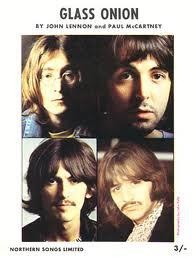
z beatles goThe song “Glass Onion” makes a number of references to Beatle songs and events. John mentions “The Fool on the Hill” and states, “I tell you man he living there still” thought by some to symbolize heaven. However, perhaps the most intriguing line in the song is “Well here’s another clue for you all…The walrus was Paul.” Seen as a final bow to his fallen bandmate and co-songwriter. Some sources have suggested that the phrase “goo goo g’joob” is from Finnegans Wake by James Joyce (Alas, the phrase “googoo goosth” is the closest Joyce gets in th book.) Never fear, the “Paul is Dead” rumorists claim that “goo goo g’joob” are the last words uttered by Humpty Dumpty before his fall. A fall that cracked his head open, much like Paul’s supposed fatal car accident.
Further proof is said to be found in the odd conclusion to “Cry Baby Cry” as Paul asks “Can you take me where I came from? Can you take me back?” Not necessarily as much for what those lines are supposed to mean, but rather that the song leads into “Revolution 9”, the most analyzed of all “White album” tracks by “Paul is Dead” clue seekers.
z revolution 9 singleRevolution 9 was an innovative sound collage that, quite frankly, soared over most listener‘s heads. Later transcripts of the dialog heard early in the song reveals two men who can be heard saying “I know all about it George. I’m sorry. Will you forgive me? Yes.” Theorists claimed that this was John talking with George Martin about the secret placement of clues on Beatles records. However, the biggest clue to Paul’s death on the track is the title itself, whose repeated phrase “Number 9” is said to sound like “turn me on, dead man” when played backwards. A dark recall to the line “I’d love to turn you on” from “A Day in the Life”.
The sound collage of “Revolution 9” is said to contain a recreation of Paul’s fatal car accident. At one point listeners hear car horns, followed by a car crash, and concluding with the crackling sounds of a fire burning. When played backwards theorists claim the statement “Let me out! There were two. There are none now.” can be plainly heard. Most astonishingly, “Paul id Dead” devotees swear that, when played normally, the following disjointed lines can be heard throughout the song: “he hit a pole. We better get him to see a surgeon. So anyhow he went to a dentist instead. They gave him a pair of teeth that weren’t any good at all…So my wings are broken and so is my hair… I’m not in the mood for words… Find the night watchman… A fine natural imbalance… He must have got it in the shoulder blades… Take this brother, may it serve you well…” The final line marking Paul’s passing of the torch to his replacement William Campbell Shears.
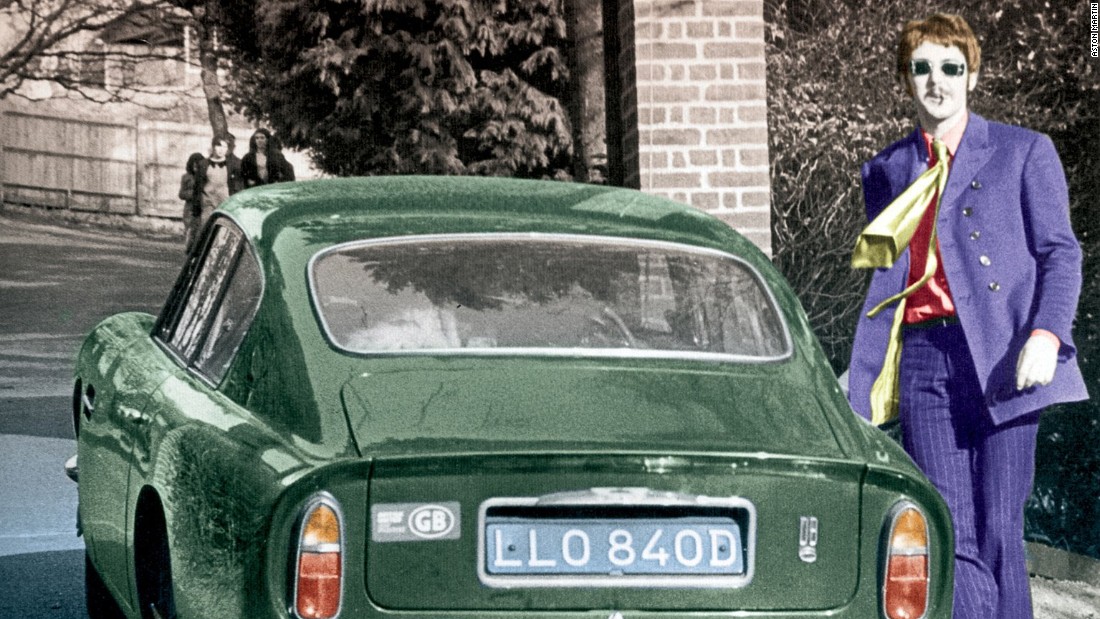
z 150422235054-paul-mccartney-car-1100x619Ardent believers believed that other “Backwards” clues could be found on the track “I’m so tired / Blackbird” when some random mumbling is heard that they believe sounds like John and Yoko right after the abrupt ending of “I’m So Tired” and before the beginning of the next song, “Blackbird“. This passage makes no sense when played forwards. However, when played backwards, they believe that you can hear John say, “Paul is a dead man. Miss him. Miss him. MISS HIM!” John Lennon was said to be expressing his grief over Paul’s death in this line of the song followed by the very next line on the record, sung by Paul, “Blackbird singing in the dead of night”, that mentions death.
Ten months later, on September 17, 1969, an article titled “Is Beatle Paul McCartney Dead?” was published in the student newspaper of Iowa’s Drake University. Soon, the “Paul is Dead” story went viral. Almost immediately, other articles followed claiming that clues to McCartney’s death could be found among the lyrics and album covers of The Beatles’ recordings. Clue hunting proved infectious and for a couple of months in late 1969 it became an international phenomenon. Just in time for the Beatles’ next album, Abbey Road. Guess what? The clues continued and soon, Paul McCartney himself would finally be heard from.