Christmas, Hollywood, Music, Pop Culture, The Beatles

21 Top Grossing Songs of All Time.

Original Publish Date September 21, 2023.

https://weeklyview.net/2023/09/21/21-top-grossing-songs-of-all-time/
So, I’m down in Florida celebrating my 34th wedding anniversary with my bride, Rhonda, who is still the prettiest girl I’ve ever seen. Down here, I’m a thousand miles away from cutting the lawn, watering the flowers, and a honey-do list as long as my arm. So what better time to write about music? I wondered what a list of the top twenty-one money-making songs of all time would look like. Not best-selling albums. Not best-selling song catalogs. Not even best-selling singles. Rather, what songs have made the most money? So, here’s a list for you to ponder. There will be obvious titles, obscure titles, and some surprises, and by the end, I’ll throw some sand in the Vaseline. Only then will you understand what put the thought in my mind.
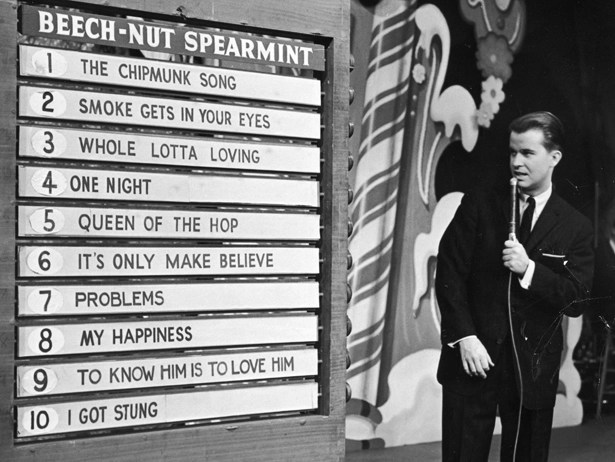
Dick Clark counting down American Bandstand hits August 5, 1957.

Many songs have made over $10 million including The Village People “YMCA,” Gene Autry’s “Rudolph the Red-Nosed Reindeer,” The Beatles “I Want to Hold Your Hand,” and, should you consult that black hole that is the Internet, names like Taylor Swift, Justin Bieber, Ed Sheehan, and a liturgy of mysterious electronic dance will muddy the issue. But for the purposes of this article, I have consulted more reputable sources for the numbers: Billboard, Music Grotto, Rolling Stone, and the Guinness Book of World Records.
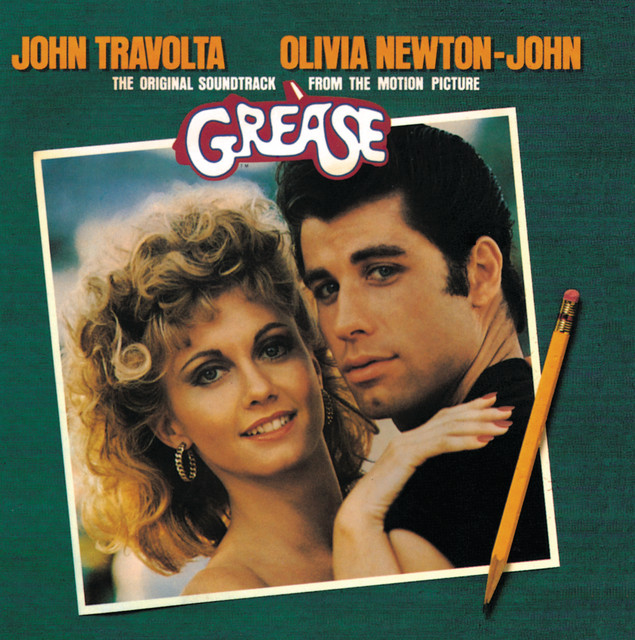
Number 21: “You’re The One That I Want,” by John Travolta and Olivia Newton-John from the 1978 film Grease. Estimated earnings: $15 million. The song featuring Travolta’s greaser Danny Zuko and Olivia’s good girl temporarily gone bad, Sandy Dombrowski, propelled the film into one of the highest-grossing musical films of all time and the soundtrack became a worldwide hit. Fun fact, Richard Gere and Barry Bostwick portrayed the Travolta character on Broadway in 1972/1973.
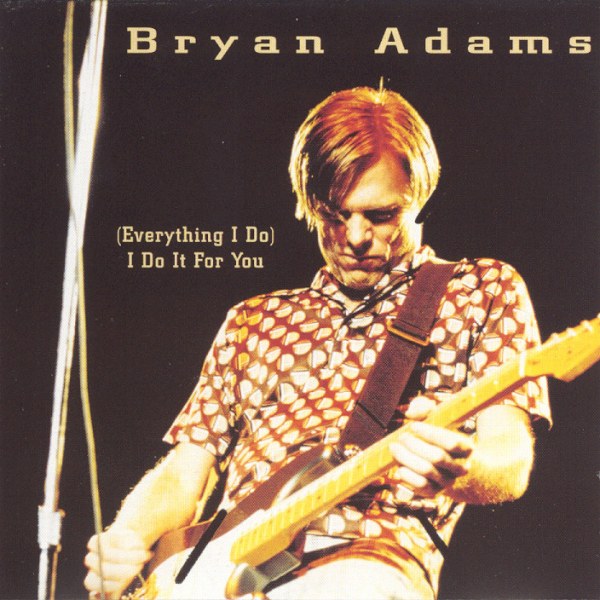
Number 20: “(Everything I Do) I Do It For You” by Bryan Adams (1991). Estimated earnings: $15 million. The song appeared on the soundtrack for the film Robin Hood: Prince of Thieves and on the Canadian singer’s sixth studio album, Waking Up the Neighbours.
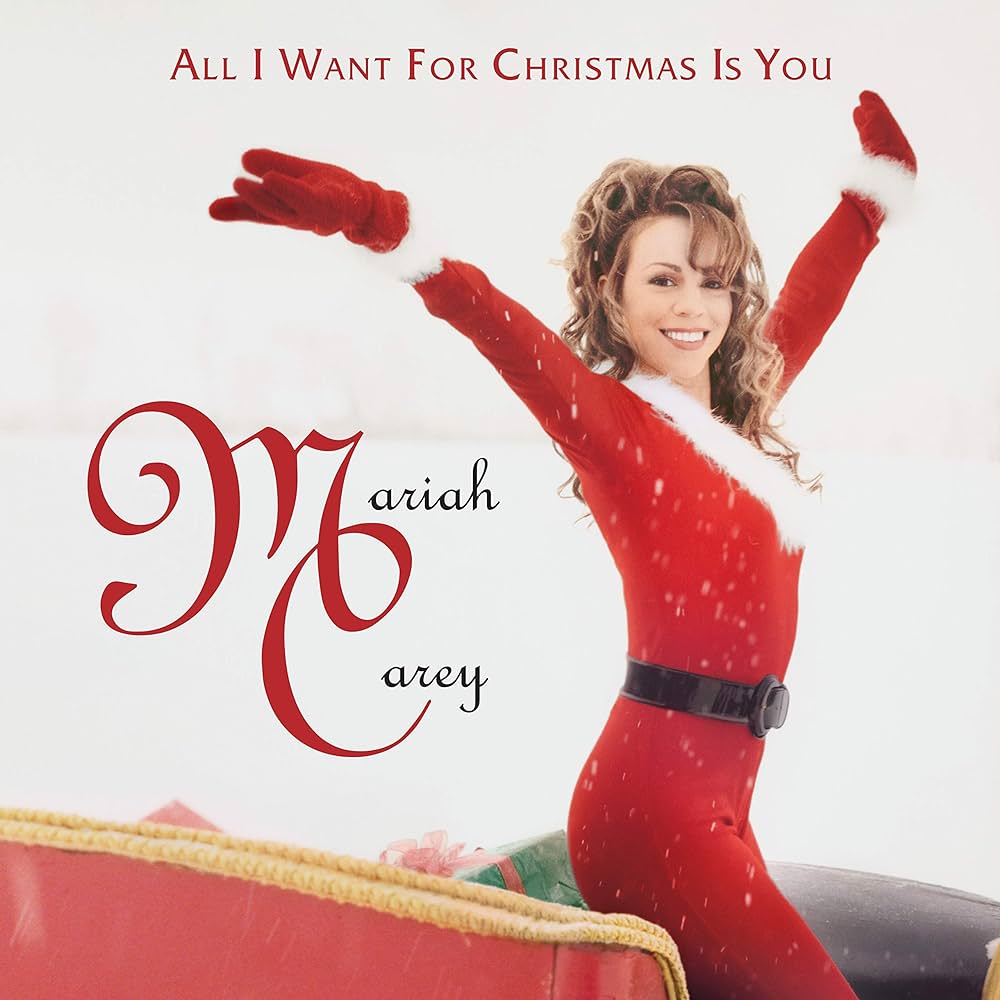
Number 19: “All I Want For Christmas Is You” by Mariah Carey (1994). Estimated earnings: $16 million. This holiday standard (or earworm depending on your point of view) is the most loved and hated song on the list by a longshot. Every holiday season it returns to the number one spot on the Billboard charts, much to the dismay of seasonal retail workers. Love it or hate it, you gotta give Mariah a tip of the cap for her skimpy Santa suit: an homage to Ronnie Spector and the Ronettes.
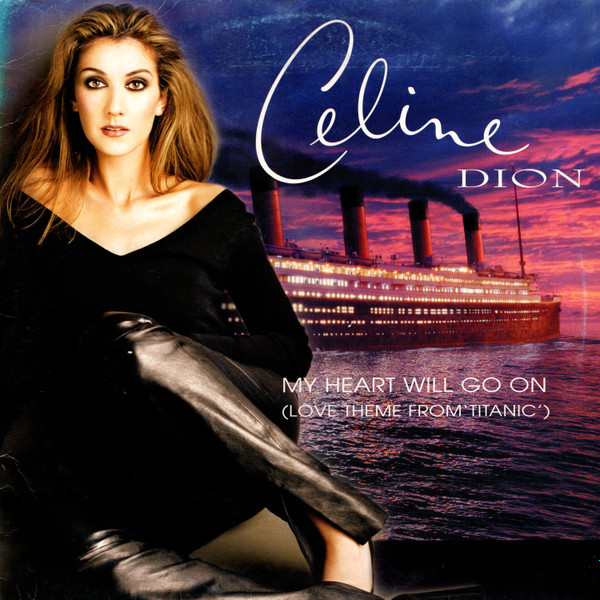
Number 18: “My Heart Will Go On” by Céline Dion (1997). Estimated earnings: $18 million. Better known as the theme song for the film Titanic, it has become Dion’s signature song and is the second-best-selling single by a woman in music history.
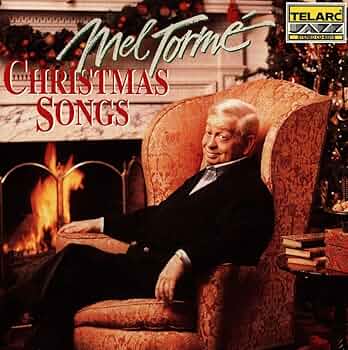
Number 17: “The Christmas Song” by Mel Torme (1944). Estimated earnings: $19 million. While the title may not ring a bell, when you hear Torme (a.k.a. “The Velvet Fog”) croon “chestnuts roasting on an open fire,” you know what time it is. The song is ironic in a couple of different ways. First Torme is Jewish. Second, Torme wrote the Christmas song “Jack Frost Nipping at Your Nose” in 45 minutes on a blistering hot California day.
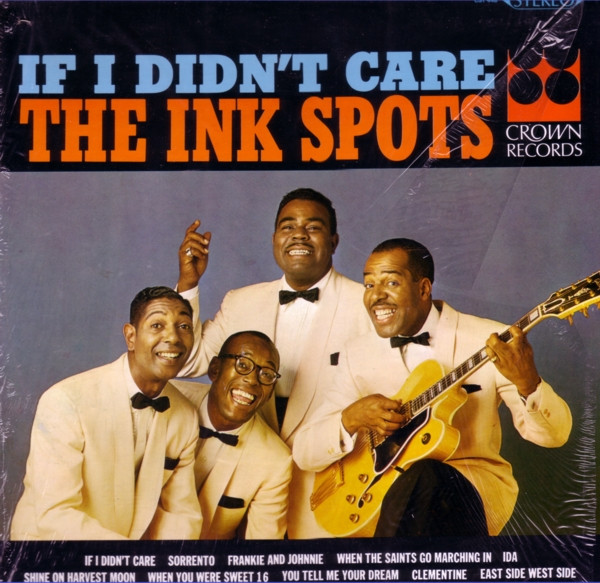
Number 16: “If I Didn’t Care” by The Ink Spots (1939). Estimated earnings: $19.75 million. The Ink Spots were one of the first all-black bands to be widely accepted in both the white and black communities. The group traces its origin to Indianapolis and in 1989 they were inducted into the Rock ‘n Roll Hall of Fame.
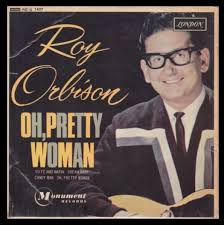
Number 15: “Oh Pretty Woman” by Roy Orbison and Bill Dees (1964). Estimated earnings: $19.75 million. Most movies form the song but this song formed the movie. The song was released as a single in August 1964 and the movie didn’t come along until 1980. The Richard Gere and Julia Roberts movie was originally intended to be a dark cautionary tale about class and prostitution in Los Angeles but the film was re-imagined as a romantic comedy and was mostly shot at Walt Disney studios. As for Orbison’s original song? It was inspired when his wife, Claudette, interrupted a conversation to announce she was going out. When Orbison asked if she had enough cash, his co-writer Bill Dees interjected, “A pretty woman never needs any money.”
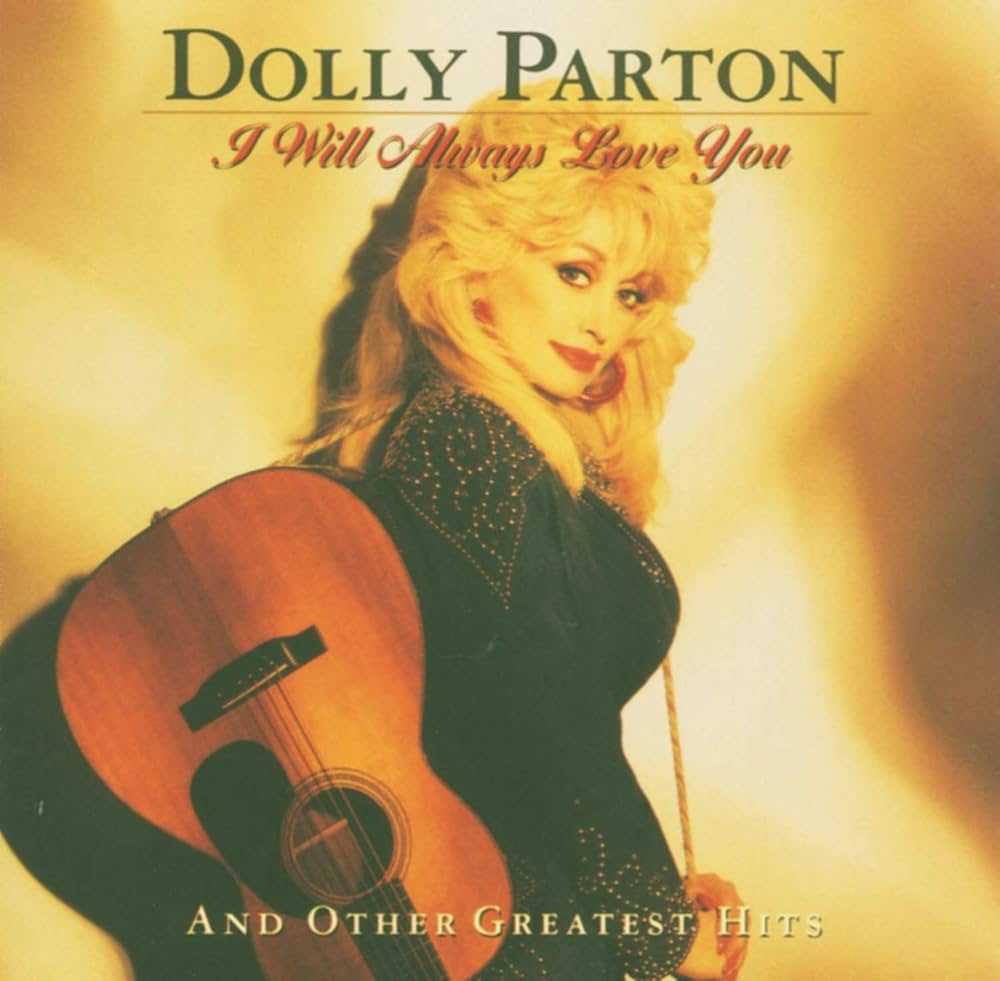
Number 14: “I Will Always Love You” by Dolly Parton (1972). Estimated earnings: $20.5 million. Dolly wrote the song to honor her early mentor, Porter Wagoner. The song helped Dolly win CMA’s Female Vocalist of the Year in 1975 but had its biggest impact in 1992 when Whitney Houston covered it for her 1992 movie, The Bodyguard. Houston’s version is the best-selling single by a woman in music history. The song has earned Dolly over $10 million which she famously donated to charities serving black communities. 
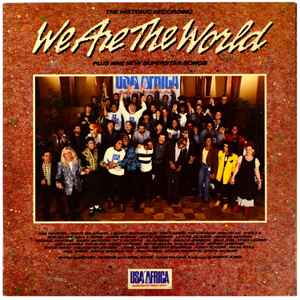
Number 13: “We Are The World” by USA For Africa (1985). Estimated earnings: $20.5 million. This charity single was written by Michael Jackson and Lionel Richie. The song featured some of the biggest musicians of the time, including Stevie Wonder, Billy Joel, Paul Simon, Kenny Rogers, Tina Turner, Diana Ross, Willie Nelson, Bruce Springsteen, Kenny Loggins, Steve Perry, Daryl Hall, Huey Lewis, Cyndi Lauper, Ray Charles, and Bob Dylan (who, when chastised by Producer Quincy Jones for singing “off-key”, responded, “That’s my style, man.”) .The chorus was equally notable: Dan Aykroyd, Harry Belafonte, Lindsey Buckingham, Sheila E., Waylon Jennings, Bette Midler, Smokey Robinson, the Pointer Sisters, and the other 4 members of the Jackson Five. The album raised a whopping $63 million in relief funds.
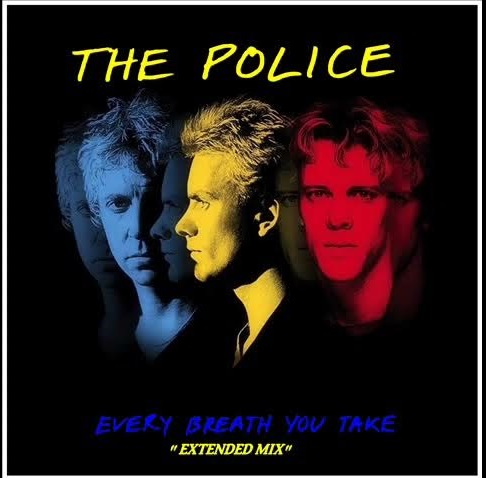
Number 12: “Every Breath You Take” by Sting (1983). Estimated earnings: $20.5 million. Although officially a song by The Police, it has become Sting’s signature song and was, for many years, a popular wedding song until it was revealed to be about a stalker with an unhealthy obsession. In 2010, Sting’s former business manager claimed that the song “is responsible for more than 1/4 of all the singer’s lifetime publishing income and today still produces $2,000 a day ($730,000 per year) in royalties income for Sting.” The songwriting for “Every Breath You Take” is credited 100% to Sting (AKA Gordon Sumner).
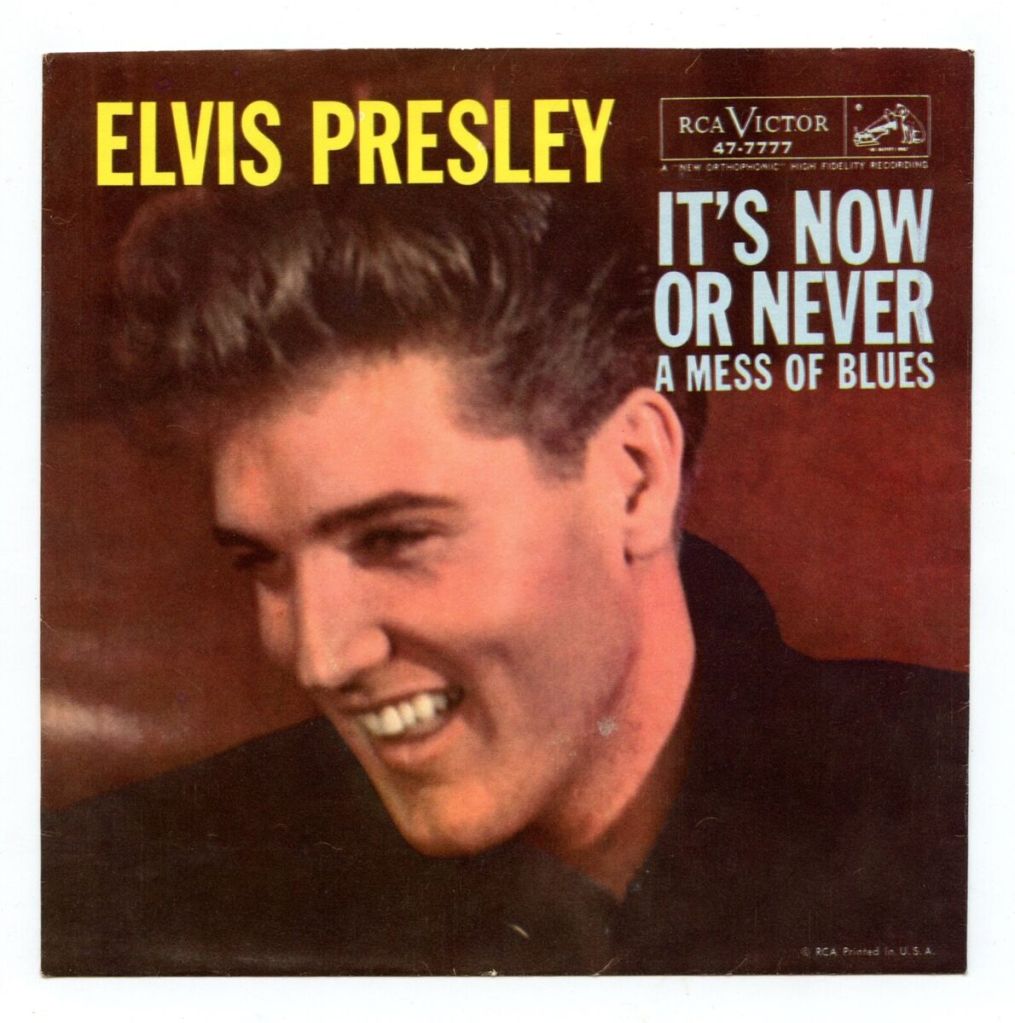
Number 11: “It’s Now Or Never” by Elvis Presley (1960). Estimated earnings: $22 million. I know, I know, why THIS Elvis song in particular? Elvis had so many great ones. When Presley wrote the song, he was serving in the military, stationed in Germany. When he returned to the States after his stint, “Now or Never” became one of his first releases, so fans raided the record stores by the millions in search of it.
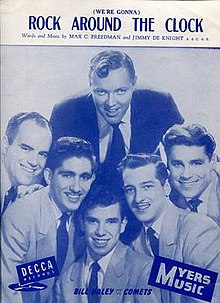
Number 10: “Rock Around The Clock” by Bill Haley & His Comets (1954). Estimated earnings: $25 million. Most of us remember it as the theme song for the Happy Days TV show, “Rock Around the Clock” was one of the earliest successful mainstream records of the rock ‘n roll era. It was the first rock and roll record to hit number one on the U.S. pop charts. Here’s a mind-bender for you: “Rock Around The Clock” was written to the tune of Hank Williams’ “Move It On Over.”

Number 9: “Santa Claus Is Coming To Town” by Haven Gillespie And Fred J. Coots (1934).  Estimated earnings: $27 million. Another head-scratcher, but as they say, timing is everything. Although the original artist who recorded it is long forgotten (Harry Reser and His Band), in November 1934 when it was covered by Eddie Cantor on his radio show, within 24 hours, 500,000 copies of sheet music and more than 30,000 records were sold and it just kept selling. The song has been recorded by over 200 artists including Bing Crosby, Neil Diamond, Fred Astaire, Bruce Springsteen, Mariah Carey, Frank Sinatra, the Temptations, the Carpenters, and the Jackson 5.
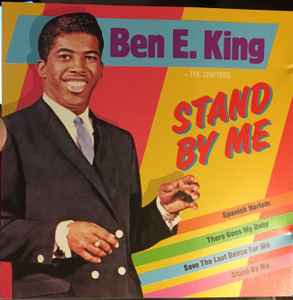
Number 8: “Stand By Me” by Ben E. King, Jerry Leiber, and Mike Stoller (1961).  Estimated earnings: $27 million. According to King, the title was inspired by a spiritual written by Sam Cooke and J. W. Alexander called “Stand by Me Father.” “Stand By Me” was successful on its own, but it shot to prominence when it was used in the Stephen King blockbuster movie of the same name twenty years later and found itself at the top of the charts in 1986. In March of 1974, John Lennon recorded two takes of the song with former Beatles bandmate Paul McCartney on the drums and Lennon on guitar. The unreleased recordings would eventually be included in a bootleg album A Toot and a Snore in ‘74.
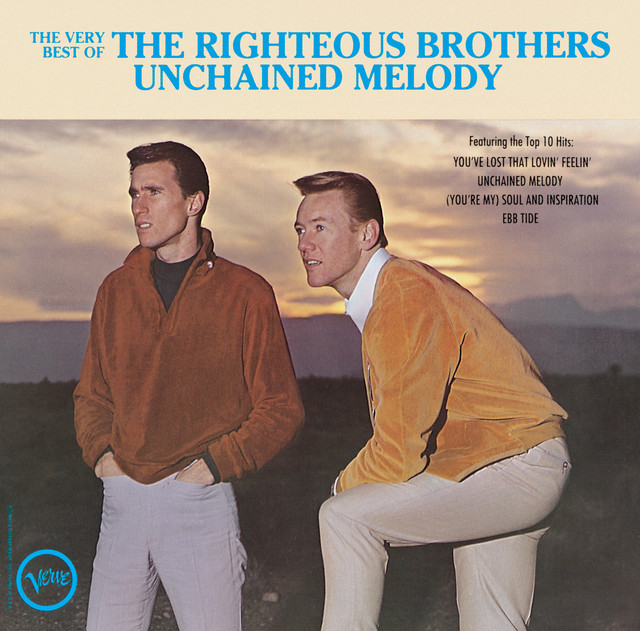
Number 7: “Unchained Melody” by Alex North And Hy Zaret (1955). Estimated earnings: $27.5 million. The song was written for a movie, Unchained, which was not a success and is remembered ONLY for starring football Hall of Famer Elroy “Crazylegs” Hirsch, Perry Mason’s Barabara Hale and Dick Van Dyke’s dentist neighbor Jerry Paris. However, the song would go on to be one of the most covered songs in recorded history; more than 650 artists at last count. The 1965 version by the Righteous Brothers is the most famous version, but the song re-emerged after it was used in the 1990 Oscar-winning movie Ghost starring Demi Moore and Patrick Swayze.
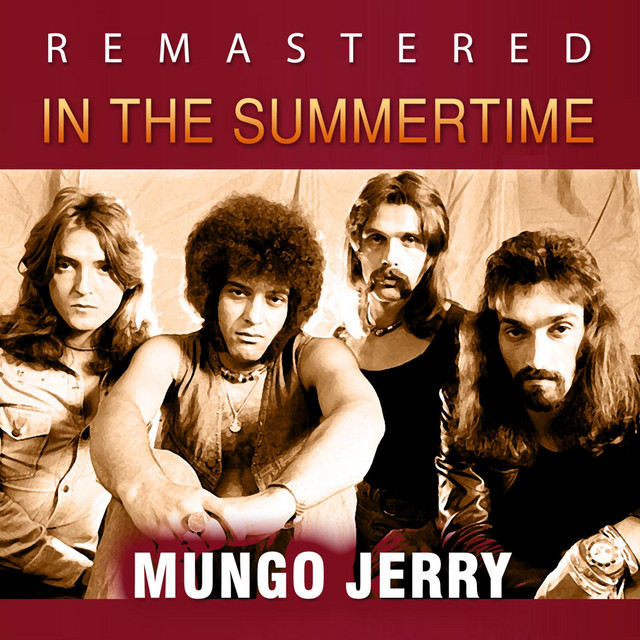
Number 6: “In The Summertime” by Mungo Jerry (1970). Estimated earnings: $30 million. I guess we should think of this as the seasonal song for summer. Just like Christmas, summer comes around every year. Impressive when you consider it was Mungo Jerry’s debut single and that lead singer Ray Dorset said it only took him 10 minutes to write. Dorset later recalled writing it “on a second-hand Fender Stratocaster while I was on break from my day job, working in a lab for Timex.” Initially, the song was only two minutes long; to make it longer, the sound of a motorcycle was added in the middle. But they didn’t have a motorcycle, so “the engineer had a Triumph sports car, which he drove past the studio microphone. So he got the stereo effects from left to right or right to left, whatever. And that was it.” That scene is made even more comical when you watch the music video for the song (one of the earliest such videos you’re likely to find) and see one of the musicians pretend to create the sound by blowing into a water jug.
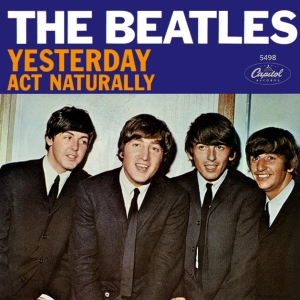
Number 5: “Yesterday” by John Lennon and Paul McCartney (1965). Estimated earnings: $30 million. Although Paul McCartney was 100% responsible for the writing and singing of the song, the songwriting credit goes to both men. From the start the duo agreed to share equal credit for their songs, no matter how much either of them contributed to the song. “Yesterday” would become the second-most-played song in the history of radio. It has been covered by more than 2200 different artists. Yoko Ono, John Lennon’s sole heir, has received millions in royalties from the song. BMI asserts that it was performed over seven million times in the 20th century.
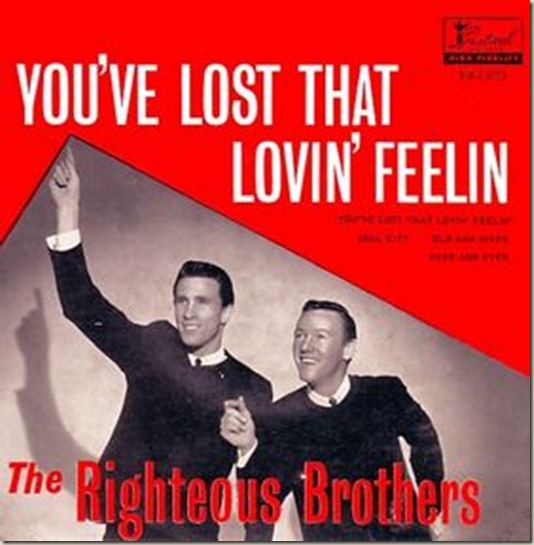
Number 4: “You’ve Lost That Feeling” by Barry Mann, Cynthia Weil, and Phil Spector (1964). Estimated earnings: $32 million. Notable as the ONLY song to crack the top 21 that was written by a convicted murderer: Phil Spector. Ironically, Spector’s sole contribution to the songwriting was the line, “and he is gone, gone, gone, Whoa, whoa, whoa.” This Spector-produced song is cited by music critics as the ultimate example of his Wall of Sound recording technique. The song became a massive hit after it was recorded by The Righteous Brothers but resurfaced in a big way in 1986 after it was included in the soundtrack for Top Gun, starring Tom Cruise. The song has been covered by over 2200 different artists and went on to become one of the most-played songs in radio history.
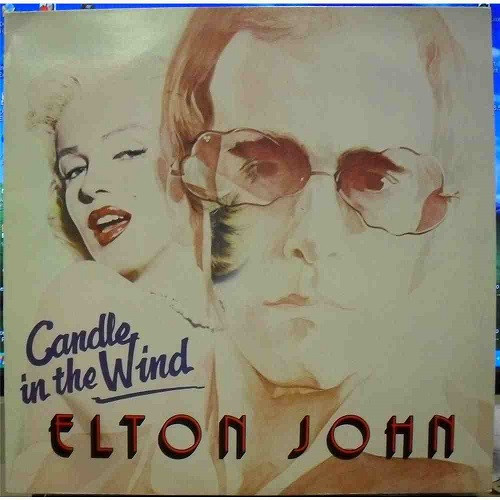
Number 3: “Candle In The Wind” by Elton John and Bernie Taupin (1973). Estimated earnings: $32 million. The song was originally written about the death of Marilyn Monroe, but, in 1997, Elton did a rewrite as a memorial for his close friend Princess Diana. The rewritten version had greater success than the original version. During a concert on April 7, 1990, at Farm Aid IV, Elton dedicated the song to Cicero, Indiana AIDS patient Ryan White, who died of AIDS complications the next day.
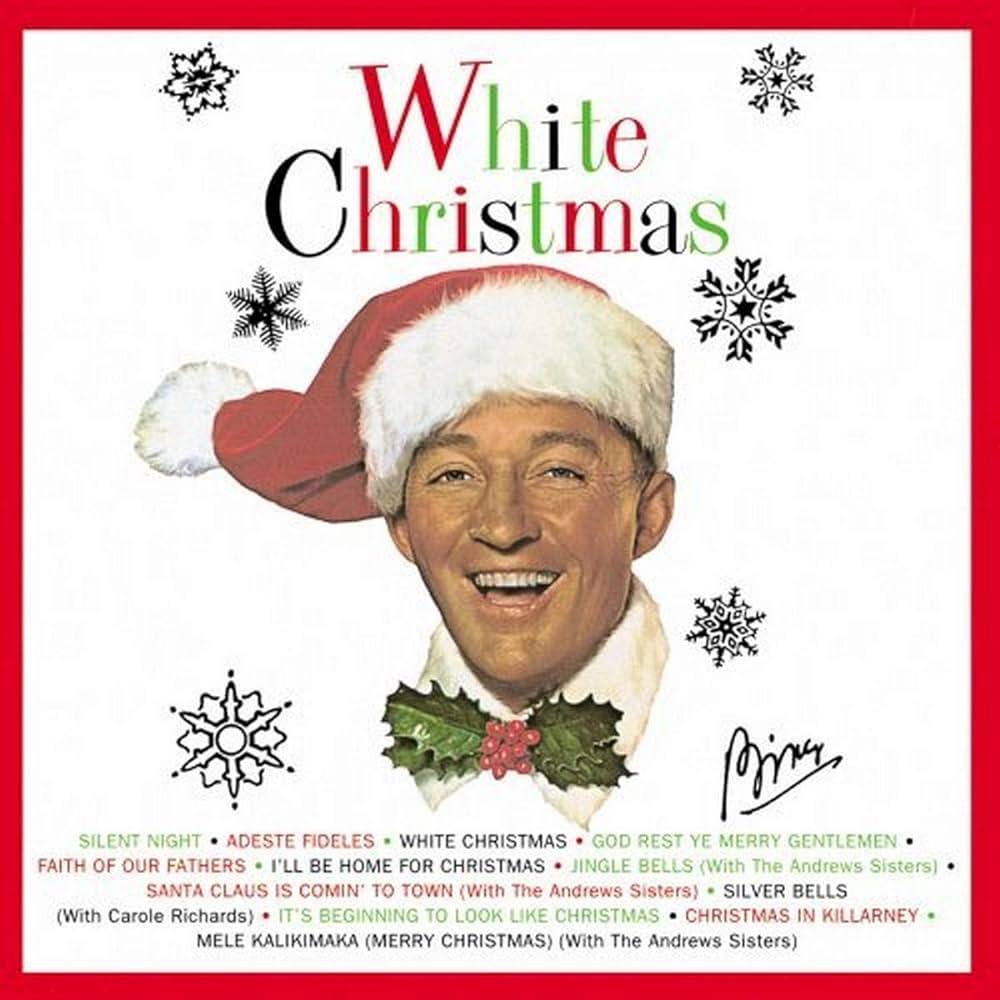
Number 2: “White Christmas” by Irving Berlin (1940). Estimated earnings: $36 million. Ironically, this standard of all Christmas songs was written by a Jewish immigrant from Russia: Irving Berlin. Though the song has been covered by countless artists, the most famous version will always be Bing Crosby’s version which sold over 100 million copies worldwide. According to Crosby’s nephew, Howard Crosby, “I once asked Uncle Bing about the most difficult thing he ever had to do during his entertainment career…He said in December 1944, he was in an outdoor USO show in northern France… he had to stand there and sing ‘White Christmas’ with 100,000 G.I.s in tears without breaking down himself. Of course, a lot of those boys were killed in the Battle of the Bulge a few days later.” Think of that the next time you hear this song.
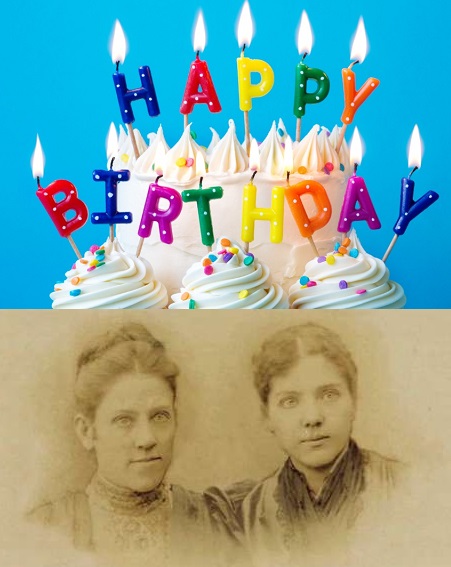
Mildred (left) and Patty (right) Hill.

Number 1: “Happy Birthday” by The Hill Sisters (1893). Estimated earnings: $50 million. The ONLY song on the list that has been sung by every generation of your family you ever knew. You know the song, but do you know the story? Mildred Jane Hill was a musicologist from Louisville, Kentucky. Born two years before the start of the Civil War in 1859, Mildred studied music, teaching, composing, and performing, specializing in the study of Negro spirituals. Hill and her sister Patty were honored at the 1893 Chicago World’s Fair for their work in the progressive education program at the experimental Louisville Experimental Kindergarten School. Her progressive 1892 article, “Negro Music,” suggested that the existing body of black music would be the basis of a distinctive American musical style in the years to come. In 1893, the Hill sisters found themselves in need of a song for their kindergarten class to sing on birthdays. 130 years later, we are still singing the Hill sisters song. Today, “Happy Birthday” brings in a reported $5,000 a day, and $2 million a year in royalties. The cost of using the song in a movie or on TV is $25,000. It is actually against the law to sing “Happy Birthday” in a large group of unrelated people, but good luck trying to enforce that one.
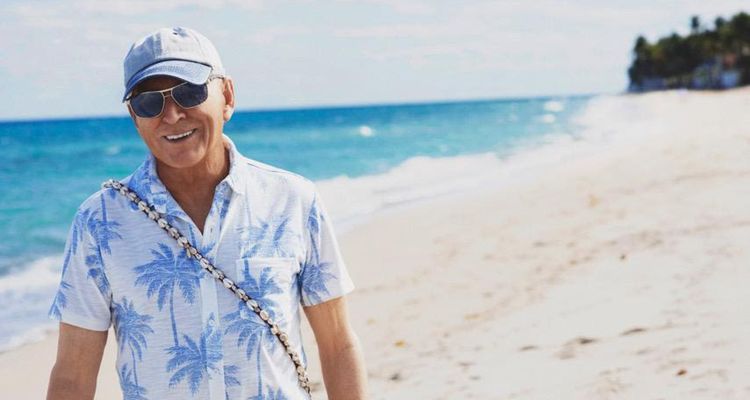
Jimmy Buffett.

There you have it. Those numbers will change in the years to come. No doubt, by scanning the list, you have deduced that all it takes for a song to make (or jump up on) the list is for a movie or TV show to pick it up as a theme song. But, as I told you earlier, I am in Florida as I write this, and for that reason, I would like to submit a song that is not on anyone’s list. Governor DeSantis of Florida has ordered that flags be lowered to half-staff from Thursday, Sept. 7, to Friday, Sept. 8th to commemorate the ‘life and legacy’ of Jimmy Buffett, the “Margaritaville” singer who died on Sept. 1st.

Buffet’s 1977 “Margaritaville” song was on his album Changes in Latitudes, Changes in Attitudes. Buffet claimed that the lyrics were taken directly from a bad day at the beach and that he really lost a flip-flop, stepped on a pop top, and cut his heel on the way back home. And, oh yes, he lost his salt shaker that day too. The song has a “lost verse” which he sometimes added when performing in concert but was cut from the original song. “Old men in tank tops, Cruisin’ the gift shops, Checkin’ out chiquitas, down by the shore. They dream about weight loss, Wish they could be their own boss, Those three-day vacations can become such a bore.” Although Buffet’s Margaritaville earned him millions, by itself, it never could have cracked the top 21.
However, Buffet’s song about life in this euphoric place has morphed into a global brand that has earned more than $4.8 billion and sees $1.5 billion in annual sales. Buffet’s Margaritaville Holdings company began in 1985 with the opening of a string of Margaritaville-themed stores and restaurants, the first of which was a store in Key West, Florida, that was followed in 1987 with the first Margaritaville Café nearby. Over the course of the next two decades, several more of each opened throughout Florida, New Orleans, and California.  In 2002, Buffet partnered with Outback Steakhouse to develop the first Cheeseburger in Paradise Restaurant in Southport, Indiana. Margaritaville resorts by Wyndham have sprouted up all over the place and most recently, a plan to develop Latitude Margaritaville: new active adult communities for those “55 and better.” At the time of his death, Buffet had amassed a personal fortune of $1 billion. That’s BILLION with a “B”, a figure that cannot be surpassed, even if you added all of the top 21 together. Apparently, Margaritaville was a pretty good place to be.
Disney, Music, Pop Culture, The Beatles

The Beatles Hit the Brakes at Walt Disney World.

Original Publish Date: December 19, 2024. https://weeklyview.net/2024/12/19/the-beatles-hit-the-brakes-at-walt-disney-world/

Quick, who broke up The Beatles? Which one of the Fab Four was the first to quit the group? And who was the last Beatle standing? Throw away all you thought you knew about the breakup of The Beatles and settle in for a Beatles Christmas story like you have never heard before. This Beatles breakup story involves John Lennon’s famous “Lost Weekend”, the Sopranos, Al Capone, and Mickey Mouse.


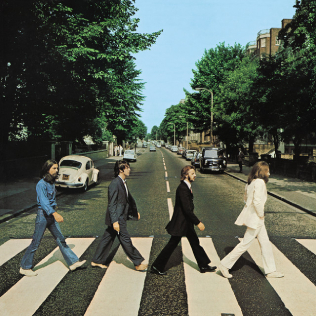
On August 20, 1969, The Beatles met for the last time at Abbey Road Studios to record what was to be the last song on their last studio album: The End. The song, which features the only song Ringo performed a drum solo on, was initially intended to be the final track on Abbey Road, but it ended up being followed by “Her Majesty” a brief tongue-in-cheek music hall song. “Her Majesty” appears 14 seconds after the The End, but was not listed on the original sleeve. Paul McCartney is the only musician to appear on the track. Some observers consider it the first example of a hidden track. The song credited to the “Lennon-McCartney” songwriting partnership brought forth a rare compliment from Lennon when he credited Paul with the line, ‘And in the end, the love you take is equal to the love you make.’ The ever-increasing acerbic Lennon offered a back-handed compliment to his songwriting partner by saying, “it is a very cosmic, philosophical line. Which again proves that if he wants to, he can think.” Thus, The End stands as the last known new recording involving all four of the Beatles during the band’s existence. And before you say it, the album Let It Be, was recorded in January 1970 ON TOP of Abbey Road Studios, NOT inside of it.

The final gathering of all four Beatles came two days later at a photo session held at John Lennon’s Tittenhurst estate. On September 20th, Lennon privately informed his bandmates at a meeting at Apple, without George Harrison present, that he was leaving the Beatles. However, it was unclear to the other members whether John just wanted a break or if his departure was permanent. Legend has it that John Lennon walked out of that 1969 meeting at Apple headquarters screaming “I want a divorce” and four years later, he would get his wish at the “Happiest Place On Earth”. Meantime, on April 10, 1970, McCartney settled the issue in a press release declaring, “I’m quitting The Beatles.” It would take another four years for the breakup to be formalized.

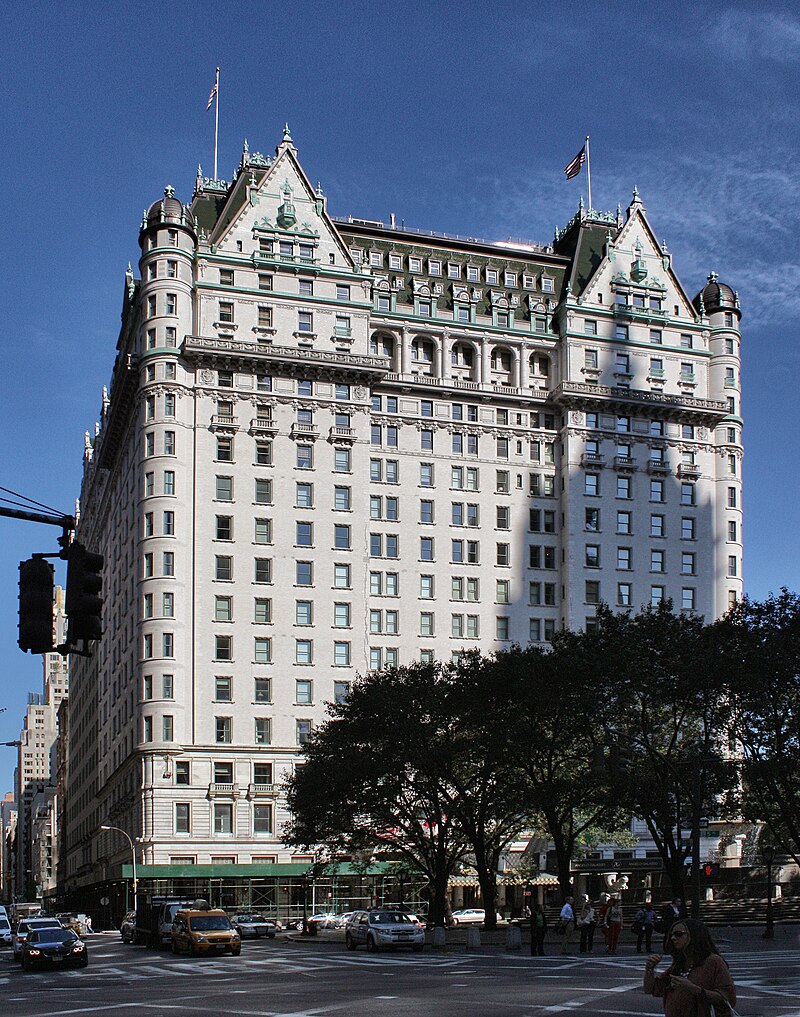
The Plaza Hotel in Manhattan, New York City.

After three years of court battles and ever-increasing acrimony amongst the Fab Four, the final dissolution of The Beatles was set to happen. The meeting was scheduled for December 19, 1974. Ironically it to happened at New York’s Plaza Hotel, the first place The Beatles stayed in America a decade before. As it happened, George Harrison was at Madison Square for two nights on his Dark Horse tour and Paul and Linda McCartney flew in for the signing. Ringo had already signed the documents in England. So, as George, and Paul sat around a large table ready to dissolve the partnership alongside Apple lawyers and business managers, Ringo listened in on the telephone to confirm that he was alive. Everyone present was wondering where John was. Keep in mind, Lennon lived within walking distance of the Plaza Hotel. George Harrison’s lawyer telephoned Lennon for an explanation. May Pang answered and from the background, John’s voice bellowed out, “The stars aren’t right,” to the lawyer’s query. When John’s response came across the speakerphone, everyone present was furious. John explained that he was going to follow his astrological signs and he wasn’t coming to the meeting.

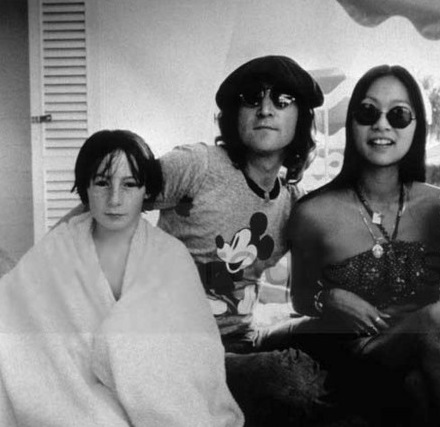
Julian & John Lennon with May Pang.

Instead, John decided that he wanted to give his 11-year-old son Julian a special Christmas holiday by taking him someplace warm. Mobster Mo Levy offered to have John, May, and Julian stay at his Palm Beach Florida condominium, not far from the former mansion of gangster Al Capone. So, Levy grabbed his son Adam and together with the wayward Beatle brood, they all flew down to Levy’s West Palm Beach estate to spend Christmas in the sunny shores of Florida. Wait, you say, where was Yoko? Well, John Lennon was in the midst of his self-described Long Weekend “sowing his oats” with May Pang, Yoko Ono’s assistant and the couple’s production coordinator. In mid-1973, while Lennon was busy working on his classic Mind Games album John and Yoko were having marital problems. Ono suggested to Pang that she become Lennon’s companion, and with Yoko’s permission, John and May began a relationship that lasted more than 18 months.

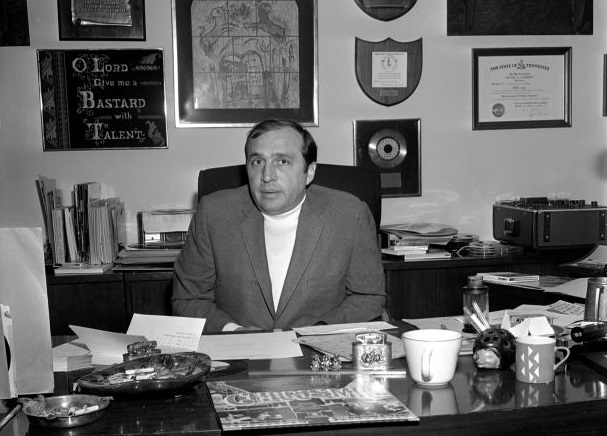
Morris Levy in his office at Roulette Records.

And that private jet-owning mobster, who was that guy? His name was Morris Levy, a music executive from Harlem with alleged mob ties to Vincent Gigante, boss of the Genovese crime family. “Moishe” or “Mo” as friends and associates called him, was known to sign up-and-coming artists to lop-sided contracts that often left the artists owing him money for touring expenses and studio time. Mo Levy would often sign his name to contracts as a song’s co-writer without the artist’s consent. Robbie Robertson of The Band was reportedly one of his victims and a witness to Mo’s henchmen holding a fellow performer by his ankles out the window of Levy’s Park Avenue apartment to get his point across. Levy, who died in 1990, was the inspiration for the HBO television series The Sopranos (1999–2007) character Hesh Rabkin, Tony Soprano’s friend who made a fortune defrauding performers, underpaying royalties, and pressing unauthorized records. Tommy James, Frankie Lymon, and Tito Puente were among his most prominent victims.

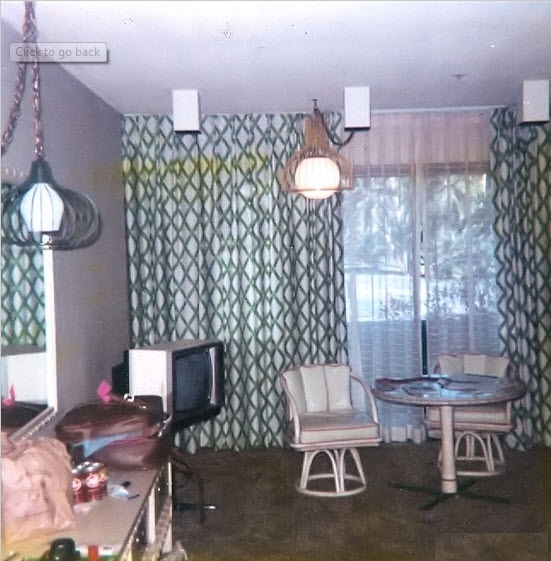
Once in South Florida, they spent their time walking on the beach, lounging by the pool and amusing themselves by throwing firecrackers at palm trees. The pinnacle of the trip came when the Lennon trio spent a day at Disney World. There one of the most famous men in the world went mostly unrecognized. At that time Disney’s Magic Kingdom was only one park on the property. They stayed at the Polynesian Hotel. To get from the Polynesian (both then and today) to the Magic Kingdom, the easiest way to travel is by Monorail. The train stops inside the hotel so guests do not have to venture outside the building. Making the Polynesian the obvious choice for John and his crew to stay.

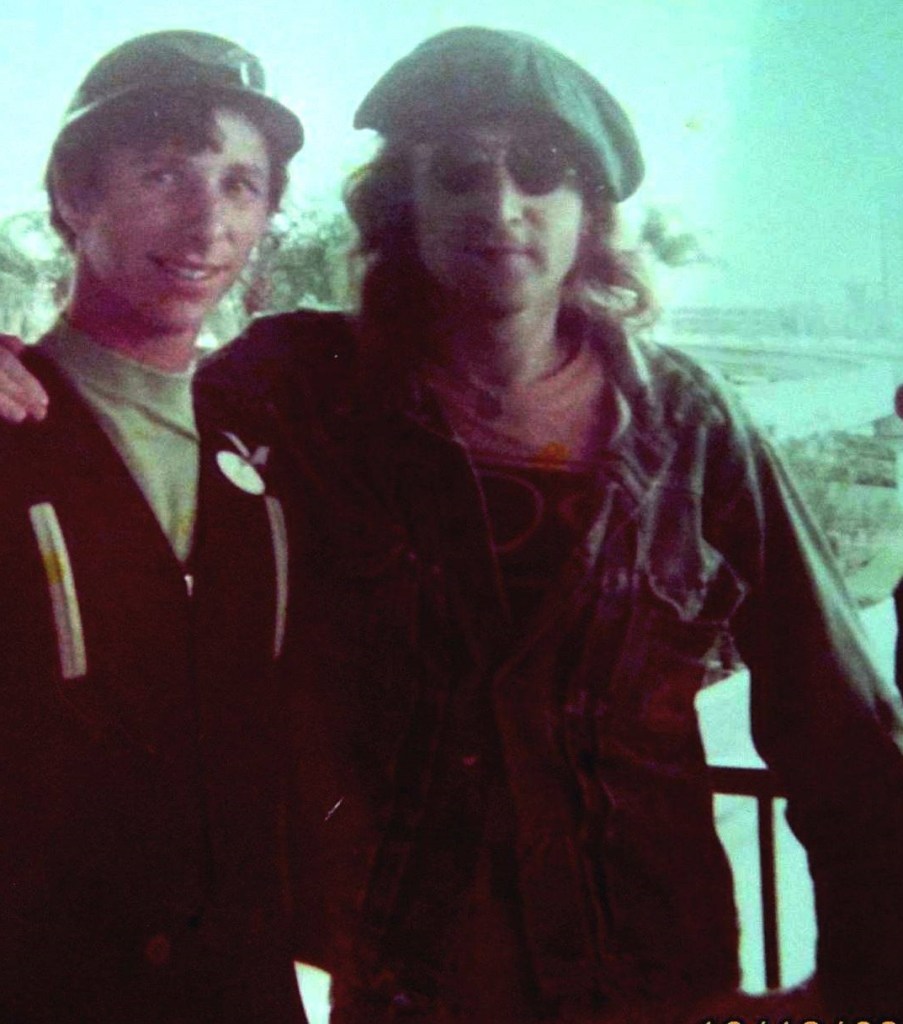
Disney monorail operator / castmember Hal East with John Lennon.

Years later, Disney monorail operator (castmember Hal East) confirmed that John, May Pang, and Julian made a few trips to the Magic Kingdom via the Monorail and were allowed to ride up front apart from the crowd. It was during these trips where John and Julian experienced the rare treat of driving the Monorail. In her book May shared an interesting memory from one of the rides: “I overheard a father tell his son [on the Monorsail] he had heard a Beatle was visiting. “Which Beatle?” The father said, “George Harrison.” I burst out laughing. John asked why. We then all started laughing so hard that the Dad turned around. It then registered which Beatle was at the park that day – and why we were laughing. “It’s O.K.,” John jokingly said, “we all look alike.” On December 29, 1974, one of Apple Corp’s lawyers hand-delivered the official documents to the House of the Mouse in Florida and John Lennon became the last of the four to sign off on the contract.

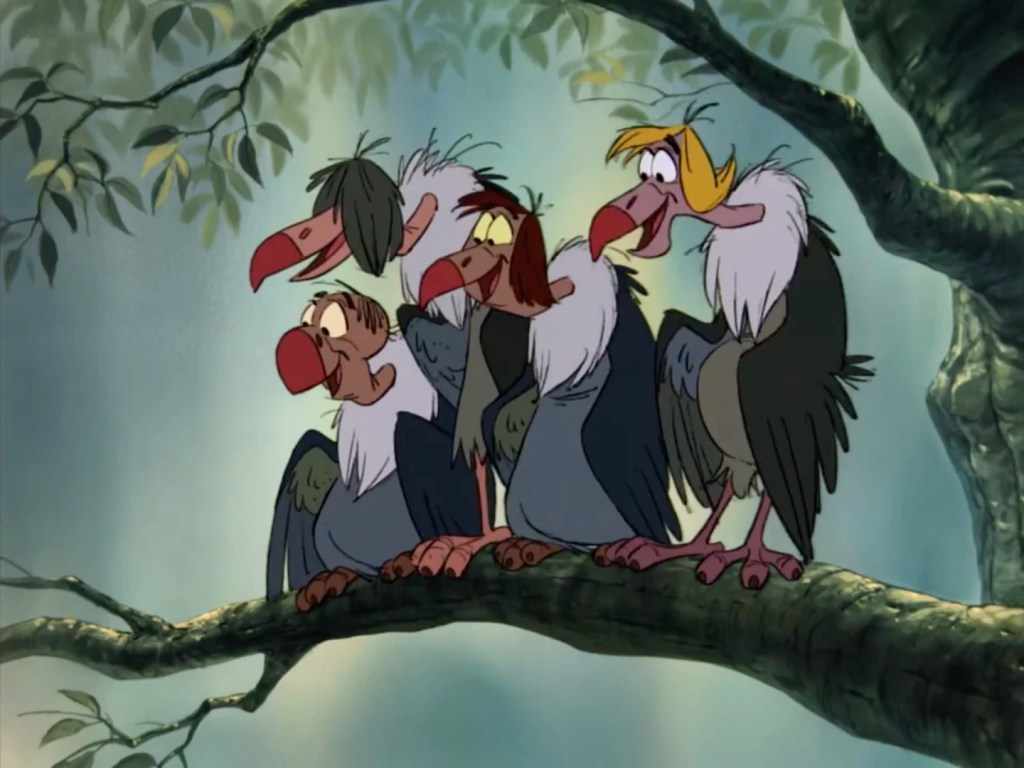
Disney’s Beatles inspired Vultures: Buzzie, Flaps, Ziggy, and Dizzy.

Ironically, the Beatles and Disney never really had much of a working relationship, but Disney did reference The Beatles in at least one of its productions: the vultures in The Jungle Book are based on the Fab Four. Disney also made plans to remake 1968’s Yellow Submarine, but the project never broke the surface. In 2020, Disney bought distribution rights for the docuseries The Beatles: Get Back from Peter Jackson and that three-part series is still streaming on Disney.

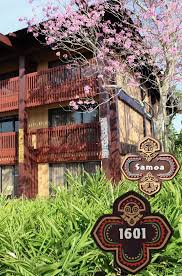
Samoa Longhouse 1601.
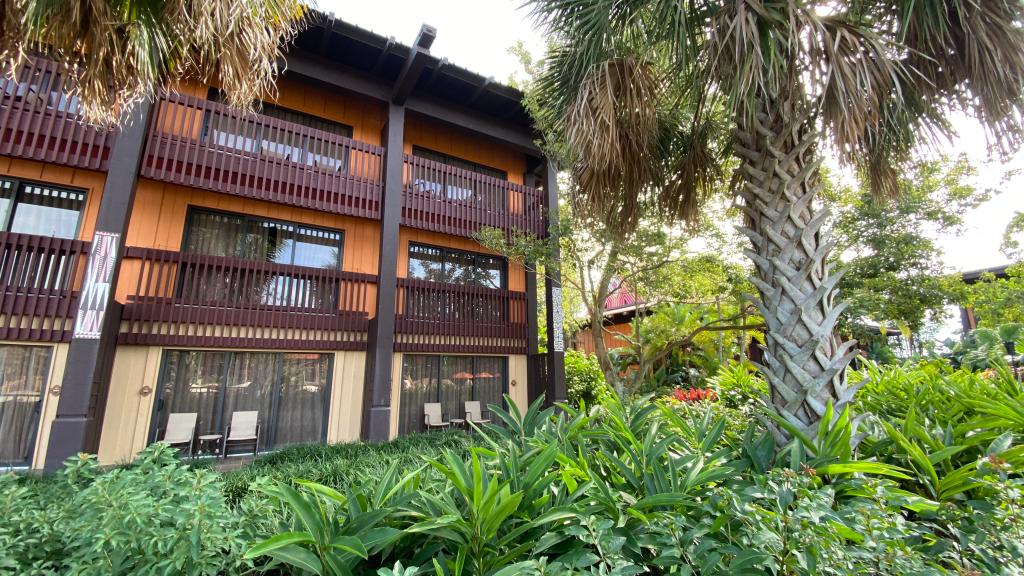
Samoa longhouse Building at Disney World’s Polynesian Resort.

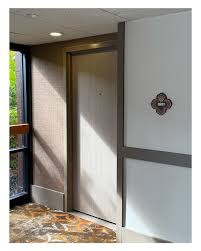
While Disney won’t confirm the exact room where it happened, dedicated Beatles / Disney fans have pinpointed the location: Room 1601 in the Samoa longhouse Building at the Polynesian Resort at Walt Disney World, Orlando. Room 1601 looks out at the Seven Seas Lagoon and it was this scene at which John gazed as he paused briefly before officially dissolving his performing relationship with the Beatles. Room 1601 is a ground-floor corner room in the Samoa longhouse that looks out on the Seven Seas Lagoon with the Cinderella Castle visible in the distance.

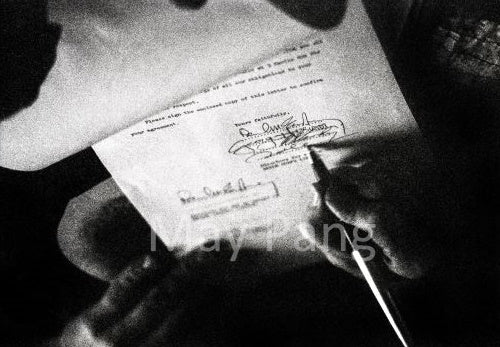
May Pang’s Photo of Lennon’s dissolution signing.

Here, with the Magic Kingdom as his backdrop, John Lennon picked up his pen and officially finished off the Beatles, once and for all. Years later May Pang remembered that John told her to “Take out your camera…He looked wistfully out the window. I could almost see him replaying the entire Beatles experience in his mind. He finally picked up his pen and, in the unlikely backdrop of the Polynesian Village Hotel at Disney World, ended the greatest rock ‘n’ roll band in history by simply scrawling ‘John Lennon’ at the bottom of the page.”

Room 1601.

In Pang’s book “Instamatic Karma: Photographs of John Lennon” (St. Martins Press 2008), there are several photos of Lennon at Disney World wearing a stylish newsboy cap and Micky Mouse ringer t-shirt posed anonymously in the park among the crowd, alongside Monorail driver Hal East, in front of Cinderella Castle and outside room 1601 at the Polynesian. Most importantly, Pang snapped a photo of Lennon’s signature on the dissolution papers. A literal snapshot of music history, Disney style. And today, if you’re lucky, you can stay in Room 1601 where the Beatles long and winding road came to an end. And then, go ride the Monorail.

Indianapolis, Music, Pop Culture, The Beatles

The Beatles, John Lennon, WIFE… and Irvington. Part III

Original Publish Date May 20, 2021.

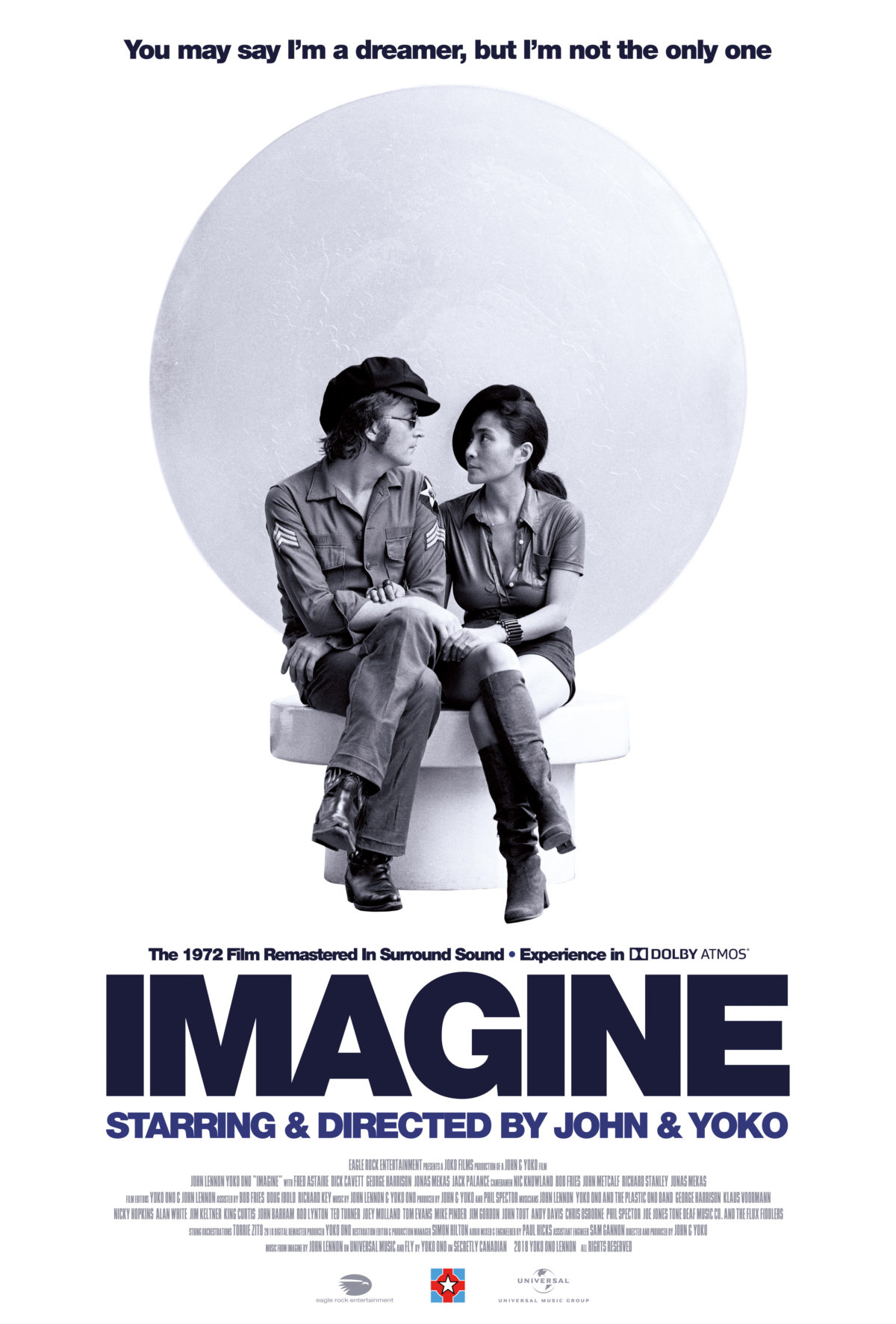
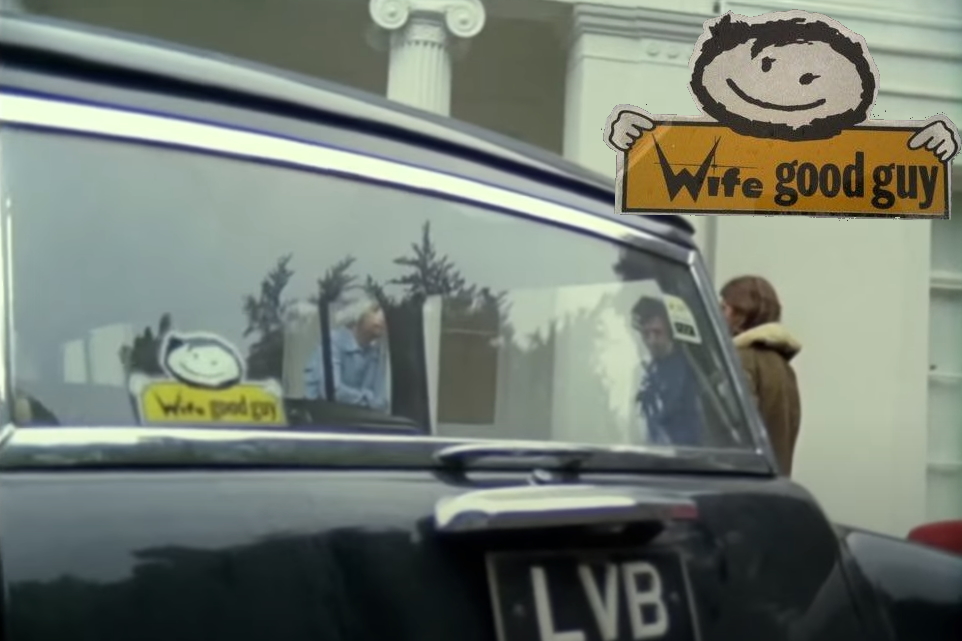
In the John Lennon film “Above Us Only Sky” (a segment from the larger film “Imagine”) there’s a scene from a 1971 encounter with a young man who shows up at Lennon’s house in England. Lennon talks with him and eventually invites him in to eat some food. In the clip, Lennon’s Mini Cooper car (parked outside the house) has a WIFE Good Guys radio sticker in the back window. How in the world did a sticker from a local Indianapolis radio station end up on a car in John Lennon’s driveway in England? The mystery was uncovered by Irvingtonian Bill Price in part I of this article and solved by Irvingtonian Stephen Bruce Smith in part II. Part III reveals another Irvington connection.
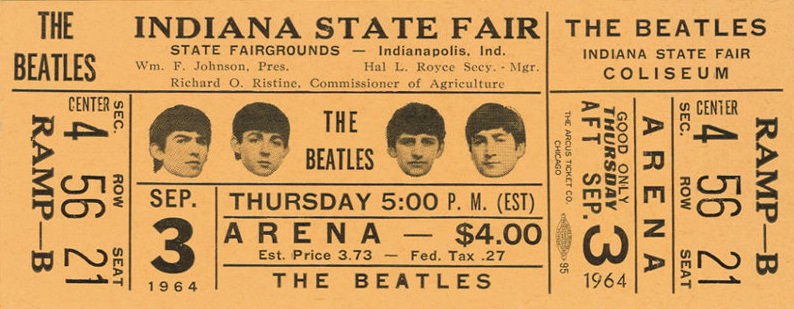
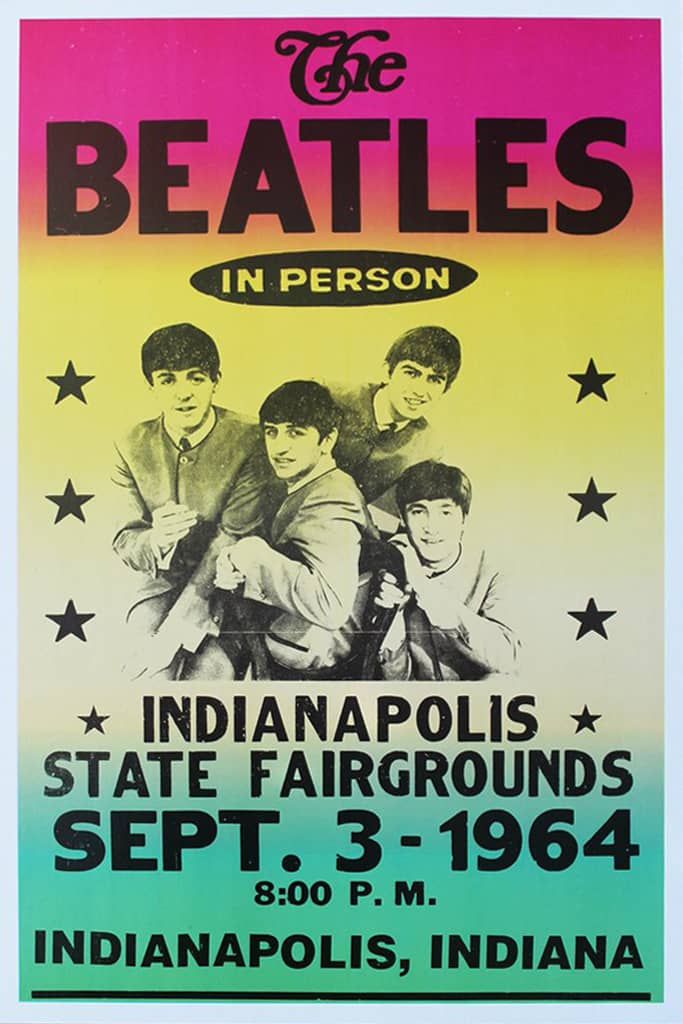
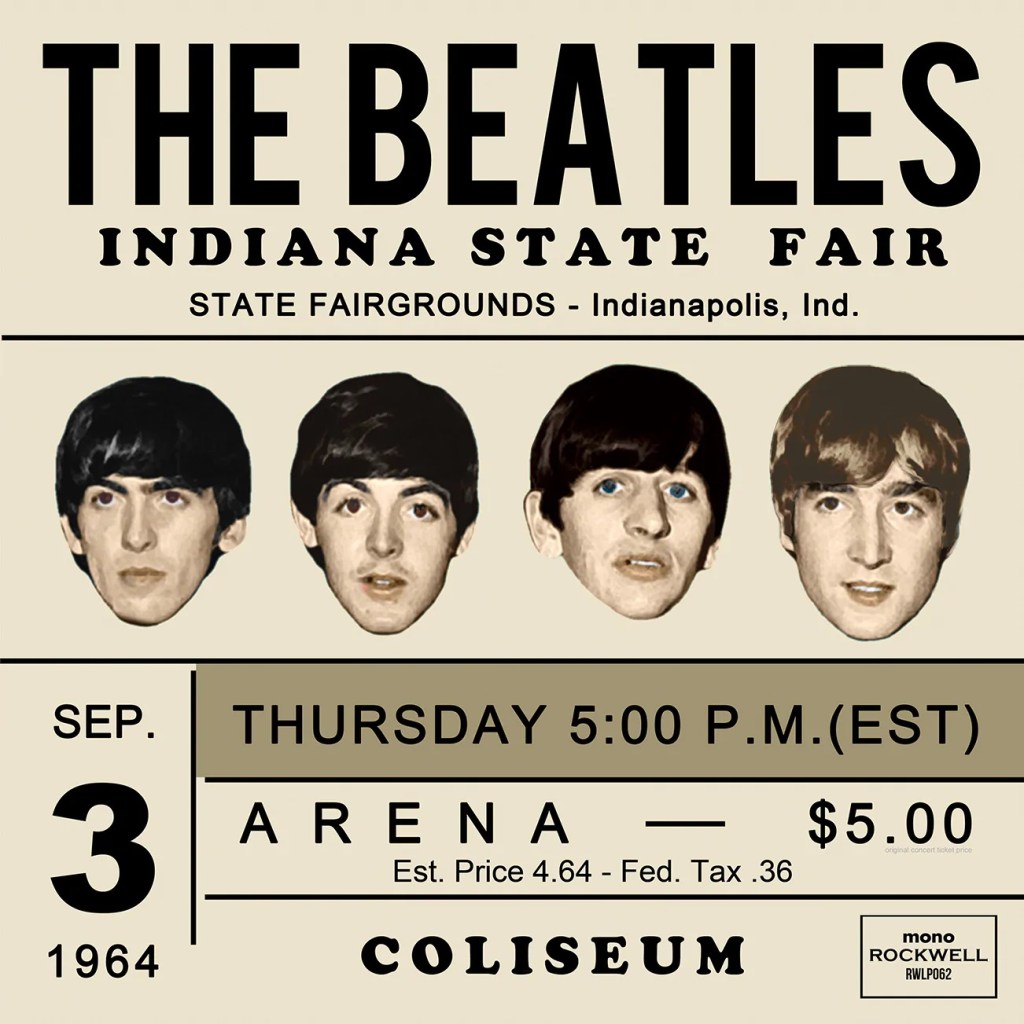
When the Beatles played two shows at the Indiana State Fair in September of 1964, Radio station WIFE 1310 sponsored the show in the Coliseum, and WIBC sponsored the show in the grandstand. In 1963, WIFE-310 AM signed on the air with a rock-heavy playlist. And by the time The Beatles arrived, the station had rapidly surged to the top of the ratings race, bringing an end to radio station WIBC-1070 AM’s reign as the champion of Indianapolis’ airwaves. In 1964, programming on WIFE largely focused on top 40 hits and bubblegum rock including The Beatles.


The Beatles concerts have been detailed by this writer in past columns and the specifics of those shows are well-known to all Circle City Beatles fans. Stephen Bruce Smith added more details to that story and revealed that Lennon “got the bumper sticker in 1964 at the station when The Beatles awarded tickets to a lucky high school girl who won a contest. I knew her brother at Howe High School. John got that sticker at the station from either Jay Reynolds or Jack Sunday (Jerry Baker).”
Turns out Smith, who knows everybody, rediscovered that lucky ticket-winning girl too. Did I mention Stephen Bruce Smith knows EVERYBODY? Her name is Elaine Conly and she is a Howe graduate, class of 1966. She was Elaine May when she won that contest back in 1964. Elaine’s mother, Virginia Casey May, who passed in 2002, was active in the Irvington Women’s Club as past chairwoman and past president of the Irvington Music Study Group. She was also a pioneer member of the neighborhood CrimeWatch program and Human Rights Commission, retiring from the Indianapolis Mayor’s office in 1977. Virginia was also a former chairwoman for the Junior Civic Theatre and scriptwriter for the “Time for Timothy (Churchmouse)” program. So Elaine, who performed in some of those productions for her mother’s Civic Theatre, knew a thing or two about the entertainment business.

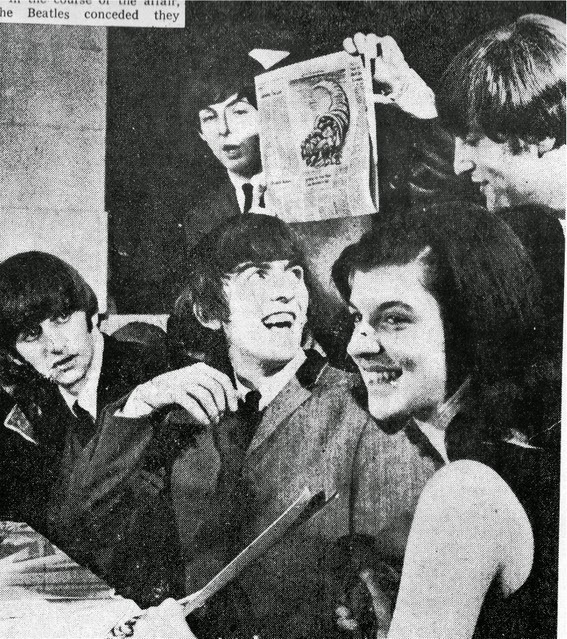
Elaine May Conly With Paul, Ringo, George & John at the Concert Press Conference.

15-year-old Elaine entered a 50-word or less summertime essay contest by the Indianapolis News titled “I want to meet the Beatles because…” Elaine entered (without telling her parents) and her 47-word essay was selected as the winner from more than 3000 entries. Her winning entry read: “I want to meet the Beatles because they have a special magic. When they perform, the oppressing world crisis and other problems can be temporarily forgotten. They sing happy, swinging songs. I’d love to meet the four young men who can make everything seem a little brighter.” Just like in the movie Bye-Bye Birdie, Elaine supplants Ann-Margret who likewise wins a contest to meet her Elvis-like hero, Conrad Birdie.
“I had to keep it a secret though, that was hard to do,” Elaine says. When her picture appeared on the front page of the newspaper announcing her victory, “The phone rang off the hook, it was pandemonium.” Elaine, the daughter of Harry A. May, grew up at 1134 N. Butler Ave., “Butler Avenue North of 10th, Two blocks from the Steer Inn,” she states.
“I was worried that they (The Beatles) would not want to meet a teen-aged kid and that they might poke fun at me. I expected to get a cold reception.” Elaine recalls, “But they were perfect gentlemen and very nice to me. I shook all of their hands and when I entered the room, John stood up an offered me his seat.” Which was a good thing because John Lennon was her chosen Beatle. “He had written a book of poetry and he was my favorite. They were all very nice and gentlemanly but John was the nicest of the four.” Elaine recalls. “I went out and bought a special black crepe dress because I heard that John liked black.”

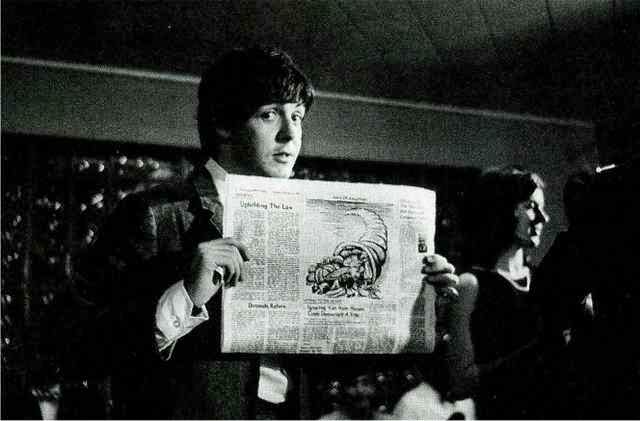
Paul McCartney with Elaine in the background.

The whole encounter, which took place in the communications building at the State Fairgrounds across from the Coliseum, took less than five minutes. Elaine reveals, “I wore the class rings of four of my classmates to the meeting. They belonged to my friends. They all wanted their ring to touch a Beatle.” When I asked if she got any souvenirs or autographs, she responds, “No, I was told (by the Indy News) that I couldn’t ask for autographs or take photographs of my own. I wish I would have because I probably could have paid for my college tuition with that money now.”
Elaine states that the newspapers followed up on Elaine’s story every few years. As for the Fab Four, “They were very funny but very polite.” she recalled. Part of Elaine’s duties that day, aside from the obvious photo op for the news, was to deliver an original editorial cartoon from the News to the Lads from Liverpool. “Then I just stood to the side for the rest of the Press Conference”, Elaine says. When she left the building, she was bombarded with questions from local reporters.

Elaine May Conly with the Beatles.
Elaine May Conly

Part of her prize package included tickets to the show. When asked what memories she had of the concert, Elaine says, “Security was very tight. It was very dark and very hard to hear them. But it was great to look at them, they were so handsome.” Her tickets? “Oh, they were very close, first 10 rows or so.” Did anyone recognize her as the contest winner? “Yes, a few people picked me out right away, but then the Beatles came out and that was that.” Elaine is still saddened by the death of her favorite Beatle. “I was watching Monday Night Football (December 8, 1980) when they broke in to announce that John Lennon had been shot. I cried. I cried a lot.”

And what about that little black dress, the only physical souvenir she has left from that encounter? “That dress was good luck.” she says, “I was wearing that dress a year later when I walked a friend to the bus station. A friend of a friend, University of Cincinnati architecture student Michael Conly, was on the bus and kept asking, “Who’s that girl in the black dress?” Long story short, Elaine and Michael Conly have been married for 51 years. And her engagement ring? Michael purchased it for her in Beatles Country: England, where he was studying in Europe.
Several years ago, Michael had a special print of his wife’s brush with the Beatles enlarged and the poster-sized photo hangs on the couple’s wall inside their Fishers home. “That’s my claim to fame I guess. Over the years it (the photo) was a big hit with our babysitters who would gasp and ask me about the encounter. I was always amazed because most of them were not even born when that meeting took place. The Beatles still have that power though, after all these years.”

Indianapolis, Music, Pop Culture, The Beatles

The Beatles, John Lennon, WIFE… and Irvington. Part II

Original Publish Date May 13, 2021.

In part I of this series, I told you about an obscure episode involving The Beatles John Lennon and the Indianapolis radio station WIFE. In the film “Above Us Only Sky” there is a car parked outside Lennon’s house that has a WIFE Good Guys radio sticker on the back window. How did a sticker from a Circle City radio station end up on a car 3,947 miles away in John Lennon’s driveway?
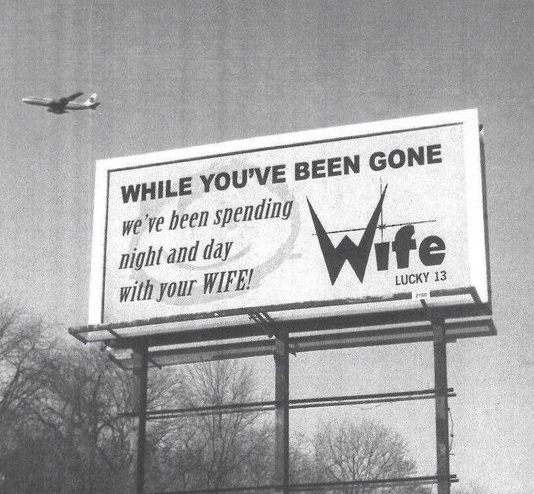
Anyone over the age of 50 should remember WIFE AM 1310 in Indianapolis. How can you forget those Coppertone commercials in the summertime: “Time to turn so you won’t burn.” Or the WIFE Lucky 13? Or the billboard near Indianapolis’ Weir Cook Airport (later Indianapolis International Airport) which amused passing motorists with the message, “While you’ve been gone we’ve been spending night and day with you WIFE!” Or even the “window on the world” of the WIFE studios at 1440 N. Meridian Street where pedestrians and downtown shoppers could walk past the window and see one of the “WIFE Good Guy” DJs in action?
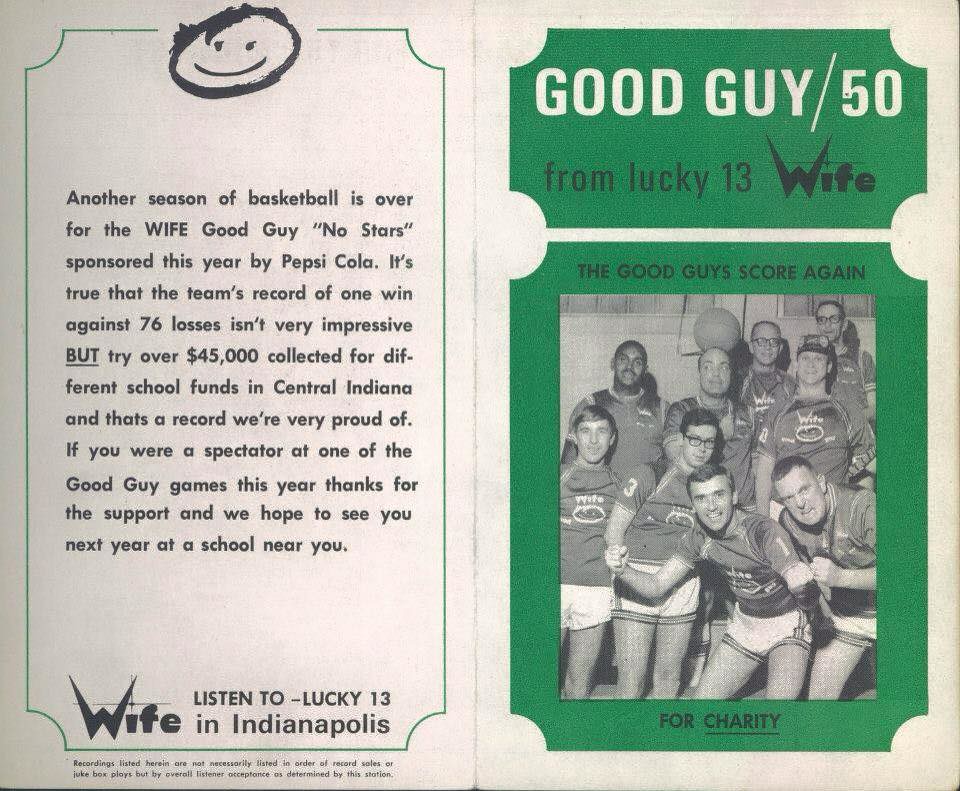
WIFE was the top 40 giant of Indy for years and the only real AM radio rockers in town during the mid to late sixties (sometimes garnering as much as a 40% share of the Indy radio audience). WIFE is remembered for their endless contests (“The 100 Thousand Dollar Dream Home” or “The 100 Thousand Dollar Cash and Car Give-A-Way”), ear-worm jingles pounding the call letters and station numbers ad nauseam, and, maybe worst of all, the station sped up the records to cram more music in between the ads, witty banter, and promos. This last practice confounded pre-teens who wondered why the songs sounded so much different on WIFE than on the 45s. Most of all, radio fans remember the “WIFE Good Guys”: Big Jack Armstrong, Roger W. Morgan, Reb Porter, Jay Reynolds, Joe Light, Jay Hawkins, Buddy Scott, Jim Fox, T.J. Byers, Scott Wheeler, Mike O’Brien, Dan Summers, and Steve Miller.


And who can forget Jack Sunday: aka ABA / NBA Indiana Pacers radio voice Jerry Baker. Jerry handled the noon to 3:00 shift for a couple of years at WIFE chanting “Hey, this is Jack Sunday” every break and intro and while hosting the “Pool Party” segments. It was Jerry Baker who introduced the Beatles during their two concert stops at the Indiana State Fairgrounds. For years, WIFE would replay Jerry’s Beatles intro from the fairgrounds every time they played one of the Fab Four’s songs: “On behalf of the Indiana State Fair Board and WIFE Good Guys…The Beatles!” No doubt about it, WIFE 1310 is an Indiana institution. And somehow, a bumper sticker from the station ended up on John Lennon’s car in England.
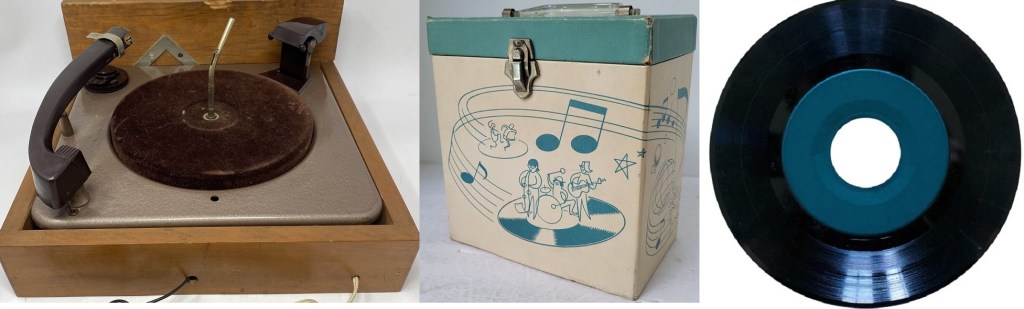
I found the answer, where else? On Facebook, which led me right back here to Irvington. I started by joining the WIFE RADIO ALUMS & FANS Facebook page. It was there that I found Irvingtonian Stephen Bruce Smith. That name should be familiar to many Irvintonians. Smith is a former Irvington Council President (1997-99), 1975 Howe high school alumni, and 1980 Butler grad. Smith, who grew up on the corner of Brookville and Grand (421 So. Grand), is a Beatles superfan, authority and collector. And he knows EVERYONE in Irvington. I called Smith on a Saturday afternoon. When he answered the phone I could hear that he was spinning Beatles vinyl on the turntable in the background. EXACTLY what you might expect from an Irvington Beatles guy.
Smith unraveled the mystery of the bumper sticker quite succinctly. “The Beatles came to Indy in September 1964 to do two concerts at The State Fair on the 3rd. WIFE sponsored the concert and had various contests surrounding the concert. The Beatles visited the WIFE studio earlier that day and were given various gifts to remember their visit to Indianapolis. They were greeted by Miss Indiana State Fair as well as meeting a girl who won the Meet The Beatles Contest. She happened to be a Howe High School girl. The WIFE Good Guy sticker on John’s Mini Cooper in the 1971 film came from that studio appearance that morning at WIFE 1330 North Meridian. John loved stickers and t-shirts so I’m sure he just stuck it on there many years later.”


However, the story doesn’t end there. Stephen went to the first Beatles concert at the Fairgrounds. There were two, one inside the Coliseum and the other on the stage/grandstands outside. “I went with my father, Stephen Smith Sr., in exchange for punishment to see Andy Williams and the Osmond Brothers,” Stephen jokingly says. “My dad was shipping supervisor at Atkomatic Valve Co. at 141 S. Sherman Drive at Brookville and Sherman. They produced valves used in the NASA space program. He passed away in November of 1967. He got the tickets for free from a coworker.”
Smith remembers actually being excused from school to go to the concert. “It was a weekday, a Thursday I think. I was 8 years old and I was worried my teacher, Mrs. Cunningham, wouldn’t agree. I went to Orchard Park School and I think I got on her bad side because I had dressed up as Vic Morrow from the Combat TV show for Halloween. She gave me a frown as she lifted my mask. Everyone else was dressed as princesses, ghosts, and cartoon characters and my costume was a little rough looking, but she let me go.” Smith found out later that several other kids in school went to the concert too.
I asked what he remembered about the concert, and he stated, “It was about 35 minutes long and they played maybe 6 songs. You couldn’t hear anything.” Smith adds that, years later, he became good friends with WIFE Good Guy DJ Jay Reynolds and they often talked about that concert. “I remember Jay gave me the greatest quote about the noise. He said, “it got so loud that it got quiet.” And he was right.” Smith recalls that the Coliseum was “remodeled and brand new after the explosion.” (On October 31, 1963, during a Holiday on Ice show, a propane leak at a concession stand caused an explosion that killed 74 people and injured around 400 others. A subject I’ve written about in past columns.)


Smith continues, “Even at that young age, I could see that the security seemed unprepared for what was happening. Girls were screaming, fainting, and crying and there was even a rumor that one girl died from an asthma attack during the concert. Girls were all peeing themselves and getting hurt jumping from seat to seat. There were 16 Marion County deputies around the stage and they were all scared to death. You could not hear a word.” Stephen continues, “My dad was a pilot in World War II and he said he hadn’t seen that kind of crazy since wartime.”
One image that sticks with Smith is that of a smashed golf cart he and his father walked past after the show. “I remember staring at that thing for a long time. It was totally destroyed. After the concert, they used it as a diversion to get the girls away from the band. These screaming girls chased it down and literally tore it apart. I can still see that trashed golf cart in my mind.”


As an adult, Stephen Bruce Smith also encountered Jerry Baker, aka WIFE Good Guy “Jack Sunday”. Smith relates, “Jerry told me that the Beatles were each given goody packs that included Bibles in each bag. And the only thing they requested was a black and white TV, coca-colas, hamburgers, French fries, and Marlboro cigarettes. Also in those goody bags were t-shirts and stickers from WIFE. John loved trinkets and collected all that stuff, t-shirts, patches, and stickers of any kind; anything American. John had stickers on everything in his house.”
It makes sense that Lennon, fresh on the heels of The Beatles’ 1970 break-up (which many attribute to Yoko Ono), chose the WIFE sticker, with its slogan “WIFE Good Guy”, as a wry contrary comment on his relationship with Yoko. The Indianapolis connection was purely coincidental.
Many years later, Smith won a contest to meet Paul McCartney backstage in Chicago in 2005. “I was ushered in to meet him with a group of reporters. It was only 6 minutes, but it seemed like 6 hours. The reporters were stunned and really weren’t talking to him. I asked him if he remembered the concerts in Indianapolis. He said, “Oh yes, I remember Ringo went drinking with the cops.” Smith adds the little-known detail that Ringo traveled up to Noblesville where one of the police security officers (State Trooper Jack Marks) owned a horse farm. “When word got out about that visit, those poor people were invaded by teenage girls wanting details.”
Smith continues, “knowing Paul owned a sheepdog, I told him I had a sheepdog myself. He asked, “Oh really, what is the dog’s name?” I answered, “Jack the Moose” and Paul said hmmm, “Jack the Moose, Jack the Moose” over and over a few times. I was hoping he was gonna use it in a song, but that never happened.” Smith, who lives next to Pleasant Run Golf Course, ran into Paul’s assistant at another McCartney concert later. “He recognized me and said as we parted, “Cool, Paul will see you after the show.” Smith says, “It never happened. But the concert was great.”


Next week, Part III


The Beatles, John Lennon, WIFE… and Irvington.

Music, Pop Culture, The Beatles

The Beatles, John Lennon, WIFE… and Irvington. Part I

Original publish date:  May 6, 2021

Last Winter, I was contacted by Irvingtonian Bill Price with a story idea. Bill is journalist Nelson Price’s cousin. Nelson is a good friend and host of the Hoosier History Live radio show that airs live from noon to 1 p.m. each Saturday on WICR 88.7 FM in Indianapolis. I have been on Nelson’s show many times over the years as have several Irvingtonians active in the literary and history communities. So I was happy to learn of our shared connection and even happier to find an Irvington connection to this story.
Bil Price lives on Graham Avenue right in the heart of Irvington, just back of the Methodist church and behind Jockomo’s. Price relates, “I was born at 16th and Ritter, but really grew up on the westside. Nelson and my grandparents lived on 9th Street over by Ellenberger Park. I moved over here after college in the late 80s. Lived by Howe for 14 years and then bought this house on Graham around 18 or 19 years ago.”

Price reveals, “In the John Lennon film “Imagine” from quite a few years back, and the documentary about him recording the Imagine album, there’s a scene where a young hippie / vagabond type of man who is apparently a shell-shocked Vietnam vet shows up at Lennon’s house. Lennon is patient and talks with him and even invites him in to eat some food. Recently, another film “Above Us Only Sky” has been released about Lennon and has the same footage. While watching this clip, I noticed something peculiar. There is a car parked outside Lennon’s house that has a WIFE Good Guys radio sticker on the back window! I am wondering how in the world did a sticker from a local Indianapolis radio station end up on a car in John Lennon’s driveway in England? I’ve asked a couple local musician buddies of mine who seem to know a lot about local music / radio and The Beatles, etc., but they have no idea of any Indianapolis connection to John Lennon at that time.”
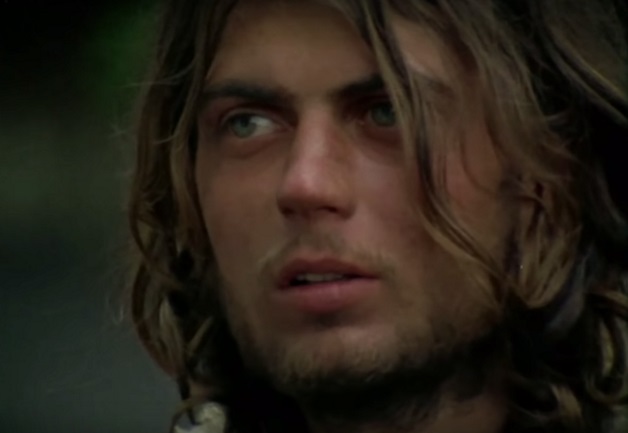
Well, Bill, you are absolutely correct, that sticker is most certainly from Indianapolis. The sticker, which features a bearded B&W beatnik smiley faced character holding up a bright yellow sign reading “WIFE Good Guy”, appears on the left side of the rear window of Lennon’s Circa-1971 Mini Cooper. Indeed, the clip from the documentary features a scene in which a young man named Curt Claudio shows up at Lennon’s house “just to see him.” The house, actually an estate mansion known as Tittenhurst Park, is located in Berkshire, near the town Ascot in England.


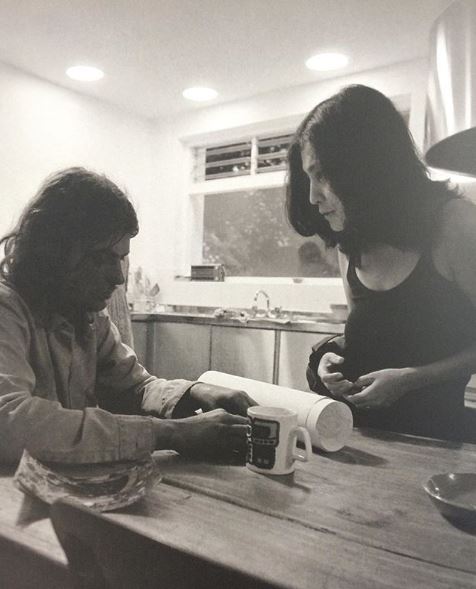
In the scene, which can be easily found on Netflix, John is leaning against the pillars of the mansion that date back to 1830, Yoko stands nearby her husband. The disheveled young man, his long hair flowing over the Shearling fur collar of a ragged sheepskin coat, carries on a lengthy, disjointed conversation with his hero from just a few feet away. Given that the scene was filmed mere months after the Manson family murdered Sharon Tate, Jay Sebring and several others under supposed orders from The Beatles White Album and knowing the way Lennon’s life ended less than a decade later, the scene is eerie to behold.
The young man had written several letters, one of which apparently stated, “I’m coming and I just need to look into your eyes and I’ll know.” Apparently Claudio had been secretly living in the rough on Lennon’s 72 acre estate for days. London police wanted to arrest the troubled fan but Lennon wouldn’t allow it, instead opting to gently talk to him face-to-face. Claudio apparently believed that some songs were speaking directly to him. Lennon does his best to dissuade that notion by asking how that could be possible since the two were strangers and stressing, “I’m just a guy who writes songs. Don’t confuse the songs with your own life. I mean, they might have relevance to your own life, but a lot of things do. So we met, you know, I’m just a guy. I write songs.”

Curt Claudio


As Claudio starts to quote the star’s lyrics, determined that the words were about him, John gently counters: “I was just having fun with words. It was literally a nonsense song. I mean Dylan does that… you just take words and you stick them together and you see if they have any meaning. Some of them do, some of them don’t.” Claudio replies: “You weren’t thinking of anyone in particular when you were singing that song?” To which Lennon replies, “How could I be? How could I be thinking of you, man? I’m thinking of me, and at best Yoko if it’s a love song. I’m singing about me and my life, and if it’s relevant about other people’s lives, then yeah, that’s alright.” Claudio looks devastated and his eyes drop to the ground. John then says: “Are you hungry?” gesturing to his friends he adds: “Let’s give him something to eat.” At which point Claudio is invited into the house and is seated at the dining room table with John and Yoko and they all eat a meal together.
For years, there was some confusion as to exactly who Curt Claudio was. Most accounts pegged him as a Vietnam War Vet. Others a hippy strung out on heroin. Still others claimed he was a deranged patient from a San Francisco mental hospital. According to the website “thedailybeatles”, Curt Claudio was born Cesare Curtis Claudio in Alameda, California on August 28, 1948. He graduated with the class of 1966 at Kennedy High School in Richmond, CA. He died in a plane crash in Fremont, CA. on December 22, 1981, a year and two weeks after Lennon’s murder. Part of Claudio’s legend states that he was so devastated by Lennon’s death that he deliberately crashed his own plane to end the pain.

Curt Claudio and Yoko Ono


Curt’s older brother Ernie cleared up the mystery, “Curt was never in the military. He was a straight “A” student in high school and earned a scholarship to the University of California in Davis, CA. Then he started using drugs and dropped out of school. He spent most of his life working on farms. We worked at Ford Motors in Milpitas, California until they closed the factory. Ford gave their employees $12,000 so they could re-train for another job. I asked Curt,” What are you going to do with your $12,000?” Curt said, “I’m either going to buy a Harley or an ultra-light airplane.” He bought the ultra-light, and that’s what killed him. He was flying too low and too slow and the plane stalled. The plane came down, bounced off a carport roof, and landed in a tree, six feet off the ground. The high impact caused his aorta to separate from the heart. Death was instantaneous.”
In 1973, John Lennon sold Tittenhurst Park to his former bandmate Ringo Starr, since Lennon had decided to live long-term in the United States and move to the Dakota (where he died). In 1988, Sheikh Zayed bin Sultan Al Nahyan – President of the United Arab Emirates and former ruler of Abu Dhabi – purchased Tittenhurst Park from Ringo Starr for 5 million pounds. Renovations took place in 1989-1990, during which many elements pertaining to Lennon’s, Ono’s and Starr’s time still on the property were removed. Astonishingly, during those renovations, wall paintings by Lennon were destroyed.


But what about that sticker? The one from the WIFE Good Guys in Indianapolis? Where on earth did that thing come from? Well, I found the just the guy to solve the mystery. And he lives right here in Irvington.