Indianapolis, Music, Pop Culture, The Beatles

The Beatles, John Lennon, WIFE… and Irvington. Part III

Original Publish Date May 20, 2021.

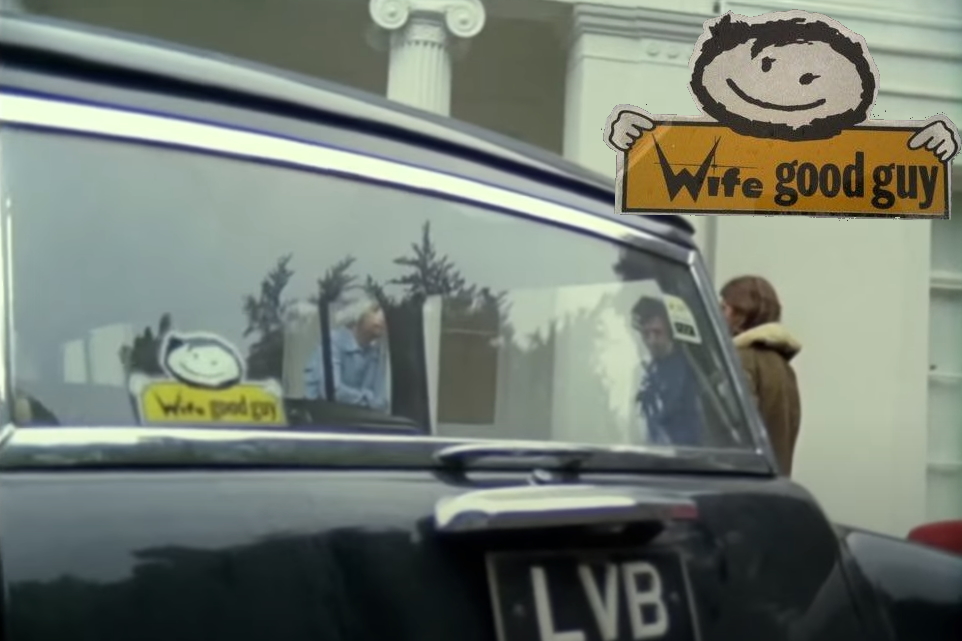
In the John Lennon film “Above Us Only Sky” (a segment from the larger film “Imagine”) there’s a scene from a 1971 encounter with a young man who shows up at Lennon’s house in England. Lennon talks with him and eventually invites him in to eat some food. In the clip, Lennon’s Mini Cooper car (parked outside the house) has a WIFE Good Guys radio sticker in the back window. How in the world did a sticker from a local Indianapolis radio station end up on a car in John Lennon’s driveway in England? The mystery was uncovered by Irvingtonian Bill Price in part I of this article and solved by Irvingtonian Stephen Bruce Smith in part II. Part III reveals another Irvington connection.
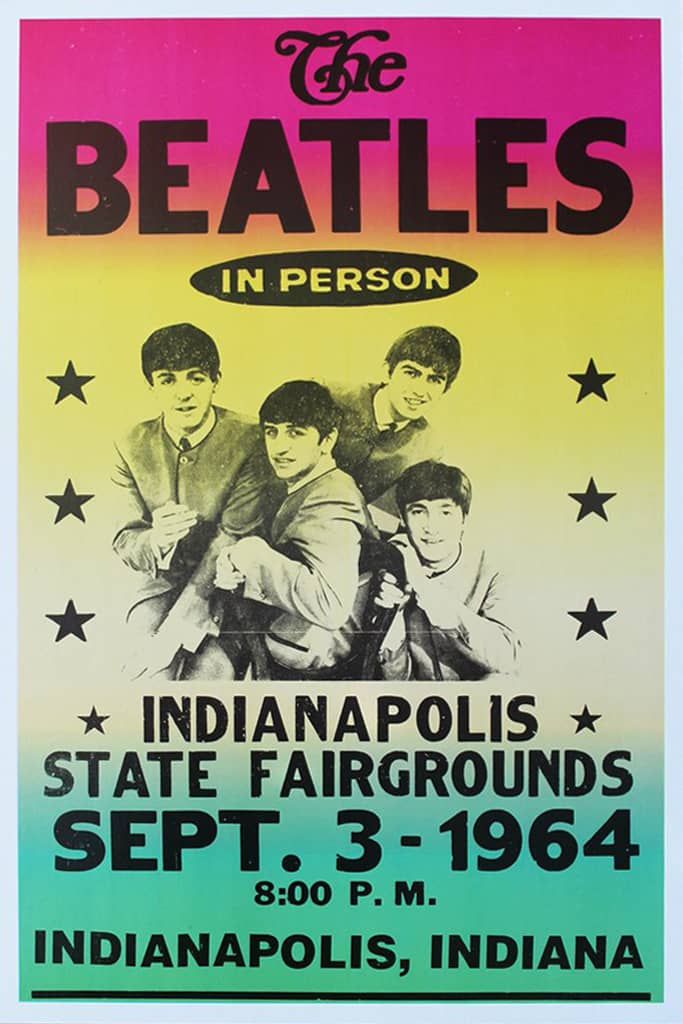
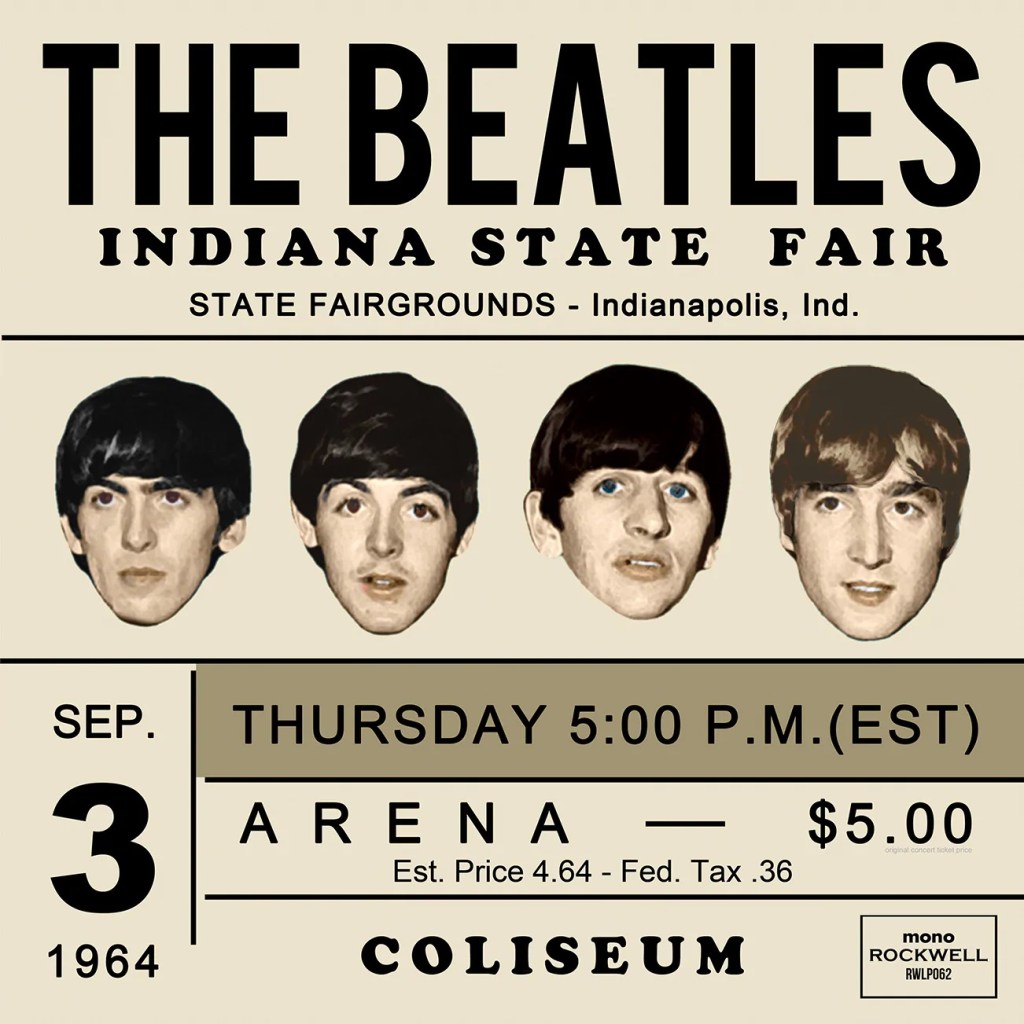
When the Beatles played two shows at the Indiana State Fair in September of 1964, Radio station WIFE 1310 sponsored the show in the Coliseum, and WIBC sponsored the show in the grandstand. In 1963, WIFE-310 AM signed on the air with a rock-heavy playlist. And by the time The Beatles arrived, the station had rapidly surged to the top of the ratings race, bringing an end to radio station WIBC-1070 AM’s reign as the champion of Indianapolis’ airwaves. In 1964, programming on WIFE largely focused on top 40 hits and bubblegum rock including The Beatles.
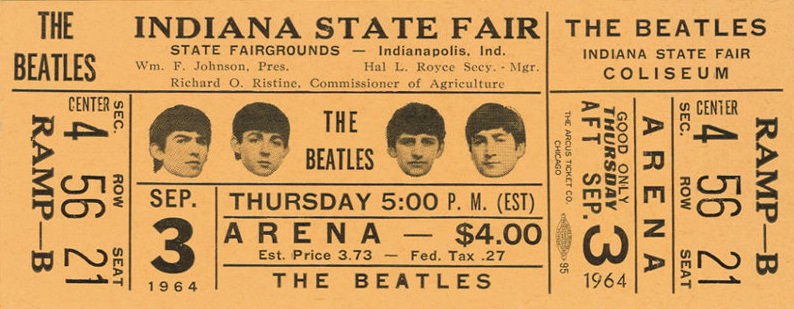

The Beatles concerts have been detailed by this writer in past columns and the specifics of those shows are well-known to all Circle City Beatles fans. Stephen Bruce Smith added more details to that story and revealed that Lennon “got the bumper sticker in 1964 at the station when The Beatles awarded tickets to a lucky high school girl who won a contest. I knew her brother at Howe High School. John got that sticker at the station from either Jay Reynolds or Jack Sunday (Jerry Baker).”
Turns out Smith, who knows everybody, rediscovered that lucky ticket-winning girl too. Did I mention Stephen Bruce Smith knows EVERYBODY? Her name is Elaine Conly and she is a Howe graduate, class of 1966. She was Elaine May when she won that contest back in 1964. Elaine’s mother, Virginia Casey May, who passed in 2002, was active in the Irvington Women’s Club as past chairwoman and past president of the Irvington Music Study Group. She was also a pioneer member of the neighborhood CrimeWatch program and Human Rights Commission, retiring from the Indianapolis Mayor’s office in 1977. Virginia was also a former chairwoman for the Junior Civic Theatre and scriptwriter for the “Time for Timothy (Churchmouse)” program. So Elaine, who performed in some of those productions for her mother’s Civic Theatre, knew a thing or two about the entertainment business.

Elaine May Conly With Paul, Ringo, George & John at the Concert Press Conference.

15-year-old Elaine entered a 50-word or less summertime essay contest by the Indianapolis News titled “I want to meet the Beatles because…” Elaine entered (without telling her parents) and her 47-word essay was selected as the winner from more than 3000 entries. Her winning entry read: “I want to meet the Beatles because they have a special magic. When they perform, the oppressing world crisis and other problems can be temporarily forgotten. They sing happy, swinging songs. I’d love to meet the four young men who can make everything seem a little brighter.” Just like in the movie Bye-Bye Birdie, Elaine supplants Ann-Margret who likewise wins a contest to meet her Elvis-like hero, Conrad Birdie.
“I had to keep it a secret though, that was hard to do,” Elaine says. When her picture appeared on the front page of the newspaper announcing her victory, “The phone rang off the hook, it was pandemonium.” Elaine, the daughter of Harry A. May, grew up at 1134 N. Butler Ave., “Butler Avenue North of 10th, Two blocks from the Steer Inn,” she states.
“I was worried that they (The Beatles) would not want to meet a teen-aged kid and that they might poke fun at me. I expected to get a cold reception.” Elaine recalls, “But they were perfect gentlemen and very nice to me. I shook all of their hands and when I entered the room, John stood up an offered me his seat.” Which was a good thing because John Lennon was her chosen Beatle. “He had written a book of poetry and he was my favorite. They were all very nice and gentlemanly but John was the nicest of the four.” Elaine recalls. “I went out and bought a special black crepe dress because I heard that John liked black.”
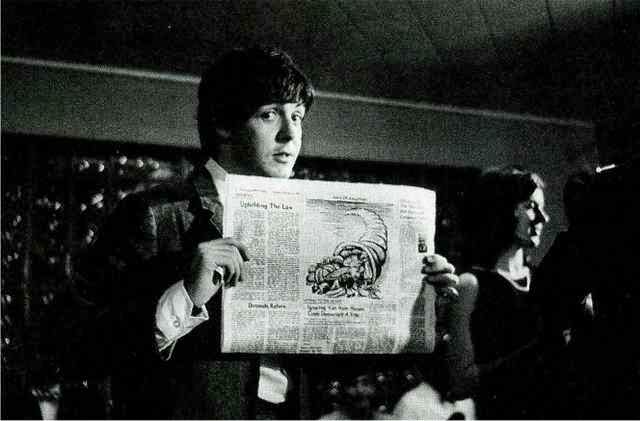
Paul McCartney with Elaine in the background.

The whole encounter, which took place in the communications building at the State Fairgrounds across from the Coliseum, took less than five minutes. Elaine reveals, “I wore the class rings of four of my classmates to the meeting. They belonged to my friends. They all wanted their ring to touch a Beatle.” When I asked if she got any souvenirs or autographs, she responds, “No, I was told (by the Indy News) that I couldn’t ask for autographs or take photographs of my own. I wish I would have because I probably could have paid for my college tuition with that money now.”
Elaine states that the newspapers followed up on Elaine’s story every few years. As for the Fab Four, “They were very funny but very polite.” she recalled. Part of Elaine’s duties that day, aside from the obvious photo op for the news, was to deliver an original editorial cartoon from the News to the Lads from Liverpool. “Then I just stood to the side for the rest of the Press Conference”, Elaine says. When she left the building, she was bombarded with questions from local reporters.
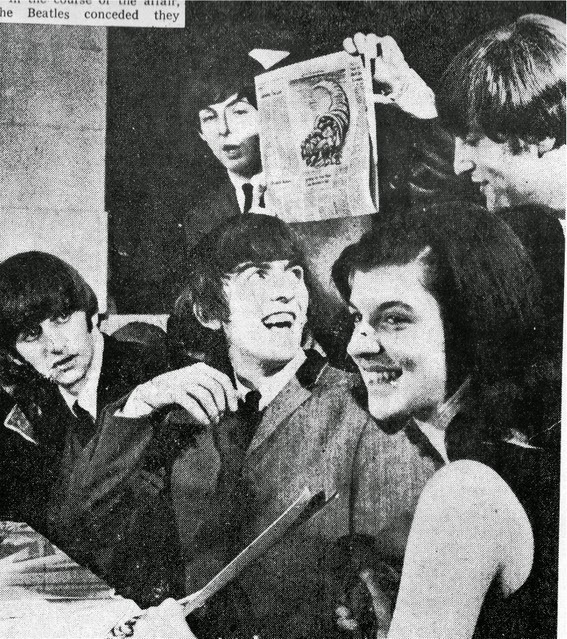
Elaine May Conly with the Beatles.
Elaine May Conly

Part of her prize package included tickets to the show. When asked what memories she had of the concert, Elaine says, “Security was very tight. It was very dark and very hard to hear them. But it was great to look at them, they were so handsome.” Her tickets? “Oh, they were very close, first 10 rows or so.” Did anyone recognize her as the contest winner? “Yes, a few people picked me out right away, but then the Beatles came out and that was that.” Elaine is still saddened by the death of her favorite Beatle. “I was watching Monday Night Football (December 8, 1980) when they broke in to announce that John Lennon had been shot. I cried. I cried a lot.”

And what about that little black dress, the only physical souvenir she has left from that encounter? “That dress was good luck.” she says, “I was wearing that dress a year later when I walked a friend to the bus station. A friend of a friend, University of Cincinnati architecture student Michael Conly, was on the bus and kept asking, “Who’s that girl in the black dress?” Long story short, Elaine and Michael Conly have been married for 51 years. And her engagement ring? Michael purchased it for her in Beatles Country: England, where he was studying in Europe.
Several years ago, Michael had a special print of his wife’s brush with the Beatles enlarged and the poster-sized photo hangs on the couple’s wall inside their Fishers home. “That’s my claim to fame I guess. Over the years it (the photo) was a big hit with our babysitters who would gasp and ask me about the encounter. I was always amazed because most of them were not even born when that meeting took place. The Beatles still have that power though, after all these years.”
Indianapolis, Music, Pop Culture, The Beatles

The Beatles, John Lennon, WIFE… and Irvington. Part II

Original Publish Date May 13, 2021.

In part I of this series, I told you about an obscure episode involving The Beatles John Lennon and the Indianapolis radio station WIFE. In the film “Above Us Only Sky” there is a car parked outside Lennon’s house that has a WIFE Good Guys radio sticker on the back window. How did a sticker from a Circle City radio station end up on a car 3,947 miles away in John Lennon’s driveway?
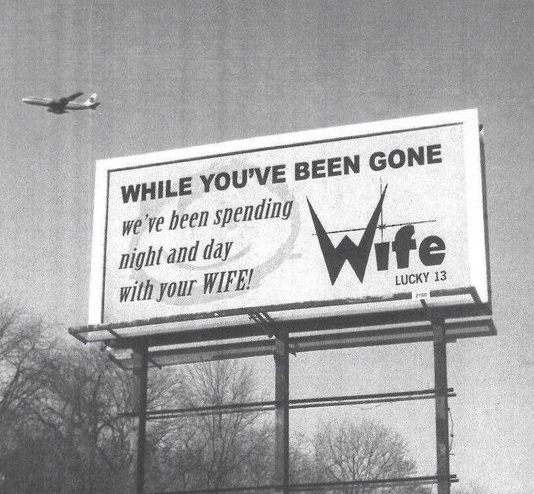
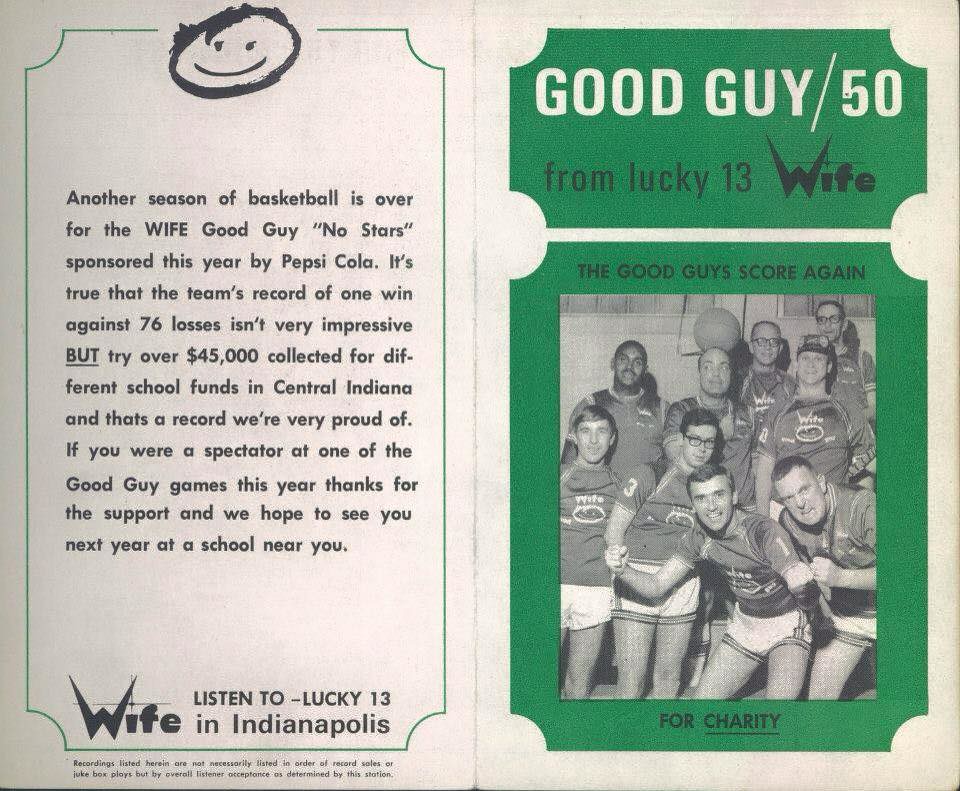
Anyone over the age of 50 should remember WIFE AM 1310 in Indianapolis. How can you forget those Coppertone commercials in the summertime: “Time to turn so you won’t burn.” Or the WIFE Lucky 13? Or the billboard near Indianapolis’ Weir Cook Airport (later Indianapolis International Airport) which amused passing motorists with the message, “While you’ve been gone we’ve been spending night and day with you WIFE!” Or even the “window on the world” of the WIFE studios at 1440 N. Meridian Street where pedestrians and downtown shoppers could walk past the window and see one of the “WIFE Good Guy” DJs in action?
WIFE was the top 40 giant of Indy for years and the only real AM radio rockers in town during the mid to late sixties (sometimes garnering as much as a 40% share of the Indy radio audience). WIFE is remembered for their endless contests (“The 100 Thousand Dollar Dream Home” or “The 100 Thousand Dollar Cash and Car Give-A-Way”), ear-worm jingles pounding the call letters and station numbers ad nauseam, and, maybe worst of all, the station sped up the records to cram more music in between the ads, witty banter, and promos. This last practice confounded pre-teens who wondered why the songs sounded so much different on WIFE than on the 45s. Most of all, radio fans remember the “WIFE Good Guys”: Big Jack Armstrong, Roger W. Morgan, Reb Porter, Jay Reynolds, Joe Light, Jay Hawkins, Buddy Scott, Jim Fox, T.J. Byers, Scott Wheeler, Mike O’Brien, Dan Summers, and Steve Miller.


And who can forget Jack Sunday: aka ABA / NBA Indiana Pacers radio voice Jerry Baker. Jerry handled the noon to 3:00 shift for a couple of years at WIFE chanting “Hey, this is Jack Sunday” every break and intro and while hosting the “Pool Party” segments. It was Jerry Baker who introduced the Beatles during their two concert stops at the Indiana State Fairgrounds. For years, WIFE would replay Jerry’s Beatles intro from the fairgrounds every time they played one of the Fab Four’s songs: “On behalf of the Indiana State Fair Board and WIFE Good Guys…The Beatles!” No doubt about it, WIFE 1310 is an Indiana institution. And somehow, a bumper sticker from the station ended up on John Lennon’s car in England.
I found the answer, where else? On Facebook, which led me right back here to Irvington. I started by joining the WIFE RADIO ALUMS & FANS Facebook page. It was there that I found Irvingtonian Stephen Bruce Smith. That name should be familiar to many Irvintonians. Smith is a former Irvington Council President (1997-99), 1975 Howe high school alumni, and 1980 Butler grad. Smith, who grew up on the corner of Brookville and Grand (421 So. Grand), is a Beatles superfan, authority and collector. And he knows EVERYONE in Irvington. I called Smith on a Saturday afternoon. When he answered the phone I could hear that he was spinning Beatles vinyl on the turntable in the background. EXACTLY what you might expect from an Irvington Beatles guy.
Smith unraveled the mystery of the bumper sticker quite succinctly. “The Beatles came to Indy in September 1964 to do two concerts at The State Fair on the 3rd. WIFE sponsored the concert and had various contests surrounding the concert. The Beatles visited the WIFE studio earlier that day and were given various gifts to remember their visit to Indianapolis. They were greeted by Miss Indiana State Fair as well as meeting a girl who won the Meet The Beatles Contest. She happened to be a Howe High School girl. The WIFE Good Guy sticker on John’s Mini Cooper in the 1971 film came from that studio appearance that morning at WIFE 1330 North Meridian. John loved stickers and t-shirts so I’m sure he just stuck it on there many years later.”


However, the story doesn’t end there. Stephen went to the first Beatles concert at the Fairgrounds. There were two, one inside the Coliseum and the other on the stage/grandstands outside. “I went with my father, Stephen Smith Sr., in exchange for punishment to see Andy Williams and the Osmond Brothers,” Stephen jokingly says. “My dad was shipping supervisor at Atkomatic Valve Co. at 141 S. Sherman Drive at Brookville and Sherman. They produced valves used in the NASA space program. He passed away in November of 1967. He got the tickets for free from a coworker.”
Smith remembers actually being excused from school to go to the concert. “It was a weekday, a Thursday I think. I was 8 years old and I was worried my teacher, Mrs. Cunningham, wouldn’t agree. I went to Orchard Park School and I think I got on her bad side because I had dressed up as Vic Morrow from the Combat TV show for Halloween. She gave me a frown as she lifted my mask. Everyone else was dressed as princesses, ghosts, and cartoon characters and my costume was a little rough looking, but she let me go.” Smith found out later that several other kids in school went to the concert too.
I asked what he remembered about the concert, and he stated, “It was about 35 minutes long and they played maybe 6 songs. You couldn’t hear anything.” Smith adds that, years later, he became good friends with WIFE Good Guy DJ Jay Reynolds and they often talked about that concert. “I remember Jay gave me the greatest quote about the noise. He said, “it got so loud that it got quiet.” And he was right.” Smith recalls that the Coliseum was “remodeled and brand new after the explosion.” (On October 31, 1963, during a Holiday on Ice show, a propane leak at a concession stand caused an explosion that killed 74 people and injured around 400 others. A subject I’ve written about in past columns.)


Smith continues, “Even at that young age, I could see that the security seemed unprepared for what was happening. Girls were screaming, fainting, and crying and there was even a rumor that one girl died from an asthma attack during the concert. Girls were all peeing themselves and getting hurt jumping from seat to seat. There were 16 Marion County deputies around the stage and they were all scared to death. You could not hear a word.” Stephen continues, “My dad was a pilot in World War II and he said he hadn’t seen that kind of crazy since wartime.”
One image that sticks with Smith is that of a smashed golf cart he and his father walked past after the show. “I remember staring at that thing for a long time. It was totally destroyed. After the concert, they used it as a diversion to get the girls away from the band. These screaming girls chased it down and literally tore it apart. I can still see that trashed golf cart in my mind.”


As an adult, Stephen Bruce Smith also encountered Jerry Baker, aka WIFE Good Guy “Jack Sunday”. Smith relates, “Jerry told me that the Beatles were each given goody packs that included Bibles in each bag. And the only thing they requested was a black and white TV, coca-colas, hamburgers, French fries, and Marlboro cigarettes. Also in those goody bags were t-shirts and stickers from WIFE. John loved trinkets and collected all that stuff, t-shirts, patches, and stickers of any kind; anything American. John had stickers on everything in his house.”
It makes sense that Lennon, fresh on the heels of The Beatles’ 1970 break-up (which many attribute to Yoko Ono), chose the WIFE sticker, with its slogan “WIFE Good Guy”, as a wry contrary comment on his relationship with Yoko. The Indianapolis connection was purely coincidental.
Many years later, Smith won a contest to meet Paul McCartney backstage in Chicago in 2005. “I was ushered in to meet him with a group of reporters. It was only 6 minutes, but it seemed like 6 hours. The reporters were stunned and really weren’t talking to him. I asked him if he remembered the concerts in Indianapolis. He said, “Oh yes, I remember Ringo went drinking with the cops.” Smith adds the little-known detail that Ringo traveled up to Noblesville where one of the police security officers (State Trooper Jack Marks) owned a horse farm. “When word got out about that visit, those poor people were invaded by teenage girls wanting details.”
Smith continues, “knowing Paul owned a sheepdog, I told him I had a sheepdog myself. He asked, “Oh really, what is the dog’s name?” I answered, “Jack the Moose” and Paul said hmmm, “Jack the Moose, Jack the Moose” over and over a few times. I was hoping he was gonna use it in a song, but that never happened.” Smith, who lives next to Pleasant Run Golf Course, ran into Paul’s assistant at another McCartney concert later. “He recognized me and said as we parted, “Cool, Paul will see you after the show.” Smith says, “It never happened. But the concert was great.”


Next week, Part III


The Beatles, John Lennon, WIFE… and Irvington.

Criminals, Indianapolis, Pop Culture, Sports

John Dillinger the ballplayer.

John “Jack Rabbit” Dillinger and the Mooresville “AC’s”

Original publish date:  April 8, 2021

Despite John Dillinger’s meteoric rise to infamy and spectacular headline grabbing death, his Indianapolis boyhood was unexceptional. He attended public schools for eight years in the Circle City and was a typical student. His teachers recalled that he liked working with his hands, was good with all things mechanical and liked reading better than math. He liked hunting, fishing, playing marbles, the Chicago Cubs and playing baseball. He was energetic and got along well with others (although he often bullied younger children), was cocky and quick witted. Dillinger quit school at age 16, not due to any trouble, but because he was bored and wanted to make money on his own.
During World War I, Dillinger tried to get a job at Link Belt in the city but was rejected because he was too young. Instead, he took a job as an apprentice machinist at James P. Burcham’s Reliance Specialty Company on the southwest side of Indianapolis and worked nights and weekends as an errand boy for the Indianapolis Board of Trade. All the while, Dillinger played second base on the company baseball team. One slot on Dillinger’s resume included a four day stint with the Indianapolis Power & Light Company drawing the hefty sum of 30 cents an hour. Just long enough for the “ringer” to help the IPL team win a league title.
In his spare time, Dillinger hung out at the local pool hall where he drank and smoked with the older men and cavorted with the local prostitutes. One of the regulars later recalled, “John would come in, hang up his hat and play pool at a quarter a game. He wasn’t very good, and he frequently lost. When he would lose two dollars, he’d put back the cue, get his cap, and walk out without a word. Never gave anyone any trouble and never said much.”

z Dillinger Sr  John Dillinger, Sr.

In 1920, his father, John Dillinger Sr., believing that the city was corrupting his son, sold his eastside Indianapolis Maywood grocery store property and moved his family to Mooresville. For the next 3 years, young Dillinger split his time between Moorseville, Martinsville and Indianapolis, traveling by interurban or motorcycle nearly every day. The athletic Dillinger quickly caught on with the semipro Mooresville Athletic Club’s “Athletics” baseball team. His reputation on the local sandlots and his quick speed earned him the nickname “The Jackrabbit”.
The 5-foot-7, 150 pound middle infielder batted leadoff and led the Athletics in hitting, for which the team’s sponsor, the Old Hickory Furniture Company, gave him a $25 reward on their way to the 1924 league championship. His game was so tight that other local teams began to pay him to play ball for them and throughout that summer the cash poured in.

z old hickory
Dillinger’s younger sister Frances, who passed away in 2015, insisted that her brother was good enough to draw Major League scouts to tiny Martinsville just to watch him play. Flush with confidence and blinded by the glare of an obviously bright future, Dillinger married Beryl Ethel Hovious in Mooresville on April 12, 1924. The couple moved into his father’s farm house but within a few weeks of the wedding, the groom was arrested for stealing 41 Buff Orpington chickens from Omer A. Zook’s farm on the Millersville Road.
Though his father was able to work out a deal to keep the case out of court, it further strained his relationship between them. Dillinger and Beryl moved out of their cramped bedroom and into Beryl’s parents’ home in Martinsville. There Dillinger got a job in an upholstery shop. All the while, Dillinger continued to play baseball. In between calling balls and strikes during AC Athletics games, umpire Ed Singleton (a web-fingered local drunk and pool shark 11-years his senior) was in the young shortstop’s ear. Singleton said he knew an old man, Frank Morgan, who carried loads of cash in his pockets around the streets of Mooresville.

z john and beryl

Beryl Hovius and John Dillinger


On September 24, 1924, the young and impressionable Dillinger accompanied Singleton on what turned out to be a botched stick-up. After ambushing Morgan with a heavy iron bolt wrapped in a cotton handkerchief and knocking him unconscious, Dillinger fled the scene, thinking he had killed his victim. Turns out the bolt was not heavy enough to render an unconscious blow so Dillinger pistol whipped the old man in the face. The gun went off, firing harmlessly into the ground, unbeknownst to the young hoodlum. The robbery netted just $50 ($750 in today’s money).
Upon hearing the gunshot, Singleton panicked and drove away with the getaway car, stranding Dillinger, who ducked into a pool hall a few blocks away. Dillinger was arrested the next day at his father’s farm and held in the county jail in Martinsville. His father visited him there and told “Junior”, “Johnnie if you did this thing, the only way is to own up to it. They’ll go easy on you and you’ll get a new start.” Dillinger, who did not have a lawyer, pled guilty and received a 10-year prison sentence. His accomplice Ed Singleton hired a lawyer and received just 5 years. John Dillinger had launched himself into the big leagues of professional crime. But again, baseball would play a pivotal role in the young outlaw’s life.z pendleton
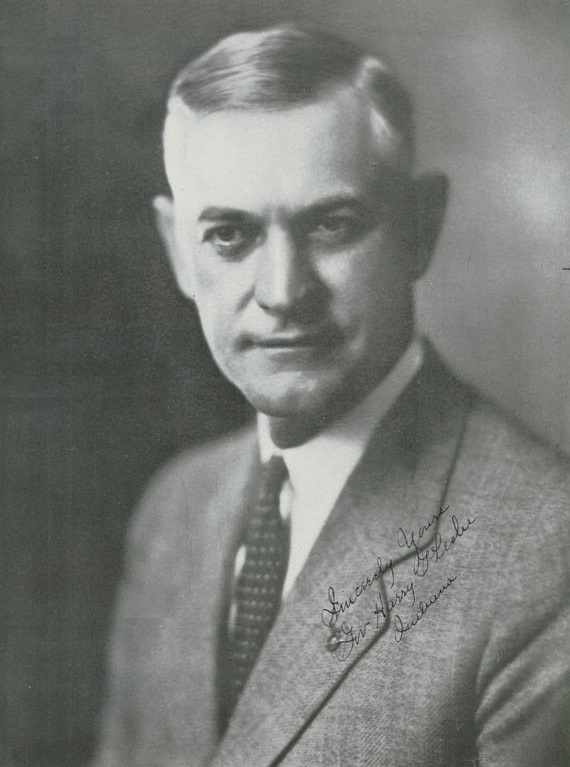
While incarcerated at the Indiana Reformatory in Pendleton, Prison officials recognized his superior ball playing skills and quickly recruited him for the prison ball club. On July 22, 1959, the 25th anniversary of Dillinger’s death, the Indianapolis News ran an article on Dillinger the ballplayer by “Outdoor Columnist” Tubby Toms. “His play was marvelous, both in the field and at bat… He might have been a Major League shortstop the caliber of a Pee Wee Reese or a Phil Rizzuto.” Tubby further mentioned an interaction between Governor Harry G. Leslie and Dillinger. Leslie, who has been detailed in a couple of my past columns, was a legendary athlete at Purdue University. Leslie always made it a point to stop and linger on visits to watch the prison ballplayers in action.
Tubby, who was the News Statehouse reporter at the time, recalls a 1932 visit to the prison with Governor Leslie when both men watched the reformatory’s baseball team take on a local semipro club. The two men couldn’t take their eyes off the shortstop whom fellow inmates were calling “jackrabbit”. Governor Leslie strongly believed in the rehabilitative power of organized competition and took a keen interest in inmates who applied themselves and excelled. So it wasn’t unusual that Dillinger captured his attention.

z 11191_1418241724

Governor Harry Leslie


Later that day, as fate would have it, Governor Leslie presided over Dillinger’s parole hearing. After Dillinger was once again denied parole, the dejected outlaw asked a question of the board. “I wonder if it would be possible to transfer me to the State Prison up at Michigan City? They’ve got a REAL ball team up there.” The Governor then said, “Gentlemen, I saw this lad play baseball this afternoon, and let me tell you, he’s got major league stuff in him. What reason can there be for denying him this request? It may play an important part in his reformation.” His request was granted and to this day, his official records state that he was sent to the big house “so he can play baseball.” It was at Michigan City where John Dillinger, under the tutelage of more seasoned cons, learned how to be a bank robber.
On May 22, 1933, Governor Paul McNutt released Dillinger from State Prison. Within a month, he held up the manager of a thread factory in Monticello, Illinois. A month after that, he held up a drugstore in Irvington. From there, he graduated to robbing banks. Dillinger followed his beloved Cubbies for the rest of his short life. Legend states that he even attended a few games at Wrigley Field while perched atop J. Edgar Hoover’s most wanted list. In fact, while playing toss in the outfield before a game in August of 1933, the bank robber was pointed out to outfielder Babe Herman as he sat with a group in the left field box seats. Cubs Hall of Fame catcher Gabby Hartnett often recalled how Chicago police routinely knew that Dillinger was in the crowd of Cubby faithful at Wrigley Field but never turned him into the G-men. Cubs all-star Woody English was once stopped on his way to the ballpark because he drove the same model of car as the outlaw did.
In a letter to his niece Mary, with whom he used to play catch, Dillinger said he was going to try and head east to see the Giants play the Senators in the 1933 World Series. Unfortunately, he was arrested on Sept. 22, 11 days before the start of the Fall Classic. He did, however, make money betting on the Giants, who won the series in five games. The 1933-1934 hot stove season was a busy one for Dillinger. He busted out of two jails and on June 22, 1934, J. Edgar Hoover’s FBI officially dubbed him Public Enemy No. 1. Dillinger responded by hiding out in plain sight in the city of big shoulders. He went to movies, partied at night clubs, toured the Chicago World’s Fair (more than once), and took in several Cubs games.Dillinger almanac


After a near fatal, botched plastic surgery in May of 1934, Dillinger dyed his hair, grew a mustache, and sported dark sunglasses to attend games at Wrigley to test out his new look out. One of Dillinger’s known hideouts in Chicago was an apartment at 901 W. Addison St., just two blocks east of Wrigley Field. On June 8th, Dillinger watched as his Cubs witness from the season before, Babe Herman, hit a 2-run homer in a loss to Cincinnati 4-3. In a story that made newspapers nation-wide, Dillinger watched from the upper deck as again Babe Herman drove in a pair of runs during a June 26th game as the Cubs defeated the Brooklyn Dodgers 5-2.
Mailman Robert Volk, who was in the garage in Crown Point on March 3, 1934 when Dillinger broke out of jail, instantly recognized the arch-criminal and the robber recognized him too. The outlaw got up and sat down next to the terrified man. After sitting in chilled silence for a while, Volk shakily said “this is getting to be a habit”, to which America’s most wanted bank robber replied “it certainly is.” Dillinger smiled and shook the mailman’s hand, introduced himself as “Jimmy Lawrence”, and left during the 7th inning stretch.

wrigley-z field-vintage-photo-photograph-print-chicago-cubs-baseball-stadium-1930s-artistic-panda
Despite this close call, Dillinger returned to Wrigley again on July 8th to watch the Pirates get pounded by his Cubbies 12-3 (for the sake of continuity, Babe Herman went 1 for 5 in this one). After the blowout, the Cubs left on an extended road trip. They were still on the road against the Phillies on July 22 when Dillinger decided to catch a movie at the Biograph Theatre. The White Sox were in town that afternoon playing a double-header against the Yankees. The Bronx Bombers ‘moidered” the north-siders in both contests. Had Dillinger been a White Sox fan he might have avoided his date with destiny and lived to die another day. He might have been in the bleachers to catch Babe Ruth’s 16th homer that day. Instead he caught a hail of bullets in a damp Chicago alleyway. According to the Cook County coroner, the jackrabbit was only three pounds above his old playing weight.

z vintage-newspaper-headline-gangster_1_20f1aaa899543d25dfae1513df663d3e

Music, Pop Culture, The Beatles

The Beatles, John Lennon, WIFE… and Irvington. Part I

Original publish date:  May 6, 2021

Last Winter, I was contacted by Irvingtonian Bill Price with a story idea. Bill is journalist Nelson Price’s cousin. Nelson is a good friend and host of the Hoosier History Live radio show that airs live from noon to 1 p.m. each Saturday on WICR 88.7 FM in Indianapolis. I have been on Nelson’s show many times over the years as have several Irvingtonians active in the literary and history communities. So I was happy to learn of our shared connection and even happier to find an Irvington connection to this story.
Bil Price lives on Graham Avenue right in the heart of Irvington, just back of the Methodist church and behind Jockomo’s. Price relates, “I was born at 16th and Ritter, but really grew up on the westside. Nelson and my grandparents lived on 9th Street over by Ellenberger Park. I moved over here after college in the late 80s. Lived by Howe for 14 years and then bought this house on Graham around 18 or 19 years ago.”

Price reveals, “In the John Lennon film “Imagine” from quite a few years back, and the documentary about him recording the Imagine album, there’s a scene where a young hippie / vagabond type of man who is apparently a shell-shocked Vietnam vet shows up at Lennon’s house. Lennon is patient and talks with him and even invites him in to eat some food. Recently, another film “Above Us Only Sky” has been released about Lennon and has the same footage. While watching this clip, I noticed something peculiar. There is a car parked outside Lennon’s house that has a WIFE Good Guys radio sticker on the back window! I am wondering how in the world did a sticker from a local Indianapolis radio station end up on a car in John Lennon’s driveway in England? I’ve asked a couple local musician buddies of mine who seem to know a lot about local music / radio and The Beatles, etc., but they have no idea of any Indianapolis connection to John Lennon at that time.”
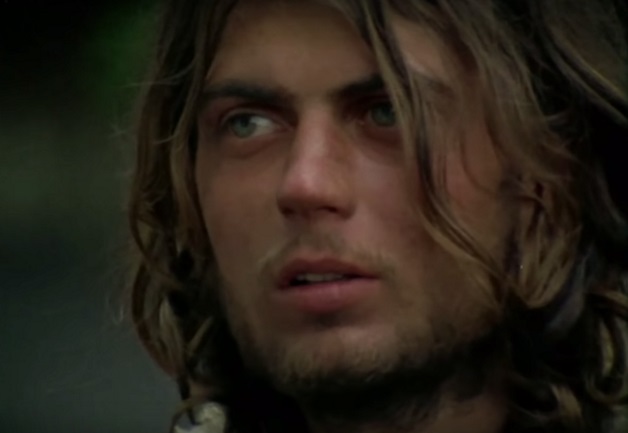
Well, Bill, you are absolutely correct, that sticker is most certainly from Indianapolis. The sticker, which features a bearded B&W beatnik smiley faced character holding up a bright yellow sign reading “WIFE Good Guy”, appears on the left side of the rear window of Lennon’s Circa-1971 Mini Cooper. Indeed, the clip from the documentary features a scene in which a young man named Curt Claudio shows up at Lennon’s house “just to see him.” The house, actually an estate mansion known as Tittenhurst Park, is located in Berkshire, near the town Ascot in England.


In the scene, which can be easily found on Netflix, John is leaning against the pillars of the mansion that date back to 1830, Yoko stands nearby her husband. The disheveled young man, his long hair flowing over the Shearling fur collar of a ragged sheepskin coat, carries on a lengthy, disjointed conversation with his hero from just a few feet away. Given that the scene was filmed mere months after the Manson family murdered Sharon Tate, Jay Sebring and several others under supposed orders from The Beatles White Album and knowing the way Lennon’s life ended less than a decade later, the scene is eerie to behold.
The young man had written several letters, one of which apparently stated, “I’m coming and I just need to look into your eyes and I’ll know.” Apparently Claudio had been secretly living in the rough on Lennon’s 72 acre estate for days. London police wanted to arrest the troubled fan but Lennon wouldn’t allow it, instead opting to gently talk to him face-to-face. Claudio apparently believed that some songs were speaking directly to him. Lennon does his best to dissuade that notion by asking how that could be possible since the two were strangers and stressing, “I’m just a guy who writes songs. Don’t confuse the songs with your own life. I mean, they might have relevance to your own life, but a lot of things do. So we met, you know, I’m just a guy. I write songs.”

Curt Claudio


As Claudio starts to quote the star’s lyrics, determined that the words were about him, John gently counters: “I was just having fun with words. It was literally a nonsense song. I mean Dylan does that… you just take words and you stick them together and you see if they have any meaning. Some of them do, some of them don’t.” Claudio replies: “You weren’t thinking of anyone in particular when you were singing that song?” To which Lennon replies, “How could I be? How could I be thinking of you, man? I’m thinking of me, and at best Yoko if it’s a love song. I’m singing about me and my life, and if it’s relevant about other people’s lives, then yeah, that’s alright.” Claudio looks devastated and his eyes drop to the ground. John then says: “Are you hungry?” gesturing to his friends he adds: “Let’s give him something to eat.” At which point Claudio is invited into the house and is seated at the dining room table with John and Yoko and they all eat a meal together.
For years, there was some confusion as to exactly who Curt Claudio was. Most accounts pegged him as a Vietnam War Vet. Others a hippy strung out on heroin. Still others claimed he was a deranged patient from a San Francisco mental hospital. According to the website “thedailybeatles”, Curt Claudio was born Cesare Curtis Claudio in Alameda, California on August 28, 1948. He graduated with the class of 1966 at Kennedy High School in Richmond, CA. He died in a plane crash in Fremont, CA. on December 22, 1981, a year and two weeks after Lennon’s murder. Part of Claudio’s legend states that he was so devastated by Lennon’s death that he deliberately crashed his own plane to end the pain.

Curt Claudio and Yoko Ono


Curt’s older brother Ernie cleared up the mystery, “Curt was never in the military. He was a straight “A” student in high school and earned a scholarship to the University of California in Davis, CA. Then he started using drugs and dropped out of school. He spent most of his life working on farms. We worked at Ford Motors in Milpitas, California until they closed the factory. Ford gave their employees $12,000 so they could re-train for another job. I asked Curt,” What are you going to do with your $12,000?” Curt said, “I’m either going to buy a Harley or an ultra-light airplane.” He bought the ultra-light, and that’s what killed him. He was flying too low and too slow and the plane stalled. The plane came down, bounced off a carport roof, and landed in a tree, six feet off the ground. The high impact caused his aorta to separate from the heart. Death was instantaneous.”
In 1973, John Lennon sold Tittenhurst Park to his former bandmate Ringo Starr, since Lennon had decided to live long-term in the United States and move to the Dakota (where he died). In 1988, Sheikh Zayed bin Sultan Al Nahyan – President of the United Arab Emirates and former ruler of Abu Dhabi – purchased Tittenhurst Park from Ringo Starr for 5 million pounds. Renovations took place in 1989-1990, during which many elements pertaining to Lennon’s, Ono’s and Starr’s time still on the property were removed. Astonishingly, during those renovations, wall paintings by Lennon were destroyed.


But what about that sticker? The one from the WIFE Good Guys in Indianapolis? Where on earth did that thing come from? Well, I found the just the guy to solve the mystery. And he lives right here in Irvington.

Abe Lincoln, Civil War, Gettysburg, Museums, Pop Culture, Presidents, Travel

Statuary Myths and Urban Legends. John Rogers.

Part II

Original publish date:  October 1, 2020

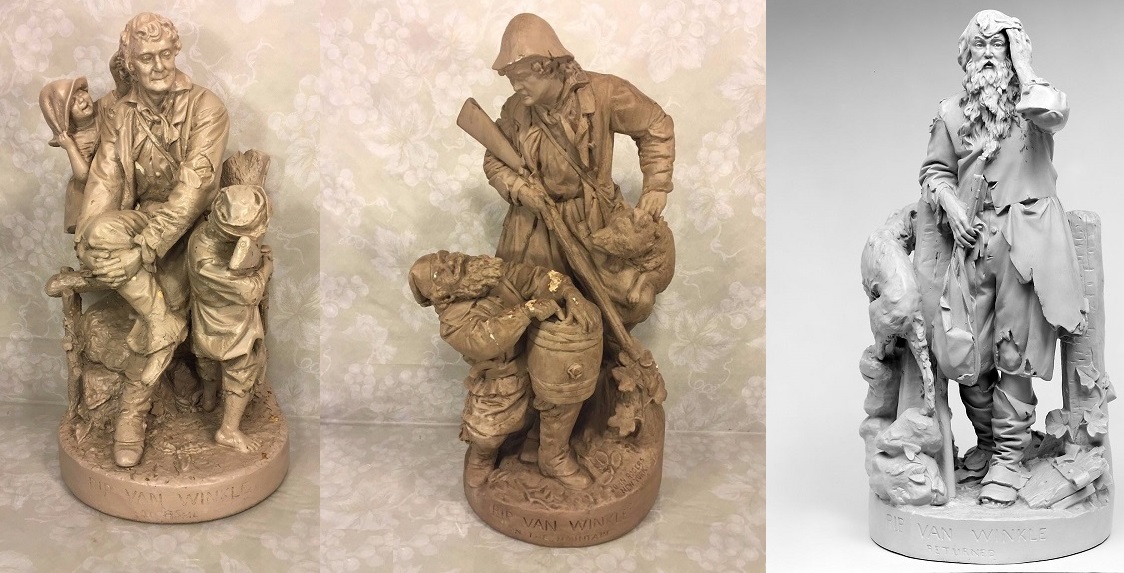
If you are a fan of Victorian decor, or if, like me, you find yourself haunting antique malls and shops, you’re probably familiar with the work of sculptor John Rogers. Commonly known as “Groups” for their routine use of more than one subject per sculpture, Rogers’ work is distinctive for many reasons: historical themes, uncommon accuracy and exquisite detail. Rogers was the first American sculptor to be classified as a “pop artist”, scorned by art critics but beloved by the average American. His themes included literary themes, Civil War soldiers, ordinary citizens, animals, sports and luminaries from the pages of history. For Irvingtonians, his works depicting namesake Washington Irving’s Rip Van Winkle are particularly prized.

zz s-l1600

John Rogers Rip Van Winkle Series.

I have a few in my office and one of my favorite places to eat, the “Back 40 Junction” in Decatur, is decorated with many John Rogers groups throughout their restaurant.
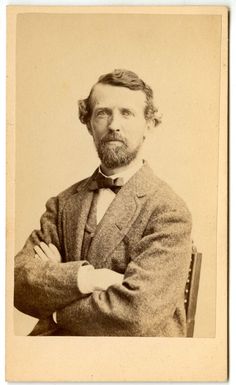
John Rogers was born in Salem, Massachusetts, on October 30, 1829, how can Halloween fans not love him already? His father, an unsuccessful but well-connected Boston merchant, felt that an artist’s life was no better than a vagabond and discouraged his artistic son from pursuing art as a profession. So, Rogers confined his love of drawing, painting and modeling in clay to his spare time. In 1856 Rogers ran away to Mark Twain’s Hannibal, Missouri where he worked as a railroad mechanic. Two years later, he moved to Europe to attain a formal education in sculpting. His first group, in 1859, he titled “The Slave Auction”. It depicts a white auctioneer as he gavels down the sale of a defiant black man, posed arms crossed, with his weeping wife and babies cowering at the side. Rogers, a strong abolitionist, was making a statement against slavery but New York shopkeepers refused to display his work in their windows for fear that the controversial subject matter would drive customers away. So Rogers hired a black salesman to peddle the statue from door-to-door and in a short time, Rogers’ statue, described as “Uncle Tom’s Cabin in plaster” became a best seller.

z john rogers cdvz artistic-sm

Sculptor John Rogers.

That same year, Rogers went to Chicago, where he entered his next statue, titled “The Checker Players” in a charity event, which won a $75.00 prize and attracted much attention. Rogers soon began rapidly producing very popular, relatively inexpensive figurines to satiate the average Gilded Age citizen’s thirst for art. Over the next quarter century, a total of 100,000 copies of nearly 90 different Rogers Groups were sold across the United States and abroad. Unsurprisingly, the next few years were filled with Rogers groups depicting scenes from the Civil War to honor their soldier boys serving far from home. These statues would remain popular with veterans after the war as well.
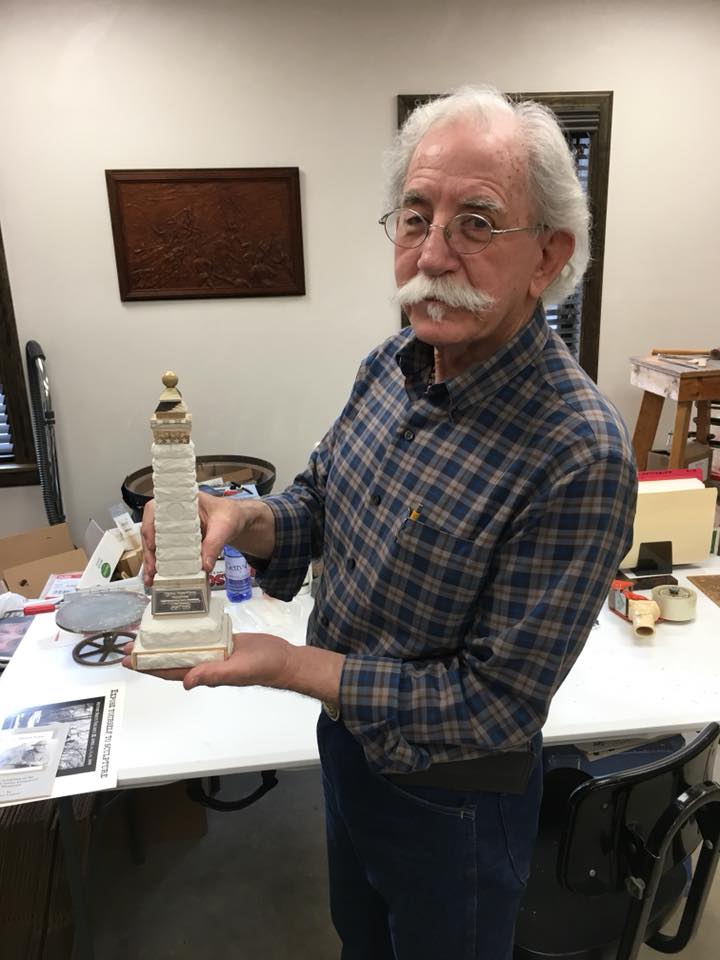
Gettysburg Longstreet monument sculptor Gary Casteel remarked, “Rogers is very well known as an American sculptor. More for his collection of small group settings rather than large public works. Both are excellent in detail and representation. His collection of CW related plaster cast pieces are quite well know and continually sought after by collectors to this day.” Rogers’ work was innovative, preferring to create his statuary based on every day, ordinary scenes from life. While Rogers’ work rarely made its way into art museums, it did grace the parlors, libraries and offices of Victorian homes around the world. However, there is one work that stands out among the rest, for subject matter, realism, and controversy.

1967.114_1.tif
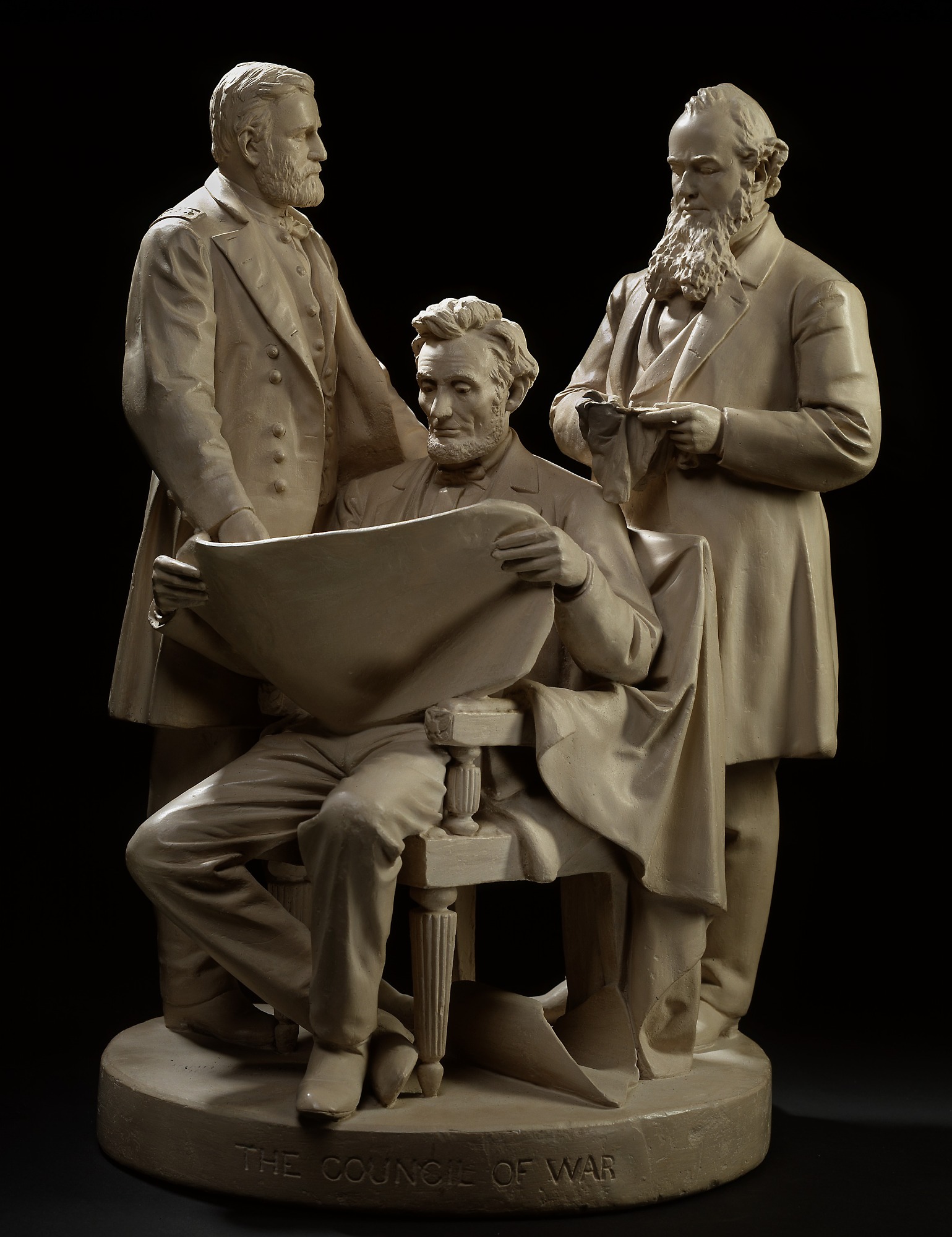
                                                         Rogers’ Council of War.

“The Council of War”, created in 1868, stands 24 inches tall and, like all of Rogers’ groups, was designed to fit perfectly on a round oak “ball and claw” footed parlor table. It depicts Abraham Lincoln seated in a chair, studying a map held in both hands, as General Ulysses S. Grant and Secretary of War Edwin Stanton confer over his shoulders. The June 1872 issue of the “American Historical Record” describes the scene: “The time is supposed to be early in March, 1864, just after Grant was appointed a Lieutenant-General and entrusted by Congress with the largess and discriminatory power as General-in-Chief of all the armies. The occasion was the Council at which the campaign of 1864 was determined upon, which was followed by Grant’s order on the 1st of May for the advance of the great armies of the Republic against the principal forces of the Confederates.”

31421516_1822681181096470_5411414843112554496_n

Gettysburg Sculptor Gary Casteel.

Both Robert Todd Lincoln and Edwin Stanton proclaimed this version of the President to be the best likeness of the man either had ever seen. Secretary Stanton wrote to the sculptor in May of 1872 stating, “I am highly gratified with the genius and artistic skill you have displayed. I think you were especially fortunate in your execution of the figure of President Lincoln. In form and feature it surpasses any effort to embody the expression of that great man which I have seen. The whole group is very natural and the work, like others from the same hand, well represents interesting incidents of the time.” Although the two surviving subjects received the piece positively, the public allegedly saw it differently: quite literally.
The controversy surrounding the pose arose based upon the positioning of Stanton behind Lincoln. Stanton, is posed polishing his spectacles, held in both hands, directly behind the President’s left ear approximately where Booth’s bullet entered Mr. Lincoln’s head. The pose is thought to have aroused the ire of collectors who believed the awkward positioning somehow stirred memories of the assassination. Hence, John Rogers made three versions of this particular group to appease those sympathies. Although the depictions of Grant and Lincoln remained the same in all three, Stanton’s hands were emptied and placed at his side in the second version and then changed back to polishing his glasses, this time forward of Lincoln’s head, in the third version. Some historians surmise the changes were affected due to the alleged theory of Stanton’s involvement in Lincoln’s murder that were circulating at the time. On the other hand, art historians claim the change was made for purely structural purposes and ease of casting to prevent breakage.
Modern day sculptors like Gary Casteel utilize many of the same methods as Rogers did a century-and-a-half ago, just as Rogers used those techniques he learned about while studying in Europe. Casteel, who like Rogers, also studied sculpture in Europe, says, “Every sculptor has his own way of sculpture production. However, there are probably similarities. I do a lot of detail as he did just simply because it’s my natural style.” The advantage that Gary Casteel has is the internet. Gary has a website and blog (Casteel Sculptures, LLC / Valley Arts Publishing) that walks his “fans” through the process of wood, wire & clay step-by-step. If you have an interest in the process, I highly recommend you subscribe to Gary’s blog. Watching Gary’s scale sculptures of the ornately detailed monuments of Gettysburg might better explain that Rogers’ changes in his Council of War group may not have been all about myth and urban legends after all.
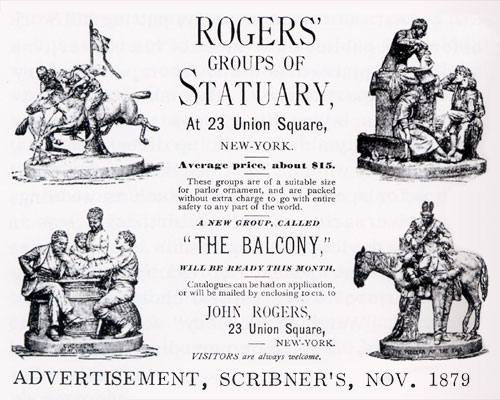
At the height of their popularity, Rogers’ figurines graced the parlors of homes in the United States and around the world. Most sold for $15 apiece (about $450 in 2020 dollars), the figurines were affordable to the middle class. Instead of working in bronze and marble, he sculpted in more affordable plaster, painted the color of putty to hide dust. Rogers was inspired by popular novels, poems and prints as well as the scenes he saw around him. By the 1880s, it seemed that families who did not have a John Rogers Group were not conforming to the times. Even Abraham Lincoln owned a John Rogers Group. My favorite account of a typical Rogers statue encounter comes from the Great American West. Libby Custer mentions in her book “Boots and Saddles” that her husband, General George Armstrong Custer, carried two prized John Rogers groups (“One More Shot” and “Mail Day”, both depicting Civil War soldiers) from post-to-post on the Western frontier including the couples’ final Indian outpost before the “Last Stand.”
z LibbyandGeorge1.jpg09082017

Libby and George Armstrong Custer.

Libby states, “Comparatively modern art was represented by two of the Rogers statuettes that we had carried about with us for years. Transportation for necessary household articles was often so limited it was sometimes a question whether anything that was not absolutely needed for the preservation of life should be taken with us, but our attachment for those little figures and the associations connected with them, made us study out a way always to carry them. At the end of each journey, we unboxed them ourselves, and sifted the sawdust through our fingers carefully, for the figures were invariably dismembered. My husband’s first occupation was to hang the few pictures and mend the statuettes. He glued on the broken portions and moulded (sic) putty in the crevices where the biscuit had crumbled. Sometimes he had to replace a bit that was lost… On one occasion we found the head of the figure entirely severed from the trunk. Nothing daunted, he fell to patching it up again… The distorted throat, made of unwieldy putty, gave the formally erect, soldierly neck a decided appearance of goiter. My laughter discouraged the impromptu artist, who for one moment felt that a “restoration” is not quite equal to the original. He declared that he would put a coat of gray paint overall, so that in a dim corner they might pass for new. I insisted that it should be a very dark corner!”
z rogersad-500

Another article, this one from the January 1926 issue of “Antiques” magazine, encapsulates the love-hate relationship for Rogers’ work: “The fact that Rogers groups are fragile has made them rare enough to arouse the interest of collectors, although I doubt that they will ever be widely collected or will ever acquire high values. They are too large to be comfortably collected in quantity. Nevertheless there might be some slight activity in Rogers groups among collectors of American antiques and it is to be hoped that existing examples will be preserved for the sake of what they express of life some forty years since.”
In 1878 Rogers opened a small studio at 13 Oenoke Ridge in New Canaan, Connecticut. By the 1890s, his work had largely fallen out of favor. Poor health forced his retirement in 1893. Rogers died at his New Canaan home on July 26, 1904. His studio was designated a U.S. National Historic Landmark in 1965. Rogers sculpted what he saw, drawing his inspiration from the everyday beauty observed by his own eye or that created by his mind’s eye while interpreting the literary works he valued most. Although he died in relative obscurity, his works live on as perfect representations of Victorian Era life at the crossroads of the Gilded Age and the Second Industrial Revolution.