
Original publish date: November 17, 2011 Reissue date: June 20, 2019
The last couple of weeks have witnessed yet another sign of the staying power of the Beatles as a couple of items hit the auction block at two different auction houses in Great Britain. One of them is historically significant while the other is slightly creepy.
On Saturday November 5th, the tooth fairy was denied when a tooth belonging to former Beatle John Lennon was sold by Omega Auction House in Cheshire England. (Admit it, an image of Austin Powers saying “Yeah, baby” just flashed through your mind.) Americans have long parodied the English and their bad teeth. The thought of actually paying money for the tooth of anyone, let alone a Beatle, may repulse and revile you. However, 49-year-old dentist Michael Zuk from Calgary, Alberta, Canada thought enough of the relic to plunk down $ 31,200 to own it.

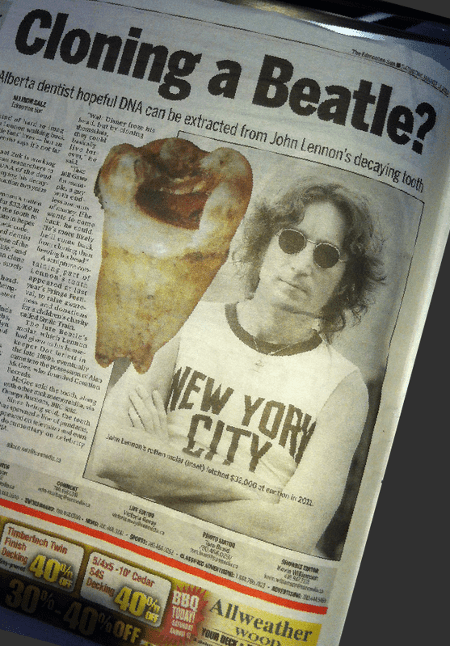
Zuk, a crusading whistle-blowing dentist and author of the 2010 book, “Confessions of a Former Cosmetic Dentist”, has practiced dentistry in the Canadian town of Red Deer for 25 years. He admitted he hoped the high profile tooth purchase might draw attention to his book. He said Lennon’s tooth is another example of how even celebrity’s teeth can be imperfect. “It’s visibly rotten and contains a large hole, Zuk said, adding it’s likely a second or third molar from the lower part of Lennon’s mouth. I’m guessing Lennon may have had an acid reflux problem caused by the rock star lifestyle.” says Dr. Zuk. “That’s my speculation, he had a stomach problem that caused a massive cavity.” Zuk said. The Doctor says he’s already making plans to take it on tour and show it off at dental schools worldwide. He added it could be used for future research. “The nerve of the tooth is dried up and inside,” he said. “But that’s where DNA would be if in the future people are interested in trying to clone John Lennon.”
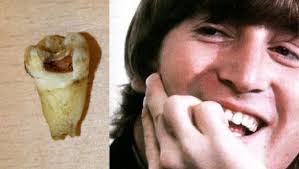 The molar, slightly yellowed with heavy coffee stains and a large cavity, was given to Dorothy “Dot” Jarlett, John Lennon’s housekeeper for half-a-decade. The story goes that one day Lennon encountered the housekeeper in the kitchen of his Kenwood home in Weybridge, Surrey. John, having just returned home from a trip to the dentist, gave Dot the tooth wrapped in a piece of paper and asked her to dispose of it for him. Then John paused for a moment and suggested that Dot give it to her daughter as a souvenir, since she was such a huge Beatles fan. Dot Jarlett’s daughter cherished the sacred relic and when she married a Canadian, she brought her Beatle biting bicuspid into the marital union. The tooth has been “living” in Canada for all but a couple of the last 45 years.
Dot Jarlett, who was employed by Lennon from 1964 to 1968, developed a warm relationship with John. Lennon’s mother died in an automobile accident less than a decade before when Lennon was just 17-years-old. He was in his mid-twenties and Dot was in her mid-forties during their association. Undoubtedly, Dot filled a void in Lennon’s life as a much needed maternal figure during her employ, thus strengthening the connection between the two. Dot’s son Barry told BBC News, “He treated her like family because he didn’t really have a very big family and he really looked after my mum. He used to call her Aunty Dot.”
 While “Aunty Dot” is selling the tooth, she plans to keep a leather wallet and a pearl necklace Lennon gave to her after returning from a concert tour of Japan. Lennon gave the Jarlett family many gifts over the years. A few years ago, Dot sold the jacket worn by John on the “Rubber Soul” album cover, also given to her by Lennon. Dot, who is now 90-years-old, said it was the right time to pass it on rather than to risk the tooth getting lost. Auction house experts have determined that the tooth is too fragile to conduct a DNA test but they have no doubt about its authenticity and point to the impeccable provenance that accompanies it.
Of course, this isn’t the first Rock-N-Roll body part to be sold at auction. In 2009, a clump of hair trimmed from Elvis Presley’s head after he famously joined the Army in 1958 sold for $18,300 at Chicago’s Leslie Hindman auction house. Lennon, who was a huge fan of the King, would be pleased to share that stage.
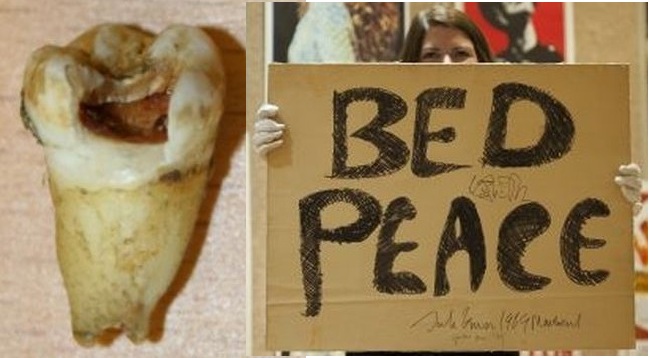
Less sensational, but undoubtedly more historically significant, 10 days later on Tuesday November 16, 2011, a placard for John Lennon and Yoko Ono’s 1969 “Bed-In for Peace” sold for $155,892 by Christie’s International auction house in London. The winning bid for this anti-Vietnam War movement relic came from an unidentified phone bidder. The handwritten cardboard rectangular sign featured the slogan: “BED PEACE” and could be seen behind John & Yoko in the window directly behind them when they spent seven days occupying rooms in the Queen Elizabeth Hotel in Montreal, Canada.
 The Montreal bed-in came two months after the couple’s honeymoon bed-in in Amsterdam and was their take on a sit-in. Lennon’s idea was for protesters to stay in bed and grow their hair rather than doing anything violent. The couple opened their hotel room door to the world’s media and spoke to journalists, politicians and artists trying to promote the idea of peace in the world. They also found time to record the anthem Give Peace a Chance. Many artworks and placards were created over the week and were moved around and given away but the Bed Peace sign was a constant.
The placard, signed and dated by the couple, was acquired by a sound engineer who attended the event. He passed it on to a colleague, whose family kept the relic safe ever since. The message “BED PEACE” was scrawled in black ink on a piece of plain manila colored foam board. The two words were outlined and then colored in with black felt tip by John Lennon himself. John and Yoko produced many artworks during the event but this was one of only two kept prominently above the bed (The other was a sign that read “Hair Peace”). Many were moved around the room and some were given away to friends and fans. However, the sign sold at the Christie’s auction was displayed in the window of the Montreal hotel room (Suite 1742) for the couple’s entire stay. It can be seen in nearly every picture taken of the pajama-bathrobe clad couple as they called for an end to the Vietnam War. The sign includes John’s self doodled mini-portrait of the newlyweds and is signed by both Lennon and Ono.
 The sign is not the only item from the Montreal “Bed-In” to be auctioned by the famed auction house recently. On July 10, 2008, Lennon’s hand-written lyrics for “Give Peace a Chance” sold for $800,000 at Christie’s. When Lennon gave teenager Gail Renard his scribbled lyrics to “Give Peace a Chance” in 1969, he told her to hold on to the cue card. “It will be worth something someday,” predicted Lennon. She did, and it was.
Renard, a teenage fan who sneaked past security guards, was among the first to arrive. She befriended Lennon, helped look after Ono’s young daughter, Kyoto, and made copies of the song Lennon wrote during the “bed-in” so their friends could read the lyrics and record it in the room. “It was a bit ‘Mission Impossible,'” Renard recalled. “It was back up back staircases and fire escapes and waiting until the security guard — until nature called — and the moment he went away, running in, knocking on the door, and Yoko answered, and I said, ‘Could we have an interview for a school magazine?’ and she said, ‘Yes’! ” They were wonderful. We were lucky. It was before the world’s press got in, and they had just arrived, and John was very tired and hungry, and they couldn’t get room service yet, and I had a Hershey bar in my handbag, and I said, ‘Would you like a chocolate bar?’ And he went, ‘Yes, please.’ And we bonded over a Hershey bar! … He was a lovely man.”
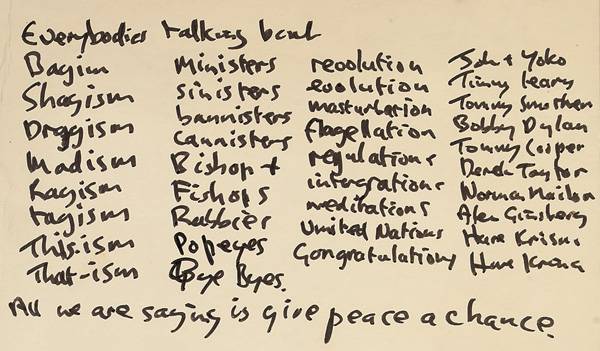
The lyrics, she added, were “on my wall originally, but then somebody pointed out, ‘Is it really wise keeping it on your wall”‘ And it became a responsibility, because it had to go into a vault and things, and I thought, ‘It should be enjoyed. It has to be enjoyed and seen, and remember why John wrote it in the first place. John and Yoko did it for love and peace.'” Renard, now a British-based TV writer and presenter, developed a lifelong friendship with Lennon, who helped launch her journalism career by placing an article she wrote about the bed-in in the Beatles Monthly magazine. The actual recording of “Give Peace a Chance” took about five minutes. It became a worldwide hit after it was touched up in the studio. A number of famous guests, including Timothy Leary, Allen Ginsberg and Tommy Smothers, sang on the record, which went to No. 14 on the Billboard charts. The song is a simple, casual affair recorded without any of the Beatles’ typically high level of musicianship and artistry, but the phrase “Give Peace a Chance” has entered the popular lexicon, surviving long after Lennon’s death in 1980.
Who’d have thought that a cue card, a sign or a tooth could be worth so much money? There was no such thing as rock memorabilia back in 1969. Who could have predicted what a big business Rock-N-Roll would become? 
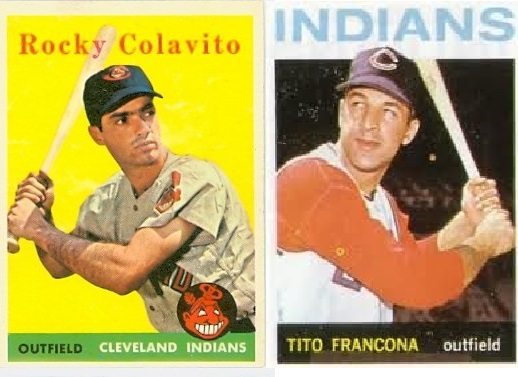
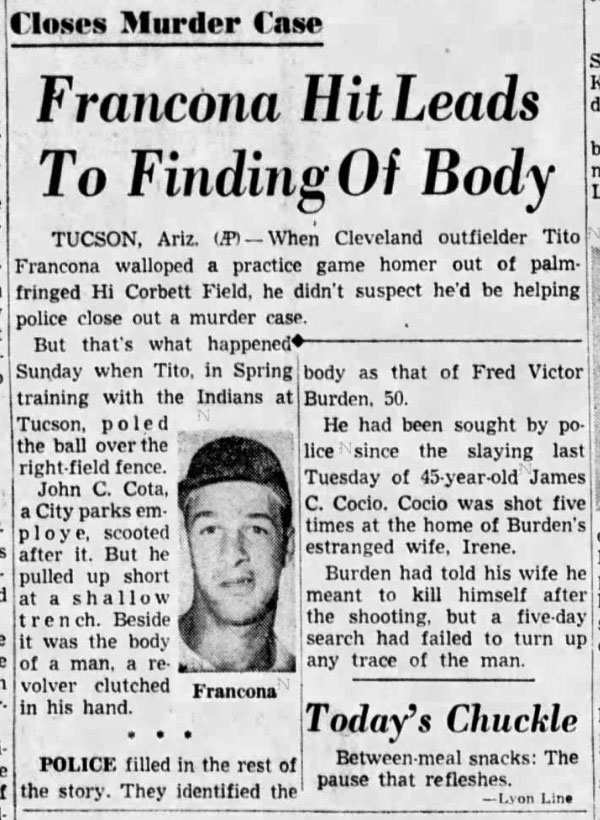 The front page of the Tucson Daily Citizen on March 27, 1961 ran a story headlined, “Practice Homer Leads To Body”. The story detailed, “An over-the-wall smash by Cleveland Indians’ Tito Francona yesterday led to the discovery that Frederick Victor Burden had carried out his threat to commit suicide after killing a man in the home of his estranged wife. Burden’s body, with a bullet in the head, was found by city parks employee John C. Cota, 52, of 238 E. E. 19th St., while he was looking for a ball that had just been knocked over the west wall during the practice at Hi Corbett Field in Randolph Park. The partially concealed body was found lying in a shallow watering trench under low – hanging palm fronds when discovered about 11:30 a m.”
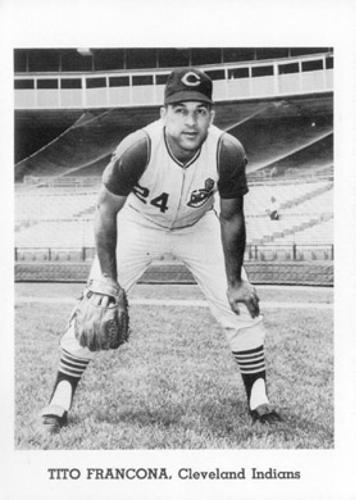 Despite having emerged as the best defensive left fielder in the league, Francona was shifted to first base during spring training in 1962 and finished the season leading the American League in double plays turned as a first baseman. He finished with 14 homers, 28 doubles and batted .272. When Birdie Tebbetts took over as Indians manager in 1963, Francona was moved back into left, but his numbers fell drastically. His .228 batting average was a career low, and his ten home runs and 41 RBIs were his fewest over a full season. The Indians acquired All-Star Leon “Daddy Wags” Wagner to play left field prior to the 1964 season, so Francona split time between right and first base. After the season, he was dealt to the St. Louis Cardinals for a player to be named later and cash.
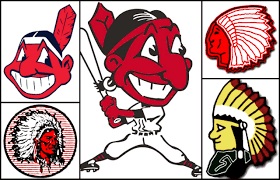 And what about that curse? The curse of Rocky Colavito? Well, in recent years, it has dampened a little with the Indians “rebuilding years” of the past two decades. But. although they’ve played in three World Series Championships since 1995, they still haven’t won one. Here are just a few of the mishaps blamed on that curse since Colavito’s 1960 trade. September 1961: Fireballer “Sudden Sam” McDowell breaks two ribs throwing a fastball. June 1964: Third Baseman Max Alvis suffers an attack of spinal meningitis on a team flight. January 1965: The Indians reacquire Rocky Colavito from the Kansas City A’s in exchange for Rookie of the Year winner Tommie Agee and future 286-game winner Tommy John. July 1970: Reds star Pete Rose plows over catcher Ray Fosse in the All-Star game, effectively ending Fosse’s career in Cleveland. June 1974: Drunken fans pour onto the Cleveland Stadium field during ten-cent beer night, forcing a forfeit while destroying the diamond. March 1977: 20-game winner Wayne Garland hurts his arm in Spring training, effectively ending his career. March 1978: Indians trade Hall of Famer Dennis Eckersley to the Red Sox. July 1981: Cleveland hosts the All-Star game which is delayed until August by the MLB strike. August 1981: 1980 AL Rookie of the Year “Super Joe” Charboneau is sent down to AAA, never to be heard of again. April 1987: Sports Illustrated picks the Indians to win the pennant but they lose 101 games and finish last. March 1993: three Indians pitchers die in car crashes and a fourth is seriously injured. July 1994: Indians are speeding towards the World Series when the season is cancelled by a player’s strike.
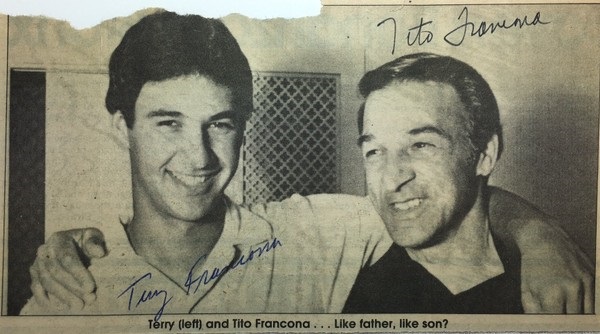 There is so much about Tito Francona that typifies that which makes baseball so interesting. Aside from one of the greatest nicknames in sports history, he was considered a journeyman for most of his career, but a damned good one. Tito Francona was a baseball player, a great husband and father and an even better teammate. When he died at the age of 84 he left a lasting legacy. Tito was there at the beginning of “The Curse” and although he’s gone, he’s likely to be there when the curse ends because “Little Tito” just might lead the Indians to a World Series Championship this season. After all, it was Francona who broke the Boston Red Sox Curse of Babe Ruth by winning two World’s Series titles in four years. Yep, baseball is a funny game.
 Inside the House chamber guests listened to historian George Bancroft (former Secretary of the Navy and the man who established the Naval Academy at Annapolis) talk about “the life, character, and services of Lincoln…forming one of the most imposing scenes ever witnessed in the land.” The address took nearly two hours. The push for a formal celebration quickly spread to state capitals, legislatures and city councils. Most northern states quickly warmed to the idea but bitterness over Reconstruction and the cult of the “Lost Cause” among southerners scuttled attempts to make Lincoln’s birthday a Federal holiday.
 In 1971 Congress passed the Uniform Monday Holiday Act. The law shifted several holidays (Veteran’s Day, Washington’s Birthday, Memorial Day, Labor Day, Lincoln’s Birthday and Columbus Day to name a few) from specific days to a Monday. The reason behind the change was seen as a way to create more three-day weekends and reduce employee absenteeism. The birthdays of George Washington and Lincoln were only 10 days apart, so they were blended into Presidents’ Day.
 Eventually, individual states created their own Presidents’ Day holidays to be observed on the third Monday in February. This celebration has been enacted in some fashion by 38 states, though never federally, and each varies by state. Some mark the day as a specific remembrance of Washington and Lincoln while others view it as a day to recognize all U.S. presidents. Alabama celebrates Washington and Jefferson. A few states still recognize Lincoln’s birthday on February 12 as its own official holiday. Most notably, Kentucky, his birth state and Illinois,his adopted home state, both celebrate Lincoln’s birthday as an official state holiday, along with a few other states including New York, Connecticut, and Missouri. However, this number has declined in recent years, when California, Ohio and New Jersey ended the celebration of Lincoln’s birthday as paid holidays to cut budgetary costs. Unfortunately, more states now celebrate Black Friday as a holiday than celebrate Lincoln’s birthday. Indiana and Georgia are a couple states that recognize Lincoln’s Birthday on the day after Thanksgiving aka Black Friday.
 In most states, Lincoln’s birthday is not celebrated separately, as a stand-alone holiday. Instead Lincoln’s Birthday is combined with a celebration of President George Washington’s birthday (also in February) and celebrated either as Washington’s Birthday or as Presidents’ Day on the third Monday in February, concurrent with the federal holiday. Good for George Washington. Sad for Abraham Lincoln. Once upon a time, Lincoln’s birthday was a milestone for Americans to pause and honor greatness.
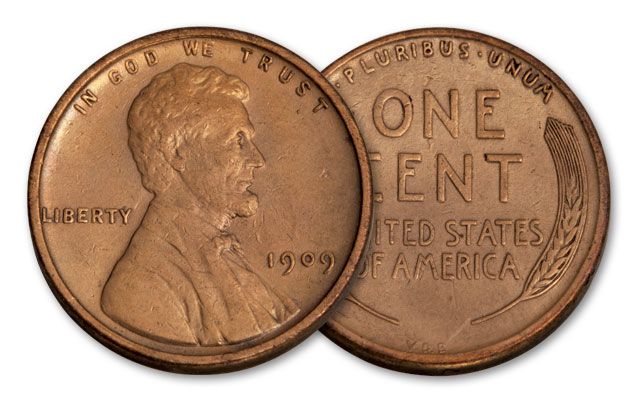 Regardless, the U.S. Mint still produces more than 13 billion pennies annually. That’s approximately 30 million pennies per day; 1,040 pennies every second. More than two-thirds of all coins produced by the U.S. Mint are pennies and the U.S. Government estimates that $62 million in circulated pennies are lost every year (according to Bloomberg). In fact, the penny is the most widely used denomination in circulation and it remains profitable to make. Each penny costs .93 of a cent to make, but the Mint collects one cent for it. The profit goes to help fund the operation of the Mint and to help pay the public debt. The average penny lasts 25 years.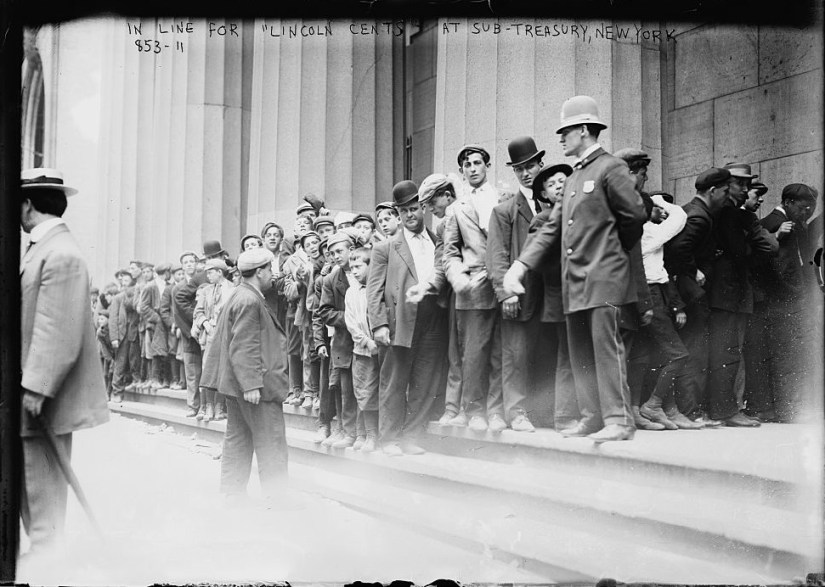


 Almost immediately conspiratorialists saw the Abbey Road album cover as a funeral procession. Leading the procession is John dressed in white, symbolizing the clergy. Next comes Ringo, dressed in black like an undertaker. Paul, the presumed corpse, is third in line and walks out of step with the other Beatles, he is barefoot and his eyes are closed. George brings up the rear, dressed in work clothes the supposed gravedigger. Also, Paul is smoking a cigarette, also known as a “coffin nail”. The fact that he is holding the cigarette in his right hand, even though the “real” Paul McCartney was left handed, only added to the belief that this was an impostor posing as the dead bassist.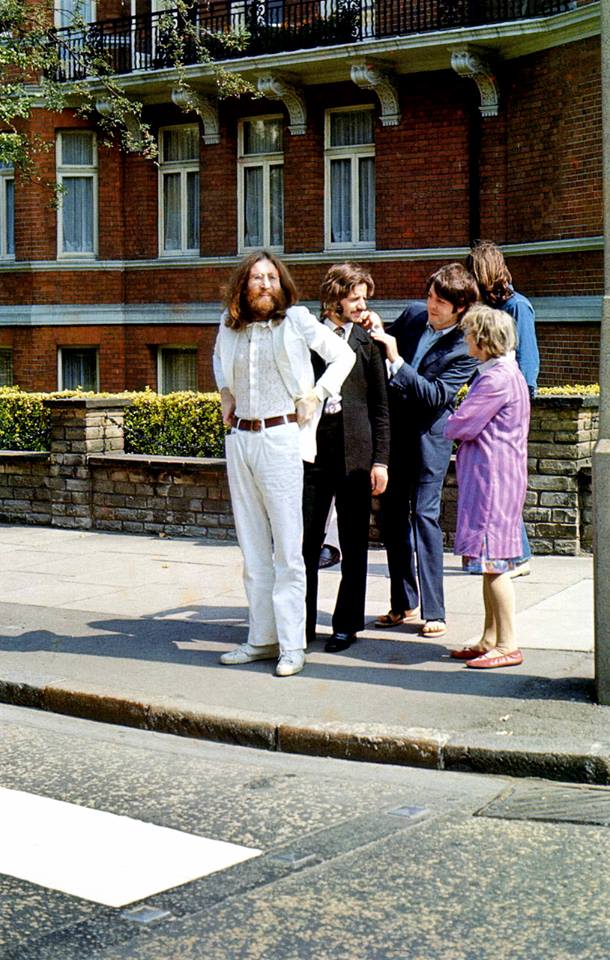
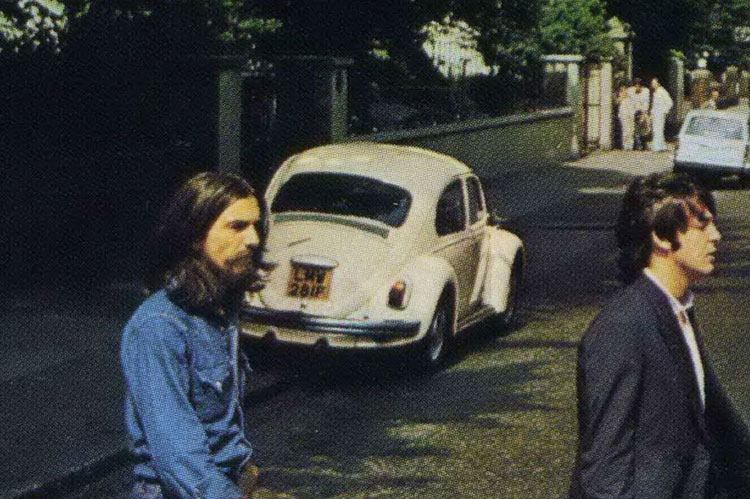 The death clues were not confined to the image of the lads in the crosswalk however. For behind the Beatles on the left side of the street is a Volkswagen Beetle with a license plate reading “LMW 28IF”, suggesting that Paul would have been 28 if he were still alive. Actually Paul would have been 27 when Abbey Road was released. This seeming miscalculation was explained away by the rumorists with the fact that Paul studied mysticism in the Near East. Most mystics believe we are all one year old at birth (counting the nine months of pregnancy) confirming that Paul would have been 28 IF he had lived!.” The first three letters on the license place, “LMW,” were interpreted as “Linda McCartney Weeps”. On the right side of the road is a police van, seen as a reference to the cover up of Paul’s death by police.
 Perhaps as expected, the clues are not only confined to the front cover, for devoted clueseekers, many hidden secrets can be found on the back cover as well. To the left of the tiles spelling out “Beatles” are eight dots, which when connected form the number “3”, so the back cover actually reads “3 Beatles”. Also, there is a crack in the “S” at the end of “Beatles”. Some say that to the right of the tiles is an odd shadow that looks like a skull.
 Finally, on the “Let It Be” cover, the album cover is black. Said to symbolize the end, or death, of the Beatles. Or maybe it was to symbolize the death of a Beatle? The background squares of John, George, and Ringo’s photos are all adorned in white. While Paul’s square is depicted with a blood red background. Also, Paul is shown facing forward rather than in three-quarter profile. Another indication of Paul’s death is seen by the fact that he grew a beard, seen by some religions as a sign of death and mourning. The rest of The Beatles’ beards are clues as well, as they all indicate that the three surviving members are in mourning for their lost bandmate.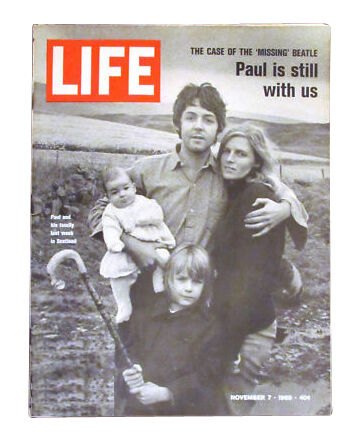

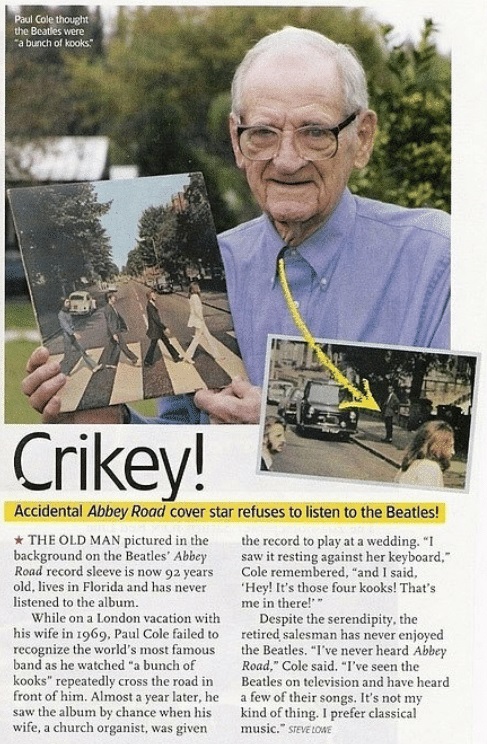 Cole, a Florida salesman, was on vacation with his wife, who wanted to go see “yet another museum.” Mr. Cole decided to wait outside on the north London thoroughfare. Cole watched as photographer Iain McMillan stood on a stepladder in the middle of the street, photographing the four Beatles as they walked, single-file, across Abbey Road. The entire shoot lasted 10 minutes. “I just happened to look up, and I saw those guys walking across the street like a line of ducks,” Cole remembered. “A bunch of kooks, I called them, because they were rather radical-looking at that time. You didn’t walk around in London barefoot.”

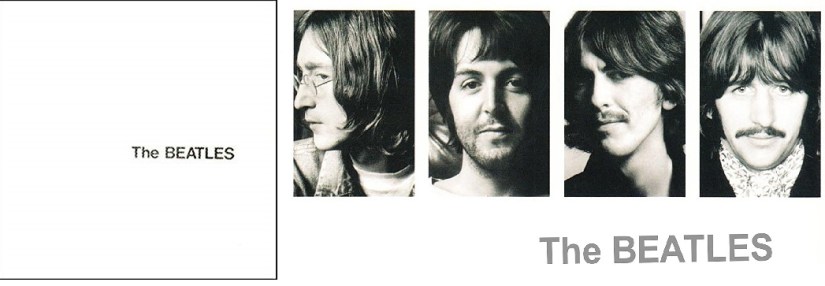 The stark snow white album cover was seen as an obvious reference to the white light of heaven, where Paul was supposed to be at its release. But it was the poster issued inside the white album (a collage featuring a number of random images of the Fab Four) that came under the scrutiny of those looking for “Paul is Dead” clues. In the lower right hand corner of the poster (page 7 of the CD booklet) is a grainy B&W photo of Paul dancing. Upon close examination, a pair of ghostly hands can be seen reaching toward Paul from behind.
 The song “Glass Onion” makes a number of references to Beatle songs and events. John mentions “The Fool on the Hill” and states, “I tell you man he living there still” thought by some to symbolize heaven. However, perhaps the most intriguing line in the song is “Well here’s another clue for you all…The walrus was Paul.” Seen as a final bow to his fallen bandmate and co-songwriter. Some sources have suggested that the phrase “goo goo g’joob” is from Finnegans Wake by James Joyce (Alas, the phrase “googoo goosth” is the closest Joyce gets in th book.) Never fear, the “Paul is Dead” rumorists claim that “goo goo g’joob” are the last words uttered by Humpty Dumpty before his fall. A fall that cracked his head open, much like Paul’s supposed fatal car accident.
 Revolution 9 was an innovative sound collage that, quite frankly, soared over most listener‘s heads. Later transcripts of the dialog heard early in the song reveals two men who can be heard saying “I know all about it George. I’m sorry. Will you forgive me? Yes.” Theorists claimed that this was John talking with George Martin about the secret placement of clues on Beatles records. However, the biggest clue to Paul’s death on the track is the title itself, whose repeated phrase “Number 9” is said to sound like “turn me on, dead man” when played backwards. A dark recall to the line “I’d love to turn you on” from “A Day in the Life”.
 Ardent believers believed that other “Backwards” clues could be found on the track “I’m so tired / Blackbird” when some random mumbling is heard that they believe sounds like John and Yoko right after the abrupt ending of “I’m So Tired” and before the beginning of the next song, “Blackbird“. This passage makes no sense when played forwards. However, when played backwards, they believe that you can hear John say, “Paul is a dead man. Miss him. Miss him. MISS HIM!” John Lennon was said to be expressing his grief over Paul’s death in this line of the song followed by the very next line on the record, sung by Paul, “Blackbird singing in the dead of night”, that mentions death.
 Alan E. Hunter