Indianapolis, Politics

Teddy Roosevelt’s emergency at St. Vincent’s Hospital in Indianapolis.

Teddy NoblesvilleOriginal publish date:  June 26, 2014

Editor’s note: Columnist Al Hunter will join author Ray Boomhower on Nelson Price’s “Hoosier History Live!” radio show on WICR-FM (88.7) this Saturday July 5th (2014) at noon. The topic of the show will be Presidential visits to Indiana. 

Teddy Roosevelt was in a tight spot in 1902. Barely a year after being catapulted into the Presidency by the assassination of William McKinley at the Buffalo, New York Pan-American Expo on September 6, 1901, T.R. was facing a revolt in his own party. Midwest Republicans were challenging the GOP on their position with tariffs, monopolistic practices and isolationism. Teddy, at the suggestion of his closest advisers, decided to make an eighteen-day tour of the Heartland to quell the uprising with a series of major speeches. After an early September east coast swing, President Roosevelt once again boarded his private train car “Columbia” for a trip to Ohio, Michigan and Indiana.
On September 3, 1902, while on a scheduled stop in Pittsfield, Massachusetts for a speech, T.R. decided that it was a beautiful day for a carriage ride to see the town. Teddy boarded a landau carriage along with Massachusetts governor Winthrop M. Crane and his private secretary George B. Cortelyou. An FBI agent, William Craig, was driving the team of horses. As in most American cities, a streetcar track ran straight down the middle of the street. Agent Craig carefully steered the President’s open-top carriage alongside the track. The trolleys had been ordered not to run that morning to ensure the safety of the town’s most famous visitor.
Teddy - CopySuddenly, as the carriage topped Howard’s Hill, a screeching sound was heard behind them. Great God! A trolley was seen wildly careening down the hill towards them. In a flash, it slammed into the carriage, throwing the president and his secretary out and onto the street’s grassy berm. The President’s face was bloodied and his leg injured, but in true Roosevelt style, T.R. brushed off his own injuries and rushed to the aid of his horribly injured bodyguard. But it was too late, FBI agent Craig was crushed to death under the wheels of the electric streetcar.
The fair-haired, blue-eyed Craig was born in Scotland in November 1855. Standing 6 foot 4, weighing 260 pounds, he was a giant of man. He spent 12 years in the British military before moving to Chicago’s South Side and joining the Secret Service in 1900. He was a favorite of Teddy Roosevelt. The President said: “The man who was killed was one of whom I was fond and whom I greatly prized for his loyalty and faithfulness.” William Craig was the first agent of the United States Secret Service killed in the line of duty. Officials declared that if the trolley had hit the carriage just two inches to the right the president and his secretary would also have died.
TeddyThe accident was never explained. Rumor was that passengers on the trolley paid the driver to follow the carriage in hopes of glimpsing the Rough Rider himself. Still others speculated that it was another Presidential assassination attempt. The driver of the trolley was sent to jail for six months. The President continued his trip and was able to keep his speaking engagements over the next few days. The now lame President stood and shook hands at a pace of fifty-two hands per minute for three hours at a time at most of these engagements. All the while, Teddy’s leg silently throbbed with pain.
The train left New York on September 20 for his eighteen day speaking tour of the Midwest. At his first stop in Cincinnati, T.R. delivered his planned speech but found that standing was becoming a problem. From Cincinnati the presidential entourage departed for Detroit. Here Roosevelt began quietly complaining about pain in his left leg. The first public indication that there might be something amiss came when T.R. was uncharacteristically unresponsive to questions from the Detroit press pool about the Anthracite Coal strike. He abruptly left the impromptu press conference, retired to the Hotel Cadillac and went to bed.
The next day, he attended a reunion of Spanish American War vets in that city. Although this was Teddy’s forte and these were “his” people, he arrived late and gave a short, labored speech. Instead of his trademark toothy grin, The President grimaced, gasped for breath between sentences and sweated profusely. After his brief address, Teddy stood for 4 hours as the parade of old veterans slowly passed in front of the reviewing stand. By the time the parade ended, Teddy Roosevelt looked like he had been “rode hard and put up wet.”
Teddy Tipton 1By the time of his first stop in Indiana, on Tuesday September 23rd, it was apparent that something was wrong with the trust busting chief executive. It was pouring rain as Teddy addressed the crowd in Logansport with a speech he had planned to deliver in Indianapolis. This speech was supposed to change the position of the presidency on national issues. The town had prepared for the Presidential visit by erecting a large platform at the corner of Seventh and Broadway in front of the High School (today aptly known as the “Roosevelt Building”). At the depot, the Elks Band was waiting to lead the procession of carriages for the special guests’ trip to the courthouse. As the parade moved up Market to Ninth Street, the skies opened and it started to rain. A local skating rink had been decorated as an alternate place for Roosevelt to speak, but Teddy insisted on speaking in the rain.
The crowd of 5,000 enthusiastically cheered their speaker as he took the stand. T.R. looked out across the sea of umbrellas and announced that he could speak in the rain only if the crowd would put their umbrellas down to hear him. The umbrellas were sheathed and Teddy presented his twenty-seven minute speech outlining the issues that troubled his administration. It seemed as though every policeman in Cass County was present and surrounding the stage, watching the crowd intently. Teddy hushed the adoring masses by imploring his countrymen that “Beneficiaries of the new prosperity must look to themselves, rather than government, for the advancement of their welfare.” Teddy Roosevelt, perhaps the most “individual” President this country has ever seen, stressed the word “individual” again and again in his speech. To the rousing cheers of the gathered crowd, Roosevelt awkwardly limped back into the train for the journey to Indianapolis.
Teddy Noblesville 1The Logansport stop must have recharged Roosevelt’s batteries as the train made a stop in Tipton where Teddy addressed another adoring crowd on the courthouse square. Next came Noblesville, where 6000 people packed the courthouse lawn to hear the young lion speak. Keep in mind the population of Noblesville was less than 4,000 people at the time. Here, Roosevelt told the crowd “We war not on industrial organizations, but on the evil in them.”
Immediately after the Noblesville speech, Roosevelt had to be assisted down off the stage onto the street as by now he was having a tough time walking. From here, the schedule called for speeches at the Columbia Club and Tomlinson Hall in Indianapolis. Telegrams were sent from the Noblesville train Station to the Columbia Club on Monument Circle stating that the president was ill. Four surgeons were waiting to check the president before he stepped out to greet the Indianapolis crowd. T.R. struggled through a few comments to the enthusiastic crowd but it was apparent that something was quite wrong. His impromptu remarks were cut short as aides rushed Teddy out to a carriage that rushed him to St. Vincent’s Hospital.
Upon arriving at the hospital, Roosevelt refused any anesthetic for the operation on his infected leg. He joked good naturedly with the surgeons “Gentlemen, you are formal! I see you have your gloves on!” T.R. removed his left shoe and his pants, revealing a golfball sized lump three quarters of the way down his shin. As he lay down on the operating table, Teddy remarked, “I guess I can stand the pain.” The attending surgeon picked, cut and scraped at the lump until the infection slowly began to ooze forth. As the doctor went deep inside the pustule, Roosevelt groaned lowly and asked for a glass of water. It took three separate aspirations before the wound was completely cleaned.
At five o’clock Cortelyou issued a statement that the operation was a success and that the President was now resting comfortably with his leg in a sling. At 7:30, a heavily sedated Theodore Roosevelt was carried out of the hospital, lying stiff on a stretcher, his ashen face shining in the glare of the streetlamps. Hoosiers, gathered on the sidewalks outside of the hospital, removed their hats as the President passed. At 8 pm, the Presidential Train left for Washington. The rest of his trip was cancelled. The fear of blood poisoning, although minimized by White House officials, was a very real concern. Later, Roosevelt had another operation to reopen the wound and scrape the bone to remove any infection. Once again, T.R. insisted that no anesthetic be administered. Yep, Theodore Roosevelt was one tough fellow and he proved it right here in Indianapolis.
Assassinations, Politics

Richard Lawrence and Old Hickory. Andrew Jackson Assassination Attempt.

Jackson attempt January 30 photo                                                   Original publish date:  January 24, 2014
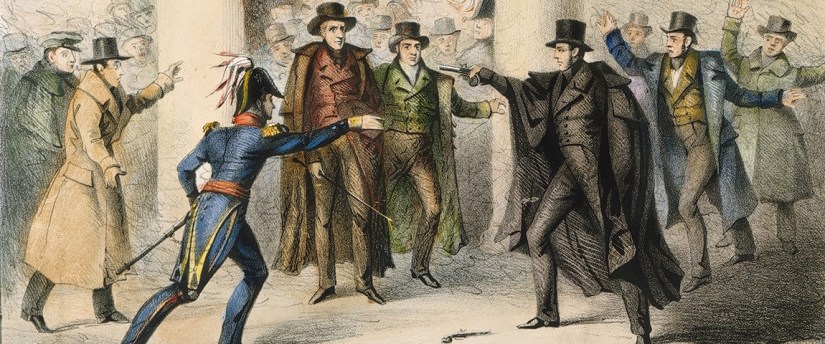
Who is Richard Lawrence and why should you care? In the next few minutes, I’ll introduce you to him, but as for caring, I’ll leave that up to you. Richard Lawrence was a house painter by trade. More importantly, he was the first known person to attempt to assassinate a President of the United States. Still doesn’t ring a bell? Don’t feel bad, the attempt came 179 years ago this week and the President in question was “Old Hickory”, Andrew Jackson.                                                                                                                                                                 

President Andrew Jackson did not know him, which comes as no surprise when you realize that, at the time of the assassination attempt Lawrence did not even know himself. He believed himself to be King Richard III of England who died some 350 years before. Lawrence was born in England sometime around 1800-1801. His family emigrated to America when he was 12 years old and settled in Virginia near Washington, D.C. Lawrence’s childhood and early adult years were apparently normal.                                                                         

Until January 30, 1835, when Lawrence attempted to shoot Jackson outside the United States Capitol, his life was an unremarkable one. Most of what we know of him comes from testimony at his trial. He was described by relatives and acquaintances as a “relatively fine young boy…” who was “reserved in his manner; but industrious and of good moral habits.” Historians speculate that exposure to chemicals contained in the house paints may have fried his brain.
Jackson-Assassination-attempt-Granger-1200X480In November 1832, Lawrence announced to his family that he was returning to England. He left Washington, D.C. only to return a month later claiming that he decided not to go because it was too cold. Within weeks, he changed his mind and told friends & family that he was returning to England to study landscape painting. Lawrence left once again and got as far as Philadelphia before returning home. He told his family that the U.S. government had prevented him from traveling abroad and barred his planned return to England. He further claimed that while in Philadelphia, he read several newspaper stories about himself that were critical of his travel plans and his character. Lawrence told his family that he had no choice but to return to Washington, D.C. until such time as he could afford to hire his own ship and captain and sail away to England.
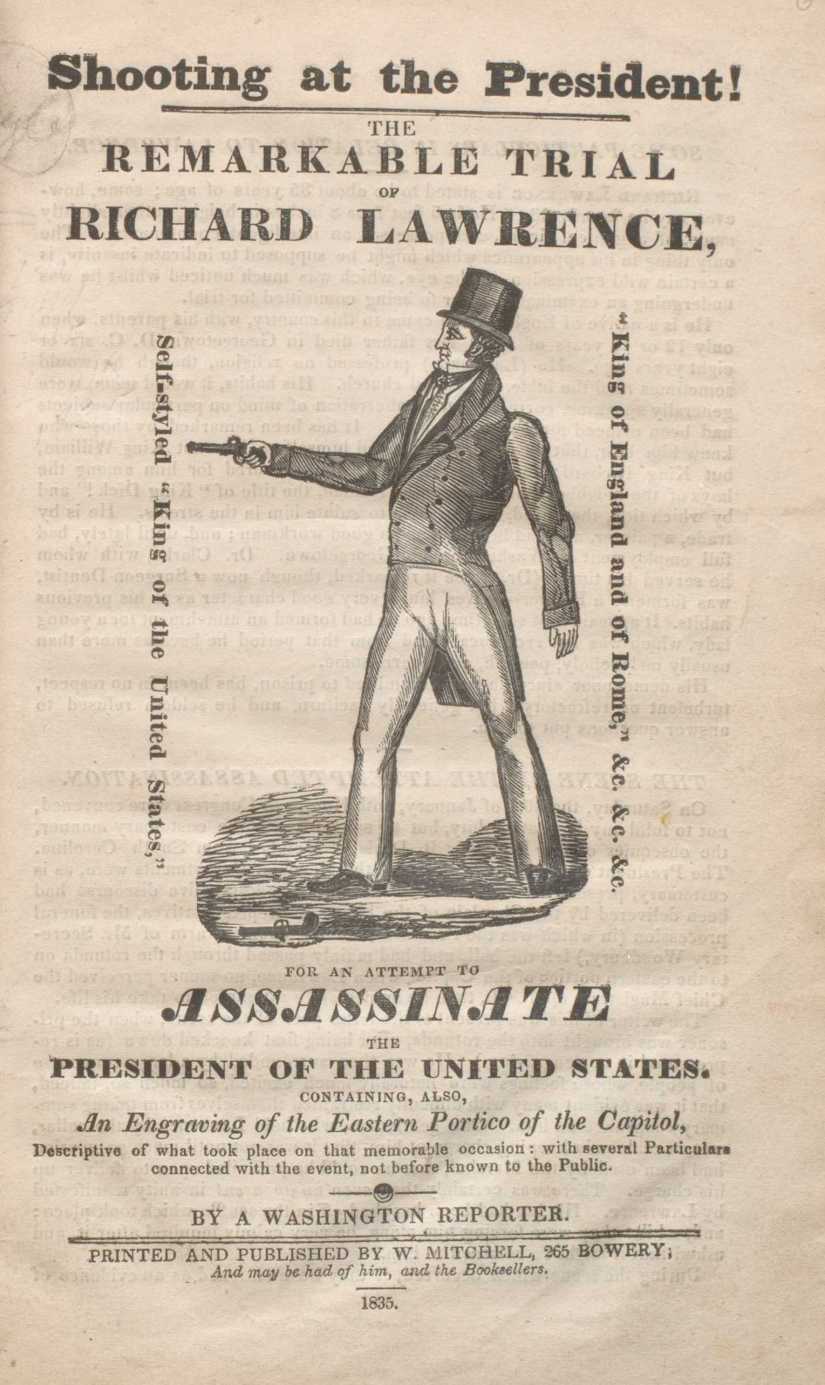
Oh yeah, he also quit his job. When questioned by his sister and brother-in-law with whom he was living, Lawrence stated that he did not need to work because the U.S. government owed him a large sum of money. Lawrence, now claiming to be King Richard III of England, believed he was owed money on two English estates that he owned. In time, Lawrence became convinced that President Jackson’s opposition to the establishment of a national bank was delaying payment on this imagined debt. He felt that if Jackson was no longer in office, Vice President Martin Van Buren would establish a national bank and allow Congress to pay him the money for his English estate claims.

Lawrence’s personality and outward appearance changed dramatically around this point. The once conservatively dressed Lawrence began buying expensive, flamboyant clothing which he changed three or four times a day. Lawrence also took to standing in the doorway of his home for hours staring blankly out into the street. Neighborhood children would jokingly address him as “King Richard”. This typically pleased Lawrence who failed to realize the children were making fun of him. He also became paranoid and hostile towards others. On one occasion, he threatened to kill a maid who he thought was laughing at him.

Lawrence also began verbally and physically abusing his family, mainly his sisters, over imagined slights. In one instance, he threatened to hit his sister with a paperweight because he believed she had been talking about him. At Lawrence’s trial, witnesses described the bizarre behavior he exhibited during this time. Several people testified that Lawrence would engage in nonsensical conversations with himself while others claimed he was prone to laughing and cursing fits.
In the weeks leading up to the assassination attempt, Lawrence began stalking Andrew Jackson. Witnesses often saw Lawrence sitting in his paint shop muttering to himself about President Jackson. On the day of the attempt, he was seen sitting in his shop reading a book and laughing. Lawrence suddenly got up and left the shop with a smile stating, “I’ll be damned if I don’t do it.”
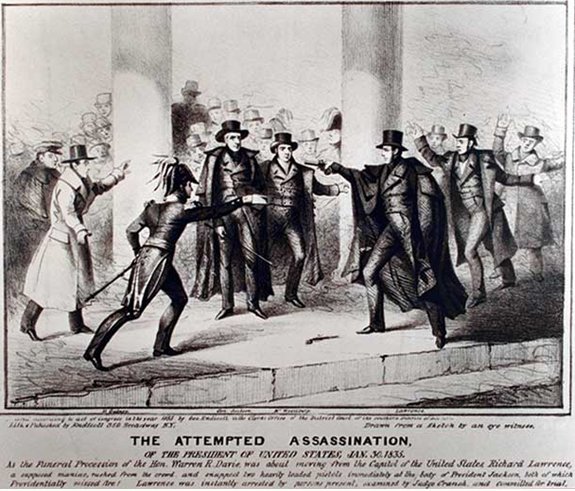
On January 30, Jackson was attending the funeral of South Carolina congressman Warren R. Davis at the U.S. Capitol. Lawrence’s plan was to shoot Jackson as he entered the service but he was unable to get close enough to the President. However, as Jackson left the funeral, Lawrence positioned himself aside a pillar on the East Portico that Jackson would soon pass by. As Jackson passed, the slender man with a thick black beard stepped from behind the pillar, pointed a one shot Derringer pistol at Jackson’s heart from six feet away, and pulled the trigger. A shot was heard, but the bullet never left the chamber.

It was later determined that the percussion cap exploded, but the bullet did not discharge. Now, the deranged house painter found himself face-to-face with a formidable opponent. While everyone else ducked and covered, the enraged Jackson headed straight toward his attacker while raising his walking cane to throttle his attacker. Lawrence dropped the first gun, immediately pulled out a second gun, and again fired at the President’s heart. This time Lawrence squeezed the trigger at point-blank range, but it also misfired. This second shot reportedly went off like the first, with a loud bang, but again no bullet exited the chamber.
Jackson’s aides quickly wrestled Lawrence away from the president, leaving Jackson unharmed. It was probably a good thing for Lawrence that the sides pulled the hero of the battle of New Orleans off of him. Andrew Jackson is said to have killed 13 men in duels and had 3 bullets in his body to prove it. Ironically, one of those who rushed to the President’s aid that day was Congressman Davy Crockett, a staunch political enemy of Jackson, who nevertheless helped restrain the would-be assassin. Crockett later said. “I wanted to see the damnedest villain in the world and now I have seen him!” Witnesses claim that Jackson had to be pulled off of his attacker again and again as he continued to beat him with his hickory cane even after Lawrence was down and completely subdued. Witnesses claimed that Jackson was shouting “Let me alone! Let me alone! I know where this came from!”

Years earlier Jackson had advised a young man on how to wield a cane in combat. He warned that “a cane swung at head level was easy to deflect; rather one should take the stick so [held like a spear] and punch him in the stomach.” He described having once fought a man that way in Tennessee: “Sir, it doubled him up. He fell at my feet, and I stamped on him.” Richard Lawrence later told investigators that the only time he ever felt genuine fear was when he saw the 67-year-old President charge at him.

Needless to say, Jackson didn’t take kindly to this assassination attempt, but instead of getting angry, he got paranoid. At the time, Jackson’s Democrats and the Whigs were locked in a battle over Jackson’s attempt to dismantle the Bank of the United States. Old Hickory was not alone in his paranoia as his vice president, Martin Van Buren, thereafter carried two loaded pistols with him when visiting the Senate. Although Lawrence was found to be a mentally unstable individual with no connections to Jackson or his political rivals, to his dying day, Jackson believed that Lawrence had been hired by his Whig Party opponents to assassinate him.

Jackson also suspected a former friend and supporter turned adversary, Senator George Poindexter of Mississippi, to be involved in the murder for hire. He had hired Lawrence to paint his house just a few months before. Poindexter was unable to convince the voters back home in Mississippi that he was not involved in the plot. When his constituents left, many of his biggest supporters withdrew their support and he was unable to get re-elected. Jackson believed Senator John C. Calhoun was the main person behind the attempt, prompting Calhoun to make a statement on the U.S. Senate floor disavowing connection to the attack. Oddly, nobody ever denied Lawrence’s involvement in a plot, including the gunman himself.
ShootingatthePresidentTheRemarkableTrialofRichardLawrenceLawrence was brought to trial on April 11, 1835, at the District of Columbia City Hall. The prosecuting attorney was Francis Scott Key, author of the Star Spangled Banner. After only five minutes of deliberation, the jury found Lawrence “not guilty by reason of insanity.” In the years following his conviction, Lawrence was held by several institutions and hospitals. In 1855, he was committed to the newly opened Government Hospital for the Insane (later renamed St. Elizabeth’s Hospital) in Washington, D.C. There he remained until his death on June 13, 1861, almost 16 years to the day after his nemesis, Andrew Jackson, died on June 8, 1845.
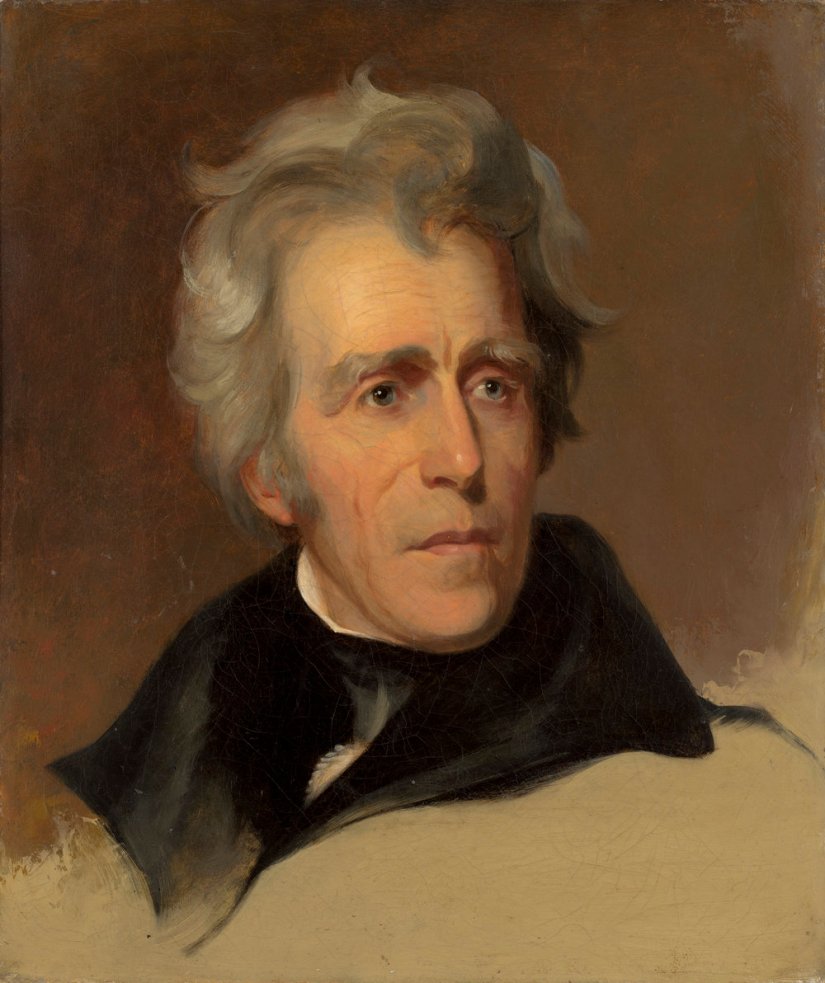
Strangely enough, not only was Andrew Jackson our country’s first commander in chief to be chased by a nut with a gun, he was also the first president to be attacked physically. A year and a half before Lawrence jumped from behind that pillar to fire upon his president, Jackson ordered the dismissal of Robert B. Randolph from the Navy for embezzlement. On May 6, 1833, Jackson sailed on USS Cygnet to Fredericksburg, Virginia, where he was to lay the cornerstone of a monument near the grave of Mary Ball Washington, George Washington’s mother. During a stopover near Alexandria, Randolph appeared and struck the President, drawing a trickle of blood from the President’s mouth. Jackson was seated behind a table at the time, which no doubt lessened the affect of the attack (for both Jackson and his assailant). Randolph fled the scene chased by several members of Jackson’s party, including the well-known writer Washington Irving. Randolph ended up getting away scot-free when Jackson decided not to press charges.

While the finest doctors in Washington were busy listening to Lawrence’s claim to be the king of England, the police were testing “his majesty’s” misfired pistols. They worked perfectly. Astonished witnesses watched as bullets once intended for the President now plowed through inch-thick wood planks at 30 paces. It was later determined that the weapons Lawrence had chosen were known for being vulnerable to moisture and the weather on that date was extremely humid and damp. A century later, Smithsonian researchers conducted a study of Lawrence’s derringers, during which both guns discharged properly on the test’s first try. It was later determined that the odds of both guns misfiring during the assassination attempt were one in 125,000.

Many of Jackson’s contemporaries believed that Old Hickory had been protected by the same “Divine Providence” that protected the fledgling nation. This national pride was a large part of the Jacksonian cultural myth fueling American “Manifest Destiny” expansion in the 1830s. Senator Thomas Hart Benton, who had also once shot at Jackson himself, reflected that “two pistols-so well loaded, so coolly handled, and which afterward fired with such readiness, force, and precision-missing fire, each in its turn when leveled eight feet at the President’s heart . . . made a deep impression upon the public feeling, and irresistibly carried many minds to the belief in a superintending Providence.” To many Americans, Jackson’s survival could be nothing but the work of a higher power.
A13734.jpgIronically, after the attack, Jackson returned by carriage to the White House and got back to business immediately. Several concerned citizens rushed to the President only to find him “calm, cool, and collected as if nothing had happened.” Another visitor arrived an hour later to find Jackson bouncing a child playfully on his knee while discussing the incident with General Winfield Scott. That evening, a thunderstorm swept the D.C. area blanketing the Capitol in thunder, lightning, and sheets of rain. Conversely, most Washingtonians never realized the storm they had just averted. Had those pistols met their mark, a literal firestorm would have swept our young nation. Eventually, the incident fed the legend that became Old Hickory. Love him or hate him, there are no gray areas with Andrew Jackson. He was a true American original.
Indianapolis, Politics

Caroline Harrison-Indianapolis loses a First Lady.

death-at-white-houseOriginal publish date:                 October 20 2013

121 years ago this Friday, America lost it’s first lady, Benjamin Harrison lost a wife and two weeks later, he lost the Presidential election. Caroline Scott and Benjamin Harrison were married on October 20, 1853. The newlyweds lived at the Harrison family home at North Bend, Ohio for the first year until Benjamin completed his law studies aand they moved to Indianapolis and set up his first practice.
During the first few years of their marriage, the couple rarely spent time together, as Benjamin worked to establish his law practice and became active in fraternal organizations to help build a network. In 1854, their first child Russell Benjamin Harrison was born. Not long after, a fire destroyed the Harrison home and all their belongings. Benjamin took a job handling cases for a local law firm and the family managed to recover financially. In 1858, Caroline gave birth to Mary Scott Harrison. In 1861 she gave birth to a second daughter, who died soon after birth.
While Benjamin Harrison’s star rose rapidly in his profession, Caroline cared for their children and was active in the First Presbyterian Church and Indianapolis orphans’ home. Benjamin’s long hours at the law office and his pursuit of a living drove a wedge between the young couple and although Caroline did not complain, the strain showed.
At the onset of the Civil War, both Harrisons sought to help in the war effort. Caroline joined Indianapolis groups that raised money for supplies to help care for wounded soldiers. In 1862, when President Abraham Lincoln issued a call for more troops, Benjamin recruited a regiment of over 1,000 men from Indiana. When the regiment left to join the Union Army at Louisville, Kentucky, Harrison was promoted to the rank of colonel, and his regiment was commissioned as the 70th Indiana Infantry.
In May 1864, the 70th Indiana regiment joined General William Tecumseh Sherman’s Atlanta Campaign and moved to the front lines, and Harrison was promoted to command the 1st Brigade of the 1st Division of the XX Corps. Harrison’s brigade participated in the brutal Battle of Nashville in December 1864, considered by historians to be the “Gettysburg of the West”. On March 22, 1865, Harrison earned a promotion to the rank of brigadier general.
The horrors of the Civil War taught General Harrison what was really important in his life and the tone of his letters to Caroline during the war are filled with a deep passionate tone. When he returned home, she would never again reproach him for neglect. His law practice and his fame grew, and he became a political force.
71035-004-D5F69C40After the war, Benjamin Harrison spent the next decade practicing law and getting involved in politics. He ran for governor of Indiana in 1876, but lost. The Harrison home on North Delaware Street was built in 1874-75, and soon became a center of political activity. Her husband’s election to the Senate in 1880 brought Caroline to Washington, DC, but a serious fall on an icy sidewalk that year undermined her health. In 1883, she had surgery in New York that required a lengthy period of recovery. She had also suffered from respiratory problems since a bout with pneumonia in her youth, and did not participate much in Washington’s winter social season.
In the fall of 1887 Harrison was nominated for President by the Republican Party. In the campaign, Caroline was a definite asset. Her natural charm and open manner offset her husband’s chilly reserve (He often wore gloves to protect him from infection from others, and it bothered him to shake the hands of White House visitors), and the press loved her. In November 1888, Harrison defeated the incumbent Grover Cleveland.
Caroline Harrison was 56 years old when she became first lady. Historians regard her as one of our most underrated First Ladies who, in contrast to her husband’s conservative policies, was earnestly devoted to women’s rights. She became known for her many “firsts” as First Lady. Caroline was the first first lady to deliver a speech she had written herself after she became the first president of the Daughters of the American Revolution.
Caroline’s sister died in early December 1889 at the executive mansion and Mrs. Harrison decided to have the funeral in the east room of the White House. It would be the first funeral in that room since Abraham Lincoln in 1865. In spite of the family tragedy, Caroline went ahead with her plans to raise the first Christmas tree in the White House that same month. She had John Phillip Sousa and the Marine Band play and, for the first time since Sarah Polk was First Lady, there was dancing in the White House.
Perhaps her biggest first came when she had electricity installed in the White House, even though she was terrified by the new technology. Seems that President Benjamin Harrison received a shock from an Edison dc current light switch, after which his family feared touching the switches. Mrs Harrison rarely operated the light switches herself, choosing instead to sleep with the lights on when neither she nor her husband were willing to touch them for fear of electrocution. Servants were often made to turn the lights on and off for the Harrison family.
Caroline_Harrison_cph.3b20942The First Lady was noted for her elegant White House receptions and dinners, but she is most remembered for her efforts to refurbish the dilapidated White House. She was horrified at the filth and clutter and thought the White House was beneath the dignity of the Presidency, describing it as “rat-infested and filthy.” She brought in ferrets to eat the rats, and lobbied to have the White House torn down and replaced with a more regal Executive Mansion. Instead the old building was refurbished from basement to attic, including a new heating system and a second bathroom. The old, sagging worn-out floors were replaced.
She hated the crowded living area and the tourists made it impossible to use the first floor. In 1889 Caroline Harrison found fault with the “circus atmosphere” in the mansion when she found visitors wandering uninvited into the family quarters. Harrison complained about the lack of privacy on the White House grounds, saying, “The White House is an office and a home combined. An evil combination.” She was the first to suggest the addition of office space to the Executive Mansion when she made up very detailed plans to add an East and a West Wing so that the original mansion could be used for entertaining and the family’s living area. Caroline Harrison’s plan was the first to move the office spaces out of the house.
As she worked to remodel the White House, Caroline was careful to inventory the contents of every room. She cataloged the mansion’s furniture, pictures and decorative objects, working to preserve those that had historical value. Caroline unearthed the chinaware of former presidential administrations found hidden away in closets and unused attic and basement spaces. She personally cleaned, repaired and identified which pieces belonged to which past President. She used their items to create a popular museum display case that remains in the White House to this day.
Artistically talented, Caroline taught classes in painting to anyone who wanted to learn and became the first First Lady to design her own White House china. She wanted new china that would be “symbolic and meaningful to Americans.” The first lady placed the Coat of Arms of the United States in the center ringed by a goldenrod and corn motif etched in gold around a wide outer band of blue. The corn represents Mrs. Harrison’s home state of Indiana and 44 stars, one for each state in the Union at the time, made up the inner border.
In the winter of 1891-1892 while she tried to fulfill her social obligations, Mrs.Harrison was frequently ill with bouts of bronchial infections. In March of 1892 she developed catarrhal pneumonia, followed by hemorrhaging of the lungs and was moved to a three-bedroom cottage on Loon Lake in the Adirondack Mountains in July. Following a brief rally, her doctors diagnosed her condition as tuberculosis, which at the time had no known cure or treatment other than rest and good nutrition. Although she briefly recovered at the mountain retreat, she suffered a setback in September and asked to be returned to the White House.
On September 20, she returned to her favorite pale green and silver bedroom in the White House. It was sometimes used as a music room, furnished in pale green plush. One account states that Mrs. Harrison’s bedroom was: “Daintily appointed in pale green and silver, it stands just as Mrs. Harrison left it, and like the rest of the beautified White House, is a memorial to her refined and artistic taste.” Caroline must have been fond of the pale green palate as many of the multi-colored fabric pieces are done in green tones.
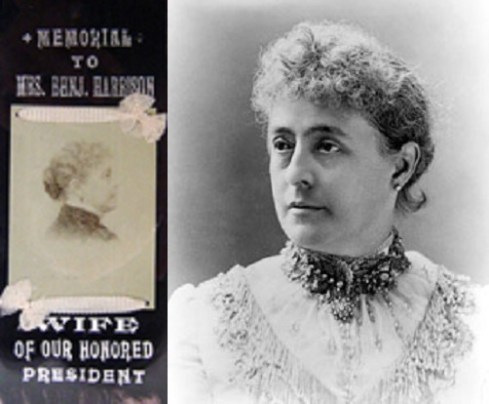
Caroline did not live to see her husband’s defeat for a second term as President. On October 25, 1892, Caroline died at the age of sixty of Typhoid fever. It was an election year, and out of respect for the president’s lady, after her death neither Harrison nor Cleveland actively campaigned for the presidency. Two weeks following her death, Harrison lost his bid for reelection. Daughter Mary Harrison McKee was already living at the White House with her family, and she took up the responsibilities of first lady for the last few months of Harrison’s term.
After private services were held in the East Room, the family brought her back to Indianapolis for interment. An official funeral service was held at the First Presbyterian Church. After the service, the cortege proceeded past the Harrison’s Delaware Street home before going on to Crown Hill Cemetery for burial.
Caroline Harrison’s legacy has proved to be historically important. The current architectural plan of the White House, in particular the East and West Wing, reflects the plan suggested by her in 1889, and the White House china room is certainly a testament to her historical sensitivity in rescuing, repairing and identifying artifacts from previous administrations. Caroline Harrison was not able to use the china she had ordered. She died before it was delivered. It arrived at the White House in December of 1892.
You can honor Caroline Harrison’s memory with a visit to the Benjamin Harrison Presidential Site at 1230 North Delaware Street. The home offers tours daily. Another option, perhaps more consistent with the season, would be to visit her final resting place at Crown Hill Cemetery at 3402 Boulevard Place. Tour Guide and historian Tom Davis will be reprising his popular “Skeletons in the closet” tours (there are 2 different) on October 24, 25, 26 and November 2. Check their web site for specifics. Although I don’t think Caroline’s gravesite is particularly featured on Tom’s tours, I’m pretty sure he’ll take you there if you were to ask him. After all, Tom knows where all the bodies are buried.

Assassinations, Auctions, Creepy history, Criminals, John F. Kennedy, Politics

Lee Harvey Oswald and the death of Innocence. Part I

oswaldshot1Original publish date:   December 7, 2013

Fifty years ago this month, the death of innocence in America began. I believe its roots can be found in a single diary entry made on February 1, 1961 that reads: “Make my first request to American Embassy, Moscow for reconsidering my position, I stated “I would like to go back to U.S.” Nearly two weeks later, on February 13, 1961, the author of that diary entry officially notifies the Embassy that he wants to return to the United States. That disgruntled Cold War continental traveler was Lee Harvey Oswald, the man who killed President John F. Kennedy.
Indeed, a case can be made that the path to the death of innocence in America was paved by many events; the assassination of Abraham Lincoln, the attack on Pearl Harbor, Watergate? However it was the death of JFK that changed America forever. True, three U.S. Presidents were assassinated before Kennedy, but these murders were perpetrated by men best described as “nuts with a cause.” Oswald killed Kennedy for one reason only; fame. Lee Harvey Oswald proved once and for all that one motivated, unknown man with a gun can change history forever. That single act shattered the myth of the invincibility of power and fostered an atmosphere of mistrust of authority that survives to this day.
The assassination of Kennedy is much too complicated to sort out in this simple article and I assume that all of the facts, theories and lore are well known to my readers, so I won’t debate the particulars here. The facts are that both men are dead and both men are forever linked by this one cowardly act. Kennedy was a true American hero; an accomplished author, legendary statesman and devoted father who deserves to be remembered for the way he lived, not the tragic way he died. Oswald is an American nightmare; the product of the original dysfunctional family, a disgraced Marine, a misanthrope who craved fame so much that he didn’t care who he killed to get it. The fact that Oswald’s name is known by millions of Americans disturbs me, but would delight the assassin immeasurably today.
Controversy followed Lee Harvey Oswald for all of his life and doesn’t appear to be waning nearly fifty years after he pulled the trigger. He very publicly supported Fidel Castro’s rise to power in the late 1950s. He defected to Communist Russia at the height of the Cold War in 1960. He changed his mind and returned to the United States, with a Russian bride, in 1961. He tried to kill right-wing Major General Edwin Walker in April of 1963. He killed millionaire President John F. Kennedy with a $ 20 mail order rifle in November of 1963. He was killed two days later in what was the first televised murder in the history of our country. For the next 3 decades he was the central figure in countless conspiracy theories revolving around the death of the President. His body was exhumed in 1981 when rumors persisted that he was not the corpse buried in his own grave. And most recently, his coffin was auctioned for @ $ 87,500 by a California auction house.

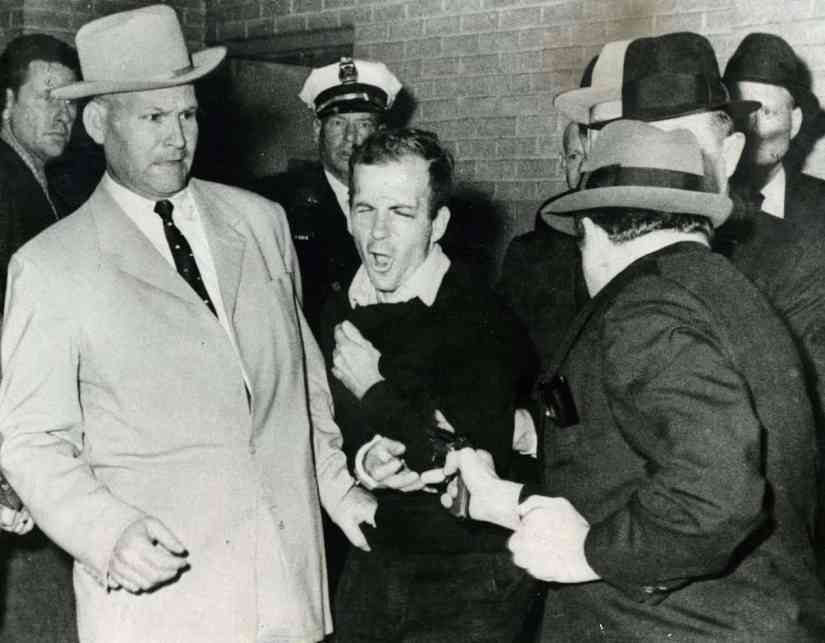
For saleLee Harvey Oswald assassinated John F. Kennedy on November 22, 1963 by firearm from the sixth floor of the Texas schoolbook depository in Dallas, Texas. Later that day, Oswald murdered Dallas police officer J. D. Tippit by shooting him four times on a Dallas street approximately 40 minutes after Kennedy. He was arrested while seated in the Texas Theatre a short time later and taken into police custody. On Sunday, November 24 Oswald was being led through the basement of Police Headquarters on his way to the county jail when, at 11:21 a.m., Dallas strip-club operator Jack Ruby stepped from the crowd and shot Oswald in the abdomen. Oswald died at 1:07 p.m. at Parkland Memorial Hospital-the same hospital where Kennedy had died two days earlier. A network television camera was broadcasting the transfer live and millions witnessed the shooting as it happened. After autopsy Oswald was buried in Fort Worth’s Rose Hill Memorial Burial Park.
In 1981, with widow Marina Oswald’s support, the grave was opened to test a theory from a conspiracy book alleging that during Oswald’s stay in the Soviet Union he was replaced with a Soviet double. The rumor claimed that it was this double, not Oswald, who killed Kennedy and who is buried in Oswald’s grave. The author charged that the remains, if exhumed, would prove it when a surgical scar Oswald was known to carry would not be found. Robert Oswald (brother of Lee Oswald) obtained a temporary restraining order halting the exhumation. Marina filed suit against Robert to allow the exhumation to proceed. Two days later citing emotional and financial burdens, Robert withdrew his opposition to the exhumation.
Backhoes began the process with the onset of sufficient daylight at about 6:30 am Central time on October 4th. The initial plan called for the removal of the entire concrete vault containing the casket. When the excavated vault was found to be cracked it was immediately obvious that the casket and body had suffered extensive water damage. The casket cover was noted to be severely weakened and one section had fallen in, actually exposing the remains to onlookers.
The casket was then covered by a cardboard lid and carefully slid onto a wooden platform placed in the trench alongside the coffin. The entire platform was then raised and placed in a waiting hearse for the trip to nearby Baylor University. The excavation took about two and a half hours, by which time the small crowd had turned into a large one including the morbidly curious and several members of the news media.
The remains arrived at Baylor and the examination began at 10:00 am. The casket was opened and it was obvious that the water that had so damaged the coffin had caused marked decomposition of the body as well. The exposed ribs crumbled with only mild pressure and the beige viscera bag containing the organs (placed in the bag after the original ’63 autopsy) was in full view.
Mortician Paul Groody, who had embalmed and buried Oswald in 1963, remained in the examination room long enough to identify the remains as those he had worked with. First, he observed rings on the hands of the body that were placed there by Marina Oswald. The rings, a gold wedding band and a red stone ring, were the same and seemed to be in the same position as he remembered. Secondly, Groody recognized the aforementioned viscera bag that was not in common use in 1963. Finally, Groody noticed that the clothes were those that he had placed on Oswald before he was laid to rest. After making his identification, Groody promptly left the examination room.
The identification would be made primarily using dental records. However, the team was aware of the craniotomy procedure performed on the skull of the deceased that would provide convincing proof of the identity of the corpse. The head was removed from the body in order to facilitate the examination by an incision near the second cervical vertebral interspace. The autopsy saw cut was indeed present providing the first confirmation of Oswald’s craniotomy procedure.
The teeth were cleaned and photographs and x-rays taken. Two forensic odontologists then charted the complete dentition independently and dental casts were made and a positive dental identification of Lee Harvey Oswald was therefore made. A news conference was held at about 3:00 pm to announce, “We… have concluded beyond any doubt, and I mean beyond any doubt, that the individual buried under the name of Lee Harvey Oswald in Rose Hill Cemetery is in fact Lee Harvey Oswald.”
Perhaps unsurprisingly, in the decades that followed, conspiracy pundits raised identity questions based on the condition of the burial vault and coffin, claiming both had been tampered with, questioned the autopsy craniotomy with the charge that the head had been replaced, and questioned the identification by dental records after it was pointed out that Oswald had lost a front tooth during a high school fight (there is a photo of him in class with a gap-tooth smile, and many classmates remember the fight and the missing tooth) and that the exhumed skull had a full set of natural front teeth. However, Marina had made it clear to the media that she considered the exhumation issue closed.
The murder of John F. Kennedy proved once and for all that a disgruntled, motivated mental defective like Oswald can change the world by a singular cowardly act and bask, however briefly, in the reflected spotlight of their unwitting victim. In some circles, Lee Harvey Oswald has become a sympathetic figure. In truth, he’s a stone cold killer who ruined many lives.
Why do I feel it necessary to delve into the gory details of Oswald’s exhumation and subsequent body defilation? Because, for years I’ve watched film clips of a beloved President’s assassination being played and replayed on television and in movies, undoubtedly at times within eye-shot of his friends, family and loved ones, and I object. I think for once, the wages of Oswald’s crime should be made clear. Lee Harvey Oswald does not rest in peace.

Disney, Politics

Walt Disney Meets LBJ.

WaltAndLBJOriginal publish date:                October 29, 2014

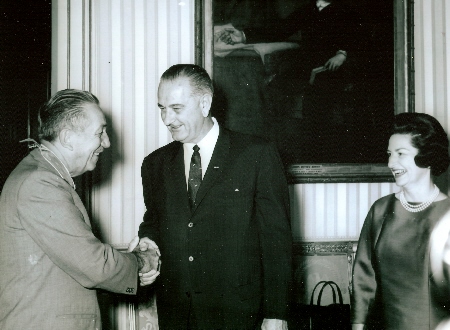
Mid-term elections are over, so I figure it is once again safe to write about politics. Well, sort of anyway. One of my favorite political stories involves a pair of baby-boomer heroes on the eve of the seminal 1964 Presidential election. On September 14, 1964, Walt Disney received the Presidential Medal of Freedom, the United States’ highest civilian honor, from Lyndon B. Johnson. The award recognizes those individuals who have made “an especially meritorious contribution to the security or national interests of the United States, world peace, cultural or other significant public or private endeavors”
There can be little doubt that Walt Disney deserved the honor, but controversy revolves around what Mr. Disney was wearing when he received the medal from President Johnson that day. Controversy from the man who brought us the happiest place on earth. What could that possibly be? Well, when Walt met Lyndon, he was wearing a Barry Goldwater for President button on his lapel. The lapel opposite the one that LBJ would pin the distinguished medal to.
The White House announced on July 3, 1964, that Walt would be a recipient of the Medal of Freedom. It was during the Goldwater campaign, and Walt Disney and his entire family were all united in their enthusiastic support of the Conservative Arizona Senator. Walt felt that it was all a ploy to surround the incumbent Democrat LBJ with people judged to be outstanding Americans for a powerful photo op during the campaign. The invitation came at a time when Walt Disney had bigger things on his mind: the New York World’s fair opening, the first death at Disneyland (Mark Maples on the Matterhorn) and the United States Lawn Bowling Championships. Wait, what? Lawn Bowling?
Betcha didn’t know that Walt Disney was one mean lawn bowler did ya? The White House ceremony was scheduled the Monday after the U.S. Lawn Bowling Championships at Buck Hill Falls, in the Pocono Mountains of eastern Pennsylvania near Scranton. The White House ceremony came at the end of a cross country journey Walt had arranged to take his Beverly Hills lawn bowling team back east to play in a few tournaments. Disney was passionate about lawn bowling at this time in his life. Walt bowled in the championships at Buck Hill Falls surrounded by, and competing against, just plain folk less than a week before he would meet the President of the United States.
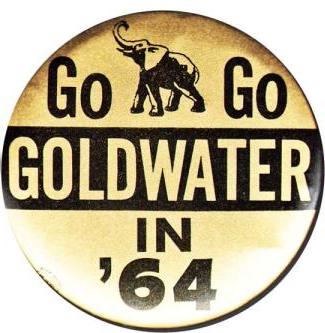
At some point during his bowling sojourn, Walt decided he wanted to wear a Goldwater button to the White House. He asked an aid to get him a Goldwater pin. They got him two; a large 3″ pin with the slogan “Go-Go Goldwater” and a small tie-tac sized metallic gold metal lapel pin that combined the letter “G” and the numerals “64” as shorthand for “Goldwater in ’64”. Walt wore the big button on the plane going to Washington and joked to friends that he was going to wear it to the White House, although no-one really thought that he would.
Here’s where the story gets a little confusing. Some say that Walt wore the small “G ’64” pin in full view on the front of his lapel while others say he wore it pinned upside down under his lapel. Some of Walt’s friends say that he left the larger pin in his pocket while still others claim that he wore it pinned under his lapel. The very lapel that LBJ would pin the medal onto.
When Walt went to the podium to receive the medal from the President, he in some way tried to let Johnson know that he was wearing the Goldwater button. One account has LBJ discovering the pin while pinning the medal on. At the point of feeling the obstruction under the lapel, Walt flipped the lapel up to show the President the pin. Another states that LBJ saw the smaller tie-tac pin while initially pinning the medal onto the opposite lapel. Still another account claims that while Walt was on the podium and at a point when he and the President were face to face, Walt flipped up his lapel to reveal the pin.
For decades, this episode was viewed as an urban legend. It’s only recently that accounts from eye witnesses have surfaced confirming the incident. Although the exact details may remain fuzzy, the event itself has not been denied. Some members of the Johnson administration came forward to admit that LBJ “was not very happy about it…but I don’t think anything was said between them” and that “Johnson did not take Walt’s political commentary with good grace at all.”
One account of the incident comes from Emile Kuri, a longtime set decorator for the Disney live-action films. Kuri was a regular travel companion of Walt’s in the 1960s. Kuri recalls: “Walt didn’t like Johnson at all and he was wearing a Goldwater button. I was wearing the same button. But before I entered the White House, I took the button off. Walt didn’t. When he went into the White House, the aides to Johnson said, “Mr. Disney, please take that off.” He said, “Why should I? I’m voting for him.” You know he had the courage to do that. I didn’t. I had to take my button off. That man had such tremendous courage.”
2013GoldwaterLine-1x10Back in Los Angeles, Walt told his daughter that he had worn the small button openly and that he had worn the larger “Go Go Goldwater” button on the underside of his lapel. He explained this double placement as “So if anyone said anything about it [the small button], I’d flash this [the larger button]… as if to say, ‘which one do you prefer I wear?’ Wearing an opponent’s button visible to LBJ would seem to have been a slap in the President’s face, a rude gesture difficult to reconcile with the Walt Disney legend.
Walter Elias Disney, was born in Chicago and grew up in Missouri. He was a very devout Congregationalist Christian, the religion of his family, and was named after the family minister. Walt’s political leanings are well-known to be conservative, anti-union, and vehemently anti-communist. Disney was a close ally of “Red Scare” zealot Joe McCarthy. Walt even testified against some of his Hollywood peers in McCarthy’s infamous House Un-American Activities Committee hearings. But was Walt Disney a boorish, ungrateful guest in the People’s House receiving an award so prestigious that- like the comparable Congressional Medal of Honor- it must be bestowed by an act of U.S. Congress?
Whatever the exact nature of Walt’s gesture, it was not defiant or insulting. It was more of an expression of Walt’s Midwestern sense of humor. If Walt said anything to LBJ about the incident, it would have surely been in jest. LBJ was well aware of Disney’s support for Goldwater before he bestowed the honor upon him. The subject of Walt’s support for Goldwater came up in one of LBJ’s recorded telephone conversations on September 6, 1964, eight days before the Medal of Freedom ceremony.
Disney was by nature an enthusiast, and in 1964, politics had become one of his enthusiasms. He had gotten to know General Dwight Eisenhower on social occasions at Palm Springs, and in July 1964, just a few days after the Medal of Freedom announcement, he visited the GOP national convention in San Francisco and was photographed there with Ike and his son, John. By wearing a Goldwater button, Walt may have been sticking up for his friends. Probably a mix of motives was at work: loyalty to fellow Republicans, sharp political differences with Johnson, and, perhaps most importantly, a once in a lifetime opportunity to pull the ultimate prank.
Years later, Walt’s daughter Diane said, “It was in bad taste not to remove it when he was received by the President. Dad did not respect Johnson, but did have great respect for the office he held. I was uneasy about what he said he’d done, but I did not let on. Rather, I probably said, ‘Good for you!’ or something like that. Alas, your animated man was not a perfect man. But he was not a coarse man. He did like to do the little unexpected ‘cute’ things like the bride and groom he designed for our wedding cake [the bride figure, representing Diane, was dressed in Levi’s, and the groom figure, representing Ron Miller, was dressed in Bermuda shorts and bare feet—and a football helmet]. He was the consummate gag man.”
WaltAndJohnson0001

Whether you believe Walt Disney was making a political statement or just pulling a gag, this little known episode from the real life of a man whose name, like Ford, Hershey or Firestone, has become an iconic American brand, must surely make you smile.