Disney, Hollywood, Indianapolis, Music

Irvington’s Disney Prince — Bill Shirley

Originally published in 2008, this article was reprinted on December 5, 2024. https://weeklyview.net/2024/12/05/irvingtons-disney-prince-bill-shirley-2/
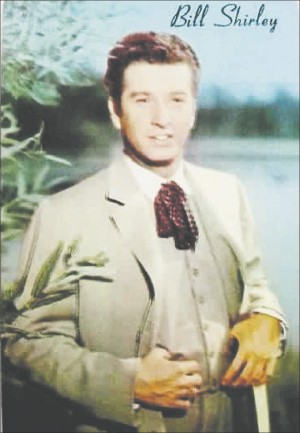
Bill Shirley on his 1953 “Mother’s Cookies” trading card.

During World War II through the I Like Ike years in America, Irvington had its own representative in Tinseltown. Irvingtonian Bill Shirley made fifteen movies starting in 1941 starring alongside Hollywood luminaries like John Wayne, Abbott and Costello, Ward Bond, and the beautiful Audrey Hepburn. Bill played the part of legendary American songwriter Stephen Foster of “”Swanee River” fame and worked with the great Walt Disney as the voice of Prince Phillip in the 1959 Disney classic Sleeping Beauty.
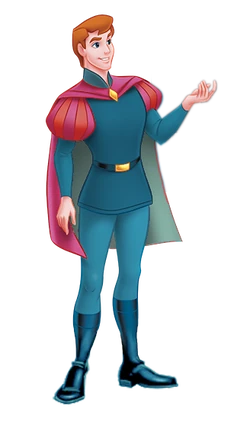
Disney’s Prince Phillip 1959.

Bill Shirley was born in Irvington on July 6, 1921, and attended George Washington Julian School number 57. From his earliest days, Bill Shirley had a natural talent for singing and acting. He would spend his afternoons daydreaming about becoming a star in Hollywood, and his weekends were spent watching his idols on the big screen at the Irving Theatre, located to this day on Washington Street between the intersection of Ritter and Johnson Streets. By the tender age of 7, blessed with a beautiful singing voice, Bill had the rare honor of singing at the Easter sunrise services held annually from 1929 to 1938 on Monument Circle until age 16. Bill gained his acting abilities while performing in musicals and plays at the Irvington Playhouse and Civic Children’s Theater.
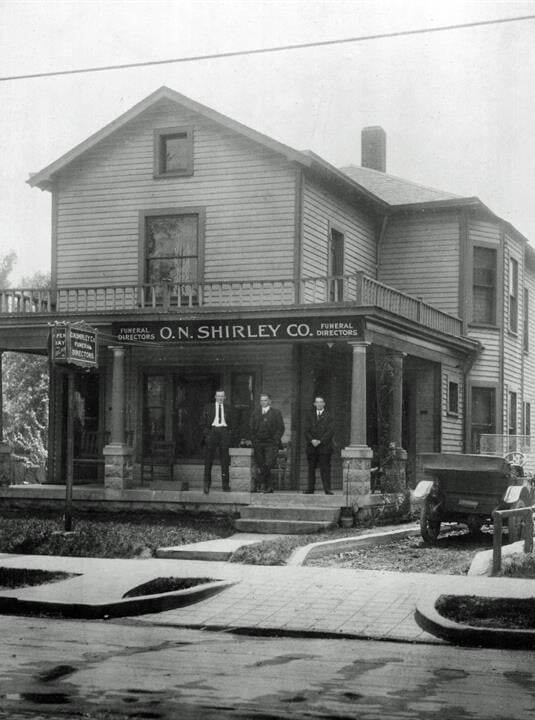
The original O.N. Shirley Funeral Home at 2755 East Washington Street in Indianapolis.

Bill’s father Ottie N. Shirley, along with his uncles Luther and Arley Shirley, formed the Shirley Brothers Funeral Home located at 2755 East Washington St. Bill lived with his family in their home at 5377 East Washington Street until he graduated from Shortridge High School at the age of 18. Immediately after Bill graduated, the family home was remodeled and opened as Irving Hill Chapel, part of the Shirley Brothers mortuary. As soon as Bill completed his studies at Shortridge, his mother packed up their bags and headed for Hollywood. She very wisely hooked Bill up with a voice coach in Los Angeles and almost immediately began to see results. His good looks, along with his mannish voice and natural acting ability, landed Bill a seven-year contract with Republic Pictures at the improbable age of 19. Bill made his first film in early 1941, a musical titled Rookies on Parade starring Bing’s brother Bob Crosby in the lead role. Within a year of arriving in Hollywood, Bill Shirley was cast in seven films for Republic Studios including the John Wayne war film Flying Tigers in 1942. Bill also appeared with one of his childhood idols, Roy Acuff in the 1942 film Hi, Neighbor shot at the Grand Ole Opry in Nashville, Tenn. His other films for Republic included Sailors on Leave and Doctors Don’t Tell in 1941, Ice Capades Review in 1942, Three Little Sisters in 1944, and Oh, You Beautiful Doll in 1949. Bill was uncredited in the film but sang the opening theme for Dancing in the Dark in 1949.
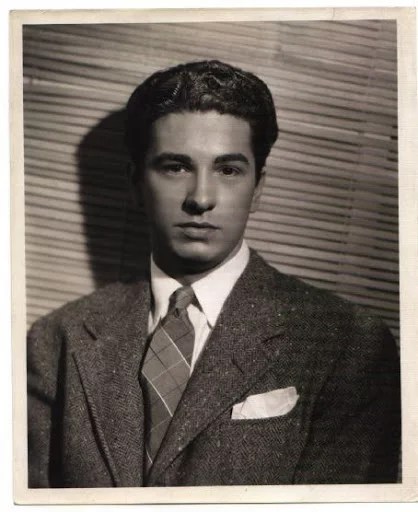
A very young Bill Shirley.

In the summer of 1942, Shirley joined the Army. When he returned at the close of the war, Bill found it hard to pick up his movie career where he had left off. He found a home as a radio announcer in Los Angeles but yearned to return to the big screen. He kept his acting skills sharp by performing on stage in the Hollywood area. He caught a break in 1947 when he was hired to dub the singing of actor Mark Stevens who was starring as Joe Howard, the man who invented kissing, in the entirely forgettable film I Wonder Who’s Kissing Her Now. This voice-over work came back to haunt him later in his career.
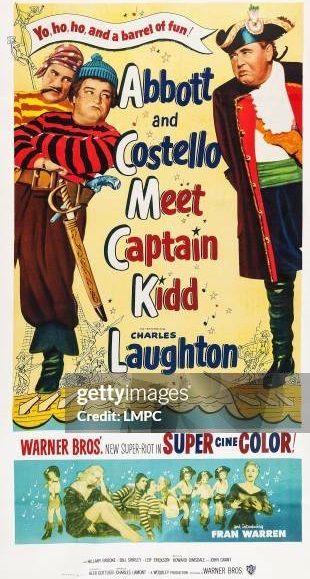
His next big break would come in 1952 when he landed a lead role as Bruce Martingale alongside the comedy team of Abbott & Costello and shared the screen with Academy Award-nominated British actor Charles Laughton in the Warner Brothers film Abbott & Costello Meet Captain Kidd. The critics hated it but the audiences loved this campy film.

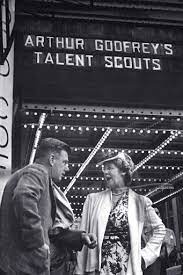
Bill landed the role of historic southern songwriter Stephen Foster in the 1952 film I Dream of Jeannie. He returned to Republic Pictures in 1953 to make the film Sweethearts on Parade. In this role, Shirley, along with co-star Ray Middleton, were being touted as Republic’s answer to the Bob Hope and Bing Crosby duo. It didn’t work. It was a critical and box office disappointment. Today the film is most remembered for the staggering 26 different songs in the film. Bill was a winning contestant on Arthur Godfrey’s “Talent Scouts” TV show which ran from 1948 to 1958. “Talent Scouts” was the highest rated TV show in America and was responsible for discovering stars like Tony Bennett, Lenny Bruce, Jonathan Winters, Connie Francis, and Don Knotts. Bill’s winning accomplishment is notable when you consider that Elvis Presley and Buddy Holly auditioned but were not chosen to appear on the show. It would take Bill six years before he made another film. But it was worth the wait.
In 1959, Bill Shirley made the film appearance he is most remembered for by today’s fans when he appeared as the voice of Prince Phillip in Walt Disney Pictures’ Sleeping Beauty. It was an impressive feat considering that he was one of only three lead voices in the entire film. The film would take nearly an entire decade to produce. The story work began in 1951, the voices were recorded in 1952 and the animation production began in 1953 and did not conclude until 1958 with the musical score recorded in 1957. During the original release on January 29, 1959, the film was considered a box office bust, returning only one-half of the Disney Studios’ investment of $6 million. It was widely criticized as slow-paced with little character development. Time has been much kinder to the film and today’s Disney fans and critics alike hail it as one of the best animated films ever made with successful releases in 20 foreign countries. To date the film has grossed nearly $500 million, placing it in the top 30 highest-grossing films of all time.
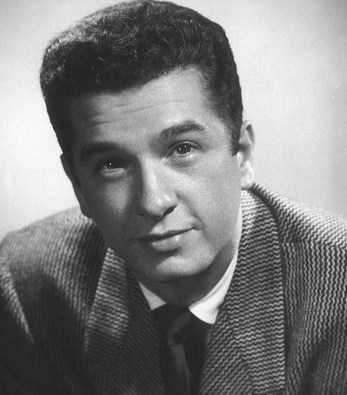
Bill Shirley.

In 1959, Bill Shirley made the film appearance he is most remembered for by today’s fans when he appeared as the voice of Prince Phillip in Walt Disney Pictures’ Sleeping Beauty. It was an impressive feat considering that he was one of only three lead voices in the entire film. The film would take nearly a decade to produce. The story work began in 1951, the voices were recorded in 1952 and the animation production began in 1953 and did not conclude until 1958 with the musical score recorded in 1957. During the original release on January 29, 1959, the film was considered a box office bust, returning only one-half of the Disney Studios’ investment of $6 million. It was widely criticized as slow-paced with little character development. Time has been much kinder to the film and today’s Disney fans and critics alike hail it as one of the best animated films ever made with successful releases in 20 foreign countries. To date the film has grossed nearly $500 million, placing it in the top 30 highest-grossing films of all time.
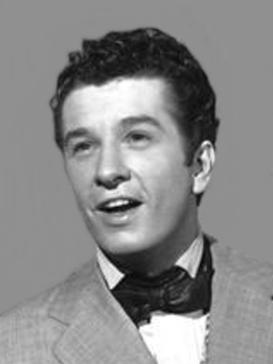
Bill Shirley.

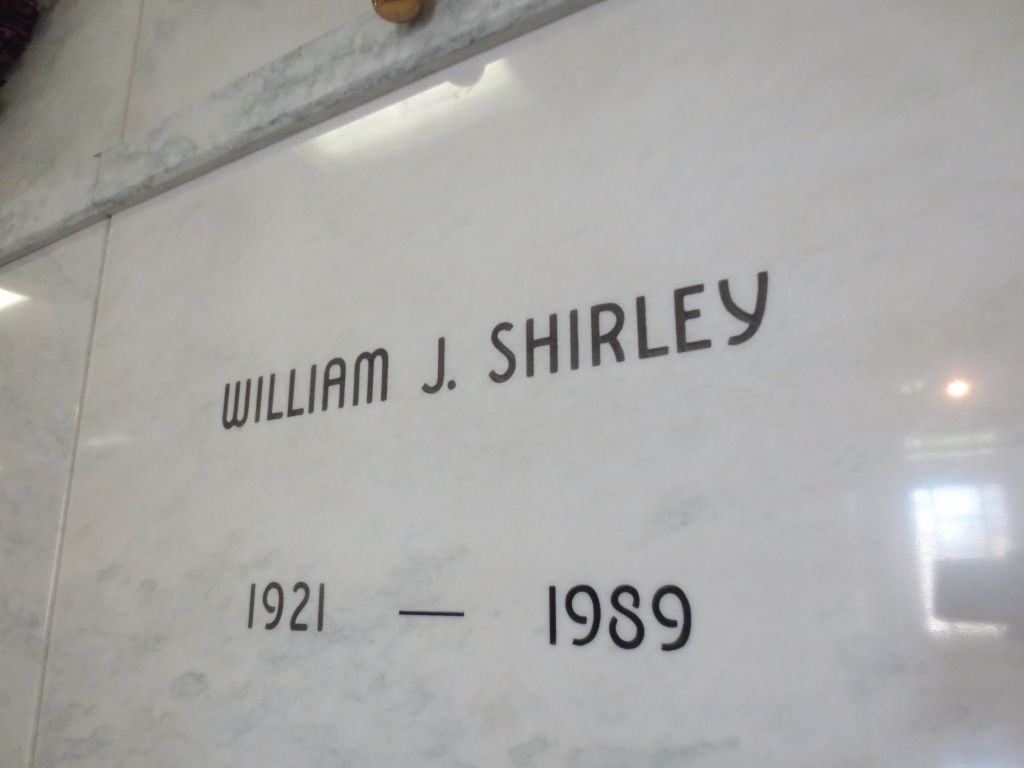
Bill Shirley died of lung cancer on August 27, 1989, in Los Angeles, California. He is buried in Crown Hill Cemetery. By the way, what is the trivia question attached to Irvington’s Bill Shirley? Prince Phillip was the first of the Disney Princes to have a first name. Cinderella’s and Snow White’s previous princes had gone nameless. Bill Shirley’s name may be all but forgotten by most of Indy’s eastsiders, but I assure you that not only has he attained a lasting measure of fame in the film industry, but he has also been immortalized in a way that not even his wildest dreams could have predicted. You see, Bill Shirley appeared in the 1953 “Mother’s Cookies” baseball-style trading card set of up-and-coming movie stars. He’s card # 33 out of the 63 card set of these premium cards that were given away in packs of Mothers Cookies sold in the Oakland/San Francisco region. The card is pretty rare and if you can find it at all, it’ll cost you about $25.
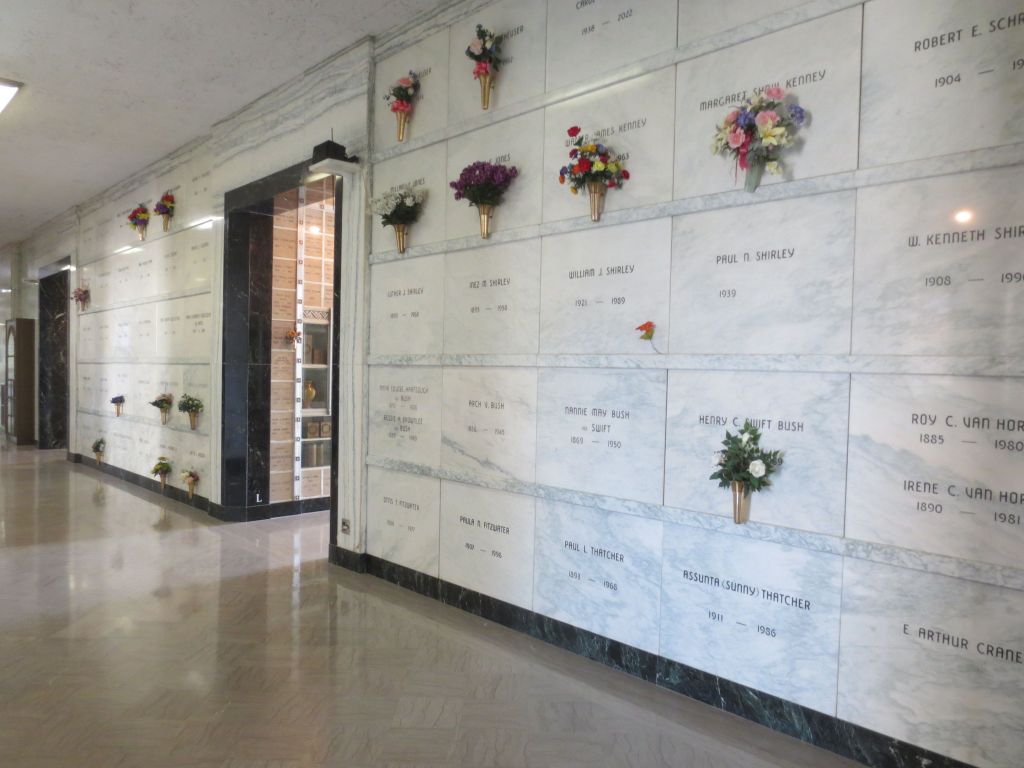
Bill Shirley’s Grave at Crown Hill Cemetery in Indianapolis, Indiana.
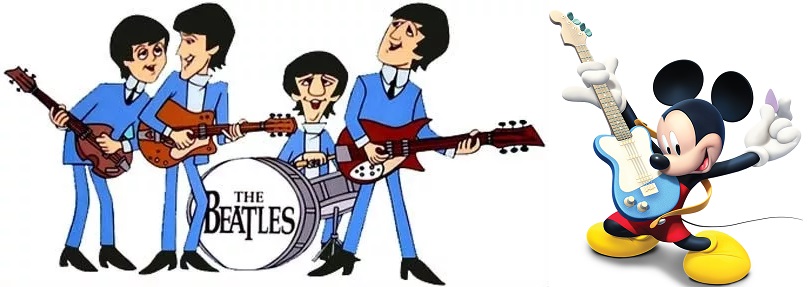
Disney, Music, Pop Culture, The Beatles

The Beatles Hit the Brakes at Walt Disney World.

Original Publish Date: December 19, 2024. https://weeklyview.net/2024/12/19/the-beatles-hit-the-brakes-at-walt-disney-world/

Quick, who broke up The Beatles? Which one of the Fab Four was the first to quit the group? And who was the last Beatle standing? Throw away all you thought you knew about the breakup of The Beatles and settle in for a Beatles Christmas story like you have never heard before. This Beatles breakup story involves John Lennon’s famous “Lost Weekend”, the Sopranos, Al Capone, and Mickey Mouse.


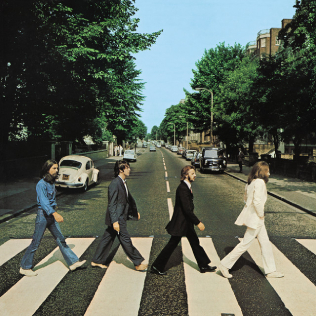
On August 20, 1969, The Beatles met for the last time at Abbey Road Studios to record what was to be the last song on their last studio album: The End. The song, which features the only song Ringo performed a drum solo on, was initially intended to be the final track on Abbey Road, but it ended up being followed by “Her Majesty” a brief tongue-in-cheek music hall song. “Her Majesty” appears 14 seconds after the The End, but was not listed on the original sleeve. Paul McCartney is the only musician to appear on the track. Some observers consider it the first example of a hidden track. The song credited to the “Lennon-McCartney” songwriting partnership brought forth a rare compliment from Lennon when he credited Paul with the line, ‘And in the end, the love you take is equal to the love you make.’ The ever-increasing acerbic Lennon offered a back-handed compliment to his songwriting partner by saying, “it is a very cosmic, philosophical line. Which again proves that if he wants to, he can think.” Thus, The End stands as the last known new recording involving all four of the Beatles during the band’s existence. And before you say it, the album Let It Be, was recorded in January 1970 ON TOP of Abbey Road Studios, NOT inside of it.

The final gathering of all four Beatles came two days later at a photo session held at John Lennon’s Tittenhurst estate. On September 20th, Lennon privately informed his bandmates at a meeting at Apple, without George Harrison present, that he was leaving the Beatles. However, it was unclear to the other members whether John just wanted a break or if his departure was permanent. Legend has it that John Lennon walked out of that 1969 meeting at Apple headquarters screaming “I want a divorce” and four years later, he would get his wish at the “Happiest Place On Earth”. Meantime, on April 10, 1970, McCartney settled the issue in a press release declaring, “I’m quitting The Beatles.” It would take another four years for the breakup to be formalized.

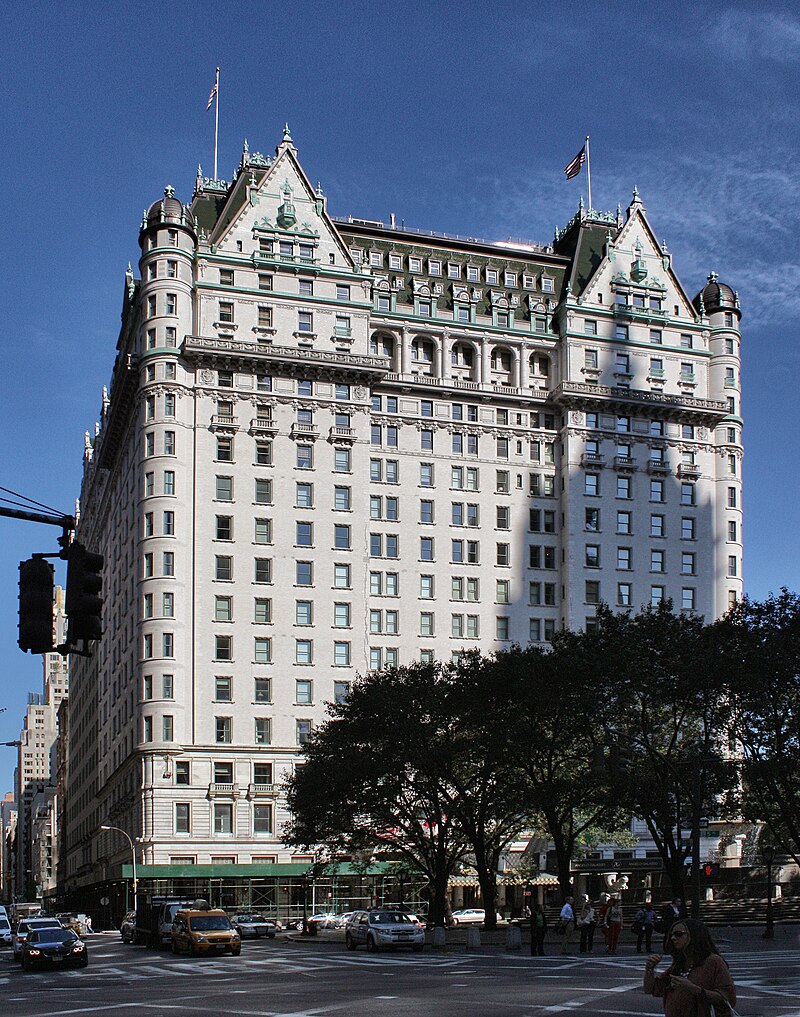
The Plaza Hotel in Manhattan, New York City.

After three years of court battles and ever-increasing acrimony amongst the Fab Four, the final dissolution of The Beatles was set to happen. The meeting was scheduled for December 19, 1974. Ironically it to happened at New York’s Plaza Hotel, the first place The Beatles stayed in America a decade before. As it happened, George Harrison was at Madison Square for two nights on his Dark Horse tour and Paul and Linda McCartney flew in for the signing. Ringo had already signed the documents in England. So, as George, and Paul sat around a large table ready to dissolve the partnership alongside Apple lawyers and business managers, Ringo listened in on the telephone to confirm that he was alive. Everyone present was wondering where John was. Keep in mind, Lennon lived within walking distance of the Plaza Hotel. George Harrison’s lawyer telephoned Lennon for an explanation. May Pang answered and from the background, John’s voice bellowed out, “The stars aren’t right,” to the lawyer’s query. When John’s response came across the speakerphone, everyone present was furious. John explained that he was going to follow his astrological signs and he wasn’t coming to the meeting.

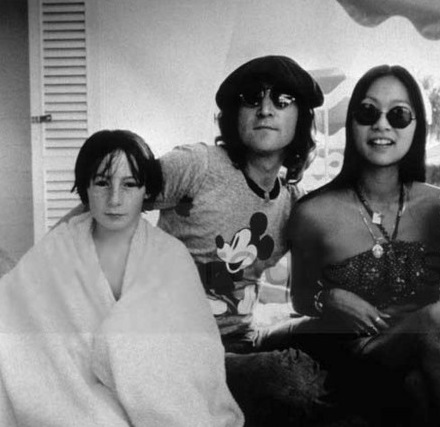
Julian & John Lennon with May Pang.

Instead, John decided that he wanted to give his 11-year-old son Julian a special Christmas holiday by taking him someplace warm. Mobster Mo Levy offered to have John, May, and Julian stay at his Palm Beach Florida condominium, not far from the former mansion of gangster Al Capone. So, Levy grabbed his son Adam and together with the wayward Beatle brood, they all flew down to Levy’s West Palm Beach estate to spend Christmas in the sunny shores of Florida. Wait, you say, where was Yoko? Well, John Lennon was in the midst of his self-described Long Weekend “sowing his oats” with May Pang, Yoko Ono’s assistant and the couple’s production coordinator. In mid-1973, while Lennon was busy working on his classic Mind Games album John and Yoko were having marital problems. Ono suggested to Pang that she become Lennon’s companion, and with Yoko’s permission, John and May began a relationship that lasted more than 18 months.

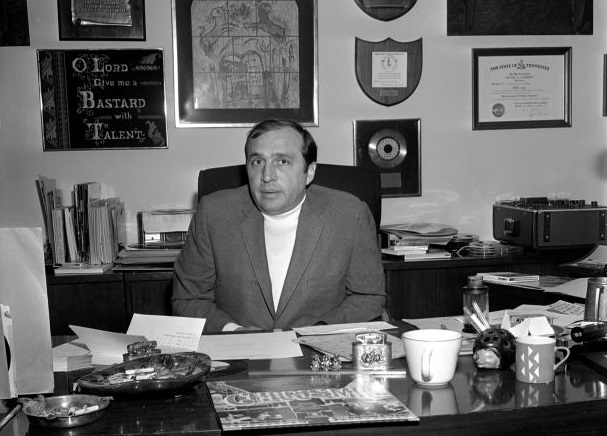
Morris Levy in his office at Roulette Records.

And that private jet-owning mobster, who was that guy? His name was Morris Levy, a music executive from Harlem with alleged mob ties to Vincent Gigante, boss of the Genovese crime family. “Moishe” or “Mo” as friends and associates called him, was known to sign up-and-coming artists to lop-sided contracts that often left the artists owing him money for touring expenses and studio time. Mo Levy would often sign his name to contracts as a song’s co-writer without the artist’s consent. Robbie Robertson of The Band was reportedly one of his victims and a witness to Mo’s henchmen holding a fellow performer by his ankles out the window of Levy’s Park Avenue apartment to get his point across. Levy, who died in 1990, was the inspiration for the HBO television series The Sopranos (1999–2007) character Hesh Rabkin, Tony Soprano’s friend who made a fortune defrauding performers, underpaying royalties, and pressing unauthorized records. Tommy James, Frankie Lymon, and Tito Puente were among his most prominent victims.

Once in South Florida, they spent their time walking on the beach, lounging by the pool and amusing themselves by throwing firecrackers at palm trees. The pinnacle of the trip came when the Lennon trio spent a day at Disney World. There one of the most famous men in the world went mostly unrecognized. At that time Disney’s Magic Kingdom was only one park on the property. They stayed at the Polynesian Hotel. To get from the Polynesian (both then and today) to the Magic Kingdom, the easiest way to travel is by Monorail. The train stops inside the hotel so guests do not have to venture outside the building. Making the Polynesian the obvious choice for John and his crew to stay.

Disney monorail operator / castmember Hal East with John Lennon.

Years later, Disney monorail operator (castmember Hal East) confirmed that John, May Pang, and Julian made a few trips to the Magic Kingdom via the Monorail and were allowed to ride up front apart from the crowd. It was during these trips where John and Julian experienced the rare treat of driving the Monorail. In her book May shared an interesting memory from one of the rides: “I overheard a father tell his son [on the Monorsail] he had heard a Beatle was visiting. “Which Beatle?” The father said, “George Harrison.” I burst out laughing. John asked why. We then all started laughing so hard that the Dad turned around. It then registered which Beatle was at the park that day – and why we were laughing. “It’s O.K.,” John jokingly said, “we all look alike.” On December 29, 1974, one of Apple Corp’s lawyers hand-delivered the official documents to the House of the Mouse in Florida and John Lennon became the last of the four to sign off on the contract.

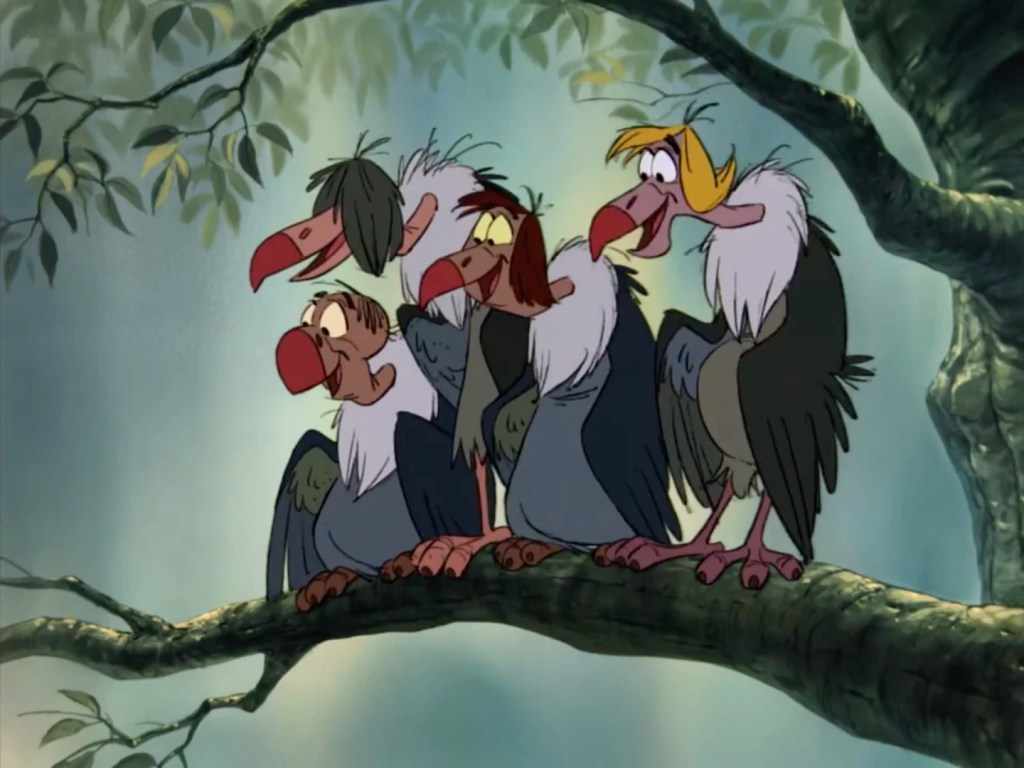
Disney’s Beatles inspired Vultures: Buzzie, Flaps, Ziggy, and Dizzy.

Ironically, the Beatles and Disney never really had much of a working relationship, but Disney did reference The Beatles in at least one of its productions: the vultures in The Jungle Book are based on the Fab Four. Disney also made plans to remake 1968’s Yellow Submarine, but the project never broke the surface. In 2020, Disney bought distribution rights for the docuseries The Beatles: Get Back from Peter Jackson and that three-part series is still streaming on Disney.

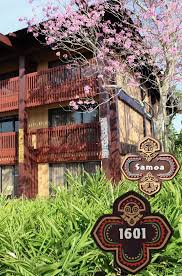
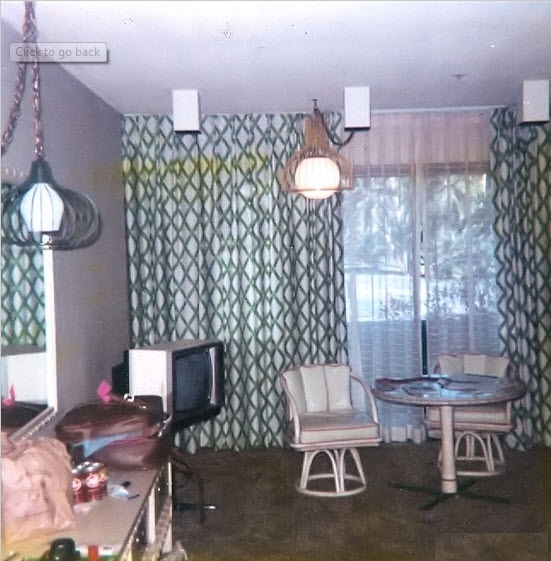
Samoa Longhouse 1601.
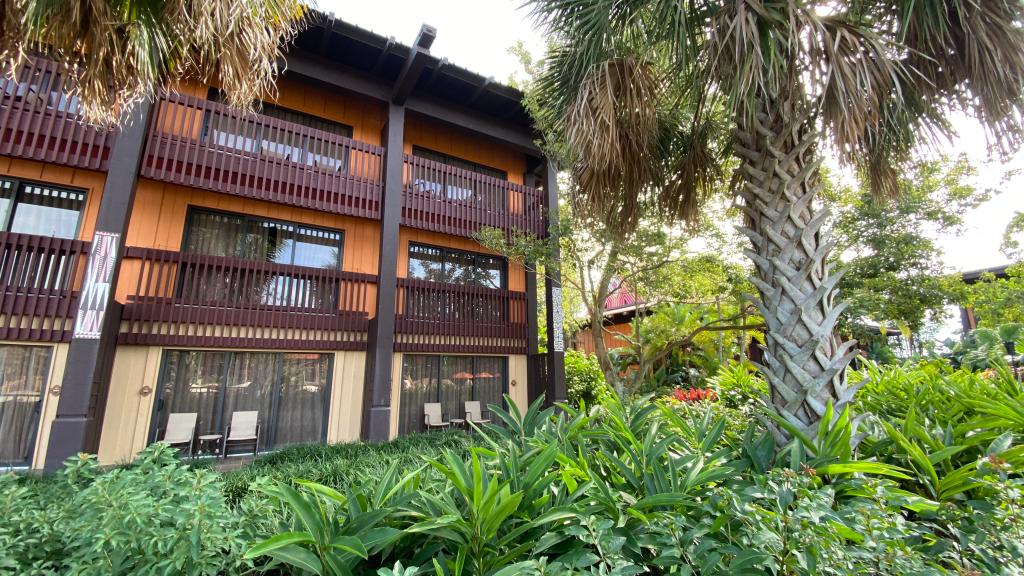
Samoa longhouse Building at Disney World’s Polynesian Resort.

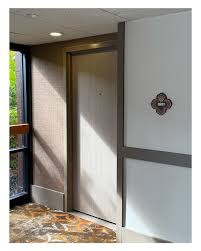
While Disney won’t confirm the exact room where it happened, dedicated Beatles / Disney fans have pinpointed the location: Room 1601 in the Samoa longhouse Building at the Polynesian Resort at Walt Disney World, Orlando. Room 1601 looks out at the Seven Seas Lagoon and it was this scene at which John gazed as he paused briefly before officially dissolving his performing relationship with the Beatles. Room 1601 is a ground-floor corner room in the Samoa longhouse that looks out on the Seven Seas Lagoon with the Cinderella Castle visible in the distance.

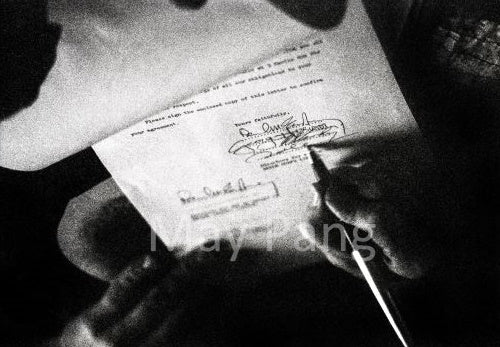
May Pang’s Photo of Lennon’s dissolution signing.

Here, with the Magic Kingdom as his backdrop, John Lennon picked up his pen and officially finished off the Beatles, once and for all. Years later May Pang remembered that John told her to “Take out your camera…He looked wistfully out the window. I could almost see him replaying the entire Beatles experience in his mind. He finally picked up his pen and, in the unlikely backdrop of the Polynesian Village Hotel at Disney World, ended the greatest rock ‘n’ roll band in history by simply scrawling ‘John Lennon’ at the bottom of the page.”

Room 1601.

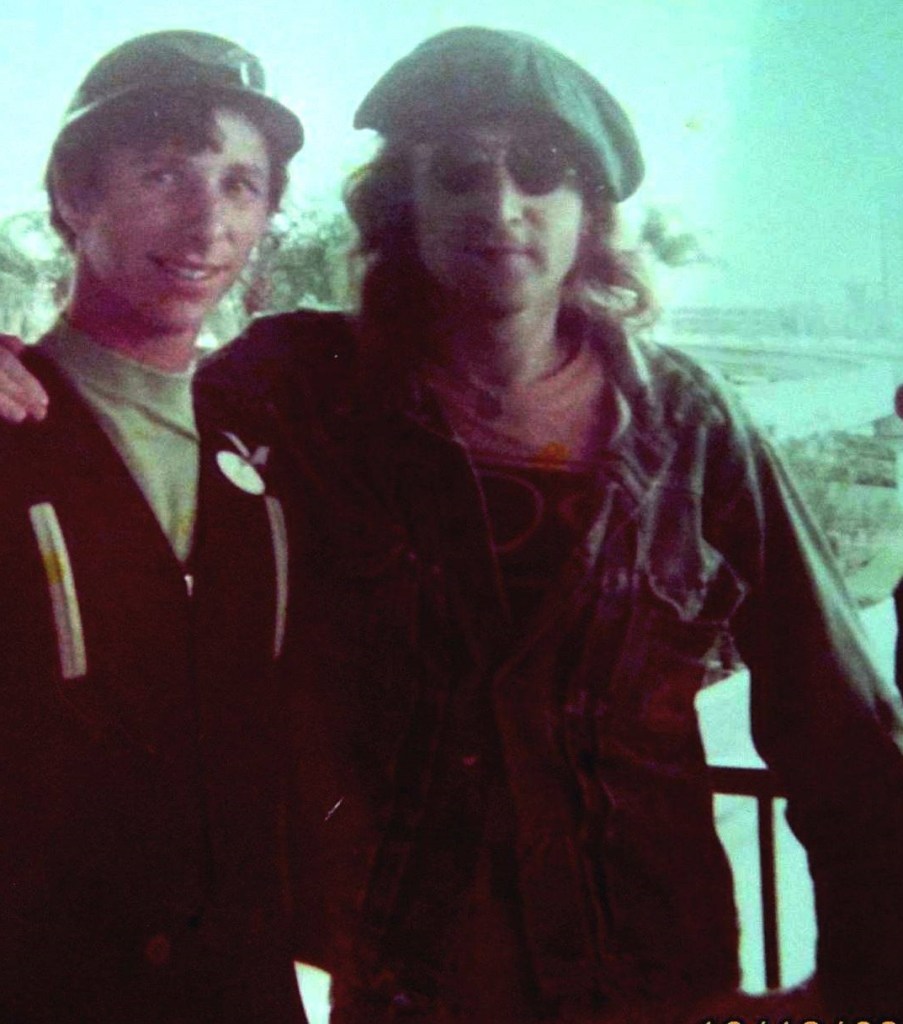
In Pang’s book “Instamatic Karma: Photographs of John Lennon” (St. Martins Press 2008), there are several photos of Lennon at Disney World wearing a stylish newsboy cap and Micky Mouse ringer t-shirt posed anonymously in the park among the crowd, alongside Monorail driver Hal East, in front of Cinderella Castle and outside room 1601 at the Polynesian. Most importantly, Pang snapped a photo of Lennon’s signature on the dissolution papers. A literal snapshot of music history, Disney style. And today, if you’re lucky, you can stay in Room 1601 where the Beatles long and winding road came to an end. And then, go ride the Monorail.

Amusement Parks, Disney, food, Pop Culture

Disney Eats McDonald’s. PART II

Disney and Ray Kroc Part II
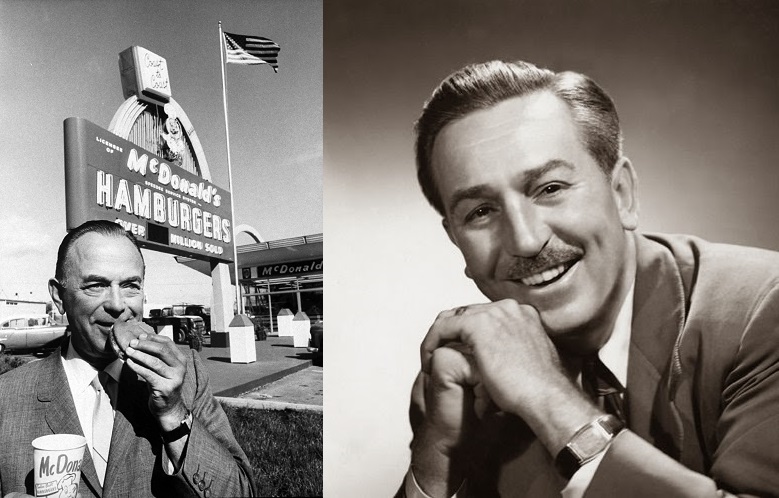
Ray Kroc & Walt Disney.

Original publish date:  January 23, 2020

Last week, In part I of this article, I discussed the relationship between two titans of Pop Culture whose brand has flourished worldwide to unprecedented levels: Walt Disney and Ray Kroc of McDonald’s. It is amazing to think that both men served in the same ambulance company at the tail end of World War I. Even more amazing to think that authors Ernest Hemingway and John Dos Passos were products of that same ambulance service. The similarities between the four men end with the close of the Great War, but Disney and Kroc would remain linked for nearly a century.
While Walt Disney was flying around the country in one of his three private airplanes searching for Disney World, meeting with executives for the 1964 New York Worlds Fair, planning movies or sporting events aboard Mickey Mouse One, he’d sometimes get a little hungry. Whenever “Uncle Walt” got that Winnie the Pooh “rumbly in the tumbly” feeling, Disney would reportedly ask, usually from the co-pilot seat: “Where are we?” The pilot would invariably reply,”We’re over Tulsa, Walt.” Or Indianapolis. Or Cleveland. Or wherever. To which Disney would cryptically reply. “Do you think there’s one down there?”

FOOD HISTORY HISTORICAL FAST FOOD BURGER HAMBURGER RESTURANT CHAIN
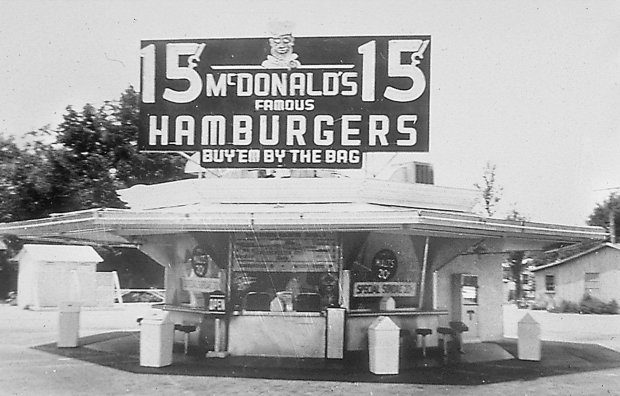
Ray Kroc’s First McDonald’s in Des Plaines, Illinois. 1955

On cue, the pilot would hand his boss a booklet listing the location of every single McDonald’s in the continental United States. If there was a McDonald’s down below in whatever city the Disney corporate plane was flying over, Walt would order the pilot to land. Once safely on the ground, Disney would call for a cab and the entire party would pile in and head out for the nearest McDonald’s to get a bite to eat. This is made all the more ironic when you consider that, as detailed in part I of this article, Ray Kroc’s pitch to place his first McDonald’s restaurant inside Walt Disney’s Disneyland was rejected in 1955. Whether Ray Kroc knew that his old war-buddy was hooked on his hamburgers is unknown, but I’d bet he’d have gotten a kick out of it were it so.

z mcds flyer
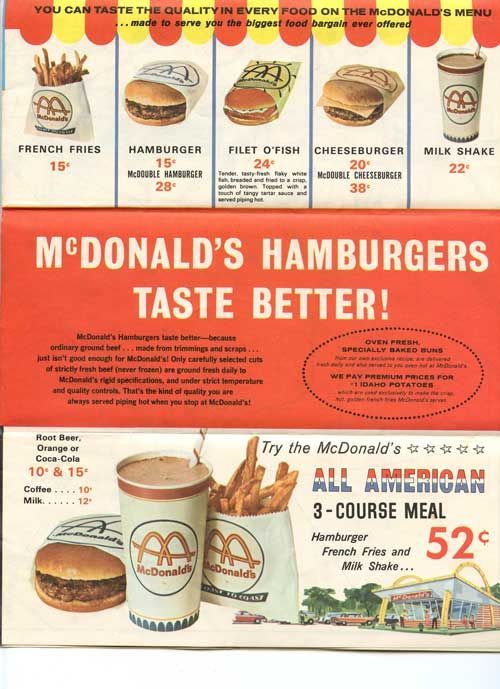
McDonald’s menu in the 1960s.

Walt Disney died on December 15, 1966. That same year, McDonald’s stock split for the very first time: 3 for 2. The year after Walt’s death, Disney stock split 2 to 1. Disney studios’ success continued that year with the groundbreaking of the Disney World theme park and addition of the Pirates of the Caribbean at Disneyland. The next few years continued the Disney shine with the Love Bug, debut of the Disneyland’s Haunted Mansion and grand opening of Disney World in Orlando. McDonald’s over that same period flourished with the introduction of the Big Mac, Quarter Pounder and television ad campaigns that boosted their brand like never before.
Fast forward to the early 1980s, McDonald’s was winning the fast food wars, having driven away most of the competition. Meanwhile, Walt Disney Productions was reeling from low theme park attendance and a string of box office flops (remember Popeye, Condorman and Return to Oz?). Suddenly Disney found itself under attack by corporate raiders like Ivan Boesky and Saul Steinberg and then nearly sold out to Coca-Cola in 1982. Disney was scrambling for someone who could come to the Magic Kingdom’s rescue. So who did Disney’s senior management approach? Uncle Walt’s old ambulance corps buddy, Ray Kroc and the McDonald’s Corporation.
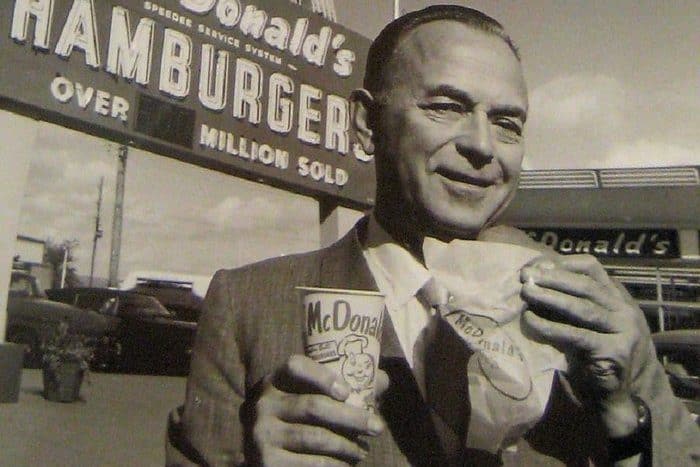
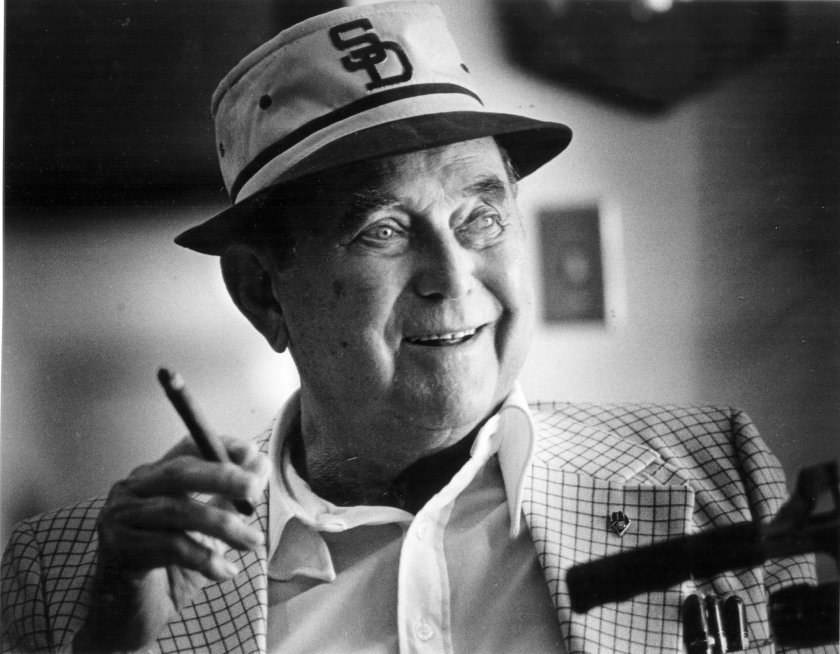
z 27-Ray-Kroc-Quotes-On-Success-Wealth-AchievementBy this time, Ray Kroc was relegated to the sidelines serving in a largely ceremonial role as McDonald’s “senior chairman”. Kroc had given up day-to-day operations of McDonald’s in 1974. Ironically, the same year he bought the San Diego Padres baseball team. The Padres were scheduled to move to Washington, D.C., after the 1973 season. Legend claims that the idea to buy the team formulated in Kroc’s mind while he was reading a newspaper on his private jet. Kroc, a life-long baseball fan who was once foiled in an attempt to buy his hometown Chicago Cubs, turned to his wife Joan and said: “I think I want to buy the San Diego Padres.” Her response: “Why would you want to buy a monastery?” Five years later, frustrated with the team’s performance and league restrictions, Kroc turned the team over to his son-in-law, Ballard Smith. “There’s more future in hamburgers than baseball,” Kroc said. Ray Kroc died on January 14, 1984 and the San Diego Padres won the N.L. pennant that same year (They lost in the World Series to the Detroit Tiger 4 games to 1).
z kroc padresBy the 1980s, Disney was a corporation that seemed to be creatively exhausted. The entertainment giant was seriously out of touch with what consumers wanted to buy, what moviegoers wanted to see. McDonald’s had introduced their wildly popular “Happy Meal” nationwide in 1979. Disney saw an opportunity for revival by proposing the idea of adding Disney toys and merchandising to Happy Meals. In 1987, the first Disney Happy Meal debuted, offering toys and prizes from familiar characters like Cinderella, The Sword In The Stone, Mickey Mouse, Aladdin, Simba, Finding Nemo, Jungle Book, 101 Dalmatians, The Lion King and other classics. For a time, changing food habits, mismanagement and failure to recognize trends, placed the Disney corporation in an exposed position. Rumors circulated that the Mouse was on the brink of being swallowed up by Mickey D’s.
The relationship came to a head when McDonald’s suggested that Disney offer discounted VHS copies of classic Disney films in their restaurants. Also, as time passed, Disney wanted to emphasize healthier eating and they became concerned about McDonald’s being tied so closely to childhood obesity. The McDonald’s-Disney agreement officially expired on January 1, 2007. Over that time, as the Disney company grew into the corporate giant it is today, McDonald’s realized their mistake. For the next several years, McDonald’s tried to reestablish the relationship, with limited success.
For awhile, McDonald’s found a presence in the food and beverage locations at the Disney theme parks. One was the McDonald’s Fry Cart that opened in Magic Kingdom’s Frontierland in 1999. Since it IS Disney after all, the imagneers fitted the location with a back story. It went like this: “With the rush of prospectors passing through Frontierland in search of gold, lots of folks in town started looking for ways to cash in on all the excitement. Back in 1853, ol’ McDonald (who had a farm, ei-ei-o), a potato farmer, decided to set up his cook wagon on the hill under the big oak tree, just off the main trail.”

z mcwdw_gold2007ww
McDonald’s French Fry Cart at Disneyland.

The story continues, “Business was booming for a couple of good years, right up until the great flood of 1855. Legend has it that men disturbed the spirits of the mountain by removing gold from Big Thunder, causing all sorts of havoc from earthquakes and avalanches to storms and floods. In fact, the nearby river rose so much, the water reached right up to McDonald’s wagon on the hill. The wagon survived, but when the water receded, the wagon started to go with it. It slid down the hill, crashed through a fence (and sharp-eyed guests could see the poorly repaired fence near the cart), and got lodged in the mud down below. This didn’t stop ol’ man McDonald, though. He just laid down some planks so folks wouldn’t get their boots muddy, and he has kept right on selling his delicious French fried potatoes to this day.”
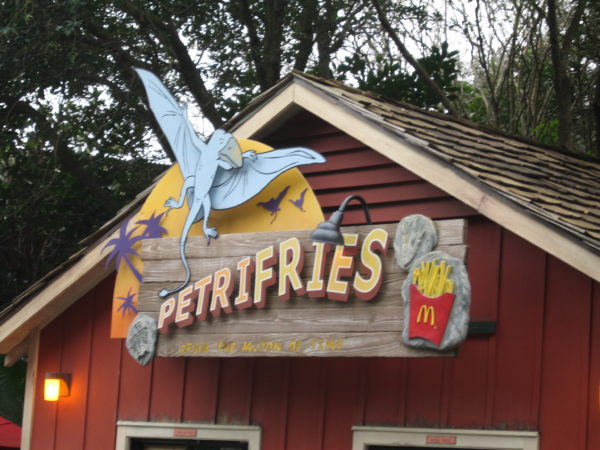
McDonald even came up with a catch phrase and posted it on the front of the wagon: “There’s gold in them thar fries!” There was also a sign placed nearby that pictured the familiar Golden Arches and proclaimed, “Same location since ’53.” The “53” was scratched out and painted over with a “55.” The McDonald’s Frontierland Fry Cart closed in late 2008. There were McDonald’s restaurants at Disney’s Animal Kingdom as well. The Boneyard, Restaurantosaurus and the “Petrifries” french fries stand which came with it’s own backstory as well. That backstory is not as interesting though as it involves a former fishing lodge where the first dinosaur fossil was found in 1947 by an unnamed amateur fossil hunter and it was hard to decipher. The Dino Institute featured a small lab, a clubhouse for student volunteers and a commissary to round out the McDonald’s connection. Although the McDonald’s french fries served there were popular with visitors, at least the few who could find it, the venue also closed.
z disney-mcdonalds-2018-03Additionally, there once was a McDonald’s at downtown Disney (before it became Disney Springs). At the Magic Kingdom, visitors could munch on french fries at the Village Fire Shoppe. At Disney’s Hollywood Studios, McDonald’s sponsored Fairfax Fries at the Sunset Ranch March. Fairfax is a reference to the street where the famous Los Angeles Farmers Market (the inspiration for the Sunset Ranch Market) is located. At Epcot, on the World Showcase promenade, is the Refreshment Port where sometimes international cast members from Canada would bring Canadian Smarties (similar to M&Ms) for the food and beverage location to make a Smarties McFlurry. The exclusive contract with Disney did not allow McDonald’s to tie in with blockbuster movies such as the Star Wars franchise even though movie studios would have preferred the tie in since McDonald’s had a higher profile and market share.
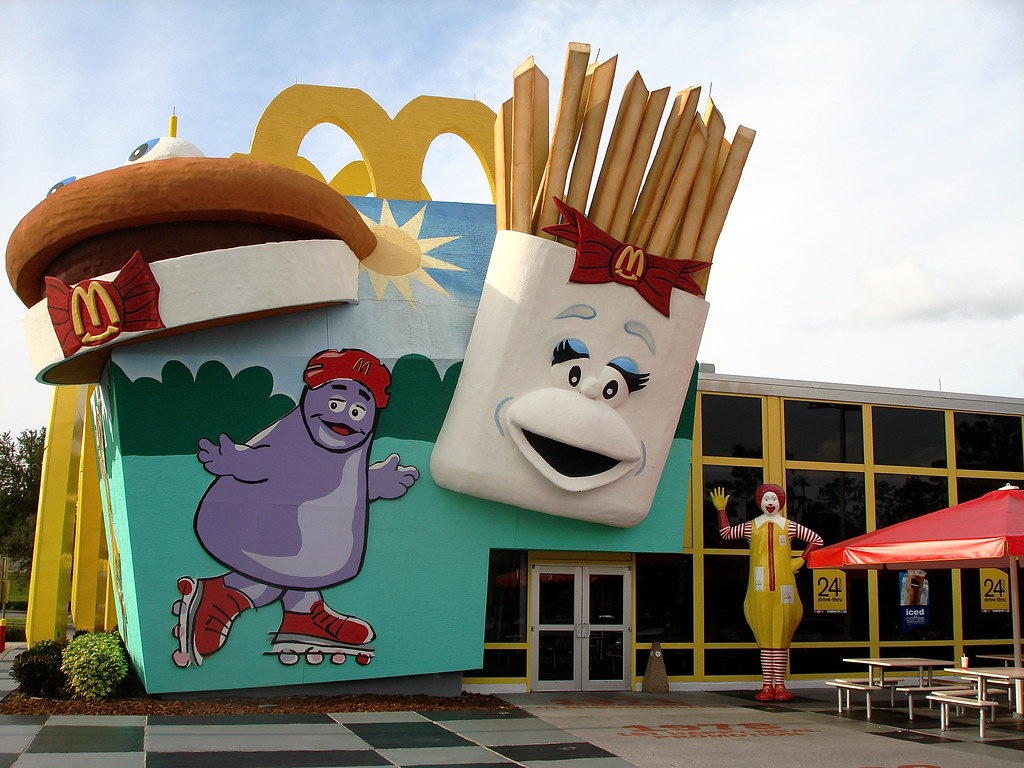
There are many Disney fans and park visitors who have fond memories of eating McDonald’s Chicken McNuggets or an Egg McMuffin during a fun day at a Disney theme park. After all, could it get any better than to receive a Disney prize in your Disney Happy Meal while on Disney property? Today, the only McDonald’s presence on Disney property is the restaurant at Disney’s All-Star sport complex hotel. Although it was briefly closed on Halloween of 2019 for renovation, it is scheduled to reopen in March of 2020. However, it is unlikely that we’ll ever see another “Hotdog-osaurus” or a “Dino-Sized Double Cheeseburger” any time soon.

DSC05673.JPG
McDonald’s at Disney’s All-Star Sports Complex.

While Disney netted more than $100 million dollars during the partnership, McDonald’s netted more than $1 billion dollars even while promoting Disney’s box office bombs. It was not unusual for a McDonald’s promotion for a film to exceed Disney’s budget for advertising the very same film. Disney got the royalties and increased advertising exposure and McDonald’s sold the food. Seems like a match made in heaven. Yeah, well, Burt Reynolds & Lonnie Anderson / Brad Pitt & Jennifer Aniston / Lee Majors & Farrah Fawcett didn’t work out either.
Both Disneyland and McDonald’s have become worldwide icons of America. Walt Disney and Ray Kroc are ranked # 9 and 10 on Baylor Univeristy’s list of Greatest American Entrepreneurs and/or Businesspeople behind Henry Ford (1), Bill Gates (2), John D. Rockefeller (3), Andrew Carnegie (4), Thomas Edison (5), Sam Walton (6), J.P. Morgan (7), G.M.’s Alfred Sloan (8). McDonald’s now operates more than 35,000 restaurants in 118 countries, serving 68 million people every day. A new branch opens every 14.5 hours, more than 75 hamburgers are sold every second and 68 million people eat something from McDonald’s each day-that’s 1% of the world’s population. McDonald’s’ estimates that one in eight American workers has been employed by the company at one stage of their careers. McDonald’s is the world’s largest distributor of toys, with the Happy Meal included in 20% of all sales.
Conversely, there are 12 Disney theme parks worldwide, welcoming 157 million visitors annually and serving a half-million guests every day. Disney has 201,000 employees, 100,000 of whom work at the two resorts in the USA. Every year, Disney World alone serves 10 million hamburgers, 6 million hot dogs, 9 million pounds of French fries, 300,000 pounds of popcorn, and 1.6 million turkey drumsticks along with 13 million bottles of water and 75 million Coca-Colas to wash them down. According to one study, Walt Disney’s logo is the fifth most recognizable logo in the world behind Starbucks (4), McDonald’s (3), Coca-Cola (2) and Nike (1).
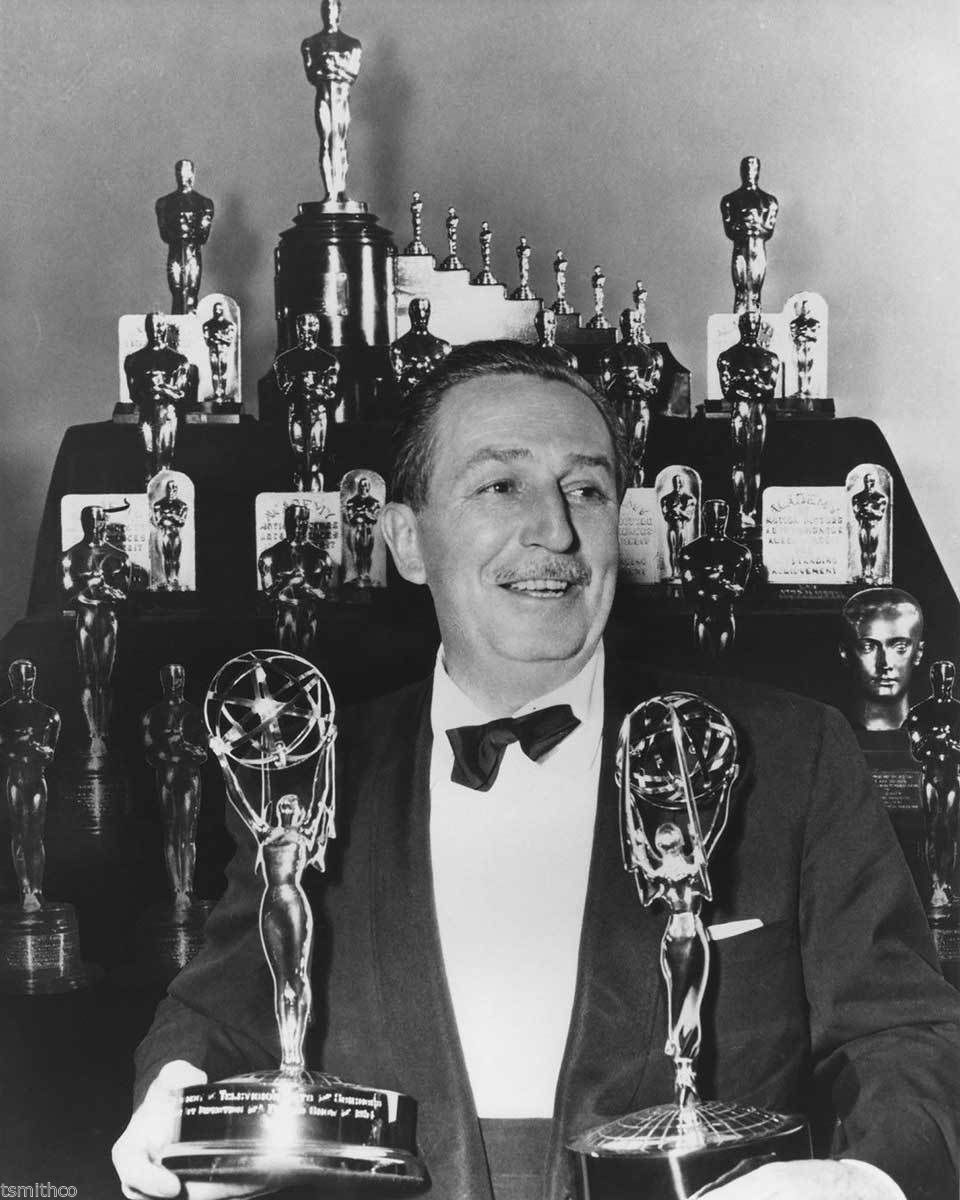
z disney awardsDuring his lifetime, Walt Disney received 59 Academy Award nominations, including 22 awards: both totals are records. Walt Disney’s net worth was equal to roughly $1 billion at the time of his death in 1966 (after adjusting for inflation). At the time of his death, Disney’s various assets were worth $100-$150 million in 1966 dollars which is the same as $750 million-$1.1 billion today. By the time of Kroc’s death in 1984, his net worth was $600 million. That’s the same as $1.4 billion after adjusting for inflation. One can only imagine how the pop culture landscape might have changed back in 1955 if those two former ambulance corps buddies had formed a partnership. But wait, would that make it Mickey D’s Mouse?
Amusement Parks, Disney, food, Pop Culture, Travel

Disney Eats McDonald’s. PART I

Disney and Ray Kroc Part I
Ray Kroc & Walt Disney-World War I Ambulance Corps.

Original publish date:  January 16, 2020

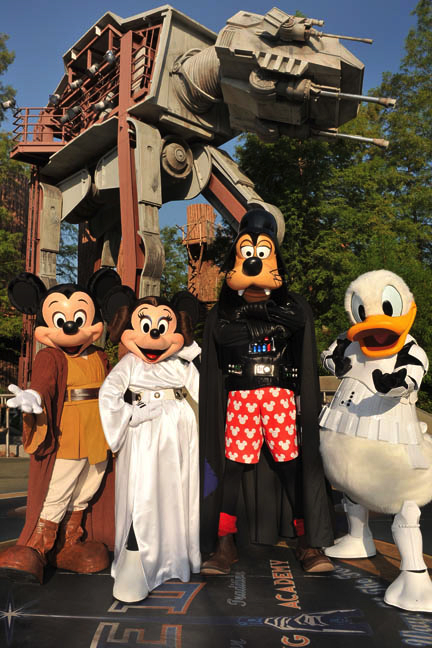
There has been a lot of hubbub going around lately about the latest Star Wars movie “The Rise of Skywalker” from Walt Disney studios and the new Star Wars themed lands in Disneyland and Disneyworld’s Hollywood Studios known as “Star Wars: Galaxy’s Edge.” Disney purchased Star Wars parent company, Lucasfilms, for $4.05 billion in cash and stock on Oct. 30, 2012 and recouped their investment in just a few short years. The four Disney Star Wars movies alone grossed more than $4.8 billion at the box office. That figure doesn’t even count any monies generated by the franchise in merchandising or at the theme parks, which opened in 2019.
What would you think if I were to tell you that the Disney / Star Wars merger was not the first “big idea” to land on the house of the mouse doorstep? There was another big idea that was nearly floated out of Anaheim over fifty years ago. And this one came from “Uncle Walt” himself. Well, to paraphrase Winnie the Pooh, Walt Disney’s rumbly tummy anyway. Believe it or not, there was a time when Disneyland and McDonald’s nearly partnered up.

z star_wars_weekend
Disney Star Wars.

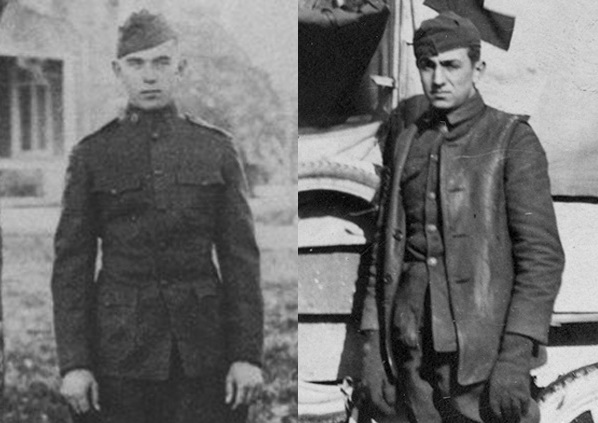
This was not a proposal made by a couple of opportunistic bandwagon jumpers, there was history behind this love affair. Walt Disney and Ray Kroc first met in a Connecticut Army camp in 1918 while both were teenaged dreamers known only to their families. Both men were born near Chicago, Illinois less than a year apart. Walter Elias Disney in Chicago’s Hermosa neighborhood on December 5, 1901 and Ray Albert Kroc in Oak Park, Illinois, on October 5, 1902.
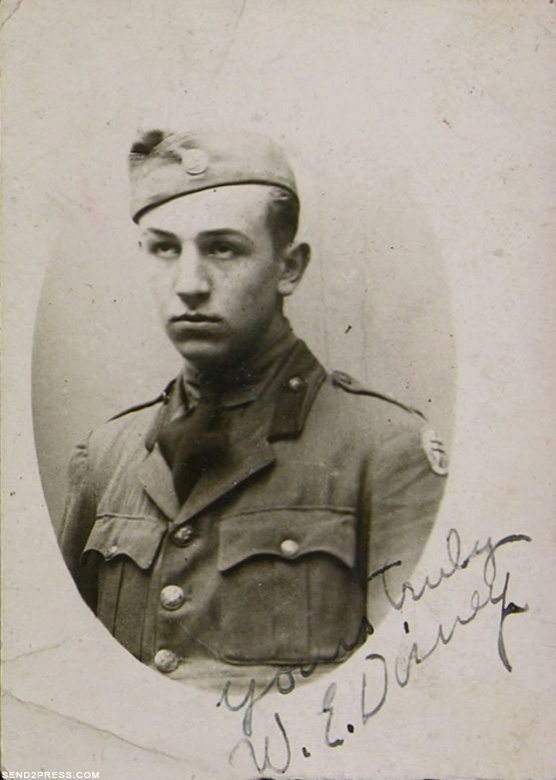
In mid-1918, Walt Disney dropped out of high school at 16 and attempted to join the United States Army to fight against the Huns, but he was rejected because he was too young. Undeterred, Disney forged the date on his birth certificate and joined the Red Cross in September 1918 as an ambulance driver. Ironically, Walt began his ambulance corps training at a burned down amusement park near the University of Chicago where he was taught by mechanics from the Yellow Cab Company how to repair motors and drive cars over rough terrain.
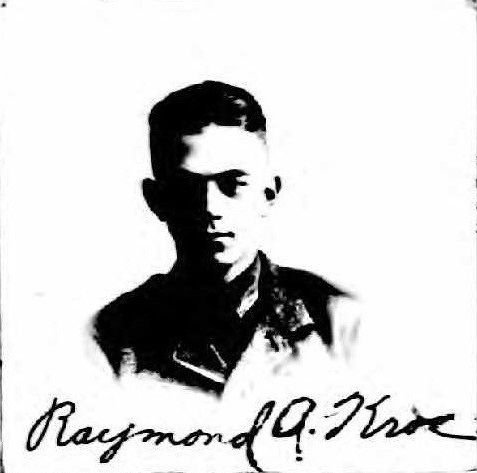
Likewise, Ray Kroc dropped out of school, lied about his age and joined the Red Cross as an ambulance driver at the age of 15. Disney was shipped to France, arriving in November, after the armistice. The only action Disney participated in was drawing cartoons on the side of ambulances. As for Kroc, the war ended shortly after he enlisted. In his 1977 autobiography “Grinding It Out: The Making of McDonald’s”, Ray Kroc said this about his old war buddy, “In my company, which assembled in Connecticut for training, was another fellow who had lied about his age to get in. He was regarded as a strange duck, because whenever we had time off and went out on the town to chase girls, he stayed in camp drawing pictures. His name was Walt Disney.”

Z kroc
Ray Kroc: Soldier.

While training to be a driver in Ambulance Company A, Disney and Kroc became friends. Ironically, at the same time, a couple of young idealistic writers, also from Chicago, were serving in the ambulance corps; Ernest Hemingway and John Dos Passos. These four men shared not only an occupation but a desire to revolutionize American writing, entertainment and pop culture. However, this article ain’t that deep and talking about Hemingway and Dos Passos is above my pay grade. This article is about pop culture at it’s finest.
After Ray and Walt returned to the US, independently, they both headed out to Southern California seeking fame and fortune. Disney as an animator, even though the cartoon industry was headquartered in New York City, and Kroc as a businessman, even though California was still a relative unknown in the business world. Disney struggled for a time but finally caught on in 1928 with a cartoon about a mouse called “Steamboat Willie”—the first cartoon with synchronized sound. For Kroc, it would take a little bit longer for his ship to come in: 26 years to be specific.

Z disney
Walt Disney: Soldier.

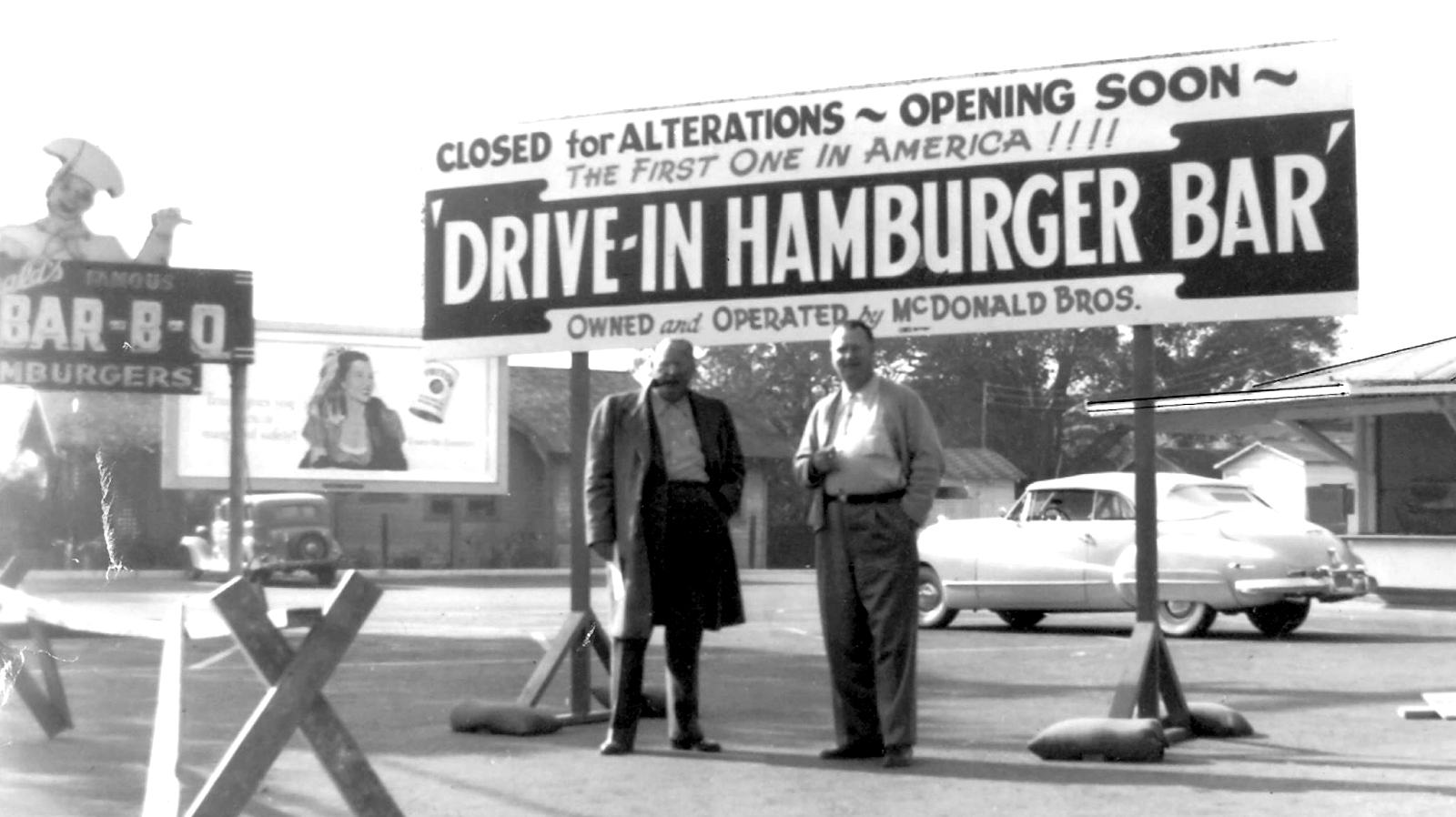
Disney’s story is well known, but Kroc’s story might be worth a revisit. Kroc was working as a traveling salesman for the Mixmaster Corporation when he met two brothers who were tearing it up in San Bernardino. Richard and Maurice “Mac” McDonald, who curiously shared the same middle name (James), developed a restaurant using what they called the “Speedee Service System.” The new restaurant proved a rousing success, especially with teenagers, and the brothers were soon making $40,000 a year, big money back then.

z mcdonald-brothers
The McDonald’s Brothers.

By 1953, the brothers had set their sights on franchising with a goal of making $1 million before they turned 50. Their first step was to buy eight shiny new milkshakes machines. Curious why one business would need eight machines, Ray visited the McDonalds’, took one glance at the brothers’ method of cooking hamburgers “assembly-line-style” to get the food out to the customers more quickly and he immediately saw dollar signs. In 1954, the McDonald brothers partnered with Ray Kroc. Around this same time (April 1954) Walt Disney unveiled his plans for a bold new concept in family fun parks he planned to call Disneyland.

z mickey walt
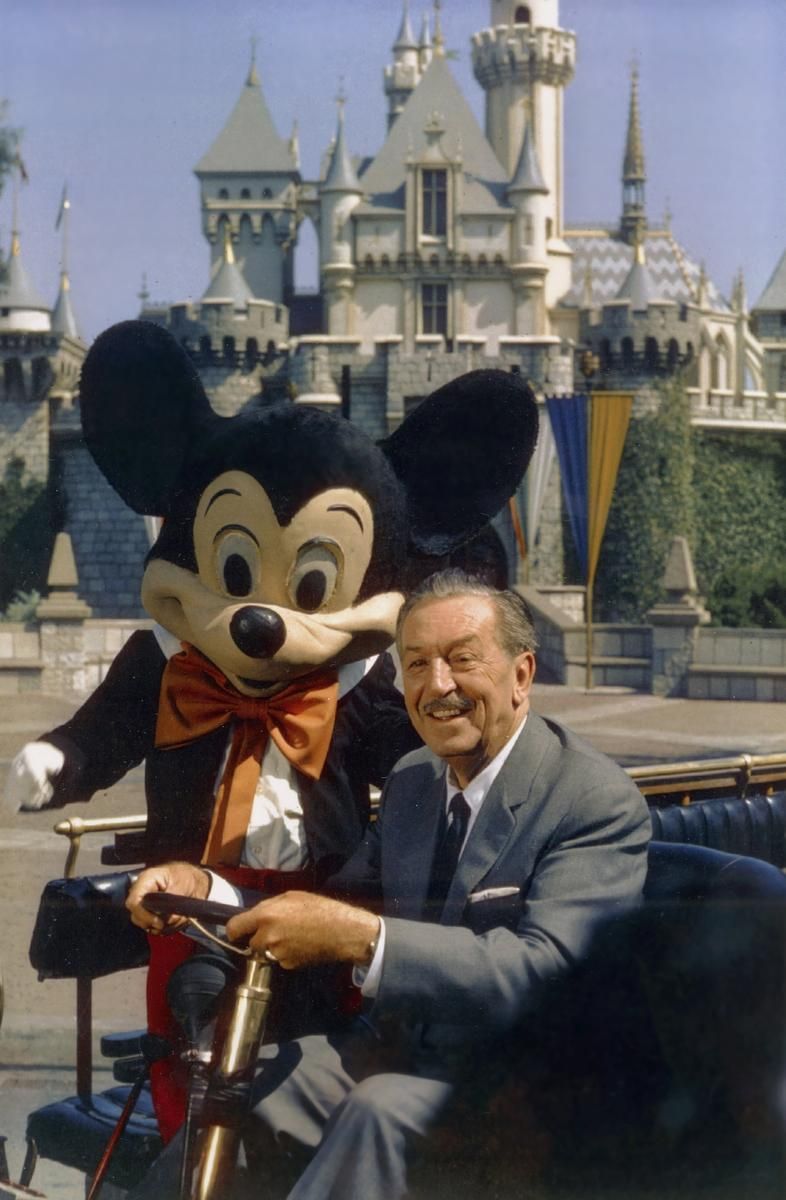
Walt Disney & Mickey Mouse-Opening Day at Disneyland July 17, 1955.

As soon as Ray Kroc heard the news about this new mega-fun park, he knew that hungry teenagers would flock to it by the carload. Kroc knew that he’d finally found the perfect place to build his first McDonald’s franchise. In late 1954, Ray sent a letter to his old ambulance corps buddy, it read, in part, “Dear Walt…I look over the Company A picture we had taken in Sound Beach, Conn. many times and recall a lot of pleasant memories.” Then Kroc cut to the chase, “I have very recently taken over the national franchise of the McDonald’s system. I would like to inquire if there may be an opportunity for a McDonald’s in your Disneyland Development.”
Walt responded cordially to the former Red Cross ambulance driver’s note by saying that he would be handing the proposal over to the Disneyland executive in charge of concessions. Walt explained that he was “currently confining his activities to the creative side” while the Disney Company “raced to complete the theme park on time.” The Disney Archives has a copy of Kroc’s letter and Walt’s response. Kroc claimed he never received a response from the vice president in charge of concessions.
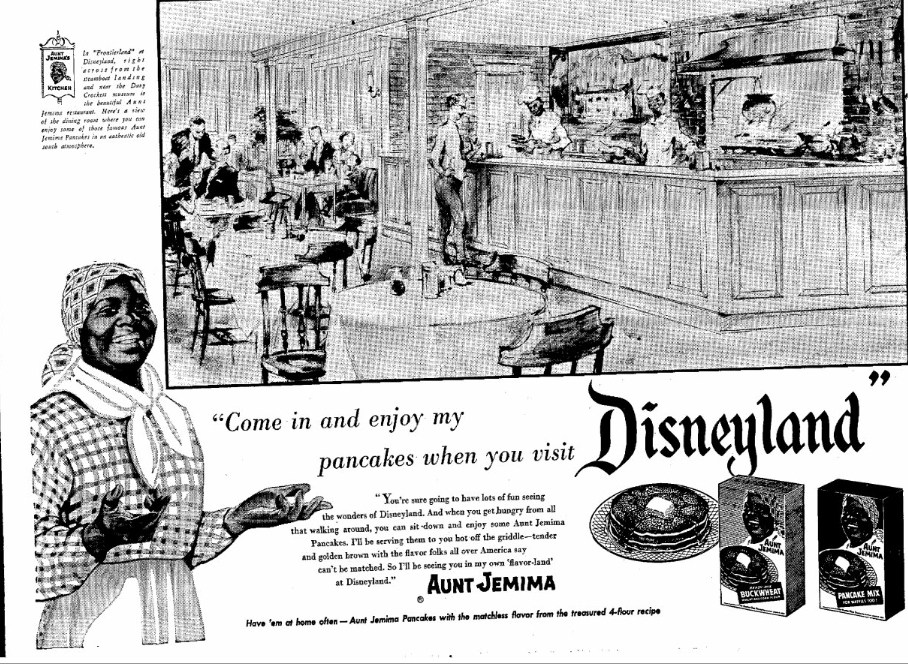
z AuntJemimasPancakeHouse2From there, well, nobody knows. For the answer, you need look no further than the fact that there are no McDonald’s at Disney. It should be noted that there were SOME franchise restaurants in Disneyland during those first first years. They included the Aunt Jemima pancake and waffle house in Frontierland and the Chicken of the Sea Pirate Ship in Fantasyland.
z chickenoftheseaTo his dying day, Ray Kroc insisted that the reason the “world’s first McDonald’s” was not featured inside Disneyland at the park’s July 17, 1955 grand opening was because the head of concessions had tried to force Ray to raise the price of his french fries by a nickle (from 10 cents to 15 cents) for the Disneyland crowd. Kroc, the man in charge of McDonald’s franchising, believed that he was being charged a franchise fee by virtue of Walt Disney Productions tacking on a concessionaire’s fee. Kroc, the consummate businessman, said he wasn’t about to give away 1/3 of his profits while gouging his customers. Great story, but by the time Disneyland debuted, Kroc had only opened one McDonald’s franchise (in Des Plaines, Illinois on April 15, 1955). So he had no loyal customers to offend…yet. Well, no customers within 2,000 miles anyway.
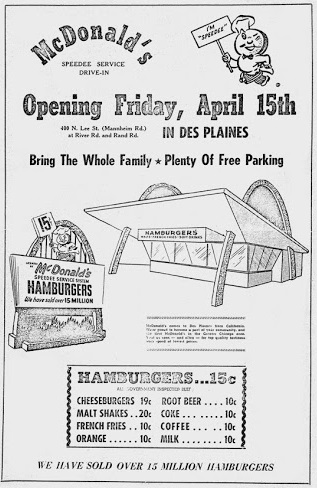
z McD des plainesIt is more likely to say that while the executives in charge of Disneyland’s concessions were undoubtedly intrigued by Ray’s “fast food” proposal, “war buddy” or not, Kroc just didn’t have enough experience in the restaurant business to take that gamble. So, despite how Kroc spun the tale to reporters from the 1950s forward, while there was some discussion of putting a McDonald’s inside the theme park, the project never really made it past the talking stage. But Ray Kroc would never let the truth stand in the way of a good story.
Ray Kroc eventually bought the brothers out in 1961, a year after Walt Disney received TWO stars on the Hollywood walk of fame: one for movies, the other for television. All business partnership questions aside, the parallels between the two men continued. Both men were vehement conservative Republicans. Disney famously wore a Barry Goldwater for President pin to the White House in 1964 when President Lyndon B. Johnson presented the Presidential medal of Freedom to the animator. Kroc donated $255,000 to Richard Nixon’s reelection campaign in 1972, and was accused by some, including N.J. Senator Harrison Williams, of trying to influence Nixon to veto a minimum wage bill making its way through Congress (which was a $ 1.60 per hour by the way).
Both men were brilliant businessmen. Both were always looking to the future. Both would be categorized as “control freaks” today. And both men were among the first to market their product specifically to children. But there was one major difference. While Kroc had a legendary temper and was famous for holding a grudge, Disney retained a childlike innocence and truly enjoyed people. While it is true that the Golden Arches never made it onto Main Street USA, they still found a place in Walt Disney’s heart. Or maybe it is more accurate to say, his stomach.
Perhaps unsurprisingly, Walt Disney , the ultimate imagineer, was one of the first businessmen in America to utilize a personal airplane for business and travel. Actually, he had three. Although Walt never got a pilot’s license, he frequently sat in the co-pilot’s seat. Lillian Disney disapproved strongly of her husband’s desire to fly. Once, after Walt announced from the cockpit: “This is your captain speaking”, Lillian jumped from her seat and stormed towards the cabin. Walt quickly backed off by saying: “No, not the captain. This is the commander in chief of the whole damned outfit!”
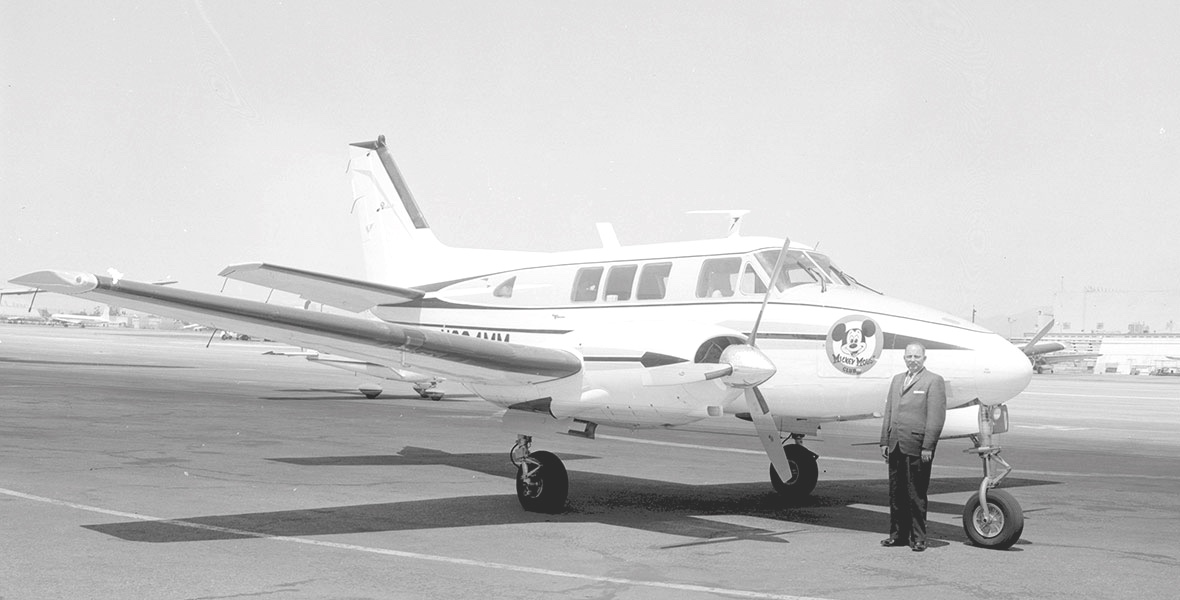
Walt’s first plane was an eight­ passenger Beechcraft Queen Air Model 80, which Walt bought in February of 1963 and used until 1965. The twin engine turboprop, nicknamed “The Queen” by Disney, had a top speed of 247 mph, a list price of $135,000 and a large circular logo of the “Mickey Mouse Club” near the nose. Legend states that it was this plane that Walt used to fly over central Florida to pick the spot for his Disney World complex nine months after purchase.

z N732G Side View Large
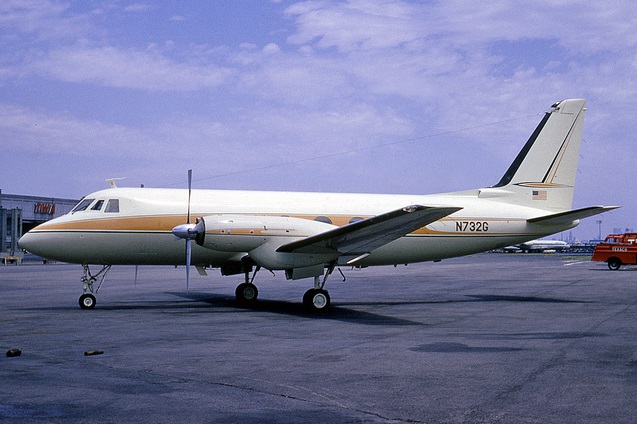
Walt’s Grumman Gulfstream G-159 Tail Number N732G.

In March of 1964, the small cabin of the Queen Air necessitated an upgrade to a used Grumman Gulfstream G-159 one, tail number N732G. This new tan and brown plane was a significant upgrade with a cruising speed of 350 mph at 30,000 feet. It was a smooth ride to the 1964-65 New York World’s Fair, while Walt was busy working on his “Great Moments with Mr. Lincoln” and “It’s a Small World” projects. At one time it was the most highly utilized Gulfstream I in the country.
In July of 1965, Walt purchased a Beechcraft King Air Model 90, which he used from 1965­ to 1967. The Beechcraft could carry 10 passengers, including a flight crew of two. It was powered by a pair of Pratt and Whitney PT-6 Turboprop engines, capable of cruising at 270 mph at 23,000 feet. Fully equipped, its list price was $320,000. Perhaps most importantly, this new plane carried the tail number N234MM. The King Air was fast and quiet, but the Gulfstream could get in and out of smaller airports much easier. So by 1967, the Gulfstream eventually ended up with the N234MM tail number and the forever designation as “Walt’s Plane”.

z N234MM Queen Air 1
Walt’s Beechcraft King Air Model 90-Tail number N234MM.

Disney pilots originally used “two-three-four-Metro-Metro” as their radio call sign but it soon morphed into “two-three-four-Mickey-Mouse” which was not a standard ICAO Aircraft call. Soon the FAA enroute controllers were also calling it “Mickey Mouse.” According to friends, Walt took delight in every aspect of flying. He loaded the luggage, served the drinks and supervised the galley. Even those with a passing knowledge of McDonald’s Ray Kroc’s personality realize it would find it hard to imagine the Golden Arches CEO doing any of that. z Gulfstream_WDA_BA_Altimeter
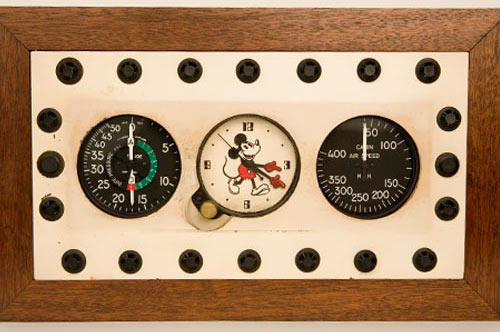
Walt’s “problem” was that he always liked to fly as low as possible, to study the landscape. Perhaps by decree of Lillian (or the insurance company) Walt ended up with his own personal seat in the back equipped with an altimeter and air speed indicator on the wall and a telephone direct to the pilot. During the 1960s, as Walt Disney was flying around the country overseeing World’s Fair attractions, selecting movie sets, participating in lawn bowling events (yes, he was a world class lawn-bowler) and planning more self-titled mega-theme parks, he would often land his plane to search for… a McDonald’s hamburger.

NEXT WEEK: Part II of Disney East McDonald’s

animals, Disney, Pop Culture

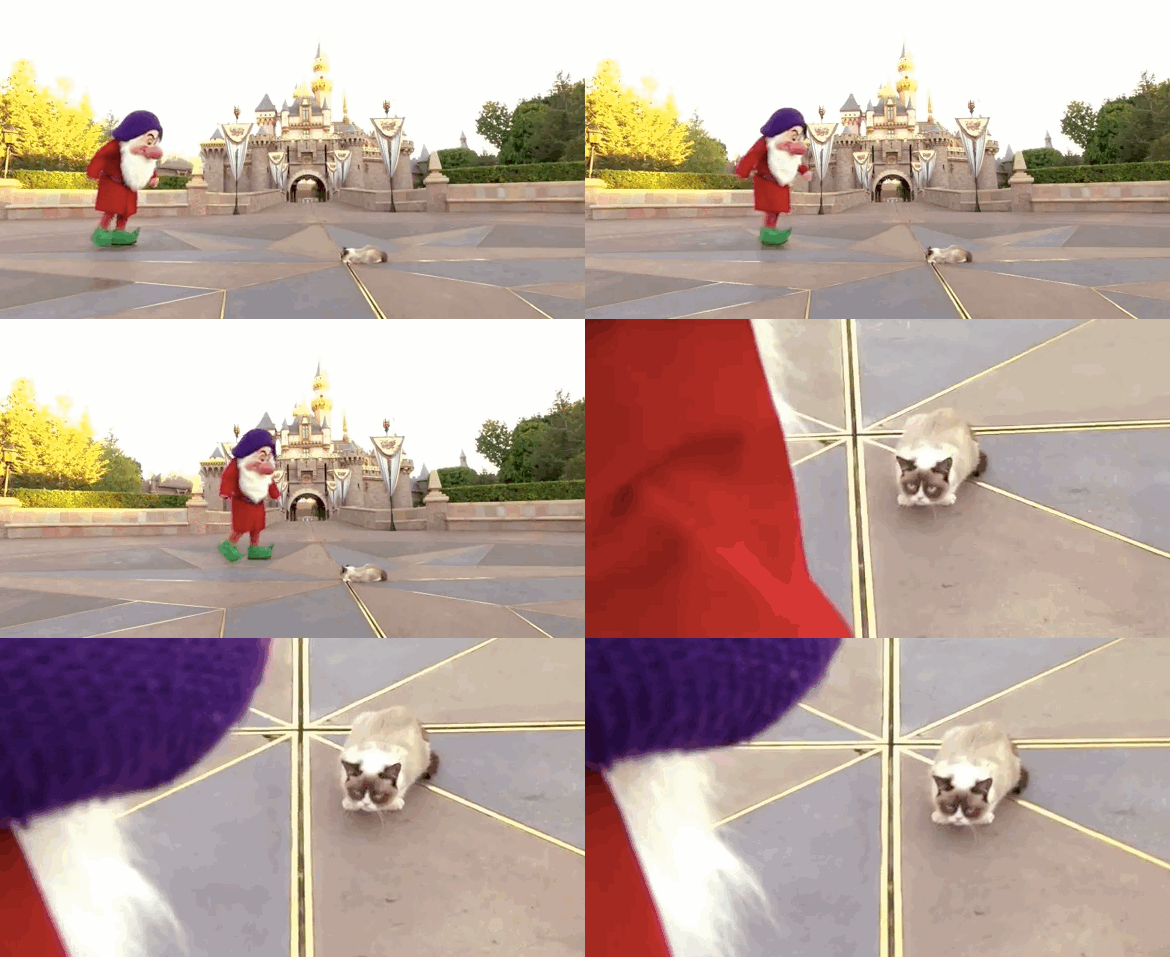
The Feral Cats of Disneyland.

disney cats       Original publish date:  December 7, 2013
At last count, there were 35 official Walt Disney cats. Figaro, Lucifer, Cheshire, Bagheera, Shere Khan, Thomas O’Malley, Duchess, Tigger, Rufus, Oliver, Dinah, Mufasa, Simba, Nala, Scar, all of those Aristocats and who can forget Si and Am from Lady and the Tramp? “We are Siamese if you please.” There’s an ear-worm for the rest of your day. No doubt, some of those cat names sound familiar while others ring silent in your mind. But do you know about the feral cats of Disneyland?
Every night at the California Disneyland theme park, after the bedraggled parents head for the exits with their sunburned children in tow, after the exhausted employees (Disneyland calls them “cast members”) have headed for home, the park fills up again, this time, with some 200 hundred feral cats. Never heard of a feral cat? A feral cat is a domestic cat that has returned to the wild. A feral cat is different from a stray cat, which is defined as a cat that has been lost or abandoned, while feral cats are born in the wild. Although the offspring of a stray cat can be considered feral if born in the wild.
When Disneyland opened over a half century ago in 1955, the location was then a rural suburb of Los Angeles called Anaheim. An area best known for producing oranges for juice and grapes for wine with a population under 15,000 people. It quickly grew to over 100,000 by 1960 and today it’s population numbers over 350,000. As the town quickly became a city the pet population grew accordingly. Almost from the start, feral cats began to gather behind the gates of the Magic Kingdom. Many factors contributed to this frenzied feline phenomenon; safety, shelter, community, but mostly food.
In the earliest days of the park, things were quite different than they are today. True, the park employed dozens of “cast members” to pick up trash back in the day, but the emphasis was on ride cleanliness back then rather than the meticulous state of grounds keeping we can see today. During renovation of the Sleeping Beauty castle two years after Disneyland opened, more than 100 cats were found living in the unused portion. Worse yet, a colony of fleas permeated the area as well.
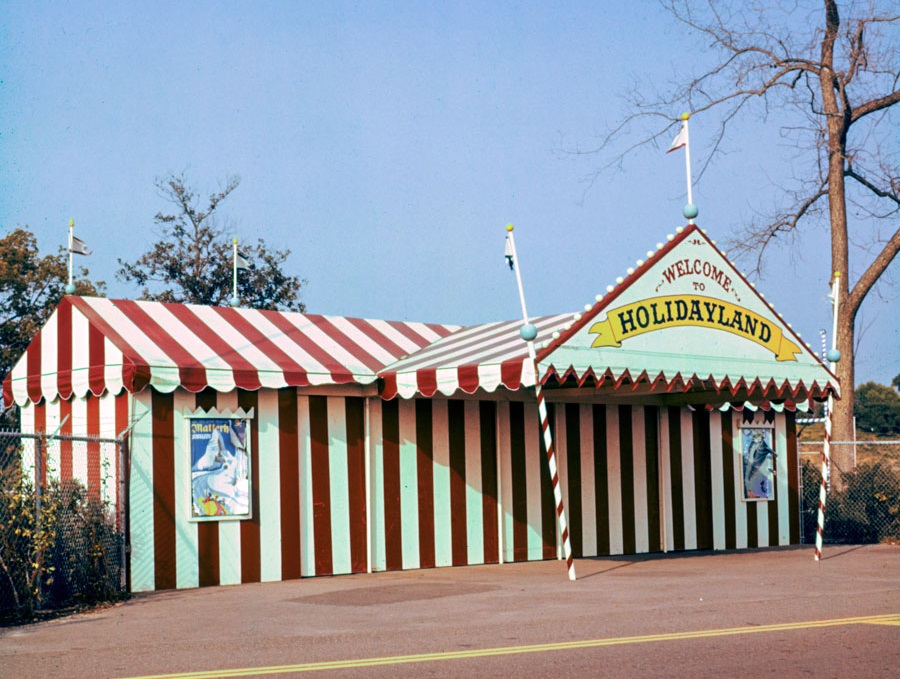
No doubt, these feral cats were first drawn to Disneyland by the discarded scraps of food left behind on park grounds by guests, but the cat population stayed for another reason: Mice. Ironic when you consider the entire Walt Disney juggernaut was built around a mouse. While Mickey Mouse may have put Disneyland on the map, a colony of feral cats helps keep the famous theme park rodent-free. The cats were first drawn to a long forgotten “lost” land of Disneyland known as “Holidayland.” Operating from 1957 to 1961, Holidayland was a 9-acre grassy picnic area located along the western edge of Disneyland, near the area that is now New Orleans Square.
SteveC_LgT_Holiday1Holidayland had its own admission gate into Disneyland and could hold up to 7,000 guests for large events. It featured playgrounds, horseshoes, a baseball diamond, volleyball courts and other activities. The centerpiece was billed as “the world’s largest candy-striped circus tent” which had previously been used by the short-lived.Mickey Mouse Club Circus and Keller’s Jungle Killers attractions inside the original Disneyland theme park. Food and concessions were available for purchase in Holidayland including beer, which was not available inside the gates of Disneyland.
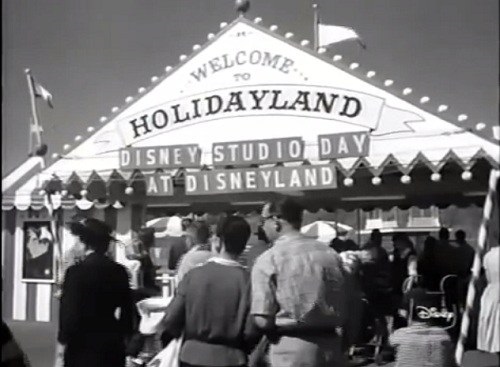
Despite providing alcohol for the relief of sun-scorched adults, Holidayland floundered, and eventually failed, after only 4 years due to its lack of shade, absence of nighttime lighting and the unsettling thought that it had no restrooms. Did I mention they sold beer? Today, the former location of Holidayland houses part of the Haunted Mansion and Pirates of the Caribbean rides. But back then, when the picnickers left, the feral cats were now left to meander new regions of the Magic Kingdom.
Holidayland1  At first, the cats were considered to be a bit of a nuisance and a possible threat to the guests. Attempts to control, cajole or coax the cats proved futile. After all, these were non-paying guests and Uncle Walt was simply not going to stand for that. So, rather than try to evict them, Disneyland decided to employ them. Soon, the cats became an integral part of the park’s everyday operations.
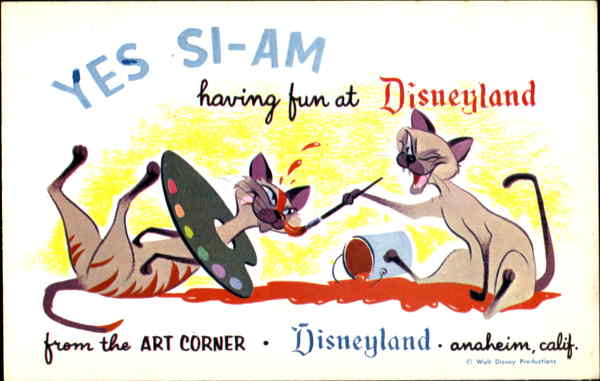
But don’t expect to spot one on your next visit as they hide during the daytime. The cats are free to come and go as they please, but only at night. The cats join the 600 custodians, painters, gardeners and decorators who work through the night to ensure that the world’s best known theme park meets the squeaky-clean ideals that Walt Disney himself extolled so many years ago. The cats work alongside a human crew that works 365 nights a year, toiling under portable floodlights sprucing, fixing and adjusting this city that never sleeps.
Siamese Cats             Just as the feral cats of Disneyland have their own specific job, every nighttime worker has his own specific task. Three workers are responsible solely for repairing and replacing the 800 umbrellas, 25,000 chairs and about 7,000 tables in the restaurants and snack bars in Disneyland and neighboring California Adventure Park. Four certified divers collect submerged trash and make repairs on water attractions like Finding Nemo and the Jungle Cruise. The work can often be tedious and occasionally bizarre.
All of the recorded music and sounds heard in the rides and throughout the park runs continuously on a loop. Seems that it is more costly for Disneyland to shut the sound off then to restart the system every day. The only time the sound is shut off is when there is an Emergency such as a massive power loss or emergency shut downs. For example, in “It’s a small world” the dolls stop moving, but the music plays on. Inside the Haunted Mansion, the doom buggies stop but the animatronics still move and the voice-over continues. Luckily the cleaning and maintenance crews can turn it down so they won’t go mad, but the feral cats don’t seem to mind.
Seven years ago, reportedly at the urging of former “Price is Right” host Bob Barker, animal care staff at the park took it upon themselves to do right by their feline employees by instituting a preventative health program of Trap-Neuter-Return”. Aided by local organizations including FixNation, Disneyland developed a lasting protocol for the humane care of the resort’s cats. Although Disneyland doesn’t monitor the total number of cats, the program has been quite successful at adopting out kittens and maintaining a balance between cat population and their Disneyland environment.
After the cats are neutered and returned to the park grounds, they receive continuing managed care. Its a pretty good gig to be a Disney-employed mouser. During the day, the feral cats of Disneyland lounge around and dine at five discreet feeding stations hidden throughout the resort strategically situated to minimize interaction with resort guests. During orientation Disney cast members are instructed to never pet the cats.
It’s nice to see such a high-profile park treating all its visitors and employees humanely-not just the human ones. California Disneyland’s “TNR” program proves that organizations and feral cat colonies can not only peacefully share the same property, but also work together in a mutually beneficial relationship to improve conditions for both parties. You may wonder, does Disneyworld in Orlando, Florida have the same problem? Well, although there have been occasional cat sightings at the Sunshine State’s Magic Kingdom, Disney Orlando has one thing Disney California doesn’t: alligators.
A story circulates that Disneyland changed its stance on the interloping cats based on an incident from those first couple years of operation. Those first original Disneyland feral cats supposedly migrated from an adjacent trailer park. During this time there was a sweet cat that hung out at the ranch in Frontierland. Employees nicknamed the female cat “Roofie” as she often hung out on the roof and surrounding landscape of the “Crockett and Russel Hat Co.” storefront. Employees would routinely bring canned cat food for her and she would come out of the tall grass, sometimes even dropping a mouse she had caught since she liked the canned food more. One day employees noticed that roofie was very ill. After work, they placed her in a box and rushed her to a nearby vet’s office. She died on the way. The vet examined her and said she died from eating poisoned mice. Word got back to Uncle Walt and the policy was changed.
Finally, proof that feral cats can be useful and worthy of life; not simply un-tamable animals for our overtaxed shelters to destroy. Many shelters in the Western US give them to ranchers and farmers for use as barn cats and back in the day police stations and college campuses kept a few around to keep their rodent population down without resorting to the use of chemicals and rodent traps everywhere. Maybe in 2014, the world will take the lead of Walt Disney and his feral cats of Disneyland.
If you would like more information on the feral cats of Indianapolis, please contact the good folks at Indy Feral. Give them a call at (317) 638-3223 or check out their website at http://www.indyferal.org/. Their Mission is to reduce the stray and feral cat overpopulation of our fair city through the non-lethal Trap-Neuter-Return (TNR) method. They could use your help and support, or they would just love to hear from you.DisneyCats