

Original Publish date: March 19, 2018
This past weekend the Irving Theatre played host to a book signing. Bob Netolicky, Robin Miller and Richard P. Tinkham visited the Irv for the official release party of their new book “We changed the game.” The book tells the story of the Indiana Pacers and the ABA from the very beginning by the men who lived it. Netolicky and Miller shared funny stories about the league that kept the crowd of 150 guests in stitches for the duration. However, even though he spoke in measured tones, sometimes barely above a whisper, it was Mr. Tinkham who kept the crowd on the edge of their seats.
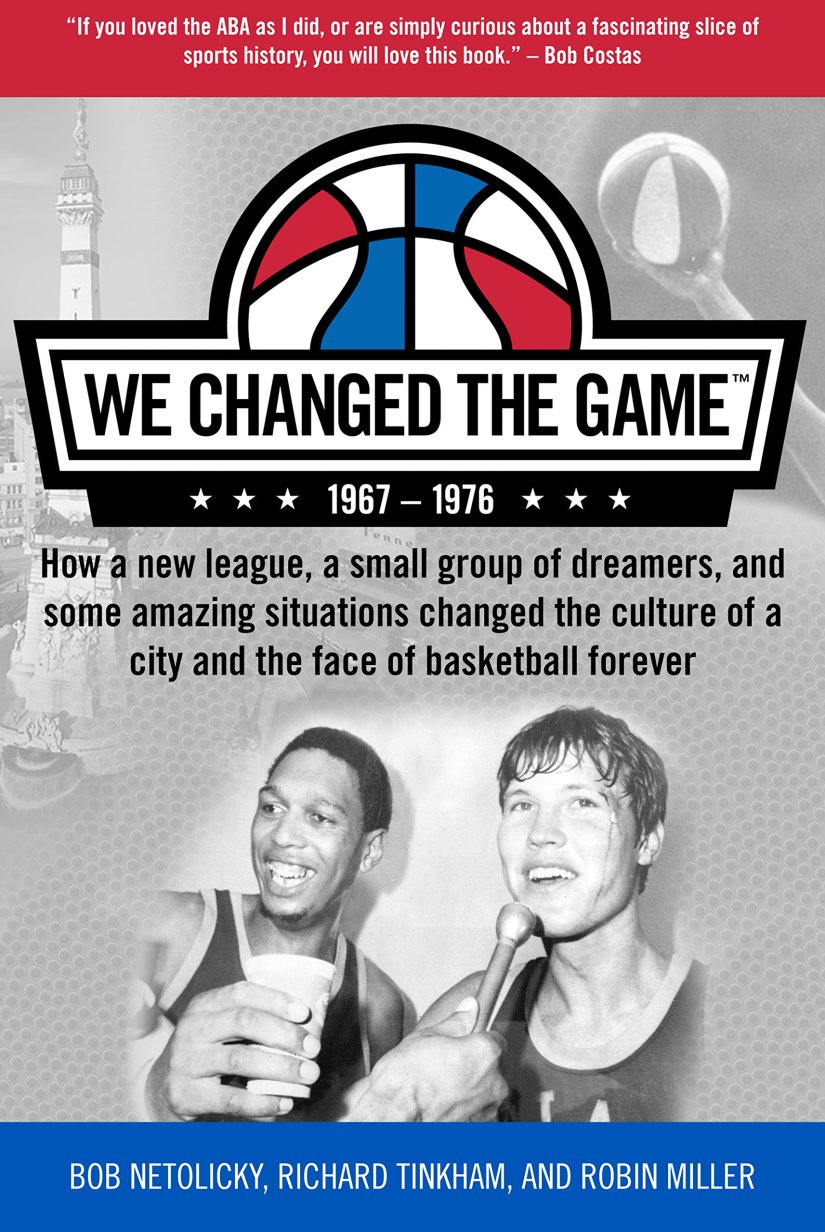 Dick Tinkham is the Rosetta Stone of the American Basketball Association. He was there during the embryonic stages of the league forward. Dick explained how the ABA was originally designed to be a six-foot or under player league…gasp! He revealed how the Pacers team almost folded at the close of the 1968-69 season…gulp! And he continued with tales of crucial deals made in airports, hotel rooms, restaurants and bars…wheeze! Yes, Dick Tinkham knows where all the bodies are buried.
Mr. Tinkham talked about early attempts by the ABA to lure Indianapolis native and hall of famer Oscar Robertson away from the NBA Cincinnati Royals. In 1967, Tinkham had hopes that Robertson might jump to the upstart Pacers. Robin Miller pointed out that Oscar had a $100,00 guaranteed contract and that “the Big O wasn’t going anywhere”. Mr. Tinkham then disclosed that it was Robertson who advocated that the Pacers travel to Dayton Ohio and check out a young man named Roger Brown. That signing changed the face of this city and arguably, saved the ABA. Ironically a few shot years later, Oscar Robertson would pop up again, this time as the foil for the ABA.
In June of 1971, only three years after the ABA began play, NBA owners voted 13–4 to work toward joining both leagues. A merger between the NBA and ABA appeared imminent and Dick Tinkham was right in the middle of it. After the 1970–71 season, Basketball Weekly reported: “The American basketball public is clamoring for a merger. So are the NBA and ABA owners, the two commissioners and every college coach. The war is over. The Armistice will be signed soon.” During this short-lived courtship, the two leagues agreed to play pre-season interleague exhibition games for the first time ever.
At last Saturday’s event in the Irving theatre, Dick Tinkham detailed how he met privately with Seattle SuperSonics owner Sam Schulman, a member of the ABA–NBA merger committee in 1971 to work out details for the merger. Schulman asked Tinkham how much it was going to take to get each ABA team (there were 11 at the time) to move into the NBA. Tinkham revealed to the gathered crowd that this was a question he had not anticipated and was totally unprepared to answer. Dick, thinking fast on his feet, replied that it would take $ 1 million for each team. Schulman agreed and phoned NBA Commissioner J. Walter Kennedy to announce that an agreement had been reached for a merger.

Schulman told the commissioner that he was so adamant about the merger that if the NBA did not accept the agreement, he would move the SuperSonics from the NBA to the ABA. Not only that, but Schulman threatened to move his soon-to-be ABA team to Los Angeles to compete directly with the Lakers. The owners of the Dallas Chaparrals (now the NBA’s San Antonio Spurs) were so confident of the impending merger that they suggested that the ABA hold off on scheduling and playing a regular season schedule for the 1971–72 season.

The first NBA vs. ABA exhibition game was played on September 21, 1971 at Moody Coliseum in Dallas, Texas. The first half was played by NBA rules and the second half by ABA rules, including the red, white and blue basketball and 3-point shot. Kareem Abdul-Jabbar’s NBA Milwaukee Bucks barely squeaked past John Beasley’s ABA Dallas Chaparrals, 106-103.
Down 12 points with 10 minutes to go, Chaps Gene Phillips hit six straight shots in fourth quarter to rally his team. The Chaps went ahead 103-102 with 24 seconds remaining on a pair of free throws from guard Donnie Freeman. With the Chap’s defense collapsing on Jabbar, McCoy McLemore hit a 15-foot jumper with 11 seconds left to give the Bucks a 104-103 lead. The Chaps’ Steve “Snapper” Jones missed a 10-foot baseline jumper with five seconds on the clock. Bucks Lucius Allen made two free throws for the final score. Bucks’ stars Oscar Robertson and Bob Dandridge missed the game. Dandridge was appearing in a Willamsburg Virginia court settling a traffic ticket and Oscar Robertson was in Washington D.C. fighting the merger.

Officially, the litigation was known as “Robertson v. National Basketball Association, 556 F.2d 682 (2d Cir. 1977)”, but it became forever known as the Oscar Robertson suit. Robertson, as president of the NBA Players Association, filed a lawsuit in April of 1970 to prevent the merger on antitrust grounds. Robertson, still smarting from his unexpected trade by his college hometown Cincinnati Royals to the Milwaukee Bucks, sought to block any merger of the NBA with the American Basketball Association, to end the option clause that bound a player to a single NBA team in perpetuity, to end the NBA’s college draft binding a player to one team, and to end restrictions on free agent signings. The suit also sought damages for NBA players for past harm caused by the option clause. The court issued an injunction against any merger thus delaying the ABA-NBA merger.
Robertson himself stated that his main gripe was that clubs basically owned their players: players were forbidden to talk to other clubs once their contract was up, because free agency did not exist back then. In 1972, the U.S. Congress came close to enacting legislation to enable a merger despite the Oscar Robertson suit. In September 1972, a merger bill was reported favorably out of a U.S. Senate committee, but the bill was put together to please the owners, and ended up not pleasing the Senators or the players. The bill subsequently died without coming to a floor vote. When Congress reconvened in 1973, another merger bill was presented to the Senate, but never advanced.
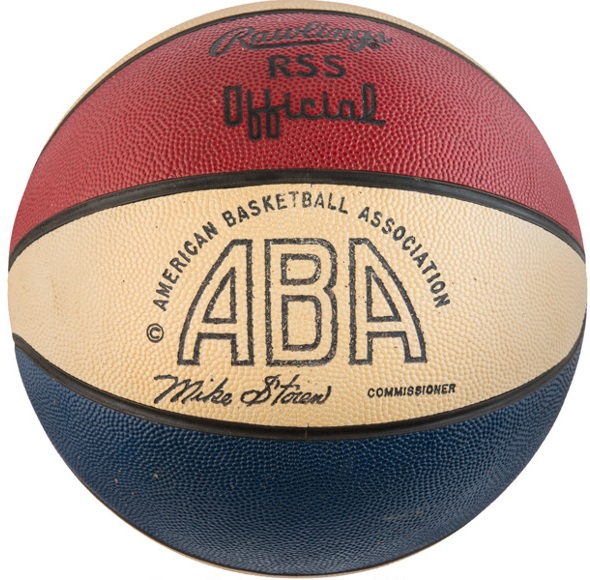 Meantime, the ABA-NBA exhibition games continued. In these ABA vs. NBA exhibition games, the ABA’s RWB ball was used for one half, and the NBA’s traditional brown ball was used in the other half, the ABA’s three-point shot (and 30 second shot clock) was used for one half only, in some games, the ABA’s no-foul out rule was in effect for the entire game and the league hosting the game provided its own referees. NBA refs wore the traditional B&W “zebra” shirts while ABA refs wore shorts matching the ball: red, white & blue. Most of the interleague games were played in ABA arenas because the NBA did not want to showcase (and legitimize) the ABA in front of NBA fans. On the flip side, ABA cities were eager to host NBA teams because they attracted extra fans, made more money, and proved both leagues could compete against each other. Results from those first few years were not highly publicized by either league.
Although they didn’t count for anything except pride, ABA / NBA exhibition games were always intense due to the bad blood between the leagues. During these ultra-competitive games players (including future Hall of Famers Rick Barry and Charlie Scott who played for teams in both leagues) were thrown out with multiple technical fouls. Likewise, Hall of Fame coaches like Larry Brown and Slick Leonard (who coached in both leagues) often ended up listening to interleague games in the locker room after being ejected.
After the 1974-75 regular season, the ABA Champion Kentucky Colonels formally challenged the NBA Champion Golden State Warriors to a “World Series of Basketball,” with a winner-take-all $1 Million purse (collected from anticipated TV revenues). The NBA and the Warriors refused the challenge. Again, after the 1975-76 season, the ABA Champion New York Nets offered to play the NBA Champion Boston Celtics in the same fashion, with the proceeds going to benefit the 1976 United States Olympic team. Predictably, the Celtics declined to participate.
In the later years of the rivalry, buoyed by younger players, better talent and the home court advantage, ABA teams began winning most of the games. Over the last three seasons of the rivalry, the ABA steadily pulled ahead: 15-10 (in 1973), 16-7 (in 1974), and 31-17 (in 1975). The ABA won the overall interleague rivalry, 79 games to 76 and in every matchup of reigning champions from the two leagues, the ABA champion won, including in the final pre-merger season when the Kentucky Colonels defeated the Golden State Warriors, sans $ 1 million dollar purse.
The Oscar Robertson suit would eventually seal the fate of the ABA and for the entirety of its pendency it presented an insurmountable obstacle to the desired merger of the two leagues. The worm was beginning to turn.
Next Week- Part II including details of the April 7, 2018 American Basketball Association Reunion in Indianapolis.
 Original publish date: February 6, 2017
 Don’t remember THAT part of Kings Island? Well, that may due to the fact that this “ride” came with an up charge. It required an extra 50 cent ticket to enter. Most kids didn’t go because they didn’t have the extra money or because their parents were unwilling to spring for the extra expense.


 On June 16th I found myself in Marshalltown examining the items. I obtained my bidder number, which happened to be bidder # 1, and retreated to my hotel room to await the next day’s auction. There’s not much to do in Marshalltown, Iowa so I decided to drive to the nearby community of LeClaire, Iowa to mark time.
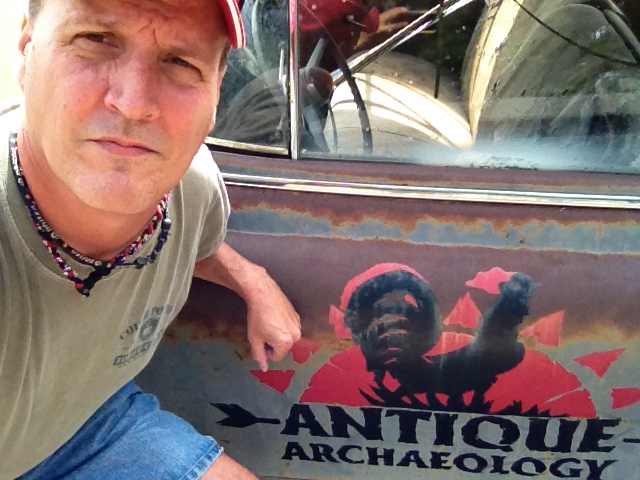
 Among the items I brought home were a pair of contemporaneous framed leaflets. Both are displayed starkly in black wood and glass frames, one is a copy of Lincoln’s farewell address to the citizens of Springfield, and the other is a copy of Lincoln’s favorite poem. The farewell address is important to me because Lincoln’s first stop after the delivery of this poignant edict was Indianapolis. The next item was a classic-looking photo of Lincoln ascending to heaven wrapped in the open arms of George Washington. The careworn oval metal frame fits snugly in the palm and bears the wear and patina of an item held repeatedly in the loving hands of a legion of Lincoln admirers.
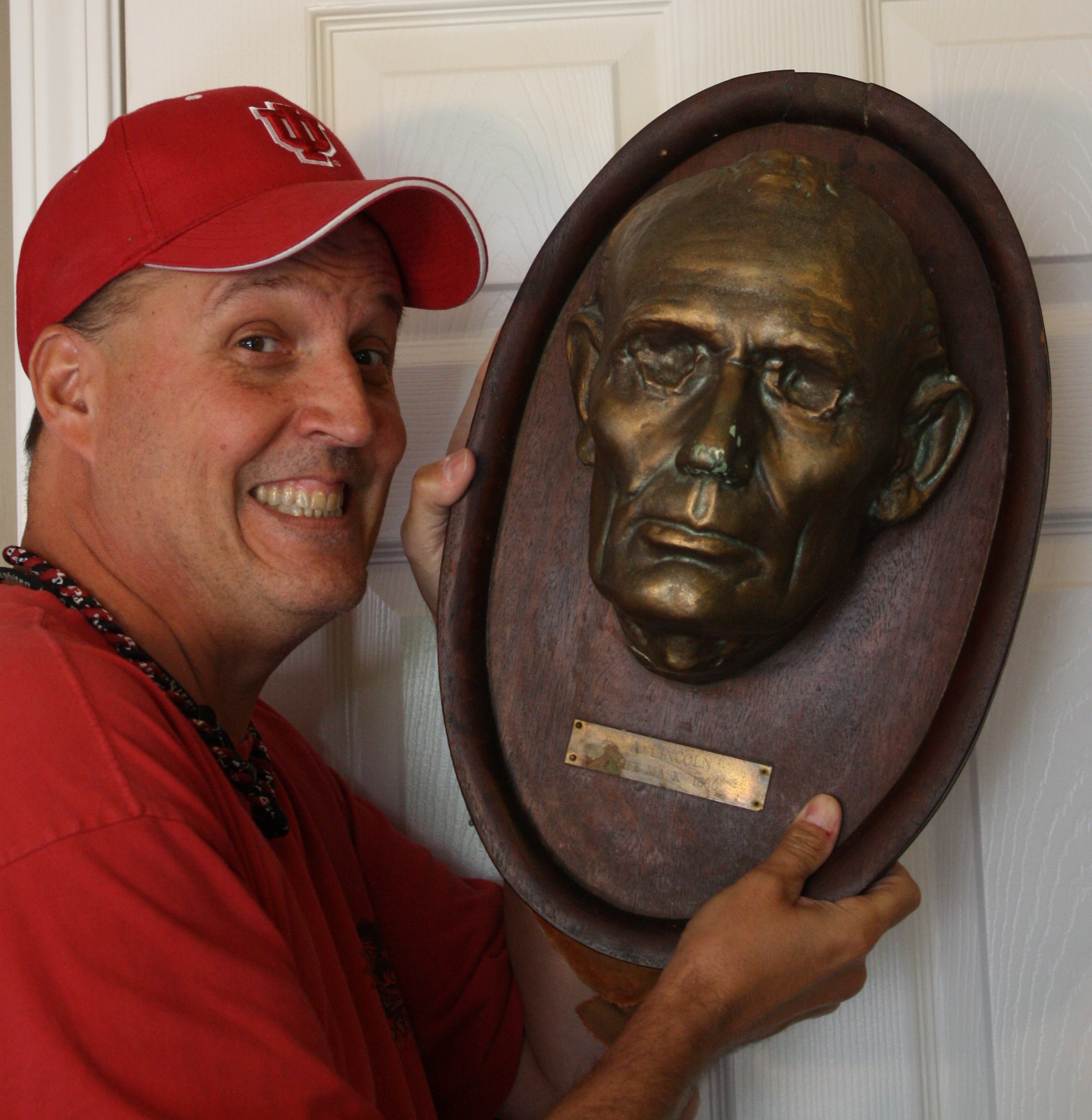 The next item is the haunting life mask of Abraham Lincoln that once hung on the wall of Oldroyd’s museum. The lifesized mask is attached to a larger handcrafted oval wooden plaque with a smaller brass nameplate attached to the front. The lifemask, made by artist Leonard Volk in 1860 before Lincoln grew his signature beard, is an accurate representation of what it would have been like to look at the face of a young and vibrant Lincoln. This item was surely a highlight of the museum and, judging by the loss of paint and subsequent repair of the nose, was a good luck talisman for all visitors. Rubbing Lincoln’s nose is still a popular tradition at the Lincoln tomb in Springfield.
 owned. The Bible was obtained by Oldroyd after Mr. Lincoln was killed and presumably following the death of Mary and Tad Lincoln. The phone book-sized Bible shows signs of heavy wear and transport in compliance with the somewhat vagabond lifestyle led by Mary and Tad after vacating the White House in 1865. Mary died in 1882. Tad preceded her in 1871. The Bible includes a couple pages of contemporary Carte de Visite photographs of the Lincoln family along with a few other disparate images from the Civil War and immediate post-period. The inclusion of CDVs depicting Union Civil War Generals Grant, Sheridan, Burnside, and Sherman alongside images of the US Capitol Dome under construction and George and Martha Washington could easily be construed as Tad’s version of collecting baseball cards.
 The last three items of acquisition were perhaps the most important to me. I am a native Hoosier. I cherish the idea that Abraham Lincoln grew to manhood in the southern region of my home state. These three items offered a direct connection to Lincoln and Indiana. The first two items are innocuous in their relevance to Lincoln the Hoosier; the Lincoln family coffee grinder and Abraham Lincoln’s ice skate.
 The next Indiana Lincoln item is an ice skate. The thick wooden shoe stand is shaped like an hourglass and the heavy iron blade is curled at each end like an ancient Crakow shoe. While no official reference exists of Lincoln the ice skater, the skate presents a romantic image of boyhood Lincoln at play on a frozen southern Indiana pond. Simply holding it in your hands brings a smile to your face.
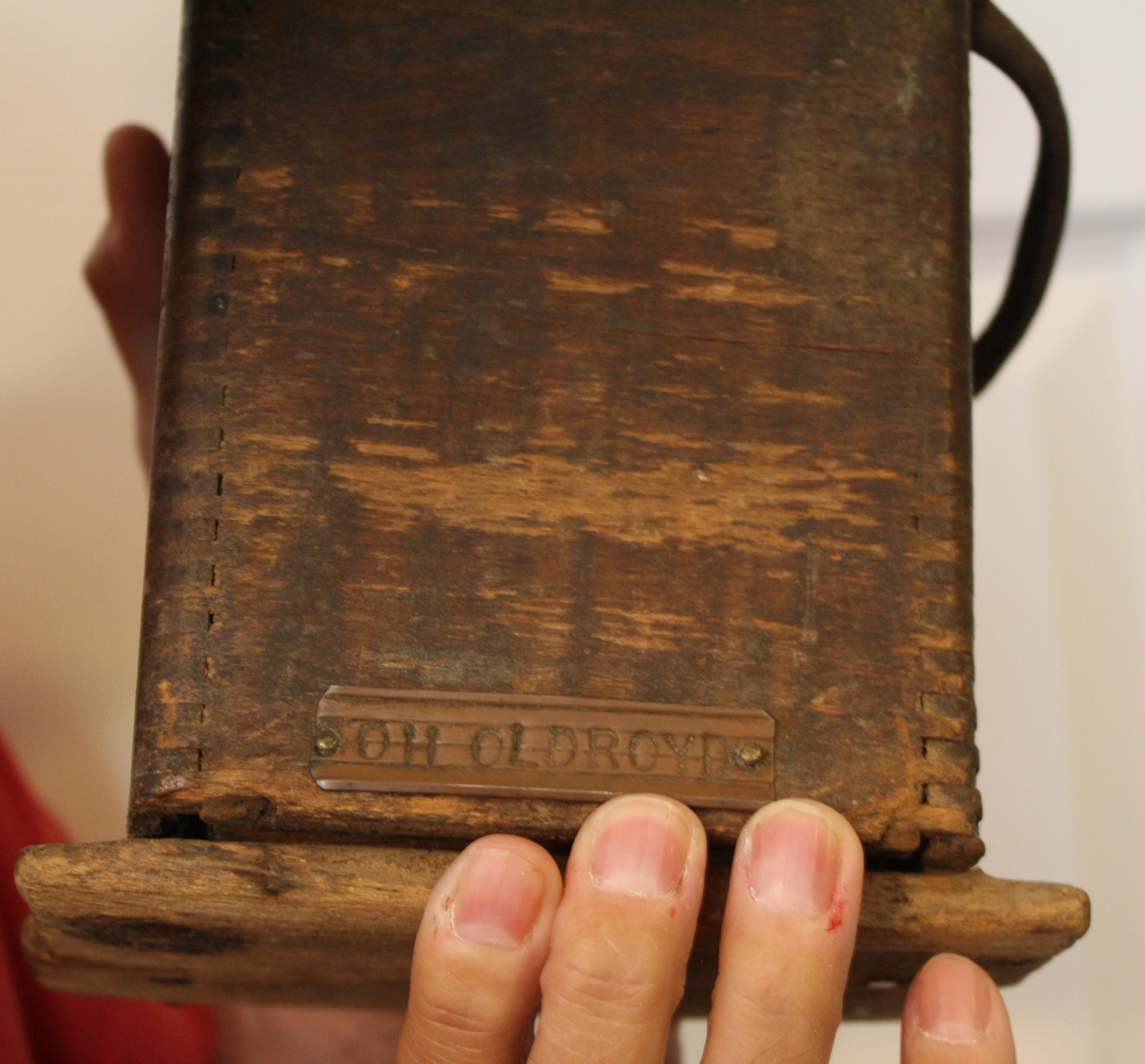
 with me, at all costs. It is an ancient-looking Colonial Era metal candle maker. During colonial times up to the Antebellum Era, candles were the main source of light during the long, dark, nighttime hours. Candles on the western frontier were made from beeswax and tallow (animal fat). The wicks were lain loosely inside the tube as the wax was poured in around them to harden.
 Included with the candle maker is a framed certificate written and signed by Osborn Oldroyd reading: “This candle maker is from the Lincoln and Sparrow Cabin on Pigeon Creek Indiana (1818-1835) O.H. Oldroyd Washington April 9, 1901”. The certificate has a small brass diecut tab attached with the seal of the state of Indiana inset. It would be hard to find a more romantic artifact to illustrate Lincoln’s time spent in the Hoosier state. Young Abraham may well have learned to read by the light of a candle made in this, the Lincoln family candle mold. Stories abound of Young Abe the railsplitter reading by candle and firelight into the wee hours of the morning after a long day’s work in the fields.
 Lastly, my wife treated me to a birthday trip to Springfield, Illinois in July. I traveled to the Lincoln home on an early Saturday morning to reflect while seated in front of the Lincoln home. Based on trips past, I’ve learned that the early morning hours are best. No school buses, tourists or fitness walkers/bikers to mar the scene. I have been coming to Springfield for many years. Of course, Abraham Lincoln is the reason for my visit. However, I never forget that Osborn Oldroyd lived in the house and operated his museum here for nearly a decade (1884-93). I’d asked several people, ranging from officials at the Lincoln Museum to parks department employees, about Oldroyd in the past but always got a cool reception to my querie.
 Original publish date: July 20, 2017
 Another of the letters, dated Dec. 10, 1902, touched me personally because it was written by the sister of Louis Weichmann, the main government witness at the trial of the conspirators. Weichmann lived in Mrs. Surratt’s boarding house and many believe it was Weichmann’s testimony that got Mary Surratt hung. Weichmann moved to Anderson Indiana after the trial and founded Anderson business college. He is buried in Anderson’s St. Francis cemetery in an unmarked grave. “Dear Sir-I am sending you a copy of Sunday’s Indianapolis Journal containing a confession of one of the conspirators of President Lincoln….With best regards from our family, I remain Sincerely yours, Mrs. C.O. Crowley Sister of the late L.J. Wiechmann.” Curiously, Mrs. Crowley misspelled her own maiden name in her letter.
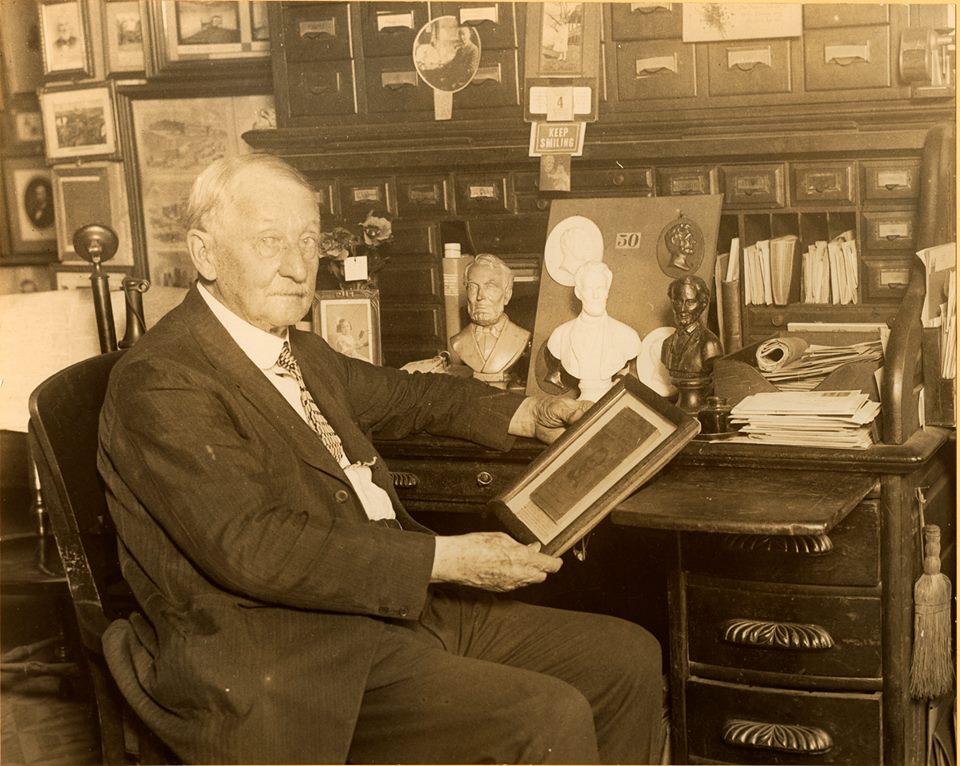
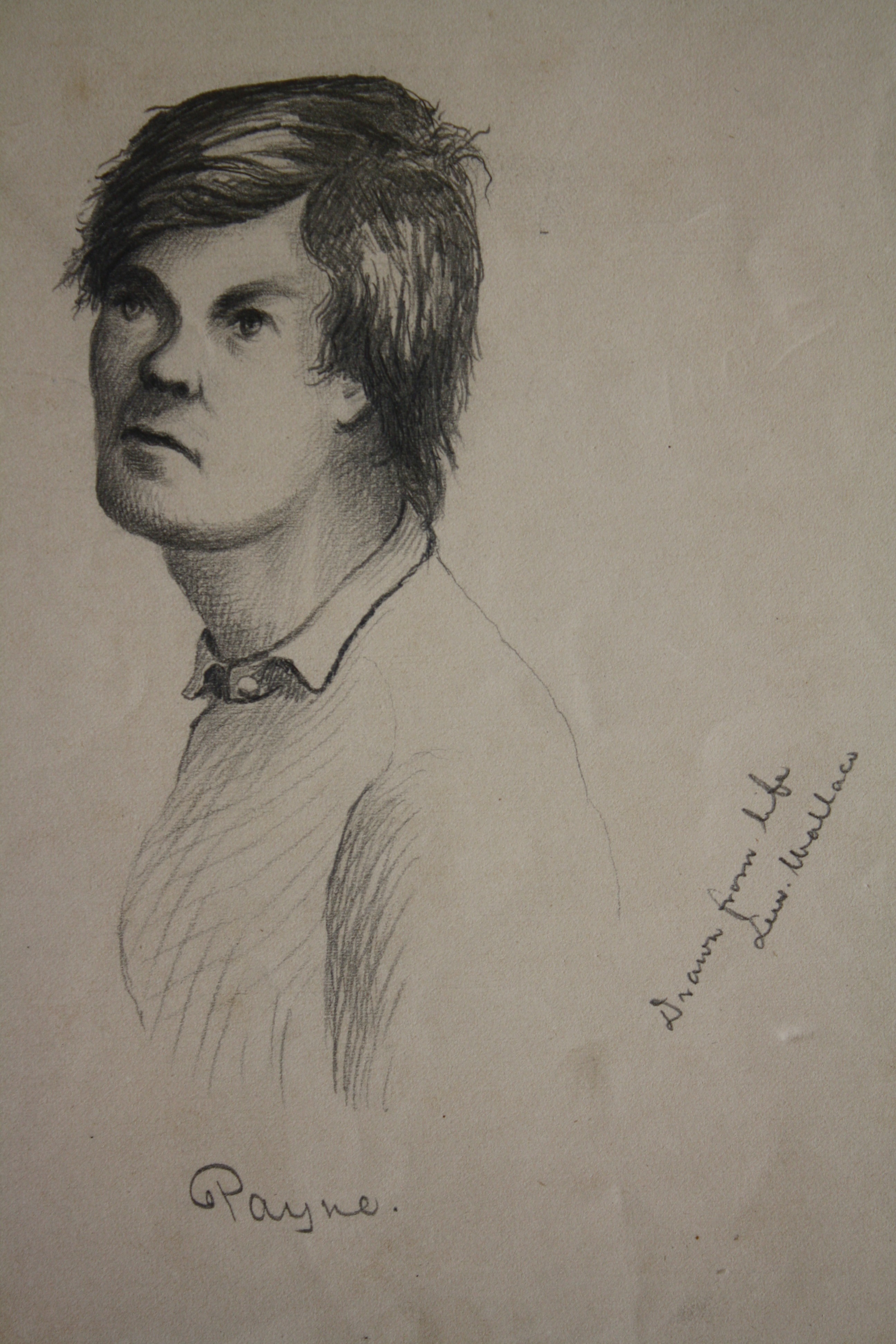 Included within that collection was a group of several dozen items that once belonged to Osborn Oldroyd himself. This included correspondence from Anderson’s Louis Weichmann to Oldroyd about shared information for books about Abraham Lincoln both men were simultaneously working on as well as photos and several handwritten eyewitness accounts of the assassination of President Lincoln. My personal favorite was a pencil drawing of Lincoln Conspirator Lewis Thornton Powell drawn by Crawfordsville, Indiana’s General Lew Wallace.
 Original publish date: July 13, 2017
 Ironically, the same year that Oldroyd moved to the Peterson house, Ford’s Theatre, where John Wilkes Booth had shot Abraham Lincoln, collapsed. The building closed since the President’s death, operated as an office until June 9, 1893, when the interior of the historic building collapsed. Twenty-two clerks died in the tragedy and sixty-eight others were seriously injured. Within a year the damage was repaired and the former theatre was remodeled for use as a government warehouse.
 The May 2, 1926, Washington Post announced the purchase with a banner headline reading, “Gets Storehouse of Lincoln Relics: Government Action Assures Preservation of Oldroyd Collection Here.” The newspaper column reported, “Captain Oldroyd has been gathering the collection for 63 years, having started on this patriotic work of love for his chieftain soon after he was released from service in the internecine strife (Civil War). Mr. Oldroyd is now 80 years old. Having for years been a student of Lincoln, acting as a guide for his collection all through its formation, Capt. Oldroyd has become a rich source of Lincoln traditions. Passage by Congress of the measure authorizing the purchase of the Oldroyd collection, 3, 000 authentic Lincoln mementos now on display in the historic Petersen House where the martyred president died, will preserve for future generations making pilgrimages to Washington a great storehouse of materials identified with Lincoln tradition.”
 What became of the pilfered Lincoln home artifacts? During a near forty year period between the 1950s and late 1980s, the Lincoln Home got back the disputed 25 items from Ford’s Theater that Oldroyd had allegedly removed without permission. “The items were well preserved. For the most part, these were all utilitarian items that might have been used every day by the residents of the home during the years before preservation became a priority.” says curator Cornelius “An argument could be made that if not for Osborn Oldroyd, these items might have been lost forever.”

