
https://weeklyview.net/2020/06/11/a-hoosier-wedding-in-lincolns-white-house/
Original publish date: June 11, 2020.
Sometimes, I need to dig up a historical story for no other reason than I need a smile. And nothing makes me smile more than sharing a story with an Indiana connection. A story that many of you have never heard before. A story that might just make you smile. This is the story of Abraham Lincoln, the Civil War, and a White House wedding. The only wedding to take place during Lincoln’s time in the White House.
In March of 1862, a 19-year-old Mount Sidney, Virginia, woman named Elizabeth Amanda Sheets wanted to marry a 28-year-old farmhand living in the same town named James Chandler, a native of Bowling Green, Kentucky. The problem was, Elizabeth’s parents disapproved of the engagement, let alone a wedding, to the much older man, so the couple decided to elope. After several months of a secret courtship, the young couple obtained a marriage license and boarded a stagecoach bound for Harper’s Ferry to get hitched.
125 miles later, as they approached the outskirts of the town, they were turned away because of the build-up of Federal forces there readying themselves for the soon-to-begin military campaign in the Shenandoah Valley. With no other options, they traveled on by stage, 63 miles away to Washington, D.C., a city neither was familiar with.
And so it was that this couple from the Rebel state of Virginia found themselves in the Union Capitol of Washington at the height of the Civil War. Luckily for them, during the war between the states, D.C. was the equivalent of Las Vegas. The stagecoach driver informed the couple that they could be married in any public building there. What’s more, the driver suggested they go and knock on the door of the White House and ask “Honest Abe” to marry them.
It sounded like a good idea to the starstruck couple, so they traveled hand-in-hand to the Executive Mansion to be joined in holy matrimony in the grandest of styles. While walking towards the White House, they asked a man who was coming towards them if it was true that they could get married there. The stranger replied that he did not know, pointed towards the front door, and told them to knock and ask for themselves.
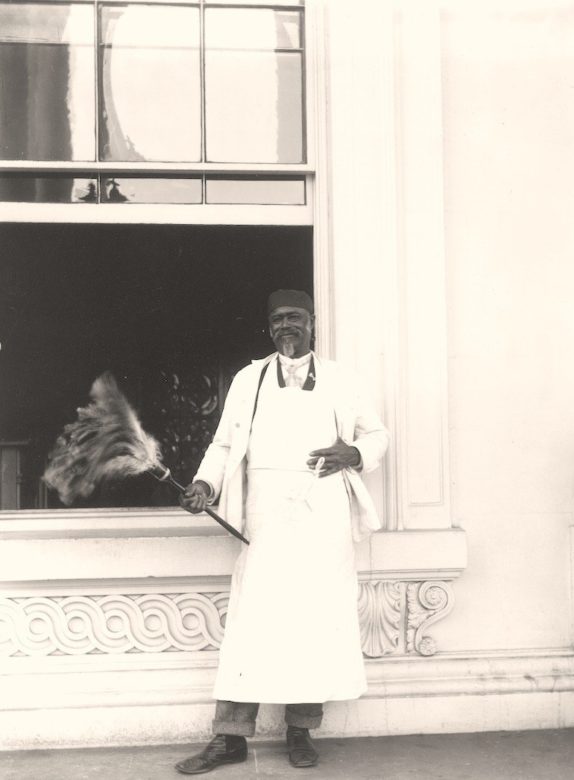
Tradition states that the door was answered by President Lincoln’s legendary doorman, Jeremiah Smith, a subject of past columns. Further tradition states that after President Lincoln heard of a young couple seeking some place to be married, he took them to the East Room and summoned a Baptist minister. The White House Historical Association reports that “a group of women then entered the room, along with First Lady Mary Todd Lincoln, to serve as witnesses for the ceremony. After the minister announced their marital status, the president and first lady shook their hands, served an elegant dinner, and invited the newlyweds to spend the night.”
Thus, again according to the White House Historical Association, “Abraham Lincoln was credited with seeing to the marriage in the White House of a couple he did not know.” The incident first surfaced in the September 27, 1901 Indianapolis News in a story headlined “Married in a Parlor of the White House” less than two weeks after the assassination of President William McKinley. Then, as now, I’m guessing the world was in need of a little good news.
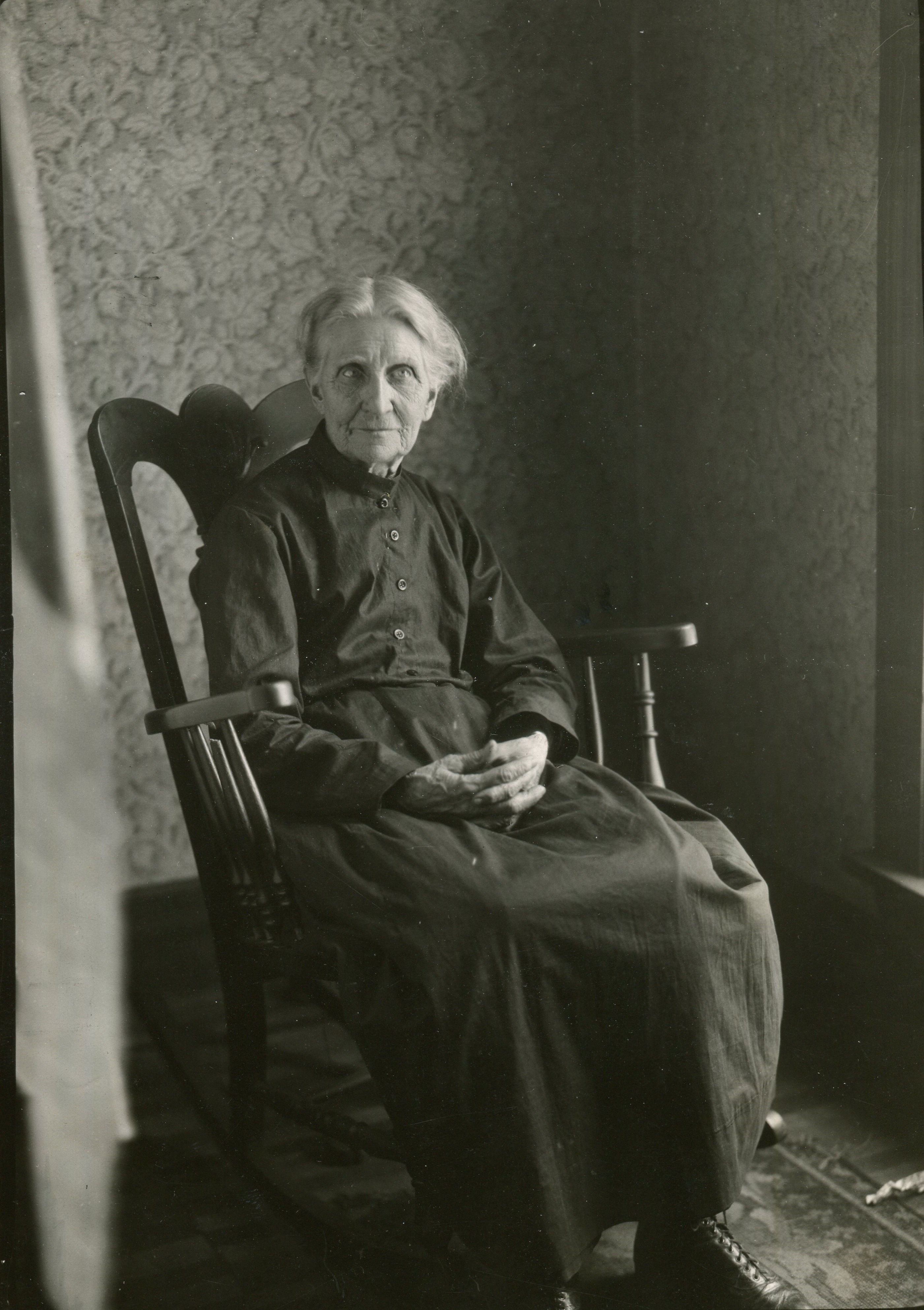
The 57-year-old widow, now known as Elizabeth Chandler, was living a quiet life in Anderson, Indiana; her husband James Henry Chandler having died six years earlier on Sept. 19, 1895, at the age of 61. The article recorded widow Chandler’s remarks about her White House wedding 44 years earlier made during a family dinner held in her honor at Rochester, Indiana. According to Mrs. Chandler, President Lincoln “shared in the happiness of the couple by suddenly finding it possible to have a wedding in the White House.”
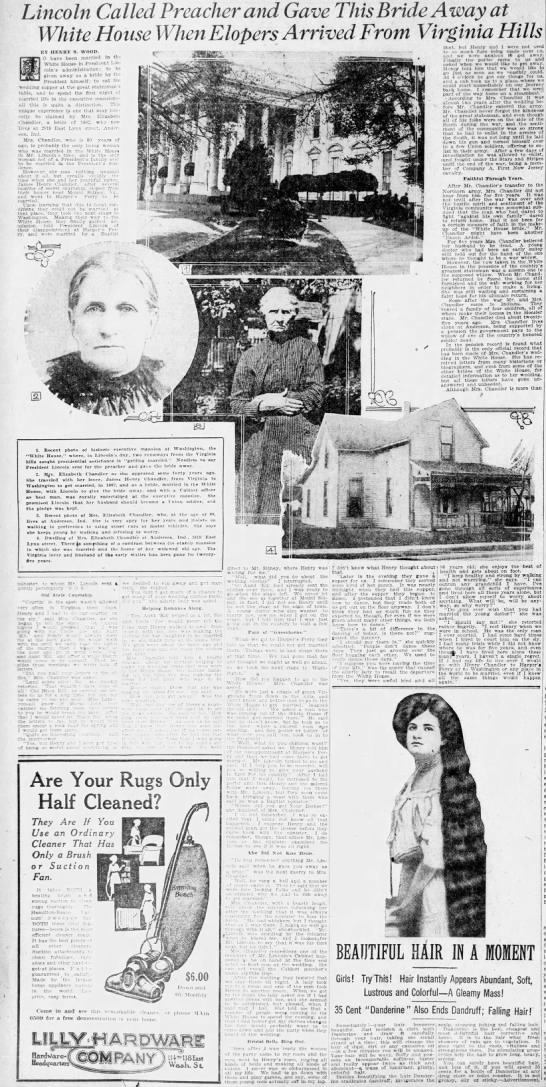
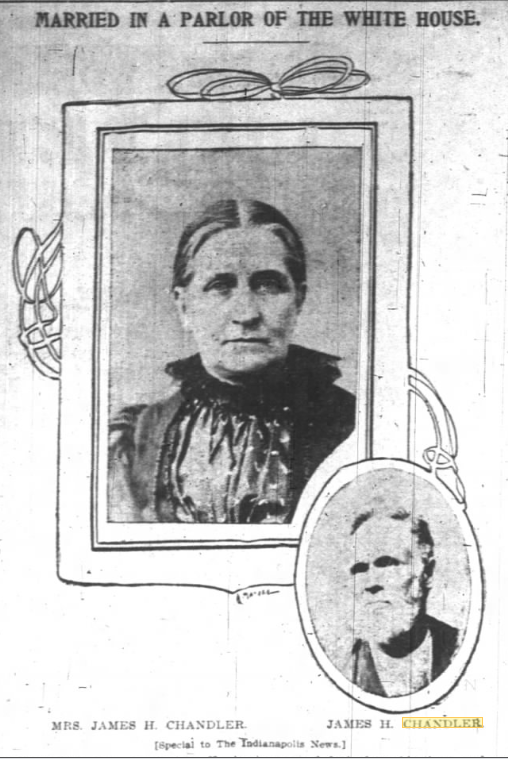
The article understates the obvious by noting, “inasmuch as she is probably the only woman living in Indiana who has the distinction of having been a White House bride… Mrs. Chandler does not regard the circumstances of the wedding as being anything out of the ordinary so far as she is concerned.” The story broke “like a romantic picture out of the past” in newspapers all over the state and was soon picked up nationally. Over the next three decades, widow Chandler’s story proved irresistible whenever there was a wedding in the White House or an important Lincoln anniversary. On February 17, 1906 (a few days after Abraham Lincoln’s 97th birthday) the Indianapolis News ran the story on the day President Teddy Roosevelt’s outspoken daughter Alice married Ohio Congressman Nicholas Longworth at the White House. The story reemerged in 1909, the 100th anniversary of the birth of Abraham Lincoln, and again in November 1913 as President Woodrow Wilson’s daughter Jessie prepared to marry Francis Sayre.
While it is difficult to prove whether the wedding actually took place, each succeeding story contained more details about the event. Elizabeth later recalled how President Abraham Lincoln led the couple up the stairs of the White House and into a big room all draped with flags. Elizabeth said she recognized the president because she had seen his picture. The young bride remembered that Lincoln summoned a messenger and, upon his arrival, the messenger and the groom left the room while Elizabeth remained with the president. Lincoln spoke to her about the war and asked whether she would be willing for her husband to fight for his country. When Lincoln noted that talk of war upset her, he changed the subject and began telling the blushing bride jokes and tall tales. After the minister’s arrived, Lincoln rang a bell and then led the wedding party into a big room, Elizabeth recalled. The president stood alongside the minister and not only did he give the bride away but also acted as the groom’s best man. Elizabeth recalled how he smiled throughout the ceremony. She stated that a Cabinet member stood up with them, but couldn’t recall his name or that of the minister. Mr. and Mrs. Lincoln were the first to shake the newlyweds’ hands. Elizabeth’s most vivid recollection of the nuptials was how scared she was. The president chatted with them awhile and then returned to his office with the unnamed Cabinet member. Elizabeth had worn a plain white cashmere dress for the ceremony. Afterwards, the couple was taken to separate rooms in the White House to change clothes, where Elizabeth changed into a navy blue cashmere dress.
According to the White House Historical Association, “a social function was being held at the White House that evening and when those present learned there were newlyweds in the house, they came ringing bells and compelled the couple to come and and join the party. The couple were greeted with handshakes and questions about where they were from and where they were going.” Elizabeth recalled that all of the guests were Northerners, and being a Virginian, she didn’t how nice Northerners were until that night. The newlywed described how she and her new husband hardly got a chance to speak during the evening because of the constant requests for her to dance the Virginia Reel.
After the party, the newlyweds were invited to a fine dinner in a room with the longest table she had ever seen. Elizabeth recalled that a hot punch was served and how everybody would stand up and drink while someone said something. The dinner lasted until the early hours of the morning. Because of the late hour and inclement weather, Elizabeth recalled that President and Mrs. Lincoln would not allow the couple to leave and insisted they stay the night. The next day, armed with a pass signed by the President himself, Mr. and Mrs. Chandler went up the Potomac River to Harper’s Ferry. From there they returned to Mount Sidney to deliver the news to the parents that they’d just got “married in the White House.”
After their fairy tale wedding in the White House, James and Elizabeth Chandler moved to a farmhouse in Augusta County, Virginia, near Mount Sidney. The couple’s home was in the heart of the Shenandoah Valley and in the path of Stonewall Jackson’s Valley Campaign. In a move that would have certainly dismayed their wedding host, 28-year-old James Henry Chandler joined the Rebel Army, enlisting as a private in the 52nd Virginia Infantry Regiment at nearby Mount Meridian on June 15, 1862. The regiment, organized the previous August, was made up of mostly Augusta County men. Perhaps because James was never paid his promised enlistment bounty, he remained in the Confederate service for only a month before going AWOL on July 17, 1862.
Chandler returned to the regiment May 23, 1863, where he remained until Oct. 14, 1863, when he was captured at the Battle of Bristoe Station, Virginia. Many years later, Elizabeth said her husband surrendered and asked permission to fight in Lincoln’s army. POW James Chandler was sent north to Washington and after some explanation and investigation, permission was granted. James took the oath of allegiance to the United States government on Dec. 13, 1863. Sixteen days later on Dec. 29, he enrolled as a private in Co. A, 1st New Jersey Cavalry. The following day he was mustered into Federal service under the name James Grimes.
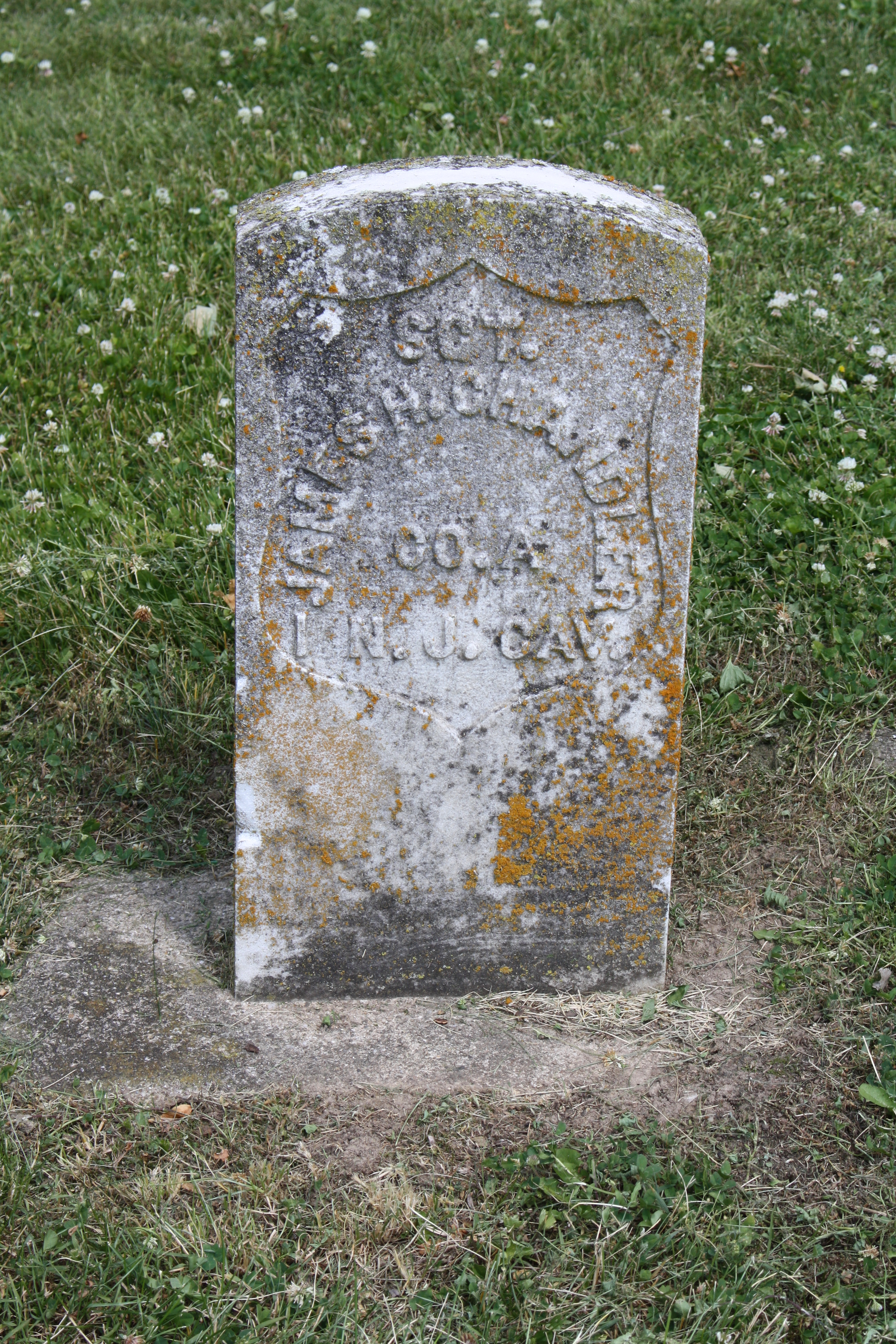
As a Federal soldier, James was promoted to the rank of corporal Nov. 1, 1864, and then sergeant June 1, 1865. At war’s end, Chandler was mustered out of service on July 24, 1865, but apparently did not return home for quite some time afterwards. Mrs. Chandler stated that, from the time he left the Confederate army in October 1863, she did not hear from him for five years and thought him among the dead. When he finally returned, he found his Virginia home intact and his wife working for a neighbor, awaiting his return. Likely because of the stigma associated with switching sides during the rebellion, the couple relocated to Henry County, Indiana. In 1868, the first of their five children was born. Census data reveals that the Chandlers were living in Jefferson Township in 1870 but by 1880 had moved to Fall Creek Township where they established a farm.
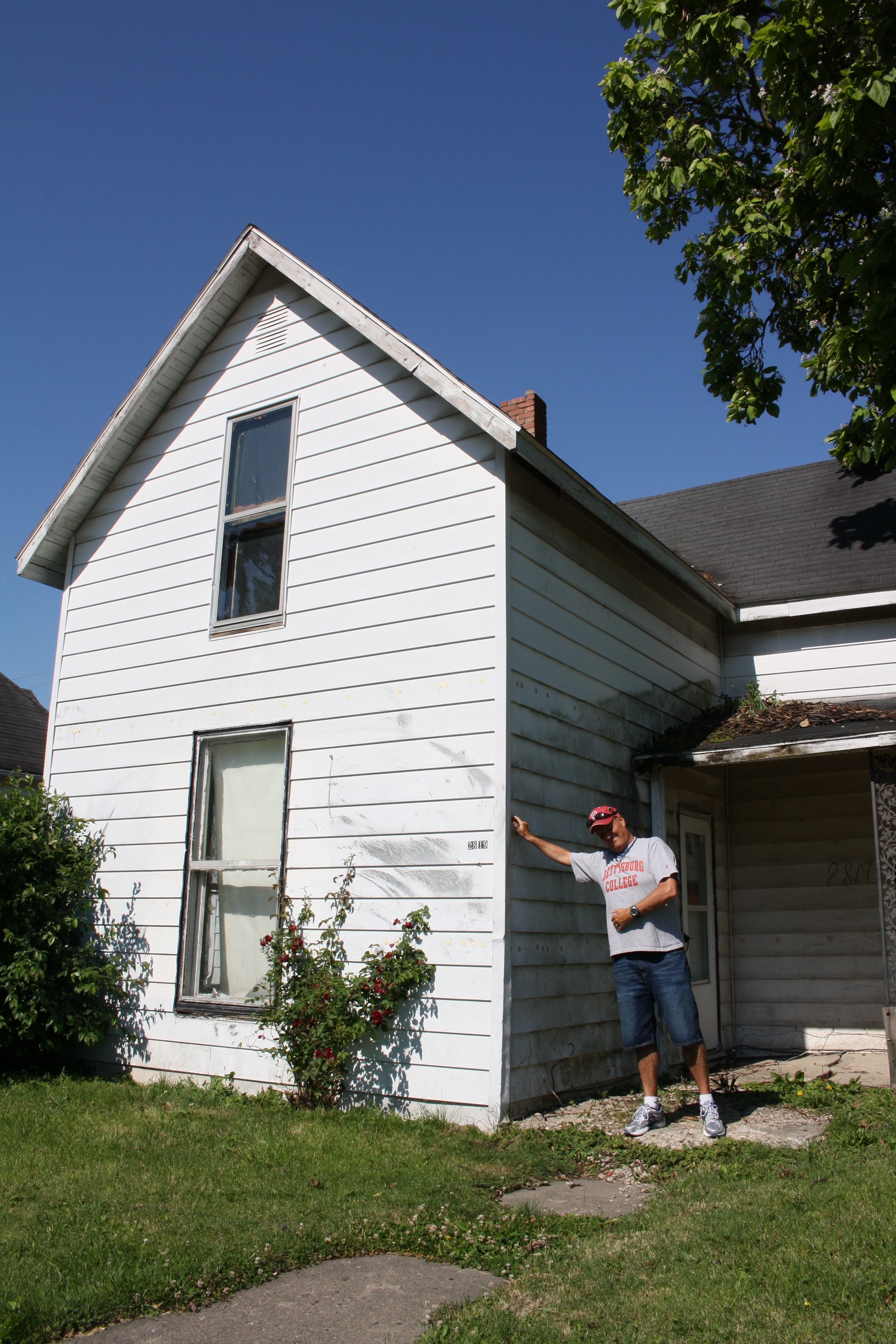
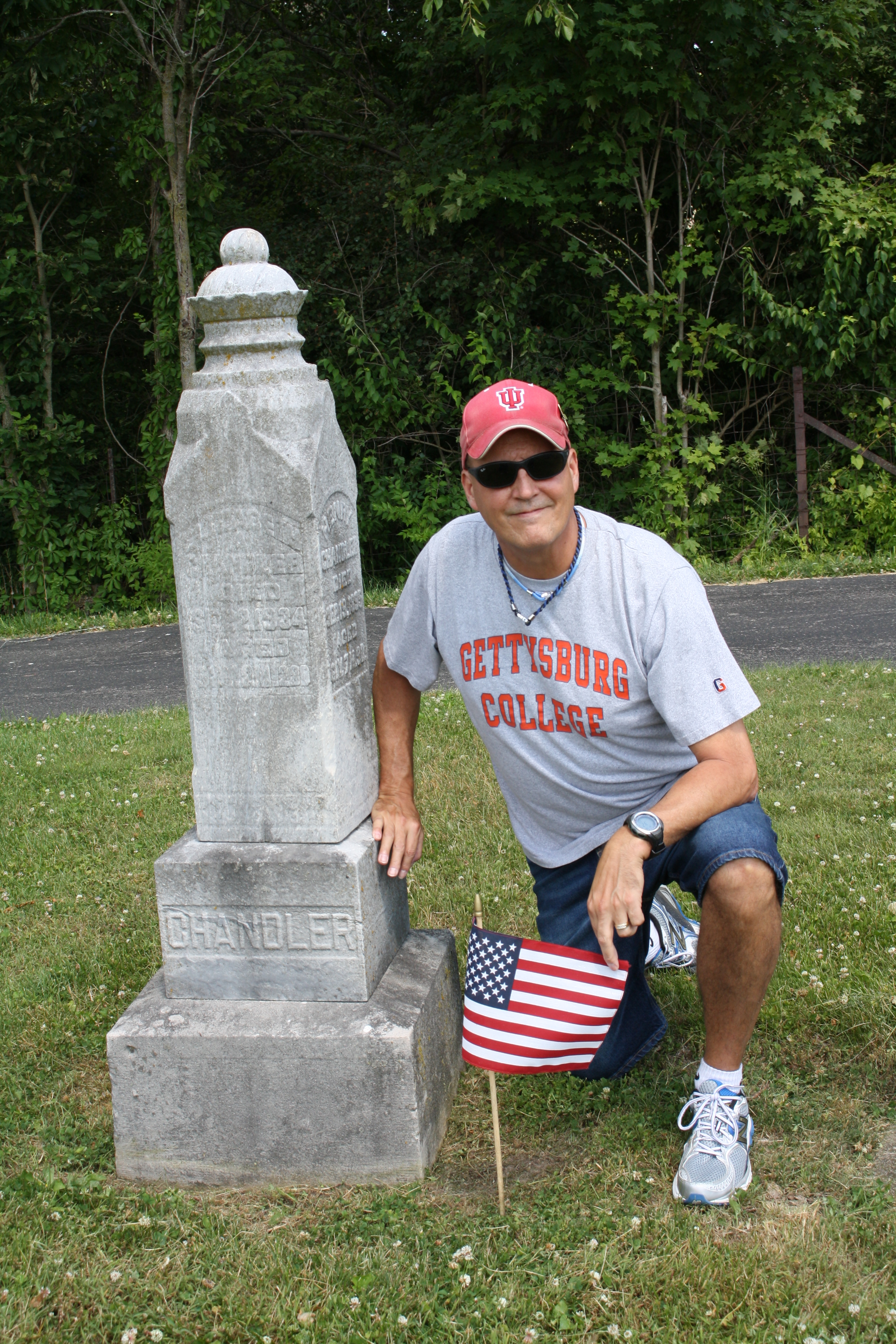
After James Henry’s death in 1895, Elizabeth moved to a little unpainted house at 2819 E. Lynn St. in Anderson (the home still stands). She was living there when her White House wedding and Lincoln connection was revealed in 1901 and remained in the home until her death in the home at the age of 92 on Sept. 2, 1934. Elizabeth and James Chandler are buried on the east side of Miller Cemetery in Middletown, Indiana. It should be noted that the only couple ever married in Lincoln’s White House are surrounded by the graves of 15 former Confederate soldiers, the largest gathering of former Rebel soldiers in any cemetery in Indiana.
Officially, there have been either 17 or 19 weddings conducted in the White House depending upon which source you use. These include nine presidential children and one president, Grover Cleveland. Because the Chandlers were not related to any of the official families and it was hastily arranged, the Chandler wedding does not register among the official records. However, the wedding date is contained in James Henry Chandler’s papers issued by the Pension Department. Following her husband’s death, Elizabeth was granted a Federal pension as a soldier’s widow by virtue of James’ service in the Civil War. However, those records do not note Chandler’s singular status as the only soldier who fought for both sides who could claim President Abraham Lincoln as his best man.
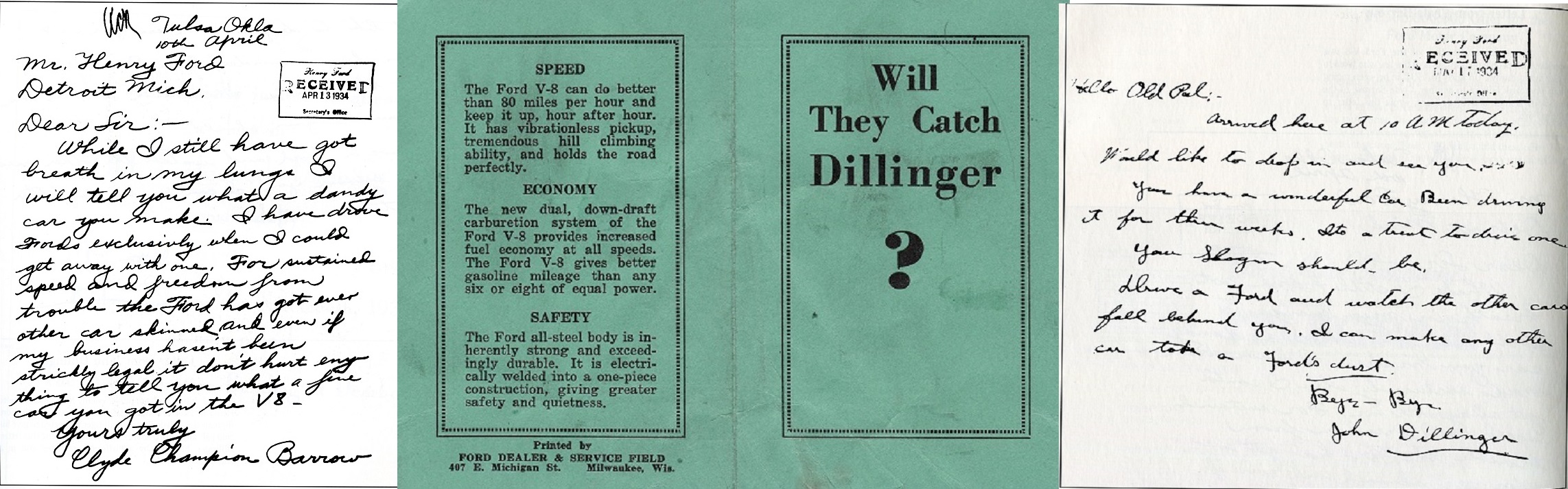
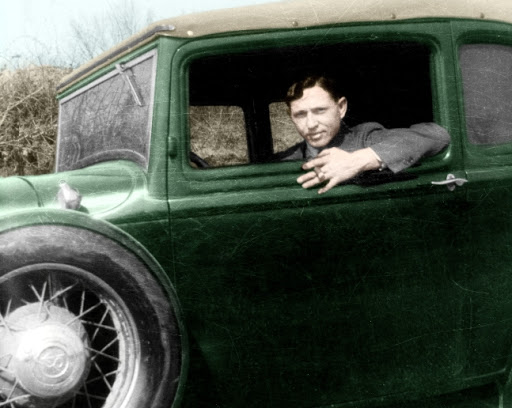
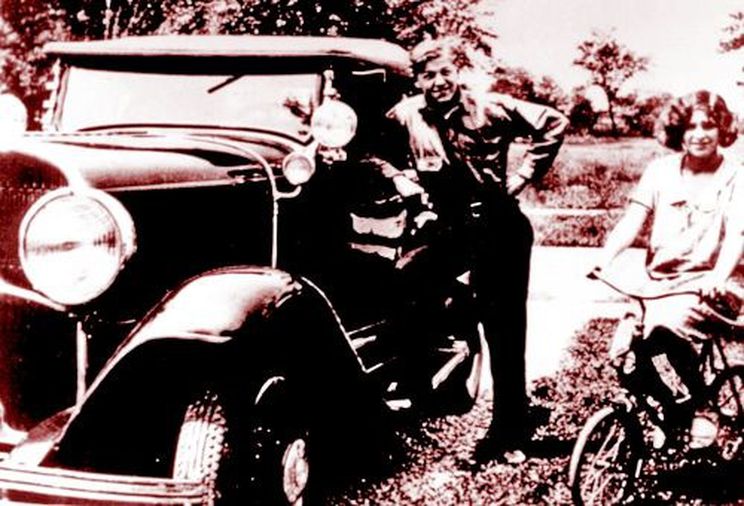
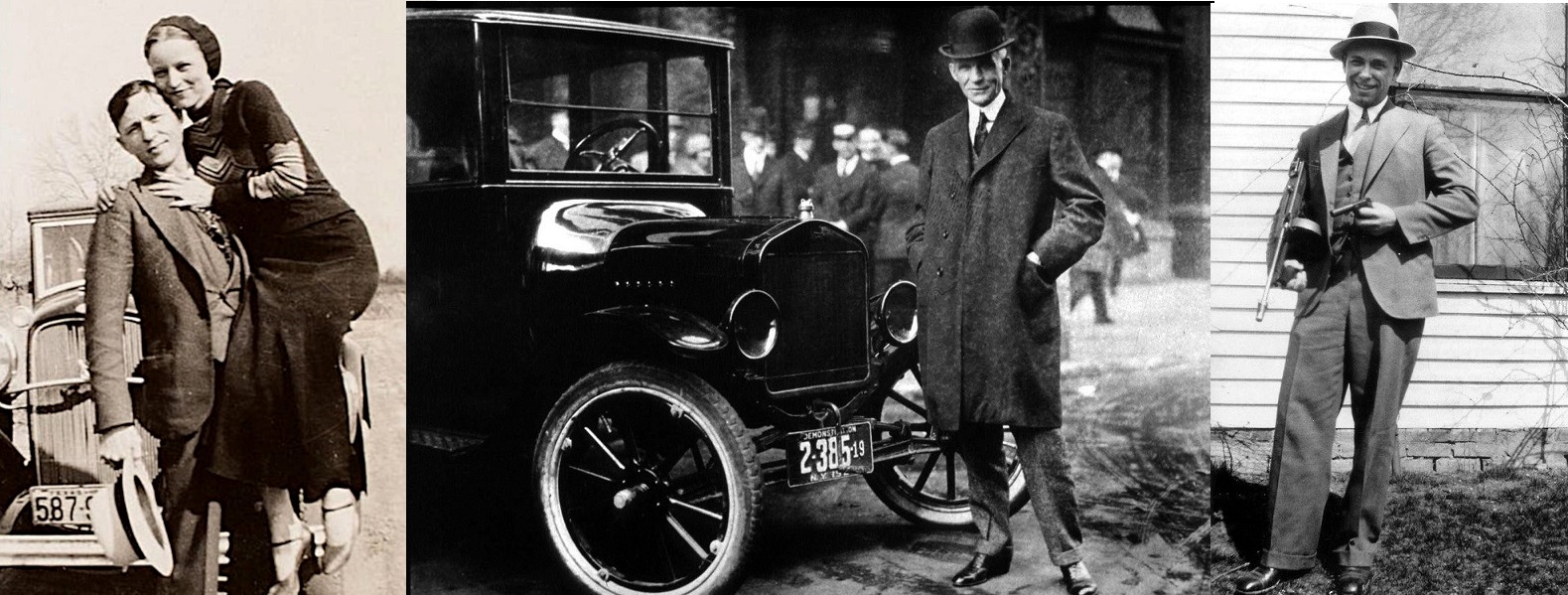
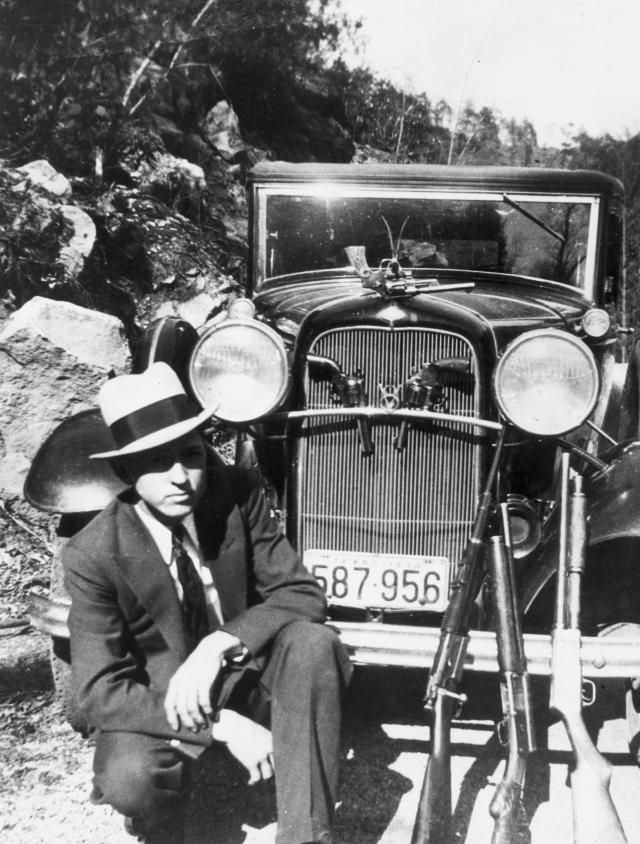 Clyde had an uncanny ability to steal Ford V8 cars and evade the police whenever he was trapped, cornered or surrounded. Clyde claimed that a Ford V8 car could outmaneuver and outrun any police car that attempted to follow him. Additionally, living a life on the run meant that Clyde and Bonnie spent days (or weeks) traveling long distances and sleeping in their car at night. Clyde supposedly preferred Ford V8s because he thought that their bodies were thicker and, thereby, more bullet-resistant. And those famous photos of Bonnie and Clyde mugging, clowning and romancing for the camera, most of them include a Ford V8 in the background.
 Clyde Barrow loved the Ford V8 so much that he wrote a letter to Henry Ford in April of 1934 praising the car. Addressed simply to “Mr. Henry Ford Detroit, Mich.” from “Tulsa, Okla. 10th April” the letter, misspellings and all, reads: “Dear Sir:- While I still have got breath in my lungs I will tell you what a dandy car you make. I have drove Fords exclusively when I could get away with one. For sustained speed and freedom from trouble the Ford has got ever other car skinned and even if my business hasen’t been strickly legal it don’t hurt enything to tell you what a fine car you got in the V8- Yours truly, Clyde Champion Barrow” (Clyde Barrow’s middle name was actually Chestnut. He jokingly listed “Champion” as his middle name when he entered the Texas state prison at Huntsville in 1930.)
 Amazingly, after Ford’s secretary failed to recognize the outlaw’s name,a reply was sent on April 18th. The neatly typed letter on the ornate letterhead of the Ford Motor Company reads: “Mr. Clyde Barrow, Tulsa, Oklahoma. Dear Sir: On behalf of Mr. Ford, we wish to acknowledge your letter of April 10 and thank you for your comments regarding the Ford car. H.R. Waddell, Secretary’s Office.” Six weeks later, Bonnie and Clyde were dead. A debate rages to this day as to whether the letter is authentic or not. Regardless, it is a priceless piece of Americana that can often be found on public display at the Henry Ford museum in Dearborn. When Dillinger was asked about Bonnie & Clyde after his capture and incarceration at Crown Point, he responded, “Bonnie & Clyde? Huh, a couple a punks.”
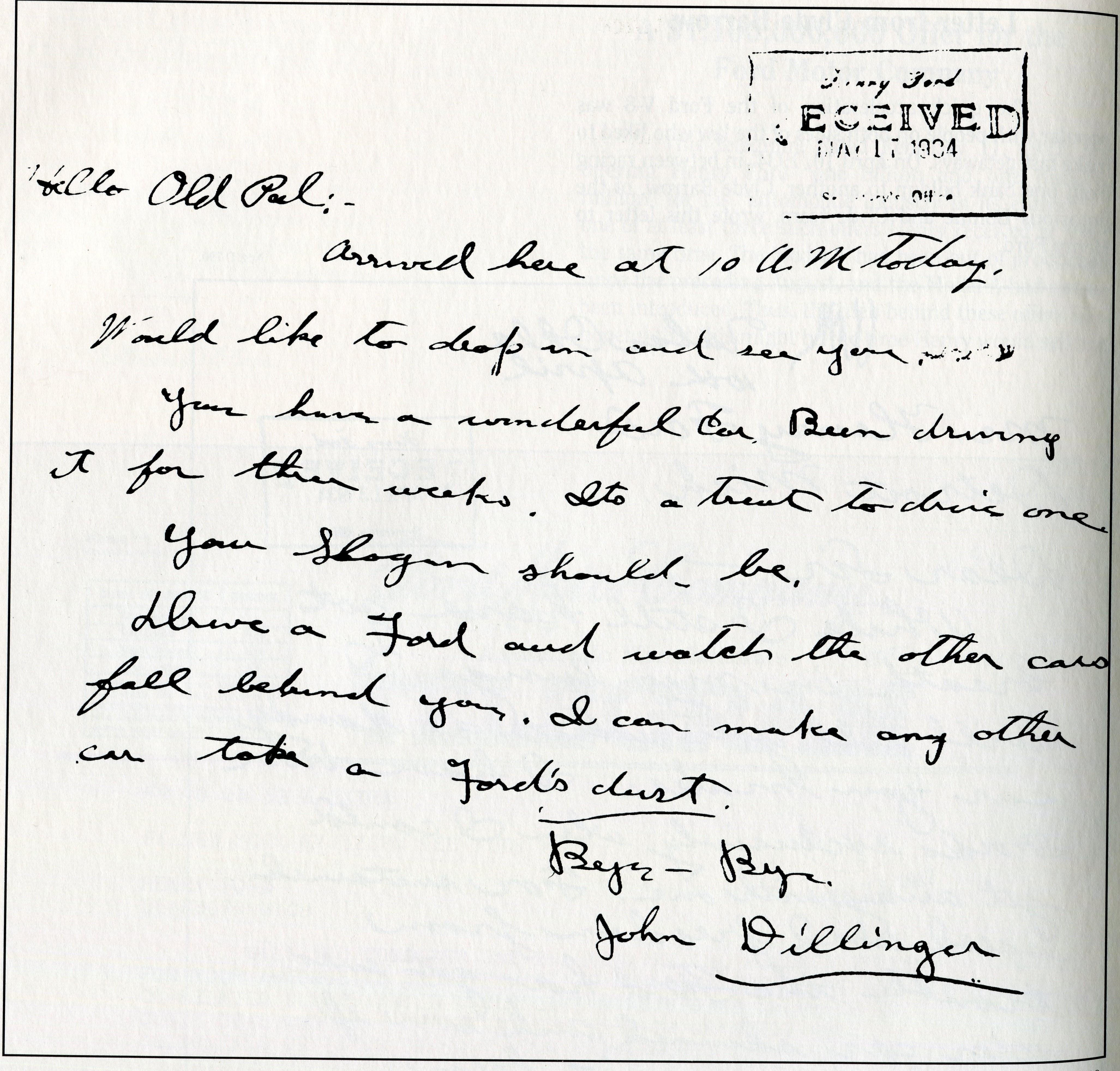 Ironically, a month later, Henry Ford would receive another letter. In May of 1934, a letter arrived from the most famous gangster in the world: John Dillinger. Like the previous letter, this one features the official stamp of the Henry Ford office, dated May 17, 1934. The letter is postmarked from Detroit and, like the Bonnie & Clyde letter, is entirely handwritten. It reads: “Hello Old Pal. Arrived here at 10:00 AM today. Would like to drop in and see you. You have a wonderful car. Been driving it for three weeks. It’s a treat to drive one. Your slogan should be, Drive a Ford and watch the other cars fall behind you. I can make any other car take a Ford’s dust! Bye-Bye, John Dillinger”. The Dillinger gang had just held up the Citizens Commercial Savings Bank in Flint, Michigan, on May 18, 1934. Like the Barrow letter, the authenticity of the letter writer is called into question. A week after this letter was received, Bonnie and Clyde were dead. 67 days later, so was John Dillinger. While Dillinger died in a Chicago Alley next to the Biograph Theater, Clyde Barrow died behind the wheel of his last stolen car: a Ford V8.
 The letter, coming on the heels of the disastrous escape by Dillinger and his gang from the Little Bohemia Lodge in Manitowish Waters, Wisconsin a month before on April 22, inspired a Milwaukee Ford Motor Car dealership to create and distribute a sales brochure asking the question, “Will They Catch John Dillinger?” on the front. When opened, it featured the answer, “Not Until They Get Him Out of a Ford V-8!” with additional info at bottom reading, “NEWS NOTE: John Dillinger evaded capture by making speedy get-away in new Ford V-8 after famous jail break at Crown Point, Indiana. His spectacular get-away from Little Bohemia Resort, Mercer, Wisconsin, was also in a Ford V-8.” The back of the brochure touts the Ford V-8’s “Speed: The Ford V-8 can do better than 80 miles per hour and keep it up, hour after hour. It has vibrationless pickup, tremendous hill climbing ability, and holds the road perfectly.” The “Economy: The new dual down-draft carburetion system of the Ford V-8 provides increased fuel economy at all speeds. The Ford V-8 gives better gasoline mileage than any other six or eight of equal power.” And, perhaps confirming Clyde Barrows assertion, the “Safety: The Ford all-steel body is inherently strong and exceedingly durable. It is electrically welded into a one-piece construction, giving greater safety and quietness.” The brochure concludes with the dealership name and address at 407 E. Michigan Street in Milwaukee, Wisconsin.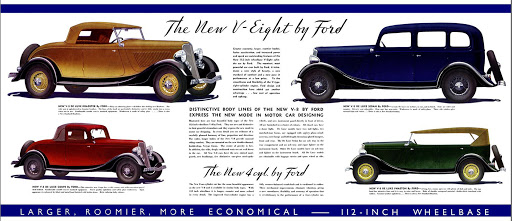
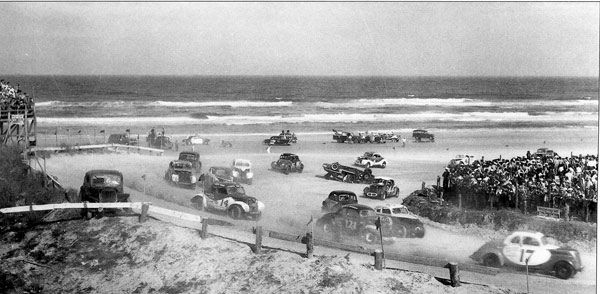 There is a lot of history on the world’s most famous beach: cars, gangsters, auto racing, motorcycles, bootleggers and Henry Ford, for starters. When you think of auto racing, two American cities come to mind: Indianapolis and Daytona. However, before Indianapolis and Daytona, Ormond Beach was the mecca of auto racing. Ormond Beach just north of Daytona, held races on the beach from 1902 until after World War II. At that time, Ormond Beach was a playground for America’s rich and famous: The Vanderbilts, Rockefellers, Roosevelts, Henry Flagler, John Jacob Astor; all spent their winters at the old Ormond Hotel.
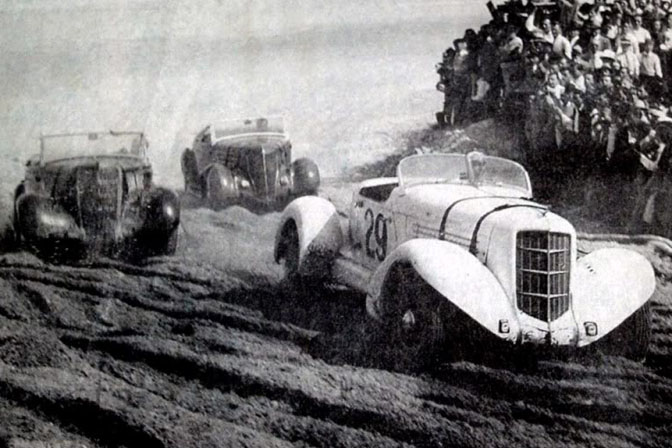 From 1902 to 1935, auto industry giants such as Henry Ford, Louis Chevrolet, and Ransom E. Olds brought their cars to race on the beach. Cigar-chomping Barney Oldfield, the most famous race-car driver in the world at the time, set a new world speed record on the Ormond-Daytona course in 1907. Racing faded somewhat in Ormond and Daytona after World War I as the racing world turned its attention to the Indianapolis Motor Speedway.
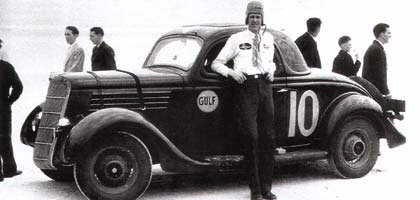
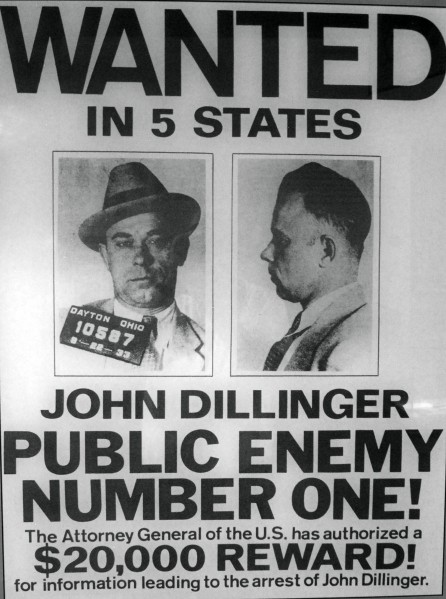 So it comes as no surprise that the gangsters of the 1930s drove Fords. In particular, outlaws John Dillinger, Bonnie and Clyde and Baby Face Nelson all preferred the Ford Model V8. Introduced in 1932, it was touted as America’s first affordable big-engine car. Dillinger also is said to have owned a Model A and what’s more, in mid-December of 1933, he drove his Ford to Daytona Beach for a vacation. After secretly visiting the Dillinger family farm in Mooresville, America’s first Public Enemy # 1 brought along girlfriend Evelyn “Billie” Frechette, Hoosier “Handsome Harry” Pierpont and his “molls” Mary Kinder, her sister Margaret and Opal Long and gang members Russell Clark and Fat Charlie Makley. The gang rented a spacious 3-story, seventeen room beach house for $ 100 a month at 901 South Atlantic Avenue until Mid-January, 1934. The house, long ago demolished, was located across the street from Seabreeze high school on the spot where “Riptides Raw Bar & Grill” and the Aliki Atrium are located today. Vacationers will recognize the “Riptides” name from the banner pulled by the tail of an airplane that constantly trails up and down Daytona beach.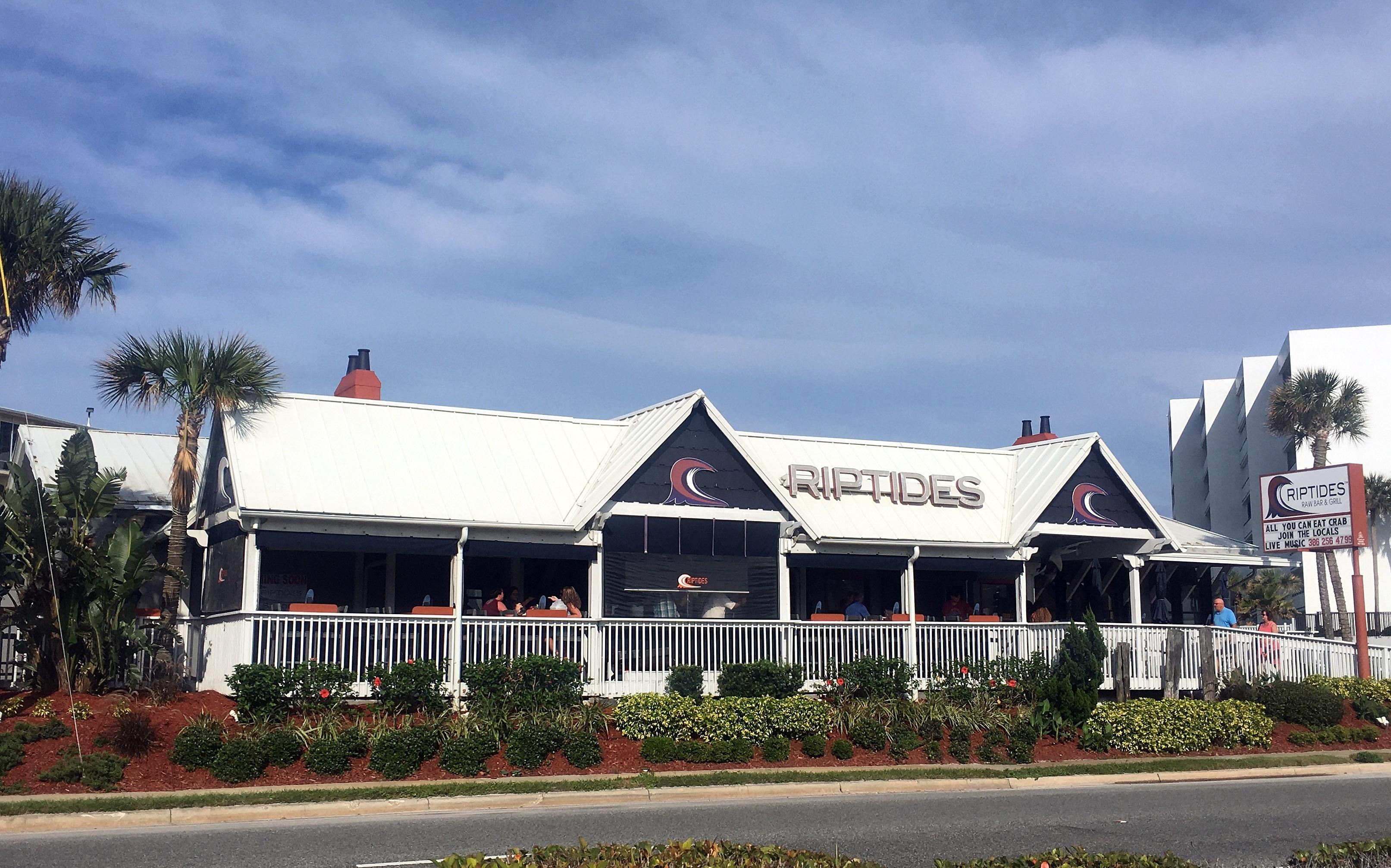
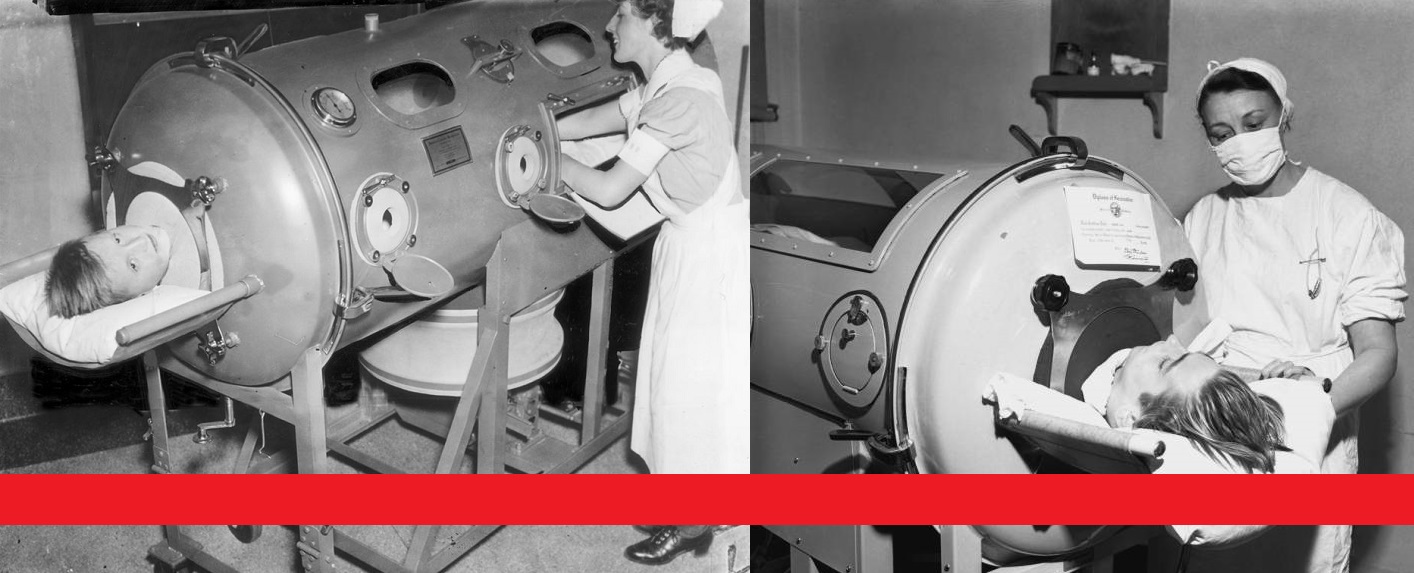

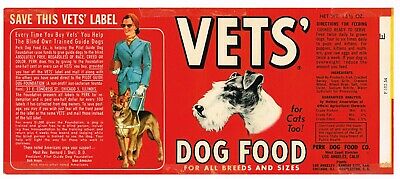 The big problem with these rumors is that they are not tied to the companies that actually have such programs, so that they motivate people to collect huge numbers of bottle caps, empty packets and the like to no avail. The biggest companies are usually the most frequently targeted, recent years those have been mostly soft drinks, beer, cigarettes, and tea. Sadly, before kidney dialysis came along you typically were told to save cigarette packs to earn time on an iron lung.
 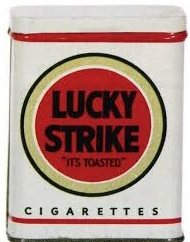 Knowing the damage smoking causes to the lungs, these red stripe redemption rumors truly proved to be a “sick bargain”.
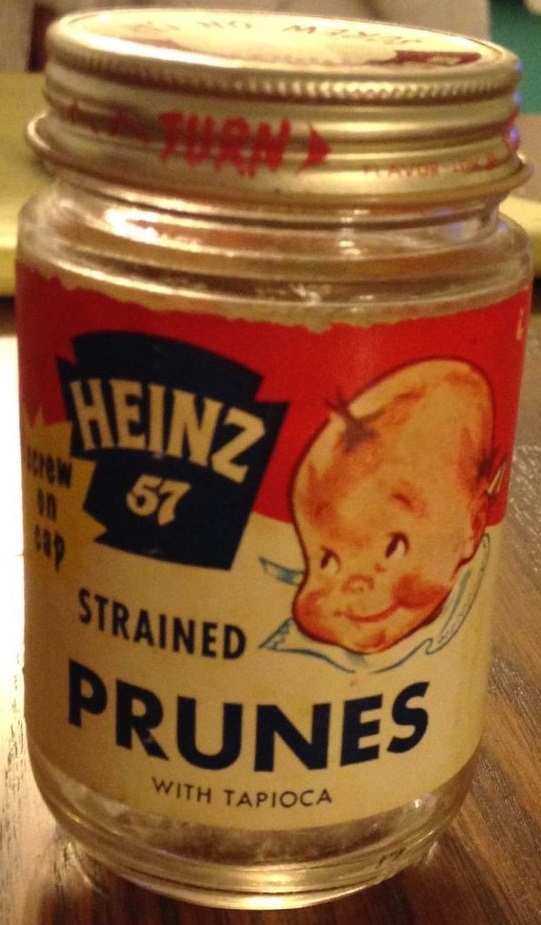 Today Heinz baby food labels can be redeemed to benefit children’s hospitals and Campbell’s soup labels can be used to buy school equipment. In Indianapolis, funds received from the recycling of pop tabs add up to between $30,000 and $50,000 annually for Riley Children’s Hospital. All this money helps with the operating expenses of the Ronald McDonald House Charities of Central Indiana and traditionally covers the cost of operating 3 rooms in the House for an entire year. With redemption rumors, it can sometimes be hard to separate fact from fiction.
 Even though it was a hoax, it didn’t mean it was a bad idea. In the 1950s, the Betty Crocker franchise started a coupon program run by General Mills. Most folks redeemed the coupons for kitchen utensils, but beginning in 1969 General Mills OK’d several fundraising campaigns in which coupons were used to purchase some 300 kidney dialysis machines. The company soon stopped dialysis drives due partly to complaints that it was “trading in human misery.” The program ceased operation in 2006.
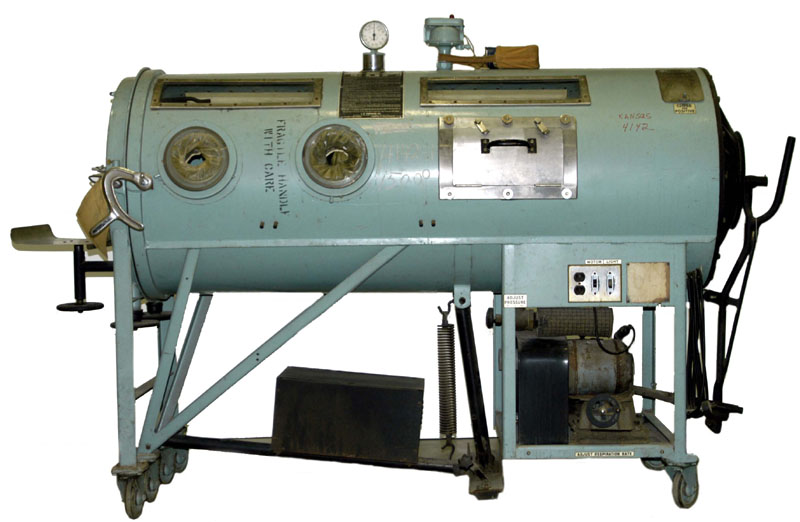 The most common iron lung, known as a “Drinker respirator”, was designed to provide temporary breathing support for people suffering paralysis of the diaphragm and intracostal muscles, which are essential for respiration. Developed in 1929, it came to be an important tool for the care of sufferers of paralytic polio. Strictly defined, “the iron lung is a large horizontal cylinder, in which a person is laid, with their head protruding from a hole in the end of the cylinder, so that their nose and mouth are outside the cylinder, exposed to ambient air, and the rest of their body sealed inside the cylinder, where air pressure is continuously cycled up and down, to stimulate breathing. To cause the patient to inhale, air is pumped out of the cylinder, causing a slight vacuum, which causes the patient’s chest and abdomen to expand (drawing air from outside the cylinder, through the patient’s exposed nose or mouth, into their lungs). Then, for the patient to exhale, the air inside the cylinder is compressed slightly (or allowed to equalize to ambient room pressure), causing the patient’s chest and abdomen to partially collapse, forcing air out of the lungs, as the patient exhales the breath through their exposed mouth and nose, outside the cylinder.” (The Iron Lung, Science Museum Group, Kensington, London, England, U.K)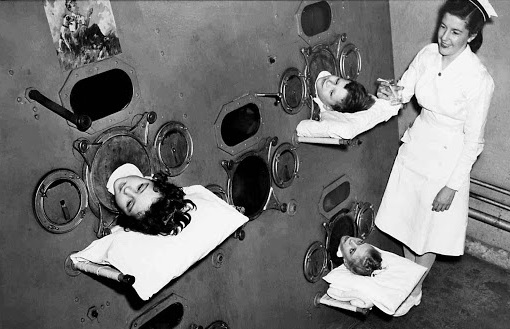
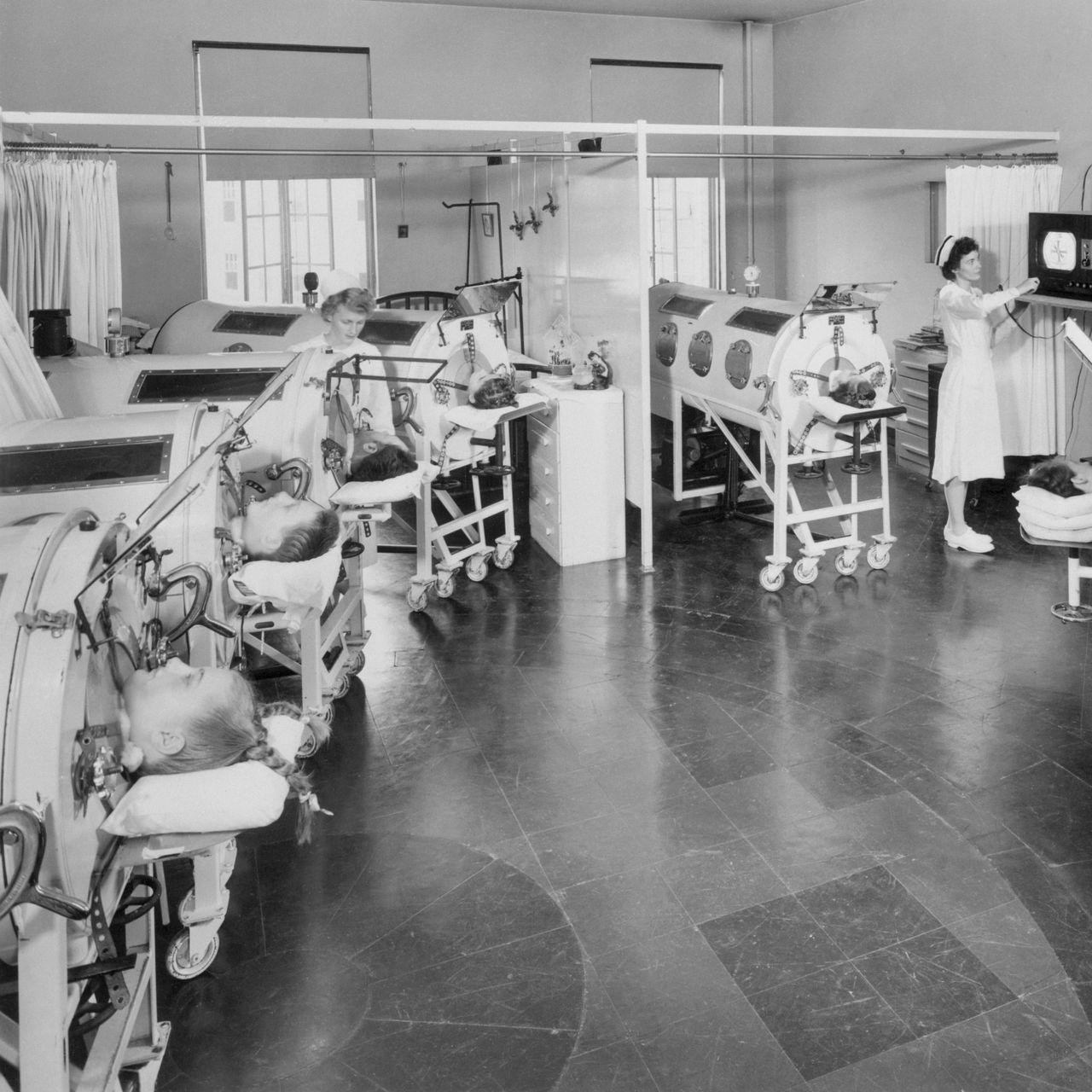 By 2018, there were only 3 of these 700 pound behemoth iron lung machines operating in the United States. Some machines have a tray that slides out of the tube, others require the patient to climb into the bed of the pod, upon which the patient lays and is then pushed into the machine. The patient’s head is the only part of the body visible once the machine is closed, and the neck collar is adjusted to keep it airtight. Since the head is exposed, patients can eat and drink in the machine but, since both are done while laying down, swallowing can be a challenge and must be done carefully. Since the machine is pushing / pulling the patient, swallowing must occur while the machine is breathing out. Coughing and sneezing can be a challenge since both are involuntary and cannot be properly timed with the rhythm of the machine. The mechanics are under the bed, which produces a vibrating sensation for the patient.
 Today’s ventilators, like those being made in Kokomo right now, are much more portable and are mostly described as “breathing machines” that can be carried as easily as a briefcase. For extreme breathing cases, smaller single-patient iron lungs, known as “Cuirass ventilators” (named for the Cuirass, a torso-covering body armor worn by armored knights), are used. The Cuirass ventilator encloses only the patient’s torso, chest or abdomen, but otherwise operates essentially the same as the original, full-sized iron lung. The lightweight variation of the cuirass is a jacket ventilator or poncho / raincoat ventilator, which uses a flexible, impermeable material (such as plastic or rubber) stretched over a metal or plastic frame placed over the patient’s torso.
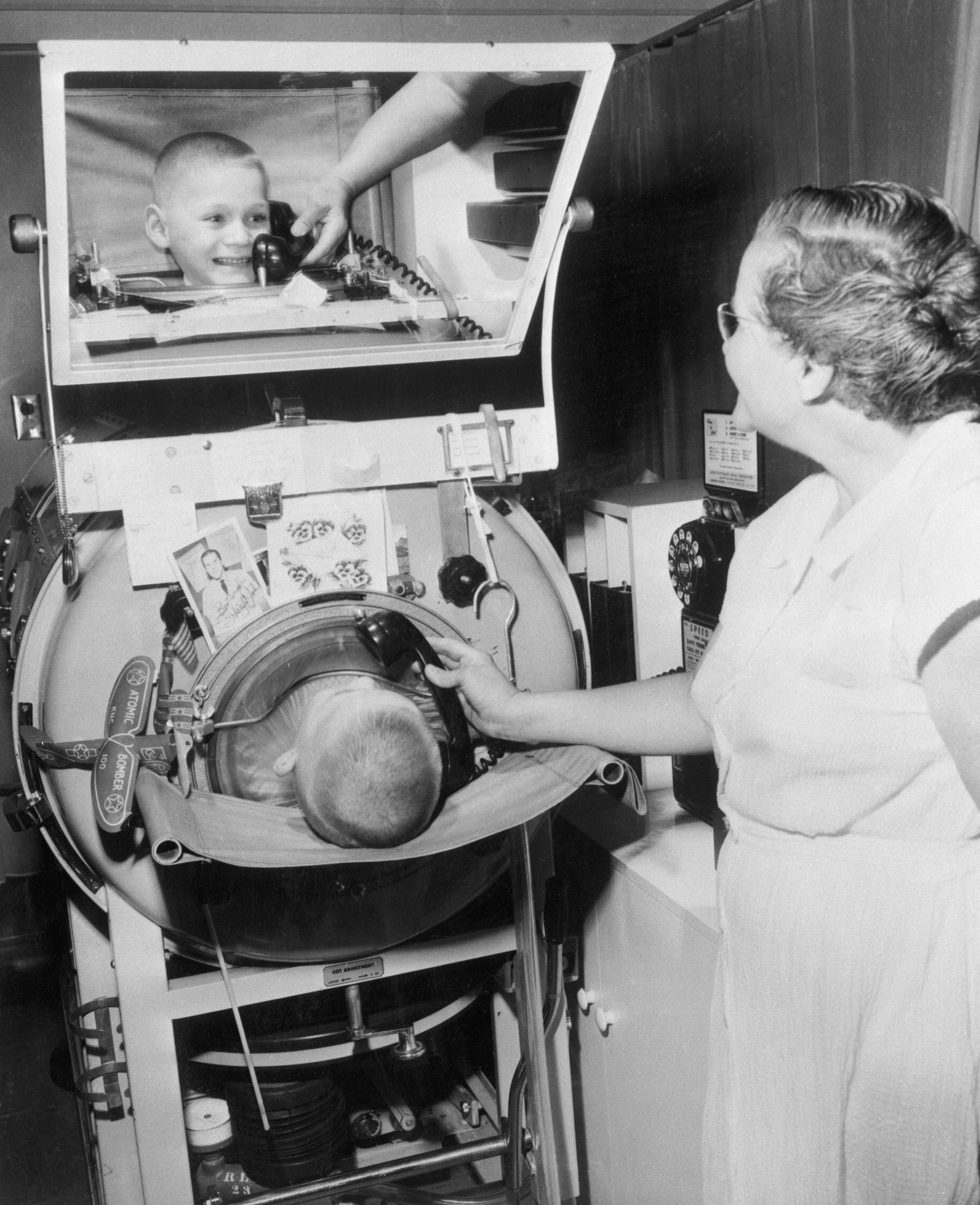 And, although the idea of the old fashioned iron lung mostly only survives in the collective public memory of baby boomers, the COVID-19 pandemic has revived some interest in the device. Thanks to the internet, public safety scams and urban legends proliferate our life daily. As silly as the idea of saving red stripes from packs of cigarettes to exchange for time in iron lungs sounded to the enlightened twenty years ago, when viewed through the periscope of new age social media theory today, it fits right in. And Covid-19 has reignited fears of epidemics past including Polio and the Spanish Flu (which allegedly originated in Kansas by the way). So, in short, there is nothing new under the sun and the takeaway from all of this is that, hopefully, this too shall pass.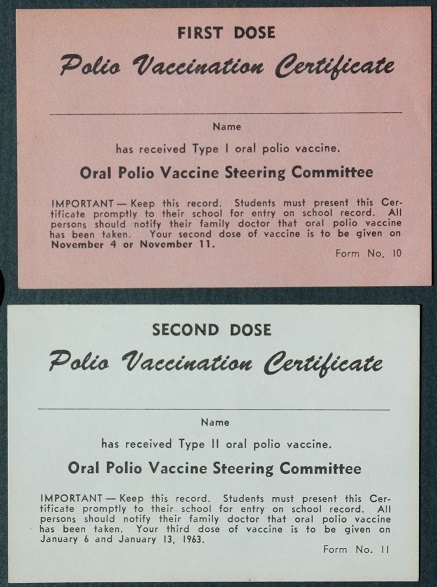
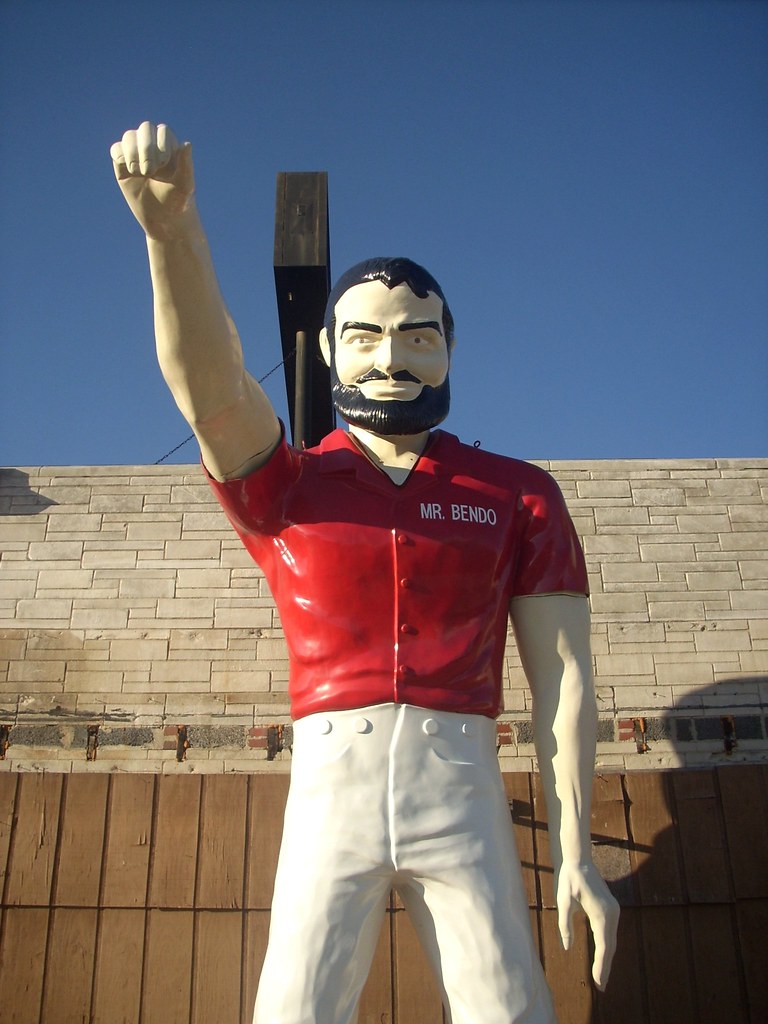
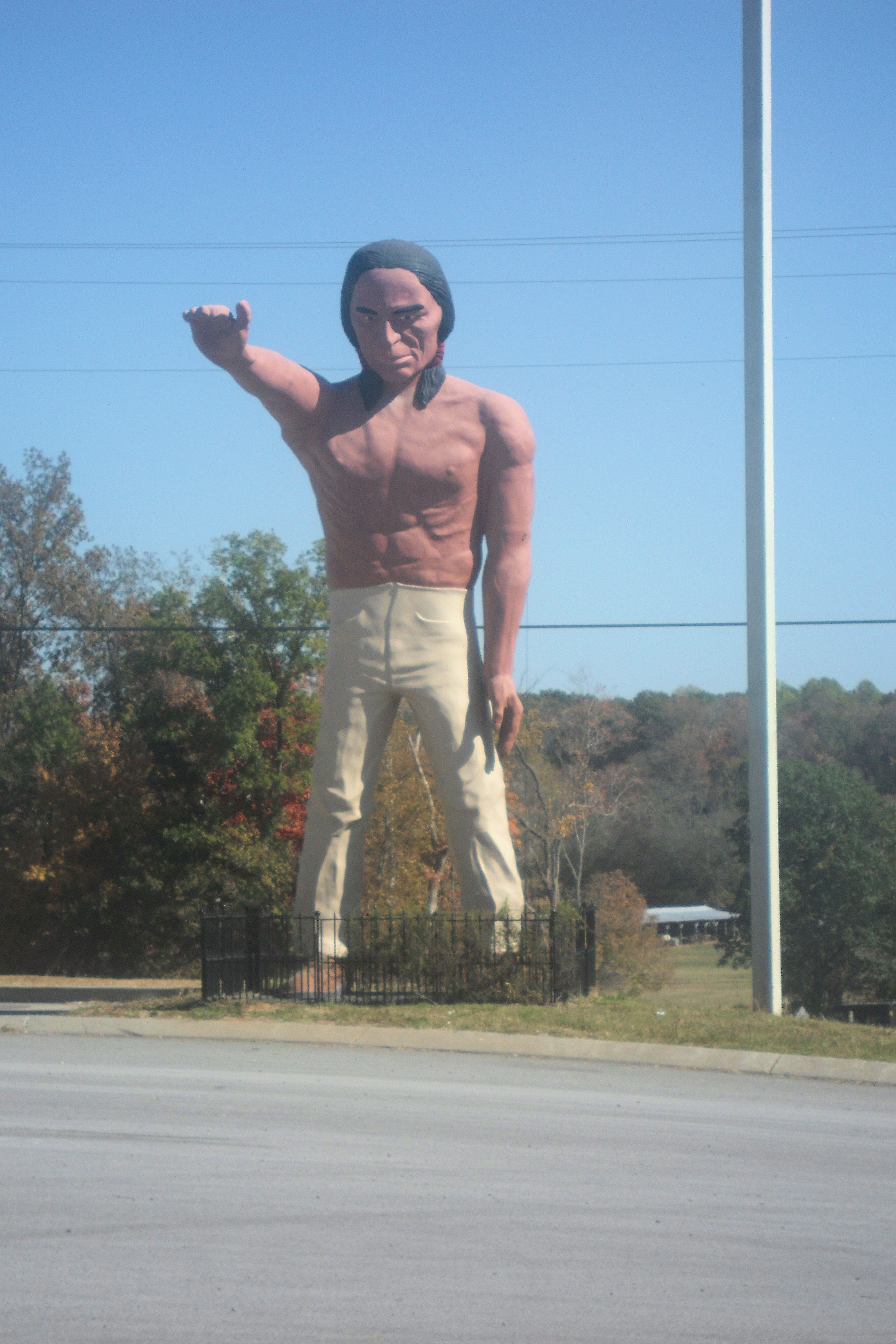 These unique roadside attractions began popping up along our highways in the 1930s and flourished into the 1960s. But the 1950s were their heyday. The Ike Era fifties was the decade of car culture; gas was cheap and families took to the open road, many for the very first time. The US interstate highway system was authorized in 1956 and construction began almost immediately in many states. Until then, families relied on connecting state road systems that took them on meandering journeys through big cities and small towns alike.
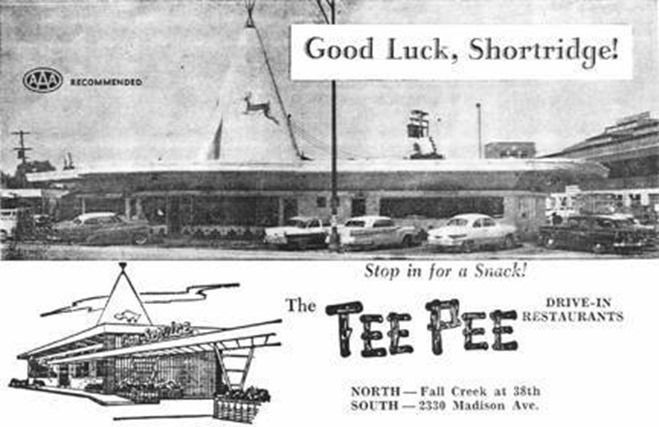 Although modern construction has ensured that you are never far from fast food and gas, if you drive highway 40 today, it is easy to imagine how that drive must have felt back in the day. Today, driving along many of Indiana’s classic highways (Michigan Road, Brookville Road, Washington Street, Lincoln Highway) traces of old gift shops, restaurants, amusement parks and motels dot the landscape. Many of you can easily recall the giant TeePees that crowned the roof of the aptly named “TeePee” restaurants on the grounds of the state fairgrounds and on the cities southside. For me, I’ll always remember the giant coffee pot that formed the roof of the “Coffee Pot” restaurant in Pennville near Richmond on the National Road.
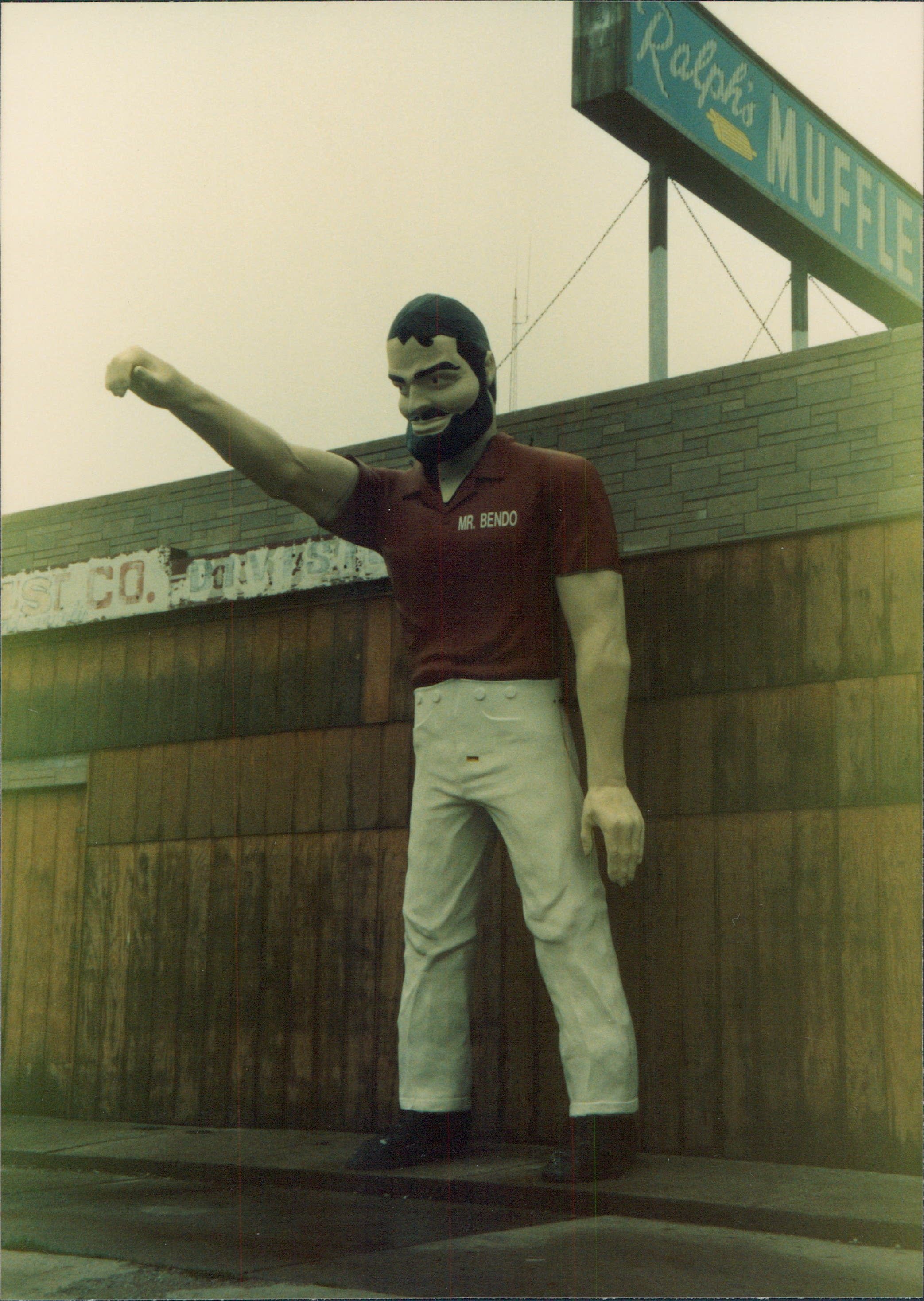 But, who remembers the “Mr. Bendo”, the muffler man? These giant statues routinely stood outside auto shops, usually with one arm outstretched while towering over the road with a muffler resting in his curved hand. Spotted in various incarnations all over the United States, these advertising icons were extraordinarily popular throughout the 1960s and 1970s. Legend claims that all of the original Muffler Men came from a single mold owned by Prewitt Fiberglass (later International Fiberglass). The first Muffler Man was allegedly a giant Paul Bunyan developed for a café on Route 66 in Arizona. Later incarnations were Native Americans, cowboys, spacemen and even the Uniroyal girl, who appeared in both a dress and a bikini. These behemoths either elicited fear or joy, but never failed to spur the imagination. Locally, you can find one of these “Mr. Bendo” statues at 1250 W. 16th St.
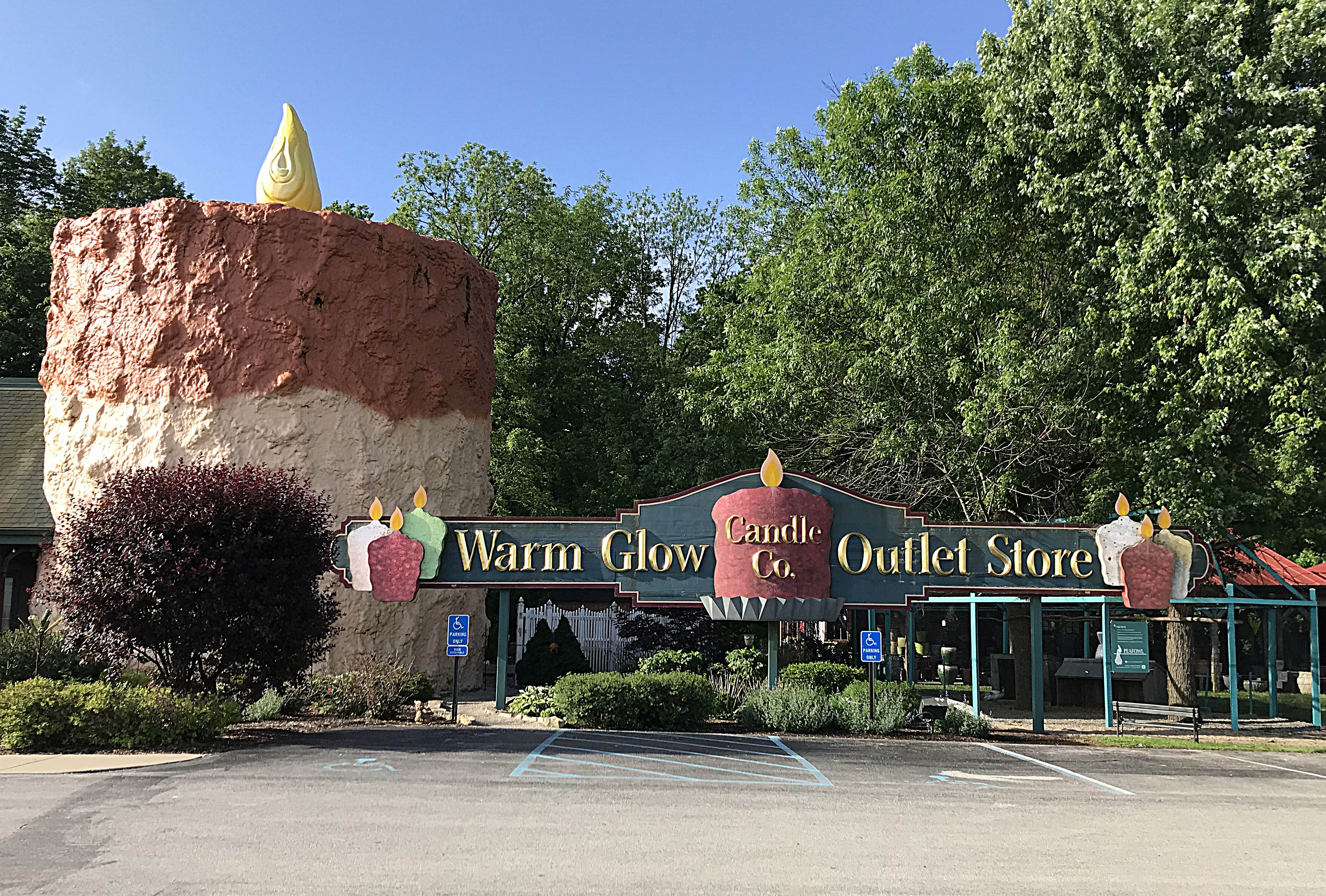 Closeby, there is a giant Uncle Sam and his two smaller nephews on Shadeland Ave (between Washington St and 10th). There are two giant globes, one on Michigan Road on the way to Zionsville and the other near the pyramids visible from the interstate. There is a large dairy cow on South Shortridge Rd (between Washington St and Brookville Rd) sitting behind a 10-foot chain link fence topped with barbed wire and guard at the gate. There are two large swans in the middle of ponds, one on Mitthoffer (Between 21st St and 30th St) and the other on Pendleton Pike. Incidently there is a big fiberglass cow at 9623 Pendleton Pike near the afore mentioned swan.
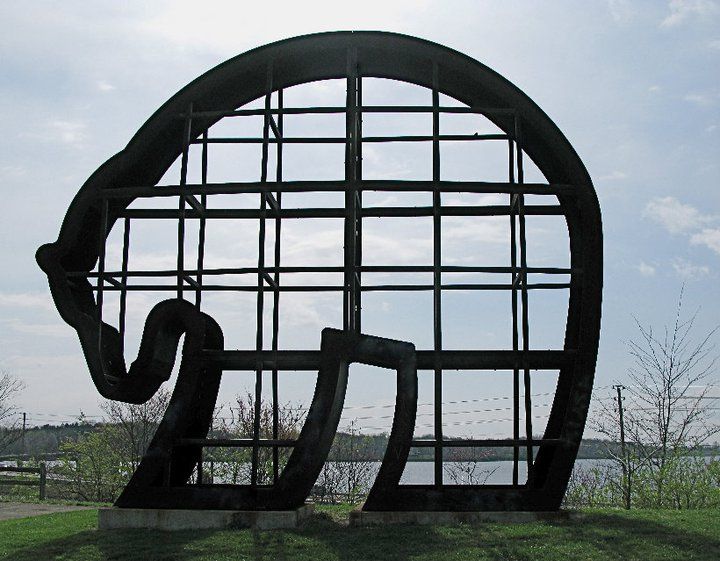 The old Galyan’s bear statue sits on the edge of the Eagle Creek Reservoir. When Dick’s Sporting Goods purchased Galyan’s, the company donated the statue to the City of Indianapolis. There are two huge bowling pins, one at Woodland bowl on the northside and the other at Expo bowl on the southside (visible from I-465). Don’t forget about the giant dinosaurs hatching from eggs at the Children’s Museum on the corner of 30th and N. Meridian Streets near downtown.
 If you’re traveling to Logansport, you can visit three giant statues in the same town; Mr. Happy Burger on the corner of US Hwy 24/W. Market St. and W. Broadway St. features a fiberglass black bull wearing a chef’s hat and a bib as does the Mr. Happy Burger located at 3131 E. Market St. along with a giant chicken statue at 7118 W. US Hwy 24 (on the north side) that you can see from the road. Muncie has two giants; A big fiberglass muffler man stands alongside the scissor-lifts & heavy equipment in the Mac Allister rental lot at 3500 N. Lee Pit Rd. and a Paul Bunyan statue is the mascot of a bar named Timbers at 2770 W. Kilgore Ave.
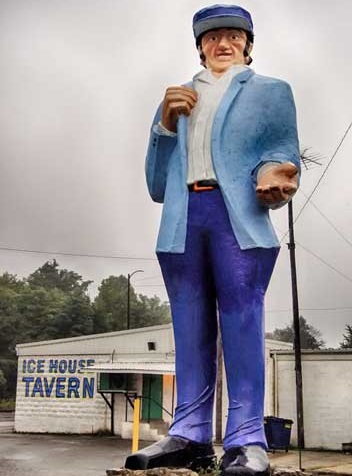
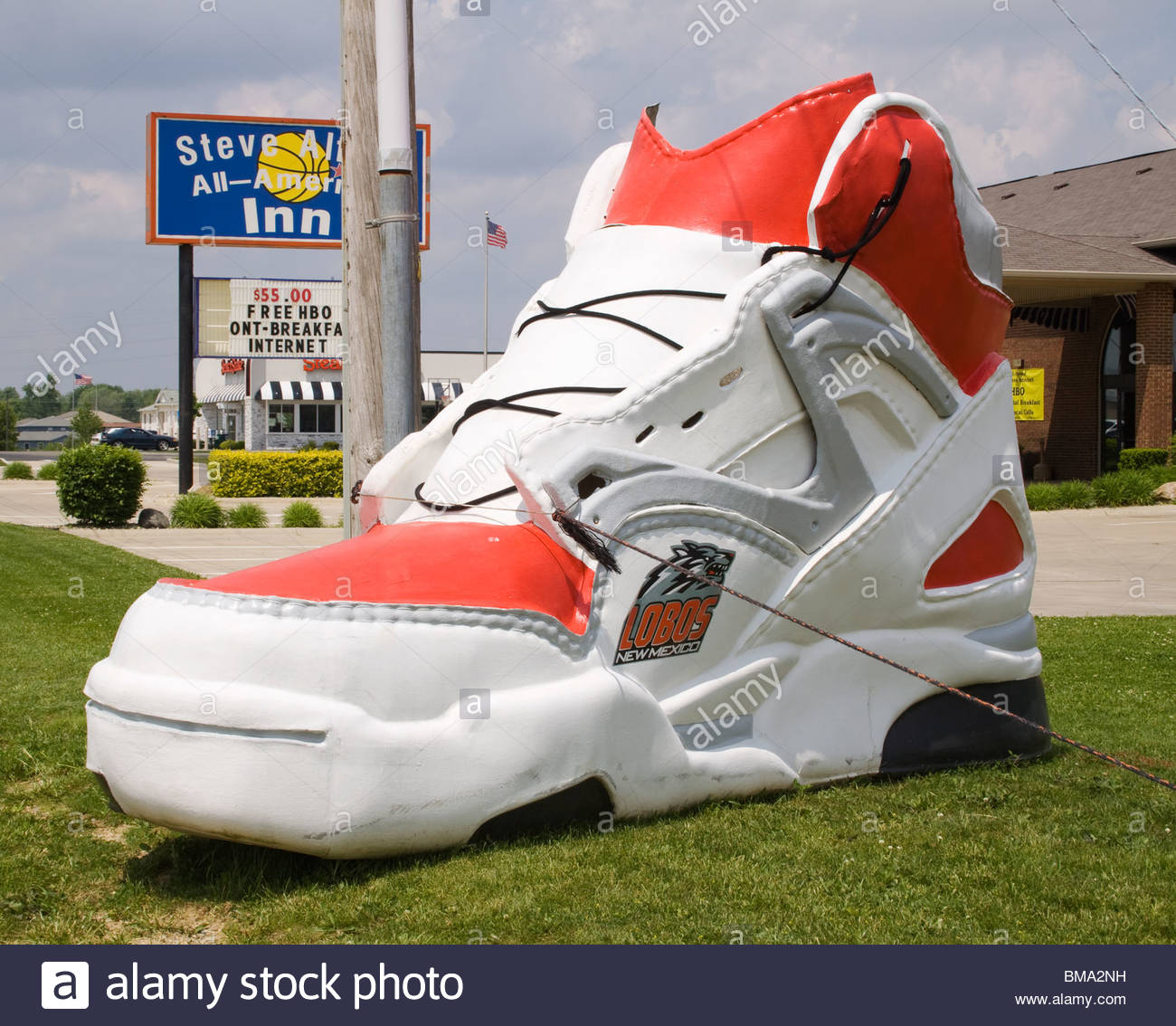 There is a car-sized basketball shoe at the Steve Alford All-American Inn on State Road 3 in New Castle and you can visit the towering, thickly-clothed “Icehouse man” painted in cool blue colors, the mascot of a bar named Icehouse at 1550 Walnut St. in New Castle. A balloon-shaped man with a chef’s hat, known by locals as “The Baker Man” is perched atop a pole with his arm raised in a friendly wave at 315 S. Railroad St. in Shirley, Indiana. And of course, who can forget the giant Santa Claus that greets visitors to Santa Claus, Indiana.
 I’m sure I’m forgetting a few, perhaps many, but if this list helps stir up some old roadside memories among you, or better yet, gets you charged up to take an inexpensive holiday in search of roadside oddities, well, then it was a worthwhile read.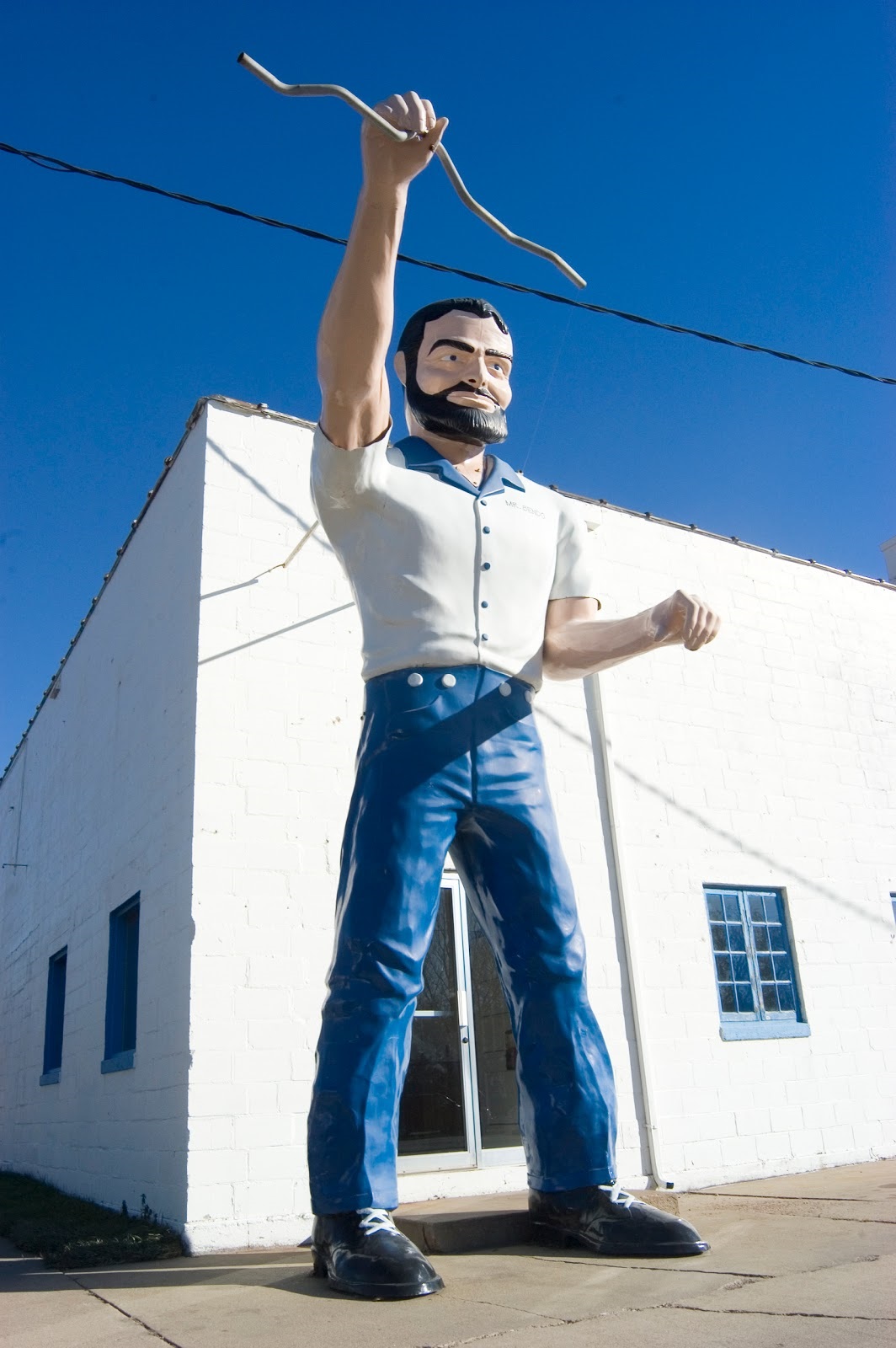
 Alan E. Hunter