
Original publish date: February 21, 2019
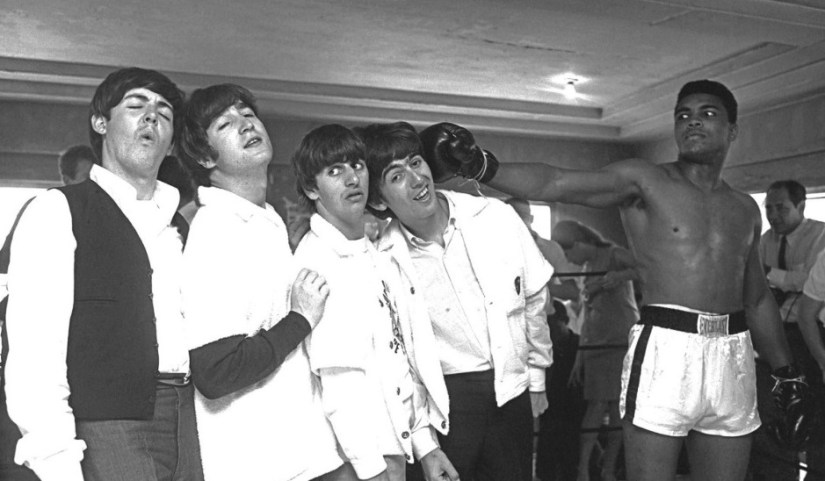
Its February in Indianapolis. As I sit at my keyboard in 10 below zero weather, my power is out, the candles are lit and my compy is running on battery power. So…time for a happy warm memory. 55 years ago, on February 18, 1964 The Beatles met a young Cassius Clay aka Muhammad Ali at his training camp in Miami Beach, Florida. The Fab Four were wrapping up their whirlwind tour of America (including two shows at the Fairgrounds in Indianapolis) and Clay / Ali was prepping for his February 25 fight against heavyweight champion Sonny Liston. Although both events would change history, for that brief moment in time, they were just five kids goofing around and mugging for the camera.

In the previous nine days, the lads from Liverpool had performed on the Ed Sullivan Show in New York before a record television audience (and taped another program for later broadcast), played concerts at Washington, D.C.’s Coliseum and New York’s Carnegie Hall, then traveled south for their second Sullivan Show appearance at Miami’s Deauville Hotel. Their Meet the Beatles album was dominating the U.S. Billboard charts and their single “I Want to Hold Your Hand” was blasting out of every transistor radio in the country. Beatlemania, which had already swept Britain for a year, was exploding worldwide. America hadn’t seen anything like this since Elvis Presley the previous decade. The band’s Svengali manager, Brian Epstein, decided the boys needed a rest and what better place to take a break than in Miami Beach?
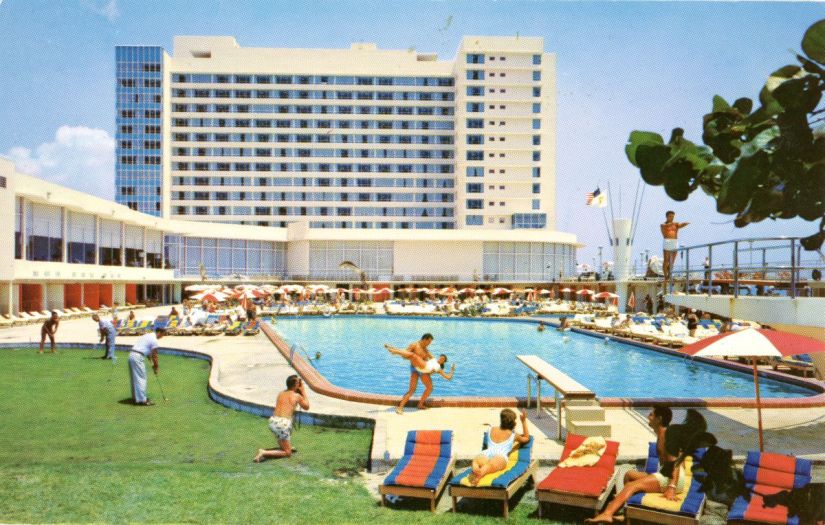
The Beatles arrival in Miami is legendary and offers a great snapshot on the innocence of “Beatlemania” in South Florida. Some 7,000 screaming teenagers greeted the Beatles at Miami International Airport. The Fab Four were thrown in a limousine, raced across town, and rushed into the Deauville Hotel. The Deauville hotel was built in the mid-1920s, and was transformed into the Deauville Beach Resort in the mid-1950s. Towering over Miami Beach, the Deauville featured 500 rooms, on-site restaurants, nightclubs, boutiques, a beauty salon, swimming pool, an ice skating rink and it’s own radio station that routinely hosted Frank Sinatra and his rat pack. The Beatles stayed on the 12th floor, which has become a shrine to Beatlemania festooned with memorabilia and photographs on the hallway walls around the actual rooms where the Beatles stayed for those eight days in February 1964. There is a guard posted by the elevator and a sign that requests: “Silence.”. John and then-wife Cynthia Lennon stayed in room 1211. Paul, George, Ringo, manager Brian Epstein and others in their entourage shared rooms. There was no backstage in the Napoleon Ballroom. The band traveled from their hotel rooms, down the elevator, across a lobby packed with screaming girls to make their way into the ballroom and through the room filled with thousands of adoring female fans waiting to see them perform for millions more watching them on TV.

On the other hand, Cassius Clay was training hard in the ring and talking smack outside of it to anyone within earshot. The brash 1960 Olympic champion had earned his shot, raising steadily through the heavyweight ranks while racking up a 19-0 record including 15 knockouts. His 1963 victory over Doug Jones and subsequent drubbing of Englishman Henry Cooper rounded out his “Bum of the month” schedule and set up his shot at the title shot at the menacing Sonny Liston. While Clay / Ali was an intelligent technical fighter, Liston was a brute whose appearance, like Mike Tyson afterwards, screamed pain. Liston had won the championship in 1962 by flooring Floyd Patterson in the first round of their title bout. Ring experts proclaimed the lithe and lean Clay / Ali didn’t have a ghost of a chance against the mammoth brawler Liston.

Problem was, like a scene straight out of “Rocky”, while “the champ” Liston was training in the relative splendor of the North Beach community center, “the upstart” Clay / Ali was sparring hard at the decrepit Fifth Street Gym in what is now South Beach. Despite its run-down appearance, the 5th Street Gym was a boxing mecca visited by the likes of Jackie Gleason, Frank Sinatra and Burt Lancaster during its heyday of the 1950-60s. The gym opened in 1950 on Washington Avenue in Miami Beach by Chris Dundee brother of Boxing Hall of Fame inductee Angelo Dundee. The rings were located on the second floor of the building and besides Clay / Ali, the gym was used for training by other champion boxers including Joe Louis, Carmen Basilio, Jake LaMotta, Willie Pastrano, and Sugar Ray Leonard.
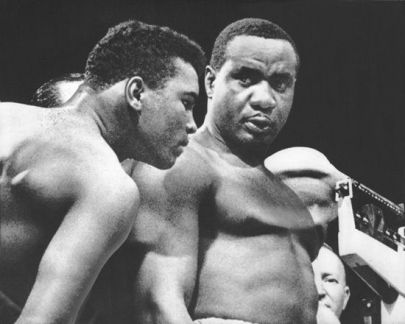
In shades of taunts to come, 22-year-old Cassius was unmercifully needling his opponent, going so far as to take his entourage by bus to Liston’s training headquarters to heckle the champion in front of the media gathered outside. Clay quickly branded Liston as the “big, ugly bear.” For his part, Liston, who was 35-1 when he met Clay / Ali, remained relatively silent, furrowed his brow, bowed his back and brushed the loudmouth youngster’s taunts off summarily. Liston was known for his toughness, formidable punching power, long reach, and intimidating appearance and was widely regarded as unbeatable.
The Beatles-or more likely someone in their entourage-requested a photo-op with heavyweight champion Liston. Fleet street photographer Harry Benson, traveling with the band on their first American trip, tried to set it up. But the grim Liston, made even grumpier from the constant harassment by Clay, had had enough youthful enthusiasm and decided he wanted no part of Beatlemania. 25-year-old New York Times reporter Robert Lipsyte, in town covering the lead up to the big fight, said Liston rebuffed the request by asking, “Who are these little sissies?”
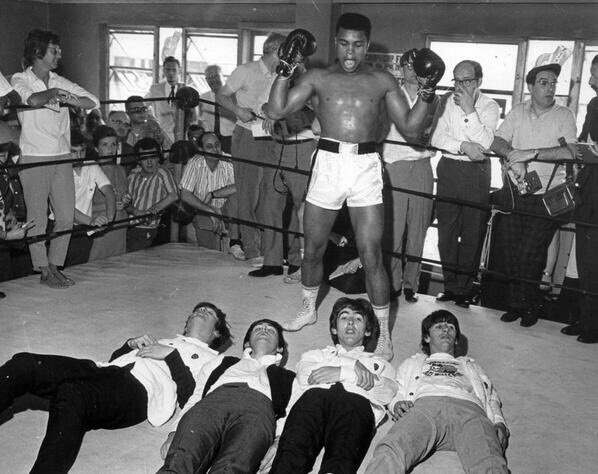
So Benson made a detour to the dingy Fifth Street Gym with the Beatles in tow for a hastily arranged session with Clay, whose own press agent welcomed the publicity. Because of dire predictions by experts promising a short, unmemorable contest, ticket sales were slow, even though it was title fight. Clay / Ali was a 7-1 underdog and aside from his antics outside the ring, he was still relatively unknown. While fight fans found Clay’s smack-talk amusing, they also believed the increasingly irritated Liston would quickly dispatch the braggart and shut the upstart’s mouth for good. Even the Beatles weren’t exactly thrilled at the proposed meeting. 
The optics of the trip did little to encourage the Fab Four’s hope as they rambled up the gym’s decaying steps. Even John Lennon referred to the young challenger at one point as “that loudmouth who’s going to lose.” The lads were ushered into the dark and dank warehouse where they waited in the stale air for Clay / Ali to arrive. The fighter was late and the boys clowned around the rings, bouncing on and off the ropes like subjects in a Charlie Chaplin film. Photographer Benson busied himself by scouting out the best angles in the gym for his photos. The lads were tired and ready to hit the beach and chase chicks. As the time ticked away, the band became increasingly impatient and annoyed. “Where is he?!” Ringo Starr angrily asked. “Let’s get the hell out of here,” Lennon muttered as he headed for the door. Instead, Clay’s promoter had a couple security guards herd the band into a dressing room, where reporter Lipsyte found the boys fuming and cursing Harry Benson’s name.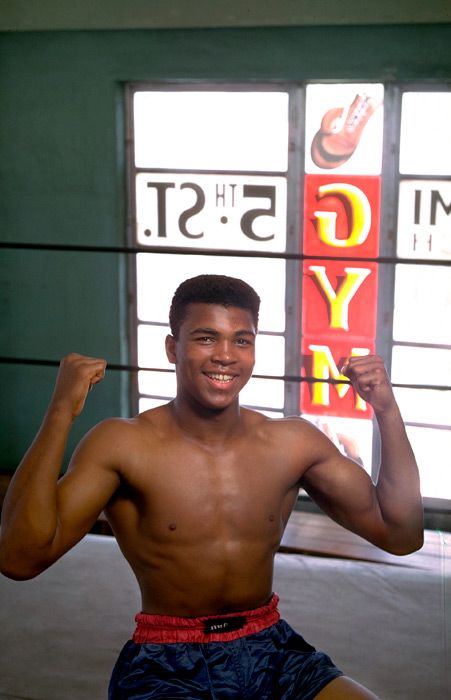
Suddenly the door swung open and the startled band-mates looked up to see the biggest man any of them had ever seen framing the doorway. “Hello there, Beatles!,” Clay exclaimed. “We oughta do some roadshows together. We’ll get rich!” The Beatles were instantly mesmerized. Amid laughter, playful nudges and jostling, the five young men who would come to define their generation, headed into the gym. There they posed, mugged and improvised slapstick situations for the cameras like old time vaudevillians. The media image-savvy young boxer at first posed in his street clothes and then changed into his white trunks. Clay characteristically bit his upper lip and posed knocking the Beatles down like dominoes. The Fab Four dutifully lay on the canvas in mock defeat before as the young fighter towered over them. Clay suddenly picked the diminutive Ringo up off the floor and effortlessly cradled him in his arms like an infant. “Man, you guys are the greatest!” Cassius enthused. “The whole world is shook up about you!” One UPI reporter said Clay ad-libbed a little verse for the occasion: “When Liston reads about the Beatles visiting me / He’ll get so mad I’ll knock him out in three!”
 The exhausted Beatles were thunderstruck by the encounter. As the dunned Fab Four fled the gym and piled back into their limo, they swore oaths to photographer Benson that they’d never speak to him again, with one unidentified Beatle carping that the whole experience had been “degrading. You made a fool of us!” The feeling was apparently mutual. Back at the gym, Clay completed his workout, then hit the dressing room for a rubdown as the press prodded him for details. Cassius turned to Lipsyte with a puzzled look and asked about the four long-haired young Englishmen he’d spent the morning clowning with earlier by asking, “Who were those little sissies?”
 A week later Sonny Liston threw in the towel by refusing to come out of his corner for the seventh round of the title fight. Of the encounter, reporter Robert Lipsyte later wrote, “In 1964 my time was not very valuable. I was a utility night rewrite writer and speechwriter at the Times when Sonny Liston fought Cassius Clay for the first time. The Times, in its wisdom, did not feel it was worth the time to send the real boxing writer. So they sent me down to Miami Beach and my instructions were, as soon as I got there, to rent a car and drive back and forth a couple of times between the arena, where the fight was going to be held in a week, and the nearest hospital. They did not want me wasting any deadline time following Cassius Clay into intensive care.”
“As I walked up the stairs to the gym there was a kind of hubbub behind me. There were these four little guys in terrycloth cabana suits who were being pushed up the stairs by two big security guards. As I found out later, it was a British rock group in America. They had been taken to Sonny Liston for a photo op. He had taken one look at them and said “I’m not posing with those sissies.” Desperately, they brought the group over to Cassius Clay—to at least get a shot with him. They were cursing. They were angry. They were absolutely furious. I introduced myself. John said, “Hi, I’m Ringo.” Ringo said, “Hi, I’m George.” I asked how they thought the fight was going to go. “Oh, he’s going to kill the little wanker,” they said. Then they were cursing, stamping their feet, banging on the door. Suddenly the door bursts open and there is the most beautiful creature any of us had ever seen. He leaned in, looked at them and said, “C’mon, let’s go make some money.” He turned and the Beatles followed him out to the ring. They lined up. He tapped Ringo. They all went down like dominoes. It was a marvelous, antic set piece. And then it was over and they left.”
The Ottawa Journal newspaper of February 19, 1964 ran an article titled, “BRITAIN’S BUSH-HAIRED BEATLES MEET BOXING’S BARON OF BRAY” which reported, “Britain’s bush-haired Beatles met boxing’s Baron of Bray, Cassius Clay, Tuesday and it ended up in clowning, off-key pandemonium. Boxing and singing probably were set back 100 years when Gaseous Cassius teamed up with.. the four mop-haired singers during a break in training at the Fifth Street gym. “Man, you guys are the greatest. The whole world is shook up about you,” said Clay, apparently a longtime Beatle fan. The raucous meeting represented two firsts: Clay admitted that someone other than himself is “great,” for the first time, and he predicted that he will flatten Liston in three rounds, even though the brash 22-year-old contender is a 6-1 underdog at the moment. The Beatles, dressed in flashy sport shirts, snow-white vests and beach shoes, enjoyed the meeting as much as Clay. They entered the training ring with a “yeah, yeah, yeah” and pretended to attack Clay en masse. Clay shouted “no, no, no” and feigned horror. It was about what you’d expect from Clay – Beatle meeting: noise, poems and more noise. Photographers had a field day during the clowning, which didn’t end until trainer Angelo Dundee reminded Clay that he had a date in exactly one week. Before they left, Clay lifted Beatle drummer Ringo Starr two feet off the floor, tossed him up and wished him good luck.The other three Beatles, George Harrison, John Lennon and Paul McCartney, watched laughing. For the Beatles, the confrontation with Clay was the kickoff of a leisurely day on the beach. They have no more appearances to make and are vacationing until Friday when they return to London. For Clay, it was a respite from the serious business of hard training. Loudmouth or not, Clay apparently realizes what he is here for. He snapped back into the routine as soon as the Beatles left.”

As for Liston, rumors circulated that the champ had been drinking heavily the night before the fight. Liston was still a world-ranked boxer when he died under mysterious circumstances at the estimated age of 39 (Sonny’s birth certificate has never been found). Almost a year after defeating Chuck Wepner on January 29, 1970, whose 1975 title fight with Muhammad Ali was the model for the “Rocky” films, Liston was found dead by his wife, Geraldine, in their Las Vegas home on January 5, 1971. Upon returning home from a two-week trip, Geraldine smelled a foul odor coming from the main bedroom. There she found her husband slumped up against the bed atop a broken foot bench. It was believed the champ was undressing for bed when he fell backward breaking the bench. Geraldine called Sonny’s attorney and his doctor, but did not notify the police until two to three hours later. Police found a quarter-ounce of heroin in a balloon in the kitchen and a half-ounce of marijuana in Liston’s pants pocket. 
Following an investigation, Las Vegas police concluded that there were no signs of foul play and declared Liston’s death a heroin overdose. The coroner said Sonny’s body was too decomposed to be conclusive and officially declared the cause of death to be “lung congestion and heart failure” to save embarrassment for the family. The date of death listed on his death certificate is December 30, 1970, which police estimated by judging the number of milk bottles and newspapers around the front door of the property. Many people who knew Liston insisted that he was afraid of needles and never would have used heroin. Some claim Liston was murdered by the mob and a loan-sharking ring in Las Vegas. Others said Liston was murdered by drug dealers with whom he’d become involved. Underworld connections and his unrecorded date of birth added to the enigma.
For their part, that evening The Beatles went to a drive-in movie, where they watched Elvis Presley in Fun In Acapulco. Cassius Clay became Muhammad Ali, “THE” heavyweight champion of a generation. It was a title he’d retain on and off for the next 15 years, twice as long as The Beatles lasted as a group. That hastily-arranged photo op of greatness from 55 years ago has become an iconic mixed-metaphor snapshot of the sixties. The participants are all shown smiling, jostling and cajoling each other in the ring, betraying no trace of the resentment being felt on all sides. Three of the five subjects are gone from this earth, but those images have achieved pop culture immortality.


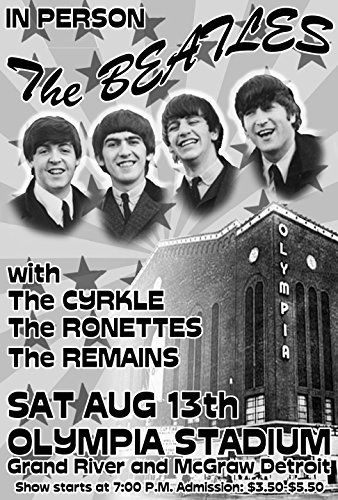 By the time the girls signed with Phil Spector in 1963, thanks mostly to Estelle, the Ronettes had their look precisely calibrated. In August of 1963 “Be My Baby” was released and by October, it had shot to No. 2 on the Billboard pop chart, making the Ronettes instant stars. The girls embarked on a tour of Britain in December of 1963 into early 1964. The Ronettes were the only girl group to tour with the Beatles. The Rolling Stiones were their opening act. When they toured, the Ronettes always traveled with at least one family member. In late 1964, the group released their only studio album, Presenting the Fabulous Ronettes Featuring Veronica, which entered the Billboard charts at number 96.
 The duo were inseperable for the remainder of the English tour until The Beatles left for Paris. When The Beatles came to America, the Ronettes met them at their hotel in New York City. The Ronettes, in fact, were on hand February 8, 1964 to welcome the Beatles as they arrived in New York for their first U.S. visit and Ed Sullivan Show appearance. But the relationship fizzled out, Estelle saying, “We saw each other many times. I was with him at the party after their concert and on other evenings when we just sat around the hotel with the rest of the group. But somehow things weren’t the same. We couldn’t recreate the same relationship we had when I was in London…Over there he’s at his best, he’s relaxed, he’s George Harrison, Englishman and not George Harrison, Beatle.”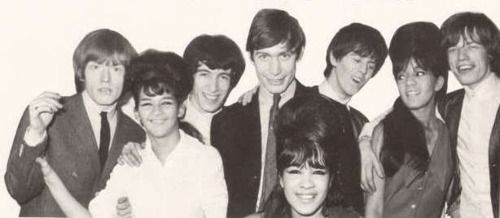
 In Keith Richards autobiography “Life” he admitted that he was dating Ronnie when the Stones toured with the Ronettes in 1963. He recalled there that Mick Jagger got with Estelle because she was less “chaperoned” than Ronnie. The pairings were viewed as controversial for a couple of reasons. One was that management, particularly The Beatles’ Brian Epstein, wanted “the boys” to remain single for fans’ sake. And two, interracial pairings were taboo back in those days. Frowned upon in the U.K. and nearly suicidal in parts of the U.S.A.
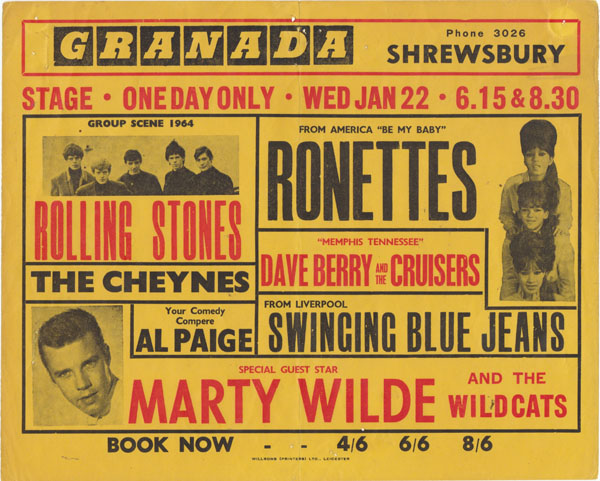 In 1965, the Ronettes continued to record and tour while making a few appearances on television, including a CBS special and the NBC pop music show, Hullabaloo. However by this time, Phil Spector was busy with other artists. The 1965 song “You’ve Lost That Lovin’ Feelin’,” produced and co-written by Spector for The Righteous Brothers, became a No. 1 hit. And by early 1966, he was preoccupied with Ike & Tina Turner. By now, The Ronettes were being moved to the back burner by Spector and some of their songs, such as “I Wish I Never Saw the Sunshine”, and two songs co-written by Harry Nilsson, “Paradise” and “Here I Sit,” were held back for decades. They had one last hurrah in August 1966 when the Ronettes (minus Ronnie) joined the Beatles on their 14-city U.S./Canada tour as one of the opening acts. As for the Rolling Stones, during one visit they made to New York in the 1960s, Ronnie’s mother ended up cooking for them at her Gotham City home.
 Fellow 1960s singer Darlene Love, who once described The Ronettes as Rock’s tough girls, said the last time she saw Estelle, “She didn’t remember me.” By the early 2000s, Estelle Bennett was homeless. In 2007, The Ronettes were inducted into the Rock and Roll Hall of Fame. Love recalled seeing Estelle at the induction ceremony. “They cleaned her up and made her look as well as possible…She looked the best she could for somebody who lived on the street. It broke my heart.” It was decided that she was too fragile to perform. A back-up singer with Ronnie Specter’s new group stood in for an encore performance of “Be My Baby”.
 Posthumously, all agreed that growing up, Estelle had been a force in creating the Ronettes’ style and act – and that she had a heart of gold. “Estelle had such an extraordinary life,” said her cousin, Nedra. “To have the fame, and all that she had at an early age, and for it all to come to an end abruptly. Not everybody can let that go and then go on with life.” “Not a bad bone in her body,” said her sister Ronnie in a press statement. “Just kindness.” At that 2007 Hall of Fame ceremony, Estelle spoke only two sentences during her acceptance speech, “I would just like to say, thank you very much for giving us this award. I’m Estelle of the Ronettes, thank you.” No, Estelle, we thank you.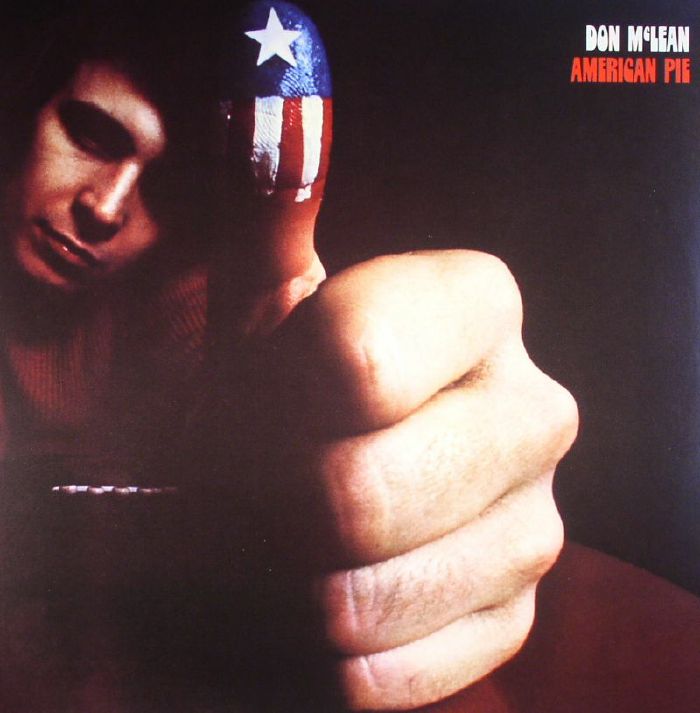
 The album launched two number one hits in the title song and “Vincent”. American Pie’s success made McLean an international star. The title track went on to become an anthem for late stage baby boomers. Decyphering the song’s lyrics became a national pasttime, sparking rumors that persist to this day. “American Pie” was the number-one US hit for four weeks in 1972. The song was listed as the No. 5 song on the RIAA project Songs of the Century and was selected for preservation in the National Recording Registry by the Library of Congress.
 McLean has really never divulged the song lyrics meanings. He has said: “They’re beyond analysis. They’re poetry.” His silence has simply added fuel to the speculation. In 2009, on the 50th anniversary of the crash, he stated that writing the first verse of the song exorcised his long-running grief over Holly’s death and that he considers the song to be “a big song … that summed up the world known as America”. It should be noted that McLean dedicated his album to Holly. Every line of the 8 1/2 minute song has been carefully culled over and, rightly or wrongly, “explained” by fans and pundits alike ever since. Some of them are simple, others, not so much.
 “A long, long time ago.”: American Pie was written in 1971 but talks about the 1950’s. “I can still remember how that music used to make me smile.”: McLean’s favorite music were the golden oldies of the 50’s. “And I knew if I had my chance, that I could make those people dance, and maybe they’d be happy for a while…”: Fifities music was primarily made for school dances and sock hops and McLean was waxing nostalgic about creating the same atmosphere with his music. “But February made me shiver.”: His idol, Buddy Holly died in a February plane crash in Iowa. “With every paper I’d deliver.”: He was a newspaper delivery boy in New Rochelle, New York. “Bad news on the doorstep, I couldn’t take one more step.”: Denotes the day he got the news of the plane crash. “I can’t remember if I cried, when I read about his widowed bride.”: Buddy Holly’s wife was pregnant when the accident occurred and soon after had a miscarriage. “But something touched me deep inside, the day the music died.”: Holly, Richie Valens and the Big Bopper died together on the same day and fans felt that these three were that only major artists left. Elvis got drafted, Little Richard turned gospel, Bill Haley was forgotten, Jerry Lee Lewis was scandalous and Chuck Berry was a convicted criminal.
 “Did you write the book of love?”:”The Book of Love” was a hit in 1968 by the Monotones. “And do you have faith in God above, if the Bible tells you so?”: Don Cornell’s book “The Bible Tells Me So” (1955) and the Sunday School song “Jesus Loves Me,” with the line “For the Bible tells me so.” were presumed memories from McLean’s childhood. “Now do you believe in rock & roll?”: McLean was a former folk singer, a medium supplanted by Rock n’ Roll. “Can music save your mortal soul?”: Music may be the only thing that can save the listener from the social upheaval of the sixties. “And, can you teach me how to dance real slow?”: another perceived reference to the innocence of the 1950s. “Now I know that you’re in love with him, ’cause I saw you dancing in the gym.”: Buddy’s widow Maria Elena remarried. “You both kicked off your shoes.”: 1950s sock hop reference. “Man, I dig those rhythm and blues.”: Buddy Holly was living in Greenwich Village at the time of his death and frequenting the Jazz bars with his young wife. “I was a lonely teenage broncin’ buck with a pink carnation and a pickup truck.”: likely a tip of the cap to Marty Robbins 1957 song A White sport Coat (And a Pink Carnation). “But I knew I was out of luck, the day the music died.”: Holly’s death presaged an end of innocence.
 “Now for ten years we’ve been on our own.”: It was a decade after Holly’s death when McLean put out his first album in 1969. “And moss grows fat on a rolling stone.”: Bob Dylan’s song “Like a Rolling Stone” signified (to many) the death of folk music. “but that’s not how it used to be.”: Again referring to Dylan’s musical changes. “When the jester sang for the king and queen.”: A veiled reference to Dylan as the jester. The king was Peter Seger and the queen Joan Baez. The two biggest names in folk music in the ’60’s. “In a coat he borrowed from James Dean.”: Although some see this as reference of Dylan’s “Freewheelin'” album cover where he is wearing a red windbreaker, it has also been explained as the movie idol’s death coming so close to Holly’s. “And a voice that came from you and me.”: again a reference to Dylan being the voice of his generation. “Oh, and while the king was looking down the jester stole his thorny crown.”: When Elvis “The King” left for the Army, Dylan stepped up to take his place. “The courtroom was adjourned, no verdict was returned.”: Dylan left the folk scene and went electric, then had his motorcycle wreck and disappeared for awhile. “And while Lennon read a book of Marx.”: Like Dylan, John Lennon and The Beatles switched genres from a pop band to serious musicians with an even more serious message. “The quartet practiced in the park and we sang dirges in the dark, the day the music died.”: The Beatles performed their last live concert at Candlestick Park and were broken up by the time this song became well known. There are many music aficionados out there who will argue that this verse is not about Bob Dylan at all but rather about the Kennedys. In that case, the lyrics should be pretty self explanatory.
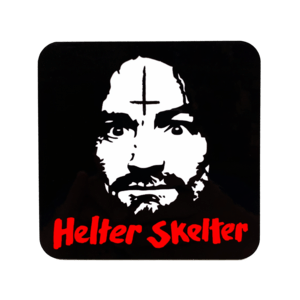 “Helter Skelter in a summer swelter.”: In the summer of 1968, Charles Manson massacred an entire family spurred on by the Beatles song “Helter Skelter” from the white album. “The Byrd flew off with to a fallout shelter.”: The Byrd’s were a popular folk-rock group who had a hit with Dylan’s “Mr. Tambourine Man,” in 1965. Dylan’s “Mr. Tambourine Man” appeared on his “Bringing It All Back Home” record, which features the image of a fallout shelter sign in the lower left corner. “Eight miles high and falling fast then landed in the foul grass.”: Eight Miles High was the first ever psychedelic song by the Byrds and tall grass refers to marijuana. “The players tried for a forward pass with the jester, on the sidelines in a cast.” Bob Dylan’s 1966 motorcycle wreck sidelined him and led to the success (out of necessity) of his back-up band, “The Band” whose 1968 and 1969 albums are considered classics. “Now the half time air was sweet perfume while sergeants played a marching tune.” Perceived reference to Dylan’s time off and the 1967 Beatles album Sgt. Pepper. “We all got up to dance, but we never got the chance.”: reference to the protests at the 1968 Chicago DNC and Kent State massacre of 1970. “Cause the players tried to take the field.”: The National Guard at Kent State University. “The marching band refused to yield.”: resulting in the deaths of of four students and wounding of nine others. “Do you recall what was revealed, the day the music died.”: Kent State University in Kent, Ohio.
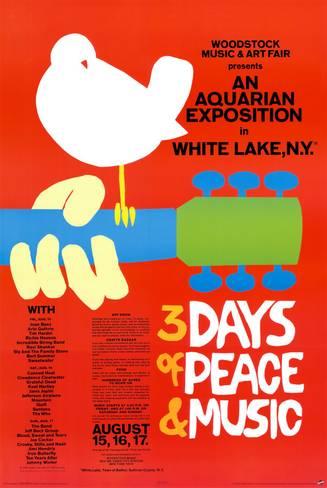 “And then we were all in one place.”: The Woodstock Festival took place in August 1969. 400,000 of McLean’s generation were there. “A generation lost in space.”: with the Apollo 11 moonlanding, the kids who grew up watching Lost in Space were coming of age. “With no time left to start again.”: The deaths of Buddy Holly and James Dean were harbingers for assassinations of the 1960s that could not be undone. “So come on Jack be nimble, Jack be quick, Jack flash sat on a candlestick.”: Reference to the Rolling Stones song Jumpin’ Jack Flash. “cause fire is the devil’s only friend.”: The Rolling Stones 1968 album Sympathy for the devil. “Oh, and as I watched him on the stage.”: In December of 1969, the Stones attempted another Woodstock at Altamont Speedway. A free concert with the Hell’s Angel’s handling the security. The Stones paid them with beer and handfuls of acid and during the performance of “Sympathy for the Devil,” a black man was beaten and stabbed to death by the Hell’s Angels. “My hands were clenched in fists of rage no angel born in hell could brake that Satan’s spell.”: The Hell’s Angels. “As the flames climbed high into the night, to light the sacrificial rite.”: The stones were helicoptered out after the murder and mayhem ensued. “I saw Satan laughing with delight, the day the music died.”: Historians point to the Stones at Altamont as the death of the sixties and good no longer triumphed over evil.
 This song’s refrain may be the hardest part of the song to explain. “So bye, bye Miss American Pie. Drove my Chevy to the levee but the levee was dry. And them good old boys were drinking whiskey and rye singing This will be the day that I die, this will be the day that I die.” The rumor was that American Pie was the name of the doomed plane carrying Holly, Valens and Richardson. Not true. It was also suggested that McLean was dating a Miss America contestant while writing the song. Also not true. Years later, McLean stated that Miss American Pie is as “American as apple pie, so the saying goes.” When taken on the face of it, I believe the refrain came together as a chorus simply because it was catchy. All hidden meanings aside, that may also be true about the entire song. Practically speaking “Chevy” rhymes with “levee”, it’s that simple. Still, theorists propose that the song’s refrain comes from Buddy Holly’s “That’ll be the day,” that eventually says “that I die.”
 In February 2015, McLean announced that Christies Auction House in New York City would sell his original lyrics for the iconic song. McLean explained his reasoning in Rolling Stone magazine: “I’m going to be 70 this year. I have two children and a wife, and none of them seem to have the mercantile instinct. I want to get the best deal that I can for them. It’s time.” The lyrics are 18 pages and contain 237 lines of manuscript and 26 lines of typed text and includes lines that didn’t make the final version as well as extensive notes. Christie’s described the lot as “Comprising: 4 pages manuscript in pencil on four sheets of blue paper stock, 11 pages manuscript on 10 sheets in pencil and ink on ruled spiral paper (including one a half sheet), 2 pages manuscript in pencil on two sheets of yellow paper stock, and one page typed manuscript on blue paper (with four lines holograph notes on verso in purple ink and pencil). Together 18 pages of manuscript on 17 sheets. ” The lot sold on April 7, 2015 for $1.2 million ($1.57 million with buyer’s premium).
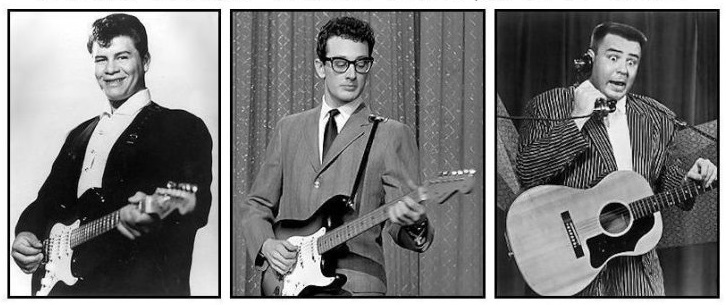


 The Bonanza had banked steeply to the right and entered a nose-down death spiral before it augured in at around 170 mph. The right wing tip hit the ground first, sending the aircraft cartwheeling across the frozen field for 540 feet before coming to rest against a wire fence at the edge of Juhl’s property. The bodies of Holly and Valens had been ejected from the torn fuselage and lay near the plane’s wreckage. Richardson’s body had been thrown over the fence and into the cornfield of Juhl’s neighbor Oscar Moffett, while Peterson’s body was entangled in the wreckage. The County coroner certified that all four victims died instantly, citing the cause of death as “gross trauma to brain” for the three artists and “brain damage” for the pilot.
 The charter plane’s wreckage was strewn across nearly 300 yards of snow-covered cornfields. The death certificate issued by the Cerro Gordo County Coroner noted the clothing Holly was wearing, the presence of a leather suitcase near his body and the following personal effects: Cash $193.00 less $11.65 coroner’s fees – $181.35, 2 Cuff links: silver 1/2 in. balls having jeweled band, Top portion of ball point pen. Notably missing from the list were Holly’s signature eyeglasses.

 Remarkably, The Bopper’s thick brown hair was “still perfectly coiffed in his familiar, 1950s flat-top.” Strangely, the Bopper’s son Jay was present during the entire autopsy. On the subject of the Bopper’s still perfect flattop, his son stated, “It was awesome.” and went on to say, “I talked to him. I got to know my dad a little better.” Jay, showing signs that he inherited his father’s droll humor, joked that the Big Bopper would never have chosen to be buried in such a tie. The Bopper was re-interred in a replacement casket donated by the Batesville Casket Co. of Batesville, Indiana in March of 2007.
 And whatever happened to those glasses? When that envelope was discovered, Holly’s parents claimed the glasses, as did his widow, and on March 20, 1981, a judge awarded the eyeglasses to María Elena in the same Mason City courthouse where they were discovered. Maria kept them until October 1998, when she sold them to Civic Lubbock, the nonprofit cultural organization that created the Buddy Holly Center. The price was $80,000. Today the glasses, visibly scarred from the plane crash, are on exhibit at the center, in a case near Holly’s Fender Strato-caster guitar. Other pieces in the collection include Buddy’s stage clothing, letters, photos, and a book containing handwritten song lyrics.
 Alan E. Hunter