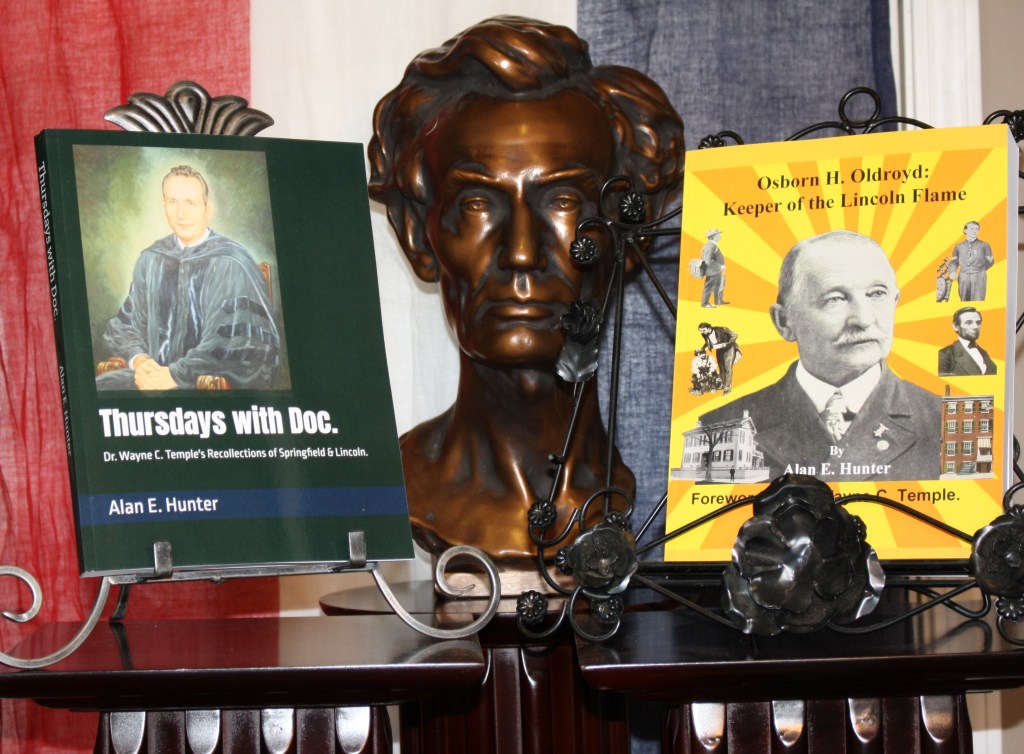
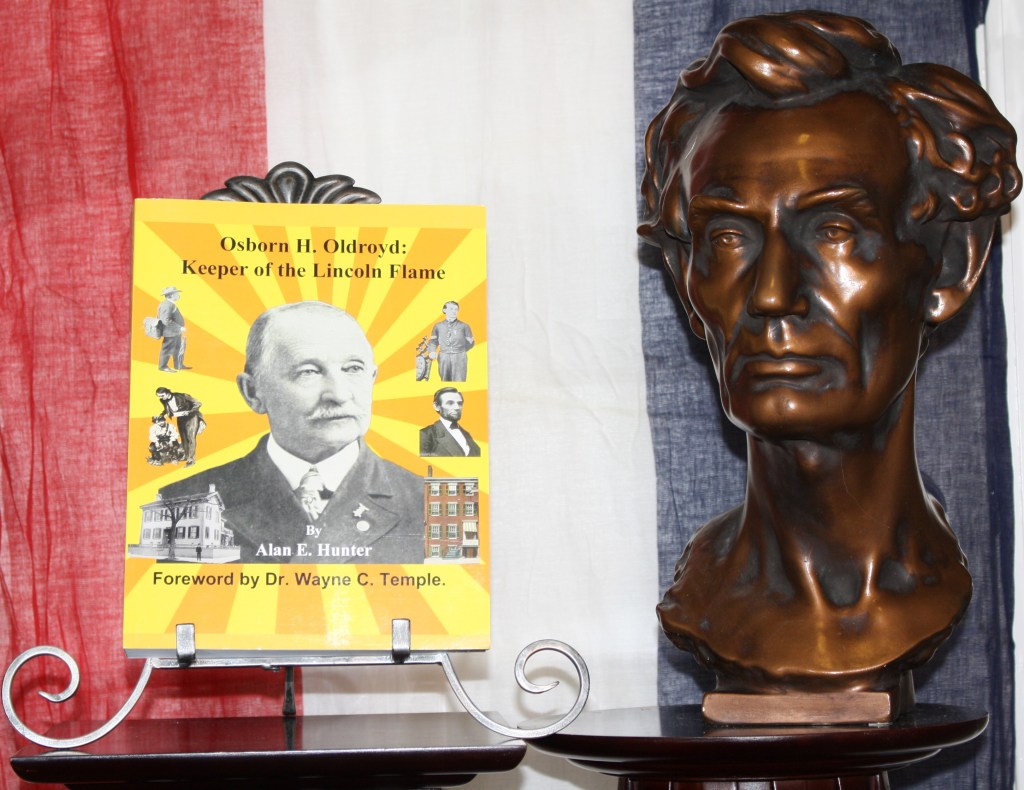
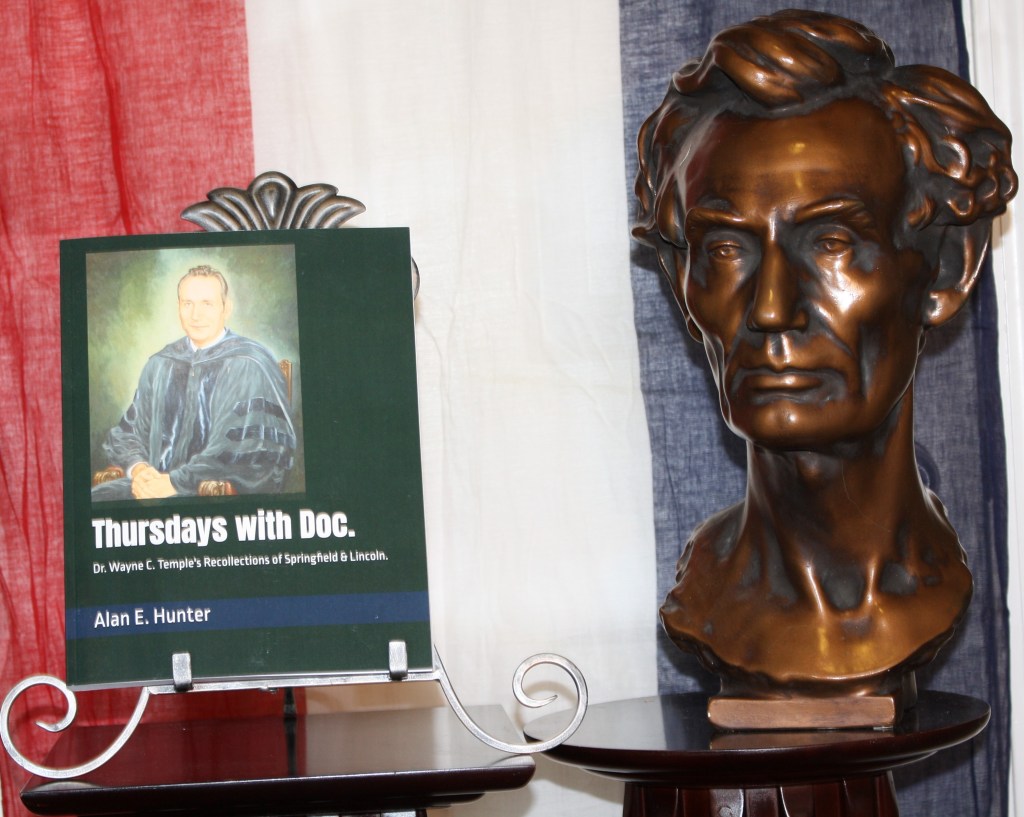
On Sunday, February 16th, 2025, the official book launch for both of my latest books, Thursdays with Doc. Dr. Wayne C. Temple’s Recollections of Springfield & Lincoln and Osborn H. Oldroyd: Keeper of the Lincoln Flame, will be held in Springfield, Illinois. 10:00 am (Central Standard Time) at Books on the Square 427 E. Washington St. Springfield, IL 62701. (217) 965-5443 https://www.booksonthesquare.com/
The author will speak about Doc and Oldroyd, their connection to each other, and Springfield, the day after theAbraham Lincoln 216th Birthday Event: Symposium & Banquetin that historic building across from the Old State Capitol Building where Lincoln served. A book signing will follow the talk. All purchases of Doc’s book that day will include a limited edition, hand-numbered bookplate signed by Doc, Dr. James Cornelius, and the author.
Osborn H. Oldroyd devoted his life to acquiring everything relating to Abraham Lincoln. For nearly half his life, Osborn Oldroyd made his home and displayed his collection in two houses directly associated with the 16th President: the Lincoln Homestead in Springfield, Illinois, and the House Where Lincoln Died in Washington, D.C., a feat that will never be surpassed. Oldroyd guarded a gateway between two worlds. On one side was the world of the now and on the other, the world of the past. When Lincoln passed from life to history, the nation’s grief gave way to reverence; sorrow gave way to esteem. Oldroyd, the loyal log cabin Republican and veteran soldier, did his best to ensure no one forgot. Oldroyd had the institutional memory gained from walking in Lincoln’s footsteps, talking with Lincoln’s contemporaries, and examining the objects associated with his idol. Oldroyd was never trained as a curator. He was a born collector whose experience in handling and researching objects while building his personal collection was his curatorial education. His ability to recount the story behind the object and inject it with enthusiasm, humor, and believability, made him a folk hero to the common man. Just as Oldroyd’s museums can be considered the first of their kind in American museum history, Oldroyd himself can be labeled as America’s first folk curator. To the collection and study of Lincoln, Osborn Oldroyd’s name is unavoidable, particularly in the study of his assassination. It could easily be said that without the efforts of Osborn H. Oldroyd, we may have lost the Lincoln Home in Springfield, the House Where Lincoln Died, and Ford’s Theatre itself. Oldroyd’s obsessive, idiosyncratic devotion to Abraham Lincoln brought the martyred President down from the fog of intellectualism and back to earth for everyone to rediscover in object form. Oldroyd was the last of his kind and the first of another. He arrives by adoration and departs by dedication, opening doors for every Lincoln collector, admirer, and scholar that followed. Born in an age of covered wagons and canals, Oldroyd lived to see the age of the automobile and the airplane. And, thanks mainly to Osborn Oldroyd, visitors to the Petersen house today can walk through the first floor, down the long hallway to stand inside the tiny, dimly-lit otherwise insignificant room with the slanted ceiling where the last, best hope of a nation was lost.
KA series of informal discussions with Springfield Illinois Lincoln scholar and author Dr. Wayne C. Temple, known affectionately as “Doc”. Who, for over 56 years, worked for nine different Illinois Secretaries of State and ten different Governors representing both parties, a remarkable feat of its own. It is a record unlikely to be equaled. Doc was with the Illinois State Archives from 1964 to 2016, much of that time as the Chief Deputy Director. Before that, Doc was editor-in-chief of the Lincoln Herald and in charge of the Dept. of Lincolniana at Lincoln Memorial University in Harrogate, Tennessee from 1958 to 1964, remaining in that position remotely from Springfield until 1973. Doc was an honorary member of the Lincoln Sesquicentennial Commission, 1959-1960, and served on the advisory council of the United States Civil War Centennial Commission, 1960-1966. Doc served in the U.S. Army from 1943 to 1946, and during that time he helped to establish General Dwight D. “Ike” Eisenhower’s communications in Europe. Doc has authored over 20 books, mostly on Lincoln, and has written over 600 articles, poems, reviews, and papers during his career. Doc graduated from the University of Illinois in 1949, studying under his mentor J.G. Randall, the “Dean of Lincoln Scholars.” Doc’s accomplishments are well covered in this volume. This book spans almost three years of interviews with Doc, James Cornelius (former Curator of the Abraham Lincoln Presidential Library and Museum), and author/newspaper columnist Alan E. Hunter. The topics cover Abraham Lincoln, the little-known history and colorful personalities of Springfield, Illinois, the Indigenous Peoples of Illinois, and the life and times of Springfield’s preeminent Lincoln scholar. Now over 100 years old, Dr. Wayne C. Temple has seen it all.
I was just informed & consulted about an upcoming program at the Knox County Public Library in Mt. Vernon, Ohio (Osborn H. Oldroyd’s birthplace). They have promised not to play up the “scoundrel” angle. The word is getting out!
Rhonda and I strolled through Irvington last week to reconnect with some old friends. We visited Ethel Winslow, my long-suffering editor at the Weekly View, and then stopped in to see Jan and Michelle at the Magick Candle. From there we went down to see Dale Harkins at the Irving and then popped into Hampton Designs to check in with Adam. After that, we tried (in vain) to track down Dawn Briggs for a stop-and-chat, then traveled over to see Randy and Terri Patee for a 3-hour porch talk over a fine cigar. Why do I retrace our visit with you? Simply because I hope that anyone reading this article either is, or will, make a similar stroll through the Irvington neighborhood this Fall season and visit their old haunts as well.
I am blessed to know these folks and every one of them has been kind, giving, and thoughtful to us over the years, particularly lately as Rhonda has faced some difficult health challenges. The gals at the Magick Candle have gifted me treasures over the years connected to the people and places they know I love (Disney’s Haunted Mansion and Abraham Lincoln come to mind), the Patees have given me relics from the pages of history, and yesterday, Adam stopped me in my tracks by stating, “Wait, Carter found something for you.” Adam fumbled around gracefully behind the counter before finding the object of his search. As he handed it to me, I felt certain that he believed it to be just another Lincoln item, but I knew immediately what it was.
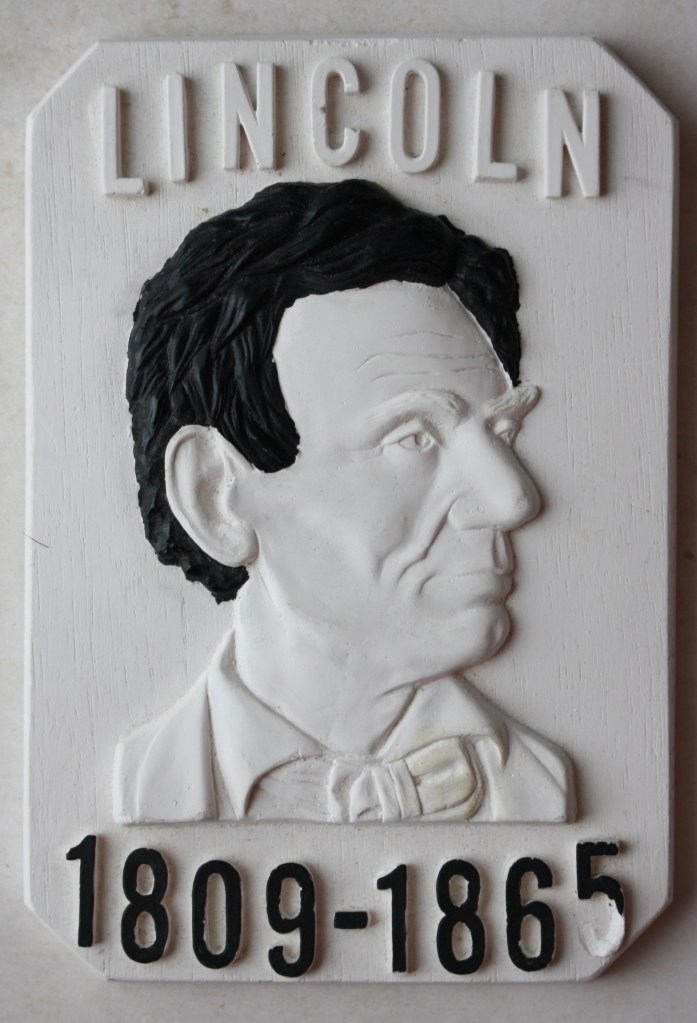
Lincoln plaque in its barest form.
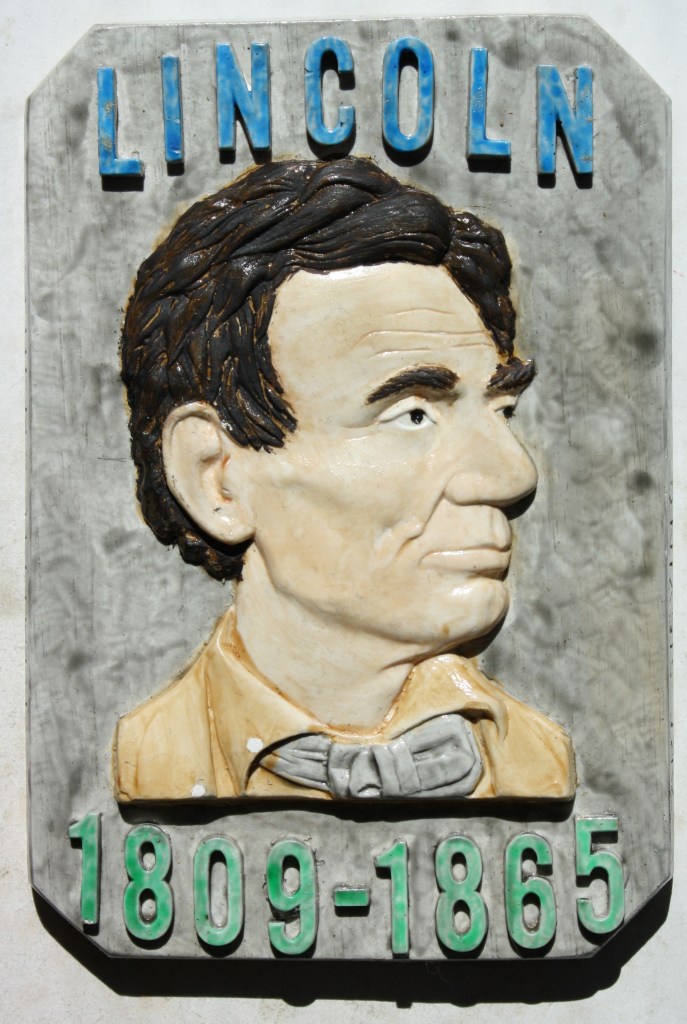
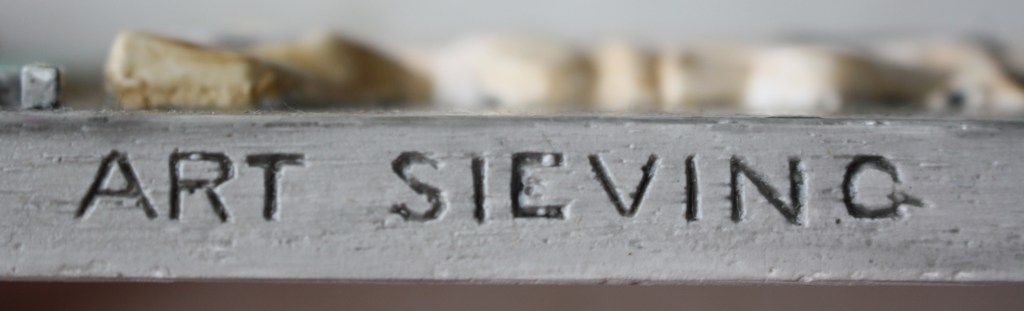
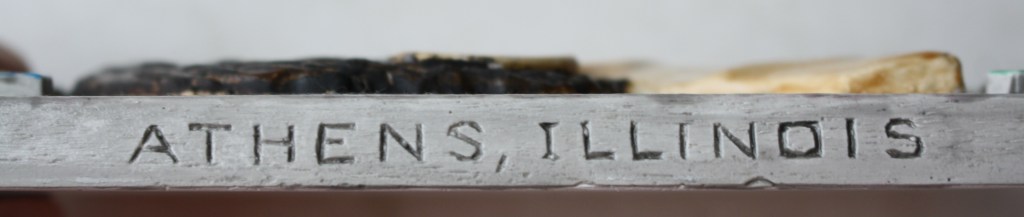
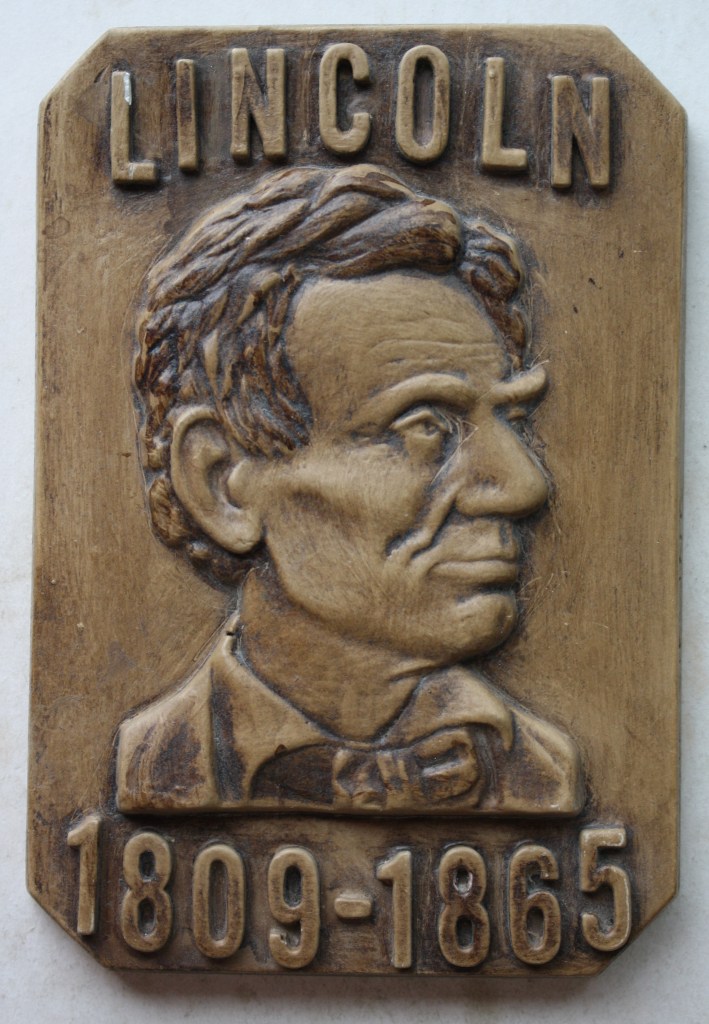
The object is a ceramic plaque about the size of a paperback novel picturing a young, beardless Abraham Lincoln with his birth and death dates inset in raised / relief lettering on the front. It is painted in bright Victorian Era colors that teeter on the edge of being gaudy but are always irresistibly attractive. Rhonda was standing by my side (as always) and when I showed it to her she oohed and aahed at it simply because she understands what such things mean to me. When I told her that it had a secret surprise attached to it, she looked closer at it. Knowing what was in store, I turned the plaque sideways in my hand to reveal the artist’s name, Art Sieving, on the right edge and then turned it over to the left edge to show the town name of Athens, Illinois. Since she has listened patiently to my historical ramblings for 35 years now, she wisely responded, “Oh, the Long Nine Museum.” Ding, ding, ding, we have a winner!
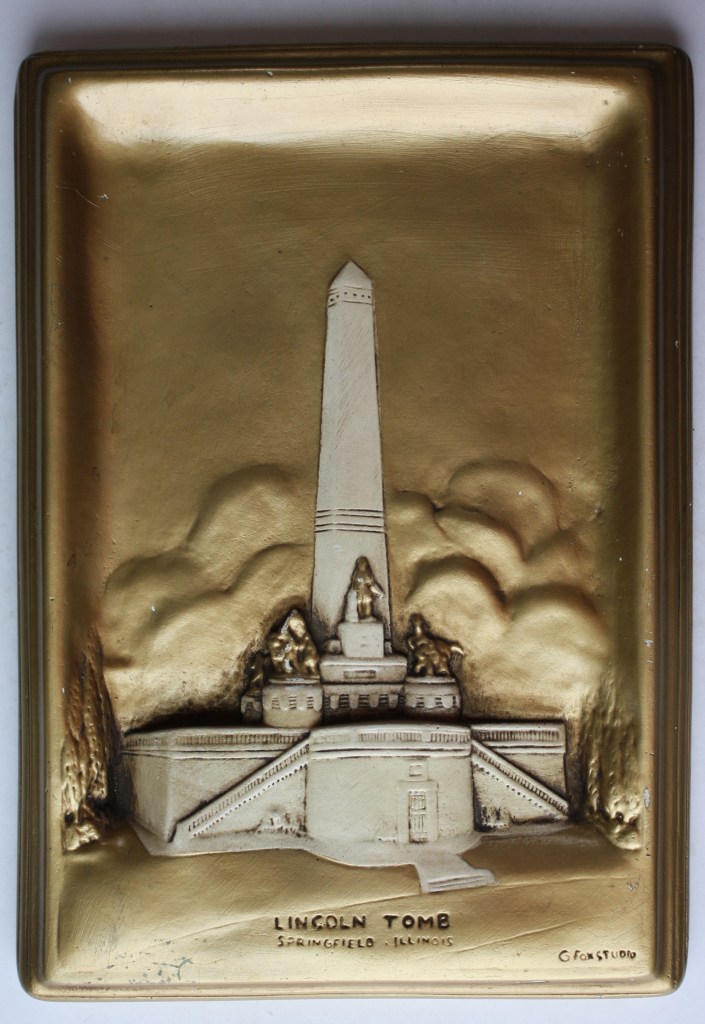
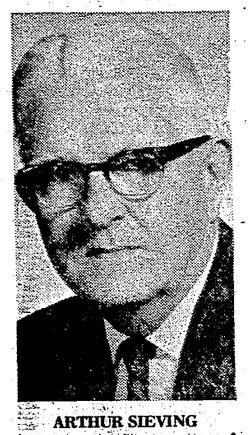
Carter and Adam had no idea, since, unlike me, they have lives outside of history books and museums, but with this gift, they had hit me in my sweet spot. I knew what it was because I already have a version, but mine, while still interesting to me, is a bland matte-finish version that pales in comparison to this one. These plaques were created by Arthur George Sieving (1902-1974) from Springfield, Ill. He was a wood carver, magician, sculptor, and ventriloquist who created many fine architectural carvings, clocks, and ventriloquist figures. At the time of his death, Art was working on the diorama displays at the Long Nine Museum in Athens. He is buried in Springfield’s Oak Ridge Cemetery final resting place of Abraham Lincoln. I was introduced, unknowingly, to Sieving’s work when, many years ago, I purchased a stunning metallic gold plaque depicting the Abraham Lincoln Tomb. About the size of a college diploma, like Carter’s plaque, it depicts the Tomb in a raised/relief style so realistically that it casts its own shadow depending on the lighting.
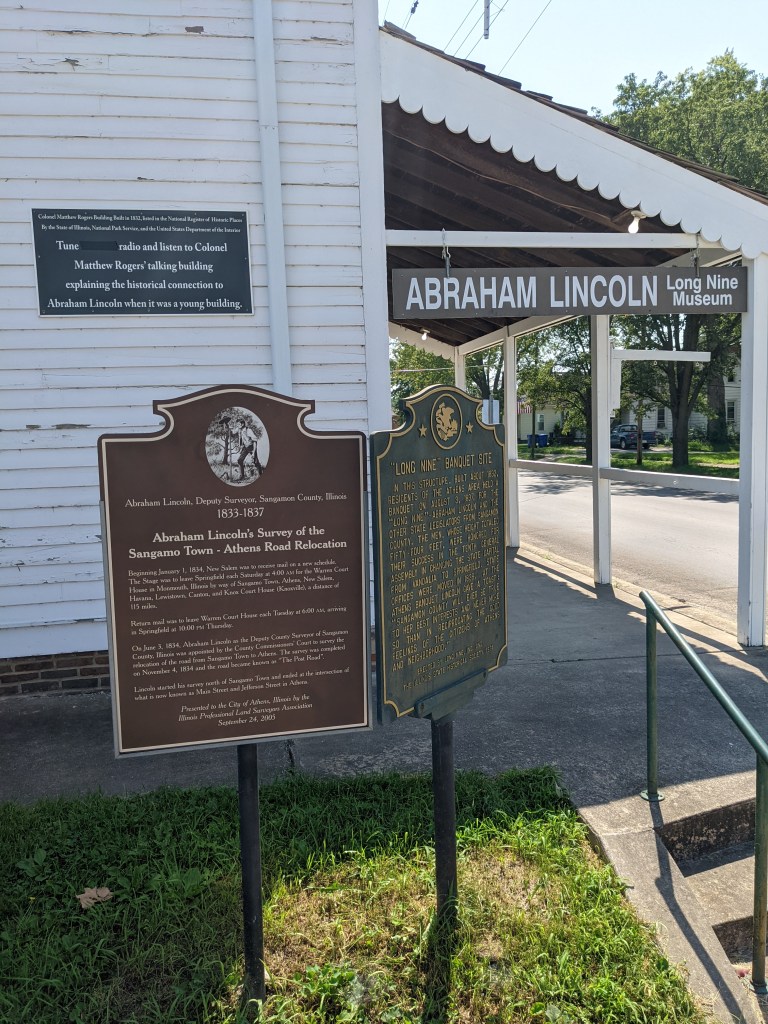
The Long Nine Museum Athens, Illinois.
I had no idea who created the piece until I traveled to Athens (Pronounced Ay-thens) just a stone’s throw north of Springfield. I ventured there to meet with Jim Siberell, curator of the Long Nine Museum, who travels from his home in Portsmouth, Ohio during the summertime months to keep the museum open. Jim and I share a mentor in Dr. Wayne C. “Doc” Temple, the subject of my upcoming biography. As Mr. Siberell toured me through the museum, I spotted the exact plaque on display there. Of course, I asked for the history and Jim explained the artist’s connection to the museum. For those of you unaware, the Long Nine building is an important waymark of Illinois history. It was in this building, on the second floor, where Abraham Lincoln and six other state legislators (two of the members did not attend) decided to move the Illinois state capitol from Vandalia (near St. Louis) to the more centralized location of Springfield.
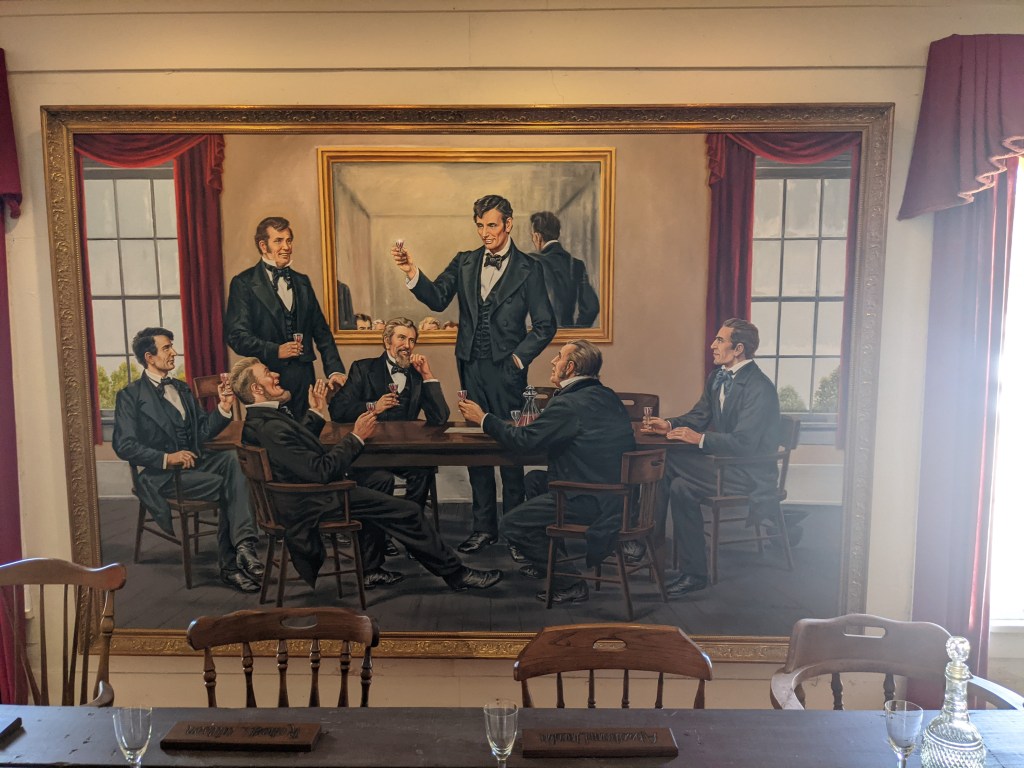
In 1837, a dinner party was held in the banquet room on the second floor to honor those legislators who were effective in passing a bill to relocate the capital. They earned the sobriquet of “The Long Nine” because together their height totaled 54 feet, each man being over 6′ tall or taller. Among the attendees was Abraham Lincoln, who at age twenty-seven was the youngest of the group. Lincoln gave the evening’s toast by saying, “Sangamon County will ever be true to her best interest and never more so than in reciprocating the good feeling of the citizens of Athens and neighborhood.” What this Hoosier finds most interesting is that when the delegates carved out the boundaries of Sangamon County, the home of the new state capitol, they left Athens out. Athens became a part of Menard County as did their neighbor, Lincoln’s New Salem.
Dayton Ohio Artist Lloyd Ostendorf’s massive Long Nine Banquet painting in the museum.
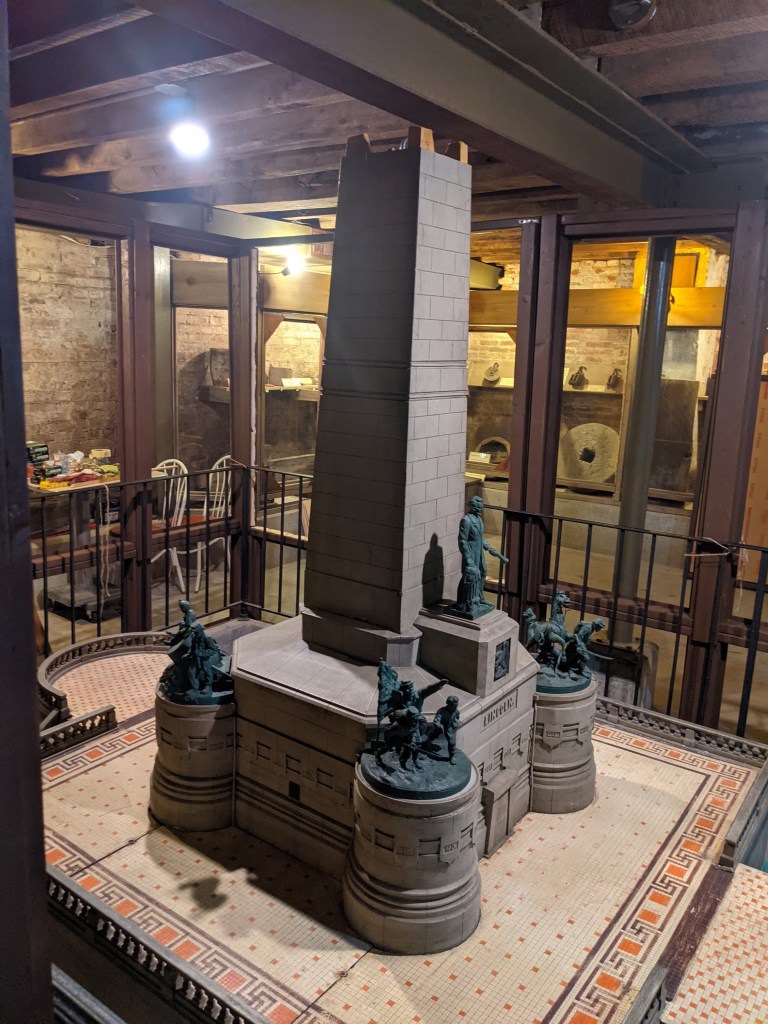
Mr. Siberell toured me through the building and explained how Art Seiving had created the dioramas in the museum that recounted the stories of the men of The Long Nine in hand-carved wooden miniature displays. Each diorama’s characters were created by Seiving and the backgrounds were painted by artist, Lloyd Ostendorf. Siberell escorted me up the original stairway to the second-floor banquet room which features a stunning, massive oil painting by the late artist Lloyd Ostendorf showing Lincoln in formal dress toasting his colleagues. The mural covers an entire wall and is set against a table arranged much the same as it would have been on that fateful night. The visitor stands upon the original flooring of the banquet room where Lincoln gave his famous toast. The history room downstairs is a researcher’s dream. It contains many copies of Lincoln’s handwritten letters, documents from the history and restoration of the building, newspapers from the era, and historic photos. A trip to the basement reveals the building’s original fireplace, an arrray of period artifacts, and a scale model of Lincoln’s Tomb so big that it required the construction of a special pit to accommodate its massive size.
Lincoln Tomb model at Long Nine Museum.
The March 23, 1973, Jacksonville (Illinois) Journal Courier reported. “Seiving has been working hard since January making the “Lincoln Head” plaques in his basement. He used a rubber mold taken from a carving…he pours into it the powdered molding material and fashions a Lincoln head of great exactness and beauty. During the past weeks, he has made enough of them to fill every available space in his basement. When he makes a few hundred more they will be delivered to a central point for use in Athens; he will then start on larger statues. The plaques being furnished are in white plaster material, but will be finished into a walnut appearance with a high polish and most attractive “feel” and “look”.
Art Sieving’s Lincoln Tomb bas relief plaque.
The article continues, “The classic dioramas made by Art Seiving will present all of those documented events which presented Lincoln in Athens, including hand-carved wooden figures, utensils, tools, buildings, and animals carved from wood.” One of Art’s carvings was titled, “Lincoln goes to school in Indiana”…It takes two people (himself and his wife) three nights to cut out 800 little paper leaves, and it’s no short job, either, to glue them to the branches, one by one. Others have taken longer. Mr. Seiving was five or six days just putting in 3,000 “tufts” of grass in his last completed scene. The grass is frayed rope strands, cut and dried and then glued down…And while you’d swear that the miniature pots and pans were made of metal, in actuality, most are simply wrapping paper glued to metal rings.” Sieving stated that it took him five to seven days to carve each figure, and one diorama alone featured 11 figures. His preferred medium was walnut with augmentations of birch wood.
Seiving is described as an “internationally known magician, sculptor and ventriloquist” whose “dummy” partner was known as “Harry O’Shea.” Of course, Art carved all of the ventriloquist dummies used in his acts himself. Art’s magic act was called the “Art Seiving and his Art of Deceiving.” Aside from the Long Nine Museum, he is best known for his dioramas at the Illinois State Museum, ‘Model of New Salem Village’ and wood sculptures including the ‘Egyptian Motif Clock’. Seiving’s George Washington carving is in the Smithsonian Institution’s collection.
Sieving’s Lincoln plaque in walnut finish.
Art’s Lincoln plaques are by no means rare but cannot be classified as common in the “collectorsphere”. I believe the Long Nine Museum still has a few for sale if memory serves, and one would set you back about the cost of a Starbucks coffee nowadays. To me, the value is not a monetary one, but rather the story the item tells. The version that Carter discovered (and so kindly gifted to me) is signed “Love, Laurie” on the back, making it all the more special to me. I tend tolove these little travel souvenirs from the 1960-70s. I’m a space race Bicentennial kid who enjoys discovering these little treasures. They represent a vacation, a trip, a moment in someone’s life. Usually a kid, they are never confined to age, race, or gender. I appreciate that, in this age where everything handmade seems to come from China, most of these old travel souvenirs originate from where they were being sold. At that moment, they were the most important thing in that person’s life. Hand-picked with a smile and a “wow” to be taken home and enjoyed long after the trip concluded. A physical manifestation of a cherished memory. So thank you “Laurie” whomever or wherever you are for saving this little treasure for a history nerd like me. And most importantly, thank you Carter for thinking of me.
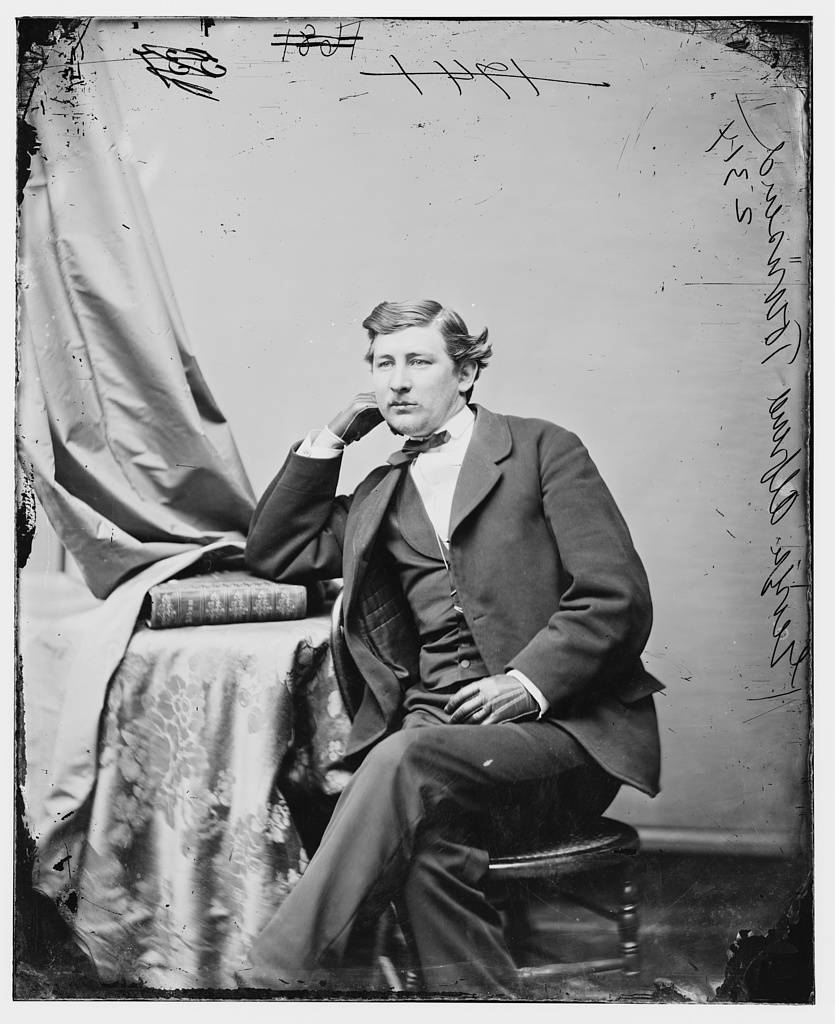
Next week will witness another sad passing in American history: the 159th anniversary of the assassination of Abraham Lincoln. Because I live with this date dancing around in my head more than most, I want to share my experience (and admiration) for a peripheral character in that tragedy: George Alfred Townsend. Born in Georgetown, Delaware on January 30, 1841, Townsend was one of the youngest war correspondents during the American Civil War. Soon after graduation from high school (with a Bachelor of Arts) in 1860, Townsend began his career as a news editor with The Philadelphia Inquirer. In 1861, he moved to the Philadelphia Press as city editor. As the war broke out, he worked for the New York Herald as a war correspondent in Philadelphia.
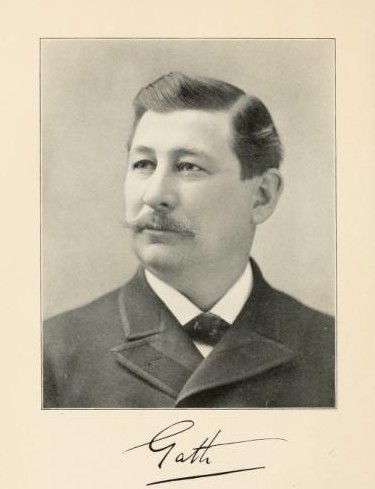
George Alfred Townsend.
By April 1862, George got his big break when General George McClellan rode through Philadelphia on his way to Washington. That fortuitous meeting would propel young Townsend to exclusive access to many of the Civil War’s greatest battles. One of America’s first nationally syndicated columnists, Townsend used the pen name “Gath” for his newspaper columns. Gath was an acronym of his initials with the addition of an “H” at the end. Friends and contemporaries like Mark Twain, Bret Harte, and Noah Brooks, claimed the “H” stood for “Heaven” while wags and rivals claimed it stood for “Hell.” Gath himself was inspired by the biblical passage uttered by David after the death of King Saul in II Samuel 1:20, “Tell it not in Gath, publish it not in the streets of Askalon.”
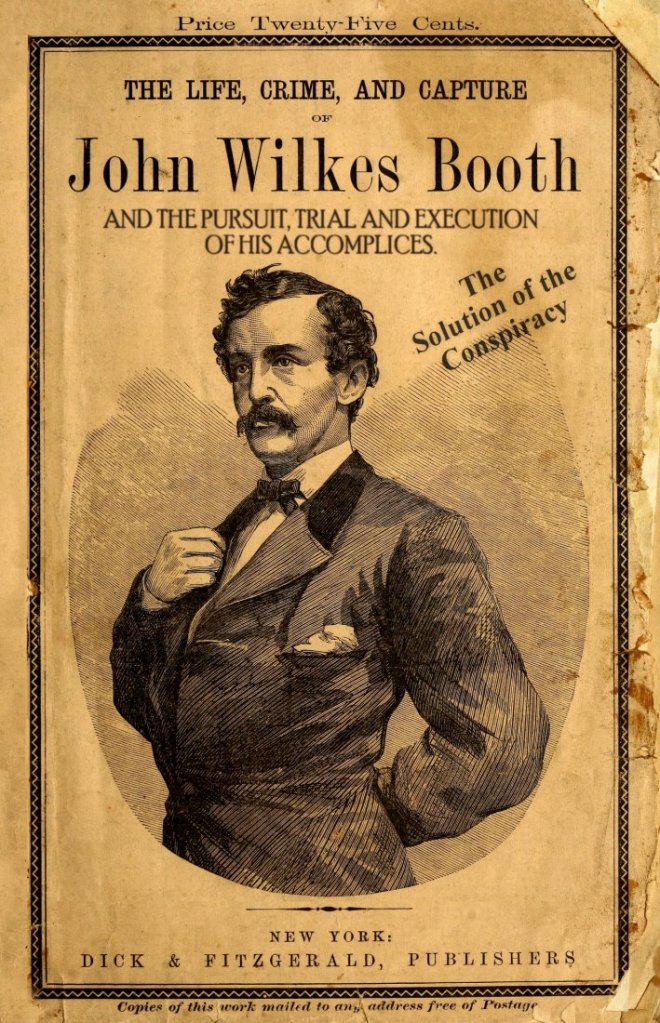
The Life, Crime and Capture of John Wilkes Booth.
While Townsend won accolades for his work covering the war, it was his coverage of the Lincoln assassination that he is best remembered for. His detailed columns (which he called “letters”) about the tragedy were filed between April 17 – May 17 and would later be published as The Life, Crime and Capture of John Wilkes Booth. Published in 1865, Townsend’s book offers a full sketch of the assassin, the conspiracy, the pursuit, trial, and execution of his accomplices. As a lifelong student of Lincoln, I have read countless books, articles, letters, and various accounts centered on his life. It was in George Alfred Townsend’s “letters” that I found my holy Grail. Townsend’s description of Lincoln in his coffin made me feel as if I were standing there myself. His description of Lincoln’s office left me awestruck and wishful. In my opinion, it would be hard to find a more worthy example of Victorian journalism than these excerpts from Gath’s “letters”.
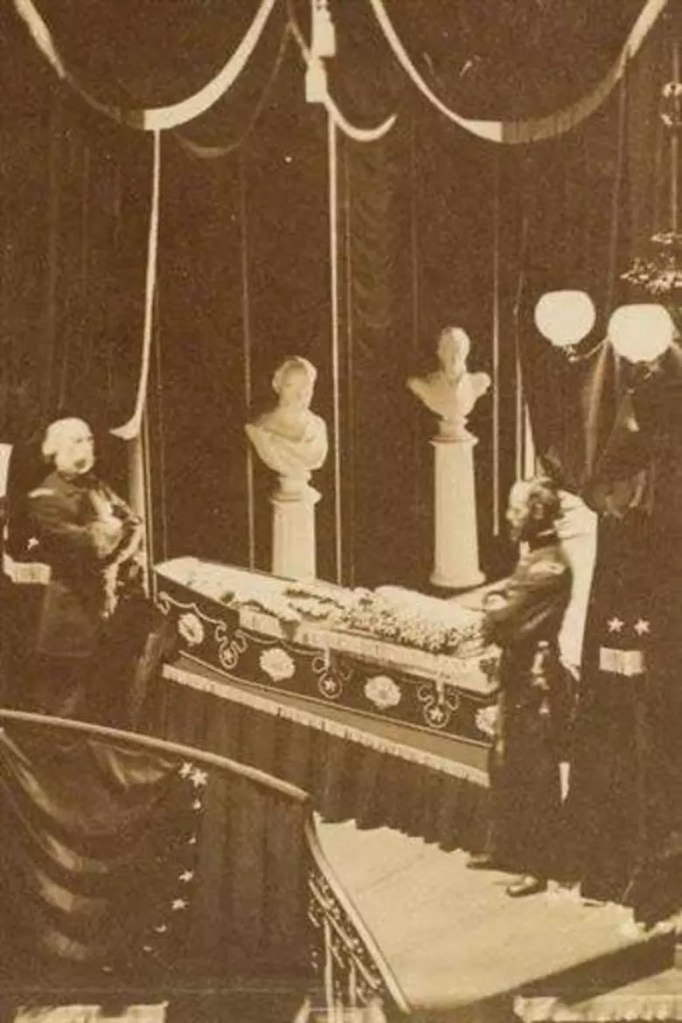
Lincoln in his coffin.
“Deeply ensconced in the white satin stuffing of his coffin, the President lies like one asleep. Death has fastened into his frozen face all the character and idiosyncrasy of life. He has not changed one line of his grave, grotesque countenance, nor smoothed out a single feature. The hue is rather bloodless and leaden; but he was always a sallow. The dark eyebrows seem abruptly arched; the beard, which will grow no more, is shaved close, save the tuft at the short small chin. The mouth is shut, like that of one who had put the foot down firm, and so are the eyes, which look as calm as slumber. The collar is short and awkward, turned over the stiff elastic cravat, and whatever energy or humor or tender gravity marked the living face is hardened into its pulseless outline. No corpse in the world is better prepared according to appearances. The white satin around it reflects sufficient light upon the face to show us that death is really there; but there are sweet roses and early magnolias, and the balmiest of lilies strewn around, as if the flowers had begun to bloom even upon his coffin. Looking on interruptedly! for there is no pressure, and henceforward the place will be thronged with gazers who will take from the site its suggestiveness and respect. Three years ago, when little Willie Lincoln died, Doctors Brown and Alexander, the embalmers or injectors, prepared his body so handsomely that the President had it twice disinterred to look upon it. The same men, in the same way, have made perpetual these beloved lineaments. There is now no blood in the body; it was drained by the jugular vein and sacredly preserved, and through a cutting on the inside of the thigh the empty blood vessels were charged with the chemical preparation which soon hardened to the consistence of stone. The long and bony body is now hard and stiff, so that beyond its present position it cannot be moved any more than the arms or legs of a statue. It has undergone many changes. The scalp has been removed, the brain taken out, the chest opened and the blood emptied. All that we see of Abraham Lincoln, so cunningly contemplated in his splendid coffin, is a mere shell, an effigy, a sculpture. He lies in sleep, but it is the sleep of marble. All that made the flesh vital, sentiment, and affectionate is gone forever.”
Lincoln Funeral Train.
On May 14, 1865, the day Abraham Lincoln’s body was placed on the funeral train to leave Washington DC forever, Townsend visited the White House. Mary Lincoln still resided there with her beloved son Tad, too distraught to leave the White House. “I am sitting in the President’s office. He was here very lately, but he will not return to dispossess me of the high-backed chair he filled so long, nor resume his daily work at the table where I am writing. There are here only Major Hay (Salem Indiana’s John Hay, Lincoln’s private secretary) and the friend who accompanies me. A bright-faced boy runs in and out, darkly attired, so that his fob chain of gold is the only relief to his mourning garb. This is little Tad, the pet of the White House. That great death, with which the world rings, has made upon him only the light impression which all things make upon childhood. He will live to be a man pointed out everywhere, for his father’s sake; and as folks look at him, the tableau of the murder will seem to encircle him.”
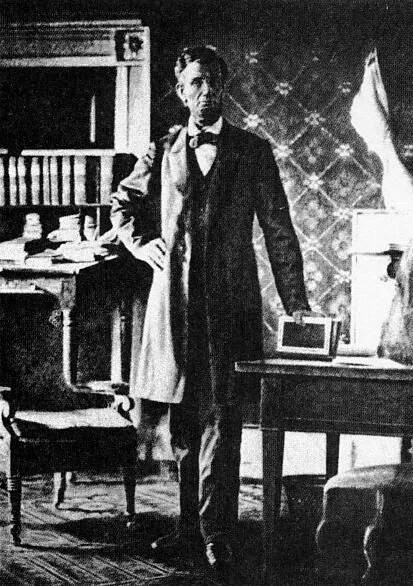
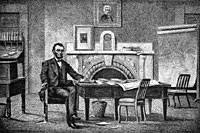
Lincoln in his White House Office.
Townsend further describes Lincoln’s office, just as he left it. “The room is long and high, and so thickly hung with maps that the color of the wall cannot be discerned. The President’s table at which I am seated adjoins a window at the farthest corner; and to the left of my chair as I reclined in it, there is a large table before an empty grate, around which there are many chairs, where the cabinet used to assemble. The carpet is trodden thin, and the brilliance of its dyes is lost. The furniture is of the formal cabinet class, stately and semi-comfortable; there are bookcases sprinkled with the sparse library of a country lawyer, but lately plethoric, like the thin body which has departed in its coffin. Outside of this room, there is an office, where his secretaries sat – a room more narrow but as long – and opposite this adjacent office, a second door, directly behind Mr. Lincoln’s chair leads by a private passage to his family quarters. I am glad to sit here in his chair, where he has spent so often, – in the atmosphere of the household he purified, and the site of the green grass and the blue river he hallowed by gazing upon, in the very center of the nation he preserved for the people, and close the list of bloodied deeds, of desperate fights of swift expiations, of renowned obsequies of which I have written, by indicting at his table the goodness of his life and the eternity of his memory.”
“They are taking away Mr. Lincoln’s private effects, to deposit them wheresoever his family may abide, and the emptiness of the place, on this sunny Sunday, revives that feeling of desolation from which the land has scarce recovered. I rise from my seat and examine the maps; they are from the coast survey and engineer departments, and exhibit all the contested grounds of the war: there are pencil lines upon them where someone has traced the route of armies, and planned the strategic circumferences of campaigns. Was it the dead President who so followed the March of Empire, and dotted the sites of shock and overthrow? So, in the half-gloomy, half-grand apartment, roamed the tall and wrinkled figure whom the country had summoned from his plain home into mighty history, with the geography of the Republic drawn into a narrow compass so that he might lay his great brown hand upon it everywhere. And walking to and fro, to and fro, to measure the destinies of arms, he often stopped, with his thoughtful eyes upon the carpet, to ask if his life were real and he were the arbiter of so tremendous issues, or whether it was not all a fever-dream, snatched from his sofa in the routine office of the Prairie state.”
“I see some books on the table; perhaps they have lain there undisturbed since the reader’s dimming eyes grew nerveless. A parliamentary manual, a thesaurus, and two books of humor, “Orpheus C. Kerr,” and “Artemis Ward.” These last were read by Mr. Lincoln in the pauses of his hard day’s labor. Their tenure here bears out the popular verdict of his partiality for a good joke; and, through the window, from the seat of Mr. Lincoln, I see across the grassy grounds of the capitol, the broken shaft of the Washington Monument, the long bridge and the fort-tipped Heights of Arlington, reaching down to the shining riverside. These scenes he looked at often to catch some freshness of leaf and water, and often raised the sash to let the world rush in where only the nation abided, and hence on that awful night, he departed early, to forget this room and its close applications in the abandon of the theater. I wonder if it were the least of Booth’s crimes to slay this public servant and the stolen hour of recreation he enjoyed but seldom. We worked his life out here, and killed him when he asked a holiday.”
George Alfred Townsend.
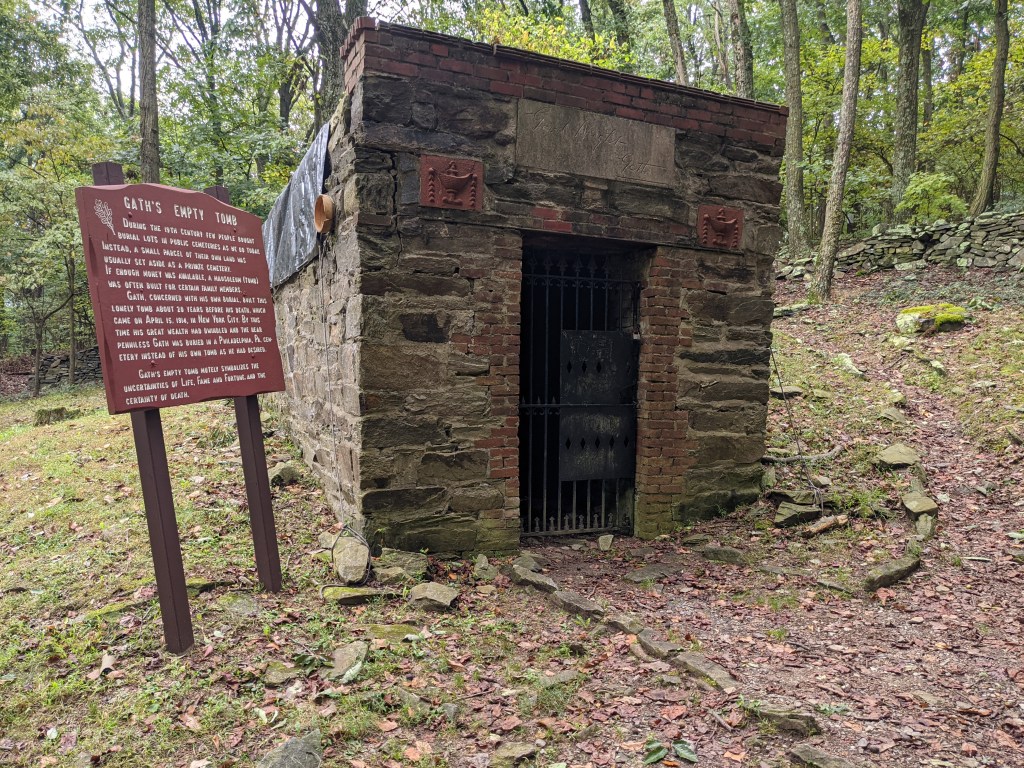
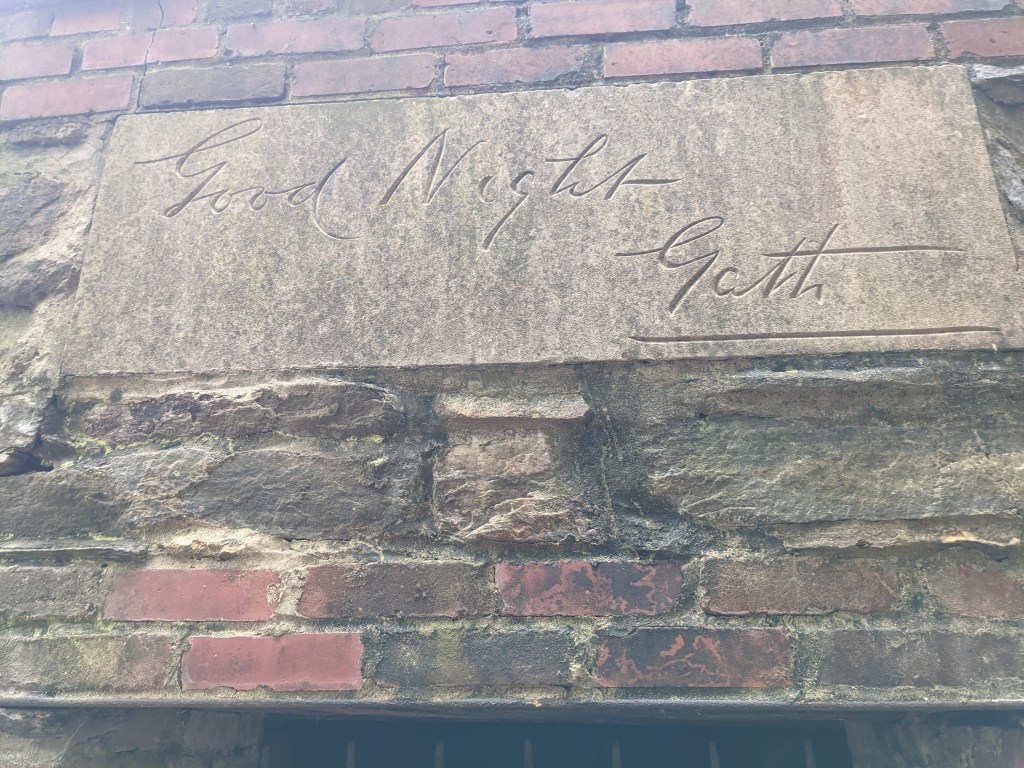
As one of the most successful journalists of his day, Townsend accumulated a tidy fortune. He used much of that fortune to build a 100-acre baronial estate near Crampton’s Gap, South Mountain, Maryland known as “Gapland”. The Civil War Battle of Crampton’s Gap was fought as part of the Battle of South Mountain on September 14, 1862, and resulted in 1,400 combined casualties. Tactically the battle resulted in a Union victory because they broke the Confederate line and drove through the gap. Strategically, the Confederates were successful in stalling the Union advance and were able to protect the rear. Gath literally bought the battlefield upon which he built his estate. The estate was composed of several buildings, including Gapland Hall, Gapland Lodge, the Den and Library Building, and a brick mausoleum (notable for its inscription of “Good Night Gath” above the entrance).
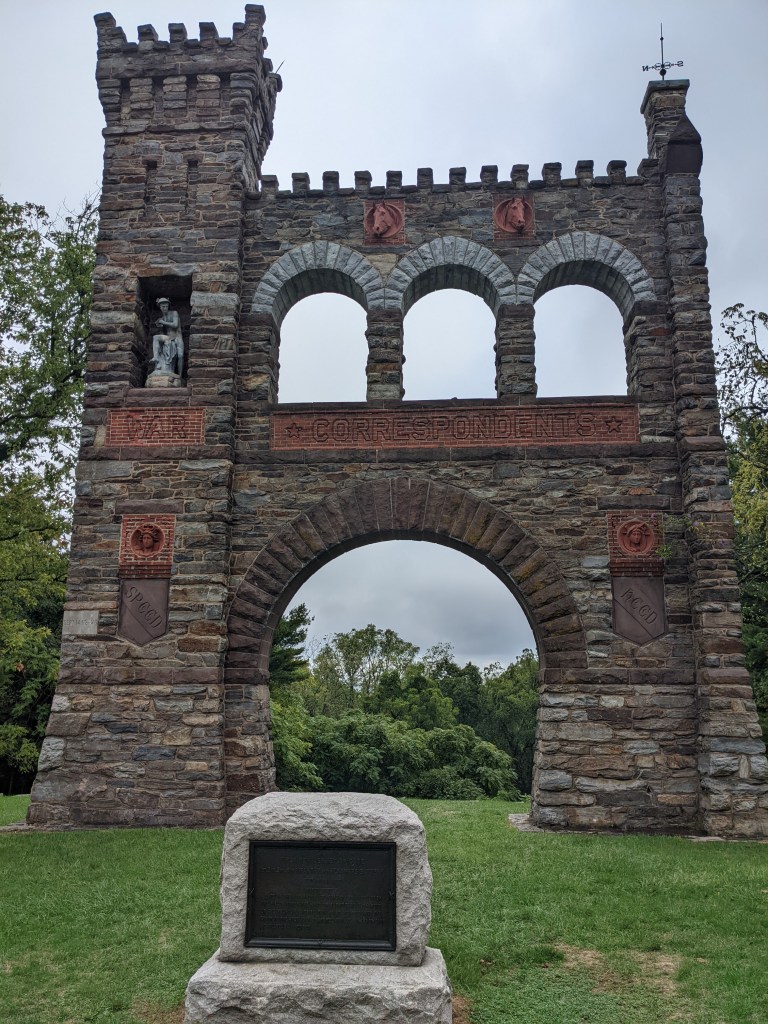
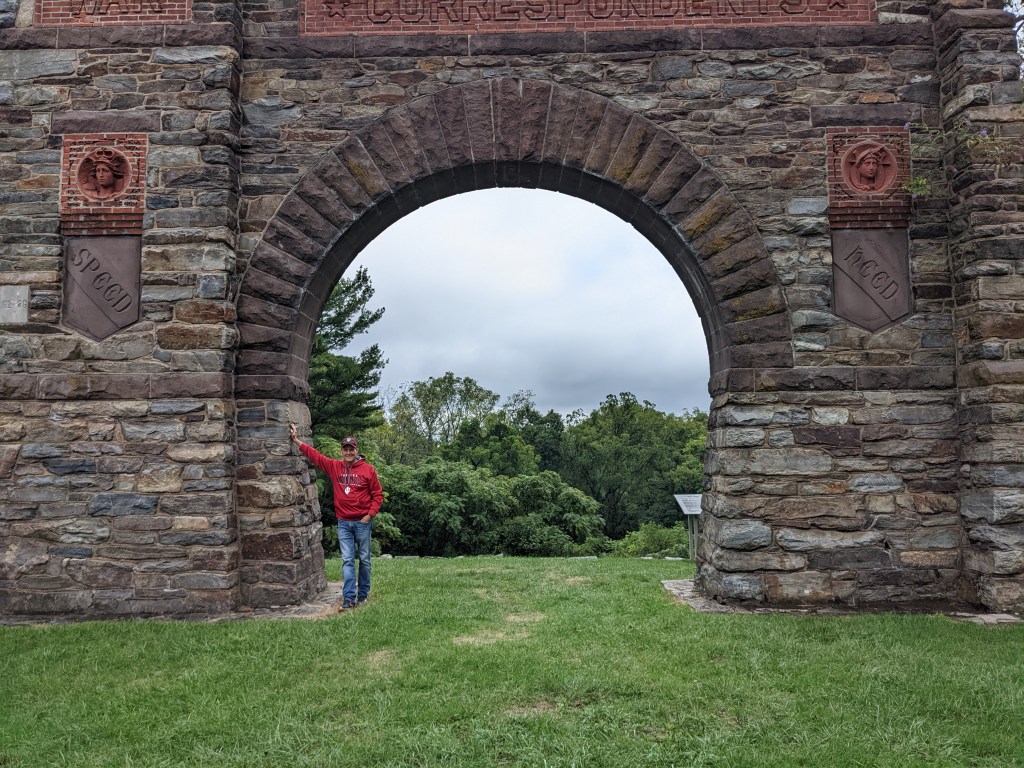
The author at Gath’s arch.
In 1896, Townsend built a monument to war correspondents to memorialize the contributions of his colleagues North and South. Dedicated in 1896, The War Correspondent Memorial Arch is 50 feet high and 40 feet wide and is the only monument in the world dedicated solely to war correspondents. Not only does the arch stand on Townsend’s original estate (operated by the Maryland Department of Natural Resources), it also rests smack dab in the middle of the Appalachian National Scenic Trail. Furthermore, the woods surrounding Gapland and the nearby town of Burkittsville were the setting for the 1999 horror film Blair Witch Project.
Gath’s Empty Tomb.
Good Night Gath.
Last September, I traveled to the Catoctin Mountains to visit Townsend’s estate not far from the Antietam battlefield. Townsend’s Gapland estate is now known as Gathland State Park. Several buildings still stand, including Gapland Hall (which is the park headquarters) and the mausoleum, while other buildings are mere shadows of their former self. Townsend left Gapland in 1911 and died in New York City three years later on April 15, 1914. The 49th anniversary of Abraham Lincoln’s death. He was buried at Laurel Hill Cemetery in Philadelphia.
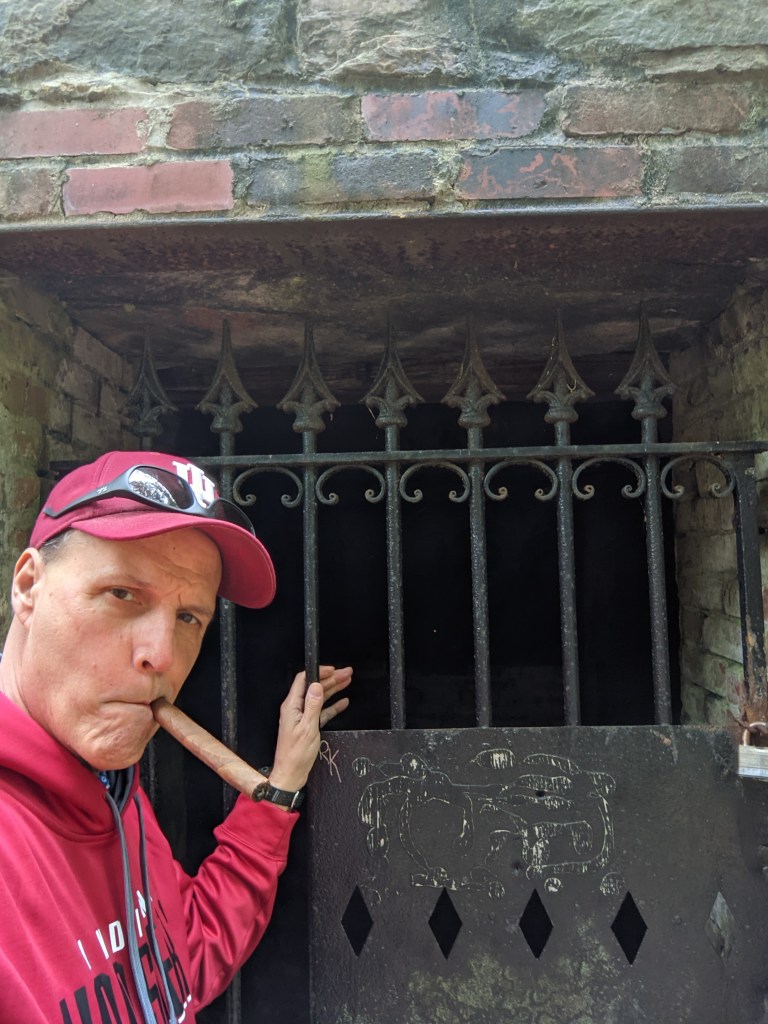
The author at Gath’s empty tomb.
His brick mausoleum, fronted by an ominous-looking iron gate causing it to look more like a jail cell than a tomb, stands empty, its roof slowly caving in. Although the object of my quest was The War Correspondent Memorial Arch, I could not help but spend most of my time seated beneath that empty tomb smoking a cigar. While the hale and hearty hikers pausing briefly at the foot of the Appalachian Trail might not have appreciated my vice, as I stared at the epitaph above the iron gate above Townsend’s unused tomb, George Alfred Townsend would understand. Good Night Gath.
Quick, who broke up The Beatles? Which one of the Fab Four was the first to quit the group? And who was the last Beatle standing? Throw away all you thought you knew about the breakup of The Beatles and settle in for a Beatles Christmas story like you have never heard before. This Beatles breakup story involves John Lennon’s famous “Lost Weekend”, the Sopranos, Al Capone, and Mickey Mouse.
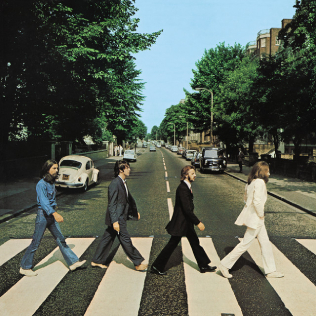
On August 20, 1969, The Beatles met for the last time at Abbey Road Studios to record what was to be the last song on their last studio album: The End. The song, which features the only song Ringo performed a drum solo on, was initially intended to be the final track on Abbey Road, but it ended up being followed by “Her Majesty” a brief tongue-in-cheek music hall song. “Her Majesty” appears 14 seconds after the The End, but was not listed on the original sleeve. Paul McCartney is the only musician to appear on the track. Some observers consider it the first example of a hidden track. The song credited to the “Lennon-McCartney” songwriting partnership brought forth a rare compliment from Lennon when he credited Paul with the line, ‘And in the end, the love you take is equal to the love you make.’ The ever-increasing acerbic Lennon offered a back-handed compliment to his songwriting partner by saying, “it is a very cosmic, philosophical line. Which again proves that if he wants to, he can think.” Thus, The End stands as the last known new recording involving all four of the Beatles during the band’s existence. And before you say it, the album Let It Be, was recorded in January 1970 ON TOP of Abbey Road Studios, NOT inside of it.
The final gathering of all four Beatles came two days later at a photo session held at John Lennon’s Tittenhurst estate. On September 20th, Lennon privately informed his bandmates at a meeting at Apple, without George Harrison present, that he was leaving the Beatles. However, it was unclear to the other members whether John just wanted a break or if his departure was permanent. Legend has it that John Lennon walked out of that 1969 meeting at Apple headquarters screaming “I want a divorce” and four years later, he would get his wish at the “Happiest Place On Earth”. Meantime, on April 10, 1970, McCartney settled the issue in a press release declaring, “I’m quitting The Beatles.” It would take another four years for the breakup to be formalized.
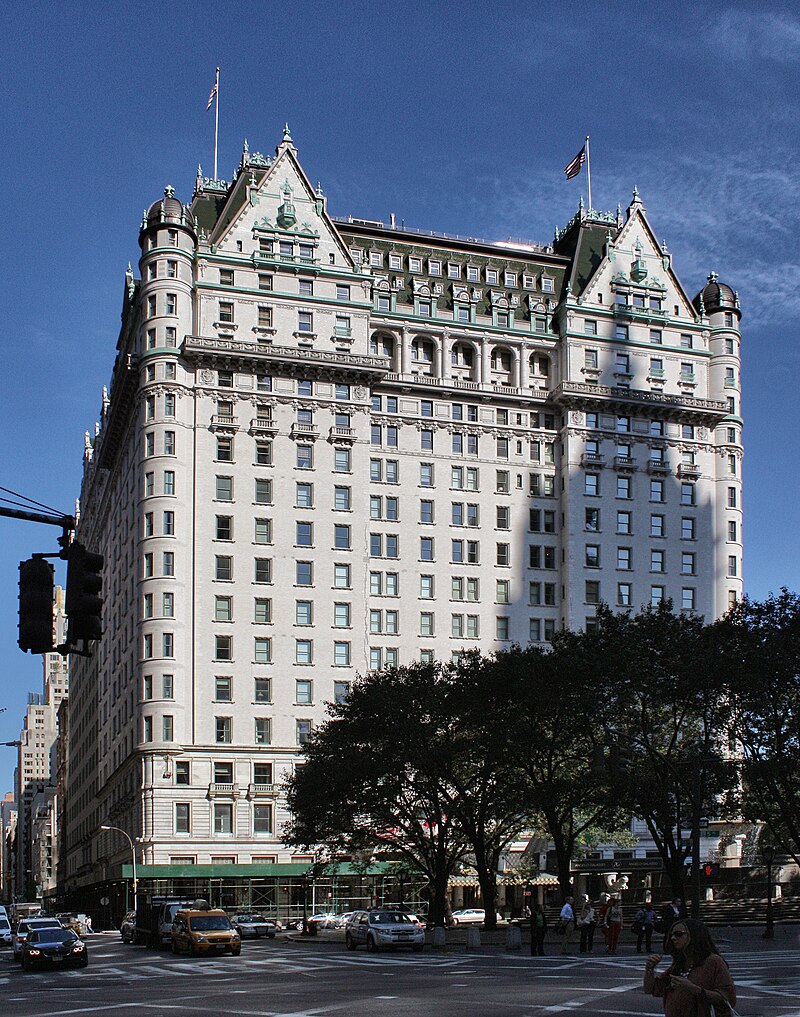
The Plaza Hotel in Manhattan, New York City.
After three years of court battles and ever-increasing acrimony amongst the Fab Four, the final dissolution of The Beatles was set to happen. The meeting was scheduled for December 19, 1974. Ironically it to happened at New York’s Plaza Hotel, the first place The Beatles stayed in America a decade before. As it happened, George Harrison was at Madison Square for two nights on his Dark Horse tour and Paul and Linda McCartney flew in for the signing. Ringo had already signed the documents in England. So, as George, and Paul sat around a large table ready to dissolve the partnership alongside Apple lawyers and business managers, Ringo listened in on the telephone to confirm that he was alive. Everyone present was wondering where John was. Keep in mind, Lennon lived within walking distance of the Plaza Hotel. George Harrison’s lawyer telephoned Lennon for an explanation. May Pang answered and from the background, John’s voice bellowed out, “The stars aren’t right,” to the lawyer’s query. When John’s response came across the speakerphone, everyone present was furious. John explained that he was going to follow his astrological signs and he wasn’t coming to the meeting.
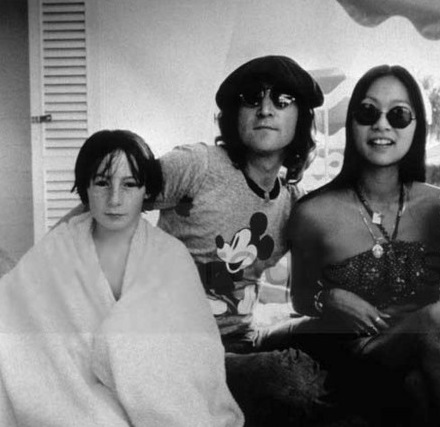
Julian & John Lennon with May Pang.
Instead, John decided that he wanted to give his 11-year-old son Julian a special Christmas holiday by taking him someplace warm. Mobster Mo Levy offered to have John, May, and Julian stay at his Palm Beach Florida condominium, not far from the former mansion of gangster Al Capone. So, Levy grabbed his son Adam and together with the wayward Beatle brood, they all flew down to Levy’s West Palm Beach estate to spend Christmas in the sunny shores of Florida. Wait, you say, where was Yoko? Well, John Lennon was in the midst of his self-described Long Weekend “sowing his oats” with May Pang, Yoko Ono’s assistant and the couple’s production coordinator. In mid-1973, while Lennon was busy working on his classic Mind Games album John and Yoko were having marital problems. Ono suggested to Pang that she become Lennon’s companion, and with Yoko’s permission, John and May began a relationship that lasted more than 18 months.
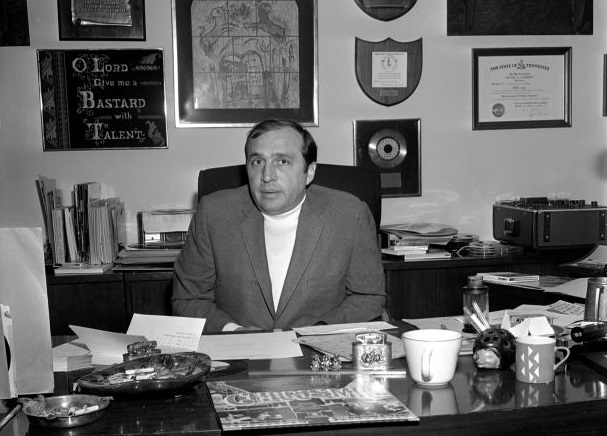
Morris Levy in his office at Roulette Records.
And that private jet-owning mobster, who was that guy? His name was Morris Levy, a music executive from Harlem with alleged mob ties to Vincent Gigante, boss of the Genovese crime family. “Moishe” or “Mo” as friends and associates called him, was known to sign up-and-coming artists to lop-sided contracts that often left the artists owing him money for touring expenses and studio time. Mo Levy would often sign his name to contracts as a song’s co-writer without the artist’s consent. Robbie Robertson of The Band was reportedly one of his victims and a witness to Mo’s henchmen holding a fellow performer by his ankles out the window of Levy’s Park Avenue apartment to get his point across. Levy, who died in 1990, was the inspiration for the HBO television series The Sopranos (1999–2007) character Hesh Rabkin, Tony Soprano’s friend who made a fortune defrauding performers, underpaying royalties, and pressing unauthorized records. Tommy James, Frankie Lymon, and Tito Puente were among his most prominent victims.
Once in South Florida, they spent their time walking on the beach, lounging by the pool and amusing themselves by throwing firecrackers at palm trees. The pinnacle of the trip came when the Lennon trio spent a day at Disney World. There one of the most famous men in the world went mostly unrecognized. At that time Disney’s Magic Kingdom was only one park on the property. They stayed at the Polynesian Hotel. To get from the Polynesian (both then and today) to the Magic Kingdom, the easiest way to travel is by Monorail. The train stops inside the hotel so guests do not have to venture outside the building. Making the Polynesian the obvious choice for John and his crew to stay.
Disney monorail operator / castmember Hal East with John Lennon.
Years later, Disney monorail operator (castmember Hal East) confirmed that John, May Pang, and Julian made a few trips to the Magic Kingdom via the Monorail and were allowed to ride up front apart from the crowd. It was during these trips where John and Julian experienced the rare treat of driving the Monorail. In her book May shared an interesting memory from one of the rides: “I overheard a father tell his son [on the Monorsail] he had heard a Beatle was visiting. “Which Beatle?” The father said, “George Harrison.” I burst out laughing. John asked why. We then all started laughing so hard that the Dad turned around. It then registered which Beatle was at the park that day – and why we were laughing. “It’s O.K.,” John jokingly said, “we all look alike.” On December 29, 1974, one of Apple Corp’s lawyers hand-delivered the official documents to the House of the Mouse in Florida and John Lennon became the last of the four to sign off on the contract.
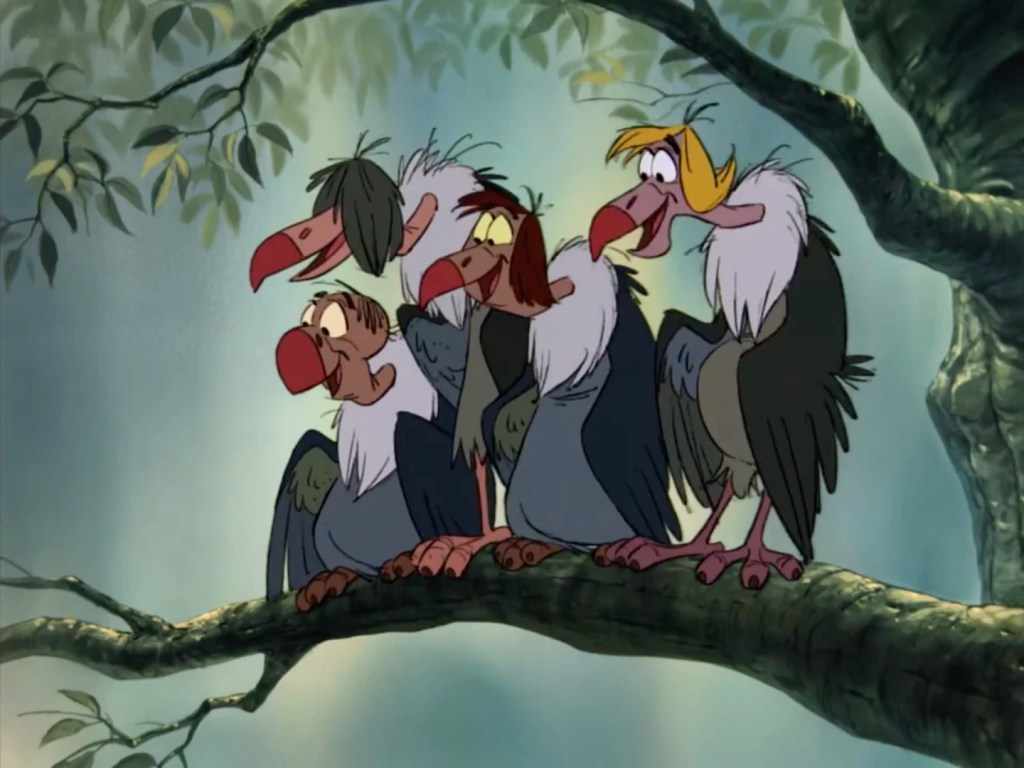
Disney’s Beatles inspired Vultures: Buzzie, Flaps, Ziggy, and Dizzy.
Ironically, the Beatles and Disney never really had much of a working relationship, but Disney did reference The Beatles in at least one of its productions: the vultures in The Jungle Book are based on the Fab Four. Disney also made plans to remake 1968’s Yellow Submarine, but the project never broke the surface. In 2020, Disney bought distribution rights for the docuseries The Beatles: Get Back from Peter Jackson and that three-part series is still streaming on Disney.
Samoa Longhouse 1601.
Samoa longhouse Building at Disney World’s Polynesian Resort.
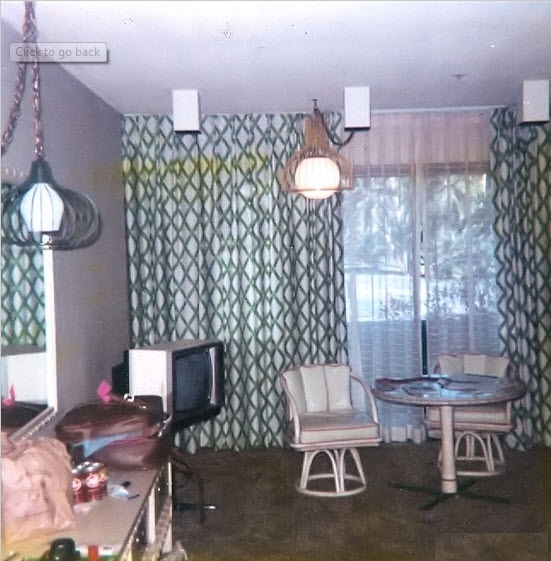
While Disney won’t confirm the exact room where it happened, dedicated Beatles / Disney fans have pinpointed the location: Room 1601 in the Samoa longhouse Building at the Polynesian Resort at Walt Disney World, Orlando. Room 1601 looks out at the Seven Seas Lagoon and it was this scene at which John gazed as he paused briefly before officially dissolving his performing relationship with the Beatles. Room 1601 is a ground-floor corner room in the Samoa longhouse that looks out on the Seven Seas Lagoon with the Cinderella Castle visible in the distance.
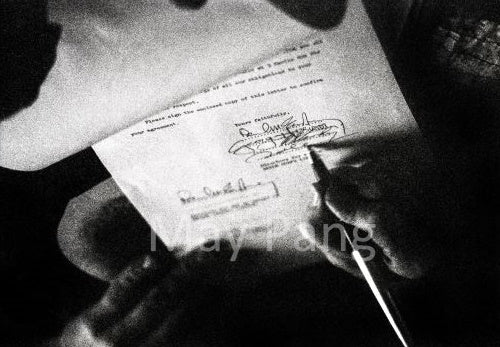
May Pang’s Photo of Lennon’s dissolution signing.
Here, with the Magic Kingdom as his backdrop, John Lennon picked up his pen and officially finished off the Beatles, once and for all. Years later May Pang remembered that John told her to “Take out your camera…He looked wistfully out the window. I could almost see him replaying the entire Beatles experience in his mind. He finally picked up his pen and, in the unlikely backdrop of the Polynesian Village Hotel at Disney World, ended the greatest rock ‘n’ roll band in history by simply scrawling ‘John Lennon’ at the bottom of the page.”
Interior of Room 1601 as it looked in 1974.
Room 1601.
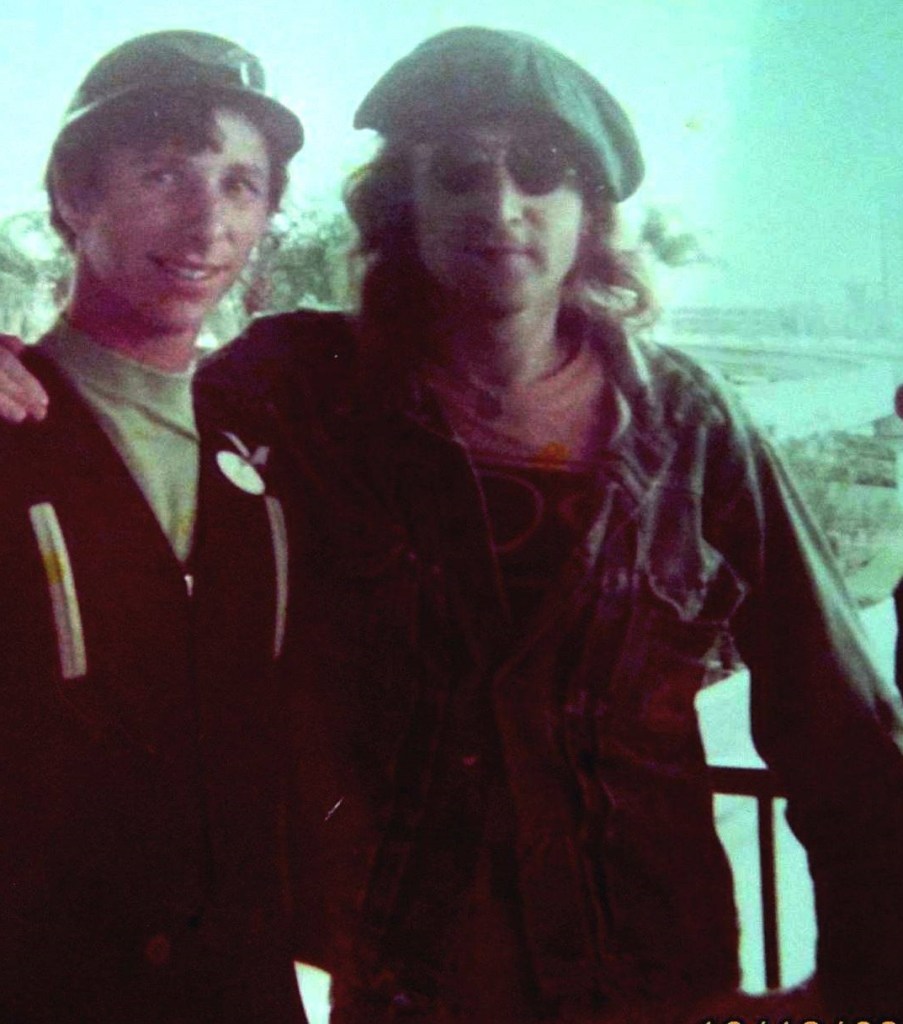
In Pang’s book “Instamatic Karma: Photographs of John Lennon” (St. Martins Press 2008), there are several photos of Lennon at Disney World wearing a stylish newsboy cap and Micky Mouse ringer t-shirt posed anonymously in the park among the crowd, alongside Monorail driver Hal East, in front of Cinderella Castle and outside room 1601 at the Polynesian. Most importantly, Pang snapped a photo of Lennon’s signature on the dissolution papers. A literal snapshot of music history, Disney style. And today, if you’re lucky, you can stay in Room 1601 where the Beatles long and winding road came to an end. And then, go ride the Monorail.
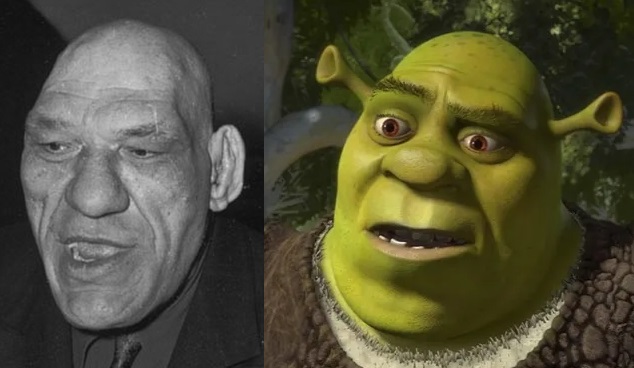
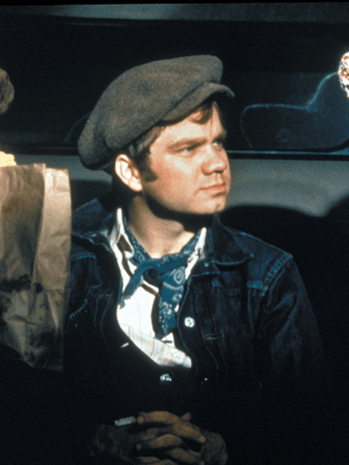
The low spark of high-heeled boys is the title track from the 1971 album by British rock band Traffic. The 11-minute, 44-second song, was written by Jim Capaldi and Steve Winwood. Capaldi credits diminutive actor Michael J. Pollard (Bonnie & Clyde) for coming up with the term while the two were in Morocco planning a movie (that was ultimately never made). In a 2009 radio interview, Capaldi said, “Pollard and I would sit around writing lyrics all day, talking about Bob Dylan and The Band, thinking up ridiculous plots for the movie…Pollard wrote in my book ‘The Low Spark of High Heeled Boys’. For me, it summed him up. He had this tremendous rebel attitude. He walked around in his cowboy boots, his leather jacket. At the time he was a heavy little dude. It seemed to sum up all the people of that generation who were just rebels.” For this writer, that lyric succinctly sums up the creation of the most iconic cartoon character of our time: Shrek. And since it is Halloween week, I’m going to tell you why.
Artist William Steig (1907-2003)
Shrek was created by William Steig (1907-2003) who, during his lifetime, was hailed as the “King of Cartoons.” Steig began drawing illustrations for The New Yorker magazine in 1930, ultimately producing more than 2,600 drawings and 117 covers for the magazine. Steig began his “second career” writing children’s books at the age of 61. In 1990, Steig published his picture book Shrek! which formed the basis for the 2001 DreamWorks Animation film. After the 2004 release of Shrek 2, Steig became the first sole creator of an animated movie franchise to gross over $1 billion after only one sequel. Eventually, three sequels and three spin-offs were produced. When asked his opinion about the movie, Steig responded: “It’s vulgar, it’s disgusting-and I loved it.”
Maurice Tillet “The French Angel” (1903 –1954)
It is widely believed that Steig based his Shrek character on the professional wrestler Maurice Tillet aka “The Angel”, a nickname given to him by his mother when he was a boy. Maurice Tillet (1903-1954), a Russian/French professional wrestler, was a two-time World Heavyweight Champion and a leading box office draw in the early 1940s. Tillet was born in 1903 in St. Petersburg, Russia. His mother was a teacher of languages and his father was a railroad engineer involved in the construction of the Trans-Siberian railroad. Tillet’s father died when he was young. In 1917, Tillet and his mother fled Russia to avoid the Revolution, settling in Reims, France. When Tillet was twenty years old, his feet, hands, and head began to swell uncontrollably. A doctor diagnosed him with acromegaly, a rare condition usually caused by a benign tumor on the pituitary gland, which causes the body to produce too much growth hormone. The condition causes the body tissues and bones to grow rapidly resulting in bone overgrowth and thickening. Over time, acromegaly leads to an abnormally large head, oversized hands and feet, and a wide range of other symptoms. Maurice had a head almost twice the size of normal for a man of his size and he could shuffle three decks of cards at once in his mammoth hands.
“The Angel”
Although Tillet’s acromegaly resulted in an abnormally grotesque appearance, in truth, “The Angel” was a highly intelligent man. He spoke 14 languages, played chess brilliantly, and despite his massive size and frightening face, was known as a modest, gentle, and friendly man. Tillet completed his law degree at the University of Toulouse but felt he would never be successful as a lawyer due to his deep voice and imposing physical appearance. Tillet joined the French Navy and served as an engineer in the submarine service for five years, rising to the rank of Chief Petty Officer. Always a good athlete, Tillet excelled at rugby. After being named to an all-France rugby team in 1926, Tillet earned the honor of shaking hands with King George V. at a game in London, a feat he considered one of his greatest achievements. In February 1937, Tillet met Lithuanian light-heavyweight champion wrestler Karl Pojello in Singapore who talked Tillet to enter the ring. Tillet wrestled for two years in France and England from 1937 to 1939 until World War II forced them to leave for the U.S.
The Angel in profile.
In Boston in 1940, Tillet began wrestling as “The French Angel” and was billed as the closest living specimen of a Neanderthal man known to exist. Tillet went unbeaten for nineteen consecutive months and became an instant attraction in the area. At his American debut at Boston Garden on January 24, 1940, Maurice walked down the aisle, climbed into the ring, leaned over the ropes, and roared at the crowd. The crowds flocked to see this monster of a man who was a throwback to prehistoric times. He was hawked as the unstoppable man and was AWA World Heavyweight Champion from May 1940 until May 1942. Maurice was 5 foot 8.5 inches in height, 276 pounds with a 47-inch chest. The bear hug became his signature move. Tillet reported to the U.S. Army in 1942 to enlist in the war effort but was turned away after being told that he would be a curiosity and distraction.
As a result of his success and unique look, several Angel imitators emerged during World War II, including “Angels” from Sweden, Russia, Canada, Poland, Czechoslovakia, Ireland, and several ubiquitous American versions emerged including the Golden Angel, Black Angel, and Lady Angel, most of whom were also suffering the effects of acromegaly. The most famous imitator was Tor Johnson known as the “Super Swedish Angel.” Johnson is best remembered not as a wrestler, but as an actor who appeared in many B-movies, including the famously bad 1957 Ed Wood movie Plan 9 from Outer Space.
Maurice Tillet in later life.
Maurice proved incredibly strong and highly popular. He staged highly publicized stunts where he would pull a bus or street car with his massive hands. By 1945, after many years of punishment in the ring combined with the fact that most people suffering from acromegaly didn’t live past the age of 30, Maurice Tillet’s health began to fail and he was no longer advertised as unstoppable. He briefly considered a movie career, but the B-movie genre was years away and the Drive-in theatre craze had not yet swept America. The Mid-1940s / Early 1950s were a long, slow ride to irrelevance and the once mighty Angel was little more than a curiosity now billed as the “Ugliest Man in the World.” A highlight came in February 1947 when Maurice took the oath of citizenship to the United States. He was a devout Catholic who attended church every Sunday and that same year he was given an audience with the Pope. In his final wrestling match, in Singapore on Valentine’s Day of 1953, Angel agreed to lose to Bert Assirati, the British World Champion recalled as being one of the strongest men to ever enter the ring.
Suffering from an enlarged heart caused by his acromegaly, Tillet died of a heart attack in Chicago’s County Hospital on September 4, 1954. He was buried at the Lithuanian National Cemetery in Justice, Illinois. As for the “low spark of high-heeled boys” reference, I find it infinitely interesting that Shrek, one of the crudest, yet most beloved animated characters of the past 50 years, was created by the principal artist of one of the most high-brow publications in the country: The New Yorker. And it was all inspired by a highly-intelligent participant in one of the world’s most low-brow professions: Pro wrestling. Things are not always what they seem my friends. Happy Halloween!
The tombstone of Maurice “The French Angel” Tillet is buried next to his trainer, Karl Pojello. Lithuanian National Cemetery in Justice, Illinois.







 Alan E. Hunter