For many Indianapolis residents, Christmas in the Circle City is defined by one thing: The World’s Largest Christmas Tree. Every year since 1962, the dedicated electrical workers of IBEW 481 have dutifully transformed the Soldiers and Sailors monument into a glistening, magical pyramid of lights that even the most skeptical Scrooge among us proudly calls the world’s largest Christmas tree. This year marks the 56th anniversary of that monumental Christmas tree. Although I never fail to take my annual trip around Monument Circle at Christmastime to gaze in wonder at the fantastic fir tree fantasy, my personal memories of Christmas on the Circle revolve around a little shack that used to rest at its base facing the Indiana Statehouse. You may think of the L.S. Ayres Cherub, Santa’s mailbox, the 26 larger-than-life toy soldiers and sailors surrounding the Circle, the 26 red & white striped peppermint sticks, the 52 garland strands or the 4,784 colored lights strung from the top of the Monument to its base, but I think of the Roselyn Bakery Christmas Hut.
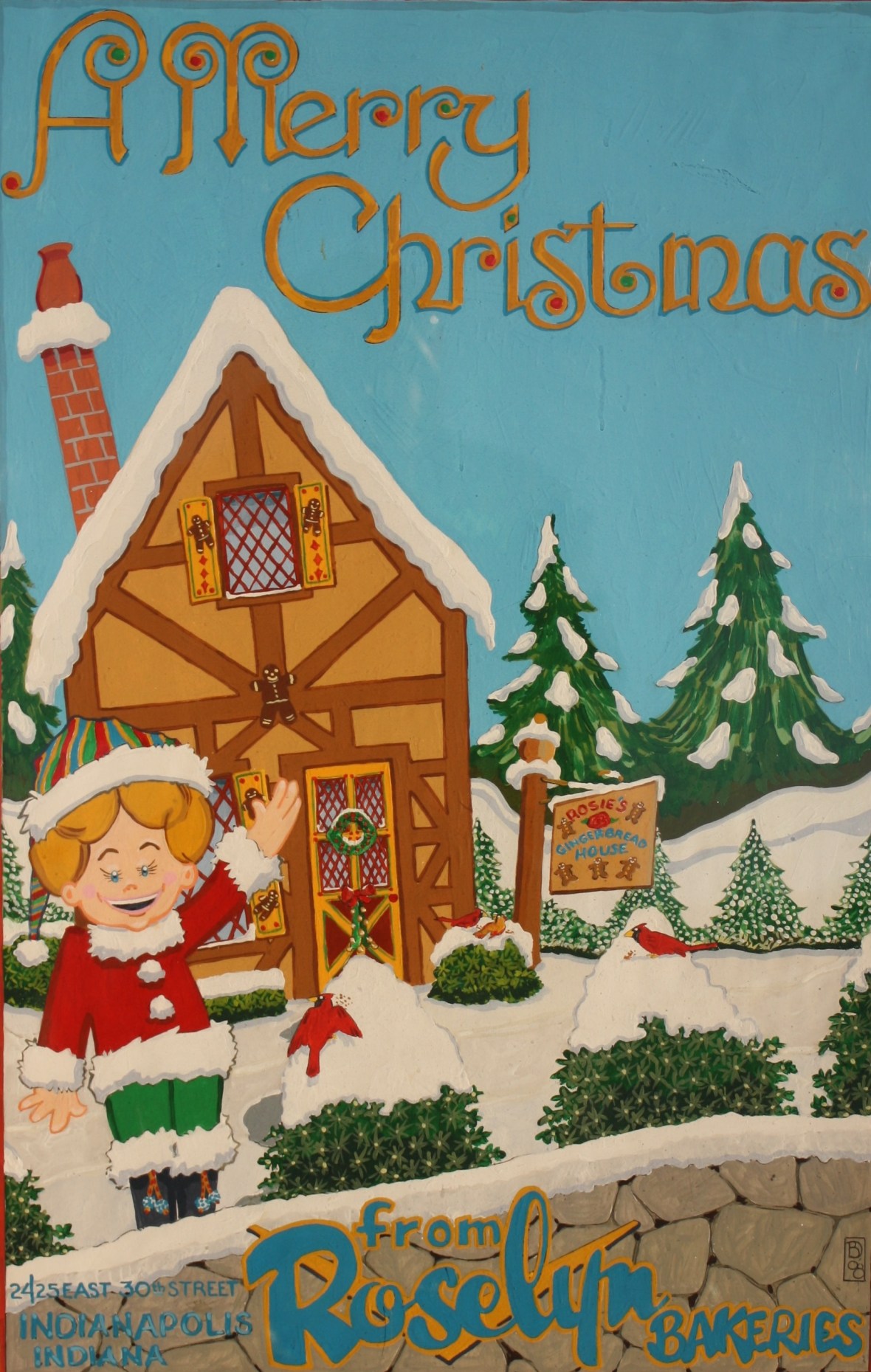
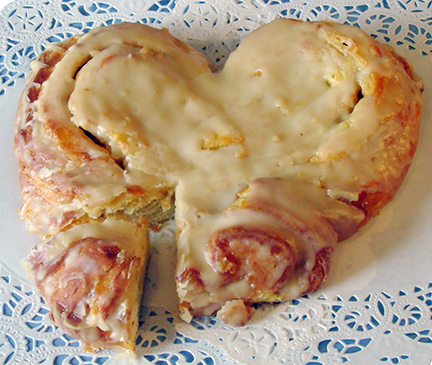
For a quarter century beginning in 1974, every year on the night after Thanksgiving Indianapolis based Roselyn Bakeries set up a special “Christmas Hut” to celebrate the lighting of the “World’s Largest Christmas Tree” on Monument Circle. The best part? Many lucky visitors received free Christmas cookies made from a “secret” Roselyn recipe. Surely those cookies were made by Roselyn’s mascot “Rosie” herself inside that tiny little shed, right? Decorated with Gingerbread man shutters and candy cane pillars, coated in what looked like white icing, the Christmas hut was set up on the West side of the Circle where it remained for 25 years from 1974 to 1999. It was estimated that some 1.2 million Gingerbread man cookies were handed out from within that festive little house over those years. Just like the bakery itself, that little hut was an institution.
Roselyn Bakery was founded in 1943 with its first storefront located at 22nd and Meridian Streets. Within the decade Roselyn bakeries could be found all over the city. You might remember those old city buses with the early Roselyn Bakery cartoon chef logo known as “Mr. Henry.” By the Bicentennial celebration in 1976, there were over 30 Roselyn locations all over central Indiana. When they closed up shop in 1999, Roselyn had some 40 locations offering over 700 different items. I’m still amazed by the memory of those Grandmotherly looking counter ladies wrapping up those cookie and cake boxes with that menacing looking string-tie machine that made that frightening bullwhip sound: “Whoosh-snap!” For me, Roselyn will always be identified for buttermilk jumbles, toffee cookies, alligator & sweetheart coffee cakes, yeast donuts and the darling little girl cartoon mascot known as “Rosie”. A blonde haired, blue eyed perpetually smiling little naive whose popularity forced the Roselyn Christmas Hut to undergo a name change to “Rosie’s Gingerbread House.” If memory serves, for a time there was even a living, breathing life-sized “Rosie” mascot dressed in a horribly oversized paper mache’ head and wearing a red velvet dress. Every so often, she would wobble awkwardly out of the Gingerbread hut to personally pass out cookies to the eager, but slightly befuddled, kiddies on the Circle. As I recall, she didn’t speak, but to a 12-year-old cartoon addicted boy like me, her skirt was short and her cookies were hot.
Today, nearly two decades after that Roselyn Christmas house disappeared, the lighting of the Circle is called the “Festival of Lights” attended by a crowd of over a 100,000 people with another 50,000 viewers watching the event live on TV from home. In 2011, Travelocity called the Circle of Lights one of the top five “must-see Christmas trees” in the country. To quote the old Virginia Slims cigarettes slogan from Rosie’s days, “You’ve come a long way baby.”
The “Christmas in the round” idea was born in 1945 at the close of World War II and intended as a celebration of peace at a monument built to honor fallen soldiers. Renowned Indianapolis architect Edward D. Pierre (IPS schools # 7 & 78, Indiana State Library and Historic Bureau) first suggested decorating and lighting the Monument as a glowing symbol of peace. Until 1961, decor was confined to the lower parts of the Monument. The next year, the “World’s Largest Christmas Tree” was born. That simple program with a few speakers in 1962 has evolved into an intricate hour-long television show today. As for Roselyn, the cakes, donuts and cookies can be found in several of the grocery store chains around town. But its not quite the same. The bakery chain’s only remaining evidence on our streets are the many Roselyn Bakery “Frankensigns” that dot the city in front of those familiar low rise buildings that once sold Rosie’s sugar-coated sweets. Eight mayors and ten governors have served our city and state over the past 50 years. I can’t say that I miss any of them, but I do miss those Gingerbread cookies. If you do too, you can make them yourself. Here’s the recipe for Roselyn Bakeries famous Gingerbread Men cookies: 1 1/4 teaspoon allspice, 2 3/4 teaspoons baking soda, 5 teaspoons ground cinnamon, 1 teaspoon ground cloves, 1 teaspoon ground ginger, 2 1/2 teaspoons salt, 3/4 cup Crisco shortening, 3/4 cup granulated sugar, 6 tablespoons whole eggs, 1 1/4 cup extra fine coconut (Make sure that the coconut you use is very fine, almost like coarse sugar-you may have to grind store bought coconut flake down), 1 1/4 cup honey, 5 cups all-purpose flour. Preheat oven to 360 degrees F. Combine allspice, baking soda, cinnamon, cloves, ginger, salt, shortening, and sugar into a large mixing bowl. Cream together. Scrape down bowl. Add beaten eggs and mix thoroughly. Scrape down bowl. Add coconut and honey and mix well. Scrape down bowl. Add flour and mix well. On a lightly floured surface, with a floured rolling pin, roll dough 1/8 inch thick. With a 5 inch long cutter, cut out men. Re-roll trimmings and cut more cookies. With spatula, place 1/2 inch apart on cookie sheets. Bake at 360 degrees for 8 minutes or until browned, then, with spatula, remove cookies to racks to cool. Decorate as desired. Makes 3 dozen cookies. Now if I could only locate a slightly used Christmas shack.
Original publish date: December 7, 2013~~Republished September 27, 2018
Quick name the Northern-most battle fought on Union soil during the American Civil War? Gettysburg? Nope, but here’s a hint…it was fought in Indiana. Corydon? Nope. Indianapolis…the Battle of Pogue’s Run. Okay, okay, so no shots were fired, but it’s still a great story from the archives of Civil War Indiana. And during this, the 150th anniversary of the Civil War, what better time than the present to revisit Indianapolis past?
It’s May 20, 1863 and there’s a battle raging at the Indiana statehouse. Rumors were spreading that Copperheads within the Indiana Democratic party were determined to take over State Government and turn it over to the Rebels. Named for the poisonous snake indigenous to Southern Indiana which gives no warning before it strikes, Copperheads were Hoosiers who opposed the American Civil War. Considered traitors by others in the North, they favored immediate peace with the Confederacy.
These “Peace Democrats” accepted the label and often identified themselves by the use of stickpins featuring the likeness of Lady Liberty, which they cut from copper pennies and proudly wore on their lapels. Copperheads damaged the Union war effort by fighting the draft, encouraging desertion, and forming conspiracies in effort to incite unrest far behind the front lines.
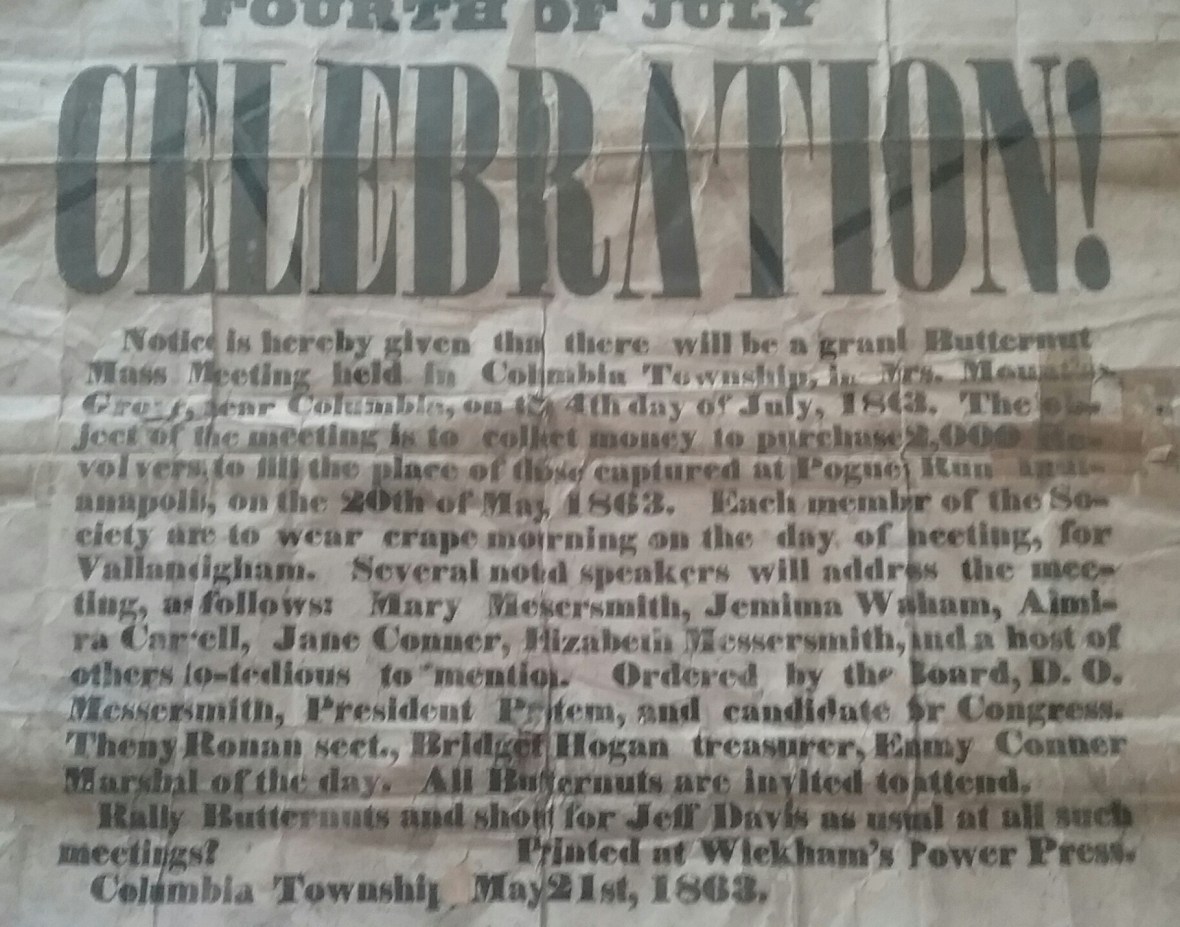
Poster on display at Historic Connersville museum.
The “Battle of Pogue’s Run” began when a rumor circulated that that many of the delegates to the Democrat state convention were carrying concealed firearms, hell bent on insurrection. Union soldiers entered the delegates hall and found personal weapons on many of the delegates. Afterwards, Union soldiers stopped departing trains carrying delegates and began another search of the delegates. Many of the delegates fled the train and began to throw their weapons into the creek that ran diagonally southwest through the city known by locals as Pogue’s Run. Some blamed the Republicans, some the Democrats, while others pointed the finger at powerful Governor Oliver P. Morton but it might be easier to place the blame on the fear and paranoia that permeated the Civil War itself.
Oliver P. Morton, Governor of Indiana for the duration of the Civil War, strongly supported President Abraham Lincoln and the Union. Perhaps more than any other northern Governor. Under his leadership, Indiana raised more men and money for the war effort than any other northern state. Whether you loved him or hated him, there was no doubt about it, Oliver P. Morton was large and in charge.
Within days of his inauguration as governor, Morton saw the war clouds on the horizon and began to prepare the state for the inevitable. He appointed men to important positions who he knew would never compromise with the southern states. Time and time again, he chose Republicans loyal to him over others connected to politicians like Congressmen George W. Julian or Schuyler Colfax, his chief rivals in the Republican Party. When the legislature resisted his call for the creation of a State armory, he collected private funds and built one himself. Morton’s new state arsenal employed seven hundred men to produce ammunition and weapons without legislative permission in preparation for the war he was sure was coming. When the South Carolinians’ fired on Ft. Sumter on April 12, 1861, he telegraphed President Abraham Lincoln within hours to announce that he already had 10,000 soldiers under arms ready to suppress the rebellion.
Lincoln and Morton maintained a close alliance during the war, although Lincoln was wary at times of Morton’s ruthlessness. Lincoln once said of Morton that he was “at times the shrewdest person I know.” Governor Morton wrote to Lincoln claiming that “no other free state is so populated with southerners”, and that these “Copperheads” kept Morton from being as forceful against secession as he wanted to be. Through sheer determination and projected self confidence, Morton kept the state united early on in the war. That is until Lincoln began to raise the emancipation question in 1862.
The cracks in Morton’s armor began to show in the mid-term elections of 1862. The Republican party suffered a major defeat at the polls and the Democratic Legislature, which had been strongly Pro-Morton during the Governor’s first 2 years in office, now turned against him. The Democrats, under future Vice-President Thomas A. Hendricks, declared that while they were strongly pro-union and supported the war effort, they opposed the abolition of slavery. In protest, and possibly out of arrogance, Morton never called the 1862 State Legislature into session. Morton believed that should he call the session, radical elements in the opposition party might undermine the Hoosier state’s devotion to the war effort, instigate riots, harbor southern spies and possibly vote to secede from the Union. The Governor issued secret instructions to GOP legislators asking them to stay away from the Statehouse, thereby thwarting efforts to attain a voting quorum. With Morton’s aid, the Republicans fled to Madison where they could cross easily into Kentucky should the Democrats attempt to forcibly return them to the capitol. Because of this, the government was at a virtual stand still. No budget, no taxes, no revenue. The state quickly ran out of money and teetered dangerously on the edge of bankruptcy. Exceeding his Constitutional powers, Morton solicited millions of dollars in personal loans to keep the Government going.
Although patently Unconstitutional, Morton’s plan worked and the Hoosier contribution to the war effort rolled on without the help of the State Legislature. The atmosphere created by Morton’s actions only worsened tensions between the two parties and guaranteed a confrontation, which was probably already inevitable. Now Democrats saw Morton as the embodiment of the National Republican agenda, with its expansion and corruption of power. They saw him as Lincoln’s henchman in Indiana as well as a tyrant in his own right.
The rage among the Democrats was bubbling to the top. They launched vicious attacks in the press against Morton, who responded by accusing them of treason. Morton again pushed the limits of his wartime authorities by using an intelligence network to deal with rebel sympathizers, the Knights of the Golden Circle, Democrats, and anyone who opposed the Union war effort, or him. While this helped to keep the state more secure, his secret police force also carried out arbitrary arrests, suppressed freedom of speech and freedom of association (particularly in the press), and generally maintained a repressive control of the southern-sympathetic minority. It was easy to see that a battle was brewing in the Circle City.
The Battle of Pogue’s Run commenced when Morton had soldiers disrupt the Democratic state convention based solely on conjecture. Many leaders of the Democratic Party were arrested, detained, or threatened and charged with the possession of firearms. Which is ironic considering Morton had been making his own guns and ammunition statutorily illegally for years and while nearly every citizen in Indianapolis, at that time considered the far western frontier, was armed to the teeth.
Governor Morton developed an incendiary plan to place Union troops inside the convention hall specifically to intimidate the delegates to the convention. About four o’clock in the afternoon, while Thomas A. Hendricks was speaking to an estimated 10,000 delegates from the rostrum, a group of a dozen-or-so soldiers entered the hall with bayonets fixed and rifles cocked. The menacing looking soldiers entered the crowd and advanced slowly toward the stand, causing a great uproar. The delegates and attendees scattered in every direction. A high fence on the east side of the state-house square was pushed down by the panicked crowd. To make matters worse, a squad of cavalry galloped back-and-forth along Tennessee street.
General John Coburn.
The soldiers moving towards the stand were ordered to halt by Colonel John Coburn, who had been guarding the quartermaster’s stores north of the State-house but who had rushed over after hearing the disturbance. He asked what they were doing. They replied they were “going for Tom Hendricks,” that he had said too much, and they intended to kill him. Coburn reasoned with the agitated soldiers and they halted. Meantime, there was much confusion on the stand. Perhaps needles to say, Hendricks closed his remarks prematurely by quickly suggesting that the resolutions be read and the meeting adjourned. The record reflects that there was no second to his motion.
When calmer heads prevailed, it was found that the resolutions declared that the Federal government had two wars upon its hands; one against the rebels and one against the constitution. The quorum breaking Republicans in the late legislature were denounced in the strongest terms and it was further declared that the Governor could not “clear himself from complicity, except by taking steps to prevent repudiation.” In reaction to the Governor’s crack-down on dissent, the Indiana Democratic Party called Morton a “Dictator” and an “Underhanded Mobster” while Republicans countered that the Democrats were using “treasonable and obstructionist tactics in the conduct of the war”.
Although now calmer, the soldiers remained agitated. Occasionally, if they heard any of the remaining Democrats speak against the war, the Republican Party, the President or Governor Morton, that individual would be grabbed roughly underneath the armpits and marched out to the street followed by a great rabble. The intent was not to harm the poor fellow but to frighten him. Eventually the scared temporary detainee either slipped away or was told that he would be released if he promised to behave himself. A number of men were taken to the police court and charged with carrying concealed weapons, and about forty pistols were taken from those arrested. Later that night as the convention concluded, many of the Democratic delegates took trains departing from Indianapolis. As the trains slowly departed from the city a great number of shots were fired from within the cars traveling on the Lafayette and Terre Haute railroads.
The delegates felt the rough treatment they deserved from the Governor’s armed thugs was undeserved and their anger manifested by an intention to create an armed disturbance. Perhaps justified in their feelings, it was not the wisest thing for them to do, and the re-agitated soldiers quickly determined to teach the remaining “Copperheads” a lesson. As the Indiana Central Railroad train left Union station a cannon from Morton’s nearby armory was commandeered and placed on the tracks in front of it. The train stopped. A small body of soldiers and policemen boarded the train and demanded the surrender of all firearms by the passengers. The delegation collected nearly two hundred weapons. The train bound for Cincinnati was also stopped and many revolvers were taken from the passengers.
Some of the enraged delegates refused to hand over their personal firearms and chose instead to throw them out the open windows into Pogue’s Run, a shallow waterway parallel to the track. Some delegates gave their pistols to women on the train, in the belief that they would not be searched. They were mistaken and in one instance, seven firearms were found hidden upon a single woman. A two foot long Bowie knife was discovered hidden in the smoldering ashes of a stove in one of the cars. In all, about five hundred loaded revolvers were taken from passengers, not all of whom were delegates to the convention, or even Democrats! Accounts of just how many weapons were thrown into Pogue’s Run ranged from 500 to 2,000. The Indianapolis Sentinel described it as: “It is with feelings of sorrow, humiliation and degradation that we witnessed the scenes of yesterday. . . . Indiana is as completely under military rule as France, Austria or Russia”. But to those who supported Morton’s action, it seemed to them that would-be insurrectionists would be too cowardly to actually rebel. The term “Battle of Pogue’s Run” was given to the event by the Republican Party derisively, who praised the soldiers involved as “halt(ing) a meeting of traitors to the Union cause”. The Democrats, on the other hand, called the event “still more assaults upon constitutional rights” by those supporting Abraham Lincoln and Governor Morton.
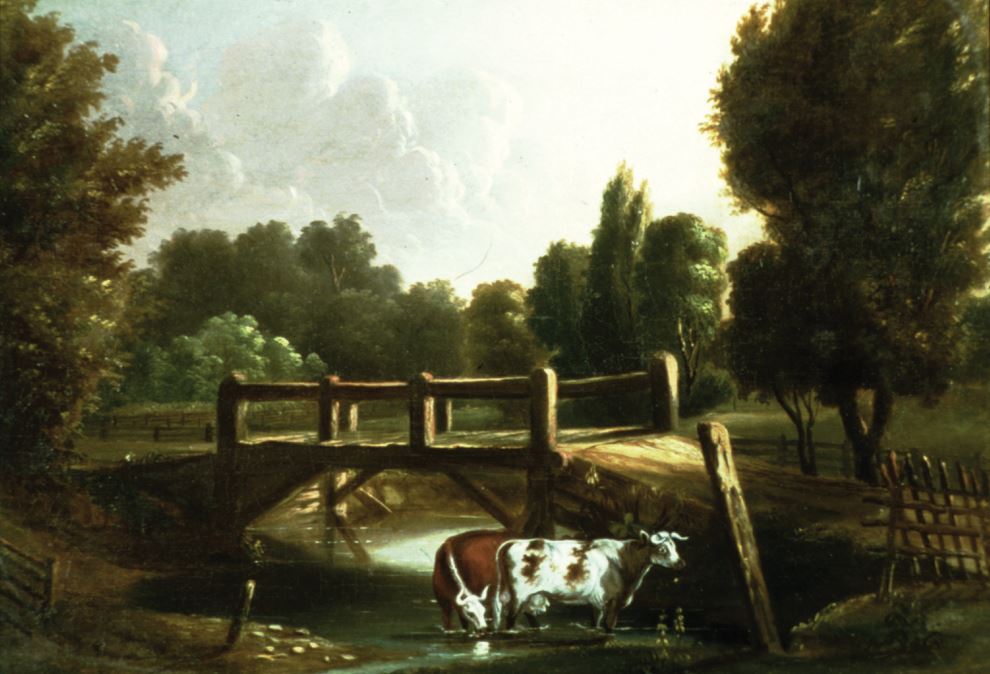
The Run flooded in 1882, killing at least ten people and exposing the skeletal remains of many of the weapons pitched into the water that May evening two decades before. The flood destroyed a covered bridge that once crossed Pogue’s Run near the spot where the battle took place. More than three decades after that devastating flood, in 1914, Pogue’s Run was rerouted into the storm sewers of downtown Indianapolis in order to allow for a perfect grid pattern for Indianapolis’ roads. The stream goes underground at New York Street, east of I-70, and eventually spills into the White River near Kentucky Avenue. Indy Parks established a Pogue’s Run Trail alongside the creek bed on the section northeast of downtown.
1871 Pogue’s Run painting by Jacob Cox.
Today, wildlife can be found on the path including ducks, geese, red-winged Blackbirds, and the occasional blue heron. A plan called “Charting Pogue’s Run” intends to mark where the creek once ran in downtown Indianapolis. The plan calls for a blue line, made of thirty permanent steel medallions and a semi-permanent blue thermoplastic line, to “meander” across roads and parking lots following the route of the historic waterway. That proposed blue line promises to show how Pogue’s Run now lies under Lucas Oil Stadium and Banker’s Life fieldhouse. I expect that at least one of those markers will be dedicated to the rich history of Pogue’s Run and the Civil War battle that bears it’s name.
Relatively speaking, Paul Ruster Memorial Park is one of the newest additions to the Indianapolis Parks system. The park’s trail consists of a 1.2 mile moderately trafficked loop trail that features a river and is rated as moderate. The park is tucked away off of busy Washington Street and the trail is like stepping into a hidden forest. The trail features some steep inclines with several elevation changes and can be very tight in certain areas. It is more of a recreational facility than a park in the traditional sense of the word. Located near the bustling Washington Square Mall shopping complex, the 102-Acre park features a small fishing pond and playground.The Ruster park is bordered by walking trails, defined by Buck Creek that borders the area, that each offer eastsiders a rural setting for jogging, hiking and dog walking. During summer, locals take advantage of the park’s picnic facilities and shelter house. In 2007, the park added two fenced in “Bark Parks” (the third such facility in Indianapolis). During the winter, the park’s many hills are filled with sledders, skaters and tubers. Ask any of these visitors about the park’s namesake and you’re likely to catch them at a loss. What’s more, most visitors are unaware that Paul Ruster Park is haunted by a centuries-old ghost. The park, acquired by the Indy Parks system in 1970, is named after a 1964 Warren Central high school graduate, Paul M. Ruster. Paul, the oldest of three sons of Marvin and Marie Ruster, died December 10, 1978 of Hodgkin’s disease. Paul’s brother Bruce was a former Warren Central baseball star and much beloved Phys-Ed teacher at Warren Central for many years. Paul was born on the eastside, attending Eastridge elementary and Woodview Junior High. He graduated from Ball State University and returned to Indy’s eastside to teach Phys-Ed at Lowell in 1969.
During his ten years at Lowell, Mr. Ruster became admired, respected and loved by the people he worked with each day. People remember him for his winning smile and infectious laugh. He always seemed to be giving his time, talents, and energies to and for his pupils. He believed in kids, encouraged them, and was not disappointed in return. While at Lowell, he completed a master’s degree at Butler University. In addition to teaching and studying, he coached girls’ softball at Lowell little league. He later coached girls’ teams affiliated with the Amateur Softball Association.
His teams worked hard for recognition and were able to travel to several neighboring states to compete in various tournaments and playoff games. Paul was able to find time to start a “Dad’s Night” at school for the fathers who had a desire to take part. Mr. Ruster also found time to participate in several basketball leagues in the city. The Lowell PTA and the community honored Mr. Ruster by establishing a scholarship in his name and by starting a petition to have the city park at 11300 East Prospect Street in his honor. The approval for the park to be named after Paul Ruster came through on June 28, 1979. Although the park may have been new to the Indy Parks system, the haunted reputation was well established. Some of the first to report the strange happenings going on within the park were people who were themselves looked upon as strange by casual observers. These were the weekend warrior gatherings of young people dressed as medieval knights wearing full combat regalia while sword fighting and jousting around the green spaces of Ruster Park. These were the early days of the “Dungeons and Dragons” phenomenon in the 1980s involving fantasy role playing groups that met on a regular basis in the park. These groups began to report strange sights and sounds coming from the periphery of the park’s boundaries that would often stop participants in their tracks. Sometimes, these spooky sounds would drive the groups from the park in fear. Soon, the ghostly rumors made the rounds among Indianapolis paranormal groups that Paul Ruster Park was a hot spot for paranormal activity and an allegedly haunted area. Paranormal investigators declared that these unexplained occurrences were emanating from a nearby abandoned family cemetery a mere stone’s throw from the new park.
Prospect Road elevated entrance to cemetery
Kitley-King cemetery, located at 11000 East Prospect Road just east of German Church Road, is in an area of woods located on the southeastern edge of the soccer field complex located within Paul Ruster Park. Although located on busy Prospect road, the cemetery, located on the site of the old Kitley family farm, is over a century old and only visible when standing directly atop it. Resting across from the point where East Prospect Road is intersected by Touchstone Drive, a set of six broken and weathered steps ascending from the curb is the only clue to the graveyard’s existence. The steps lead up from the road into a stone walled square plot of ground within which rest a smattering of gravestones in varied states of disrepair nestled into what looks like the foundation of a long forgotten house.
Sadly, only two monuments remain intact. They are the John W. King (1806-1893) and Francis Kitley markers. The cemetery is not well maintained and the two remaining stones are severely cracked. The grass around the area is usually overgrown and uncut.
An 1889 Sanborn map of the area shows the presence of two farms at the intersection of German Church and Prospect Roads. The properties were registered to J. and J.N. Kitley and to Francis Kitley. Across the street on this 1889 map is a farm once owned by Andrew King. Francis’ home once rested on what today is the soccer field. Since the Kitleys and Kings were farmers, it was natural to bury their loved ones in the land beside the farms.
County records show that John Kitley recorded an eighty acre farm on this spot on December 16, 1825. Kitley was born in Hamilton County, Ohio on April 15, 1793 and died sometime around February 25, 1865 (based on his will’s probate date). His stone was once within the cemetery but is missing today, as is that of his wife, Anna Fox Kitley. However the couple’s mortal remains undoubtedly rest beneath the soil to this very day. John and Anna were organizers of the Cumberland Baptist Church on the National Road, or present day Washington Street, located a short distance to the north. The Scotch-Irish Kitleys, who were Methodists, intermarried with the neighboring King family, who were members of St. Johns Evangelical Church on German Church Road.
According to county records, also buried in the Kitley-King cemetery plot are John & Anna’s son, Francis Kitley (December 25, 1823-October 16, 1886) and Mary Jane Smithers Kitley, who is listed on the back of Francis’ stone with the dates: Feb. 6, 1841-Aug. 25, 1932. Other “lost” graves may include siblings Sarah King, Elizabeth King, Lillian Hart, Walter S Kitley, John Kitley, Hester Wiese and James Nelson. Still others may include James’ widow, Rose, and their children Floyd and Frank along with their wives, Alma and Anna, respectively. As with many Indiana pioneer cemeteries, records are sketchy and incomplete with graves remaining unmarked and unrecorded. Legend claims that many years ago a 12-year-old boy living on the farm was killed while walking along the nearby train tracks. No-one knows if he was struck by a train or whether some other harm befell him. Reportedly, he is now buried in an unmarked grave within the foundation of his old house. Witnesses claim that if you walk the long path leading from the soccer fields through the woods to his grave near Prospect you can hear the boy playing his harmonica. Still other witnesses have reported seeing the ghostly image of a young boy walking down the road and again, he is seen playing a harmonica.
The railroad tracks are long gone, but the wandering spirit of the musical boy remains. His spirit has been witnessed near the large fishing pond located just west of Muessing Road within the heavily wooded area of the park. Fishermen have often reported the plaintive sounds of a ghostly harmonica heard moving through the woods and around the perimeter of the old fishing hole, as if circling them. It is believed that this lonely wanderer is John Kitley, young namesake son of the farm’s owner, who died on April 12, 1864.
What is known is that Paul Ruster State Park, built for the enjoyment of the children of Indianapolis’ east side and named to honor a devoted kid-loving eastsider, is visited by hundreds of joyful children who run and play in its green spaces all year round. Most likely these visitors frolic and play unaware that a sad and lonely Civil War era lad may be watching from afar wishing he could join them, or perhaps just play them a tune.
Bill “Bojangles” Robinson was the most famous of all African American tap dancers of the twentieth century. No wait, he was, race notwithstanding, the most famous tap-dancer of all time. Robinson used his popularity to challenge and overcome numerous racial barriers, becoming one of the first minstrel and vaudeville performers to appear without the use of blackface makeup (Yes, African American performers were required to perform in Blackface up until World War I). One of the earliest African American performers to go solo.The first African American to appear in a Hollywood film in an interracial dance team (with Temple in The Little Colonel) and the first African American to headline a mixed-race Broadway production.
Offstage Robinson was the first Hollywood Civil Rights activist by using his fame to persuade the Dallas police department to hire its first African American policemen. He staged the first integrated public event in Miami, a fundraiser which, with the permission of the mayor, was attended by both black and white city residents. He also used his star power to lobby President Franklin D. Roosevelt for more equitable treatment of African American soldiers during World War II. Orphaned at a young age and raised by a grandmother who was a former slave, Bill Robinson was born to make a difference. In the early 1920s, Robinson took his career on the road as a solo vaudeville act, touring throughout the country. He frequently visited Indianapolis, where he performed multiple shows per night, often on two different stages, at the B.F.Keith theatre. Robinson worked 51 weeks per year, taking a week off every season for the World Series. Bojangles was an avid baseball fan and co-founder of the New York Black Yankees of the old Negro National League in 1936.
Toward the end of the vaudeville era, Robinson joined other black performers on Broadway in “Blackbirds of 1928”, an all- black revue for white audiences. After 1930, black revues waned in popularity, but Robinson remained popular with white audiences for more than a decade starring in fourteen motion pictures produced by such companies as RKO, 20th Century Fox, and Paramount Pictures. Most of them had musical settings, in which he played old-fashioned roles in nostalgic romances. Robinson appeared opposite Will Rogers in In Old Kentucky (1935), the last movie Rogers made prior to his death in an airplane crash. Robinson and Rogers were good friends, and after Rogers’ death, Robinson refused to fly, instead travelling by train to Hollywood for his film work.
He was cast as a specialty performer in a standalone scene. This practice, customary at the time, permitted Southern theaters to remove scenes containing black performers from their showings of the film. Times being what they were, his most frequent role was that of an antebellum butler or servant opposite reigning #1 box office moppet Shirley Temple in films: The Little Colonel (1935), The Littlest Rebel (1935), Just Around the Corner (1938) and Rebecca of Sunnybrook Farm (1938). In addition, he assisted in the choreography on one of her other films, Dimples (1936). Robinson and Temple became the first interracial dance partners in Hollywood history and lifelong friends. The dance scenes, controversial for their time, were cut out in the south along with all other scenes showing Temple and Robinson making physical contact. By 1937 Robinson was earning $6,600 a week for his films, a strikingly high sum for a black entertainer in Hollywood at the time. At the 1939 New York World’s Fair, he returned to the stage in “The Hot Mikado”, a jazz version of the Gilbert and Sullivan operetta which quickly became one of the greatest hits of the fair. Consequently, August 25, 1939 was named ‘’Bill Robinson Day’’ at the World’s Fair. By the 1940s, although he continued to perform, Robinson was past his prime and showing symptoms of heart disease. Robinson’s final film appearance is considered by critics as his best when he starred in the 1943 Fox musical Stormy Weather alongside Lena Horne.
From 1936 until his death in 1949, Robinson made numerous radio and occasional television appearances. It was during these appearances that Robinson introduced and popularized a word of his own invention, copacetic, meaning tip-top, which he had used for years in his vaudeville shows. It was added to Webster’s Dictionary dictionary in 1934. During the 1930-40s, Robinson was appointed as the honorary Mayor of Harlem, a lifetime member of countless policemen’s associations and fraternal orders, and a mascot of the New York Giants major league baseball team.
Onstage, Robinson’s open face, twinkling eyes and infectious smile were irresistible and his tapping was delicate and clear. Robinson had no doubts that he was the best at what he did, a self-confidence that some mistook for arrogance. Bojangles felt that he had more than paid his dues and sometimes brooded that, because he was black, he had to wait until he was in sixties before he could enjoy the fame and fortune given to less talented white dancers. Rivals and wags pointed to Robinson’s lack of education as the reason for his nasty demeanor and pegged Bill as confrontational, quarrelsome, and as a heavy drinker and gambler. But they could not deny that his dancing was extraordinary.
On March 21, 1908, as a result of a dispute with a tailor over a suit, Robinson was arrested in New York City for armed robbery. After being released on bail, Robinson failed to take the charges and impending trial seriously. He paid little attention to mounting a defense. On September 30, Bojangles was shocked when he was convicted and sentenced to 11–15 years hard labor in New York’s Sing Sing prison. Robinson’s influential friends hired a new attorney who produced evidence that Robinson had been falsely accused. Though he was exonerated at his second trial and his accusers indicted for perjury, the trial and time spent in the Tombs (Manhattan’s prison complex) affected Robinson deeply. After he was released, he never again traveled unarmed and made a point of registering his pistol at the local police station of each town where he performed. Robinson’s wife, Fanny, always sent a letter of introduction with complimentary tickets and other gifts to the local police chief’s wife in each town ahead of her husband’s engagements.
Robinson loved to play pool and insisted on silence when he attempted certain shots. At these times when the game was on the line, he would pull out his pistol, lay it on the edge of the pool table and take his shot, as the stunned patrons fell silent. African-American newspapers often derided Robinson as the quintessential Uncle Tom because of his cheerful and shameless subservience to whites on film. But in real life Robinson was the sort of man who, when refused service at all-white restaurants, would lay his gold-plated pearl-handled revolver on the counter and demand to be served.
Despite these adverse incidents that appear to reveal more about the times than the man, in fact, Robinson was a remarkably generous man. His participation in benefits is legendary and it is estimated that he gave away well over one million dollars in loans and charities during his lifetime. Despite his massive workload, he never refused to appear at a benefit for those artists who were less successful or ailing. It has been estimated that in one year he appeared in a staggering 400 benefits. Often on two different stages in the same city on the same night. Despite earning and spending a fortune, his memories of surviving the streets as a child never left him, prompting many acts of generosity.
Bill “Bojangles” Robinson held the world record for running backward. He learned this skill while a young vaudevillian and used the trick to generate publicity in cities where he wasn’t the headliner. He called them “freak sprinting” races and would challenge all comers, including Olympic Champion Jesse Owens. He never lost in his lifetime. Later, the duo became such good friends that Owens made a gift to Robinson of one of his four Olympic gold medals. In 1922, Robinson set the world record for running backward (100 yards in 13.5 seconds). The record stood until 1977, when it was beaten by two-tenths of a second.
After a series of heart attacks, doctors advised him to quit performing in 1948. Robinson maintained that though he had trouble walking, talking, sleeping and breathing, when he danced he felt wonderful. Robinson’s final public appearance was as a surprise guest on Ted Mack’s Original Amateur Hour TV show. He died a few weeks later on November 25, 1949. Despite earning more than $ 3 million during his lifetime, Robinson died penniless at the age of 71 from heart failure at Columbia Presbyterian Center in New York City . His funeral was arranged and paid for by longtime friend and television host Ed Sullivan. Robinson’s casket lay in state in Harlem, where an estimated 32,000 people filed past to pay their last respects. The schools in Harlem were closed for a half-day so that children could attend or listen to the funeral, which was broadcast over the radio. Reverend Adam Clayton Powell, Sr. conducted the service at the Abyssinian Baptist Church, and New York Mayor William O’Dwyer gave the eulogy. Newspapers estimated that one hundred thousand people turned out to witness the passing of his funeral procession. Robinson is buried in the Cemetery of the Evergreens in Brooklyn. In 1989, a joint U.S. Senate/House resolution declared “National Tap Dance Day” to be May 25, the anniversary of Bill Robinson’s birth.
Bill Robinson was successful despite the obstacle of racism. My favorite Robinson story finds Bojangles seated in a restaurant as a rude customer loudly object to his presence. When the manager suggested that it might be better if Robinson left, Bill smiled and asked, “Have you got a ten dollar bill?” As the manager lays his bill on the counter, Robinson removes six $10 bills from his own wallet and adds them to the manager’s banknote. After mixing all of the bills together, Robinson says, “Here, let’s see you pick out the colored one”. The restaurant manager served Robinson without further delay.
So there you have it, a 2-part story of a true American hero. Now you know why I was so happy to find that suitcase of Big Band memorabilia containing items associated with Bill “Bojangles” Robinson. I’ve already told you about most of the contents in that suitcase. But there is one item that shines above all others. Well, to me at least.
It is a page out of an old fashioned scrapbook. On that page is a small photo of Deke Moffitt with his friend Bojangles. Moffitt is holding his son up and the trio are clowning with a toy pop-gun. The typewritten caption under the photo reads: “I think this was the last snap-shot ever taken of Bill Robinson. It was taken on July 13, 1949.” Of course, there is no real way to prove that claim, but it is certainly intriguing. Under the photo, also attached to the page is a small hand drawn self caricature titled “Bill” with an autograph above it reading “Best Wishes Bill Robinson”. The sketch was drawn by Bill “Bojangles” Robinson himself and it speaks to the innocence and purity of the image Mr. Robinson projected on screen all those years ago.
This past fall, I drove to a place called White’s Farm in Brookville,Indiana, not far from Cincinnati. Every Wednesday you’ll find over 100 flea market and antique dealers set-up in the hills and dales of an area once riddled with the remnants of Ancient Native American Indian Burial Mounds. “Brookville” is one of those shows that starts “flashlight early” with most dealers arriving around 3:00 a.m. and packed up and gone by 10:00 a.m. It was one of those “dew you can chew” kind of mornings replete with tiny droplets of water hanging so thick in the air that it seemed like you could catch them on your tongue like snowflakes.
While walking up a hillside my flashlight caught hold of a pile of old paper and photographs and I instinctively froze. After all, I’m a paper and photo guy and damp cool mornings are the bane of my flea market existence. Even from 15 feet away, I recognized a familiar face smiling out from the crowd. It was a hero from my past. It was Bill “Bojangles” Robinson. If you’re old enough to remember Black and White TV, the original Sammy Terry TV show, Timothy Church-mouse or Cowboy Bob and Janie, then you should remember Bill Robinson. If you’re over the age of 40, you can remember a time before cable TV. A time when television stations actually went off the air at night and didn’t come back on until farm shows or cartoons popped up the next morning. Back then, it was a badge of honor to say you made it up to watch the flag wave to the rhythm of the National Anthem.
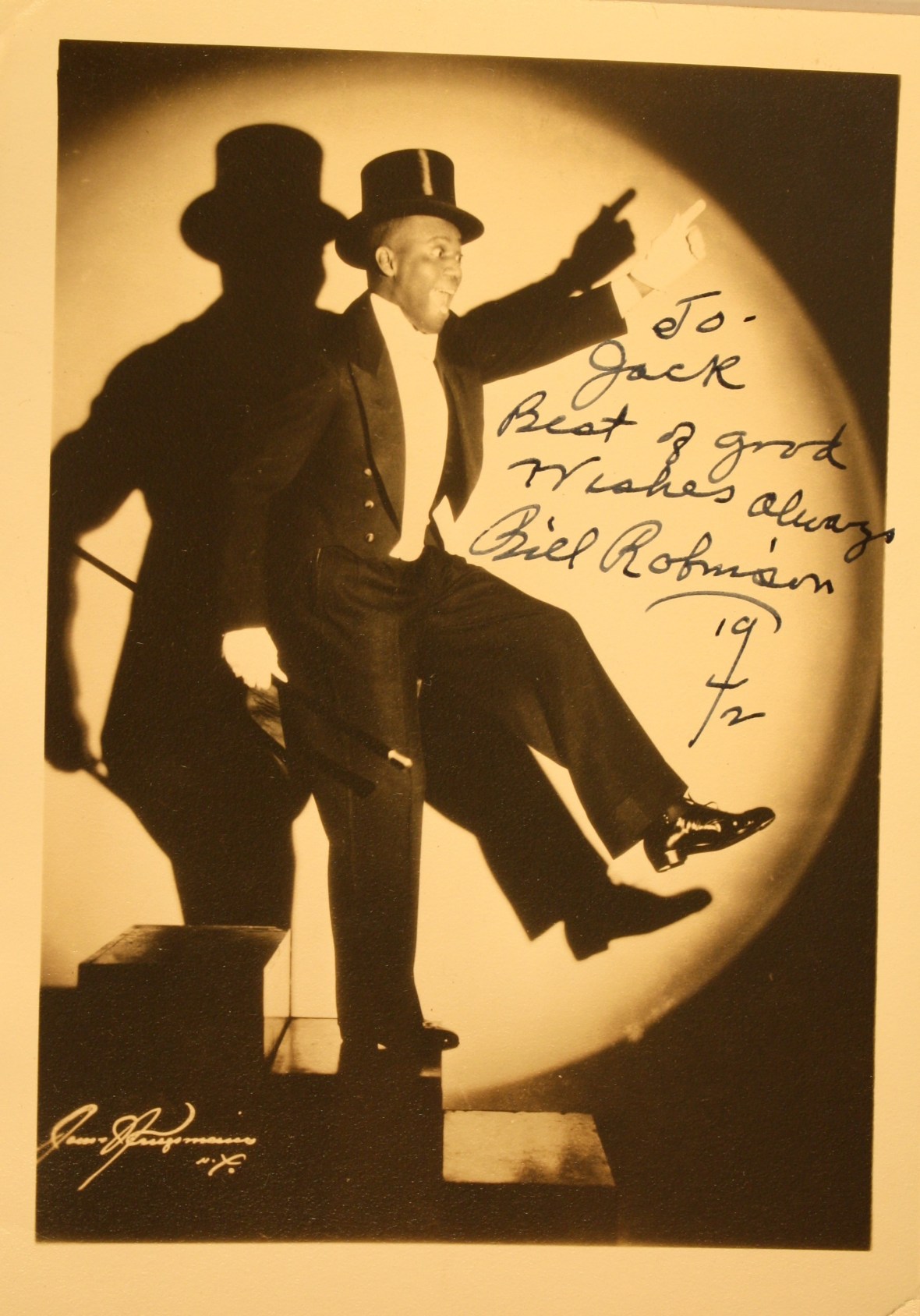
After the weekend cartoon shows were over and before the sports programming began, well, that was the time for America’s sweetheart: Shirley Temple. And right there next to that darling little dancer, matching her step-for-step, was Bill “Bojangles” Robinson. And here, right here in the soggy farm fields of Brookville,Indiana, was a 5×7 World War II Era photo autographed by Bojangles himself! I sheepishly asked the vendor what the story was on the group of photographs and he replied, “Oh those all belonged to a famous Big Band leader from Cincinnati and those are all gangsters from Newport (Kentucky).”
I held up the Robinson photo in particular and the seller stated, “Oh he (the band leader) was great friends with Bill Robinson.” I asked the dealer what he wanted for the photo and he said he was trying to sell the whole collection as one lot. He then added, “I have a whole suitcase of this stuff in my truck.” Oh really? Of course I asked to see the suitcase and sure enough, it was crammed full of wonderful things. I negotiated a price, more than I expected to pay, but less than the value of my childhood memories. In instances like this, you lead with your heart, dig for your wallet and hope your wife will understand. For the sake of full disclosure, I must admit that I once owned a photo signed by Bill Robinson. Bojangles signed it for an Indiana Mayor whose name now escapes me. I sold it to a collector in the late 1980s for $ 100. But I rationalized the sale of the relic because the photo literally looked like it had been dipped in water and $ 100 might as well have been $ 1,000 to me and my young bride. By finding this photo on a dew soaked Southern Indian hillside, I felt the pendulum had swung back my way.
I took the suitcase home and eagerly, but carefully, began to disassemble the contents. As my fellow collectors will attest, it doesn’t get much better than this. Suitcases full of unpicked goodies fill the slumber-time dreams of every collector, regardless of the subject one desires to collect. This suitcase did not disappoint.
Turns out that this grouping represented the personal memorabilia of 1930-40s Era Queen City Big Band Leader, musician and composer “Deke” Moffitt (1906-1976). During his career, Moffitt performed with Red Skelton, Bill (Bojangles) Robinson, Perry Como, Dean Martin and Jerry Lewis, Martha Raye, Betty Grable and the Three Stooges. After his touring career was over, Deke became music director for a Cincinnati theatre and later a high school music teacher.
Big Band Leader Deke Moffitt
Among the collection were contracts, sheet music and records of songs Deke had composed and letters / correspondence from Deke’s years on the road, many from famous musicians. There was even a photo of Deke clowning around outside of what looked like a theatre backstage door with the Three Stooges (Larry, Moe & Shemp). But what caught my interest were the few items from Bill “Bojangles” Robinson. Along with the photo I mentioned previously, there was a handwritten note to Deke and a telegram from Bill. I’ll tell you what else was in there later on in the article.
First, I want to try and explain why Bill “Bojangles” Robinson matters to me and more importantly, why he should matter to you. The predominate reason for my admiration is simple: I can’t dance. For the same reason I guffaw at the Three Stooges, giggle at Groucho Marx and crack up at the Little Rascals, I can’t help but stop and gaze in wonder whenever I see the masters dance. Fred Astaire, Gene Kelly, Gregory Hines, John Travolta: they all stand on the shoulders of Bill Robinson. Except none of the above were burdened with the constraints of Jim Crow America. Friends say there were three certainties about Bill Robinson: he loved to eat vanilla ice cream, gamble with dice or cards, and dancing was his life. At the time of his divorce his wife Fannie accused him of being a danceaholic-a man willing to sacrifice everything to dance. While his personal life was full of contradictions, his peers and historians agree he was one of the greatest American dancers of all time.
Bill “Bojangles” Robinson was born Luther Robinson in Richmond, Virginia, on May 25, 1878. He claimed he did not like the name Luther, so he traded names with his younger brother Bill. Apparently his little brother didn’t like the name either so he changed his name to “Percy” and later became famous on his own as a dancer and musician. Although orphaned and reared by a grandmother who had been a slave, Bill Robinson would become the best known and highest paid African American entertainer in the first half of the twentieth century. Robinson began hoofing in beer gardens at age 6 and quit school the next year to begin work as a professional dancer. His career started in minstrel shows then moved to vaudeville, Broadway, the recording industry, Hollywood movies, radio, and television. He died 65 years ago this week on November 25, 1949.
The name “Bojangles” mirrors it’s enigmatic namesake. Some say the name referred to his happy-go-lucky ebullience while others claim the name refers to Bill’s fiery, argumentative disposition. Today, the word Bojangles refers to to a style of percussive, rhythmic tap-dance originated by African Americans. The word is southern in origin and means “mischief maker.” The nickname was appropriate for Robinson, whose popularity transcended his race, despite a personal life chronicled by newspapers and magazines as a series of misadventures and court appearances.
While Robinson didn’t invent tap dancing, he was the artist chiefly responsible for getting tap dance “up on its toes” by dancing upright and swinging. Before Robinson tap was most often a stoop shouldered, flat-footed shuffle style, sometimes known as “sand dancing'”. Robinson performed on the balls of his feet with a shuffle-tap style that allowed more improvisation. This new style got him noticed and eventually made him a legend. Bojangles’ unique sound came from using wooden taps and his direct claim to fame would be the creation of his famous “stair dance,” which involved tapping up and down a flight of stairs both backwards and forwards. A style he unsuccessfully attempted to patent. Following the demise of vaudeville, Broadway beckoned with “Blackbirds of 1928,” an all-black revue that would prominently feature Bill and other black musical talents. Soon, he was headlining with Cab Calloway at the famous Cotton Club in Harlem. Robinson is also credited with having introduced a new word, copacetic, into popular culture, via his repeated use of it in vaudeville and radio appearances. Robinson was a true pioneer in his field with many “firsts” to his credit.
A popular figure in both the black and white entertainment worlds of his era, he is best remembered today for his dancing with Shirley Temple in a series of films during the 1930s. Although a trailblazer and acknowledged pioneer, Robinson battled inner demons that belied his demeanor as a happy and easygoing character on the big screen. On one hand, he had to deal with discrimination and racial injustice by whites and on the other hand, he was labeled as the quintessential “Uncle Tom” by his own people. Decades of dealing with this untenable double standard turned Bojangles into a split personality capable of unwavering loyalty and kindness to some while turning him into an angry man, frustrated by his second-class treatment in society who was known to flash a gun to others. Measured by today’s standards and celebrity shenanigans, Robinson’s behavior would be considered tame. Next week, I’ll continue the story of this man and tell you what else I found in that suitcase.

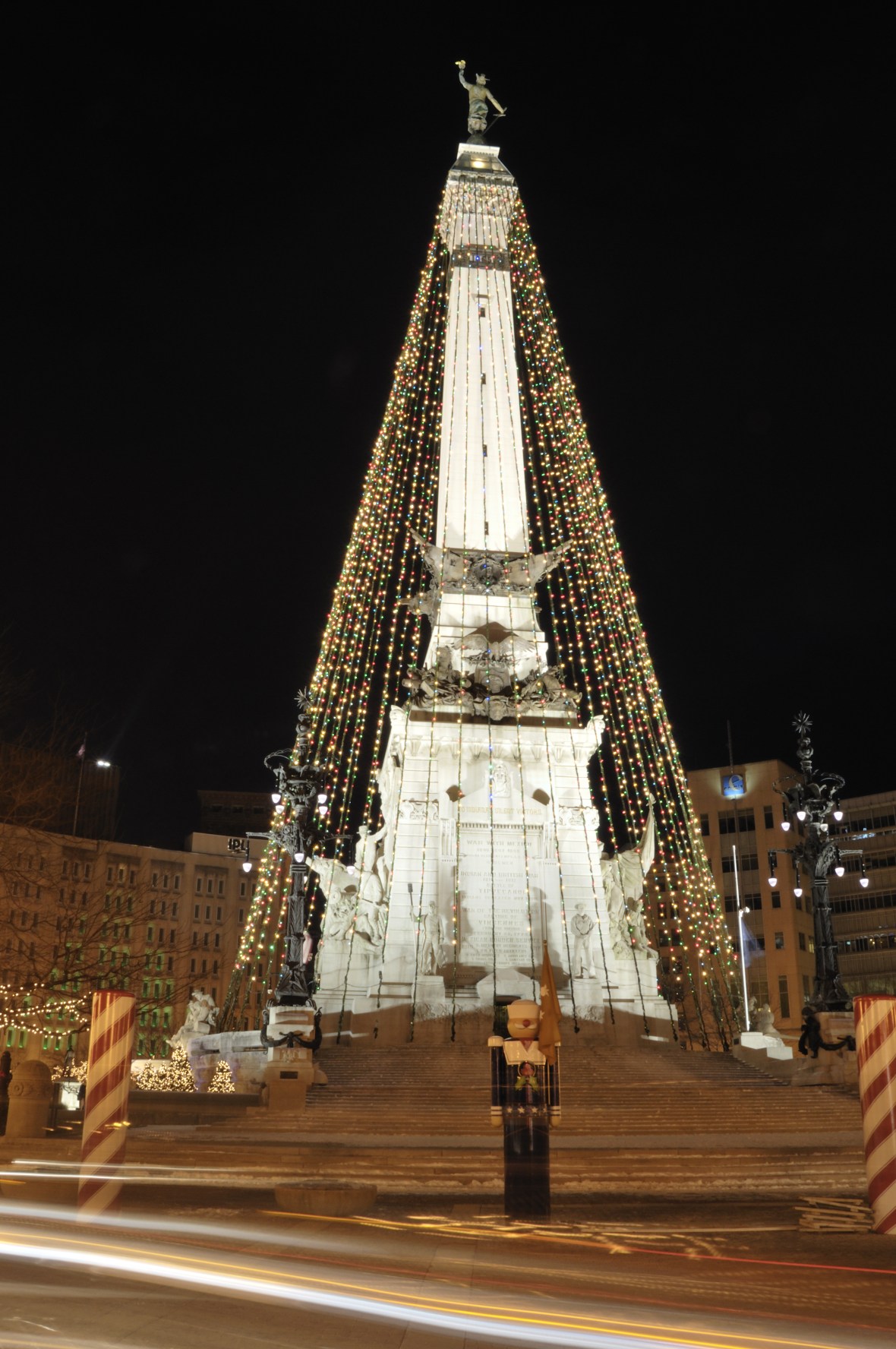 Although I never fail to take my annual trip around Monument Circle at Christmastime to gaze in wonder at the fantastic fir tree fantasy, my personal memories of Christmas on the Circle revolve around a little shack that used to rest at its base facing the Indiana Statehouse. You may think of the L.S. Ayres Cherub, Santa’s mailbox, the 26 larger-than-life toy soldiers and sailors surrounding the Circle, the 26 red & white striped peppermint sticks, the 52 garland strands or the 4,784 colored lights strung from the top of the Monument to its base, but I think of the Roselyn Bakery Christmas Hut.
 Decorated with Gingerbread man shutters and candy cane pillars, coated in what looked like white icing, the Christmas hut was set up on the West side of the Circle where it remained for 25 years from 1974 to 1999. It was estimated that some 1.2 million Gingerbread man cookies were handed out from within that festive little house over those years. Just like the bakery itself, that little hut was an institution.
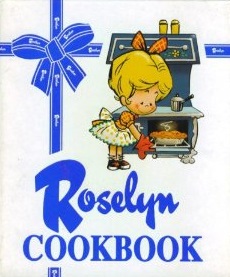 For me, Roselyn will always be identified for buttermilk jumbles, toffee cookies, alligator & sweetheart coffee cakes, yeast donuts and the darling little girl cartoon mascot known as “Rosie”. A blonde haired, blue eyed perpetually smiling little naive whose popularity forced the Roselyn Christmas Hut to undergo a name change to “Rosie’s Gingerbread House.” If memory serves, for a time there was even a living, breathing life-sized “Rosie” mascot dressed in a horribly oversized paper mache’ head and wearing a red velvet dress. Every so often, she would wobble awkwardly out of the Gingerbread hut to personally pass out cookies to the eager, but slightly befuddled, kiddies on the Circle. As I recall, she didn’t speak, but to a 12-year-old cartoon addicted boy like me, her skirt was short and her cookies were hot.
 a long way baby.”
 Eight mayors and ten governors have served our city and state over the past 50 years. I can’t say that I miss any of them, but I do miss those Gingerbread cookies. If you do too, you can make them yourself. Here’s the recipe for Roselyn Bakeries famous Gingerbread Men cookies: 1 1/4 teaspoon allspice, 2 3/4 teaspoons baking soda, 5 teaspoons ground cinnamon, 1 teaspoon ground cloves, 1 teaspoon ground ginger, 2 1/2 teaspoons salt, 3/4 cup Crisco shortening, 3/4 cup granulated sugar, 6 tablespoons whole eggs, 1 1/4 cup extra fine coconut (Make sure that the coconut you use is very fine, almost like coarse sugar-you may have to grind store bought coconut flake down), 1 1/4 cup honey, 5 cups all-purpose flour. Preheat oven to 360 degrees F. Combine allspice, baking soda, cinnamon, cloves, ginger, salt, shortening, and sugar into a large mixing bowl. Cream together. Scrape down bowl. Add beaten eggs and mix thoroughly.
 Scrape down bowl. Add coconut and honey and mix well. Scrape down bowl. Add flour and mix well. On a lightly floured surface, with a floured rolling pin, roll dough 1/8 inch thick. With a 5 inch long cutter, cut out men. Re-roll trimmings and cut more cookies. With spatula, place 1/2 inch apart on cookie sheets. Bake at 360 degrees for 8 minutes or until browned, then, with spatula, remove cookies to racks to cool. Decorate as desired. Makes 3 dozen cookies. Now if I could only locate a slightly used Christmas shack.
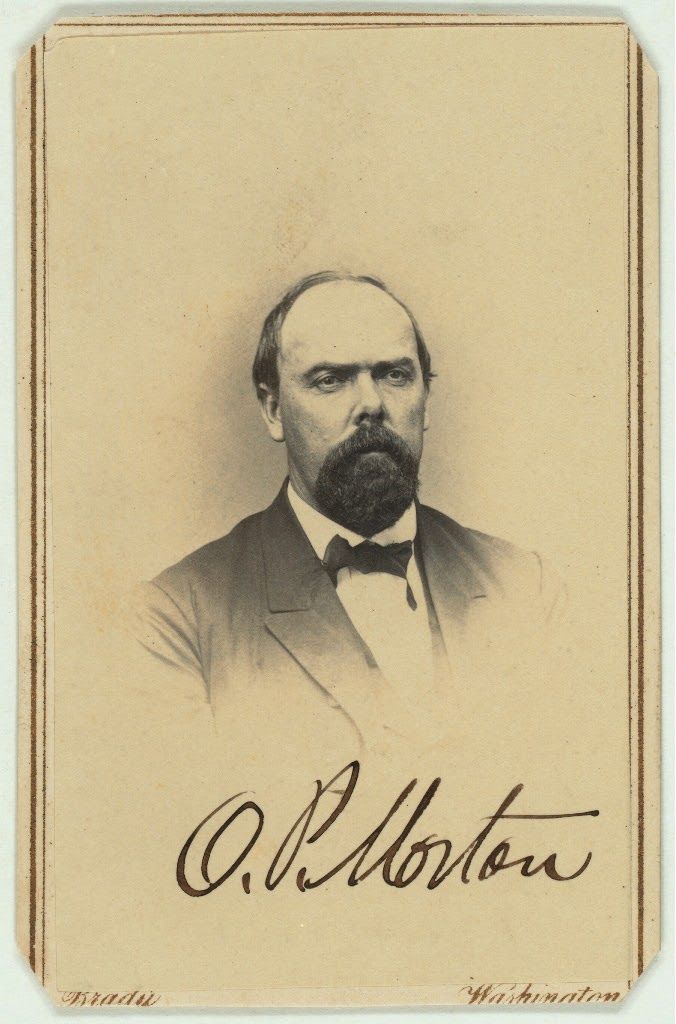 Morton believed that should he call the session, radical elements in the opposition party might undermine the Hoosier state’s devotion to the war effort, instigate riots, harbor southern spies and possibly vote to secede from the Union. The Governor issued secret instructions to GOP legislators asking them to stay away from the Statehouse, thereby thwarting efforts to attain a voting quorum. With Morton’s aid, the Republicans fled to Madison where they could cross easily into Kentucky should the Democrats attempt to forcibly return them to the capitol. Because of this, the government was at a virtual stand still. No budget, no taxes, no revenue. The state quickly ran out of money and teetered dangerously on the edge of bankruptcy. Exceeding his Constitutional powers, Morton solicited millions of dollars in personal loans to keep the Government going.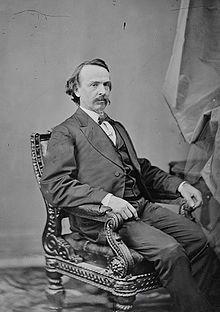
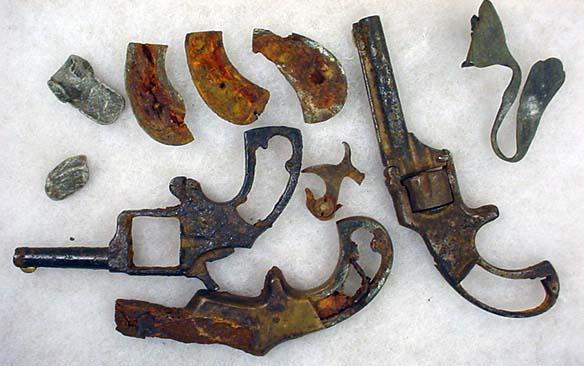
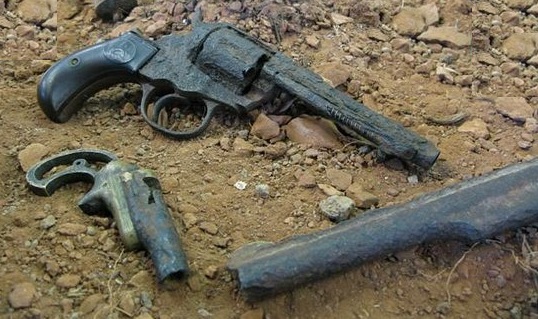 Accounts of just how many weapons were thrown into Pogue’s Run ranged from 500 to 2,000. The Indianapolis Sentinel described it as: “It is with feelings of sorrow, humiliation and degradation that we witnessed the scenes of yesterday. . . . Indiana is as completely under military rule as France, Austria or Russia”. But to those who supported Morton’s action, it seemed to them that would-be insurrectionists would be too cowardly to actually rebel. The term “Battle of Pogue’s Run” was given to the event by the Republican Party derisively, who praised the soldiers involved as “halt(ing) a meeting of traitors to the Union cause”. The Democrats, on the other hand, called the event “still more assaults upon constitutional rights” by those supporting Abraham Lincoln and Governor Morton.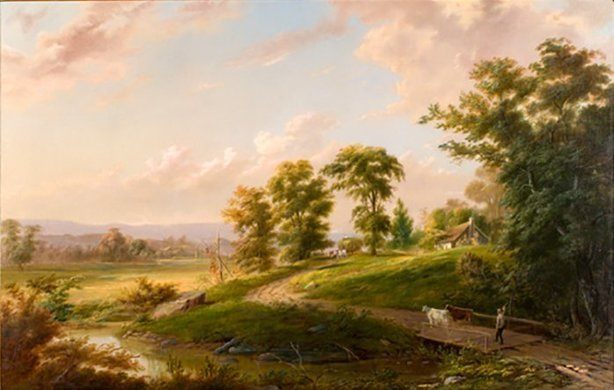

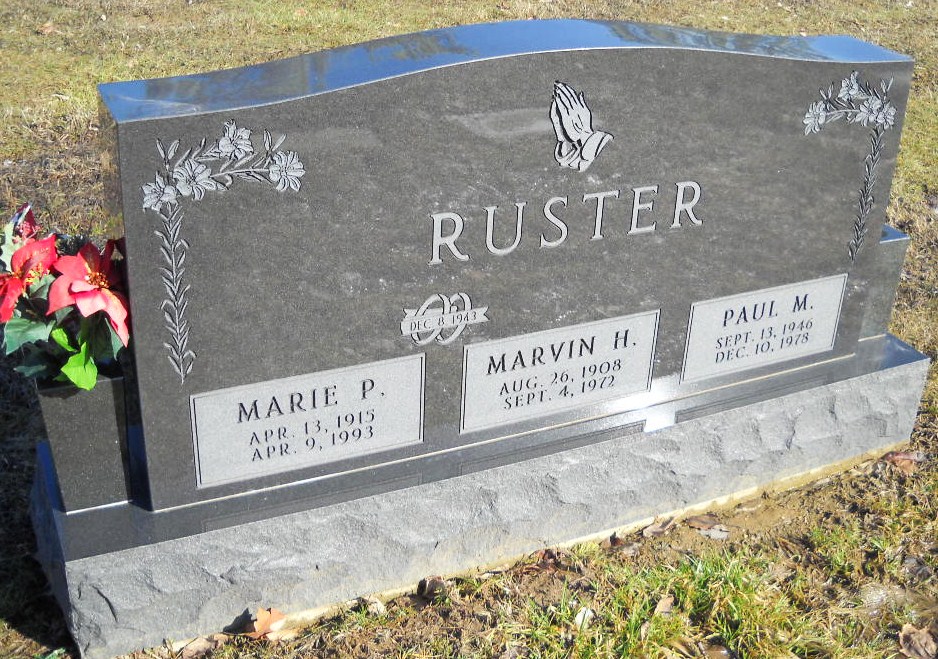 Ask any of these visitors about the park’s namesake and you’re likely to catch them at a loss. What’s more, most visitors are unaware that Paul Ruster Park is haunted by a centuries-old ghost. The park, acquired by the Indy Parks system in 1970, is named after a 1964 Warren Central high school graduate, Paul M. Ruster. Paul, the oldest of three sons of Marvin and Marie Ruster, died December 10, 1978 of Hodgkin’s disease. Paul’s brother Bruce was a former Warren Central baseball star and much beloved Phys-Ed teacher at Warren Central for many years. Paul was born on the eastside, attending Eastridge elementary and Woodview Junior High. He graduated from Ball State University and returned to Indy’s eastside to teach Phys-Ed at Lowell in 1969.
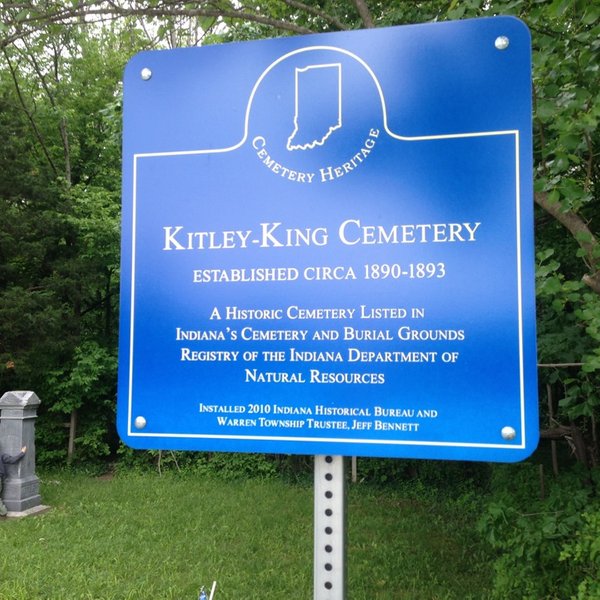 Although the park may have been new to the Indy Parks system, the haunted reputation was well established. Some of the first to report the strange happenings going on within the park were people who were themselves looked upon as strange by casual observers. These were the weekend warrior gatherings of young people dressed as medieval knights wearing full combat regalia while sword fighting and jousting around the green spaces of Ruster Park. These were the early days of the “Dungeons and Dragons” phenomenon in the 1980s involving fantasy role playing groups that met on a regular basis in the park. These groups began to report strange sights and sounds coming from the periphery of the park’s boundaries that would often stop participants in their tracks. Sometimes, these spooky sounds would drive the groups from the park in fear. Soon, the ghostly rumors made the rounds among Indianapolis paranormal groups that Paul Ruster Park was a hot spot for paranormal activity and an allegedly haunted area. Paranormal investigators declared that these unexplained occurrences were emanating from a nearby abandoned family cemetery a mere stone’s throw from the new park.
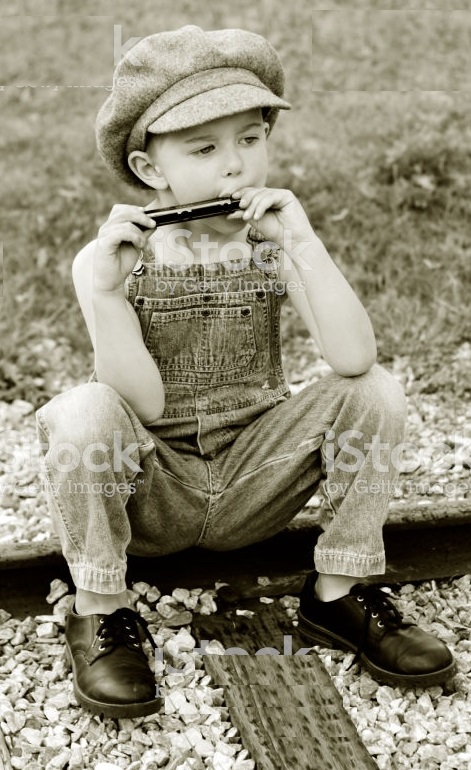 Legend claims that many years ago a 12-year-old boy living on the farm was killed while walking along the nearby train tracks. No-one knows if he was struck by a train or whether some other harm befell him. Reportedly, he is now buried in an unmarked grave within the foundation of his old house. Witnesses claim that if you walk the long path leading from the soccer fields through the woods to his grave near Prospect you can hear the boy playing his harmonica. Still other witnesses have reported seeing the ghostly image of a young boy walking down the road and again, he is seen playing a harmonica.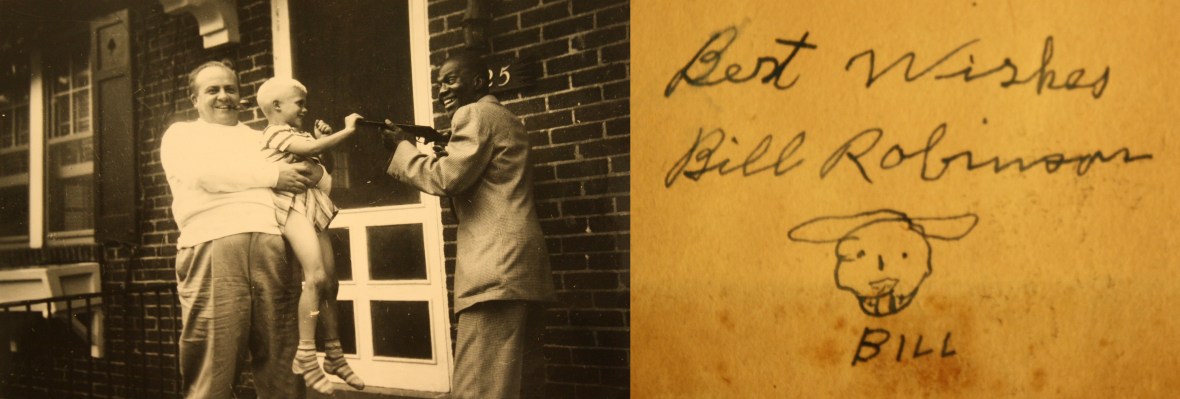
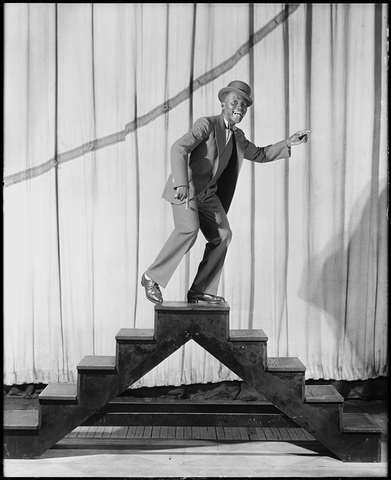 In the early 1920s, Robinson took his career on the road as a solo vaudeville act, touring throughout the country. He frequently visited Indianapolis, where he performed multiple shows per night, often on two different stages, at the B.F.Keith theatre. Robinson worked 51 weeks per year, taking a week off every season for the World Series. Bojangles was an avid baseball fan and co-founder of the New York Black Yankees of the old Negro National League in 1936.
 At the 1939 New York World’s Fair, he returned to the stage in “The Hot Mikado”, a jazz version of the Gilbert and Sullivan operetta which quickly became one of the greatest hits of the fair. Consequently, August 25, 1939 was named ‘’Bill Robinson Day’’ at the World’s Fair. By the 1940s, although he continued to perform, Robinson was past his prime and showing symptoms of heart disease. Robinson’s final film appearance is considered by critics as his best when he starred in the 1943 Fox musical Stormy Weather alongside Lena Horne.
 Robinson’s casket lay in state in Harlem, where an estimated 32,000 people filed past to pay their last respects. The schools in Harlem were closed for a half-day so that children could attend or listen to the funeral, which was broadcast over the radio. Reverend Adam Clayton Powell, Sr. conducted the service at the Abyssinian Baptist Church, and New York Mayor William O’Dwyer gave the eulogy. Newspapers estimated that one hundred thousand people turned out to witness the passing of his funeral procession. Robinson is buried in the Cemetery of the Evergreens in Brooklyn. In 1989, a joint U.S. Senate/House resolution declared “National Tap Dance Day” to be May 25, the anniversary of Bill Robinson’s birth.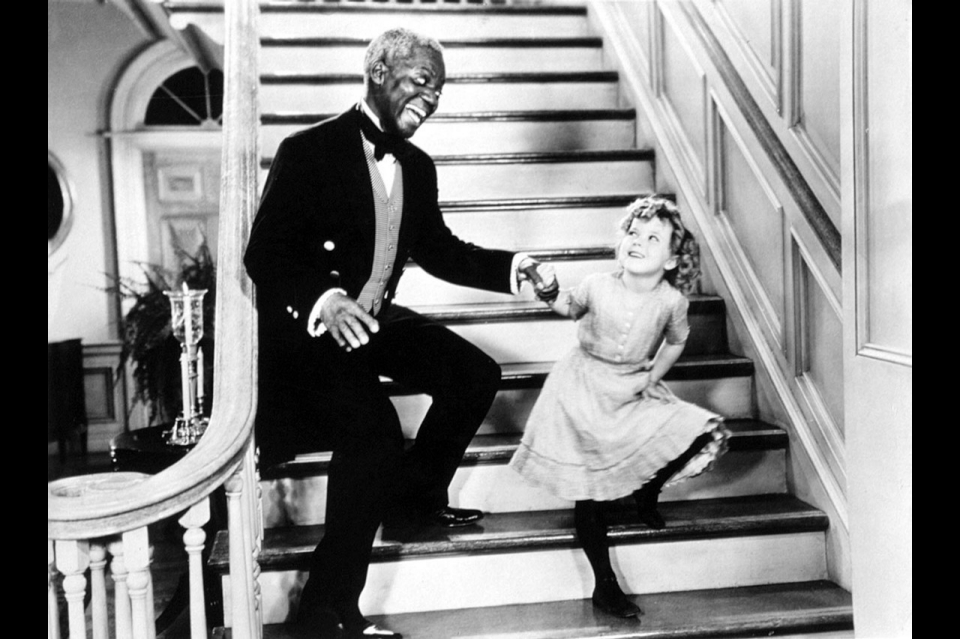
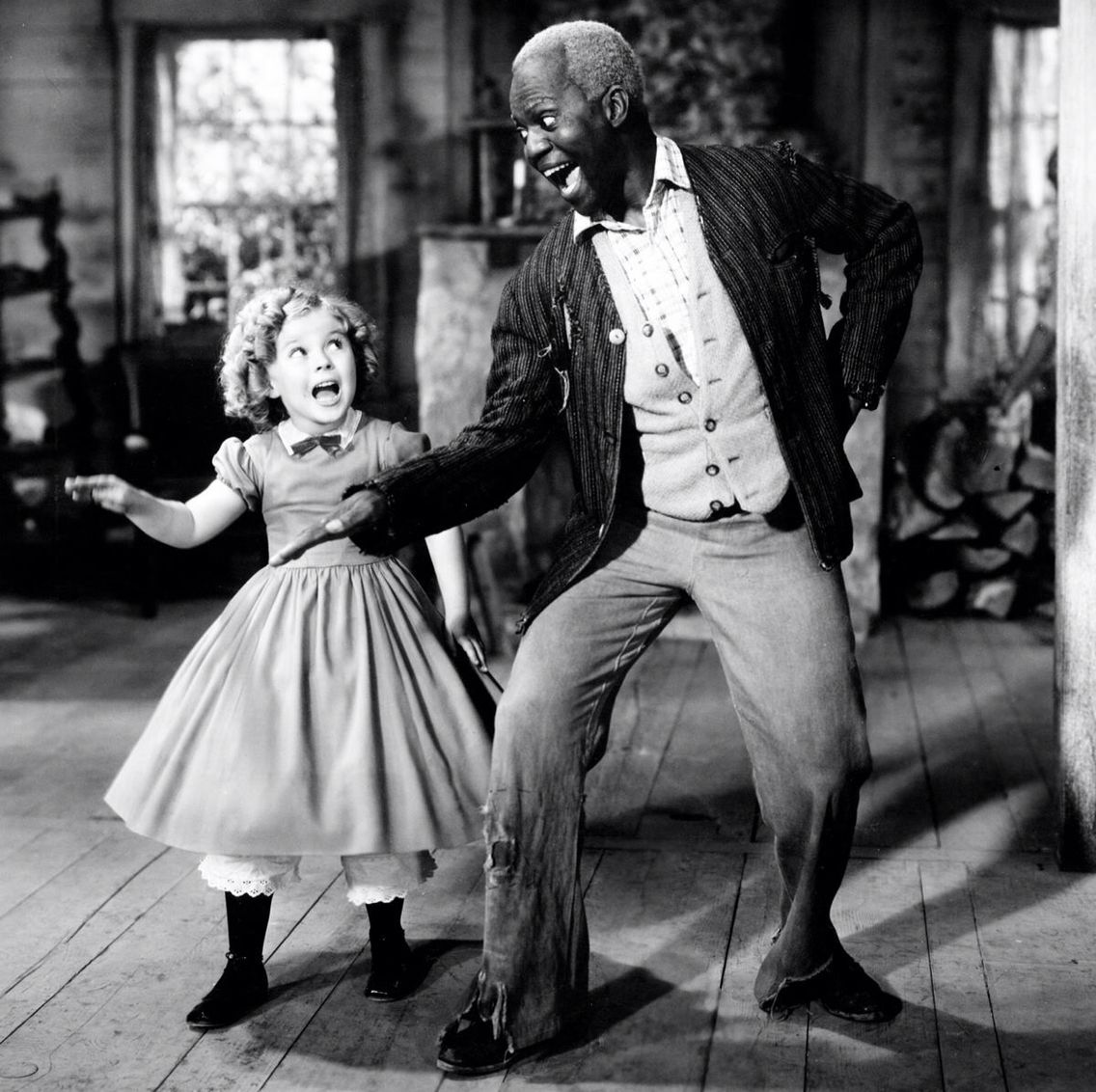 If you’re old enough to remember Black and White TV, the original Sammy Terry TV show, Timothy Church-mouse or Cowboy Bob and Janie, then you should remember Bill Robinson. If you’re over the age of 40, you can remember a time before cable TV. A time when television stations actually went off the air at night and didn’t come back on until farm shows or cartoons popped up the next morning. Back then, it was a badge of honor to say you made it up to watch the flag wave to the rhythm of the National Anthem.
 For the sake of full disclosure, I must admit that I once owned a photo signed by Bill Robinson. Bojangles signed it for an Indiana Mayor whose name now escapes me. I sold it to a collector in the late 1980s for $ 100. But I rationalized the sale of the relic because the photo literally looked like it had been dipped in water and $ 100 might as well have been $ 1,000 to me and my young bride. By finding this photo on a dew soaked Southern Indian hillside, I felt the pendulum had swung back my way.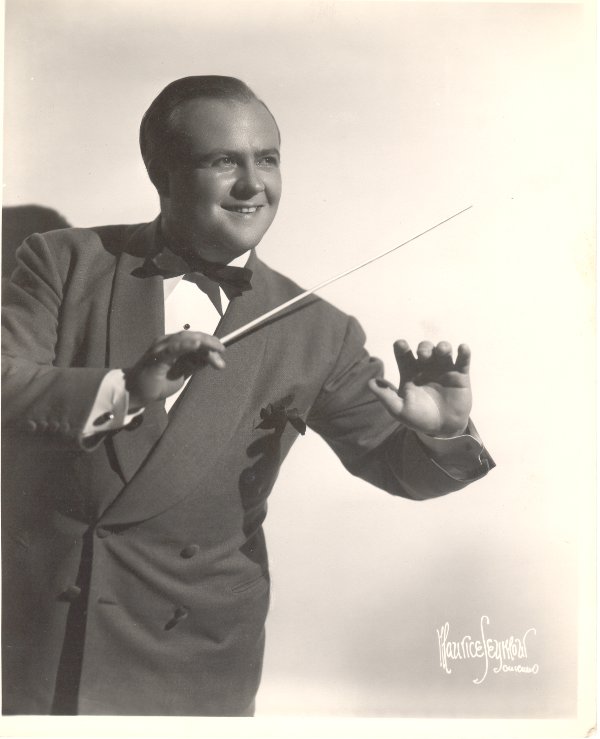
 Friends say there were three certainties about Bill Robinson: he loved to eat vanilla ice cream, gamble with dice or cards, and dancing was his life. At the time of his divorce his wife Fannie accused him of being a danceaholic-a man willing to sacrifice everything to dance. While his personal life was full of contradictions, his peers and historians agree he was one of the greatest American dancers of all time.
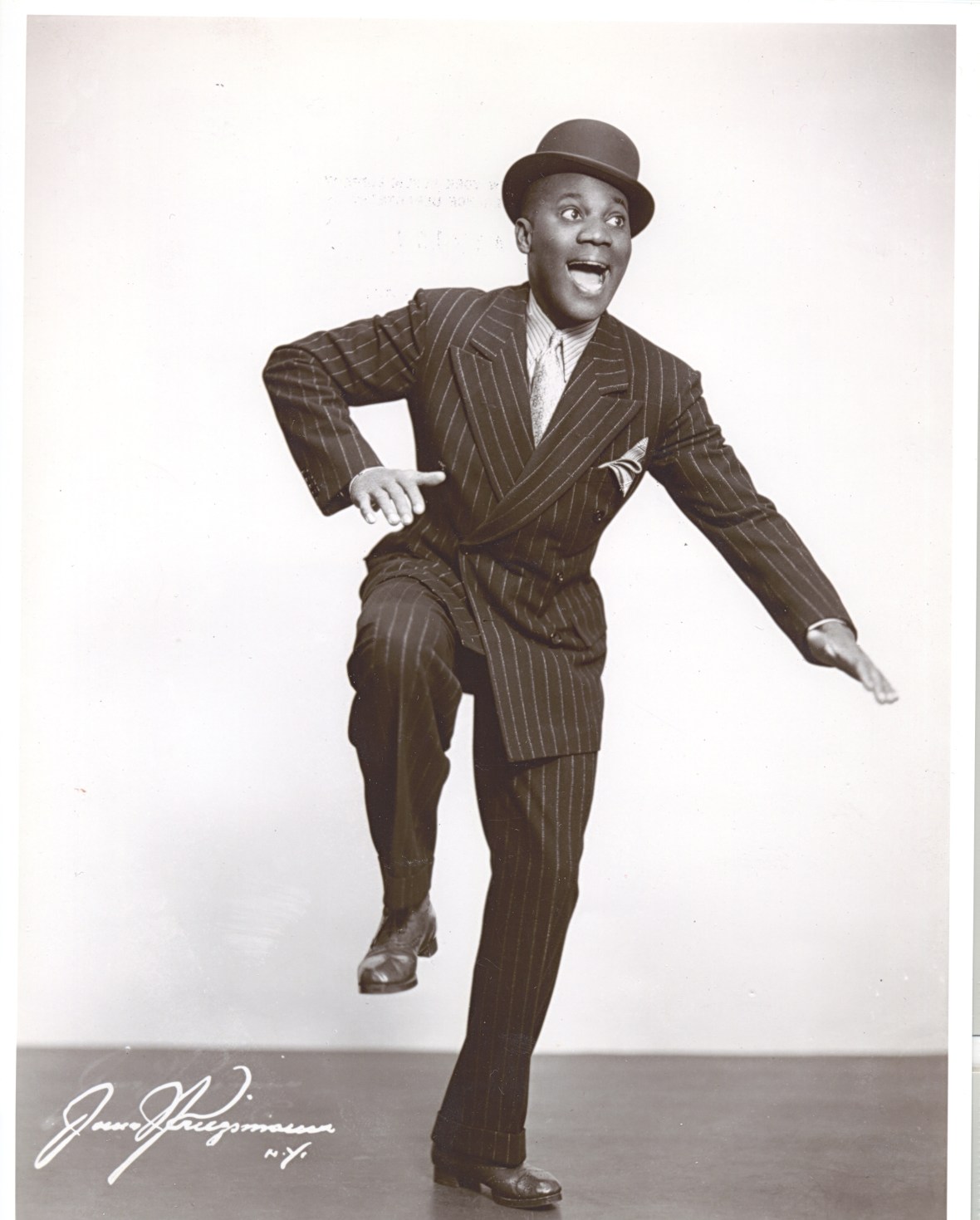 Following the demise of vaudeville, Broadway beckoned with “Blackbirds of 1928,” an all-black revue that would prominently feature Bill and other black musical talents. Soon, he was headlining with Cab Calloway at the famous Cotton Club in Harlem. Robinson is also credited with having introduced a new word, copacetic, into popular culture, via his repeated use of it in vaudeville and radio appearances. Robinson was a true pioneer in his field with many “firsts” to his credit.
