Assassinations, Pop Culture

The Lorraine Motel. Prelude and Aftermath. Part I.

Lorraine Motel Part IOriginal publish date:  March 31, 2017

History just happens. Often, history is well planned, scheduled and expected. The history I have always found most appealing is that which was unplanned, unscheduled and unexpected. Examples: Gettysburg, Woodstock, and Robert F. Kennedy’s April 4, 1968 speech in Indianapolis. True, the soldiers were gonna fight, the bands were gonna rock and RFK was gonna give a speech, but history happened far beyond the participants’ wildest imaginations. The prologue and aftermath, those always intrigued me the most.
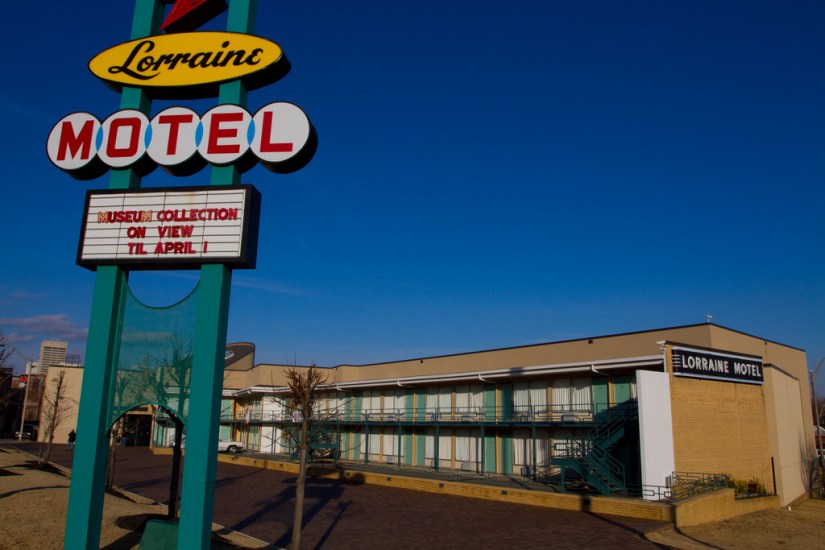
For example, the Loraine Motel in Memphis, Tennessee. Historians recognize the name as the site of the assassination of Reverend Martin Luther King, Jr. But what about the Lorraine Motel before and after that tragic night? The Lorraine Motel, located at 450 Mulberry Street, in downtown Memphis, first opened its doors in 1925. The 16-room one-story all-white establishment was first known as the Windsor Hotel and stood just six blocks east of the Mississippi River. When the hotel first opened, Memphis was fast becoming a music hotspot with Beale Street as a mecca for Delta blues fans. Machine Gun Kelly roamed the streets, Cotton was king and Democratic Party Boss Crump ran the city like a well oiled machine.
The Windsor served businessmen, musicians and tourists until the closing days of World War II when it underwent a name change to the Marquette Hotel. In 1945, the hotel was purchased by minority businessman Walter Bailey, who renamed the hotel “Lorraine” to honor his wife Loree and his favorite song “Sweet Lorraine” by Nat King Cole. During the segregation era, Bailey re-branded the hotel as upscale lodging that catering to black clientele. At the time of purchase the Lorraine included 16 rooms, a café, and living quarters for the Baileys.
The Baileys added a second floor with 12 rooms, a swimming pool, and drive-up access for more rooms on the south side of the complex. The Baileys added even more guest rooms and drive-up access, transforming it from a hotel into a motel. Under the Baileys’ ownership, the Lorraine Motel became a safe haven for black travelers in the Jim Crow South. The motel was listed in “The Negro Motorist Green Book,” also known as the Green Guide, a compilation of hotels, restaurants, gas stations, beauty parlors, barber shops, and other businesses that were friendly to African-Americans during the segregation era.
As lackluster as those old guest registers from the Windsor must have been in the hotel’s first two decades, Bailey’s Lorraine became star studded and the registers must have read like a who’s who of black celebrities. With the 1957 opening of Stax Records, less than 3 miles away, the Lorraine became the preferred home away from home for some of the biggest names in the music business: Ray Charles, Lionel Hampton, Aretha Franklin, Ethel Waters, Otis Redding, Cab Calloway, Count Basie, Louis Armstrong, Sarah Vaughan, the Staple Singers and Wilson Pickett to name just a few. The Lorraine was even visited by the Bailey’s favorite singer Nat King Cole on several occasions.
The motel’s proximity to Beale Street attracted black songwriters and session musicians would stay at the Lorraine while they were recording in Memphis. Negro League baseball teams, in town to play the Memphis Red Sox, and the Harlem Globetrotters also spent time at the motel. Although officially categorized as a segregated hotel, the Baileys welcomed both black and white guests. The Lorraine became equally famous its home-cooked meals, Memphis barbecue, and upscale environment at affordable rates (under $13 a night).
Stax recording artist Isaac Hayes, best remembered by baby boomers for his classic theme from “Shaft”, former owner of the old ABA Memphis Tams and as his character “Chef” from South Park, was a frequent guest of the Lorraine Motel back in the day. He once said this of the historic motel, “We’d go down to the Lorraine Motel and we’d lay by the pool and Mr. Bailey would bring us fried chicken and we’d eat ice cream. . . . We’d just frolic until the sun goes down and [then] we’d go back to work.” Two famous songs, Wilson Pickett’s “In the Midnight Hour” and Eddie Floyd’s “Knock on Wood,” were written at the motel.
Steve Cropper, a white Stax record guitarist with Booker T & the MG’s, co-wrote both songs with the artists while staying at the Loraine. He has stated in interviews that there was a lightning storm the night that he and Eddie wrote the song, hence the lyrics ‘It’s like thunder and lightning, The way you love me is frightening’. When Sam & Dave shout “Play It Steve” in their hit song “Soul Man”, they’re talking about Cropper. Other prominent guests included Brooklyn Dodgers stars Jackie Robinson and Roy Campanella.
However, Martin Luther King, Jr., was the Lorraine Motel’s most famous guest. It was Dr. King’s preferred residence while visiting the city. Dr. King and Rev. Ralph Abernathy had stayed together at the Lorraine several times, sharing Room 306 so often that they jokingly called it “the King-Abernathy suite” when phoning in reservations. His last visit was in the spring of 1968, when he came to Memphis to support 1,300 striking sanitation workers. Their grievances included unfair working conditions: when it rained, black workers were sent home without pay while paid white supervisors remained on the job, black workers were given only one uniform and no place in which to change clothes, and poor pay capped at a fraction of the pay for white workers doing the same jobs. Following a bloody confrontation between marching strikers and police, a court injunction had been issued banning further protests. King hoped to lead a peaceful protest march aimed at overturning the court injunction.
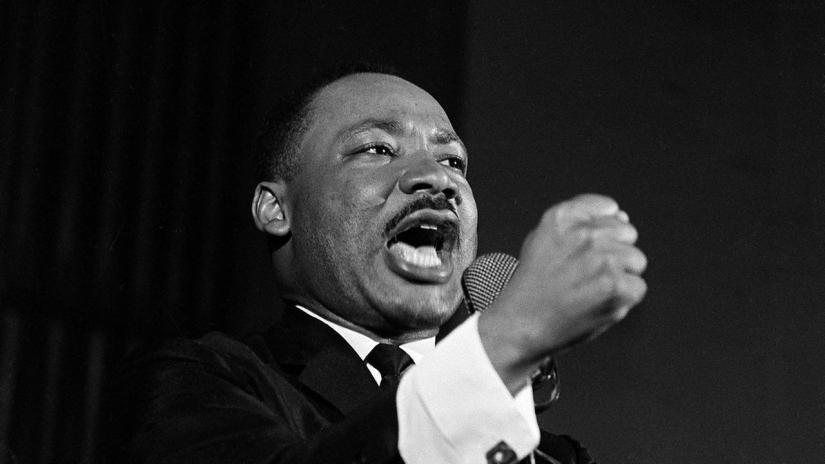
921552_1280x720Dr. King had stayed at the Lorraine on March 18, when he spoke to an enormous crowd at the Mason Temple Church of God in Christ in support of the striking sanitation workers. The venue was perhaps the largest meeting space for African Americans in the South and a good fit for King’s Poor People’s Campaign. As King called for a general work the crowd (estimated at 12-14,000 people) erupted in cheers and foot-stomping.
King returned to Memphis a week later to lead a protest march on City Hall. That day turned out to be one of the worst in King’s career. The marchers paraded down Beale Street with Dr. King was at the head of the column. When they turned onto Main Street, they were greeted by police in riot gear blocking their way. Dr. King reluctantly turned around. Then, police attacked with tear gas and billy clubs. One marcher was shot to death. Dozens of protesters were injured and nearly 300 arrested. Stores were looted and burned. The whole sad affair was captured on film and broadcast on television. Soon, Memphis became an armed camp and martial law was the rule of the day.
Dr. King quickly planned a return visit six days later to blot this stain off the civil rights landscape. That morning, King’s plane from Atlanta was delayed by a bomb threat; no explosive was found. King spent the better part of the day, April 3, meeting with aides and local organizers at the Lorraine Motel. He was exhausted and feeling ill. A heavy storm rumbled in and raged on and off all day long. That evening, Mason Temple had scheduled Rev. Abernathy as the evening speaker, but when the 3,000 person crowd demanded to hear King, Abernathy phoned King at his room in the Lorraine and asked him to address the assembly.
Dr. King arrived as the storm rattled windows and rain beat down on the metal roof of the Temple. Dr. King stepped to the podium and delivered his prophetic “Mountaintop” speech that night. It would be the last speech of his life. He closed with the eerily prophetic lines, “I would like to live a long life. Longevity has its place.But I’m not concerned about that now… I’ve seen the promised land. I may not get there with you… And so I’m happy, tonight. I’m not worried about anything. I’m not fearing any man! Mine eyes have seen the glory of the coming of the Lord!”
questi7King spent April 4, 1968, the last day of his life, at the Lorraine Motel. He shared a plate of fried Mississippi River catfish with Rev. Abernathy for his final meal. Afterwards, Dr. King participated in a playful pillow fight with Abernathy and aide Andrew Young. Just after 6 p.m., Dr. King stepped out of Room 306 and conversed with Jesse Jackson in the parking lot below. He leaned over the metal railing and asked the saxophonist Ben Branch to play “Take My Hand, Precious Lord” , one of King’s personal favorites, at the rally that evening. As King wondered aloud whether he needed a topcoat and turned back towards his room, a sharp sound rang out. Some thought it was a firecracker, or a car backfiring. Martin Luther King Jr. had been shot in the face. He died shortly afterwards at a hospital.
The world, and the Lorraine Motel, would never be the same.

Criminals, Pop Culture

I tink dat I shall nevah see a ting as be-u-de-full as dis tree. Al Capone’s tree.

Al Capone treeOriginal publish date:  November 5, 2014

In May of 1932, 33-year-old Chicago Gangster Al Capone was sent to Atlanta Penitentiary following his conviction for tax evasion. Upon his arrival at Atlanta, Capone was officially diagnosed with syphilis and gonorrhea. He arrived while suffering severe withdrawal symptoms from his cocaine addiction and dealing with the drug’s aftermath: a hole in his septum (the nose wall separating the nostrils). Capone busied himself at his prison job of stitching soles on shoes for eight hours a day, but his letters home were rambling and barely coherent. Contrary to his Chicago tough guy reputation, he was seen as a weak personality who could not deal with bullying by fellow inmates. His cellmate, seasoned convict & former low level Capone gang member Red Rudinsky, found himself becoming a protector for Capone. The conspicuous protection of Rudinsky and other friendly prisoners, as well as accusations from less friendly inmates, led prison official to believe that Capone was receiving special treatment.
Ironically, while these rumors were unfounded, it was decided to move Capone to the recently opened Alcatraz Federal Penitentiary. Once on “The Rock”, Capone went downhill fast. His neurosyphilis was slowly driving “Scarface” mad. He spent the last year of his sentence in the prison hospital, confused and disoriented. I once met an inmate who was at Alcatraz at the same time as Capone. He was an orderly in the prison hospital on the segregated 2nd floor of the prison (along with “Birdman” Robert Stroud) and regularly encountered “Big Al” on his rounds. He explained to me that he always had to be careful while near Capone as Al liked to engage in “Snowball” fights. The material used to make these snowballs was the worst you can imagine, suitable only for flushing down a toilet. Al Capone was going insane and Alcatraz wanted him gone.
Capone completed his term in Alcatraz on January 6, 1939 after serving nearly eight years of an 11-year sentence. Officials thought him harmless and didn’t think he had much longer to live. He was transferred to the Federal Correctional Institution at Terminal Island in California, to serve out his sentence for contempt of court. After leaving Terminal island, the ailing ex prohibition gangster was transported and given his unconditional release at Lewisburg penitentiary in Philadelphia in the early hours of November 16, 1939, 75 years ago this week.
Capone was referred by prison officials to Johns Hopkins Hospital in Baltimore for the treatment of paresis (weakness of the limbs and bodily functions caused by late-stage syphilis of the brain). Johns Hopkins refused to admit him solely based on his infamous reputation reported in the newspapers, but nearby Union Memorial Hospital took him in and gave him the necessary treatment to ease the disease.
Al Capone entered Union Memorial hospital as a private citizen but he didn’t travel light. Capone brought along an entourage including a massage therapist, bodyguards, a manicurist, chefs, and his very own food tasters, who spent a good amount of time testing out Little Italy’s finest for the ailing gangster. He ended up as the lone patient on the fifth floor. Scarface was attended to by well known syphilologists Dr. Joseph E. Moore and Dr.Walter Baetjer. Dr. Moore stated “The illness is a long standing nervous disorder for which he has recently undergone drastic treatment and for which further medical care is still necessary.”
After almost eight weeks at the hospital, on January 8,1940 the Capone’s took up residence at 5708 Pimlico Road in the city. It was believed that a home and family setting might be the best thing for Al and his recuperation. The family members that moved into the north end home were Al’s brother John, son Albert (aka “Sonny”), his mother Theresa and his wife Mae. According to his brother John Capone,” The Al Capone of today isn’t the Al Capone of a few years ago.” Al’s gangster brother Ralph would come up and visit occasionally at the hospital and then the home. Al could be seen taking short walks on the streets of Baltimore assisted by family members.
Although the Baltimore home was leased until April, the Capone’s felt that Al would recover more quickly at his sunny home in Palm Island, Florida. Without telling the doctors at Union Memorial, the Capone family packed up Al on March 19,1940 and made the 30-hour drive to Florida. John told reporters that they had left secretly from Baltimore because they did not want anything to happen that would aggravate Al’s condition. After the trip, the Capone family physician handed out a written statement reading: “His physical condition following the trip may be regarded as being considerably weakened. For the present he must be kept isolated and free from contact with anyone except his immediate family.” Big Al was now down to 230 from his “salad days” weight of 268 lbs.
In 1946, his physician and a Baltimore psychiatrist performed examinations and concluded Capone had the mental capability of a 12-year-old child. Capone spent the last years of his life at his mansion in Palm Island fishing in his swimming pool and talking incoherently to long dead gangsters from his past. On January 21, 1947, Capone had a stroke. He regained consciousness and started to improve but contracted pneumonia. He suffered a fatal cardiac arrest the next day. On January 25, 1947, Al Capone died in his home, surrounded by his family; he wаs buried аt Mount Carmel Cemetery in Hillside, Illinois.
Al Capone never forgot the good care he received at the hospital and as a token of his appreciation, in 1940 he donated two Japanese weeping cherry trees as a parting gift. The trees were planted outside the hospital. Today only one tree remains; the second was chopped down during the hospital’s 1955 expansion of its medical records wing. The very un-gangster-like tree thrived and has signaled spring every year for its north Baltimore neighborhood for the last three quarters of a century. Known as the Capone tree, the gangster relic lives on outside the hospital’s East 33rd Street entrance (the entrance to the hospital’s original building).
During a 2010 snowstorm, the remaining tree was split in half and lost a 10-foot branch. The toppled tree limb left a gaping hole halfway up the trunk and raised concerns for the erstwhile gangster landmark. An arborist was called in to tend to the ailing tree. He found the tree “in general decline” but was able to save it. Fearful of not getting as lucky next time, several other smaller sprouts called “Caponettes” were planted around the hospital in hopes the legacy would continue.
The broken tree limb was saved by a local woodworking artist and fashioned into functional works of art. He made an assortment of bowls, trinket boxes, wine stoppers, pens and even a small vase from the wood of the felled limb. The hospital sold the broken limb artifacts on eBay as part of a hospital fundraiser known as Union Memorial’s “Champions of Care” gala. Today, its canopy spans 42 feet across and it nearly reaches the fourth floor, one story below where Capone and his entourage occupied an entire level of the hospital. The tree long ago reached celebrity status-more for its intriguing history than its imposing presence. It remains in place as a fleeting reminder of one of America’s most notorious gangsters in the form of a fluffy pink tree.

Music, Pop Culture

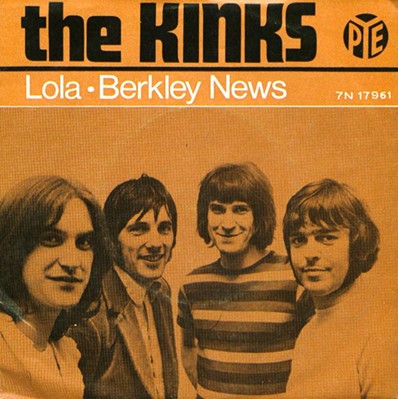
The Kinks Lola. A Transgender anthem revisited. Part II

Kinks Lola Part IIOriginal publish date:  April 3, 2016

Last week, we revisited The Kinks classic transgender anthem, “Lola.” It seemed like the right time to take a look back since the subject has been in the news so much lately. Trouble was, contrary to what you may think, the transgender subject the song alludes to was not the problem. The problem was the band’s use of the brand name Coca-Cola in the opening verse. Seems that the BBC had a strict policy against product placement of any kind back in the day and refused to play the song. Kinks frontman and songwriter Ray Davies was forced to fly back-and-forth from the U.S. to the U.K. to redo the phrase from Coca-Cola to Cherry Cola during the middle of a US concert tour. Today that would require a simple file transfer, back then it involved a few Transatlantic Jet flights.
Last week’s article ended with the question, was the song in any way autobiographical? Contemporary rumors whispered that the song was written about a supposed date between Ray Davies and a trans woman actress Candy Darling. The same Candy mentioned in Lou Reed’s 1972 song “Walk On The Wild Side” (“Candy came from out on the island, in the backroom she was everybody’s darling”). Darling was one of Andy Warhol’s original “superstars” at Warhol’s New York studio known as the Factory. Davies eventually disavowed the rumor, saying that the two only went out to dinner together and that he had known the whole time of Darling’s gender identity.
Davies once said the idea behind the song this way: “It was a real experience in a club. I was asked to dance by somebody who was a fabulous looking woman. I said “no thank you.” And she went in a cab with my manager straight afterwards. It’s based on a personal experience. But not every word.” Davies further explained, “‘Lola’ was a love song, and the person they fall in love with is a transvestite. It’s not their fault – they didn’t know – but you know it’s not going to last.”
Kinks drummer Mick Avory claims the song was partially inspired by Avory’s frequenting of transgender bars in west London. Avory said, “We used to know this character called Michael McGrath. He used to hound the group a bit, because being called The Kinks did attract these sorts of people. He used to come down to Top of the Pops, and he was publicist for John Stephen’s shop in Carnaby Street. He used to have this place in Earl’s Court, and he used to invite me to all these drag queen acts and transsexual pubs. They were like secret clubs. And that’s where Ray got the idea for the song.”
Ray put the rumors to rest once and for all when he told Rolling Stone magazine that the song was inspired by a true encounter experienced by the band’s manager. Ray explains that he wrote “Lola” after Kinks manager Robert Wace spent a night in Paris dancing with a transgender woman. Davies said of the incident, “In his apartment, Robert had been dancing with this black woman, and he said, ‘I’m really onto a thing here.’ And it was okay until we left at six in the morning and then I said, ‘Have you seen the stubble?’ He said ‘Yeah,’ but he was too drunk to care, I think.”
Although it was a major hit, Ray’s brother Dave Davies did not enjoy the success, saying, “In fact, when ‘Lola’ was a hit, it made me feel a bit uncomfortable. Because it was taking us out of a different sort of comfort zone, where we’d been getting into the work, and the writing and the musicality was more thought about. It did have that smell of: ‘Oh blimey, not that again.’ I found it a bit odd, that period.” Brother Ray said that he had initially struggled with writing an opening that would sell the song, but the rest of the song “came naturally.”
There may have been another reason for Dave’s discontent. Every Kinks fan knows that the brothers Davies don’t get along. Although the acrimony existed long before the 1970 song hits the charts (Dave once claimed that the only three years Ray was happy were the three years before he (Dave) was born), Lola certainly fueled the simmering sibling rivalry between the two. Ray has sole songwriting credits on the song, but Dave always believed he should have gotten equal credit for the song’s authorship. In his autobiography, Dave claims that he came up with the music for “Lola” and his brother Ray added the lyrics after hearing it. In a 1990 interview, Dave said that “Lola” was written in a similar fashion to ‘You Really Got Me’ in that the two worked on Ray’s basic skeleton of the song, saying that the song was more of a collaborative effort than many believed.
While the feud between the brothers may be common knowledge for rock aficionados, most don’t realize that the Kinks were the original bad boys of the British Invasion. Only in The Kinks case, they never really invaded. Seems like an on stage fist fight between drummer Mick Avory and guitarist Dave Davies derailed The Kinks invasion before it ever started. Performing at Cardiff’s Capital Theatre in May 1965, tensions among band members came to a head on stage after just two songs. Dave insulted Avory’s drumming and Mick dropped his sticks and knocked Dave unconscious in front of a startled crowd of fans.
Dave was laying on the stage and Avory, convinced he had killed his bandmate, fled the concert hall and went into hiding. Dave was rushed to Cardiff Royal Infirmary and received 16 stitches. When the police caught up with the Kinks’ drummer, he denied the whole thing happened. The cops pointed out that they had the entire audience as witnesses. Dave Davies ended up dropping all charges and relations in the band were smoothed over. The same couldn’t be said for their chances of success in the States though.
Because of the onstage bust-up and various other misdoings, The American Federation of Musicians placed a four year ban against the group on touring the United States. The ban coincided with the rise of The Beatles and the British Invasion. The Kinks popularity in North America undoubtedly suffered as a result. As Ray Davies later stated, “In many respects, that ridiculous ban took away the best years of the Kinks’ career when the original band was performing at its peak. We came about in the first days after Beatlemania, got chased everywhere we went and had to have police escorts to and fro,” Ray said. “I never even heard a note we played for a long time, the crowd’s screaming was always so loud. We were battlers,” he continued. “But the very thing that makes a band special is what ultimately causes it to break up. What made our music interesting ended up being the very thing that destroyed it.”
Now, about that transgender elephant in the room, yes, “Lola” received backlash for its controversial lyrics. Censorship talk began to arise, with some radio stations fading the track out before Lola’s biological sex is revealed in the song’s final verse. On November 18, 1970, the song was banned in Australia because of “controversial subject matter.” Regardless, “Lola” received positive reviews from critics. It opened the door for artists like Lou Reed and David Bowie to explore homosexuality in songs that straight people liked too. Did you know David Bowie produced that Lou Reed classic?
The song was also well-liked by the band. Mick Avory said “I always liked ‘Lola’, I liked the subject. It’s not like anything else. I liked it for that. We’d always take a different path.” In 1999 Dave Davies said of the song, “We just thought it was little bit tongue-in-cheek humor that we might slip by the radio censorship, which it did. We always tried to get things past the censors and a lot of people didn’t realize what the song was about.” In a 1983 interview, Ray Davies said, “I’m just very pleased I recorded it and more pleased I wrote it.”
The Kinks were probably unaware of it, but an American song published in 1918 was the first to combine Lola and Coca-Cola. In “Ev’ry Day’ll Be Sunday When The Town Goes Dry,” we hear the line, “At the table with Lola they will serve us Coca-Cola.” An anti-Prohibition song published in anticipation of the 18th amendment, the song addresses the prospect of being unable to buy alcohol on any day of the week. And as for that mythical champagne that tastes just like Coca-Cola? Ray Davies insists it’s the real thing, stating, “I had a Californian champagne that tasted like it, in some kind of L.A. bordello tourist trap.” So, in the spirit of “Lola”, I think I’ll go out on a limb here and predict that the Transgender question will soon devolve into an argument about the added expense of building new bathrooms. All in an effort to undermine the real civil rights issue.

Music, Pop Culture

The Kinks Lola. A Transgender anthem revisited. Part I

Kinks Lola Part I  Original publish date:              May 27, 2016

Transgender questions have been in the news a lot lately, but for baby boomers and millennial’s, it’s nothing new. 46 years ago this week, Ray Davies of the Kinks was frantically scrambling from continent to continent on a last minute mission to change the lyrics of the most controversial Transgender song of it’s day. The song detailed a romantic encounter between a young man and a transvestite named Lola in a club in Soho, England. With that kind of content in 1970 Richard Nixon America, you may think, well, duh. However, the change had nothing to do with content and everything to do with corporate branding, namely Coca-Cola.
For the record, “Lola” is a song written by Ray Davies and performed by English rock band the Kinks on their album “Lola Versus Powerman and the Moneygoround, Part One”. The song is written in short story fashion, the first-person narrator describes his confusion towards Lola who “walked like a woman and talked like a man”. The song was released in the United Kingdom on June 12, 1970, while in the United States it was released on June 28, 1970. But because of two words in the song’s opening verse, it almost didn’t happen at all.
The song begins, “I met her in a club down in old Soho where you drink champagne and it tastes just like Coca cola. C-O-L-A cola.” Despite its controversial subject matter, the BBC banned the track for a different reason. On the eve of the single’s release, the band was informed that the BBC wouldn’t play it because it went against their strict “no product placement” policy. The word “Coca-Cola” in the lyrics threatened to derail what many consider to be one of the most important cultural songs in Rock ‘n Roll history.
Turns out that the BBC Radio’s policy against product placement was realized at the last minute and in the middle of The Kinks tour of North America. After the band’s May 23, 1970 concert at The Depot in Minneapolis, songwriter Ray Davies was forced to make two round-trip flights from New York to London and hop across the pond back before the band’s next gig six days later. All this to change the line from “Coca-cola” to the soulless pacifistic “cherry cola” for the single’s release.
Of course some of the urgency was due and owing to Davies’ feeling that when he wrote ‘Lola’ (as he wrote in his autobiography) he wanted something that would “sell in the first five seconds” and he wasn’t about to let it be banned. Ray later claimed the song was his first genuine attempt to write a mainstream hit. He was going to do whatever it took to fix the track. Problem was, the master tapes were back in the U.K., so he had to jump on a plane and rush back to Morgan Studios in Willesden, London to record the necessary two word overdub.
According to Thomas M. Kitts’ book Ray Davies: Not Like Everybody Else, Davies booked a brief session to change “Coca-Cola” to “cherry cola” but was unhappy with the result. However, the band was waiting back in Chicago, so Ray was forced to return to the States in time for the May 29 & 30th gigs at the Aragon ballroom, then plan a trip back to the studio in the U.K. in the first few days of June. The Kinks were scheduled to play Ungano’s nightclub in New York City on June 4 to kick off a grueling series of 25 concerts in 36 days from Harrisburg to San Francisco. So this second session re-dub would be his last chance before the album’s release.
After several takes, Davies finally came up with a finished version that met his liking and passed muster with the BBC. But the saga wasn’t over. Davies was blindsided again when censors decided that a key line in the band’s next single, “Apeman,” needed amending too. Apparently, in the line “…the air pollution is a-foggin’ up my eyes…”, the word “a-foggin'” sounded too much like dropping the f-bomb. The original lyric remains intact on the album, and is heard at 2:20. If you listen to the album version of Lola, the BBC banned line remains. Although the lyrics in the gatefold sleeve of the original LP use the “cherry-cola” line, the album cut actually contains the original “Coca-Cola” version.
These days, recording an overdub is as simple as emailing someone an audio file, which is a lot cheaper, perhaps more efficient, but definitely not as cool. Like many of my fellow Kinks fans, I can distinctly remember hearing the “Coca-Cola” version as a kid growing up in Indianapolis. Seems that the US radio stations weren’t as particular as the BBC. In fact, I have my suspicions that back then, Coke probably liked the idea of having their name thrown out a few thousand times a day on AM radio. Pop culture maven that I’ve always been, I always thought the Coca-Cola version was far better then the redo.
Turns out, all that effort paid off in the end: ‘Lola’ was an instant hit, reaching number two on the UK Singles Chart and remaining high on the U.S. Billboard Hot 100 charts for 20 weeks, peaking at # 9. The single also saw success worldwide, reaching the top of the charts in Ireland, New Zealand, and South Africa, as well as the top 5 in Germany, Austria, Belgium, and Switzerland. The track became one of The Kinks’ signature songs and was later ranked number 422 on “Rolling Stone’s 500 Greatest Songs of All Time” as well as number 473 on the “NME’s 500 Greatest Songs Of All Time” list.
The song’s success came at a critical time for the band and had important ramifications going forward, allowing them to negotiate a new contract with RCA Records, construct their own London Studio, and assume more creative and managerial control. In a 1970 interview, Dave Davies claimed that, if “Lola” had been a failure, the band would have “gone on making records for another year or so and then drifted apart.” Instead, the song paved the way for more controversial songs by other artists to follow.
Initial recordings of the song began in April 1970, but, as the band’s bassist John Dalton recalled, recording for “Lola” took particularly long, stretching well into May. During April, four to five versions were attempted, utilizing different keys as well as varying beginnings and styles. By mid-May, new piano parts were added to the backing track by John Gosling, the band’s newly minted piano player. Vocals were also added at this time and the song coalesced into an anthem for the LBGT community.
The distinct twangy guitar rift that opens the song was achieved by combining the sound of a Martin guitar alongside a vintage Dobro resonating guitar. Dobro is the generic term for a wood-bodied, single cone resonator guitar that looks like it has a giant tin pie plate covering the sound hole behind the strings. Ray Davies credited this mixture of guitar sounds for the song’s unique sound. Ray said, “I remember going into a music store on Shaftesbury Avenue when we were about to make ‘Lola.’ I said, ‘I want to get a really good guitar sound on this record, I want a Martin.’ And in the corner they had this old 1938 Dobro that I bought for $150. I put them together on ‘Lola’ which is what makes that clangy sound: the combination of the Martin and the Dobro with heavy compression.” The sound and content became legendary, but the real question remained, was the song in any way autobiographical?

Indianapolis, Music, Pop Culture

Busted-The 1961 Heroin arrest of Ray Charles in Indianapolis.

Charles_Ray_arrested_in_Indianapolis_Nov_1961_AP_PhotoOriginal publish date:  November 19, 2008

Located on the “point” of Washington Street and Kentucky Avenue, the Downtown Sheraton-Lincoln Hotel was the place to stay for “anyone who was anyone” visiting the Circle City during the tumultuous sixties. The Sheraton-Lincoln’s Rail Splitter restaurant and Cole Porter ballroom hosted celebrities by the score and became the epicenter of Robert F. Kennedy’s 1968 Hoosier Presidential primary campaign victory. Located on the “point” of Washington Street and Kentucky Avenue, the Downtown Sheraton-Lincoln Hotel was the place to stay for “anyone who was anyone” visiting the Circle City during the tumultuous sixties. The Sheraton-Lincoln’s Rail Splitter restaurant and Cole Porter ballroom hosted celebrities by the score and became the epicenter of Robert F. Kennedy’s 1968 Hoosier Presidential primary campaign victory.  The Hotel Lincoln was built in 1918 and designed by famed Indianapolis architects, Rubush and Hunter, the same firm that created the Madame C.J. Walker theatre, Columbia Club and old City Hall among others. The hotel, named after Abraham Lincoln, was the tallest flatiron building ever built in Indianapolis. It was acquired by Sheraton Hotels in 1955 and became known as the Sheraton-Lincoln Hotel. This four-corner intersection, obliterated in the early 1970s, was known as Lincoln Square in honor of Mr. Lincoln’s 1861 speech from the balcony of the Bates House across the street. A bust of Abraham Lincoln stood on a marble column in the lobby of the hotel for generations.

On Sunday November 12, 1961, Ray Charles checked in to the Downtown Sheraton-Lincoln Hotel. Ironically, his band spent the night in the Claypool Hotel across the street at Washington and Illinois Streets; the spot where Lincoln delivered his speech. That night, Ray got a call from a man whom he did not know. This man called with an offer to sell Ray drugs. Charles told him to come on over, and after which, the musician purchased weed and a dozen $ 3 capsules of heroin.

The next day, Ray and his band traveled to Anderson for a concert at the “Wigwam”, the new high school gym. After the show ended, they all headed back to Indianapolis. The bandmates got Ray to his room and left to see Aretha Franklin perform at the Pink Poodle at 252 North Capitol Ave. By all indications, Ray Charles stayed behind and got high.

The next morning, Tuesday November 14, 1961, at 9:00 am, Ray was awakened by a knock on the door. At first he ignored it but the knocking soon turned to pounding. Ray asked, “Who is it?”…”Western Union” was the reply. Still half asleep and dressed only in his underwear, Ray felt his way through the room and cautiously opened the door. Suddenly, two IPD detectives, William Owen and Robert Keithly, rushed in announcing that they had received an anonymous tip from a local drug dealer that there were illegal drugs in the room.

A search quickly found what they were looking for, Ray’s leather zippered “fix” bag. The detectives discovered 10 empty capsules, each containing heroin residue and a hypodermic needle. A closer search found a cold cream jar filled with marijuana they new would be there. They charged Ray with a violation of the 1935 Indiana Narcotics act and for being a “common addict”, a charge designed more to humiliate Ray than to punish him. When the narcs pulled up Ray’s sleeves, they discovered what they described in court as “the worst track marks they’d ever seen.”

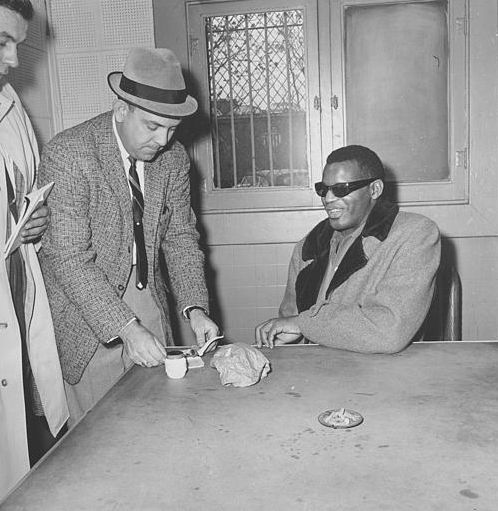
The officers led Ray out to the waiting police car and quickly took him to police headquarters a short distance away. There they fingerprinted and photographed their celebrity prisoner and brazenly let the press in to take pictures of the humiliated and confused musician. If you google the pictures taken that day, you’ll see Ray at his lowest. Ray Charles, the greatest R & B musician of all time, broke down that day. Although blind, Ray new instinctively what was going on. At first, he could only hear the familiar sound of one camera shutter clicking.

Then, as police let reporters in, he could hear the pop of flash bulbs snapping. He could feel the warmth of the flashes on his face followed by the clatter of the bulbs hitting the floor after being ejected. Ray must have felt like a man in a foxhole with bullets crashing all around. Ray’s soft sobbing soon broke into full- throated crying. The reporters yelled out questions at the helpless young man. “How did you get started on drugs, Ray?”

“I started using stuff when I was 16” Ray said as the tears rolled down from under the dark glasses hiding his eyes. “When I first started in show business. Then I had to have more and more.” Apparently ashamed by his statement and situation, he started to cry even heavier now saying “I don’t know what to do about my wife and kids. I’ve got a month’s work to do and I have to do it.” Then Ray stumbled back to the old excuses all junkies use; “I really need help. Nobody can lick this by themselves. I’ll go to Lexington (narcotics hospital). It might do me some good. I guess I’ve always wanted to go, but it was easier to go the other way. A guy who lives in the dark has to have something to keep him going. The grind is just too much.”

On drugs in the music industry, Ray said, “Believe me, there are a lot bigger guys than me who are hooked a lot worse.” Then Ray regained some of his old fire as he talked about the informant who turned him in, “Whoever he was, it was a dirty trick for him to pull.” Unbelievably, a reporter asked Ray if he’d like to see his kids using drugs. Ray began to cry again and said, “It’s a rotten business.”

Luckily the sideshow lasted only a few hours. Ray was released on $ 130 cash bond the next morning. As Ray left the jail, he covered his head with his overcoat from reporters. Ray left for a gig in Evansville that night, hoping to put the Indianapolis nightmare far behind him. Ray’s bandmates heard the news of Ray’s arrest on the radio that same morning. As they poured out into the hallways to talk about the situation, Ray came walking in. “Let’s get outta here, man.” was all he said. They quickly packed their gear and started out on the 2 hour trip to Southern Indiana.

At the Evansville concert that night, reporters swarmed over Ray backstage just before the show. Frustrated, Ray jumped up and down with his fists clenched as if he were skipping rope. Sometimes he squatted so low that it seemed he would tip over backwards. Ray claimed it was the result of nerves and lack of sleep. He regained his composure and patiently answered the inevitable questions hurled at him by reporters. No, he had no idea how much money he’d spent on drugs in his lifetime, “That’s like asking how much you spend on cigarettes.” Ray claimed that he’d been misquoted and that he hadn’t been an addict since age 16, “It ain’t been that long, not near that long.” When asked what he planned to tell the judge the next morning back in Indianapolis, Ray said, “I’ll deny everything, you can quote me.”

News of the arrest spread fast, especially in the black press. As Ray arrived at Municipal Court for his scheduled appearance before Judge Ernie S. Burke, a huge mob of fans, reporters, television cameras and radio news crews were waiting for him. They jammed the halls of the courthouse, causing enough of a spectacle that Judge Burke threatened loudly to clear the courtroom and the building. Wisely, Judge Burke dropped the “common addict” charge and set Ray’s trial date on the drug possession charge for January 4, 1962, releasing Ray on $ 1,000 bond. As Ray left the courtroom, he told reporters, “I don’t feel up to answering questions about my life or this event.” then left Indiana for Nashville, Tennessee. The controversy followed Ray for the rest of the tour. Ed Sullivan immediately canceled an appearance by Ray on his popular TV show and several concert venues canceled Ray’s scheduled gigs. But it was nothing compared to the carnival atmosphere he’d experienced in Indianapolis.

Ray Charles would return to Indianapolis twice more in 1962 to clear up the drug bust. On January 9, 1962 Ray made his first appearance in court to answer the charges. He sat uncomfortably in a courtroom packed with media and fans, at times gently rocking back and forth with his head bowed and his hands tucked between his knees. Ray’s lawyer spent this session attacking the police for entering Ray’s room under false pretenses and with no warrant. Three weeks later, Ray returned for a 5 minute session as Judge Burke ruled the police search illegal and dismissed the charges. Even though Ray was a celebrity, he still had the same constitutional rights as every american citizen. Ray left the Hoosier courtroom for the last time with a general “No comment” to the press. Ironically, at the time of his Indianapolis arrest, Ray’s single “Hit the Road Jack” was in the top ten of the Billboard charts. When he returned in January of 1962, Ray’s single “Unchain my heart” was in Billboard’s top ten.

In 1964 he was arrested again for possession of marijuana and heroin. Following a self-imposed stay at St. Francis Hospital in Lynwood, California, where he kicked his drug habit “in 96 hours” (the total treatment took 3 to 4 months, though), Charles received five years probation. Charles reappeared in the charts in 1966 with a series of hits composed by the relatively unknown team of Ashford & Simpson. Ironically one of those hits was the song “Let’s Go Get Stoned”, which became his first number-one R&B hit in many years.

“Brother Ray” Charles pioneered the soul music genre by combining rhythm and blues and gospel styles like no one before or since. Frank Sinatra called Ray Charles “the only true genius in show business.”  In 2002, Rolling Stone ranked Charles number ten on its list of the “100 Greatest Artists of All Time”, and second on their 2008 list of the “100 Greatest Singers of All Time” behind only Aretha Franklin and just ahead of Elvis Presley. On June 10, 2004, at the age of 73, Ray Charles died of complications resulting from acute liver disease at his home in Beverly Hills surrounded by family and friends.

Ray’s arrest became a footnote in the pop culture history of Indianapolis. But what became of the Downtown Sheraton-Lincoln Hotel? The hotel was demolished in April of 1973. It marked the first time that controlled dynamite was used to raze a building in Indiana. Public officials were reluctant to allow dynamite rather than the traditional wrecking ball, but the promise of saving both time and money tipped the scales. The exact time was kept a secret and the surrounding area was cordoned off for blocks. Over 200 spectators gathered to witness the building fall to the ground. Today, the Hyatt Regency stands where the Sheraton-Lincoln once  was.

The Hyatt was built with a triangular shape to pay homage to the angling street and flatiron building that once stood on the site. The building opened in 1977 and it’s circular upper floor houses the Eagle’s Nest, a rotating restaurant. One of the most prominent features of the Eagle’s Nest is a piano bar. On the weekends, guests are entertained with songs from the american songbook. No doubt, Ray Charles tunes are among them. It just goes to show you, what goes around, comes around.