Indianapolis, Music, Pop Culture

Busted-The 1961 Heroin arrest of Ray Charles in Indianapolis.

Charles_Ray_arrested_in_Indianapolis_Nov_1961_AP_PhotoOriginal publish date:  November 19, 2008

Located on the “point” of Washington Street and Kentucky Avenue, the Downtown Sheraton-Lincoln Hotel was the place to stay for “anyone who was anyone” visiting the Circle City during the tumultuous sixties. The Sheraton-Lincoln’s Rail Splitter restaurant and Cole Porter ballroom hosted celebrities by the score and became the epicenter of Robert F. Kennedy’s 1968 Hoosier Presidential primary campaign victory. Located on the “point” of Washington Street and Kentucky Avenue, the Downtown Sheraton-Lincoln Hotel was the place to stay for “anyone who was anyone” visiting the Circle City during the tumultuous sixties. The Sheraton-Lincoln’s Rail Splitter restaurant and Cole Porter ballroom hosted celebrities by the score and became the epicenter of Robert F. Kennedy’s 1968 Hoosier Presidential primary campaign victory.  The Hotel Lincoln was built in 1918 and designed by famed Indianapolis architects, Rubush and Hunter, the same firm that created the Madame C.J. Walker theatre, Columbia Club and old City Hall among others. The hotel, named after Abraham Lincoln, was the tallest flatiron building ever built in Indianapolis. It was acquired by Sheraton Hotels in 1955 and became known as the Sheraton-Lincoln Hotel. This four-corner intersection, obliterated in the early 1970s, was known as Lincoln Square in honor of Mr. Lincoln’s 1861 speech from the balcony of the Bates House across the street. A bust of Abraham Lincoln stood on a marble column in the lobby of the hotel for generations.

On Sunday November 12, 1961, Ray Charles checked in to the Downtown Sheraton-Lincoln Hotel. Ironically, his band spent the night in the Claypool Hotel across the street at Washington and Illinois Streets; the spot where Lincoln delivered his speech. That night, Ray got a call from a man whom he did not know. This man called with an offer to sell Ray drugs. Charles told him to come on over, and after which, the musician purchased weed and a dozen $ 3 capsules of heroin.

The next day, Ray and his band traveled to Anderson for a concert at the “Wigwam”, the new high school gym. After the show ended, they all headed back to Indianapolis. The bandmates got Ray to his room and left to see Aretha Franklin perform at the Pink Poodle at 252 North Capitol Ave. By all indications, Ray Charles stayed behind and got high.

The next morning, Tuesday November 14, 1961, at 9:00 am, Ray was awakened by a knock on the door. At first he ignored it but the knocking soon turned to pounding. Ray asked, “Who is it?”…”Western Union” was the reply. Still half asleep and dressed only in his underwear, Ray felt his way through the room and cautiously opened the door. Suddenly, two IPD detectives, William Owen and Robert Keithly, rushed in announcing that they had received an anonymous tip from a local drug dealer that there were illegal drugs in the room.

A search quickly found what they were looking for, Ray’s leather zippered “fix” bag. The detectives discovered 10 empty capsules, each containing heroin residue and a hypodermic needle. A closer search found a cold cream jar filled with marijuana they new would be there. They charged Ray with a violation of the 1935 Indiana Narcotics act and for being a “common addict”, a charge designed more to humiliate Ray than to punish him. When the narcs pulled up Ray’s sleeves, they discovered what they described in court as “the worst track marks they’d ever seen.”

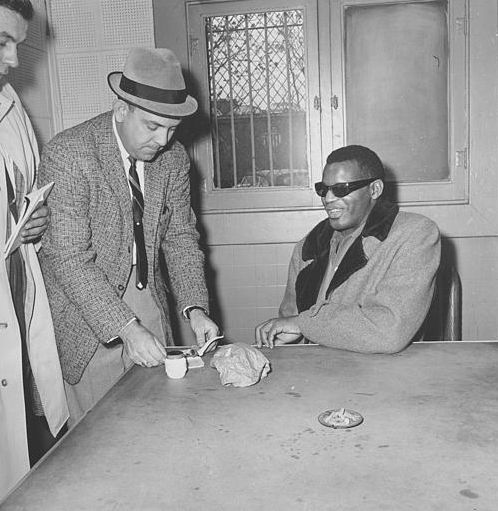
The officers led Ray out to the waiting police car and quickly took him to police headquarters a short distance away. There they fingerprinted and photographed their celebrity prisoner and brazenly let the press in to take pictures of the humiliated and confused musician. If you google the pictures taken that day, you’ll see Ray at his lowest. Ray Charles, the greatest R & B musician of all time, broke down that day. Although blind, Ray new instinctively what was going on. At first, he could only hear the familiar sound of one camera shutter clicking.

Then, as police let reporters in, he could hear the pop of flash bulbs snapping. He could feel the warmth of the flashes on his face followed by the clatter of the bulbs hitting the floor after being ejected. Ray must have felt like a man in a foxhole with bullets crashing all around. Ray’s soft sobbing soon broke into full- throated crying. The reporters yelled out questions at the helpless young man. “How did you get started on drugs, Ray?”

“I started using stuff when I was 16” Ray said as the tears rolled down from under the dark glasses hiding his eyes. “When I first started in show business. Then I had to have more and more.” Apparently ashamed by his statement and situation, he started to cry even heavier now saying “I don’t know what to do about my wife and kids. I’ve got a month’s work to do and I have to do it.” Then Ray stumbled back to the old excuses all junkies use; “I really need help. Nobody can lick this by themselves. I’ll go to Lexington (narcotics hospital). It might do me some good. I guess I’ve always wanted to go, but it was easier to go the other way. A guy who lives in the dark has to have something to keep him going. The grind is just too much.”

On drugs in the music industry, Ray said, “Believe me, there are a lot bigger guys than me who are hooked a lot worse.” Then Ray regained some of his old fire as he talked about the informant who turned him in, “Whoever he was, it was a dirty trick for him to pull.” Unbelievably, a reporter asked Ray if he’d like to see his kids using drugs. Ray began to cry again and said, “It’s a rotten business.”

Luckily the sideshow lasted only a few hours. Ray was released on $ 130 cash bond the next morning. As Ray left the jail, he covered his head with his overcoat from reporters. Ray left for a gig in Evansville that night, hoping to put the Indianapolis nightmare far behind him. Ray’s bandmates heard the news of Ray’s arrest on the radio that same morning. As they poured out into the hallways to talk about the situation, Ray came walking in. “Let’s get outta here, man.” was all he said. They quickly packed their gear and started out on the 2 hour trip to Southern Indiana.

At the Evansville concert that night, reporters swarmed over Ray backstage just before the show. Frustrated, Ray jumped up and down with his fists clenched as if he were skipping rope. Sometimes he squatted so low that it seemed he would tip over backwards. Ray claimed it was the result of nerves and lack of sleep. He regained his composure and patiently answered the inevitable questions hurled at him by reporters. No, he had no idea how much money he’d spent on drugs in his lifetime, “That’s like asking how much you spend on cigarettes.” Ray claimed that he’d been misquoted and that he hadn’t been an addict since age 16, “It ain’t been that long, not near that long.” When asked what he planned to tell the judge the next morning back in Indianapolis, Ray said, “I’ll deny everything, you can quote me.”

News of the arrest spread fast, especially in the black press. As Ray arrived at Municipal Court for his scheduled appearance before Judge Ernie S. Burke, a huge mob of fans, reporters, television cameras and radio news crews were waiting for him. They jammed the halls of the courthouse, causing enough of a spectacle that Judge Burke threatened loudly to clear the courtroom and the building. Wisely, Judge Burke dropped the “common addict” charge and set Ray’s trial date on the drug possession charge for January 4, 1962, releasing Ray on $ 1,000 bond. As Ray left the courtroom, he told reporters, “I don’t feel up to answering questions about my life or this event.” then left Indiana for Nashville, Tennessee. The controversy followed Ray for the rest of the tour. Ed Sullivan immediately canceled an appearance by Ray on his popular TV show and several concert venues canceled Ray’s scheduled gigs. But it was nothing compared to the carnival atmosphere he’d experienced in Indianapolis.

Ray Charles would return to Indianapolis twice more in 1962 to clear up the drug bust. On January 9, 1962 Ray made his first appearance in court to answer the charges. He sat uncomfortably in a courtroom packed with media and fans, at times gently rocking back and forth with his head bowed and his hands tucked between his knees. Ray’s lawyer spent this session attacking the police for entering Ray’s room under false pretenses and with no warrant. Three weeks later, Ray returned for a 5 minute session as Judge Burke ruled the police search illegal and dismissed the charges. Even though Ray was a celebrity, he still had the same constitutional rights as every american citizen. Ray left the Hoosier courtroom for the last time with a general “No comment” to the press. Ironically, at the time of his Indianapolis arrest, Ray’s single “Hit the Road Jack” was in the top ten of the Billboard charts. When he returned in January of 1962, Ray’s single “Unchain my heart” was in Billboard’s top ten.

In 1964 he was arrested again for possession of marijuana and heroin. Following a self-imposed stay at St. Francis Hospital in Lynwood, California, where he kicked his drug habit “in 96 hours” (the total treatment took 3 to 4 months, though), Charles received five years probation. Charles reappeared in the charts in 1966 with a series of hits composed by the relatively unknown team of Ashford & Simpson. Ironically one of those hits was the song “Let’s Go Get Stoned”, which became his first number-one R&B hit in many years.

“Brother Ray” Charles pioneered the soul music genre by combining rhythm and blues and gospel styles like no one before or since. Frank Sinatra called Ray Charles “the only true genius in show business.”  In 2002, Rolling Stone ranked Charles number ten on its list of the “100 Greatest Artists of All Time”, and second on their 2008 list of the “100 Greatest Singers of All Time” behind only Aretha Franklin and just ahead of Elvis Presley. On June 10, 2004, at the age of 73, Ray Charles died of complications resulting from acute liver disease at his home in Beverly Hills surrounded by family and friends.

Ray’s arrest became a footnote in the pop culture history of Indianapolis. But what became of the Downtown Sheraton-Lincoln Hotel? The hotel was demolished in April of 1973. It marked the first time that controlled dynamite was used to raze a building in Indiana. Public officials were reluctant to allow dynamite rather than the traditional wrecking ball, but the promise of saving both time and money tipped the scales. The exact time was kept a secret and the surrounding area was cordoned off for blocks. Over 200 spectators gathered to witness the building fall to the ground. Today, the Hyatt Regency stands where the Sheraton-Lincoln once  was.

The Hyatt was built with a triangular shape to pay homage to the angling street and flatiron building that once stood on the site. The building opened in 1977 and it’s circular upper floor houses the Eagle’s Nest, a rotating restaurant. One of the most prominent features of the Eagle’s Nest is a piano bar. On the weekends, guests are entertained with songs from the american songbook. No doubt, Ray Charles tunes are among them. It just goes to show you, what goes around, comes around.
Indianapolis, Pop Culture

Thomas Edison in Indianapolis.

thomas-edisonOriginal publish date:  June 7, 2013

The most famous and prolific inventor of all time, Thomas Alva Edison died over 85 years ago. His tremendous influence on modern life remains unchallenged by any other American, living or dead. Edison’s inventions include the light bulb, the phonograph, the motion picture camera, and vast improvements on the telegraph and telephone. In his 84 years, he acquired an astounding 1,093 patents, a record that eclipses all other inventors. It is a tribute to his genius as an inventor, businessman, and promoter that many believe we owe our way of life to his ideas. But, did you know that what Edison himself considered his first invention was created right here in Indianapolis?

Thomas Alva Edison was born on February 11, 1847, in Milan, Ohio. Known as “Al” in his youth, Edison was the youngest, and sickliest, of seven children, only four of which survived to adulthood. In search of a better life for his family, Edison’s father Sam moved to Port Huron, Michigan, in 1854, where he worked in the lumber business.
“Al” was a poor student fascinated with mechanical things and chemical experiments instead of book learning. When a schoolmaster called Edison “addled,” his furious mother took him out of the school and began to home school the young inventor. Edison said many years later, “My mother was the making of me. She was so true, so sure of me, and I felt I had some one to live for, some one I must not disappoint.”
The home schooling schedule made his life more flexible and, like most boys of his day, Edison began working at the age of 11. His first job was helping in the family garden, but as “hoeing corn in a hot sun is unattractive,” he found other work when the opportunity arose. That opportunity came in late 1859 when the Grand Trunk Railroad was extended through Port Huron to Detroit. Edison talked his way into a job as a “candy butcher,” selling candy, newspapers, and magazines to the passengers. In that position he soon showed an entrepreneurial flair. While he was away working on the train, he employed boys to sell vegetables and magazines in Port Huron for him. With that money, he bought a printing press, which he used to start up the Grand Trunk Herald, the first newspaper published on a train. He wrote the articles and printed and sold the newspapers to passengers on the train. He spent his free time reading scientific books and technical manuals, most left behind by the passengers on the trains. In fact, passengers would often leave their reading materials behind and Al would resell them to the next group of travelers over-and-over again.
During layovers in the “Motor City”, Edison continued his education by visiting the Detroit Public Library to consult science books before returning to the train to perform chemistry experiments in the baggage car. That is, until an accidental fire forced him to stop his on board experiments. In 1859 12-year-old Edison lost almost all his hearing. Several theories have been advanced as to what caused his hearing loss. Some attribute it to the aftereffects of scarlet fever contracted as a child. Edison himself blamed it on a conductor who lifted the lad by his ears after that fire in the baggage car. However, he never let his disability discourage him. Instead, since it made it easier for him to concentrate on his experiments and research, he treated it as an asset.
No doubt his hearing loss caused Edison to retreat more into reading and personal solitude. Along the way, he picked up the rudiments of telegraphy. His first big break came quite by accident, literally. In 1862, 15-year-old Edison rescued the toddler son of telegraph operator James MacKenzie from the path of a rolling freight car. MacKenzie rewarded him by giving him lessons. After practicing intensively all summer, Edison took a part-time telegraph job in Port Huron.
The Civil War was raging, and when the battle of Shiloh was reported in the Detroit Free Press in early April 1862, Edison talked the editor into giving him extra copies on credit and then telegraphed the headlines ahead to the train’s scheduled stops. The crowds were so large and the demand for the papers so great that he steadily increased the price at each station, selling all the papers at a handsome profit. It is clear that young Al learned a valuable lesson about the power of the telegraph and the press. He learned quickly that knowledge was power and power was money. By the time he was sixteen, Edison was proficient enough to work as a telegrapher full time.
Within a year Edison had embarked on a four-year stint as an itinerant telegrapher, a path followed by many ambitious, technically oriented young men. During those years he advanced to the front rank of telegraphers, becoming an expert receiver known for his clear, rapid handwriting. His proficiency elevated Edison to the upper echelon of elite press-wire operators, the men who handled the lengthy, important news dispatches. A highly esteemed, much desired position during the Civil War. Although still a teenager, he mixed and mingled with much older journalists and editors, frequenting their offices and engaging in their conversations that would often last into the wee hours of the morning. Some of his fellow operators would become newspaper reporters and Al’s close association with them them would, in time, help push Edison into the public eye.
Edison worked in many of the larger cities of the Midwest, then considered to be the epicenter of cutting edge technical advances in the United States. Like all operators, Edison had to maintain his instruments and the batteries that powered the lines. He studied them and thought about ways to improve them, experimenting with discarded, outdated and broken instruments. He purchased a small lathe and some other tools. For two months in early 1864, Edison had become a “tramp telegrapher”, the term used to describe a young “gun for hire” telegraph operator in search of the highest bidder. He worked in Fort Wayne before moving to Indianapolis in the Fall-Winter of 1864.
For a few months in 1864, the Indianapolis Union Station Depot was the place of employment for the young inventor. Thomas Edison arrived in the Hoosier Capitol City as a seventeen-and-a-half year old second-class telegraph operator for Western Union. He had bounced along, moving through larger and larger cities, using his telegraphing jobs mostly as laboratories for his experiments. He usually left these jobs in a hurry after being dismissed when the budding inventor became distracted and failed to send and receive messages properly. The fact that he had no trouble landing jobs in new cities speaks to the demand for telegraphers during wartime.
The telegraph revolutionized communications in the United States and the job of telegraph operator became one of the highest paid new professions. Young Edison imagined a life of glamorous freedom and excitement. In truth, most of the men who actually made their living this way, although highly skilled, were undisciplined with a variety of problems, unhappy home lives and physical detriments, usually alcoholism.
Edison, on the other hand, was greatly helped by his experience as a telegrapher. He used the long stretches of solitude and inactivity between messages to think and tinker with his experiments. Not unlike the modern day computer programmer, the telegraph operator’s job involved challenges, problem solving, and innovation. And in Indianapolis, Edison was first introduced to Western Union, a company whose ruthless bargaining, price cuts, and slash-and-burn business tactics eventually made them the top telegraph service in the U.S. Edison picked up many successful business practices from Western Union and, in time, would become known for his own ruthless tactics.
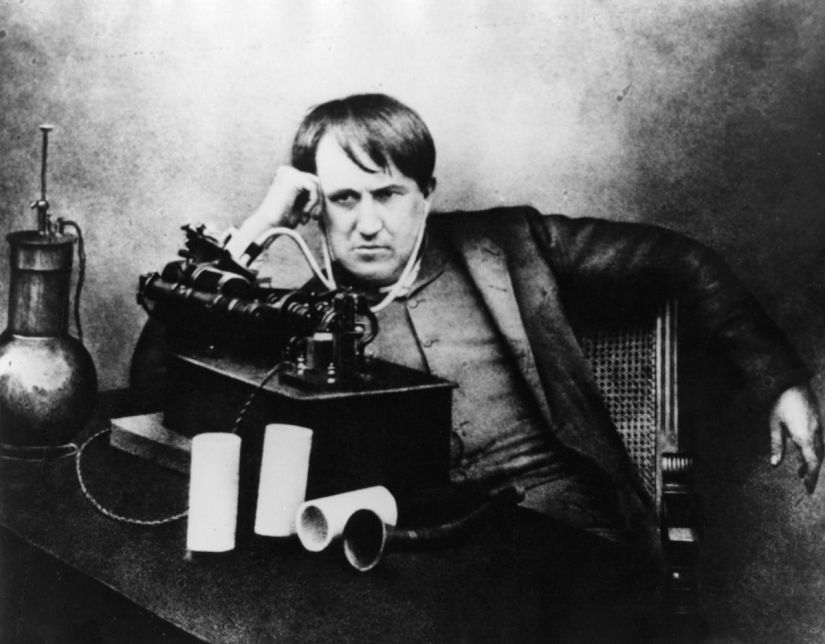
It was at Union Station that he developed his first invention, which he called the “automatic repeater telegraph”, a device used to record incoming telegraph signals and replay them at any desired rate. This allowed him to transcribe the often rapid-fire messages sent via the news wires. This skill meant a higher pay grade for him.
The legend surrounding Edison’s end of tenure at Indianapolis Union Station is told in many forms and fashions, making it hard to separate fact from fiction. A thumbnail version might go like this: It was November 8, 1864. Abraham Lincoln was being challenged for a second term by the flamboyant Union General whom Lincoln had hired, and fired, twice during the Civil War, George McClellan, a Democrat. The outcome was far from certain and northerners perched on the edge of their seats waiting to hear the results of this important wartime election. State-by-state the votes were counted and the telegraph wires were hot with returns.
Young Edison thought this would be the perfect time to unwrap, uncoil and unleash his new invention, which he named the “Morse repeater.” The invention consisted of two separate telegraph machines that Al had “jerry-rigged” together, one to transcribe the message and the other to save it. The device slowed down the incoming messages so transcribing operators could process the content more precisely. The machine worked fine, at first. Things quickly broke down and soon, quite literally, sparks began to fly. Seems the results were coming in too fast for even two machines to keep track of. Edison’s boss was infuriated by what he viewed as yet another Cockamamie gadget and reportedly fired the young inventor on the spot. Edison packed up his supplies and quickly moved to Cincinnati where he soon developed a more successful data storage device. Eventually, this device would become known by all as the phonograph.
At one time, Union Station once had a plaque somewhere inside it’s walls honoring Edison’s brief service in our city. But I have been unable to confirm that it still exists. Seems that the plaque, like Edison’s time in the Circle City, has been lost and forgotten.

food, Pop Culture

Willard Scott Retired (and why you should care).

Willard Scott McDonaldsOriginal publish date:  September 11, 2015
Ten days before Christmas Willard Scott announced his retirement after a 65 year career. Yes, SIXTY-FIVE years! To be perfectly honest, I thought he retired decades ago but that probably says more about me than it does the indefatigable Mr. Scott. So, what’s the big deal about a TV weatherman retiring you ask? Well, not only was Willard Scott the weatherman for The Today Show for 35 years, he was Bozo the clown from 1959 to 1962 and he created the very first Ronald McDonald in 1963.
Scott was born in Alexandria, Virginia, on March 7, 1934. He began his career as a 16-year-old, working in 1950 as an NBC page at WRC-AM, NBC’s owned-and-operated radio station in Washington, D.C. Scott attended American University, where he met Ed Walker at the school’s radio station. From 1955 to 1972, Scott and Walker formed the Joy Boys show on WRC-AM Radio. For nearly two decades, the Joy Boys were DC’s version of the Bob & Tom show. From Ike to JFK to LBJ to Nixon, everyone listened to the Joy Boys. Scott spent his spare time balancing his night-time radio career with a daytime job as the host of WRC children’s television programs playing characters such as Commander Retro and Bozo the Clown.
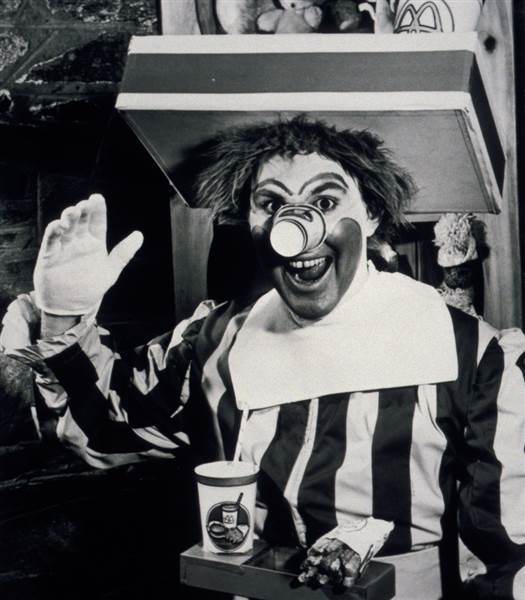
From August 1959 to August 1962 Scott portrayed Bozo the Clown at WRC. When the TV station dropped the Bozo character, Scott wanted to keep his clown gig going. Willard thought that a clown bearing hamburgers would be irresistible to children. So he morphed his Bozo character into a clown he named Ronald McDonald for two locally owned DC area McDonald’s franchises. In 1963, he appeared in 3 DC area TV commercials using the catch phrase, “Ronald McDonald, the Hamburger-Happy Clown.” Scott’s character wore a a red and yellow striped suit, could magically pull as many as 3 hamburgers at a time out of his belt, and wears a nose made out of a McDonald’s cup. His hat, made of a tray holding a Styrofoam hamburger, a bag of fries and a milkshake, covered a shock of spaghetti-like hair .
Even though Willard Scott’s original Ronald more closely resembled a scarecrow than a clown, Ray Kroc liked the idea. So, in typical “Kroc-style”, he usurped the idea and hired another actor to portray the hamburger clown for his own national commercials. Scott wasn’t selected as spokesclown for the company’s ads because the agency thought Willard was too fat for the role of an “extremely active” Ronald McDonald. In time, Willard Scott’s brainchild would become one of the world’s best-known advertising icons. But Willard never missed a beat.
In 1970, Scott began appearing on WRC-TV as a weekday weatherman. In 1980, NBC asked Willard to become its weatherman for The Today Show. He soon became the archetype of all “wacky” weathermen to follow. Scott routinely did weather reports on the road, interviewing locals at community festivals and landmarks, a forerunner of today’s weather channel programming. NBC executives once insisted that the bald-headed Scott wear a hairpiece. He complied when in New York, but refused when outside of the studio, resulting in a strange dichotomy on the air. His toupee occasionally tilted or fell off on the air, ensuring Scott an eternal place in the TV blooper hall of fame.
In 1989, an internal memo from Today Show co-host Bryant Gumbel was leaked to the media. In the memo, Gumbel said Scott “holds the show hostage to his assortment of whims, wishes, birthdays and bad taste…This guy is killing us and no one’s even trying to rein him in.” The public backlash against Gumbel, battling a difficult and aloof label already, became a media firestorm. The next time they appeared on camera together Scott kissed Gumbel on the cheek to show he’d forgiven him, and also later said he hoped the whole thing would go away. One thing was certain, Willard, like the Ronald McDonald character he created, would change but not go away.
As Willard became the face of NBC Today Show weather, Ronald McDonald became the primary mascot of the McDonald’s fast-food restaurant chain. According to one survey found on stunning-stuff.com, 96% of all schoolchildren in the United States recognize Ronald. The character and costume evolved drastically over the years and continues to be a cornerstone of the McDonald’s corporation marketing campaigns to this day. Ray Kroc’s Ronald ditched the food tray hat and cup nose in favor of a painted white face and a bright red wig. He is dressed in yellow clothes, red and white striped shirt, yellow gloves, and red clown shoes with yellow laces to mirror the official McDonald’s colors.
In television commercials of the 1960s, ’70s and ’80s, Ronald inhabited a fantasy world called McDonaldland where he had adventures with friends Mayor McCheese, the Hamburglar, Grimace, Birdie the Early Bird, and The Fry Kids. In recent years, McDonaldland has been largely phased out, and Ronald is portrayed interacting with families in their everyday lives.
In 1971, Ronald got a major makeover that found him wearing a yellow jumpsuit, red and white striped shirt and legs, yellow gloves, red shoes, red hair, whiteface makeup and a big red smile. The suit had three french fry bags for pockets, all of which read “McDonald’s”. That look would last for more than 40 years with only a few subtle changes to his hair style, sleeve length and pocket design. In 1998 the french fry pockets on Ronald’s jumpsuit were replaced with red seamed pockets, the stripes on the shirt became thicker, and the back of the suit featured the name “Ronald” like a sports jersey (the name would be removed by 2000).
In early 2014, Ronald’s jumpsuit was dropped in favor of a more athletic looking costume of yellow cargo pants, a vest and a red-and-white striped rugby shirt. His classic clown shoes remain part of the official uniform. The new look was designed to more favorably appeal to social media sites like Facebook and Twitter.
Over the decades, Willard’s Hamburger-Happy clown has been played by at least ten different actors, whose names are recalled by only the most fervent of Ronald McDonald fans. Today, many people work full-time making appearances in the Ronald McDonald costume, visiting children in hospitals, attending restaurant grand openings and charity events.
From the late 1980s until the early 1990s, Scott served as spokesperson alongside Pat Summerall for True Value Hardware Stores. In 1992, Scott ironically recorded a TV commercial for McDonald’s arch-rival Burger King. (Take that Ray Kroc!) Scott left his daily gig as The Today Show weatherman in 1996 and was succeeded by Al Roker. Willard continued to substitute for Roker for the next decade until NBC acquired The Weather Channel in 2009. Weather channel meteorologists served as substitutes but Willard continued to appear twice a week on the morning program to wish centenarians a happy birthday. He remains the commercial voice of Smucker’s jellies, which sponsors his birthday tributes on Today.
True, to most, Willard Scott was that annoying weather guy on The Today Show endlessly wishing old folks well on their 100th birthday. In fact, Willard Scott himself once said, “I got more mail than anybody in the history of The Today Show, but half of it was to get me off the air.” But now you know, despite his NFL lineman size, there’s more than meets the eye when you’re talking about Willard Scott. Well, I guess you really can’t judge a book by the cover.

food, Pop Culture

A Gunfight With Colonel Sanders.

Col. Sanders_HarlandOriginal publish date:  September 10, 2015
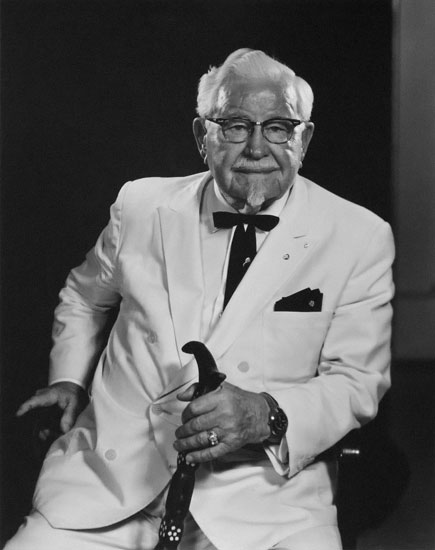
Colonel Harland Sanders died 35 years ago this week (December 16, 1980) but lately he’s been getting more TV face time than Abe Vigoda, Kirk Douglas and Zsa Zsa Gabor combined (who are all still alive, at least at the time of this writing). The Colonel has proven so popular in fact, that two former Saturday Night Lives are battling over who will portray him in the flesh in Kentucky Fried Chicken commercials. My wife and I love those TV ads; our kids think they are creepy. Colonel Sanders is perhaps the best known recurring fast food namesake our country has ever known. He is also a lot more complicated than he looks.
For example, did you know that Colonel Sanders, founder of KENTUCKY Fried Chicken was born in Indiana? Yep, Sanders was born on September 9, 1890 in a four-room house located 3 miles east of Henryville, Indiana. His father died when Harland was only 5 years old and by the age of seven Sanders was a skilled cook out of necessity. Sanders’ mother remarried in 1902, and the family moved to Greenwood, Indiana. Young Harland didn’t get along very well with his new stepfather. In 1903 he dropped out of seventh grade and soon he was working full time painting horse carriages in Indianapolis. When he was 14 he moved to southern Indiana and worked on a farm for a couple of years. In 1905, he moved in with an uncle in New Albany.
After leaving New Albany in late 1906, he joined the United States Army in Alabama (where another of his uncles lived) and was trained as a teamster / mule minder for a few months. He then became a blacksmith, then ash-pan cleaner, then steam engine stoker for the Northern Alabama Railroad. He married, moved to Jackson Tennessee and went to work as a fireman for the Illinois Central railroad while going to law school at night. He got in a fight with a co-worker and lost his job. The family moved to Little Rock Arkansas and Harland went to work for the Rock Island Railroad while he finished up his law degree. He practiced law in Little Rock for three years before he lost that gig after he got in a fight in the courtroom-with his own client! From there, it was back to Henryville where the Sanders clan moved in with Harland’s mother. Sanders went to work as a laborer on the Pennsylvania Railroad.
In 1916, the Sanders family moved to Jeffersonville, where Sanders got a job selling life insurance for Prudential. Sanders was eventually fired for insubordination. He moved to Louisville and got a sales job with Mutual Benefit Life of New Jersey. During this time, Sanders was sort of an ad-hoc doctor which contemporaries described as a “Helpful but technically unlicensed” obstetrician, delivering babies with rudimentary supplies like lard and Vaseline. In 1920, Sanders established a ferry boat company on the Ohio River between Jeffersonville and Louisville. The ferry was an instant success. In around 1922 he took a job as secretary at the Chamber of Commerce in Columbus, Indiana. He admitted to not being very good at the job, and resigned after less than a year. Sanders cashed in his ferry boat company shares for $22,000 and used the money to establish a company manufacturing acetylene lamps for automobiles. The venture failed after Delco introduced an electric lamp that they sold on credit.
Sanders moved to Winchester, Kentucky, to work as a salesman for the Michelin Tire Company. He lost his job in 1924 due in large part to his fiery temper. In 1924, by chance, he met the general manager of Standard Oil of Kentucky, who asked him to run a service station in Nicholasville. In 1930, the station closed as a result of the Great Depression. That same year, the Shell Oil Company offered Sanders a service station in North Corbin, Kentucky rent free, in return for paying them a percentage of sales.
It was here that Sanders began to serve chicken dishes and other meals such as country ham and steaks to weary travelers. Initially he served the customers in his adjacent living quarters before opening a restaurant. Oh, and if his bio hasn’t grabbed you by now, maybe your ears will prick up when I tell you that it was while working at his Shell station / restaurant combo where Colonel Harland Sanders, American icon, once shot a man.
The stretch of road where Sanders’ first restaurant was located in Corbin, Kentucky was on a nasty stretch of highway known as “Hell’s Half-Acre.” The region was full of bootleggers, and there were plenty of gunfights to keep things lively. Sanders kept a gun beneath his cash register and a shotgun near his bed to protect his family and his business. Turns out, Sanders didn’t need to worry about desperadoes, he had enough trouble just dealing with the competition. Sanders had his hands full just keeping an eye on his rival down the street, a man named Matt Stewart. Stewart ran a competing Standard Oil gas station down the road from Sanders, and the two men just didn’t exactly get along.
The ever enterprising Sanders decided to advertise his “Sanders Superior Gas Station” by painting a sign on a nearby railroad wall. Stewart didn’t like this move and promptly painted over Sanders’ sign. Furious, Sanders threatened to shoot off Stewart’s head and proceeded to repaint his billboard. But Matt Stewart was a stubborn fellow, so he grabbed a brush and started slapping paint on Sanders’ new sign.
Sanders was in the middle of a meeting with two Shell officials named Robert Gibson and H.D. Shelburne when the news of Stewart’s whitewash reached him. Determined to put a stop to Stewart’s shenanigans once and for all, the trio grabbed their loaded guns, jumped in a car, and drove off to settle the issue. They found Stewart perched on a ladder, paintbrush in hand. Sanders jumped out of the car and yelled, “Well, you son-of-a—–, I see you done it again.” Stewart jumped down from the ladder, pulled out his pistol and promptly fired five shots, three of which went directly into Robert Gibson’s heart, killing him instantly.
The Colonel said he grabbed the fallen man’s gun and started shooting back (even though he was carrying a pistol of his own). Stewart ducked behind the disputed railroad wall and for a moment appeared to be winning the gunfight. The Colonel went one way and Shelburne the other and the duo soon had Matt Stewart in a crossfire. Shelburne shot Stewart in the hip and Sanders shot him in the shoulder. A local newspaper article described Sanders’ actions as: “he jumped into the breach and under withering fire grabbed his fallen comrade’s gun . . . [and] the future Colonel unloaded with true aim and hurled hot lead into Stewart’s shoulder.” Bleeding and in pain, Stewart shouted, “Don’t shoot, Sanders! You’ve killed me!” The Colonel was a hothead but he was no murderer. The two men backed off and Stewart’s life was spared.
Ironically, Stewart was arrested in the hospital, tried and sentenced to 18 years in prison. Sanders and Shelburne were found not guilty. Sanders felt true remorse for his part in the incident and later went to Stewart’s daughter Ona May, apologized, and offered his help if she ever needed it. Local legend claims that the Colonel took care of Ona May for the rest of her life.
Sanders went back to his Shell station where he continued to serve steak, ham, biscuits, and his special recipe fried chicken to hungry customers. It was not fancy, served family style with bowls of food from which the diners served themselves, but by all accounts, it was “finger lickin’ good.” As the business grew into a motel/cafe, Sanders began wearing a black suit, growing a goatee that he would dye white and calling himself “Colonel.” Soon, he was running a full-fledged restaurant across the street, and his food was so popular that Governor Ruby Laffoon gave Sanders the honorary title of Kentucky Colonel. And the rest is history.
By the time of his death in 1980, there were an estimated 6,000 KFC outlets in 48 countries worldwide, with $2 billion of sales annually. As for Matt Stewart, well, after two years behind bars, he was shot to death by a deputy sheriff. No one knows for sure, but rumors has it the deputy was a paid gunman, hired to assassinate Stewart by Robert Gibson’s family. The deputy sheriff was never charged.
For many of this generation, Colonel Sanders is little more than a cartoon of an old guy on a KFC bucket. The real Colonel cussed like a sailor, was an unashamed flirt and an astute businessman with a proven record of eliminating the competition; one way or another. He was nothing like the aw-shucks version that history has handed down to us. He ate fried chicken, mashed potatoes, gravy and biscuits every single day, which added an extra 50 pounds on his 5-foot, 11-inch frame. In short, the Hoosier born Kentucky Colonel lived a life every bit as worthy as his secret recipe.

Baseball, Pop Culture

Chicago Cubs: The Curse of Billy Goat Sianis.

SPT BILLGOAT A  Original publish date:          February 27, 2017

Its not often these days that goats make the news. You may have heard recently that a severed goat’s head mysteriously appeared outside of Wrigley Field, home of the Chicago Cubs baseball team. To the uninitiated observer, the news of a blood soaked box containing the mortal remains of a Capra aegagrus hircus (domestic goat) might sound like some Medievel relic or a scene out of a Wes Craven film. However, diehard Cubs fans will immediately recognize the significance of such a macabre offering.
On April 10, 2013, a box arrived at the friendly confines addressed to the club’s owner Thomas S. Ricketts. Ricketts has been making noise recently with threats to move the team out of Wrigley Field unless the ballpark is updated and a newer larger mega-video screen is installed above the Ivy covered walls of the National League’s oldest baseball park. Ricketts is currently embroiled in heated negotiations with city officials and neighborhood business people about the proposed $300 million renovation. Cubs staff discovered the package and immediately called police. Chicago police responded to a call about an “intimidating package” around 2:30 p.m. By why a goat’s head? What did it mean?
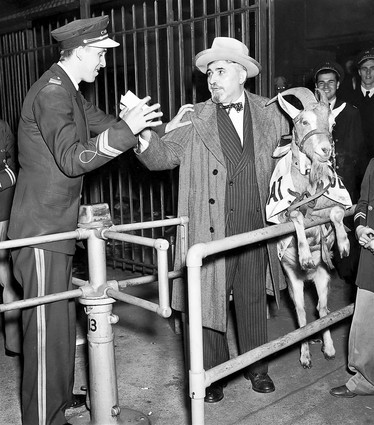
Well, Cubs lore says Chicago tavern owner Billy Sianis cursed the Cubs when they wouldn’t let his pet goat into Wrigley Field on October 6, 1945. Sianis purchased 2 box seat tickets for $ 7.20 for he and his pet goat, Murphy. He arrived with the goat wearing a sign stating “We Got Detroit’s Goat”. The legend claims that Sianis was asked to leave a World Series game against the Detroit Tigers at Wrigley because his pet goat’s odor was bothering other fans. He was outraged and declared, “Them Cubs, they ain’t gonna win no more,” which has been interpreted to mean that there would never be another World Series game won at Wrigley Field. Of course, it helps feed the legend that the Cubs have not won a National League pennant since that World War II Era incident. Making matters worse, the Cubs have not won a World Series in 105 years.
Since then, there have been countless renditions of the fabled incident, so many in fact that it has become hard to separate fact from fiction. Most renditions state that Sianis declared that no World Series games would ever again be played at Wrigley Field, still others say that his ban was on the Cubs appearing in any World Series, regardless of venue. The Sianis’ family claimed that “Billy” (ironically the most popular name for American domestic goats) sent a telegram to then team owner Philip K. Wrigley reading, “You are going to lose this World Series and you are never going to win another World Series again because you insulted my goat.” Whatever the truth, the Cubs were up two games to one in that 1945 series but ended up losing Game 4 as well as the best-of-seven series four games to three.
Newspapermen all over Chicago knew a good story when they “smelled” one, so the curse was quickly immortalized in columns and has spread like wildfire for decades hence. Legendary Chicago Daily News, Sun-Times and Tribune syndicated columnist Mike Royko popularized the goat legend when, during the 2003 postseason, Fox television commentators played it up during the Cubs-Marlins match-up in the 2003 National League Championship Series.
In an apparent mea culpa by the team, the curse was “lifted” in 1969 by Sianis himself. It didn’t take, as the 1969 Cubs finished with a record of 92-70, 8 games behind the New York Mets. That star crossed season saw the Cubs in first place for 155 days, until mid-September when they lost 17 out of 25 games. The “Miracle Mets” went on to win the World Series. Later, Billy Sianis’ nephew Sam, was brought out onto Wrigley Field with a goat multiple times in attempts to break the curse: on Opening Day in 1984 and 1989 (in both years, the Cubs went on to win their division), in 1994 to stop a home losing streak, and in 1998 for the wild card game (which the Cubs won).
In 2003, the Chinese zodiac’s Year of the Goat, a group of Cubs fans headed to Houston with a billy goat named “Virgil Homer” and attempted to gain entrance to Minute Maid Park, home of their division rivals the Astros. After they were denied entrance, they unfurled a scroll, read a verse and proclaimed they were “reversing the curse.” The ploy seemed to be working as the Cubs won the division that year, but then came the “Bartman incident”.
In the eighth inning of Game 6 of the NLCS, with Chicago ahead 3–0 and holding a 3 games to 2 lead in the best of 7 series, Marlins’ second baseman Luis Castillo hit a ball down the left field line. As the ball hovered in limbo between fair and foul, several spectators attempted to catch it. One of those fans, Steve Bartman, reached for the ball, deflecting it out of the reach of Cubs outfielder Moisés Alou. Had Alou caught the ball, it would have been the second out in the inning, and the Cubs would have been just four outs away from playing in the World Series. Instead, the Cubs lost the lead and ultimately the game, by giving up eight runs in the inning. Bartman, a lifelong Cubs fan, had to be escorted from the stadium by security guards, and received police protection for a time when his name and address were made public on MLB message boards.
In another bizarre incident on October 3, 2007, a goat carcass was found hanging from the statue of beloved broadcaster Harry Caray. While the Cubs did win the NL Central Division title in 2007 and 2008, they were swept in the first round of the playoffs in both years. Yet another dead goat (this time just the head) was found hanging on the Caray statue on Opening day of 2009. At 2:40 a.m. police responded to a 911 call at the intersection of Clark and Addison streets. Police took the goat down and disposed of the remains. No arrests were made in either incident.
More recently, Cubs fans have sought reversal via a more spiritual course by bringing in Catholic priests to bless the field, stadium, and dugout. On April Fool’s Day of 2011, a group calling itself “Reverse The Curse” was born. This social enterprise is dedicated to squaring the deal with Billy Sianis’ ghost by giving goats to families in developing countries to combat worldwide poverty. These goats provide the family with milk, cheese, and alternative income to help lift them out of poverty. Reverse The Curse further expanded into reversing the curses that afflict the world’s children in Education and Obesity.
Some Cubs fans further chart the curse’s effect by the number of players who won World Series titles after leaving the Cubs. They include Lou Brock, Bill Madlock, Manny Trillo, Bruce Sutter, Dennis Eckersley, Joe Carter, Greg Maddux, Joe Girardi (as both a player and a manager), and Mark Grace to name but a few. More recently, Tim Lincecum, the San Francisco Giant pitcher known as “The Freak”, was originally drafted by the Cubs.
But what about that original goat and it’s owner? Billy Sianis was born in 1895 in Greece. In 1912 he immigrated to the United States, where he became a prominent, yet crafty, Chicago bar owner. In early 1934, two months after the repeal of Prohibition, Sianis purchased the Lincoln Tavern, a bar across the street from Chicago Stadium, for $205 with a bounced check (he made good on it with the proceeds from the first weekend they were open). That summer a baby goat fell off the back of a truck into the street outside the tavern. Sianis nursed the goat to health and named it “Murphy”. To honor his favorite pet, Sianis renamed his bar the “Billy Goat Tavern” . The bar became a popular hangout for celebrities in the 1940s.
When the 1944 Republican National Convention came to town, he posted a sign saying “No Republicans allowed” causing the place to be packed with Republicans demanding to be served. Of course, a great deal of publicity followed and Sianis took advantage of it. Sianis used his goat to draw attention to his bar; he began wearing a goatee, nicknamed himself “Billy Goat”, and began to sneak the goat into unusual locations for publicity stunts. That explains the Wrigley Field fiasco huh?
In 1964, it moved to its current location under Michigan Avenue. It’s new location, situated between the offices of the Chicago Tribune and the old Chicago Sun-Times building, led to the tavern’s popularity among newspaper columnists, particularly Mike Royko. In 1969, Sianis petitioned powerful Chicago mayor Richard J. Daley to issue him the first liquor license for the moon. His hope, according to the letter displayed on the bar’s wall, was to “best serve his country by serving delicious cheeseburgers to wayfaring astronauts as well as raising moon-goats”.
Sianis died on October 22, 1970, at the St. Clair Hotel where he made his home. Billy Goat Sianis is linked to pop culture and sports trivia for the “Goat Curse”, but that is by no means his only claim to fame. Another sign on the wall reads: “Cheezborger, Cheezborger, Cheezborger. No Pepsi. Coke,” These words, with Pepsi and Coke in reverse order, were originally spoken and immortalized by John Belushi in, “Olympia Cafe,” an early Saturday Night Live sketch that was inspired by the Billy Goat tavern and it’s Greek owner. Although Belushi himself never set foot inside the Billy Goat, SNL stars Bill Murray and Don Novello (Father Guido Sarducci) were regulars.
Nevertheless, although Billy Goat Sianis’ life resonates through the pages of pop culture history far beyond the reaches of the Wrigley Field Goat Curse, many Cub fans are convinced that some residual aspect of that original 1945 curse persists. Since the Cubs are entering Spring training 2017 as defending World Champions, hopefully this is the last we’ll ever hear about a Cubs curse.