

Original Publish date: August 16, 2015
The Tribeca Film Festival in New York City opens this weekend. Recently, news that Robert De Niro, co-founder of the festival, announced he was pulling an anti-vaxxer film came as a shocker to the medical and science community as much as it did for fans of the festival. The documentary, titled Vaxxed: From Cover-Up to Conspiracy, is directed by British gastroenterologist Andrew Wakefield, who published a study in 1998 linking the MMR (measles, mumps, rubella) vaccine to autism.
De Niro, who himself has a child with autism, first zealously defended the choice of the film for the festival. The decision to pull the film has restarted the anti-vaxxer movement in a big way. What does anti-vaxxer mean, you ask? Strictly defined, an Anti-vaxxer is any person who is opposed to vaccination, typically a parent who does not wish to vaccinate their child. Some believe, myself included, that the anti-vaxxer argument started right here in Irvington. And what’s more, that the first symbol for the anti-vaxxer movement is a beloved little doll that is as American as apple-pie: Raggedy Ann.

Everyone is familiar with the cute little rag doll known as Raggedy Ann but most don’t know the real story about her creator or his inspiration. John Barton Gruelle was born on Christmas eve 1880 in Arcola, Illinois. A the age of two, he moved with his family to Indianapolis, where his painter father, Richard Gruelle, became associated with the Hoosier Group of painters, many of whom lived in Irvington. Undoubtedly, the elder Gruelle introduced his son Johnny to Irvington at an early age and he never forgot it.
Johnny married Myrtle J. Swann on March 23, 1901 and a little over a year later, 18-year-old Myrtle gave birth to a daughter, Marcella Delight Gruelle on August 18, 1902. Gruelle was working as an illustrator for the Indianapolis People newspaper and would soon leave to join the Indianapolis News. Around 1903, the couple had saved up enough money to buy a lot at 5630 Lowell Ave (early records show the address variously as “5606” and “5696”). The family would eventually build a 3-story home on the lot.
Johnny spent long hours at the drawing board, hurrying home each night to play with baby Marcella, whom he called Muggins. Popular legend claims that Raggedy Ann was born in suburban Indianapolis (Irvington perhaps?) when Marcella brought from her grandmother’s attic a long forgotten faceless rag doll upon which her father drew a face. The myth further states that Gruelle suggested that Marcella’s grandmother sew a shoe button for a missing eye. He then suggested naming the doll Raggedy Ann by combing the names of two James Whitcomb Riley poems, “The Raggedy Man” and “Little Orphant Annie”. The legend is further bolstered by the the knowledge that Poet Riley had been a close friend of the Gruelle family.

Separating fact from fiction when it comes to Raggedy Ann is made all the more difficult because Gruelle was a prankster with a puckish sense of humor who was known for initiating many of these legends himself. What is known for sure is that Johnny Gruelle received US Patent D47789 for his Raggedy Ann doll on September 7, 1915. The character was introduced to the public in the 1918 book Raggedy Ann Stories based on tales that Gruelle drew from playtime episodes and stories shared with daughter Marcella. By this time, Gruelle had left Indianapolis for good and his beloved daughter Marcella was not there to share the stories she had inspired.
The year is 1915. America is marching towards World War I and smallpox is hot on its heels. Mass inoculation was the public response. It seemed that the easiest solution to the epidemic was to inoculate all public school children against the dreaded disease. Perhaps unbelievably nowadays, obtaining consent from the parents prior to inoculation was not necessary back then. Children were routinely inoculated at school, sometimes several times for the same disease without parents even knowing it.
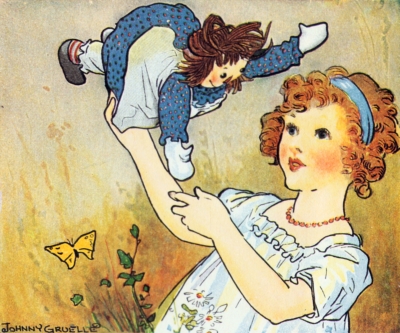
Marcella Gruelle was one of those young schoolchildren receiving a hypodermic smallpox inoculation at school. Almost immediately, she loses her appetite, becomes feverish and fatigued. Instead of notifying her parents, the school nurse administers another round of shots to little Miss Gruelle. Marcella’s health continues to decline and she quickly becomes bedridden. She loses her muscle control, “becoming listless and lifeless like a rag doll.”
Marcella dies a slow and painful death, every moment of which witnessed by her loving parents. After her death in November of 1915, seven leading physicians were called upon to opine about the cause of her death. Six of them determined that death was caused as the result of vaccine induced poisoning and call it malpractice. The seventh, being the head of the school board and a supporter of vaccination, declined to comment.
In spite of this, Marcella’s death certificate cited vascular heart disease of several years duration as the cause of death. The secondary (or contributory) cause was listed as oedema with a duration of about 90 days. Oedema is defined as a condition characterized by an excess of watery fluid collecting in the cavities or tissues of the body. Nowhere on the certificate was a vaccination, or infected vaccination for that matter, listed as a cause of death. For the rest of their lives, Myrtle and Johnny Gruelle staunchly maintained that either a bad vaccination or a dirty needle had killed their daughter.
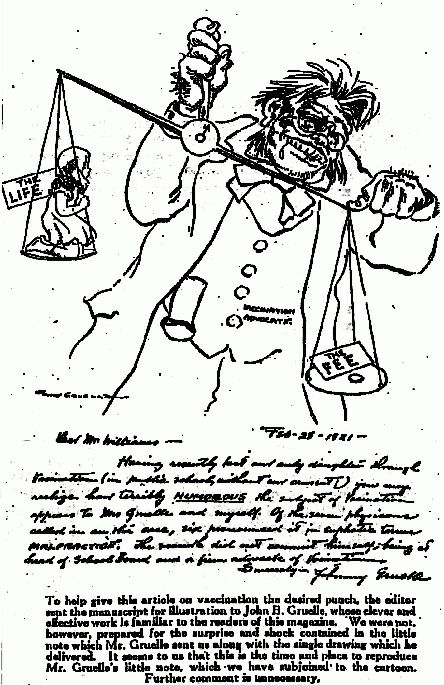
Not long after his daughter’s death, the still grieving Gruelle was commissioned to create an illustration for an article in Physical Culture magazine titled “Vaccines Killed My Two Sisters.” The cartoon is a clever and effective work, reflective of Johnny’s style which is familiar to the readers of the magazine. Mr. Gruelle enclosed the following handwritten note along with his submitted illustration: “Feb. 28, 1921. Dear Mrs. Williams, Having recently lost our only daughter through Vaccination (in public school, without our consent) you may realize how terribly HUMOROUS the subject of vaccination appears to Mrs. Gruelle and myself. Of the seven physicians called in on the case, six pronounced it in emphatic terms MALPRACTICE. The seventh did not commit himself, being the head of the school board and a firm advocate of vaccination. Sincerely, Johnny Gruelle.”
The tragic vaccine-induced death of Marcella propelled Johnny to become a staunch member of the anti-vaccination movement of the time. Shortly after Marcella’s death, Johnny puts the finishing touches on a doll much different than the more popular, rigid, ceramic and composite dolls of the time. Rather than create a rigid doll that stands up straight with a healthy and happy glow, in a fitting tribute to his only daughter, he designs a soft cloth rag doll to represent her limp and dying body. Raggedy Ann is a stark contrast to the Era’s Kewpie doll’s erect posture and healthy demeanor.
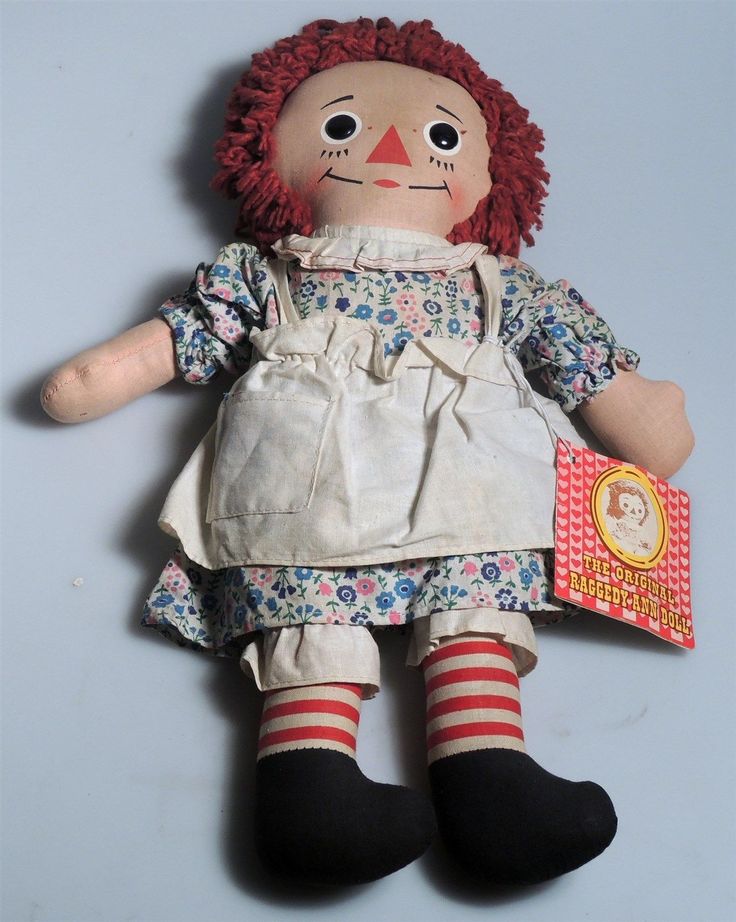
In 1920, Chicago department store giant, Marshall Field, markets the Raggedy Ann doll. It becomes an instant best seller and customers have no clue about the tragic inspiration behind it. To generations of consumers, Raggedy Ann is their colorful little friend with a candy heart. To the anti-vaxxers, Raggedy Ann symbolizes a century of childhood vaccine injuries and deaths.
 Original publish date: February 6, 2017
 Don’t remember THAT part of Kings Island? Well, that may due to the fact that this “ride” came with an up charge. It required an extra 50 cent ticket to enter. Most kids didn’t go because they didn’t have the extra money or because their parents were unwilling to spring for the extra expense.

 Original publish date: July 11, 2014
 After Chenault’s arrest, police found a hit list of names in his pocket that included 10 black clergymen and strangely, Aretha Franklin. Weeks before the incident, witnesses said that Markie went through numerous personality changes. One day he was an anti-communist; the next day a Black Panther militant. One day he was a Christian, the next, a Muslim or a Jew. One week he was chasing women, the next week he claimed to be homosexual.But mostly, Markie turned lonely and withdrawn. His motivation for the dastardly crime was a mystery.
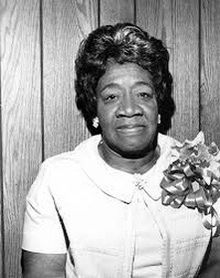 Alberta Williams King died at the age of 69 by the actions of little Markie Chenault. Her death was a shock to the congregation, the city, and the nation. In her honor, Atlanta mayor Maynard Jackson ordered the flags on all Atlanta city buildings to be flown at half-staff. Her body came back to Ebenezer Baptist Church to lie in state for public viewing, just a few feet from where she was shot. Alberta’s funeral was held at Ebenezer Baptist Church; U.S. representative from Georgia Andrew Young, who was on the balcony of the Lorraine Motel when her son was killed six years earlier, officiated at the service. Funeral attendees included members of the King family, second lady of the United States Betty Ford, and Georgia governor Jimmy Carter. She was buried in the same double mausoleum at Atlanta’s South-View cemetery that had previously held her son Martin Luther King, Jr.’s remains.
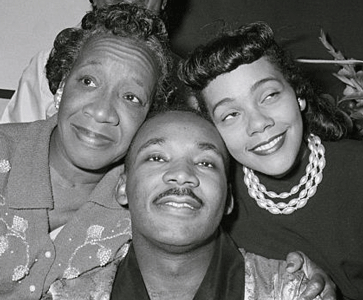 His father said in his autobiography, “Alveda had been up the night before, she said, talking with her father and watching a television movie with him. He’d seemed unusually quiet…and not very interested in the film. But he had wanted to stay up and Alveda left him sitting in an easy chair, staring at the TV, when she went off to bed… I had questions about A.D.’s death and I still have them now. He was a good swimmer. Why did he drown? I don’t know — I don’t know that we will ever know what happened.” Naomi King, A.D.’s widow, said, “There is no doubt in my mind that the system killed my husband.”
 Original publish date: June 10, 2013
 Sean Leslie Flynn, born May 31, 1971, made some forgettable films during his short movie career including the regrettable remake of his father’s classic “Captain Blood” featuring the predictable title “Son of Captain Blood”. When he “retired” from acting, Flynn signed a contract with Time Magazine. In a search for exceptional images, he attached himself to Special Forces units and even irregulars operating in remote areas.
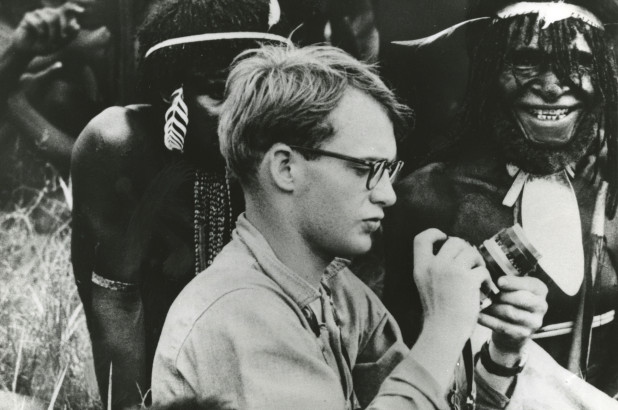 On November 17, 1961, Rockefeller and Dutch anthropologist René Wassing were in a 40-foot dugout canoe about three miles from shore when their double pontoon boat was swamped and overturned into the Arafura Sea. Their two local guides swam for help and told the Anglos to stay put, for obvious reasons. After drifting for some time in the rolling waters off the coast of New Guinea, Rockefeller said to Wassing “I think I can make it”. Michael estimated that the catamaran boat was five miles from the shore. The current was against him, and he risked a confrontation with a shark or crocodile, but perhaps because he was a Rockefeller, the fabled family of industrialists, philanthropists and politicians, he decided to swim for it. Later it was determined that the capsized boat was closer to twelve miles off shore when Michael pushed off.
 Original publish date: September 2, 2013
