
Original publish date: November 25, 2008 Updated/Republished December 6,2018
As Christmas morning creeps ever-closer, parents all over the Hoosier state are making their lists and checking them twice. No doubt, at least a few of those lists will include a bicycle. I’m not sure if the bike retains the same lofty perch it did a half a century ago. I’m equally unsure if moms and dads still spend the hours after midnight busting knuckles, pinching fingers and squinting hopelessly at indecipherable directions written in more than one language.
The bicycle has become almost an afterthought in today’s world. But once, it truly was the eighth wonder of the world. The bicycle introduced a radical new invention known as the “pneumatic tire”. In addition to air-filled rubber tires, we can thank the bicycle for giving us ball bearings, devised to reduce friction in the bicycle’s axle and steering column, for wire spokes, and for differential gears that allow connected wheels to spin at different speeds.
And where would our airplanes, golf clubs, tent poles and lawn furniture be without the metal tubing used in bicycle frames to lighten the vehicle without compromising its strength? Bicycles also gave birth to our national highway system, as cyclists and cycling clubs outside major cities across the country tired of rutted mud paths and began lobbying for the construction of paved roads. What’s more, many of the bicycle repair shops were the breeding grounds for a number of pioneers in the transportation industry, including carmakers Henry Ford and Charles Duryea and aviation pioneers Orville and Wilbur Wright. All of these men started out as bicycle mechanics. And did you know that Indianapolis was on the cutting edge of the bicycle industry from the very beginning?
 Although the first documented appearance of a bicycle in Indianapolis can be traced to a demonstration of the high-wheeled bike called the “Ordinary” in 1869, these old fashioned contraptions (known back then as “Velocipedes”) would be almost unrecognizable to the riders of today. With their huge front tires and seats that seemed to require a ladder to climb up to, these early bikes were awkward and unwieldy for use by all but the most hardy of daredevil souls (They didn’t call them “boneshakers” for nothing back then). It would take nearly 25 years after the close of the American Civil War before the bike began to resemble the form most familiar to riders of today. The development of the safety bike with it’s 2 equal-sized wheels in the 1880s made the new sport more acceptable as a hobby and pastime.
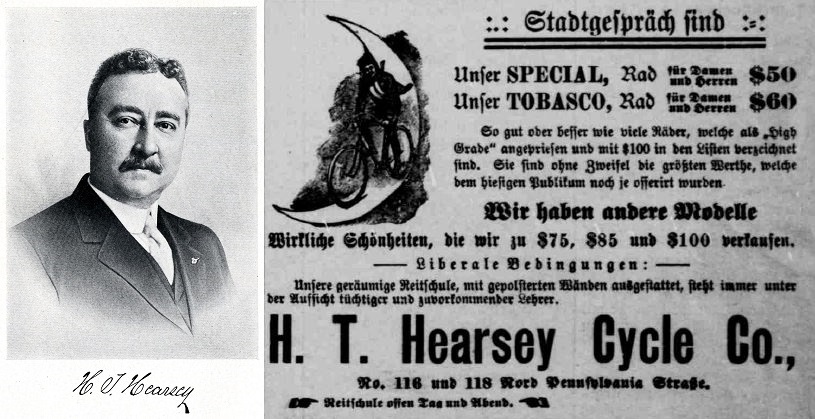
 In 1887 bicycle mechanic and expert rider Henry T. Hearsey (1863-1939) opened the first bicycle showroom in Indianapolis. His store was located at the intersection of Delaware and New York Streets on the city’s near eastside. Hearsey introduced the first safety bike to Indianapolis, the English-made Rudge, which sold for the princely sum of $150 (roughly $4,000 in today’s money). Keep in mind that was about twice the price of a horse and buggy at the time. He would later open a larger shop at 116-118 North Pennsylvania Street. He is credited for introducing the 1st safety bicycle in the Capitol city in 1889. Hoosiers took to it immediately and within a few short years, the streets of Indy were so clogged with bicyclists that the City Council passed a bicycle licensing ordinance requiring a $ 1 license fee for every bicycle in the city.
Henry Hearsey had fallen in love with Indianapolis during an exhibition tour for the Cunningham-Heath bicycle company of Boston, Massachusetts in 1885. He not only sold the first new style bicycles in the Indy area, he also formed the first riding clubs in the city. These clubs, with colorful names like the “U.S. Military Wheelmen”, the “Zig-Zag Cycling Club” and the “Dragon Cycle Club”, would regularly host festive long distance bicycle trips known as “Century Rides” to towns like Greenfield and Bloomington. This period has been called the “Golden Age of Bicycling” by historians. Hearsey also had two famous names working for him at his bike shop: Carl Fisher and Major Taylor.
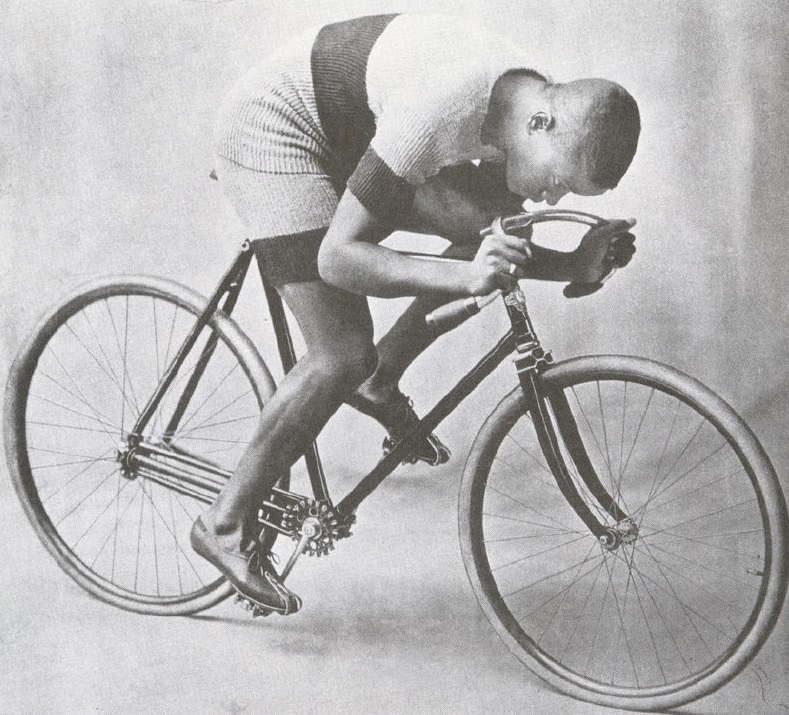
Legendary Indianapolis African American bicycle champion Marshall “Major” Taylor was hired by Henry Hearsey to perform bicycle stunts outside of his shop in 1892. 14-year-old Taylor’s job was as “head trainer” teaching local residents how to ride the new machines.Taylor performed his stunts while dressed in a military uniform and earned  the nickname “Major”, which stuck with him the rest of his life. He has been widely acknowledged as the first American International superstar of bicycle racing. He was the first African American to achieve the level of world champion and the second black athlete to win a world championship in any sport. Carl Fisher was one of the founders of the Indianapolis Motor Speedway, developer of the city of Miami and the creator of the famous “Lincoln Highway” and the “Dixie Highway.”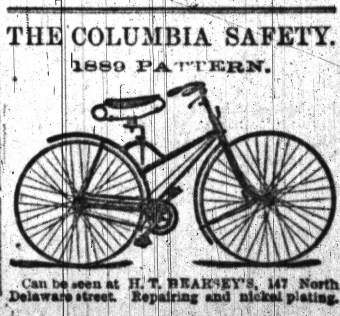
His innovations included the installation of a revolutionary foot air bellows system that would be known for decades as the “town pump” for public use outside of his store. His shop became a popular hangout for the city’s bicyclists who liked to drop in and rub elbows with all of the greatest bike racers of the age. Indianapolis was a midwest mecca for pro-bicycling in the late 1800s and early 1900s. Hearsey would often use the massive Tomlinson Hall in Indy to unveil the newest model of bicycle in the 1890s. Tomlinson Hall was the largest public venue in the city and Hearsey would routinely fill the place to the rafters with excited Hoosier bicyclists, which would be like renting Lucas Oil Stadium to unveil a new bike today. Cycling in the Circle City was so popular that on April 28, 1895 the Indianapolis Journal ran an eight-page supplement called the “Bicycle Edition” entirely devoted to the cycling craze consuming the Hoosier State and the rest of the country.
 Cycling was so popular in Indianapolis that the city constructed a racing track known as the “Newby Oval” located near 30th Street and Central Avenue in 1898. The track was designed by Shortridge graduate Herbert Foltz who also designed the Broadway Methodist Church, Irvington United Methodist Church and the Meridian Heights Presbyterian Church. Foltz would also design the new Shortridge High School at 34th and Meridian. The state of the art cycling facility could, and often did, seat 20,000 and hosted several national championships sponsored by the chief sanctioning body, “The League of American Wheelmen.” The American Wheelmen often got involved in local and national politics. Hoosier wheelmen raced into the William McKinley presidential campaign in 1896 and helped him win the election. With this new found political clout, riding clubs began to put pressure on politicians to improve urban streets and rural roads, exclaiming “We are a factor in politics, and demand that the great cause of Good Roads be given consideration.”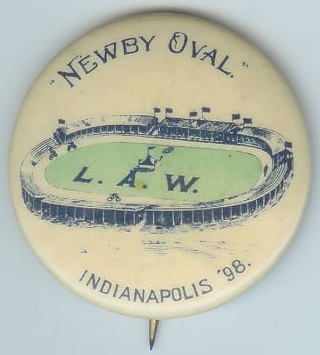
During this turn-of-the-century era, Indianapolis became one of the leading manufacturers of bicycles in the United States with companies like Waverly, Munger, Swift, Outing, Eclipse and the Ben-Hur offering some of the finest riding machines of the day. According to the Indiana Historical Bureau, from 1895-96, Indianapolis had nine bicycle factories employing nearly 1,500 men, women and boys. Not to mention a couple dozen repair shops, parts suppliers and specialty stores stocking bicycle attire like collapsible drinking cups, canteens, hats, goggles, shoes and clothing.
In the years before World War I, two entire city blocks around Pennsylvania Avenue became known as “bicycle alley”. Here bicycle enthusiasts congregated among the many manufacturers, outfitters and repair shops to talk shop, swap stories and plan routes. Some of the more popular spots to ride in the Circle City included 16th Street and Senate Avenue, Broad Ripple and the tow path along the Central Canal.
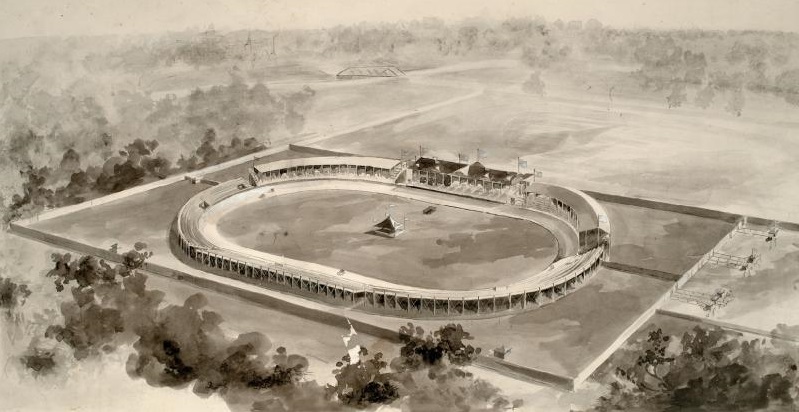
The gem of Indianapolis’ cycling community was the Newby Oval on Central Avenue and 13th Street. The $23,000, quarter-mile track featured a surface made of white pine boards, rough side up to keep wheels from slipping. Wire brushing removed splinters before the floorboards were dipped into a tank of wood preservative and nailed into place. The track featured a “whale-back” design of banked curves to increase safety and accommodate speed. The Newby Oval featured grandstand seating, two amphitheaters, and bleachers designed to hold more than 8,000 spectators.
The Newby Oval’s first race, sponsored by the League of American Wheelmen hosted its first bike race on July 4, 1898. The contest included ragtime, two-step, and patriotic tunes to serenade the riders and spectators alike. Every time a rider neared the finish line, spectators fired their pistols in the air in anticipation. For a time, the Newby Oval was considered to host the city’s first automobile race. The euphoria didn’t last long though. Because cars would need to run in separate heats at the Newby Oval, the event was moved to the State Fairgrounds, where multiple vehicles could compete at one time. The track’s building materials were put up for sale and by early 1903, the Newby Oval was dismantled. By the turn-of-the-century, interest in cars was outpacing bicycles. By 1908, the bicycle craze was over.
With the advent of the automobile and motorcycles in the early 1910s, interest in bicycling as a form of transportation waned. Henry T. Hearsey changed with the times and became Indianapolis’ first automobile dealer. Hearsey lived at 339 East Tippencanoe Street, just a stone’s throw away from the James Whitcomb Riley house in Lockerbee Square. Indianapolis, just as it had in the generation before with bicycles, soon become a pioneer in the manufacture of automobiles, second only to Detroit in fact. Most of the parties involved in the Indianapolis Motor Speedway were former colleagues of Henry Hearsey and members of his bicycle clubs.
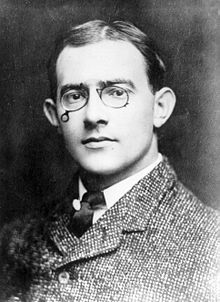
While images of the old fashioned high-wheeled “ordinary” bicycles and the winged tire logo of the Indianapolis Motor Speedway are instantly recognizable to sports fans all over the world, no-one remembers Henry T. Hearsey today. Hearsey not only introduced Indianapolis to the first commercially viable bicycle, opened the first Circle City bicycle shop, was the first to recognize the genius of Major Taylor and Carl Fisher and opened the first car dealership in the city. He was born during the Civil War, flourished during the Gilded Age / Industrial Age / Progressive Era / Roaring Twenties and survived the Great Depression. Henry T. Hearsey, the trailblazing businessman whose name is unknown to most Hoosiers, died in the summer of 1939. He lies buried in Crown Hill Cemetery among the many notable names from the pages of Indianapolis’ history, most of whom knew him personally and called him by his nickname. Happy holidays “Harry” Hearsey, the Circle City tips its collective cap to you.

 Although I never fail to take my annual trip around Monument Circle at Christmastime to gaze in wonder at the fantastic fir tree fantasy, my personal memories of Christmas on the Circle revolve around a little shack that used to rest at its base facing the Indiana Statehouse. You may think of the L.S. Ayres Cherub, Santa’s mailbox, the 26 larger-than-life toy soldiers and sailors surrounding the Circle, the 26 red & white striped peppermint sticks, the 52 garland strands or the 4,784 colored lights strung from the top of the Monument to its base, but I think of the Roselyn Bakery Christmas Hut.
 Decorated with Gingerbread man shutters and candy cane pillars, coated in what looked like white icing, the Christmas hut was set up on the West side of the Circle where it remained for 25 years from 1974 to 1999. It was estimated that some 1.2 million Gingerbread man cookies were handed out from within that festive little house over those years. Just like the bakery itself, that little hut was an institution.
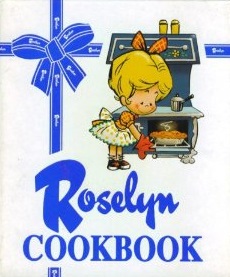 For me, Roselyn will always be identified for buttermilk jumbles, toffee cookies, alligator & sweetheart coffee cakes, yeast donuts and the darling little girl cartoon mascot known as “Rosie”. A blonde haired, blue eyed perpetually smiling little naive whose popularity forced the Roselyn Christmas Hut to undergo a name change to “Rosie’s Gingerbread House.” If memory serves, for a time there was even a living, breathing life-sized “Rosie” mascot dressed in a horribly oversized paper mache’ head and wearing a red velvet dress. Every so often, she would wobble awkwardly out of the Gingerbread hut to personally pass out cookies to the eager, but slightly befuddled, kiddies on the Circle. As I recall, she didn’t speak, but to a 12-year-old cartoon addicted boy like me, her skirt was short and her cookies were hot.
 a long way baby.”
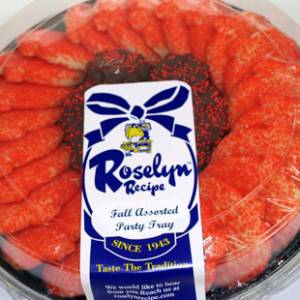 Eight mayors and ten governors have served our city and state over the past 50 years. I can’t say that I miss any of them, but I do miss those Gingerbread cookies. If you do too, you can make them yourself. Here’s the recipe for Roselyn Bakeries famous Gingerbread Men cookies: 1 1/4 teaspoon allspice, 2 3/4 teaspoons baking soda, 5 teaspoons ground cinnamon, 1 teaspoon ground cloves, 1 teaspoon ground ginger, 2 1/2 teaspoons salt, 3/4 cup Crisco shortening, 3/4 cup granulated sugar, 6 tablespoons whole eggs, 1 1/4 cup extra fine coconut (Make sure that the coconut you use is very fine, almost like coarse sugar-you may have to grind store bought coconut flake down), 1 1/4 cup honey, 5 cups all-purpose flour. Preheat oven to 360 degrees F. Combine allspice, baking soda, cinnamon, cloves, ginger, salt, shortening, and sugar into a large mixing bowl. Cream together. Scrape down bowl. Add beaten eggs and mix thoroughly.
 Scrape down bowl. Add coconut and honey and mix well. Scrape down bowl. Add flour and mix well. On a lightly floured surface, with a floured rolling pin, roll dough 1/8 inch thick. With a 5 inch long cutter, cut out men. Re-roll trimmings and cut more cookies. With spatula, place 1/2 inch apart on cookie sheets. Bake at 360 degrees for 8 minutes or until browned, then, with spatula, remove cookies to racks to cool. Decorate as desired. Makes 3 dozen cookies. Now if I could only locate a slightly used Christmas shack.

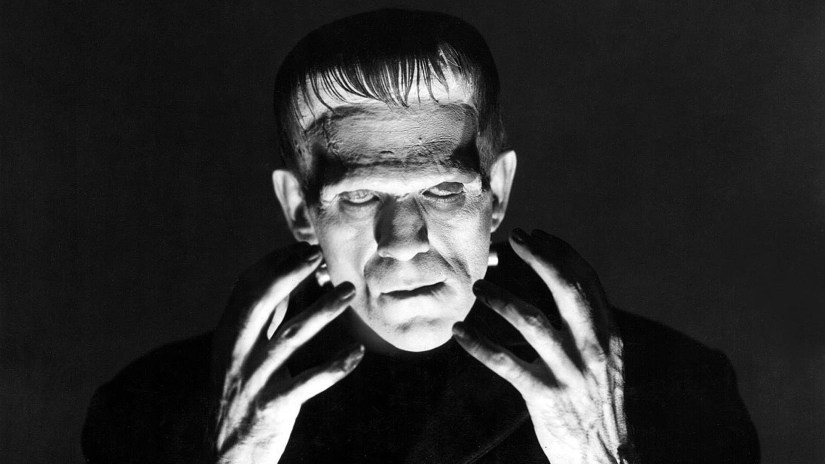
 What better time to introduce two of the world’s most popular monsters? Frankenstein and Dracula were born on the same night in the same weekend in 1816. They were brought to life by Mary Shelley and Lord Byron during a contest to see who could create the scariest monster. The weekend was wet and stormy and Lord Byron suggested the reading of ghost stories to pass away the dreary weather. Sitting around a log fire at the Villa Diodati on the shores of Lake Geneva, the company of friends amused themselves by reading German ghost stories translated into French from the book Fantasmagoriana. The members of the party were Lord Byron and his mistress Claire Claremont, his doctor John Polidori, Percy Bysshe and Mary Shelley. Lord Byron is known for his poetry, mostly Don Juan. After reading a few stories, Byron suggested that each member of their party write their own story of horror.
 Unable to think of a story, young Mary became anxious, in the introduction to her book she recalled: “Have you thought of a story? I was asked each morning, and each morning I was forced to reply with a mortifying negative.” During one evening in the middle of summer, the discussions turned to the nature of the principle of life. “Perhaps a corpse would be re-animated”, Mary noted, “galvanism had given token of such things”. It was after midnight before they retired, and unable to sleep, she became possessed by her imagination as she beheld the grim terrors of her “waking dream.” In September 2011, astronomer Donald Olson, after visiting the Lake Geneva villa and inspecting data about the motion of the moon and stars, concluded that her “waking dream” took place “between 2 a.m. and 3 a.m.” on June 16, 1816, several days after the initial idea by Lord Byron that they each write a ghost story.
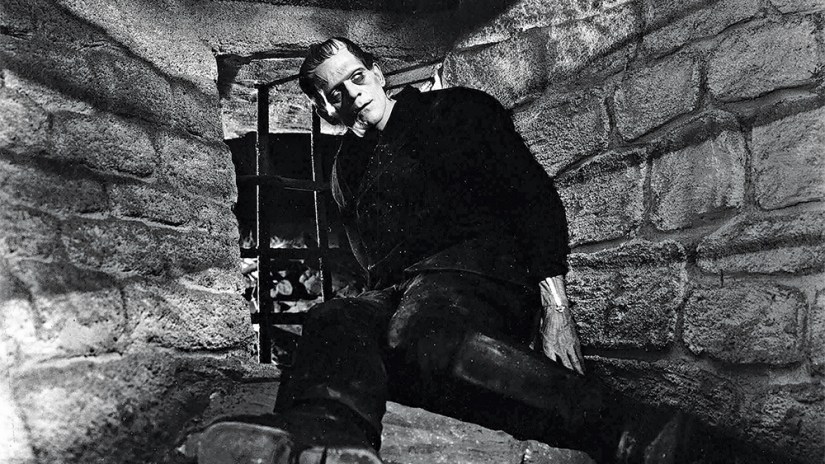 When “Frankenstein” was published it became an immediate sensation. Mary Shelley crafted her book so that readers’ sympathies would lie not only with Frankenstein, whose suffering is dreadful, but also with the creature, whose suffering is worse. Shelley skillfully directs her readers’ sympathy, page by page, paragraph by paragraph, sometimes even line by line, from Frankenstein to the creature. Shelley deftly navigates the creature’s vicious murders, first of Frankenstein’s little brother, then of his best friend, and, finally, of his bride. In 1824, one critic wrote, “The justice is indisputably on his side and his sufferings are, to me, touching to the last degree.”
 A century later, a lurching, grunting Boris Karloff defined the most widely accepted version of the creature in Universal Pictures’s 1931 production of “Frankenstein.” Karloff’s monster-portrayed as prodigiously eloquent, learned, and persuasive in the novel-was no longer merely nameless but all but speechless, too. “Frankenstein” has spawned many different depictions in the two centuries since its publication. For its bicentennial, the original, 1818 edition has been reissued in paperback form by Penguin Classics as “The New Annotated Frankenstein.”
 This coming Saturday, October 20th at 2 PM, several of those famous friends will be here in Irvington at the Irving theater to share their talent with our community in a program I have called, “Whispers from the Grave. Testimony of Irvington’s Most Famous Crimes.” Over the past decade and a half I have gathered testimony, witness accounts, personal statements and personality sketches of the characters, both good and bad, from the stories I share on the tours. This Saturday, local celebrities, journalists and members of the media will lend their talents to the voices of these characters. Much of this spoken word performance will offer accounts that have not been heard for over a century. This testimony, told in its entirety using the words of the subjects themselves, is always poignant, sometimes shocking and often scandalous.
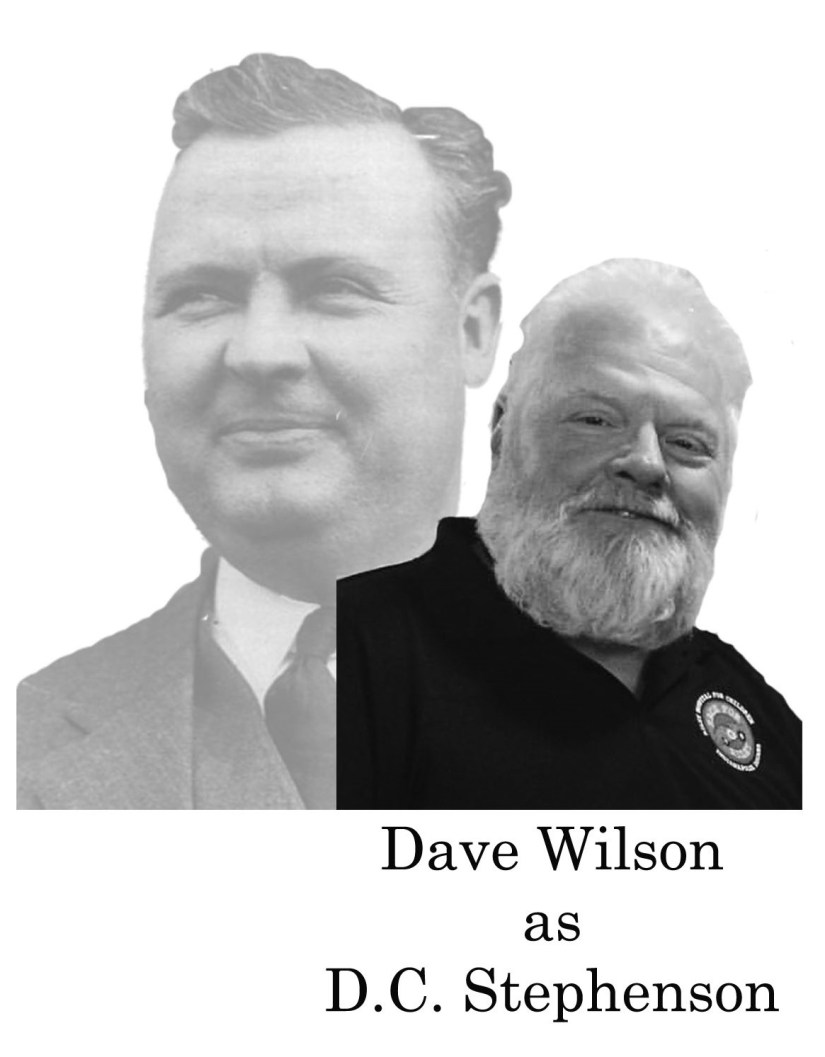 Joining us Saturday will be long time Q 95 star and stand up comic Dave “the King” Wilson reading the words of DC Stephenson. David Curtis Stephenson was the Grand Dragon of the Indiana Ku Klux Klan who reigned supreme here in central Indiana during The Roaring 20s. Stephenson controlled Indiana politics from the governor’s office to the mayor’s office with Klan money and influence from his University Avenue home here in Irvington. Gathering testimony and statements from Stephenson’s made all the more harder by the fact that after his 1925 trial for murder concluded, the official court papers mysteriously disappeared.
 2 – time Emmy award-winning former WTHR on air personality & meteorologist Nicole Misencik who will be voicing Madge Oberholtzer. Tragically, Madge was the undeserving victim of DC Stephenson’s crime in the spring of 1925. Madge was an Irvingtonian and former student at Butler College whose death at the hands of Stephenson brought down the Ku Klux Klan, which was the most powerful organization in the country at the time. Madge’s testimony was so graphically detailed that when it was read aloud in open court in Noblesville Indiana, women fainted and grown men got up and left the room. Nicole will recount Madge’s 9 – page deathbed declaration and its entirety for the first time in public and nearly a century.
 Former WTHR reporter Brandon Kline will be voicing Pinkerton detective Frank Geyer, the man who brought America’s first serial killer to justice. Brandon will wear the hero cape by voicing this legendary Pinkerton agent who is dogged determination alone solved Irvington’s first murder, that of 10-year-old Howard Pitezel. Brandon’s hero duty will be doubled when he also voices Irvingtonian lawyer Asa J Smith who recorded Madge’s deathbed declaration in what promises to be a most memorable exchange with his wife Nicole.
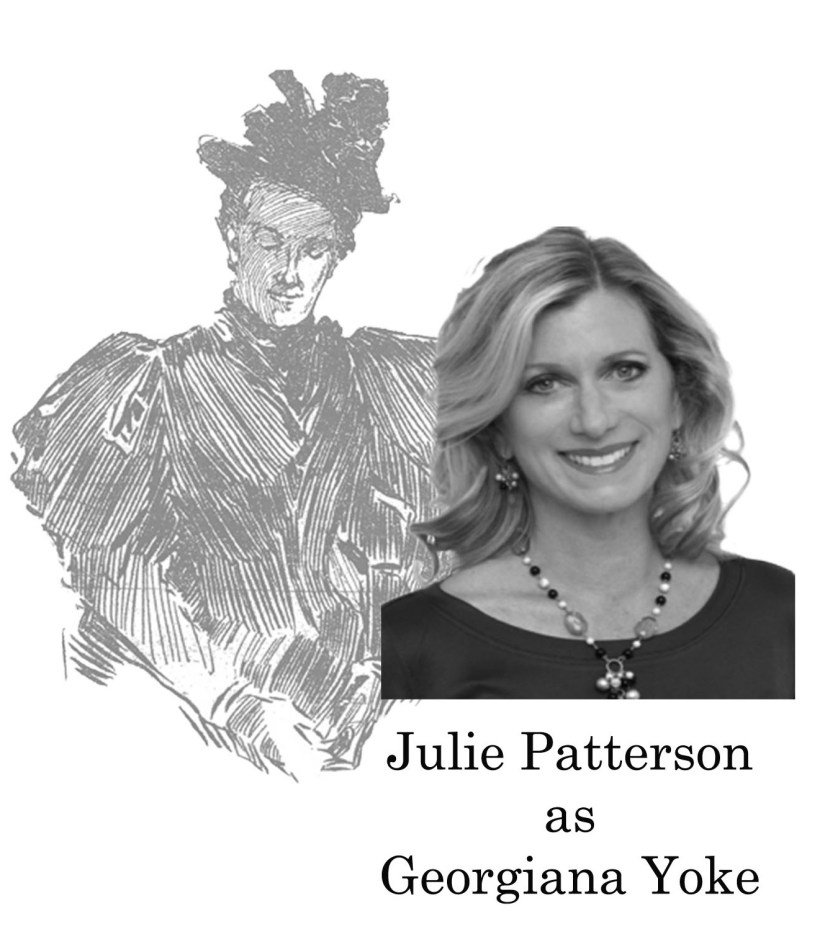 Boomer TV personality, longtime WZPL radio host and former WISH – TV alumni Julie Patterson will be voicing the last wife of HH Holmes, Georgiana Yoke. Ms. Yoke, a native of Franklin Indiana, is easily the most unknown character in the presentation. Georgiana’s family has deep connections to Indianapolis’east side at both Garfield Park and Holliday Park. Georgiana narrowly escaped death at the hands of her husband and, after his death by hanging, could not escape the cloud of suspicion that hung over her in Indianapolis after her husband’s crimes were revealed. Julie’s interpretation of Georgiana will also include her court testimony, some of which was delivered by her husband HH Holmes while acting as his own counsel.
 Ed Wenck, long time local radio host, journalist, author and on-air television personality, will be voicing America’s first serial killer HH Holmes. Allegedly responsible for over 200 murders, Holmes admitted to killing 27. The arch fiend came to Irvington in October 1894 on the heels of the 1893 Chicago world’s fair. His crimes are numerous, gruesome and unspeakable. Ed will voice America’s first serial killer using Holmes’ own words which are guaranteed to make your skin crawl.


 The Chicago club opened on a bitterly cold day in Chicago, yet lines of eager prospective members stretched around the block, warmed by ideas of what was to be found inside. Membership was available to anyone willing to purchase a key – $50 for residents and $25 for out-of-towners. The club “key” itself was metal and topped off with a rabbit head, later replaced by a gold plastic credit card to carry in a wallet. Hefner was present at the grand opening until the club closed at 4am. Keyholders gawked at ladies in their colorful Playboy Bunny outfits and dined on steaks and salads (no fancy hors d’oeuvres or desserts here), drank cocktails and bought packs of cigarettes and Playboy logo lighters. Most club items were available for the standard price of $1.50 per item (an exorbitant price at the time, especially for drinks and cigarettes). In the club’s first year, entertainment included the most popular stars of the day, including Mel Torme, Barbara Streisand and a 19-year-old Aretha Franklin.
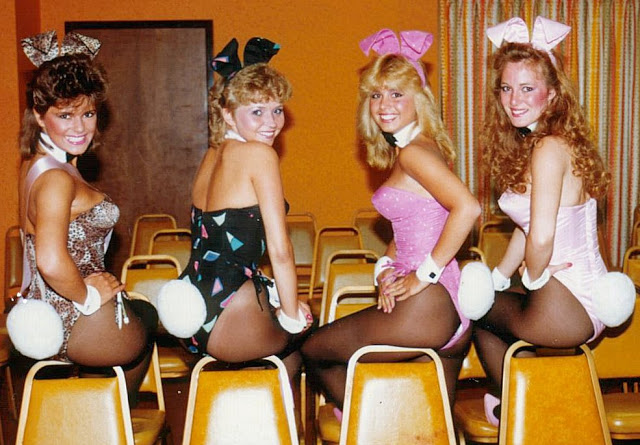
 The Bunnies themselves were instructed, in a 44-page “Bunny Manual”, that they could not date customers, give out their phone numbers, or meet their boyfriends or husbands within two blocks of the club. If they did, they would face the tortuous penalty of being banned from the “bunny hutch.” There were different types of Bunnies, including the Door Bunny, Cigarette Bunny, Floor Bunny, Playmate Bunny and the Jet Bunnies (specially selected to serve on the Playboy “Big Bunny” Jet). To become a Bunny, women first had to audition. Prospective “Kits” (short for “Kitten Rabbits”) underwent thorough and strict training before officially becoming a Bunny. Bunnies were required to be able to identify 143 brands of liquor and know how to garnish 20 cocktail variations. Customers were also not allowed to touch the Bunnies, and demerits were given if a Bunny’s appearance was not properly organized.

 Most readers are aware of feminist Gloria Steinem’s crusade to expose the sexist treatment of Playboy Bunnies in her 1983 book “Outrageous Acts and Everyday Rebellions.” The article featured a photo of Steinem in Bunny uniform and detailed how women were treated at those clubs. The article was first published in 1963 in Show magazine as “A Bunny’s Tale”. But are there any other famous former Bunnies out there? Well, yes, the “hutch” is littered with the names of young, struggling Hollywood actresses. Some are familiar: Lauren Hutton, Sherilyn Fenn (Twin Peaks TV star), Barbara Bosson (Hill Street Blues TV star), Patricia Quinn (Magenta from Rocky Horror), Kathryn Leigh Scott (Dark Shadows TV star) and many others. Jon Bon Jovi’s mom, Carol Sharkey, was a Bunny as was Kimba Wood, Bill Clinton’s nominee for Attorney General in 1993. At least 32 former Bunnies were also Playboy Magazine Centerfold “Playmates.” Rock stars Dale Bozzio (Missing Persons and Frank Zappa) and Blondie’s Debbie Harry were also Bunnies. Harry once famously remarked, “The girls there were part of the entertainment; part of the sort of mystique, the excitement, the naughtiness of it. But on the inside of that job, the girls were treated very, very well. There was a lot of benefits: health benefits, job security, good salary, good money. It was a very sought-after kind of job.”
 The Chicago Playboy Club enjoyed a long and successful quarter century run, but closed in 1986. Today, the “One Magnificent Mile Building” has replaced the Chicago Playboy Club, and in 2000, that stretch of Walton was given the honorary name of “Hugh Hefner Way.” The original magazine headquarters was located nearby as was the original Playboy Mansion at 1340 N. State St., both of which have also moved on. Sadly, nothing has quite replaced the Playboy Club in Chicago. Hugh Hefner died at his home in Holmby Hills, Los Angeles, California, on September 27, 2017, at the age of 91. The cause was sepsis brought on by an E. coli infection. He is interred at Westwood Memorial Park in Los Angeles, in the $75,000 crypt beside Marilyn Monroe. “Spending eternity next to Marilyn is an opportunity too sweet to pass up.”

