
Original publish date: May 2014 Reissue date: September 26, 2019
Outlaws Bonnie and Clyde have been in the news again lately, nearly 85 years after they died in dramatic fashion on a dusty backroad in Gibsland, Louisiana. I wrote this 3-part series over 5 years ago and have since added an updated part 4 to the saga. So, here are the first 3 parts as written a hemi-decade ago. Stay tuned for the updates just in time for Halloween Festival weekend.
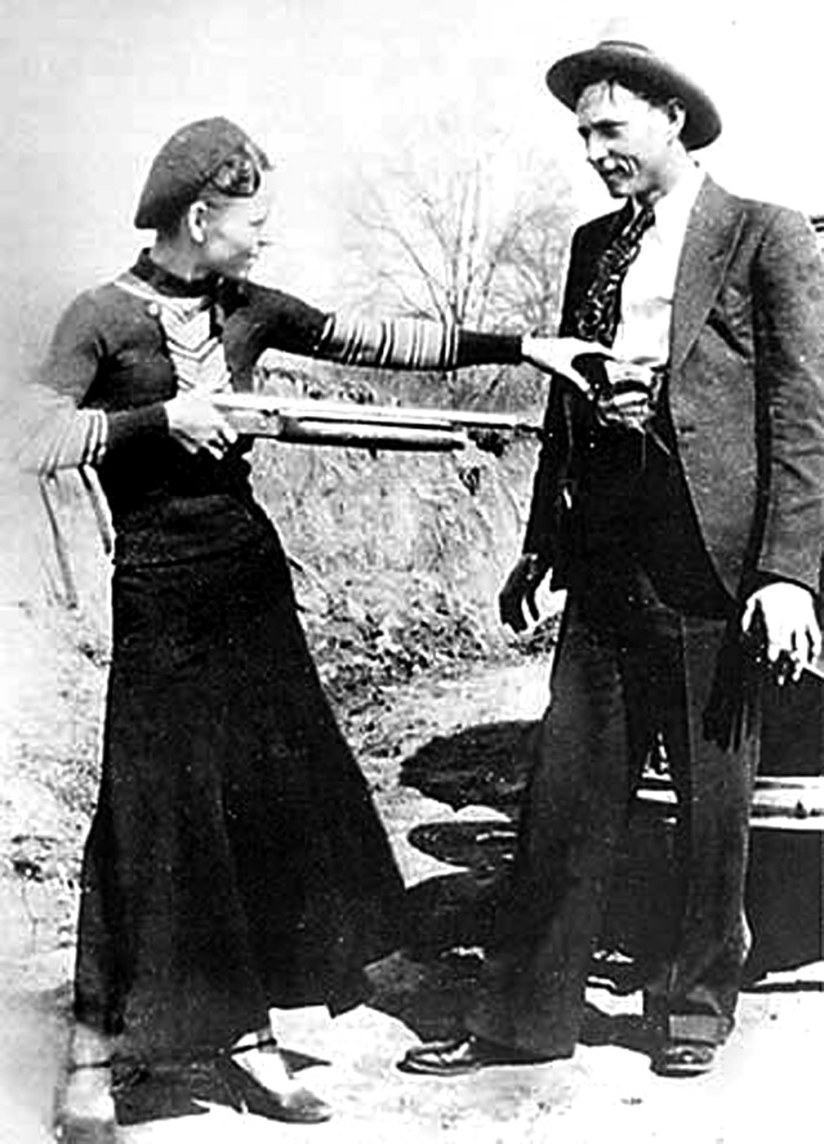
Bonnie and Clyde. Names that evoke different images to different people. Although their image, like those of Billy the Kid , Jesse James and John Dillinger, have been romanticized over the years; the truth is a little bit more complicated. Without doubt, Bonnie Parker and Clyde Barrow are the most famous pair of star crossed outlaws this country has ever seen. On May 23, 1934, 80 years ago this week, they died exactly as they lived: violently. Bonnie was only 23 years old; Clyde a mere 24.
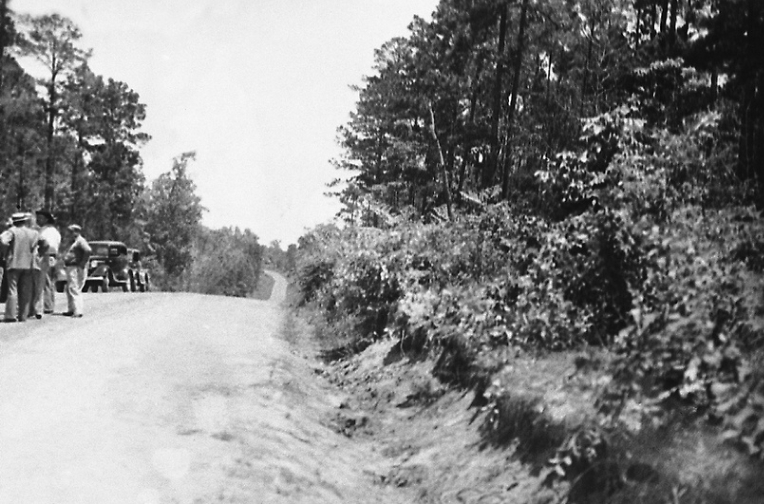
On a dusty, mosquito choked rural road near Gibsland, Louisiana, Bonnie & Clyde were ambushed by a group of six heavily armed hardcore Texas lawmen. The deadly duo never had a chance. When the smoke had cleared, the coroner counted 17 separate entrance wounds on Clyde Barrow’s body and 26 on Bonnie Parker’s. Other accounts say Clyde was shot 23 times and Bonnie 25, either way, they were killed instantly. The wounds included several headshots on each, one bullet snapping Barrow’s spinal column. Undertaker C. F. “Boots” Bailey had difficulty embalming the bodies because of all the bullet holes.
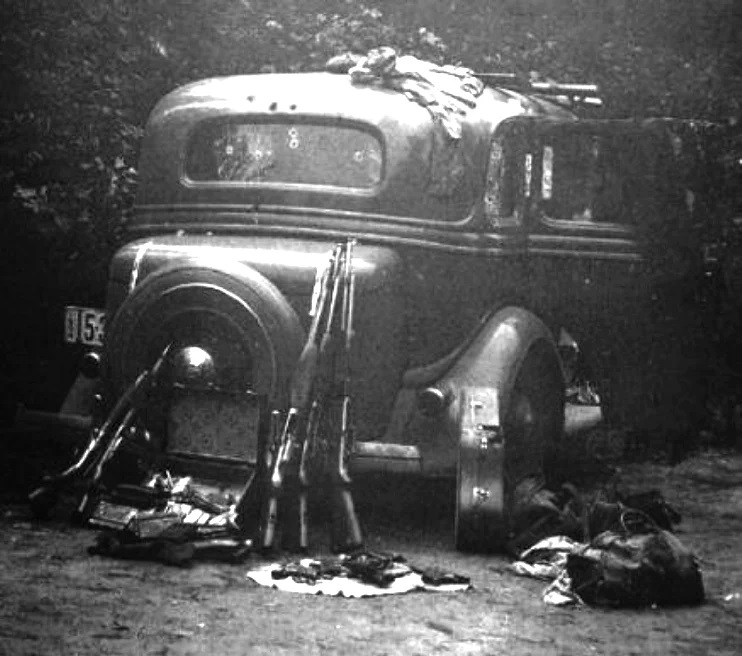
The posse used Browning Automatic Rifles, perhaps better known in gun circles as “BAR’s”, which was ironically also the weapon most favored by the Barrow Gang. The BAR’s were so powerful that some of the bullets went completely through one car door and out the other. A total of 167 bullets were fired, non of which came from either Bonnie or Clyde. The temporarily deafened officers inspected the vehicle and discovered an arsenal of weapons, including stolen automatic rifles, sawed-off semi-automatic shotguns, assorted handguns, and several thousand rounds of ammunition.

According to statements made by Dallas County Sheriff’s Deputies Ted Hinton and Bob Alcorn (both of whom knew Barrow and Parker by sight): “Each of us six officers had a shotgun and an automatic rifle and pistols. We opened fire with the automatic rifles. They were emptied before the car got even with us. Then we used shotguns … There was smoke coming from the car, and it looked like it was on fire. After shooting the shotguns, we emptied the pistols at the car, which had passed us and ran into a ditch about 50 yards on down the road. It almost turned over. We kept shooting at the car even after it stopped. We weren’t taking any chances.” The lawmen had been hiding in the bushes for a day and a half waiting for the outlaws. They weren’t in a mood to parlay.
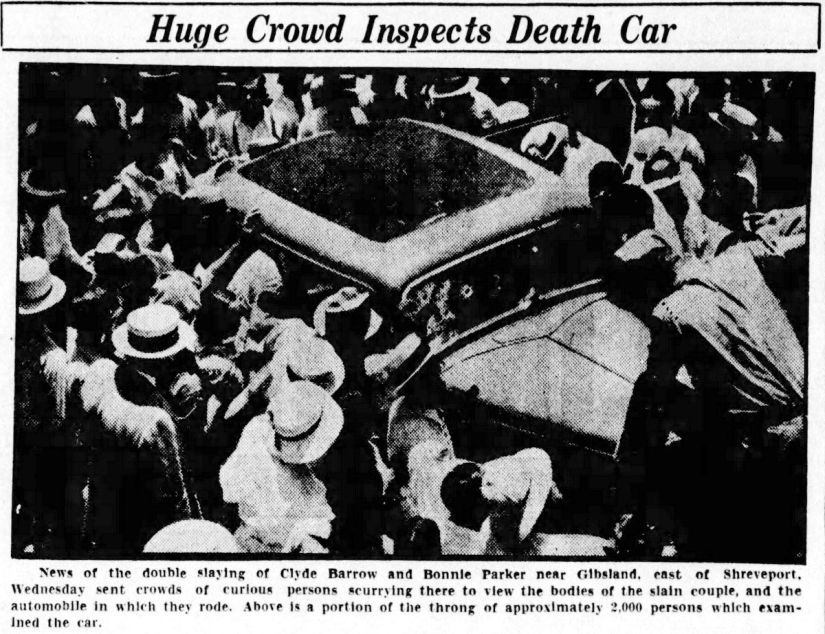 Word of the ambush quickly spread after the officers drove into town to telephone their respective bosses. A raucous crowd soon flooded the death scene and the car that was still resting there. Two members of the posse were left to guard the bodies, but they quickly lost control of the bloodthirsty souvenir hunters. Locals pushed and shoved their way to the death car; one woman cut off bloody locks of Bonnie’s hair and pieces from her dress. She was later seen back in town selling them as grisly souvenirs. Hinton returned just in time to keep a man from cutting off Clyde’s trigger finger. Arriving at the scene, the coroner observed the following: “nearly everyone had begun collecting souvenirs such as shell casings, slivers of glass from the shattered car windows, and bloody pieces of clothing from the garments of Bonnie and Clyde. One eager man had opened his pocket knife, and was reaching into the car to cut off Clyde’s left ear.” The coroner enlisted Hamer for help in controlling the “circus-like atmosphere” and Clyde’s ear remained intact.
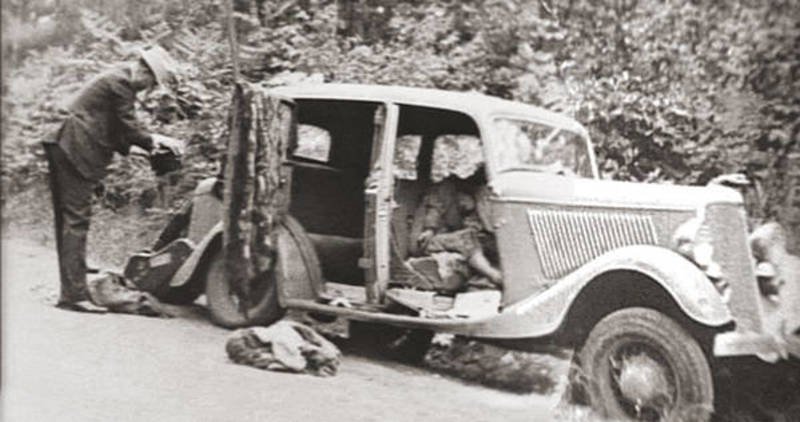
Texas Ranger inspecting death car with Bonnie’s dead body still inside.
The Ford, with the bodies still inside, was towed to the Conger Furniture Store & funeral parlor located on Railroad Avenue downtown across from the Illinois Central train station (which is now a historical museum containing Bonnie and Clyde artifacts.) The crowds were so unruly, that the caretaker had to squirt embalming fluid on them to keep them back. Preliminary embalming was done by Bailey in a small preparation room in back of the furniture store (it was common for furniture and undertakers to be together back then.) The tiny northwest Louisiana town swelled in population from 2,000 to 12,000 within hours. Curiosity seekers arrived on foot, by train, horseback, buggy, and airplane. Beer, which normally sold for 15 cents a bottle, jumped to 25 cents; ham sandwiches quickly sold out. After identifying his son’s body, Henry Barrow sat in a rocking chair in the furniture section and wept.
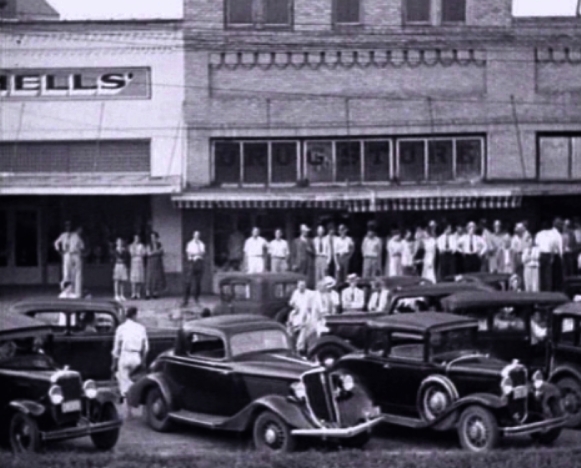
H.D. Darby, a young undertaker who worked for the McClure Funeral Parlor in nearby Ruston, and Sophia Stone, a home demonstration agent also from Ruston, came to Arcadia to identify the bodies. They had been kidnapped by the Barrow gang the previous year in Ruston, on April 27, 1933, and released near Waldo, Arkansas. Bonnie reportedly laughed when she asked Darby his profession and discovered he was an undertaker. She remarked that maybe someday he would be working on her. As fate would have it, Darby assisted Bailey in embalming the outlaws.
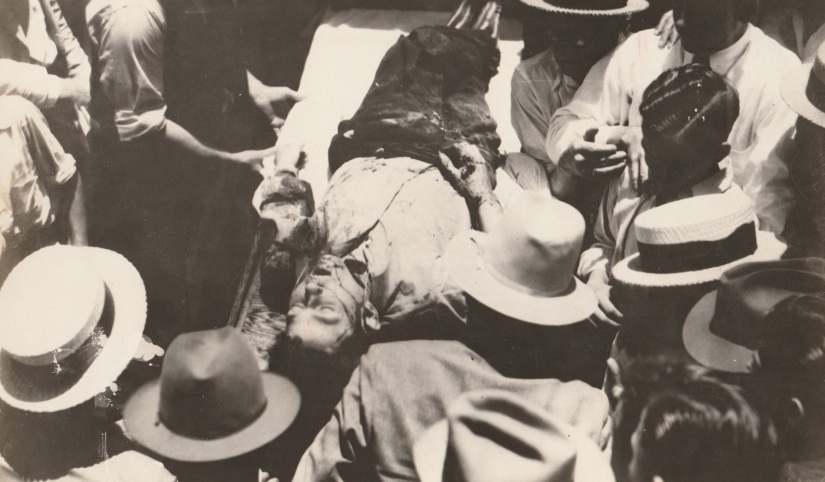
The coroner found $ 500 in cash in Clyde’s pockets and $ 6 and some change in Bonnie’s purse alongside a bullet shattered pocket mirror. All the fingers on Bonnie’s right hand had been shot off, as they laid on a pack of bloody cigarettes. Inside the car, besides the firearms arsenal, other curious items were found, including a saxophone, Hollywood movie magazines, newspapers, a box of fishing tackle and 15 sets of license plates from various states, including Indiana.
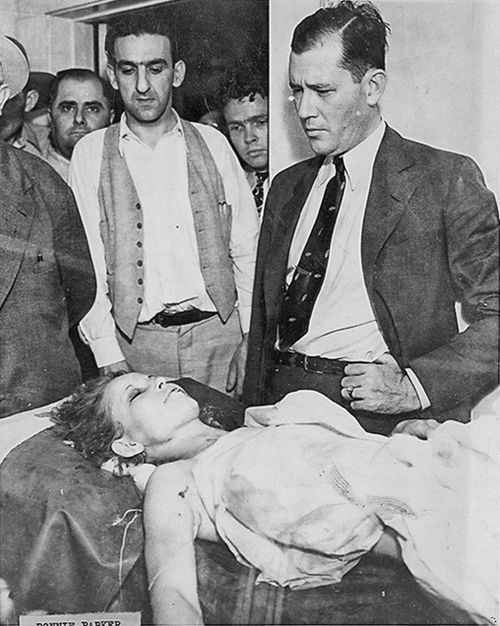
Although Bonnie had famously requested that she and Clyde be buried side by side in her poem “The Story of Bonnie and Clyde”, the Parker family would not allow it. Mrs. Parker was quoted as having said, “Clyde had her for two years and look what he did to her.” Mrs. Parker wanted to grant her daughter’s final wish by bringing the dead outlaw’s body home, but mobs surrounding the Parker house day-and-night made that impossible. Parker’s family used the McKamy-Campbell Funeral Home, located on present day Martin Luther King, Jr. Blvd in Dallas, to conduct her funeral. Bonnie’s mutilated hair was waved and curled into its former neatness. Her nails were manicured. More than 20,000 attended Bonnie Parker’s funeral, and her family had to be escorted by lawmen to her grave site.
Bonnie’s brother, Hubert “Buster” Parker, escorted her body from Arcadia to Dallas in the back of an ambulance. Her services were held on Saturday, May 26, 1934, at 2 pm, in the funeral home. Flowers came from everywhere, including some with cards allegedly from Pretty Boy Floyd and John Dillinger, who were still very much alive and on the run themselves. Curiously, the largest floral tribute was sent by a group of Dallas city newsboys. Seems the issue covering the deaths of Bonnie and Clyde sold 500,000 newspapers in Dallas alone. Although initially buried in the Fishtrap Cemetery, Parker was moved in 1945 to the new Crown Hill Cemetery in Dallas.
Clyde Barrow’s family used the Sparkman-Holtz-Brand Morticians in downtown Dallas. Thousands of people gathered outside both Dallas funeral homes hoping for a chance to view the bodies. Barrow’s private funeral was held at sunset on Friday, May 25, in the funeral home’s chapel. He was buried next to his brother Buck on a bare slope in a West Dallas Cemetery. The Barrow brothers share a single granite marker with their names on it and a four-word epitaph previously selected by Clyde: “Gone but not forgotten.” As the crowd dispersed, a low-flying plane dropped a gigantic floral wreath near the gravesite.
The life insurance policies for both Bonnie Parker and Clyde Barrow were paid in full by American National of Galveston. Since then, the policy of pay-outs has changed to exclude pay-outs in cases of deaths caused by any criminal act by the insured. Those original life insurance policies, obtained by the mothers of Bonnie and Clyde, are displayed at the American National Insurance Company Building in Galveston, Tx. It has been reported that the families of the outlaws made more off their death than the deadly duo ever made off of their short lives of crime.
The six men of the posse were each to receive a one-sixth share of the reward money. Dallas Sheriff Schmid had promised Ted Hinton this would total some $26,000, but most of the state, county, and other organizations that had pledged reward funds reneged on their pledges. In the end, each lawman earned just $200.23 for his efforts. Hamer promised his barber a lock of Clyde’s hair and delivered on that promise by picking a lock off of Clyde’s shirt that had been shorn off by a BAR bullet. The posse, including Frank Hamer, took and kept for themselves all of the guns that were found in the death car. Personal items such as Bonnie’s clothing and Clyde’s saxophone were also taken, and when the Parker family asked for them back, they were refused.
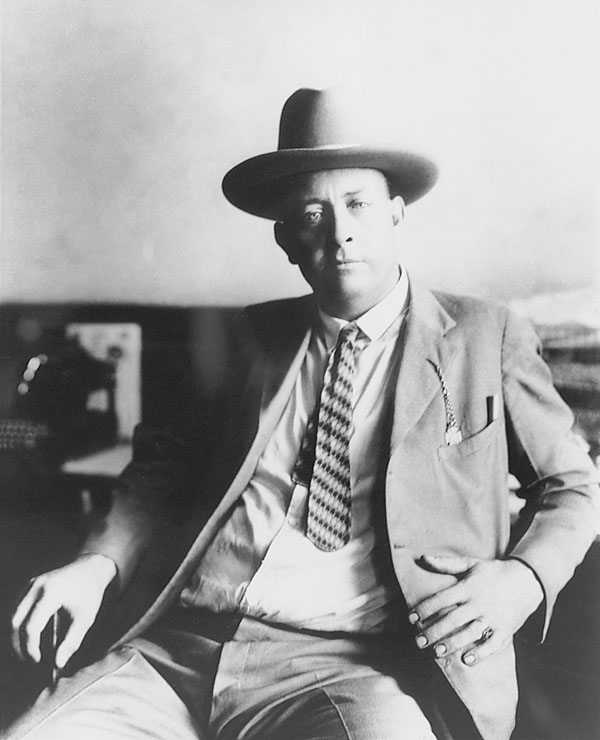
In July, Clyde’s mother wrote to Hamer asking for the guns’ return: “You don’t never want to forget my boy was never tried in no court for murder and no one is guilty until proven guilty by some court so I hope you will answer this letter and also return the guns I am asking for.” The guns were not returned, and remained with the Hamer family. There’s no evidence Hamer ever answered her letter. The guns were later sold as souvenirs.
Bonnie and Clyde are thought of almost exclusively as Southwestern outlaws from the rough-and-tumble areas of Texas, Oklahoma and Louisiana. But did you know that the Barrow gang had ties to Indiana? One of those ties marries one of the grisliest of all blood relics ever collected with an iconic Circle City department store not far from where you are reading this article right now.
Next Week: Part II of Bonnie & Clyde-The Indiana Connection


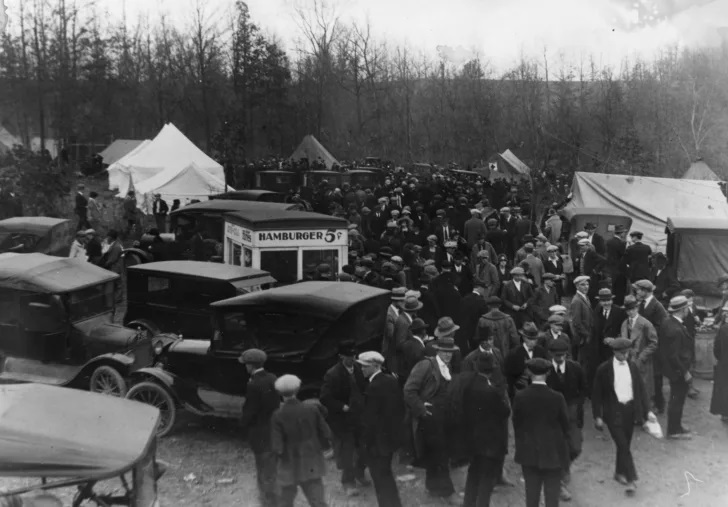


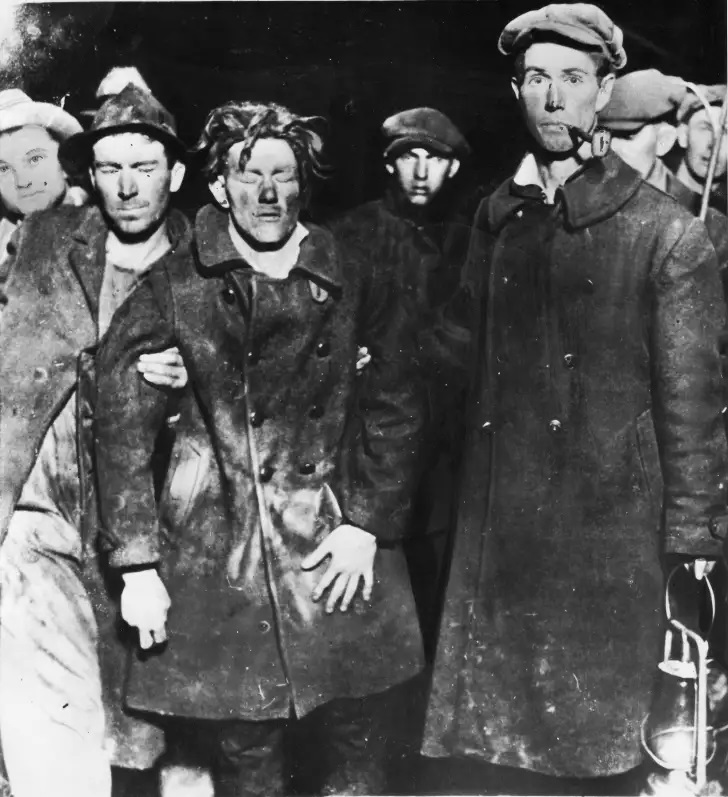
 As springtime returned to the Kentucky hills, the Collins family melted back into their rocky, hillside farm; no richer from the limelight. After the crowds departed, locals saw old man Lee scouring the rescue site for glass bottles to return for deposit. Two years later, in 1927, a struggling Lee Collins sold Crystal Cave to a dentist named Dr. Harry B. Thomas. The sale included White Crystal cave and the burial site of Floyd Collins. Lee’s $10,000 deal with Dr. Thomas included a morbid clause: that his son’s body could be exhumed and displayed in a glass-covered coffin inside the cavern. The enterprising country doctor quickly dug the dead man up and placed Floyd’s encased body on display in Crystal Cave. The gimmick worked and, much to the horror of Floyd’s friends and the Collins family, tourists flocked to Crystal Cave to view the embalmed body of the man now known as the “Greatest Cave Explorer Ever Known.”
 Sometime in the wee hours of March 18-19, 1929, Floyd’s body was stolen. The grave robbers “rescued” Collins’s corpse with the intentions of chucking him into the Green River, but Floyd’s body got tangled in the heavy underbrush and Dr. Thomas recovered the remains from a nearby field, minus his injured left leg. The remains were re-interned in a chained casket and placed in a secluded portion of Crystal Cave dubbed the “Grand Canyon”. A half-a-year later, the Great Depression blanketed the country and Floyd Collins’ saga was now a forgotten footnote. Times in Cave City got tough. Tourism plummeted-the same limelight that drew tourists innumerable to the Kentucky cave region now caused visitors to avoid it. As tourism dollars dried up, the sleazy tricks of local cave owners intensified. That feeling pervades Cave City today.


 However, Paula’s younger sister Gail, (a Harvard graduate and architect who lives in Oakland, CA) caught the Collins’ family fever and is a caver. Paula explains, “she got the spelunking gene – she and her husband belonged to a Spelunking Club when she was in her 20s.” Gail states, “Floyd Collins was in a forbidden “sandstone” cave which is the most fragile of rocks. I only went into Limestone caves which are more stable. The biggest concern about spelunking in Indiana & Kentucky is flash flooding. We only did caving during the dry months and mostly winter, when the ground is frozen for 5-8 weeks at a time. I spent New Yea’s Eve in a cave with Chuck (her husband) and our Spelunking group one year. One of my last spelunking adventures I was pulled out of a very wet cave entry, by a caving buddy, 6’6″, 250 lb former Marine, because the makeshift tree trunk ladder was missing two rungs. He reached into the hole and used one arm to hoist me out. A harrowing adventure indeed.” Seems that Gail narrowly escaped the fate of her long lost cousin Floyd.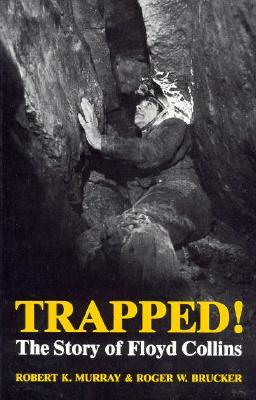



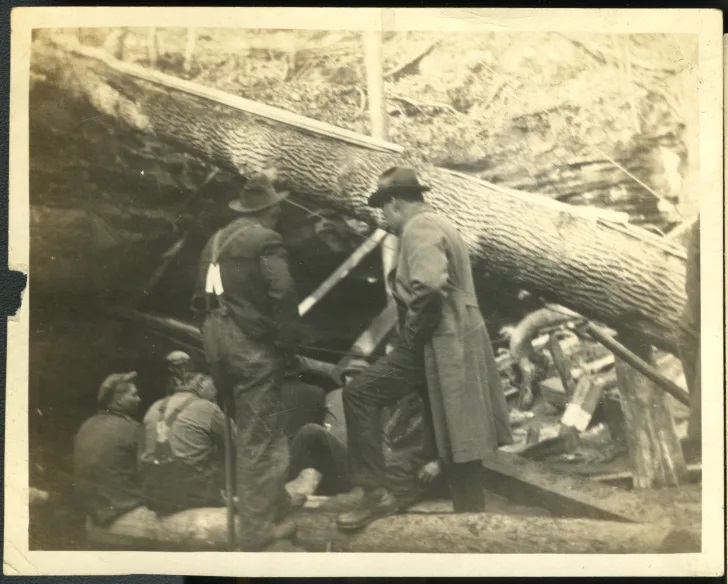


 An enterprising local scientist jerry-rigged a wire to a lightbulb that was sent down to not only illuminate the hole, but also to keep Floyd warm. An amplifier on the other end was closely monitored by technicians hunched over an electronic box under the tarp. A cross between a telegraph and a stethoscope, it detected vibrations whenever Collins moved and was viewed as a desperate lifeline. The amplifier crackled 20 times per minute, which the scientist claimed as proof positive that Collins was still alive and breathing. Alive and breathing, but still trapped.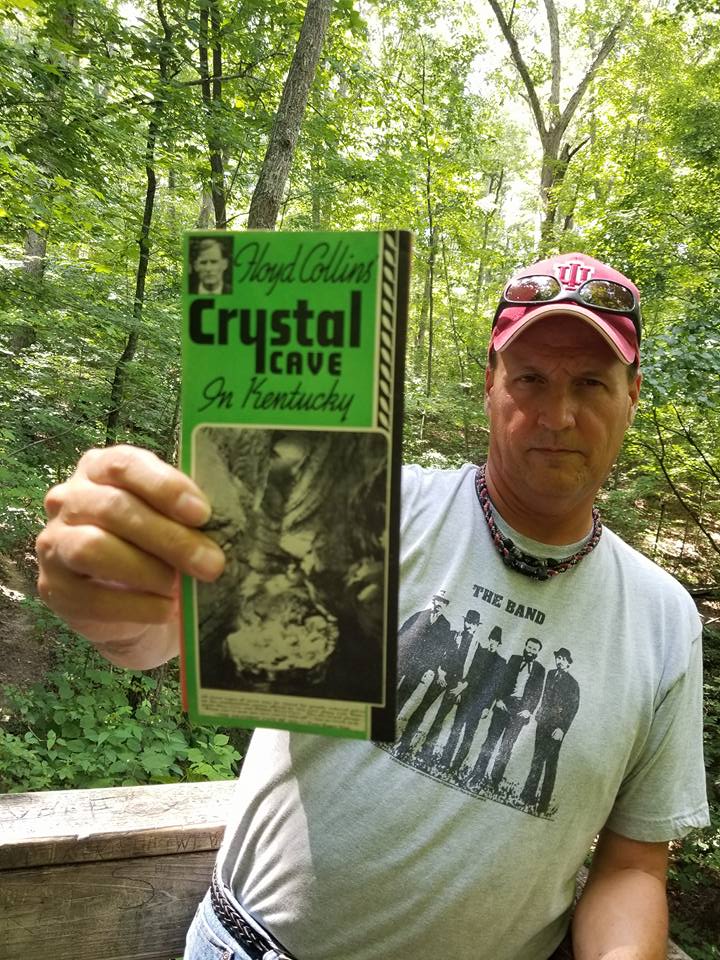
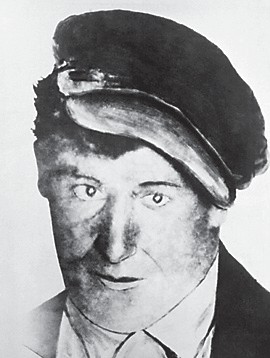
 Floyd Collins is one of those people. Collins was long, lean, logical and legendary. He remains history’s most famous spelunker. Not only because of the way he lived, but also because of the way he died. William Floyd Collins was born on July 20, 1887 in Auburn, Kentucky. He was the third child of Leonidas Collins and Martha Jane Burnett. Collins had five brothers and two sisters, including another brother named Floyd. Which was not uncommon for the time as frontier families often feared that a child might not survive to adulthood.
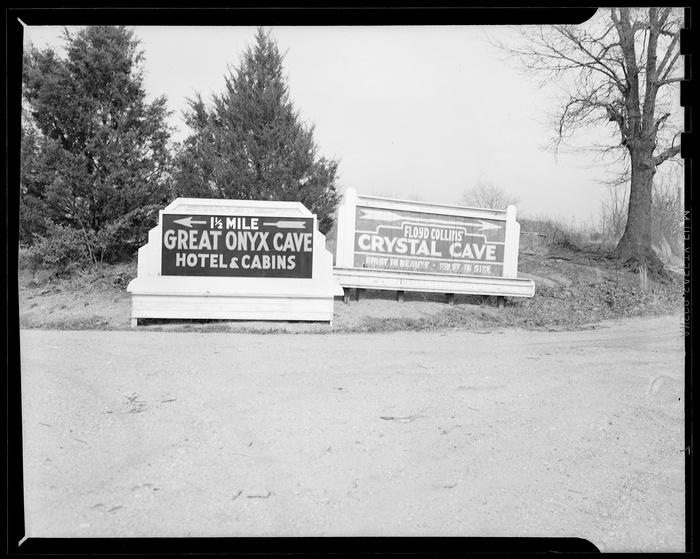 The biggest business in the area was Mammoth Cave, but there were others: Great Onyx Cave, Colossal Cavern, Great Crystal Cave, Dorsey Cave, Salt Cave, Indian Cave, Parlor Cave, Diamond Cave, and Doyles Cave. These holes were all owned and operated by men who charged admission to the visiting tourists who were more than happy to pay for the privilege. At the center of it all was Cave City. Here was the depot that brought wealthy visitors in on the hour, all hungry for adventure. And Cave City residents were more than happy to assist these gullible visitors by relieving them of their cash. As we will see later in this article, not much has changed in 200 years.
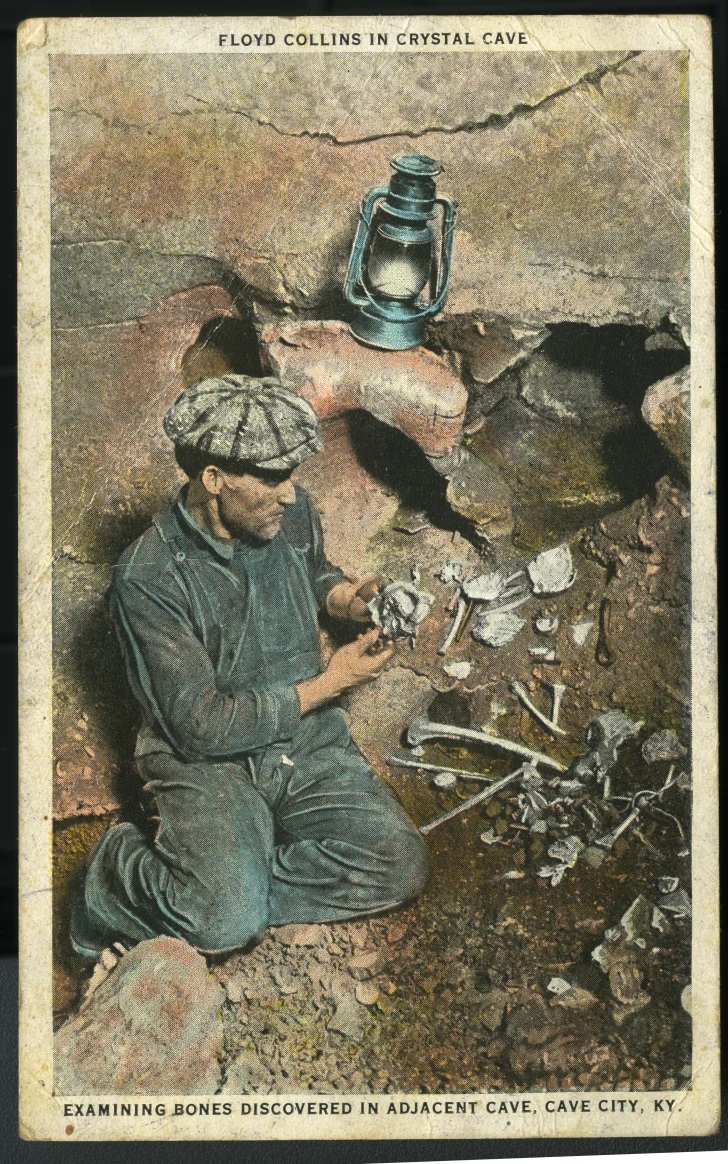 Collins first tasted celebrity when he discovered Crystal Cave in 1917 when he discovered Crystal Cave (now part of the Flint Ridge Cave System of the Mammoth Cave National Park). Twenty-seven year old Collins had chased a ground hog down a hole on his father’s farm. The hole turned out to be a passage to a large cavern Floyd called “White Crystal Cave”. He owned one half and his father owned the other. They went into business, selling options on the cave to a neighbor named Johnny Gerald who’d made a little money buying and selling tobacco. Johnny and Floyd took turns; one of them stood on the side of the road and tried to talk the tourists inside; the other guided them through the cave’s.
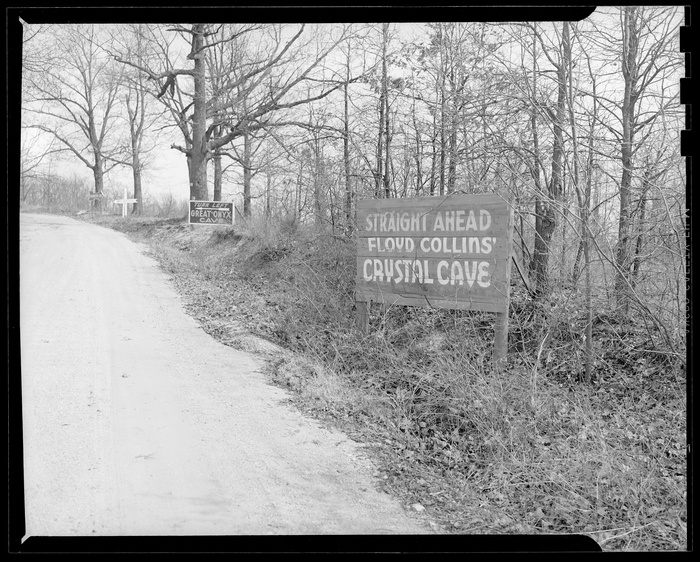 Soon the Collins family found themselves smack dab in the middle of the “Cave Wars” of the early 1920s, where Central Kentucky cave owners and explorers entered into a bitter competition to exploit the bounty of caves for commercial profit. Trouble was, Crystal Cave was the last cave on the road from Cave City. By the time tourists discovered it, they were out of money and interest. During the Cave War years, cave owners competed bitterly among each other in order to bring in visitors. The most common tactic was to deploy a man, referred to as a “capper”, who would suddenly rush out of the bushes, hop onto your car’s running board along the rugged road out to Mammoth to excitedly inform you that Mammoth had collapsed or was under quarantine from Consumption (now known as Tuberculosis) and would persuade you to visit their cave instead.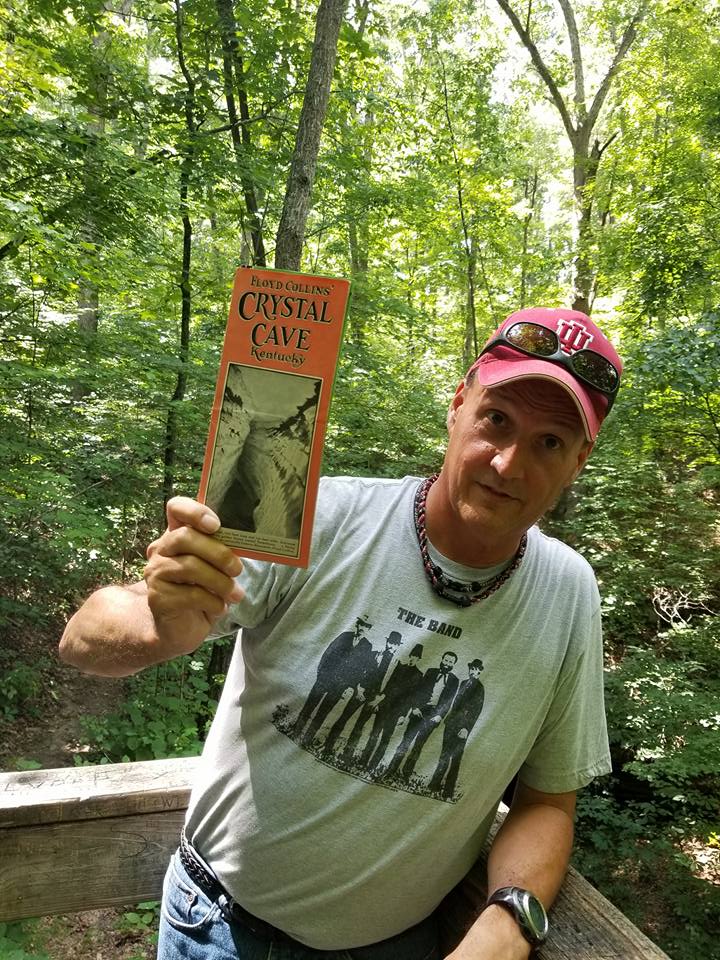

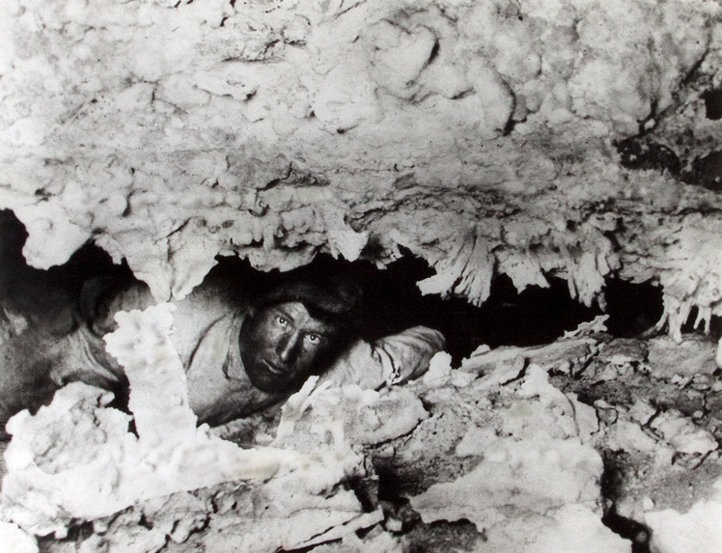
 Floyd was encased under a 4′ x 4′ square, two ton block of solid limestone ceiling, the sidewalls of the tunnel were composed of loose stones, pebbles, sand and mud. Floyd was careful to avoid bumping or displacing anything likely to cause a collapse. Collins made it through, muddy, soaked and sweating, after leaving his securely attached rope for a future trip into the 60-foot precipice he had yet to see. He wriggled head first back into the tight gravelly crevice leading to the steep, serpentine chute he’d just come in by. Pushing the kerosene lantern ahead of him as far as he could, he would then twist and squirm, shrugging ahead inch by inch till reaching the lantern before repeating the pattern by pushing ahead. Suddenly, Floyd’s lantern fell over, broke and went out.
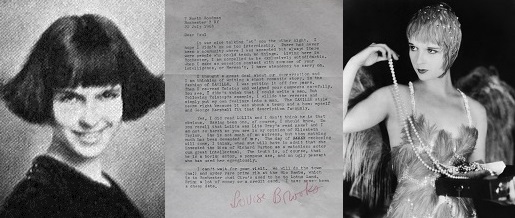
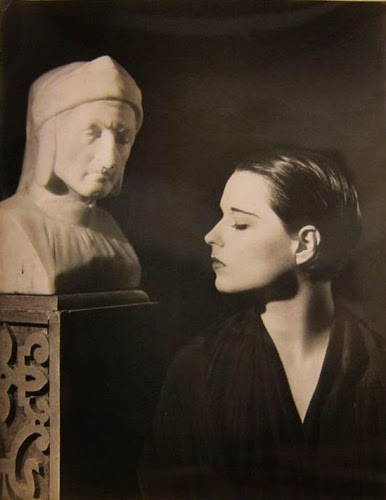

 Beginning in 1925, she starred in seventeen silent films and eight ‘talkies’ before retiring in 1938. She would forever be remembered as the iconic symbol of the flapper, and for popularizing the short ‘Bob’ haircut. Google Louise Brooks’ images and you will see why. In short, she was gorgeous at a time when classic Hollywood photographers were at their peak.
 Brooks began her career in 1922 as a dancer, joining the legendary Denishawn modern dance company in L.A., whose members included founders Ruth St. Denis and Ted Shawn, as well as a young Martha Graham. Her perceived closeness to Shawn (husband of Ruth St. Denis) got her booted from the troupe. Thanks to her friend Barbara Bennett (sister of Constance and Joan), Brooks almost immediately found employment as a chorus girl in George White’s Scandals and as a featured dancer in the Ziegfeld Follies. From there, her career caught fire.
 Despite French film historians proclaiming Brooks skill surpassing Marlene Dietrich and Greta Garbo as a film icon, she lived in relative obscurity for years in New York City and Rochester, N.Y. Despite her two marriages, she never had children, referring to herself as “Barren Brooks”. Her many lovers once included a young William S. Paley, the founder of CBS along with a veritable who’s who of Hollywood leading men and women.
 By her own admission, Brooks was a sexually liberated woman, not afraid to experiment, even posing fully nude for art photography in her golden years. Brooks enjoyed fostering speculation about her sexuality, cultivating friendships with lesbian and bisexual women. She admitted to some lesbian dalliances, including a one-night stand with Greta Garbo. She later described Garbo as masculine but a “charming and tender lover”.
