Indianapolis, Irvington Ghost Tours, Witches

The Black Hat Society Calendar Release Friday the 13th.

Witches

Original publish date:  October 12, 2017

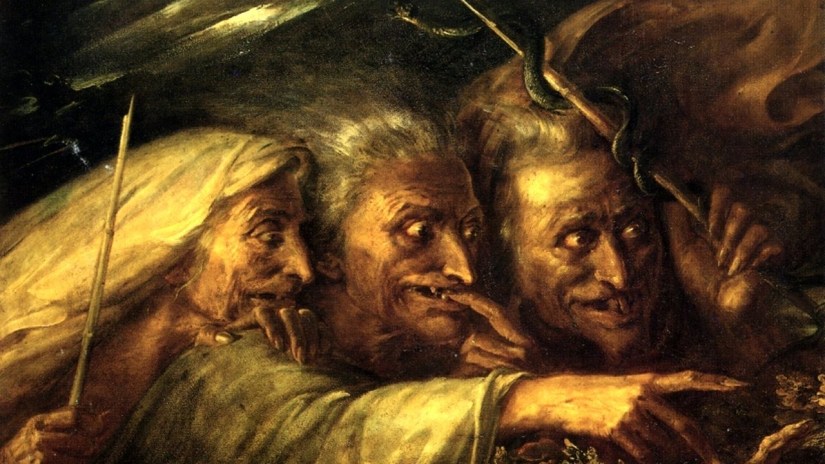
A dark cave. In the middle, a boiling cauldron. Thunder. Enter the three Witches. “Round about the cauldron go; In the poison’d entrails throw…Eye of newt and toe of frog, Wool of bat and tongue of dog,..Scale of dragon, tooth of wolf, Witches’ mummy, maw and gulf…Ditch-deliver’d by a drab, Make the gruel thick and slab: Add thereto a tiger’s chaudron, For the ingredients of our cauldron…Double, double, toil and trouble; Fire burn and cauldron bubble.” Witches Chant Macbeth by William Shakespeare .
maxresdefault
The Three Witches from Shakespeare’s “Macbeth” (1827) by Alexandre-Marie Colin. 

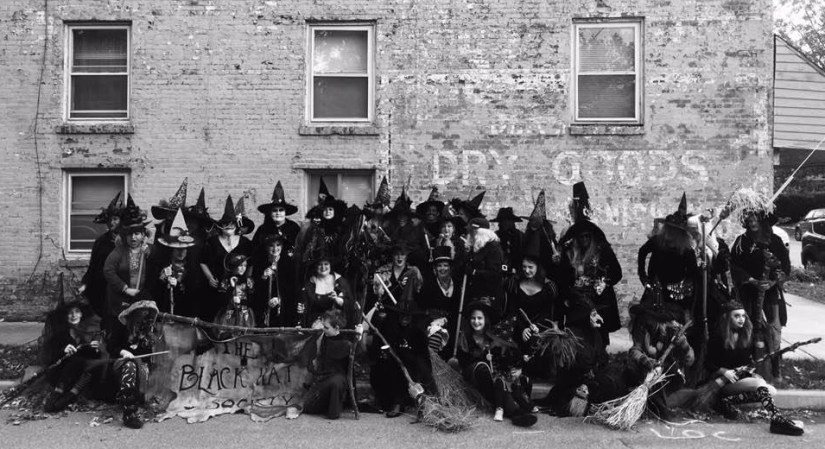
The coolest thing to come to Irvington in a very long time has arrived. The Black Hat Society has taken the eastside of Indianapolis by storm. Since their debut at the 2016 Historic Irvington Halloween Festival, their membership has grown as fast as their popularity. The coven of friendly witches was the brainchild of Karin Mullens. In the summer of 2016, Karin saw a video of German witches on facebook and immediately thought of her Irvington neighborhood.

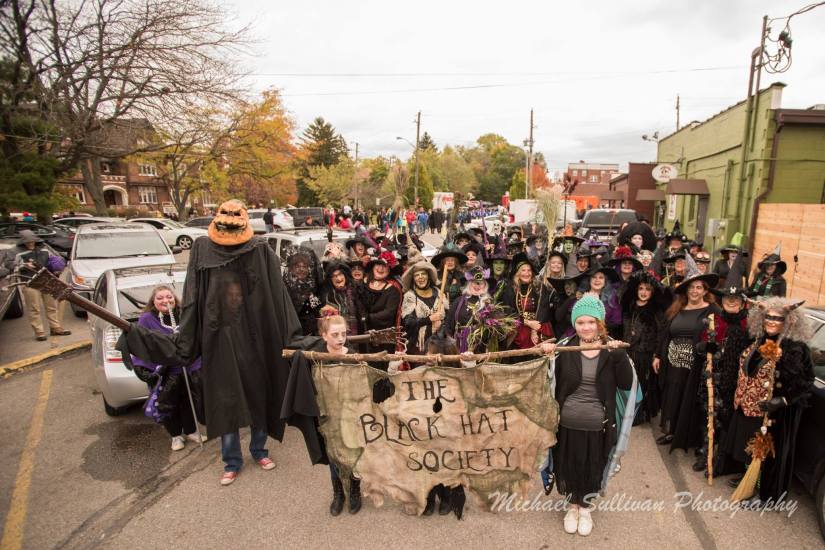
Irvington has long been home to spooky stories, legends and tales of ghosts and goblins. Why not witches too? After all, Irvington is home to the countries longest running Halloween festival, which this year celebrates its 71st annual street festival and costume parade along the Historic National Road. The tradition of the Black Hat Society kicks off this Friday the 13th (would you expect anything less?) with a calendar release at the Irving Theatre at 7:00 pm.
Facebook_The-Historic-Irvington-Halloween-Festival2
Parade photo by Michael Sullivan Photography.

The public is cordially invited to attend this first ever event free of charge. The Black Hat Society will be out in all their glory to greet fans, well-wishers and friends. The calendar will be available for purchase for $ 20 and if you are lucky, you can get the members to autograph your calendar up close and in person. Dont miss your chance to obtain your very own treasure that is destined to become a cherished memento of Irvington lore in the years to come. Oh, and by the way, you’ll be helping out some local charities at the same time.

The calendar features images of the Black Hat Society witches posed in settings and scenes in and around Irvington. The images, created by photographer Michael Sullivan, are fantastic and each month captures the whimsy of the witches posed in seasonal themes and familiar Irvington businesses. Settings include The Irving Theatre, Jockamos Upper Crust Pizza, Snips Salon & Spa, Lincoln Square Pancake House, Black Sheep Gifts, Artisan Realtors, Irvington Insurance, Coal Yard Coffee, Two Poodles and a Cake, the Irvington Wellness Center, 10 South Johnson Coffee House and of course, the Oakley-Hammond Funeral Home. They are all represented in this debut calendar. What makes the calendar even more fun is the way photographer Sullivan has posed his coven. But you’ll have to discover that on your own because I’m sworn to secrecy and even I know that a promise to a witch is one that should not be broken.

59f611740231b.imageThe charities involved are the Diabetes Youth Foundation summer camp in Noblesville, Helping Paws Pet Rescue and The PourHouse Street Outreach Center. The Black Hat Society hopes to raise $ 10,000 for these worthy charities. In addition, there will be a donation box placed at the entrance of the Irving Theatre during the event. The Black Hat Society requests donations of men’s socks, pet food and cleaning supplies, all of which are in almost constant need by these institutions. Karin informs me that Eric Wilson at Irvington Insurance has helped mightily in spearheading the group’s donation efforts.

Weekly View readers will not be surprised that the ranks of the Black Hat Society are populated by Irvingtonians and east-siders. Karin informs, “We are about 30% Irvingtonians, 20% east-siders (Little Flower, Emerson Heights, Bosart Brown) and the remaining 50% come from nearby communities like Carmel, Greenfield, Franklin, Greenwood and the West side.” The group started out with about 50-60 members, “But we’re up to over 100 members now.” says Karin. “We practiced two times a week for six weeks before we marched in the parade but had out debut at last year’s Spooky Stories on the Circle.”
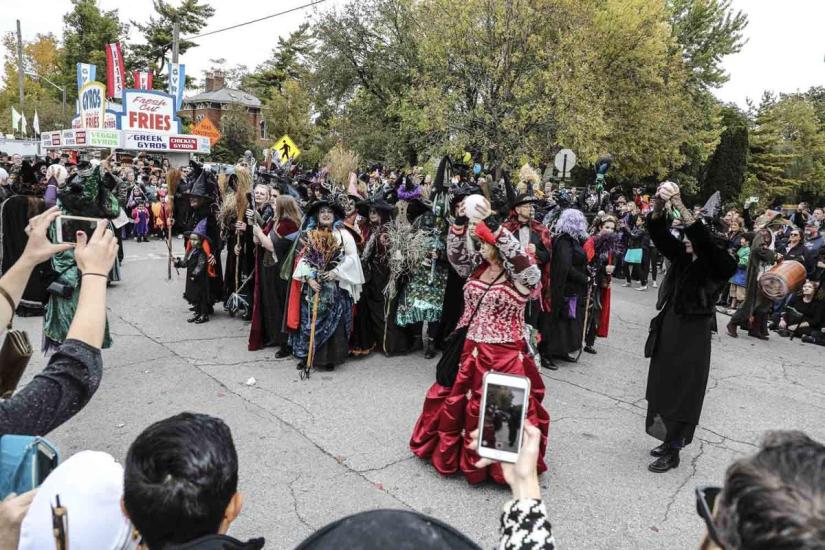
5bd9b509c774e.imageFrom there, the Black Hat Society marched in the Indy St. Patrick’s Day parade, Pride parade and they recently won a $ 100 prize in a parade in Fountain Square. Should you miss the releases party, never fear, the witches will have their calendars for sale at their booth at the Halloween Festival. The calendars can be ordered on line at theblackhatsociety.org and on their facebook page.

I am fortunate, as are many of you, to say that several of the witches are friends of mine. Nancy Tindall-Sponsel, a founding member, may be the most enthusiastic of all the witches. Nancy has her hands full this time of year with her duties as chair of the Halloween Festival, but she always has time to talk about the witches. “It was a big surprise,” she states, “how the group came together so fast. We’re just a group of women that have formed a sisterhood. There are no qualifications for membership, just a willingness to have fun and enjoy.” Nancy states that the group has formed a fellowship that is so close that they can now “haunt” Goodwill stores and thrift shops looking for costume additions. “If we find something for our costume that we already have, we’ll pick it up and share it with other members.” says Nancy.

Dawn Briggs, another founding member, also speaks glowingly of the group. “Most of us are just girls who never got to play dress up,” Dawn says. “We are a Fraternity of friends. There are no cliques. It was instant bonding. We all have fun lifting each other up and raising money for charity.” Dawn continues, “Some of the ladies are shy by nature but when they put on that costume, they change. Even though we’re mostly women, there is no cattiness involved.”
al-and-jan-check-2013
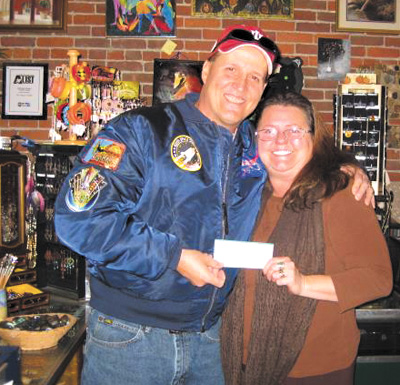
The author and Jan DeFerbrache of the Magic Candle.

Jan DeFerbrache, owner of the Magic Candle, is the unofficial historian of the group. Jan guides the membership in the do’s and don’t’s of witchcraft and makes sure that the members appearances are accurate. Jan’s knowledge helped out during the St. Patrick’s Day parade when most of the marchers wore “earth witch” costumes to better keep within the theme of the holiday.

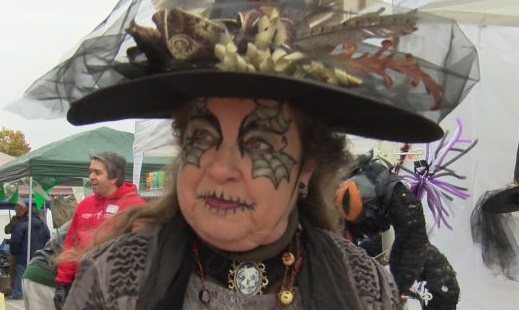
Paula Nicewanger, creative director of this newspaper, and her husband Steve, are members of the troupe. During last year’s parade Paula was in the coven, but not as a member. She was taking photos of the witches for her newspaper and was swept up inside of the coven as they marched along Washington Street. She had such a good time that she joined the Black Hat Society shortly afterwards. Paula, an accomplished artist, created an original painting that will be turned into a poster that will also be sold at the witches’ Halloween festival booth. The poster depicts five of the witches (Paula, Dawn Briggs, Renee Cotterman, Karin Mullens & Kitty Fenstermaker) in full costume posed around a cauldron.
irvington-woan-e1509250393100_38912815_ver1.0
Paula Nicewanger.

Other founding members include Michelle Roberts, Karen Davis, Sue Beecher, and Leslie Walsh. Michelle has just recently been named Vice-President of the group. Molly McPherson is the official choreographer for the group and helps with the music. Nancy Lynch acts as creative director and arranged the sites used for the calendar photos. I’m repeatedly told that Christy Raymer is the witch to seek out and shake hands with. Apparently Christy has an eyeball on the back of her hand that looks so realistic it’s scary.

It may come as a surprise to some that the Black Hat Society is not entirely made up of women. The group includes a few men too. Along with Steve Nicewanger, Tim Lynch, Dylan Roahrig and Craig Rutherford are among the warlocks in the group. Roger Disher, whose wife Kim is a founding member, is described by some of the girls as a coven member too but I’m told he doesn’t dress up. Kim says, “He’s a quiet member. Support system of sorts.” Kim confirms what many of the other witches say by relating that above all else, the group is “FUN!” and loves supporting the neighborhood and the fact that “we welcome ALL!”

While Steve calls himself a warlock, Dylan wears a kilt for his costume, and Kim calls Roger a quiet member, Black Hat Society member Craig Rutherford proudly calls himself a “male witch.” Craig, the unofficial prop maker for nearly every Halloween Festival event including the Black Hat Society, didn’t march with the witches last year but plans on marching in this year’s parade. And about this year’s parade, every Black Hat Society member agrees that something BIG is in the works for this year. What that something big is has become the best kept secret in Irvington. None of the witches are talking but Craig came closer to anyone by admitting that his role this year will be as a witches’ minion.

53778687_1823021094469367_5747701049993461760_nWhen I asked Craig what it is like to be a male witch surrounded by so many women, he answered succinctly, “It’s lonely.” Craig would like to see more guys join the group. “At last year’s St. Patrick’s Day Parade, I made eight drums for our drum line, but we only had 4 drummers. We need more guys!” Craig is amazed by just how generous the witches in the Black Hat Society are, “If I need something for a prop or help in building a set, I get 30 or 40 responses within minutes.”

I’d suggest you make plans now to attend the Halloween festival parade on October 28th. The route is such that you can stake out your optimal viewing position well before it starts. The parade will commence from the Irvington United Methodist Church and head West on Washington Street, then backtrack to the east on Washington to Audubon. The parade will then head South on Audubon and end at Bonna. So bring a chair, stake out your spot and get ready to enjoy the show. But first, head out to the Irving Theatre Friday the 13th from 7:00 to 9:00 and get your calendar before they sell out. As the witches of Shakespeare’s Macbeth lamented, “By the pricking of my thumbs, Something wicked this way comes. Open locks, Whoever knocks!” The witches will be expecting you.

54278739_1823020701136073_5587545859874095104_n
St. Patrick’s Day Parade photo by Nancy Ann Tindall-Sponsel 
Abe Lincoln, Civil War, Indianapolis, Irvington Ghost Tours

Sons of Union Veterans Ben Harrison Camp # 356.

IMG_3526[1]
Left to right: Dave Wilson, Bob Winters, Mike Beck, Past Department Commander (PDC); Tim Beckman, PDC; Garry Walls, PCC; Bruce Kolb, PDC; Jim Floyd.

Original publish date:  July 11, 2019

Sometimes you just need to step back, relax, reflect awhile and think about what it means to be a Hoosier. The fourth of July seems a perfect time for such reflections. I was born in Indianapolis, as were my parents, grand parents and great-grand parents. Like many of us, I had forefathers who served in the Civil War. In my case, I had gr-gr-grandfathers serving on both sides of the conflict; my maternal forefather was riding with Morgan’s Raiders while my paternal forefather was chasing him. Had one caught the other, I might not be here.
This past Memorial Day, I finally decided to venture out to Crown Hill Cemetery and attend the official ceremonies hosted by the Sons of Union Veterans of the Civil War-Ben Harrison Camp #356. Dave “The King” Wilson had suggested I join a few years back and I just got around to joining recently. I’ve known Camp Commander Jim Floyd for nearly two decades and was delighted to be present as a spectator while Jim and Dave led the ceremonies. Truth is, I joined not only to honor the veterans in my past family but also to honor my muse of the past decade: Osborn Oldroyd.

1917 GAR
Osborn H. Oldroyd

As many of you know, Oldroyd has been on my mind lately. Not only was he the very first curator of a Lincoln museum, first housed in the Lincoln homestead in Springfield, Illinois for a decade and then in the House Where Lincoln Died in Washington D.C. for over three decades more. Equally importantly, he also served as Assistant Adjutant General of the Grand Army of the Republic in the District for over twenty years. Regardless of how I got there, I got there. And hopefully by the time you’re finished reading this article, you’ll decide you might want to join too.
The Ben Harrison Camp No. 356 SUVCW was originally founded on June 19, 1884 with 46 members, most of whom were “real sons”. After that first camp disbanded, it reorganized on March 8, 1897 with 32 members. It continued meeting into the early 1970’s before it disbanded again. In 1981, the Ben Harrison camp was organized once again and has met continuously ever since. Their mission statement, quite simply, is to “Honor Union Veterans and all who have patriotically served our country in any war, preserving & perpetuating the Grand Army of the Republic, and Patriotic Education.” All with the goal to help America become a better nation by helping to keep the stories and sacrifice of our Civil War ancestors alive.
The Ben Harrison camp “honors the soldiers who fought to preserve the Union and free an enslaved people through activities including: maintaining their graves, teaching patriotism, and ensuring future generations continue to learn from the mistakes of the past.” As for the parent organization, “The Sons of Union Veterans of the Civil War (SUVCW) is the volunteer, non-profit, charitable, fraternal, patriotic and educational organization created by the Grand Army of the Republic (GAR), which was the largest Union Civil War veterans’ organization. The SUVCW is officially recognized as the GAR’s legal successor, and received its Congressional Charter in 1954.”

IMG_3525[1]
Left to right: Dave Wilson, Jim Floyd,  Bob Winters, Jim Floyd.
These fellows truly practice what they preach. In the past few years of outside observation, I’ve watched from afar as these men have repaired, reset, restored, cleaned and replaced the markers of dozens of Hoosier Civil war soldiers; led the charge by decorating soldier’s graves for memorial day at Crown Hill Cemetery and Remembrance Day every November in Gettysburg as well as protecting a Hoosier monument in distress at Vicksburg. This past effort is of particular interest to me as it was on this field that Osborn Oldroyd was wounded three times in battle. I’ve fairly worn out my family, friends and readers over the past several years by rambling on about Oldroyd, so I’ll spare you any further abuse on the Lincoln collector / curator…for now.
IMG_3521This memorial day, the Ben Harrison camp honored Hoosier Civil War soldier Captain Richard Burns. With temperatures in Indianapolis hovering above or around the 90 degree mark for nearly two months now, Captain Burns’ story seems apropos to the moment. For you see, Captain Richard Burns died of sunstroke. At 5′ 10″ and weighing 143 pounds, Richard Burns was light skinned with piercing blue eyes and prematurely gray hair. Burns first enlisted on September 21, 1861 as a private in Third Battery, Indiana Light Artillery. The unit was organized in Connersville, Indiana, and mustered in at Indianapolis on August 24, 1861. Ironically, the unit would muster out nearly 4 years to the day (August 21, 1865) at the same place.
Within weeks of his enlistment, Burns was appointed corporal on October 1, 1861. From there Burns advanced to squad sergeant then orderly sergeant. On November 25, 1862 he was appointed second lieutenant then rose to first lieutenant on October 25, 1863. On July 25, 1865 Burns was appointed captain, a rank he would retain until his discharge on August 21, 1865. While his rise through the ranks might be described as meteoric, it did not come without cost. During his service, Burns contracted typhoid pneumonia (more commonly known as consumption back then) and was plagued by chronic diarrhea for nearly all of his military service. The latter, while uncomfortable, was temporary. However, the Streptococcus pneumonia remained and slowly invaded and weakened his heart for the remainder of his life.
Before the war, Burns worked in the “burnt district” of Wayne County as a heavy machinist. After his discharge, Burns returned to Cambridge City but was confined to light duty, working as a grocery clerk and a brick mason. Burns relocated to Montana in 1867, presumably chasing gold or cattle alongside other fortune-hunting Civil War veterans, but moved back to Cambridge City the next year. From there, Burns moved to Anderson and finally to Indianapolis.
According to an article titled “THE OPPRESSIVE HEAT” found in the August 16, 1888 Indianapolis Journal newspaper (page 8), “The remarkably cool weather of the first three days of the week was followed by a hot wave yesterday that raised the mercury to 91 degrees at 3 o’clock in the afternoon. The air during the afternoon and early evening, in the absence of any breeze, was very oppressive, and as people were not prepared for the sudden change there was much discomfort. At 5 o’clock in the evening Richard Burns, a brick-mason, living at No. 90 North New Jersey street, was prostrated on Hadley avenue, where he was working. Kregelo’s ambulance was called, and the attendants were taking him to the City Hospital when he died. He was fifty years of age.”

img
August 16, 1888 Indianapolis Journal newspaper

The Indianapolis News of that same day, reported “Yesterday afternoon the temperature mounted to an uncomfortable degree, and the heat was very oppressive. Late in the day Captain Richard Burns, residing 90 North New Jersey street and employed on Hadley avenue, was overcome by the heat, and he died while Kregelo’s ambulance was removing him to the hospital. He was aged about fifty, and was a member of Chapman Post, G. A. R., and a pensioner. he leaves a wife, but no children….” He was buried on Lot 49, Section 4 in Crown Hill Cemetery on August 19, 1888 at 2:00.

This memorial day’s ceremony at Crown Hill was solemn, stirring and well organized. However, it wasn’t until afterwards that I learned of a connection between Captain Burns, myself and Irvington. The Third Light Battery was assigned to General John C. Fremont’s Army of the Tennessee and accompanied it in the campaign through southwestern Missouri in the Western Theater. In December, 1863, the battery moved to Columbus, Ky., where it served in the winter campaign through western Tennessee before it moved to Vicksburg and joined Sherman’s army on the expedition to Meridian, Miss., in Feb., 1864. From there, the battery assisted in the storming and capture of Fort De Russy. It then served at Memphis and Tupelo, Miss. In Jan., 1865, the unit moved to New Orleans, where it took part in the siege and capture of Fort Blakely, which resulted in the surrender of Mobile. It next moved to Montgomery, thence to Selma, Ala., where it remained until July 30, 1865, when orders were received to proceed to Indianapolis. It was mustered out Aug. 13, 1865, numbering 3 officers and 71 men, having lost 64 in killed and wounded.

Captain Richard Burns served in in the Third Battery, Indiana Light Artillery alongside fellow Captains James M. Cockefair, Thomas J. Ginn, and Watton W. Frybarger. Capt. Frybarger was promoted major and was wounded in the head during the Battle of Shiloh. After which he was ordered back to Indianapolis to organize all of the state’s artillery units by his pre-war friend, Indiana’s Civil War Governor Oliver P. Morton. It should be noted that Frybarger has the distinction of organizing the Hoosier state’s only artillery battery in place BEFORE the war. Frybarger went to work shoring up the southern border of Indiana by placing guns at several places along the Ohio River. His invasion fears were realized in early July of 1863 when Morgan’s Raiders invaded the state via Kentucky. Yes, Major Frybarger was a born artillerist.

Dave Ring
The W.W. Frybarger ring on Dave Wilson’s finger.

If you have taken my October tours of Irvington, then you’ve met Major Frybarger. Well, sort of anyway. I conclude every tour of Irvington with a stop at the spot where Abraham Lincoln’s funeral train slowly steamed past in the pre-dawn hours of April 30th, 1865. As I share with my guests, many years ago I was offered some of the personal effects of Major Frybarger. Among those effects were an ancient leather-bound album full of family tintype and CDV photos, a lock of his hair, a large silver platter, and his regimental ring. The platter, which at 21″ tall and 33″ wide, is quite large. It is inscribed “Presented by the 22nd and 23rd Indiana Mounted Artillery to Mrs Major W.W. Frybarger Indianapolis March 1863” and was given to the Major’s wife by grateful soldiers in thanks to the Major securing the southern Indiana border.

Frybarger redu
Major W.W. Frybarger

Equally important to the Frybarger saga is his role in the Lincoln funeral here in Indianapolis. As every Hoosier student of Lincoln knows, when the martyred President’s remains arrived in Indianapolis, it arrived in the midst of a torrential downpour so strong that the official public ceremonies had to be cancelled. For that evening of April 30th, 1865 Mr. Lincoln’s body remained in the rotunda of the old statehouse. Who was in charge of the decorating and care of the railsplitter’s body that night? Major W.W. Frybarger. I tell October visitors to Irvington that story while placing the ring on the finger of every guest I approach with the admonition that Frybarger’s regimental ring may well have touched the body of Abraham Lincoln.

Frybarger
Major W.W. Frybarger.

Now, thanks to the impeccable research of Sons of Union Veterans Camp Commander Jim Floyd and Eliza E. George Auxiliary No. 356 Secretary / Treasurer Jennifer Thompson, I now have another connection to Frybarger. I should note that by the time you read this article, I will have joined the Sons of Union Veterans Ben Harrison Camp No. 356 as an official member. I am sure that the brothers would be happy to have you in their ranks as well. For more information, contact http://benharrisoncamp.org/ Or drop me an e-mail and I’ll steer you towards this fine organization.


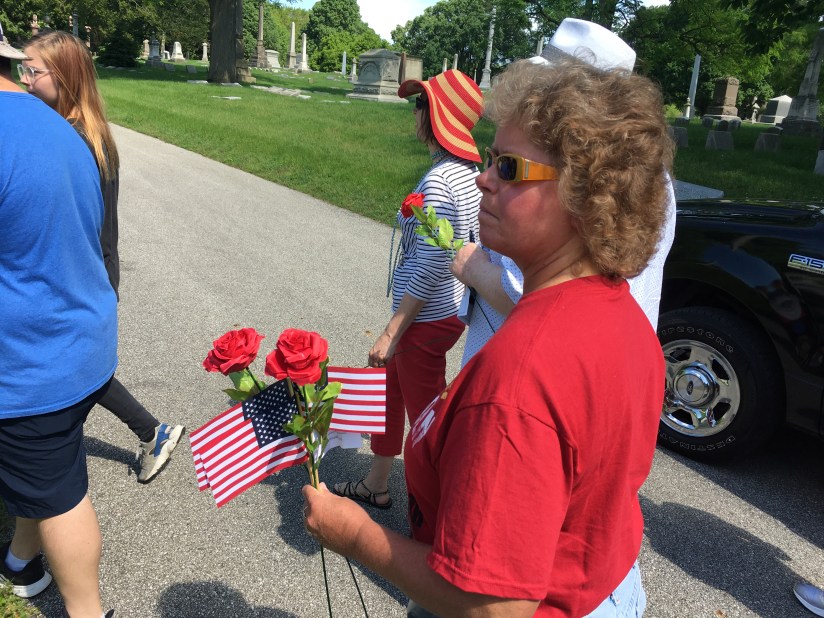
IMG_3515
Rhonda Hunter with flowers at the ceremony.
IMG_3519
Dave Wilson, Rhonda Hunter & Jim Floyd.
Indianapolis, Pop Culture, Travel

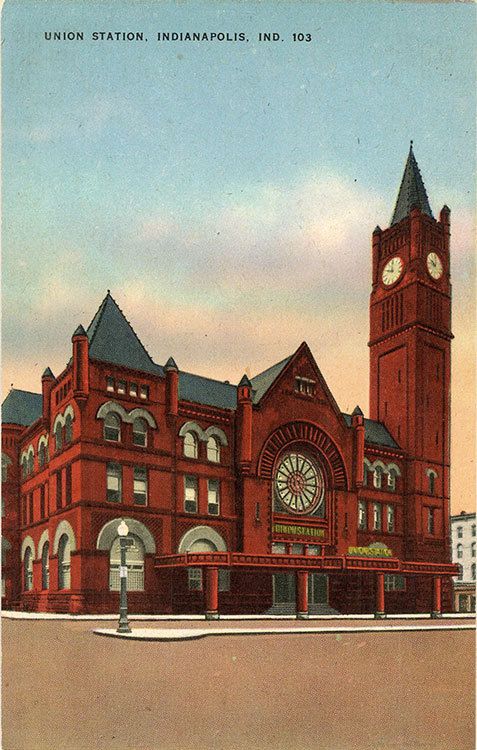
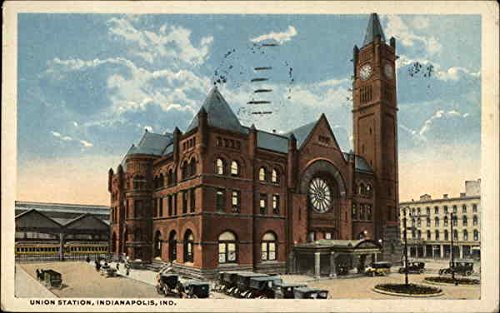
Indianapolis Union Station.

z 81eb37495c47ff81aa17dab628cd5bc2

Original publish date:  June 8, 2015        Reissue date: July 3, 2019

Twenty-Five years ago this week, the single most important icon of our Capitol city’s railroad era, Union Station, reopened to much fanfare, high hopes and hoopla as a downtown destination for visitors and citizens alike. Indianapolis Union Station reopened its doors on April 26, 1986 as a festival Marketplace.
The first railroad came to Indianapolis in 1847 and within a year there were four serving the city. Railroads connected the young state capital to the rest of the nation. Over the next decade, other major rail lines would reach town. But they each had their own tracks and their own depots. In 1848, the city fathers developed an idea to build a single station that all the railroads would share. The four railroads liked the idea and in 1853 the original Union Depot was built in Indianapolis. Union Station was integral to the growth and development of antebellum Indianapolis. It was the first time in American history that all railroad trains could enter and leave a city from a single central station.
It was America’s first “union” railway depot (whose very name suggests the meeting of several railheads) but soon the idea was duplicated across the nation. Union Station united passenger and freight trains from many competing railroad companies into a single convenient downtown terminal. The station prospered for decades serving up to 200 trains and thousands of people per day. By 1870 more than a dozen railroads were now converging at the “Crossroads of America.”
z INDIANAPOLIS-Indiana-UNION-RAILROAD-STATIONBeginning in November 1886 a new station was constructed just north of the existing station, and soon a three-story, red brick and granite station with extensive vaulted Romanesque arches and a 185-foot clock tower began to rise towards the Hoosier heavens. It was that clock, with its four separate clock faces each nine feet in diameter, that would become an Indianapolis landmark for generations to come.
z Vintage-Postcard-Indianapolis-Indiana-Interior-Union-Station
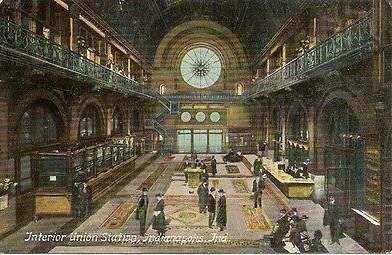
The Grand Hall at Union Station.

The station, whose focal point was a three-story structure known as the Grand Hall, was completed in late September, 1888 and by all accounts was a raving success. In the early 20th Century it was assumed that as long as the cities population grew, so would the need for trains. In 1920, Union Station was averaging 176 trains a day. That figure does not include all of the electric rail traffic in the city. The original large iron train shed was replaced with a larger, poured concrete structure. The new shed, which survives to this day, offered twelve passenger and two express freight tracks.
Some of the better documented notables known to have passed through Union Station include Presidents Abraham Lincoln, Woodrow Wilson, Theodore Roosevelt and Harry Truman. However, its not enough to simply state that these were the only famous names to travel through Union Station. In the age before automobile and air travel became the unconscious norm, Americans traveled by train. Every politician, every movie star, every author, every athlete, every famous (or infamous) person traveling east of the Mississippi, traveled through Union Station. Names innumerable populate the scrolls of time at Union Station.

z 635896041231932250-Edison-and-phonograph
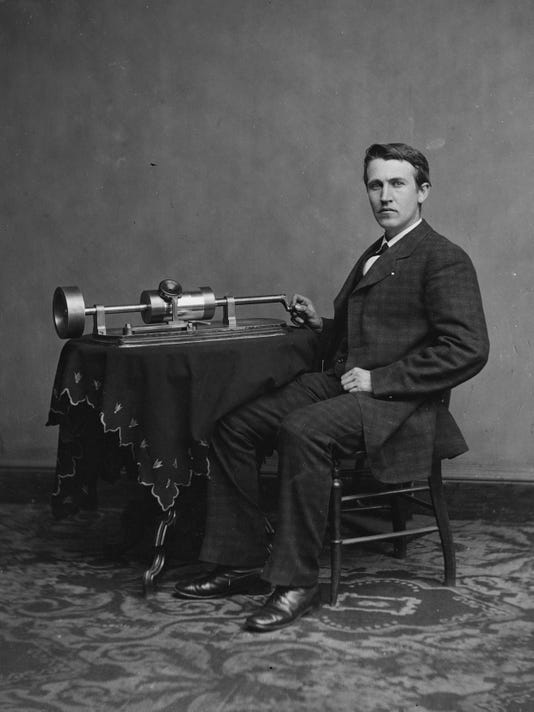
Thomas Edison

Seventeen-year-old Thomas Edison worked at Union Station in 1864 as a Western Union telegraph operator but was fired for spending too much of his time on “useless” experiments. One of those experiments included wiring two telegraphs together, one to receive incoming messages and the other to save them, resulting in a primitive data storage device. Sadly, it broke down on the night of Abraham Lincoln’s re-election due to extraordinarily high incoming traffic and Edison was fired. Edison moved to Cincinnati shortly afterwards and perfected his device, which he called a phonograph, and the rest is history. Ironically, the golden age of Union Station runs nearly concurrently with the life of it’s most famous terminated employee, Thomas Edison (1847-1931).
z 51mOWzAwX6LTrain travel dropped in the 1930s, mostly because of the Great Depression, but rebounded during World War II because so many servicemen were on the move. After the war, passenger trains were declining as the automobile and aviation industries experienced rapid growth, all but signing the death warrant of Union Station. By 1946, as post-war passenger service fell off, only 64 trains a month operated and by 1952, barely 50 passenger trains a month used the station. Over the next generation, as rail travel continued to decline, Union Station gradually became a dark, ghostly relic of a by-gone era. During the 1960s and 1970s, it suffered from the same pattern of deferred maintenance and slow decline plaguing most urban buildings.
z imagesUnion Station was then owned by Penn Central, a “Frankenline” created by the merger of the old Pennsylvania and New York Central lines. A series of events including inflation, poor management, abnormally harsh weather and the withdrawal of a government-guaranteed $200-million operating loan forced the Penn Central to file for bankruptcy protection on June 21, 1970. Many of the once-powerful railroad firms were bankrupt and only six trains operated out of the station. Penn Central offered the station for sale and the decline continued when by 1971, the United States mail room closed and Amtrak was formed out of the few remaining rail lines. It looked like the grand station would be bulldozed into a parking lot. A “Save Union Station” committee scrambled to keep it from being demolished.
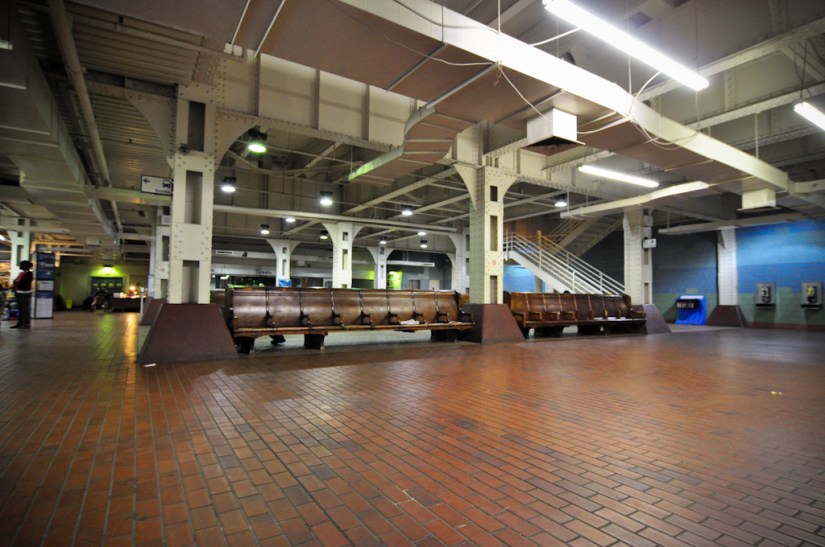
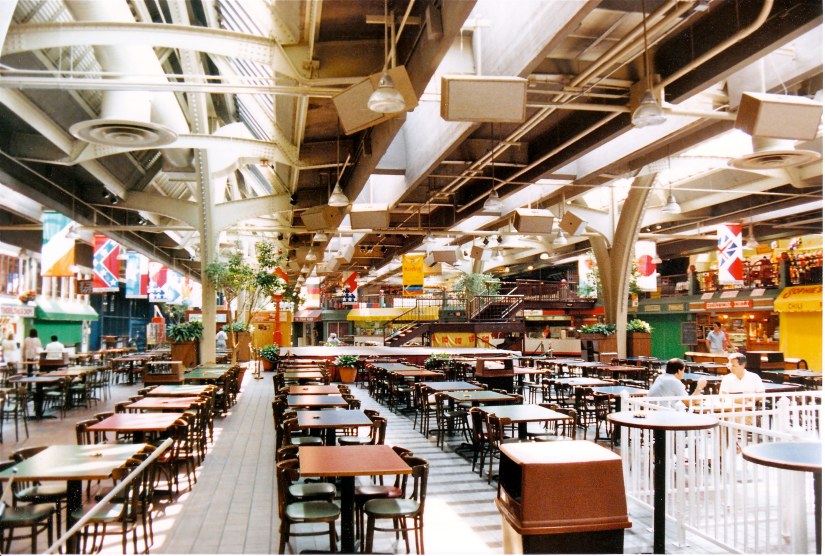
z mayorlugar
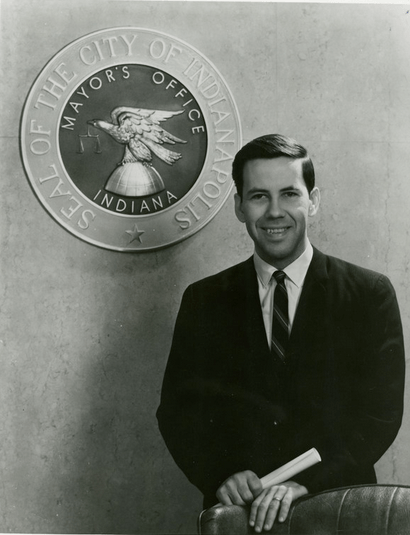
Indianapolis Mayor Richard Lugar.

Mayor Richard Lugar led the effort to save the station. Hope sprang anew in 1974 when Union Station was listed on the National Register of Historic Places (protecting it from demolition) and was purchased for $196,666 by a group of 21 private investors known as “Union Station Associates.” A year later, only two trains remained and four years later in 1979, “The National Limited”, which ran from New York to St. Louis, was the last passenger train to use the station for one year. The station was closed and for a few months the largely vacant Union Station became a municipal eyesore and hangout for gangs and the cities less fortunate. In 1980, the city of Indianapolis purchased the station for $434,500 and Amtrak reinstated the Hoosier State, running daily from Indianapolis to Chicago
In 1982, inspired by the success of adaptive reuse projects in comparative sized cities like Boston, Baltimore, and San Antonio, the city government stepped in to save the historic landmark. A local development team from Borns Management Corp. began a renovation project that turned the facility into a 1 million-square-foot “Urban festival marketplace.” After almost 15 years of deterioration, Union Station re-opened its doors in 1986 after a $50 million dollar facelift to much fanfare showcasing many specialty shops and fine restaurants. Local developer Robert Borns used the Federal investment tax credit program for historic structures to convert and modernize Union Station.

z union_station_5
Interior Union Station.

At first, it was a breath of fresh air and a “must see” for locals and tourists alike. For a time, the future looked bright for the renovated landmark. Crowds flocked to the urban mall in search of everything from gourmet food to fashionable clothing. Specialty shops included a magic shop, sports store and an appropriately apropos toy train store. However, it was not a longterm success, although it did stay open for about a decade. By 1989 the station reports a $2.92 million net loss and the following year, Union Station reports a $3.38 million net loss. In 1991 the Borns turn over their long-term lease for Union Station to the Balcor Co., a Skokie, Ill., finance and real estate firm that held a $23 million mortgage on the station. In 1992 station officials report business is picking up, but still ask the city to defer payments on loans the city made to the station. In 1993, the station reported turning a profit of $431,000-the first time since it’s opening in 1986 that it has been in the black.

Indianapolis-1988_0003
Interior Union Station in 1988.

By early 1995, Balcor Corp. puts its lease up for sale and 3 months later, USA Group Inc. buys Union Station for $3.2 million and gives most of it to the city of Indianapolis, except for the 852-car parking garage attached to property. About $ 26 million in outstanding loan payments are forgiven by governmental agencies and Balcor. A year later, three Union Station bars and restaurants shut down, citing declines in business since Circle Centre opened-leaving the station about 50 percent occupied. Faced with declining patronage and continued high maintenance costs, city officials shuttered the mall venture in 1996. It was closed for renovation on April 1, 1997 and in October 1999 the Union Station once again reopened as Crowne Plaza’s Grand Hall and Conference Center.
The old train shed became the home to the new Crowne Plaza luxury hotel. Four tracks at the north and south ends were retained, and stocked with thirteen old heavyweight Pullman cars which were converted them into hotel suites. The cars harken back to Union Station’s heyday by being named after prominent personalities known to have traveled through the train station, including Charlie Chaplin, Louis Armstrong, Jon Philip Sousa, Benjamin Harrison, Winston Churchill, Greta Garbo, P.T. Barnum, Cole Porter, Diamond Jim Brady, Amelia Earhart, Rudolph Valentino, Lillian Russell and Jean Harlow.
z 1.-Crowne-Plaza_54_990x660Perhaps as an homage to the vibrant spirits of luminaries past, Twenty-eight “Ghost People” linger around the Grand Hall at Union Station. Dressed in authentic period clothing, carrying real items from their times, each have a special story. Made of white fiberglass, they were created by Indianapolis native Gary Rittenhouse, from an idea of developers Bob and Sandra Borns, who were fascinated by the history of thousands of people beginning and ending their travels in Union Station.z maxresdefault
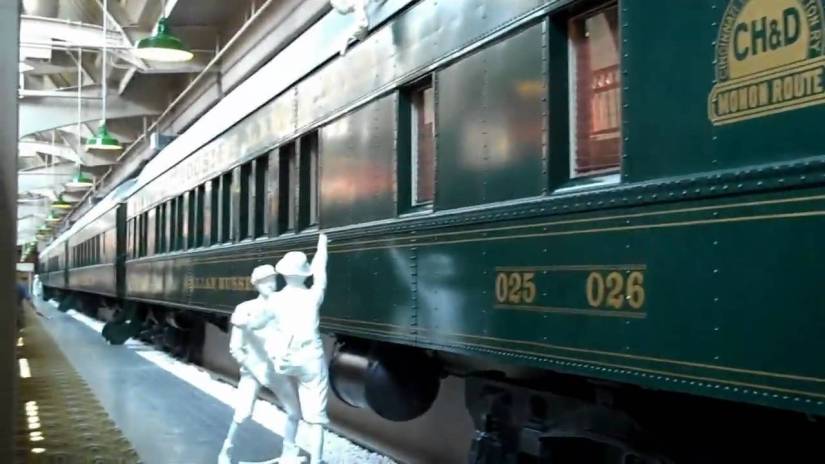
Today, the station is owned by the City of Indianapolis and houses a major hotel, restaurants, a charter school and a banquet hall . A branch office of the Mexican Embassy also is located in the building, a sign of Indy’s changing demographics, and a fitting place, because this was the gateway to Indianapolis for most of the city’s immigrants of the late 19th and early 20th centuries.
I’ve told you why Union Station is important to Indianapolis but I have not told you why the station is important to me. It is important to me because this was the site of my first date with a pretty little girl from Frankton, Indiana way back in 1988, She was unfamiliar with the big city of Indianapolis and I was Indianapolis born and raised. I loved union Station then as I love it now. I love the history, mystique and wonder contained within it’s walls and I love the little Frankton girl whose hand quivered in mine as we walked the storied halls of this Grand Indiana landmark. In fact, Union Station was the site of our first kiss. A memory that still makes us smile. I’d like to think that our story is special, but I suspect that ours is only one of many such tales of romance and young love that can trace their genesis back to a first date or first encounter at Indianapolis Union Station. A historic tapestry that Rhonda and I are proud to be woven into.

Indianapolis, Politics, Pop Culture, Presidents

Watergate-The Indianapolis Connection.

Nixon

Original publish date:  June 29, 2012            Reissue date: June 27, 2019

Last week, I recounted the 40th anniversary of the Watergate break-in and fall from grace of the Richard Nixon administration. There are not many voices left to clarify the events and personalities from that sad affair today. However, we are fortunate that two of the most important figures from Watergate have reunited to share their recollections of the scandal from a four decade perspective. Bob Woodward and Carl Bernstein recently co-authored an article for the Washington Post discussing the Nixon White House and Watergate affair as seen through the haze of history.
To me, the most interesting aspect of the Woodward / Bernstein article was the clarification of the role played in the events leading up to Watergate by a young Indianapolis attorney named Thomas Charles Huston. A man I have known for over 30-years myself. A complicated, enigmatic man to say the least. Over those years, I belonged to a political items collecting organization with Mr. Huston and even worked for him for a couple years in the early 1990s. I politely stayed off the subject of the Nixon White House years myself, but over that time picked up interesting tidbits from his relatives and friends. More on that later.

z 2895
Carl Bernstein & Bob Woodward of the Washington Post.

To Woodward and Bernstein, the most amazing developments from the years since the Watergate scandal are the continuing revelations further proving President Nixon’s involvement in the whole affair. It must be remembered that the duo of young reporters were shunned by their peers, dismissed by colleagues and threatened by the Washington establishment and the government itself. If anything, the tapes proved that Nixon was involved in schemes and secret plans potentially far worse than the hotel break-in that brought him down.
Woodward and Bernstein discovered that Nixon’s first war was against the anti-Vietnam War movement., which he considered subversive and detrimental to the war effort in Southeast Asia. In 1970, the President approved the top-secret “Huston Plan”, authorizing the CIA, the FBI and military intelligence units to identify any and all individuals identified as “domestic security threats”, in short, all those considered unfriendly to the Nixon administration.
z watergate_news_4Tom Huston (derisively called “Secret Agent X-5” behind his back by some White House officials), the White House aide who devised the plan, was a young right-wing lawyer who had been hired as an assistant to White House speech writer Patrick Buchanan. Huston graduated from Indiana University in 1966 and from 1967 to 1969, served as an officer in the United States Army assigned to the Defense Intelligence Agency and was associate counsel to the president of the United States from 1969-1971.His only qualifications for his White House position were political – he had been president of the Young Americans for Freedom, a conservative campus organization nationwide.
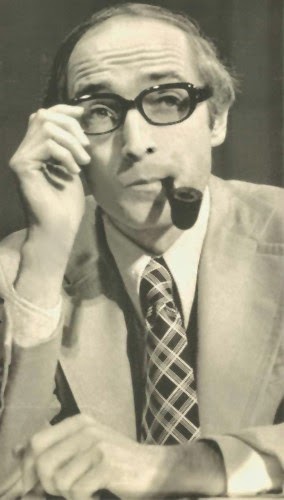
The Huston Plan was a 43-page report and outline of proposed security operations unknown by all but the most intimate Nixon White House insiders until it came to light during the 1973 Watergate hearings. The radical plan was born from President Richard Nixon’s desire to better coordinate domestic intelligence information gathering about ‘left-wing radicals’ and the anti-war movement in general. The plan was based on the assumption that, as Nixon said, “hundreds, perhaps thousands, of Americans—mostly under 30—are determined to destroy our society.” It called for intercepting mail, wire-tapping, covertly photographing and video-taping of administration “enemies” and lifting restrictions on “surreptitious entry”, in plainer speak, break-ins and “black bag jobs.” At one time it also called for the creation of camps in Western states where anti-war protesters would be detained. Huston’s Top Secret memo warns that parts of the plan are “clearly illegal.”
z 79 HustonDespite Huston’s warning that his namesake plan was illegal, Nixon approves the plan, but rejects one element-that he personally authorize any break-ins. Per Huston plan guidelines, the Internal Revenue Service began to harass left-wing think tanks and charitable organizations such as the Brookings Institution and the Ford Foundation. Huston writes that “making sensitive political inquiries at the IRS is about as safe a procedure as trusting a whore,” since the administration has no “reliable political friends at IRS.” He adds, “We won’t be in control of the government and in a position of effective leverage until such time as we have complete and total control of the top three slots of the IRS.” Huston suggests breaking into the Brookings Institute to find “the classified material which they have stashed over there,” adding: “There are a number of ways we could handle this. There are risks in all of them, of course; but there are also risks in allowing a government-in-exile to grow increasingly arrogant and powerful as each day goes by.”
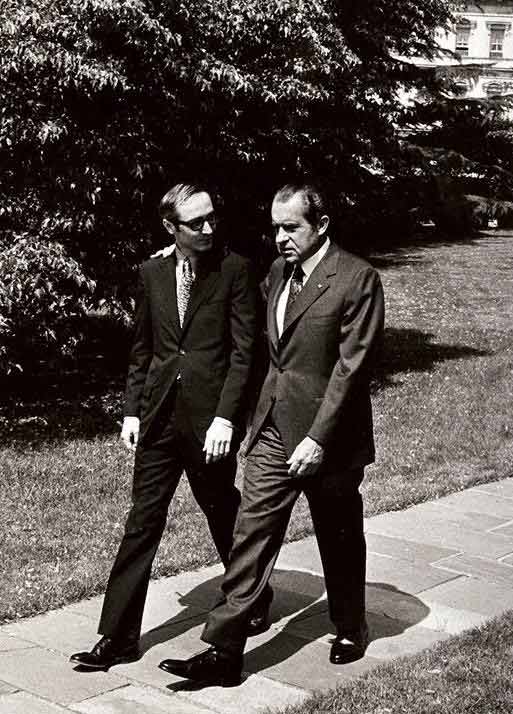
FBI Director J. Edgar Hoover objected to the plan, not on ethics or principles, but because he considered those types of activities the FBI’s turf. One June 5, 1970, FBI director J. Edgar Hoover brought Huston into his office and explains that the “old ways” of unfettered wiretaps, political infiltration, and calculated break-ins and burglaries are “too dangerous,” to attempt today. Hoover says he will not share FBI intelligence with other agencies, and will not authorize any illegal activities without President Nixon’s personal, written approval. The next day, Nixon withdraws his support for the Huston plan. Although Nixon covertly personally implemented several of its provisions anyway including lowering the age of campus informants and expanding surveillance of American college students and interception of mail.

z 9755
Tom Huston and Richard Nixon.

Placed in a White House safe, Huston’s blueprint became public in 1973 after Congress investigated the Watergate affair and learned that Nixon had ordered illegal monitoring of American citizens. Historians consider the Huston Plan as the impetus of what Attorney General Mitchell referred to as, “White House horrors” including the Plumbers Unit, the proposed fire-bombing of the Brookings Institution, the 1971 burglary of the office of the psychiatrist of Daniel Ellsberg, the creation of a White House enemies list, the use of the Internal Revenue Service (IRS) to punish those deemed to be enemies, and the Watergate affair itself.
Woodward and Bernstein are amazed at the psychotic ramblings still surfacing on the tapes as they are released a few at a time over the past few years. Huston’s name continues to surface on the tapes as well. On June 17, 1971, exactly one year before the Watergate break-in, Nixon met in the Oval Office with his chief of staff, Bob Haldeman and national security adviser Henry Kissinger to talk about former president Lyndon Johnson’s handling of the 1968 bombing halt in Vietnam. “You can blackmail Johnson on this stuff, and it might be worth doing,” Haldeman said, according to the tape of the meeting. “Yeah,” Kissinger said, “but Bob and I have been trying to put the damn thing together for three years.” They wanted the complete story of Johnson’s actions. “Huston swears to God there’s a file on it at Brookings,” Haldeman said. “Bob,” Nixon said, “now you remember Huston’s plan? Implement it. . . . I mean, I want it implemented on a thievery basis. G-d damn it, get in and get those files. Blow the safe and get it.” Nixon would not let the matter drop. Thirteen days later, according to another taped discussion with Haldeman and Kissinger, the president said: “Break in and take it out. You understand?” The next morning, Nixon said: “Bob, get on the Brookings thing right away. I’ve got to get that safe cracked over there.” And later that morning, he persisted, “Who’s gonna break in the Brookings Institution?” Luckily for history’s sake, the break-in was never carried out, at least not that we are aware of.

NYT2008121823552234C
W. Mark Felt

W. Mark Felt, the deputy director of the FBI and the man who would later be identified as Woodward’s “Deep Throat” source, later called Huston “a kind of White House gauleiter over the intelligence community.” The definition of “gauleiter” is, according to Webster’s Dictionary, “the leader or chief official of a political district under Nazi control.” Huston developed a staggeringly long “enemies list” that included, in historian Richard Reeves’s words, “most every man or woman who had ever said a discouraging word about Nixon.” As details of the Huston plan surfaced after Watergate, with its blatant contempt for civil liberties and disdain for the rule of Constitutional law, many historians and journalists identified it with the spirit and mood thought to pervade the Nixon White House.

z 20130901__ssjm0902obfrost1
David Frost & Richard Nixon.

During the 1977 David Frost Nixon interviews, former Watergate prosecutor Philip Lacovara told Frost’s aide James Reston Jr. that it was surprising Huston was not taken out and shot. Reston would later write: “Not only was Tom Charles Huston not taken out and shot, the plan was calmly considered and signed by Nixon, and was in force for a week, until J. Edgar Hoover objected on territorial rather than philosophical grounds.”
For his part, Mr. Huston has rarely spoke publicly of the plan that bears his name. In late 1973, Huston talked about Watergate and civil liberties with a small audience during a meeting of the Philadelphia chapter of the conservative organization Young Americans for Freedom (YAF). According to Huston, at that time, the country was reeling from bombings and bomb threats, closed-down schools, National Guard alerts, university ROTC buildings being burned, police officers injured and killed, civilians killed, snipers firing from rooftops; in short, a country on the brink of armed insurrection. “Looking back, it is easy to understand why people now think the administration overreacted,” he says. “And had I known at the time that if we had done nothing, the problem would just go away, I would have recommended that we do nothing. But we did not understand that, and I don’t think that any reasonable person could have known this. Something had to be done. In the last analysis, I suppose this is an example of the dangers of letting down your guard against increased executive powers—no matter what the circumstances. Not that the danger was not real, but in this case the risk of the remedy was as great as the disease. There was a willingness to accept without challenge the Executive’s claim to increased power. That’s why we acted as we did, and it was a mistake.”
z secrets-about-watergate-richard-nixonDuring the question-and-answer session at that meeting, a woman stood up to relay a story of how her son was being beat up by neighborhood bullies, and how, after trying in vain to get law enforcement authorities to step in, gave her son a baseball bat and told him to defend himself. Meanwhile, the partisan crowd is chanting and cheering in sympathy with the increasingly agitated mother, and the chant: “Hooray for Watergate! Hooray for Watergate!” began to fill the room. Huston waited for the cheering to die down and says, “I’d like to say that this really goes to the heart of the problem. Back in 1970, one thing that bothered me the most was that it seemed as though the only way to solve the problem was to hand out baseball bats. In fact, it was already beginning to happen. Something had to be done. And out of it came the Plumbers and then a progression to Watergate. Well, I think that it’s the best thing that ever happened to this country that it got stopped when it did. We faced up to it…. [We] made mistakes.”
In an interview after that speech, Huston speaks derisively about many of his former White House colleagues, particularly Richard Nixon. “Frankly, I wouldn’t put anything past him and those damn technocrats,” he says of Nixon and his senior aides. “you can’t begin to compete with the professional Nixonites when it comes to deception. If Nixon told them to nationalize the railroads, they’d have nationalized the railroads. If he’d told them to exterminate the Jews, they’d have exterminated the Jews.” Despite alleged authorship of the radical plan that bears his name, Tom Huston left the Nixon White House with his reputation intact and managed to remain above the morass of the Watergate Scandal.

z hunter-s-thompson-quotes
Hunter S. Thompson

He did not, however, escape the wickedly lucid scrutiny of legendary “Gonzo” journalist and author Hunter S. Thompson, who said of Huston in his book, “The Great Shark Hunt” in 1979, “the Tom Charles Huston Domestic Intelligence Plan amounted to nothing less than the creation of a White House Gestapo.”
During my period of closest association with Tom Huston, he was a partner with the Barnes & Thornburg law firm and was chairman of the firm’s Real Estate Department. Huston is listed in Who’s Who in America, The Best Lawyers in America and Who’s Who in Indianapolis Commercial Real Estate and is admitted to practice law in Indiana. The mild mannered man most often seen dressed in a fine mohair topcoat, English derby hat and smoking a pipe is far from what one might expect from the author of a document that, in 2007, author James Reston Jr. called “arguably the most anti-democratic document in American history… a blueprint to undermine the fundamental right of dissent and free speech in America.”


Criminals, Indianapolis, Irvington Ghost Tours

IRVINGTON’S LINK TO THE FORMATION OF THE F.B.I.

Holmes-Dillinger

Original publish date:  January 19, 2009

Reissue date: June 6, 2019

This article originally ran in the January 19, 2009 edition of the Eastside Voice. I spent this past weekend with the Great-great-grandson of H.H. Holmes, “Bloodstains” author Jeff Mudgett, and the film crew from Travel Channel’s “Ghost Adventures” series. We gathered to tape a show inside the home where Holmes committed one of his most heinous crimes: the murder of 10-year-old Howard Pitezel. For that reason, I thought this might be a perfect time to revisit one of the few positive aspects of that crime and highlight Irvington’s role in the saga of Federal law enforcement in this country. While the society has faded away, the meeting place has closed its doors and the article’s agent provocateur has become a fellow columnist, the subject matter retains its relevance a decade later.

Z Holmes Irvington
H.H. Holmes murdering 10-year-old Howard Pitezel in Irvington.

During the inaugural meeting of the “Ichabod Crane Society of things that go bump in the night” at Book Mamas in Irvington held Saturday January 17 2009, I learned something interesting I’d like to share with you. One of the guests, Irvingtonian Steve Nicewanger asked me if I was aware that Irvington had a connection to the formation of the Federal Bureau of Investigation. Steve informed me that the F.B.I. had been formed to track down one of Irvington’s most infamous figures, America’s first serial killer Dr. H.H. Holmes. Holmes was alleged to have killed over 200 people in Chicago in 1893. His story is well documented and his spirit is rumored to still haunt the Irvington bungalow where he murdered and desecrated the body of a 10 year old boy named Howard Pitezel. Holmes came through Irvington in the autumn of 1894 while being chased by a dogged Pinkerton Detective named Frank Geyer. I thought I had researched the Holmes saga pretty thoroughly, but I must admit that I had never heard of this possible connection. I was intrigued by the thought of it.
z john-dillinger-wanted-posteI have always attributed the genesis of the F.B.I. to another infamous Hoosier with Irvington ties, John Dillinger, who robbed an Irvington drug store and soda fountain in the summer of 1933. The building still stands and is home today to DuFours restaurant on the northwest corner of Washington and Audubon (now the Lincoln Square Pancake House). At the time, Dillinger allegedly lived on a property known as “Rickett’s Farm” near the Kile Oak in Irvington. I knew that J. Edgar Hoover, the man most people credit with forming the present day F.B.I., was a little known Washington D.C. bureaucrat until Dillinger came along. Hoover made his reputation by expanding the law enforcement powers of his obscure bureau to track down Dillinger. Dillinger became the bureau’s first “Public Enemy # 1” on June 22,1934, which ironically was John’s 31st birthday. Hoover’s G-men would kill Dillinger barely a month later outside of Chicago’s Biograph Theatre on July 23, 1934. Hoover would display Dillinger’s death mask on the wall outside of his office for the next 40 years.
Intrigued by Mr. Nicewanger’s statement, I immediately began research to see if indeed this connection could be made. Sure enough, it’s true…at least in theory. Quoting the Bureau’s official website; “The FBI originated from a force of Special Agents created in 1908 by Attorney General Charles Bonaparte during the Presidency of Theodore Roosevelt. The two men first met when they both spoke at a meeting of the Baltimore Civil Service Reform Association. Roosevelt, then Civil Service Commissioner, boasted of his reforms in federal law enforcement. It was 1892, a time when law enforcement was often political rather than professional…Roosevelt and Bonaparte both were “Progressives.” They shared the conviction that efficiency and expertise, not political connections, should determine who could best serve in government.”

z tr
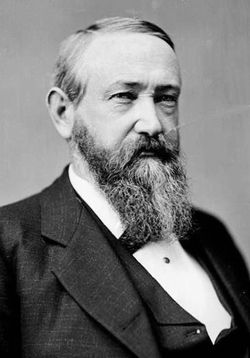
Benjamin Harrison

A young Teddy Roosevelt campaigned in the Midwest for Benjamin Harrison in the 1888 presidential election, including many stump speeches here in the Hoosier state. As a reward, President Harrison appointed Roosevelt to the United States Civil Service Commission, where he served until 1895. It was during this time that H.H.Holmes was fast becoming America’s version of “Jack the Ripper”. As he fled Chicago in 1894, Holmes used the inability of local law enforcement agencies to communicate with each other to evade prosecution. During this period, the Bureau was a branch of the “Secret Service” staffed by former “Pinkertons” from the legendary detective agency founded by Allen Pinkerton. Upon Pinkerton’s death in 1884, the Pinkertons were mostly known as thugs whose job it was to break up early labor union rallies and for their role in the hounding of Butch Cassidy’s Wild Bunch. Holmes would be captured and hung in Philadelphia on May 7, 1896. The ability of Holmes to evade capture while his heinous crimes were reported on the front pages of newspapers across America would lead to the conversation of a unified national law enforcement reporting and evidence gathering agency by Roosevelt and others.

z Harrison
Benjamin Harrison

Harrison’s career ended with his defeat to Grover Cleveland in 1892. Ironically, one of the first things he did after leaving office was to visit the World’s Columbian Exposition in Chicago in June 1893, an event closely associated with H.H. Holmes. As Harrison’s career waned, Roosevelt’s career was catching fire. From his post on the US Civil Service Commission, Teddy became President of the New York City Board of Police Commissioners, then Assistant Secretary of the Navy, Governor of New York and Vice-President of the United States. Theodore Roosevelt became President of the United States in 1901, five years later, Teddy dedicated Fort Benjamin Harrison in the former president’s honor in 1906.
Shortly before Fort Ben’s dedication, Roosevelt appointed Bonaparte Attorney General.

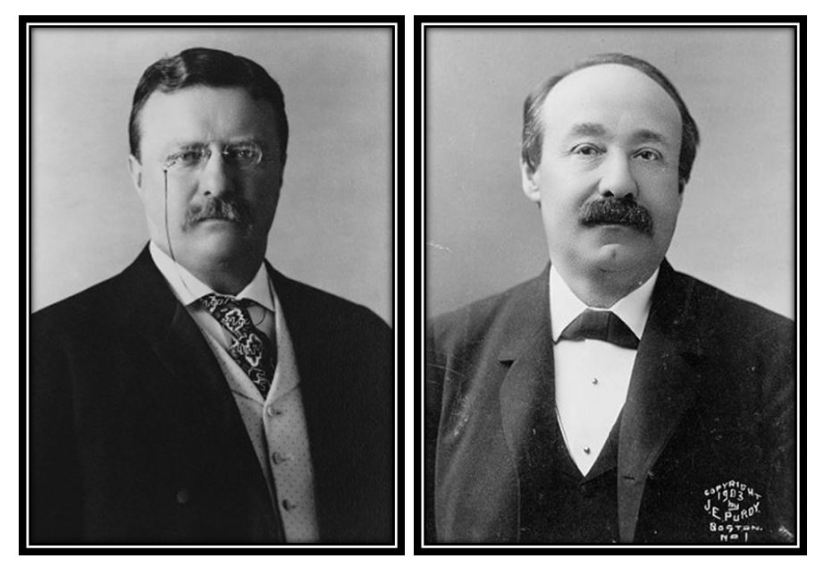
z Teddy-Roosevelt-Charles-Bonaparte
Teddy Roosevelt and Attorney General Charles Bonaparte

In 1908, Bonaparte applied their shared philosophy from 1892 to form the Department of Justice by creating a corps of Special Agents. It had neither a name nor an officially designated leader other than the Attorney General. Yet, these former detectives and Secret Service men were the forerunners of the FBI. In the forty years between Holmes in 1893 and Dillinger in 1933, the bureau would slowly expand it’s law enforcement responsibilities. If the 1893 Bureau had encountered the evil Dr. Holmes, the best they could do would have been to gather information to assist in his arrest. In 1933, the Bureau’s powers had been expanded to the point of using deadly force upon first contact with John Dillinger.

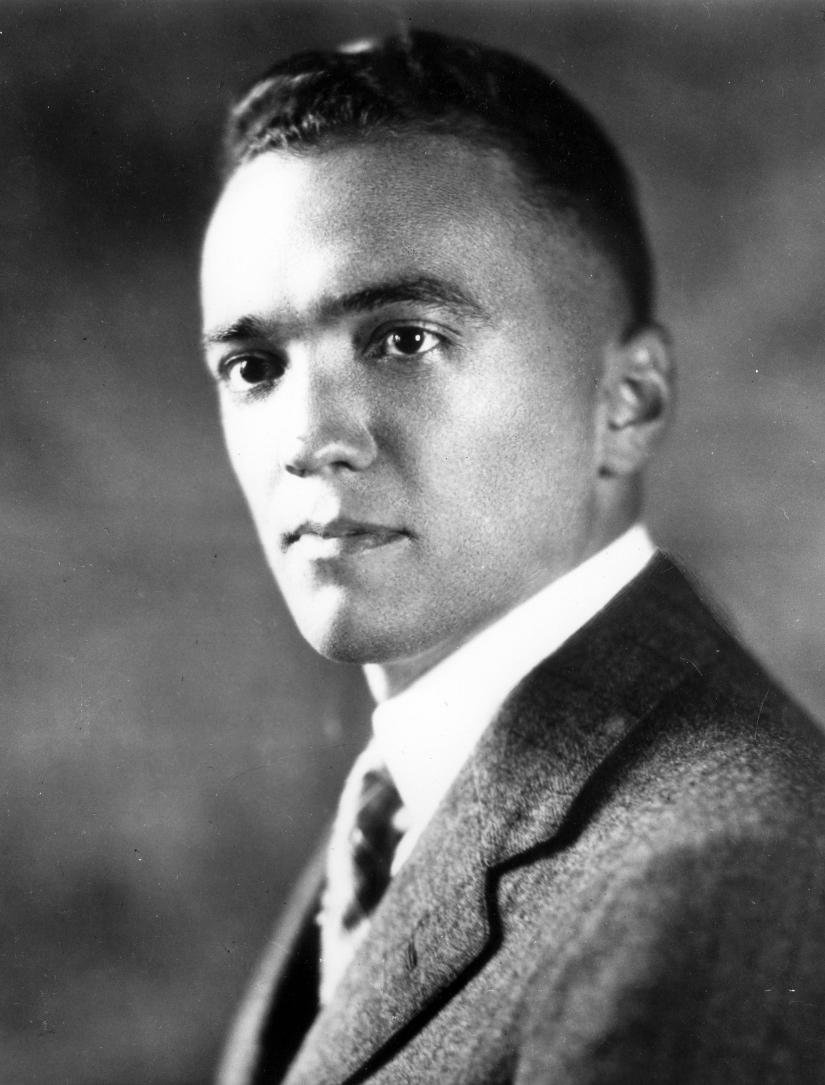
z Hoover
J. Edgar Hoover

So an insightful comment by Irvingtonian Steve Nicewanger provoked research that would once again perfectly illustrate the uniqueness of the Eastside Indianapolis community known as Irvington. Reminding us that three separate personalities with fleeting ties to the Irvington community; a serial killer, a bank robber and a U.S. President would contribute to the founding of the most powerful law enforcement agency the world has ever known. Today’s F.B.I.