
Original publish date: January 3, 2019
My wife and I have developed a Christmas time tradition of visiting Gatlinburg, Tennessee every December. We’ve been traveling to the area on and off for over 25 years. Back then the region retained an atmosphere where one could imagine Dolly Parton walking down the sidewalk but nowadays, one might expect to see Wayne Newton driving past in a limousine instead. It used to be the type of place where kitschy souvenir stores sold Cedar wood souvenir moonshine stills, featured live bears and homey gemstone pits for the kids to dig through. But those days are long gone. Gatlinburg is today home to glitzy storefronts selling Harley Davidson clothes, designer moonshine and Pandora charms.
You can still drive through Smoky Mountain National Park in search of black bears at Cades Cove and find a cozy log cabin to eat a flapjack in. Some things never change. A couple weeks ago we stopped at an antique mall near Lexington Kentucky where I found a shoebox full of old letters just begging for my attention. One of the envelopes contained a Christmas card from the old Indianapolis Clowns Negro league baseball club. I opened it quickly but carefully, saw what was contained inside, and handed it to Rhonda with the explicit instructions, “Don’t lose this.” I knew we were going to be holed up in the room for the next couple days and this would be a fun thing to examine over morning coffee.
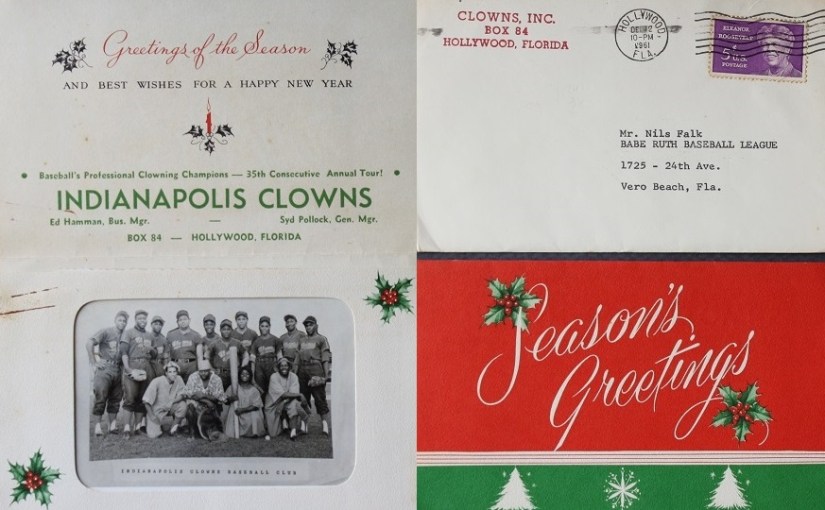
I’m an early riser; Rhonda likes to sleep in and I’m okay with that. It was time to examine my find. The envelope contained a Christmas card from the 1961 Clowns baseball team after they relocated to Hollywood, Florida in the late 1950s. The Christmas card looks like any other; bright red, white & green with “Season’s Greetings” on the front. However the magic happens when you open it and the contents are revealed. The interior features a great real photo image of the entire uniformed team captioned: “Indianapolis Clowns Baseball Club” at bottom. The photo is actually a B&W snapshot that was individually inserted into a pocket window frame inside the card. It is easy to imagine a room full of elegantly dressed women chatting gleefully away as they carefully stuff each photo in place in the Clowns’ front office. Or maybe it was a room full of bat boys and ticket takers. Regardless, it makes for a romantic holiday image.
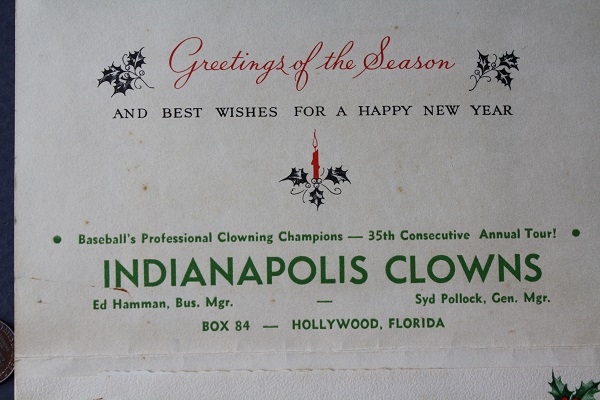 The card reads: “Greetings of the Season and Best Wishes for a Happy New Year. Baseball’s Professional Clowning Champions- 35th Consecutive Annual Tour! Indianapolis Clowns Ed Hamman, Bus. Mgr. Syd Pollack, Gen. Mgr. Box 84- Hollywood, Florida” inside. The original mailing envelope has the return address on front and same on back via an embossed stamp on the back. The Christmas card was sent to the Babe Ruth Baseball League in Vero Beach, Florida. True baseball fans will recognize Vero Beach as the spring training home of former Negro leader Jackie Robinson’s Brooklyn Dodgers and later the Koufax/Drysdale Los Angeles Dodgers. For a baseball fanatic, there is a lot going on in this little Christmas card.
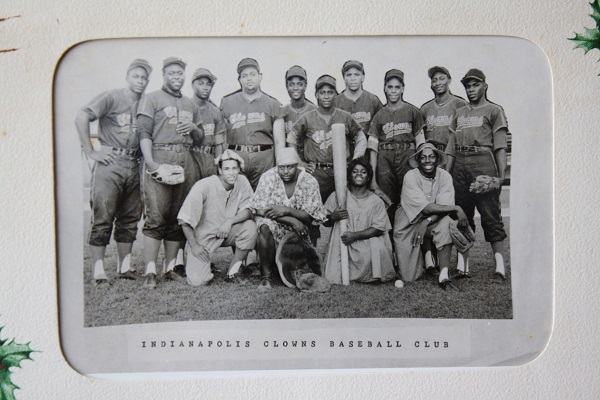 The team photo pictures 10 players in old wool baseball uniforms standing in a line with another four players dressed in comic field costumes including a female player holding one of the Clowns’ trademark props, a grossly oversized baseball bat. The Clowns were one of the first professional baseball teams to hire a female player. They featured three prominent women players on their roster in the 1950s: Mamie “Peanut” Johnson (1935-2017) a right handed pitcher who went 33-8 in 3 seasons with the Clowns, Constance “Connie” Morgan (1935-1996) who played 2 seasons at second base for the Clowns and the first female player in the Negro Leagues, Marcenia “Toni” Stone (1921-1996) who once got a hit off of Satchel Paige.
Most of my interest in the Clowns centers around the fact that they’re from my hometown. But also because they were the first professional team for one of my baseball heroes; Hank Aaron. On November 20, 1951, Aaron signed his first Pro contract with the Clowns. The 6 foot, 180 pound Aaron would play three months at shortstop, batting cleanup for the Clowns. He earned $200 per month.
While with the Clowns, his teammates called him “Pork Chop” because it was the only thing the kid from Mobile Alabama  knew how to order off the menu. Aaron first experienced overt northern style racism while playing with the Clowns. The team was in Washington, D.C. and a few of the Clowns’ players decided to grab a pregame breakfast in a restaurant behind Griffith Stadium. The players were seated and served but after they finished their meals, they could hear the sounds of employees breaking all the plates in the kitchen. Aaron and his teammates were stung by the irony of being in the capital of the “Land of Freedom” whose employees felt they “had to destroy the plates that had touched the forks that had been in the mouths of black men. If dogs had eaten off those plates, they’d have washed them.”
Aaron finished with a .366 batting average in 26 official Negro league games; 5 home runs, 33 RBI, 41 hits, and 9 stolen bases. At the close of his three months with the Indianapolis Clowns, Aaron received two offers from MLB teams via telegram; one from the New York Giants and the other from the Boston Braves. Years later, Aaron recalled later: “I had the Giants’ contract in my hand. But the Braves offered fifty dollars a month more. That’s the only thing that kept Willie Mays and me from being teammates – fifty dollars.” The Braves eventually purchased Aaron’s contract from the Clowns for $10,000.
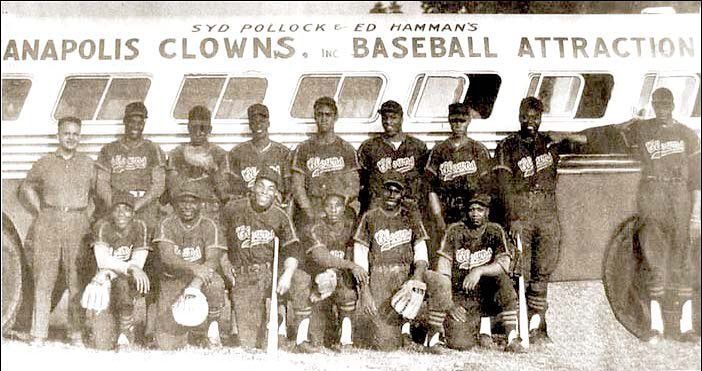 During Aaron’s tenure the Clowns were a powerhouse team in the Negro American League. However, the story of the Indianapolis Clowns does not begin, or end, with the Hank Aaron connection. The team traces their origins back to the 1930s. They began play as the independent Ethiopian Clowns, joined the Negro American League as the Cincinnati Clowns and, after a couple of years, relocated to Indianapolis. The team was formed in Miami, Florida, sometime around 1935-1936 and was originally known as the Miami Giants. After a couple years the team changed its name to the Miami Ethiopian Clowns and hit the road to become the longest running barnstorming team in professional baseball history.
Over the next few decades, the Clowns developed into a nationally-known combination of show business and baseball that earned them the designation as the Harlem Globetrotters of baseball. The team built a national following as one of baseball’s favorite entertainment attractions during the 1930s and the club was the only “clowning team” to earn entrance into black baseball’s “major leagues.” Though the Clowns always played a credible brand of baseball, their Globetrotter-like comedy routines was the stuff that paid the bills, filled the stands and brought national attention.
In 1943, the team toned down its clowning routines and joined the Negro American League. They also moved to Ohio’s Queen city to became the Cincinnati Clowns. The team floated back and forth between Cincinnati and Indianapolis for the 1944 and 1945 seasons before officially moving to Indianapolis after World War II in 1946. While this was an epiphanal moment in the history of Indianapolis baseball, the euphoria didn’t last long.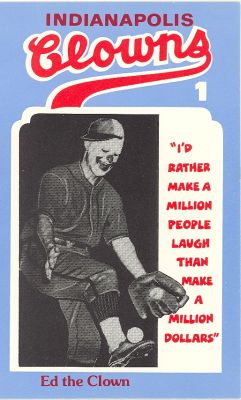
Baseball’s color barrier came tumbling down on April 18, 1946, when Jackie Robinson made his first appearance with the Montreal Royals in the Triple-A International League. Robinson was called up to the parent club the next season and helped the Dodgers win the National League pennant on his way to winning the first National League Rookie of the Year award. After Robinson’s success, a steady stream of black players representing the elite of the Negro leagues flowed into the majors leagues. By 1952, there were 150 black players in major league baseball. For the Clowns, the result was sadly predictable. Black fans followed their stars to the big leagues, and attendance at traditional black ballparks tanked.
The Negro National League folded after the 1949 season. Some proposals were offered to keep the league alive as a developmental league for black players, but that idea was contrary to the goal of full integration. The Negro American League continued on throughout the 1950s, but closed its doors for good in 1962, the year after this Christmas card was issued. So the Negro leagues, once among the largest and most prosperous black-owned business ventures, faded into oblivion. After the demise, the Clowns continued barnstorming across the country and returned to their clowning routines out of financial necessity. It remains a testament to the strength of the Clowns’reputation that they were able to sign a young Hank Aaron who would, nowadays, come out of baseball’s minor league system.
The years immediately preceding this Christmas card were, despite the demise of the Negro leagues, the most productive for the Indianapolis franchise. In 1950 the Clowns won their first Negro American League championship behind their star catcher Sam Hairston, who won the League’s Triple Crown title with 17 homeruns, 71 RBI and a .424 batting average. Hairston also led the league with 100 hits and 176 total bases.
During the 1951 season the Clowns did not play a single home game in Indianapolis but won their second Negro American League championship. The Clowns captured their third league championship in 1952. The Clowns’ success earned them a steady barnstorming gig during the off-season traveling with Jackie Robinson’s All Stars. In 1954, the Clowns won their fourth league championship in five years. The next year, the Clowns dropped out of the league to pursue a full time barnstorming schedule. The Clowns played 143 games on the road in 1963. Although this sounds like a staggering number, it is the smallest number of games the Clowns had ever played in one year. Along the way the Clowns broke all color barriers by playing in front of both white and black crowds.
 Harlem Globetrotter star “Goose” Tatum also played for the Clowns during this time. Goose was as much of a showman on the diamond as he was on the basketball court. Whether fielding balls with a glove triple the size of a normal one, confusing opposing players with hidden ball tricks or playing second base while seated in a rocking chair, Tatum was amazing. During the same era, Richard “King Tut” King played the field using an enormous first baseman’s mitt and occasionally augmenting his uniform with grass hula skirts in the field. King, who spent over 20-years with the Clowns, paved the way for great white baseball comedians like Max Patkin.
Clowns pitcher Ed Hamman would fire fastballs from between his legs and from behind his back while going as far as to go into the crowd to sell peanuts and programs while his team was at bat. Hamman also invented “shadow ball”. Hamman’s brainchild had all nine players going through the motions of a real game from pitching to fielding to batting -all without a ball. Hamman’s name appears on the 1961 Christmas card as the team’s business manager.
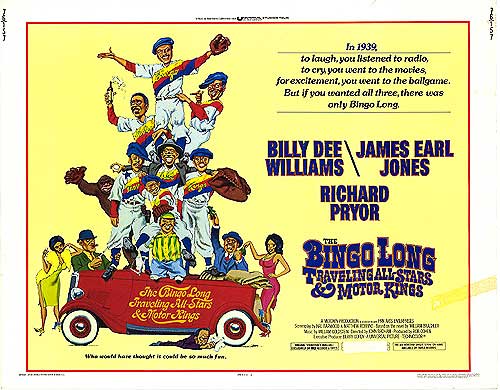
 By 1966 the Indianapolis Clowns were the last Negro league team still playing. The Clowns continued to play exhibition games into the 1980s, but as a humorous sideshow rather than a competitive sport. After many years on the road as a barnstorming team, the Clowns finally disbanded in 1989. The Clowns were also the first team to feature women as umpires. The 1976 movie “The Bingo Long Traveling All-Stars & Motor Kings”, starring James Earl Jones, Billy Dee Williams, and Richard Pryor, is based on the Indianapolis Clowns.
According to the official website of the Negro Leagues: “The Harlem Globetrotters have won their place in the world’s hearts as comedians with great basketball skill. The Indianapolis Clowns did exactly the same in segregated America. The Clowns crossed all color barriers with their brand of comedy and earned their place in baseball history with trend setting ideas, actions and great play between the lines. Unlike the Globetrotters however, the Clowns took an opposite road to fame. The Clowns became a legitimate playing team after beginning as entertainers -the exact opposite of their basketball playing cousins.” Seasons greetings everybody through the haze of history and your Indianapolis Clowns.


 Barb guided us through every step of cannon restoration, carefully explaining what it took to keep her guns in perfect order. This was heady air we were breathing. Terms like breeches, swells, trunnions, rimbases, chambers, astragals, base rings, vents, bores, girdles, chambers, cascabels, knobs, wadding, windage and calibre seeped into our heads like sand through an hourglass. Barb Adams knows every inch of these guns.

 Although the first documented appearance of a bicycle in Indianapolis can be traced to a demonstration of the high-wheeled bike called the “Ordinary” in 1869, these old fashioned contraptions (known back then as “Velocipedes”) would be almost unrecognizable to the riders of today. With their huge front tires and seats that seemed to require a ladder to climb up to, these early bikes were awkward and unwieldy for use by all but the most hardy of daredevil souls (They didn’t call them “boneshakers” for nothing back then). It would take nearly 25 years after the close of the American Civil War before the bike began to resemble the form most familiar to riders of today. The development of the safety bike with it’s 2 equal-sized wheels in the 1880s made the new sport more acceptable as a hobby and pastime.
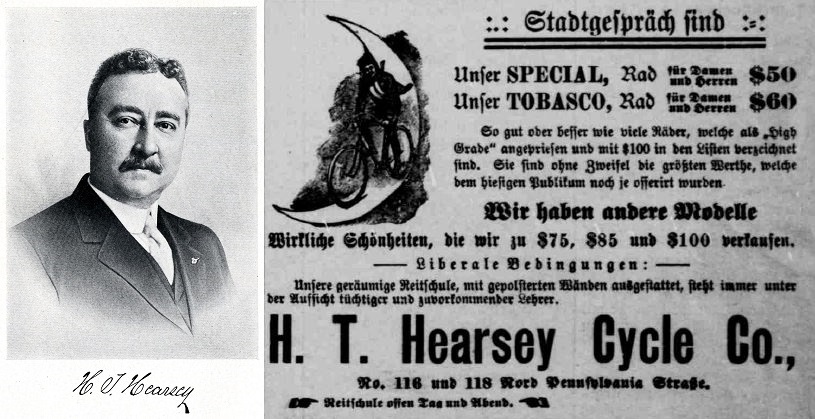
 In 1887 bicycle mechanic and expert rider Henry T. Hearsey (1863-1939) opened the first bicycle showroom in Indianapolis. His store was located at the intersection of Delaware and New York Streets on the city’s near eastside. Hearsey introduced the first safety bike to Indianapolis, the English-made Rudge, which sold for the princely sum of $150 (roughly $4,000 in today’s money). Keep in mind that was about twice the price of a horse and buggy at the time. He would later open a larger shop at 116-118 North Pennsylvania Street. He is credited for introducing the 1st safety bicycle in the Capitol city in 1889. Hoosiers took to it immediately and within a few short years, the streets of Indy were so clogged with bicyclists that the City Council passed a bicycle licensing ordinance requiring a $ 1 license fee for every bicycle in the city.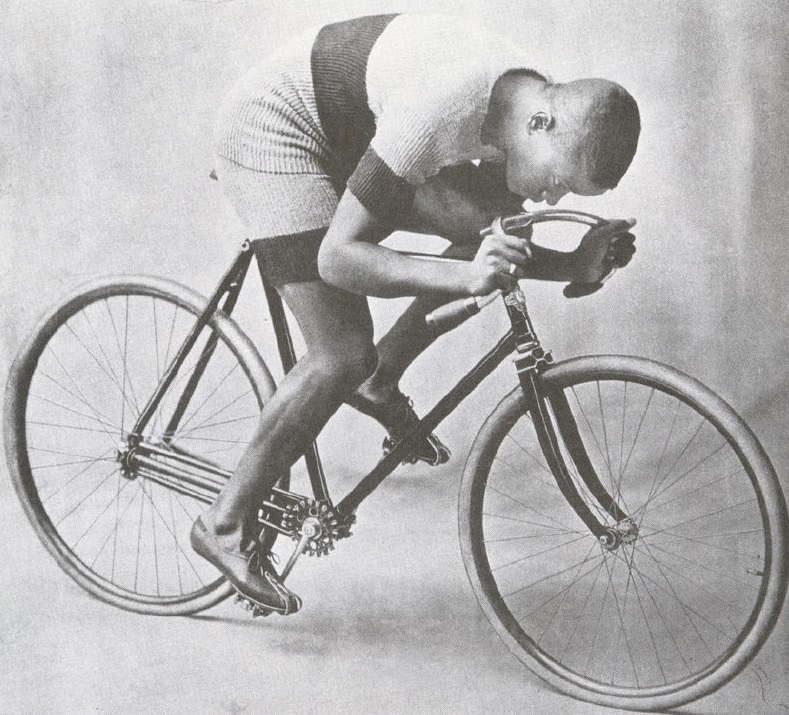
 the nickname “Major”, which stuck with him the rest of his life. He has been widely acknowledged as the first American International superstar of bicycle racing. He was the first African American to achieve the level of world champion and the second black athlete to win a world championship in any sport. Carl Fisher was one of the founders of the Indianapolis Motor Speedway, developer of the city of Miami and the creator of the famous “Lincoln Highway” and the “Dixie Highway.”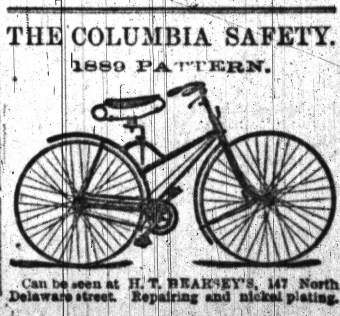
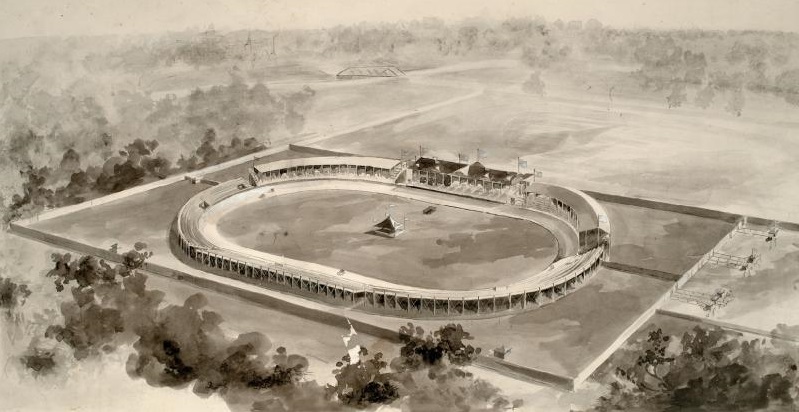
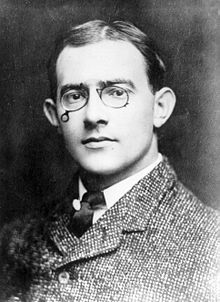
 Cycling was so popular in Indianapolis that the city constructed a racing track known as the “Newby Oval” located near 30th Street and Central Avenue in 1898. The track was designed by Shortridge graduate Herbert Foltz who also designed the Broadway Methodist Church, Irvington United Methodist Church and the Meridian Heights Presbyterian Church. Foltz would also design the new Shortridge High School at 34th and Meridian. The state of the art cycling facility could, and often did, seat 20,000 and hosted several national championships sponsored by the chief sanctioning body, “The League of American Wheelmen.” The American Wheelmen often got involved in local and national politics. Hoosier wheelmen raced into the William McKinley presidential campaign in 1896 and helped him win the election. With this new found political clout, riding clubs began to put pressure on politicians to improve urban streets and rural roads, exclaiming “We are a factor in politics, and demand that the great cause of Good Roads be given consideration.”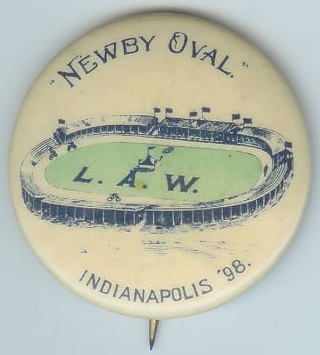


 The ALPLM’s “problems” began back in 2007 when it purchased the famous Taper collection for $23 million. “The collection is amazing,” says Sam, “the Lincoln top hat and bloodied gloves seem to be the items that resonate most with people, but the collection is much more than that.” Dr. Wheeler says that the uniqueness of the Taper collection centers around its emphasis on assassination related items, a field that had been largely ignored by Lincoln collectors at that time of its assemblage. The collection was created by Louise Taper, daughter-in-law of Southern California real estate magnate S. Mark Taper. She created the exhibition The Last Best Hope of Earth: Abraham Lincoln and the Promise of America which was at the Huntington Library from 1993–1994 and at the Chicago Historical Society from 1996-1997.
 “Bottom line,” Sam says, “we need to keep the collection here. That is our first priority.” It is easy to see how important this collection is to Dr. Wheeler by simply watching his eyes as he speaks. To Wheeler, the collection is not just a part of the museum, it is a part of the state of Illinois. Sam relates how when he speaks to groups, which he does quite regularly on behalf of the ALPLM, he often reaches into the vault to bring along pieces from the Taper collection to fit the topic. “People love seeing these items. It gives them a direct connection to Lincoln.” states Wheeler.
 Hoosiers may ask, why doesn’t the ALPLM just ask the state of Illinois for the money? After all, with 300,000 visitors annually, the Lincoln Library Museum is one of the most popular tourist sites in the state of Illinois and is prominently featured in all of their state tourism ads. Well, the state is billions of dollars in debt despite approving a major income-tax increase last summer and as of the time of this writing, has yet to put together a budget. To the casual observer, one would think that financial stalemate between the state and the museum would be a no-brainer when you consider that the ALPLM has drawn more than 4 million visitors since opening in 2005. The truth is a little more complicated than that. Illinois State government runs and funds the Lincoln library and museum. The separately run foundation raises private funds to support the presidential complex. The foundation, which is not funded by the state, operates a gift store and restaurant but has little role in the complex’s operations, programs and oversight.


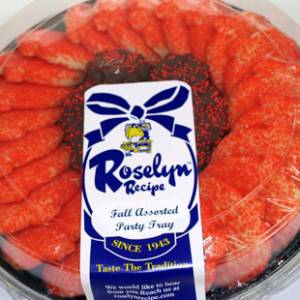
 Although I never fail to take my annual trip around Monument Circle at Christmastime to gaze in wonder at the fantastic fir tree fantasy, my personal memories of Christmas on the Circle revolve around a little shack that used to rest at its base facing the Indiana Statehouse. You may think of the L.S. Ayres Cherub, Santa’s mailbox, the 26 larger-than-life toy soldiers and sailors surrounding the Circle, the 26 red & white striped peppermint sticks, the 52 garland strands or the 4,784 colored lights strung from the top of the Monument to its base, but I think of the Roselyn Bakery Christmas Hut.
 Decorated with Gingerbread man shutters and candy cane pillars, coated in what looked like white icing, the Christmas hut was set up on the West side of the Circle where it remained for 25 years from 1974 to 1999. It was estimated that some 1.2 million Gingerbread man cookies were handed out from within that festive little house over those years. Just like the bakery itself, that little hut was an institution.
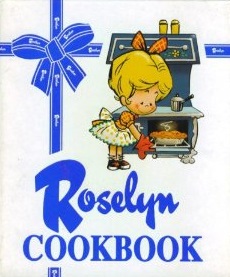 For me, Roselyn will always be identified for buttermilk jumbles, toffee cookies, alligator & sweetheart coffee cakes, yeast donuts and the darling little girl cartoon mascot known as “Rosie”. A blonde haired, blue eyed perpetually smiling little naive whose popularity forced the Roselyn Christmas Hut to undergo a name change to “Rosie’s Gingerbread House.” If memory serves, for a time there was even a living, breathing life-sized “Rosie” mascot dressed in a horribly oversized paper mache’ head and wearing a red velvet dress. Every so often, she would wobble awkwardly out of the Gingerbread hut to personally pass out cookies to the eager, but slightly befuddled, kiddies on the Circle. As I recall, she didn’t speak, but to a 12-year-old cartoon addicted boy like me, her skirt was short and her cookies were hot.
 a long way baby.”
 Eight mayors and ten governors have served our city and state over the past 50 years. I can’t say that I miss any of them, but I do miss those Gingerbread cookies. If you do too, you can make them yourself. Here’s the recipe for Roselyn Bakeries famous Gingerbread Men cookies: 1 1/4 teaspoon allspice, 2 3/4 teaspoons baking soda, 5 teaspoons ground cinnamon, 1 teaspoon ground cloves, 1 teaspoon ground ginger, 2 1/2 teaspoons salt, 3/4 cup Crisco shortening, 3/4 cup granulated sugar, 6 tablespoons whole eggs, 1 1/4 cup extra fine coconut (Make sure that the coconut you use is very fine, almost like coarse sugar-you may have to grind store bought coconut flake down), 1 1/4 cup honey, 5 cups all-purpose flour. Preheat oven to 360 degrees F. Combine allspice, baking soda, cinnamon, cloves, ginger, salt, shortening, and sugar into a large mixing bowl. Cream together. Scrape down bowl. Add beaten eggs and mix thoroughly.
 Scrape down bowl. Add coconut and honey and mix well. Scrape down bowl. Add flour and mix well. On a lightly floured surface, with a floured rolling pin, roll dough 1/8 inch thick. With a 5 inch long cutter, cut out men. Re-roll trimmings and cut more cookies. With spatula, place 1/2 inch apart on cookie sheets. Bake at 360 degrees for 8 minutes or until browned, then, with spatula, remove cookies to racks to cool. Decorate as desired. Makes 3 dozen cookies. Now if I could only locate a slightly used Christmas shack.
 Alan E. Hunter