

Original publish date: September 13, 2018
155 years after the last cannon shot was fired in anger on the hallowed fields at Gettysburg, Pennsylvania, a dutiful volunteer keeps watch over the cannons located there. The Gettysburg National Military Park is 9.358 mi.² in size and features some 1,300 monuments and 400 cannons. It takes an army to maintain the monuments but there is only one angel left on the field caring for those artillery pieces, many of which saw use in the battle itself.
I ran into Barb Adams quite by accident in late June 2018, just a couple days before the 155th anniversary of the great battle. I was visiting Gettysburg with my wife and friends Kris and Roger Branch. I have recently taken up a new hobby of “etching” tombstones, plaques and monument faces at the many historic places I often find myself visiting. Etching is a fairly simple hobby that involves paper pencil and a little masking tape. If you, like me, ever traced a Lincoln penny with a pencil by rubbing the graphite over the surface of the coin, then you have etched too.
Roger Branch is a former U.S. Army artilleryman with an interest in cannons. Last year I found an “artsy” photo collage of the crest of Little Round Top which I gave to Roger. One of the photos was a close up of the muzzle from one of the big guns. Little did I know, that minor gift would set him on a quest to find that cannon, the very gun pictured in that old photographic display. Kris, Roger and I hit the battlefield at dawn in search of the many rock carvings made by soldiers still existing there. (Sleepyhead Rhonda stayed behind) I was determined to make a couple etchings if practicable. I also knew I wanted to make etchings of the Irish brigade monument along with the Hancock, Sickles and Lewis Addison Armistead wounding monuments. Especially since Armistead was the man I named my son Addison after.
Roger wanted to make an etching of the Alonzo Cushing marker at the bloody angle just yards away from the high water mark of the Confederacy. All of these we did and more. Etching can get into your soul and literally seep into your blood. Once you’ve been out etching, you notice that your fingers are covered with black graphite. It gets on everything you touch from that point on. Oh, it washes off easily, but somehow that sooty residue makes you feel authentic, especially when you’re on a battlefield.
Flush with excitement and caught up in the moment, our grimy little trio headed to the massive Pennsylvania monument in search of Roger’s cannon. We had checked all of the guns at the high watermark for comparison; to no avail. While checking the muzzles of the guns near the First Minnesota monument, it occurred to us that we could easily etch those muzzles. The guns are dated per time of manufacture, so the thought of getting one etching from each year (1861, 1862, 1863, 1864, & 1865) became our quest of the moment.
There we stood, three middle-aged graphite-stained 8-year-olds tracing our little hearts out. Kris held the paper taut like a spider web on a gutter spout. Roger traced away like a Hollywood makeup artist on an aging starlet. My job? To keep watch. Because we weren’t entirely sure we were allowed to do this. We were stretching the boundaries of our usual mantra: “Take nothing but pictures-leave nothing but footprints.”
Suddenly, a car pulled up and out stepped an athletic looking woman whose shirt, pants, shoes, wrists, fingers and elbows were be-dabbed with paint. She walked up to our sheepish looking little trio and for a few seconds we wondered if we were in trouble or not. Roger remained cool, calm and collected and never stopped etching. He remained focused and was determined to complete his task. Turns out, this handsome suntanned lady was Barb Adams and she was the keeper of the cannons.
We asked if we were in trouble, and she answered, “No, I just want to watch you do one.” Roger finished his etching as we chatted with Barb and she informed us of what she does every day. Her job is to maintain, clean and repaint every cannon on the Gettysburg battlefield. She knows them all by heart and maintains a detailed accounting of every gun on that field. Roger immediately pulled out his cell phone and asked, “Do you know where this gun is?” To which Barb answered, “Are you guys going to be here for a while? I can go check my book and let you know.”

She jumped in her car and drove back to her office, returning several minutes later with her binder identifying the location of her cannons. “Sorry guys, that gun is not on this field.” came Barb’s reply. To say we were crestfallen might be an understatement. Our spirits were lifted when Barb invited us to come visit the cannon restoration shop later that day. “I have to get permission from my boss first, but I don’t think he’ll mind,” she said. So off we went to spend our day trying to contain our excitement until 5:30 rolled around and we could visit what we were sure was going to be a magical place.
The Gettysburg cannon shop is located just off Confederate Avenue on the outskirts of the Lutheran seminary. You wouldn’t even know it was there unless someone (like Barb) gave you directions. Our little group, now joined by Rhonda, entered the shop and were immediately transformed back to 1863. The shop is littered with all things cannon. There are barrels, carriages, limbers, wheels, and parts of every sort. Guns, howitzers 3 inch ordinance rifles, 10 pound parrots, and 12-pound Napoleon’s; Wrought Iron, Bronze, and Cast-Iron; Smoothbore’s, James and Whitworth’s; 6 pounders, 10 pounders, 12 pounders, 14 pounders, 20 pounders, 24 pounders, and 3-inch ordinance rifles. Truly, an artilleryman’s dream.
 Barb guided us through every step of cannon restoration, carefully explaining what it took to keep her guns in perfect order. This was heady air we were breathing. Terms like breeches, swells, trunnions, rimbases, chambers, astragals, base rings, vents, bores, girdles, chambers, cascabels, knobs, wadding, windage and calibre seeped into our heads like sand through an hourglass. Barb Adams knows every inch of these guns.
She explains that the cannon restoration program was started by the “Friends of the National Park” at Gettysburg over 20 years ago. Barb spends her days, especially in summertime, on the un-shaded, boiling hot fields of Gettysburg. “I try to get out there early, before it gets too hot and the buses start rolling in, ” she says. “I love talking to people, especially schoolkids, but I never seem to get enough work done because I get wrapped up in talking about cannons.”
Barb’s routine is a patient one. Each cannon, when removed for restoration, is taken back to the shop where it is sandblasted and the carriage refurbished. “The wood wears down quickest and we have to replace the wooden carriages and the spokes of the wheels most often. It takes two months just to get each gun to my paint room.” Barb continues, “Each cannon gets two coats of primer, two coats of green paint and two coats of black paint. Anywhere two pieces of metal meet has to be caulked to keep moisture out.” Add to those duties that Barb also paints the white letters on all of the coal black battery markers and itinerary plaques found scattered throughout the battlefield, and you can tell she has her hands full.
I wondered, how did a distinguished looking lady like Barb get started in this meticulous business? “It was my husband’s dream to paint a cannon. Just one cannon. Somehow, one cannon turned into all of them.” Barb explains that she met her husband, John Scott Adams of the Washington Post, on the battlefield July 1st, 1998. The couple was married in 2001 and John died in 2002. In her previous life, Barb was a nurse from Rochester, New York, which seems fitting for someone who cares so lovingly for the cannons on the Gettysburg battlefield. “I was a fan of Lincoln and that’s what brought me to Gettysburg. I met John here and he told me he had always wanted to paint a cannon, which I thought sounded interesting. So we did. That’s how it all started.”
Sixteen years later, Barb is the only volunteer caring for the cannons full-time. She’s at it everyday, weather providing, with her ancient brown metal folding chair, coffee can full of paintbrushes, paint rags, paint cans and, pardon the pun, an abundance of patients. “You’d be surprised how much wear and tear these big guns take.” Barb says. Besides schoolkids climbing all over them and overzealous reenactors incessantly rubbing / leaning on them, Barb says squirrels cause a lot of damage. “Squirrels sharpen their teeth on the wooden carriages and even on the metal parts like the rings, axles, knobs and necks of the guns. If you look close you can see their little tooth scratches.”
Barb explains that while there are many good part-time volunteers that sometimes help her in her task, it’s just a drop in the bucket compared to what still needs to be done. “At any given time, there are 30 to 40 cannons waiting to be restored.” she says. When asked who will take over when she decides to hang it up, Barb forlornly replies, “I don’t know. I’m the only one left. There just doesn’t seem to be an interest anymore. I tried giving it up once, and answered the phones at the desk for two weeks, but then I said that’s enough of that and headed back out to the battlefield. Luckily, there are other people just as passionate as I am about these cannons. You should talk to Bruce Vanisacker, he lives in your neck of the woods near Monroe Michigan. He knows everything about the history of these cannons.”
Well you didn’t have to tell me twice. I can talk to an expert from the adopted hometown of General George Armstrong Custer? Yeah Boy! I called him straightaway. Although it is a 7 hour drive from Monroe to Gettysburg, Bruce seems to know every inch of that battlefield like the back of his hand. Like Barb, who is 435 miles away, Bruce knows every gun on that field. He knows where every gun is placed, which ones have been restored and which ones are waiting. Bruce created a large wall map hanging just inside the door of the cannon shop featuring hundreds of tiny red and blue cannons designating their condition.
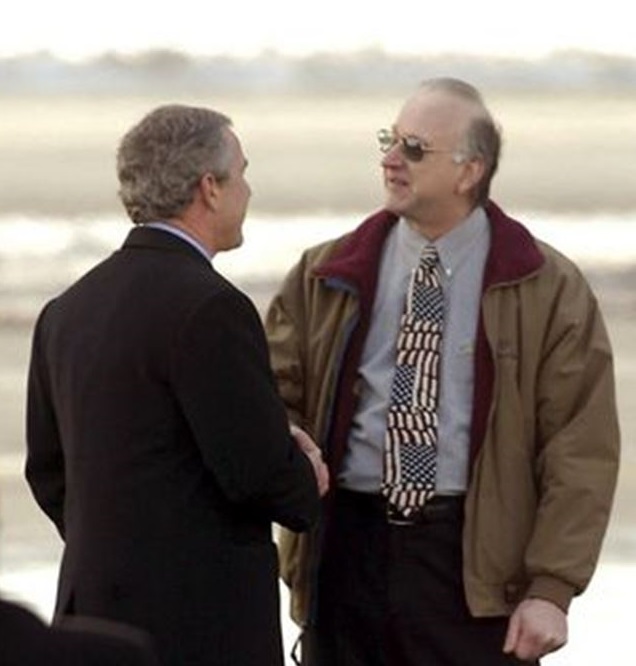
Bruce’s expertise is in the repair and manufacture of broken or damaged cannon parts. A dedicated tool and die maker who makes the 45-mile (one way) commute every workday, Bruce can cast any artillery replacement part in a flash. He visits Gettysburg on average three times a year and has for the past quarter century. He is a walking textbook of Gettysburg artillery. Bruce notes that in 1916 there were 410 cannons, which he calls “tubes”, placed on the field. Attrition brought that number down to 370 by 2002 “counting cannons damaged by vehicles or trees falling on them.” Bruce says that cannons were largely ignored until 1896. Bruce recalls how 8 cannon tubes were taken from storage and traded away to other parks for other items to add to the Gettysburg NPS Museum. “The carriages were in pretty bad shape so it seemed like a good idea at the time. In the 1930s one cannon was removed from the field and sent down to the Stones River Battlefield. It had the name “Murfreesboro” carved in the barrel so we sent it home.” says Bruce.
He explains how most of the ordinance stacks (cannonballs and parrot shells) were removed in the late 1970s / early 1980s. “The only original stacks left on the field are located on Benner’s Hill. There are a couple stacks at the Confederate High Water Mark, but I believe those are cast in bronze and not original ordinance. The High Water Mark does have the earliest tubes on the field though, place there in 1892. I have records showing that 60 original 24-pound field howitzers were shipped to Gettysburg in the 1890s. They were left laying in an open field for 3-5 years before being mounted.” Bruce states that before the age of battlefield preservation at Gettysburg, there were howitzers being used as flagposts on parts of the field, muzzle up with the “flags sticking out of the tubes. We had two cannons stolen back in 1968 and 1972 and they were never recovered. But one of those was a replica, so…” Bruce states that since the artillery restoration program began in 1996, “We started pulling tubes off 10-12 at a time for restoration and repair. When those were finished we’d pull another 10-12 off and replace them with the restored tubes.”
I couldn’t resist asking Bruce about the range of firepower used on the field during those three hot days back in 1863. “The best example I can think of is that the Union was using 10 pound parrot guns and three-inch ordinance guns placed on top of Cemetery Hill. Those guns could easily hit the tree line on Seminary Ridge 3/4’s of a mile away. They could fire over a mile but were most accurate at 3/4’s distance. The most common ordinance was canister shot. Like a coffee can filled with golf balls that was deadly at 400 yards or closer.”
Bruce can’t say enough good things about Barb Adams. He worries that hers is becoming a lost art. And, that there is no one to replace her. “There is absolutely no one to take over when she leaves. No one with the enthusiasm and pride that she has. It’s more than a hobby to her, it’s a labor of love. She is so humble that I don’t think she realizes how truly talented and valuable she is to the Gettysburg battlefield.”
On our last morning at Gettysburg, we revisited the crest of Little Round Top to drink our morning coffee atop the ridge and watch as the fog rolled in over Devil’s Den. About 30 yards away from the rock where the life-size statue of Union General Gouverneur K. Warren stands (the only rock on the entire battlefield visitors are forbidden to climb) rest the cannons known as “Hazlett’s guns”. This is truly hallowed ground. Here alongside these guns Brigade commander Stephen Weed fell mortally wounded, and when Lieutenant Charles E. Hazlett knelt to hear the General’s dying words he, too, fell mortally wounded.
Roger decided to check and see if one of these cannons, some of the most famous Union cannons in the history of the Civil War, might be the one from his photo. We were stunned to find that the object of our search had been right under our noses the entire time. Roger found his cannon and we immediately left the summit in search of Barb Adams. We found her at the bloody angle painting one of Cushing’s guns. She was elated at the news, saying, “I thought we were looking for a 6-pound gun, those are 10 pounders up there. See, YOU taught ME something new.” No Barb, YOU taught us everything we know. And what of her husband, the cannon man John Scott Adams? Barb wears his wedding ring on a chain around her neck. Meaning that, although he’s been gone for 16 years now, he’s still with his bride Barb… cleaning cannons on the Gettysburg battlefield everyday.

 Although the first documented appearance of a bicycle in Indianapolis can be traced to a demonstration of the high-wheeled bike called the “Ordinary” in 1869, these old fashioned contraptions (known back then as “Velocipedes”) would be almost unrecognizable to the riders of today. With their huge front tires and seats that seemed to require a ladder to climb up to, these early bikes were awkward and unwieldy for use by all but the most hardy of daredevil souls (They didn’t call them “boneshakers” for nothing back then). It would take nearly 25 years after the close of the American Civil War before the bike began to resemble the form most familiar to riders of today. The development of the safety bike with it’s 2 equal-sized wheels in the 1880s made the new sport more acceptable as a hobby and pastime.
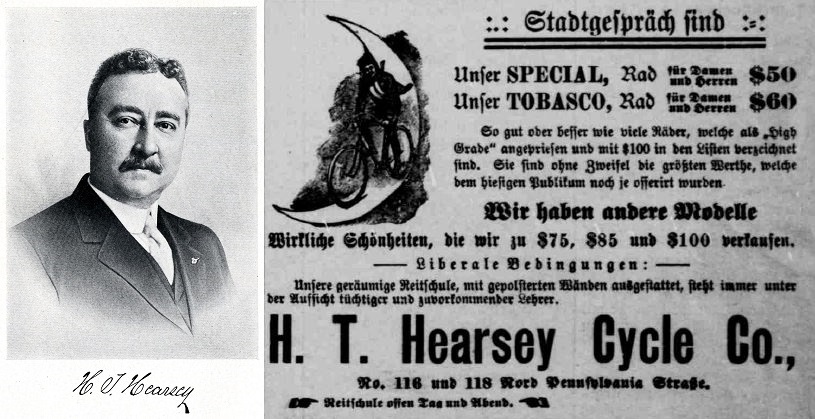
 In 1887 bicycle mechanic and expert rider Henry T. Hearsey (1863-1939) opened the first bicycle showroom in Indianapolis. His store was located at the intersection of Delaware and New York Streets on the city’s near eastside. Hearsey introduced the first safety bike to Indianapolis, the English-made Rudge, which sold for the princely sum of $150 (roughly $4,000 in today’s money). Keep in mind that was about twice the price of a horse and buggy at the time. He would later open a larger shop at 116-118 North Pennsylvania Street. He is credited for introducing the 1st safety bicycle in the Capitol city in 1889. Hoosiers took to it immediately and within a few short years, the streets of Indy were so clogged with bicyclists that the City Council passed a bicycle licensing ordinance requiring a $ 1 license fee for every bicycle in the city.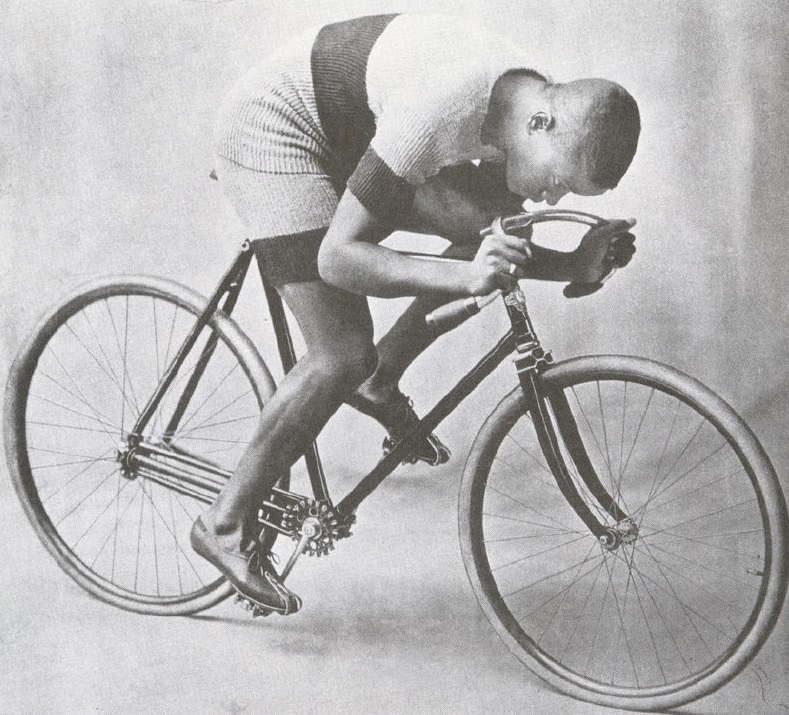
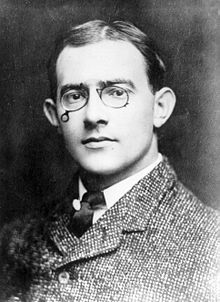
 the nickname “Major”, which stuck with him the rest of his life. He has been widely acknowledged as the first American International superstar of bicycle racing. He was the first African American to achieve the level of world champion and the second black athlete to win a world championship in any sport. Carl Fisher was one of the founders of the Indianapolis Motor Speedway, developer of the city of Miami and the creator of the famous “Lincoln Highway” and the “Dixie Highway.”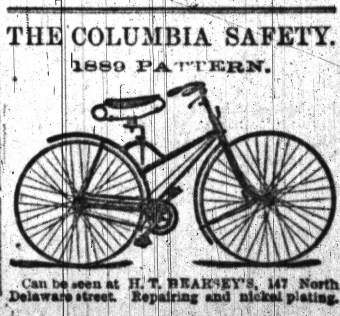
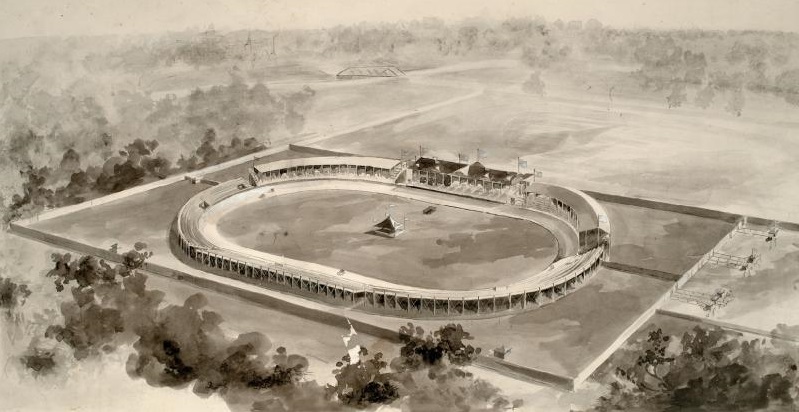
 Cycling was so popular in Indianapolis that the city constructed a racing track known as the “Newby Oval” located near 30th Street and Central Avenue in 1898. The track was designed by Shortridge graduate Herbert Foltz who also designed the Broadway Methodist Church, Irvington United Methodist Church and the Meridian Heights Presbyterian Church. Foltz would also design the new Shortridge High School at 34th and Meridian. The state of the art cycling facility could, and often did, seat 20,000 and hosted several national championships sponsored by the chief sanctioning body, “The League of American Wheelmen.” The American Wheelmen often got involved in local and national politics. Hoosier wheelmen raced into the William McKinley presidential campaign in 1896 and helped him win the election. With this new found political clout, riding clubs began to put pressure on politicians to improve urban streets and rural roads, exclaiming “We are a factor in politics, and demand that the great cause of Good Roads be given consideration.”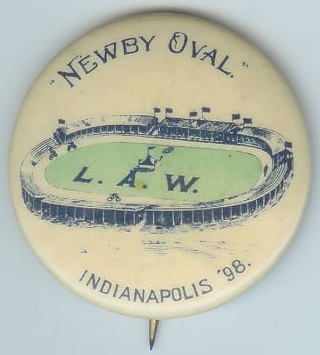


 The ALPLM’s “problems” began back in 2007 when it purchased the famous Taper collection for $23 million. “The collection is amazing,” says Sam, “the Lincoln top hat and bloodied gloves seem to be the items that resonate most with people, but the collection is much more than that.” Dr. Wheeler says that the uniqueness of the Taper collection centers around its emphasis on assassination related items, a field that had been largely ignored by Lincoln collectors at that time of its assemblage. The collection was created by Louise Taper, daughter-in-law of Southern California real estate magnate S. Mark Taper. She created the exhibition The Last Best Hope of Earth: Abraham Lincoln and the Promise of America which was at the Huntington Library from 1993–1994 and at the Chicago Historical Society from 1996-1997.
 “Bottom line,” Sam says, “we need to keep the collection here. That is our first priority.” It is easy to see how important this collection is to Dr. Wheeler by simply watching his eyes as he speaks. To Wheeler, the collection is not just a part of the museum, it is a part of the state of Illinois. Sam relates how when he speaks to groups, which he does quite regularly on behalf of the ALPLM, he often reaches into the vault to bring along pieces from the Taper collection to fit the topic. “People love seeing these items. It gives them a direct connection to Lincoln.” states Wheeler.
 Hoosiers may ask, why doesn’t the ALPLM just ask the state of Illinois for the money? After all, with 300,000 visitors annually, the Lincoln Library Museum is one of the most popular tourist sites in the state of Illinois and is prominently featured in all of their state tourism ads. Well, the state is billions of dollars in debt despite approving a major income-tax increase last summer and as of the time of this writing, has yet to put together a budget. To the casual observer, one would think that financial stalemate between the state and the museum would be a no-brainer when you consider that the ALPLM has drawn more than 4 million visitors since opening in 2005. The truth is a little more complicated than that. Illinois State government runs and funds the Lincoln library and museum. The separately run foundation raises private funds to support the presidential complex. The foundation, which is not funded by the state, operates a gift store and restaurant but has little role in the complex’s operations, programs and oversight.


 Although I never fail to take my annual trip around Monument Circle at Christmastime to gaze in wonder at the fantastic fir tree fantasy, my personal memories of Christmas on the Circle revolve around a little shack that used to rest at its base facing the Indiana Statehouse. You may think of the L.S. Ayres Cherub, Santa’s mailbox, the 26 larger-than-life toy soldiers and sailors surrounding the Circle, the 26 red & white striped peppermint sticks, the 52 garland strands or the 4,784 colored lights strung from the top of the Monument to its base, but I think of the Roselyn Bakery Christmas Hut.
 Decorated with Gingerbread man shutters and candy cane pillars, coated in what looked like white icing, the Christmas hut was set up on the West side of the Circle where it remained for 25 years from 1974 to 1999. It was estimated that some 1.2 million Gingerbread man cookies were handed out from within that festive little house over those years. Just like the bakery itself, that little hut was an institution.
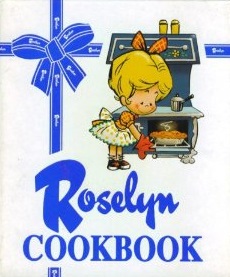 For me, Roselyn will always be identified for buttermilk jumbles, toffee cookies, alligator & sweetheart coffee cakes, yeast donuts and the darling little girl cartoon mascot known as “Rosie”. A blonde haired, blue eyed perpetually smiling little naive whose popularity forced the Roselyn Christmas Hut to undergo a name change to “Rosie’s Gingerbread House.” If memory serves, for a time there was even a living, breathing life-sized “Rosie” mascot dressed in a horribly oversized paper mache’ head and wearing a red velvet dress. Every so often, she would wobble awkwardly out of the Gingerbread hut to personally pass out cookies to the eager, but slightly befuddled, kiddies on the Circle. As I recall, she didn’t speak, but to a 12-year-old cartoon addicted boy like me, her skirt was short and her cookies were hot.
 a long way baby.”
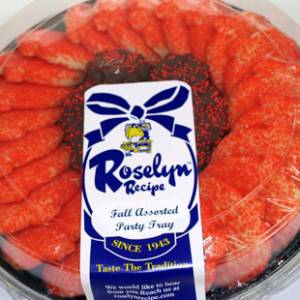 Eight mayors and ten governors have served our city and state over the past 50 years. I can’t say that I miss any of them, but I do miss those Gingerbread cookies. If you do too, you can make them yourself. Here’s the recipe for Roselyn Bakeries famous Gingerbread Men cookies: 1 1/4 teaspoon allspice, 2 3/4 teaspoons baking soda, 5 teaspoons ground cinnamon, 1 teaspoon ground cloves, 1 teaspoon ground ginger, 2 1/2 teaspoons salt, 3/4 cup Crisco shortening, 3/4 cup granulated sugar, 6 tablespoons whole eggs, 1 1/4 cup extra fine coconut (Make sure that the coconut you use is very fine, almost like coarse sugar-you may have to grind store bought coconut flake down), 1 1/4 cup honey, 5 cups all-purpose flour. Preheat oven to 360 degrees F. Combine allspice, baking soda, cinnamon, cloves, ginger, salt, shortening, and sugar into a large mixing bowl. Cream together. Scrape down bowl. Add beaten eggs and mix thoroughly.
 Scrape down bowl. Add coconut and honey and mix well. Scrape down bowl. Add flour and mix well. On a lightly floured surface, with a floured rolling pin, roll dough 1/8 inch thick. With a 5 inch long cutter, cut out men. Re-roll trimmings and cut more cookies. With spatula, place 1/2 inch apart on cookie sheets. Bake at 360 degrees for 8 minutes or until browned, then, with spatula, remove cookies to racks to cool. Decorate as desired. Makes 3 dozen cookies. Now if I could only locate a slightly used Christmas shack.
 Alan E. Hunter