

Original publish date: June 22, 2018
Any student of history knows that Gettysburg was the turning point of the Civil War. Up until 2:00 pm on July 3rd 1863, when General James Longstreet ordered General George Pickett out of the woods along Seminary Ridge, the South still had a chance. Pickett’s charge would fail miserably and less than 2 years later, the war for Southern independence was over. But the battle to restore both men’s reputations had just begun. As detailed in parts I and II of this series, that battle was waged by the General’s widows and would last well into the 20th century.


Joshua Chamberlain, Daniel Butterfield, James Longstreet and one-legged Dan Sickles
pose in Gettysburg on July 3, 1888. Sickles lost his leg at Gettysburg on July 3, 1863.
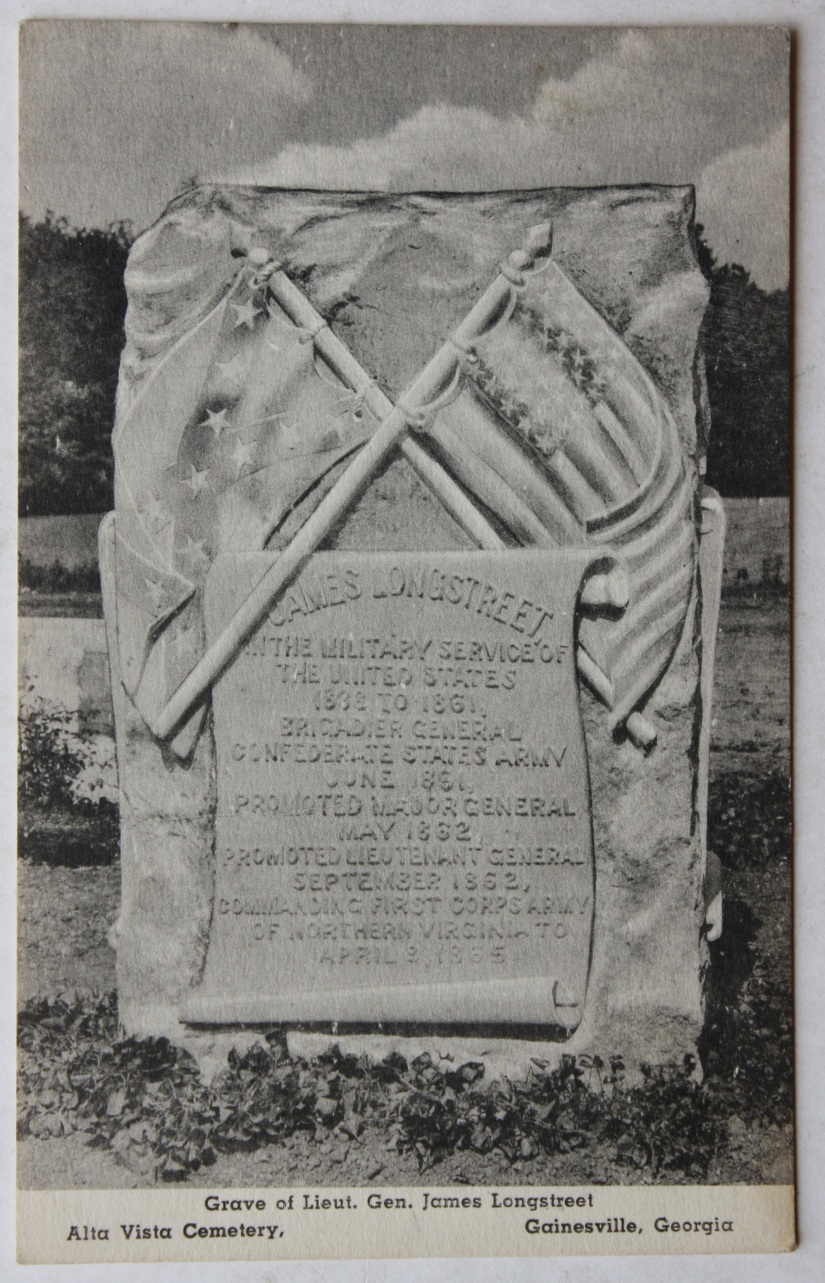
After the General died in 1904, his widow Helen Dortch Longstreet, known as the “Fighting Lady,” spent the next half century fulfilling a promise made to her husband that “in the future, so long as I shall live, whenever your war record is attacked, I will make answer.” In 1939, as the founder of the Longstreet Memorial Association, she arranged to have a statue of her late husband placed at Gettysburg. The proposed Longstreet memorial would be created by sculptor Paul Manship and a scale model of the statue was unveiled at the site dedication event in July, 1941. The sample statue featured General Longstreet on a horse (with one foot up) urging his men forward with a wave of his hat held in his outstretched arm. At 12 feet high and 12 feet wide, it was placed atop a base of red marble and would be surrounded by stone seats for viewing.

However, after a photo of the proposed statue was published in a local newspaper, the National Park Service wrote a letter to Mrs. Longstreet voicing a concern: “There is one feature that has caused considerable local comment and one I feel to be of sufficient importance to be called to your attention…The position of the horses’ feet in each of the existing equestrian statues now in the park tell a story. This fact is widely known and has become one of the items of which the visiting public likes to check. 1. Both feet of the ground: Rider died in action. 2. One foot off the ground: Rider wounded in action. 3. All four feet on the ground: Rider unscathed. As far as I have been able to determine this uniformity of position is but a happenstance. However, it is true within the park.”

Mrs Longstreet replied: “This will thank you warmly for your constructive criticism of the model of the proposed equestrian statue of General Longstreet for the Gettysburg field. I am forwarding it to Mr. Manship, the sculptor, who will, I am sure, will appreciate it as sincerely as I do. I know it is Mr. Manship’s intention to make the Longstreet Memorial the noblest on the Gettysburg battlefield and to correspond in every respect with the magnificent memorials already there.” And that is where the question remained until December 7. 1941. The bombing of Pearl Harbor changed everything and put the brakes on the Longstreet memorial plans at Gettysburg.

With the coming of World War II, raising funds to build the Longstreet monument seemed pointless in the face of homefront shortages and War Bond fund raising rallies to fight the Axis. After the war, interest for Civil War monuments evaporated. Although Mrs. Longstreet’s efforts to raise funds for her husband’s monument continued, her health declined rapidly. By the mid-1950s, Mrs. Longstreet developed “mental problems” and in 1957 she was placed in Central State Hospital in Milledgeville, Georgia. She remained institutionalized there until her death on May 3, 1862. Three years later the Soldiers and Sailors of the Confederacy monument would instead be placed on the original ground selected for the Longstreet memorial.

The Longstreet memorial remained forgotten for the next 30 years until pop culture and history collided to rekindle the legend of General James Longstreet. Ken Burns 1990 PBS documentary miniseries on the Civil War changed everything. Suddenly the Civil War was brought to the forefront like never before. Then came the 1993 movie Gettysburg which detailed the complicated men and ideals of this highly misunderstood period of American history. One of those most affected by the tarnished legend of Longstreet was a Sanford, North Carolina state forestry service heavy-equipment operator named Robert C. Thomas.
Thomas was moved to action after reading a 1990 book, “Lee’s Tarnished Lieutenant: James Longstreet and His Place in Southern History”, written by Dr. William Garrett Piston, editor of North and South magazine and Professor at Southwest Missouri State University . Thomas shared the book with fellow Civil War enthusiasts and together they decided that Longstreet’s time was overdue. In June 1991, Robert & Joe Thomas, along with Ray King, Bill Bates and Sion Harrington formed the Longstreet Memorial Fund Committee. This band of dedicated activists began selling mugs, T-shirts, tote bags, pens and cross-stitch portraits of the general at re-enactments across the country to raise funds for a proper monument to honor General James Longstreet. Gettysburg sculptor Gary Casteel was enlisted to craft a monument for placement in Pitzer Woods on Confederate Avenue on the battlefield.

As fate would have it, during a late April trip to Gettysburg, I happened across the studio of Mr. Casteel. My habit is to wander the battlefield on early fog wrapped mornings before the tour buses role in while my wife Rhonda sleeps in. Last year, the Hall of Presidents and First Ladies wax museum was closed and all of the figures were sold off. The 363 lots sold in a January 2017 auction for a total of $217,409. If you’re interested, as am I, the average cost of a wax president was $3,088 while the average cost of a wax first lady figure was $437 proving that the wage gap transcends the pages of time. The top three highest-selling presidents were Abraham Lincoln ($9,350); Teddy Roosevelt ($8,800); Ulysses S. Grant ($6,820). Mary Todd Lincoln sold for $990 while Rosalynn Carter hammered down at a mere $247.50.
While relaxing atop my sunny perch on the Hancock equestrian monument base (across from the Evergreen cemetery gatehouse) I noticed that the old wax museum had undergone a facelift. So I wandered over to take a peek at the new digs and quite happily stumbled across the studio of none other than Gary Casteel, the sculptor of the Longstreet monument. i could hardly contain my excitement. I had heard stories about that monument for years since it’s 1998 installment and unveiling and immediately altered my travel plans in hopes of meeting this accomplished artist. It was well worth the wait.
Rhonda and I ventured over to the studio (at 789 Baltimore St. in Gettysburg) and much to my amazement, we were greeted by the artist in the flesh. Gary Casteel is the epitome of a southern gentleman. He speaks in measured tones that bespeak his West Virginia birthright. When I hear a West Virginia accent, I think of General Chuck Yeager. Tom Wolfe said it best in his book “The Right Stuff” when he described it as: “a particular drawl, a particular folksiness, a particular down-home calmness” that seems to draw the listener in and immediately put them at peace. Phrases like “Oh my” frame words like Riv-ah, He-ah and Nev-ah to form sentences with genteel insight rarely heard in Hoosier land.

Classical music fills the air of Gary Casteel’s studio and adds to the importance of the moment. Gary’s studio, adjacent to the entrance to the National Cemetery, is sparkly clean and meticulously organized. Not at all like certain media portrayals would lead you to believe an artist’s studio should look like. There is no tortured artist at work here my friends. This is the workplace of a practiced hand that is straight as a preacher and as long a memory. One look at Gary’s work and that attention to minute detail is easily discerned. Although his work appears effortless, it is obviously the result of decades of difficult training and practice.
Gary Casteel grew up in the coal mining region of West Virginia and resolved early to become a sculptor while attending grade school there. Contrary to the stereotypes of the region, from an early age, he listened to classical music on the radio, devoured the works of William Shakespeare and idolized Michelangelo. In Gary’s own words, “through marriage, divorce, military service, occupation transfers, relocation, business ownership or family strife, I stayed true to my commitment to become a sculptor.” The Longstreet commission was the culmination of a lifetime dream for sculptor Casteel.
“My point of view has always been that heroes are larger than life. They are to be physically and mentally looked up to.” says Casteel. “In my youth, I was reared with ideals of heroes such as Davy Crockett, Daniel Boone, Robert E. Lee, George Patton. Now as a middle aged man with more than half a century of experience, living in an age of of hero deterioration and downfall, I choose my Icons with more wisdom. Longstreet, the General, was larger than life.” Gary Casteel decided that the memorial to Longstreet should be larger than life as well.
Unlike most monuments at Gettysburg, Casteel’s Longstreet rests at ground level and is not perched upon a lofty pedestal. The General is shown astride his favorite horse, Hero. Longstreet is pulling hard at the reins as Hero’s hooves dig into the soft Pennsylvania soil. The General’s attention is directed towards the copse of trees, the focal point of attack, mere moments before his troops would emerge from the treeline behind him. The field has become known as Pickett’s Charge and the copse of trees is forever referred to as the high water mark of the Confederacy. General Longstreet’s steely gaze is forever fixed on the target his men would never attain and one he never believed was attainable in the first place.

 I asked Mr. Casteel if it was true that Longstreet’s granddaughter attended the unveiling ceremony. He answered quickly, “Oh yes. Jamie Longstreet Paterson attended the dedication ceremony. We brought out a ladder and she climbed up to get a better look at the General. I was worried because she was 67-years-old but more worried when she started to cry,” said Gary. “I thought, oh my, we may have a problem here. When she came down, I realized they were tears of joy as she said, ‘I never thought I would look him in the face’.” Sculptor Casteel’s Longstreet memorial was one of the last monuments erected at the Gettysburg National Military Park. It was dedicated on July 3, 1998, the 135th anniversary of the end of the battle of Gettysburg. Jamie Paterson Longstreet died six years later on August 4, 2014.
 It should be noted that Casteel is not only an accomplished sculptor, knowledgeable historian and well versed art scholar, he has deeper personal roots in the Civil War and Battle of Gettysburg itself. Casteel says that his own family had two ancestors -brothers in fact- who actually fired at each other from opposing sides during the Battle of Gettysburg. “I call him Uncle Bill and he placed his rifle against that stone wall and fired our way from right over there” as he points out his studio window. Casteel is currently hard at work on several pieces for the proposed National Civil War Memorial. “Did you realize that there is no national monument to the Civil War?” he asks.

 Gary guides us to a loose leaf binder containing images of the large sculpture medallions he has created for the museum. Lincoln, Lee, Jefferson Davis, and John Wilkes Booth are just a few of the completed images resting on the drying racks in the back of Gary’s studio. Gary remarks, “I asked Ed Bearss (Chief Historian Emeritus of the National Park Service), who serves on the museum board, why there was no plaque for Joshua Lawrence Chamberlain (Hero of Gettysburg’s Little Round Top) in the selection. He responded, ‘Gary, no one ever heard of Chamberlain before Gettysburg or afterwards for that matter.” Yes, talking with Gary Casteel gives new perspective to an old subject and promises to make a visit to his studio an unforgettable memory.
If Longstreet had died in battle, he undoubtedly would have been placed among the South’s greatest heroes, with monuments located everywhere he led men into battle. But after the death of Lee in 1870 and Pickett’s death five years later in 1875, Longstreet became the living scapegoat for the South’s defeat at Gettysburg. Gary Casteel’s statue has helped alter that view. Sometimes all it takes a new perspective from an old school craftsman to help cast things in a new light.
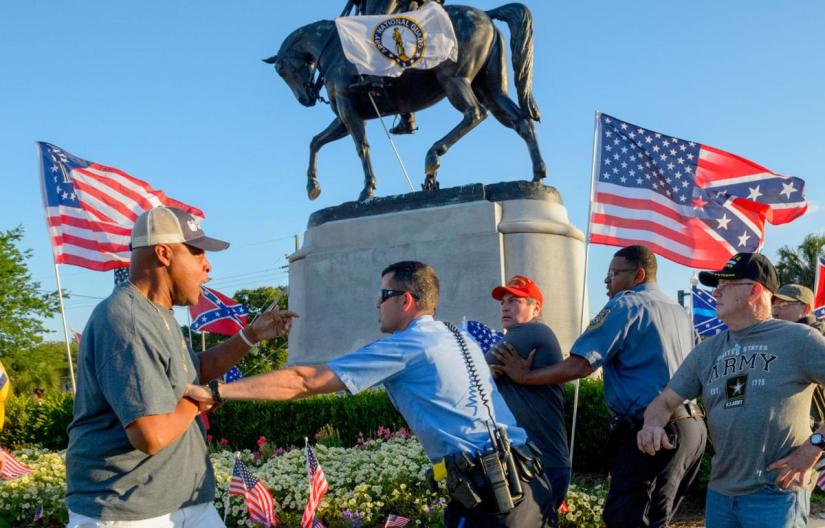


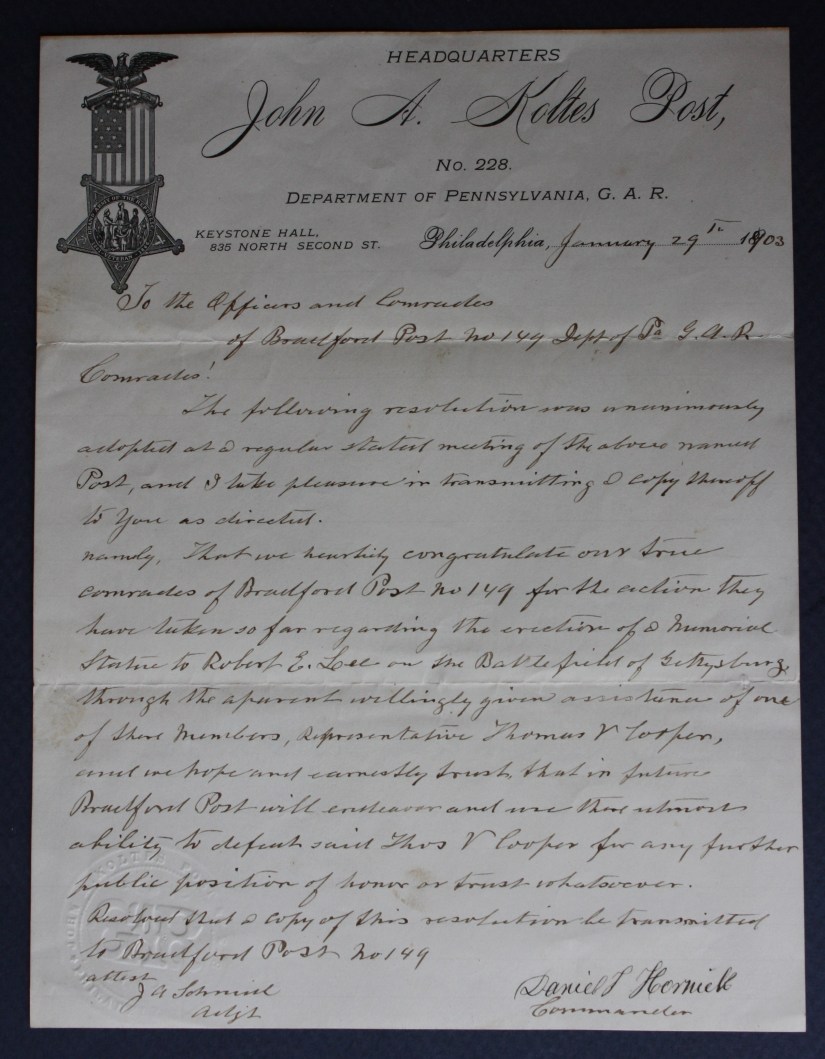
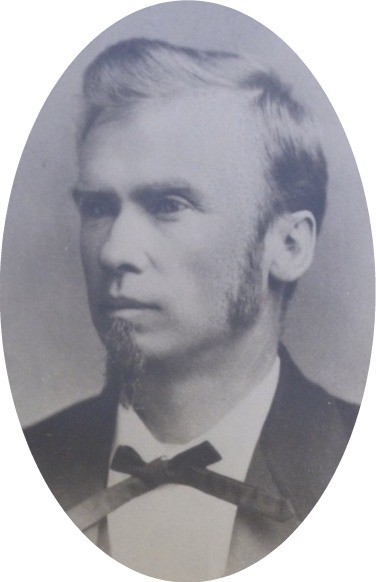


 Her efforts worked and today, Pickett is widely remembered as a tragic hero of the disastrous charge at Gettysburg that bears his name. Rather than place blame at the feet of the South’s “Marble Man”, Robert E. Lee, LaSalle shifted blame to James Longstreet. Her effort was well received by the purveyors of the Lost Cause and Pickett’s reputation was posthumously restored.
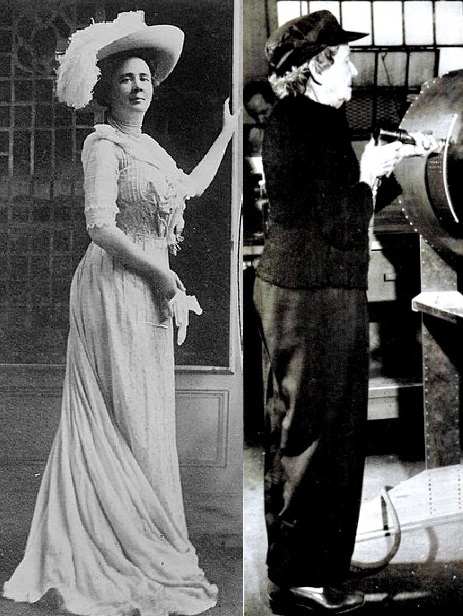
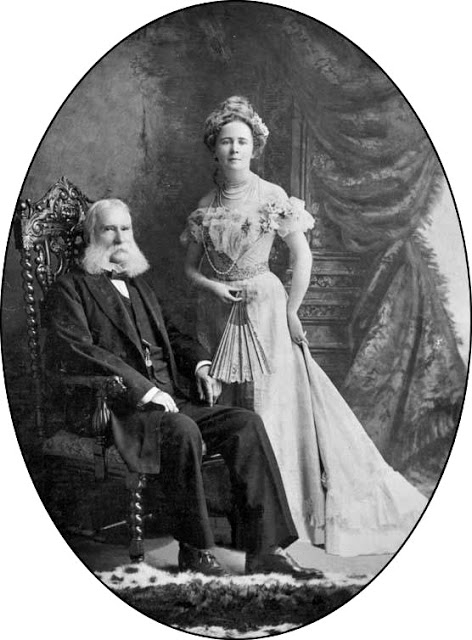 But General Longstreet had a secret weapon of his own: his young bride, Helen Dortch Longstreet. The General married her in 1897 in a ceremony at the governor’s mansion in Atlanta. She was 34 and he was 76. She would outlive her husband by 58 years, passing away in 1962 during the National Centennial Celebration of the Civil War. By the time of her death, she had accomplished more than most any other woman of her era and helped restore her husband’s legacy along the way. And I have the letters to prove it.
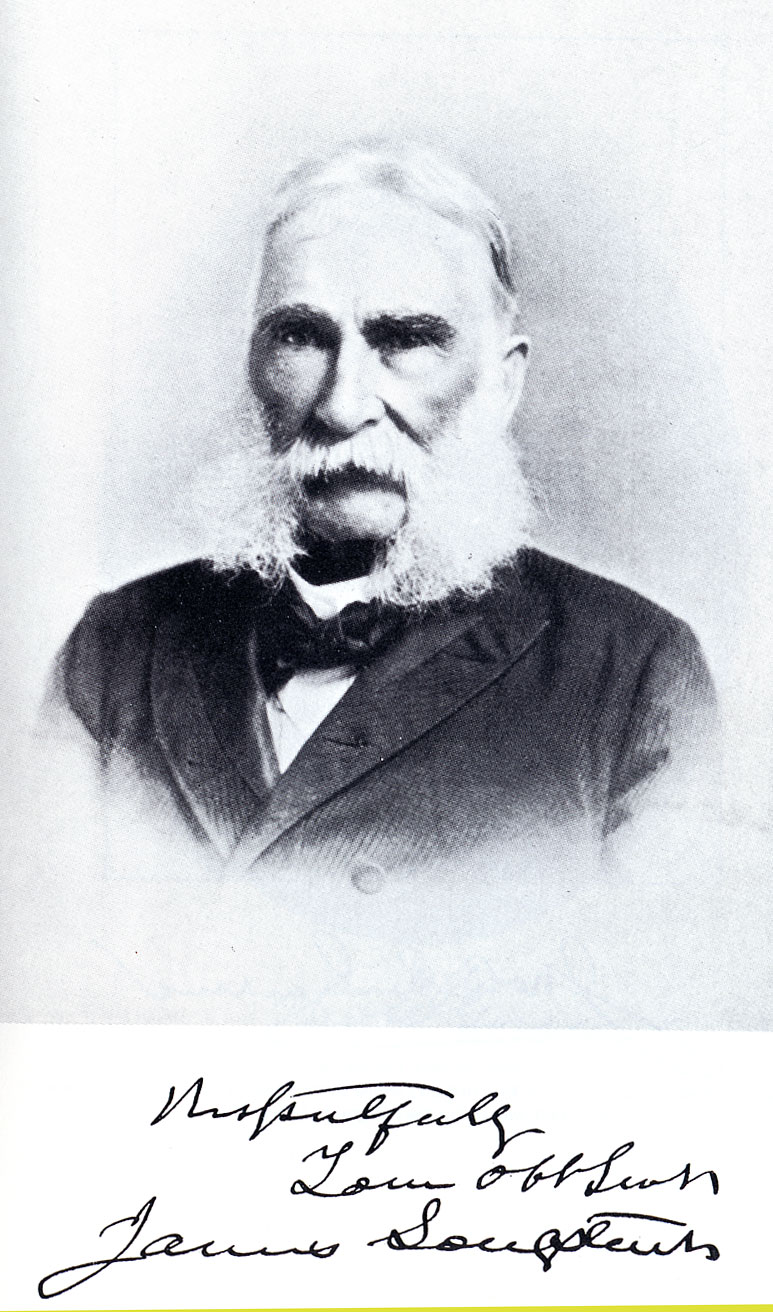
 Longstreet served in a variety of government positions after the war, including ambassador to Turkey and as a Federal Marshall. He served as a railroad commissioner and spent his final years trying to refute continued attacks on his character raised by his former friends and brothers in arms who labeled him as a traitor to a failed ideal. His 1896 memoirs, a labor of five years titled “From Manassas to Appomattox”, he attempted to set the record straight.
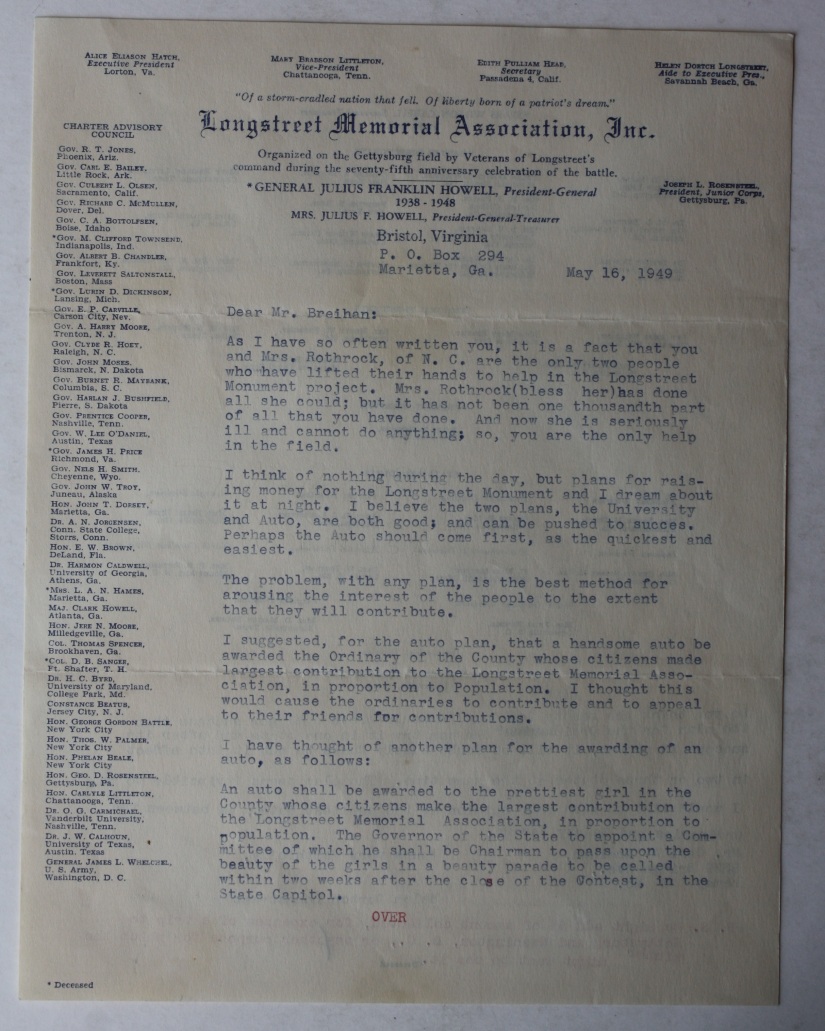
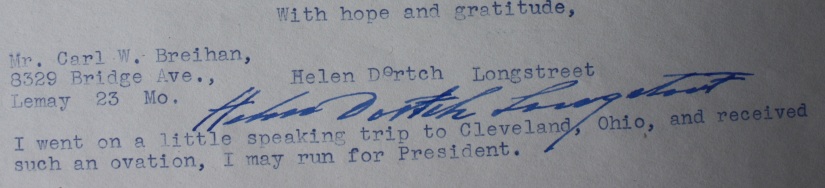 The letter continues, “The auto dealers will pay more attention to the plan if presented by a young, vigorous, intelligent gentleman like yourself, than by an old woman….I could never make them understand that behind the wrinkles and gray hairs the vigor and enthusiasm of youth still lives…When the monument stands finished on the field of glory, Carl W. Breihan, more than any other person in the world will deserve the credit.” She added the postscript, “I went on a little speaking trip to Cleveland, Ohio and received such an ovation, I may run for President.”
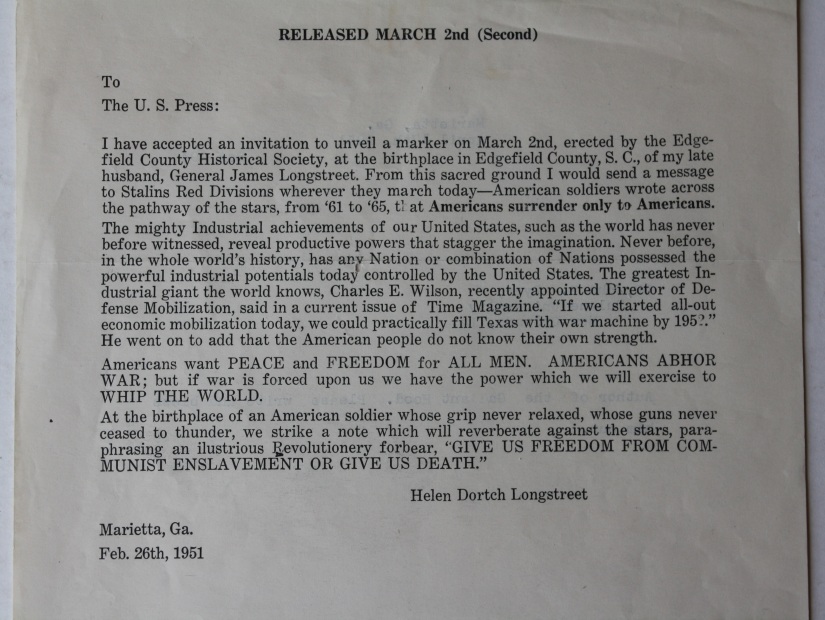 The next letter is in the form of a press release. Dated Feb. 26, 1951, it mentions the unveiling of a marker at General Longstreet’s South Carolina birthplace that likely includes excerpts from her planned speech at the ceremony. “I would send a message to Stalin’s Red Divisions wherever they march today-American soldiers wrote across the pathway of the stars, from ’61 to ’65, that Americans surrender only to Americans….Americans want PEACE and FREEDOM for ALL MEN. AMERICANS ABHOR WAR; but if war is forced upon us we have the power which will exercise to WHIP THE WORLD…At the birthplace of an American soldier whose grip never relaxed, whose guns never ceased to thunder, we strike a note which will reverberate against the stars.”
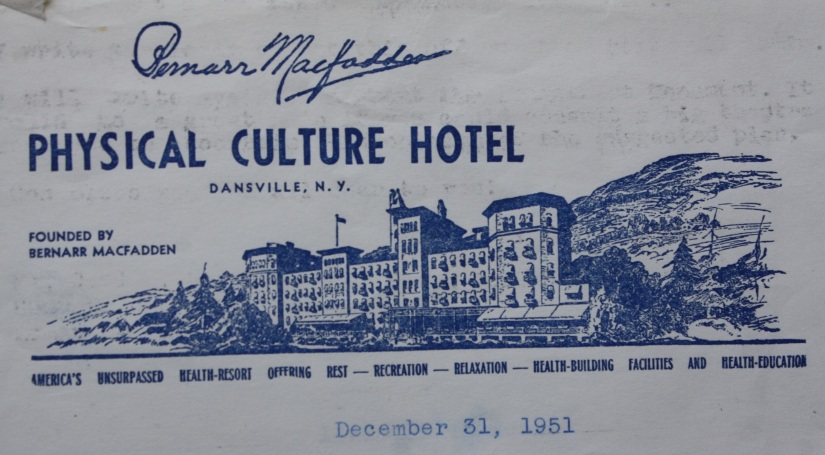
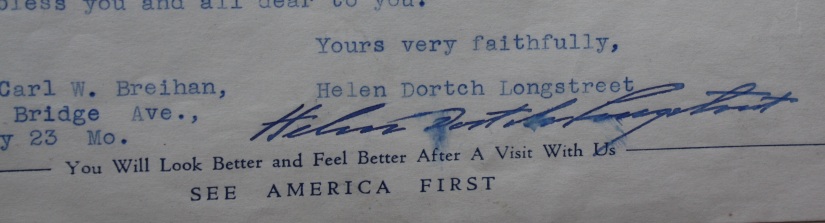 The Physical Culture Hotel, founded by former professional wrestler and magazine mogul Bernarr MacFadden, began life as the “Jackson Sanitorium” (founded in 1854), a health spa credited with inventing granola and launching the Kellogg cereal company. The Hotel was a pioneer in the use of hydrotherapy but also emphasized recreation and social activities such as swimming, sunbathing, tennis, and dancing. McFadden and his hotel were on the cutting edge of the physical fitness movement in America and at age 88, Helen Dortch Longstreet was right in the center of it. To me, this letter is emblematic of the widow Longstreet. She was ahead of her time, unpredictable and most of all, she never gave up.
 Further research reveals that, during World War II, Mrs. Longstreet was a Rosie the Riveter assembling B-29 bombers at the Bell Aircraft plant in Atlanta. She explained, “I was at the head of my class in riveting school. In fact I was the only one in it.” She worked in the factory for two years, refused to join the union, never missed a day of work or showed up late for a shift. Widow Longstreet told Life magazine reporters, surprised to find a Civil War General’s widow alive and well and working for the war effort, “I just want to build bombers to bomb Hitler.”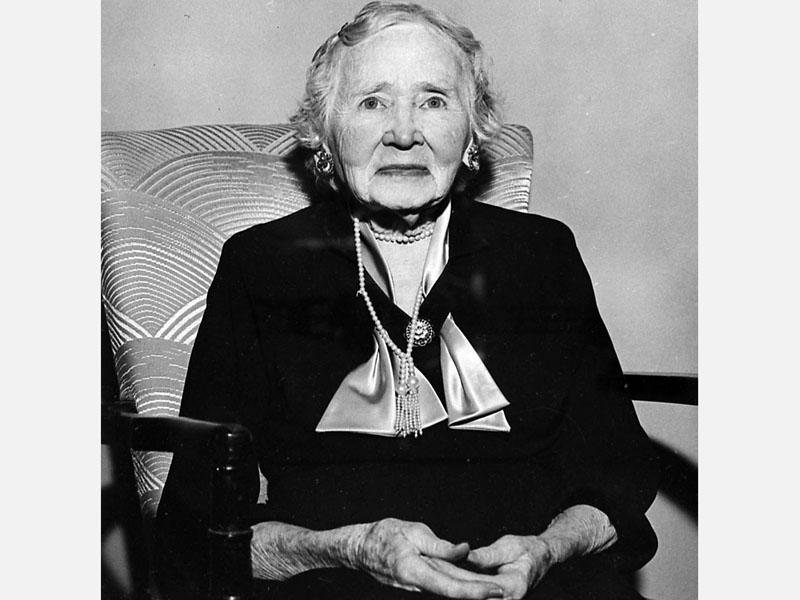
 In 1998, the Military Order of the Stars and Bars and United Daughters of the Confederacy worked together to pay for LaSalle’s disinterment and reburial in front of the George E. Pickett Memorial in Hollywood Cemetery. Widow Pickett was buried on Saturday, March 21, 1998. She was the first woman interred in the Confederate military burial section. On July 3 of that same year, one of the last monuments was erected on the Gettysburg National Military Park. It was an equestrian statue of General James Longstreet on his horse “Hero” in Pitzer Woods on Confederate Avenue. Perhaps most astonishingly, 135 years after the battle, Jamie Longstreet Paterson, the 67-year-old granddaughter of General Longstreet was there to see it.
 We’ve all heard the stories, legends and rumors surrounding that now legendary first event. It was sponsored by the Walt Disney company featuring costumed characters with a Disney based theme. The Disney folks gave away potentially priceless hand painted film production cels right here on the streets of old Irvington town. Walt Disney himself was seen walking down Audubon with Mickey Mouse at his side. It’s hard to separate fact from fiction nowadays.
 A week later on May 5, 1942, every United States citizen received their much anticipated “War Ration Book Number One”, good for a 56-week supply of sugar. Initially, each stamp was good for one pound of sugar and could be redeemed over a specified two-week period. Later on, as other items such as coffee and shoes were rationed, each stamp became good for two pounds of sugar over a four-week period. The ration book bore the recipient’s name and could only be used by household members. Stamps had to be torn off in the presence of the grocer. If the book was lost, stolen, or destroyed, an application had to be submitted to the Ration Board for a new copy. If the ration book holder entered the hospital for greater than a 10-day stay, the ration book had to be brought along with them. Talk about your red tape!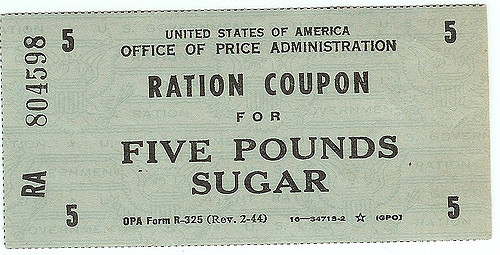
 To make matters worse, just because you had a sugar stamp didn’t mean sugar was available for purchase. Shortages occurred often throughout the war, and in early 1945 sugar became nearly impossible to find in any quantity. As Europe was liberated from the grip of Nazi Germany, the United States took on the main responsibility for providing food to those war ravaged countries. On May 1, 1945, the sugar ration for American families was slashed to 15 pounds per year for household use and 15 pounds per year for canning – roughly eight ounces per week per household. Sugar supplies remained scarce and, just as sugar had the distinction of being the first product rationed at the start of the war, sugar was the last product to be rationed after the war. Sugar rationing continued until June of 1947, over six months after the first Irvington Halloween festival in October of 1946.
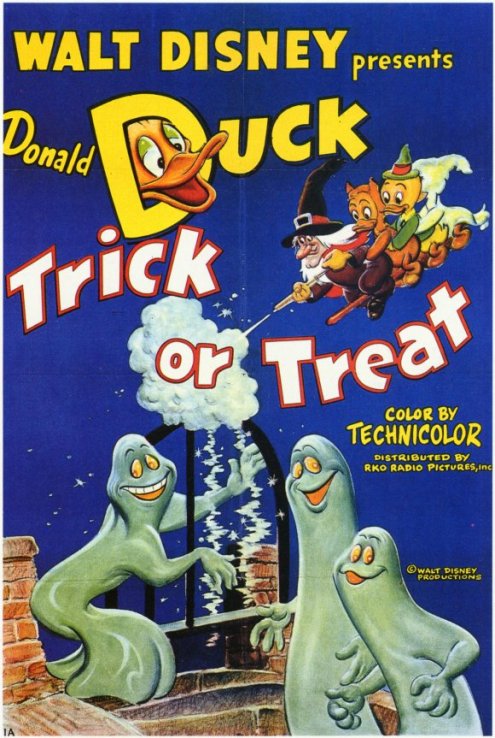
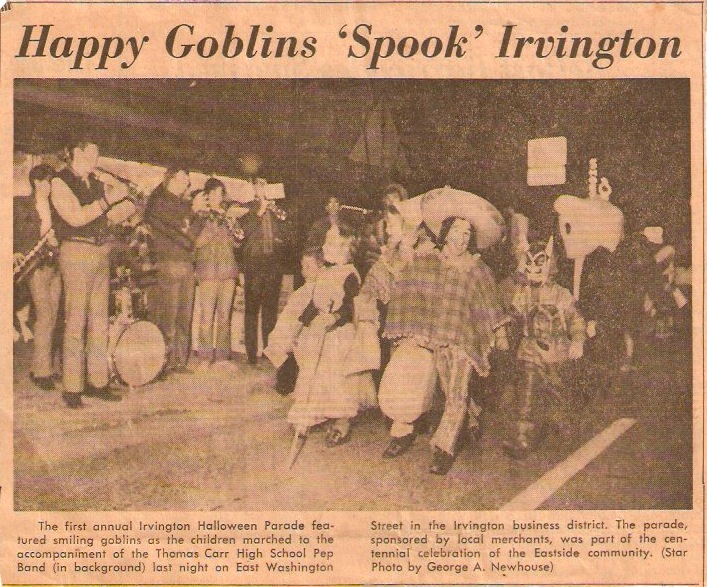 An argument can be made that it was events like the First Irvington Halloween Festival that kicked off the tradition of trick-or-treating as we know it today. Although the Halloween holiday was certainly well known in America before that first Irvington celebration, it was predominantly a holiday for adult costume parties and a chance to cut loose with friends playing party games while consuming hard cider. Early national attention to trick-or-treating in popular culture really began a year later in October of 1947. That’s when the custom of passing out the playful “candy bribes” began to appear in issues of children’s magazines like Jack and Jill and Children’s Activities, and in Halloween episodes of network radio programs like The Baby Snooks Show, The Jack Benny Show and The Adventures of Ozzie and Harriet. Trick-or-treating was first depicted in a Peanuts comic strip in 1951, perhaps the image most identified with the children’s holiday in the hearts and minds of baby boomers today. The custom had become firmly established in popular culture by 1952, when Walt Disney debuted his Donald Duck movie “Trick or Treat”, and again when Ozzie and Harriet were besieged by trick-or-treaters on an episode of their popular television show. In 1953, less than a decade after that first festival in Irvington, the tradition of Halloween as a children’s holiday was fully accepted when UNICEF conducted it’s first national children’s charity fund raising campaign centered around trick-or-treaters.
 Most of this column’s readers are aware that part of my passion for history revolves around collecting, cataloging, displaying and observing antiques and collectibles. There exists in the collecting world a strong group of enthusiasts devoted to the pursuit and preservation of Halloween memorabilia of all types. Costumes, decorations, photographs, publications and postcards in particular. The origins of Halloween as we now know it might best be traced in the postcards issued to celebrate the tradition. The thousands of Halloween postcards produced between the turn of the 20th century and the 1920s commonly show costumed children, but do not depict trick-or-treating. It is believed that the pranks associated with early Halloween were perpetrated by unattended children left to their own devices while their parents caroused and partied without them. Some have characterized Halloween trick-or-treating as an adult invention to curtail vandalism previously associated with the holiday. Halloween was not widely accepted and many adults, as reported in newspapers from the 1930s and 1940s, typically saw it as a form of extortion, with reactions ranging from bemused indulgence to anger. Sometimes, even the children protested. As late as Halloween of 1948, members of the Madison Square Boys Club in New York City carried a parade banner that read “American Boys Don’t Beg.” Times have certainly changed since that first Halloween festival 65 years ago.
 A 2005 study by the National Confectioners Association reported that 80 percent of American households gave out candy to trick-or-treaters, and that 93 percent of children, teenagers, and young adults planned to either venture out trick-or-treating or to participate in other Halloween associated activities. In 2008, Halloween candy, costumes and other related products accounted for $5.77 billion in revenue. An estimated $2 billion worth of candy will be passed out during this Halloween season and one study claims that “an average Jack-O-Lantern bucket carries about 250 pieces of candy amounting to about 9,000 calories and containing three pounds of sugar.” Yes, 65-years ago, Halloween looked quite different than it does today. Next week, doorbells all over Irvington will ring, doors will be opened and wide-eyed gaggles of eager children will unanimously cry out “Trick-or-Treat” from Oak Avenue to Pleasant Run Parkway.
 Costumed kids will be rewarded for their efforts with all sorts of tribute in the form of coins, nuts, popcorn balls, fruit, cookies, cakes, and toys. As a casual observer born long after that first Irvington Halloween Festival and an active participant in the festivities that will begin next week, I’m glad that our Irvington forefathers skirted government regulations all those years ago. In fact, as a fan of all things Irvington, I’d go so far as to say that this community has played a big part in the Halloween holiday as we know it today. Because, grammar notwithstanding, nobody does Halloween like Irvington do.
 My first thought, where the heck is Bloomfield, Indiana? Well, if you didn’t know, it is a small town of some 2,400 people located in Greene County not far from, and currently considered a part of, Bloomington. Its best known for having one of the most well preserved covered bridges in the state and for its long association with the Native American Indian tribes including the Miami, Kickapoo, Piankeshaw, and Wesa tribes. That settled, I was on to the next question. What is this thing? I’m guessing some of you already know the answer, but it was unknown to me. It is a book, distributed by the electric company to their wartime, homefront customers to read their own meters and pay the fees associated with usage based on the honor system. That’s right, the honor system. With the electric company. An Oxymoron if you ever heard one right?
 The customer would record the electricity their household used, pay the bill, and the electric company trusted them. Seriously? The electric company…trust you? Could that be possible? Can you imagine such a system? I gotta tell ya, when I see things like this I’m convinced that I was born in the wrong era. I must admit, I’m one of those people that believes that the World War II Generation was truly our greatest. Life was simpler, people were nicer, and businesses were staffed by friends and neighbors who were really rooting for our success. Whenever I see things like this I realize that back then, everyone pulled together to do their part. All for one and one for all. Corny, but true. I didn’t realize that this little booklet was a first generation relic of the rural electrification movement that began in 1935 as part of an effort to bring electricity, telephone and indoor plumbing to the rural communities all over the state. Something we take for granted today.

 Alan E. Hunter