food, Politics

Elwood’s Airport Restaurant. The world’s only fly-in / drive-in.

Original publish date March 24, 2022. https://weeklyview.net/2022/03/24/elwoods-airport-restaurant-the-worlds-only-fly-in-drive-in/
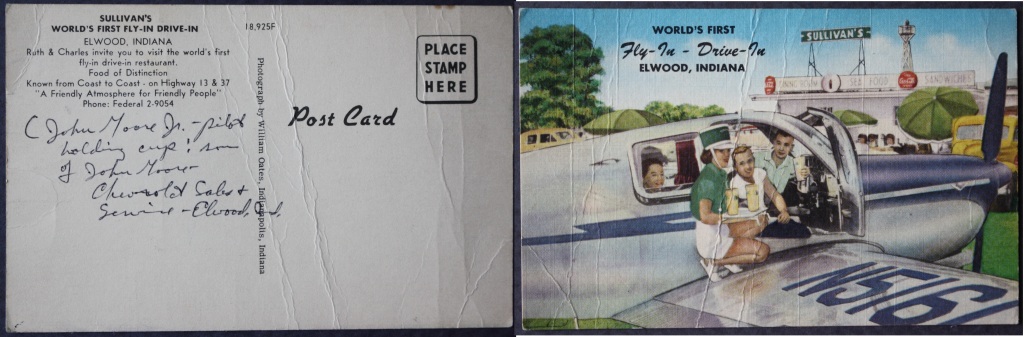
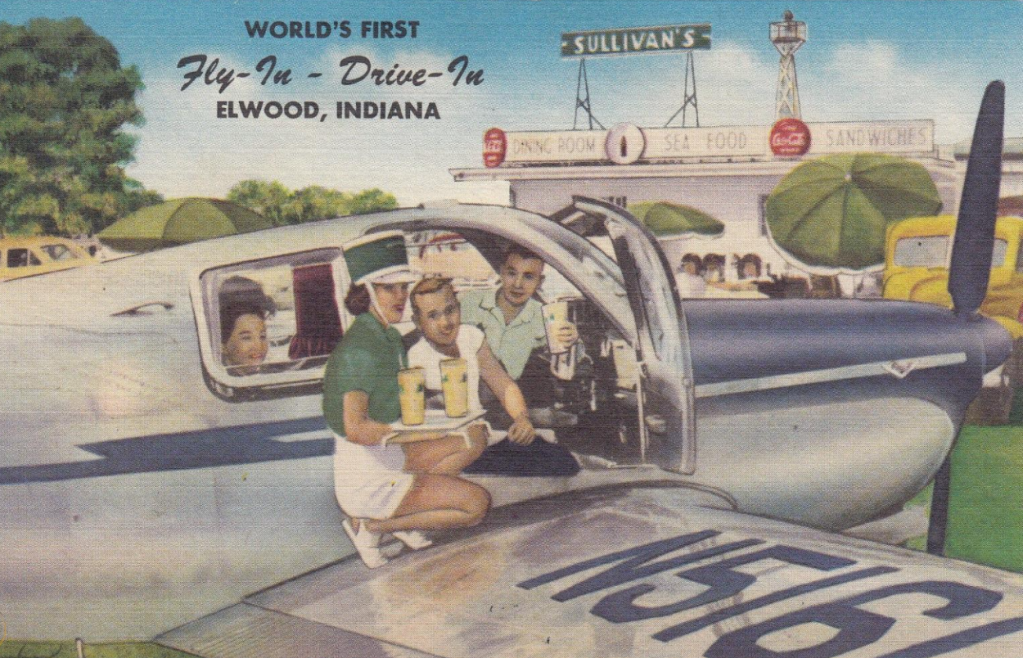
The author’s recent antique show find produced this postcard with the caption: “John Moore, Jr.-pilot holding cup, son of John Moore Chevrolet Sales + Service, Elwood, Ind.” written in vintage ink.

A couple of weeks ago, my wife Rhonda and I drove about 40 miles north of Irvington to Elwood to visit the world’s first (and only) fly-in drive-in restaurant. Resting just northeast of the intersection of Indiana 37 and 13, the Airport Restaurant is located at 10130 State Road 37 on what was once the Elwood Airport. The planes are long gone, and diners no longer rub elbows with pilots, but the Airport Restaurant is still the place where all the locals eat.
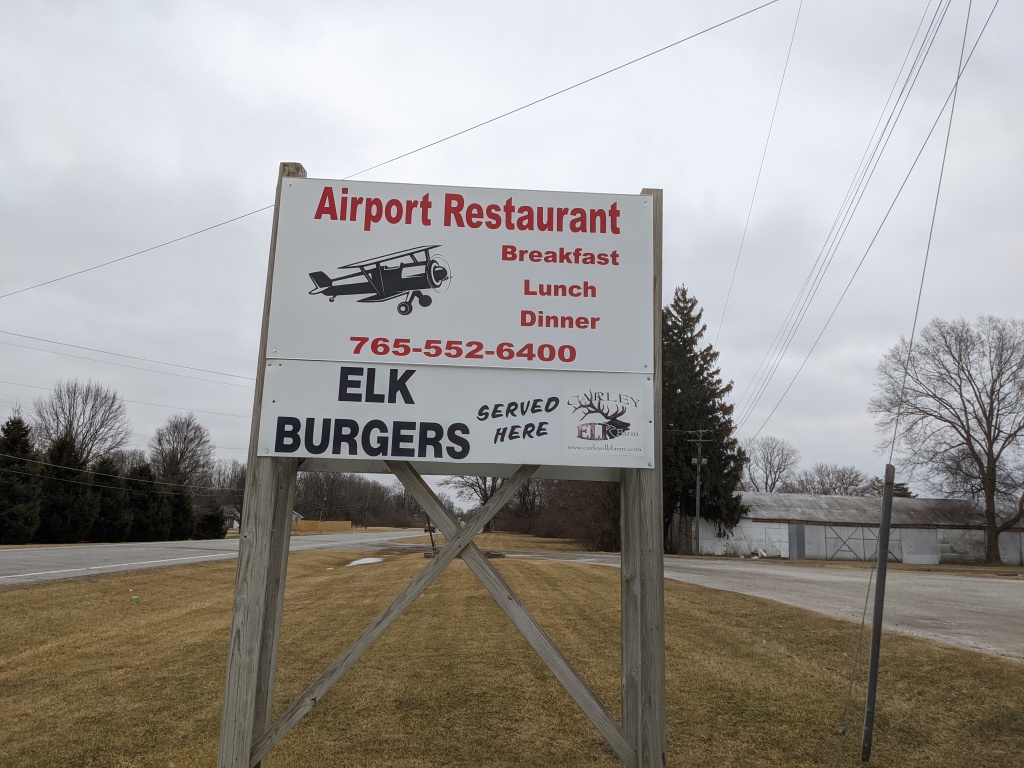
The airport was founded just after World War II by Elwood residents Don and Georgia Orbaugh. It featured two grass runways, measuring 2,243 feet and 2,076 feet. The sod landing strips accommodated single-engine planes and their specialty was known as the $100 hamburger. The restaurant did not charge $100 for burgers, but for pilots, that’s what they became. “By the time you get in your airplane, fill it up with gas, and fly a 100 miles, it’s a $100 hamburger,” the old pilot’s joke went. Don and Georgia Orbaugh owned and operated the airport for 56 years before it passed to daughters Ann Brewer and Donna Ewing.
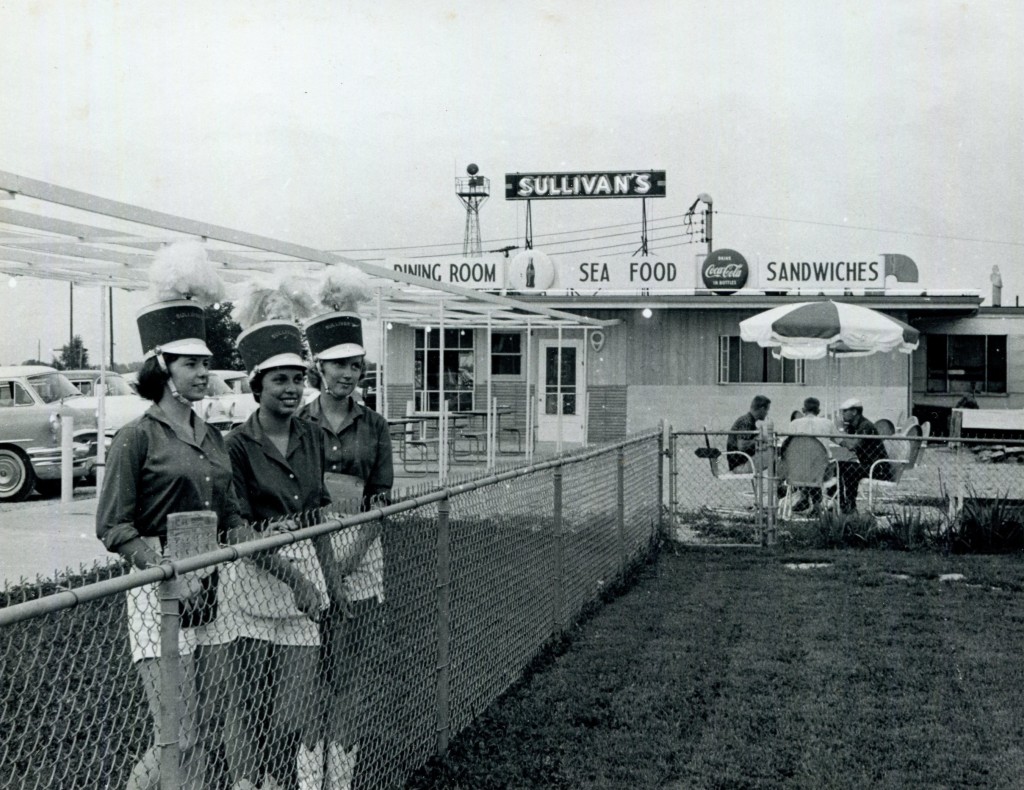
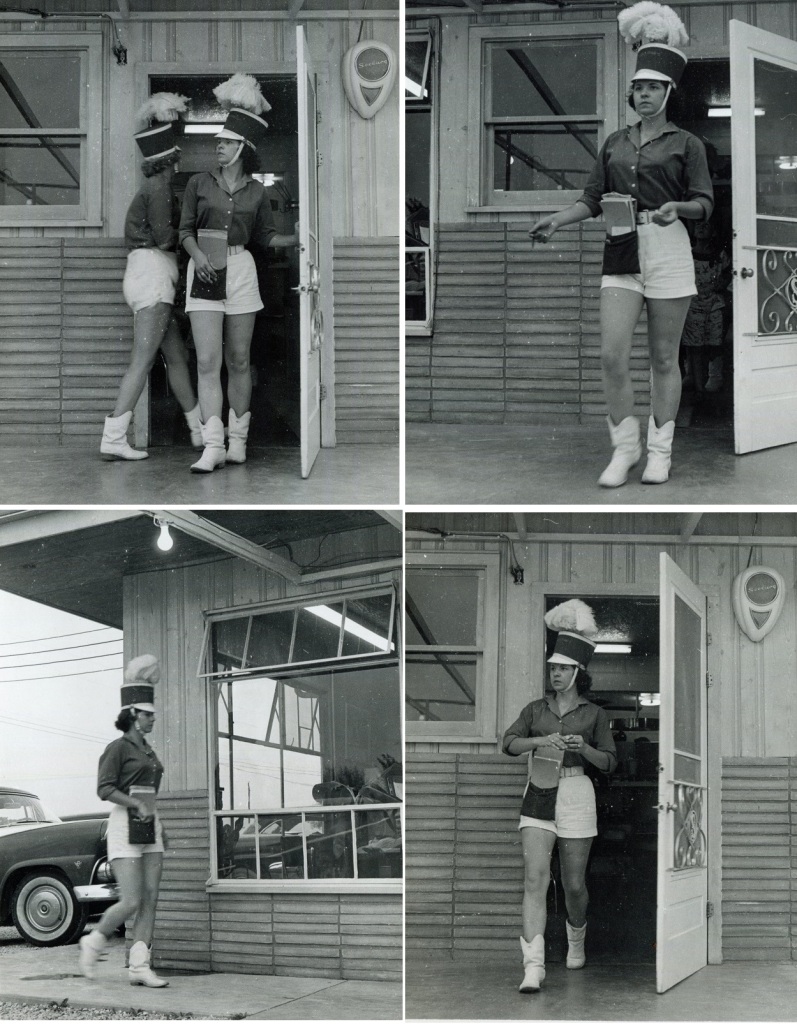
The uniformed carhops at Sullivans Airport Restaurant in Elwood, Indiana.

In 1952, “Sullivan’s Airport Restaurant” gained statewide attention when it opened an ice cream shack staffed by pretty young carhops. By 1953, a dining room was added to the shack, and young girls wearing tiny green uniforms with boxy marching band hats served curbside customers in their cars and pilots in their planes. Truth be told, the airport was really a “touch-and-go” facility where pilots practiced their landings and takeoffs. Most pilots only flew into the airport to visit the restaurant and ogle the carhops. By the end of the 50s, the novelty was over. There are a few photos (and at least one postcard) surviving of the Airport Restaurant during its heyday. The photos show the young waitresses in their carhop uniforms and the postcard pictures one of them standing on the wing of an airplane serving food to the pilots inside the cockpit.
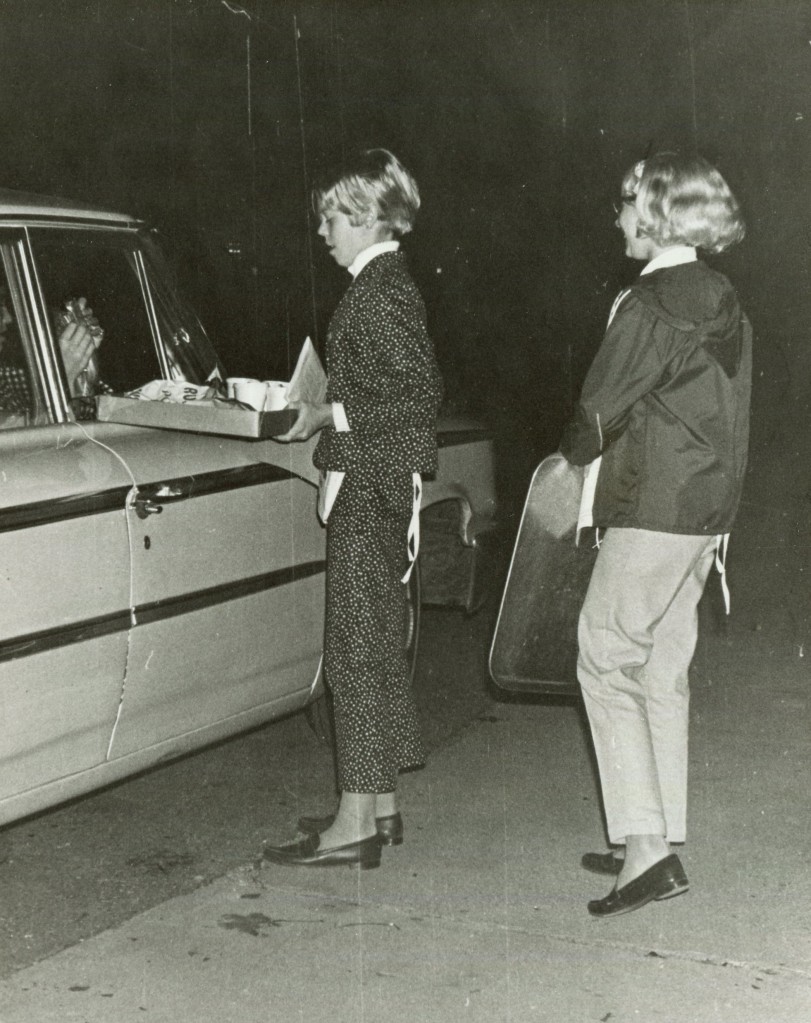
Civilian employees serving customers in cars at Sullivan’s Airport Restaurant in Elwood, Indiana.
The carhops at Sullivan’s Airport Restaurant in Elwood, Indiana.

Al Swineforth, the current owner of the Airport Restaurant, has a long history in the restaurant business. “I moved to Elwood in 1970. I was a General Manager for Darden Foods in Anderson for 22 years when I retired,” he stated. For those who don’t know, Darden’s family of restaurants features some of the most recognizable and successful brands in full-service dining — Olive Garden, LongHorn Steakhouse, and Cheddar’s to name a few — serving more than 320 million guests annually in over 1,800 restaurants located across North America. Al smiled wryly, then said, “The day I retired, I was driving north on 13 when I stopped at 37 and saw the old Wheeler’s truck stop. I stayed retired for a total of four hours.”
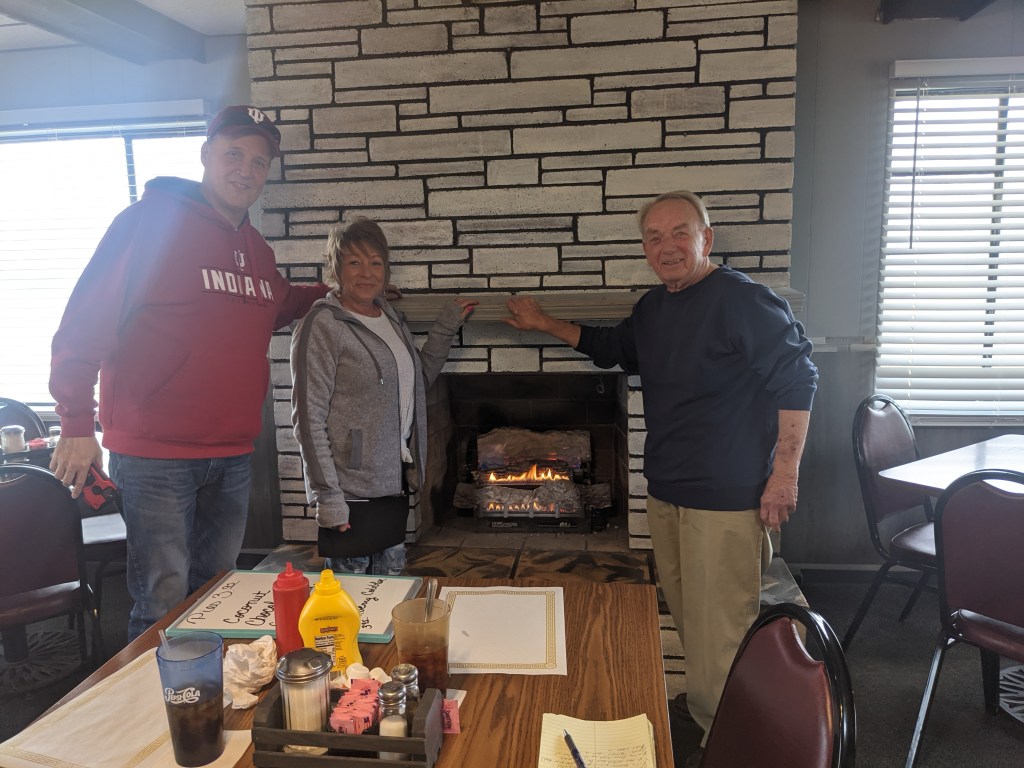
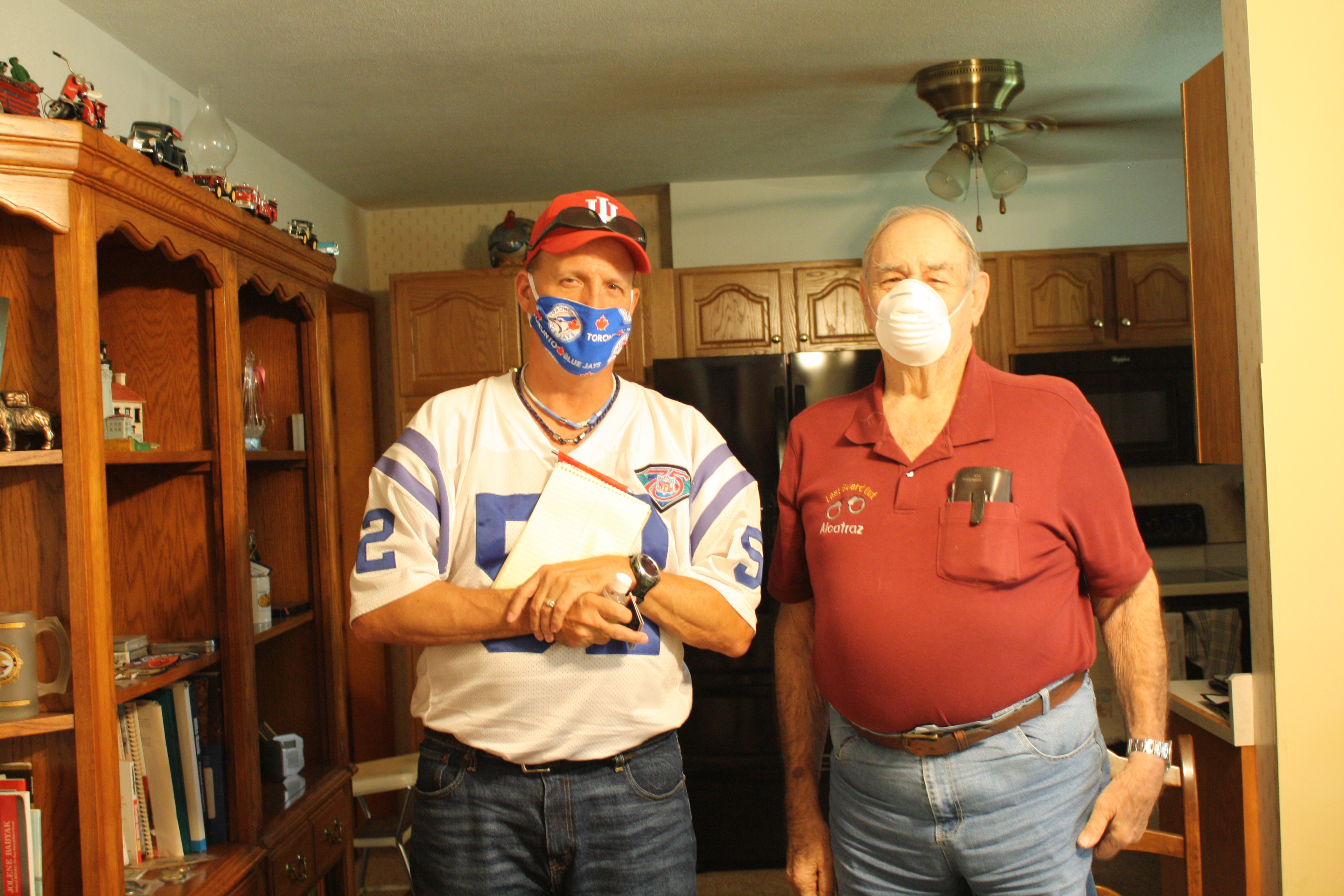
The author with Holly Fettig and Al Swineforth.

Anyone who has ever driven through northern Hamilton County on State Road 37 knows the old “Wheelers” building. The truck stop opened in 1940 as  “Scotty’s Inn.” This was back when SR 37 was the main route between Fort Wayne and Indy, so Scotty’s became a well-known stop for truckers, local farmers, and travelers alike. It featured gas pumps, a restaurant on the main floor, and “tourist rooms” upstairs. Swineforth reopened the restaurant after it sat derelict for many years following a devastating kitchen fire in the 1970s.
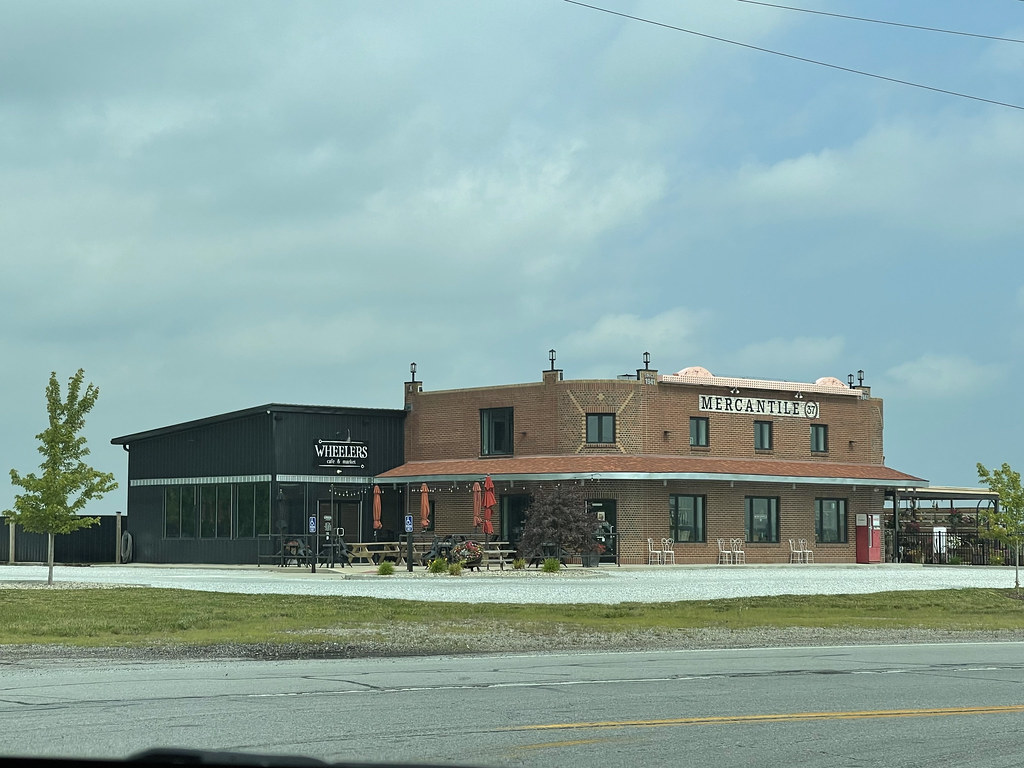
Wheeler’s Restaurant & Mercantile on State Road 37 today.

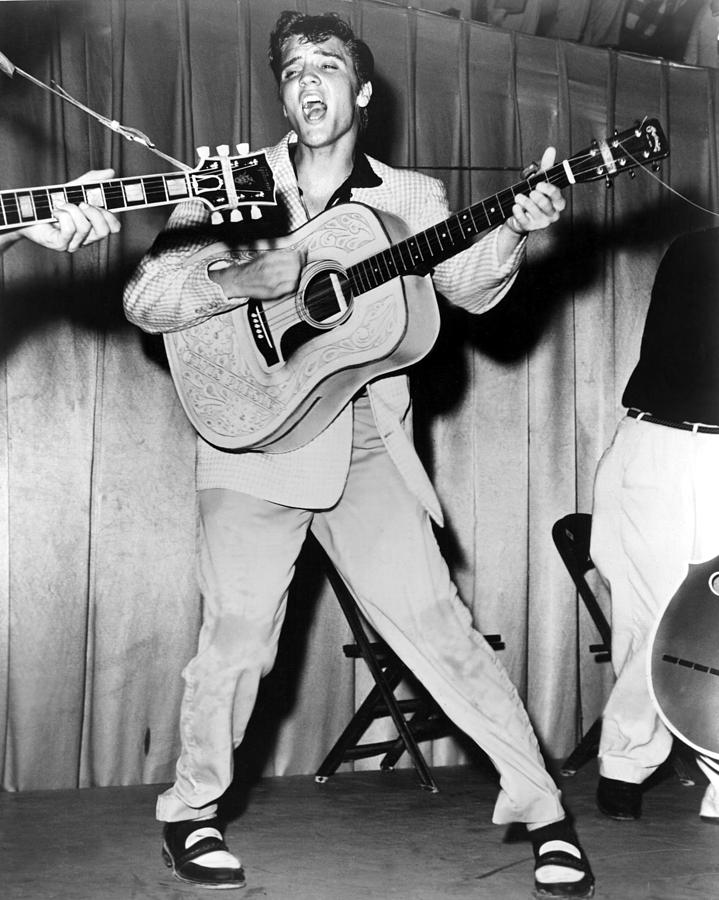
Swineforth recalled that the place was a mess when he took it over. “Oh the stories that building could tell,” he said. “Those rooms upstairs were rented to truckers by the hour,” he whispered with a wink. “You know, Elvis Presley came through there once back in the 1950s.” Swineforth ran his restaurant from 1993 to 1999 before the ancient infrastructure finally forced him to shut it down. The building remained vacant for nearly two decades before it reopened in 2018 as Mercantile 37.
Indiana Governor Frank O’Bannon.

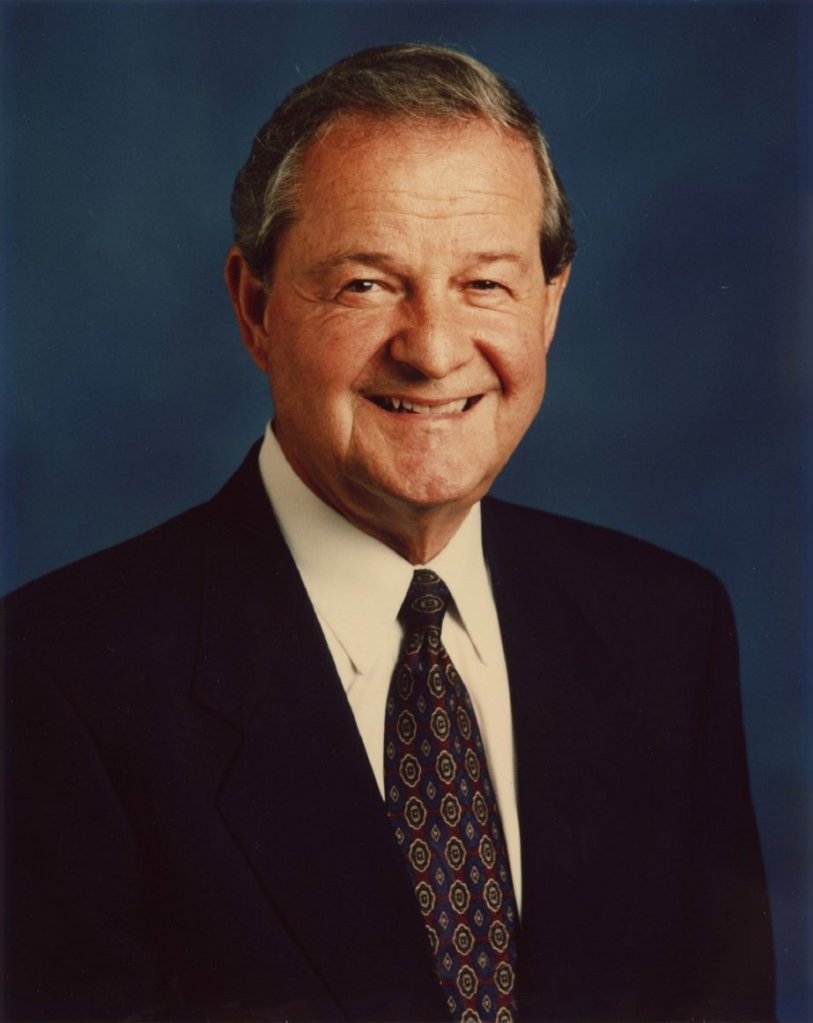
After Swineforth closed his restaurant at the old Wheelers, he landed in Elwood. “I rent the building from the Orbaugh daughters. I own the name and everything within these walls, but the 74-acre airport property remains in the Orbaugh family,” Al noted. “Every Governor since Otis Bowen has stopped in here. Well, except Evan Bayh, he was never here. Mike Pence came in here all the time before he became Vice-President.” Al said, “He used to hold meetings right over there at that corner table.” Swineforth recalls one Governor’s visit in particular. “Frank O’Bannon came in here once for a meet-and-greet. We were running planes then and there were a couple of pilots in here. The Governor’s bodyguards went out and pulled the car up to leave and while they were gone the Governor said that he’d really like to take a plane ride. Pilot John Ward told him his plane was right outside and the Governor took off out the back door and was circling the runways within minutes.” Al closed by saying, “When those bodyguards came back in to get him, you should have seen the looks on their faces when I pointed to the sky and told them ‘there he goes.’ You couldn’t get away with that nowadays.”
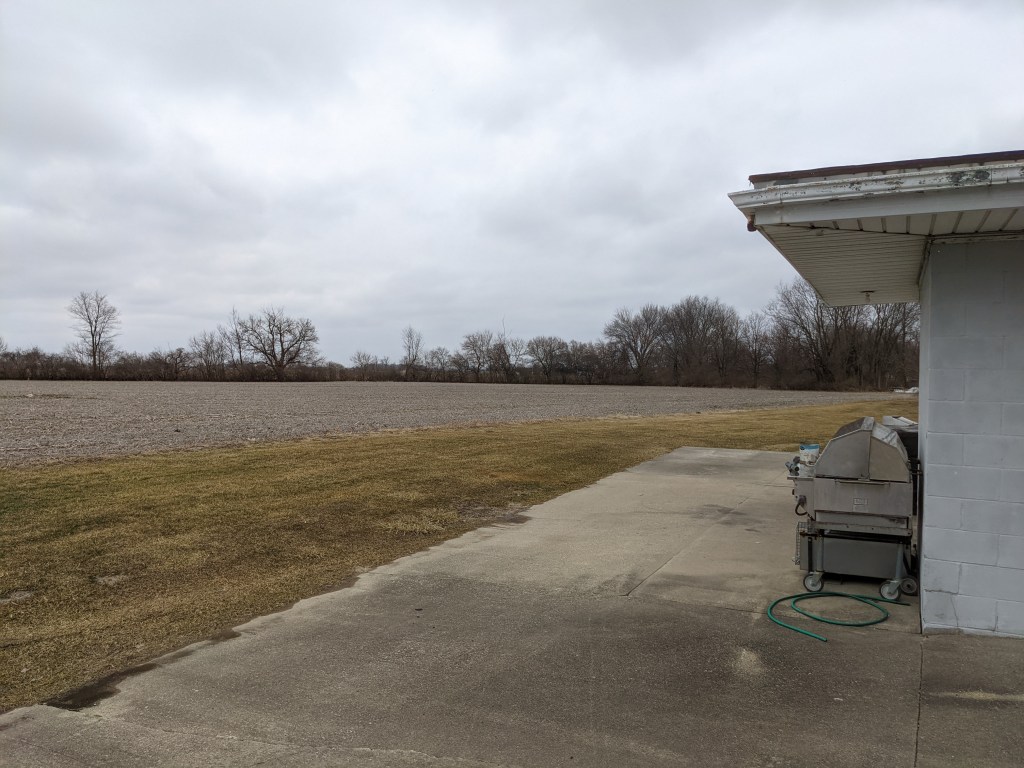
The old runways are a farm field behind the restaurant today.
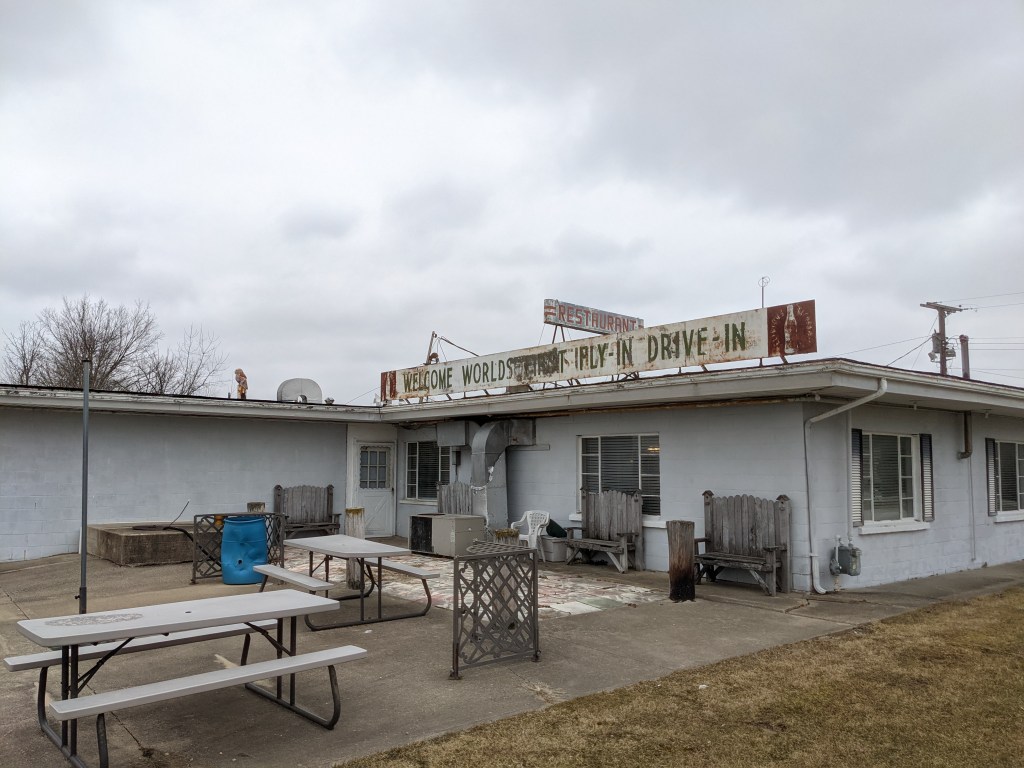
Back of the restaurant today.
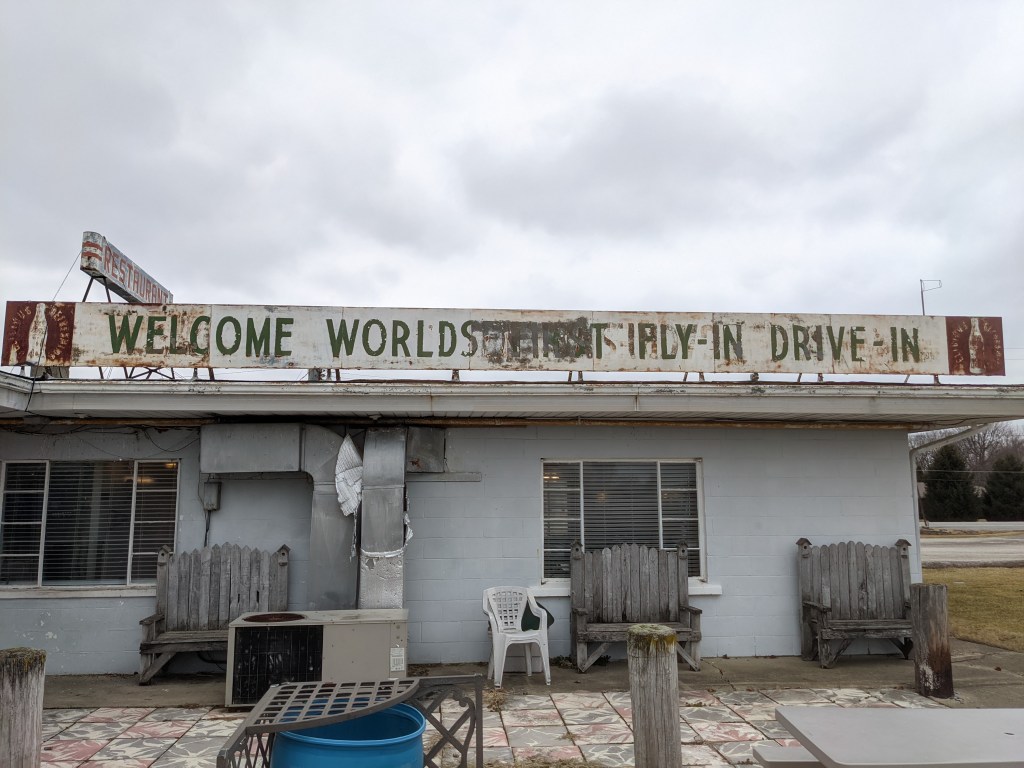
The original welcome sign for the restaurant as seen from the back patio.

The airport closed for good on September 1, 2008. The former runways were leased to a local farmer, who has since planted them in crops. Statistics from the previous year showed that the airport had 2,604 general aviation aircraft operations, an average of 217 per month. When I asked him how it affected his business, Al replied, “I lost $100,000 overnight.” That wasn’t the only calamity Swineforth had to weather. Like most restaurants, the COVID-19 pandemic nearly devastated the Airport Restaurant. “We never closed during COVID,” he stated. “Oh we shuttered the dining room but we were open for curbside and delivery.” It might surprise some to learn that Swineforth thinks the pandemic actually helped his business. “The community really came through for us. I think they appreciated that we never closed. Our business picked up after we reopened.”
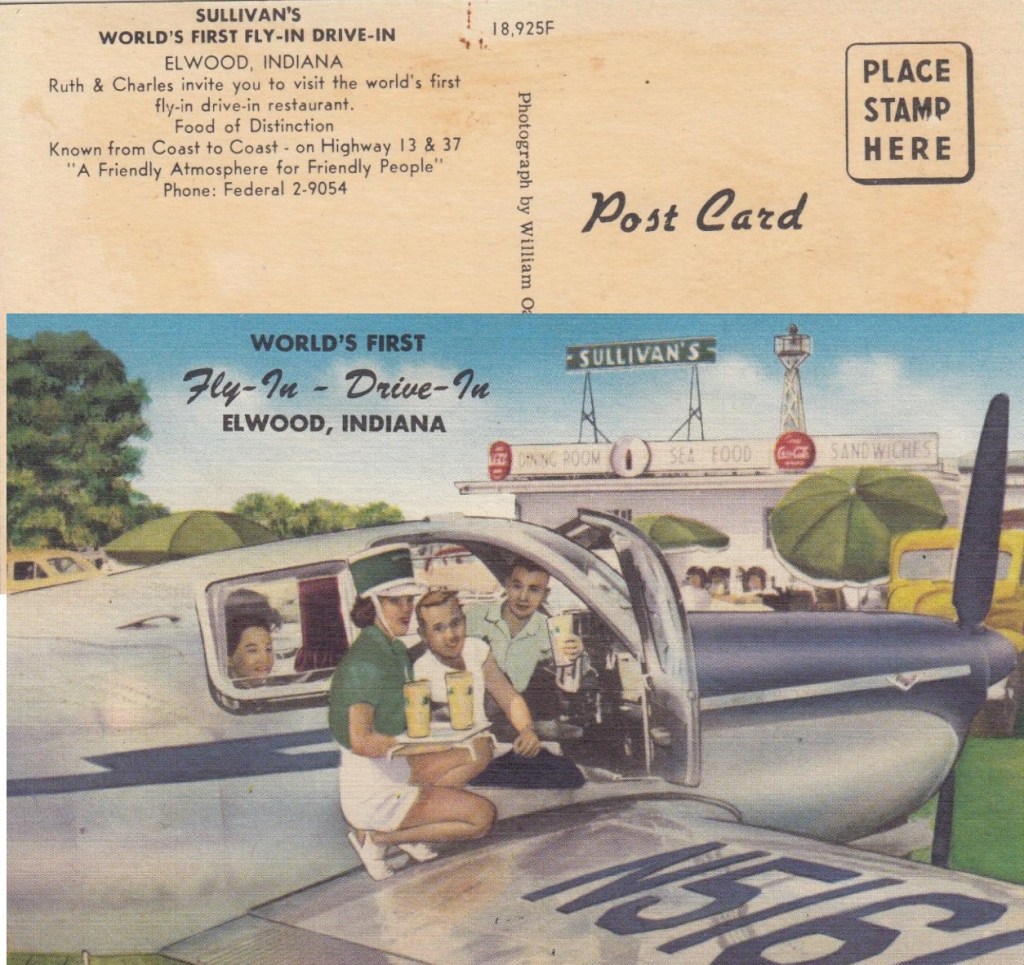
I visited the Airport Restaurant on a weekday and was immediately greeted by owner Al Swineforth. Al insisted that we have lunch before we sat down to chat, his treat. We were seated in the dining room right next to the fireplace. Our waitress Holly Fettig greeted us warmly and informed us that she had worked there since she was 18 years old. “My mom worked here for a few years before I started,” Holly said. “I’ve been here for over 25 years now.” I question that statement because she looks like she would still get carded in any bar she found herself in today.
Elwood’s Airport Inn Menu.

The menu is full of so many different dishes that it is hard to zero in on any one particular selection. The restaurant fare runs the gamut from Hoosier staples like grilled tenderloins, onion rings, fried green tomatoes, and double-decker hamburgers to steak, chicken and noodles, or fish dinners. Holly informed us that they are “famous for our elk burgers.” Rhonda had broccoli cheddar soup and a grilled ham & cheese sandwich and I opted for a giant hamburger, fries, and chili. Next time, I’m trying that elk burger. We were not disappointed. The restaurant serves breakfast, lunch, and dinner with homemade pies also available.
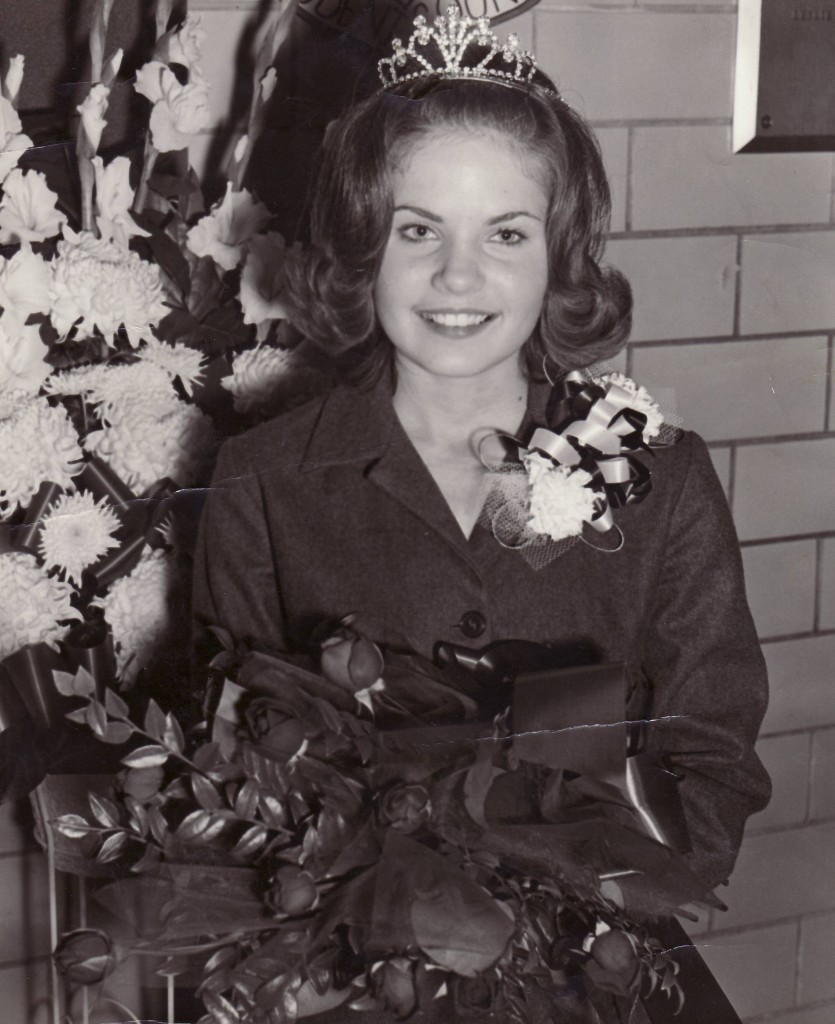
The author’s mother-in-law Kathy Hudson.

After lunch, we sat down with Al and Holly and explained the reason for our visit. Turns out that the restaurant has a family connection. My mother-in-law, Kathy Hudson, worked at the restaurant in 1968 at a time when it was being managed by my wife’s great-grandfather, Virgil Edgar Musick. Rhonda’s dad, Ron Musick, has told us for years about his grandfather and his restaurant and recalled helping with the bookkeeping when he was in high school. “The restaurant was called Musick’s Airport Restaurant back then. Granddad was a musician. He played slide guitar in a band along with running the restaurant.” Ronnie said, “Seemed like he was playing on the radio every weekend on WOWO up in Fort Wayne. He backed up some pretty big-name musicians in his day.”
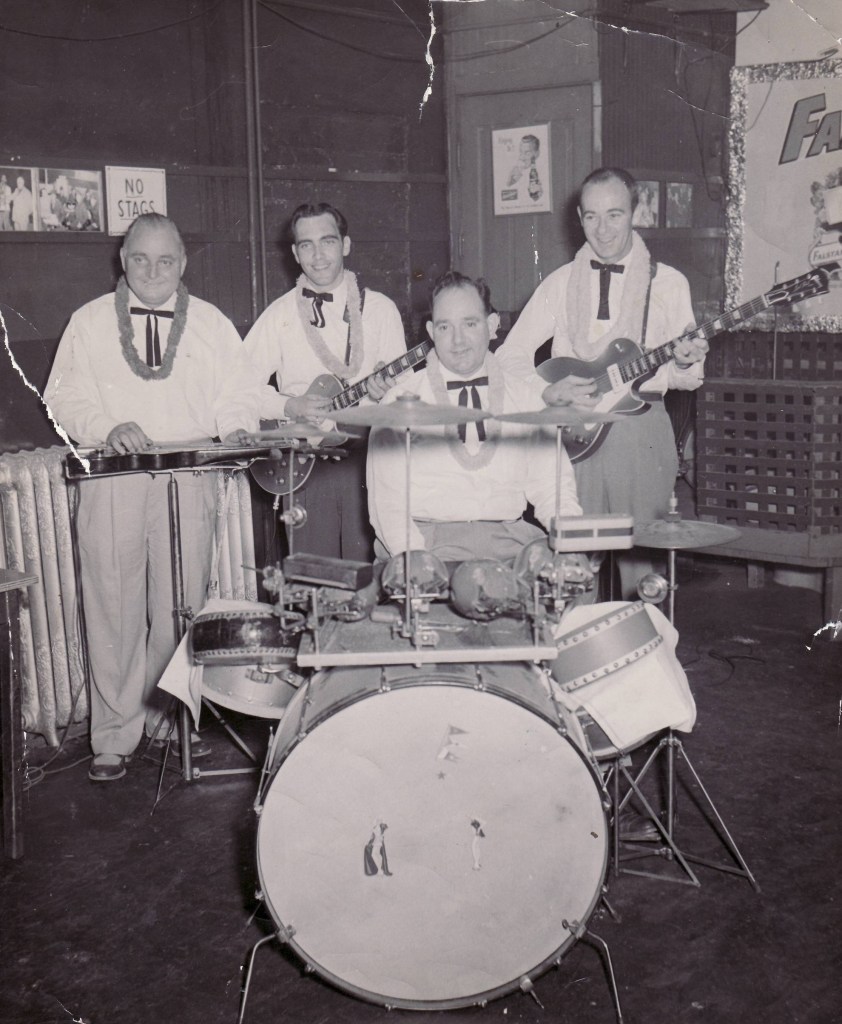
Virgil Musick on slide guitar standing at left.

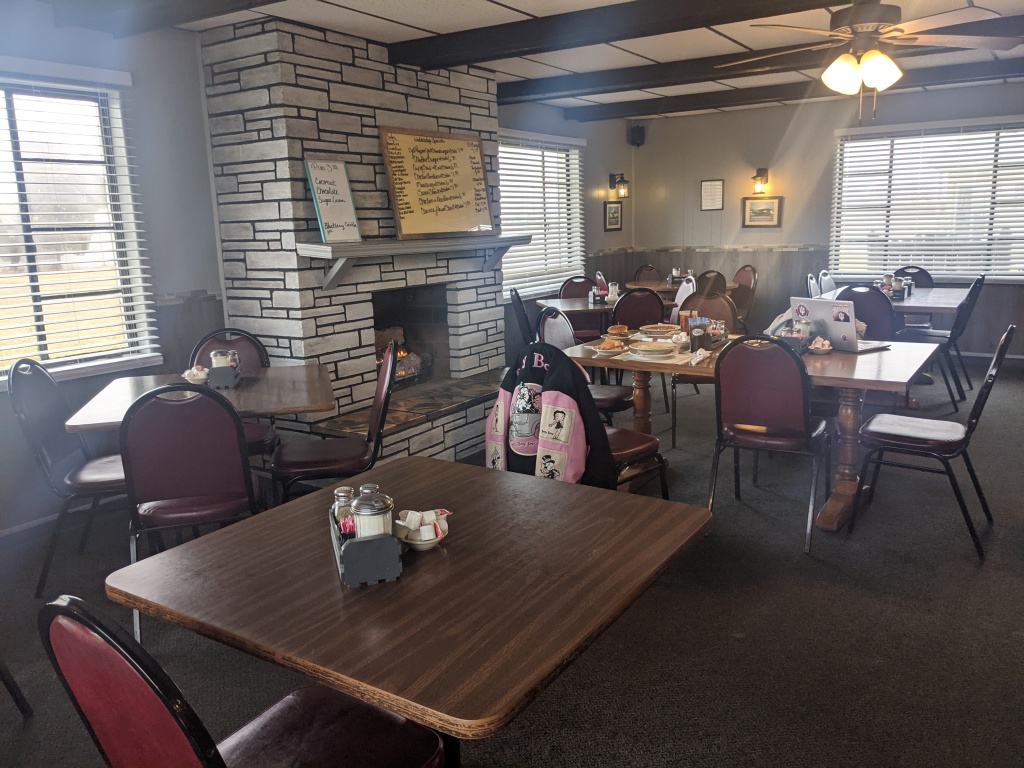
Kathy told us that she was working as a waitress there when Bobby Kennedy’s campaign flew into Elwood in May of 1968. “I don’t remember Bobby being there, but his advance guys were there, all dressed up in suits and dark sunglasses. They asked me if I wanted to go for an airplane ride and I told them, ‘Well, only if my husband can come along.’ The advance men told her, ‘Sure, he can sit on the wing.’ Did I mention that Kathy, former homecoming queen at Anderson Highland High School back in 1964, is quite the looker? The fireplace table was important because Rhonda’s only memory of the restaurant centers around a photo of her and grandmother Nina Pace standing in front of it. Rhonda told Al, “But I remember it as red brick, not white.” Al explained, “Yes it was red but we painted it white when we remodeled the place several years ago.”
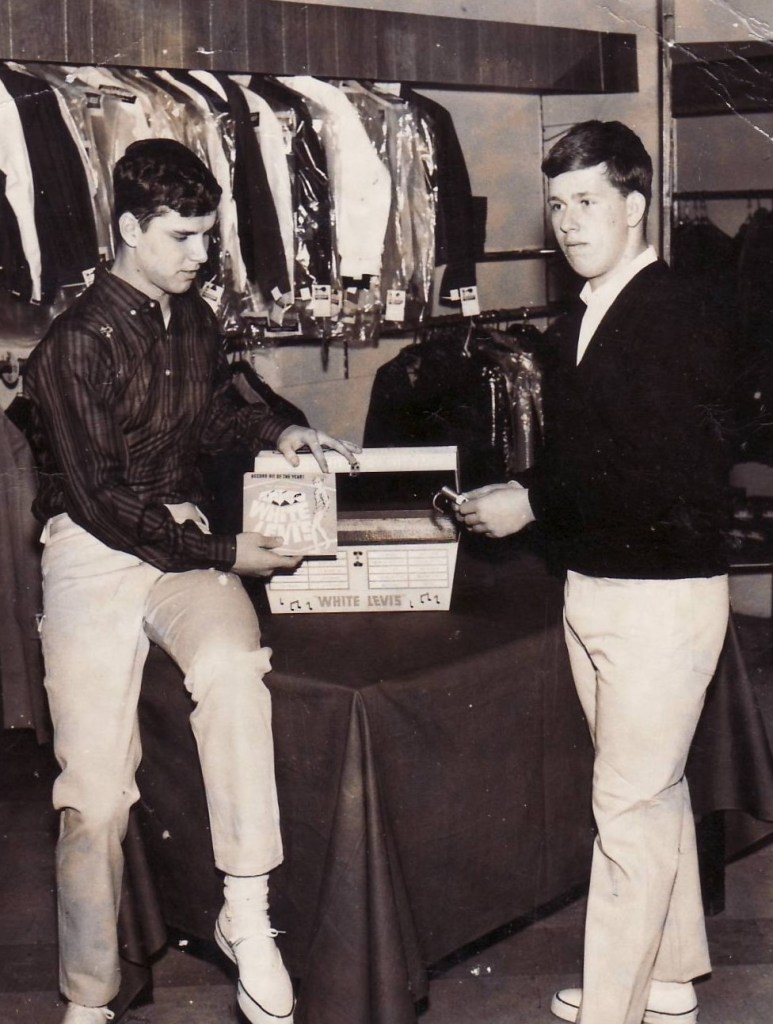
The author’s father-in-law Ron Musick at left.

The planes don’t come here anymore and the runways were plowed over years ago. However, evidence of the airport survives in the many pictures of planes, parked on the grassy runways, taken back in the 1960s and 70s that now line the walls of the restaurant. My father-in-law, Keith Hudson, remembered tooling around Elwood back when it was a working airport. “We used to cut through here by driving up the runway back then. I still eat there from time to time.” When I mentioned Hud’s name to Al, he said, “Oh yeah, I know Keith from Bernie’s bar in Frankton.” Turns out that before he ran the Airport Restaurant, Virgil Musick ran the 128-club in Frankton. Seems like Al Swineforth knows everyone in Madison County. And as for those shortcuts through a working airport runway, don’t worry Hud, I think the statute of limitations has run on that by now.
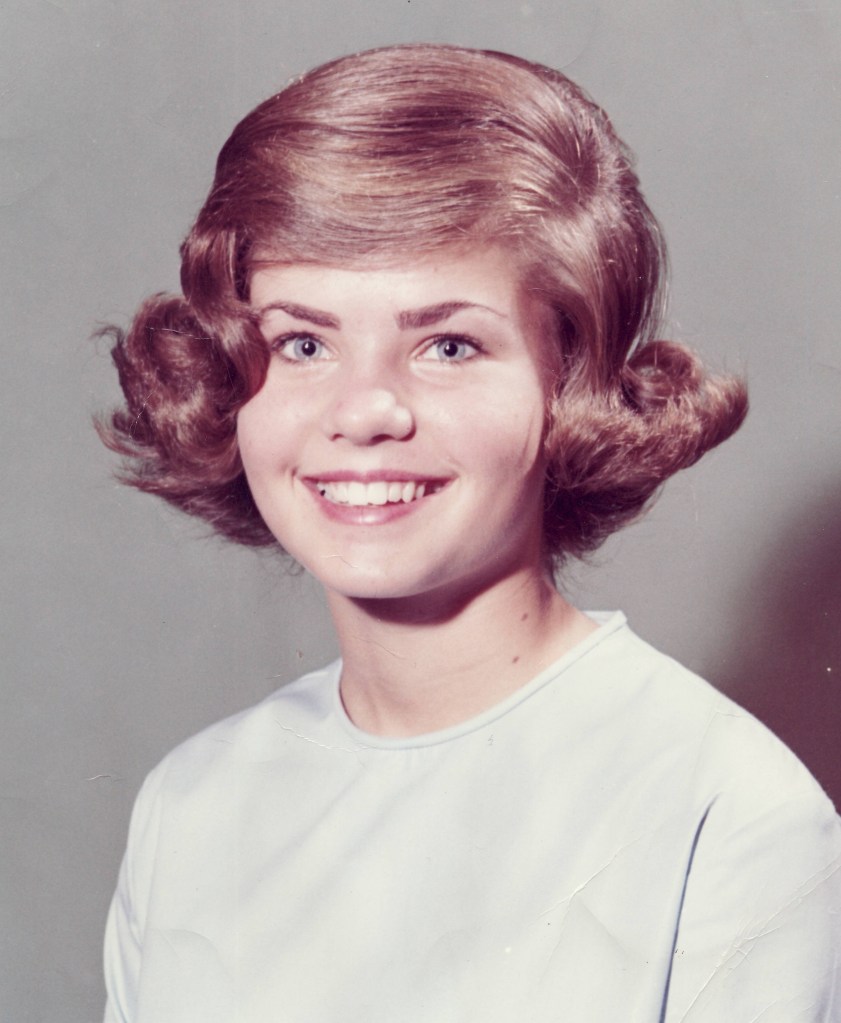
Looking at Kathy, it is easy to understand how she drew the attention of RFK’s security detail in 1968.
The dining room of the Airport Restaurant in Elwood, Indiana as it appears today.

Criminals, Indianapolis, Museums, National Park Service, Pop Culture

A Hoosier Guard on Alcatraz PART IV

Albright Part IV
The author and Jim Albright at the Albright family home in Terre Haute.

Original publish date:  July 30, 2020

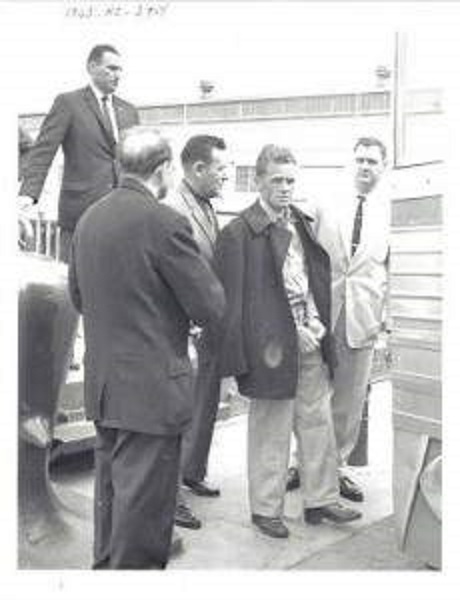
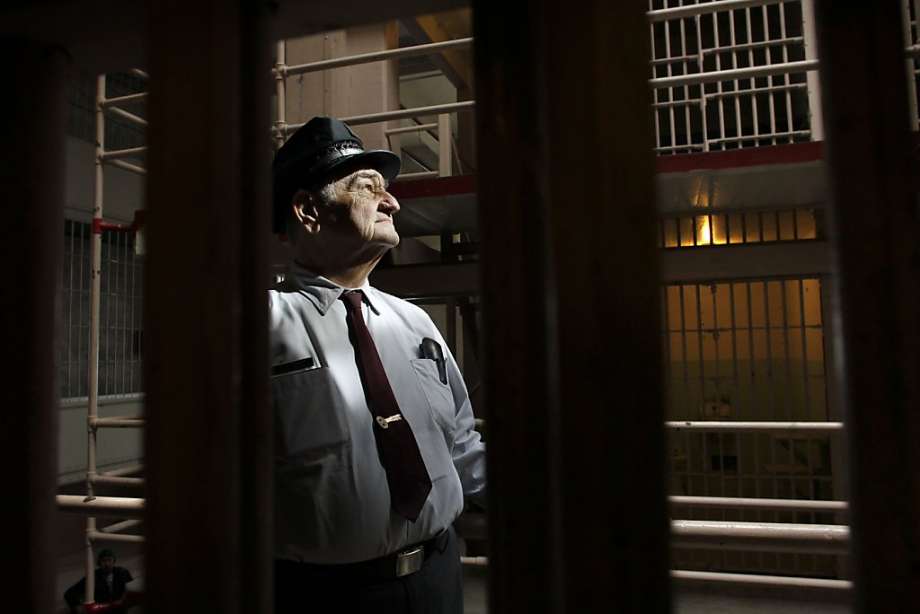
I asked guard Jim Albright what he remembers about the closing of Alcatraz prison in March of 1963, in particular the visit by Attorney General Robert F. Kennedy. “Oh yeah. I remember. He toured the island and had about 50 bodyguards all around him. He didn’t want any of those bad guys to get near him.” Jim can still recall the names and numbers of the infamous inmates on the island when he was there. “Whitey Bulger # 1428, Alvin Creepy Karpis # 325. Alvin was the lowest number left when I was there. Alvin did more time on the island than any other convict. He did just straight at 26 years.” Jim recalls both Bulger and Karpis as “good cons”, both were “quiet and respectful when they spoke to you.” However Jim does say this about Karpis, a notorious kidnapper with the Ma Barker gang, “He was creepy, oh yeah, he was creepy.” Jim states, “I always treated them like I would have wanted to be treated had I been the convict. My job was not to punish them, my job was security.”z ce unnamed
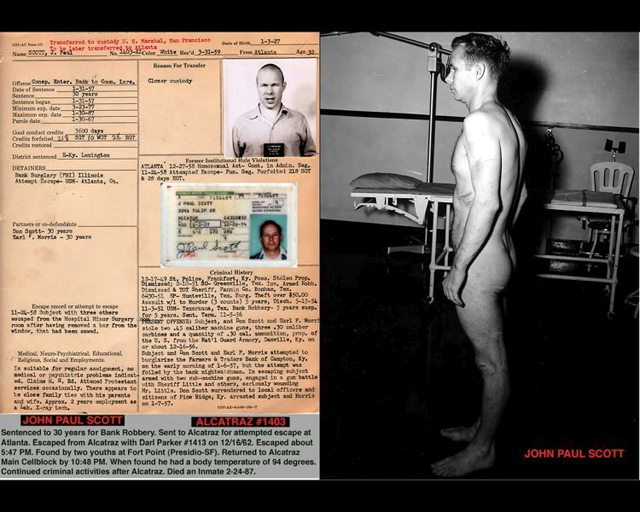
Jim recalls, “Everybody talks about that escape in the Clint Eastwood movie, but I was on duty for the last escape from Alcatraz. John Paul Scott # 1503. December 16, 1962. That was 25 years, almost to the day from the first escape. I was in the control center. I got the call on the red phone, that’s the emergency phone, and you ‘dial the deuces’ as they call it, 222. ‘Jim get me some help, I got a couple missing from the kitchen basement’ was all I heard.” It was Jim Albright’s responsibility to call out the news, order the boat and man the towers for that final escape. Once again displaying his amazing recall after nearly 60 years, Jim says, “Darrel and Don Pickens, they were from Arizona, and they were both red haired and red freckles, red faced…I put them out in # 2 and # 3 towers and every thing’s going along and pretty soon they’re yelling.” They had found Scott’s fellow escapee Daryl D. Parker clinging for life on “Little Alcatraz” (a small rock in San Francisco Bay roughly 80 yards off the northwest side of the Island). Scott, by now naked and battered senseless, came to rest on a rocky outcropping in the bay near Fort Point. He was brought back to the Rock.z JOHN PAUL SCOTT L

z ja fw
Frank Weatherman & Jim Albright (far right)

“I escorted the last inmate off the island, Frank Weatherman # 1576. We never had reporters, they were never allowed on the island but that day (of the closing) we probably had 250 of ’em, from all walks of news. One of ’em almost got in line as we’re heading out and asked me ‘what do you think about this?’ as we’re walking and I said, ‘Hey! I’m still working. My job is going on right now. The biggest thing I gotta watch right now is that one of you damned idiots don’t give ’em something they can escape with. Afterwards, I thought, Jim, keep your big mouth shut.” I asked Cathy where she was during that final prisoner walk down to the dock and she answered, “I was on the balcony watching. I was filming it.” Jim says, “We took the film to get it developed, but never got it back.” Cathy answers, “Somebody’s got it but we don’t.” Cathy also notes, “Well the inmates did not want Alcatraz to close. Some of them cried when they left because where they were going they might have to go to a 4-or-5-man cell, Alcatraz was single cells and they liked that.” Jim adds, “Some of them went, and Creepy Karpis was one of em, to McNeil Island in Washington and they had 10-man cells up there. Creepy, for 25, 26 years almost was used to a one man cell. They finally paroled him and deported him to Canada…from there he went to Spain. I guess he couldn’t take being free, cause he hung himself.”

z stroud-1b
Inmate # 594: Robert Stroud aka The Birdman of Alcatraz.

Jim missed Robert Stroud, the infamous “Birdman of Alcatraz”, by just a few days. “I went there in August and he left in July. But I heard all the stories about him,” Jim recalls. “He was not liked by inmates or staff, either one. You talk about somebody no good, that was him…He was a weird old, nasty guy.” Jim and Cathy remained on the island for three months after that last inmate was escorted onto the boat by Officer Albright himself. It was only afterwards that the couple allowed themselves a little luxury, “We were there March to June. We moved from 64 building over across the parade ground to the city side…They had what they called B & C apartments, these were nicer apartments, they had fireplaces in them.” Jim smiles as he recalls Alcatraz historian and author Jerry Champion jokingly asking, “You had a fireplace did ya? Where’d you get your firewood?” (There are no trees on Alcatraz island).

z 920x920
Jim Albright returns to Alcatraz.

Jim guesses that there may be a “half a dozen or less” Alcatraz guards still living, and “two of them are in wheelchairs” and the former guard estimates the same for the former convicts. Cathy notes that the inmates used to come to the reunions too and Jim recalls that it took awhile for the inmates to show up because “they were ashamed of what the guards would think, ya know.” But spend five minutes with Jim Albright and you quickly realize that he was never one to hold a grudge. Officer Albright is simply not the judging kind. Jim Albright is a people person. He enjoys meeting people and loves to see their reactions when he shares his story, especially when he reveals that they lived on the island. “As soon as I tell them that and point to my wife, it’s “FWEET!” (he says with a whistle and grin), they go right over to her and I’ve lost ’em.”
For many years, Jim and Cathy traveled by train from Terre Haute to San Francisco, a 2 1/4 day’s travel from nearby Galesburg, Illinois. “There used to be 150 people come out to those reunions, but then it got down to 30 cause there’s just nobody left.” Because of the current situation with Covid-19, the couple’s trip has been postponed. Cathy admits, “Well, we’re all getting older” and Jim chimes in, “And that’s the thing about not going in August, that means that last August was probably our last time going out there. The odds are against us.” Jim and Cathy fear that the alumni association will soon be no more. “There’s just not enough of ’em left,” Cathy says.
z DYwvoC_VAAABixRA week after our visit to Jim and Cathy Albright, the United States Supreme Court lifted the ban on executions at the Terre Haute penitentiary located a mere three miles from their front door. At the time of this writing, there had been three executions in four days. While there were never any State sanctioned executions at Alcatraz, there was not much rehabilitation taking place there either. Convicts were different back then, some actually viewed it as a profession. When asked about the convicts of today, Jim simply shakes his head and says, “They were more like professional convicts ya know ‘I did the crime, I’ll do the time’. It’s just not the same. It’s a different world now.”
In his book, Jim wrote quite eloquently of his feelings on that last day, “Emotions of prison personnel were very strong and it was hard to accept that all the convicts were gone…I boarded the boat for the last time as a guard on Alcatraz. I though to myself, what an experience I had just completed, and how fast the time went by. I felt tears grow in my eyes as the boat went across the water to Fort Mason.” I asked the couple individually, if they could make one statement about the Rock, what would it be? Cathy answered, “Well, I really liked the place. I did not want to leave. It was one big family… It was something special. It was home.” Jim reflected for a few moments, titled his head back as if looking through the mist of time, and replied, “A very enjoyable life living on the island and a very safe place to raise our children.”

z EBT-L-ALCATRAZ-0813-10
The Rock.

Alcatraz Federal Penitentiary has been closed for over 57 years now. During that time it has become more myth than reality. Alcatraz Island encompasses a total of 22 acres in the center of San Francisco Bay. It opened to the public in fall 1973 and since that time has hosted millions of people from every corner of the world. The flood of people who once lived on the island during the time it was the world’s most famous prison has trickled to a slow drip. However, there remains one couple living on the western edge of the Hoosier state who know that sometimes, even if they don’t consider themselves as such, legends are real and history is the foundation of all that is worthy in life.

519kJvKIU8L._SL500_

Criminals, Politics, Pop Culture

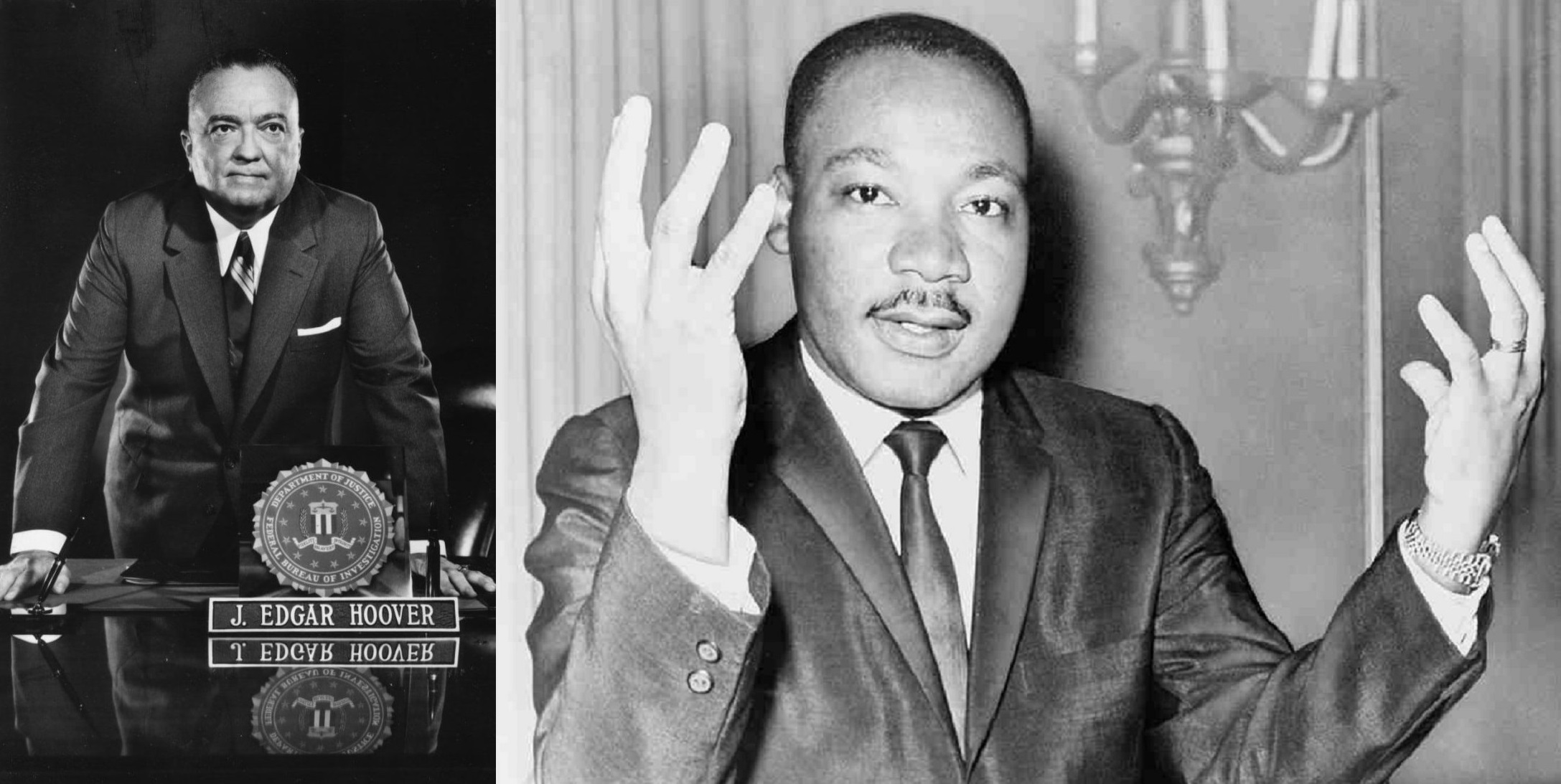
J. Edgar Hoover’s FBI and Dr. Martin Luther King, Jr.

Hoover-MLK

Original publish date:  December 5, 2019

Politics. No matter where you go, you can’t escape it. No doubt last week Thanksgiving tables all across the Hoosier state either artfully dodged or spiritedly discussed politics in one form or another. Luckily, if you don’t like the political situation in this country, you can do your part to change it by exercising your right to vote. But what about the influence wielded by those most powerful “influencers” who never ran for office nor received a single vote? I’m not talking about the Kardashians, Oprah, Ellen or Taylor Swift. They may influence style and pop culture, but they do not steer public policy.

z social-media-influencer-online-chats
An argument could be made that today we are living within the most powerful unelected government in history of the United States. I would imagine that the average citizen could name more unelected policy influencers than they could legislators. Doubt that? Names like Buffet, Gates, Zuckerberg, the Koch Brothers, Limbaugh, Hannity, Maher, O’Reilly, Soros, Bezos, Musk ring a bell? However, any child of the sixties would counter those examples with names like Dylan, Lennon, Leary, Ali, Malcolm X, and Chavez. The difference is that today’s policy influencers attempt change through money while baby boomer influencers attempted change through ideals. In the case of the sixties, the two most powerful unelected influencers came from opposite ends of the spectrum. They were FBI leader J. Edgar Hoover and Civil Rights leader Dr. Martin Luther King, Jr.

z GettyImages_97264803.0
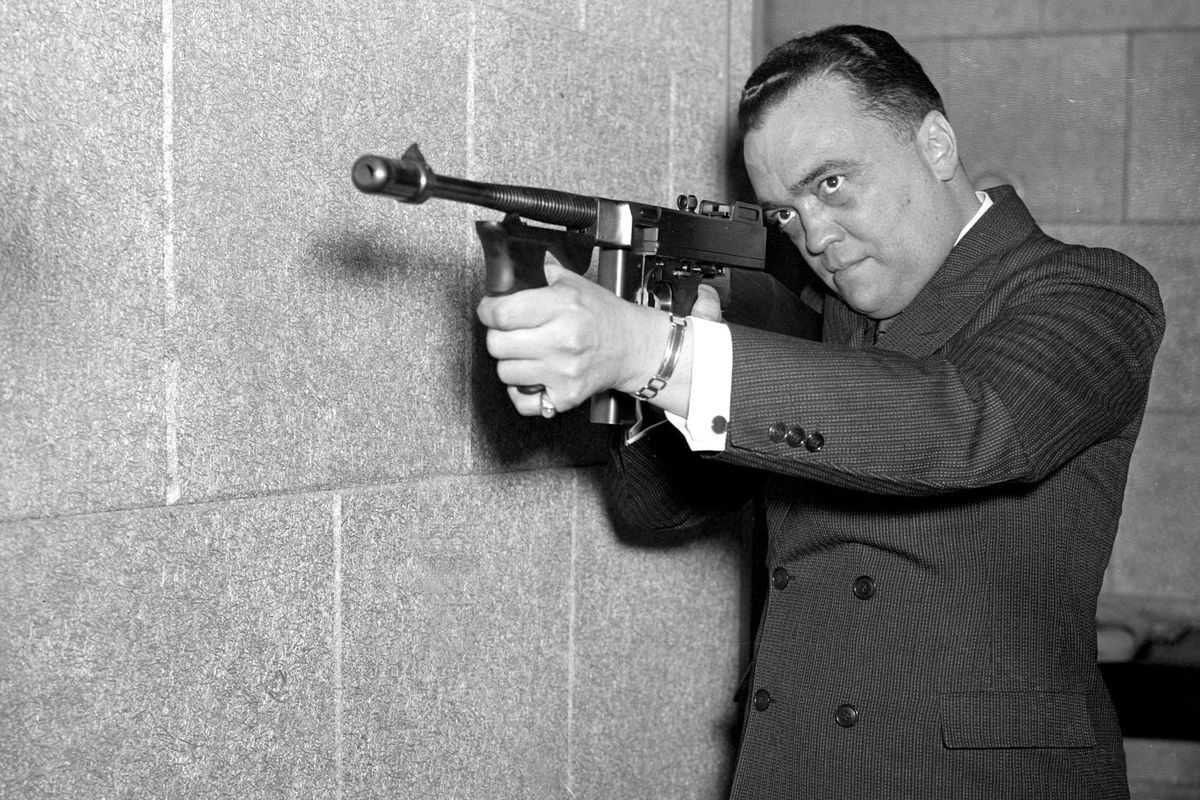
Although J. Edgar Hoover was never elected to any office, for decades, he was every bit as powerful as any person in the country. Hoover’s power emanated from his leadership of the FBI but was enhanced by his ready use of blackmail and, ironically, other criminal practices to stay in power. Since his death in 1972, Hoover’s legacy remains in conflict. Hoover’s critics say he harassed civil rights leaders, discriminated against gays (particularly federal workers) and gathered incriminating evidence to blackmail political figures; friend and foe. While his supporters point to Hoover’s modernization of law enforcement methods, his standardization of the the FBI’s fingerprint database and for bringing forensic science into criminal investigations as his legacy.

selma_movie_2_original_47981
During a three week period 55 years ago, the dichotomy of the Hoover-King affair was defined. On Nov. 18, 1964, Hoover told a gathering of women reporters, “In my opinion, Dr. Martin Luther King is the most notorious liar in the country.” Hoover’s statement was in response to Dr. King’s suggestion that the F.B.I. was not doing enough to protect Freedom Riders fighting Jim Crow racism in the South. That “Freedom Summer” campaign to get African Americans to register to vote was marred by violence, including the killings of three civil rights workers in Mississippi.
Hoover’s comments prompted a request by Dr. King for a meeting with the Director. “I was appalled and surprised at your reported statement maligning my integrity,” King wrote in a telegram to Hoover. “What motivated such an irresponsible accusation is a mystery to me.” King turned the tables on the Director by telling reporters: “I cannot conceive of Mr. Hoover making a statement like this without being under extreme pressure….I have nothing but sympathy for this man who has served his country so well.” In contrast, privately Hoover called King “the burrhead” and “a tom cat with degenerate sexual urges.”z mlk-fbi-1
But before that meeting could be arranged, FBI assistant director and head of the Domestic Intelligence Division at the time, William C. Sullivan, sent an anonymous letter to King, threatening to make public the civil rights leader’s sex life. Hence known colloquially as the “suicide letter” for its suggestion that King kill himself to avoid the embarrassing revelations, it is unknown whether the letter was sent at Hoover’s direction. However, a full and uncensored copy can be found in Hoover’s confidential files at the National Archives. The letter dictated: “There is only one way out for you. You better take it before your filthy, abnormal, fraudulent self is bared to the nation”.
On Dec. 1st, Dr. King meets with J. Edgar Hoover to discuss the perceived slander campaign by the Director. Hoover later told Time magazine, “I held him in complete contempt…First I felt I shouldn’t see him, but then I thought he might become a martyr if I didn’t.” Hoover hated King for several reasons, first, because he believed King was a Communist, but also for King’s criticism of the FBI for failing to solve civil rights-related crimes. And, as Wm. Sullivan wrote in his memoir, “Hoover was opposed to change, to the civil rights movement, and to blacks.”

z 5a45193c241dc.image
John F. Kennedy, J. Edgar Hoover & Robert F. Kennedy

In 1963 Hoover used the King Communist accusation to convince Attorney General Robert Kennedy to allow the FBI tap King’s phones and bug his hotel rooms. Although Kennedy only gave written approval for “limited wiretapping” of Dr. King’s phones “on a trial basis, for a month or so”, Hoover extended the clearance so his men were “unshackled” to look for evidence in any areas of King’s life they deemed worthy. The bugs revealed that King was having extramarital affairs, which disgusted Hoover, a lifelong bachelor whose own sexuality remains a mystery. The bug also picked up King describing Hoover as, “old and senile.” Hoover shared his tapes of King’s sexual romps with President Lyndon Johnson, who then allegedly played them for his aides. Hoover also directed his assistants to leak the details of King’s sex life to reporters. A tape was also sent anonymously to King’s wife Coretta.

z LBJ-Hoover-1000x1236
Hoover & LBJ

Around Thanksgiving, Newsweek reported that President Johnson had decided to “find a new chief of the FBI.” FBI agent Sullivan wrote that it was “Johnson who ordered Hoover to meet with King and patch things up.” Hoover ordered his aide Cartha DeLoach, “Make sure the meeting is in my office. And no press. Do you hear me, no press!” While DeLoach followed orders no-one informed Dr. King’s aides, and when the civil rights leader arrived at Hoover’s office, there was a mob of reporters waiting outside.
The 69-year-old Hoover met with the 35-year-old Dr. King and his aides, Ralph Abernathy and Andrew Young. “I’m grateful for the opportunity to meet with you,” King said. He told Hoover that he appreciated the work the FBI had done in civil rights cases and said that while “Many Negroes have complained that the FBI has been ineffective but I, myself discount such criticism. And I want to assure you that I have been seriously misquoted in the matter of slurs against the FBI.” Dr. King’s statement took about two minutes. After which, Hoover spoke without stopping for the better part of an hour extolling the virtues of the FBI and denouncing the communists. Meanwhile, America’s greatest Civil Rights orator sat quietly and listened.
During the meeting, Hoover was asked why the FBI didn’t have more black agents. “The problem is, we require not only a college diploma, but in most cases an advanced degree,” Hoover said. “We won’t water down our qualifications because of the color of a person’s skin.” The meeting ended without addressing the issues that had prompted the meeting. “We never got around to discussing the ‘most notorious liar’ business. Nor did we even get to mention the FBI surveillance,” Andrew Young later wrote in his memoir. “In fact, nothing happened except that Hoover rambled on and on about the virtues of the FBI.”
z famous-disputes-hoover-kingIn 1970, two years after King’s assassination, Hoover told a Time reporter. “King was very suave and smooth. He sat right there where you’re sitting and said he never criticized the FBI. I said, ‘Mr. King’-I never called him reverend- ‘stop right there. You’re lying….If you ever say anything that’s a lie again, I’ll brand you a liar again.’ Strange to say, he never attacked the Bureau again for as long as he lived.” Nobody else present that day remembered that confrontation-not Young, not Abernathy, not even Deputy Director Deke DeLoach, who was taking notes that afternoon.
z large
Deke Deloach and J. Edgar Hoover.

In the years after that meeting, Hoover tasked several FBI agents to 24-hour monitoring of the activities of Dr. King. The FBI Director directed his agents to set up wiretaps, monitor travel, conduct surveillance, and record all of King’s activities- including those he met with, what they discussed, how long they stayed, and how often they interacted- in an attempt to discredit or charge him with something.
President Truman once said, “We want no Gestapo or secret police. The FBI is tending in that direction.” J. Edgar Hoover used his power to further his own agenda and secure his position as leader of the most powerful law enforcement agency in the country. And black people were a favorite target of Hoover’s FBI. Legal scholar Randall Kennedy said that Hoover “viewed protest against white domination as tending toward treason.” This view of the world led Hoover to align himself with all of the forces of racial oppression, but he may have done his greatest damage not through action, but through inaction. He relentlessly pursued high profile targets like the Black Panthers, but neglected to protect the basic human rights of “ordinary” black citizens.
Because Hoover hated communists as much as he hated black people, he often equated one with the other, claiming that the civil rights movement was a tool of the communist party. Make no mistake about it though, J. Edgar Hoover’s enemies list did not end with Dr. Martin Luther King, Jr.. The great crime fighting G-man’s other targets included Ralph Abernathy, Muhammad Ali, James Baldwin, H. Rap Brown, Stokely Carmichael, Eldridge Cleaver, Tom Hayden, Ernest Hemingway, Abbie Hoffman, Malcolm X, and Huey P. Newton and wiretappings and illegal break-ins of the Southern Christian Leadership Conference that King headed.

z 635804090494403983-mlk-nobel-prize-18
Dr. King accepting the Nobel Prize.

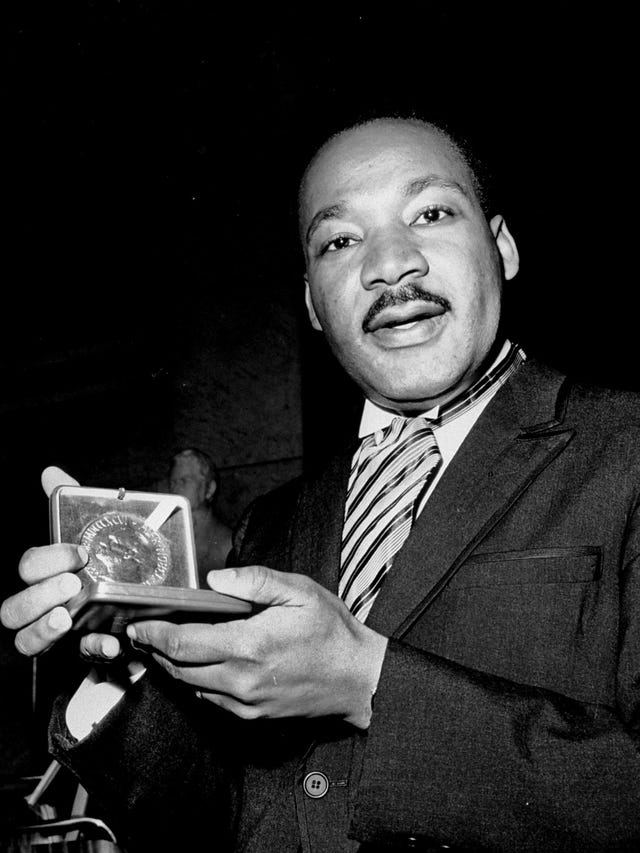
While the Hoover-King meeting was deemed unremarkable and went mostly unnoticed by the American press, it was viewed otherwise by the citizens of the world at large. On Dec. 10th, 1964 the Nobel Peace Prize was awarded to Dr Martin Luther King Jr., making him the youngest winner of the prestigious award. Officially, it was awarded to him for leading nonviolent resistance to racial prejudice in the U.S. At Dr. King’s acceptance speech in Oslo, he remarked, “I accept the Nobel Prize for Peace at a moment when 22 million Negroes of the United States of America are engaged in a creative battle to end the long night of racial injustice…I accept this award today with an abiding faith in America and an audacious faith in the future of mankind. I refuse to accept despair as the final response to the ambiguities of history…I believe that unarmed truth and unconditional love will have the final word in reality…I believe that wounded justice, lying prostrate on the blood-flowing streets of our nations, can be lifted from this dust of shame to reign supreme among the children of men…I still believe that We Shall overcome!”
After King accepted the Nobel Peace Prize, Hoover wrote his reaction on a news clipping: “King could well qualify for the ‘top alley cat’ prize.” And even by 1969, a year after Dr. King’s death, FBI efforts to discredit the Civil Rights leader had not slackened. The Bureau furnished ammunition to opponents that enabled attacks on King’s memory, and tried to block efforts to honor the slain leader. The campaign to tarnish Dr. King’s legacy persisted until Hoover’s death in 1972.

z MLK_JEH
MLK and Hoover.

Hoover’s meeting with Dr. King 55 years ago did nothing to enhance his personal legacy. Today, he is remembered as a cross-dressing closet homosexual suffering from paranoid delusions. But could self-loathing also qualify as a symptom of Hoover’s obsession of Dr. King, the Civil Rights movement and personal persecution of the black race?
In his 1993 book “Official and Confidential” author Anthony Summers said that ,in some black communities in the East, he discovered that it was generally believed J. Edgar Hoover had black roots and was even referred to as a “soul brother” in some circles. Writer Gore Vidal, a contemporary of the Director who grew up in Washington, D.C. in the 1930s also said in an interview: “It was always said in my family and around the city that Hoover was mulatto. And that he came from a family that passed.”
So, as you contemplate the many layers of political intrigue addressed in this article and populating the headlines, airwaves and social media today, keep in mind that things may not always appear as they seem. As the Wizard of Oz himself, Frank Morgan said way back in 1939. “Pay no attention to that man behind the curtain!” Oftentimes it is the legacy that reveals the real truths of an age or era. And that legacy can only be accurately deciphered through the lens of time.