
Original publish date: August 22, 2019
Last month Rhonda and I once again traveled the route of the World’s Longest Yard Sale along Highway 127 in Kentucky and Tennessee. Once again we started just south of Cincinnati and made our way to Crossville Tennessee. We set out on Wednesday morning and by Friday morning we had had enough. It has been our experience that after noon on Friday it becomes a frustrating route of diminishing returns. Traffic slows to a crawl, parking becomes a problem and our patience becomes frayed like an old pair of blue jean cut offs. Don’t even get me started on Saturday. You’re a better man than me if you can survive a Saturday on the 127.
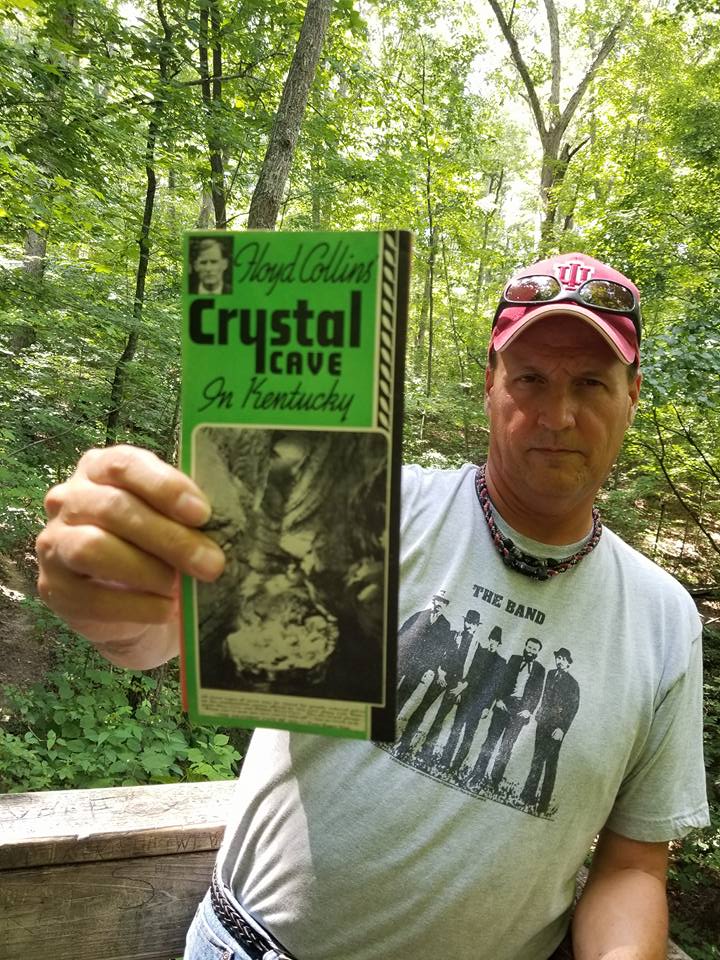
So this year we decided to veer off to Cave City, Kentucky on Friday afternoon and chase the ghost of old Floyd Collins. I’ve always found myself drawn to antiheroes. The men and women who manage to achieve notoriety and great things while orbiting around the fringe of establishment. Some of these personalities seem to be predestined for greatness while others seem to succeed in spite of themselves. Not to be confused with an underdog, an antihero is often doomed to be critiqued (and sometimes ostracized) by people whose achievements would never stack up over a lifetime.
 Floyd Collins is one of those people. Collins was long, lean, logical and legendary. He remains history’s most famous spelunker. Not only because of the way he lived, but also because of the way he died. William Floyd Collins was born on July 20, 1887 in Auburn, Kentucky. He was the third child of Leonidas Collins and Martha Jane Burnett. Collins had five brothers and two sisters, including another brother named Floyd. Which was not uncommon for the time as frontier families often feared that a child might not survive to adulthood.
Central Kentucky, nestled firmly in America’s limestone belt, is not the best for farming. The soil is poor and thin and the bluegrass it produces is best for livestock grazing rather than crop production. However it does produce some of the best caves in the world.
Floyd’s Central Kentucky home rested smack dab in the middle of a region riddled by hundreds of miles of interconnected caverns, most notable of which is Mammoth Cave National Park, the longest cave system in the world. Mammoth Cave became an unlikely tourist attraction after the War of 1812 when British soldiers ventured into it. Soon several other caves opened to serve the adventure seeking tourist. At that time the region represented the far westernmost frontier and a trip to an underground cave system was the capstone to a thrill seeking adventure. The roads, little more than livestock paths back then, were in rough shape and accommodations were scant. Eventually a train was put in that would stop at the various caves and a series of grand hotels were constructed.
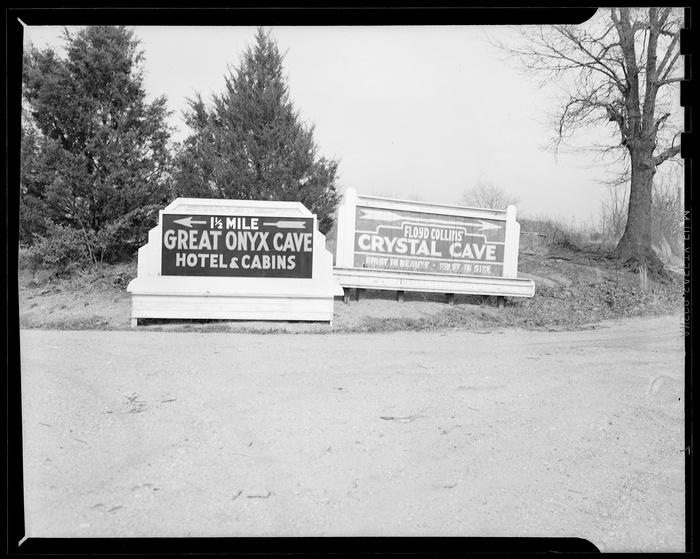 The biggest business in the area was Mammoth Cave, but there were others: Great Onyx Cave, Colossal Cavern, Great Crystal Cave, Dorsey Cave, Salt Cave, Indian Cave, Parlor Cave, Diamond Cave, and Doyles Cave. These holes were all owned and operated by men who charged admission to the visiting tourists who were more than happy to pay for the privilege. At the center of it all was Cave City. Here was the depot that brought wealthy visitors in on the hour, all hungry for adventure. And Cave City residents were more than happy to assist these gullible visitors by relieving them of their cash. As we will see later in this article, not much has changed in 200 years.
From his earliest days, Collins spent his time crouching, crawling and slithering on his belly through holes that a groundhog would find challenging to navigate. Floyd learned early that “there was money in them-there holes.” Floyd spent his time through those damp, dark holes collecting arrowheads, “Tommyhawks” and moccasins to sell to the visitors by the pocketful. In time, visiting professors from American colleges and universities discovered the young spelunker’s talent for acquisition and offered good sums of money for any Native American Indian artifact that Floyd would send them. Some of Floyd’s discoveries can be found in the Chicago Field Museum to this day. Floyd was particularly active in the wintertime. He would walk for miles up and down the bluegrass hills looking for telltale puffs of smoke rising from the ground. Floyd knew it was steam rising from an underground passage that just might lead to the next great cave.
Floyd, a loner, would often disappear into the underground mazes for hours to explore cracks, crevices and sink-holes, only to unexpectedly pop up in a field or woodlot several miles from his point of entry. Collins usually took along a lantern, a can or two of beans, 70 feet of rope, and a compass on those solitary expeditions. The compass wasn’t to guide him, he claimed, but instead was a good luck charm. Although known as history’s greatest spelunker, Collins broke every rule of caving. He always traveled alone, never told anyone where he was going, always covered his tracks, often caved at night and followed water and, to his ultimate doom, to Floyd every discovery was kept a closely guarded secret.
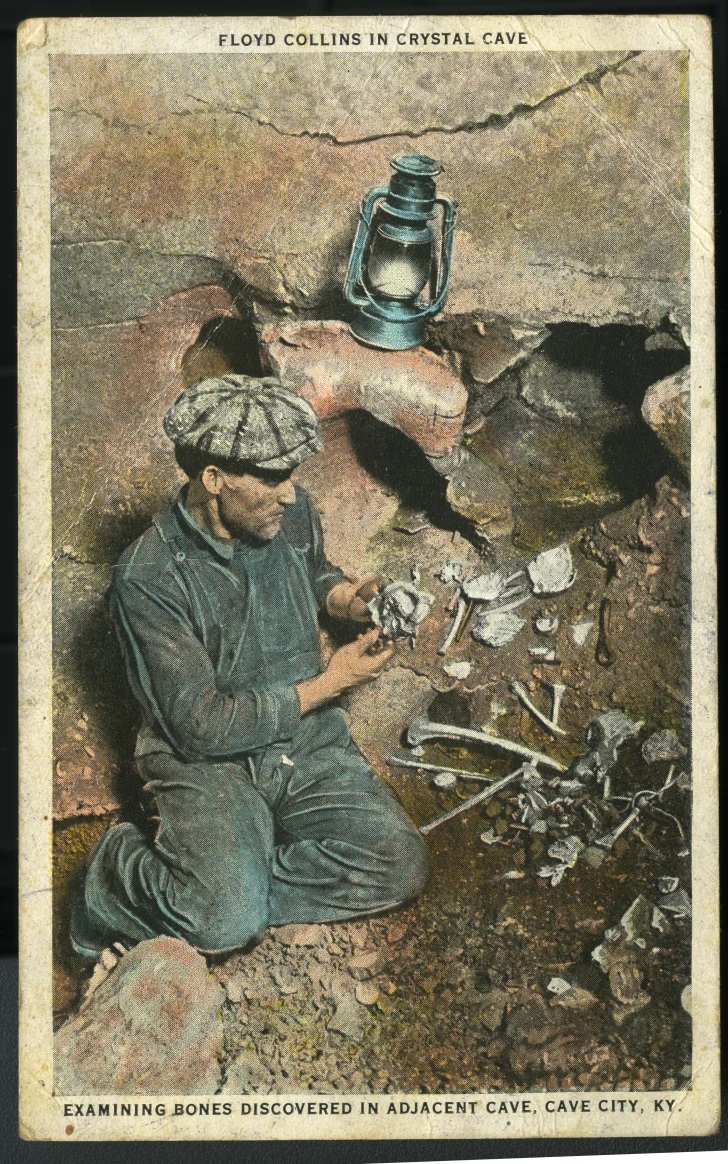 Collins first tasted celebrity when he discovered Crystal Cave in 1917 when he discovered Crystal Cave (now part of the Flint Ridge Cave System of the Mammoth Cave National Park). Twenty-seven year old Collins had chased a ground hog down a hole on his father’s farm. The hole turned out to be a passage to a large cavern Floyd called “White Crystal Cave”. He owned one half and his father owned the other. They went into business, selling options on the cave to a neighbor named Johnny Gerald who’d made a little money buying and selling tobacco. Johnny and Floyd took turns; one of them stood on the side of the road and tried to talk the tourists inside; the other guided them through the cave’s.
The pair worked unceasingly and spent every dime they had to open their new White Crystal Cave and make it accessible to visitors. It was Floyd who came up with the colorful names for the interior cave formations designed to dazzle visitors. In the decade after World War I, many generations of cavers followed Floyd down the Valley of Decision to the Devil’s Kitchen, left though the Gypsum Route to the Scotchman’s Trap to where the cave REALLY begins, eventually leading through the bowels of Flint Ridge to the surrounding caves. Floyd’s tour led his guests down Grand Canyon Avenue to see Nanny Ramsey’s Flower Garden of gypsum crystals and, much to the dismay of its owners, Floyd’s route eventually connected to Mammoth Cave.
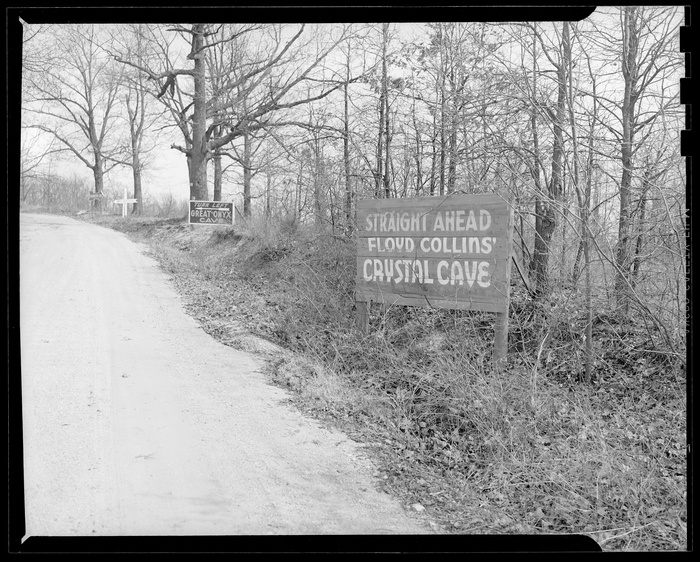 Soon the Collins family found themselves smack dab in the middle of the “Cave Wars” of the early 1920s, where Central Kentucky cave owners and explorers entered into a bitter competition to exploit the bounty of caves for commercial profit. Trouble was, Crystal Cave was the last cave on the road from Cave City. By the time tourists discovered it, they were out of money and interest. During the Cave War years, cave owners competed bitterly among each other in order to bring in visitors. The most common tactic was to deploy a man, referred to as a “capper”, who would suddenly rush out of the bushes, hop onto your car’s running board along the rugged road out to Mammoth to excitedly inform you that Mammoth had collapsed or was under quarantine from Consumption (now known as Tuberculosis) and would persuade you to visit their cave instead.
During the Cave Wars era, if someone finds an entrance to your cave on their property there was nothing to prevent them from exploiting that entrance and making money off of your find. So Floyd, who’s Crystal Cave was the back door entrance to Mammoth, was constantly on the lookout for an undiscovered “new front door” to Mammoth Cave. In the winter of 1925 Floyd decided to take a gamble on an overhanging sandstone ledge that contained a small, already known cave on the property of Bee Doyle. The site would be the first cave tourists would see on the road to Mammoth from Cave City. Collins and Doyle had agreed that, if a new entrance could be found, they would split the profits 50/50.
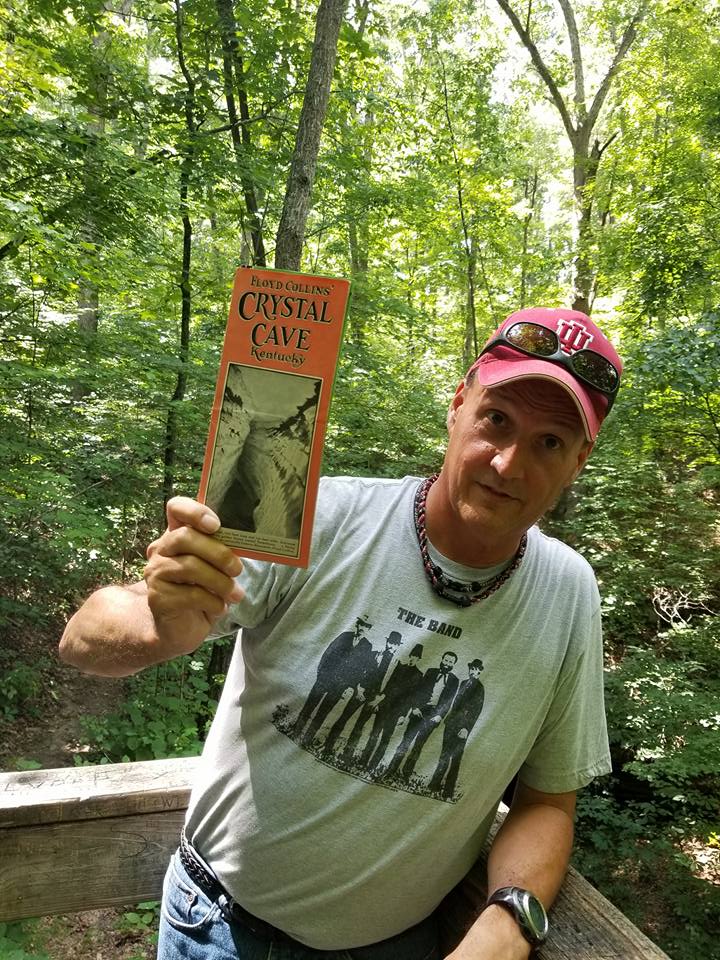
On January 30, 1925, true to form, ventured alone into “Sand Cave” in search of that new entrance. Floyd had known of this spot since his childhood days and had already done some preliminary work with a stick of dynamite to dislodge a couple of huge precariously perched boulders that guarded the entrance. The Sand Cave site is nestled in a wooded surrounding, hidden by sandstone ledges of overhanging rock, each sheltering a crescent-shaped spot. The constant dripping of water leeching through the sandstone keeps the moist soil cool and plantless. That day, Floyd, with rope and lantern, entered the tight, mud-lined passage alone and unnoticed. The 150 foot claustrophobic mud slick tube could only be slithered through in most spots, with little room to crawl, let alone sit up or stand. It was absolute darkness and the damp, rock-strewn passage turned, narrowed or switched back underneath itself, and at times, Floyd, unable to turn around, was forced to wriggle upside down to traverse its depths.

Floyd had been down this far before, having earlier removed some large stones and other obstructions that revealed a 10-foot-long chute so tight and steeply sloped, that Floyd knew he had to drop into it feet first for risk of being unable to push himself up and backward to a turnaround spot. Floyd dropped down the chute, where, at the bottom he worked his hobnailed boots into a narrow crevice, referred to as a “pinch” by cavers, met the chute horizontally at 90 degrees. Collins believed this spot to be the final secret link into a much larger cavern below, as he could feel the cave winds blow as he inched his feet farther into it. The coffin like crevice rose only about six inches above Floyd’s chest, tight on each side, and perhaps ten feet long before it opened onto a wide ledge overlooking a 60-foot drop.
 Floyd was encased under a 4′ x 4′ square, two ton block of solid limestone ceiling, the sidewalls of the tunnel were composed of loose stones, pebbles, sand and mud. Floyd was careful to avoid bumping or displacing anything likely to cause a collapse. Collins made it through, muddy, soaked and sweating, after leaving his securely attached rope for a future trip into the 60-foot precipice he had yet to see. He wriggled head first back into the tight gravelly crevice leading to the steep, serpentine chute he’d just come in by. Pushing the kerosene lantern ahead of him as far as he could, he would then twist and squirm, shrugging ahead inch by inch till reaching the lantern before repeating the pattern by pushing ahead. Suddenly, Floyd’s lantern fell over, broke and went out.
Normally, the cave-savvy Floyd would take it in stride, but this development was unnerving. On his way into the tight pinch Floyd had noticed a peculiar hanging stone and had been particularly careful not to disturb it. Now, while he “crawfished” backward in the dark, his knee dislodged the 27-pound rock which dropped, wedging his left foot into v-shaped groove in the floor of the passage like a guillotine. His progress halted, Floyd lay on his back, tilted to his left at a 45 degree angle, his arms pinned down to his sides, and a solid limestone block five inches above his face. With lime water dripping maddeningly onto his face, Floyd discovered that the more he struggled, the more loose stone and dirt settled around him. Soon he was frozen in place. Floyd Collins was trapped in a narrow crawlway, 55 feet underground, and to make matters worse, no one knew he was there.

Next Week- Part II- Floyd Collins-Legendary Spelunker
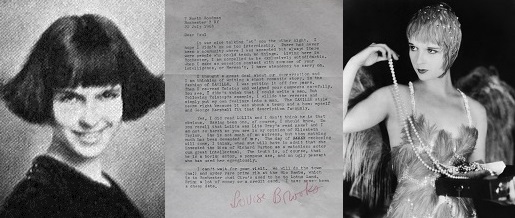
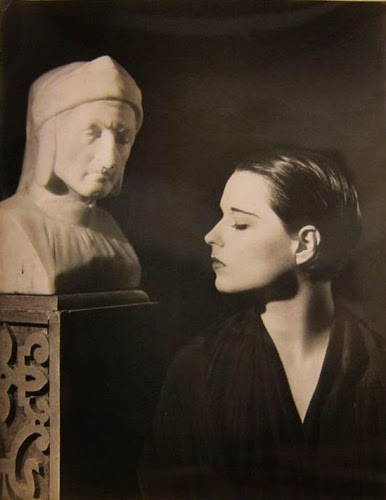

 Beginning in 1925, she starred in seventeen silent films and eight ‘talkies’ before retiring in 1938. She would forever be remembered as the iconic symbol of the flapper, and for popularizing the short ‘Bob’ haircut. Google Louise Brooks’ images and you will see why. In short, she was gorgeous at a time when classic Hollywood photographers were at their peak.
 Brooks began her career in 1922 as a dancer, joining the legendary Denishawn modern dance company in L.A., whose members included founders Ruth St. Denis and Ted Shawn, as well as a young Martha Graham. Her perceived closeness to Shawn (husband of Ruth St. Denis) got her booted from the troupe. Thanks to her friend Barbara Bennett (sister of Constance and Joan), Brooks almost immediately found employment as a chorus girl in George White’s Scandals and as a featured dancer in the Ziegfeld Follies. From there, her career caught fire.
 Despite French film historians proclaiming Brooks skill surpassing Marlene Dietrich and Greta Garbo as a film icon, she lived in relative obscurity for years in New York City and Rochester, N.Y. Despite her two marriages, she never had children, referring to herself as “Barren Brooks”. Her many lovers once included a young William S. Paley, the founder of CBS along with a veritable who’s who of Hollywood leading men and women.
 By her own admission, Brooks was a sexually liberated woman, not afraid to experiment, even posing fully nude for art photography in her golden years. Brooks enjoyed fostering speculation about her sexuality, cultivating friendships with lesbian and bisexual women. She admitted to some lesbian dalliances, including a one-night stand with Greta Garbo. She later described Garbo as masculine but a “charming and tender lover”.
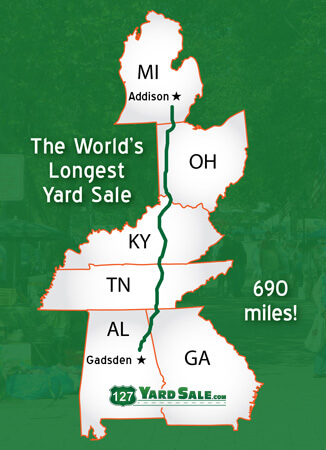
 It was during the second day of the trip where our little quartet found our most interesting finds along the route. While at a tent city near Grimsley, Tennessee we came upon a large group of dealers set up in a local park. On this 95 degree / 50 % humidity day (heat index 107), I found a rather refined looking group of Southern Belles strategically seated in a shady corner of their booth. Leaning against a post near them was a heavy steel sign from the Jack Kerouac Era California State Beaches that read: “Clothing Optional Beyond This Point”. My red-faced smirk must have betrayed me and the ladies giggled at my sheepish delight. I asked for the price and as I picked it up I realized that the sign had 2 bullet holes in the center of it. I had to have it! I forked over the cash equivalent of a St. Elmo’s dinner for two (with shrimp cocktails of course) to make it mine. The delightful owner said she had purchased the sign on “this very same field 8 years ago.”
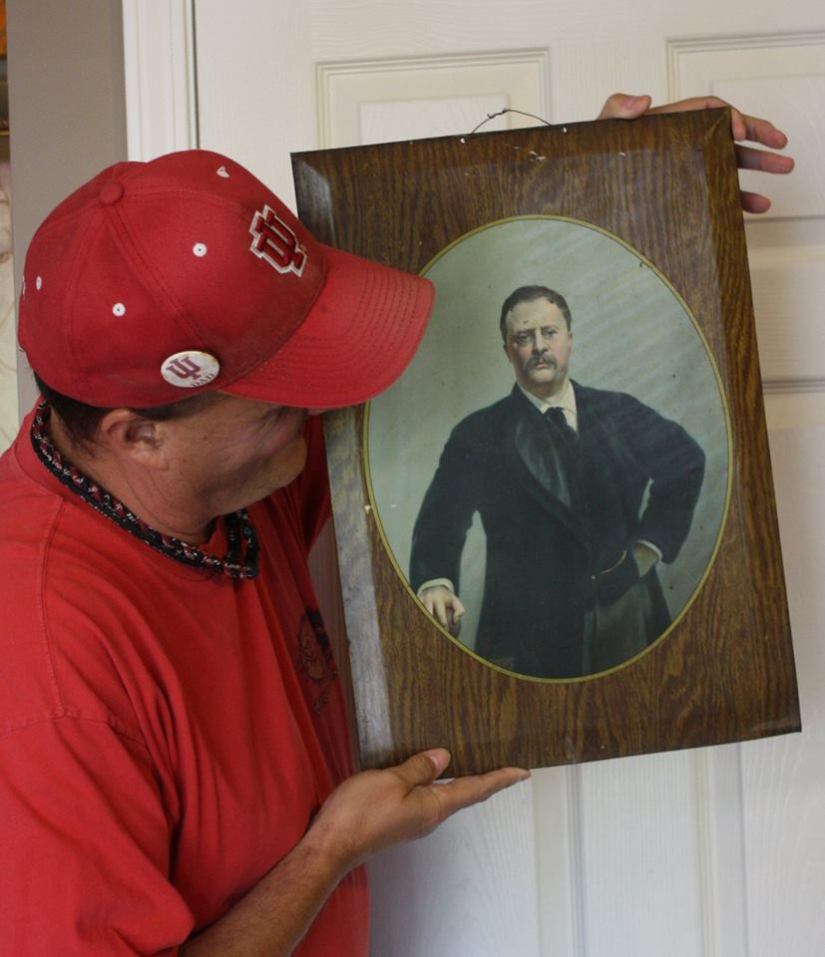
 Rhonda found a San Francisco Candlestick Park exit sign in the same booth from another lady and got a much better deal than I (about the cost of a McDonald’s Happy Meal.) A little further down the road, I found a beautiful Teddy Roosevelt metal color lithographed sign from 1903, a real stuffed alligator dressed as a sheriff complete with tiny cowboy hat and badge (please don’t judge me animal activists) and a wooden sign that had me puzzled at first. It was a large B&W direction arrow sign with the word “AWFISS” on the front. My traveling companion Chuck Hodson had to clue me in on the meaning. Apparently, “AWFISS” is slang for “Office” in the hill country. Sadly, it was not for sale.
 The last of the day’s finds was made by Chuck. It was a 12″ tall miniature prison electric chair complete with skull and crossbones in the back chair rest. “Beware Tennessee State Prison” and a 1956 year date were painted on the seat back. Constructed of wood, finish nails and leather straps, it was obviously made by an inmate back in the Ike Era. The Prison, located near downtown Nashville, opened in 1898 and closed in 1992. Hollywood movies Nashville, Ernest Goes to Jail, The Green Mile, and many more were filmed within it’s walls. I find myself strangely drawn to objects like these. I guess I love that type of gallows humor.

 Assuming you are starting South of Cincinnati, consider making hotel reservations in or around the Harrodsburg / Danville, Kentucky area for your first night’s stay. Not only will you be spending the night in historic Daniel Boone country, you’ll most likely find that, allowing for the frequent stops on your treasure hunt, you will have seen all you care to see by the time you reach this area. Go out and have a nice dinner and turn in early. If you are a people person, you’ll soon discover that most of your fellow hotel guests are coming off the sale as well. Many of them are eager to tell stories, share tips and show off their prized buys after a day of buying on the 127. Swapping tales about your shared struggle can be some of the best memories of all and are only rarely disappointing.
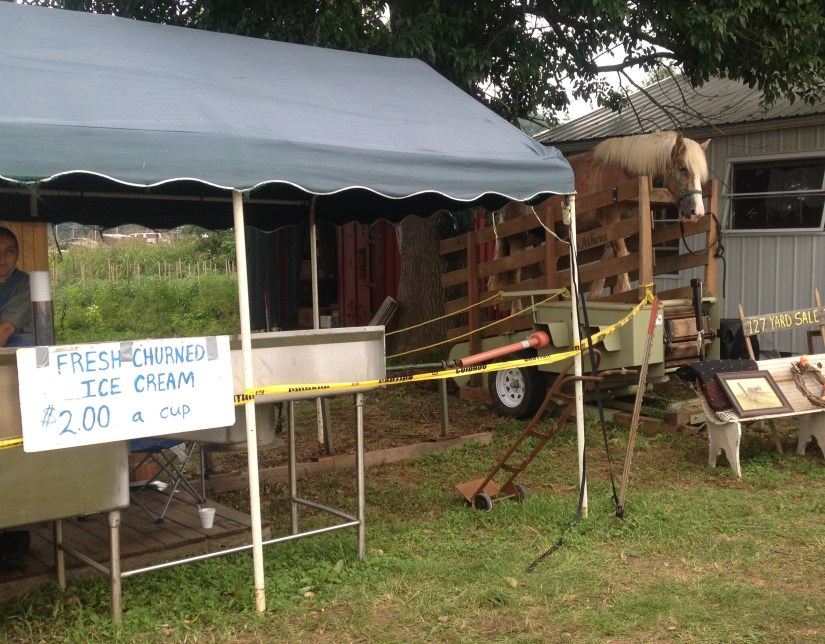
 Once you’re out on the road again, you’ll soon find that yard sales are EVERYWHERE! In the front yards of people’s homes, farm fields, cow pastures, side streets and alleyways, in empty lots, business parking lots, community parks, churches and town centers. Some areas will have large groups of vendors together (127 veterans call these ‘tent cities’), while others will be set up separately. As you weave your way from one yard sale to the next, Highway 127 winds through horse country surrounded by beautiful rural areas and interesting scenery, so be sure to enjoy the ride along the way.

 We started our trip on Wednesday, August 2nd south of Cincinnati. We allowed ourselves three days for the 127. We learned long ago that it would take at least five to hit every sale. We started out at nine in the morning and made it as far as Harrodsburg Kentucky that evening. Normally it would take 2 hours to drive the 120 mile route between the two locations. The next day, Thursday, August 3rd, we left around 8:30 AM and by 6 PM we had made it as far as Spring City Tennessee. This day’s route was 180 miles between locations. Normally this is a four hour trip without stops. By our third day, Friday, August 4th, between the crowds, the traffic and general fatigue, we had just about had our fill. By the time we had reached Chattanooga that afternoon, we were done.
 And what did we find on the world’s longest yard sale 2017 redux? Unlike years past, we really didn’t find anything fantastic for ourselves; we just found stuff. Don’t get me wrong, we found some cool things. We just didn’t find any life changers. My personal prize was a bronze statue of Gettysburg hero General Winfield Scott Hancock. It now rests on my desk. I found tons of old paper to play that I am still winding my way through. My favorite so far is a packet of letters written by a French woman to her soldier beau in Geneva Indiana in 1919 – 20 at the close of World War I. She pleads for news from her soldier boy and wonders why he doesn’t write. Poignant to say the least.
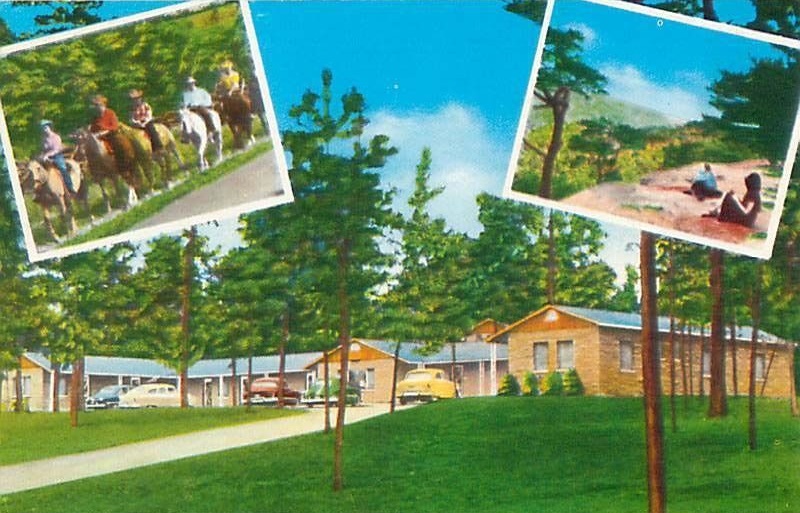
 My favorite memory comes from a gentleman I met at the Jordan Motel in Jamestown Tennessee. The motel is an important landmark on the 127 because this is the spot where the first booths were set up back in 1987 to start what would become the world’s longest yard sale. Jamestown is in the heart of Big South Fork Country which bills itself as the Trail Riding Capital of the Southeast. At first I was drawn to the booth by a large metal highway 70 sign leaning against a nearby tree. It was only 35 bucks but it wasn’t our I-70 so I passed. Let me rephrase that, Rhonda suggested I pass because I am apparently out of room for any more road signs.
 On this man’s table were a couple dirty squares of carpeting, each about 4″x4″ and each displayed in picture frames. Alongside the dingy relics were photographs of a scene that looked strangely familiar to me. It was a large hole inside a closed building that I soon recognized as the sinkhole that swallowed eight Corvettes at the National Corvette Museum in Bowling Green Kentucky around Valentine’s Day of 2014. I asked about them and was informed me that the vendor was the contractor hired to pull the cars out and repair the hole. He said, “In fact, I’m the guy that fired up that Corvette and drove it out. It didn’t have anything but an oil leak.” As he searched his cell phone to show me a video of the event as proof, he informed me that he was surprised the Corvette museum called him because, “I’m just a good old boy from Kentucky, I didn’t know thing about Corvettes or fixing sinkholes.” As Rhonda and I got back in the car and drove south, she asked me if I had asked him how much they were. Strangely, I hadn’t. I guess I was too caught up in the story.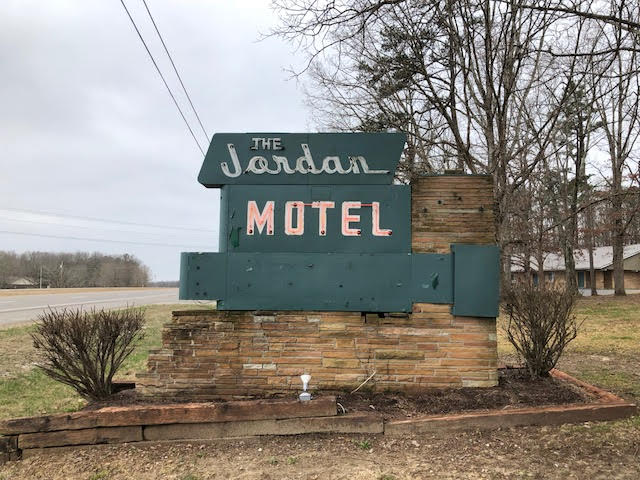
 Spring City Mayor Billy Ray Patton claims the town is one of the best places in the world to view the eclipse because it is located along the exact path the eclipse will travel. Spring City rests on the 70 mile wide “path of totality.” Residents and visitors will have two minutes and 39 seconds of totality when the moon completely blocks the view of the sun. The total solar eclipse will darken skies all the way from Oregon to South Carolina. But don’t get any ideas, the hotels in Spring City were already sold out two weeks ago. On Monday this small TVA town of 2000 is expected to swell to 50,000 with visitors hoping to catch a good view of the eclipse.
 Alan E. Hunter