

 Original publish date: October 20 2013
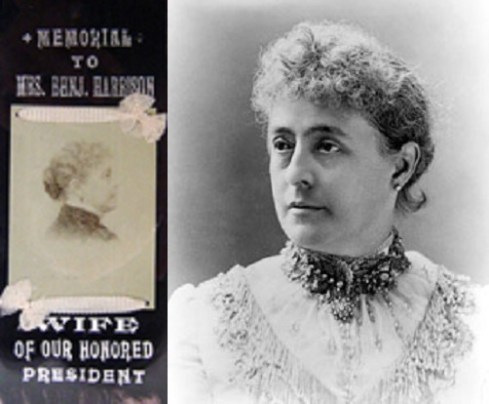
121 years ago this Friday, America lost it’s first lady, Benjamin Harrison lost a wife and two weeks later, he lost the Presidential election. Caroline Scott and Benjamin Harrison were married on October 20, 1853. The newlyweds lived at the Harrison family home at North Bend, Ohio for the first year until Benjamin completed his law studies aand they moved to Indianapolis and set up his first practice.
During the first few years of their marriage, the couple rarely spent time together, as Benjamin worked to establish his law practice and became active in fraternal organizations to help build a network. In 1854, their first child Russell Benjamin Harrison was born. Not long after, a fire destroyed the Harrison home and all their belongings. Benjamin took a job handling cases for a local law firm and the family managed to recover financially. In 1858, Caroline gave birth to Mary Scott Harrison. In 1861 she gave birth to a second daughter, who died soon after birth.
While Benjamin Harrison’s star rose rapidly in his profession, Caroline cared for their children and was active in the First Presbyterian Church and Indianapolis orphans’ home. Benjamin’s long hours at the law office and his pursuit of a living drove a wedge between the young couple and although Caroline did not complain, the strain showed.
At the onset of the Civil War, both Harrisons sought to help in the war effort. Caroline joined Indianapolis groups that raised money for supplies to help care for wounded soldiers. In 1862, when President Abraham Lincoln issued a call for more troops, Benjamin recruited a regiment of over 1,000 men from Indiana. When the regiment left to join the Union Army at Louisville, Kentucky, Harrison was promoted to the rank of colonel, and his regiment was commissioned as the 70th Indiana Infantry.
In May 1864, the 70th Indiana regiment joined General William Tecumseh Sherman’s Atlanta Campaign and moved to the front lines, and Harrison was promoted to command the 1st Brigade of the 1st Division of the XX Corps. Harrison’s brigade participated in the brutal Battle of Nashville in December 1864, considered by historians to be the “Gettysburg of the West”. On March 22, 1865, Harrison earned a promotion to the rank of brigadier general.
The horrors of the Civil War taught General Harrison what was really important in his life and the tone of his letters to Caroline during the war are filled with a deep passionate tone. When he returned home, she would never again reproach him for neglect. His law practice and his fame grew, and he became a political force.
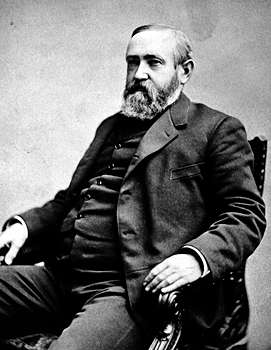 After the war, Benjamin Harrison spent the next decade practicing law and getting involved in politics. He ran for governor of Indiana in 1876, but lost. The Harrison home on North Delaware Street was built in 1874-75, and soon became a center of political activity. Her husband’s election to the Senate in 1880 brought Caroline to Washington, DC, but a serious fall on an icy sidewalk that year undermined her health. In 1883, she had surgery in New York that required a lengthy period of recovery. She had also suffered from respiratory problems since a bout with pneumonia in her youth, and did not participate much in Washington’s winter social season.
In the fall of 1887 Harrison was nominated for President by the Republican Party. In the campaign, Caroline was a definite asset. Her natural charm and open manner offset her husband’s chilly reserve (He often wore gloves to protect him from infection from others, and it bothered him to shake the hands of White House visitors), and the press loved her. In November 1888, Harrison defeated the incumbent Grover Cleveland.
Caroline Harrison was 56 years old when she became first lady. Historians regard her as one of our most underrated First Ladies who, in contrast to her husband’s conservative policies, was earnestly devoted to women’s rights. She became known for her many “firsts” as First Lady. Caroline was the first first lady to deliver a speech she had written herself after she became the first president of the Daughters of the American Revolution.
Caroline’s sister died in early December 1889 at the executive mansion and Mrs. Harrison decided to have the funeral in the east room of the White House. It would be the first funeral in that room since Abraham Lincoln in 1865. In spite of the family tragedy, Caroline went ahead with her plans to raise the first Christmas tree in the White House that same month. She had John Phillip Sousa and the Marine Band play and, for the first time since Sarah Polk was First Lady, there was dancing in the White House.
Perhaps her biggest first came when she had electricity installed in the White House, even though she was terrified by the new technology. Seems that President Benjamin Harrison received a shock from an Edison dc current light switch, after which his family feared touching the switches. Mrs Harrison rarely operated the light switches herself, choosing instead to sleep with the lights on when neither she nor her husband were willing to touch them for fear of electrocution. Servants were often made to turn the lights on and off for the Harrison family.
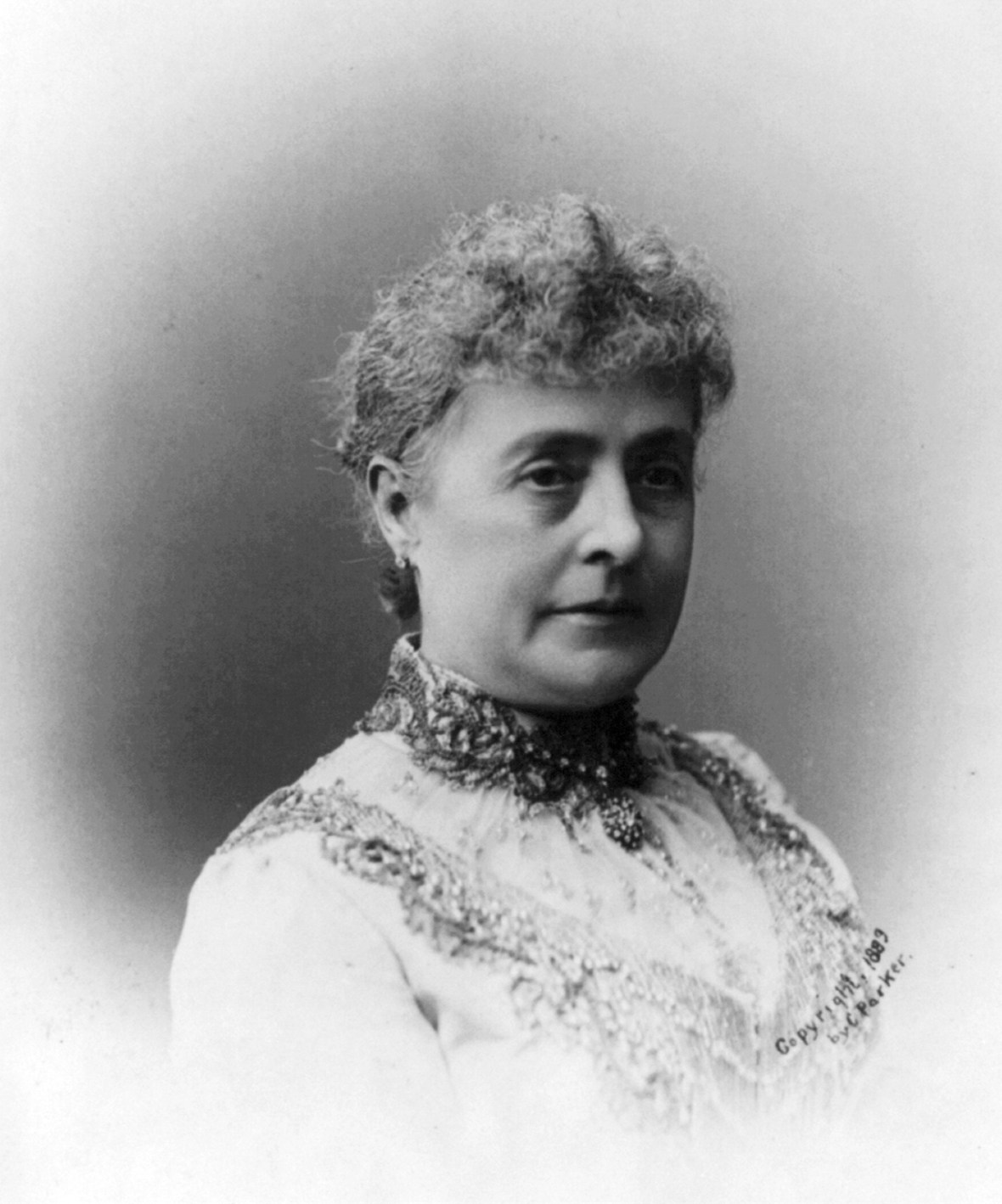 The First Lady was noted for her elegant White House receptions and dinners, but she is most remembered for her efforts to refurbish the dilapidated White House. She was horrified at the filth and clutter and thought the White House was beneath the dignity of the Presidency, describing it as “rat-infested and filthy.” She brought in ferrets to eat the rats, and lobbied to have the White House torn down and replaced with a more regal Executive Mansion. Instead the old building was refurbished from basement to attic, including a new heating system and a second bathroom. The old, sagging worn-out floors were replaced.
She hated the crowded living area and the tourists made it impossible to use the first floor. In 1889 Caroline Harrison found fault with the “circus atmosphere” in the mansion when she found visitors wandering uninvited into the family quarters. Harrison complained about the lack of privacy on the White House grounds, saying, “The White House is an office and a home combined. An evil combination.” She was the first to suggest the addition of office space to the Executive Mansion when she made up very detailed plans to add an East and a West Wing so that the original mansion could be used for entertaining and the family’s living area. Caroline Harrison’s plan was the first to move the office spaces out of the house.
As she worked to remodel the White House, Caroline was careful to inventory the contents of every room. She cataloged the mansion’s furniture, pictures and decorative objects, working to preserve those that had historical value. Caroline unearthed the chinaware of former presidential administrations found hidden away in closets and unused attic and basement spaces. She personally cleaned, repaired and identified which pieces belonged to which past President. She used their items to create a popular museum display case that remains in the White House to this day.
Artistically talented, Caroline taught classes in painting to anyone who wanted to learn and became the first First Lady to design her own White House china. She wanted new china that would be “symbolic and meaningful to Americans.” The first lady placed the Coat of Arms of the United States in the center ringed by a goldenrod and corn motif etched in gold around a wide outer band of blue. The corn represents Mrs. Harrison’s home state of Indiana and 44 stars, one for each state in the Union at the time, made up the inner border.
In the winter of 1891-1892 while she tried to fulfill her social obligations, Mrs.Harrison was frequently ill with bouts of bronchial infections. In March of 1892 she developed catarrhal pneumonia, followed by hemorrhaging of the lungs and was moved to a three-bedroom cottage on Loon Lake in the Adirondack Mountains in July. Following a brief rally, her doctors diagnosed her condition as tuberculosis, which at the time had no known cure or treatment other than rest and good nutrition. Although she briefly recovered at the mountain retreat, she suffered a setback in September and asked to be returned to the White House.
On September 20, she returned to her favorite pale green and silver bedroom in the White House. It was sometimes used as a music room, furnished in pale green plush. One account states that Mrs. Harrison’s bedroom was: “Daintily appointed in pale green and silver, it stands just as Mrs. Harrison left it, and like the rest of the beautified White House, is a memorial to her refined and artistic taste.” Caroline must have been fond of the pale green palate as many of the multi-colored fabric pieces are done in green tones.
Caroline did not live to see her husband’s defeat for a second term as President. On October 25, 1892, Caroline died at the age of sixty of Typhoid fever. It was an election year, and out of respect for the president’s lady, after her death neither Harrison nor Cleveland actively campaigned for the presidency. Two weeks following her death, Harrison lost his bid for reelection. Daughter Mary Harrison McKee was already living at the White House with her family, and she took up the responsibilities of first lady for the last few months of Harrison’s term.
After private services were held in the East Room, the family brought her back to Indianapolis for interment. An official funeral service was held at the First Presbyterian Church. After the service, the cortege proceeded past the Harrison’s Delaware Street home before going on to Crown Hill Cemetery for burial.
Caroline Harrison’s legacy has proved to be historically important. The current architectural plan of the White House, in particular the East and West Wing, reflects the plan suggested by her in 1889, and the White House china room is certainly a testament to her historical sensitivity in rescuing, repairing and identifying artifacts from previous administrations. Caroline Harrison was not able to use the china she had ordered. She died before it was delivered. It arrived at the White House in December of 1892.
You can honor Caroline Harrison’s memory with a visit to the Benjamin Harrison Presidential Site at 1230 North Delaware Street. The home offers tours daily. Another option, perhaps more consistent with the season, would be to visit her final resting place at Crown Hill Cemetery at 3402 Boulevard Place. Tour Guide and historian Tom Davis will be reprising his popular “Skeletons in the closet” tours (there are 2 different) on October 24, 25, 26 and November 2. Check their web site for specifics. Although I don’t think Caroline’s gravesite is particularly featured on Tom’s tours, I’m pretty sure he’ll take you there if you were to ask him. After all, Tom knows where all the bodies are buried.
 Original publish date: August 18, 2013
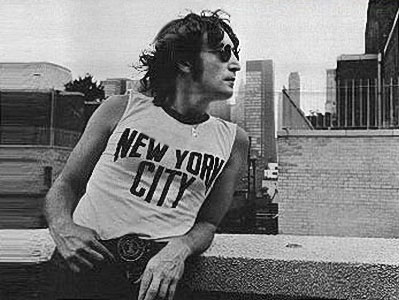
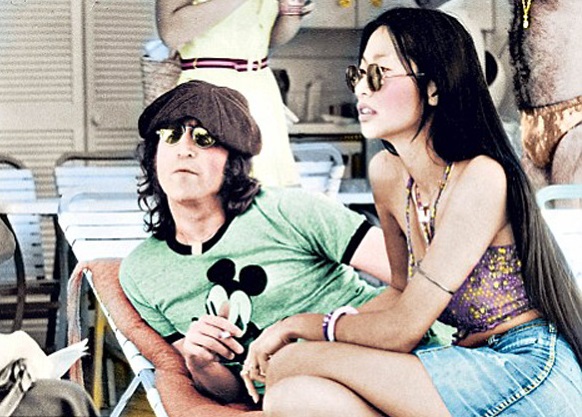 That August night began no differently from any other evening for John and May. John made and received phone calls, watched TV and listened to the day’s recorded studio work while making notes. The 52nd Street apartment was hot that night, but by 8 O’ Clock the air had cooled off enough for May to turn off the air conditioner and open the windows to catch the breeze coming off the river. Just a few feet off the apartment’s living room was the building’s roof, accessible through a side window. This rooftop acted as the couple’s private observation deck, offering a million dollar view of New York’s Eastside. The haze had now cleared over the cityscape and around 8:30 p.m., May decided to take a shower, leaving Lennon alone in the living room reviewing mock-ups of his new record’s cover. The cover art on the final product would be a painting by a 12-year-old John Lennon.
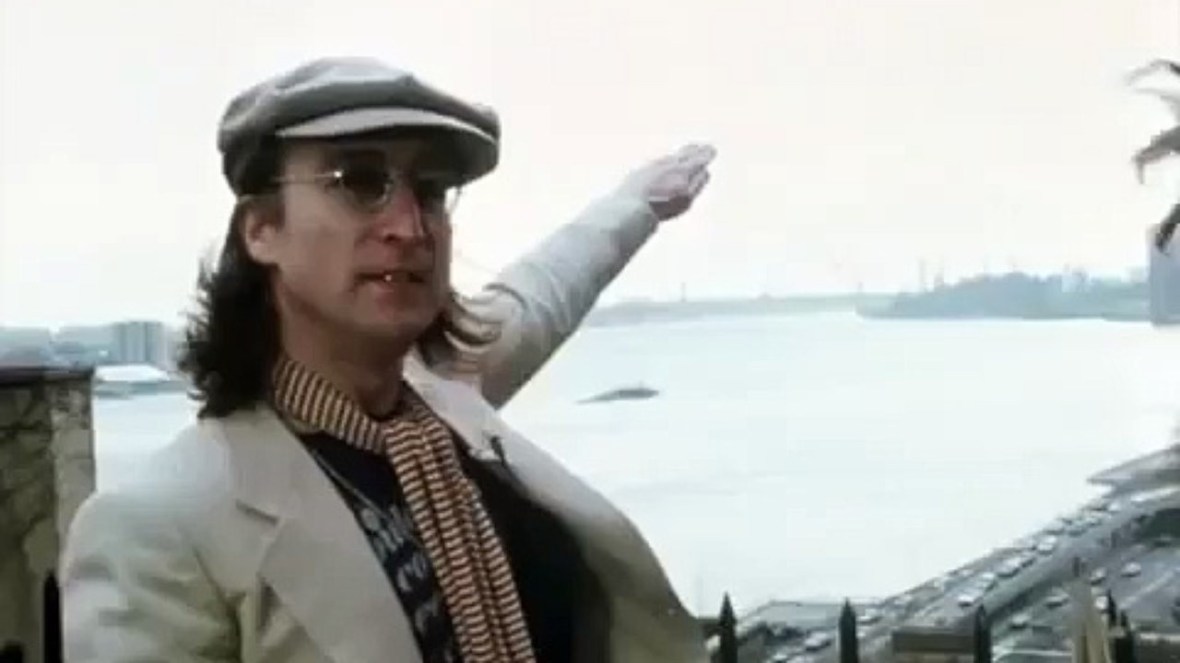 Bob Gruen arrived and John excitedly told the photographer what had transpired. Gruen later recalled “I took the film home and put John’s roll between two rolls of film I’d taken earlier that day and developed them”. “My two rolls of film came out perfectly but John’s roll was blank. Later I asked him ” did you call the newspaper?” and he said “I’m not going to call up the newspaper and say, This is John Lennon and I saw a flying saucer last night”… So Bob Gruen called up the local police precinct and asked if anyone had reported a UFO or flying saucer. The police responded with “Where? Up on the East Side? You’re the third call on it”. Then Bob called the Daily News and they said, “On the East Side? Five people reported it”. Finally, Gruen called the ultra-conservative New York Times and asked a reporter if anybody had reported a flying saucer? The reporter hung up on him.
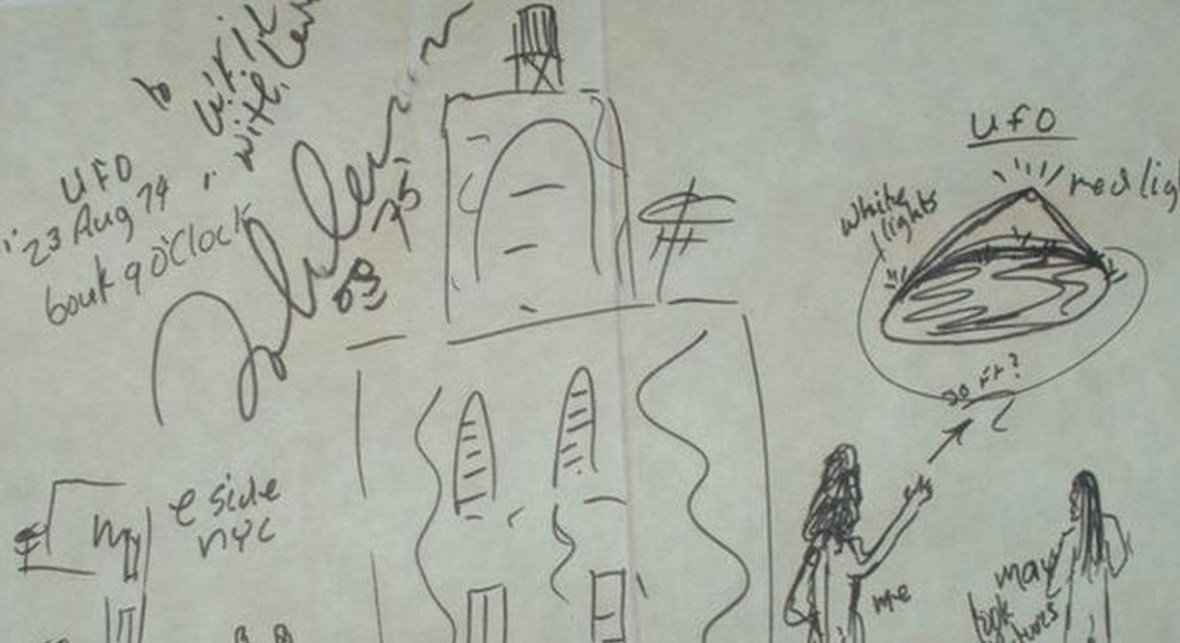 Hand drawn, autographed UFO sketch by John Lennon.
 Original publish date: December 7, 2013
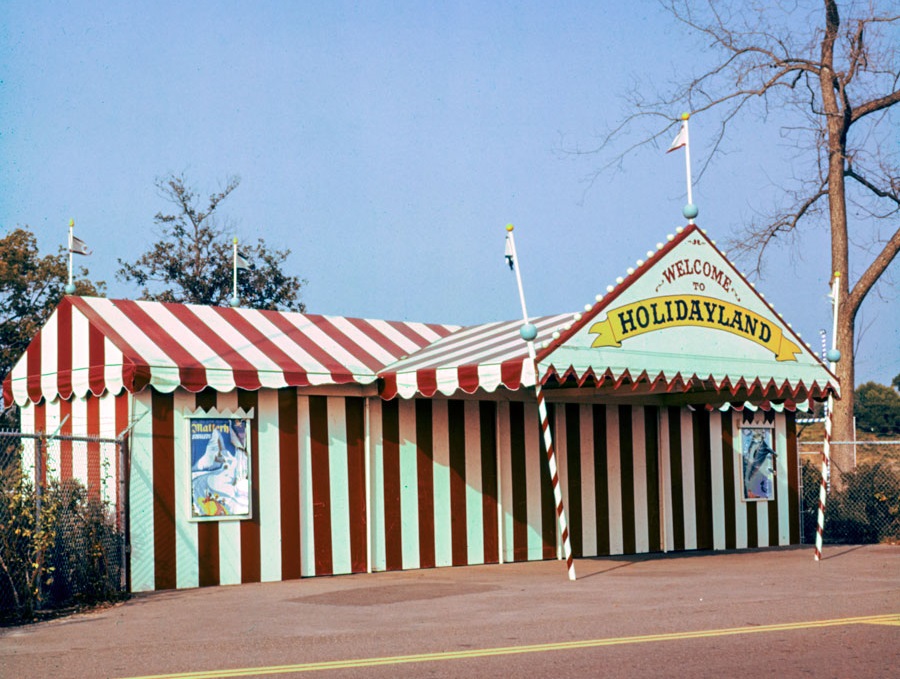 Holidayland had its own admission gate into Disneyland and could hold up to 7,000 guests for large events. It featured playgrounds, horseshoes, a baseball diamond, volleyball courts and other activities. The centerpiece was billed as “the world’s largest candy-striped circus tent” which had previously been used by the short-lived.Mickey Mouse Club Circus and Keller’s Jungle Killers attractions inside the original Disneyland theme park. Food and concessions were available for purchase in Holidayland including beer, which was not available inside the gates of Disneyland.
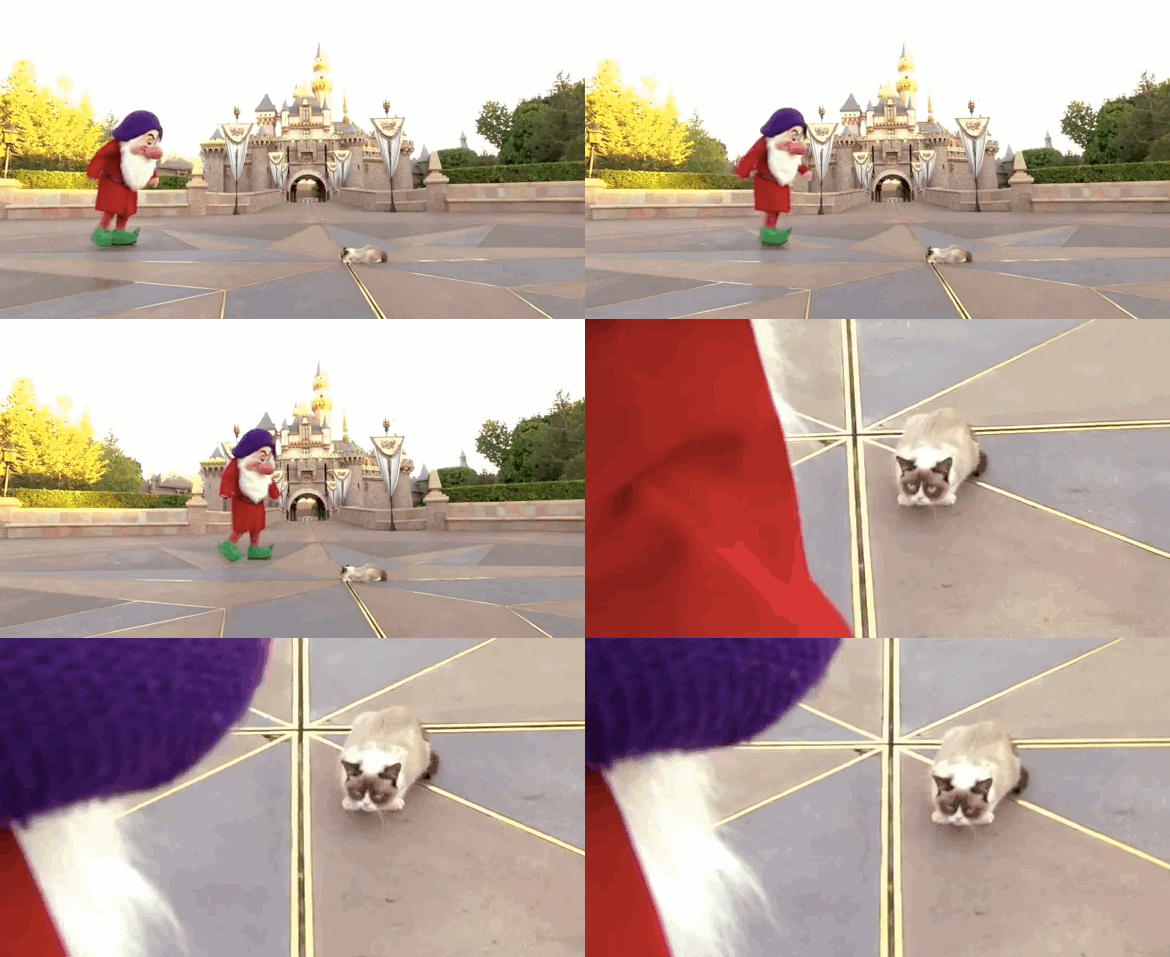
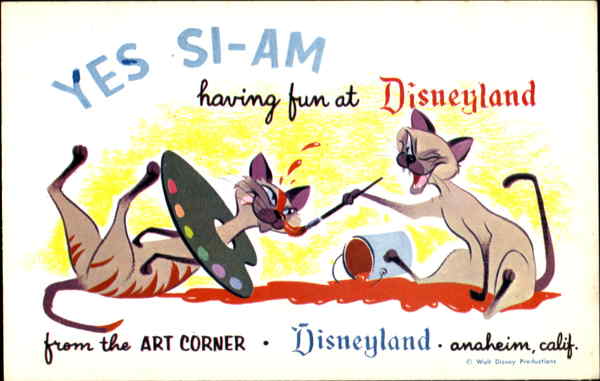
 At first, the cats were considered to be a bit of a nuisance and a possible threat to the guests. Attempts to control, cajole or coax the cats proved futile. After all, these were non-paying guests and Uncle Walt was simply not going to stand for that. So, rather than try to evict them, Disneyland decided to employ them. Soon, the cats became an integral part of the park’s everyday operations.
 Just as the feral cats of Disneyland have their own specific job, every nighttime worker has his own specific task. Three workers are responsible solely for repairing and replacing the 800 umbrellas, 25,000 chairs and about 7,000 tables in the restaurants and snack bars in Disneyland and neighboring California Adventure Park. Four certified divers collect submerged trash and make repairs on water attractions like Finding Nemo and the Jungle Cruise. The work can often be tedious and occasionally bizarre.
 Original publish date: March 20, 2014
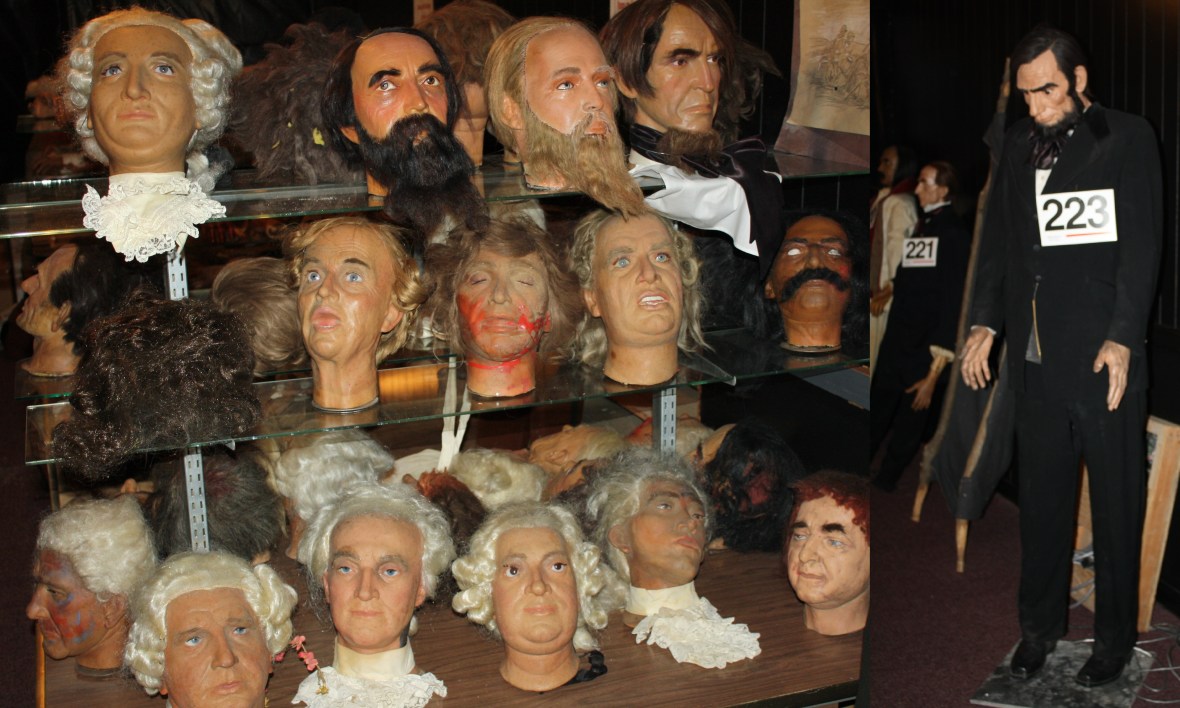
 On Saturday, March 15th the museum’s contents were sold to the public at auction. The sale included 95 Civil War wax figures and the accouterments used to illustrate each scene. In it’s half century of service the museum saw over 8 million visitors walk through the turnstiles, now lot # 265 in this very special auction.
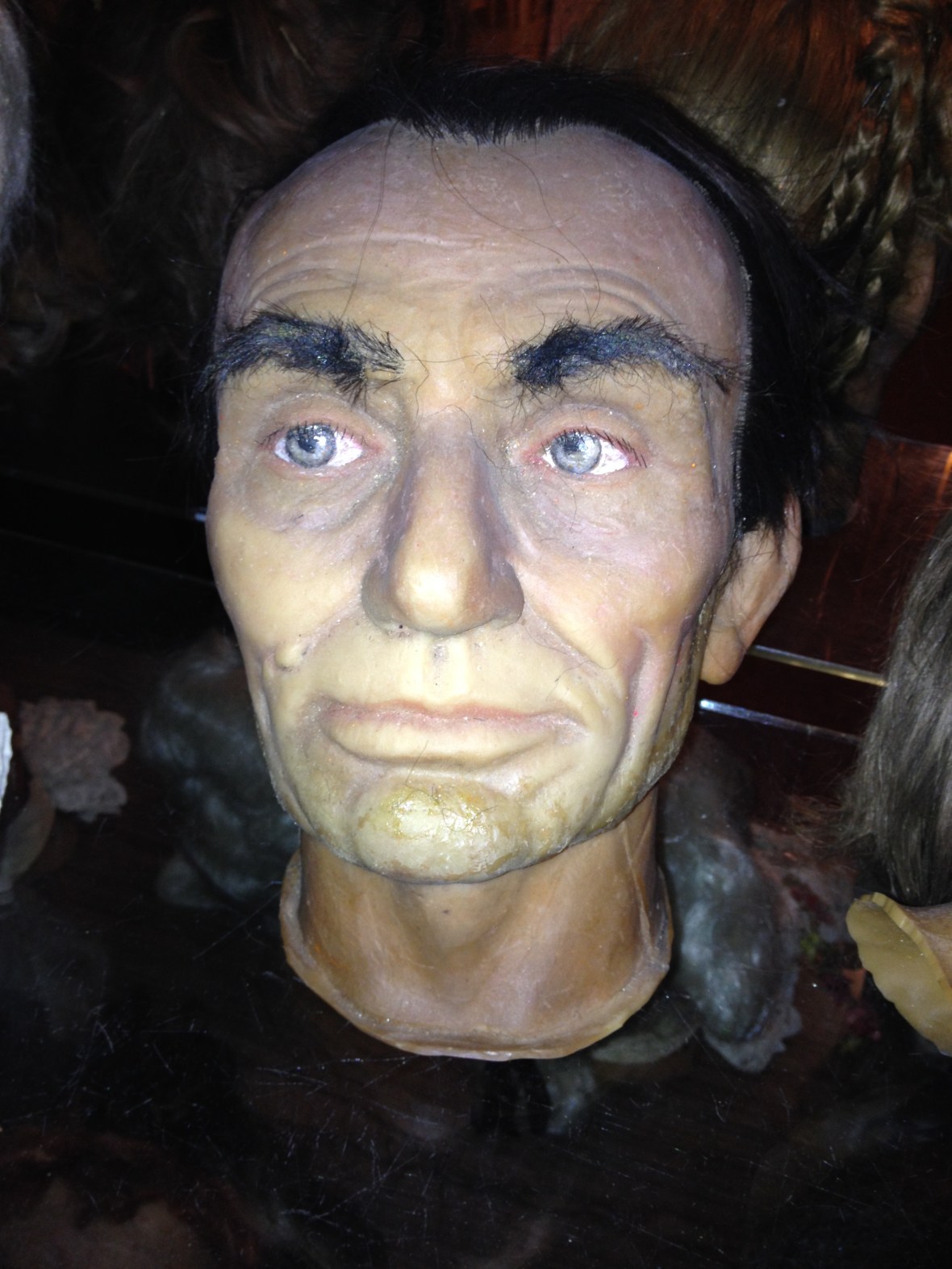
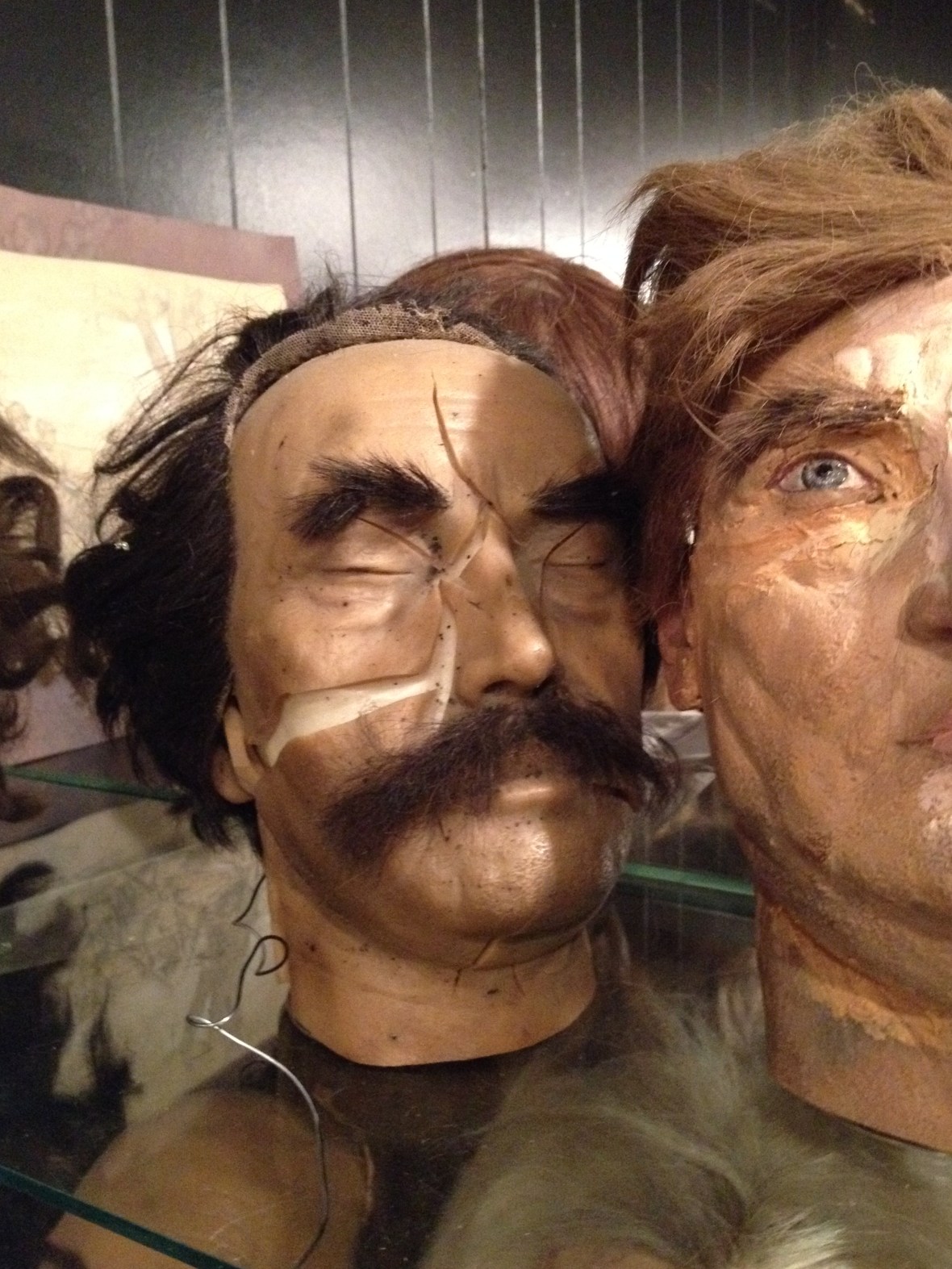
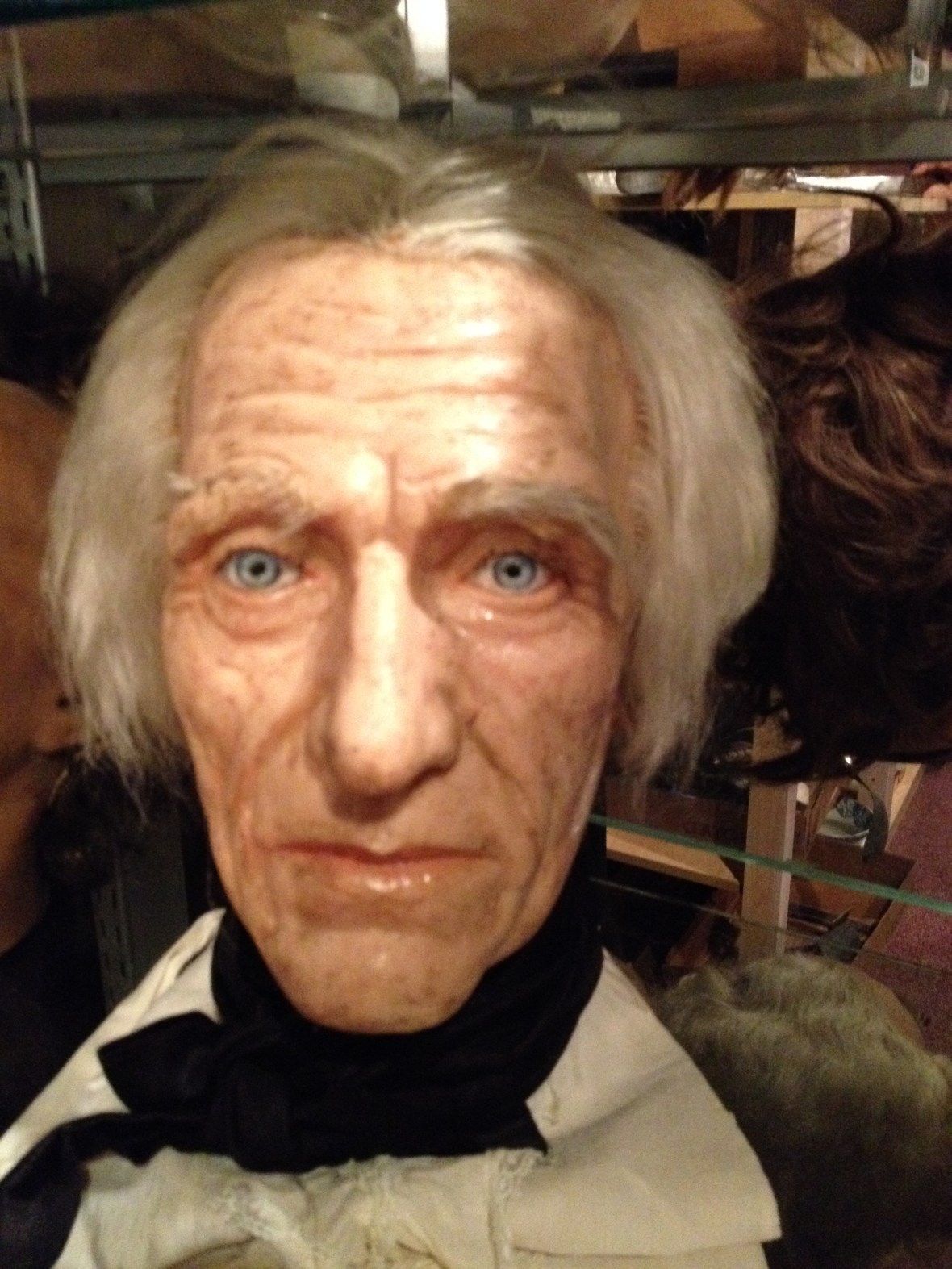 As I finished perusing the auction lots, I halted at an area tucked away in a back corner of the hall. This dimly lit crook featured tiered shelves upon which rested approximately 40 disembodied heads. Some of the heads were recognizable to me; Abraham Lincoln, Andrew Jackson. On a shelf nearby lay a pile of arms, legs and hands. Some of these body parts, in keeping with the brutality of the Civil War, were spattered with blood stains. Seeing these, I turned to my wife and said “Now these have the potential to go sky high.”
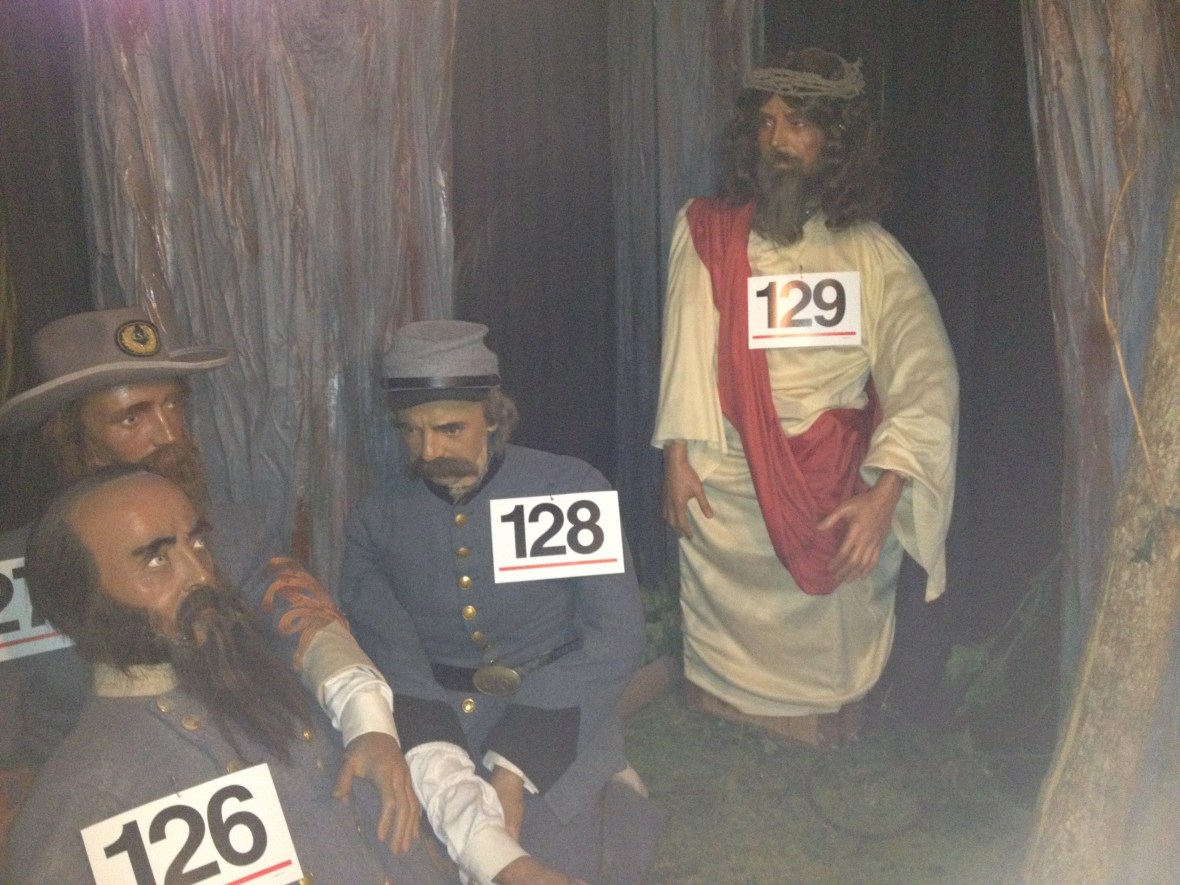 The synchronicity of the moment was not lost on me as, outside just yards away, bulldozers busily cleared out the massive football field sized blacktop parking lot. It had once served the old visitor’s center (torn down in 2008) and Cyclorama building, built the same year as the wax museum and torn down in March 2013. In the past 25 years I watched as other tourist landmarks disappeared from the borough including the Lincoln Room Museum, The National Tower, and now, the Wax Museum.
 Undoubtedly the happiest person in the room that day was a young woman named Kim Yates. She was hard to miss. Towards the end of the auction she bid on, and won, the last wax figure in the catalog. Suddenly, the previously sedate young lady began to scream wildly and jump around the room. One of the ringmen sidled over to me, after noting the look of obvious surprise on my face, and whispered, “She’s never bid in an auction before.”
 Original publish date: July 14, 2010
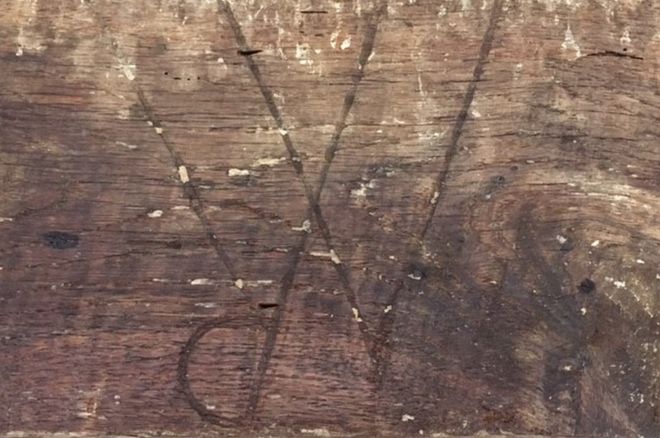
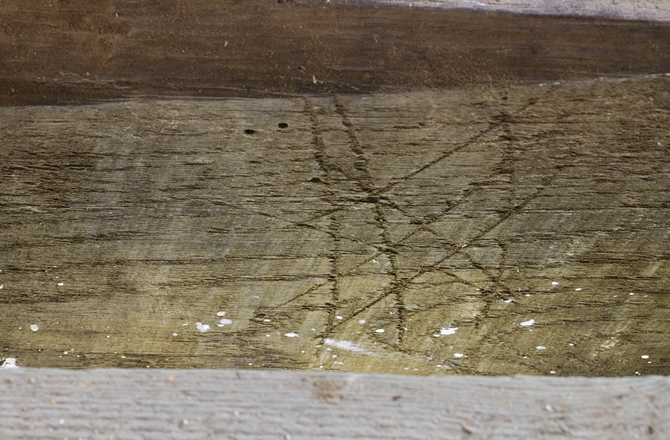 He was watching a documentary about witches and soon a segment flashed across the screen that told about the superstitious markings made by ancient people used to ward off witchcraft. The program talked about an English estate called “Kew Palace”, built in 1631. The owners were particularly superstitious, and believed that evil influences or witches could enter the house disguised as cats or frogs and cast spells on people while they slept. To ward this off, the original carpenters who made the roof carved special secret signs near windows, doors, fireplaces and other vulnerable places, to protect themselves from evil. ( Other ways of protecting a house included hiding old shoes, mummified cats and kittens under the floorboards, or ‘urine bottles’ filled with hair and nail-clippings in special, secret cavities.)
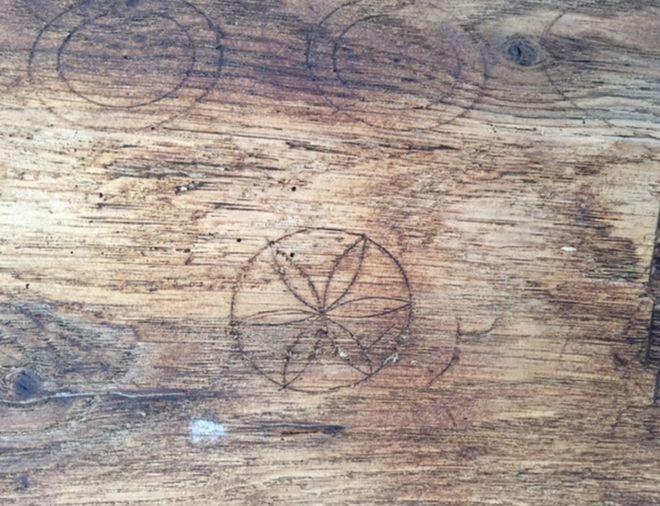 Rick has no idea where the panel originally came from but he suspects that the symbols were cut into the item by the resident family before being affixed as a softening decoration to an ancient stone wall. That way the marks would be unseen by the casual observer, presumed witch or evil spirit, but still provide protection for the family at the same time. Rick quickly discovered that there has been little formal study of these “witches signs” and historians have offered little support to his theories, choosing instead to dismiss them as silly superstitions.
