


Original publish date: August 1, 2019
Hannibal, Missouri is an easy 1 1/2 hour drive west of Springfield, Illinois. Rhonda and I stayed at the Wyndham Best Western on the river, located downtown. The hotel is clean and convenient, the staff is friendly, but it may be a bit dated for some people’s taste. If you’re a baby boomer, you’ll recognize the style. Indoor pool, large foyer with ample seating, rattan wallpaper, sliding glass door closets and lightswitches on the outside of the bathrooms. The kind of place that was once considered the swankiest address in town back when Don Knotts, Debbie Reynolds and castoffs from “The Love Boat” might stay while starring in traveling dinner theatre productions. Personally, we loved it because of it was within easy walking distance of the Mississippi River, Mark Twain’s childhood home and historic downtown. Not to mention, Rhonda loved the free chocolate chip cookies, which were hot, soft and plentiful.
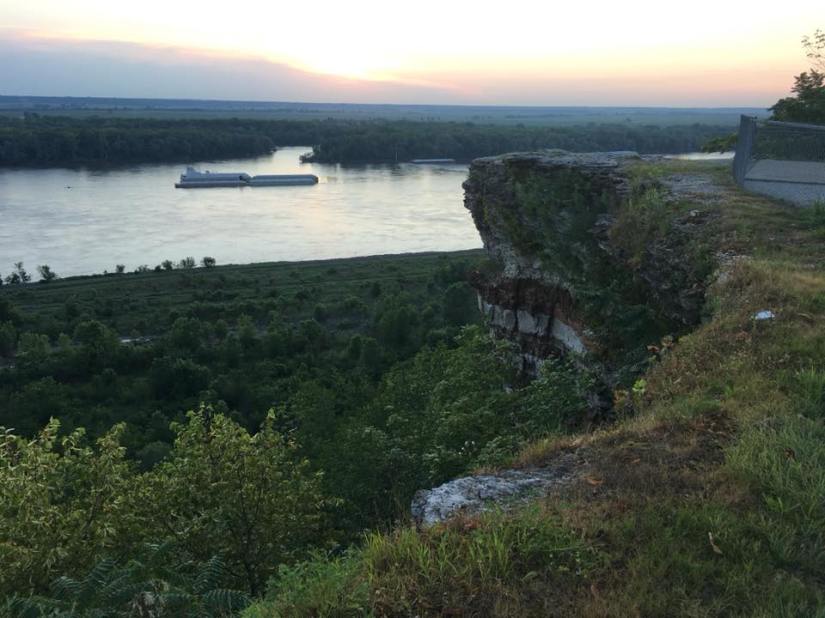
 I wasn’t quite sure what to expect with Hannibal and arrived there hoping to chase Mark Twain’s shadow the same as I had done with Lincoln in Springfield. The town rests in a valley between two large cliffs directly on the Mississippi River. A lighthouse rests atop one cliff and a romantic, jagged crest known as “Lover’s Leap” rests atop the other. While beautiful to look at, the result for today’s visitors is terrible cell phone reception. That is unless you find yourself on top of one of those cliffs, where service zips right along. And, just like the land of Lincoln, Mark Twain casts a large shadow in Hannibal, Missouri.
Located directly across from the hotel is the Mark Twain Diner, famous for its fried chicken and homemade root beer. In fact, the building is crowned by a gigantic root beer stein that spins slowly in the sky beckoning travelers to come in and sample a frosty mug. Also located one street over are the homes of Tom Sawyer, Becky Thatcher and Huck Finn. Although literary characters, all are based on real people from Twain’s childhood. The street, open only to foot traffic, slopes down to the Mississippi River. It is easy to envision what this little stretch of cobblestone road must have looked like in the 1840s when the author and his family lived here.

In one of the more brilliant uses of tourist object marketing that I have ever seen, outside of the Tom Sawyer house is the famous white picket fence which the young rascal tricked his naïve young friends into painting for him. Bolted to the sidewalk in front of the fence is an old-fashioned wooden bucket containing large wooden paintbrushes tethered by wire ropes to the bottom of the bucket. By my observation, these props are irresistible to every passerby who encounters it. The urge to pick up a brush and pose for a picture is too perfect to pass up. While there, I saw many cars pull up on the street below, jump out for a “pretend paint” picture and jump right back into their car before heading on down the road. This was their chosen Tom Sawyer memory.
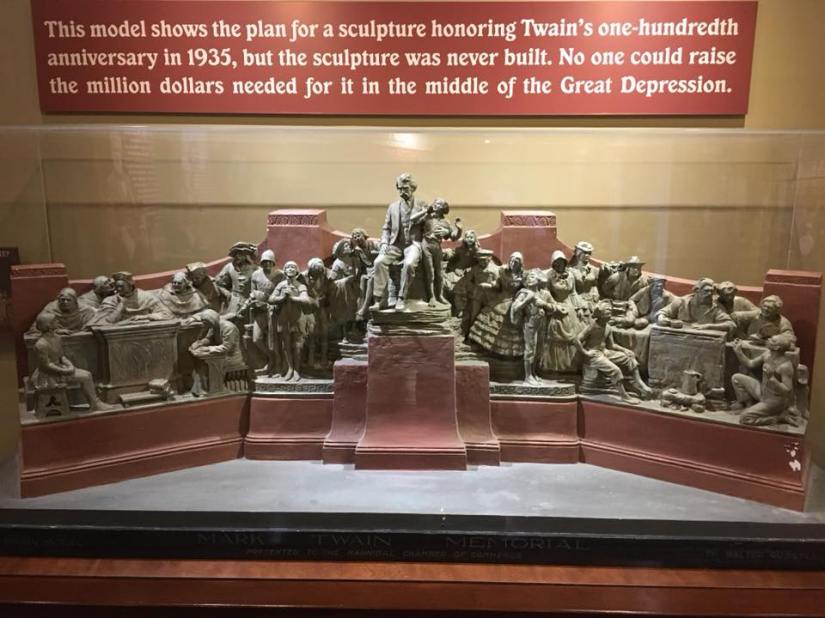 The Mark Twain House offers an excellent tour for a reasonable $12 per person that encompasses the homes of all of those familiar Tom Sawyer characters found in Mark Twain’s books. The tour concludes in the Mark Twain Museum located in the historic downtown district and features priceless relics, mementos, artwork, furniture and assorted objects once owned by and associated with Samuel Clemens (aka Mark Twain). After the tour, it is highly recommended that you take the short walk down to the shore of the Mississippi River.
I ventured down to the Big Muddy to skip stones across this legendary river that I daydreamed about as a child. Little did I know that our trip came a mere two weeks after a devastating flood visited Hannibal, destroying much of the riverfront. The backhoes were in place and temporarily idled from their duties of plowing out mud and repairing the riprap. If ever I saw tired looking machines, these were it. However, their presence offered me a unique opportunity. As part of their operation, the machines clawed up about 8 to 12 inches of topsoil in an area that was once home to a Gilded Age amusement park. The result was the accidental unearthing of ancient ink wells, medicine bottles, insulators, crockery and broken china that now rested like ancient talismans there for cultivating.

 Suddenly I was a 10-year-old boy joyfully picking up bits of glass, rusted metal and broken crockery all the while convincing myself that any one of which surely belonged to a steamboat captain, riverboat gambler or a pirate. Such are the trinkets that dreams are made of. Should you prefer your treasure of a more cultivated nature, Hannibal has many hole-in-the-wall antique shops featuring more relics from the past. Hannibal is unique among tourist river towns because it has not yet been overtaken by commercialized establishment chain restaurants or stores. Its streets are not overrun by the Harley crowd. Oh, there is an upper-class motorcycle crowd element here, but these riders seem content to park their bikes and walk the town rather than to ride it.
Most importantly, Hannibal, Missouri is home to some of the friendliest people I have ever met. I was met with a friendly greeting by nearly every person I encountered, whether on the street or in a shop. While visiting one such antique shop called “Savannah’s” on Main Street, a wicked storm moved into town. Moments after we completed our purchase, the storm blew in and the power went out. Our hotel was over a mile away and we were on foot.
Rhonda & I exited the shop, which luckily had a recessed doorway covered by a large tarp to keep us dry and out of the wind. We watched and waited for some 20 minutes to see if the storm would blow over; it didn’t. Rivulets of water filled the street while sizable metal flower stands blew down the darkened roadway like tumbleweeds. When it was apparent that the storm was not going away, the shop’s attendant, a woman named Phyllis who had been checking on us every 5 minutes or so, opened the door and said, “Come on you two sugar babies, I’m driving you back to your hotel.” Turns out that our guardian angel was a retired teacher with over 30 years experience, many of those years teaching special needs students. No wonder, she was our angel.
The next morning, while again scrounging for more waterfront treasures, I met a friendly local who educated me about life on the river, barges and bridges, giving me a general outline of what I was looking at and for. He explained that these floods come about every 10 – 15 years and some are worse than others. Seeing that I was a cigar smoker, he suggested that I go halfway up the cliff where the lighthouse rests for a perfect perch.
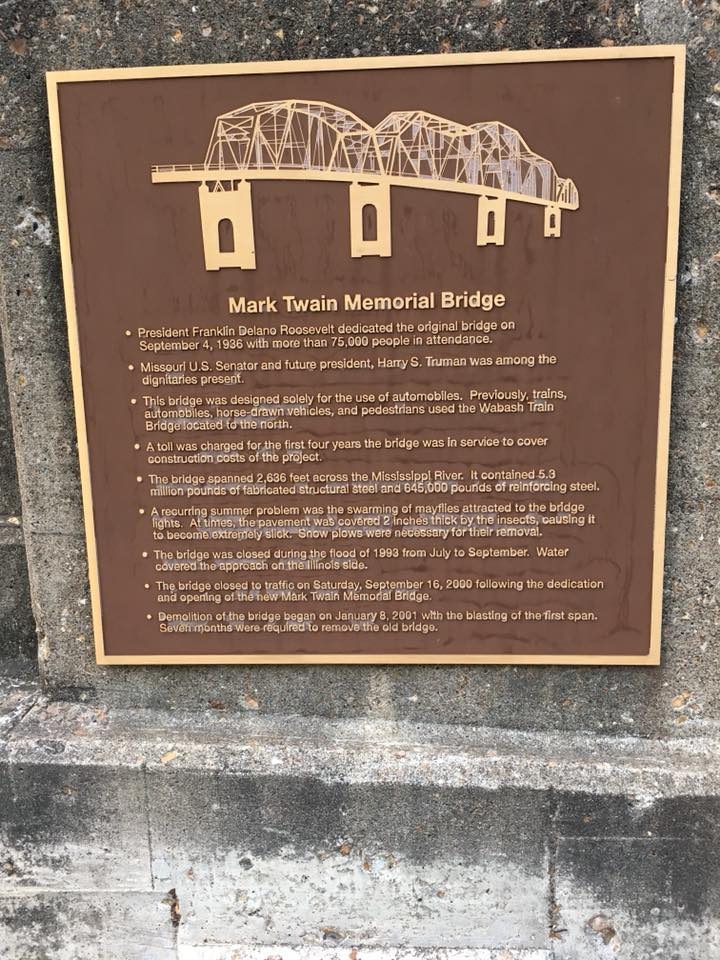 I took his advice and ventured up the hillside. There I found a quaint little pocket park created from an abandoned roadway and concrete bridge footing of a steel suspension bridge that once spanned the mighty Mississippi to Illinois on the other side. The bridge had been dedicated in the 1930s by Franklin D. Roosevelt himself with then-Senator Harry S Truman assisting. As I sat there puffing and reflecting, an older gentleman, climbing the stairs for exercise, walked by and said good evening. He stopped for a moment and, excited by my discovery, I said something silly like “Cool to think that FDR and Truman were here.” He shook his head and continued with his exercise.
Some 15 minutes later the older gent, retracing his route, remarked, “I walk these steps 2 or 3 times a week and you know most young people don’t bother to talk to me. They don’t even notice me, their faces usually buried in their cell phones. You know, I was here when FDR came. I was 3 years old and my dad put me on his shoulders because he wanted me to see FDR. I didn’t see Truman though.” We talked for a while and he revealed that he had lived in Hannibal all his life, graduated from the local high school in 1950 and was shipped off to Korea in 1951. I asked if he saw active combat and he said “oh yeah.” The admission was no big deal to him, but it floored me. We talked a little bit longer, he told me how much he loved Hannibal and, after I thanked him for his service, he bade me good night.
The next day Rhonda and I went to visit the former home of the Unsinkable Molly Brown, the suffragette heroine who survived the sinking of the Titanic (and several other disasters). It was her 152nd birthday. Margaret “Maggie” Brown (the name Molly was a Hollywood invention) was born in Hannibal in 1867 and lived in the home during her childhood. Later she married a poor Colorado mining engineer who struck it rich in the mines of Leadville which immediately catapulted Ms. Brown into high society. It was well worth the trip.
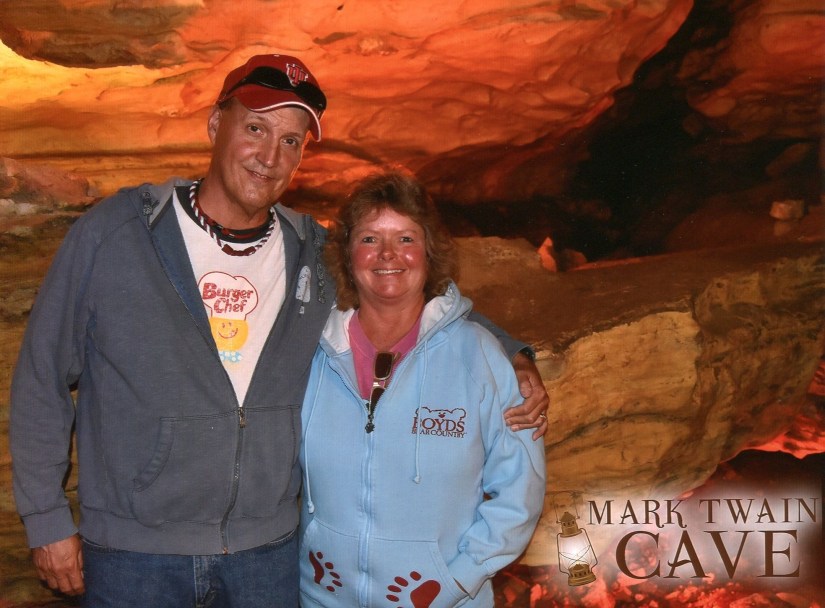
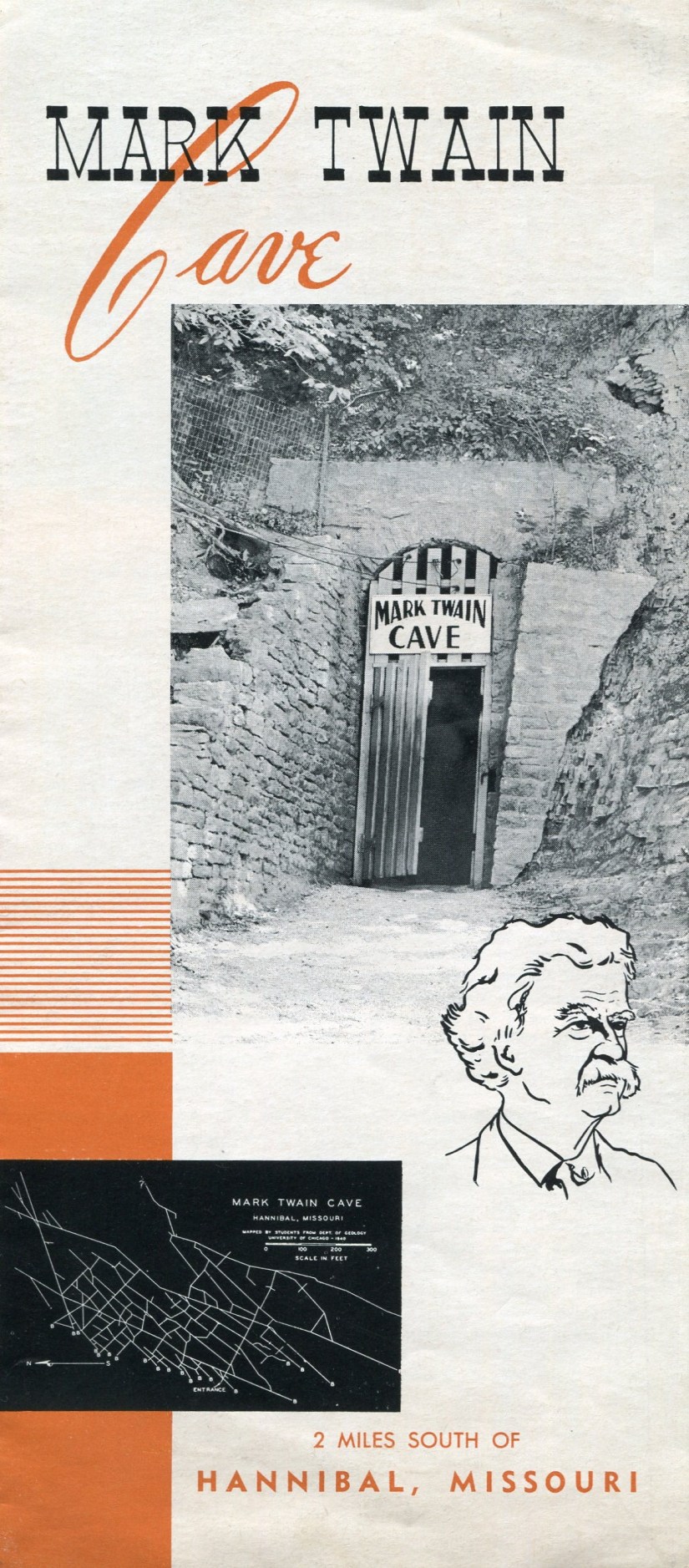
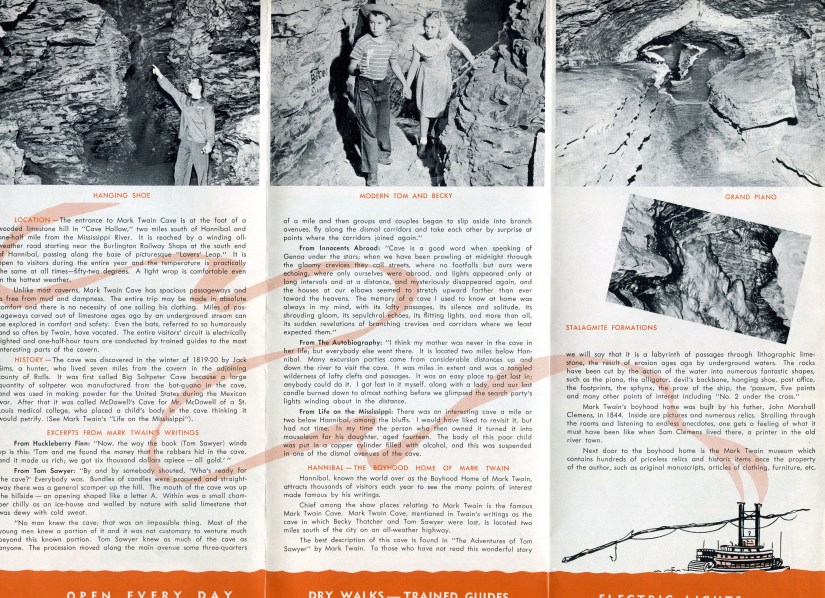
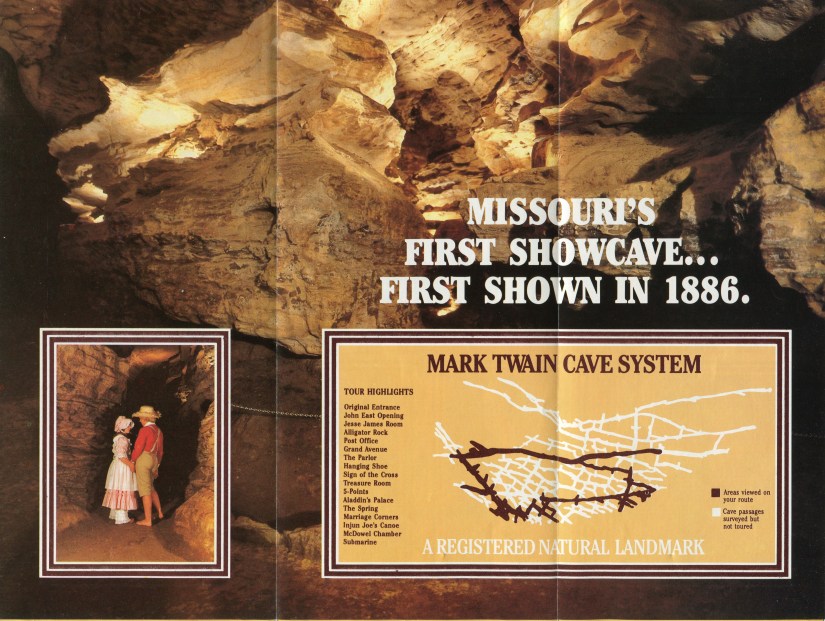
However, I came to visit Mark Twain’s cave. As many of you know, I collect old paper, particularly old photographs, letters and brochures. I recently ran across an old tourist brochure from the cave, made sometime around World War II, and decided I had to visit. Mark Twain’s cave is purportedly the same literary location featured in his Tom Sawyer book. Here young Sawyer, Huck and Becky chased ghosts, dug for buried treasure and discovered the outlaw “Injun Jim” (or “Injun Joe” depending on who you talk to), who really wasn’t an outlaw at all.

A tour of Mark Twain’s cave, while a feast for the imagination for any Samuel Clemens fan, is probably the most commercial experience you are likely to encounter in Hannibal. The tour guide walks guests briskly through the cave while reciting a very mechanical script committed to memory for 6 tours a day. The well rehearsed stories of Tom Sawyer characters mingle with tales of dead bodies, Wild West outlaw Jesse James, young Sam Clemens and even artist Norman Rockwell, to make for an enjoyable experience, but it does not leave much room for discussion, discovery or exploration.
Luckily, we also toured Cameron Cave, resting nearby on the same property, but separate (both in location and admission) from Mark Twain’s cave. Unlike the more commercial Twain cave, discovered in 1819, the lesser-known Cameron Cave was first discovered in 1925 and remained a closely guarded family secret until the early 1970s. The family offered limited tours over the years, mostly for special events and visiting dignitaries, but nothing like Twain’s cave. Our tour of Mark Twain’s cave featured some 20 guests, but our tour of Cameron Cave was just Rhonda, myself and our young guide Nathan. Now THAT was a cave.
Nathan was able to guide us through the cave at an easy pace affording us plenty of time to explain each and every aspect, formation, discovery and historical anecdote along the way. Cameron Cave rests below an Irish Catholic cemetery which led to stories of ghosts in the cave. Nathan stopped at the entrance and demonstrated what the old cave guides used to call a “spook horn”. It consisted of a rock ledge outcropping that, when banged on with a closed fist, emits an echoing sound like a musical instrument. 3 bangs on the spook horn chased the ghosts away, 2 bangs invited them back at the conclusion of the tour. How can you not love folklore like that?
This trip, when carefully considered, is perfect for Hoosiers because of its relatively short travel time (you can make it back from Hannibal in less than five hours), its Midwestern familiarity, rich history and friendly people. it seems fitting that when you visit Springfield and Hannibal, you lose an hour. Because, one thing is for certain, visiting these places sure feels like you are stepping back in time.









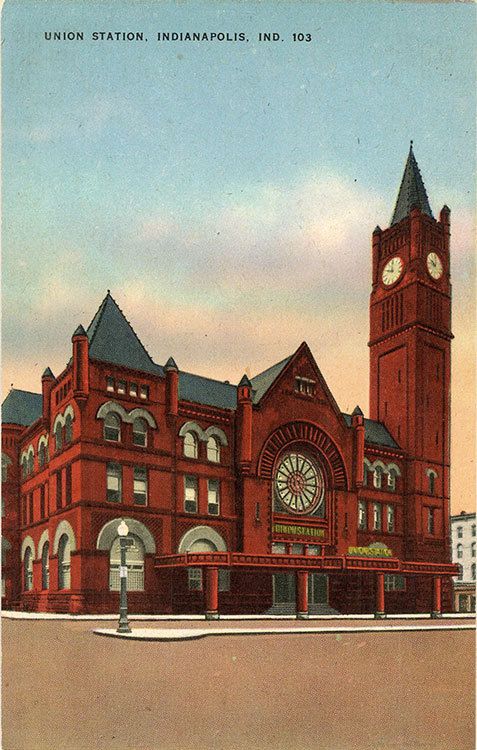
 Beginning in November 1886 a new station was constructed just north of the existing station, and soon a three-story, red brick and granite station with extensive vaulted Romanesque arches and a 185-foot clock tower began to rise towards the Hoosier heavens. It was that clock, with its four separate clock faces each nine feet in diameter, that would become an Indianapolis landmark for generations to come.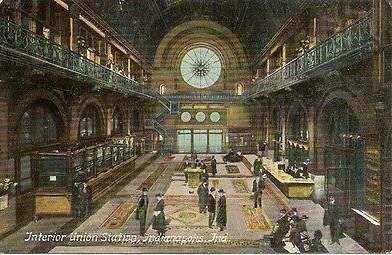
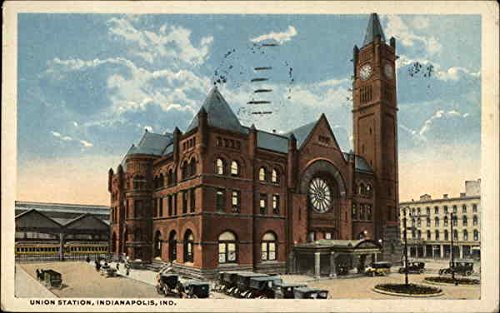 Train travel dropped in the 1930s, mostly because of the Great Depression, but rebounded during World War II because so many servicemen were on the move. After the war, passenger trains were declining as the automobile and aviation industries experienced rapid growth, all but signing the death warrant of Union Station. By 1946, as post-war passenger service fell off, only 64 trains a month operated and by 1952, barely 50 passenger trains a month used the station. Over the next generation, as rail travel continued to decline, Union Station gradually became a dark, ghostly relic of a by-gone era. During the 1960s and 1970s, it suffered from the same pattern of deferred maintenance and slow decline plaguing most urban buildings.
 Union Station was then owned by Penn Central, a “Frankenline” created by the merger of the old Pennsylvania and New York Central lines. A series of events including inflation, poor management, abnormally harsh weather and the withdrawal of a government-guaranteed $200-million operating loan forced the Penn Central to file for bankruptcy protection on June 21, 1970. Many of the once-powerful railroad firms were bankrupt and only six trains operated out of the station. Penn Central offered the station for sale and the decline continued when by 1971, the United States mail room closed and Amtrak was formed out of the few remaining rail lines. It looked like the grand station would be bulldozed into a parking lot. A “Save Union Station” committee scrambled to keep it from being demolished.
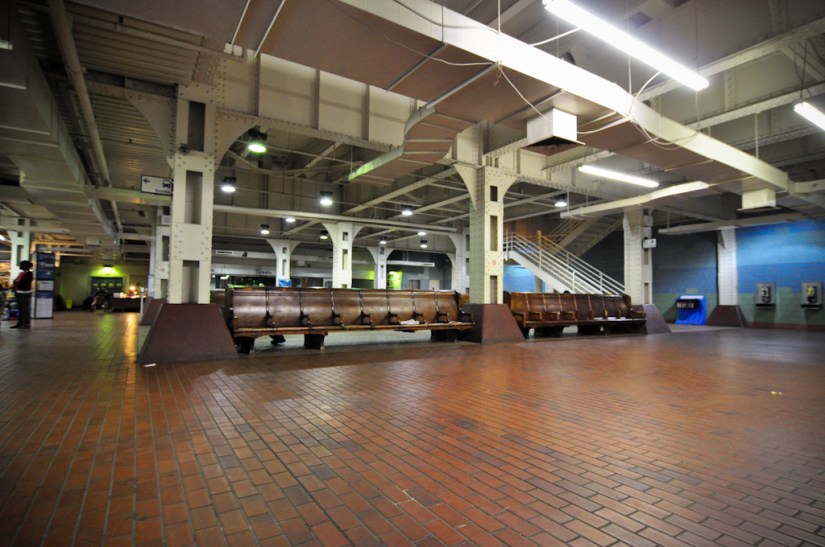
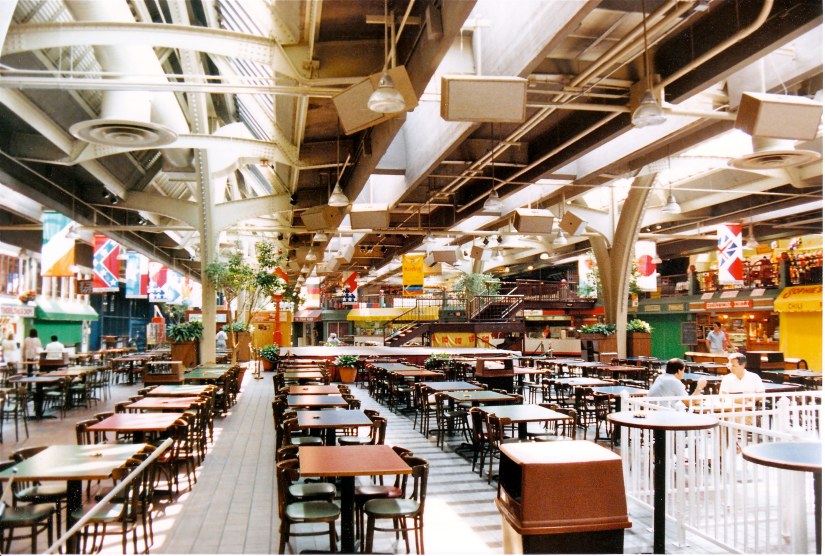
 Perhaps as an homage to the vibrant spirits of luminaries past, Twenty-eight “Ghost People” linger around the Grand Hall at Union Station. Dressed in authentic period clothing, carrying real items from their times, each have a special story. Made of white fiberglass, they were created by Indianapolis native Gary Rittenhouse, from an idea of developers Bob and Sandra Borns, who were fascinated by the history of thousands of people beginning and ending their travels in Union Station.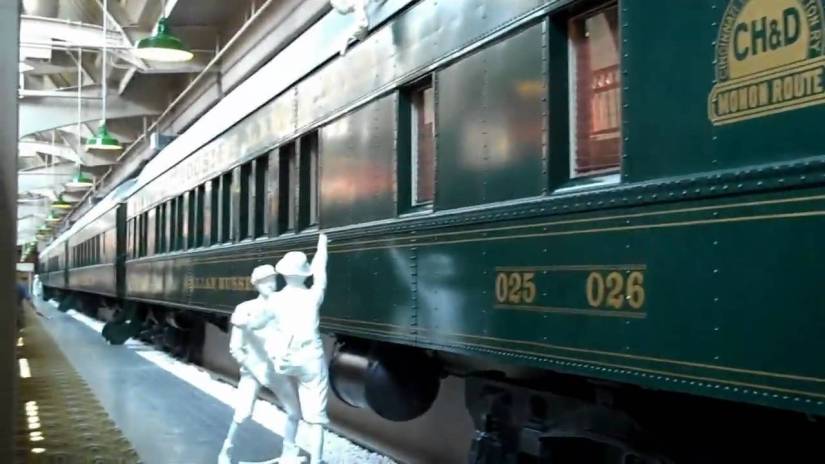

 Dyer said the site will probably remain as-is for the next year or more, as it has become a popular gathering place for mourners. The purchase price was $600,000 more than its appraised value. He said the city will reach out to both LBGT groups and local community for advice on how the memorial should proceed. I didn’t tell Rhonda where we were going, I just said “Let’s go for a drive.” Good sport that she is, she agreed without reservation and off we went. While just about everyone knows the story of the massacre, not many know the history of the nightclub itself.
 The Orlando Weekly newspaper once described Pulse as featuring “three glitzy, throbbing rooms of twinks, club boys and twinks at heart. Every night has something different in store, but Pulse is known to have some pretty impressive drag shows, and the bar’s dancers are usually gorgeous.” However, Pulse was more than just a party spot for the LBGT, it hosted themed performances each night and had a monthly program featuring educational events geared towards the LGBT community. The Washington Post described its first 12 years as “a community hub for HIV prevention, breast-cancer awareness and immigrant rights”, and reported it had partnered with educational and advocacy groups such as Come Out with Pride, Equality Florida, and the Zebra Coalition. President Obama once described Pulse as both a refuge for LGBT and for Puerto Rican people.
 Top 10 Orlando called it a “firm favorite for the Orlando gay crowd”, The Rough Guide to Florida deemed it “justifiably popular”, citing its “great lighting and sound plus cabaret performers, drag acts, and erotic dancers.” The entire premises, including the washrooms, were handicap accessible. Using “periodic consumer surveys”, Zagat rated Pulse 25/30 for atmosphere, 25/30 decor, and 22/30 service.
 Before Pulse was founded, the building site was home to the Sarasota Herald Company, a 1930s Era daily newspaper. In 1985 it became Lorenzo’s pizza restaurant. By 1999, it had become Dante’s, a bar with live music. Dante’s closed in January 2003. Pulse was founded on July 2, 2004 by Barbara Poma and Ron Legler. Poma’s brother, John, died in 1991 from AIDS, and the club was “named for John’s pulse to live on”, according to their website. Legler was President of the Florida Theatrical Association at the time of the club’s foundation.
 Visitors have written messages of hope on the canvas signs. Some designed to cheer the future, others to toast the past, while more still are there to nourish the soul and soothe an unquiet mind. A few scrawlings just want it to be known that Jake from Iowa was there and that Jake from Iowa understands and is sorry it happened. Some messages are from friends, many are from family and others from Orlando residents paying respect, like Orlando Boy Scout Troop 534 who proudly proclaim that they are Orlando Strong.
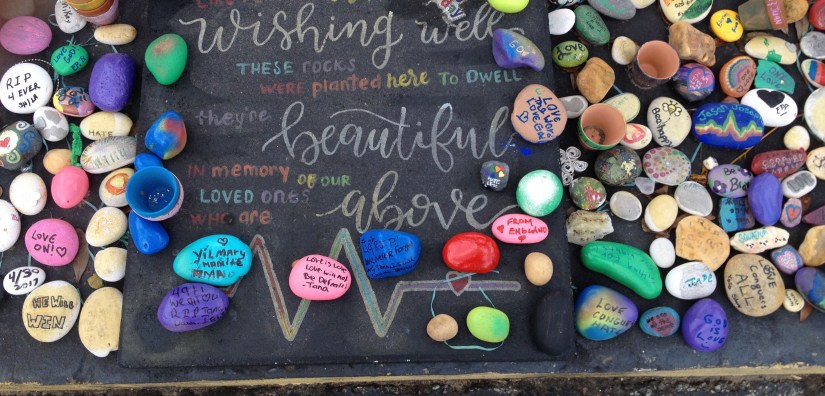 I’m a firm believer that seeing, touching and walking the paths of important events leads to better understanding of what happened there. The Pulse site could be a perfect place to reflect and remember. Orange Avenue is a busy road but what strikes a first time visitor like me is that no farther than 100 yards behind the site are neighborhoods full of homes and average everyday people. One can only imagine how that tragedy affected these folks.
 Sadly, our nation’s historical landscape is pock-marked with sites where tragedy has defined a region. All too often these sites involved the attempted eradication of human rights, whether individually or as a group. One need only recall the evils of slavery and horrors of reconstruction to understand the impact of a failed ideology. Every group has had to climb its own mountain to affect change; some sadder and more tragic than others.
 The memory that I will take with me is of a pair of young women who appeared and walked slowly down the fence. It was a young teacher escorting a beautiful blind student. The teacher stopped at every banner, reading it aloud to her sightless charge.
 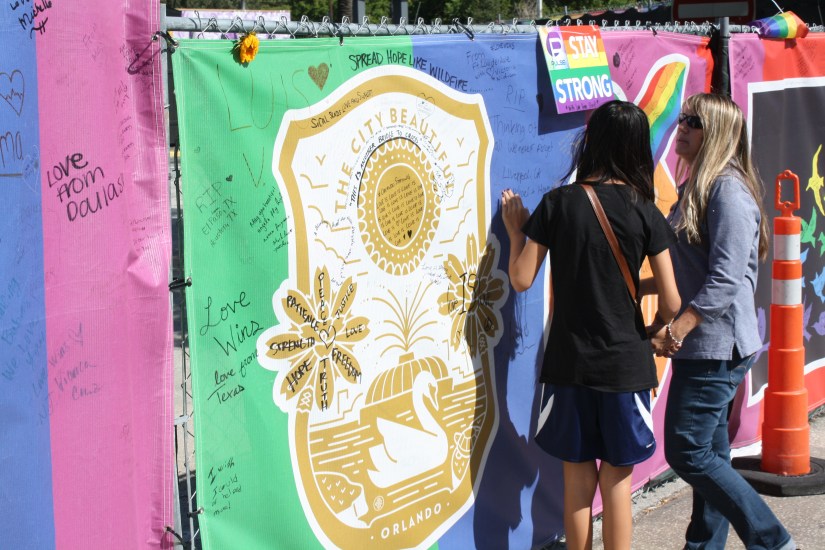 The young student then reached out and touched every banner gently with her fingertips, as if absorbing the moment for her own personal posterity. Our daughter Jasmine and two of her / our close friends, Elise and Jada, work at the Indiana School for the Blind. I’d like to think that if any one of those three young women were in the same position, they’d do the same for their students. Please Orlando, transform the Pulse nightclub site into a memorial that all Americans can be proud of.

 Alan E. Hunter