Civil War, Gettysburg, Museums, Pop Culture, Travel

Statuary Myths and Urban Legends. Gettysburg.

Part I

Original publish date:  September 24, 2020

I find myself hanging around statues all the time. On Battlefields. In Museums. Visiting cemeteries. My office. I truly love looking at statues & sculptures of every sort, heck, I even find myself admiring the old fonts on those statues and plaques. Not too crazy about the recent trend of “Cairns” (aka rock stacking) sprouting up in creeks and rivers and along trails in parks, but that’s another story. I do love statues and admire the artists that created them.
As many of you know, I spend a lot of time in Gettysburg- 2 to 3 trips a year. Part of the attraction of Gettysburg, to many, are the monuments and statues located on every part of the 6,000 acre park; some 1,300 at last count. As all devotees of the battlefield know, there is a legend that circulates around the eight equestrian statues found on the field. It has become known colloquially as the “hoof code” and until recently, solely by coincidence, it held true.
The tradition stated that the position of the horse hoofs on the statue dictated the fate of it’s rider. All four hoofs down: the rider survived the battle unscathed. One hoof up: the rider was wounded during the battle and survived. Two hoofs up: the rider was killed during the battle. According to the National Park Service, aside from the myths that the Rebels stumbled into the battle of Gettysburg while searching for shoes for footsore soldiers or that Lincoln wrote the Gettysburg address on the back of an envelope on the train to Gettysburg, the horse code legend is most enduring.

zz s-l1600
It appears that the stories were simply created by those early battlefield guides as a convenient way to get guests to remember the fates of the rider. Although harmless, it nearly drove the park brass crazy trying to explain the fallacy to guests, dignitaries and letter-writers for over a century. One letter found in the NPS archives from October of 1931, written by then superintendent E. B. Davis, addresses the issue bluntly, “The story that the posture of the horse in equestrian statues on this battlefield indicates whether the rider was killed, wounded, or unhurt seems to be one of those myths which grow up around historical places and are almost impossible to destroy. Sculptors whom I have consulted assure me there is no such convention connected with the art. This office does not countenance the story. On the contrary, invariably discourages it. It seems, however, to appeal to some imaginations among both guides and tourists. If you are in position to supply the name of your guide or the number of his cap, I can possibly stop one from further reciting the myth.” So, not only did it drive the NPS crazy, the sculptors weren’t too happy about it either.
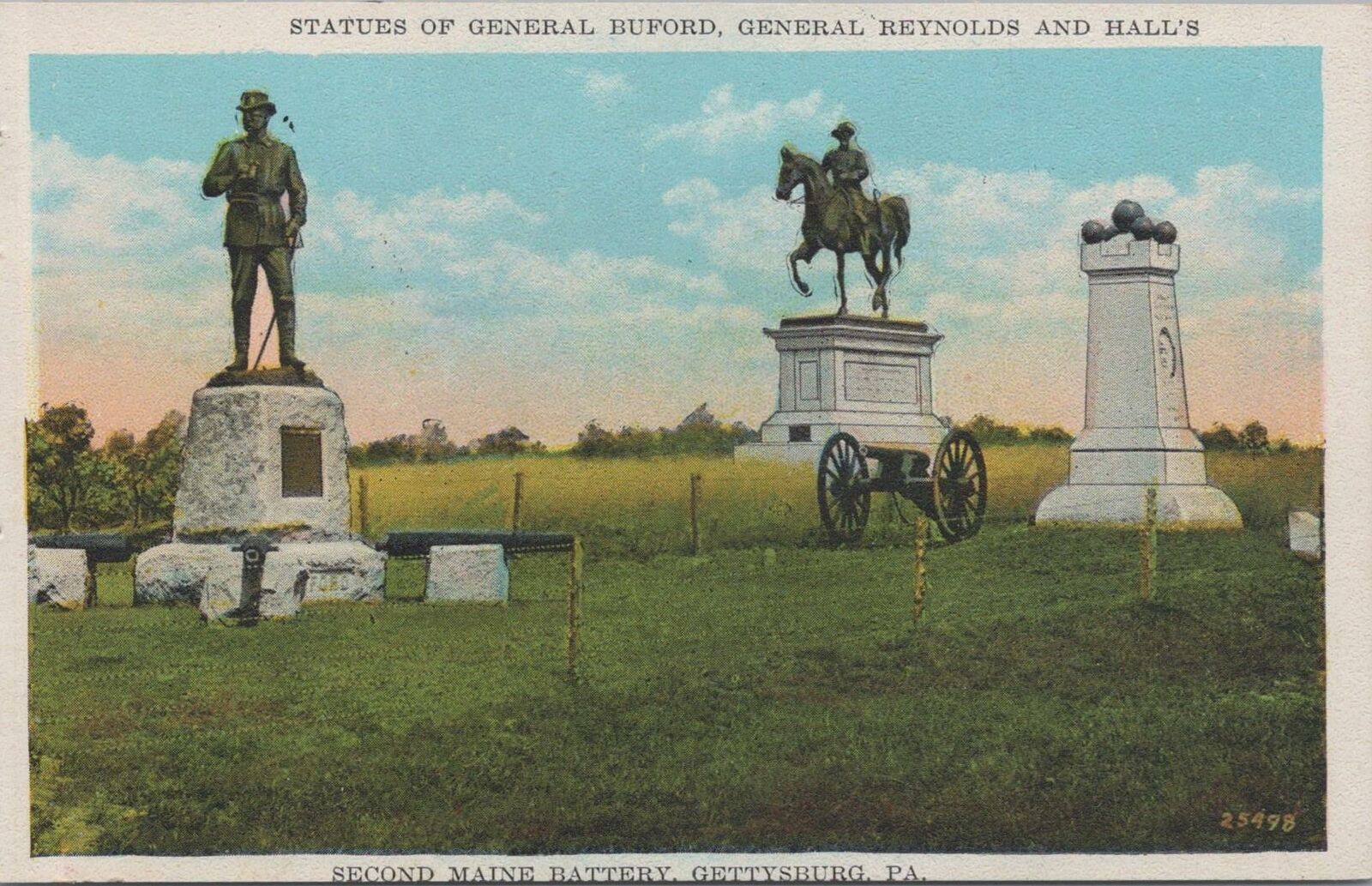
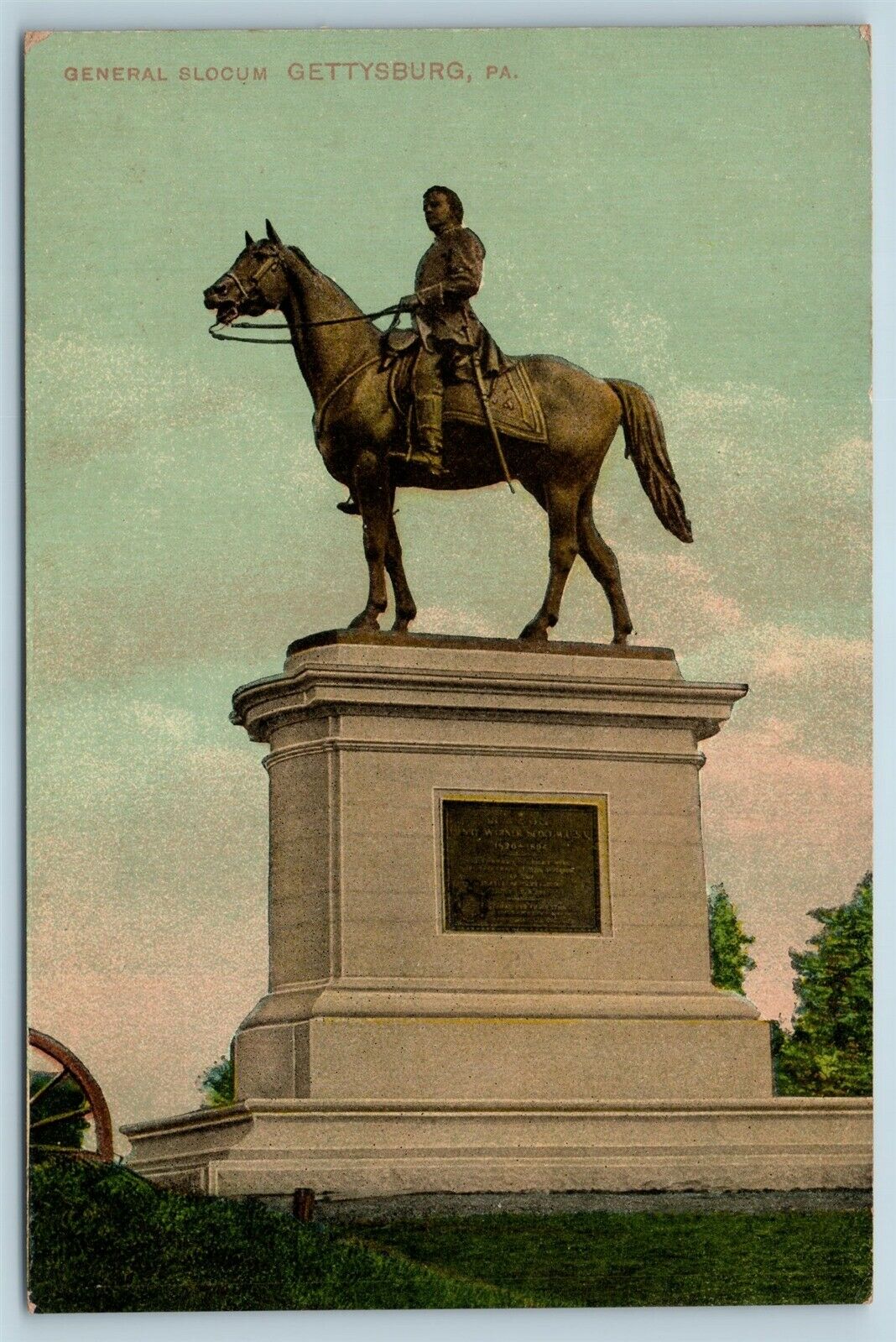
z Screenshot (175)The statues on the field represent Union Generals Meade, Reynolds, Hancock, Howard, Slocum, and Sedgwick, and Confederates, Lee, atop the Virginia Memorial, and James Longstreet. According to the NPS, “Meade and Hancock were the first on June 5, 1896. They were followed by Reynolds, July 1, 1899, Slocum, September 19, 1902, Sedgwick, June 19, 1913, and Howard, November 12, 1932. The Virginia Memorial was dedicated on June 8, 1917. Longstreet did not come along until 1998 and by this time the myth was firmly established.”
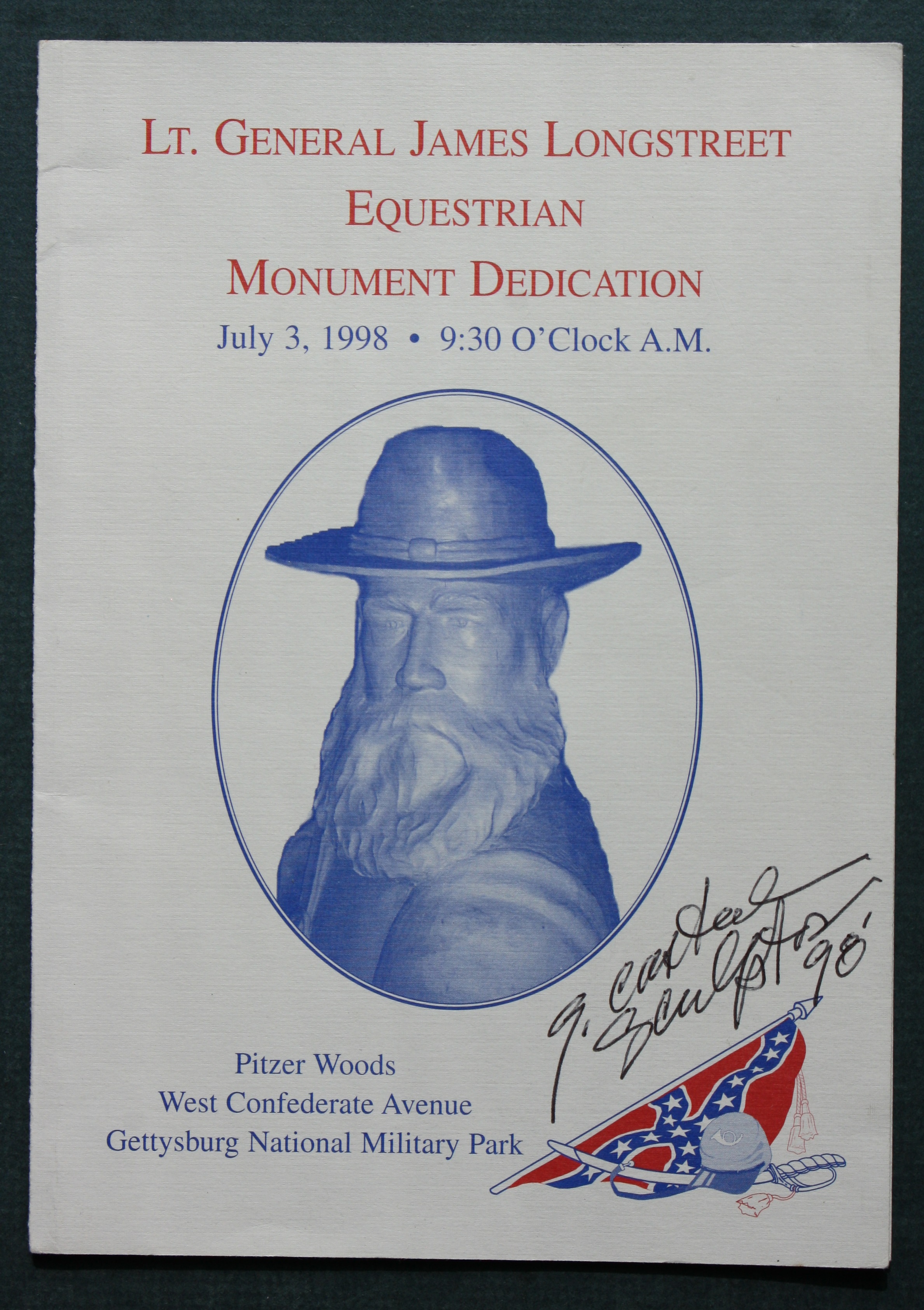
The Longstreet statue, created by artist Gary Casteel, was dedicated on July 3, 1998. Located in Pitzer Woods on West Confederate Avenue in the Gettysburg National Military Park, Gary’s statue is unique because it rests on the ground, not on a pedestal. “I wanted people to be able to walk right up to it; see it, touch it.” says the sculptor. Gary, whose studio is located near the entrance of the National Cemetery and the iconic landmark Evergreen Cemetery gatehouse in the old “Hall of Presidents” wax museum, is still busy practicing his craft within site of the Hancock monument across the Baltimore Pike.
Sculptor Frank Edwin Elwell’s larger-than-life bronze figure of Hancock astride “a horse” depicts the general extending a reassuring hand toward unseen Union soldiers. The horse “Hancock the Superb” straddles was not his own. On July 3, 1863, Gettysburg saw the greatest artillery barrage in the history of North America warfare. The earth rattling blasts of over 100 Confederate cannons and the thunderous roar of Union guns in reply, spooked Hancock’s horse, and it froze, refusing to move. Hancock dismounted, borrowed the horse of a nearby surgeon, and embarked on his ride, one of the most famous in the history of the Civil War. Hancock, fully exposed to enemy fire, rode up and down the line to bolster the morale of his troops who lay behind the stone wall. When aides begged the General to dismount, his reply was, “There are times when a Corps Commander’s life does not matter.” He was wounded grievously and his equestrian statue reflects that wound with one hoof up.
The placement of Hancock’s statue on East Cemetery Hill required the dismantling of a precarious looking wooden observation tower that stood on the hill from 1878 until 1896. But what about that horse? What was his name? Historians have studied that question for years to no avail. Every Civil War buff knows Lee’s horse at Gettysburg was “Traveller”, Meade’s horse: “Old Baldy”. We even know the name of Meade’s (he had two) and Lee’s back-up horses, “Blackie” & “Gertie” and “Lucy Long” respectively.
Reynolds horse: “Fancy”, his secondary horse was called “Prince”. Sedgwick’s horse was named “Rambler”, his two back-ups; “Cornwall” and “Handsome Joe”. General Henry Slocum’s horse was named “Charlie” and General Longstreet’s horse was “Hero”. BTW, in case you’re wondering, General Joshua Lawrence Chamberlain’s horse was named “Charlemagne” but he did not get it until the autumn of 1863, after Gettysburg. The horse, a small brown Morgan horse with scars and sores from pack-service had been captured from the Confederates. Chamberlain has no monument, equestrian or otherwise, on the field except for that of the 20th Maine on Little Round Top.
z slocum s-l1600But Hancock’s horse at Gettysburg? No one knows. Likewise, General O.O. Howard’s horse remains nameless (he had at least two shot out from under him and himself was wounded twice in battle) but the sternly pious one-armed General’s nickname of “Uh Oh” survives. So named by soldiers because when the General showed up, one way or another, there was gonna be a fight (he was awarded the Medal of Honor for actions at Gettysburg). Look up at his statue the next time you’re walking the field and you’ll see the empty flap of his right arm (shot off at the Battle of Seven Pines a year earlier) pinned neatly to his coat.
31381355_1822681061096482_4450482538460217344_n

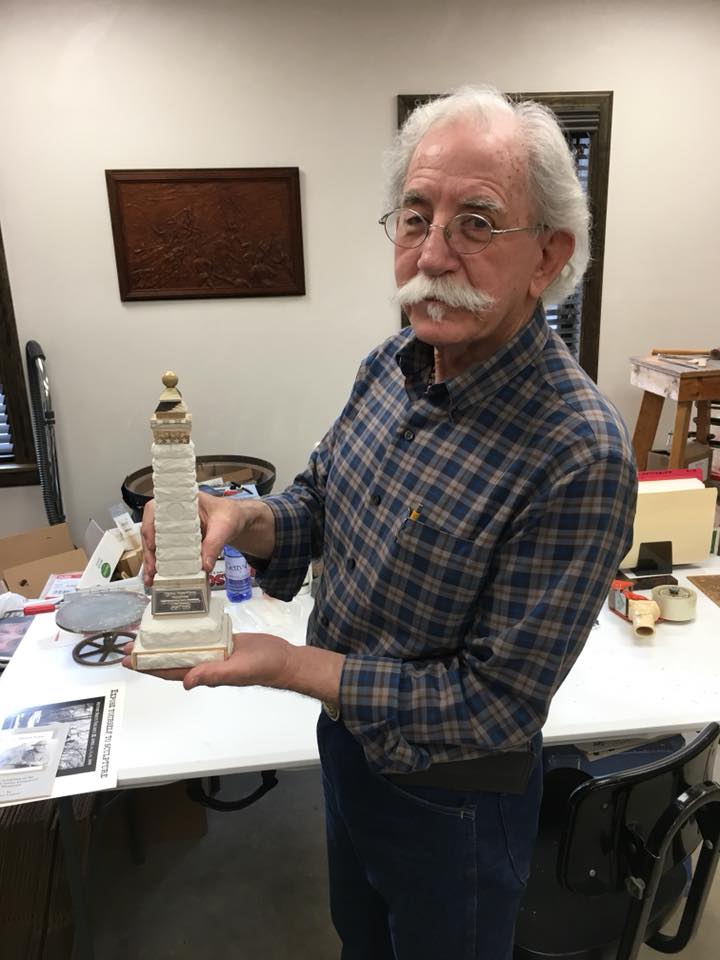
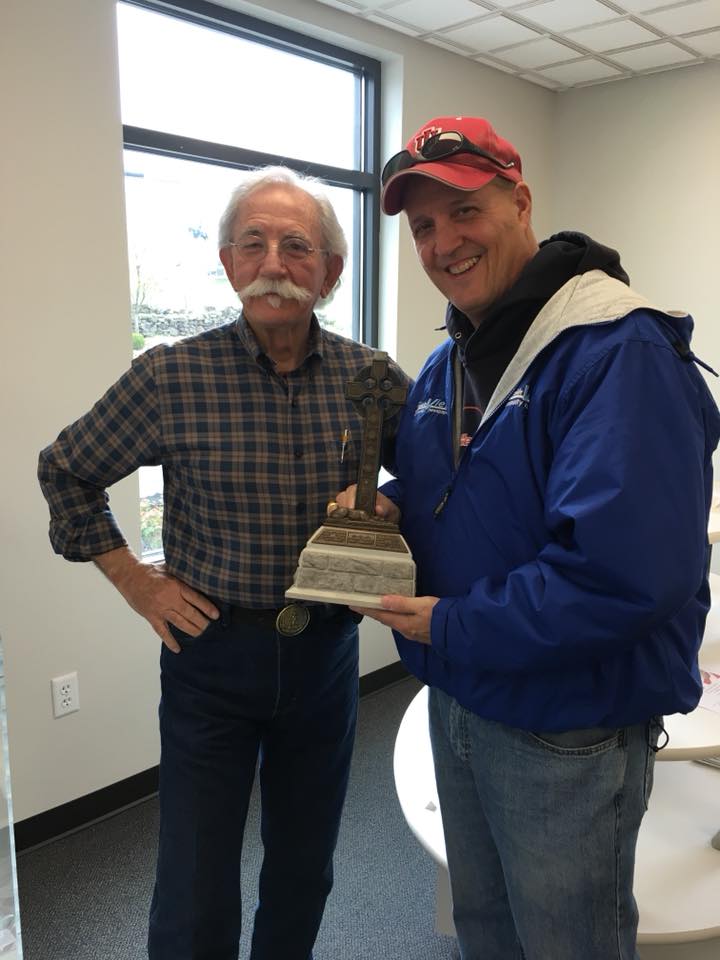
Sculptor Gary Casteel and the author in Casteel’s Gettysburg shop.

Which brings me back to sculptor Gary Casteel. Gary’s statue of General Longstreet is featured on his horse with one foot raised, even though Longstreet was not wounded in that battle. However, he was seriously wounded in the Wilderness battle the following year. The hoof is depicted in an upraised position, making it the perfect place for visitors to place coins, lucky four-leaf clovers and other mementos atop it. Casteel’s equestrian statue, the most recent general officer monument on the field, may settle the “hoof code” urban legend once and for all. Should you ever find yourself in Gettysburg, stop in Gary Casteel’s studio at 789 Baltimore Street and ask him yourself. Asked for comment on the myth, Mr. Casteel answered, “The “code” only works at Gettysburg and over the years it has become “law” thus challenging those who wish to question or break it, like me!” after which he jokingly adds, “It took a Confederate to challenge Yankee rule once again!” Yes, if you find yourself in Gettysburg, a visit to Casteel Sculptures is a must see. Most visitors fail to realize the rare opportunity afforded them with just such a visit. You can walk to battlefield and gaze at statues innumerable, but you can only talk to one sculptor: Gary Casteel.
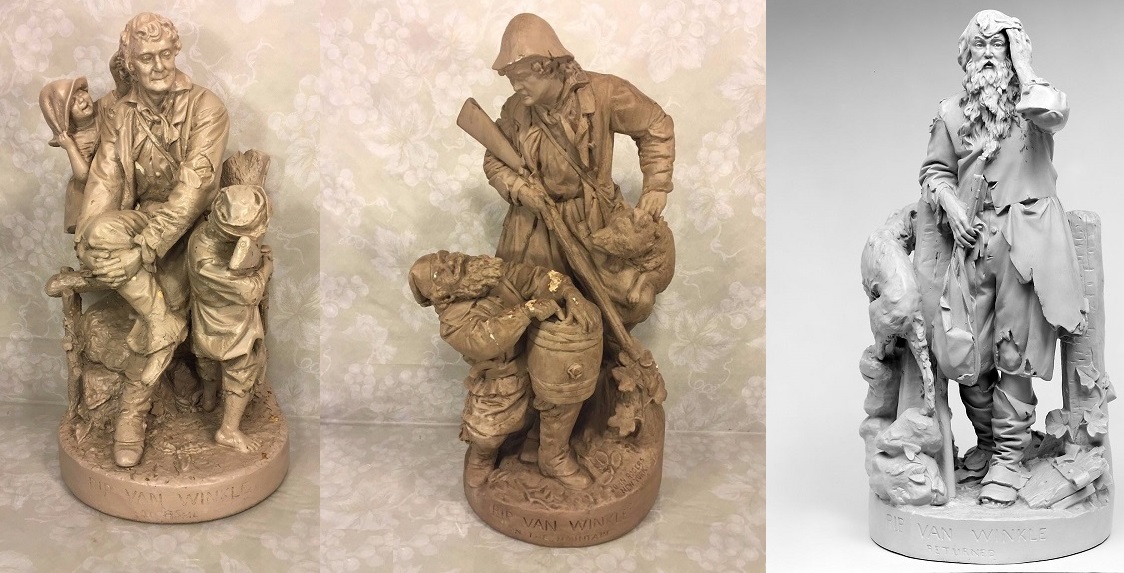
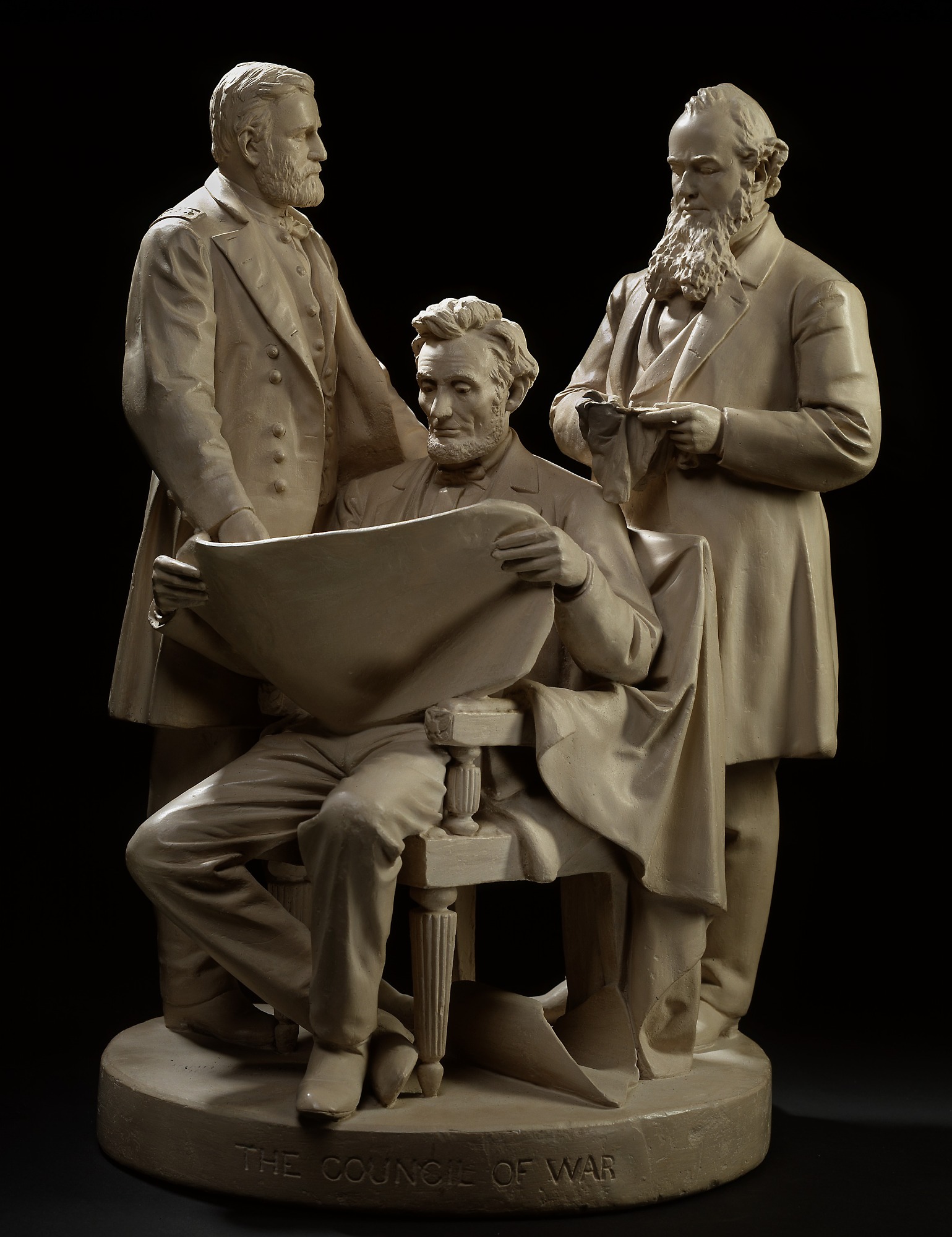
That brings me to another statuary myth, one that I have been enamored with since I was a small boy. It involves the first American “pop sculptor”, the Civil War, the Abraham Lincoln assassination and George Armstrong Custer. Next week in part II of “Statuary Myths and Urban Legends.”

z IMG_2526

Civil War, Creepy history, Ghosts, Irvington Ghost Tours, Travel

Haunted Antique Mall.

549b01d3e7296.image

Original publish date:  October 5, 2010              Reissue / Updated: August 6, 2020

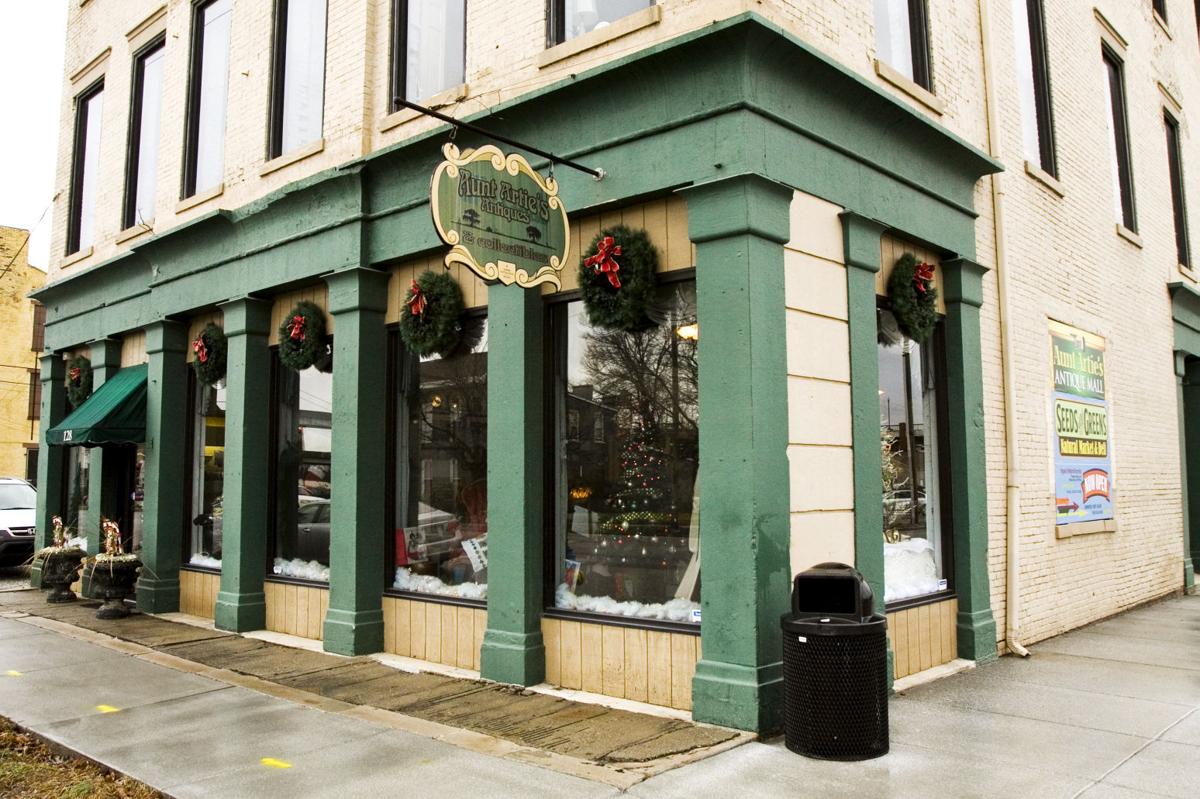
Here’s a one tank trip that might just help make your autumn season a little bit better. It combines many things that I like and perhaps a couple of things you might fancy as well; History, Antiques and ghosts! Recently my wife Rhonda and I took a trip down to New Albany, Indiana (just a stones throw from Louisville) to visit a place I’d long heard about but had yet to visit, Aunt Arties Antique Mall at 128 W. Main Street in New Albany.
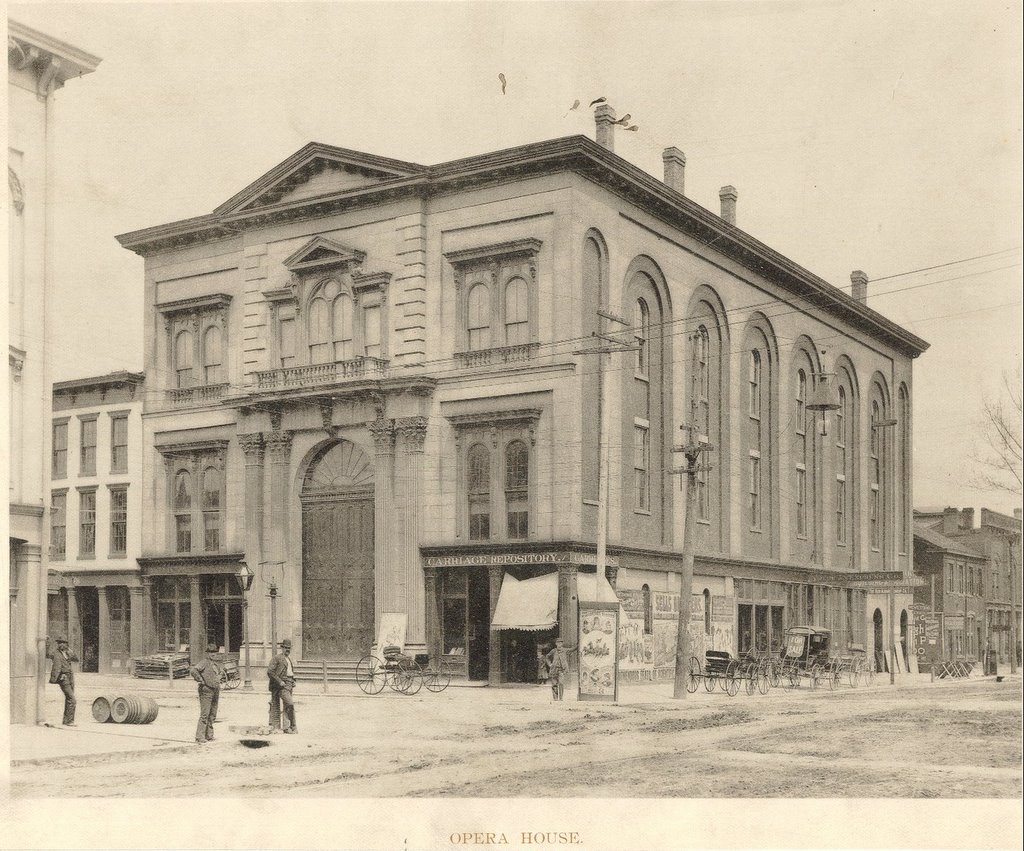
Judy Gwinn is the owner of the old Ohio River Opera House and has turned the stately old building into one of the nicest antique malls in Southern Indiana. For antiquers, it is like stepping a decade back in time to a multi-dealer co-op with 3 floors of collectibles that would please most any collector. In short, it’s a mall full of quality merchandise the likes of which we all used to find in the days before Ebay.
“There are a lot of strange things that go on in this old building,” Judy says, “It has a vibe all its own.” Gwinn has operated the antique mall for nearly 10 years now and has witnessed many unexplained occurrences over the past decade. Lucky for Judy and her dealers, the ghosts of Aunt Arties aren’t poltergeists so breakage has not been a problem, “Although they sometimes move things around the building.”

z Opera
Woodward Hall New Albany, Indiana

The building, originally known as Woodward Hall, was built in 1853 and purposely situated a block from the river on the corner of State and Main, “J.K. Woodward built it so that his wife and kids did not have to deal with the drunks and neer-do-wells that often prowled the docks down by the river in the years before the Civil War. He wanted a safe place for his family to enjoy themselves.” said Judy. In its lifetime just about every famous person who passed through New Albany appeared on the 3rd floor Opera House including the famed Siamese twins Eng and Chang, P.T.Barnum’s diminutive protege Tom Thumb and his friend, Commodore Foote, Opera star Adelina Patti, Philosopher/Poet Ralph Waldo Emerson, and self taught former slave turned master musician Blind Tom who was billed as the “Negro piano prodigy.” Not every performer to grace the stage of old Woodward Hall was famous though. The venue attracted countless numbers of minstrel shows, political debates, religious revivals, social lectures and dramatic productions.
The lower 2 levels housed a dry goods / department store well into the 20th century in what was once the largest city in the state before the Civil War. Although Judy is responsible for its current look, it has been used as an antique store since the late 1980s. Along with the city’s reputation as a river community, New Albany also has a rich history as a factory town and will celebrate its 200th anniversary in 2013.
z utc posterThe Opera House hosted the first performance of the inflammatory anti-slavery play “Uncle Tom’s Cabin” and its location straddling the North-South boundary caused quite a stir in the days leading up to the Civil War. During the “War of the Rebellion”, the building was used as “Hospital No. 9” and soldiers from both sides of the conflict could often be found lying side-by-side within its walls. In April of 1862, the steamer “H.J. Adams” delivered 200 wounded soldiers to the converted Opera House fresh from the killing fields of Shiloh. In these years before sterilization set the standard of hospital care, a wounded soldier sent to Hospital No. 9, as with any hospital North or South of the Mason-Dixon line, might as well have been handed a death sentence. Many a soldier in Hospital No. 9 would write letters telling friends and family that he was on the mend from a minor battle wound one day, only to die unexpectedly the next day from disease.
Judy and the girls that work in the mall feel that some of these performers and soldiers have never left the building. “I never believed in ghosts until I bought this building. Neither did my husband, but after all of the strange things we’ve experienced in this building, We have changed my minds,” Judy Gwinn said. However, she is no longer afraid of being thought of as a crackpot because she is not the only person to witness these unexplained happenings.
z 5c05d88edef32.imageJudy recalls how in 2001, her youngest son David was down in the building’s cellar “fishing” for old bottles in a cistern that he had removed the concrete covering from. “He was laying on his stomach down there alone when he suddenly felt someone tap him on the shoulder” she says, “he looked around expecting to see the source of the poking, but saw that he was still down there alone. Since that time, David does not like to be in the basement by himself.”
Judy recalls one time when she and her sister were walking down the stairway from the second to the first floor when she suddenly lost her balance and began to fall. “Something pulled me back and saved me from falling and serious injury. I shook for several minutes after that one.” says Judy.
img485Spirits of a Civil War soldier and a woman in an old fashioned Antebellum Era dress have been seen lounging around the cafe area by a few folks. “Every once in awhile, we’ll get a psychic coming through here telling us that they see the spirits of several Civil War soldiers around the entire building and sense sadness in the basement area.” says Gwinn.
On one occasion, Judy was down in the cellar with a group of 4 people when the youngest person down there, an 11-year-old girl wandered a few feet away from the group. “We all watched as a bright white orb of light appeared and went right through that little girl.” she says, “I have seen shadows go through walls and felt the tapping on my own shoulder. Whatever it is, I’m not scared of it anymore.”
Judy Gwinn might not be afraid of the ghosts that linger within the walls of Aunt Arties Antique Mall, but others might have a different opinion. Judy confesses that some people have walked in the doors and turned around and walked right back out. She’s seen more than a few people start walking up the stairs only to suddenly stop and walk carefully back down the stairway. When asked about the basement, Judy says, “Oh my, I don’t think we could ever use this area for anything more than storage. Its just too creepy and I’m not even sure that the employees want to come down here.”

z 10672416_798739180182771_6158681886050951161_n
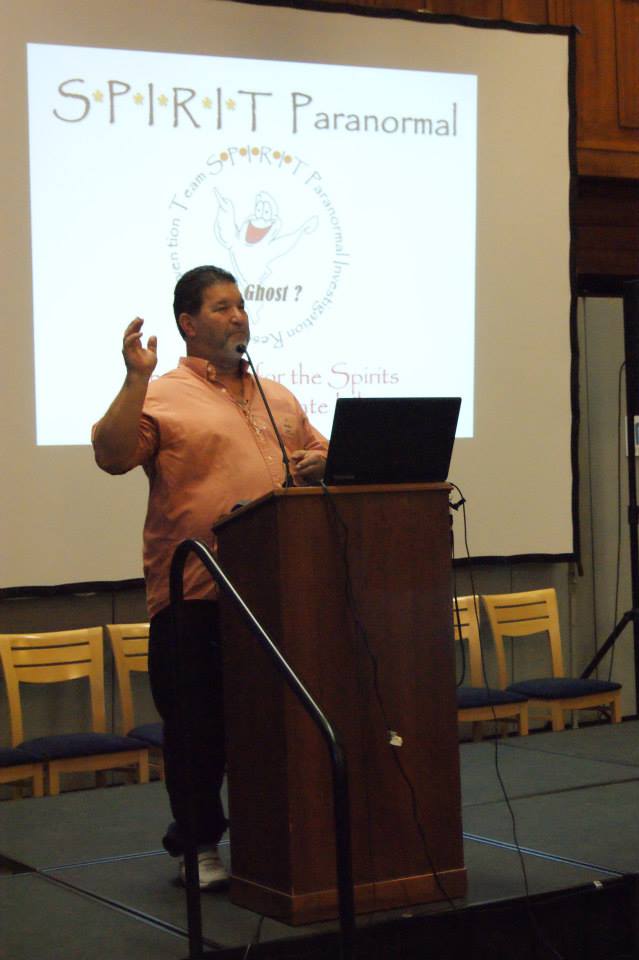
Tim Poynter delivering a presentation at the Indiana State Library in Indianapolis.

Update: This article originally ran 10 years ago. Aunt Arties closed its doors on New Years Eve of 2014 and the remaining contents were auctioned off in February of 2015. After Rhonda and I visited the store in the Fall of 2010, we took another trip down with several intuitives, including Tim Poynter and Jill Werner. My decision to rerun this story came after the following facebook post from Tim: “Aunt Arties was once a stop on the underground railroad with a reputation of being haunted by a Lady in blue/gray. When we arrived the spirit of a young soldier started following one of the group around. He was very smitten with Jill and had big puppy dog eyes. I noticed the lady spirit on the stairway overseeing our groups investigation. We spent some time on each floor looking for spirits. Near the end of our visit I noticed several spirits of slaves that had been buried on the property still residing in the basement even after all those years. They has perished from injuries received from their perilous journey to freedom. They were still very afraid of our attention to their being there. I remember being overwhelmed with their fear and mistrust. The connection with spirit often comes with much more than we expect. After understanding that we were not a threat they became more forth-giving of their trip to freedom. Even though they had died, they died as free men. I helped them understand that the only thing holding them there was their own energy and off they went. We that were born to freedom seldom understand it’s true value. Those that restrict the freedom of others don’t understand the mark they leave on their own soul.” Well said, Tim, well said.

Criminals, Museums, National Park Service, Pop Culture, Travel

A Hoosier Guard on Alcatraz PART III

Albright Part III
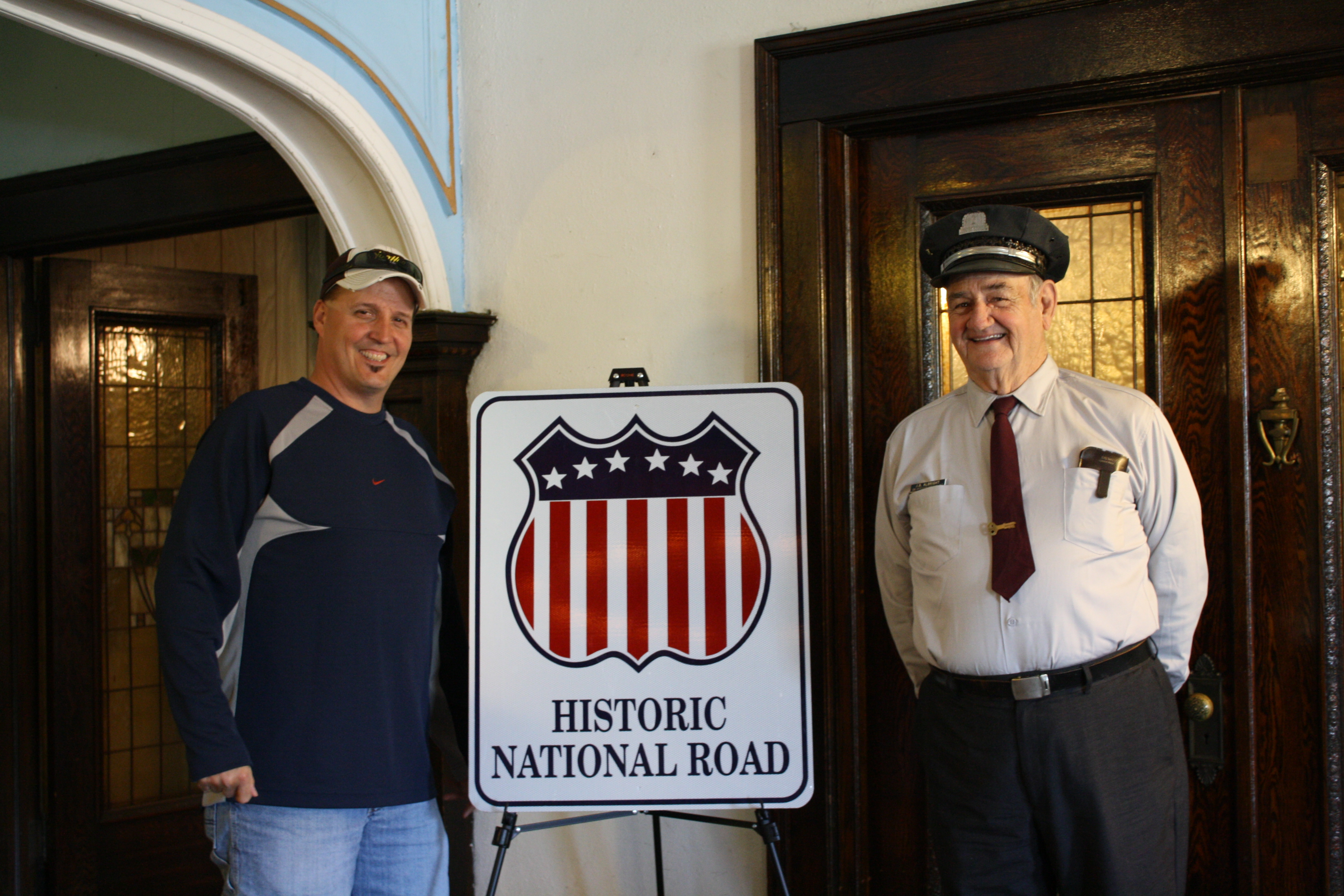
The author and Jim Albright-Indiana National Road Meeting at Brazil Lodge in 2010.

Original publish date:  July 23, 2020

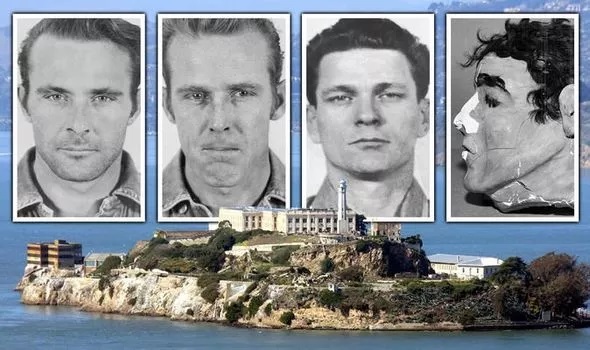
Jim Albright was on duty the night the most famous escape from Alcatraz took place. On June 11, 1962, Frank Morris, Clarence Anglin and his brother John escaped through a hole in the back of their cells, the details of which were chronicled in Clint Eastwood’s 1979 film, “Escape From Alcatraz.” Albright recalled the escape in his 2008 book, “Last Guard Out. A Riveting Account By The Last Guard To Leave Alcatraz” (available at Amazon), “The movie showed them escaping off Broadway and that is not correct. In real life they escaped off Seedy Avenue (outside of B Block).” Jim also points out that the movie showed Eastwood stealing a pair of fingernail clippers off the Warden’s desk, “This would not have been necessary as each inmate was issued a pair when they first arrive at the prison.”

z 1962-Alcatraz-prison-break-1249788
The Anglin Brothers, Morris & a dummy head.

On the night of the escape, Jim recalled, “I had been over in town playing ball and I stepped in a gopher hole and twisted my knee, so they give me some crutches. The next morning (after the escape was discovered), I’m crutching up the hill when I run into the Lieutenant and he says ‘we got some missing’ and orders me to watch the back of the cell house.” Later, Jim went inside the cellhouse to “see what was going on.” He looked in Anglin’s cell and saw the false head. “They got dummy heads up there now that look like I made them. The dummy head I saw that morning looked very real. They did a good job, in fact, when I saw it I thought I had the wrong cell, it looked that real.”
Also in his book, Jim vividly remembers the events leading up to the bustout (“I told them those blankets should not be there”), the escape (“After the escape I was placed on roof detail after night fell, with a pistol and flashlight. I couldn’t flash very often because of limited mobility with crutches.”) and the aftermath (“The inmates had a field day teasing, laughing, comments, etc., toward the guards in the immediate time after the escape.”). “John Anglin was the older brother and John worked for me in the clothing room, so I knew John real well,” Jim believes, “I strongly feel the Anglin brothers probably killed (Frank) Morris to lesson the weight of the raft, and they in turn drowned and washed out to sea…I think about it even after all these years and realize that I too was a part of all of this.” The after effects are still visible. Several times during the story, Jim would stop, shake his head, and say “Them damn blankets.”
Likewise, Cathy recalls the escape from her unique perspective. “I was downstairs with the kids visiting with Betty Miller and we heard this alarm go off. Well, that means you don’t leave where you’re at and I’m down there and I’ve got two kids in diapers and didn’t have any extra diapers so we used towels for diapers until I could go. They searched Betty’s place and then they searched my apartment. But as far as being afraid, I never was, I really felt safer there than I did some other places.”

z 14492243666_6a483a88fc_c
Tom Reeves, Jr.’s reconstructed water tower on Alcatraz.

When I asked Jim about the current trend of tearing down monuments, he recalled the Native American Indian occupation of Alcatraz that took place from 1969 to 1971, years after the Albrights’ left the island. “When the original water tower was replaced after it was rusting away and pieces were falling off of it, they hired a guy, a former kid named Tom Reeves, Jr. who was teenager living on the island when I was there, his dad worked in the hospital as an MTA, his stepmom worked in town as a nurse.” the old guard chuckles as a memory bubbles up, “Tom had a little scheme going when he was in high school, everybody wanted to go to Alcatraz. All of his buddies, everybody in the school wanted to go to Alcatraz. Tom would say ‘I will take you to Alcatraz for two bucks’ so he’d get 3 or 4 guys, get two bucks a piece, bring ’em over and show ’em the island and take ’em back. The Warden found out about it and he wasn’t happy.”

IMG_0117
Cathy and Jim Albright.

After the laughter died down, Jim continued, “Tom grew up and became an engineer. He has an office in San Francisco, Seattle and somewhere in Hawaii, he was that big. So he engineered the repair of that water tower to make it look just as it did when we were there so that it would hold up. And it looked like new. And then they went and put Indian Graffiti back on it. And I asked (National Park Service Ranger) John Cantwell why they did that and Cantwell’s answer was, ‘Jim, love it or hate it, that is part of our history.'” Jim points out that Reeves, Jr. and his company restored the water tower and helped preserve several of the decaying buildings, including the steel tie-rods used to shore up the Warden’s House that was burnt during the Indian occupation, “at no charge, he did all that for free, he didn’t charge ’em a dime.” Jim and the Alcatraz alumni association wanted to place a plaque near the water tower thanking Reeves, Jr., as a former resident and benefactor, but the Park Service wouldn’t let them.
z Ghiradeli_54_990x660Jim’s recollections about his time on the island are limitless, he can affirm or deny legends about the island with ease. He relates details as if they happened yesterday. “The best cell placement on the island was the second tier because you could look out to see and hear San Francisco. On New Years especially, you could hear the parties and watch the party boats go past. When I was there, Ghiardelli Chocolate factory was still operational and you could smell that chocolate cooking when the breeze was just right.” He continues, “Al, you’ll like this, when I was in the tower, if one of those boats got too close to the island, I’d warn them with a bullhorn and if they didn’t listen, I could fire a shot across their bow. They moved then,” says the veteran guard. The prisoners were aware of the rumor that the island was patrolled by sharks, “Well the prisoners heard the rumor that the guards went down and caught all the sharks and cut the left fin off to make them swim in a circle around the island and we guards didn’t do anything to change their mind.”
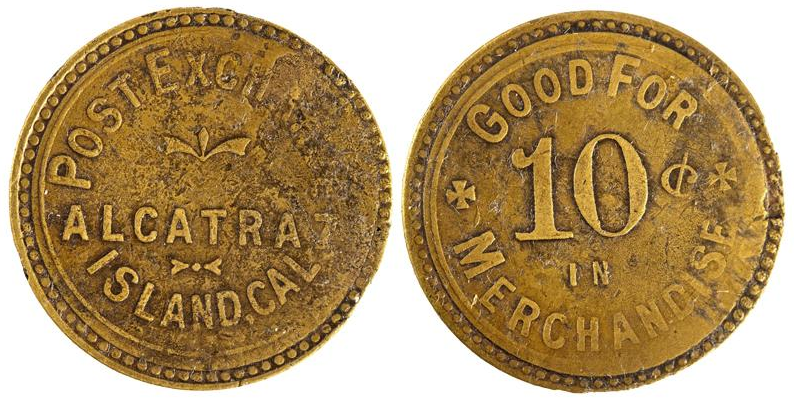
z shutterstock_743324311.0Jim recalls patrolling the perimeter of the island and occasionally finding relics left over by military personnel during the time Alcatraz was in operation as a military fort guarding the bay from the Civil War up into World War II. Jim would see the old tokens gleaming in the moonlite at water’s edge, “I found script, I guess you’d call it. I think I’ve still got a dime, a fifty cent piece and a quarter around here somewhere.” He continues, “the guys would fish, there was a bout a half a dozen of them, down below the industries building. When you were dock and patrolman, there was a list, when you walked into the dock office, and when you saw the stripe bass running, you looked on that list and you’d call those guys who wanted to fish, anytime day or night, and you could make another round and when yo came back there could be anywhere from ten to thirty guys down there fishing. They made a Formica chute where they’d filet them right there on the spot and give the scraps to the seagulls. Quite often, you could help yourself to as many filets as you wanted. The head chef loved it cause they’d catch enough to feed the whole main line of prisoners.” I asked Jim if he ate the same meals the convicts ate. “When I first started there, I went thru the line and took my food back to a table in the kitchen. then they built us an officer’s dining room upstairs. The food was good.” Jim says the Alcatraz convicts, “had the best food in the prison service. Good food keeps trouble down.”
Screenshot (163)
Alcatraz “script” tokens.

Cathy chuckles as she recalls Blackie Audett (a longtime convict who worked in the kitchen). “Whenever I baked cookies, I’d lay them out on the window sill to cool. Every time I baked cookies, there would be 3 or 4 officers, I counted 10 one time, that would knock on the door and say, ‘Hey you’re making cookies, I want a few.’ And I asked Jim how did they know? Well, come to find out, that Blackie Audett could look out of that dining room window into my kitchen and see my cookies. Well, that scared the heck out of me. I wondered if he can see in the kitchen window, can he see into the living room window or the bedroom window.” Jim, forever on guard, says, “Yeah, Blackie was there (incarcerated) three times.” Jim also confirms another bit of trivia from Clint Eastwood’s movie, “We had a guy named Ianelli. He was a weightlifter and he had muscles on top of his muscles. I always shook him down extra special and teased him that he was getting lax. They called him Wolf.” Albright confirms that Wolf was a sexual predator as portrayed in the movie and recalled that Wolf was after a young inmate named Robbins who worked back in the “dishtray room”. Jim recalls Wolf was after “Robbie”. “One day Robbie got a pipe and came up behind Wolf hit in the back of the head and damn near killed him. If he (Wolf) had not been in such good shape he would have died. He was sent to our hospital upstairs and brought him about a third of the way back before they shipped him to our medical hospital in Springfield, Missouri. I don’t know if he’s still alive or not but he sure was never the same.”

519kJvKIU8L._SL500_

Criminals, Indianapolis, Museums, National Park Service, Pop Culture, Travel

A Hoosier Guard on Alcatraz PART II

Albright Part II
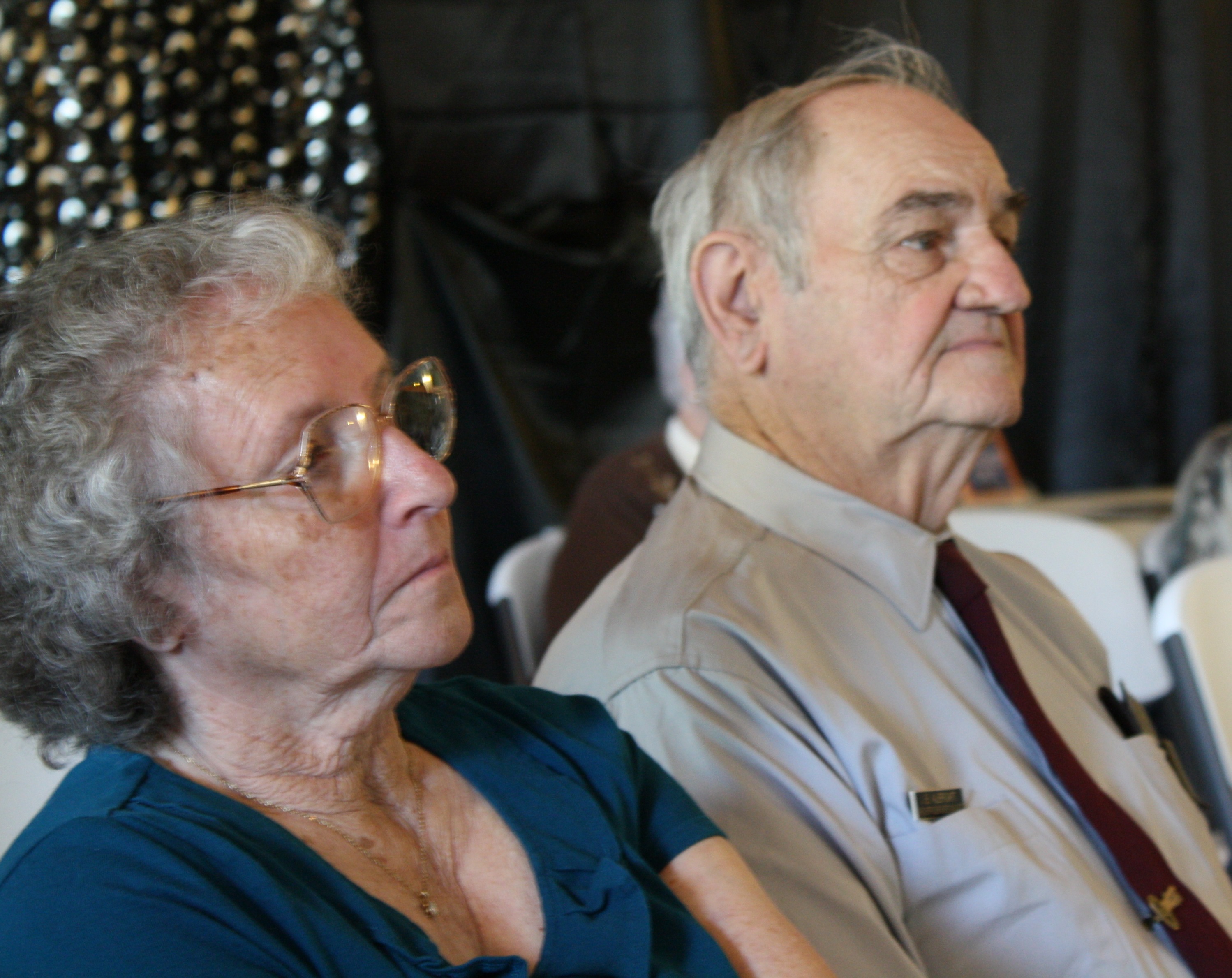
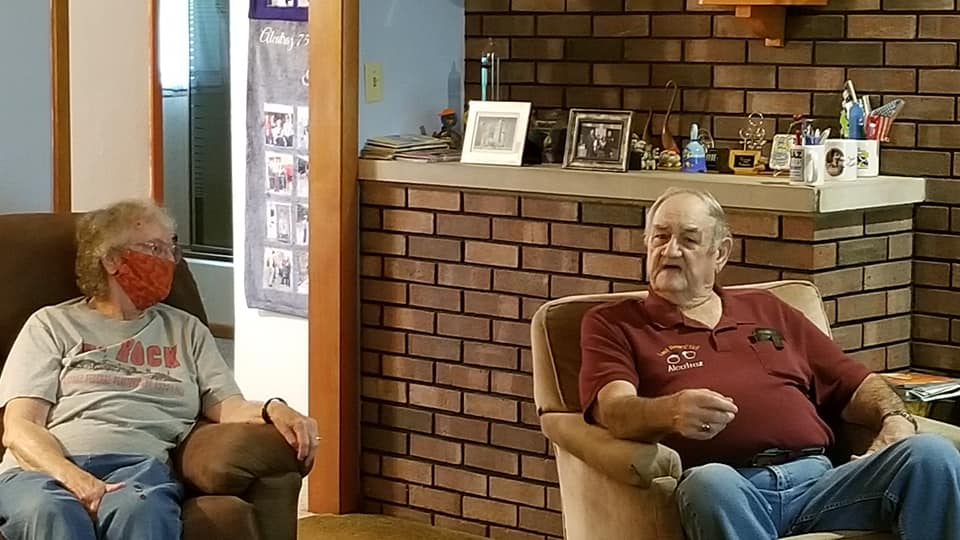
Cathy and Jim Albright

Original publish date:  July 16, 2020

A couple of weeks ago, with Covid-19 restrictions finally easing up, I traveled west on the National Road to Terre Haute with my wife Rhonda and friends Kris and Roger Branch to see a couple of Hoosier legends that I hadn’t seen in almost a decade. Jim and Cathy Albright welcomed our little band of intrepid historians into their home to catch up and listen to stories as only they could tell them. Jim was the last guard off the Island prison in San Francisco Bay known as Alcatraz. No, it doesn’t mean that Jim was the last man to board the final boat off the island when it closed on March 21, 1963, rather, Jim and his wife Cathy remained living on Alcatraz for weeks after it’s closing. As detailed in part one of this series last week, when the prison closed, the Albright’s daughter Donna Sue was only 11 days old and suffering from a foot abnormality that required surgery. The child could not be moved in her fragile condition, so the family remained on the island for 3 more months before leaving on June 22, 1963.
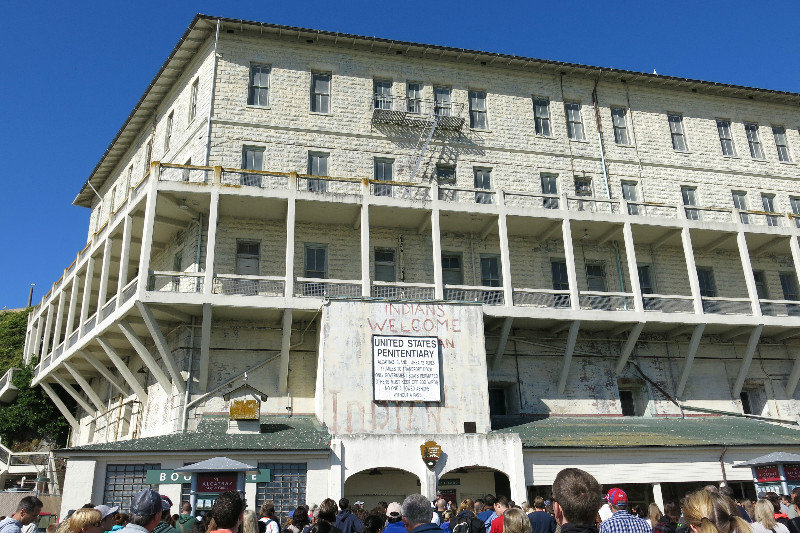
Social distancing guidelines and masks in place, we sat down for a talk about “The Rock.” Ironically, the couple celebrated their 65th anniversary in April during Indiana’s stay at home lockdown period. And Jim Albright knows a thing or tow about lockdown. On their 60th anniversary the couple renewed their vows on Alcatraz, “The biggest surprise I had when we got remarried out there was that she said yes the second time,” Jim says with a smile. Cathy recalls that she can still gaze up at their old apartment in Building 64 and see the curtains she made hanging in the window, although, “You can’t go into the building now, the floors and stairs are all falling apart and it’s not safe,” Cathy says.

7z 583471-Building-64-at-Alcatraz-0
Building 64 at Alcatraz.

From time-to-time, the couple still visit different civic organizations and talk about their years at Alcatraz. “You name the organization, we’ve spoken to ’em.” Jim says, “We have been going back to Alcatraz every year in August for a long time now. (Cathy recalls that first visit was on the 35th anniversary of the prison’s closing-“to the day”-she says) We take the train out but we are going to cancel this year because of the virus.” Jim recalled his first visit to his old island home so many years ago, “John Cantwell (NPS Ranger) offered to escort us around the island and it turned out to be a six-and-a-half hour tour.” To which Cathy laughs and says, “That’s because you were talking so much.” Jim’s recall of events on the island is remarkable. During that first tour, Jim shared details which Ranger Cantwell had never heard before. According to the former guard, Cantwell remarked, “Jim, we’ve had a lot of guys come back here, but they don’t remember the things that you do.” Jim continued, “That’s because wherever I went on the island, and we went EVERYWHERE; the east gun gallery, up on the roof, the old officer’s dining room, every time that I go somewhere, when I step in it seems to trigger something, and I remember…”

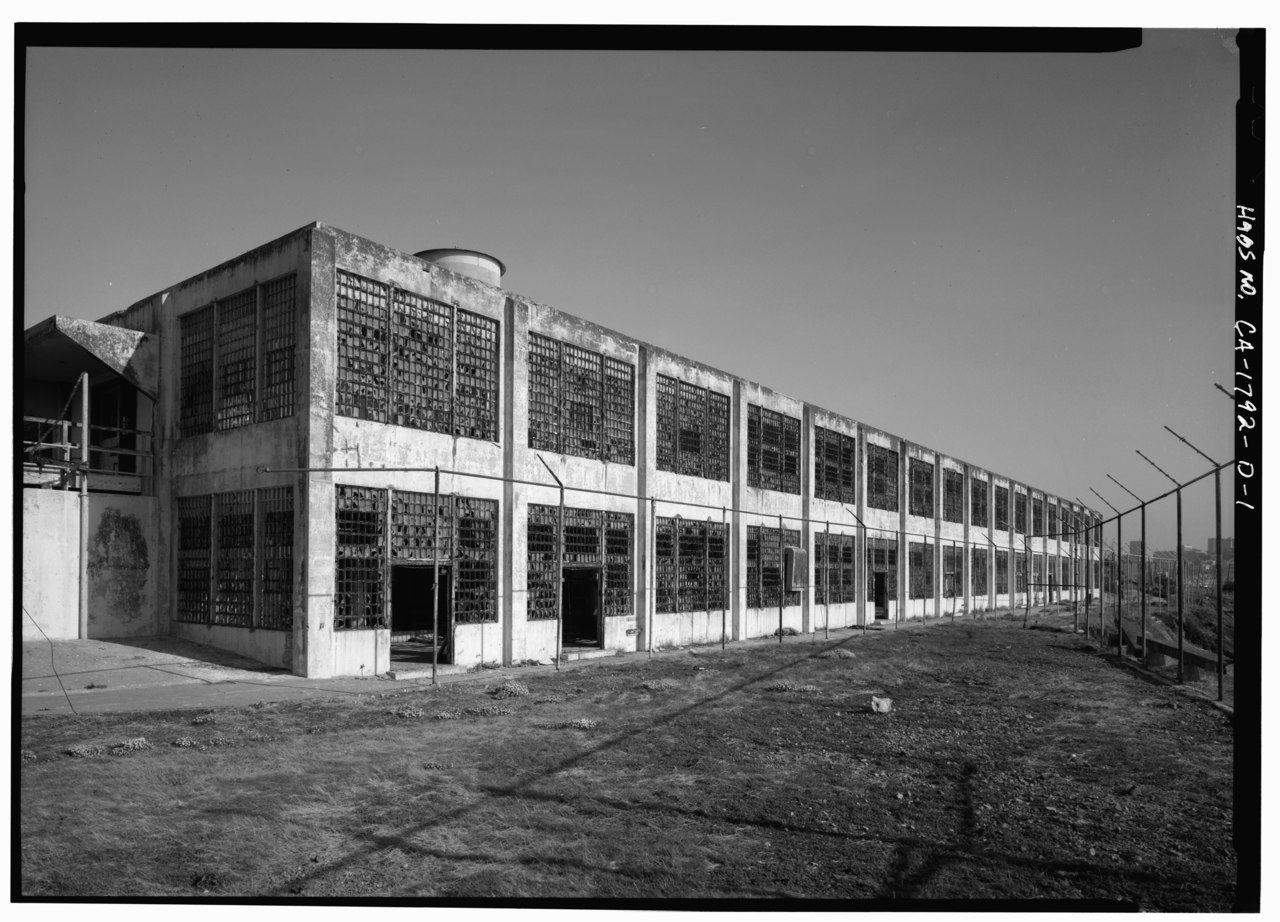
Z Industries
The New Industries Building at Alcatraz.

Cantwell took them to the old Industries building where there were “Great big, probably 8 foot by 10 foot, photographs of the prison and Jim was in several of them, so that was neat to go see that.” Jim says with a chuckle. Cathy adds, “He says he remembers stuff all the time, brings it up, he used to be able to tell you every inmate that was in there when he was there…their name, number, where they worked, where they lived.” Jim chimes in, “But I can’t anymore. It’s all gotten away. When I went there on August 24, 1959, that was my original starting date, and the low number of the inmates at that time was a guy named Clark, number 242, and of course when I left, 1576, Frank Weatherman was the high number. So we had not quite that many inmates cause if you came back, you got another number, I can think of one inmate who was there three different times under three different numbers. I come in August of 1959 and left the island June 22 of ’63.”
I asked Jim if he still had relics and souvenirs from his time as a guard and he shared that he still had his uniform but not the jacket. “I had to turn that in. I don’t know why, I was the only one left on the island and I shoulda kept it.” To which Cathy replied, “Then he found out later that they took all of those coats and stuff like that and dumped it out in the bay.” Jim adds, “Lt. Robbins came on the boat with a whole box of keys and dumped ’em into the bay. Fortunately, I was working the control center when it closed up so I have a key to the main gate. Being in the right place at the right time…I’ve also got a key to the main visiting room.”

z jimalbright-955ad39abb04a0cb2b7d719ff432ce79bb5acecc-s800-c85
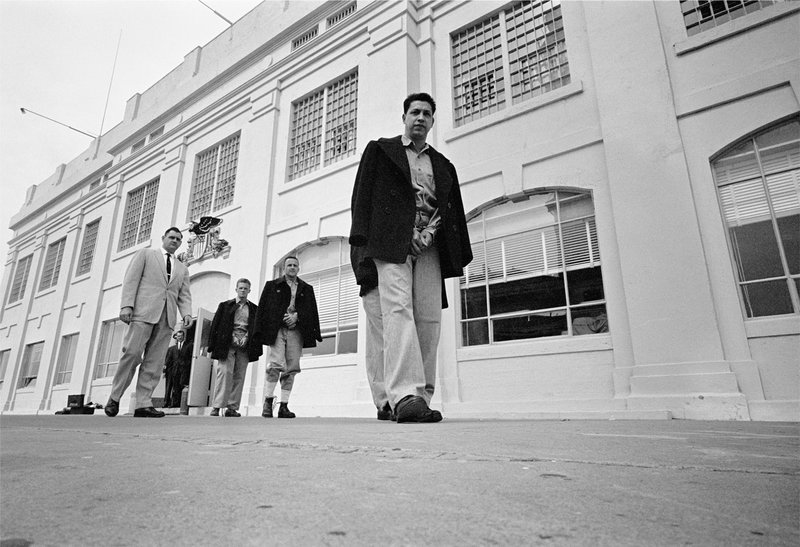
Jim Albright leading the “last line” of prisoners out of Alcatraz.

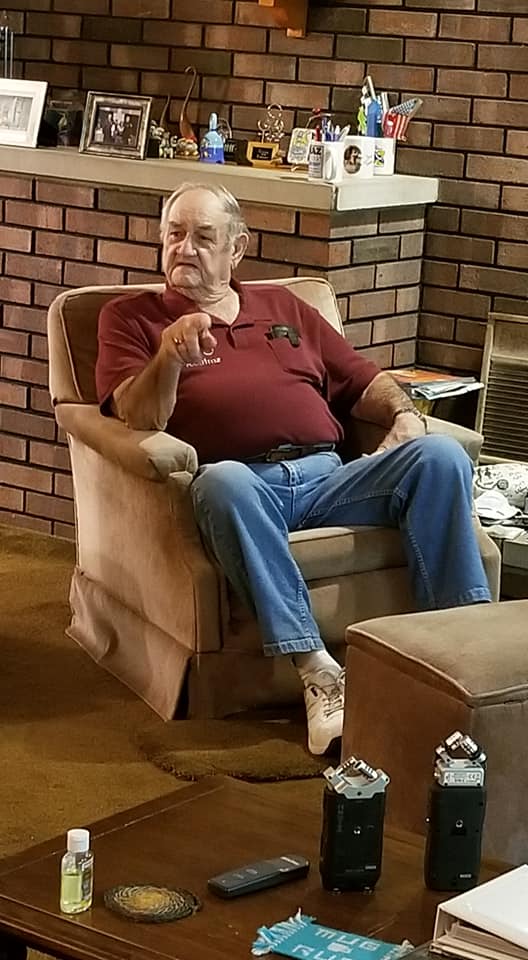
And, since we we all seated in the Albright’s living room, I recalled that Jim had once told me that they also bought much of the de-accessioned furniture from Alcatraz. Cathy giggles as Jim reveals that the chair he is seated in, and that from which Kris was filming from, were all once located in the furnished apartments for guards and officials on the island. Jim points out, “that magazine rack, is off the island.” Cathy reports, “We bought most of it out of the warden’s house, they were selling it, when they closed the island, you could go up there and buy it and we did.” Cathy notes that the furniture is marked with a small metal tag reading “USP Alcatraz Survey” on the bottom. Jim further reports, “that tag has a number stamped on it and they had a book that they could tell exactly what that was and where it was.” He points over his shoulder and states, “That one bedroom down there, most of the furniture is Alcatraz, two or three items in our bedroom are all Alcatraz, the dining room table and chairs, a couple items out here and on the back porch. Red Ball moving company came to the island moved it for us. Everything had to go by barge over to Fort Mason”

Albright Part IIa
Jim Albright seated in one of the original Alcatraz chairs.

Jim recalls that his duties were light during the three months he remained on Alcatraz as the last guard. “There were others there, we weren’t alone on the island. There was a caretaker, a few maintenance workers and the lighthouse operators. I still spent my time patrolling the island with my bullhorn cause everybody wanted to board that island so I ran around yelling ‘you gotta stay off, this is Government property.'” When Jim left Alcatraz, he went to Marion, Illinois. “That was one of the seven places,” Cathy replies. The couple settled in Terre Haute and Jim retired here. “Three miles from my door to the prison gate. Last April I’m retired 35 years and I enjoy every minute of it.” he states. When I asked if his Alcatraz service helped him later on in his career, Jim said, “Because I had worked at Alcatraz, they didn’t even question what I did or how I did it. You know, it really helped as I went to different places.”

z e781c1fb6b8525d77dcfd9980ae80dfd
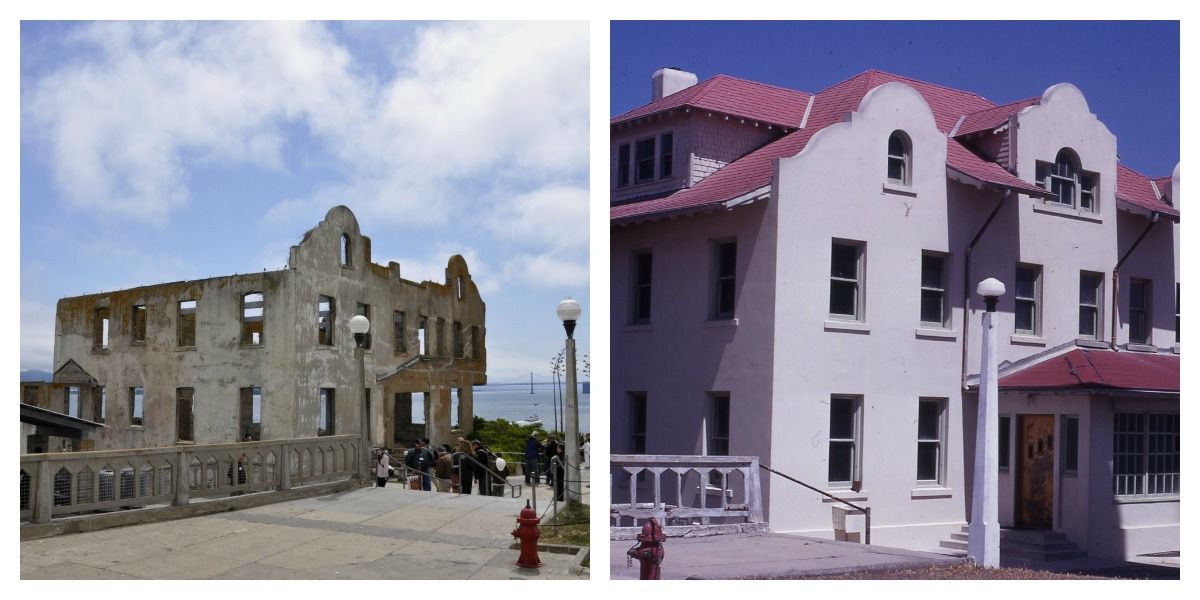
The Warden’s house on Alcatraz as it once looked (right) and as it looks today (left).

I asked how Alcatraz compared to other duty, especially considering that the guards lived with their families alongside the prisoners. Cathy replied, “Well, we could go anywhere but ‘up top’ that’s what we called where the cellhouse was located. The only time we ever went up there was when the warden’s wife had a party and then we were escorted up there and when the party was done, we were escorted back down.” Cathy further stated that the families could travel into San Francisco whenever they wanted. “When we’d go to the grocery store, if they found out we were from Alcatraz, people would just back away from you. They had a big park there and our son would want to go so I’d let him run all over there. When the women found out that we lived on Alcatraz, he couldn’t play with them anymore. The kids didn’t care what the moms said, they’d just play, you know.” Jim recalls, “there was like twelve boats a day” going into San Francisco, “somewhere around here I still have the boat schedule. The last boat ran back at 12:20 am for the guys working midnight shift, if you missed that boat, you were in town all night.”

519kJvKIU8L._SL500_

Criminals, Indianapolis, National Park Service, Pop Culture, Travel

A Hoosier Guard on Alcatraz Part I

Albright-Cantwell-Hunter
NPS Ranger John Cantwell and the author with Jim and Cathy Albright at Alcatraz fpr the 75th anniversary of the prison’s opening on August 11, 2009.

Original publish date:  October 23, 2009                Reissue date:  July 9, 2020


This column was first published 11 years ago. Last weekend, I traveled to Terre Haute to check on it’s subject. Next, week, in Parts 2, 3 & 4, I will bring you up to speed on Jim Albright, the last guard to leave the notorious San Francisco Bay island prison know as “The Rock.”

Alcatraz Federal Penitentiary opened 75 years ago on August 11, 1934. I covered my visit to the “The Rock” in an earlier “Eastside Voice” article. As I stood on the same Alcatraz boat dock that received the likes of Al “Scarface” Capone, George “Machine Gun” Kelly, Alvin “Creepy” Karpis, and Robert Stroud aka “The Birdman of Alcatraz” my attention was caught by a distinguished looking gentleman with what appeared to be a uniform draped over his arm and an Alcatraz prison guard hat in his hand. I asked one of the Park Rangers standing near me what the story was and he identified the man as a former Alcatraz guard from Terre Haute, Indiana and realizing that I was on the island for a story on an Indianapolis inmate, he followed that up with, “Oh yeah, you might want to talk to him. He was the last guard off the island.” I barely heard the last line as I was race walking across the dock towards him.

            As soon as I approached, the man saw my Indiana University hat and immediately extended his hand in a friendly greeting. “Indiana, huh? I’m from Terre Haute” he said, “I’m Jim Albright and I was here for 4 years until the prison closed in 1963.”  He went on to tell me that he gained a unique designation as the last guard off the island when he and his family left on June 22, 1963, over 3 months AFTER the prison closed on March 21, 1963. At that moment, the V.I.P. tram arrived to escort Jim and his lovely wife Catherine up the winding 130 foot hill that covers a steep quarter mile series of roads up to the cell house where Jim was here to sign copies of his book’ “Last Guard Out“.  You can imagine my distress at having just heard and comprehended this tasty nugget as the tram was pulling away. Just as I was contemplating the idea of chasing after the tram to complete the interview, I was whisked away into the bowels of building 64 under the old officer’s quarters that act as the backdrop for arrival.

z EBT-L-ALCATRAZ-0813-10
Alcatraz Island.

            Here I awaited Alcatraz park ranger John Cantwell in what once was a gun port of old “Fortress Alcatraz” with the gun ports still plainly visible in the walls. The building now acts as the Ranger’s research station and library. Cantwell graciously answered all of my questions and then led me on a tour of several areas that are strictly off limits to the general public. A dedicated public servant and a true asset to the National Park Service, Cantwell then took me up to meet up again with Jim and his wife Cathy who were busily autographing copies of the book for guests on the island in the huge new bookstore humorously referred to as the “Alcatraz Wal-Mart” by island employees. It’s interesting to note that the bookstore is located in the basement below the old kitchen, an area previously off limits to visitors probably best remembered by true Alcatraz buffs as the area where inmate / author Jim Quilllen attempted his breakout through the tunnel housing the steam pipes for the cell house. Jim greeted me wearing his original Alcatraz guard’s uniform from head to toe and looking pretty sharp I must say. I don’t know about you, but I don’t think I could fit into the same clothes I wore 20 years ago, let alone 50 years after I wore them.

            Jim and Cathy had driven across country from Terre Haute to San Francisco with their nine grandchildren in tow (complete with sleeping bags & luggage) to attend the 75th anniversary celebration on “The Rock“. The grandkids got the thrill of a lifetime when the whole family spent the night in the cells on “D block” together with the other guests and families attending the official ceremonies. With a sparkle in his eye, Jim told how he made sure the family slept in the cells on the middle tier of D block because “that’s the only tier that you can see all of the San Francisco shoreline from.” He paused for a moment to make sure that I knew it was the first time he’d ever slept in a cell. Jim lamented how he sometimes runs into young people who have never heard of Alcatraz, which is hard to imagine.

            In between autographs, Jim told me the story of his time on Alcatraz. He proudly pointed out that he was hired as a guard 50 years ago that very month (August 1959) as a 24 year old Iowa farm boy with no previous law enforcement experience. He was loading milk cans for Sealtest Dairy in Denver, Colorado when his corrections officer brother-in-law asked if he had ever considered a change of career. Alcatraz sounded a lot more exciting than milk cans, so in 1956 Jim, Cathy and their son Kenneth packed everything they owned into the back of a 1956 Chevy Nomad and drove out to the city by the bay. Jim took one look at the fog covered rock in the middle of San Francisco Bay and wondered what they had gotten themselves into. He was proud of the fact that both of his daughters, Vicki Lynn (Harland) and Donna Sue (Hinzman) were born on the island and their birth certificates list “Alcatraz” as their place of birth.

Albright-Hunters
The author, Jim Albright & Addison Hunter at Alcatraz.

            As Jim signed books, took pictures with guests and chatted with fans, I was able to talk to Cathy about her time on the Island. Most people unfamiliar with Alcatraz do not realize that the families of the guards lived on the island alongside the inmates; although Catherine pointed out that they rarely came into contact with each other. “There were 3 inmates that worked in the mess hall and from our windows we could see the 5 inmates that worked on the dock, but that was about it. Of course, there were no women employed on the island. The only women here were housewives and mothers.” she said. When asked what, if anything, made Alcatraz special, Catherine replied that it was the feeling of “Community” that she remembers most. Everyone knew everyone and there was always someone willing to help whenever you needed it. She remembers that she had one of the girls at 3 am and before she could pack an overnight bag for her trip to the hospital, 2 neighbors were in the apartment to help.

The Albrights remembered that the island had its own grocery store, bowling alley and movie theatre with a new movie showing every Sunday night. Jim & Cathy lived in an apartment in San Francisco for the first 6 weeks while waiting for housing to open up on the island, Cathy remembers that it was hard to find housing in the city by the bay as most apartments would allow pets, but no children. Someone had told the Albrights that the apartments on the island were furnished, so the family sold all of their furniture only to find that, when they moved in, the rooms were bare. Jim smiles broadly when he recalls that rent on the island apartment was $ 27.50 per month and included laundry, dry cleaning and utilities. Along with his uniform, Jim brought along several artifacts from his years on Alcatraz including his 1959 ID card, whistle, leather key strap, Alcatraz key “chit” tag that was exchanged for cell door keys and perhaps most interesting a couple of shiny brass Post / PX / Store tokens from the old military post years. Jim recalled how the launch boat used to dock on the west side of the island where he found the tokens shining in the moonlight in about 6 inches of water near the dock one night.

519kJvKIU8L._SL500_
Jim Albright’s Book.

            Jim then told me the story of how he gained the designation as Alcatraz Island’s “Last Guard Out“. When the prison closed on March 21, 1963, the Albright’s daughter Donna Sue was only 11 days old and suffering from a foot abnormality that required surgery. The child could not be moved in her fragile condition, so the family remained on the island for 3 more months before leaving on June 22, 1963. The Albrights were the only family left on the island aside from a night watchman and a handful of government workers left behind to remove any useful equipment that could be transferred to other prisons or facilities. In late June of 1963, Jim was one of 10 Alcatraz guards handpicked by the Warden to be transferred to the new “Supermax” prison in Marion, Illinois which was built to replace “The Rock“.

            I asked Jim if being known as a former Alcatraz guard carried any weight at other facilities and he quickly replied “Oh, yes. With both guards AND Prisoners.” He remembered how he went from Alcatraz, which had 1 guard for every 3 inmates, to Marion where he worked alone from Midnight to 6 am watching 212 inmates armed only with a telephone in a prison so new that it had no doors on the cells and the containment fence that was supposed to surround the prison was incomplete. “That’s when the Alcatraz reputation made a difference. The inmates just didn’t mess with that.” He said. After Marion, Jim worked for a time at the Federal Prison in Petersburg, Virginia. Jim and Cathy Albright were transferred to the Federal Prison in Terre Haute, Indiana in 1972 and, aside from 4 years spent at a Milan, Michigan facility (1979 to 1983), they’ve been Hoosiers ever since. Jim retired as a Terre Haute Federal Prison guard in 1985.

            It was on a visit to Alcatraz Island in 1998 that Jim’s identity as an Alcatraz treasure was discovered. Jim was visiting “The Rock” as a tourist with his family, having purchased a ticket just like everyone else to visit his old home and workplace. Ranger John Cantwell asked the crowd if there were anyone present with a connection to the island and Jim, humble as always, didn’t say anything. It was Jim’s brother-in-law, John Peters, who finally spoke up to reveal Jim’s past as an Island guard. For years, everyone who knew Jim’s story urged him to write a book, now Ranger Cantwell himself contributed his voice to those urgings. The end result is the 2008 book “Last Guard Out –A riveting account by the last guard to leave Alcatraz” covering Jim Albright’s years of service on “The Rock.”

In case you’re wondering, yes I bought one and gleefully asked Jim & Cathy to sign my copy and date it on that historic 75th anniversary day. Now you will have the same opportunity as I did to meet and talk with Jim and Cathy Albright right here in Irvington. The Albrights will be in Irvington for the Halloween festival, signing copies of his book “Last Guard Out” at Book Mamas book store located at 9 South Johnson Avenue in Irvington from 3 PM to 4 PM on Saturday October 31. Don’t miss this opportunity to meet a true Hoosier legend.

The book’s a great read made even better now that I know the author and his wife. Of course, I would not be true to the “spirit” of this column if I didn’t ask Jim about the ghosts of Alcatraz. Jim thought for a moment and said, “You know, I worked on this Island for 4 years at all hours of the night and day. Midnight, 3 am, 4 am, every possible time slot and I never heard anything that I could call a ghost.” It does make me wonder though, what do you think those 9 grandkids who spent the night in Alcatraz’s legendary spooky cells of D block would say if I asked them the same thing?