

Original publish date: October 23, 2009 Reissue date: July 9, 2020
This column was first published 11 years ago. Last weekend, I traveled to Terre Haute to check on it’s subject. Next, week, in Parts 2, 3 & 4, I will bring you up to speed on Jim Albright, the last guard to leave the notorious San Francisco Bay island prison know as “The Rock.”
Alcatraz Federal Penitentiary opened 75 years ago on August 11, 1934. I covered my visit to the “The Rock” in an earlier “Eastside Voice” article. As I stood on the same Alcatraz boat dock that received the likes of Al “Scarface” Capone, George “Machine Gun” Kelly, Alvin “Creepy” Karpis, and Robert Stroud aka “The Birdman of Alcatraz” my attention was caught by a distinguished looking gentleman with what appeared to be a uniform draped over his arm and an Alcatraz prison guard hat in his hand. I asked one of the Park Rangers standing near me what the story was and he identified the man as a former Alcatraz guard from Terre Haute, Indiana and realizing that I was on the island for a story on an Indianapolis inmate, he followed that up with, “Oh yeah, you might want to talk to him. He was the last guard off the island.” I barely heard the last line as I was race walking across the dock towards him.
As soon as I approached, the man saw my Indiana University hat and immediately extended his hand in a friendly greeting. “Indiana, huh? I’m from Terre Haute” he said, “I’m Jim Albright and I was here for 4 years until the prison closed in 1963.” He went on to tell me that he gained a unique designation as the last guard off the island when he and his family left on June 22, 1963, over 3 months AFTER the prison closed on March 21, 1963. At that moment, the V.I.P. tram arrived to escort Jim and his lovely wife Catherine up the winding 130 foot hill that covers a steep quarter mile series of roads up to the cell house where Jim was here to sign copies of his book’ “Last Guard Out“. You can imagine my distress at having just heard and comprehended this tasty nugget as the tram was pulling away. Just as I was contemplating the idea of chasing after the tram to complete the interview, I was whisked away into the bowels of building 64 under the old officer’s quarters that act as the backdrop for arrival.
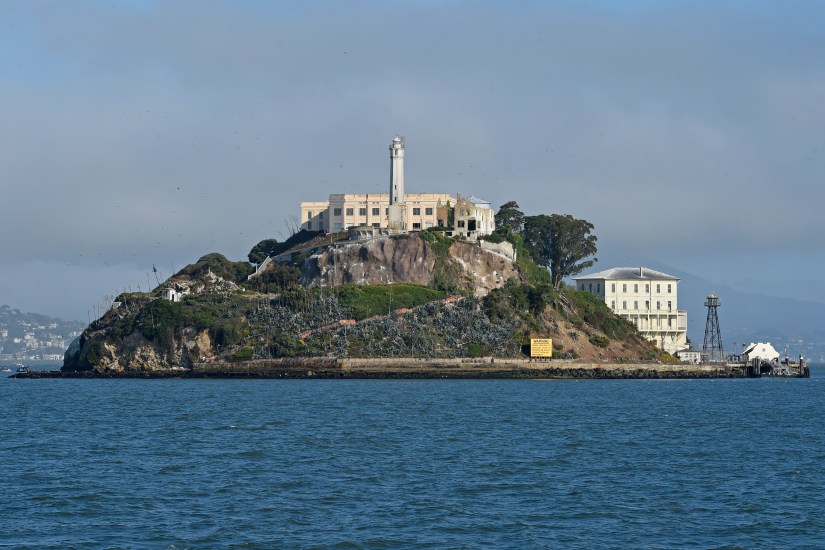
Here I awaited Alcatraz park ranger John Cantwell in what once was a gun port of old “Fortress Alcatraz” with the gun ports still plainly visible in the walls. The building now acts as the Ranger’s research station and library. Cantwell graciously answered all of my questions and then led me on a tour of several areas that are strictly off limits to the general public. A dedicated public servant and a true asset to the National Park Service, Cantwell then took me up to meet up again with Jim and his wife Cathy who were busily autographing copies of the book for guests on the island in the huge new bookstore humorously referred to as the “Alcatraz Wal-Mart” by island employees. It’s interesting to note that the bookstore is located in the basement below the old kitchen, an area previously off limits to visitors probably best remembered by true Alcatraz buffs as the area where inmate / author Jim Quilllen attempted his breakout through the tunnel housing the steam pipes for the cell house. Jim greeted me wearing his original Alcatraz guard’s uniform from head to toe and looking pretty sharp I must say. I don’t know about you, but I don’t think I could fit into the same clothes I wore 20 years ago, let alone 50 years after I wore them.
Jim and Cathy had driven across country from Terre Haute to San Francisco with their nine grandchildren in tow (complete with sleeping bags & luggage) to attend the 75th anniversary celebration on “The Rock“. The grandkids got the thrill of a lifetime when the whole family spent the night in the cells on “D block” together with the other guests and families attending the official ceremonies. With a sparkle in his eye, Jim told how he made sure the family slept in the cells on the middle tier of D block because “that’s the only tier that you can see all of the San Francisco shoreline from.” He paused for a moment to make sure that I knew it was the first time he’d ever slept in a cell. Jim lamented how he sometimes runs into young people who have never heard of Alcatraz, which is hard to imagine.
In between autographs, Jim told me the story of his time on Alcatraz. He proudly pointed out that he was hired as a guard 50 years ago that very month (August 1959) as a 24 year old Iowa farm boy with no previous law enforcement experience. He was loading milk cans for Sealtest Dairy in Denver, Colorado when his corrections officer brother-in-law asked if he had ever considered a change of career. Alcatraz sounded a lot more exciting than milk cans, so in 1956 Jim, Cathy and their son Kenneth packed everything they owned into the back of a 1956 Chevy Nomad and drove out to the city by the bay. Jim took one look at the fog covered rock in the middle of San Francisco Bay and wondered what they had gotten themselves into. He was proud of the fact that both of his daughters, Vicki Lynn (Harland) and Donna Sue (Hinzman) were born on the island and their birth certificates list “Alcatraz” as their place of birth.

As Jim signed books, took pictures with guests and chatted with fans, I was able to talk to Cathy about her time on the Island. Most people unfamiliar with Alcatraz do not realize that the families of the guards lived on the island alongside the inmates; although Catherine pointed out that they rarely came into contact with each other. “There were 3 inmates that worked in the mess hall and from our windows we could see the 5 inmates that worked on the dock, but that was about it. Of course, there were no women employed on the island. The only women here were housewives and mothers.” she said. When asked what, if anything, made Alcatraz special, Catherine replied that it was the feeling of “Community” that she remembers most. Everyone knew everyone and there was always someone willing to help whenever you needed it. She remembers that she had one of the girls at 3 am and before she could pack an overnight bag for her trip to the hospital, 2 neighbors were in the apartment to help.
The Albrights remembered that the island had its own grocery store, bowling alley and movie theatre with a new movie showing every Sunday night. Jim & Cathy lived in an apartment in San Francisco for the first 6 weeks while waiting for housing to open up on the island, Cathy remembers that it was hard to find housing in the city by the bay as most apartments would allow pets, but no children. Someone had told the Albrights that the apartments on the island were furnished, so the family sold all of their furniture only to find that, when they moved in, the rooms were bare. Jim smiles broadly when he recalls that rent on the island apartment was $ 27.50 per month and included laundry, dry cleaning and utilities. Along with his uniform, Jim brought along several artifacts from his years on Alcatraz including his 1959 ID card, whistle, leather key strap, Alcatraz key “chit” tag that was exchanged for cell door keys and perhaps most interesting a couple of shiny brass Post / PX / Store tokens from the old military post years. Jim recalled how the launch boat used to dock on the west side of the island where he found the tokens shining in the moonlight in about 6 inches of water near the dock one night.

Jim then told me the story of how he gained the designation as Alcatraz Island’s “Last Guard Out“. When the prison closed on March 21, 1963, the Albright’s daughter Donna Sue was only 11 days old and suffering from a foot abnormality that required surgery. The child could not be moved in her fragile condition, so the family remained on the island for 3 more months before leaving on June 22, 1963. The Albrights were the only family left on the island aside from a night watchman and a handful of government workers left behind to remove any useful equipment that could be transferred to other prisons or facilities. In late June of 1963, Jim was one of 10 Alcatraz guards handpicked by the Warden to be transferred to the new “Supermax” prison in Marion, Illinois which was built to replace “The Rock“.
I asked Jim if being known as a former Alcatraz guard carried any weight at other facilities and he quickly replied “Oh, yes. With both guards AND Prisoners.” He remembered how he went from Alcatraz, which had 1 guard for every 3 inmates, to Marion where he worked alone from Midnight to 6 am watching 212 inmates armed only with a telephone in a prison so new that it had no doors on the cells and the containment fence that was supposed to surround the prison was incomplete. “That’s when the Alcatraz reputation made a difference. The inmates just didn’t mess with that.” He said. After Marion, Jim worked for a time at the Federal Prison in Petersburg, Virginia. Jim and Cathy Albright were transferred to the Federal Prison in Terre Haute, Indiana in 1972 and, aside from 4 years spent at a Milan, Michigan facility (1979 to 1983), they’ve been Hoosiers ever since. Jim retired as a Terre Haute Federal Prison guard in 1985.
It was on a visit to Alcatraz Island in 1998 that Jim’s identity as an Alcatraz treasure was discovered. Jim was visiting “The Rock” as a tourist with his family, having purchased a ticket just like everyone else to visit his old home and workplace. Ranger John Cantwell asked the crowd if there were anyone present with a connection to the island and Jim, humble as always, didn’t say anything. It was Jim’s brother-in-law, John Peters, who finally spoke up to reveal Jim’s past as an Island guard. For years, everyone who knew Jim’s story urged him to write a book, now Ranger Cantwell himself contributed his voice to those urgings. The end result is the 2008 book “Last Guard Out –A riveting account by the last guard to leave Alcatraz” covering Jim Albright’s years of service on “The Rock.”
In case you’re wondering, yes I bought one and gleefully asked Jim & Cathy to sign my copy and date it on that historic 75th anniversary day. Now you will have the same opportunity as I did to meet and talk with Jim and Cathy Albright right here in Irvington. The Albrights will be in Irvington for the Halloween festival, signing copies of his book “Last Guard Out” at Book Mamas book store located at 9 South Johnson Avenue in Irvington from 3 PM to 4 PM on Saturday October 31. Don’t miss this opportunity to meet a true Hoosier legend.
The book’s a great read made even better now that I know the author and his wife. Of course, I would not be true to the “spirit” of this column if I didn’t ask Jim about the ghosts of Alcatraz. Jim thought for a moment and said, “You know, I worked on this Island for 4 years at all hours of the night and day. Midnight, 3 am, 4 am, every possible time slot and I never heard anything that I could call a ghost.” It does make me wonder though, what do you think those 9 grandkids who spent the night in Alcatraz’s legendary spooky cells of D block would say if I asked them the same thing?

 When animals huddle together in open fields…when ants travel in straight lines (or are unusually active)…when the “Northern Lights” are visible in the sky…when bats cry much, or attempt to fly into the house…when more bees enter than leave the hive (every notice that bees never get caught in a shower?)…when distant bells sound close…when birds skim close to the ground…when boiling water evaporates more rapidly than usual…when dead branches fall to the ground in calm weather…when bubbles rise from marshy ground or appear on pools of stagnant water…
 If coffee bubbles cling to the cup instead of floating in the center…when corns are more painful than usual… when cottonwood trees turn the undersides of their leaves upward…when a cow thumps its ribs, or attempts to scratch its ear, with its tail…when crabs leave the water and remain on land… when cream or milk sours during the night…an old adage states that a new (crescent) moon with horns tilting downward can’t hold water so…when crickets chirp loudly and more persistently than usual… when crows caw loudly and continuously or when a crow is seen flying alone… when curly hair becomes more unruly than usual…
 When grate fires crackle and throw sparks to a greater degree than usual…when fish jump from the water, or swim close to the surface…when oiled floors “sweat”…when flowers stay open all night (and some say when the fragrance is stronger)… when frogs assume a brownish hue and croak louder and longer…when there are two full moons in a single month…when geese are particularly noisy…when glow worms shine brighter…when goats bleat a great deal…
 And lastly, when ordinary salt begins to lump, cake and clog the saltcellar, get ready for rain. According to Morton’s, their salt is not made this way because, “When it rains it pours.” Morton’s explanation: “Because of its unique cube shaped crystals, which tumble off one another in damp weather instead of sticking together like the flake crystals of ordinary salt…every grain is usable-there are no wasteful lumps to throw away. If you have children between 6 and 18, be sure to use the iodized variety and thus protect them simple goiter.” Goiter is a swelling in the neck resulting from an enlarged thyroid gland. Before iodized salt hit the grocery shelves on May 1, 1924, iodine deficiency was the main cause of goiter in the U.S. and even though it has nothing to do with rain, I couldn’t resist throwing that last part in. So much information packed into such a little brochure.


 What we don’t know is how Allie came to the Riley home. Depending on who you talk to, Allie was; a friend of the family, a castoff of the Orphan Train movement (1854-1929), or she was brought to the home by her uncle, John Rittenhouse, who brought the young girl to Greenfield where he “dressed her in black” and “bound her out to earn her board and keep”. Ultimately, Mary Alice was taken in by Captain Reuben Riley as a servant to help his wife Elizabeth with the housework and her four children; John, James, Elva May and Alex.
 When James was eleven, he asked Allie what he would be when he grew up. “Perhaps you’ll be a lawyer, like your father,” she suggested. “Or maybe someday, you’ll be a great poet.” Allie may have been the first to put this idea in James’ mind, but it is known that his mother and father were both gifted storytellers. Riley often shared his vivid childhood recollection of Allie climbing the stairs every night to her lonesome “rafter room” in the attic. And with every careful step leaning down and patting each stair affectionately as she called them by name.
 I, like many fellow Hoosiers, am drawn to this particular poem because it was written to be recited aloud and not necessarily to be read from a page. Written in nineteenth century Hoosier dialect, the words can be difficult to read in modern times. Riley dedicates his poem “to all the little ones,” which immediately gets the attention of his intended audience; children. The alliteration, phonetic intensifiers and onomatopoeia add sing-song effects to the rhymes that become clearer when read aloud. The exclamatory refrain ending each stanza is urgently spoken adding more emphasis as the poem goes on. It is written in first person which makes the poem much more personal. Simply stated, the poem is read exactly as young “Bud” Riley recalled Allie telling it to him when he was a wide-eyed little boy.
 Riley wrote another poem about her titled, “Where Is Mary Alice Smith?” In this poem he depicts the little orphan girl falling in love with a soldier boy who was killed during the war which caused her to die of grief. In truth, after leaving the Riley’s employ, Mary Alice went to work in a Tavern on the National Road in the town of Philadelphia where she met her husband John Gray and their marriage produced seven children.
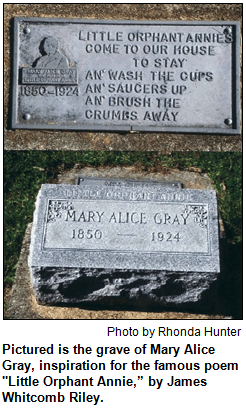
 Jut remember, as you travel out to the old Riley home on U.S. Highway 40 (the old National Road) you’re bound to pass through the remains of a little pike town called Philadelphia. The road starts to rise just past the Philadelphia signpost and there on the right is a small cemetery. Stop your car and walk towards the oldest headstones under the tall trees in back of the old burial ground. It is there that you will find the final resting place of Mary Alice Smith Gray, Riley’s beloved “Little Orphant Annie.” Its best you go before twilight though because should you delay past nightfall, “the Gobble-uns ‘at gits you ef you don’t watch out!”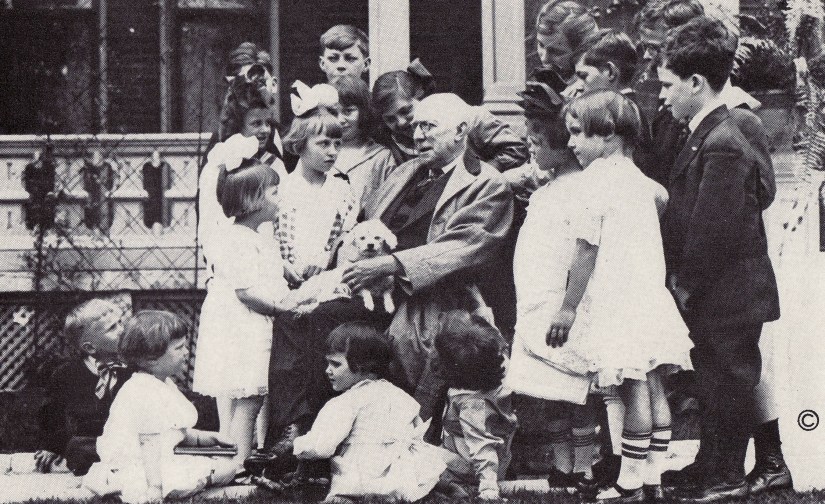

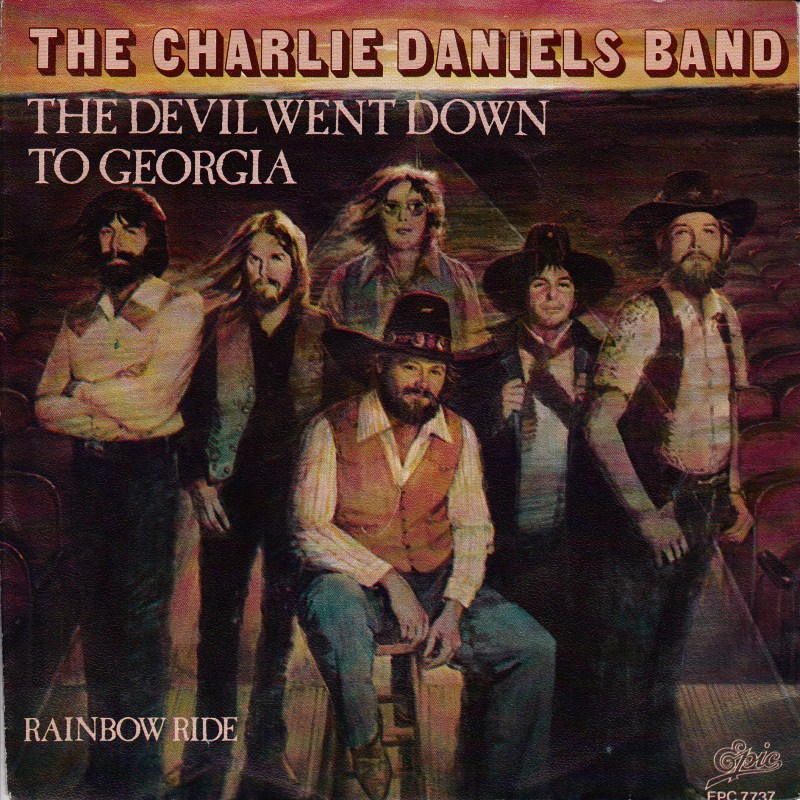 Legend claims this song tells the story of the most famous guitar player you’ve probably never heard of. Robert Johnson was born in Hazelhurst, Mississippi on May 8, 1911. He died under mysterious circumstances 75 years ago this week, on August 16, 1938. Johnson’s life has ascended into legend and it is often hard to separate fact from fiction, where this Mississippi bluesman’s life is concerned.
 Johnson’s haunting, spiritual lyrics survive in songs such as “Cross Road Blues”, “Sweet Home Chicago” and “Me and the Devil Blues”. Robert Johnson’s shortlist of 29 landmark recordings from 1936 & 1937 display a combination of singing, guitar skills, and songwriting talent that influenced future generations of musicians. The American Record Corporation released eleven 78rpm records on their Vocalion label during Johnson¹s lifetime, and one more after his death.
 Contemporaries described him as well mannered, soft spoken, and most often, indecipherable. As for his character, everyone seems to agree that, while he was pleasant and outgoing in public, in private he was reserved and liked to go his own way. Musicians who knew Johnson testified that he was a nice guy and fairly average—except, of course, for his musical talent, his weakness for whiskey and women, and his commitment to the road.
 Johnson’s poorly documented life and shadowy death at age 27, fueled the Faustian myth that he sold his soul to the devil to achieve success. This self-perpetuating legend states that sometime in the early-1930s Johnson strolled down a Clarksdale, Mississippi county road and was stopped at the intersection of highways 61 and 49 by Lucifer himself. It was here that he sold his soul to become the best blues guitarist that ever lived. Robert Johnson actually recorded songs alluding to this legend of the devil’s crossroads, and his untimely death only fed the legend.
 The capstone to Robert Johnson’s legend is cemented by the details of his early death at the age of 27. On the night of Saturday, August 13, 1938, Johnson was playing in a juke joint 15 miles outside of Greenwood, Mississippi when he was allegedly murdered by the jealous husband of a woman with whom he had flirted. In an account by fellow blues legend Sonny Boy Williamson, Johnson had been flirting with a married woman at a dance, where she gave him a bottle of whiskey poisoned (reportedly with strychnine or lye) by her husband. When Johnson took the bottle, Williamson knocked it out of his hand and advised him to never drink from a bottle that he had not personally seen opened. Johnson replied, “Don’t ever knock a bottle out of my hand.”
 Ironically, 75 years ago this week, while Robert Johnson was thrashing back and forth in agony on his deathbed in 1938, Columbia Records producer John H. Hammond was frantically searching for Johnson to book him for the first “From Spirituals to Swing” concert at Carnegie Hall in New York. Robert Johnson’s “Big break” never reached him.

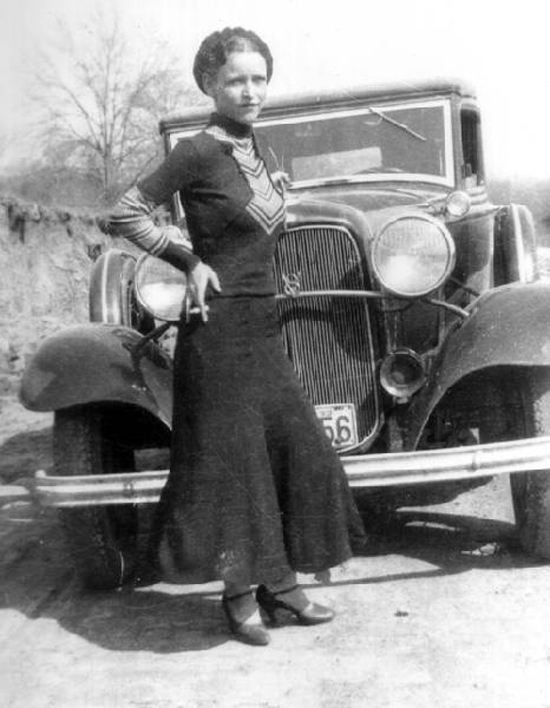
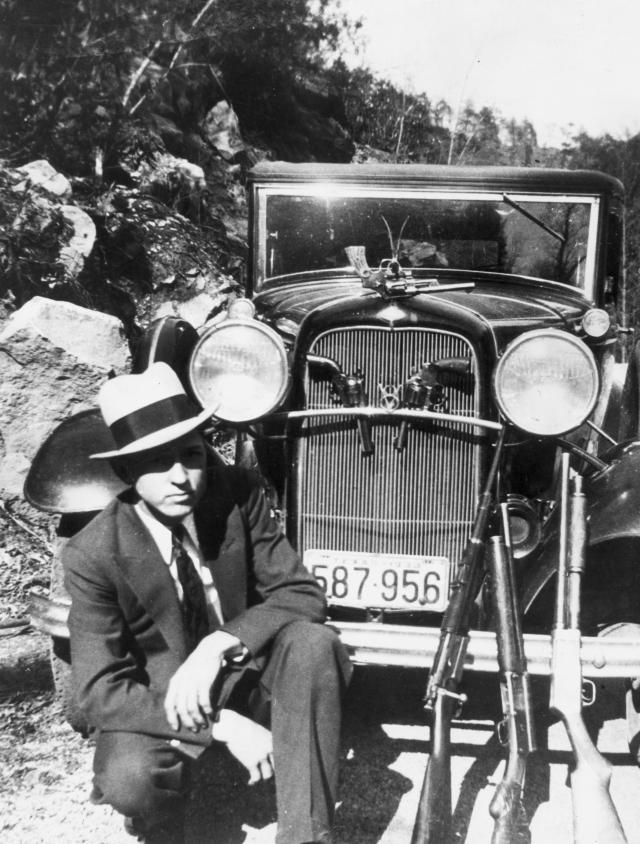 Clyde had an uncanny ability to steal Ford V8 cars and evade the police whenever he was trapped, cornered or surrounded. Clyde claimed that a Ford V8 car could outmaneuver and outrun any police car that attempted to follow him. Additionally, living a life on the run meant that Clyde and Bonnie spent days (or weeks) traveling long distances and sleeping in their car at night. Clyde supposedly preferred Ford V8s because he thought that their bodies were thicker and, thereby, more bullet-resistant. And those famous photos of Bonnie and Clyde mugging, clowning and romancing for the camera, most of them include a Ford V8 in the background.
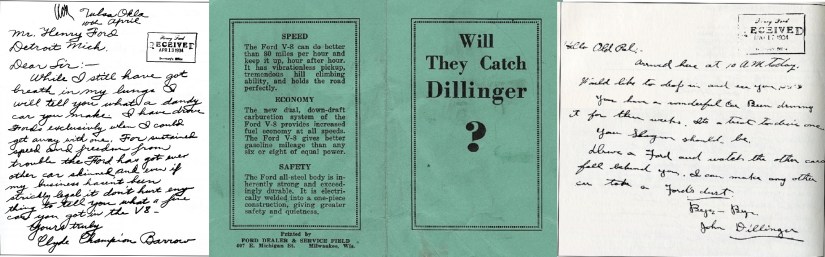
 Clyde Barrow loved the Ford V8 so much that he wrote a letter to Henry Ford in April of 1934 praising the car. Addressed simply to “Mr. Henry Ford Detroit, Mich.” from “Tulsa, Okla. 10th April” the letter, misspellings and all, reads: “Dear Sir:- While I still have got breath in my lungs I will tell you what a dandy car you make. I have drove Fords exclusively when I could get away with one. For sustained speed and freedom from trouble the Ford has got ever other car skinned and even if my business hasen’t been strickly legal it don’t hurt enything to tell you what a fine car you got in the V8- Yours truly, Clyde Champion Barrow” (Clyde Barrow’s middle name was actually Chestnut. He jokingly listed “Champion” as his middle name when he entered the Texas state prison at Huntsville in 1930.)
 Amazingly, after Ford’s secretary failed to recognize the outlaw’s name,a reply was sent on April 18th. The neatly typed letter on the ornate letterhead of the Ford Motor Company reads: “Mr. Clyde Barrow, Tulsa, Oklahoma. Dear Sir: On behalf of Mr. Ford, we wish to acknowledge your letter of April 10 and thank you for your comments regarding the Ford car. H.R. Waddell, Secretary’s Office.” Six weeks later, Bonnie and Clyde were dead. A debate rages to this day as to whether the letter is authentic or not. Regardless, it is a priceless piece of Americana that can often be found on public display at the Henry Ford museum in Dearborn. When Dillinger was asked about Bonnie & Clyde after his capture and incarceration at Crown Point, he responded, “Bonnie & Clyde? Huh, a couple a punks.”
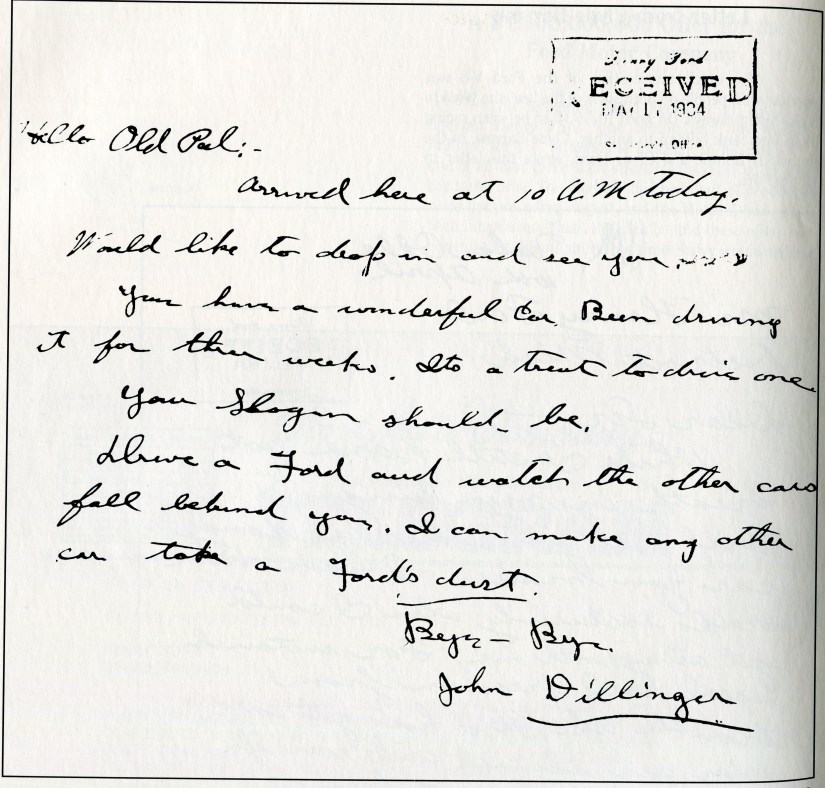 Ironically, a month later, Henry Ford would receive another letter. In May of 1934, a letter arrived from the most famous gangster in the world: John Dillinger. Like the previous letter, this one features the official stamp of the Henry Ford office, dated May 17, 1934. The letter is postmarked from Detroit and, like the Bonnie & Clyde letter, is entirely handwritten. It reads: “Hello Old Pal. Arrived here at 10:00 AM today. Would like to drop in and see you. You have a wonderful car. Been driving it for three weeks. It’s a treat to drive one. Your slogan should be, Drive a Ford and watch the other cars fall behind you. I can make any other car take a Ford’s dust! Bye-Bye, John Dillinger”. The Dillinger gang had just held up the Citizens Commercial Savings Bank in Flint, Michigan, on May 18, 1934. Like the Barrow letter, the authenticity of the letter writer is called into question. A week after this letter was received, Bonnie and Clyde were dead. 67 days later, so was John Dillinger. While Dillinger died in a Chicago Alley next to the Biograph Theater, Clyde Barrow died behind the wheel of his last stolen car: a Ford V8.
 The letter, coming on the heels of the disastrous escape by Dillinger and his gang from the Little Bohemia Lodge in Manitowish Waters, Wisconsin a month before on April 22, inspired a Milwaukee Ford Motor Car dealership to create and distribute a sales brochure asking the question, “Will They Catch John Dillinger?” on the front. When opened, it featured the answer, “Not Until They Get Him Out of a Ford V-8!” with additional info at bottom reading, “NEWS NOTE: John Dillinger evaded capture by making speedy get-away in new Ford V-8 after famous jail break at Crown Point, Indiana. His spectacular get-away from Little Bohemia Resort, Mercer, Wisconsin, was also in a Ford V-8.” The back of the brochure touts the Ford V-8’s “Speed: The Ford V-8 can do better than 80 miles per hour and keep it up, hour after hour. It has vibrationless pickup, tremendous hill climbing ability, and holds the road perfectly.” The “Economy: The new dual down-draft carburetion system of the Ford V-8 provides increased fuel economy at all speeds. The Ford V-8 gives better gasoline mileage than any other six or eight of equal power.” And, perhaps confirming Clyde Barrows assertion, the “Safety: The Ford all-steel body is inherently strong and exceedingly durable. It is electrically welded into a one-piece construction, giving greater safety and quietness.” The brochure concludes with the dealership name and address at 407 E. Michigan Street in Milwaukee, Wisconsin.
 Alan E. Hunter