animals, Disney, Pop Culture

The Feral Cats of Disneyland.

disney cats       Original publish date:  December 7, 2013

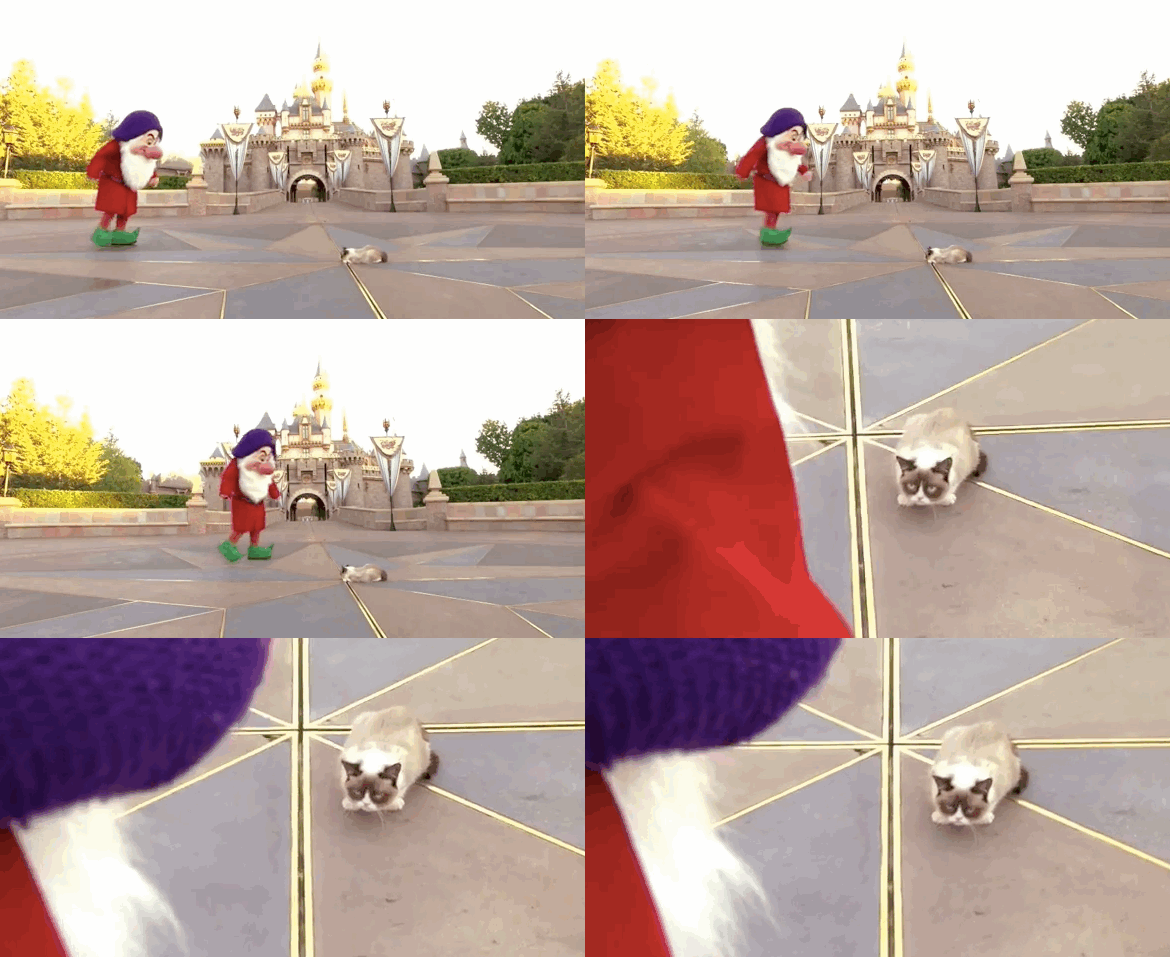
At last count, there were 35 official Walt Disney cats. Figaro, Lucifer, Cheshire, Bagheera, Shere Khan, Thomas O’Malley, Duchess, Tigger, Rufus, Oliver, Dinah, Mufasa, Simba, Nala, Scar, all of those Aristocats and who can forget Si and Am from Lady and the Tramp? “We are Siamese if you please.” There’s an ear-worm for the rest of your day. No doubt, some of those cat names sound familiar while others ring silent in your mind. But do you know about the feral cats of Disneyland?
Every night at the California Disneyland theme park, after the bedraggled parents head for the exits with their sunburned children in tow, after the exhausted employees (Disneyland calls them “cast members”) have headed for home, the park fills up again, this time, with some 200 hundred feral cats. Never heard of a feral cat? A feral cat is a domestic cat that has returned to the wild. A feral cat is different from a stray cat, which is defined as a cat that has been lost or abandoned, while feral cats are born in the wild. Although the offspring of a stray cat can be considered feral if born in the wild.
When Disneyland opened over a half century ago in 1955, the location was then a rural suburb of Los Angeles called Anaheim. An area best known for producing oranges for juice and grapes for wine with a population under 15,000 people. It quickly grew to over 100,000 by 1960 and today it’s population numbers over 350,000. As the town quickly became a city the pet population grew accordingly. Almost from the start, feral cats began to gather behind the gates of the Magic Kingdom. Many factors contributed to this frenzied feline phenomenon; safety, shelter, community, but mostly food.
In the earliest days of the park, things were quite different than they are today. True, the park employed dozens of “cast members” to pick up trash back in the day, but the emphasis was on ride cleanliness back then rather than the meticulous state of grounds keeping we can see today. During renovation of the Sleeping Beauty castle two years after Disneyland opened, more than 100 cats were found living in the unused portion. Worse yet, a colony of fleas permeated the area as well.
No doubt, these feral cats were first drawn to Disneyland by the discarded scraps of food left behind on park grounds by guests, but the cat population stayed for another reason: Mice. Ironic when you consider the entire Walt Disney juggernaut was built around a mouse. While Mickey Mouse may have put Disneyland on the map, a colony of feral cats helps keep the famous theme park rodent-free. The cats were first drawn to a long forgotten “lost” land of Disneyland known as “Holidayland.” Operating from 1957 to 1961, Holidayland was a 9-acre grassy picnic area located along the western edge of Disneyland, near the area that is now New Orleans Square.
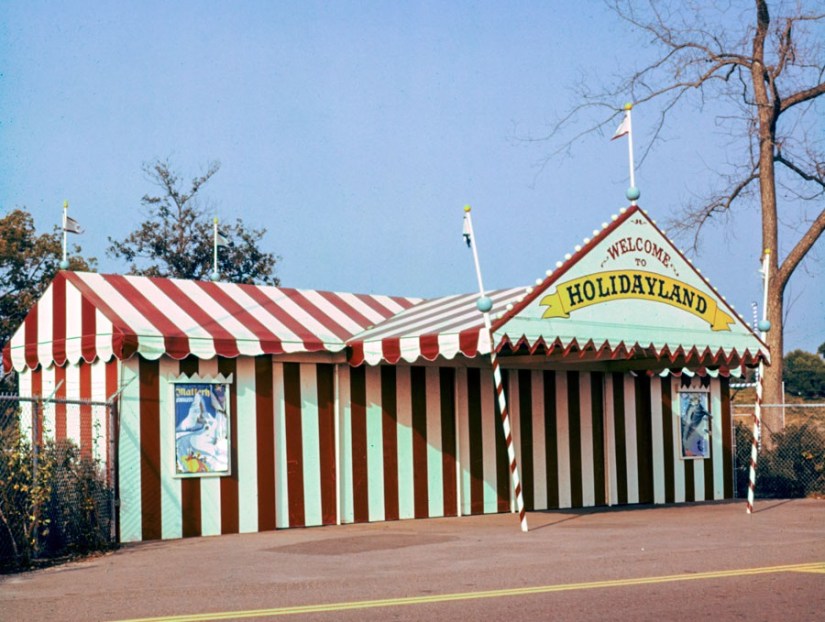
SteveC_LgT_Holiday1Holidayland had its own admission gate into Disneyland and could hold up to 7,000 guests for large events. It featured playgrounds, horseshoes, a baseball diamond, volleyball courts and other activities. The centerpiece was billed as “the world’s largest candy-striped circus tent” which had previously been used by the short-lived.Mickey Mouse Club Circus and Keller’s Jungle Killers attractions inside the original Disneyland theme park. Food and concessions were available for purchase in Holidayland including beer, which was not available inside the gates of Disneyland.
Despite providing alcohol for the relief of sun-scorched adults, Holidayland floundered, and eventually failed, after only 4 years due to its lack of shade, absence of nighttime lighting and the unsettling thought that it had no restrooms. Did I mention they sold beer? Today, the former location of Holidayland houses part of the Haunted Mansion and Pirates of the Caribbean rides. But back then, when the picnickers left, the feral cats were now left to meander new regions of the Magic Kingdom.
Holidayland1  At first, the cats were considered to be a bit of a nuisance and a possible threat to the guests. Attempts to control, cajole or coax the cats proved futile. After all, these were non-paying guests and Uncle Walt was simply not going to stand for that. So, rather than try to evict them, Disneyland decided to employ them. Soon, the cats became an integral part of the park’s everyday operations.
But don’t expect to spot one on your next visit as they hide during the daytime. The cats are free to come and go as they please, but only at night. The cats join the 600 custodians, painters, gardeners and decorators who work through the night to ensure that the world’s best known theme park meets the squeaky-clean ideals that Walt Disney himself extolled so many years ago. The cats work alongside a human crew that works 365 nights a year, toiling under portable floodlights sprucing, fixing and adjusting this city that never sleeps.
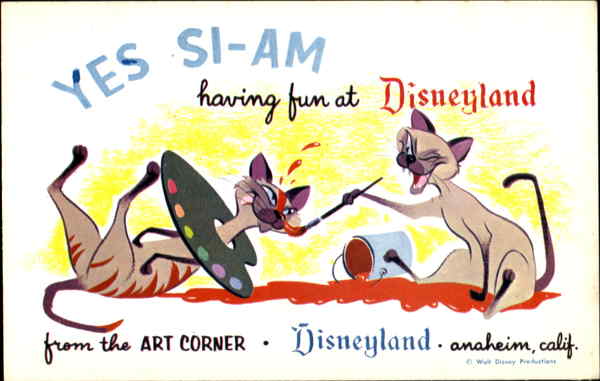
Siamese Cats             Just as the feral cats of Disneyland have their own specific job, every nighttime worker has his own specific task. Three workers are responsible solely for repairing and replacing the 800 umbrellas, 25,000 chairs and about 7,000 tables in the restaurants and snack bars in Disneyland and neighboring California Adventure Park. Four certified divers collect submerged trash and make repairs on water attractions like Finding Nemo and the Jungle Cruise. The work can often be tedious and occasionally bizarre.
All of the recorded music and sounds heard in the rides and throughout the park runs continuously on a loop. Seems that it is more costly for Disneyland to shut the sound off then to restart the system every day. The only time the sound is shut off is when there is an Emergency such as a massive power loss or emergency shut downs. For example, in “It’s a small world” the dolls stop moving, but the music plays on. Inside the Haunted Mansion, the doom buggies stop but the animatronics still move and the voice-over continues. Luckily the cleaning and maintenance crews can turn it down so they won’t go mad, but the feral cats don’t seem to mind.
Seven years ago, reportedly at the urging of former “Price is Right” host Bob Barker, animal care staff at the park took it upon themselves to do right by their feline employees by instituting a preventative health program of Trap-Neuter-Return”. Aided by local organizations including FixNation, Disneyland developed a lasting protocol for the humane care of the resort’s cats. Although Disneyland doesn’t monitor the total number of cats, the program has been quite successful at adopting out kittens and maintaining a balance between cat population and their Disneyland environment.
After the cats are neutered and returned to the park grounds, they receive continuing managed care. Its a pretty good gig to be a Disney-employed mouser. During the day, the feral cats of Disneyland lounge around and dine at five discreet feeding stations hidden throughout the resort strategically situated to minimize interaction with resort guests. During orientation Disney cast members are instructed to never pet the cats.
It’s nice to see such a high-profile park treating all its visitors and employees humanely-not just the human ones. California Disneyland’s “TNR” program proves that organizations and feral cat colonies can not only peacefully share the same property, but also work together in a mutually beneficial relationship to improve conditions for both parties. You may wonder, does Disneyworld in Orlando, Florida have the same problem? Well, although there have been occasional cat sightings at the Sunshine State’s Magic Kingdom, Disney Orlando has one thing Disney California doesn’t: alligators.
A story circulates that Disneyland changed its stance on the interloping cats based on an incident from those first couple years of operation. Those first original Disneyland feral cats supposedly migrated from an adjacent trailer park. During this time there was a sweet cat that hung out at the ranch in Frontierland. Employees nicknamed the female cat “Roofie” as she often hung out on the roof and surrounding landscape of the “Crockett and Russel Hat Co.” storefront. Employees would routinely bring canned cat food for her and she would come out of the tall grass, sometimes even dropping a mouse she had caught since she liked the canned food more. One day employees noticed that roofie was very ill. After work, they placed her in a box and rushed her to a nearby vet’s office. She died on the way. The vet examined her and said she died from eating poisoned mice. Word got back to Uncle Walt and the policy was changed.
Finally, proof that feral cats can be useful and worthy of life; not simply un-tamable animals for our overtaxed shelters to destroy. Many shelters in the Western US give them to ranchers and farmers for use as barn cats and back in the day police stations and college campuses kept a few around to keep their rodent population down without resorting to the use of chemicals and rodent traps everywhere. Maybe in 2014, the world will take the lead of Walt Disney and his feral cats of Disneyland.
If you would like more information on the feral cats of Indianapolis, please contact the good folks at Indy Feral. Give them a call at (317) 638-3223 or check out their website at http://www.indyferal.org/. Their Mission is to reduce the stray and feral cat overpopulation of our fair city through the non-lethal Trap-Neuter-Return (TNR) method. They could use your help and support, or they would just love to hear from you.DisneyCats
Abe Lincoln, Auctions, Gettysburg, Pop Culture

The Gettysburg Wax Museum Auction.

Wax MuseumOriginal publish date:  March 20, 2014

Seeking escape from the coldest, harshest winter in recent memory, I sought escape by attending a liquidation auction at an iconic baby boomer tourist landmark on the site of America’s greatest battlefield; The Gettysburg Wax Museum in Pennsylvania. Aware of my penchant for tourist traps and knowing that the museum was built the year I was born (1962), despite my reservations, she decreed “You’re going.”
Known as “The National Civil War Wax Museum”, the site at 297 Steinwehr Avenue opened April 19, 1962. That week Walter Cronkite took over as CBS anchorman, Bob Dylan performed “Blowin’ in the Wind” for the first time in Greenwich Village, the Boston Celtics won their fourth straight NBA championship, the Seattle World’s Fair opened and Indy 500 champion Al Unser Jr. was born (on the museum’s opening day). The original Museum featured 35 scenes containing over 150 individual figures highlighting the Civil War and Gettysburg. The museum’s purpose was not only to entertain but to educate.
IMG_0520On Saturday, March 15th the museum’s contents were sold to the public at auction. The sale included 95 Civil War wax figures and the accouterments used to illustrate each scene. In it’s half century of service the museum saw over 8 million visitors walk through the turnstiles, now lot # 265 in this very special auction.
Although I had been in the museum many times over the past 25 years, it was a shock to now see the building gutted and lain bare. Most of the auction lots were arranged in the scenes where they had “lived” for the past half-century. It seemed strange to now step into the scenes to get a closer view of the lifelike depictions from the pages of history. These forms thast were gazed upon by untold generations of visitors including presidents, diplomats, dignitaries and just plain folk from every walk of life.
I met 19-year wax museum employee Stephanie Lightner while walking the halls among the ghostly figures. She is the manager of the new museum that will soon be open there. Stephanie says the building was purchased by a New Jersey man who had grown up in Gettysburg and that the facility was being retooled to better accommodate a new generation of visitors. “We’ll be keeping some of the exhibits to display in the new museum,” said Stephanie. She said that the new owner kept all of the staff from the Wax Museum, always a good thing. The new museum, known as the “Gettysburg Heritage Center”, is set to open in late April but as Stephanie smilingly admits, “It might be Memorial Day at this point.”
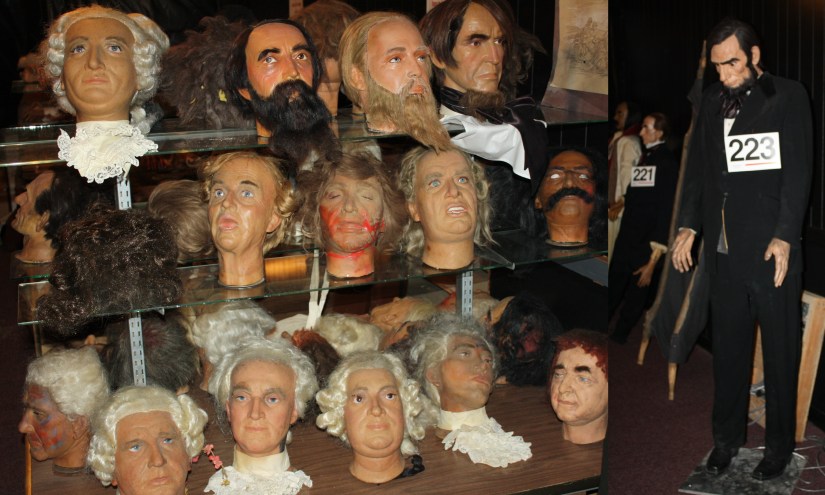
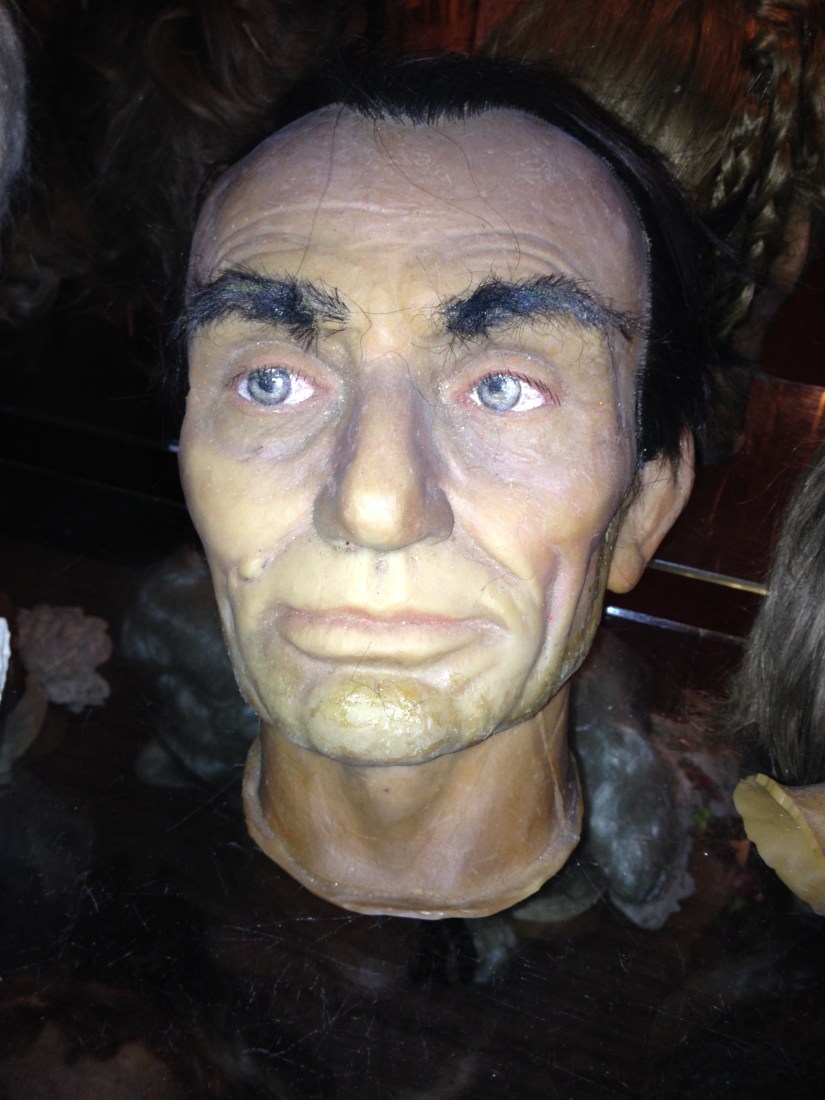
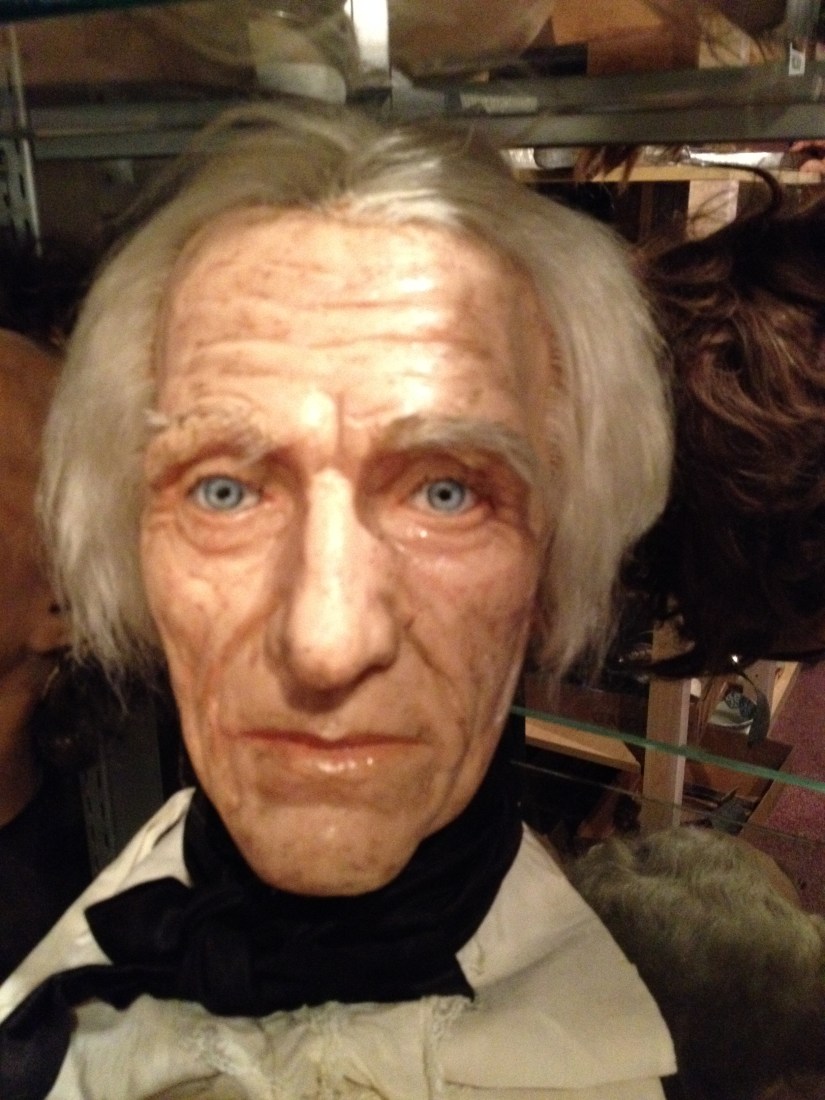
IMG_0521As I finished perusing the auction lots, I halted at an area tucked away in a back corner of the hall. This dimly lit crook featured tiered shelves upon which rested approximately 40 disembodied heads. Some of the heads were recognizable to me; Abraham Lincoln, Andrew Jackson. On a shelf nearby lay a pile of arms, legs and hands. Some of these body parts, in keeping with the brutality of the Civil War, were spattered with blood stains. Seeing these, I turned to my wife and said “Now these have the potential to go sky high.”
Officially, the auction featured 335 official lots but that number would balloon to over 400 by close of sale. The crowd quickly ballooned to standing room only. It was a strange mix of Civil War re-enactors, Harley dude’s and local Pennsylvania Dutchmen. I spotted a few ghost hunter types in the crowd as well, no doubt hoping to score a disembodied head, bloodstained arm or broken hand should the opportunity arise. I saw some familiar faces, among them Gettysburg’s former Abe Lincoln, Bill Ciampo, who told me, “I just came to see if there was a market for this stuff. When I sold my Lincoln wax statue, I sold it for $500 just to get rid of it.” Ciampo walked up to the Lincoln figures (the museum had three full Lincoln figures and one head) and said, “See, their chins are already drooping, that’s why I got rid of mine.”
IMG_0523The synchronicity of the moment was not lost on me as, outside just yards away, bulldozers busily cleared out the massive football field sized blacktop parking lot. It had once served the old visitor’s center (torn down in 2008) and Cyclorama building, built the same year as the wax museum and torn down in March 2013. In the past 25 years I watched as other tourist landmarks disappeared from the borough including the Lincoln Room Museum, The National Tower, and now, the Wax Museum.
Also among the crowd was Erik L. Dorr, curator and owner of “The Gettysburg Museum of History” at 219 Baltimore Street. Erik painstakingly maintains his fantastic personal collection of relics from the Battle and the pages of American history within the walls of his ancestral family home. “The house was built in the 1850s and has been in my family for four generations. It was extensively remodeled in 1867 and again in the early 1900s.” said Dorr.
On this day, Mr. Dorr was searching for additions to his massive collection. “I’m running out of room at my Museum now. I actually tried to buy the whole Wax Museum, including the contents, land and building. I thought it would be a fun experiment and I was getting financing in order but it didn’t fall into place fast enough and the museum sold.” says Dorr, “I would have kept the wax museum intact as much as possible while adding my collection to it.” Among the items he bid on and won were the Jenny Wade, George Armstrong Custer and John Wilkes Booth wax statues. He also bought many of the signs including the iconic interior entryway sign that lit up to indicate when the next group should enter.
“I bought most of the Jenny Wade booth with the idea of recreating it in my museum.” Dorr remarked. “As it stands now, I’ll have to display the statues one at a time because of space limitations.” Mr. Dorr reports that he is actively looking for a new space to house his collection, “I could get a place just outside of the town limits, but I want it to stay in the borough of Gettysburg.” Currently Dorr, the consummate historian, is busy making plans to attend the 70th anniversary of the D-Day invasion at Normandy in early June as an invited guest. “They’re calling this the last reunion.” he says, “The trip is pretty brutal and most of the vets won’t make it to the 75th.” But that’s a story for a future column.
Seated nearby were a young couple whom I met by taking a photo of them proudly displaying their bidder number. Turns out this couple was Scott and Lori Hilts from Arcade New York. They live on an 1850s dairy farm and Scott has converted the barn into a museum dedicated to the battle of Gettysburg. In a familiar refrain, Scott admits, “I’m running out of room. It’s 40’by 80′, but I might have to expand.”
Scott, owner and operator of 2 funeral homes, proudly traces his roots back to Corp. John Christ of Co. E 136th New York State volunteer infantry who was wounded on the mystical third day at Gettysburg. “I bought the (Robert E.) Lee and (George) Meade figures because I felt they were the ones most identified with Gettysburg,” Hilts said, “but I bought some paintings and signs too. Since I bought the Lee-Longstreet conference painting, I went ahead and bought the General James Longstreet figure too.” He also bought a colorful Zouave soldier to represent the many ethnic troops that fought at Gettysburg and to honor his home state.
I asked Lori about Scott’s Gettysburg obsession and she explained that she was “fine with it and it keeps him out of trouble.” She admitted that when Scott told her of his plans to purchase a wax figure or two, she thought the idea was “strange” and her biggest fear was running into one of them in the middle of the night. “As long as they stay in his man cave, then I guess it’s all right.” Besides, Lori reports that she found a Steiff “center stitched teddy bear” the next day at an antique show in nearby New Oxford so, “It was a good tip for me too.”
Scott, an arduous collector whose specialty is images, letters and diaries of soldiers killed, wounded or held as POWs at Gettysburg, loves nothing better than researching every item he adds to his collection. Over the years I have found that it is often collectors like Scott who are most dedicated to the preservation, protection and promotion of history. Scott Hilts is one of those new breed “collector as curator / preservationists.”
By my count the auction grossed just over $ 100,000, a figure that does not reflect the 10% buyers premium. There were over 350 registered bidders from as far away as Los Angeles. You might think it would be one of the statues that brought the most money at the sale. But the top lot was # 317, a rare Singer sewing machine made in 1846, that brought $5775 and a round of applause from the crowd. The famous General figures, and those of Jennie Wade and Jesus Christ, all landed in the $1000 neighborhood. The Lincoln figures sold for upwards of $2000 each. But many of the lots receiving spirited bidding included the furniture, wall hangings, and artwork that adorned the scenes. Items that went largely unnoticed by museum visitors focused solely on the statues. Civil War military equipment and uniforms used to adorn the wax figures (swords, belts, hats, saddles, and bayonets) all sold well.
A personal favorite was the larger-than-life animated figure of Abraham Lincoln, for years the closing scene for the Museum. This figure moved ever so slightly to the cadence of The Gettysburg Address, or at least it used to. Now the figure looked rather sad, more resembling the Addams family Lurch character than our 16th President. The $ 2200 winning bid came via phone. I couldn’t help but wonder if the bidder would’ve been half as exuberant had they been there to view the statue in person. Oh, and that turnstile I mentioned before, it sold for $ 495. A pittance when you consider the aggregate humanity that hip-checked their way past its mechanical tentacles.
After the last lot was hammered down, I asked Erik Dorr if there were any surprises or regrets at the auction. “I thought most stuff went as expected, but some lots went higher than I would’ve guessed. I knew the Gettysburg lots would go high and recognized many local collectors in the crowd. But it seemed like they waited, bid on the lot they wanted, and left, which might’ve actually helped me.” Dorr said “I wanted to bid on one of the paintings or the Lincolns, but couldn’t justify the high price. I noticed that after the sale, all of the Lincoln statues were grouped together waiting for shipment. I suspect that they were all sold to the same bidder and that they might have actually sold for more had bidding continued.”
When I posed the same question to Scott Hilts, he responded, “I thought things went very reasonably, not cheap, but lower than I expected.” As for regrets, he says, “I wish I’d have bought the George Pickett figure. It only sold for $ 700. I should have bought more of the paintings too.” Scott offers perhaps the most touching observations of the day by saying, “I first came to this museum when I was 8-years-old. I brought my son Derron here when he was the same age. (Scott has 3 daughters too). Now Derron is graduating from Fredonia State University this June. My Great-Great-Grandfather was wounded where those bulldozers are working right now. In fact, he may well have received his wound right here where the museum sits. He was here that’s for sure.” Scott Hilts love for Gettysburg is deeply rooted.
IMG_0519Undoubtedly the happiest person in the room that day was a young woman named Kim Yates. She was hard to miss. Towards the end of the auction she bid on, and won, the last wax figure in the catalog. Suddenly, the previously sedate young lady began to scream wildly and jump around the room. One of the ringmen sidled over to me, after noting the look of obvious surprise on my face, and whispered, “She’s never bid in an auction before.”
Within moments, that same ringman rolled out those uncatalogued body parts. The Lincoln head sold for $330, then Andy Jackson’s head brought $275, followed by several more disembodied heads sporting powdered wigs sold for $ 250 each. Then it was down to the bloodied heads. Suddenly Kim Yates sprang to the front of the room and began bidding on the grisly remains faster than the ringmen could keep up with. After all was finished and the last lot hammered down, Kim told me, “I bought 6 heads, 4 torsos, a sword and a whole bunch of hands and arms.” Turns out that Kim runs a haunted attraction near Baltimore known as “Kim’s Krypt”, scheduled to open that very night. “My only worry is getting them back in time to display them tonight.” Who knew that props from one of Gettysburg’s most esteemed museums would someday end up in a haunted house? I told you those body parts would go crazy.

As you can see in this clip, I nearly owned this sign (the ring-man is pointing at me). Instead, it went to Eric Dorr’s museum in Gettysburg. A suitable place.

Ghosts, Hollywood, Pop Culture

Clifton Webb’s Ghost-Forgotten Hoosier Hollywood Icon

webb1Original publish date:  November 9, 2008

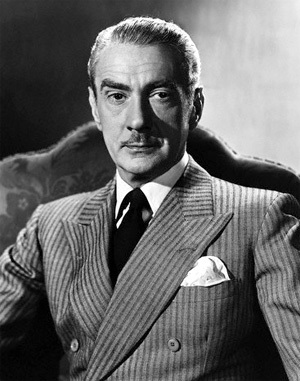
If you’re a fan of the Golden Age of Hollywood, then you should recognize the name Clifton Webb. If you’ve never heard of him, but consider yourself a fan of old Hollywood movies, don’t despair as you’ve probably seen Webb in one of his many old movies or television appearances made during his long career in Tinseltown. He’s one of those great character actors whose face is very familiar but whose name escapes us. So great in fact that he was nominated for 3 Academy Awards and 2 Golden Globe awards ( winning one in 1946) during his career. His story is sadly sweet.

If you’re a fan of the Golden Age of Hollywood, then you should recognize the name Clifton Webb. If you’ve never heard of him, but consider yourself a fan of old Hollywood movies, don’t despair as you’ve probably seen Webb in one of his many old movies or television appearances made during his long career in Tinseltown. He’s one of those great character actors whose face is very familiar but whose name escapes us. So great in fact that he was nominated for 3 Academy Awards and 2 Golden Globe awards ( winning one in 1946) during his career. His story is sadly sweet.  Clifton Webb was born Webb Parmelee Hollenbeck to a multi-generational Hoosier farming family in Marion County on November 19, 1889. If you find a biography on Mr. Webb, it will most likely claim that he was born in Beech Grove. However that information proves faulty when you realize that Beech Grove wasn’t formed as a community until after he was born. Beech Grove as we know it was not formed until 1906. Before that time it was known as a region known for the many Beech trees that populated the area. The town of Beech Grove was formed when the Big Four railroad began to use it as a hub during the early 1900s.

It’s much more accurate to say that Clifton Webb was born nearer to Brookville Road in the South eastern area of Marion County. So it’s accurate to say that Webb started life as an east-sider. However, he did not stay long. Webb’s father, Jacob Grant Hollenbeck (1867-1939) , was an Indiana farmer and sometime green grocer. His domineering mother, Maybelle A. Parmelee (1869-1960) was the daughter of a railroad conductor. Maybelle insisted that her “Little Webb” keep her family name along with that of Webb’s father. She moved with her “little Webb” to New York City after her husband’s job as a ticket taker did not suit her plans for her son’s career advancement in the theater.

Maybelle was known to tell anyone she came in contact with the “We never speak of him. He didn’t care for the theater.” Maybelle had “little Webb” enrolled in singing, dancing, & acting classes in New York City by the age of 5. Maybelle was an effective and aggressive stage mother who managed to get “little Webb” his stage debut at Carnegie Hall at the age of only 7 in a play called “The Brownies”. Webb was so effective in this first role that he was signed up to tour with a traveling vaudeville acting troupe. Shortly afterwards he was tapped for lead roles as Tom Sawyer and Oliver Twist. Maybelle kept “little Webb” busy between performances with painting and opera lessons. Webb quite school by the age of 13. He was performing opera solos on stage by the age of 17.

By the age of 19, Webb had dropped both the Parmelee and Hollenbeck names and adopted the stage name we know as “Clifton Webb”. He was performing regularly on Broadway and it was not unusual to find his mother Maybelle’s name listed in the playbill along with her “little Webb” as a minor scene player or extra. During this period, Webb co-starred with legends like Will Rogers and Al Jolson in plays and musicals written by luminaries like Cole Porter, Irving Berlin, Oscar Wilde, Noel Coward, the Gershwins and Jerome Kern. Webb received billing above Humphrey Bogart in Bogie’s first stage performance. Although he appeared in a few silent films in the 1920s, he stuck to Broadway until 1944.

webbclifton01Webb was tapped by director Otto Preminger to appear in the classic “Laura” alongside Gene Tierney. He would receive his first Oscar nomination for this appearance, even though he was relatively unknown to movie fans. 2 years later in 1946 he again starred with Tierney in the cult classic film “The Razor’s Edge”. He received his second Oscar nomination for this role. Webb’s created the lasting character “Mr. Belvedere” in 1949 for the film “Sitting Pretty” and would reprise the role 2 more times. This character would earn him his third and final Academy Award nomination. This same “Mr. Belvedere” character would be retooled as a TV show and played by 4 different actors from the 1950s thru the 1980s.
Some of Webb’s other films (He made 25 films in all) include: “The Dark Corner” in 1946, “Cheaper by the Dozen” with Myrna Loy in 1950, “For Heaven’s Sake” in 1950, “Dreamboat” in 1952, “Woman’s World” in 1954, “Titanic” in 1954 (He played Barbara Stanwyck’s doomed husband), “Three Coins in a Fountain” (1954), “The Man Who Never Was” in 1956, “Boy on a Dolphin” (1957), and “The Remarkable Mr. Pennypacker” in 1959. It’s been claimed that Webb’s real life persona was most like that of his “Mr. Belvedere” character, described as being somewhat of a “Sophisticated, stuffy, effete snob” by some who knew him. It was no secret that Clifton Webb was gay. This at a time in Hollywood when it was an unwritten rule in Tinseltown to “Don’t ask, don’t tell”.

Clifton Webb’s elegant style landed him on Hollywood’s best dressed list for decades. Webb was the subject of many great stories and quotes in Hollywood. One of comic Bob Newhart’s favorite stories is to relate how while he was a young & naive star in Hollywood at one of his first exclusive parties, Clifton Webb approached this wide eyed newcomer and startled Newhart by asking him if he wanted to dance. Despite this obvious frankness, Clifton Webb managed to keep his personal life out of the Hollywood tabloids. Although the rumor in late 1950’s Hollywood was that Webb was once romantically linked with fellow Hoosier icon James Dean. It was widely known that Webb openly flirted with young, good looking men at parties in Hollywood, taking satisfaction in garnering more attention from them than the women in the room.

However, this is all unsubstantiated Hollywood gossip. Webb was never seriously linked to anyone in Hollywood, male or female. He never married. This is at least due in part to his abnormally close relationship with his mother, who seemed to be the sole object of Webb’s tenderness and love. She lived with her son until her death at age 91 in 1960. Webb was distraught. So much so that his friend Noel Coward tried to get him to snap out of the deep depression months after her death by telling Webb, “It must be difficult to be orphaned at 70, Clifton.” As for trivia, cartoonist Jay Ward claimed that he modeled the “Peabody” character from the Rocky & Bullwinkle show on Clifton Webb.

Direct quotes attributed to Webb include, when speaking of his alternative lifestyle, he said “It’s never morals, it’s manners.” and “You can be rich and dull or poor and amusing–but you must always contribute something to the community.” On the subject of wearing a partially exposed handkerchief in a suit jacket pocket, Webb said “Never pointed, never square…it should always be, of course, pear shaped.”

Clifton Webb never really recovered from the loss of his mother and his health began to suffer for it. He reportedly locked her room and refused to remove her belongings, choosing instead to leave everything just as he left it. He spent the last 5 years of his life as a sad, lonely recluse in his Beverly Hills home. Sadly, upon her death he slipped into a prolonged period of denial and depression going so far as to contact dozens of clairvoyants and spirit mediums in an effort to contact the spirit of his dead mother. One of these mediums was the former Blonde Bombshell star Mae West, who was herself known for a powerful spiritually intuitive gift of communicating with the spirits of the dead.

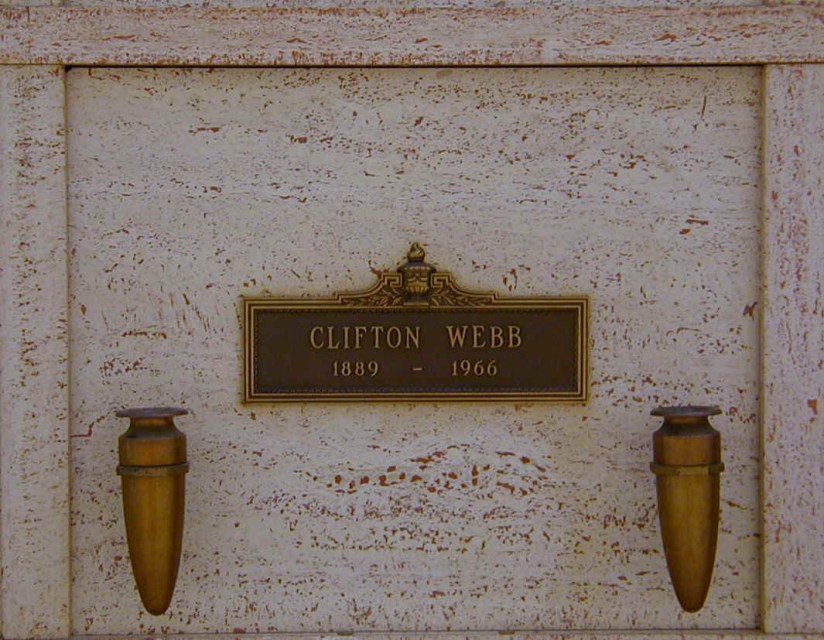
Clifton Webb died of a heart attack on October  13, 1966 at the age of 76. He was awarded his own star on the Hollywood walk of fame. It’s located at 6840 Hollywood Blvd. He was interred in a burial vault at Hollywood Forever Cemetery. His is crypt 2350, Corridor G-6 in the Abbey of Psalms. Why so much detail about Webb’s burial spot? Because it’s rumored to be haunted by Webb himself.

Rarely will you find accounts of ghosts “haunting” their gravesites, but Clifton Webb is the exception to this general rule. Clifton Webb’s restless spirit has been seen haunting the crypt in the section known as “The Sanctuary of Peace” where his mortal remains were laid to rest. Mr. Webb is always seen fastidiously dressed in his dapper suit and sometimes has been known to startle visitors by yelling at them in his distinctive voice. There are even a few accounts of Mr. Webb haunting his old house at 1005 Rexford Drive in Beverly Hills before it was torn down many years ago. It has been claimed that the reason for his haunting is his reluctance to relinquish his fame and the fear that his legacy might be forgotten. The precursor for these ghostly visits by Webb in his burial vaults is the unnerving sound of the marble slab that covers the opening shifting back and forth.

Clifton_Webb1I can tell you from first hand experience, this slab does indeed move to and fro within the slot that covers the burial cavity. I had heard these legends and visited the Hollywood Forever cemetery 9 years ago to test the theory. I will tell you that it’s an eerie feeling and an even stranger sound. If I were alone in that vault and heard that sound without explanation as to whom or what was causing it, I would not stick around to see if it was my famous fellow Hoosier, Clifton Webb!

Auctions, Pop Culture

Roy Rogers Auction. Happy Trails for sale.

441Original publish date:  July 16, 2010

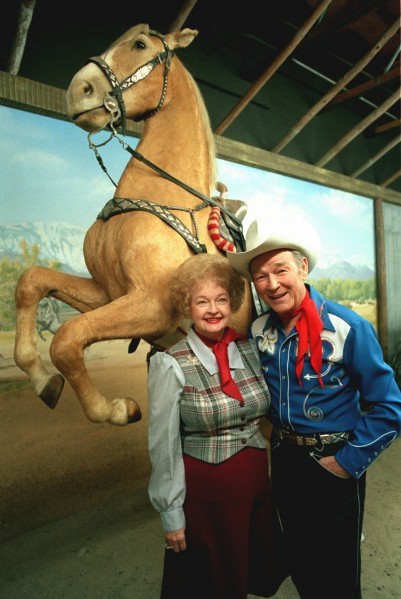
Roy Rogers. If you’re a baby boomer you think “King of the Cowboys”, if you’re a Gen-Xer or younger, you think chicken. Roy Rogers, born Leonard Franklin Slye on November 5, 1911, was an American singer and cowboy actor, as well as the namesake of the Roy Rogers Restaurants chain. He and his wife Dale Evans (known as the “Queen of the West”), his golden palomino Trigger, and his German shepherd dog, Bullet, were featured in over one hundred movies and The Roy Rogers Show. The show ran on radio for nine years before moving to television from 1951 through 1957.

Roy Rogers. If you’re a baby boomer you think “King of the Cowboys”, if you’re a Gen-Xer or younger, you think chicken. Roy Rogers, born Leonard Franklin Slye on November 5, 1911, was an American singer and cowboy actor, as well as the namesake of the Roy Rogers Restaurants chain. He and his wife Dale Evans (known as the “Queen of the West”), his golden palomino Trigger, and his German shepherd dog, Bullet, were featured in over one hundred movies and The Roy Rogers Show. The show ran on radio for nine years before moving to television from 1951 through 1957.  Rogers was well ahead of his time in many aspects. He was one of the first Hollywood stars to realize the power of his likeness and maintaining his image. Rogers endorsed everything from cap guns, cowboy hats and comic books to clothing brands, lunch boxes and fried chicken. His “Roy Rogers Enterprises” was created in the 1950s and every item Roy endorsed was personally approved and inspected by Rogers himself and carried his “Pledge to parents” attesting to its quality.So powerful was the Roy Rogers brand that Roy was able to open the “Roy Rogers-Dale Evans Museum” near their home in Apple Valley, California in 1967 before relocating to nearby Victorville on old historic Route 66 in 1976 and finally ending up in Branson, Missouri in 2003. The museum was filled with hundreds of one-of-a-kind personal mementos from Roy & Dale’s careers as well as at least one of every product Roy or Dale ever endorsed. It seems that Roy insisted on retaining at least one example of every item bearing his likeness over the years.

roy-rogers-dale-evans-773x1024Roy died on July 6, 1998 and Dale followed him on February 7, 2001, prompting the move to Branson. Sadly, the popular museum closed for financial reasons on Dec. 12, 2009. It seems that Roy’s demographic and interest in his life and career was dying with him. The museum was operated by Roy Rogers, Jr., known as “Dusty” to fans, whose decision to close the museum was like another death in the family. In a move that shocked fans, historians and preservationists alike, Dusty announced that the contents of the museum would be liquidated. What most people fail to realize is that Dusty is simply doing what his late father told him to. Roy often told his family that when interest in his career inevitably waned, sell the collection and close the museum.
According to the website: “The decision to close the Museum has come after two years of steady decline in visitors to the Museum. A lot of factors have made our decision for us. The economy for one, people are just not traveling as much. Dad’s fans are getting older, and concerned about their retirement funds. Everyone is concerned about their future in this present economy. Secondly, with our high fiscal obligations we cannot continue to accumulate debt to keep the doors open. This situation is one I have not wanted to happen. Dad always said, ‘If the museum starts costing you money, then liquidate everything and move on.’ Myself and my family have tried to hold together the museum and collection for over fifteen years, so it is very difficult to think that it will all be gone soon.”

The contents of the museum, 348 lots in all, were auctioned to the highest bidder by Christie’s auction house during a highly anticipated sale on July 14-15 in New York City. The auction included what many considered to be the centerpiece of the museum, Roy’s horse Trigger, a huge 15.3 hands high golden palomino. Perhaps the most famous horse in entertainment history, Trigger was featured in all of Roy’s movies and television throughout the 1950s. Born in 1934 on a ranch owned by Bing Crosby, Trigger entertained movie and television audiences for three decades. When Trigger died in 1965, Roy hired a taxidermist to mount the animal in a rearing position on two legs. Trigger was estimated to sell for $100,000-$200,000, the final gavel price was $ 266,000. In addition to the stuffed horse, the auction featured ornate western costumes, saddles, personal photos, musical instruments, awards and the Nellybelle Jeep from Rogers’ television show.

rogerstrigger

Dale Evans’ pearl-colored quarter horse Buttermilk, a light buckskin Quarter Horse with dark points that appeared in numerous films for over 30 years from 1941 to 1972, was estimated to sell for $30,000 to $40,000, it sold for $ 25,000, well below auction estimate and less than a tenth of Trigger’s gavel price. The Rogers’ German Shepherd Bullet was estimated to sell for $10,000 to $15,000. The final price was $ 35,000 and sold to the same man that purchased Trigger. Bullet was a master at knowing who the bad guys were, and always eager to bite a gun out of their hand or to tackle them when his human partners were outnumbered. He could run alongside Roy’s horse Trigger and keep up no matter where they went. The sale also included Roy’s back-up horse, Trigger Jr. with a pre-sale estimate of between $30,000 to $50,000. The second “other Trigger” was a registered Tennessee Walking Horse whom Roy himself called Trigger Jr. It sold for $ 18,750.

In case you’re wondering, the animal’s hides were stretched over plastic statue likenesses of each subject to obtain a realistic lifelike look. Although Trigger gained fame as Roy’s horse, his first screen appearance was as Olivia De Havilland’s mare in Warner Brothers pictures “The Adventures of Robin Hood” in 1938. In keeping with the “spirit” of the column, Roy’s beloved horse Trigger was the subject of a rather macabre incident that occurred after his death in 1965. It seems that after Trigger’s hide was removed for mounting, the remaining meat was illegally sold to several unscrupulous southwest eateries. Can you imagine the horrific prospect of eating a “Trigger Burger” ? The butcher responsible, John L. Jones, was sentenced to five years in prison.

Another highlight of the Rogers museum sale included another kind of horsepower, Roy Rogers’ personal automobile, a 1964 Bonneville convertible, adorned with collectible silver dollars and featuring door handles and a gear shift knob made from silver-plated pistols. The car’s interior is all hand tooled leather and features no less than 14 authentic guns, rendered non-firing by the designer, in its design. The hood ornament is a pair of 6 foot long Texas longhorns. It was estimated at $100,000 to $150,000 and sold for $ 254.500. The Willy’s CJ-2A Jeep “Nellybelle” used in the TV show from 1951 to 1957 to drive around Mineral City was also featured in the sale; it carried a pre-sale estimate of $ 20,000 to $ 30,000 and sold for $ 116,500.

Other items included in the auction were 60 pairs of cowboy boots, dozens of Roy & Dale’s cowboy hats and belt buckles, trophies, many of Roy’s pocket and wrist watches, musical instruments, paintings, countless movie posters and props,  household furnishings (including the Roger’s family dining room table) and tools. The sale of the collection from the defunct Museum was expected to generate about $1.4 million, with all proceeds going to the family. The sale generated just under $ 3 million.

Although the museum is closed and the contents now reside in private collections all over the world, reminders of Roy & Dale are not merely confined to their old movies, songs and television shows. Their Apple Valley, California home is the final resting place for both Roy and Dale and there are reminders of the Rogers family everywhere including roads and highways named in their honor. Roy and Dale created St. Hillary’s Episcopal Church, founded a home for boys, and took in some 20-40 foster children and raised them as their own. Yes, Roy Rogers was a savvy self-promoter, shrewd personal investor and slightly unorthodox lifetime curator of his own legacy and name. But it would seem that he actually lived the life and values his character portrayed on screen and in this case, Mommas, go ahead and let your babies grow up to be cowboys.4c40ce319e51c.image

Assassinations, Creepy history, John F. Kennedy, Pop Culture

Lee Harvey Oswald and the death of Innocence. Part II

781_1026023017Original publish date:  December 14, 2013

It was Monday November 24, 1963 and recently widowed Marina and the rest of the family were watching the John F. Kennedy funeral in a Fort Worth, Texas motel. Marina wanted to keep watching it, but the family said it was time to leave for nearby Rose Hill Cemetery. When they arrived, the small party drove straight to the chapel, expecting that their loved one would be buried in a religious service. But the chapel was empty. Instead, she was told to expect a brief service at the gravesite.
The 22-year-old widow made her way to section 17 of Shannon Rose Hill Memorial Park, a lonely, sparsely populated plot of Texas real estate where even the grass struggled to survive. A hole was waiting there with a handful of empty chairs waiting alongside. Only a few people were there to watch as the casket was lowered into the ground. Reporters who were covering the funeral carried the casket from the hearse to the graveside. Reporters? The casket contained the remains of 24-year-old Lee Harvey Oswald, the murderer of President John F. Kennedy and Dallas police officer J.D. Tippitt.
The dead man’s wife, Marina, felt humiliated that her husband was denied a religious ceremony. She was ashamed that no friends were present to act as pallbearers for her beloved Lee. Instead reporters, there for a story, were pressed into service to carry the dead man to his final resting place. This sad Texas spectacle was in sharp contrast to the ceremony taking place at the same time some 35 miles away in Dallas. The funeral of Officer Tippit at the Laurel Land Memorial Park cemetery included posthumous awards of valor and accolades from all over the nation. The lavish state funeral of President John F. Kennedy in full swing some 1,360 miles away in the Nation’s Capitol included accolades from all over the world.
Oswald’s funeral time, date and location were kept a closely guarded secret during its preparations in order to keep the morbidly curious away. To further insure that the services would not be disturbed, Oswald’s funeral was held at the same time as JFK’s because the family and officials from the funeral home knew that at that time everyone would be attending the president’s funeral.781_132829300087
On December 16, 2010, the original coffin of assassin Lee Harvey Oswald sold for $87,469 (which includes a 20 percent buyers’ fee) in an online auction at a California auction house. The starter bid was $1,000 and bidding ended when one of two top buyers dropped out around 10 p.m. The auction described the macabre relic as: “Original pine coffin that held the body of Lee Harvey Oswald from his burial on 25 November 1963 until his exhumation on 4 October 1981. At the time, conspiracy theories swirled over who was actually buried in the coffin.The coffin’s wood exterior was very soft from moisture damage, and had dark areas of discoloration. Visible along the sides were the tarnished original metallic ornamentation. The interior of the casket also showed splotchy dark discoloration and moisture-softening of the wood. A portion of the original fabric that lined the top of the casket had fallen upon the decomposed remains. Oswald’s remains were transported back to Rose Hill Cemetery for re-interment in a new casket and vault. The original deteriorated coffin offered here, measures 80″ long x 24″ deep, with the thickness of the sides of the casket approximately one inch. Sitting on wood crate which measures 84″ x 24″. Accompanied by a Letter of Authenticity by Funeral Director Allen Baumgardner, who assisted at the original embalming of Lee Harvey Oswald and later purchased the Miller Funeral Home along with all of its property.”
Because water had got into a cracked burial vault and damaged the original coffin, the funeral home swapped it with the family for a new one and Oswald’s body was reburied in another casket. The original casket was heavily water damaged and whats left of its metal ornamentation is rusted and parts of it, including the roof, have rotted extensively. Its satin lining has long since disintegrated but the coffin still contains shredded newspapers and other padding material left from its manufacture. Baumgardner, one of the funeral directors who participated in that autopsy kept the casket because no one seemed interested in it at the time, The Dallas Morning News reported. Baumgardner was a 21-year-old funeral home assistant when Oswald was shot to death, “I’ve never seen so many security police and FBI and Secret Service and news media just everywhere,” he recalled. The mortician kept it in storage in his Fort Worth funeral home for three decades. But Baumgardner, now 68, decided last month to sell it. “None of us is going to be around forever,” he said.
The auction also included instruments used to embalm Oswald, the 1963 funeral home log book, ( On Page 525 are the details of the original $573.50 mortuary fee and $135 cemetery plot. Oswald’s coffin cost $300, and the leaky vault that enclosed it was $200), an Easter card he sent to his brother and a section of the car seat the President Kennedy was sitting on when he was shot described as “A chilling relic…section of the seat upon which he and First Lady Jacqueline Kennedy sat…Light blue leather seat section which composed the main portion of the bench seat and clearly shows rust-colored staining consistent with long-dried blood…Accompanied by a letter of provenance on White House letterhead by White House Technical Service Rep. F. Vaughn Ferguson. Ferguson, whose involvement with the limousine before and after the shooting is well-documented, writes in part: “…Four days after the assassination the White House upholsterer and I removed this leather at the White House. The light blue leather is from the center of the rear seat…The spots on the leather are the dried blood of our beloved President John F. Kennedy.” The first draft of Oswald’s death certificate is for sale too. It was redone after the justice of the peace hastily wrote “Shot by Jack Rubenstein” in the space listing “How Injury Occurred” and someone pointed out that Ruby had not yet been convicted of the killing.
Although the auction is over and your chance to participate is lost, never fear. For if you want a chance to experience any left over “bad vibes” of Lee Harvey Oswald, you can always travel to Ft. Worth and try to locate the final resting place of the enigmatic Marine assassin. Just keep in mind, its not easy. True Oswald is buried in section 17 of east Ft. Worth’s Rose Hill cemetery (7301 East Lancaster Avenue) once you get there, don’t expect any help from the cemetery staff. The workers are not allowed to divulge the location of Oswald’s grave. The general manager at Rose Hill confirms that curiosity-seekers are not told how to find his grave at the sprawling cemetery, out of respect for his relatives. Another reason for the secrecy might be found in the current marker atop the dead assassin’s body that is inscribed simply “Oswald.” The current rose colored granite stone replaces the stolen original tombstone, which gave Oswald’s full name and birth-death dates.
If you find Oswald’s marker, you’d never realize that his controversial mother Marguerite, who died Jan. 17, 1981, is buried next to him on the left in an unmarked grave. However, the first thing you’ll notice is the stone marker that rests just inches to the left of Oswald inscribed simply “Nick Beef”. For years, veteran journalists, scholars and members of the entertainment world who have studied the assassination, knew nothing about the “Nick Beef” mystery. Who is it? What does it mean? Why is it so close to the Oswald stone? No-one knew.
d12508937307b3a2fe6c2cc97a868177The mysterious stone was first noticed in 1998 and soon after word of the “Nick Beef” stone got out prompting would be grave hunters to ask the staff for directions to that stone, knowing that was the surest way to find Oswald’s. But nowadays, the staff is wise to that ploy and they won’t tell people where Nick Beef’s grave is either. But the question remains, who is / was Nick Beef?
On holidays, when the cemetery is covered with flowers from loved ones, both of these plots typically remain barren. However, they remain free of ornamentation for two very different reasons. It can be argued that no single gravesite in the country holds more secrets than Lee Harvey Oswald’s. Whatever secrets Oswald knew, he certainly took them to the grave with him. But Nick Beef’s grave holds a secret too: it’s empty. Ask the black suits at the cemetery office, and they’ll tell you that Nick Beef is the stage name of a comedian who bought the plot and had a headstone with that name installed. As part of his act, he reportedly told fans that if they wanted to find Oswald’s grave at Rose Hill…just ask for Nick Beef and you’ll find Oswald.
However, the employees can’t tell you anymore about Nick Beef than I’ve told you here, in fact they will often teasingly mislead you by claiming that Mr. Beef is a disc jockey. If you find the Oswald grave and its “Beef” neighbor on your own and return to the office to confront the workers who routinely tell visitors asking for Mr. Beef’s grave by saying “They have no record of any such person”, the office workers explain their dissemination of misinformation with , “I did not lie. You asked me where Nick Beef is buried, and I told you truthfully that no Nick Beef is buried here. That stone marks a cenotaph (A monument erected in honor of a dead person whose remains lie elsewhere).”
Internet searches and computerized property records suggest only one vague possibility – that a “Nick Beef” might have lived in a high-rise apartment complex in New York during the mid to late 1990s. The spot is in Manhattan’s trendy West Village, known for its nightspots, and comedy clubs. But there is no phone number for a “Nick Beef,” and several residents of the complex said they do not remember a neighbor by such a name. However, the Comedy Cellar, one of New York’s most established stage-comedy clubs, whose featured entertainers have included Robin Williams, Jerry Seinfeld and Chris Rock, is located only a block away. But, after that, the “Nick Beef” trail turns cold.
After you have found Lee Harvey Oswald’s Gravesite you can exit Rose Hill Memorial Burial Park and head west on Lancaster Avenue. A couple blocks before you reach the 820 Freeway, on the right side of the road, in the Urban Village of Handley, you will find The Ozzie Rabbit Lodge. Ozzie Rabbit was Oswald’s nickname while in the army.
If you’re looking for a bright spot in the Oswald family tragedy, believe it or not, a few can be found. His brother, Robert, lives in Wichita Falls Texas and according to the funeral home paid the total cost of $710.00 for the burial of his brother. He believes that Lee was guilty of JFK’s murder and blames his mother as the main reason his brother went bad. Robert has lived a model life and has made a few media appearances recently. Despite the stigma of being the brother of an assassin, he maintains a quiet dignity that has earned him the admiration of many. Lee’s half-brother John is deceased.
Lee’s daughters, June and Rachael took the name of their stepfather, Ken Porter, in 1965. This helped them to maintain a slight anonymity while growing up in Texas. According to a 1995 article, June keeps a low profile and uses her married name in an effort to protect her own children from the controversy. She manages to keep a sense of humor and mentioned that she enjoyed the “second spitter” episode of Seinfeld, which parodies the Single Bullet theory. In 1995 it was reported that Rachael worked for seven years as a waitress while putting herself through nursing school. She seemed to be the more conspiracy-oriented of the two daughters and enjoyed meeting Oliver Stone during the making of his film “JFK”.
Marina, the widow of Lee Harvey Oswald, has changed her beliefs about the assassination several times over the years and is often described as being influenced by whatever book or theory is in vogue at the time. In 1965 she married Kenneth Jess Porter, with whom she has a grown son. The couple divorced on October 11, 1974. She has lived in Dallas for many years, and has appeared in numerous documentaries on the Kennedy assassination. In recent years she has expressed the view that Oswald was innocent in the assassination, though she has never recanted any of her Warren Commission testimony. In April 1996 she wrote : “At the time of the assassination of this great president whom I loved, I was misled by the “evidence” presented to me by government authorities and I assisted in the conviction of Lee Harvey Oswald as the assassin. From the new information now available, I am now convinced that he was an FBI informant and believe that he did not kill President Kennedy.”
John Kennedy’s assassination was the death of innocence. After that, the shock, sorrow and overwhelming bewilderment of unexpected celebrity death no longer surprised us. JFK’s was the first American tragedy covered from start to finish by every available media, but most especially television. During that extended weekend of unabated grief, the main players visited us in our living rooms. We could feel the events as they unfolded as if they were happening to our friends, neighbors, or relatives. We would find out in short order that it was sadly all too true. And we would never trust again