Last week, we once again visited the famous “Paul is Dead” rumor that haunted the Beatles rock band for many years. Obviously, the rumor that Paul McCartney died in a November 1966 car accident was just a rumor, to many Beatlemaniacs during the final years of the turbulent sixties decade, it was very real. It had become a national pastime to search for clues to Paul’s death in the music and artwork produced by the band. The albums Sgt. Pepper’s Lonely Hearts Club Band and Magical Mystery tour were allegedly rife with references to Sir Paul’s demise.
The band’s next album, a self-titled work known as “The White Album”, was released on November 22, 1968, prophetically 5-years to the day after the assassination of President John F. Kennedy. The death reference is not overstated, as soon, the “Paul is Dead” theorists would dissect the music and its accompanying poster for further clues of McCartney’s death. The death connection continued as, in time, the album would be blamed for inspiring Charles Manson and his “family” during their murder spree. Much of which was aimed at the music industry itself through the Beach Boys drummer Dennis Wilson and the band’s record producer Terry Melcher. But that’s another story. The stark snow white album cover was seen as an obvious reference to the white light of heaven, where Paul was supposed to be at its release. But it was the poster issued inside the white album (a collage featuring a number of random images of the Fab Four) that came under the scrutiny of those looking for “Paul is Dead” clues. In the lower right hand corner of the poster (page 7 of the CD booklet) is a grainy B&W photo of Paul dancing. Upon close examination, a pair of ghostly hands can be seen reaching toward Paul from behind.
In the lower left hand corner of the poster (page 18 of the CD booklet) is a cold war inspired passport photograph of Paul in disguise. Conspiracy theorists suggested that this image was actually of Paul’s replacement in the band, William Campbell Shears, taken prior to the plastic surgery that made him look more the “the late” Paul McCartney.
In the upper left hand corner of the poster (page 3 of the CD booklet) is a picture of Paul with his head partially submerged in a bathtub. The position of Paul’s head and the suds around him suggest the grisly accident scene of his fatal accident or perhaps the aftermath in the morgue. One version of the “Paul is dead” story claims that Paul left the recording studio after arguing with drummer Ringo Starr. In his song “Don’t Pass Me By”, Ringo is said to express his regret at the tragic turn of events after Paul’s angry departure from the studio: “I listen for your footsteps coming up the drive…I listen for your footsteps but they don’t arrive.” At the end of “While My Guitar Gently Weeps”, George Harrison is thought to moan the words “Paul, Paul”. The song “Glass Onion” makes a number of references to Beatle songs and events. John mentions “The Fool on the Hill” and states, “I tell you man he living there still” thought by some to symbolize heaven. However, perhaps the most intriguing line in the song is “Well here’s another clue for you all…The walrus was Paul.” Seen as a final bow to his fallen bandmate and co-songwriter. Some sources have suggested that the phrase “goo goo g’joob” is from Finnegans Wake by James Joyce (Alas, the phrase “googoo goosth” is the closest Joyce gets in th book.) Never fear, the “Paul is Dead” rumorists claim that “goo goo g’joob” are the last words uttered by Humpty Dumpty before his fall. A fall that cracked his head open, much like Paul’s supposed fatal car accident.
Further proof is said to be found in the odd conclusion to “Cry Baby Cry” as Paul asks “Can you take me where I came from? Can you take me back?” Not necessarily as much for what those lines are supposed to mean, but rather that the song leads into “Revolution 9”, the most analyzed of all “White album” tracks by “Paul is Dead” clue seekers. Revolution 9 was an innovative sound collage that, quite frankly, soared over most listener‘s heads. Later transcripts of the dialog heard early in the song reveals two men who can be heard saying “I know all about it George. I’m sorry. Will you forgive me? Yes.” Theorists claimed that this was John talking with George Martin about the secret placement of clues on Beatles records. However, the biggest clue to Paul’s death on the track is the title itself, whose repeated phrase “Number 9” is said to sound like “turn me on, dead man” when played backwards. A dark recall to the line “I’d love to turn you on” from “A Day in the Life”.
The sound collage of “Revolution 9” is said to contain a recreation of Paul’s fatal car accident. At one point listeners hear car horns, followed by a car crash, and concluding with the crackling sounds of a fire burning. When played backwards theorists claim the statement “Let me out! There were two. There are none now.” can be plainly heard. Most astonishingly, “Paul id Dead” devotees swear that, when played normally, the following disjointed lines can be heard throughout the song: “he hit a pole. We better get him to see a surgeon. So anyhow he went to a dentist instead. They gave him a pair of teeth that weren’t any good at all…So my wings are broken and so is my hair… I’m not in the mood for words… Find the night watchman… A fine natural imbalance… He must have got it in the shoulder blades… Take this brother, may it serve you well…” The final line marking Paul’s passing of the torch to his replacement William Campbell Shears. Ardent believers believed that other “Backwards” clues could be found on the track “I’m so tired / Blackbird” when some random mumbling is heard that they believe sounds like John and Yoko right after the abrupt ending of “I’m So Tired” and before the beginning of the next song, “Blackbird“. This passage makes no sense when played forwards. However, when played backwards, they believe that you can hear John say, “Paul is a dead man. Miss him. Miss him. MISS HIM!” John Lennon was said to be expressing his grief over Paul’s death in this line of the song followed by the very next line on the record, sung by Paul, “Blackbird singing in the dead of night”, that mentions death.
Ten months later, on September 17, 1969, an article titled “Is Beatle Paul McCartney Dead?” was published in the student newspaper of Iowa’s Drake University. Soon, the “Paul is Dead” story went viral. Almost immediately, other articles followed claiming that clues to McCartney’s death could be found among the lyrics and album covers of The Beatles’ recordings. Clue hunting proved infectious and for a couple of months in late 1969 it became an international phenomenon. Just in time for the Beatles’ next album, Abbey Road. Guess what? The clues continued and soon, Paul McCartney himself would finally be heard from.
Last week, we revisited the famous “Paul is Dead” rumor swirling around the Beatles rock band during the last few years of the turbulent sixties decade. The rumor that Paul McCartney died in a November 1966 car crash seems silly to us now, but it was pervasive back in the day. As we covered in Part I of this series, the album “Sgt. Pepper’s Lonely Hearts Club Band” was released in June of 1967 to much well deserved fanfare. Both for the music it contained and the supposed references it made to the death of the Beatles’ heartthrob bass player. Magical Mystery Tour was released on December 8, 1967. After the success of Sgt. Pepper’s, Paul McCartney wanted to create a film based upon The Beatles and their music. The film was to be unscripted and would “star” various “ordinary” people who were to travel the countryside on a bus and experience “magical” adventures on film. The Magical Mystery Tour film was made and included six new Beatles songs. The film was universally panned and largely forgotten, but the resulting album / soundtrack is considered a classic. Produced by George Martin, Magical Mystery Tour was packaged by Capitol records as a full LP with a 24-page companion picture booklet.
The booklet was eagerly devoured by the “Paul is dead” theorists and the clues it supposedly offered only fueled the ever-growing conspiracy. So, dear readers go and dust off your copies of Magical Mystery tour as we thumb through it and decipher the clues. On page 3 of the booklet, Paul is dressed in a British military uniform posed seated behind a desk with a nameplate that reads “I Was” in front of him. Further interpretations of the nameplate claim it reads either “I You Was” or “I Was You,” both suggesting that Paul had disappeared and been replaced by a double. Also, the British Union Jack flags behind Paul are crossed as they would traditionally appear at a military funeral.
On page 6, John Lennon appears as a carnival barker manning a ticket booth with a sign reading: “The best way to go is by M&D Co.” According to the “Paul is dead” rumor, M&D Co. was a funeral parlor, but such a place never existed. Theorists also note that in the picture, a departure time is given but the return time is blank.
On page 9, “Fool on the Hill” is shown next to a cartoon image of Paul who appears to be standing on a grave shaped mound of grass. The second “L” in the title extends above Paul’s head and dribbles into his scalp as though his head were split open. This picture hints at the devastating head injury that Paul allegedly sustained in his fatal accident.
In the band photos on pages 10, 11 and 12, Paul appears without shoes, which would become a recurring theme among the “Paul is Dead” crowd in years to come. Also, on Ringo’s bass drum between the word “Love” and the name “The Beatles”, the numeral “3” can plainly be seen which seems to spell out the cryptic phrase “Love the 3 Beatles”. Eerily, in that same photo, blood appears to be dripping from Paul’s shoes resting next to the drum. Theorists assert that “empty shoes were a Grecian symbol of death.” On page 23, the Beatles are all wearing stark white tuxedos with carnations in the lapels. Paul’s flower is black while the other Beatles have red flowers. Years later, Paul denied that the black carnation had any significance at all; “I was wearing a black flower because they ran out of red ones.”
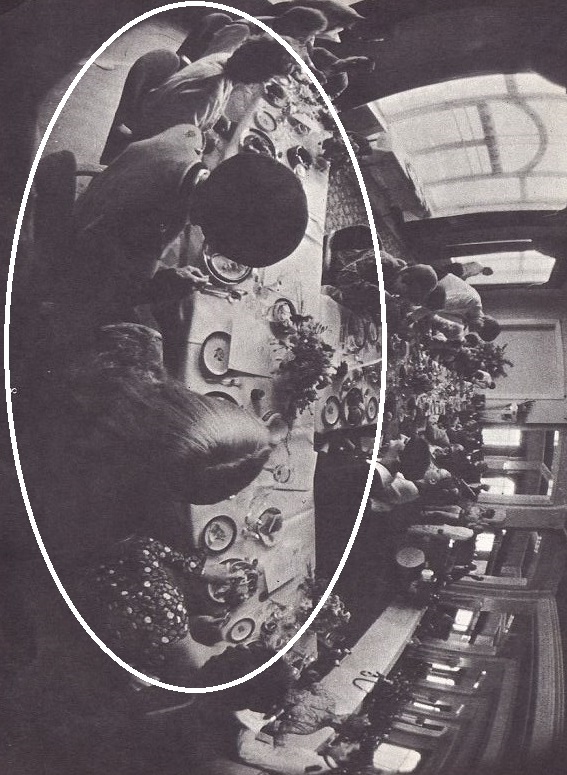
And on the final page of the photo booklet, once again, a hand appears over Paul’s head. Although this instance of a hand over Paul’s head isn’t nearly as dramatic as the Sgt. Pepper’s cover photo because several people have their hands raised above their heads in this picture. But it certainly did nothing to ease the conspiracies. However, there is one compelling image in the pages of the pictorial book that, when analyzed, virtually screamed out to all those looking for signs of death in the Beatles’ works to substantiate the rumors of Paul’s premature passing. On page 8 of the booklet, a dining scene, at the left of the image (but on the right as the image is rotated one turn clockwise), with a little imagination, you can see a skull in this picture. It occupies the left side of the picture, with the beret of the person seated at the table forming the eye and the hair of the woman seated next to him the mouth. Like a “Magic Eye” painting, once you’ve accepted it as a skull, it’s easy to see the damage to the top of the head. This grisly image suggests the damage to Paul’s head as a result of his car crash. The fact that this picture, unlike all of the other images in the booklet, does not appear in the movie again only encouraged the “Paul is Dead” crowd as proof of his passing.
Then there’s the cover image. The bandmates appear on the cover, as they did in the companion film, dressed in outlandish animal costumes. The animal costumes were in keeping with the predominantly psychedelic themes of the music on the LP. It’s a common misconception that Paul was the walrus, no doubt made famous by the lyric in Glass Onion on “The White Album” and the song’s innumerable references to it in the ‘Paul is Dead’ conspiracy. However, Paul isn’t the walrus, John is. This can be seen in the ‘I Am The Walrus’ segment of the Magical Mystery Tour film where the walrus is seated at the piano singing the song (just as John was at the start of the song). The hippo is standing in front playing left-handed bass guitar. In truth, Paul was the Hippo, John was the Walrus, George was the Rabbit and Ringo was the Chicken. Theorists would claim a connection between Paul’s supposed Walrus costume and the death rumor, but the real controversy revolved around the word “Beatles” above the lad’s heads that purportedly reveal a secret phone number. As Rolling Stone famously pointed out, it’s not exactly clear what that phone number is supposed to be. Depending on whom you ask it could be read as “231-7438, 834-7135, 536-0195, 510-6643, 546-3663, 624-7125, no telling what city, maybe London.” If you turn the album cover upside down and hold it in front of a mirror you can see the numbers 8341735, which is a stretch because the threes, the seven and the five are backwards. If you simply hold the album cover upside-down, the numbers could be 5371438. Of course, there is no area code. The rumor claimed that when this number was dialed, the caller would receive information about Paul’s death, or the person would be able to take a trip to “Magical Beatle Mystery Island”, or maybe even speak to Paul in the hereafter. Stories circulated about the strange responses callers were receiving from the voices on the other end of the phone line. Later it was discovered that one of the phone numbers belonged to a journalist who was nearly driven crazy by the numerous phone calls from people hoping to connect with the late Paul McCartney. But it was the music contained on the album that offered the clue seekers the most tantalizing hints at Paul’s demise. One of the best known “Paul is dead” audio clues comes at the end of “Strawberry Fields Forever”. As the song fades out for the second time, John allegedly says “I buried Paul.”‘ This audio clue can be heard more clearly when the record is played at 45 rpm as John’s voice is slowed down to a virtual crawl. Years later, John admitted that he was really saying “cranberry sauce,” which became evident on the “take 7 and edit piece” version of the song that appeared on Anthology II in 1996. Paul explained “That’s John’s humor. John would say something totally out of sync, like ‘cranberry sauce.’ If you don’t realize that John’s apt to say something like ‘cranberry sauce’ when he feels like it, then you start to hear a funny little word there, and you think aha!”
The “Paul is Dead” theorists prophetically point to the song, “I am the Walrus” on the album as definitive proof of McCartney’s death. The very fact that theorists looked for clues in “I Am the Walrus” was ironic, since John’s intent was to write a song with nonsensical imagery to poke fun at all those people looking for clues in every Beatle lyric. Still, John’s explanation didn’t stop them from looking for “Paul is Dead” clues in the song.
According to the “Paul is Dead” rumor: Paul left the recording studio in anger on a “stupid bloody Tuesday” after a quarrel with his bandmates. The refrain “I’m crying” is John expressing his grief over Paul’s death. The references to “pretty little policemen” and “waiting for the van to come” refer to the police present at the site of Paul’s fatal accident. The opening line of the song, “I am he as you are he as you are me and we are all together” suggests that all of the Beatles were aware of the death and ensuing cover-up. In the “Paul is dead” mythology, the walrus is an image of death. But no evidence for this statement has ever surfaced to explain why. The album, movie and pictorial booklet are arguably the most ambitious effort ever attempted by the Fab Four. Completed at a time when the Beatles were still having fun, but questioning their viability at the same time. Although they saw themselves as a rock band, their fans were looking at them as modern day prophets. Undoubtedly, this view was responsible in large part for the devastation perceived by the “Paul is Dead” rumors that continued to swirl around the band. The band’s next effort, “The White Album”, would do nothing to help end the controversy.
It has been over half a century since one of the most famous hoaxes in Rock-N-Roll history began. On Wednesday November 9, 1966 at 5 am, Paul McCartney, while working on the album “Sgt. Pepper’s Lonely Hearts Club Band”, stormed out of the studio during a recording session after an argument with the other members of the group. He jumped into his Austin-Healey and sped off down the road, lost control of his sportscar and crashed into a telephone pole. Paul McCartney was dead. Well, that was the rumor anyway.
Although teen-agers and music fans all over Britain began to panic upon circulation of the shocking rumor, Paul’s bandmates and the band’s management quickly discovered that there was absolutely no truth to it at all. As the Beatles’ Press Officer Derek Taylor found out when he telephoned Paul’s St. John’s Wood home and the voice responding on the other end of the line was Paul himself. Paul calmly explained that he had been at home all day and his black Mini Cooper (NOT an Austin Healey) was safely locked up in his garage. The Beatles management addressed the rumor in the February 1967 issue # 43 of “The Beatles Monthly Book” (the Beatles’ official fan club magazine) with a short blurb that appeared in the “Beatle News” section, entitled “FALSE RUMOUR”. Far from calming nervous Beatles fans, this only intensified the ferocity of the “Paul is Dead” rumor.
Suddenly, the “Paul is dead” urban legend spread throughout the world. Now, not only was Paul dead, he had been secretly replaced in the band by a look-alike. The rumor could not have come at a worse time for the band. To say the Beatles were going through a rough patch would be an understatement. After releasing “Revolver” in August 1966, the band quickly grew tired of touring. They were frustrated with not being able to hear themselves onstage, due to the incessant shrieks and screams of their female fans at shows. The band had been touring and recording in the studio non-stop for nearly 2 years. They were growing tired of life on the road and not being able to play the songs they liked, to say nothing about debuting new material on stage. During that last tour, the airplane they were traveling in was shot at as they landed in Texas, and a prankster threw a firecracker at the stage during their Memphis show which everyone thought at first was a gunshot. The Beatles were burnt out and the band had had enough. The band’s attitude and message became darker and soon, concerts became dangerous as the Beatles’ started to receive death threats after some comments made by John Lennon at a press conference that year. John’s quote “the Beatles are bigger than Jesus” was taken out of context and according to John Lennon, “upset the very Christian KKK”. In the Philippines they unintentionally offended Imelda Marcos, a former beauty queen, by not meeting with her privately before their show. Filipino citizens took this as an excuse to rob, harass and threaten death to the Beatles. They stopped touring soon after the show at Candlestick Park in San Francisco on August 29, 1966. Less than six months later, the McCartney death rumor had reached a fever pitch worldwide and just like Paul himself, it refused to die.
John Lennon & Ringo Starr at the cover shoot.
Okay Baby Boomers, go dust off your “Sgt. Pepper’s” album for the rest of this article. For it is that cover and the songs found on it that fueled the mania. Released on June 1, 1967, Sgt. Pepper’s Lonely Hearts Club Band was rife with “Paul is dead” clues. Turns out, it was Paul’s idea that the Beatles immerse themselves in a new identity for the album’s release. The original idea behind the album cover was to show the Beatles assuming a new identity while laying to rest their earlier “Fab Four” image. The wax images of the younger Beatles look mournfully on the gravesite because the Beatles were no longer the same band. The “Paul is dead” crowd interpreted the cover as representing a funeral for Paul.
Looking at the modern, psychedelic Beatles posed on the cover, one notices that, while three of the Beatles are standing at an angle, Paul is facing the camera as if his body was being propped up by his bandmates standing at his sides like a scene out of “Weekend at Bernie’s”. John, George & Ringo are holding shiny gold band instruments, but Paul’s cor anglaise woodwind instrument is black. A disembodied hand appears above Paul’s head, as though he is being blessed by a priest before being interred.
Across the gravesite is a bass guitar oriented the way that left-hander McCartney would have played it. The strings of the bass are made of sticks but there are only three sticks rather than four, representing the three Beatles without Paul. Some rumorists claimed that the yellow hyacinth flowers spell out the name “PAUL?” or that when the album is turned sideways, the flowers form the letter “P”.
Another rumor claimed that if you held the album cover up to a mirror, the words “LONELY HEARTS” written across the front of the bass drum reflect back as “IONEIX HE<>DIE”. When arranged as “I ONE IX HE <> DIE,” this image suggests the date (11-9, or November 9, 1966) that Paul died and the diamond between the words “HE” and “DIE” points directly at Paul. Another interpretation suggests this could also be read as “1 ONE 1 X”, meaning that one of the four is gone, and then the “HE DIE” along with the ever present diamond / arrow pointing to Paul as the missing Beatle.
Shirley Temple Doll.
The Shirley Temple doll at the right of the picture wears a sweater that reads “WELCOME THE ROLLING STONES”. Hinting that the Rolling Stones were involved in the conspiracy. After all, without the Beatles the Rolling Stones would have been the undisputed leading rock and roll band. A model of an Aston-Martin, the type of car that Paul was supposedly driving at the time of his fatal accident, is leaning against the doll’s leg. The interior of the car is red, symbolizing Paul’s bloody accident. Also, the doll rests on the lap of a cloth draped figure (which is creepy all by itself) that is wearing a blood stained driving glove.
The Japanese stone figure at the feet of the wax images of the younger Beatles has a line on its head, rumored to represent the head wound that Paul sustained in the fatal accident. The four-armed Indian doll at the front of the picture is Shiva, symbol of both destruction and creation. Two of the doll’s arms are raised, one pointing at the wax image of the younger Paul and the other pointing at Paul himself. The television set on the ground to the right of the Beatles is turned off, suggesting that the news of the tragedy had been suppressed.
The “Paul is Dead” controversy is not the only thing that the Sgt. Pepper’s album cover is known for. It was one of the first to feature a center gatefold sleeve and it was also the first album to have the song lyrics printed on the cover. Of course, a bi-fold album had never been seen before so rumors began that it was made this way to resemble a prayer book or funeral program. Naturally, clues were found within the folds of the album as well. On the inside photo, Paul is wearing a patch on his band uniform with the letters “O.P.D.” that theorists interpreted as “Officially Pronounced Dead.” According to tradition, this British Police jargon “O.P.D.” phrase is the equivalent of American police forces use of “D.O.A.” (Dead On Arrival). (Much later, in a Life magazine article Paul stated, “It is all bloody stupid. I picked up the O.P.D. badge in Canada. It was a police badge. Perhaps it means Ontario Police Department or something.” Actually, the badge Paul was wearing reads “O.P.P.”, which stands for the Ontario Provincial Police. The angle of the photograph makes the final “P” look like a “D”.)
On the original album the song lyrics are printed on the back cover over a picture of the Beatles. Unlike the rest of the Beatles, Paul has his back turned to the camera which, by its very appearance, further fueled rumors that he was dead. Furthermore, the three black buttons on the waist above the tail of Paul’s coat are supposed to represent the mourning of the remaining Beatles. Although John, Paul and George were all about the same height (Ringo, much shorter), in the gatefold photo, Paul appears taller than the other Beatles, suggesting that he is ascending to the heavens. Another clue points out that next to Paul’s head are the words “WITHOUT YOU” from the song title “Within You Without You”.
Also, George appears to be pointing at the words “Wednesday morning at five o’clock as the day begins”, which was supposed to have been the time of Paul’s fatal accident. In reality, George deliberately positioned his hand in this way not to point to the printed lyrics, but to make the letter “L”, the first letter in the word “LOVE”. His fellow Beatles appear to be spelling out the word “LOVE” with their hands as well. John’s hands are arranged in a “V” shape, and Ringo’s clasped hands form an “E”. The “O” is missing as Paul’s hands are not visible.
The lyrics themselves added to Paul’s death legend and to his replacement by a look-alike. The title song introduces Billy Shears (Paul’s alleged replacement) in “With a Little Help from My Friends”. Insiders hint that Paul’s rumored replacement, a man named William Campbell Shears, was still working on perfecting his singing voice. This theory was again referred to in the same song with the line: “Lend me your ears and I’ll sing you a song/And I’ll try not to sing out of key”.
Paul and his 1966 Aston Martin DB6.
Several other “Sgt. Peppers” songs purportedly make reference to Paul’s tragic accident. “Good Morning, Good Morning” opens with the line “Nothing to do to save his life call his wife in.” One version of Paul’s fatal accident story was that he had picked up a female hitch-hiker named Rita and she became so excited when she realized she was in a car with Paul McCartney that she threw herself on him, thereby causing the wreck. As told in the song “Lovely Rita,” “I took her home/I nearly made it”.
In “A Day in the Life” John sings “He blew his mind out in a car/He hadn’t noticed that the lights had changed/A crowd of people stood and stared/They’d seen his face before/Nobody was really sure if he was from the House of Lords”. This last lyric was, at the time, perhaps the most convincing argument that Paul McCartney was dead. Years later, John Lennon revealed that the inspiration for the spooky song lyrics was the death of Tara Browne, the 21-year-old heir to the Guinness fortune and close friend of Lennon and McCartney, who had crashed his Lotus Elan on December 18, 1966 in Redcliffe Gardens, Earls Court. Producer George Martin however, believes that the entire song, including this morose verse, is a drug reference and that Lennon was imagining a stoned politician who had stopped at a set of traffic lights. Regardless, the album did nothing to quell the rumor that “Paul was Dead.” The Beatles, who were by this time totally fed up with dealing with the press, did little to dissuade the discussion of demise. Some pundits have speculated over the years that the entire affair was a ploy by the Beatles’ and their management designed to sell more albums. Which makes sense when you consider that the McCartney death rumor would continue to swirl around future album releases by the Fab Four in the coming years.
What cannot be denied about “Sgt. Pepper” was its impact on music history. The album regularly appears at the top of most music critic’s lists of “Greatest albums of all time.” The influence obviously extended beyond the music itself, as our short analysis of the cover art suggests, by changing the way the jackets containing the music told a story of its own. In pop-culture, the heavy moustaches worn by all of the Beatles band members swiftly became a hallmark of hippie style. The brightly colored parodies of military uniforms worn by the band on the cover have been, at least in part, attributed by cultural historians as fueling the anti-authoritarian and anti-establishment movement of the hippy era.
John Lennon, Brian Epstein & Paul McCartney
Nearly 3 months after Sgt. Pepper’s release, an incident occurred that further fueled the death rumor, changed the Beatles forever, and drove them further into seclusion. In August 1967, the band was informed of the death of the man responsible in large part for their success; manager Brian Epstein. The coroner ruled Epstein’s death an accidental overdose, but it was widely rumored that a suicide note had been discovered among his possessions. Epstein worried that the band might not renew his management contract, due to expire in October. Epstein’s death left the group confused and fearful about the future and did nothing to extinguish the rumors of Paul McCartney’s death. In fact, Brian Epstein’s death just added fuel to the fire.
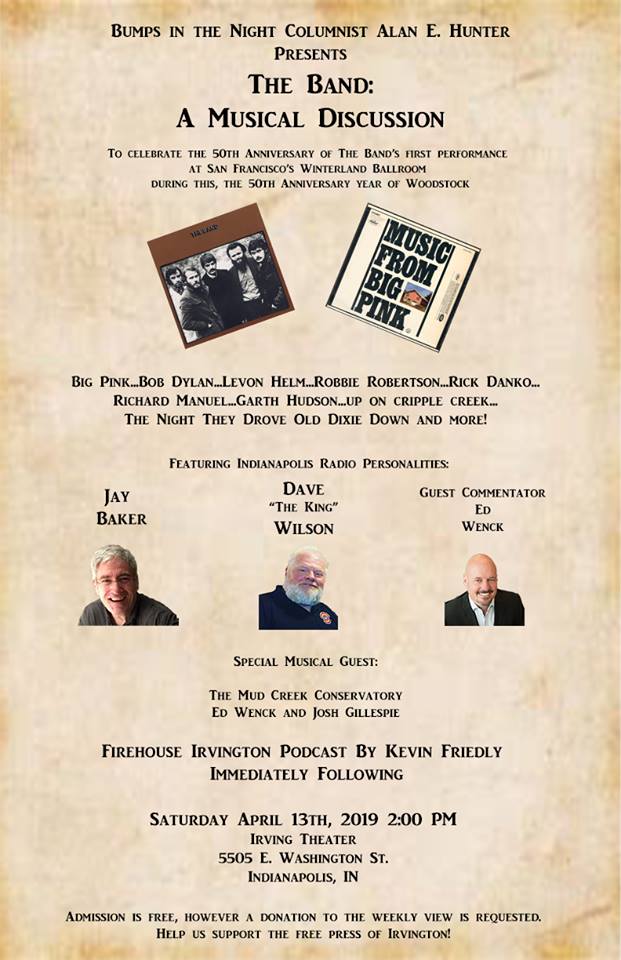
You are cordially invited to come over to the Irving theatre this Saturday, April 13th from 2 PM to 4 PM and talk about music. This is the 50th anniversary year of Woodstock, the concert that changed both the culture and history of music while defining a generation. More importantly, this event will celebrate the 50th anniversary of the first live concert by The Band at the Winterland ballroom in San Francisco California. The Band (Levon Helm, Robbie Robertson, Rick Danko, Richard Manuel and Garth Hudson) not only change the face of rock ‘n roll, they almost single-handedly created the movement that became known as “Americana” music. Although known by many as Bob Dylan’s backup band, as we shall see this Saturday, there is more to the fellas than meets the eye.
When these five self-described bearded “Cowboys” appeared on the January 12, 1970 cover of Time magazine (a first for an American band by the way) they were described as “The New Sound of Country Rock.” They came to epitomize Woodstock, the community and the concert, although they landed at both quite coincidentally. In an era when other bands were writing and performing songs about sex, drugs and rock ‘n roll, The Band were performing songs about reflection and history created in the basement of a little pink house in the Catskill Mountains. The songs dripped with sentiment, depth and meaning straight out of the pages of American history even though four out of the five members were Canadians.
This Saturday I will host an in depth discussion about The Band and its impact on American music. Joining me will be local radio legends Dave “the King” Wilson, Ed Wenck and Jay Baker. The program will start at 1:30 p.m. with live music in the Irving theatre performed by The Mud Creek Conservancy, the acoustic duo of Ed Wenck and Josh Gillespie. Occurring before the presentation this will be their first live performance. The duo will play and explain a couple of The Band’s best-known songs for us during the discussion as well. The program will also include a live podcast of “Firehouse Irvington” by Kevin Friedly and Jay Baker after the show. We invite you to come out, share thoughts, ask questions and even bring your guitar to play and sing along in what promises to be a show for the ages.
Channel 13’s Nicole Misensik and Brandon Kline will be on hand to assist with questions from the audience and Dave Wilson will act as the official emcee. The program will feature film clips of The Band on stage, taped interviews and historic photographs that, combined with the discussion, will help form a more complete history of what many critics believe was the greatest band in the history of rock ‘n roll. The band’s iconic lyrics will be discussed as well as their motivation and meaning and songwriting process. Not to mention some interesting connections to pop culture events and personalities that lasted well before and long after their breakup in 1976. The Band was born only after the near fatal motorcycle accident involving the world’s most famous electric folksinger changed their direction. And, although The Band’s first album “Music From Big Pink” debuted on July 1st, 1968, the band from West Saugerties, New York did not perform live until the spring of 1969 a continent away in San Francisco. The album was created start to finish in two weeks time with no overdubbing, unheard of for its day. What’s more, The Band very nearly didn’t take the stage at all; saved only after legendary promoter Bill Graham picked a hypnotist out of a bay area phonebook to right the ship. The little-known stories of these great incidents will be discussed this Saturday.
Most people forget that The Band even performed at Woodstock, let alone was a headliner. We will discuss how mismanagement not only kept The Band out of the film and off of the soundtrack, it kept Bob Dylan off of the stage. All but only the most devoted fans realize that The Band not only performed at Woodstock, but also at the largest concert in the history of music alongside the Grateful Dead and the Allman Brothers at Watkins Glen New York four years later. And then there was the 1970 Festival Express tour across Canada featuring Janis Joplin, the Grateful Dead and The Band. The Festival Express was a 14 car long train that stopped in three Canadian cities: Toronto, Winnipeg and Calgary, during the summer of 1970, that ultimately became one long non-stop jam session and never ending party fueled by drugs and alcohol. To understand The Band, one must also understand the era into which it was born. Big Pink’s 1968 debut was also the year of student protests against the Vietnam War, Martin Luther King and Robert F Kennedy’s assassination, riots at the Democratic National Convention in Chicago, Black Panther demonstrations, feminists protesting the Miss America pageant in Atlantic City, Apollo 7 and 8’s moon landing rehearsal flights, Charles Manson gathering his cult members at Spahn Ranch and Nixon’s nomination for president. To many, America was coming apart at the seams and the divide between generations had never seemed wider. This band, formed out of a classically trained musician, a teenaged alcoholic, a butche’rs apprentice, a Jewish Native American grifter and a veteran performer from the Mississippi Delta, stepped forward to bridge the gap. While considered the fathers of the history conscious “Americana” music movement, make no mistake about it, these guys were quintessential rock and rollers. Fast cars, fast women, and fast times punctuated the lives of each member of The Band. They started in the age of rockabilly, while Elvis Presley was still shaking things, up and finished at the dawn of hip-hop. They crossed paths with Hollywood movie stars, gangsters and presidents. Eric Clapton, Van Morrison, Dr. John, Sonny Boy Williamson, Muddy Waters, Conway Twitty, Tiny Tim, Jack Ruby, Martin Scorsese and Jimmy Carter all play a part in the story of these four Canadians and one self-described “cracker” from Arkansas to create a mystique that still surrounds them today, long after three out of the five band members have passed.
Not only is this Saturday’s event timed to coincide with an important anniversary in the history of The Band, it is also taking place on “National Record Store Day”. There will be live music outside the Irving theatre beginning early in the day and lasting long after this presentation concludes. The program will start at 2 PM, admission is free, but we ask that you please make a donation at the door to the weekly view newspaper to help support the Free Press of Indianapolis.
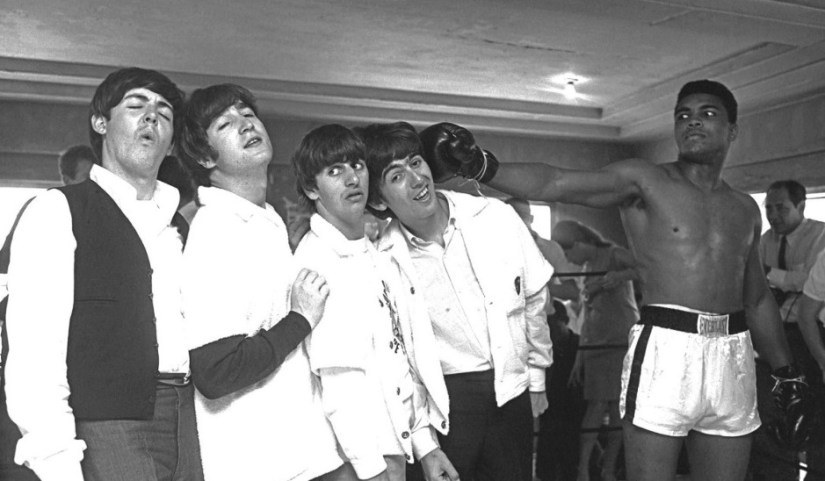
Its February in Indianapolis. As I sit at my keyboard in 10 below zero weather, my power is out, the candles are lit and my compy is running on battery power. So…time for a happy warm memory. 55 years ago, on February 18, 1964 The Beatles met a young Cassius Clay aka Muhammad Ali at his training camp in Miami Beach, Florida. The Fab Four were wrapping up their whirlwind tour of America (including two shows at the Fairgrounds in Indianapolis) and Clay / Ali was prepping for his February 25 fight against heavyweight champion Sonny Liston. Although both events would change history, for that brief moment in time, they were just five kids goofing around and mugging for the camera.
The Beatles and Ed Sullivan.
In the previous nine days, the lads from Liverpool had performed on the Ed Sullivan Show in New York before a record television audience (and taped another program for later broadcast), played concerts at Washington, D.C.’s Coliseum and New York’s Carnegie Hall, then traveled south for their second Sullivan Show appearance at Miami’s Deauville Hotel. Their Meet the Beatles album was dominating the U.S. Billboard charts and their single “I Want to Hold Your Hand” was blasting out of every transistor radio in the country. Beatlemania, which had already swept Britain for a year, was exploding worldwide. America hadn’t seen anything like this since Elvis Presley the previous decade. The band’s Svengali manager, Brian Epstein, decided the boys needed a rest and what better place to take a break than in Miami Beach?
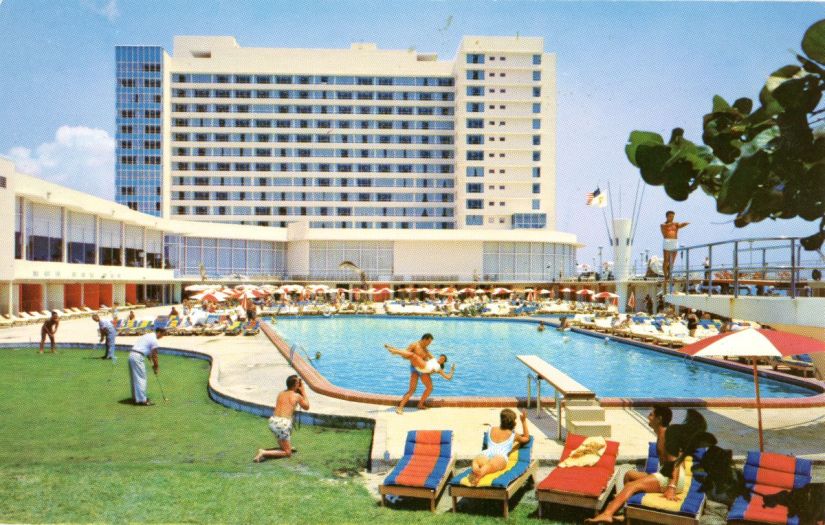
The Deauville Hotel. Miami Beach.
The Beatles arrival in Miami is legendary and offers a great snapshot on the innocence of “Beatlemania” in South Florida. Some 7,000 screaming teenagers greeted the Beatles at Miami International Airport. The Fab Four were thrown in a limousine, raced across town, and rushed into the Deauville Hotel. The Deauville hotel was built in the mid-1920s, and was transformed into the Deauville Beach Resort in the mid-1950s. Towering over Miami Beach, the Deauville featured 500 rooms, on-site restaurants, nightclubs, boutiques, a beauty salon, swimming pool, an ice skating rink and it’s own radio station that routinely hosted Frank Sinatra and his rat pack. The Beatles stayed on the 12th floor, which has become a shrine to Beatlemania festooned with memorabilia and photographs on the hallway walls around the actual rooms where the Beatles stayed for those eight days in February 1964. There is a guard posted by the elevator and a sign that requests: “Silence.”. John and then-wife Cynthia Lennon stayed in room 1211. Paul, George, Ringo, manager Brian Epstein and others in their entourage shared rooms. There was no backstage in the Napoleon Ballroom. The band traveled from their hotel rooms, down the elevator, across a lobby packed with screaming girls to make their way into the ballroom and through the room filled with thousands of adoring female fans waiting to see them perform for millions more watching them on TV.
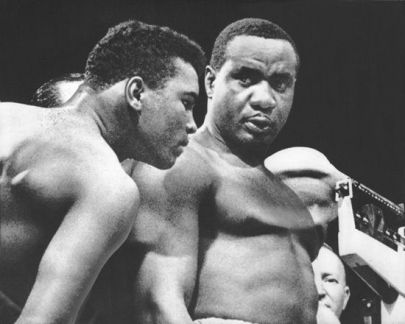
On the other hand, Cassius Clay was training hard in the ring and talking smack outside of it to anyone within earshot. The brash 1960 Olympic champion had earned his shot, raising steadily through the heavyweight ranks while racking up a 19-0 record including 15 knockouts. His 1963 victory over Doug Jones and subsequent drubbing of Englishman Henry Cooper rounded out his “Bum of the month” schedule and set up his shot at the title shot at the menacing Sonny Liston. While Clay / Ali was an intelligent technical fighter, Liston was a brute whose appearance, like Mike Tyson afterwards, screamed pain. Liston had won the championship in 1962 by flooring Floyd Patterson in the first round of their title bout. Ring experts proclaimed the lithe and lean Clay / Ali didn’t have a ghost of a chance against the mammoth brawler Liston.
Problem was, like a scene straight out of “Rocky”, while “the champ” Liston was training in the relative splendor of the North Beach community center, “the upstart” Clay / Ali was sparring hard at the decrepit Fifth Street Gym in what is now South Beach. Despite its run-down appearance, the 5th Street Gym was a boxing mecca visited by the likes of Jackie Gleason, Frank Sinatra and Burt Lancaster during its heyday of the 1950-60s. The gym opened in 1950 on Washington Avenue in Miami Beach by Chris Dundee brother of Boxing Hall of Fame inductee Angelo Dundee. The rings were located on the second floor of the building and besides Clay / Ali, the gym was used for training by other champion boxers including Joe Louis, Carmen Basilio, Jake LaMotta, Willie Pastrano, and Sugar Ray Leonard.
In shades of taunts to come, 22-year-old Cassius was unmercifully needling his opponent, going so far as to take his entourage by bus to Liston’s training headquarters to heckle the champion in front of the media gathered outside. Clay quickly branded Liston as the “big, ugly bear.” For his part, Liston, who was 35-1 when he met Clay / Ali, remained relatively silent, furrowed his brow, bowed his back and brushed the loudmouth youngster’s taunts off summarily. Liston was known for his toughness, formidable punching power, long reach, and intimidating appearance and was widely regarded as unbeatable.
The Beatles-or more likely someone in their entourage-requested a photo-op with heavyweight champion Liston. Fleet street photographer Harry Benson, traveling with the band on their first American trip, tried to set it up. But the grim Liston, made even grumpier from the constant harassment by Clay, had had enough youthful enthusiasm and decided he wanted no part of Beatlemania. 25-year-old New York Times reporter Robert Lipsyte, in town covering the lead up to the big fight, said Liston rebuffed the request by asking, “Who are these little sissies?”
So Benson made a detour to the dingy Fifth Street Gym with the Beatles in tow for a hastily arranged session with Clay, whose own press agent welcomed the publicity. Because of dire predictions by experts promising a short, unmemorable contest, ticket sales were slow, even though it was title fight. Clay / Ali was a 7-1 underdog and aside from his antics outside the ring, he was still relatively unknown. While fight fans found Clay’s smack-talk amusing, they also believed the increasingly irritated Liston would quickly dispatch the braggart and shut the upstart’s mouth for good. Even the Beatles weren’t exactly thrilled at the proposed meeting.
The optics of the trip did little to encourage the Fab Four’s hope as they rambled up the gym’s decaying steps. Even John Lennon referred to the young challenger at one point as “that loudmouth who’s going to lose.” The lads were ushered into the dark and dank warehouse where they waited in the stale air for Clay / Ali to arrive. The fighter was late and the boys clowned around the rings, bouncing on and off the ropes like subjects in a Charlie Chaplin film. Photographer Benson busied himself by scouting out the best angles in the gym for his photos. The lads were tired and ready to hit the beach and chase chicks. As the time ticked away, the band became increasingly impatient and annoyed. “Where is he?!” Ringo Starr angrily asked. “Let’s get the hell out of here,” Lennon muttered as he headed for the door. Instead, Clay’s promoter had a couple security guards herd the band into a dressing room, where reporter Lipsyte found the boys fuming and cursing Harry Benson’s name.
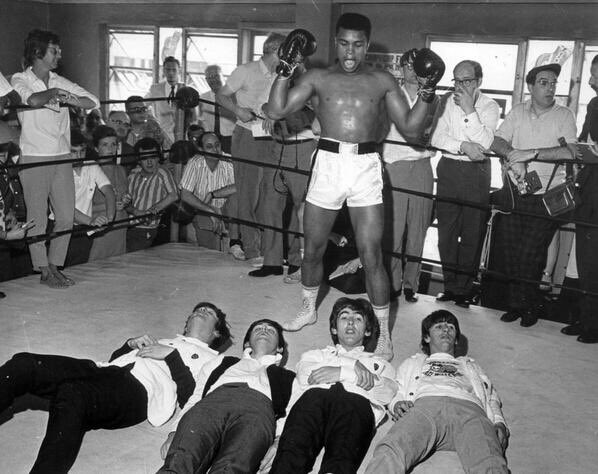
Suddenly the door swung open and the startled band-mates looked up to see the biggest man any of them had ever seen framing the doorway. “Hello there, Beatles!,” Clay exclaimed. “We oughta do some roadshows together. We’ll get rich!” The Beatles were instantly mesmerized. Amid laughter, playful nudges and jostling, the five young men who would come to define their generation, headed into the gym. There they posed, mugged and improvised slapstick situations for the cameras like old time vaudevillians. The media image-savvy young boxer at first posed in his street clothes and then changed into his white trunks. Clay characteristically bit his upper lip and posed knocking the Beatles down like dominoes. The Fab Four dutifully lay on the canvas in mock defeat before as the young fighter towered over them. Clay suddenly picked the diminutive Ringo up off the floor and effortlessly cradled him in his arms like an infant. “Man, you guys are the greatest!” Cassius enthused. “The whole world is shook up about you!” One UPI reporter said Clay ad-libbed a little verse for the occasion: “When Liston reads about the Beatles visiting me / He’ll get so mad I’ll knock him out in three!” The exhausted Beatles were thunderstruck by the encounter. As the dunned Fab Four fled the gym and piled back into their limo, they swore oaths to photographer Benson that they’d never speak to him again, with one unidentified Beatle carping that the whole experience had been “degrading. You made a fool of us!” The feeling was apparently mutual. Back at the gym, Clay completed his workout, then hit the dressing room for a rubdown as the press prodded him for details. Cassius turned to Lipsyte with a puzzled look and asked about the four long-haired young Englishmen he’d spent the morning clowning with earlier by asking, “Who were those little sissies?” A week later Sonny Liston threw in the towel by refusing to come out of his corner for the seventh round of the title fight. Of the encounter, reporter Robert Lipsyte later wrote, “In 1964 my time was not very valuable. I was a utility night rewrite writer and speechwriter at the Times when Sonny Liston fought Cassius Clay for the first time. The Times, in its wisdom, did not feel it was worth the time to send the real boxing writer. So they sent me down to Miami Beach and my instructions were, as soon as I got there, to rent a car and drive back and forth a couple of times between the arena, where the fight was going to be held in a week, and the nearest hospital. They did not want me wasting any deadline time following Cassius Clay into intensive care.”
“As I walked up the stairs to the gym there was a kind of hubbub behind me. There were these four little guys in terrycloth cabana suits who were being pushed up the stairs by two big security guards. As I found out later, it was a British rock group in America. They had been taken to Sonny Liston for a photo op. He had taken one look at them and said “I’m not posing with those sissies.” Desperately, they brought the group over to Cassius Clay—to at least get a shot with him. They were cursing. They were angry. They were absolutely furious. I introduced myself. John said, “Hi, I’m Ringo.” Ringo said, “Hi, I’m George.” I asked how they thought the fight was going to go. “Oh, he’s going to kill the little wanker,” they said. Then they were cursing, stamping their feet, banging on the door. Suddenly the door bursts open and there is the most beautiful creature any of us had ever seen. He leaned in, looked at them and said, “C’mon, let’s go make some money.” He turned and the Beatles followed him out to the ring. They lined up. He tapped Ringo. They all went down like dominoes. It was a marvelous, antic set piece. And then it was over and they left.”
The Ottawa Journal newspaper of February 19, 1964 ran an article titled, “BRITAIN’S BUSH-HAIRED BEATLES MEET BOXING’S BARON OF BRAY” which reported, “Britain’s bush-haired Beatles met boxing’s Baron of Bray, Cassius Clay, Tuesday and it ended up in clowning, off-key pandemonium. Boxing and singing probably were set back 100 years when Gaseous Cassius teamed up with.. the four mop-haired singers during a break in training at the Fifth Street gym. “Man, you guys are the greatest. The whole world is shook up about you,” said Clay, apparently a longtime Beatle fan. The raucous meeting represented two firsts: Clay admitted that someone other than himself is “great,” for the first time, and he predicted that he will flatten Liston in three rounds, even though the brash 22-year-old contender is a 6-1 underdog at the moment. The Beatles, dressed in flashy sport shirts, snow-white vests and beach shoes, enjoyed the meeting as much as Clay. They entered the training ring with a “yeah, yeah, yeah” and pretended to attack Clay en masse. Clay shouted “no, no, no” and feigned horror. It was about what you’d expect from Clay – Beatle meeting: noise, poems and more noise. Photographers had a field day during the clowning, which didn’t end until trainer Angelo Dundee reminded Clay that he had a date in exactly one week. Before they left, Clay lifted Beatle drummer Ringo Starr two feet off the floor, tossed him up and wished him good luck.The other three Beatles, George Harrison, John Lennon and Paul McCartney, watched laughing. For the Beatles, the confrontation with Clay was the kickoff of a leisurely day on the beach. They have no more appearances to make and are vacationing until Friday when they return to London. For Clay, it was a respite from the serious business of hard training. Loudmouth or not, Clay apparently realizes what he is here for. He snapped back into the routine as soon as the Beatles left.”
As for Liston, rumors circulated that the champ had been drinking heavily the night before the fight. Liston was still a world-ranked boxer when he died under mysterious circumstances at the estimated age of 39 (Sonny’s birth certificate has never been found). Almost a year after defeating Chuck Wepner on January 29, 1970, whose 1975 title fight with Muhammad Ali was the model for the “Rocky” films, Liston was found dead by his wife, Geraldine, in their Las Vegas home on January 5, 1971. Upon returning home from a two-week trip, Geraldine smelled a foul odor coming from the main bedroom. There she found her husband slumped up against the bed atop a broken foot bench. It was believed the champ was undressing for bed when he fell backward breaking the bench. Geraldine called Sonny’s attorney and his doctor, but did not notify the police until two to three hours later. Police found a quarter-ounce of heroin in a balloon in the kitchen and a half-ounce of marijuana in Liston’s pants pocket.
Following an investigation, Las Vegas police concluded that there were no signs of foul play and declared Liston’s death a heroin overdose. The coroner said Sonny’s body was too decomposed to be conclusive and officially declared the cause of death to be “lung congestion and heart failure” to save embarrassment for the family. The date of death listed on his death certificate is December 30, 1970, which police estimated by judging the number of milk bottles and newspapers around the front door of the property. Many people who knew Liston insisted that he was afraid of needles and never would have used heroin. Some claim Liston was murdered by the mob and a loan-sharking ring in Las Vegas. Others said Liston was murdered by drug dealers with whom he’d become involved. Underworld connections and his unrecorded date of birth added to the enigma.
For their part, that evening The Beatles went to a drive-in movie, where they watched Elvis Presley in Fun In Acapulco. Cassius Clay became Muhammad Ali, “THE” heavyweight champion of a generation. It was a title he’d retain on and off for the next 15 years, twice as long as The Beatles lasted as a group. That hastily-arranged photo op of greatness from 55 years ago has become an iconic mixed-metaphor snapshot of the sixties. The participants are all shown smiling, jostling and cajoling each other in the ring, betraying no trace of the resentment being felt on all sides. Three of the five subjects are gone from this earth, but those images have achieved pop culture immortality.


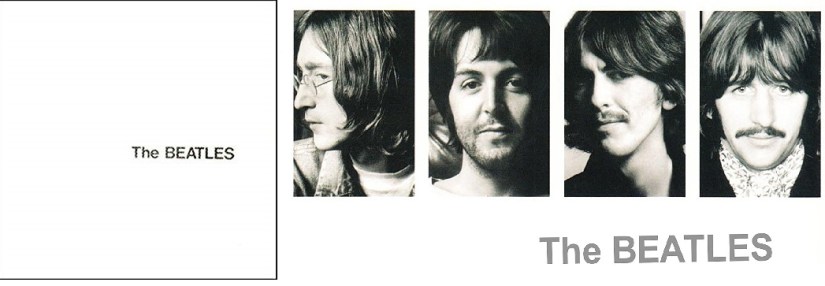 The stark snow white album cover was seen as an obvious reference to the white light of heaven, where Paul was supposed to be at its release. But it was the poster issued inside the white album (a collage featuring a number of random images of the Fab Four) that came under the scrutiny of those looking for “Paul is Dead” clues. In the lower right hand corner of the poster (page 7 of the CD booklet) is a grainy B&W photo of Paul dancing. Upon close examination, a pair of ghostly hands can be seen reaching toward Paul from behind.
 The song “Glass Onion” makes a number of references to Beatle songs and events. John mentions “The Fool on the Hill” and states, “I tell you man he living there still” thought by some to symbolize heaven. However, perhaps the most intriguing line in the song is “Well here’s another clue for you all…The walrus was Paul.” Seen as a final bow to his fallen bandmate and co-songwriter. Some sources have suggested that the phrase “goo goo g’joob” is from Finnegans Wake by James Joyce (Alas, the phrase “googoo goosth” is the closest Joyce gets in th book.) Never fear, the “Paul is Dead” rumorists claim that “goo goo g’joob” are the last words uttered by Humpty Dumpty before his fall. A fall that cracked his head open, much like Paul’s supposed fatal car accident.
 Revolution 9 was an innovative sound collage that, quite frankly, soared over most listener‘s heads. Later transcripts of the dialog heard early in the song reveals two men who can be heard saying “I know all about it George. I’m sorry. Will you forgive me? Yes.” Theorists claimed that this was John talking with George Martin about the secret placement of clues on Beatles records. However, the biggest clue to Paul’s death on the track is the title itself, whose repeated phrase “Number 9” is said to sound like “turn me on, dead man” when played backwards. A dark recall to the line “I’d love to turn you on” from “A Day in the Life”.
 Ardent believers believed that other “Backwards” clues could be found on the track “I’m so tired / Blackbird” when some random mumbling is heard that they believe sounds like John and Yoko right after the abrupt ending of “I’m So Tired” and before the beginning of the next song, “Blackbird“. This passage makes no sense when played forwards. However, when played backwards, they believe that you can hear John say, “Paul is a dead man. Miss him. Miss him. MISS HIM!” John Lennon was said to be expressing his grief over Paul’s death in this line of the song followed by the very next line on the record, sung by Paul, “Blackbird singing in the dead of night”, that mentions death.
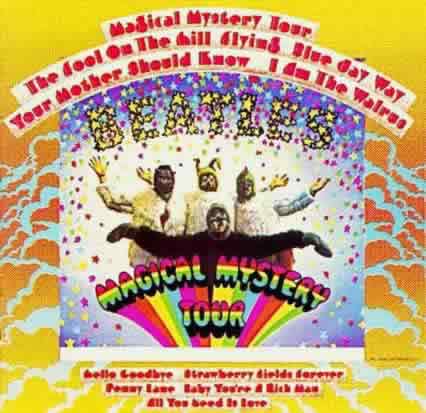
 Magical Mystery Tour was released on December 8, 1967. After the success of Sgt. Pepper’s, Paul McCartney wanted to create a film based upon The Beatles and their music. The film was to be unscripted and would “star” various “ordinary” people who were to travel the countryside on a bus and experience “magical” adventures on film. The Magical Mystery Tour film was made and included six new Beatles songs. The film was universally panned and largely forgotten, but the resulting album / soundtrack is considered a classic. Produced by George Martin, Magical Mystery Tour was packaged by Capitol records as a full LP with a 24-page companion picture booklet.


 On page 23, the Beatles are all wearing stark white tuxedos with carnations in the lapels. Paul’s flower is black while the other Beatles have red flowers. Years later, Paul denied that the black carnation had any significance at all; “I was wearing a black flower because they ran out of red ones.”
 And on the final page of the photo booklet, once again, a hand appears over Paul’s head. Although this instance of a hand over Paul’s head isn’t nearly as dramatic as the Sgt. Pepper’s cover photo because several people have their hands raised above their heads in this picture. But it certainly did nothing to ease the conspiracies.
 However, there is one compelling image in the pages of the pictorial book that, when analyzed, virtually screamed out to all those looking for signs of death in the Beatles’ works to substantiate the rumors of Paul’s premature passing. On page 8 of the booklet, a dining scene, at the left of the image (but on the right as the image is rotated one turn clockwise), with a little imagination, you can see a skull in this picture. It occupies the left side of the picture, with the beret of the person seated at the table forming the eye and the hair of the woman seated next to him the mouth. Like a “Magic Eye” painting, once you’ve accepted it as a skull, it’s easy to see the damage to the top of the head. This grisly image suggests the damage to Paul’s head as a result of his car crash. The fact that this picture, unlike all of the other images in the booklet, does not appear in the movie again only encouraged the “Paul is Dead” crowd as proof of his passing.
 Theorists would claim a connection between Paul’s supposed Walrus costume and the death rumor, but the real controversy revolved around the word “Beatles” above the lad’s heads that purportedly reveal a secret phone number. As Rolling Stone famously pointed out, it’s not exactly clear what that phone number is supposed to be. Depending on whom you ask it could be read as “231-7438, 834-7135, 536-0195, 510-6643, 546-3663, 624-7125, no telling what city, maybe London.” If you turn the album cover upside down and hold it in front of a mirror you can see the numbers 8341735, which is a stretch because the threes, the seven and the five are backwards. If you simply hold the album cover upside-down, the numbers could be 5371438. Of course, there is no area code. The rumor claimed that when this number was dialed, the caller would receive information about Paul’s death, or the person would be able to take a trip to “Magical Beatle Mystery Island”, or maybe even speak to Paul in the hereafter. Stories circulated about the strange responses callers were receiving from the voices on the other end of the phone line. Later it was discovered that one of the phone numbers belonged to a journalist who was nearly driven crazy by the numerous phone calls from people hoping to connect with the late Paul McCartney.
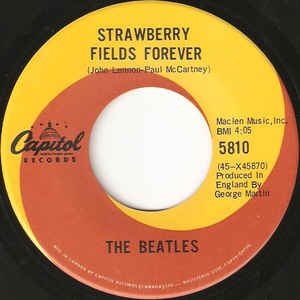 But it was the music contained on the album that offered the clue seekers the most tantalizing hints at Paul’s demise. One of the best known “Paul is dead” audio clues comes at the end of “Strawberry Fields Forever”. As the song fades out for the second time, John allegedly says “I buried Paul.”‘ This audio clue can be heard more clearly when the record is played at 45 rpm as John’s voice is slowed down to a virtual crawl. Years later, John admitted that he was really saying “cranberry sauce,” which became evident on the “take 7 and edit piece” version of the song that appeared on Anthology II in 1996. Paul explained “That’s John’s humor. John would say something totally out of sync, like ‘cranberry sauce.’ If you don’t realize that John’s apt to say something like ‘cranberry sauce’ when he feels like it, then you start to hear a funny little word there, and you think aha!”
 The album, movie and pictorial booklet are arguably the most ambitious effort ever attempted by the Fab Four. Completed at a time when the Beatles were still having fun, but questioning their viability at the same time. Although they saw themselves as a rock band, their fans were looking at them as modern day prophets. Undoubtedly, this view was responsible in large part for the devastation perceived by the “Paul is Dead” rumors that continued to swirl around the band. The band’s next effort, “The White Album”, would do nothing to help end the controversy.

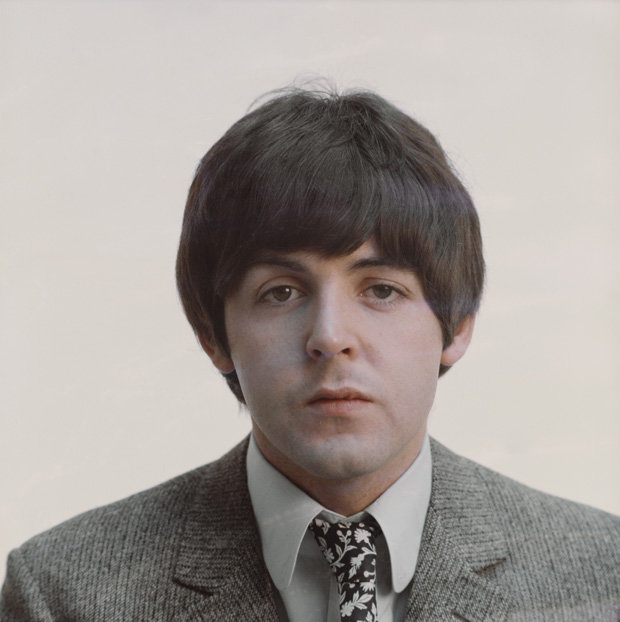
 During that last tour, the airplane they were traveling in was shot at as they landed in Texas, and a prankster threw a firecracker at the stage during their Memphis show which everyone thought at first was a gunshot. The Beatles were burnt out and the band had had enough. The band’s attitude and message became darker and soon, concerts became dangerous as the Beatles’ started to receive death threats after some comments made by John Lennon at a press conference that year. John’s quote “the Beatles are bigger than Jesus” was taken out of context and according to John Lennon, “upset the very Christian KKK”. In the Philippines they unintentionally offended Imelda Marcos, a former beauty queen, by not meeting with her privately before their show. Filipino citizens took this as an excuse to rob, harass and threaten death to the Beatles. They stopped touring soon after the show at Candlestick Park in San Francisco on August 29, 1966. Less than six months later, the McCartney death rumor had reached a fever pitch worldwide and just like Paul himself, it refused to die.


 On the inside photo, Paul is wearing a patch on his band uniform with the letters “O.P.D.” that theorists interpreted as “Officially Pronounced Dead.” According to tradition, this British Police jargon “O.P.D.” phrase is the equivalent of American police forces use of “D.O.A.” (Dead On Arrival). (Much later, in a Life magazine article Paul stated, “It is all bloody stupid. I picked up the O.P.D. badge in Canada. It was a police badge. Perhaps it means Ontario Police Department or something.” Actually, the badge Paul was wearing reads “O.P.P.”, which stands for the Ontario Provincial Police. The angle of the photograph makes the final “P” look like a “D”.)
 Furthermore, the three black buttons on the waist above the tail of Paul’s coat are supposed to represent the mourning of the remaining Beatles. Although John, Paul and George were all about the same height (Ringo, much shorter), in the gatefold photo, Paul appears taller than the other Beatles, suggesting that he is ascending to the heavens. Another clue points out that next to Paul’s head are the words “WITHOUT YOU” from the song title “Within You Without You”.
 Regardless, the album did nothing to quell the rumor that “Paul was Dead.” The Beatles, who were by this time totally fed up with dealing with the press, did little to dissuade the discussion of demise. Some pundits have speculated over the years that the entire affair was a ploy by the Beatles’ and their management designed to sell more albums. Which makes sense when you consider that the McCartney death rumor would continue to swirl around future album releases by the Fab Four in the coming years.

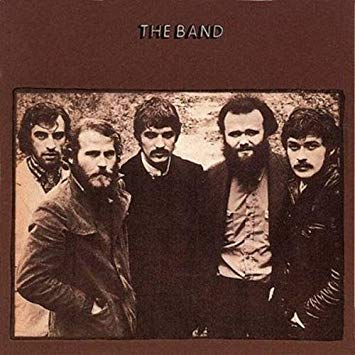


 The Band was born only after the near fatal motorcycle accident involving the world’s most famous electric folksinger changed their direction. And, although The Band’s first album “Music From Big Pink” debuted on July 1st, 1968, the band from West Saugerties, New York did not perform live until the spring of 1969 a continent away in San Francisco. The album was created start to finish in two weeks time with no overdubbing, unheard of for its day. What’s more, The Band very nearly didn’t take the stage at all; saved only after legendary promoter Bill Graham picked a hypnotist out of a bay area phonebook to right the ship. The little-known stories of these great incidents will be discussed this Saturday.
 To understand The Band, one must also understand the era into which it was born. Big Pink’s 1968 debut was also the year of student protests against the Vietnam War, Martin Luther King and Robert F Kennedy’s assassination, riots at the Democratic National Convention in Chicago, Black Panther demonstrations, feminists protesting the Miss America pageant in Atlantic City, Apollo 7 and 8’s moon landing rehearsal flights, Charles Manson gathering his cult members at Spahn Ranch and Nixon’s nomination for president. To many, America was coming apart at the seams and the divide between generations had never seemed wider. This band, formed out of a classically trained musician, a teenaged alcoholic, a butche’rs apprentice, a Jewish Native American grifter and a veteran performer from the Mississippi Delta, stepped forward to bridge the gap.
 While considered the fathers of the history conscious “Americana” music movement, make no mistake about it, these guys were quintessential rock and rollers. Fast cars, fast women, and fast times punctuated the lives of each member of The Band. They started in the age of rockabilly, while Elvis Presley was still shaking things, up and finished at the dawn of hip-hop. They crossed paths with Hollywood movie stars, gangsters and presidents. Eric Clapton, Van Morrison, Dr. John, Sonny Boy Williamson, Muddy Waters, Conway Twitty, Tiny Tim, Jack Ruby, Martin Scorsese and Jimmy Carter all play a part in the story of these four Canadians and one self-described “cracker” from Arkansas to create a mystique that still surrounds them today, long after three out of the five band members have passed.





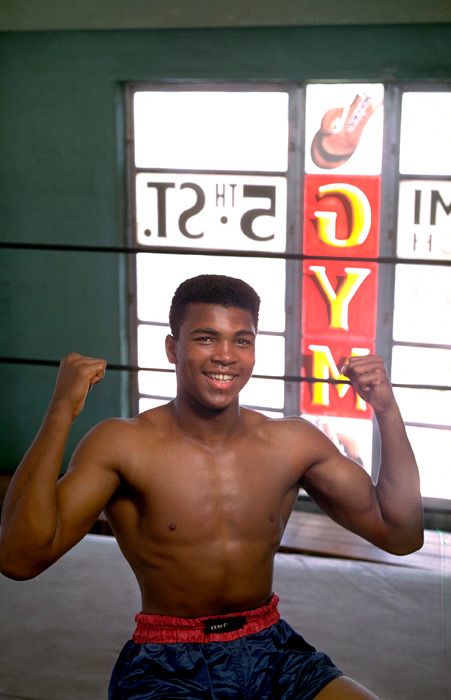
 The exhausted Beatles were thunderstruck by the encounter. As the dunned Fab Four fled the gym and piled back into their limo, they swore oaths to photographer Benson that they’d never speak to him again, with one unidentified Beatle carping that the whole experience had been “degrading. You made a fool of us!” The feeling was apparently mutual. Back at the gym, Clay completed his workout, then hit the dressing room for a rubdown as the press prodded him for details. Cassius turned to Lipsyte with a puzzled look and asked about the four long-haired young Englishmen he’d spent the morning clowning with earlier by asking, “Who were those little sissies?”
 A week later Sonny Liston threw in the towel by refusing to come out of his corner for the seventh round of the title fight. Of the encounter, reporter Robert Lipsyte later wrote, “In 1964 my time was not very valuable. I was a utility night rewrite writer and speechwriter at the Times when Sonny Liston fought Cassius Clay for the first time. The Times, in its wisdom, did not feel it was worth the time to send the real boxing writer. So they sent me down to Miami Beach and my instructions were, as soon as I got there, to rent a car and drive back and forth a couple of times between the arena, where the fight was going to be held in a week, and the nearest hospital. They did not want me wasting any deadline time following Cassius Clay into intensive care.”


