For many Indianapolis residents, Christmas in the Circle City is defined by one thing: The World’s Largest Christmas Tree. Every year since 1962, the dedicated electrical workers of IBEW 481 have dutifully transformed the Soldiers and Sailors monument into a glistening, magical pyramid of lights that even the most skeptical Scrooge among us proudly calls the world’s largest Christmas tree. This year marks the 56th anniversary of that monumental Christmas tree. Although I never fail to take my annual trip around Monument Circle at Christmastime to gaze in wonder at the fantastic fir tree fantasy, my personal memories of Christmas on the Circle revolve around a little shack that used to rest at its base facing the Indiana Statehouse. You may think of the L.S. Ayres Cherub, Santa’s mailbox, the 26 larger-than-life toy soldiers and sailors surrounding the Circle, the 26 red & white striped peppermint sticks, the 52 garland strands or the 4,784 colored lights strung from the top of the Monument to its base, but I think of the Roselyn Bakery Christmas Hut.
For a quarter century beginning in 1974, every year on the night after Thanksgiving Indianapolis based Roselyn Bakeries set up a special “Christmas Hut” to celebrate the lighting of the “World’s Largest Christmas Tree” on Monument Circle. The best part? Many lucky visitors received free Christmas cookies made from a “secret” Roselyn recipe. Surely those cookies were made by Roselyn’s mascot “Rosie” herself inside that tiny little shed, right? Decorated with Gingerbread man shutters and candy cane pillars, coated in what looked like white icing, the Christmas hut was set up on the West side of the Circle where it remained for 25 years from 1974 to 1999. It was estimated that some 1.2 million Gingerbread man cookies were handed out from within that festive little house over those years. Just like the bakery itself, that little hut was an institution.
Roselyn Bakery was founded in 1943 with its first storefront located at 22nd and Meridian Streets. Within the decade Roselyn bakeries could be found all over the city. You might remember those old city buses with the early Roselyn Bakery cartoon chef logo known as “Mr. Henry.” By the Bicentennial celebration in 1976, there were over 30 Roselyn locations all over central Indiana. When they closed up shop in 1999, Roselyn had some 40 locations offering over 700 different items. I’m still amazed by the memory of those Grandmotherly looking counter ladies wrapping up those cookie and cake boxes with that menacing looking string-tie machine that made that frightening bullwhip sound: “Whoosh-snap!” For me, Roselyn will always be identified for buttermilk jumbles, toffee cookies, alligator & sweetheart coffee cakes, yeast donuts and the darling little girl cartoon mascot known as “Rosie”. A blonde haired, blue eyed perpetually smiling little naive whose popularity forced the Roselyn Christmas Hut to undergo a name change to “Rosie’s Gingerbread House.” If memory serves, for a time there was even a living, breathing life-sized “Rosie” mascot dressed in a horribly oversized paper mache’ head and wearing a red velvet dress. Every so often, she would wobble awkwardly out of the Gingerbread hut to personally pass out cookies to the eager, but slightly befuddled, kiddies on the Circle. As I recall, she didn’t speak, but to a 12-year-old cartoon addicted boy like me, her skirt was short and her cookies were hot.
Today, nearly two decades after that Roselyn Christmas house disappeared, the lighting of the Circle is called the “Festival of Lights” attended by a crowd of over a 100,000 people with another 50,000 viewers watching the event live on TV from home. In 2011, Travelocity called the Circle of Lights one of the top five “must-see Christmas trees” in the country. To quote the old Virginia Slims cigarettes slogan from Rosie’s days, “You’ve come a long way baby.”
The “Christmas in the round” idea was born in 1945 at the close of World War II and intended as a celebration of peace at a monument built to honor fallen soldiers. Renowned Indianapolis architect Edward D. Pierre (IPS schools # 7 & 78, Indiana State Library and Historic Bureau) first suggested decorating and lighting the Monument as a glowing symbol of peace. Until 1961, decor was confined to the lower parts of the Monument. The next year, the “World’s Largest Christmas Tree” was born. That simple program with a few speakers in 1962 has evolved into an intricate hour-long television show today. As for Roselyn, the cakes, donuts and cookies can be found in several of the grocery store chains around town. But its not quite the same. The bakery chain’s only remaining evidence on our streets are the many Roselyn Bakery “Frankensigns” that dot the city in front of those familiar low rise buildings that once sold Rosie’s sugar-coated sweets. Eight mayors and ten governors have served our city and state over the past 50 years. I can’t say that I miss any of them, but I do miss those Gingerbread cookies. If you do too, you can make them yourself. Here’s the recipe for Roselyn Bakeries famous Gingerbread Men cookies: 1 1/4 teaspoon allspice, 2 3/4 teaspoons baking soda, 5 teaspoons ground cinnamon, 1 teaspoon ground cloves, 1 teaspoon ground ginger, 2 1/2 teaspoons salt, 3/4 cup Crisco shortening, 3/4 cup granulated sugar, 6 tablespoons whole eggs, 1 1/4 cup extra fine coconut (Make sure that the coconut you use is very fine, almost like coarse sugar-you may have to grind store bought coconut flake down), 1 1/4 cup honey, 5 cups all-purpose flour. Preheat oven to 360 degrees F. Combine allspice, baking soda, cinnamon, cloves, ginger, salt, shortening, and sugar into a large mixing bowl. Cream together. Scrape down bowl. Add beaten eggs and mix thoroughly. Scrape down bowl. Add coconut and honey and mix well. Scrape down bowl. Add flour and mix well. On a lightly floured surface, with a floured rolling pin, roll dough 1/8 inch thick. With a 5 inch long cutter, cut out men. Re-roll trimmings and cut more cookies. With spatula, place 1/2 inch apart on cookie sheets. Bake at 360 degrees for 8 minutes or until browned, then, with spatula, remove cookies to racks to cool. Decorate as desired. Makes 3 dozen cookies. Now if I could only locate a slightly used Christmas shack.
Original publish date: December 7, 2013~~Republished September 27, 2018
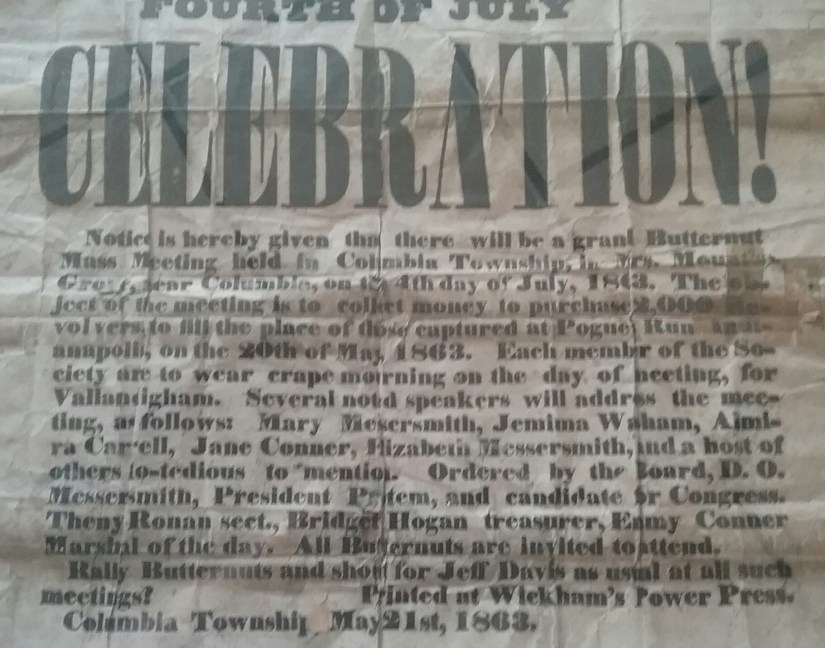
Quick name the Northern-most battle fought on Union soil during the American Civil War? Gettysburg? Nope, but here’s a hint…it was fought in Indiana. Corydon? Nope. Indianapolis…the Battle of Pogue’s Run. Okay, okay, so no shots were fired, but it’s still a great story from the archives of Civil War Indiana. And during this, the 150th anniversary of the Civil War, what better time than the present to revisit Indianapolis past?
It’s May 20, 1863 and there’s a battle raging at the Indiana statehouse. Rumors were spreading that Copperheads within the Indiana Democratic party were determined to take over State Government and turn it over to the Rebels. Named for the poisonous snake indigenous to Southern Indiana which gives no warning before it strikes, Copperheads were Hoosiers who opposed the American Civil War. Considered traitors by others in the North, they favored immediate peace with the Confederacy.
These “Peace Democrats” accepted the label and often identified themselves by the use of stickpins featuring the likeness of Lady Liberty, which they cut from copper pennies and proudly wore on their lapels. Copperheads damaged the Union war effort by fighting the draft, encouraging desertion, and forming conspiracies in effort to incite unrest far behind the front lines.
Poster on display at Historic Connersville museum.
The “Battle of Pogue’s Run” began when a rumor circulated that that many of the delegates to the Democrat state convention were carrying concealed firearms, hell bent on insurrection. Union soldiers entered the delegates hall and found personal weapons on many of the delegates. Afterwards, Union soldiers stopped departing trains carrying delegates and began another search of the delegates. Many of the delegates fled the train and began to throw their weapons into the creek that ran diagonally southwest through the city known by locals as Pogue’s Run. Some blamed the Republicans, some the Democrats, while others pointed the finger at powerful Governor Oliver P. Morton but it might be easier to place the blame on the fear and paranoia that permeated the Civil War itself.
Oliver P. Morton, Governor of Indiana for the duration of the Civil War, strongly supported President Abraham Lincoln and the Union. Perhaps more than any other northern Governor. Under his leadership, Indiana raised more men and money for the war effort than any other northern state. Whether you loved him or hated him, there was no doubt about it, Oliver P. Morton was large and in charge.
Within days of his inauguration as governor, Morton saw the war clouds on the horizon and began to prepare the state for the inevitable. He appointed men to important positions who he knew would never compromise with the southern states. Time and time again, he chose Republicans loyal to him over others connected to politicians like Congressmen George W. Julian or Schuyler Colfax, his chief rivals in the Republican Party. When the legislature resisted his call for the creation of a State armory, he collected private funds and built one himself. Morton’s new state arsenal employed seven hundred men to produce ammunition and weapons without legislative permission in preparation for the war he was sure was coming. When the South Carolinians’ fired on Ft. Sumter on April 12, 1861, he telegraphed President Abraham Lincoln within hours to announce that he already had 10,000 soldiers under arms ready to suppress the rebellion.
Lincoln and Morton maintained a close alliance during the war, although Lincoln was wary at times of Morton’s ruthlessness. Lincoln once said of Morton that he was “at times the shrewdest person I know.” Governor Morton wrote to Lincoln claiming that “no other free state is so populated with southerners”, and that these “Copperheads” kept Morton from being as forceful against secession as he wanted to be. Through sheer determination and projected self confidence, Morton kept the state united early on in the war. That is until Lincoln began to raise the emancipation question in 1862.
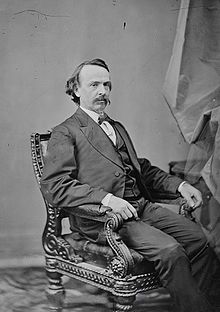
The cracks in Morton’s armor began to show in the mid-term elections of 1862. The Republican party suffered a major defeat at the polls and the Democratic Legislature, which had been strongly Pro-Morton during the Governor’s first 2 years in office, now turned against him. The Democrats, under future Vice-President Thomas A. Hendricks, declared that while they were strongly pro-union and supported the war effort, they opposed the abolition of slavery. In protest, and possibly out of arrogance, Morton never called the 1862 State Legislature into session. Morton believed that should he call the session, radical elements in the opposition party might undermine the Hoosier state’s devotion to the war effort, instigate riots, harbor southern spies and possibly vote to secede from the Union. The Governor issued secret instructions to GOP legislators asking them to stay away from the Statehouse, thereby thwarting efforts to attain a voting quorum. With Morton’s aid, the Republicans fled to Madison where they could cross easily into Kentucky should the Democrats attempt to forcibly return them to the capitol. Because of this, the government was at a virtual stand still. No budget, no taxes, no revenue. The state quickly ran out of money and teetered dangerously on the edge of bankruptcy. Exceeding his Constitutional powers, Morton solicited millions of dollars in personal loans to keep the Government going.
Although patently Unconstitutional, Morton’s plan worked and the Hoosier contribution to the war effort rolled on without the help of the State Legislature. The atmosphere created by Morton’s actions only worsened tensions between the two parties and guaranteed a confrontation, which was probably already inevitable. Now Democrats saw Morton as the embodiment of the National Republican agenda, with its expansion and corruption of power. They saw him as Lincoln’s henchman in Indiana as well as a tyrant in his own right.
The rage among the Democrats was bubbling to the top. They launched vicious attacks in the press against Morton, who responded by accusing them of treason. Morton again pushed the limits of his wartime authorities by using an intelligence network to deal with rebel sympathizers, the Knights of the Golden Circle, Democrats, and anyone who opposed the Union war effort, or him. While this helped to keep the state more secure, his secret police force also carried out arbitrary arrests, suppressed freedom of speech and freedom of association (particularly in the press), and generally maintained a repressive control of the southern-sympathetic minority. It was easy to see that a battle was brewing in the Circle City.
The Battle of Pogue’s Run commenced when Morton had soldiers disrupt the Democratic state convention based solely on conjecture. Many leaders of the Democratic Party were arrested, detained, or threatened and charged with the possession of firearms. Which is ironic considering Morton had been making his own guns and ammunition statutorily illegally for years and while nearly every citizen in Indianapolis, at that time considered the far western frontier, was armed to the teeth.
Governor Morton developed an incendiary plan to place Union troops inside the convention hall specifically to intimidate the delegates to the convention. About four o’clock in the afternoon, while Thomas A. Hendricks was speaking to an estimated 10,000 delegates from the rostrum, a group of a dozen-or-so soldiers entered the hall with bayonets fixed and rifles cocked. The menacing looking soldiers entered the crowd and advanced slowly toward the stand, causing a great uproar. The delegates and attendees scattered in every direction. A high fence on the east side of the state-house square was pushed down by the panicked crowd. To make matters worse, a squad of cavalry galloped back-and-forth along Tennessee street.
General John Coburn.
The soldiers moving towards the stand were ordered to halt by Colonel John Coburn, who had been guarding the quartermaster’s stores north of the State-house but who had rushed over after hearing the disturbance. He asked what they were doing. They replied they were “going for Tom Hendricks,” that he had said too much, and they intended to kill him. Coburn reasoned with the agitated soldiers and they halted. Meantime, there was much confusion on the stand. Perhaps needles to say, Hendricks closed his remarks prematurely by quickly suggesting that the resolutions be read and the meeting adjourned. The record reflects that there was no second to his motion.
When calmer heads prevailed, it was found that the resolutions declared that the Federal government had two wars upon its hands; one against the rebels and one against the constitution. The quorum breaking Republicans in the late legislature were denounced in the strongest terms and it was further declared that the Governor could not “clear himself from complicity, except by taking steps to prevent repudiation.” In reaction to the Governor’s crack-down on dissent, the Indiana Democratic Party called Morton a “Dictator” and an “Underhanded Mobster” while Republicans countered that the Democrats were using “treasonable and obstructionist tactics in the conduct of the war”.
Although now calmer, the soldiers remained agitated. Occasionally, if they heard any of the remaining Democrats speak against the war, the Republican Party, the President or Governor Morton, that individual would be grabbed roughly underneath the armpits and marched out to the street followed by a great rabble. The intent was not to harm the poor fellow but to frighten him. Eventually the scared temporary detainee either slipped away or was told that he would be released if he promised to behave himself. A number of men were taken to the police court and charged with carrying concealed weapons, and about forty pistols were taken from those arrested. Later that night as the convention concluded, many of the Democratic delegates took trains departing from Indianapolis. As the trains slowly departed from the city a great number of shots were fired from within the cars traveling on the Lafayette and Terre Haute railroads.
The delegates felt the rough treatment they deserved from the Governor’s armed thugs was undeserved and their anger manifested by an intention to create an armed disturbance. Perhaps justified in their feelings, it was not the wisest thing for them to do, and the re-agitated soldiers quickly determined to teach the remaining “Copperheads” a lesson. As the Indiana Central Railroad train left Union station a cannon from Morton’s nearby armory was commandeered and placed on the tracks in front of it. The train stopped. A small body of soldiers and policemen boarded the train and demanded the surrender of all firearms by the passengers. The delegation collected nearly two hundred weapons. The train bound for Cincinnati was also stopped and many revolvers were taken from the passengers.
Some of the enraged delegates refused to hand over their personal firearms and chose instead to throw them out the open windows into Pogue’s Run, a shallow waterway parallel to the track. Some delegates gave their pistols to women on the train, in the belief that they would not be searched. They were mistaken and in one instance, seven firearms were found hidden upon a single woman. A two foot long Bowie knife was discovered hidden in the smoldering ashes of a stove in one of the cars. In all, about five hundred loaded revolvers were taken from passengers, not all of whom were delegates to the convention, or even Democrats! Accounts of just how many weapons were thrown into Pogue’s Run ranged from 500 to 2,000. The Indianapolis Sentinel described it as: “It is with feelings of sorrow, humiliation and degradation that we witnessed the scenes of yesterday. . . . Indiana is as completely under military rule as France, Austria or Russia”. But to those who supported Morton’s action, it seemed to them that would-be insurrectionists would be too cowardly to actually rebel. The term “Battle of Pogue’s Run” was given to the event by the Republican Party derisively, who praised the soldiers involved as “halt(ing) a meeting of traitors to the Union cause”. The Democrats, on the other hand, called the event “still more assaults upon constitutional rights” by those supporting Abraham Lincoln and Governor Morton.
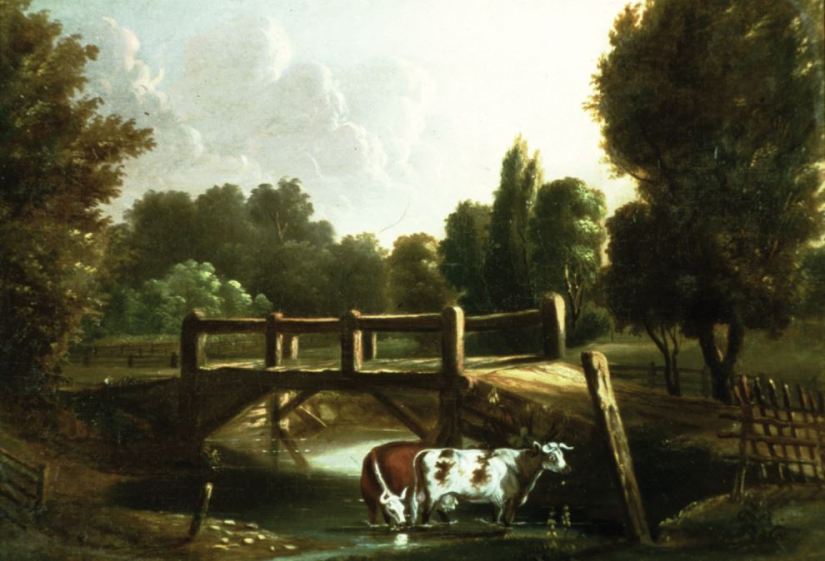
The Run flooded in 1882, killing at least ten people and exposing the skeletal remains of many of the weapons pitched into the water that May evening two decades before. The flood destroyed a covered bridge that once crossed Pogue’s Run near the spot where the battle took place. More than three decades after that devastating flood, in 1914, Pogue’s Run was rerouted into the storm sewers of downtown Indianapolis in order to allow for a perfect grid pattern for Indianapolis’ roads. The stream goes underground at New York Street, east of I-70, and eventually spills into the White River near Kentucky Avenue. Indy Parks established a Pogue’s Run Trail alongside the creek bed on the section northeast of downtown.
1871 Pogue’s Run painting by Jacob Cox.
Today, wildlife can be found on the path including ducks, geese, red-winged Blackbirds, and the occasional blue heron. A plan called “Charting Pogue’s Run” intends to mark where the creek once ran in downtown Indianapolis. The plan calls for a blue line, made of thirty permanent steel medallions and a semi-permanent blue thermoplastic line, to “meander” across roads and parking lots following the route of the historic waterway. That proposed blue line promises to show how Pogue’s Run now lies under Lucas Oil Stadium and Banker’s Life fieldhouse. I expect that at least one of those markers will be dedicated to the rich history of Pogue’s Run and the Civil War battle that bears it’s name.
Relatively speaking, Paul Ruster Memorial Park is one of the newest additions to the Indianapolis Parks system. The park’s trail consists of a 1.2 mile moderately trafficked loop trail that features a river and is rated as moderate. The park is tucked away off of busy Washington Street and the trail is like stepping into a hidden forest. The trail features some steep inclines with several elevation changes and can be very tight in certain areas. It is more of a recreational facility than a park in the traditional sense of the word. Located near the bustling Washington Square Mall shopping complex, the 102-Acre park features a small fishing pond and playground.The Ruster park is bordered by walking trails, defined by Buck Creek that borders the area, that each offer eastsiders a rural setting for jogging, hiking and dog walking. During summer, locals take advantage of the park’s picnic facilities and shelter house. In 2007, the park added two fenced in “Bark Parks” (the third such facility in Indianapolis). During the winter, the park’s many hills are filled with sledders, skaters and tubers. Ask any of these visitors about the park’s namesake and you’re likely to catch them at a loss. What’s more, most visitors are unaware that Paul Ruster Park is haunted by a centuries-old ghost. The park, acquired by the Indy Parks system in 1970, is named after a 1964 Warren Central high school graduate, Paul M. Ruster. Paul, the oldest of three sons of Marvin and Marie Ruster, died December 10, 1978 of Hodgkin’s disease. Paul’s brother Bruce was a former Warren Central baseball star and much beloved Phys-Ed teacher at Warren Central for many years. Paul was born on the eastside, attending Eastridge elementary and Woodview Junior High. He graduated from Ball State University and returned to Indy’s eastside to teach Phys-Ed at Lowell in 1969.
During his ten years at Lowell, Mr. Ruster became admired, respected and loved by the people he worked with each day. People remember him for his winning smile and infectious laugh. He always seemed to be giving his time, talents, and energies to and for his pupils. He believed in kids, encouraged them, and was not disappointed in return. While at Lowell, he completed a master’s degree at Butler University. In addition to teaching and studying, he coached girls’ softball at Lowell little league. He later coached girls’ teams affiliated with the Amateur Softball Association.
His teams worked hard for recognition and were able to travel to several neighboring states to compete in various tournaments and playoff games. Paul was able to find time to start a “Dad’s Night” at school for the fathers who had a desire to take part. Mr. Ruster also found time to participate in several basketball leagues in the city. The Lowell PTA and the community honored Mr. Ruster by establishing a scholarship in his name and by starting a petition to have the city park at 11300 East Prospect Street in his honor. The approval for the park to be named after Paul Ruster came through on June 28, 1979. Although the park may have been new to the Indy Parks system, the haunted reputation was well established. Some of the first to report the strange happenings going on within the park were people who were themselves looked upon as strange by casual observers. These were the weekend warrior gatherings of young people dressed as medieval knights wearing full combat regalia while sword fighting and jousting around the green spaces of Ruster Park. These were the early days of the “Dungeons and Dragons” phenomenon in the 1980s involving fantasy role playing groups that met on a regular basis in the park. These groups began to report strange sights and sounds coming from the periphery of the park’s boundaries that would often stop participants in their tracks. Sometimes, these spooky sounds would drive the groups from the park in fear. Soon, the ghostly rumors made the rounds among Indianapolis paranormal groups that Paul Ruster Park was a hot spot for paranormal activity and an allegedly haunted area. Paranormal investigators declared that these unexplained occurrences were emanating from a nearby abandoned family cemetery a mere stone’s throw from the new park.
Prospect Road elevated entrance to cemetery
Kitley-King cemetery, located at 11000 East Prospect Road just east of German Church Road, is in an area of woods located on the southeastern edge of the soccer field complex located within Paul Ruster Park. Although located on busy Prospect road, the cemetery, located on the site of the old Kitley family farm, is over a century old and only visible when standing directly atop it. Resting across from the point where East Prospect Road is intersected by Touchstone Drive, a set of six broken and weathered steps ascending from the curb is the only clue to the graveyard’s existence. The steps lead up from the road into a stone walled square plot of ground within which rest a smattering of gravestones in varied states of disrepair nestled into what looks like the foundation of a long forgotten house.
Sadly, only two monuments remain intact. They are the John W. King (1806-1893) and Francis Kitley markers. The cemetery is not well maintained and the two remaining stones are severely cracked. The grass around the area is usually overgrown and uncut.
An 1889 Sanborn map of the area shows the presence of two farms at the intersection of German Church and Prospect Roads. The properties were registered to J. and J.N. Kitley and to Francis Kitley. Across the street on this 1889 map is a farm once owned by Andrew King. Francis’ home once rested on what today is the soccer field. Since the Kitleys and Kings were farmers, it was natural to bury their loved ones in the land beside the farms.
County records show that John Kitley recorded an eighty acre farm on this spot on December 16, 1825. Kitley was born in Hamilton County, Ohio on April 15, 1793 and died sometime around February 25, 1865 (based on his will’s probate date). His stone was once within the cemetery but is missing today, as is that of his wife, Anna Fox Kitley. However the couple’s mortal remains undoubtedly rest beneath the soil to this very day. John and Anna were organizers of the Cumberland Baptist Church on the National Road, or present day Washington Street, located a short distance to the north. The Scotch-Irish Kitleys, who were Methodists, intermarried with the neighboring King family, who were members of St. Johns Evangelical Church on German Church Road.
According to county records, also buried in the Kitley-King cemetery plot are John & Anna’s son, Francis Kitley (December 25, 1823-October 16, 1886) and Mary Jane Smithers Kitley, who is listed on the back of Francis’ stone with the dates: Feb. 6, 1841-Aug. 25, 1932. Other “lost” graves may include siblings Sarah King, Elizabeth King, Lillian Hart, Walter S Kitley, John Kitley, Hester Wiese and James Nelson. Still others may include James’ widow, Rose, and their children Floyd and Frank along with their wives, Alma and Anna, respectively. As with many Indiana pioneer cemeteries, records are sketchy and incomplete with graves remaining unmarked and unrecorded. Legend claims that many years ago a 12-year-old boy living on the farm was killed while walking along the nearby train tracks. No-one knows if he was struck by a train or whether some other harm befell him. Reportedly, he is now buried in an unmarked grave within the foundation of his old house. Witnesses claim that if you walk the long path leading from the soccer fields through the woods to his grave near Prospect you can hear the boy playing his harmonica. Still other witnesses have reported seeing the ghostly image of a young boy walking down the road and again, he is seen playing a harmonica.
The railroad tracks are long gone, but the wandering spirit of the musical boy remains. His spirit has been witnessed near the large fishing pond located just west of Muessing Road within the heavily wooded area of the park. Fishermen have often reported the plaintive sounds of a ghostly harmonica heard moving through the woods and around the perimeter of the old fishing hole, as if circling them. It is believed that this lonely wanderer is John Kitley, young namesake son of the farm’s owner, who died on April 12, 1864.
What is known is that Paul Ruster State Park, built for the enjoyment of the children of Indianapolis’ east side and named to honor a devoted kid-loving eastsider, is visited by hundreds of joyful children who run and play in its green spaces all year round. Most likely these visitors frolic and play unaware that a sad and lonely Civil War era lad may be watching from afar wishing he could join them, or perhaps just play them a tune.
This will be my 16th season of leading October ghost tours in Irvington. Along the way I have made many friends, some of whom return year after year to take a stroll through haunted Irvington. I have been fortunate to meet many talented and famous people who have come on the tours. I have connected with family members of the personalities I talk about on the tours and I have been privileged to hear first-hand accounts and stories that mirror the fun and spooky atmosphere of autumnal Irvington. That is what makes October in Irvington so special to me. This coming Saturday, October 20th at 2 PM, several of those famous friends will be here in Irvington at the Irving theater to share their talent with our community in a program I have called, “Whispers from the Grave. Testimony of Irvington’s Most Famous Crimes.” Over the past decade and a half I have gathered testimony, witness accounts, personal statements and personality sketches of the characters, both good and bad, from the stories I share on the tours. This Saturday, local celebrities, journalists and members of the media will lend their talents to the voices of these characters. Much of this spoken word performance will offer accounts that have not been heard for over a century. This testimony, told in its entirety using the words of the subjects themselves, is always poignant, sometimes shocking and often scandalous.
The doors of the Irving theater will open at 1 PM this Saturday and will close promptly at 2 PM for the start of the presentation. No one will be admitted after 2 PM out of respect for the performers and the solemn content. Parental discretion is advised and content may not be suitable for all audiences. This is the real thing in the performance promises to prove the old adage that “truth is stranger than fiction.” The performance is free to the public, but a $ 5.00 minimum donation is requested. The proceeds will benefit the Free Press of Irvington.
Photo by Lauri Mohr Imaginemohr photography.
Those of you who have taken my tours understand that an Irvington ghost tour is really a history lesson disguised as a ghost story. Over the years proceeds from the tours over the years have helped fund many local philanthropic endeavors including the Irvington food bank at Gaia works, the IHS / Bona Thompson Museum, Halloween festival, the Irvington Council, the children’s Guardian home, the Girl Scouts, and several scholarships for local high school students. This Saturday’s presentation will be an opportunity for guests to better understand the foundation of the ghost tours by hearing accounts from the people who lived it. Joining us Saturday will be long time Q 95 star and stand up comic Dave “the King” Wilson reading the words of DC Stephenson. David Curtis Stephenson was the Grand Dragon of the Indiana Ku Klux Klan who reigned supreme here in central Indiana during The Roaring 20s. Stephenson controlled Indiana politics from the governor’s office to the mayor’s office with Klan money and influence from his University Avenue home here in Irvington. Gathering testimony and statements from Stephenson’s made all the more harder by the fact that after his 1925 trial for murder concluded, the official court papers mysteriously disappeared. 2 – time Emmy award-winning former WTHR on air personality & meteorologist Nicole Misencik who will be voicing Madge Oberholtzer. Tragically, Madge was the undeserving victim of DC Stephenson’s crime in the spring of 1925. Madge was an Irvingtonian and former student at Butler College whose death at the hands of Stephenson brought down the Ku Klux Klan, which was the most powerful organization in the country at the time. Madge’s testimony was so graphically detailed that when it was read aloud in open court in Noblesville Indiana, women fainted and grown men got up and left the room. Nicole will recount Madge’s 9 – page deathbed declaration and its entirety for the first time in public and nearly a century. Former WTHR reporter Brandon Kline will be voicing Pinkerton detective Frank Geyer, the man who brought America’s first serial killer to justice. Brandon will wear the hero cape by voicing this legendary Pinkerton agent who is dogged determination alone solved Irvington’s first murder, that of 10-year-old Howard Pitezel. Brandon’s hero duty will be doubled when he also voices Irvingtonian lawyer Asa J Smith who recorded Madge’s deathbed declaration in what promises to be a most memorable exchange with his wife Nicole. Boomer TV personality, longtime WZPL radio host and former WISH – TV alumni Julie Patterson will be voicing the last wife of HH Holmes, Georgiana Yoke. Ms. Yoke, a native of Franklin Indiana, is easily the most unknown character in the presentation. Georgiana’s family has deep connections to Indianapolis’east side at both Garfield Park and Holliday Park. Georgiana narrowly escaped death at the hands of her husband and, after his death by hanging, could not escape the cloud of suspicion that hung over her in Indianapolis after her husband’s crimes were revealed. Julie’s interpretation of Georgiana will also include her court testimony, some of which was delivered by her husband HH Holmes while acting as his own counsel. Ed Wenck, long time local radio host, journalist, author and on-air television personality, will be voicing America’s first serial killer HH Holmes. Allegedly responsible for over 200 murders, Holmes admitted to killing 27. The arch fiend came to Irvington in October 1894 on the heels of the 1893 Chicago world’s fair. His crimes are numerous, gruesome and unspeakable. Ed will voice America’s first serial killer using Holmes’ own words which are guaranteed to make your skin crawl.
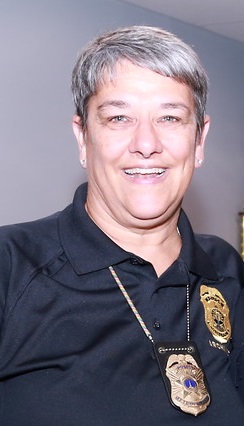
Sgt. Jo Moore
Special guest Jo Moore, retired IMPD Sergeant, will be voicing the unsung hero of the Holmes saga in Irvington, Detective David S Richards. Sgt. Moore will help outline the details of the alleged “Curse of HH Holmes” that lingered for over a quarter century after the serial killer was hanged. Sgt. Moore has been instrumental in meticulously researching the lives and duty roster of Indianapolis policemen whose honorable recognition is long overdue. Jo has also led the charge to create a museum archive honoring fallen members of Indianapolis police departments past and present. Her own son, Officer David Moore, prominent among them.
These Circle City personalities, all of which are friends of Irvington, have strong backgrounds with the press and public service. Their individual love of Indianapolis history will shine through during their performances. It promises to be an afternoon to remember. So join us this Saturday, October 20th at 2 PM inside the Irving theater for this unique performance. Remember, parental discretion is advised and the content may not be suitable for all audiences and most importantly, no one will be admitted after 2:00 PM.
Alan E. Hunter on the last Indianapolis Street Car, Photo by Rhonda Hunter.
Original publish date: July 23, 2018
At 11:59 pm on Thursday July 12, 2018, the Indiana Transportation Museum (ITM) in Noblesville, Indiana ceased to exist when the Hamilton County Sheriff’s Office swarmed the grounds at Forest Park and sealed the property. The closing, although known by all parties involved, still came as a shock to the system for the dedicated volunteers working furiously to save the engines, railcars and equipment they have so lovingly cared for over the past half-century. Even though everyone knew it was coming, no one really expected it to happen.
As an intensely interested (but uninvested) observer of what happened that week after Independence Day, I immediately recognized the politics involved on both sides. There can be no doubt there were strong opinions on both sides of the issue. Like all parties involved, I have my own opinion. However, I am neither a train-guy nor an investigative journalist. I have a background in historic preservation, particularly when it comes to my birth state of Indiana, and I write about Hoosier history. I don’t think it’s my place to take sides in this debate. What’s done is done, what’s right is right and in the words of Buffalo Springfield, “Nobody’s right if everybody’s wrong.”
From the moment that I walked into that chaotic scene one week before it’s closing, I was struck by the dedication of the people working on those trains. Whether talking about on-site volunteers from the ITM or those from neighboring rail museums, one thing was clear from the start, when it comes to trains, these people are passionate about preservation. The people I’m talking about don’t have PhD’s, don’t serve on boards of directors and don’t give a damn about self-promotion or the politics involved. They love trains, period. So when I heard the news of the ITM’s closing, I felt it would be best to honor these folks rather than add to the chatter of discontent.
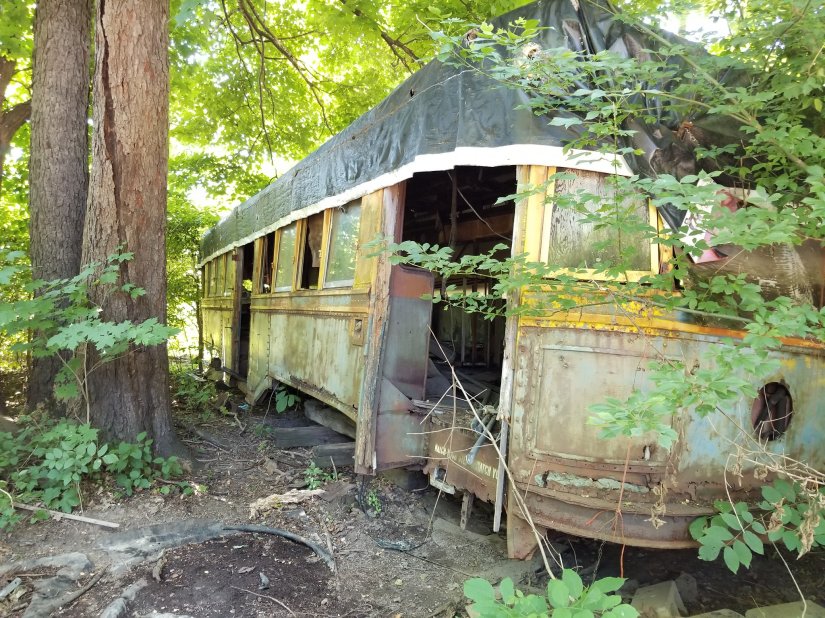
The last Indianapolis Street Car. Photo by Kris Branch.
In part one of this article, I detailed the quest that brought me to the ITM in the first place: the search for the last surviving Indianapolis streetcar. I had been tipped off to the car’s presence at ITM by Meg Purnsley, friend and dedicated Indianapolis preservationist. My first inquiries about the fate of car # 153 were met with puzzled looks on the greased streaked faces of the first few people I encountered. Finally I was directed to the trolley barn just east of the Hobbs station depot where I found Craig Presler hovering over a couple wooden trolley cars located there. As it turned out, locating Craig was my first good find of the day, but certainly not my last.
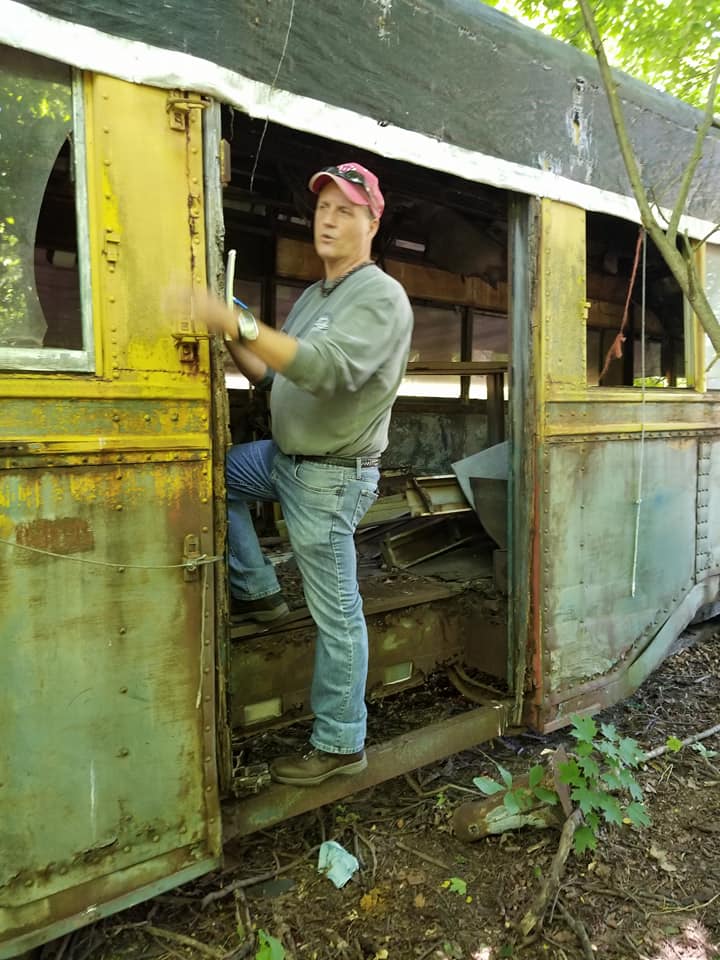
When I asked Craig about the fate of Indy streetcar 1-5-3, he answered, “Well I can take you to where it was but it was crushed some time ago.” What? I was gobsmacked by the news and immediately sick to my stomach. Thank goodness my wife Rhonda was there to prop me up else I may have fainted dead away on the spot. Craig walked us a couple hundred yards past another trolley barn and pointed to a train car parked near the tree line. “The car you’re looking for was located right behind this one,” said Craig. “But it was crushed some time ago.” I’m no Indiana Jones, but as I looked into the trees several yards past the wood line, I saw the gleam of a window. “What’s that? Is that it?” I asked Craig. Then, time slowed down like a scene from a Quentin Tarantino movie as Craig said, “Maybe, I guess it didn’t get crushed after all.”
In a flash, Rhonda and I found ourselves blazing a trail through the thick overgrowth towards that window. With each step, the shadowy silhouette of car 153 emerged from the wilderness. It was in pretty bad shape, but it was there. Knowing that time was not on my side, my every thought went to getting this car out of these woods before it was too late. As I said before, I am not a train guy and have no idea what it would take to get this relic out of these woods. Craig assured me that it could be done and pledged to help in any way that he could. Meantime, the hour was getting late and I needed to try and find a home for this historic streetcar. I arranged to meet Craig the next day to talk more about saving the car.
Once home, I fired up the lines of communication to anyone I thought might be able to help save this car. I updated former Indiana National Road Association Presidents Meg Purnsley and Ron Sanders on the dire situation. Both assured me that INRA might be a suitable home. I contacted Stevi Stoesz Kersh, Executive Director of Indianapolis City Market, who enlisted her help and counsel. I even contacted Dale Harkins of the Irving theater for his advice. The Facebook community chimed in with concern and caring comments. The support was there, no doubt, but we were running out of time.
The next day Rhonda & I returned to the ITM. Once again I sought out Craig Presler. As detailed in part one of ths story, Craig directed me towards Laddie Vitek of the Illinois Railway Museum and William Whitmer of the “Hoosier Heartland Trolley Co.” who met us at the car in the woods. Both agreed that the car could (and should) be saved. The only question was, how could we do it?
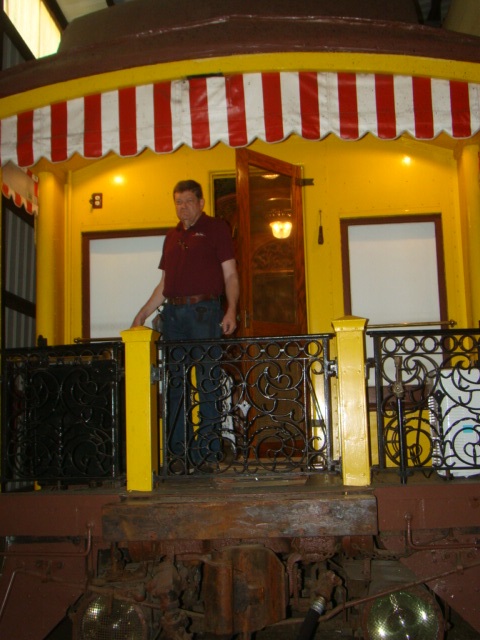
Craig Presler on back of the Flagler Car, Photo by Steve Hunt.
We spent the rest of that second day walking and talking with Craig Presler. Although my focus was on the last surviving Indy streetcar and how to save it, I could plainly see that news of the museum’s closing was devastating Craig. Turns out Craig Presler’s history with the ITM is nearly as old as the museum itself. He came to Noblesville in the early 1970s and worked at Firestone for over three decades while volunteering his time to the ITM on nights and weekends. He lives within walking distance of the museum and when he retired last year he made plans to devote the lion’s share of his time guiding visitors through the train cars at the ITM. In particular the lavish railcar known as “The Flagler Car.”
Craig Presler inside the Flagler Car, Photo by Kris Branch.
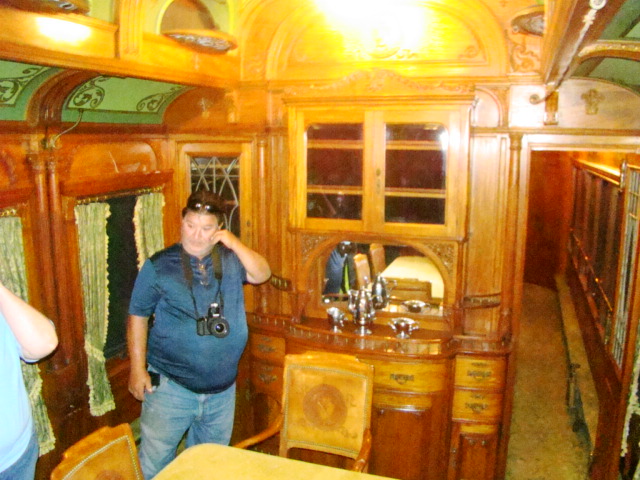
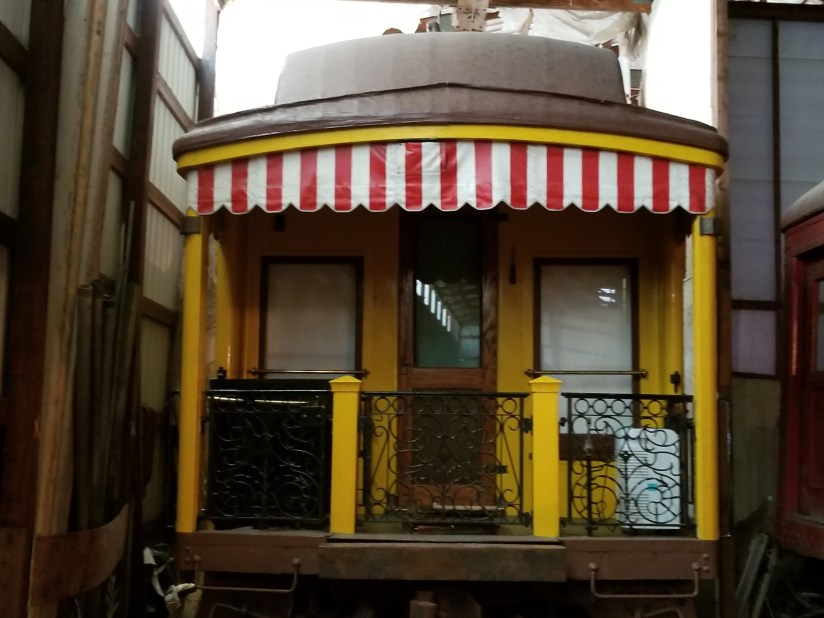
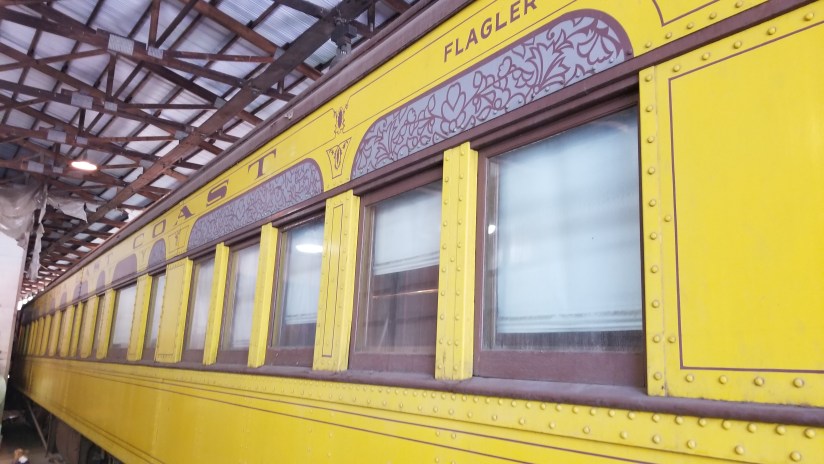
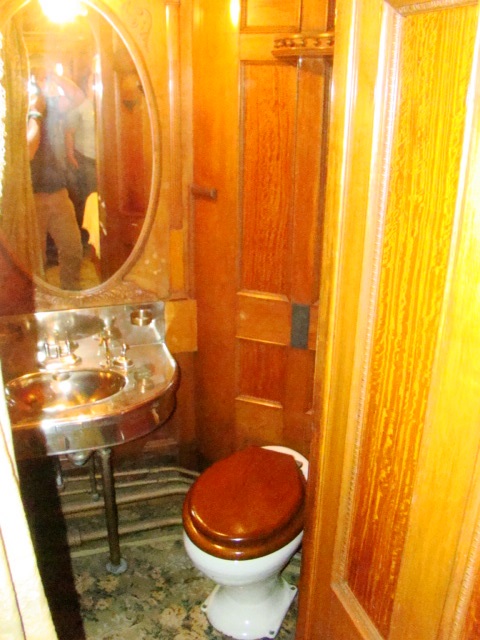
Craig Presler knows every square inch of Henry Flagler’s 1898 private railcar. The name Flagler is familiar to anyone who has spent any time visiting St. Augustine Florida but really, Flagler is second only to Walt Disney when it comes to the state of Florida’s prominence as a tourist mecca. Henry Morrison Flagler (January 2, 1830 – May 20, 1913) was a founder of Standard Oil and an early partner of John D Rockefeller in Ohio. He almost singlehandedly developed the Atlantic coast of Florida and he founded Florida’s East Coast Railway. Today, he is known as the father of Miami and Palm Beach, Florida.
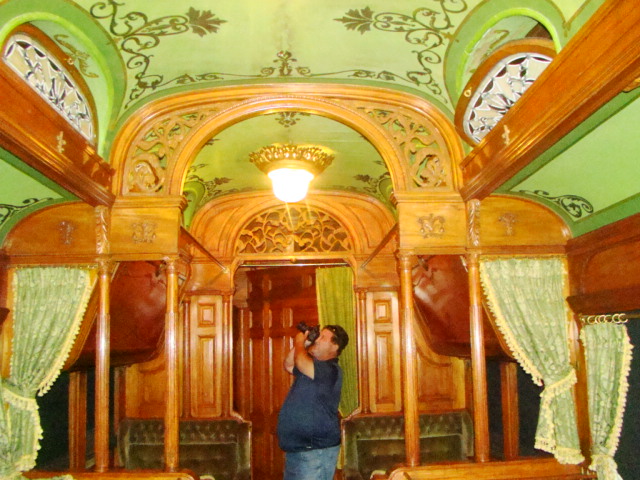
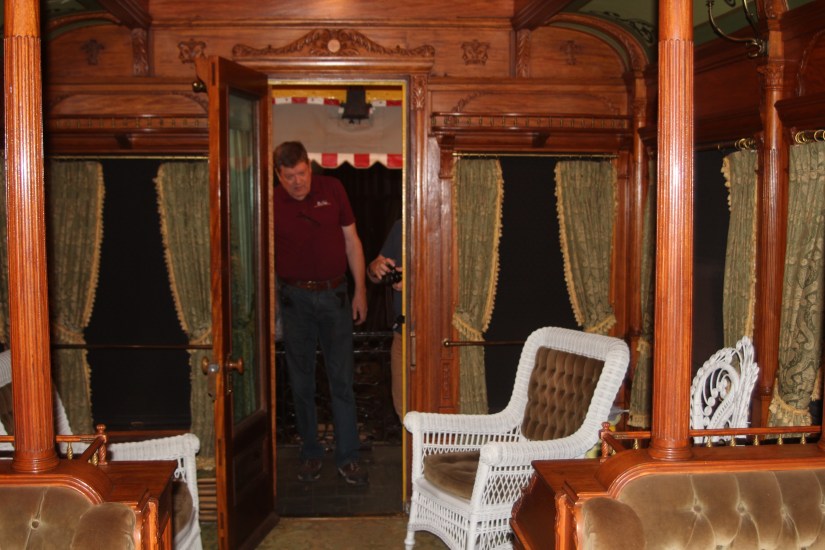
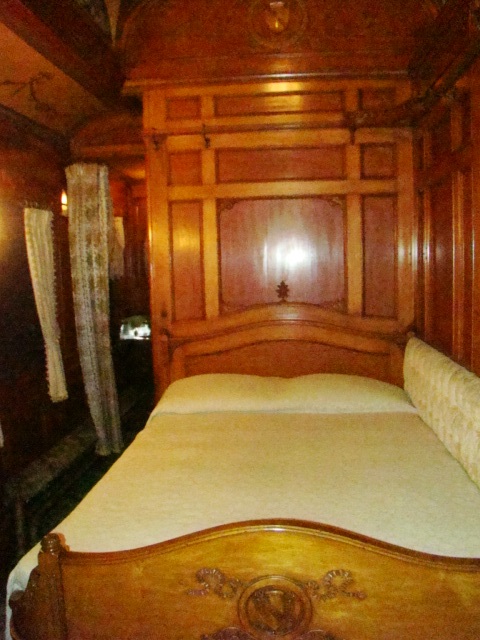
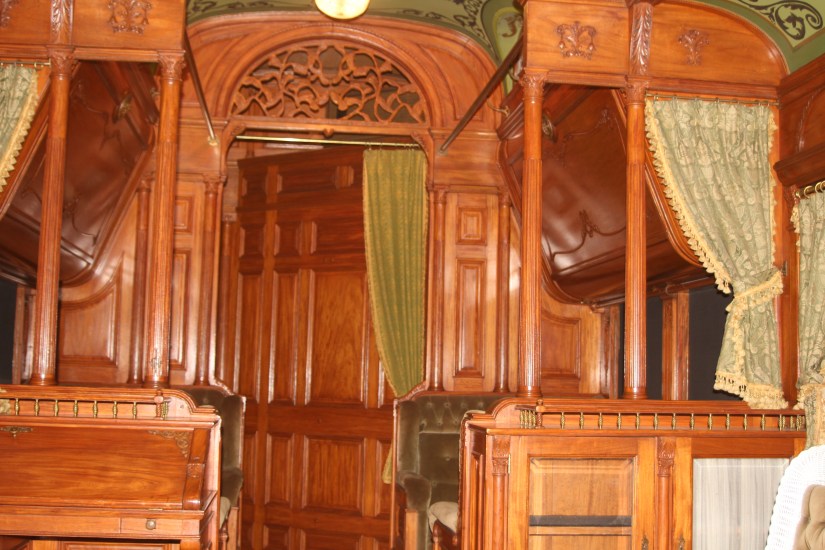
“Indianapolis Motor Speedway owner Tony Holman bought this car for his wife’s birthday in 1968 and in turn we got it several years ago,” says Craig. “The wood is all Canarium which is a blonde mahogany native to the Canary Islands. Henry Flagler pretty
Tim Poynter inside of the Flagler Car, Photo by Steve Hunt.
much owned the whole east coast of Florida and he told the builders of the car that he wanted it to look sunny like Florida. The rail line continued to operate the car until about 1951 – 52 when it was purchased by a man from Anderson named Ike Duffy who managed a meatpacking plant but who, more importantly, is remembered today as a founding father of the NBA. He started one of the inaugural franchises known as the Anderson Packers. Ike use the train to promote his business and rode it around to all his meatpacking plants in Noblesville, Lebanon, Anderson, Muncie and Brazil. He would serve his employees lunch that he actually cooked in the kitchen of this car. When Ike Duffy died in 1968, Tony Hulman bought it. I’m told that he took it to Chicago twice and that Mrs. Hulman never rode in it.”
Craig Presler on back of the Flagler Car, Photo by Tim Poynter.
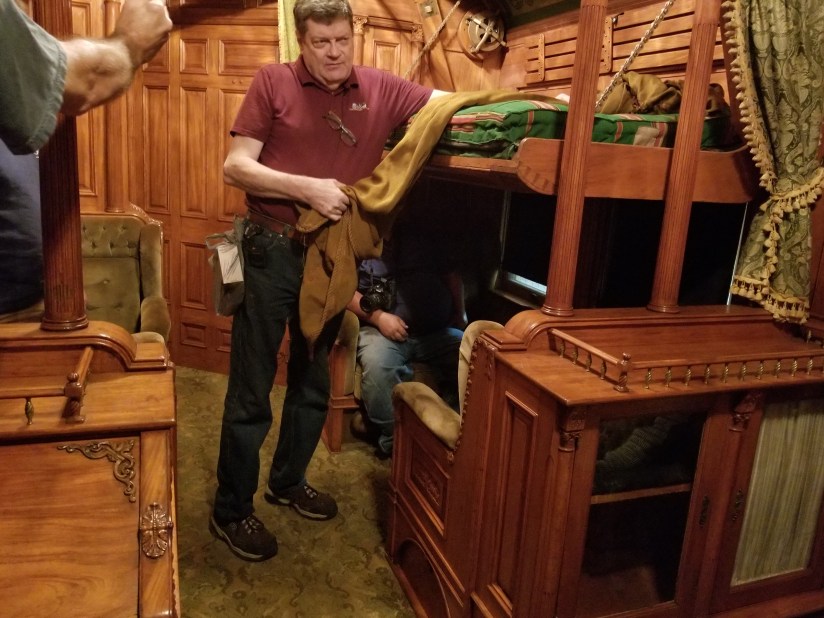
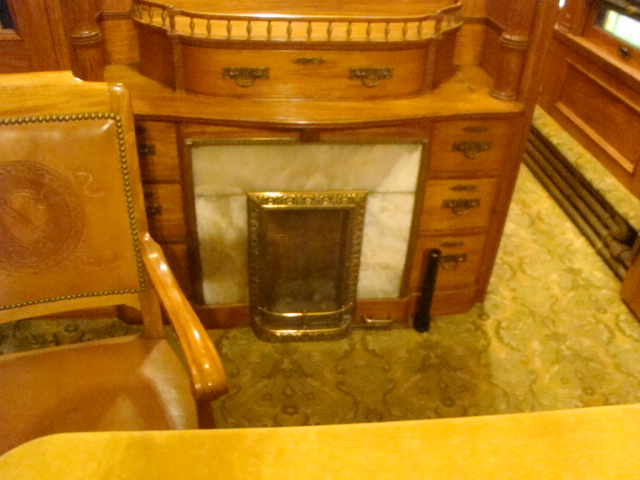
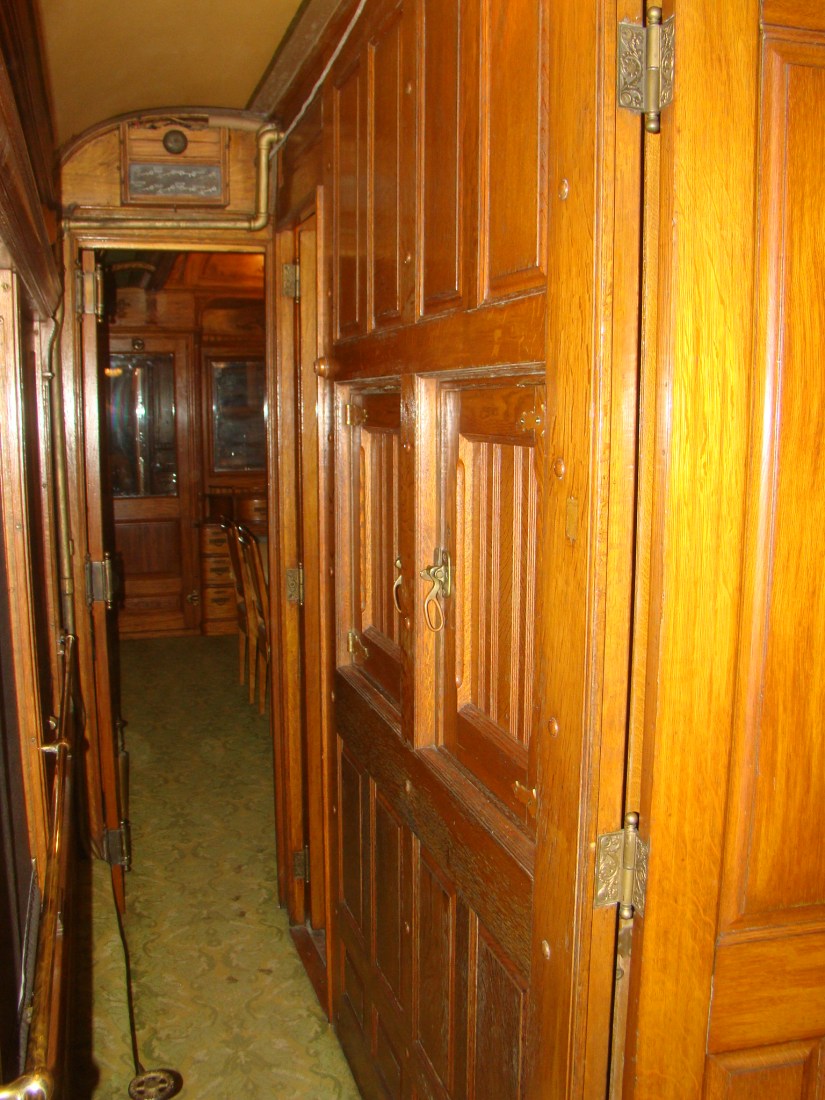
Craig delighted showing visitors (like us) all of the secret compartments and high-end accouterments that were found all over the Flagler car. It had self-closing windows, drawers and beds all over the place. Zinc lined compartments to hold and chill champagne bottles and the finest blinds, carpeting, curtains and Persian rug styled monogrammed blankets money could buy. It was easy to see that this car was a large part of Craig Presler’s life. When I asked him what would become of the car after the museum closed, he said, “I’m told the car is being moved to our affiliate in Logansport and that I will be able to go up on the weekends and continue to give tours.”
As Rhonda and I exited the the railcar following Craig’s impromptu tour, two officials I had been talking to previously about the ITM’s closure pulled me aside and informed me that while we were touring the car, it had been sold. It was going to be moved to a museum in Monon Indiana some 90 miles away. They finished by saying, “Don’t tell Craig, he does not know yet.” Knowing how much Craig loved this car, I knew this was going to be devastating news. As we left that day we arranged to meet Craig the next morning.
Craig Presler, Rhonda Hunter, Kris & Roger Branch & Alan E. Hunter in the Flagler Car, Photo by Tim Poynter
We showed up on Saturday, but this time with reinforcements: Kris and Roger Branch, Tim Poynter and Steve Hunt. One way or another we were going to save this car. I noticed that Craig had a plastic bag hooked on his belt loop. It contained a spray can of adhesive and some specialty tools. Craig said he brought them to fix a small piece of woodwork in the Flagler car he had pointed out to us the day before. The damaged area was so small as to be indiscernible to anyone else but Craig. The sad part is that the sight of that bag made me realize instantly that no one had yet told Craig his beloved Flagler car had been sold. He insisted on showing the Flagler car to the new additions in our group. That was Craig’s last tour. (the Flagler car made it out at 11:45. It was the last train out before the gate were locked.)
Tim Poynter in the Flagler Car, Photo by Steve Hunt.
The realization was all the more ironic because the object of my quest, the dilapidated shell of the last surviving Indianapolis streetcar was moldering away in the woods not 20 yards away from that opulent Flagler car. Before I could ponder the dichotomy of the situation any further, I received a text message from William Whitmer telling me that the streetcar had been saved. We met at the streetcar and William delivered the good news.
William explained how he had stepped up and bought the car just in the nick of time. William had arrived at the streetcar, receipt in hand, just as the wrecker was creeping slowly towards it. “I couldn’t believe it,” William said, “I literally had to stand in front of the streetcar and wave my arms to get them to stop. They had been told the streetcar was scrap and that they were there to break it up. Five more minutes and the streetcar would have been crushed. The driver didn’t want to believe me until I showed him the receipt.”
William said that after our discussion the day before, “We did a very preliminary examination on the car body. The frame and car bolster (where the truck/wheels attach) is in solid shape. The actual structural steel is not too rotted. Side bracing is acceptable, and a lot of the upright steel frame is acceptable. The car is in overall better condition than we thought originally, making restoration far more likely.”
Then he shocked me by saying, “If it hadn’t been for you Al, this car would have been lost.” I was unprepared for that statement. Although humbled, I had to admit that it was not entirely my doing. First, I was there on a story for the Weekly View. Secondly, I was acting on a tip from Meg Purnsley. So without the paper and the heads up from Meg, this story would never have happened. And most importantly, without the quick action by William Whitmer and his Hoosier Heartland Trolley Group , the last surviving Indianapolis streetcar would have been lost forever. Will informs me that it may take up to 10 years to restore the car. He insists that he will keep us updated on the progress.
The streetcar has been saved but the museum is lost forever. While I no longer worry about the fate of the engines and cars, I do worry about the people. In particular my new friend Craig Presler. What is to become of him? His baby, the Flagler car, now resides nearly two hours away. The museum that was his passion is no more. The site will undoubtedly be plowed under and a swing set, waterpark or zip line will take its place in a year or so. All of the sabre rattling by the city of Noblesville about the ITM’s chemical hazards will be forgotten and no environmental cleanup will take place. Because none was needed. Another historical treasure lost to the temporal winds of political folly.
Luckily, William Whitmer assures me that his group has a place for Craig Presler and any other displaced ITM volunteer looking for a place to land. One thing can be sure, after the dust settles in the woods of Forest Park, much soul searching will be needed in the preservation community. In my opinion, it certainly smacks of just another backdoor “eminent domain” situation in Hamilton County. What I can say for sure is that I met many hardworking volunteers during the last days and hours of the Indiana Transportation Museum in Noblesville. Their individual flames burned bright. Some were warmed by the flame. Others were burnt by it. And although the flame of the ITM has burned out, that of the last surviving Indianapolis streetcar burns on.
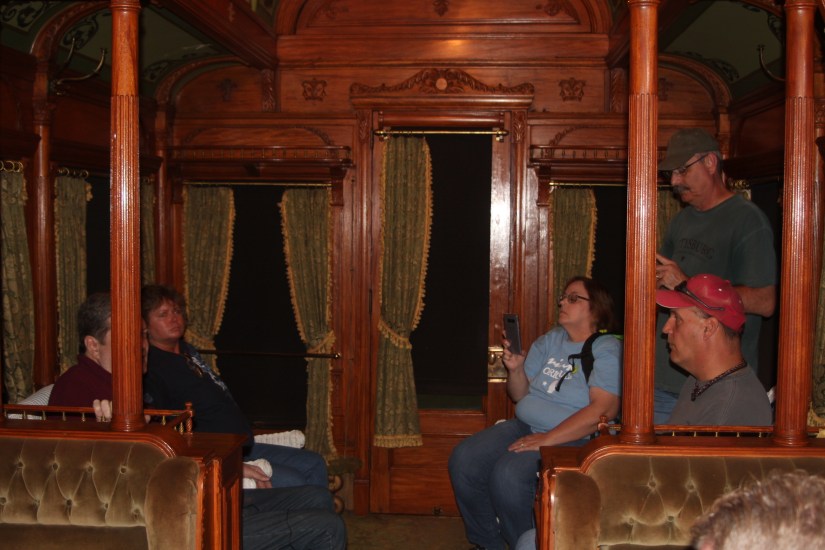
Back of the Flagler Car, Photo by Kris Branch.The Flagler Car, Photo by Kris Branch.The washroom of the Flagler Car, Photo by Steve Hunt.Bedroom in the Flagler Car, Photo by Steve Hunt.Fireplace inside of the Flagler Car, Photo by Steve Hunt.Interior of the Flagler Car, Photo by Tim Poynter.Hallway of the Flagler Car, Photo by Tim Poynter.


 Although I never fail to take my annual trip around Monument Circle at Christmastime to gaze in wonder at the fantastic fir tree fantasy, my personal memories of Christmas on the Circle revolve around a little shack that used to rest at its base facing the Indiana Statehouse. You may think of the L.S. Ayres Cherub, Santa’s mailbox, the 26 larger-than-life toy soldiers and sailors surrounding the Circle, the 26 red & white striped peppermint sticks, the 52 garland strands or the 4,784 colored lights strung from the top of the Monument to its base, but I think of the Roselyn Bakery Christmas Hut.
 Decorated with Gingerbread man shutters and candy cane pillars, coated in what looked like white icing, the Christmas hut was set up on the West side of the Circle where it remained for 25 years from 1974 to 1999. It was estimated that some 1.2 million Gingerbread man cookies were handed out from within that festive little house over those years. Just like the bakery itself, that little hut was an institution.

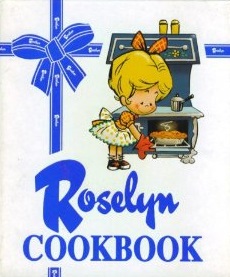 For me, Roselyn will always be identified for buttermilk jumbles, toffee cookies, alligator & sweetheart coffee cakes, yeast donuts and the darling little girl cartoon mascot known as “Rosie”. A blonde haired, blue eyed perpetually smiling little naive whose popularity forced the Roselyn Christmas Hut to undergo a name change to “Rosie’s Gingerbread House.” If memory serves, for a time there was even a living, breathing life-sized “Rosie” mascot dressed in a horribly oversized paper mache’ head and wearing a red velvet dress. Every so often, she would wobble awkwardly out of the Gingerbread hut to personally pass out cookies to the eager, but slightly befuddled, kiddies on the Circle. As I recall, she didn’t speak, but to a 12-year-old cartoon addicted boy like me, her skirt was short and her cookies were hot.
 a long way baby.”
 Eight mayors and ten governors have served our city and state over the past 50 years. I can’t say that I miss any of them, but I do miss those Gingerbread cookies. If you do too, you can make them yourself. Here’s the recipe for Roselyn Bakeries famous Gingerbread Men cookies: 1 1/4 teaspoon allspice, 2 3/4 teaspoons baking soda, 5 teaspoons ground cinnamon, 1 teaspoon ground cloves, 1 teaspoon ground ginger, 2 1/2 teaspoons salt, 3/4 cup Crisco shortening, 3/4 cup granulated sugar, 6 tablespoons whole eggs, 1 1/4 cup extra fine coconut (Make sure that the coconut you use is very fine, almost like coarse sugar-you may have to grind store bought coconut flake down), 1 1/4 cup honey, 5 cups all-purpose flour. Preheat oven to 360 degrees F. Combine allspice, baking soda, cinnamon, cloves, ginger, salt, shortening, and sugar into a large mixing bowl. Cream together. Scrape down bowl. Add beaten eggs and mix thoroughly.
 Scrape down bowl. Add coconut and honey and mix well. Scrape down bowl. Add flour and mix well. On a lightly floured surface, with a floured rolling pin, roll dough 1/8 inch thick. With a 5 inch long cutter, cut out men. Re-roll trimmings and cut more cookies. With spatula, place 1/2 inch apart on cookie sheets. Bake at 360 degrees for 8 minutes or until browned, then, with spatula, remove cookies to racks to cool. Decorate as desired. Makes 3 dozen cookies. Now if I could only locate a slightly used Christmas shack.

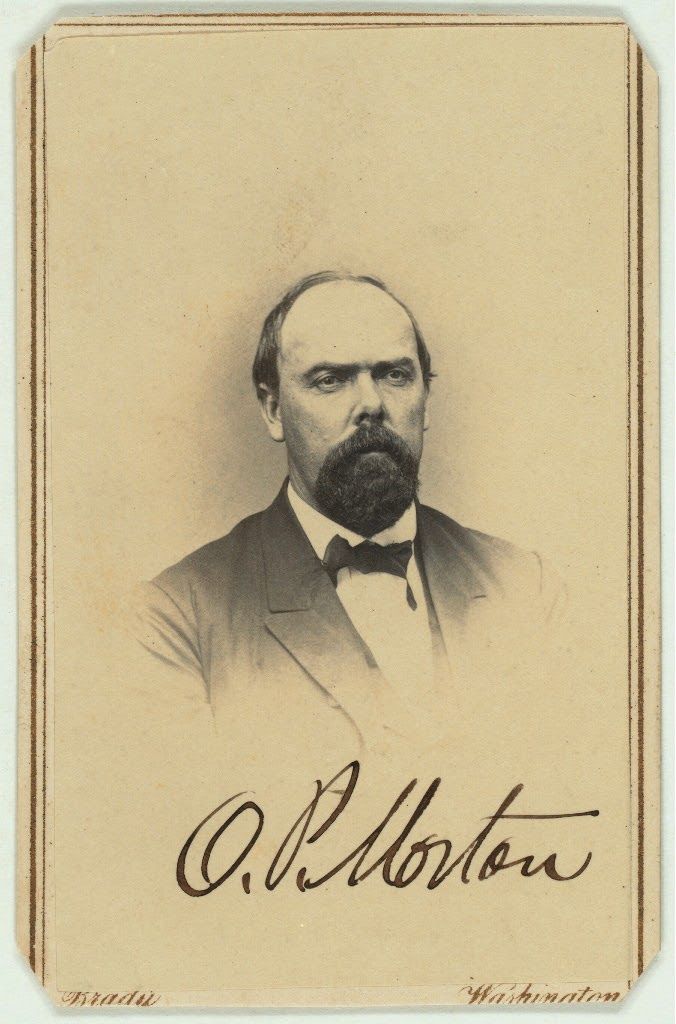 Morton believed that should he call the session, radical elements in the opposition party might undermine the Hoosier state’s devotion to the war effort, instigate riots, harbor southern spies and possibly vote to secede from the Union. The Governor issued secret instructions to GOP legislators asking them to stay away from the Statehouse, thereby thwarting efforts to attain a voting quorum. With Morton’s aid, the Republicans fled to Madison where they could cross easily into Kentucky should the Democrats attempt to forcibly return them to the capitol. Because of this, the government was at a virtual stand still. No budget, no taxes, no revenue. The state quickly ran out of money and teetered dangerously on the edge of bankruptcy. Exceeding his Constitutional powers, Morton solicited millions of dollars in personal loans to keep the Government going.
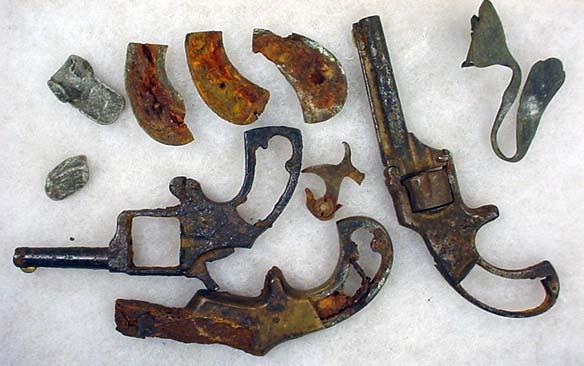
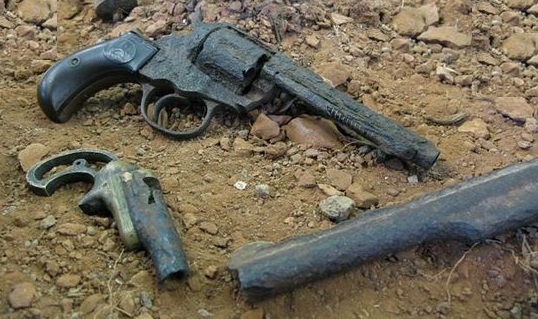 Accounts of just how many weapons were thrown into Pogue’s Run ranged from 500 to 2,000. The Indianapolis Sentinel described it as: “It is with feelings of sorrow, humiliation and degradation that we witnessed the scenes of yesterday. . . . Indiana is as completely under military rule as France, Austria or Russia”. But to those who supported Morton’s action, it seemed to them that would-be insurrectionists would be too cowardly to actually rebel. The term “Battle of Pogue’s Run” was given to the event by the Republican Party derisively, who praised the soldiers involved as “halt(ing) a meeting of traitors to the Union cause”. The Democrats, on the other hand, called the event “still more assaults upon constitutional rights” by those supporting Abraham Lincoln and Governor Morton.


 Ask any of these visitors about the park’s namesake and you’re likely to catch them at a loss. What’s more, most visitors are unaware that Paul Ruster Park is haunted by a centuries-old ghost. The park, acquired by the Indy Parks system in 1970, is named after a 1964 Warren Central high school graduate, Paul M. Ruster. Paul, the oldest of three sons of Marvin and Marie Ruster, died December 10, 1978 of Hodgkin’s disease. Paul’s brother Bruce was a former Warren Central baseball star and much beloved Phys-Ed teacher at Warren Central for many years. Paul was born on the eastside, attending Eastridge elementary and Woodview Junior High. He graduated from Ball State University and returned to Indy’s eastside to teach Phys-Ed at Lowell in 1969.
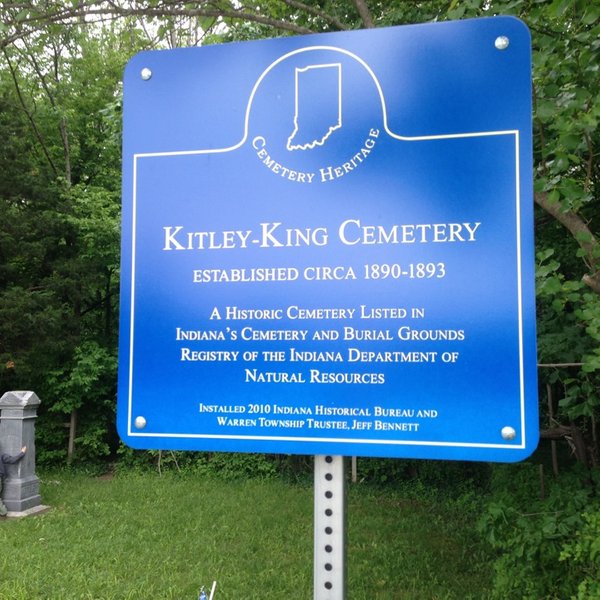 Although the park may have been new to the Indy Parks system, the haunted reputation was well established. Some of the first to report the strange happenings going on within the park were people who were themselves looked upon as strange by casual observers. These were the weekend warrior gatherings of young people dressed as medieval knights wearing full combat regalia while sword fighting and jousting around the green spaces of Ruster Park. These were the early days of the “Dungeons and Dragons” phenomenon in the 1980s involving fantasy role playing groups that met on a regular basis in the park. These groups began to report strange sights and sounds coming from the periphery of the park’s boundaries that would often stop participants in their tracks. Sometimes, these spooky sounds would drive the groups from the park in fear. Soon, the ghostly rumors made the rounds among Indianapolis paranormal groups that Paul Ruster Park was a hot spot for paranormal activity and an allegedly haunted area. Paranormal investigators declared that these unexplained occurrences were emanating from a nearby abandoned family cemetery a mere stone’s throw from the new park.

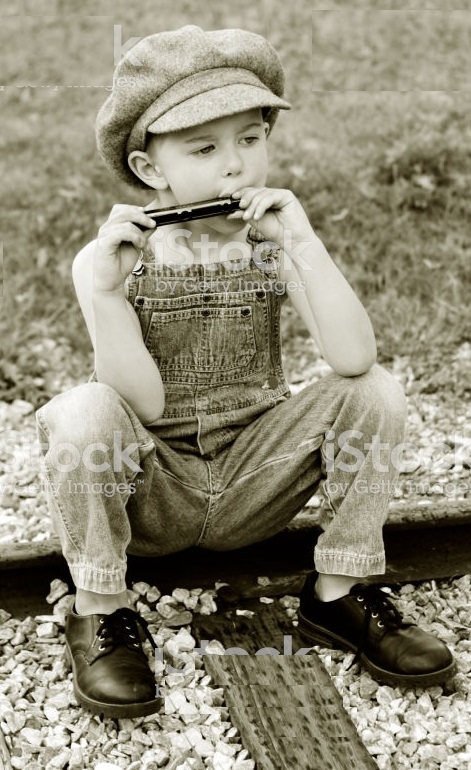 Legend claims that many years ago a 12-year-old boy living on the farm was killed while walking along the nearby train tracks. No-one knows if he was struck by a train or whether some other harm befell him. Reportedly, he is now buried in an unmarked grave within the foundation of his old house. Witnesses claim that if you walk the long path leading from the soccer fields through the woods to his grave near Prospect you can hear the boy playing his harmonica. Still other witnesses have reported seeing the ghostly image of a young boy walking down the road and again, he is seen playing a harmonica.

 This coming Saturday, October 20th at 2 PM, several of those famous friends will be here in Irvington at the Irving theater to share their talent with our community in a program I have called, “Whispers from the Grave. Testimony of Irvington’s Most Famous Crimes.” Over the past decade and a half I have gathered testimony, witness accounts, personal statements and personality sketches of the characters, both good and bad, from the stories I share on the tours. This Saturday, local celebrities, journalists and members of the media will lend their talents to the voices of these characters. Much of this spoken word performance will offer accounts that have not been heard for over a century. This testimony, told in its entirety using the words of the subjects themselves, is always poignant, sometimes shocking and often scandalous.

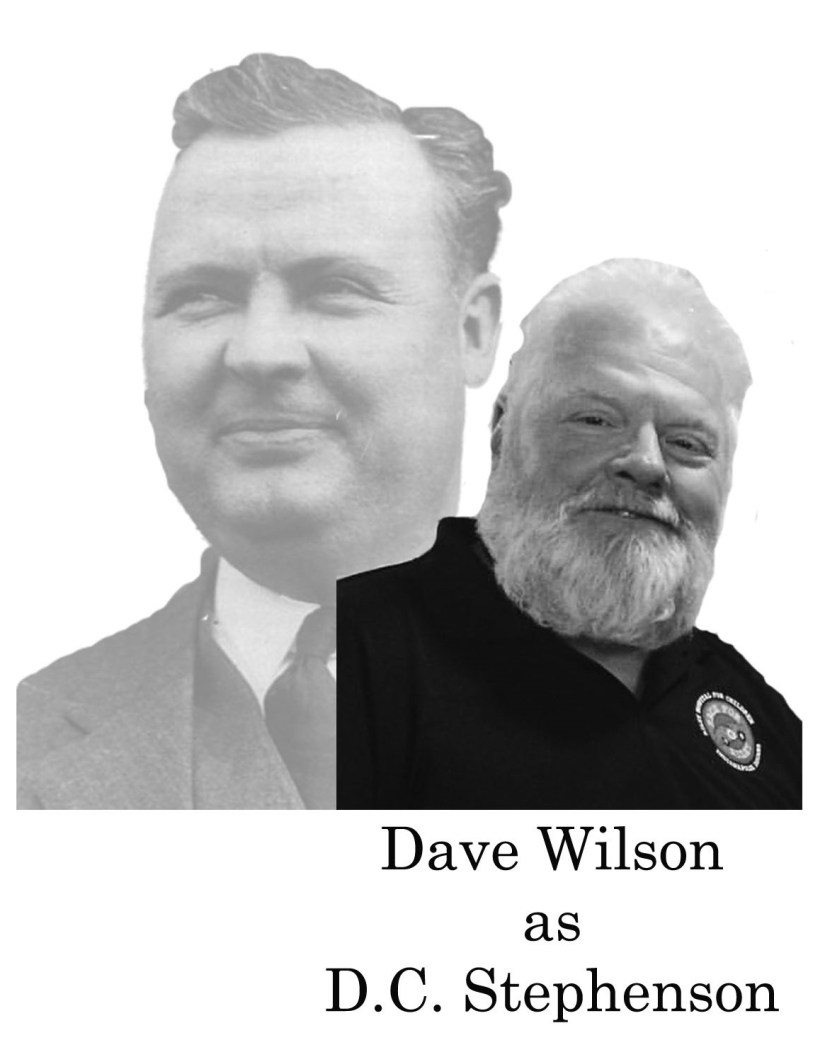 Joining us Saturday will be long time Q 95 star and stand up comic Dave “the King” Wilson reading the words of DC Stephenson. David Curtis Stephenson was the Grand Dragon of the Indiana Ku Klux Klan who reigned supreme here in central Indiana during The Roaring 20s. Stephenson controlled Indiana politics from the governor’s office to the mayor’s office with Klan money and influence from his University Avenue home here in Irvington. Gathering testimony and statements from Stephenson’s made all the more harder by the fact that after his 1925 trial for murder concluded, the official court papers mysteriously disappeared.
 2 – time Emmy award-winning former WTHR on air personality & meteorologist Nicole Misencik who will be voicing Madge Oberholtzer. Tragically, Madge was the undeserving victim of DC Stephenson’s crime in the spring of 1925. Madge was an Irvingtonian and former student at Butler College whose death at the hands of Stephenson brought down the Ku Klux Klan, which was the most powerful organization in the country at the time. Madge’s testimony was so graphically detailed that when it was read aloud in open court in Noblesville Indiana, women fainted and grown men got up and left the room. Nicole will recount Madge’s 9 – page deathbed declaration and its entirety for the first time in public and nearly a century.
 Former WTHR reporter Brandon Kline will be voicing Pinkerton detective Frank Geyer, the man who brought America’s first serial killer to justice. Brandon will wear the hero cape by voicing this legendary Pinkerton agent who is dogged determination alone solved Irvington’s first murder, that of 10-year-old Howard Pitezel. Brandon’s hero duty will be doubled when he also voices Irvingtonian lawyer Asa J Smith who recorded Madge’s deathbed declaration in what promises to be a most memorable exchange with his wife Nicole.
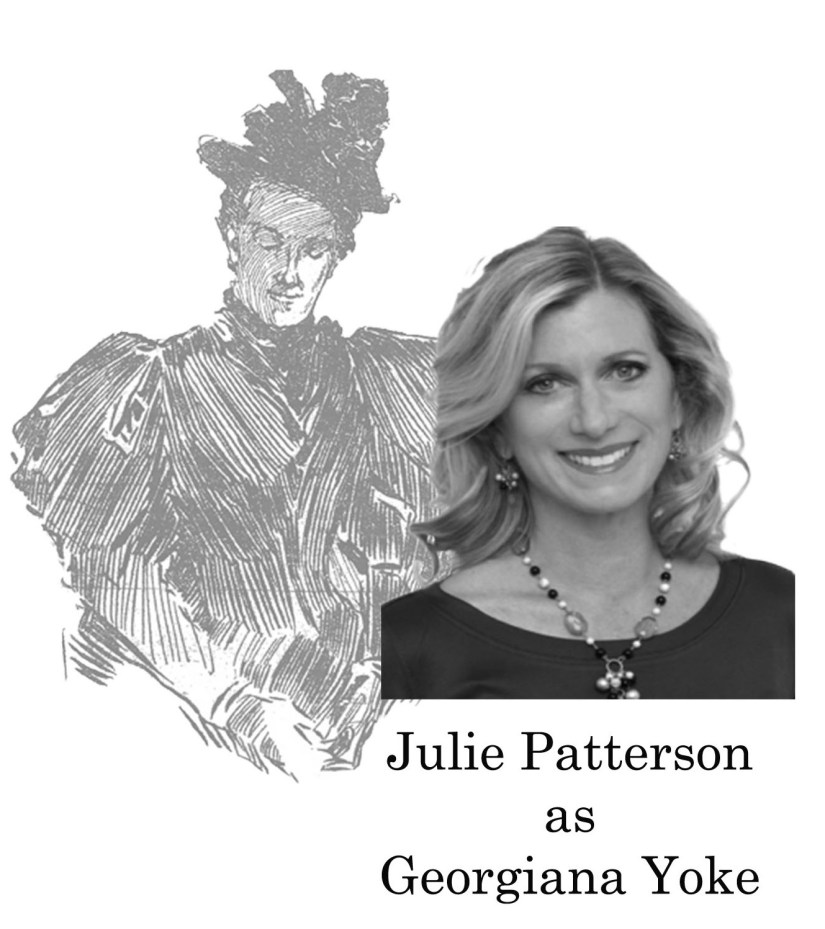 Boomer TV personality, longtime WZPL radio host and former WISH – TV alumni Julie Patterson will be voicing the last wife of HH Holmes, Georgiana Yoke. Ms. Yoke, a native of Franklin Indiana, is easily the most unknown character in the presentation. Georgiana’s family has deep connections to Indianapolis’east side at both Garfield Park and Holliday Park. Georgiana narrowly escaped death at the hands of her husband and, after his death by hanging, could not escape the cloud of suspicion that hung over her in Indianapolis after her husband’s crimes were revealed. Julie’s interpretation of Georgiana will also include her court testimony, some of which was delivered by her husband HH Holmes while acting as his own counsel.
 Ed Wenck, long time local radio host, journalist, author and on-air television personality, will be voicing America’s first serial killer HH Holmes. Allegedly responsible for over 200 murders, Holmes admitted to killing 27. The arch fiend came to Irvington in October 1894 on the heels of the 1893 Chicago world’s fair. His crimes are numerous, gruesome and unspeakable. Ed will voice America’s first serial killer using Holmes’ own words which are guaranteed to make your skin crawl.