
Original publish date: June 8, 2017
Magician Harry Houdini had a very unlikely boyhood hero. A hero adored by a generation before Houdini’s 1874 birth and a hero worshiped by generations hence. Harry Houdini’s hero was Abraham Lincoln. Houdini’s devotion to Lincoln could be found on stage during his shows. He traveled with a pet eagle named ‘Josephus Daniel Abraham Lincoln’ or ‘Abe Lincoln’ for short. Houdini’s eagle would materialize at the end of his Whirlwind of Colors routine culminating in a wild frenzy of scarves and other fabric pulled from a small container.
 In Kenneth Silverman’s 1996 Biography “Houdini!!!: The Career of Ehrich Weiss : American Self-Liberator, Europe’s Eclipsing Sensation, World’s Handcuff King & Prison Breaker”, the author relays how Houdini referred to Lincoln as “my hero of heroes.” Houdini claimed to have read every book about Lincoln by the time he was a teenager. In William Kalush’s 2006 biography “The Secret Life of Houdini: The Making of America’s First Superhero”, there is a story of young Houdini attending a seance where the medium produced a message from our 16th President. Houdini, Lincoln expert that he was, then asked a question to Lincoln via the medium and was puzzled when the answer that came back was not correct. This encounter led to Houdini’s early discovery that most Spiritualists were fake.
 As he grew older and more financially secure, Houdini began to amass a personal collection of Lincoln memorabilia, particularly letters and autographs of the Great Emancipator. He also collected handwritten letters of every member of the assassin John Wilkes Booths family, several in response to letters sent by Houdini himself. Spending much of his adult life on the road, in hotels and traveling for days on ships and trains, Houdini became a prolific man of letters. One such letter survives that illustrates his desire and devotion to add to his Lincoln collection, despite the constraints of his vagabond lifestyle.
The letter is written on the magician’s personal “Lettergram” form that featured two portraits of Harry at the top. It was written in Milwaukee on September 20, 1923. Houdini’s pictorial Lettergram began with a printed message reading, “Please pardon any incivility in this letter. It has been rushed to you under stress of business and written in the dressing room. Therefore all formalities like Dear Sir, Dear Madame. etc. have been omitted, not to be curt or brusque; but that it is deemed better to let you hear from me in a lettergram of a few words than not at all.” The Lettergram was sent to Anton Heitmuller, a Washington businessman who billed himself as “Specializing in Selling Collections of Autographs, Manuscripts, Historical Broadsides and Curios”.
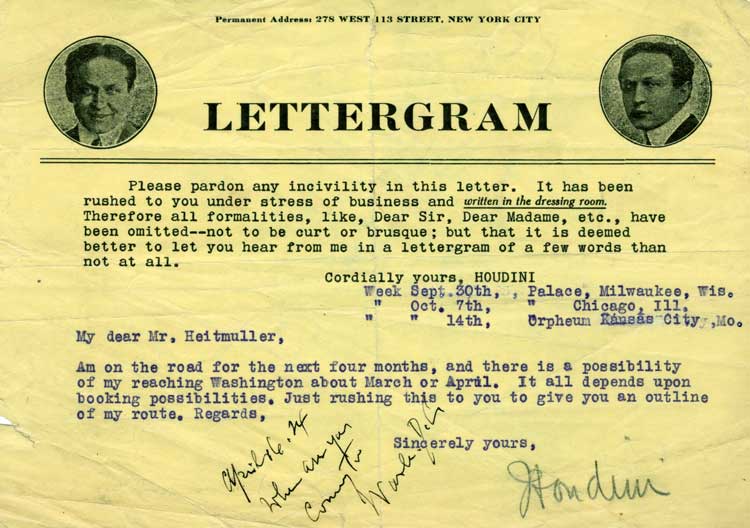
Heitmuller was peddling artifacts related to John Wilkes Booth along with a collection of items of Dr. Samuel Mudd, who was imprisoned for treating Booth’s broken leg after the assassination. Heitmuller saw a promotional opportunity for both he and Houdini in showing these materials; Houdini showed some interest but being at the height of his career, found it hard to find time to get to Washington to see the artifacts. Houdini’s typed letter reads, “I am on the road for the next four months, and there is a possibility of my reaching Washington about March or April. It all depends upon booking possibilities. Just rushing this to you to give you an outline of my route.” The note was signed in pencil by Houdini. Whether or not the meeting, let alone a purchase, ever took place is unknown, but the lettergram illustrates Houdini’s desire to acquire Lincolnania and the lengths he would go to find it.
Houdini became a friendly acquaintance of Abraham Lincoln’s son Robert Todd Lincoln. In one instance, a spirit medium claimed to possess authentic spirit photographs of Abraham Lincoln. Houdini sent copies of the photos to Robert Todd Lincoln and debunked them by proving that the images were manipulated from known photos of his father taken while Mr. Lincoln was still very much alive. To further prove his point, Houdini produced photos of himself alongside Mr. Lincoln.
 On Feb. 13, 1924, a day after the 115th anniversary of Abraham Lincoln’s birth, Houdini typed out a letter to Mary Edwards Lincoln Brown, the grand-daughter of Ninian and Elizabeth Edwards, Mary Lincoln’s sister. The letter, written from the dressing room of the State Lake Theatre in Chicago, Illinois, reads: “My dear Mrs. Brown: Enclosed you will find a Spirit Photograph of your renowned ancestor, and although the Theomonistic Society in Washington, D.C. claim that it is a genuine spirit photograph, as I made this one, you have my word for it, that it is only a trick effect. Mrs. Houdini joins me in sending you kindest regards, Sincerely yours, Houdini.”
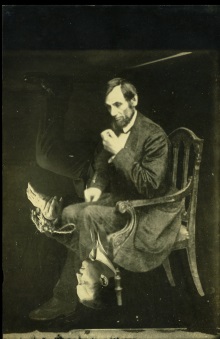 Furthermore, Houdini also produced ‘fake spirit messages’ from Lincoln during his lectures to debunk spiritualism. Many spiritualists attempted to back up their fake photos and messages by claiming that Abraham Lincoln himself was a devoted spiritualist who had held seances in the White House. As proof, they cited a piece of British sheet music, published while Lincoln was President, which portrayed Honest Abe holding a candle while violins and tambourines flew about his head. The piece of music was called The Dark Séance Polka and the caption below the illustration of the president read “Abraham Lincoln and the Spiritualists”.
Actually it was Mary Lincoln who consulted a series of mediums in a desperate attempt to contact their dead son Willie, who died in the White House. Houdini naturally pointed out that President Lincoln was in attendance for only one such “call to the dead” and then solely to support his grieving wife. After the seance, Lincoln gently guided Mary over to a window that looked out over Washington and pointed to the lunatic asylum with a warning that if she didn’t stop this foolishness, she would end up there.

Clues to Houdini’s admiration of Abraham Lincoln can also be found in a couple of the magicians he associated with. One was a former Civil War veteran named Harry Cooke who first took up magic as a means to entertain his fellow soldiers in camp. Legend claims that Cooke once showed Lincoln an escape from a piece of rope and the president was so impressed he put him to work as a Spy for the Union Army. Cooke kept a two dollar bill given him by Mr. Lincoln on another occasion when he was performing before the president and his cabinet. Amazingly Cooke was also present in Ford’s Theatre the night Lincoln was assassinated. Harry Cooke and Harry Houdini knew each other well and Houdini considered the elder magician as an early mentor. Many historians credit Cooke as being the first escape artist in America. Houdini, of course, became America’s greatest escape artist.

One final connection between Houdini and Lincoln is magician Signor Blitz. During the Civil War, Blitz performed at hundreds of Union Army Hospitals. His act was made up of several parts, including magic, ventriloquism, plate spinning and the command of trained birds. Blitz was apparently one of the first performers to use a dummy during his ventriloquism thereby setting the stage for future generations. His favorite trick was the Bullet Catching act (snaring a gun fired bullet between his teeth). However, a number of close calls persuaded the magician to remove it from his show. The final straw was when an audience member took out a six shooter and yelled “if you can catch one, you can call all of them!”. Fortunately, Blitz was able to stop the man from shooting.

Blitz once performed at a July 4th function where Lincoln and his son Tad were present. The incident took place near the Summer White House on the grounds of the Old Soldier’s Home in the Rock Creek section of DC, today it is known as Lincoln’s Cottage. Lincoln often used the cottage during the summer months to escape the brutal foggy bottom heat of the Executive Mansion. In early July of 1863, President Lincoln took a break from his duties to watch a rehearsal of the upcoming July 4th parade. Numerous people stood along the street watching the rehearsal, among them Signor Blitz.
The sly magician reached out and produced a bird from the hair of one of the girls in the parade. The rehearsal parade came to a sudden stop and now all eyes were on Blitz. Thinking fast on his feet, the magician quickly produced an egg from the mouth of a child standing nearby. Blitz had no idea that the child was none other than the President’s son, Tad Lincoln. Blitz was soon formally introduced to the President and one of the most remarkable impromptu conversations of the Civil War ensued. Lincoln surprised the magician by saying,”Why, of course, it’s Signor Blitz, one of the most famous men in America. How many children have you made happy, Signor Blitz?” The magician answered “Thousands and tens of thousands”. The President then dolefully replied, “While I fear that I have made thousands and tens of thousands unhappy. But it is for each of us to do his duty in this world and I am trying to do mine.”
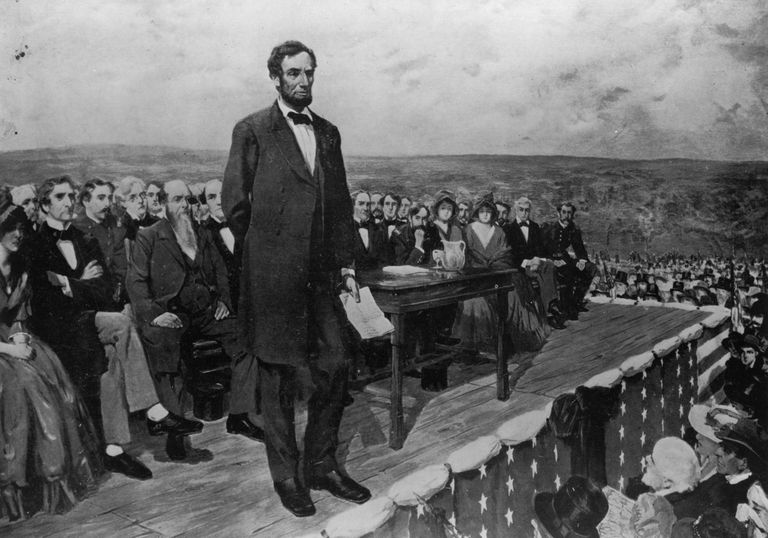
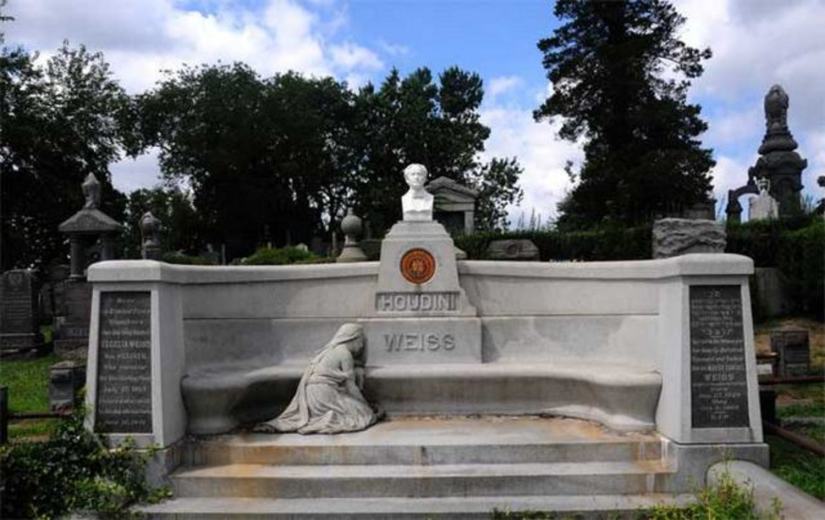
This exchange took place just as the Battle of Gettysburg was winding down. Lincoln had not yet heard news about the outcome of the battle. What neither knew was the Union victory at Gettysburg, combined with the siege conclusion at Vicksburg, had just turned the tide of the war for the Union. Of course, Houdini was keenly aware of the connection between Blitz and Lincoln. After Harry Houdini died on October 31, 1926 in Detroit, Michigan, he was buried in Machpelah Cemetery in New York City. About a hundred yards away is the grave of Signor Blitz.


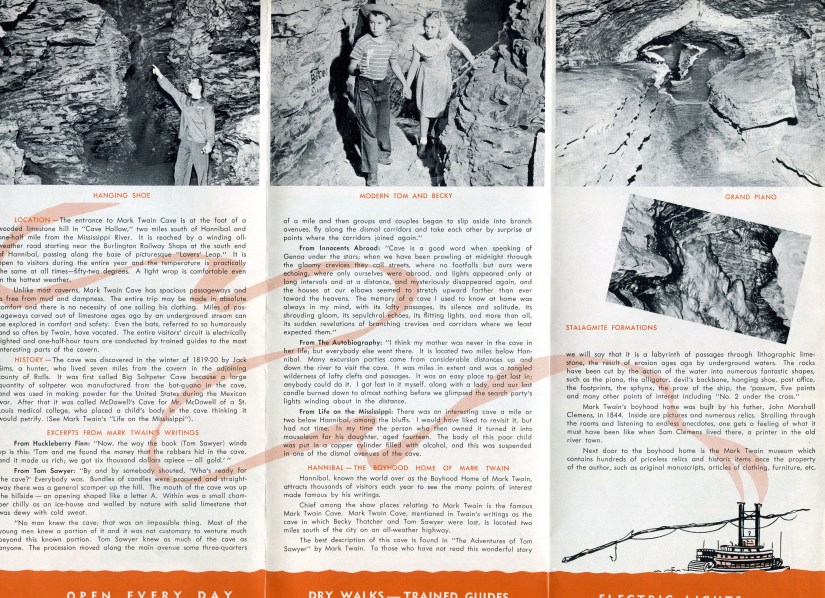
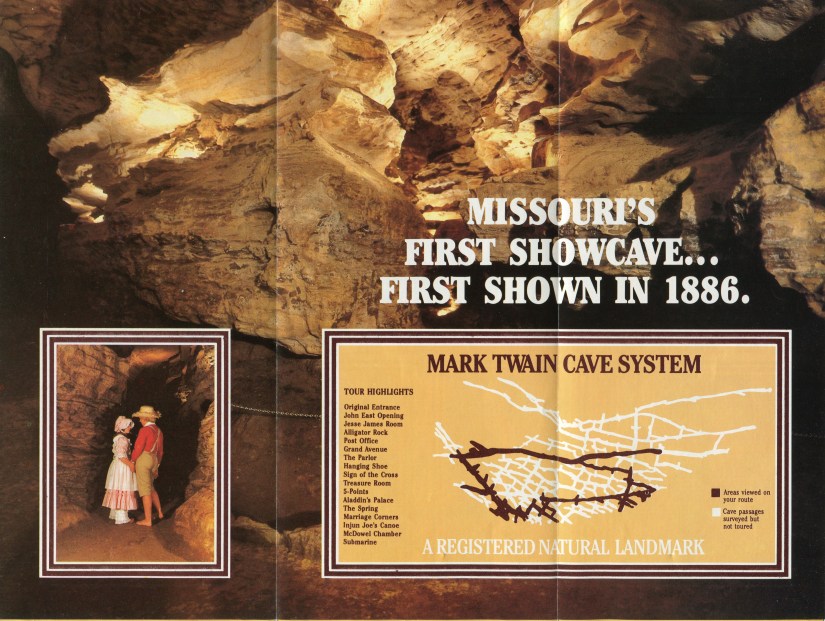
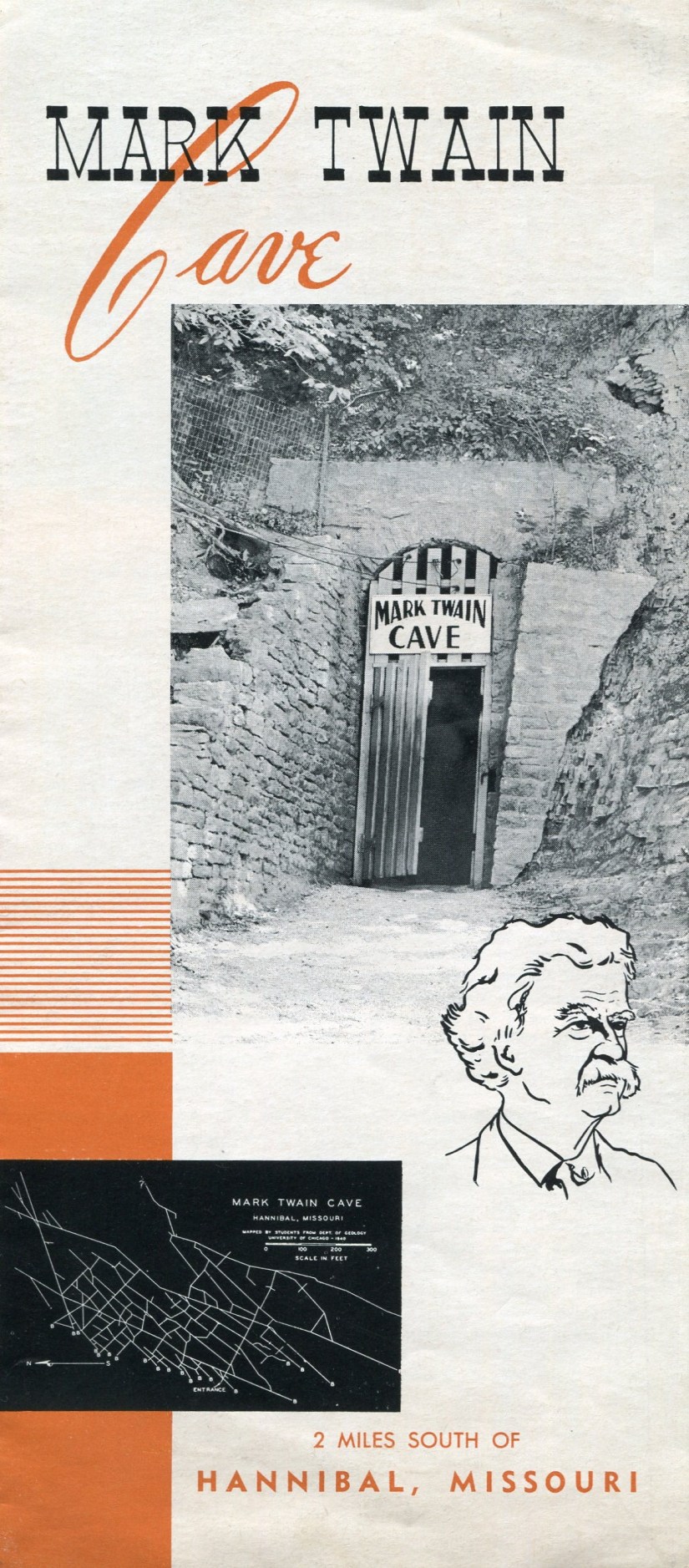 I wasn’t quite sure what to expect with Hannibal and arrived there hoping to chase Mark Twain’s shadow the same as I had done with Lincoln in Springfield. The town rests in a valley between two large cliffs directly on the Mississippi River. A lighthouse rests atop one cliff and a romantic, jagged crest known as “Lover’s Leap” rests atop the other. While beautiful to look at, the result for today’s visitors is terrible cell phone reception. That is unless you find yourself on top of one of those cliffs, where service zips right along. And, just like the land of Lincoln, Mark Twain casts a large shadow in Hannibal, Missouri.
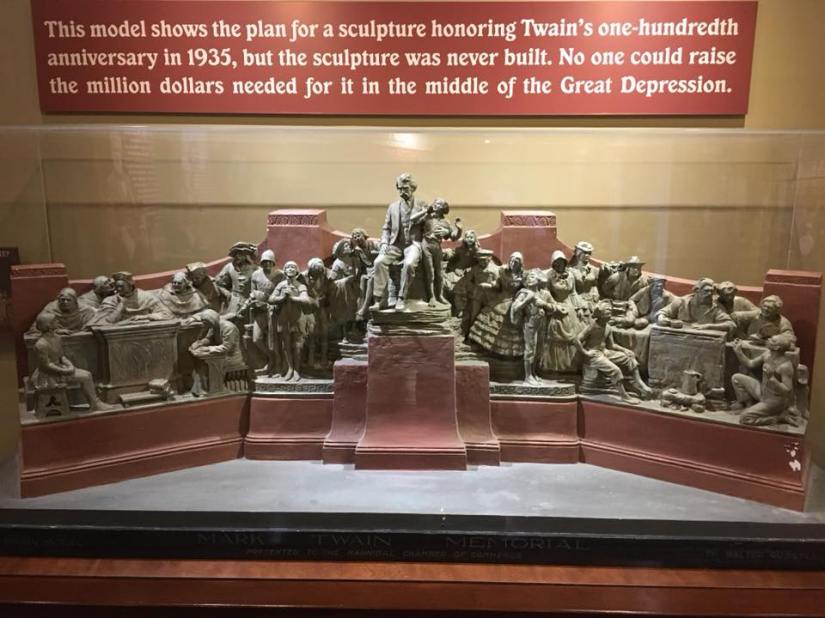 The Mark Twain House offers an excellent tour for a reasonable $12 per person that encompasses the homes of all of those familiar Tom Sawyer characters found in Mark Twain’s books. The tour concludes in the Mark Twain Museum located in the historic downtown district and features priceless relics, mementos, artwork, furniture and assorted objects once owned by and associated with Samuel Clemens (aka Mark Twain). After the tour, it is highly recommended that you take the short walk down to the shore of the Mississippi River.
 Suddenly I was a 10-year-old boy joyfully picking up bits of glass, rusted metal and broken crockery all the while convincing myself that any one of which surely belonged to a steamboat captain, riverboat gambler or a pirate. Such are the trinkets that dreams are made of. Should you prefer your treasure of a more cultivated nature, Hannibal has many hole-in-the-wall antique shops featuring more relics from the past. Hannibal is unique among tourist river towns because it has not yet been overtaken by commercialized establishment chain restaurants or stores. Its streets are not overrun by the Harley crowd. Oh, there is an upper-class motorcycle crowd element here, but these riders seem content to park their bikes and walk the town rather than to ride it.
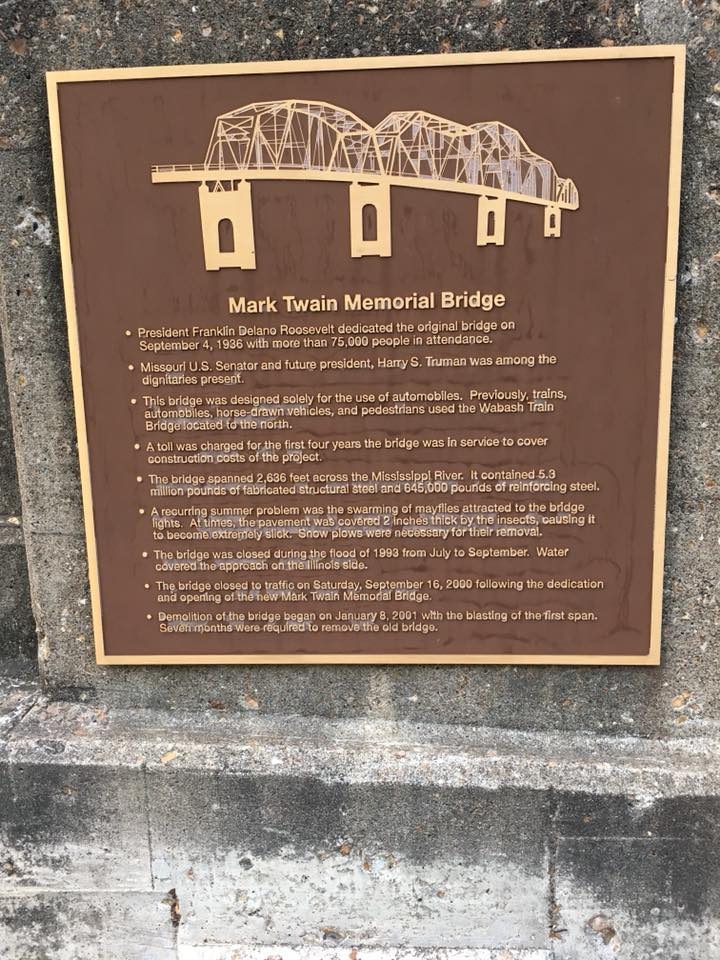 I took his advice and ventured up the hillside. There I found a quaint little pocket park created from an abandoned roadway and concrete bridge footing of a steel suspension bridge that once spanned the mighty Mississippi to Illinois on the other side. The bridge had been dedicated in the 1930s by Franklin D. Roosevelt himself with then-Senator Harry S Truman assisting. As I sat there puffing and reflecting, an older gentleman, climbing the stairs for exercise, walked by and said good evening. He stopped for a moment and, excited by my discovery, I said something silly like “Cool to think that FDR and Truman were here.” He shook his head and continued with his exercise.





 Ask any of these visitors about the park’s namesake and you’re likely to catch them at a loss. What’s more, most visitors are unaware that Paul Ruster Park is haunted by a centuries-old ghost. The park, acquired by the Indy Parks system in 1970, is named after a 1964 Warren Central high school graduate, Paul M. Ruster. Paul, the oldest of three sons of Marvin and Marie Ruster, died December 10, 1978 of Hodgkin’s disease. Paul’s brother Bruce was a former Warren Central baseball star and much beloved Phys-Ed teacher at Warren Central for many years. Paul was born on the eastside, attending Eastridge elementary and Woodview Junior High. He graduated from Ball State University and returned to Indy’s eastside to teach Phys-Ed at Lowell in 1969.
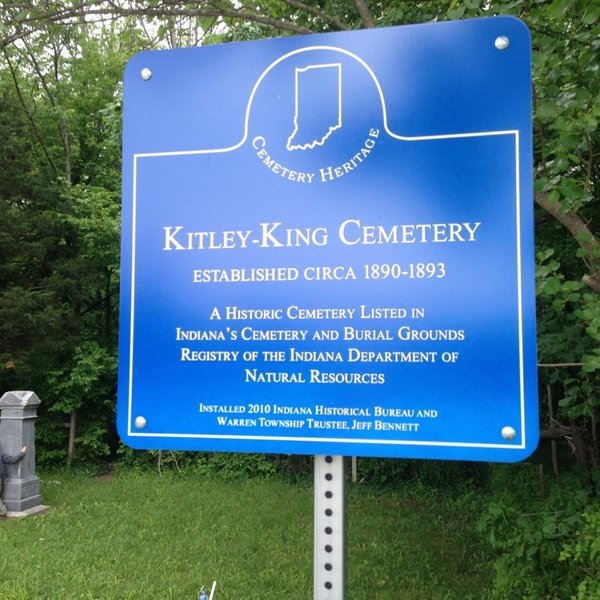 Although the park may have been new to the Indy Parks system, the haunted reputation was well established. Some of the first to report the strange happenings going on within the park were people who were themselves looked upon as strange by casual observers. These were the weekend warrior gatherings of young people dressed as medieval knights wearing full combat regalia while sword fighting and jousting around the green spaces of Ruster Park. These were the early days of the “Dungeons and Dragons” phenomenon in the 1980s involving fantasy role playing groups that met on a regular basis in the park. These groups began to report strange sights and sounds coming from the periphery of the park’s boundaries that would often stop participants in their tracks. Sometimes, these spooky sounds would drive the groups from the park in fear. Soon, the ghostly rumors made the rounds among Indianapolis paranormal groups that Paul Ruster Park was a hot spot for paranormal activity and an allegedly haunted area. Paranormal investigators declared that these unexplained occurrences were emanating from a nearby abandoned family cemetery a mere stone’s throw from the new park.
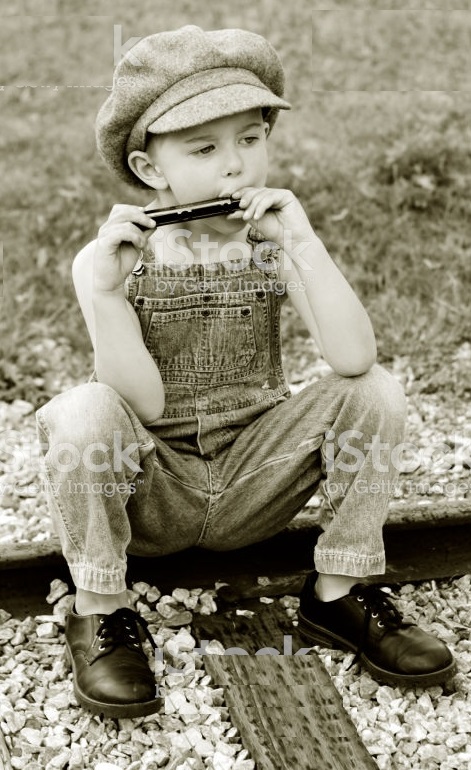 Legend claims that many years ago a 12-year-old boy living on the farm was killed while walking along the nearby train tracks. No-one knows if he was struck by a train or whether some other harm befell him. Reportedly, he is now buried in an unmarked grave within the foundation of his old house. Witnesses claim that if you walk the long path leading from the soccer fields through the woods to his grave near Prospect you can hear the boy playing his harmonica. Still other witnesses have reported seeing the ghostly image of a young boy walking down the road and again, he is seen playing a harmonica.
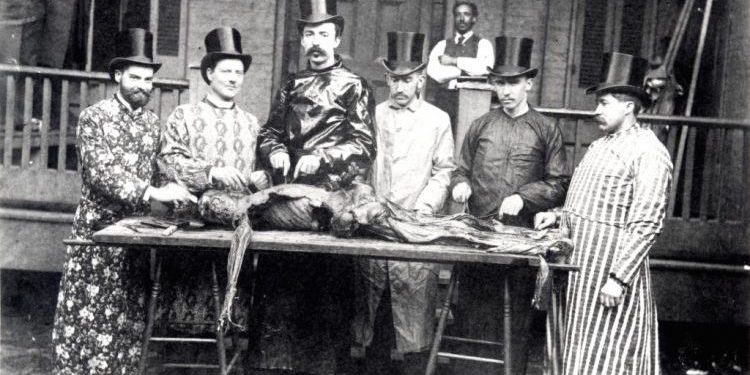
 is a rope with a hook at one end, a short crowbar, and a spade and a pick. He generally has a “pard,” as it is easier to hunt in couples. He is notified of the “plant” (body), and by personal inspection makes himself familiar with all the surroundings, before the attempt is made. The pick and spade remove the earth from the grave as far as the widest part of the coffin, and with the crowbar, the coffin is shattered, and the rope with the hook end fastened around the cadaver’s neck, when it is drawn out through the hole without disturbing the earth elsewhere. As soon as the cadaver is sacked, the earth replaced, and the grave made to look as near like it was as possible. There are some bunglers however, who have been guilty of leaving the grave open, with fragments of the cadaver’s clothing lying around. They are a disgrace to the profession, and have done much to foster an unfriendly public sentiment in this city.”
 THE MOST FRUITFUL FIELDS: “The most of the stiffs are raised at Greenlawn cemetery (in Franklin, south of the city), at the Mt. Jackson cemetery (on the grounds of Central State hospital), and at the Poor Farm cemetery (Northwest of the city). So far as I know Crown Hill has never been troubled. Many of the village cemeteries in the neighboring counties are also visited, however, and made to contribute their quota to the cause of science. Some of these village cadavers are those of people who moved in the best society, and besides their value in material for dissection, are rich in jewelry, laces, velvets, etc. The hair of a female subject is alone worth $25. Nothing is wasted, you may be sure. Even the ornaments on the coffin lids are used again..”
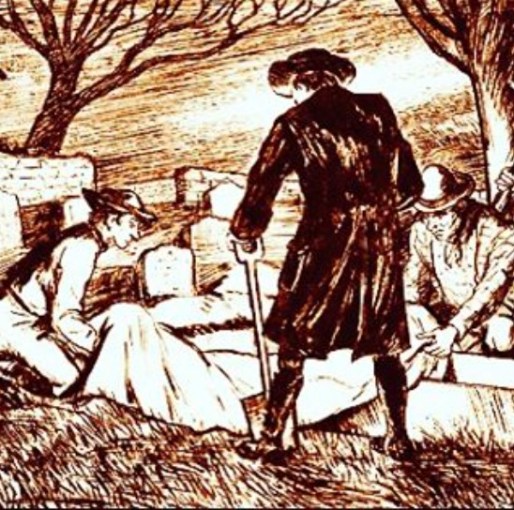 The night was a graverobber’s best friend. He lived in it, worked in it, played in it and hid in it. Late at night, these ghouls would steal into cemeteries where a burial had just taken place. In general, fresh graves were best, since the earth had not yet settled and digging was easy work. Laying a sheet or tarp beside the grave, the dirt was shoveled on top of it so the nearby grounds were undisturbed. Most body snatchers could remove the body in less time than it took most people to saddle a horse. They would carefully cover the telltale hole with dirt again, making sure the grave looked the same as it had before they came. Then hurriedly take the body away via the alleyways and sewers of the city, finally delivering the anonymous dearly departed to the back door of a medical school. In time, several of these ghouls began to furnish fresh corpses for sale by murdering the poor, homeless citizens of the city who once stood silent vigil in the alleys as the graverobbers crept past with their macabre cargo in tow.
 In the late 1800s in Indiana, it has been estimated that between 80 to 120 bodies each year were purchased from grave robbers to be used for medical instruction at medical schools and teaching facilities in Indianapolis. An end to the “big business” of grave robbing came as a result of twentieth-century legislation in Indiana which allowed individuals to donate their bodies for this purpose. In 1903, the Indiana General Assembly enacted legislation that created the state anatomical board that was empowered to receive unclaimed bodies from throughout the state and distribute them to medical schools. The act was “for the promotion of anatomical science and to prevent grave desecration.”
 Alan E. Hunter