Creepy history, Gettysburg, Hollywood, Pop Culture, Weekly Column

James Dean in Gettysburg.

Originally Published in December 2011. Republish Date December 21, 2023.

https://weeklyview.net/2023/12/21/james-dean-in-gettysburg/
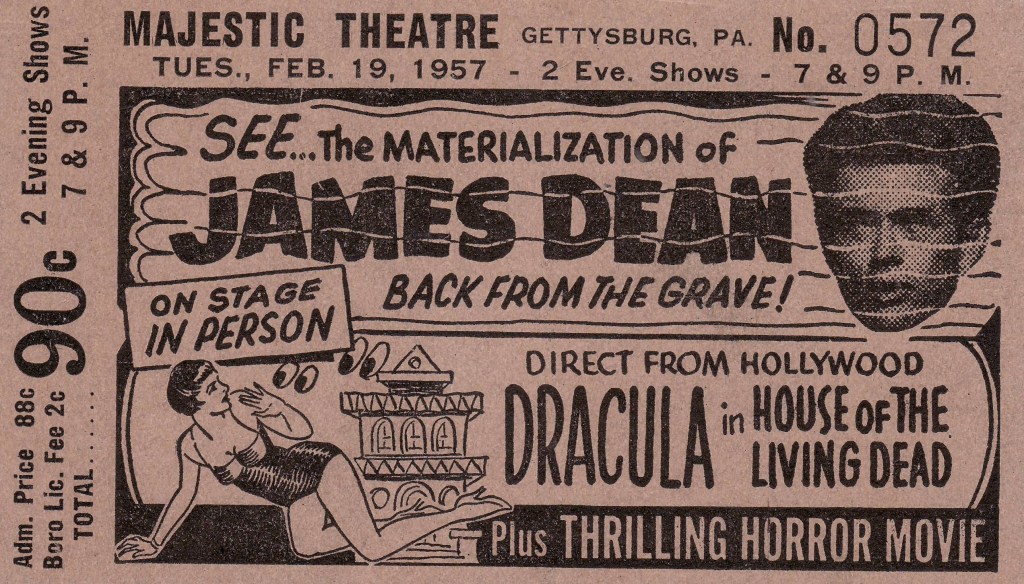
There is an item on my office desk that calls to me every time my mind wanders, I’m gathering my thoughts, or most often, while I’m waiting for a document to load on the computer. It’s a ticket stub, smaller than an index card, from a Tuesday, February 19, 1957, double feature movie at the Majestic Theatre in Gettysburg, Pennsylvania. I bought the ticket in an antique mall just off the Gettysburg town square while on a trip with friends to the famous Civil War battlefield this past Spring. Native Hoosier that I am, my heart jumps a little whenever I see something with an Indiana connection so far away from home.

The ticket is for a movie touted as being “Direct from Hollywood” (Where else would it be from in 1957?) called “Dracula in House of the Living Dead”. The ticket features the cartoon image of a young woman on her hands and knees crawling away from a house whose disembodied eyes follow her, and oh yeah, she’s in a skimpy bathing suit. I’m not an expert on Dracula movies, but my guess is that this movie was just a rehash of an old well-known film with a brand new title designed to lure unsuspecting people into the theatre believing they were seeing a new release. A despicable practice common amongst studios back in the 1950s Era.
While the Dracula ticket and its promise of an additional unannounced “Thrilling Horror Movie”, were intriguing to be sure, they were not the reason for my purchase. Above the terror-stricken swimsuit-clad woman, there was an eerie floating head of someone very familiar to me and many of my fellow Hoosier baby boomers. It was Fairmount’s own James Dean. The printed promise near his image read: “See…the materialization of James Dean BACK FROM THE GRAVE!” On Stage in Person” Cool, James Dean in Gettysburg, why that’s so…Wait, that’s…impossible. James Dean died in a car crash on September 30, 1956, and this ticket is dated after Valentine’s Day of 1957! How could that be?
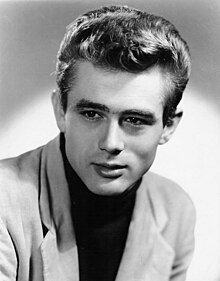
James Dean.

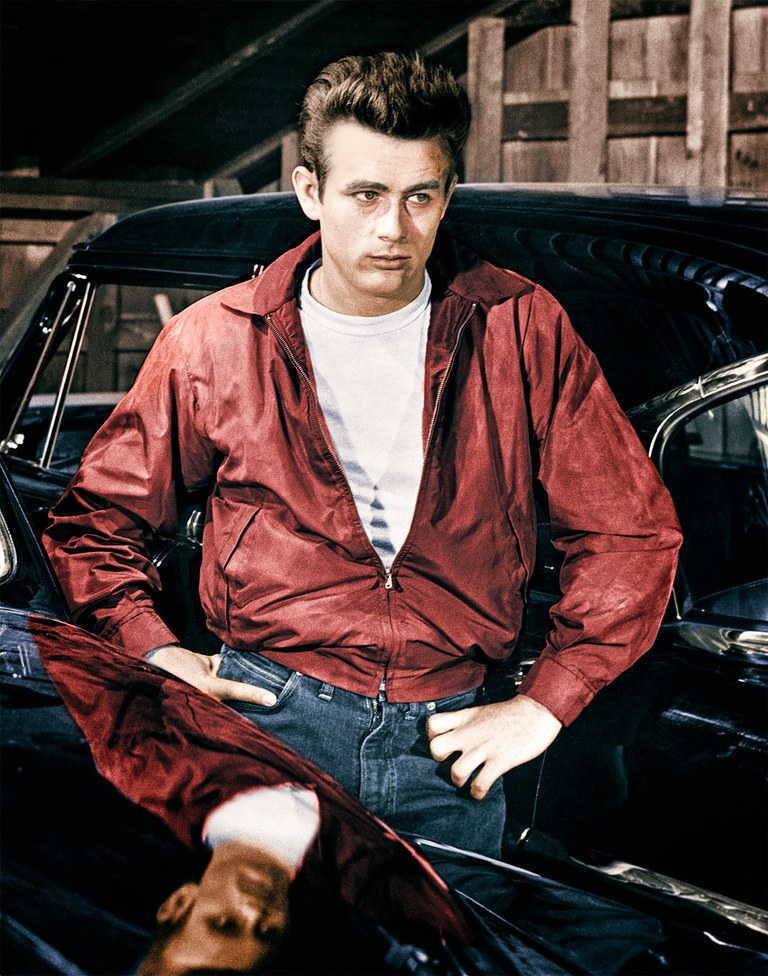
After a few minutes, I realized that this surely must be one of the earliest attempts at the exploitation of a dead celebrity ever attempted. Today, Hollywood barely waits for the body to get cold before cranking out biopics and making cable movies about dead celebrities. Anna Nicole-Smith, Heath Ledger, and Michael Jackson are recent examples. But in 1957 Gettysburg, really? One can only imagine the theatre owner dreaming up this stunt to draw a crowd, finding a good looking blonde haired kid from nearby Gettysburg College, paying him a small fee, and instructing him to walk out on stage wearing blue jeans, a white t-shirt, a red cloth jacket, and sunglasses before exiting speedily amid the gasps, squeals and screams of the frenzied teens in attendance.
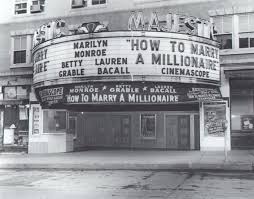
Gettysburg’s Majestic Theatre in 1953.

Did I mention that the Majestic Theatre is built so close to the historic Lincoln train depot station that you can almost touch it? The very same train depot where Lincoln arrived the night before he delivered his incomparable Gettysburg Address on the battlefield, on November 18, 1863. A spot many consider to be hallowed ground. But how could this be? Was this an isolated incident of gross exploitation or part of a larger movement? A little research reveals that shortly after James Dean’s death on a lonely California highway, a “James Dean Lives” cult was born.
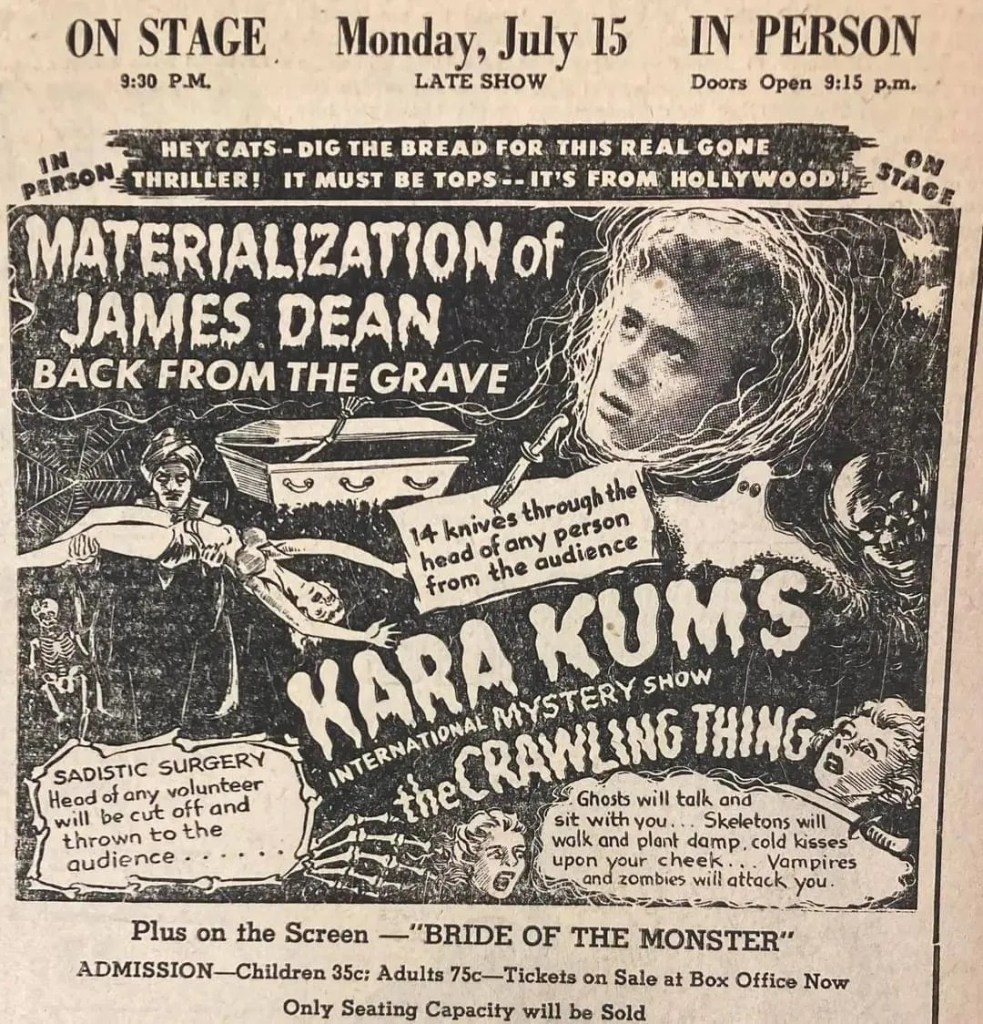
Brochure/leaflet from Magician Kara Kum’s conjuring of James Dean.

The first indication that the “James Dean Lives” cult was getting out of hand appeared in January of 1956, just three months after Dean died on the last day of September of 1955. Since October, Warner Brothers studio had been deluged with frantic fan letters expressing shock and disbelief that the teen idol was really dead. The letters continued to flow into the studio past Thanksgiving, but by December, the letter stream dramatically increased, both in volume and in spiritual tone. It now seemed that fans didn’t believe Jimmy was gone at all. New rumors claimed that he was being kept alive in a California nursing home and that the studios were stalling for time, just waiting for his recovery and a comeback. Hollywood Gossip columnist Walter Winchell printed the rumor that Dean was disfigured but still alive in his column. Other stories insisted that it wasn’t Dean at all who died in the car wreck, but rather a hitchhiker. Still more farfetched was the rumor that the actor was in hiding learning to operate his artificial limbs or that he had been placed in a sanitarium to recover. Three thousand letters came in during January and increased so steadily that by July, that number had increased to seven thousand. By the first anniversary of his death, Warner Brothers had received over fifty thousand fan letters from all over the world.
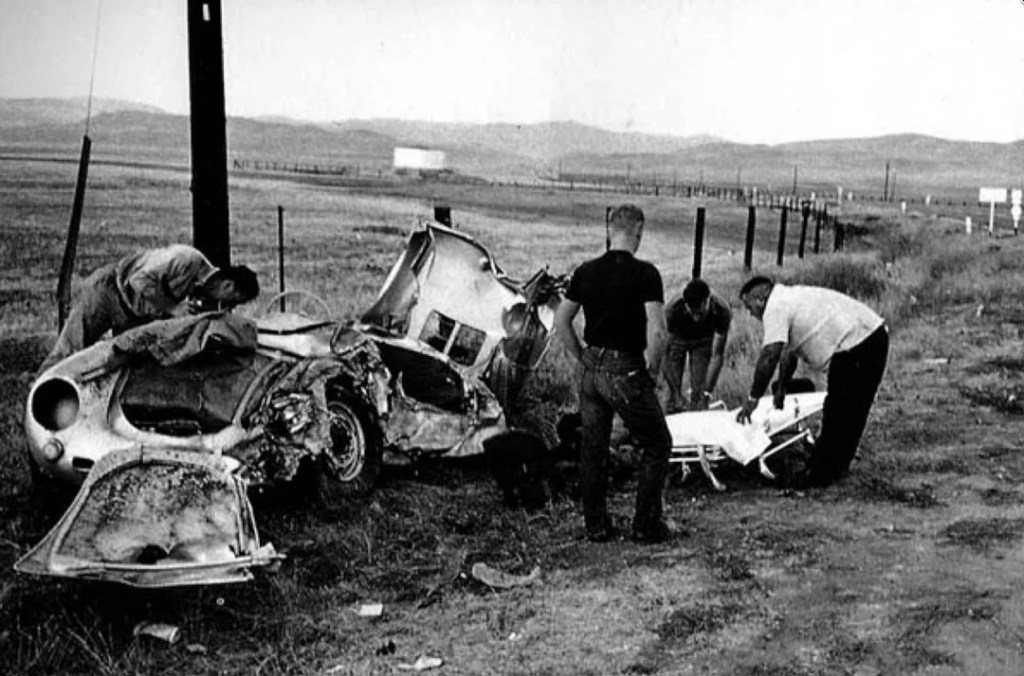
The automobile crash that killed James Dean on Sept. 30, 1955, in Cholame, California.

However, some of the “Mass hysteria” attributed to the “James Dean Lives” rumors can be rationally explained away. Much of this fan mail came from remote regions of South America, Australia, and Western Europe. While these areas still received the movies, albeit posthumously, they did not receive much news and were most likely unaware that James Dean was dead. Many times, these letters were addressed simply to: “James Dean Warner Brothers Studios Burbank California USA” and contained notes that read “Dear James Dean-I love your movies. Will you send me a picture?” That first year, the studio obliged and sent out the photos as requested, which undoubtedly did little to quell the rumors.
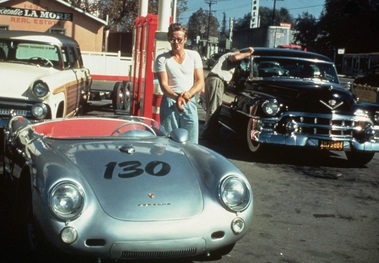
James Dean next to his Porsche 550, a few hours before his death.

But that didn’t explain all of the letters. From the day of his death, it seemed that young people would not let Dean die. Warner Brothers hired a special fan mail agency, the first of its kind in Hollywood, to deal with the deluge of mail that poured into the studio addressed to the dead star. Mattson’s, a Hollywood clothing shop, received hundreds of orders for red jackets identical to the one Dean had worn in Rebel Without a Cause. Griffith Park, where pivotal scenes from the movie were shot, became a tourist attraction overnight. Fans lined up inside the Observatory, hoping for a chance to sit in the same seat Dean had occupied in the film.
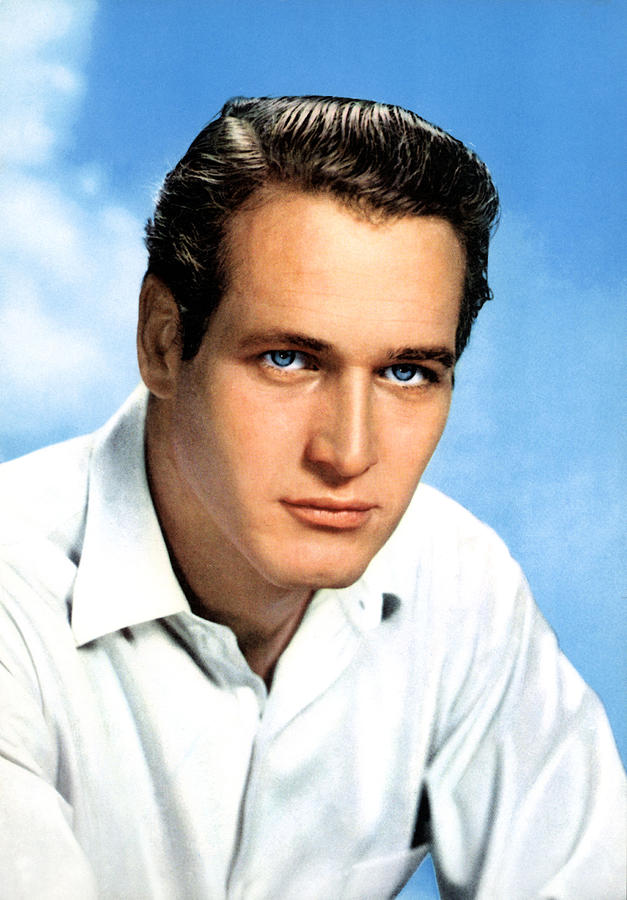
Paul Newman 1950s.

Although today’s generations might not be familiar with James Dean, over the years, an impressive list of actors and performers have claimed to have been influenced by him, including Bob Dylan, Al Pacino, Martin Sheen, and the late Jim Morrison, poet and lead singer for the Doors. Humphrey Bogart, who outlived Dean by two years and also knew a thing or two about cool, once said: “Dean died at just the right time. He left behind a legend. If he had lived, he’d never have been able to live up to his publicity.” Eventually, the realization that James Dean was gone set in. The world of cool moved on to others like Elvis Presley, The Beatles, Terre Haute’s own Steve McQueen, and Paul Newman, to name just a few. The Paul Newman comparison is not a random one. Not only will readers of my column recognize my admiration for Newman, but they might also be surprised by the ethereal connection between Newman and Dean.
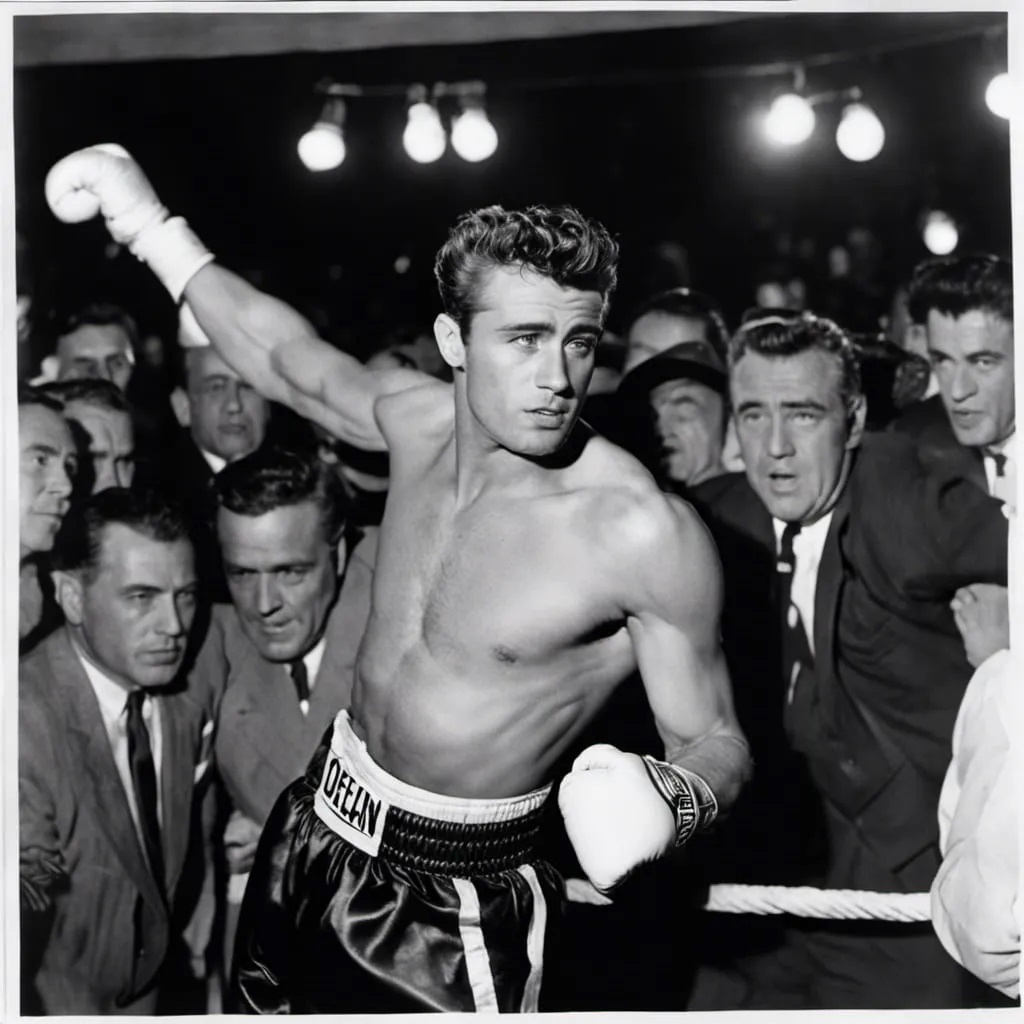
Fantasy photo of James Dean as Rocky Graziano.

James Dean’s final screen test for East of Eden (1955) was shot with Paul Newman, who also was in the final running for the role of Dean’s character Cal’s fraternal twin brother Aron. At the time of his death, Dean was signed to star as the lead (as Boxer Rocky Graziano) in the 1956 MGM movie “Somebody Up There Likes Me” and the 1958 Warner Brothers movie “The Left Handed Gun” (as Billy the Kid). Both roles subsequently were taken by Paul Newman and both helped make him a star. Some film experts have claimed that Newman’s career may never have gotten off the ground at all if Dean had lived. Both young actors often competed for the same roles and there just weren’t enough scripts to go around. When Dean died, he was signed to play in “The Battler” on the “Playwrights ’56” television series. The role went instead to Paul Newman. To further illustrate the Dean-Newman connection, Jimmy was the front-runner to star alongside Elizabeth Taylor in Cat on a Hot Tin Roof (Released in 1958), when he died, the role went to Paul Newman. The role earned Newman an Academy Award nomination and established Newman as a star once and for all.

The two megastars mug for the camera for a few seconds when Dean says to Newman, “Kiss Me” to which the older Newman replies “Can’t here.” Watch closely and you’ll see that Newman is sweating profussely under his armpits. More importantly, the clip instantly transports the viewer back to a time before James Dean climbed into the driver’s seat of his Porsche Spider and rode towards the California horizon, and immortality.
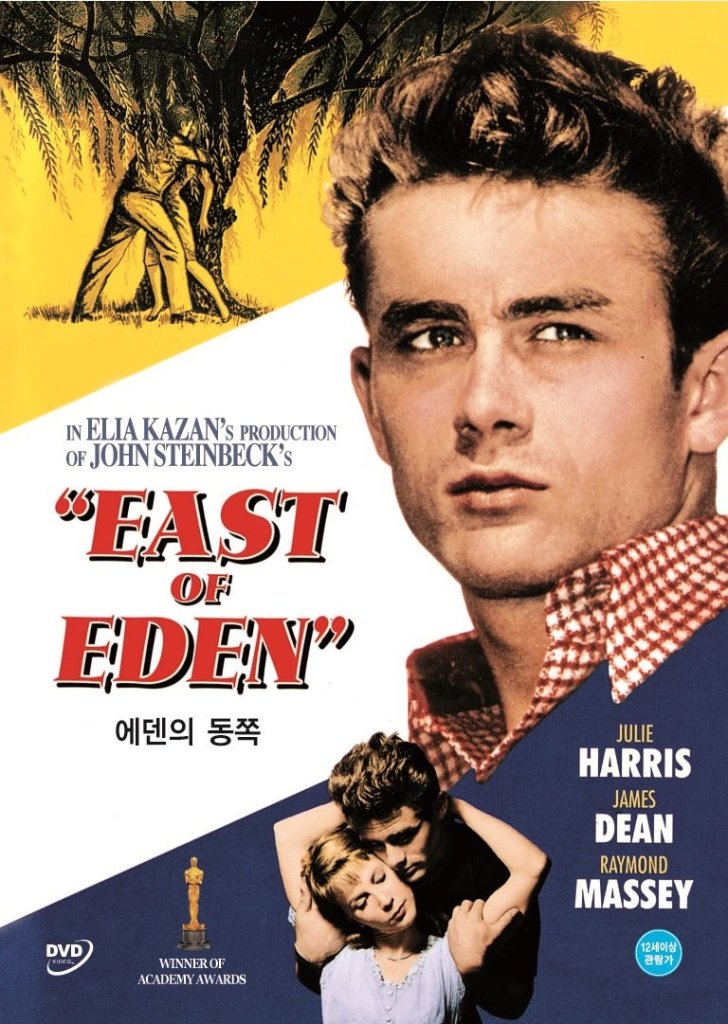
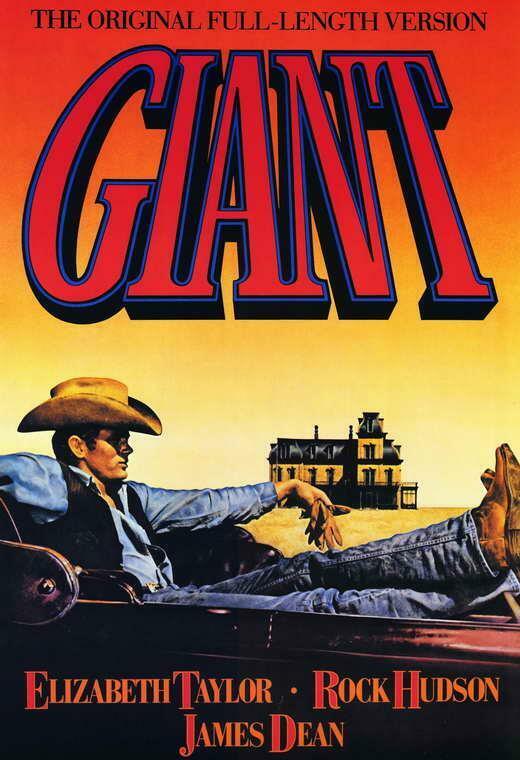
Just before his death, Dean’s agent, Jane Deacy, negotiated a 9-picture deal over 6 years with Warner Bros. worth $900,000. In 1956, Dean became the first actor to receive an Academy Award nomination posthumously, for his role in East of Eden (1955). He did not win. A year later, in 1957 Jimmy was nominated for his second Oscar for “Giant”, thereby becoming the only actor in history to receive more than one Oscar nomination posthumously. James Dean was nominated for Academy Awards in two-thirds of his films, a record which will probably never be bettered.
Abe Lincoln, Civil War, Gettysburg, Museums, Pop Culture, Presidents, Travel

Statuary Myths and Urban Legends. John Rogers.

Part II

Original publish date:  October 1, 2020

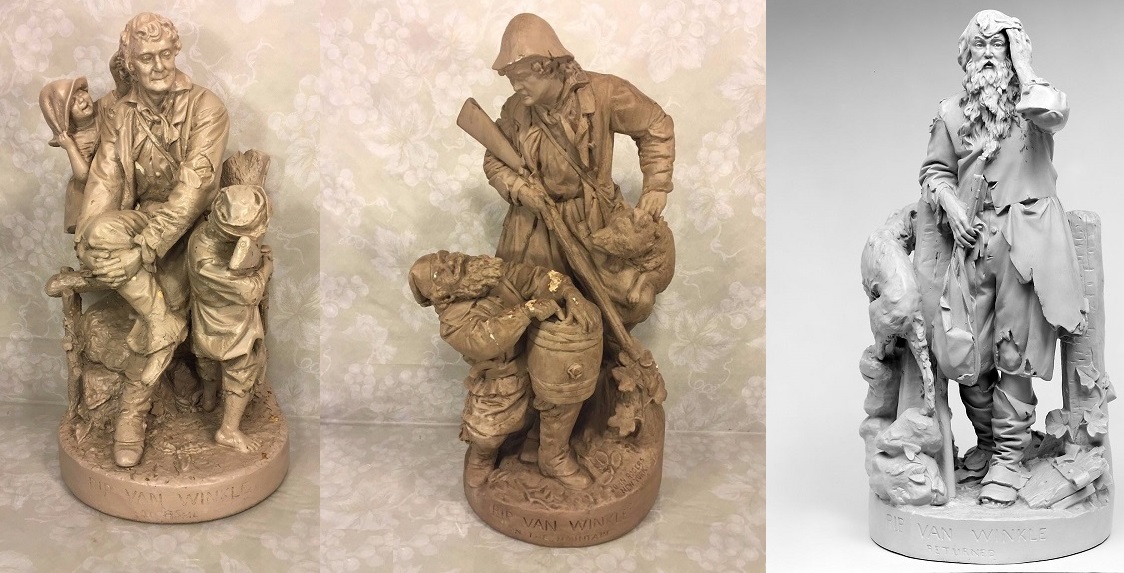
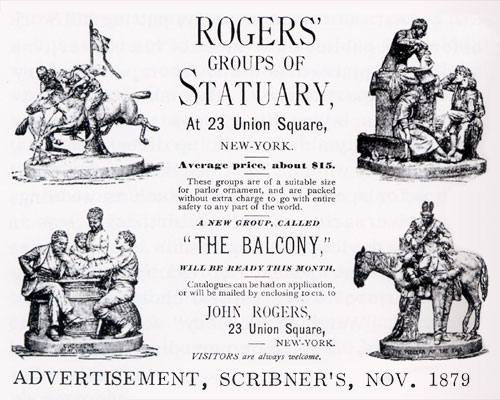
If you are a fan of Victorian decor, or if, like me, you find yourself haunting antique malls and shops, you’re probably familiar with the work of sculptor John Rogers. Commonly known as “Groups” for their routine use of more than one subject per sculpture, Rogers’ work is distinctive for many reasons: historical themes, uncommon accuracy and exquisite detail. Rogers was the first American sculptor to be classified as a “pop artist”, scorned by art critics but beloved by the average American. His themes included literary themes, Civil War soldiers, ordinary citizens, animals, sports and luminaries from the pages of history. For Irvingtonians, his works depicting namesake Washington Irving’s Rip Van Winkle are particularly prized.

zz s-l1600

John Rogers Rip Van Winkle Series.

I have a few in my office and one of my favorite places to eat, the “Back 40 Junction” in Decatur, is decorated with many John Rogers groups throughout their restaurant.
John Rogers was born in Salem, Massachusetts, on October 30, 1829, how can Halloween fans not love him already? His father, an unsuccessful but well-connected Boston merchant, felt that an artist’s life was no better than a vagabond and discouraged his artistic son from pursuing art as a profession. So, Rogers confined his love of drawing, painting and modeling in clay to his spare time. In 1856 Rogers ran away to Mark Twain’s Hannibal, Missouri where he worked as a railroad mechanic. Two years later, he moved to Europe to attain a formal education in sculpting. His first group, in 1859, he titled “The Slave Auction”. It depicts a white auctioneer as he gavels down the sale of a defiant black man, posed arms crossed, with his weeping wife and babies cowering at the side. Rogers, a strong abolitionist, was making a statement against slavery but New York shopkeepers refused to display his work in their windows for fear that the controversial subject matter would drive customers away. So Rogers hired a black salesman to peddle the statue from door-to-door and in a short time, Rogers’ statue, described as “Uncle Tom’s Cabin in plaster” became a best seller.

z john rogers cdvz artistic-sm

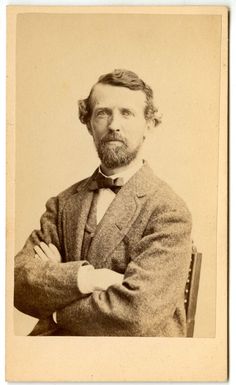
Sculptor John Rogers.

That same year, Rogers went to Chicago, where he entered his next statue, titled “The Checker Players” in a charity event, which won a $75.00 prize and attracted much attention. Rogers soon began rapidly producing very popular, relatively inexpensive figurines to satiate the average Gilded Age citizen’s thirst for art. Over the next quarter century, a total of 100,000 copies of nearly 90 different Rogers Groups were sold across the United States and abroad. Unsurprisingly, the next few years were filled with Rogers groups depicting scenes from the Civil War to honor their soldier boys serving far from home. These statues would remain popular with veterans after the war as well.
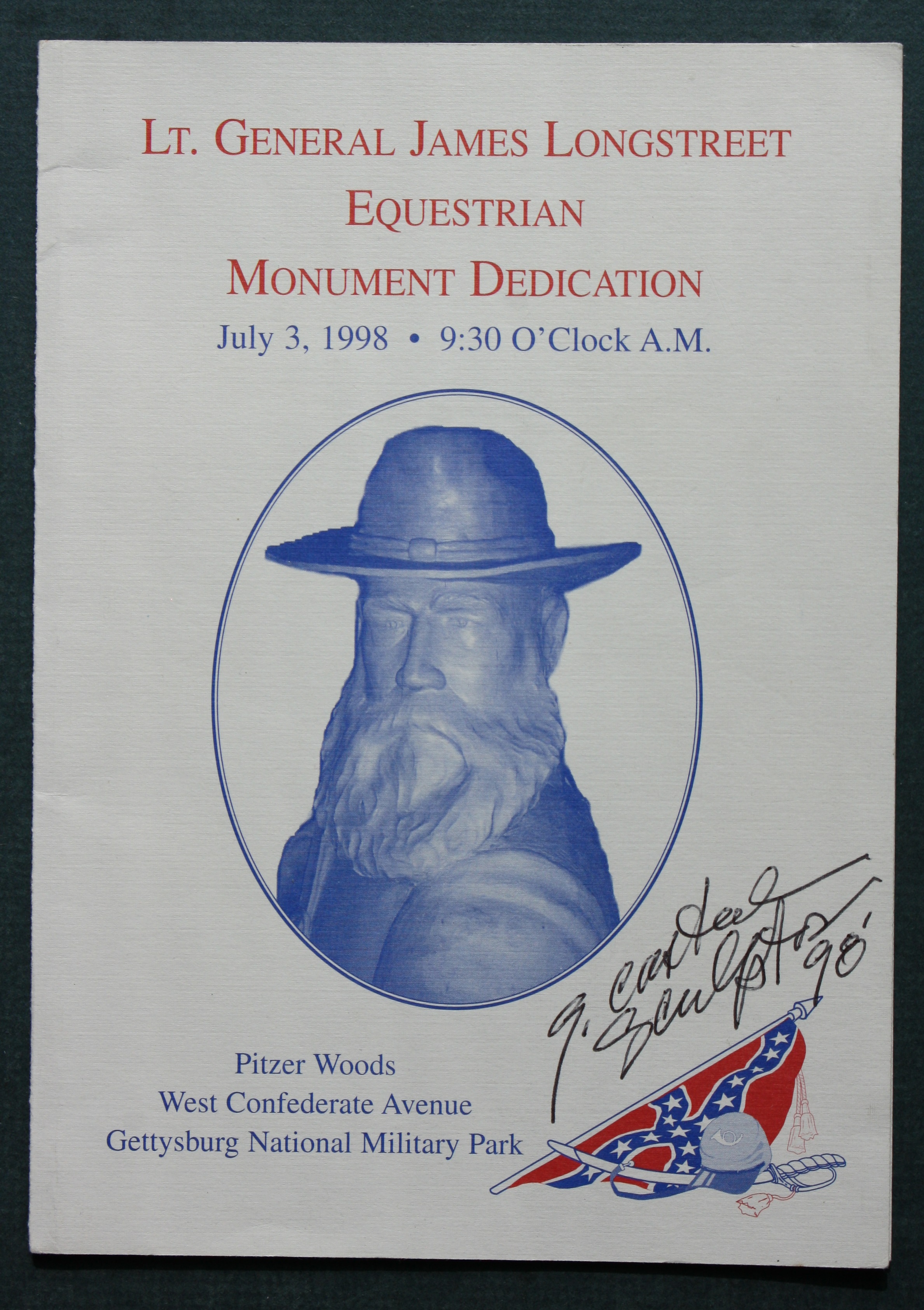
Gettysburg Longstreet monument sculptor Gary Casteel remarked, “Rogers is very well known as an American sculptor. More for his collection of small group settings rather than large public works. Both are excellent in detail and representation. His collection of CW related plaster cast pieces are quite well know and continually sought after by collectors to this day.” Rogers’ work was innovative, preferring to create his statuary based on every day, ordinary scenes from life. While Rogers’ work rarely made its way into art museums, it did grace the parlors, libraries and offices of Victorian homes around the world. However, there is one work that stands out among the rest, for subject matter, realism, and controversy.

1967.114_1.tif
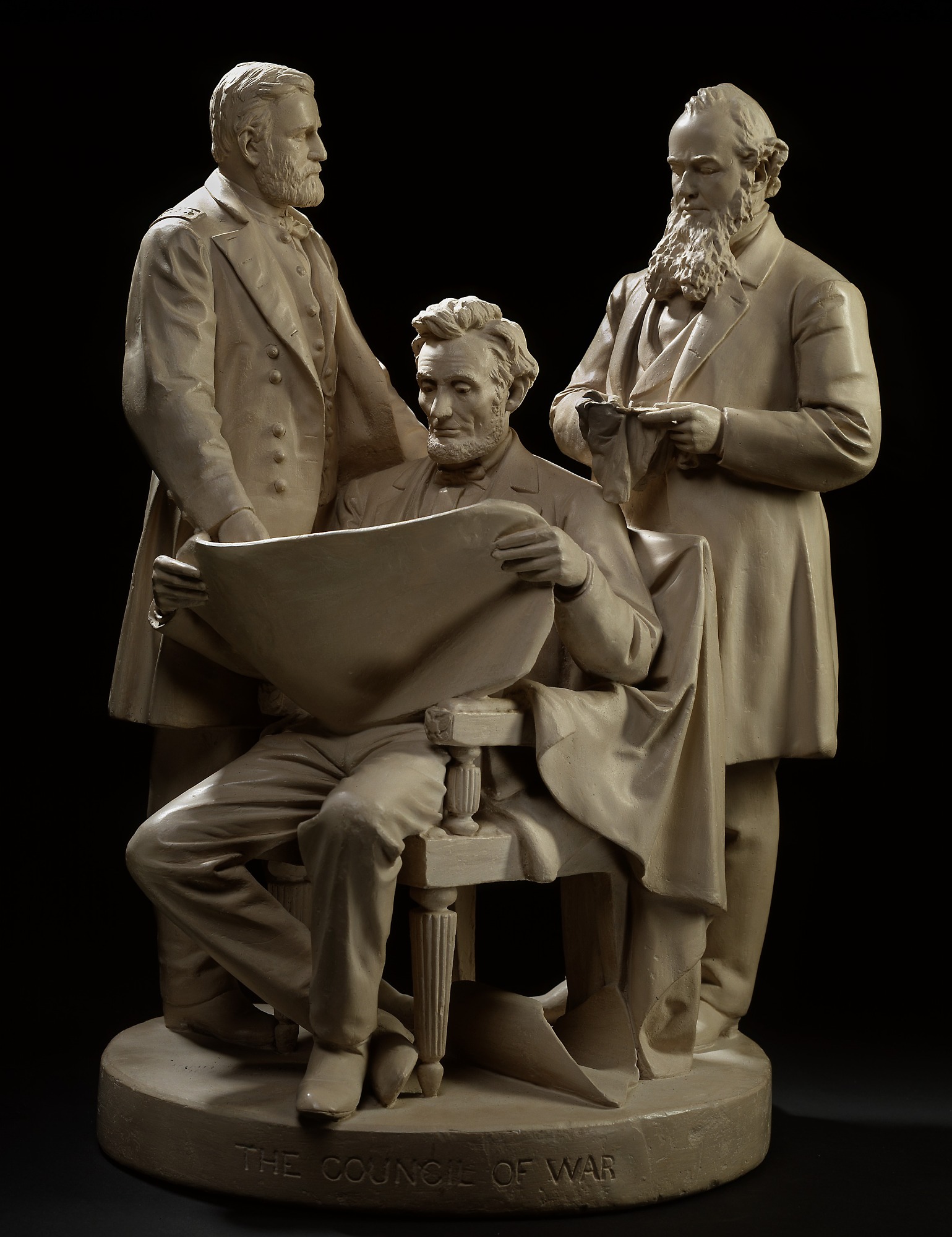
                                                         Rogers’ Council of War.

“The Council of War”, created in 1868, stands 24 inches tall and, like all of Rogers’ groups, was designed to fit perfectly on a round oak “ball and claw” footed parlor table. It depicts Abraham Lincoln seated in a chair, studying a map held in both hands, as General Ulysses S. Grant and Secretary of War Edwin Stanton confer over his shoulders. The June 1872 issue of the “American Historical Record” describes the scene: “The time is supposed to be early in March, 1864, just after Grant was appointed a Lieutenant-General and entrusted by Congress with the largess and discriminatory power as General-in-Chief of all the armies. The occasion was the Council at which the campaign of 1864 was determined upon, which was followed by Grant’s order on the 1st of May for the advance of the great armies of the Republic against the principal forces of the Confederates.”

31421516_1822681181096470_5411414843112554496_n

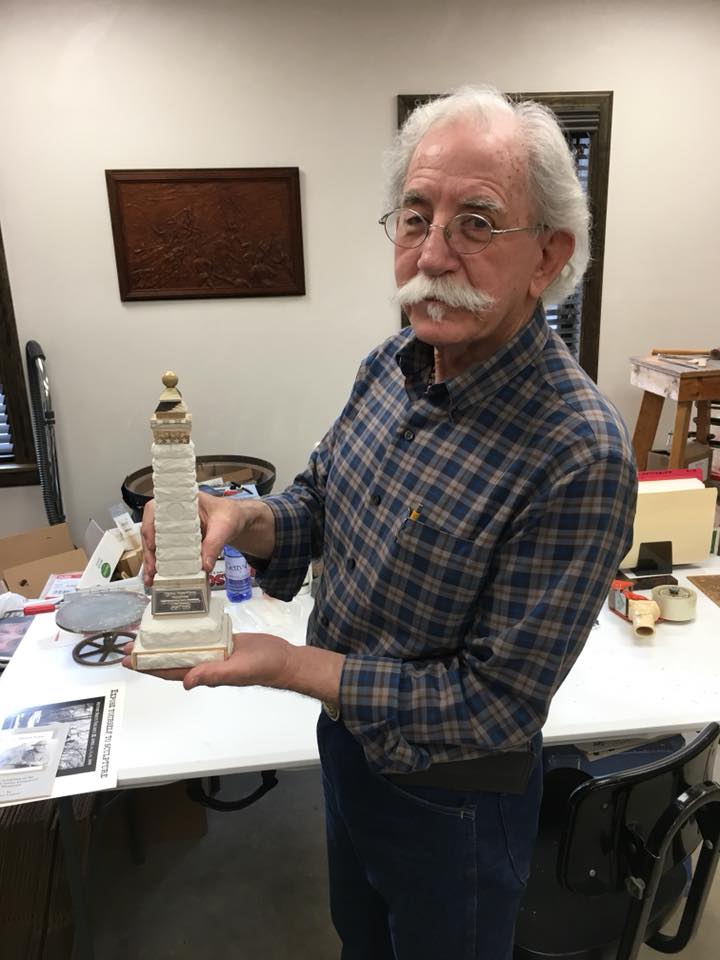
Gettysburg Sculptor Gary Casteel.

Both Robert Todd Lincoln and Edwin Stanton proclaimed this version of the President to be the best likeness of the man either had ever seen. Secretary Stanton wrote to the sculptor in May of 1872 stating, “I am highly gratified with the genius and artistic skill you have displayed. I think you were especially fortunate in your execution of the figure of President Lincoln. In form and feature it surpasses any effort to embody the expression of that great man which I have seen. The whole group is very natural and the work, like others from the same hand, well represents interesting incidents of the time.” Although the two surviving subjects received the piece positively, the public allegedly saw it differently: quite literally.
The controversy surrounding the pose arose based upon the positioning of Stanton behind Lincoln. Stanton, is posed polishing his spectacles, held in both hands, directly behind the President’s left ear approximately where Booth’s bullet entered Mr. Lincoln’s head. The pose is thought to have aroused the ire of collectors who believed the awkward positioning somehow stirred memories of the assassination. Hence, John Rogers made three versions of this particular group to appease those sympathies. Although the depictions of Grant and Lincoln remained the same in all three, Stanton’s hands were emptied and placed at his side in the second version and then changed back to polishing his glasses, this time forward of Lincoln’s head, in the third version. Some historians surmise the changes were affected due to the alleged theory of Stanton’s involvement in Lincoln’s murder that were circulating at the time. On the other hand, art historians claim the change was made for purely structural purposes and ease of casting to prevent breakage.
Modern day sculptors like Gary Casteel utilize many of the same methods as Rogers did a century-and-a-half ago, just as Rogers used those techniques he learned about while studying in Europe. Casteel, who like Rogers, also studied sculpture in Europe, says, “Every sculptor has his own way of sculpture production. However, there are probably similarities. I do a lot of detail as he did just simply because it’s my natural style.” The advantage that Gary Casteel has is the internet. Gary has a website and blog (Casteel Sculptures, LLC / Valley Arts Publishing) that walks his “fans” through the process of wood, wire & clay step-by-step. If you have an interest in the process, I highly recommend you subscribe to Gary’s blog. Watching Gary’s scale sculptures of the ornately detailed monuments of Gettysburg might better explain that Rogers’ changes in his Council of War group may not have been all about myth and urban legends after all.
At the height of their popularity, Rogers’ figurines graced the parlors of homes in the United States and around the world. Most sold for $15 apiece (about $450 in 2020 dollars), the figurines were affordable to the middle class. Instead of working in bronze and marble, he sculpted in more affordable plaster, painted the color of putty to hide dust. Rogers was inspired by popular novels, poems and prints as well as the scenes he saw around him. By the 1880s, it seemed that families who did not have a John Rogers Group were not conforming to the times. Even Abraham Lincoln owned a John Rogers Group. My favorite account of a typical Rogers statue encounter comes from the Great American West. Libby Custer mentions in her book “Boots and Saddles” that her husband, General George Armstrong Custer, carried two prized John Rogers groups (“One More Shot” and “Mail Day”, both depicting Civil War soldiers) from post-to-post on the Western frontier including the couples’ final Indian outpost before the “Last Stand.”
z LibbyandGeorge1.jpg09082017

Libby and George Armstrong Custer.

Libby states, “Comparatively modern art was represented by two of the Rogers statuettes that we had carried about with us for years. Transportation for necessary household articles was often so limited it was sometimes a question whether anything that was not absolutely needed for the preservation of life should be taken with us, but our attachment for those little figures and the associations connected with them, made us study out a way always to carry them. At the end of each journey, we unboxed them ourselves, and sifted the sawdust through our fingers carefully, for the figures were invariably dismembered. My husband’s first occupation was to hang the few pictures and mend the statuettes. He glued on the broken portions and moulded (sic) putty in the crevices where the biscuit had crumbled. Sometimes he had to replace a bit that was lost… On one occasion we found the head of the figure entirely severed from the trunk. Nothing daunted, he fell to patching it up again… The distorted throat, made of unwieldy putty, gave the formally erect, soldierly neck a decided appearance of goiter. My laughter discouraged the impromptu artist, who for one moment felt that a “restoration” is not quite equal to the original. He declared that he would put a coat of gray paint overall, so that in a dim corner they might pass for new. I insisted that it should be a very dark corner!”
z rogersad-500

Another article, this one from the January 1926 issue of “Antiques” magazine, encapsulates the love-hate relationship for Rogers’ work: “The fact that Rogers groups are fragile has made them rare enough to arouse the interest of collectors, although I doubt that they will ever be widely collected or will ever acquire high values. They are too large to be comfortably collected in quantity. Nevertheless there might be some slight activity in Rogers groups among collectors of American antiques and it is to be hoped that existing examples will be preserved for the sake of what they express of life some forty years since.”
In 1878 Rogers opened a small studio at 13 Oenoke Ridge in New Canaan, Connecticut. By the 1890s, his work had largely fallen out of favor. Poor health forced his retirement in 1893. Rogers died at his New Canaan home on July 26, 1904. His studio was designated a U.S. National Historic Landmark in 1965. Rogers sculpted what he saw, drawing his inspiration from the everyday beauty observed by his own eye or that created by his mind’s eye while interpreting the literary works he valued most. Although he died in relative obscurity, his works live on as perfect representations of Victorian Era life at the crossroads of the Gilded Age and the Second Industrial Revolution.

Civil War, Gettysburg, Museums, Pop Culture, Travel

Statuary Myths and Urban Legends. Gettysburg.

Part I

Original publish date:  September 24, 2020

I find myself hanging around statues all the time. On Battlefields. In Museums. Visiting cemeteries. My office. I truly love looking at statues & sculptures of every sort, heck, I even find myself admiring the old fonts on those statues and plaques. Not too crazy about the recent trend of “Cairns” (aka rock stacking) sprouting up in creeks and rivers and along trails in parks, but that’s another story. I do love statues and admire the artists that created them.
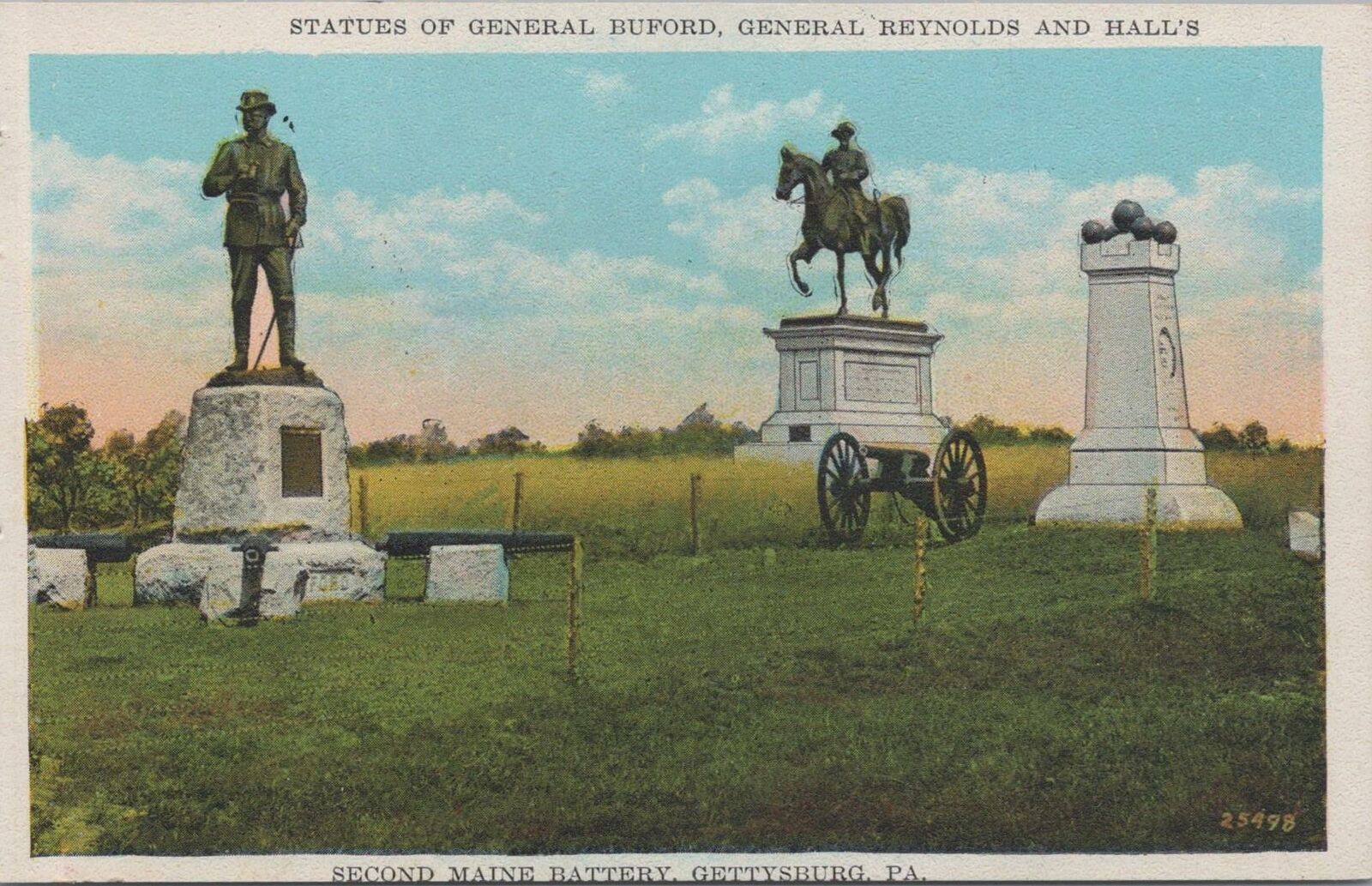
As many of you know, I spend a lot of time in Gettysburg- 2 to 3 trips a year. Part of the attraction of Gettysburg, to many, are the monuments and statues located on every part of the 6,000 acre park; some 1,300 at last count. As all devotees of the battlefield know, there is a legend that circulates around the eight equestrian statues found on the field. It has become known colloquially as the “hoof code” and until recently, solely by coincidence, it held true.
The tradition stated that the position of the horse hoofs on the statue dictated the fate of it’s rider. All four hoofs down: the rider survived the battle unscathed. One hoof up: the rider was wounded during the battle and survived. Two hoofs up: the rider was killed during the battle. According to the National Park Service, aside from the myths that the Rebels stumbled into the battle of Gettysburg while searching for shoes for footsore soldiers or that Lincoln wrote the Gettysburg address on the back of an envelope on the train to Gettysburg, the horse code legend is most enduring.

zz s-l1600
It appears that the stories were simply created by those early battlefield guides as a convenient way to get guests to remember the fates of the rider. Although harmless, it nearly drove the park brass crazy trying to explain the fallacy to guests, dignitaries and letter-writers for over a century. One letter found in the NPS archives from October of 1931, written by then superintendent E. B. Davis, addresses the issue bluntly, “The story that the posture of the horse in equestrian statues on this battlefield indicates whether the rider was killed, wounded, or unhurt seems to be one of those myths which grow up around historical places and are almost impossible to destroy. Sculptors whom I have consulted assure me there is no such convention connected with the art. This office does not countenance the story. On the contrary, invariably discourages it. It seems, however, to appeal to some imaginations among both guides and tourists. If you are in position to supply the name of your guide or the number of his cap, I can possibly stop one from further reciting the myth.” So, not only did it drive the NPS crazy, the sculptors weren’t too happy about it either.
z Screenshot (175)The statues on the field represent Union Generals Meade, Reynolds, Hancock, Howard, Slocum, and Sedgwick, and Confederates, Lee, atop the Virginia Memorial, and James Longstreet. According to the NPS, “Meade and Hancock were the first on June 5, 1896. They were followed by Reynolds, July 1, 1899, Slocum, September 19, 1902, Sedgwick, June 19, 1913, and Howard, November 12, 1932. The Virginia Memorial was dedicated on June 8, 1917. Longstreet did not come along until 1998 and by this time the myth was firmly established.”
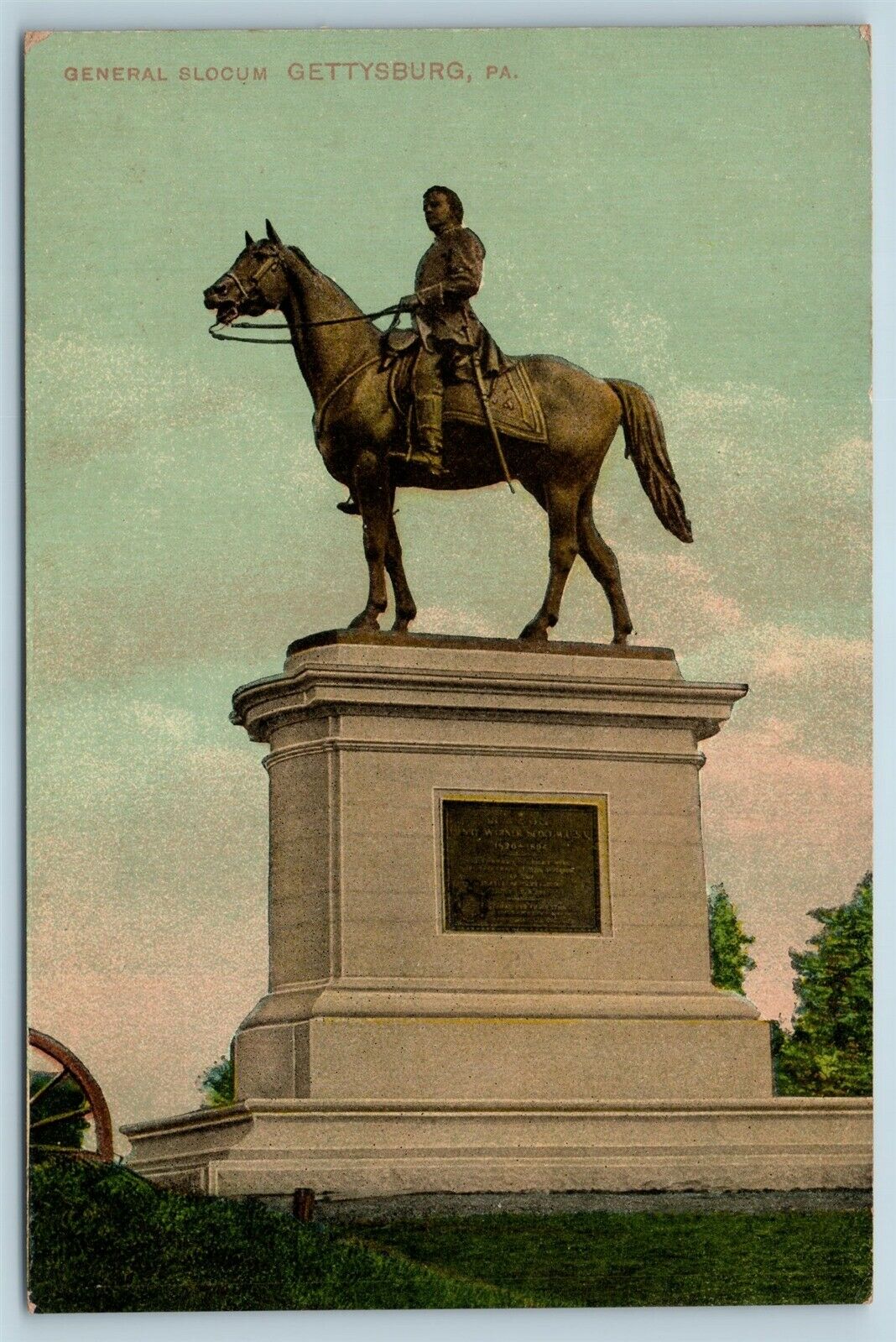
The Longstreet statue, created by artist Gary Casteel, was dedicated on July 3, 1998. Located in Pitzer Woods on West Confederate Avenue in the Gettysburg National Military Park, Gary’s statue is unique because it rests on the ground, not on a pedestal. “I wanted people to be able to walk right up to it; see it, touch it.” says the sculptor. Gary, whose studio is located near the entrance of the National Cemetery and the iconic landmark Evergreen Cemetery gatehouse in the old “Hall of Presidents” wax museum, is still busy practicing his craft within site of the Hancock monument across the Baltimore Pike.
Sculptor Frank Edwin Elwell’s larger-than-life bronze figure of Hancock astride “a horse” depicts the general extending a reassuring hand toward unseen Union soldiers. The horse “Hancock the Superb” straddles was not his own. On July 3, 1863, Gettysburg saw the greatest artillery barrage in the history of North America warfare. The earth rattling blasts of over 100 Confederate cannons and the thunderous roar of Union guns in reply, spooked Hancock’s horse, and it froze, refusing to move. Hancock dismounted, borrowed the horse of a nearby surgeon, and embarked on his ride, one of the most famous in the history of the Civil War. Hancock, fully exposed to enemy fire, rode up and down the line to bolster the morale of his troops who lay behind the stone wall. When aides begged the General to dismount, his reply was, “There are times when a Corps Commander’s life does not matter.” He was wounded grievously and his equestrian statue reflects that wound with one hoof up.
The placement of Hancock’s statue on East Cemetery Hill required the dismantling of a precarious looking wooden observation tower that stood on the hill from 1878 until 1896. But what about that horse? What was his name? Historians have studied that question for years to no avail. Every Civil War buff knows Lee’s horse at Gettysburg was “Traveller”, Meade’s horse: “Old Baldy”. We even know the name of Meade’s (he had two) and Lee’s back-up horses, “Blackie” & “Gertie” and “Lucy Long” respectively.
Reynolds horse: “Fancy”, his secondary horse was called “Prince”. Sedgwick’s horse was named “Rambler”, his two back-ups; “Cornwall” and “Handsome Joe”. General Henry Slocum’s horse was named “Charlie” and General Longstreet’s horse was “Hero”. BTW, in case you’re wondering, General Joshua Lawrence Chamberlain’s horse was named “Charlemagne” but he did not get it until the autumn of 1863, after Gettysburg. The horse, a small brown Morgan horse with scars and sores from pack-service had been captured from the Confederates. Chamberlain has no monument, equestrian or otherwise, on the field except for that of the 20th Maine on Little Round Top.
z slocum s-l1600But Hancock’s horse at Gettysburg? No one knows. Likewise, General O.O. Howard’s horse remains nameless (he had at least two shot out from under him and himself was wounded twice in battle) but the sternly pious one-armed General’s nickname of “Uh Oh” survives. So named by soldiers because when the General showed up, one way or another, there was gonna be a fight (he was awarded the Medal of Honor for actions at Gettysburg). Look up at his statue the next time you’re walking the field and you’ll see the empty flap of his right arm (shot off at the Battle of Seven Pines a year earlier) pinned neatly to his coat.
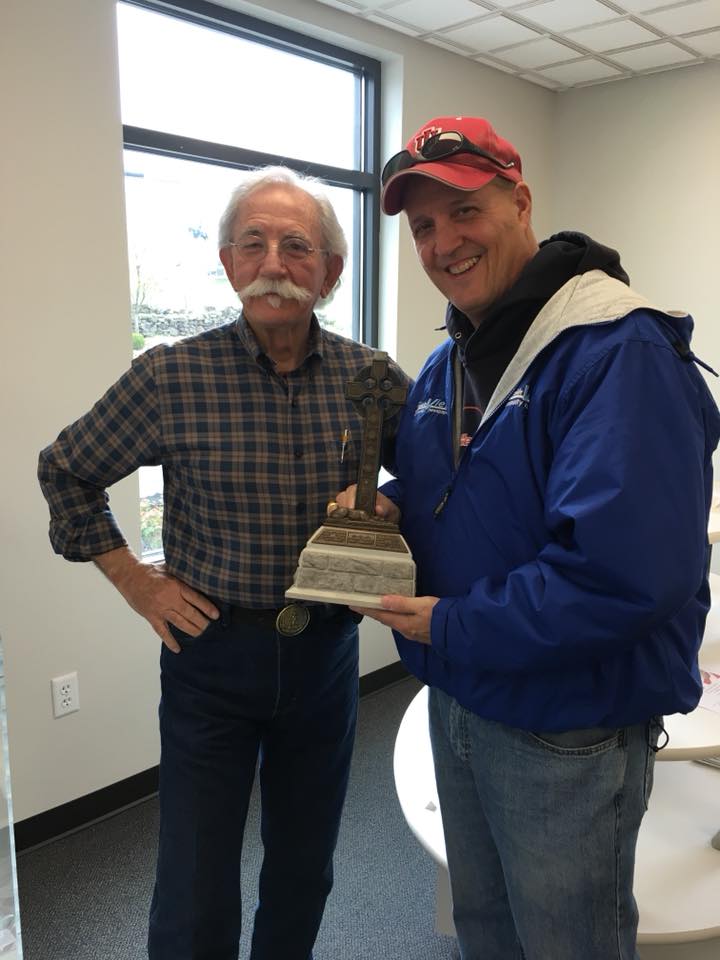
31381355_1822681061096482_4450482538460217344_n

Sculptor Gary Casteel and the author in Casteel’s Gettysburg shop.

Which brings me back to sculptor Gary Casteel. Gary’s statue of General Longstreet is featured on his horse with one foot raised, even though Longstreet was not wounded in that battle. However, he was seriously wounded in the Wilderness battle the following year. The hoof is depicted in an upraised position, making it the perfect place for visitors to place coins, lucky four-leaf clovers and other mementos atop it. Casteel’s equestrian statue, the most recent general officer monument on the field, may settle the “hoof code” urban legend once and for all. Should you ever find yourself in Gettysburg, stop in Gary Casteel’s studio at 789 Baltimore Street and ask him yourself. Asked for comment on the myth, Mr. Casteel answered, “The “code” only works at Gettysburg and over the years it has become “law” thus challenging those who wish to question or break it, like me!” after which he jokingly adds, “It took a Confederate to challenge Yankee rule once again!” Yes, if you find yourself in Gettysburg, a visit to Casteel Sculptures is a must see. Most visitors fail to realize the rare opportunity afforded them with just such a visit. You can walk to battlefield and gaze at statues innumerable, but you can only talk to one sculptor: Gary Casteel.
That brings me to another statuary myth, one that I have been enamored with since I was a small boy. It involves the first American “pop sculptor”, the Civil War, the Abraham Lincoln assassination and George Armstrong Custer. Next week in part II of “Statuary Myths and Urban Legends.”

z IMG_2526

Civil War, Gettysburg, John F. Kennedy, National Park Service, Presidents, Travel

Gettysburg’s Bill Frassanito: Father of “Then and Now.”

William A. Frassanito photo
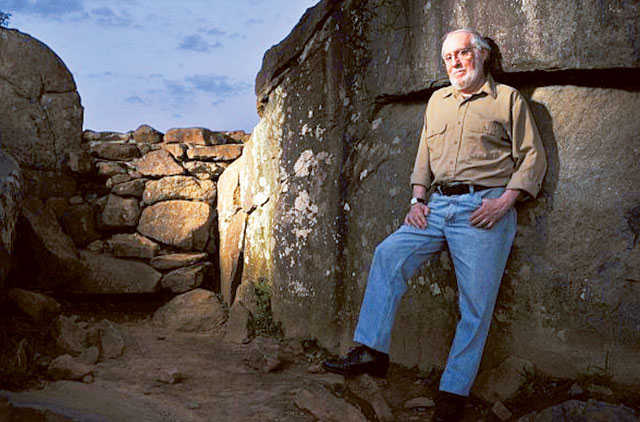
Historian Bill Frassanito and Alan E. Hunter

Original publish date:  September 19, 2019

Over the past decade there has been a subtle yet perceptible shift in historical genre on the Internet (particularly on Facebook) known as the “Then and Now” movement. If you are a fan of historical photography, or of the time and space continuum theory, then no doubt you have noticed these images. They consist of a blended pair of photographs, usually landscapes or buildings, one old, one new, both morphed into a single image for comparison. They are eerie reminders of a shared place and time probably best described by William Faulkner in his classic Requiem for a Nun as “The past is never dead. It’s not even the past.” If, like me, you’re a fan of this genre you need to thank one man: William A. Frassanito of Gettysburg, Pennsylvania.

1_16a080f6c78.1203916_3878439317_16a080f6c78_large
Bill Frassanito posed in the Sniper’s Nest at Devil’d Den.

Mr. Frassanito first popularized the “then and now” movement in his groundbreaking book “Gettysburg. A Journey in Time“. He followed up that classic with two similar books on Antietam, another on Grant and Lee in Virginia and three more on Gettysburg, including his seminal study of Early Photography at Gettysburg. Mr. Frassanito was among the first to conduct a historical comparison based on identifying topographical elements found in archival photographs that remain consistent on the landscape today. Bill’s work sent a shockwave through the historical community that resonates to this day.
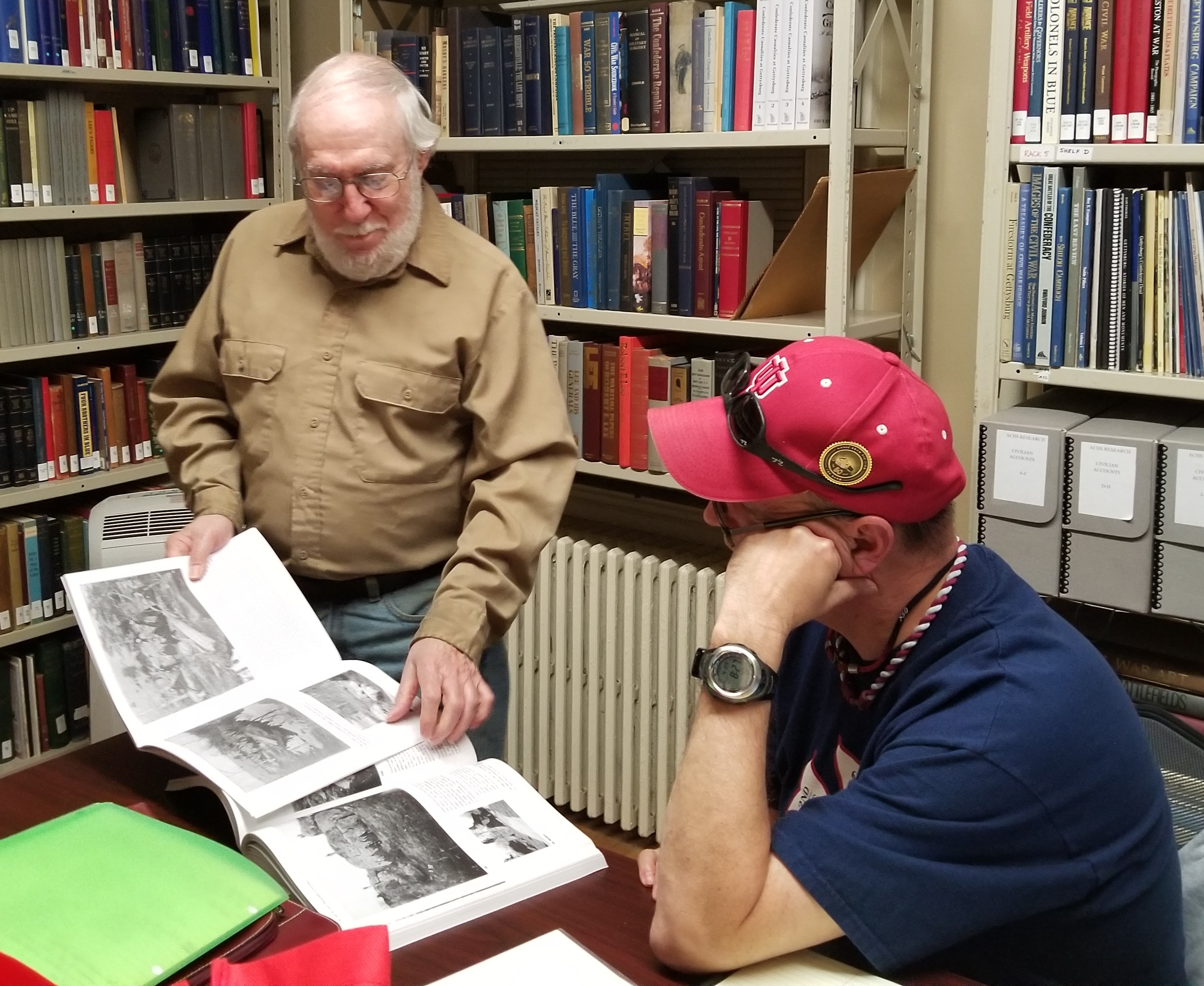
I interviewed Mr. Frassanito at the Adams County Historical Society research center (368 Springs Avenue Gettysburg) a couple times during the past few months. I was in Gettysburg looking for information on Osborn Oldroyd, whose father was a one time Adams County resident and former owner of a textile mill in the county. Most of my readers will recognize the Oldroyd name as a near constant in this writer’s work. early-photography-updated_1024x1024Needless to say, I was pleased with my visit to and pleasantly reminded how invaluable places and people like these are to the preservation and education of history. After the ACHS helped fill in some blanks in my research, I turned my attention to author Bill Frassanito. He is intensely private, yet unassuming and modest in demeanor. Although an author by trade and historian by nature, Mr. Frassanito has the soul of a teacher.
When I asked Mr. Frassanito how he developed the concept fot the modern “then and now” movement so prevalent on the Internet nowadays, he modestly answers, “I’ve always been fascinated by the concept of time and that today is tomorrow’s history. What I tried to do in the use of ‘then and now’ was to have the reader experience the photograph, but it’s not just the ‘then and now’, it’s the maps that allow people to go and stand on the spot and experience what the photographer experienced. So it’s a total picture used in a systematic fashion book after book after book. I didn’t invent the concept, but I took it to a level that was completely unprecedented. When my ‘journey’ book came out in 1975, there were about a dozen modern books on the battle of Gettysburg available. Now there are zillions on every aspect of the battle.”Picture106
When asked if there are any more books on the horizon, Bill answers, “My first book came out when I was 28 in 1975 and the last came out in ’97 and I’m through writing. I’ve done everything I’ve wanted to do. I was much sharper 20 years ago than I am now. I’m especially pleased that part of my legacy are people like Garry Adleman and Tim Smith, and they constantly mention my work, so I do have a legacy. I’m not going to be around forever but I do know that 100 years from now there will be a group of people that are very familiar with the role my pioneering work played, so the average person probably won’t know about me but the experts will know indefinitely. I laid the foundation so when new stuff surfaces they will know how to fit it in.”
512DBQHBXZL._SX379_BO1,204,203,200_When asked what first drew him to Gettysburg, he explains, “My first trip to Gettysburg was in 1956 when I was nine years old, and I was just awed by all the monuments, cannons and stuff. I started my research when I was a kid and much of the research for Journey in Time was done when I worked it into a Masters thesis (he is a proud Gettysburg College alum). “When you went to Gettysburg College, I was the high school class of ’64, college class of ’68, at that time all the male students had to take either phys ed or ROTC for two years, after that you made the decision whether you continued on to advanced ROTC, then you were a part of the Army and you got paid. From there you are committed to, after graduation, serving for two years as a second lieutenant, then on to grad school.”
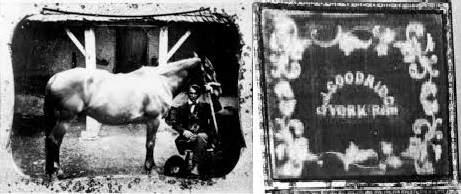
Frassanito continues, “I was accepted to Gettysburg College my senior year in high school. I went to high school in Long Island. I spent a weekend at the college as a senior. I had some time off and I visited the Red Patch Antique Shop and I asked if they had any old photos and he (the shop owner) brought out a basket full of cased images. Among the photos was an outdoor daguerreotype, which is very rare. I opened up this quarter plate daguerreotype, it was a farmer sitting on a bench with a horse in front of the barn. I asked how much and he said a $1.50, which doesn’t sound like much, but it was worth more back then. On the inside of the case was the name of the photographer, “G.J. Goodrich York, Pa.” Years later I discovered that Glenalvin J. Goodrich was one of the few black photographers in Pennsylvania. But because of the battle, he moved to Michigan.”

glalvin
Glenalvin J.Goodrich photo from the Frassanito Collection.

Glenalvin, son of former-slave, opened his first photo studio at the age of 18 in 1847 and later operated his studio out of the Goodridge residence on East Philadelphia Street. Mr. Frassanito has already allowed the daguerreotype to be used in two different books asking only that credit for the photo be given to the Frassanito collection. “Just last year I was contacted by someone who wanted to purchase the daguerreotype and I said I’m sorry it’s not for sale, I have personal attachment to it. His offer kept going up and up and up. His last offer was $10,000. And I told him, no it’s not for sale, I’m sorry. It’s going to go to the Adams County Historical Society. Now, when it is at the Adams County Historical Society, since it’s not Adams County related, if they wanted to make a deal with the York County historical Society, I would have no problem because technically that would be, probably, the most appropriate place.”
510dSFzAnXLBill’s collecting interests are not solely confined to Gettysburg. “All of my stuff is going to the Adams County Historical Society. It will be called the Frassanito collection. Including all my stuff that goes beyond Gettysburg and Adams County. My interest in military history includes World War I and Franco Prussian war, it’s very expansive.” Mr. Frassanito’s interest in all things military came when he saw the 1956 movie “War and Peace” starring Audrey Hepburn and Henry Fonda and, he states, “from that time on I’ve been fascinated by Russian history including the Crimean War” (October 1853 to February 1856 in which the Russian Empire lost to an alliance of the Ottoman Empire, France, Britain and Sardinia).
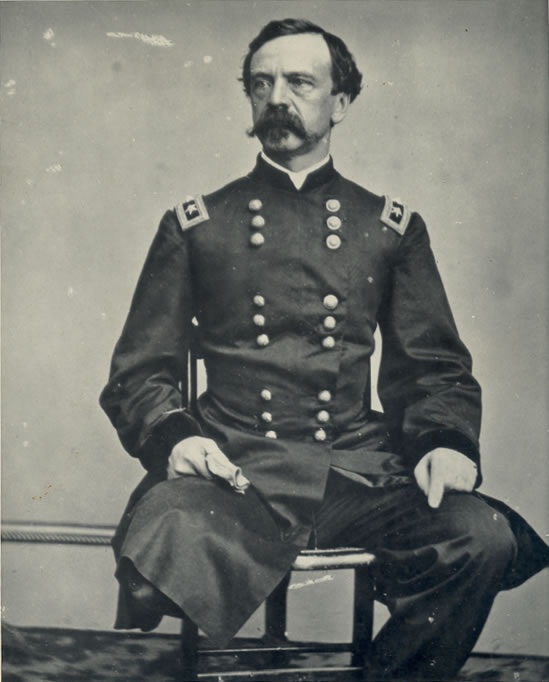
“It was 1968, my senior year, my parents came to visit me from Long Island. We rode around the countryside and stopped at an antique shop in New Oxford. I asked my standard question, do you have any old photographs? The shopowner brought out this brown paper bag full of old photos removed from photo albums. Apparently he would sell the empty albums. There were 130 Carte de Visites, I asked how much and he said a dollar.” Among those CDV’s was a rare photo of an identified Franco-Prussian soldier. But more importantly was the discovery of two photos from a New York City gallery. One signed on front “G.G. Sickles”, the other “Susan M. Sickles.” Frassanito thought no more about the photos until years later when he discovered that these were the parents of the famous Gettysburg General Dan Sickles, who lost a leg in the Peach Orchard during the battle of Gettysburg. “I eventually made a connection with the Sickles family and learned that they had no photographs of these relatives.” says Frassanito, “Turns out I have the only photos. They were just stuck in this old brown paper bag.” he says with a chuckle.

sickles2_lg
General Dan Sickles.

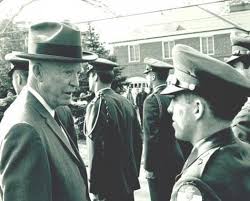
Bill then details a chance meeting he had with Pres. Dwight D Eisenhower while serving in advanced ROTC as a junior at Gettysburg College. “As fate would have it, they lined us up by size, and as I was the shortest cadet in the unit, I was positioned at the far left of the line, which turned out to be the sweet spot where all the cameras and newspapermen were positioned. Much to my surprise, Ike stopped in front of me and we had a short conversation while the cameras clicked away. It was not a substantive talk and you could of knocked me over with a feather.” That photo can be found in Mr. Frassanito’s updated Gettysburg Bicentennial Album book available for sale at the Adams County Historical Society.

images
President Dwight D. Eisenhower and Cadet Wm. Frassanito.

“I’m the definition of a baby boomer.” Bill reveals, “The war ended in ’45 and the millions of serviceman came home and the boom started in ’46. My pop was in the Navy and he got back from the Pacific in December of ’45 and I arrived exactly 9 months later to join my older brother and my parents. I was born in September 1946. The neat piece of trivia of here is that three months before I was born in June 1946, President Donald Trump was born. Two months before I was born in July 1946 President George W. Bush was born. And one month before I was born in August 1946, President Bill Clinton was born. It’s the first time in American history that we have three presidents not only born in the same year, but born in successive months.” Then, Bill says with a wink, “June, July and August and I’m September, so I’m technically the next president. But I haven’t made my final decision yet.”
51ZBRZ32XXL._SX372_BO1,204,203,200_Bill continued, “I fortunately survived Vietnam and I put it (his book research) all together when I got out of the Army. I tried to get a job in the museum field but the book took off when I signed with one of the top publishers, Charles Scribner’s. It was later picked up for the Book-of-the-Month club. That became the first of seven books on Civil War photography. I spent eight years and eight months on that project.” One of Bill’s most important discoveries was the “Slaughter Pen” near Devil’s Den. Bill’s book included detailed maps. Bill explains, “The whole purpose of the book was to enable people to re-experience standing where the photographer was. One of the questions I often get is why I don’t update the modern photographs. I’ll never do that as I see them as sort of a time capsule in themselves and I want people to know what the battlefield looked like when I spent five years looking for these spots.”
Another of Mr. Frassanito’s photographic discoveries was to identify the family of General John Reynolds pictured in Devil’s Den on the battlefield. When asked if there have been any more discoveries of historical photography at Gettysburg, Bill states, “As far as early photography of Gettysburg is concerned, the last major discovery were those photos of the posed soldiers in Devil’s Den (made by Frassanito). The hunt for the “Harvest of Death” is still going on. Those are the photos of the union dead. I established that these two camera angles showed the same group of bodies looking at a different direction.” Mr. Frassanito has not been able to pinpoint the exact location for this famous photograph, although many others have approached him with locational suggestions over the years.
4824523984Frassanito notes that the publication of that photo started a search that is still going on 44 years later. There have been two dozen sites that have been suggested as the site of the photograph. “When people make their discoveries it becomes a religious experience. Every one of those sites has major problems. As far as I’m concerned I don’t want to see a faulty location declared the site and have the search end. That’s the biggest mystery for Civil War photography at Gettysburg. And I’m hoping that one day a pristine 1863 version of the original stereoview or negative surfaces.”
Previous to my April visit, I shared, as part of my research at the Adams County Historical Society, the fact that I had just come from researching at the Smithsonian, the Library of Congress and the House Where Lincoln Died. While in Washington, my steward for the day was a young woman named Janet Folkerts who had just learned that she was now the curator in charge of the Vietnam War Memorial wall museum. I was aware that Bill had served (with distinction) during the Vietnam War, so I asked him about his service. He detailed his term of service in Vietnam and shared his story about the wall.
Bill was discharged in August of 1971 and upon returning to Gettysburg in November, Bill began taking all of his “modern” photographs used in his groundbreaking book. “I was there (Vietnam) in ’70 and ’71. I was assigned to the 525 military intelligence group in Saigon. I worked at MACV (aka ‘Mac-Vee’) headquarters (Military Assistance Command, Vietnam) which was the nerve center for all of Indochina. I worked at the highest level of military intelligence, so we knew what was really going on. We knew that the war was a lost cause once the US troops left. We had very little faith in the South Vietnamese, there was corruption from the top down. So anyway, I worked in the safest place in Vietnam.” However, once Bill’s work shift was over and he departed, he was on his own.
grant-lee-william-frassanito-1st-ed_1_edb0ce335255c79d8238032d9886a873“I lived about 2 miles away in kind of a slum area of Saigon, it was a hotel we rented from the Vietnamese called Horn Hall. On the main floor was a narrow lobby, and there were two shifts requiring a duty officer, you had to spend six hours just sitting there. You had a pistol and if anything happened, you were in charge. One of the shifts was midnight to six. On the 16th of December 1970 I was assigned night duty at MACV headquarters so my name was removed from the night duty at Horne Hall. Later, we got a phone call that a bomb had gone off that night at Horne Hall and the Lieutenant on duty was instantly killed. And I realized that had I been sitting there, all of my discoveries would have gone with me. And these classic photos of the 24th Michigan and 1st Minnesota would still be misidentified.”
At this point, Bill slides over to the computer and, in somewhat surreal fashion, Googles his own name to find the photo online showing the devastation that may have been his own fate. “It was a 35 pound satchel charge and that’s the seat I could’ve been sitting in. It blew out both walls of this narrow hall and that’s where they found the body of the Lieutenant.” I asked if he knew the Lieutenant, “No, I socialized with the people I worked with, but the officers quarters (where the bomb exploded) you just slept there basically. I knew my roommate but I didn’t know the name of the Lieutenant and I didn’t want it bouncing around in my head for the rest of my life so I made no effort to remember it. Years later, I visited the wall down in Washington and I found out that the 58,000+ names are in chronological order. So I was curious to see, if I had died, where my name would be. There was only one 1st Lieutenant killed in military region three on the night of December 16th, so I found the spot and wrote the name of the officer down. I started wondering what it would have been like for people visiting the wall to see my name there.”

large
The Vietnam War Memorial in Washington, D.C.

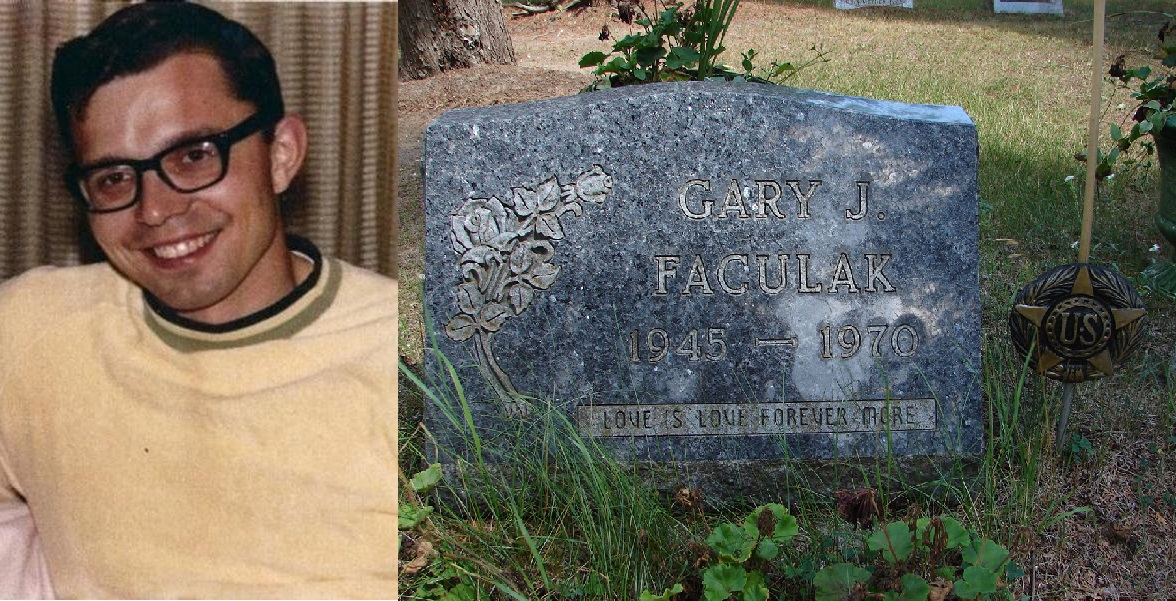
Unsurprisingly, Bill researched the soldier (Gary J. Faculak) and contacted his family to learn more about the man; his hopes, aspirations and goals. Turns out the dead soldier was from Boyne City, Michigan and aspired to own a tour boat and lead tours on Lake Charlevoix (Michigan’s third largest lake) when he got out of the Army. Lt. Faculak is buried in Maple Lawn cemetery in Boyne City. Ironically, the cemetery made headlines in May of 2011 when two special Civil War veterans were honored not far from Lt. Faculak’s grave, thanks to the Robert Finch Camp No. 14 of the Sons of Union Veterans of the Civil War. Two Native American Indian sharpshooters (John Jacko and William Isaacs), buried a century ago in unmarked graves, finally received their long overdue headstones. Both soldiers were members of Co. K of the Michigan 1st Sharpshooters, the only all-Indian unit in the Union Army east of the Mississippi. Both men were also members of the G.A.R.

Faculak_Gary_DOB_1945
Lt. Gary J. Faculak.

What’s more, Bill learned that he was not the only one to narrowly escape death that day. Turns out another young officer (Van Buchanan) had switched shifts with Lt. Faculak that night. “If it hadn’t been for the Internet, I would never have been able to make the connection,” says Bill. Well, Mr. Frassanito, if it hadn’t been for your dogged detective work for a group of dusty, old, mislabeled, long-forgotten photographs, we would have never made the connection either. Well done, soldier, well done.

71085339_10215130158749297_177258965367783424_n
Alan E. Hunter delivering Bill Frassanito his Weekly View article.

70966264_10215138561159352_942130913515405312_o
Bill Frassanito & Alan E. Hunter at the Reliance Mine Saloon in Gettysburg. You may visit Bill there every Monday, Wednesday or Friday night from 10:15 pm into the wee hours.

Abe Lincoln, Creepy history, Gettysburg, Ghosts

Harry Houdini and Abraham Lincoln.

Houdini & Lincoln

Original publish date:  June 8, 2017

Magician Harry Houdini had a very unlikely boyhood hero. A hero adored by a generation before Houdini’s 1874 birth and a hero worshiped by generations hence. Harry Houdini’s hero was Abraham Lincoln. Houdini’s devotion to Lincoln could be found on stage during his shows. He traveled with a pet eagle named ‘Josephus Daniel Abraham Lincoln’ or ‘Abe Lincoln’ for short. Houdini’s eagle would materialize at the end of his Whirlwind of Colors routine culminating in a wild frenzy of scarves and other fabric pulled from a small container.
Houdini & birdIn Kenneth Silverman’s 1996 Biography “Houdini!!!: The Career of Ehrich Weiss : American Self-Liberator, Europe’s Eclipsing Sensation, World’s Handcuff King & Prison Breaker”, the author relays how Houdini referred to Lincoln as “my hero of heroes.” Houdini claimed to have read every book about Lincoln by the time he was a teenager. In William Kalush’s 2006 biography “The Secret Life of Houdini: The Making of America’s First Superhero”, there is a story of young Houdini attending a seance where the medium produced a message from our 16th President. Houdini, Lincoln expert that he was, then asked a question to Lincoln via the medium and was puzzled when the answer that came back was not correct. This encounter led to Houdini’s early discovery that most Spiritualists were fake.
amd_houdini_originalAs he grew older and more financially secure, Houdini began to amass a personal collection of Lincoln memorabilia, particularly letters and autographs of the Great Emancipator. He also collected handwritten letters of every member of the assassin John Wilkes Booths family, several in response to letters sent by Houdini himself. Spending much of his adult life on the road, in hotels and traveling for days on ships and trains, Houdini became a prolific man of letters. One such letter survives that illustrates his desire and devotion to add to his Lincoln collection, despite the constraints of his vagabond lifestyle.
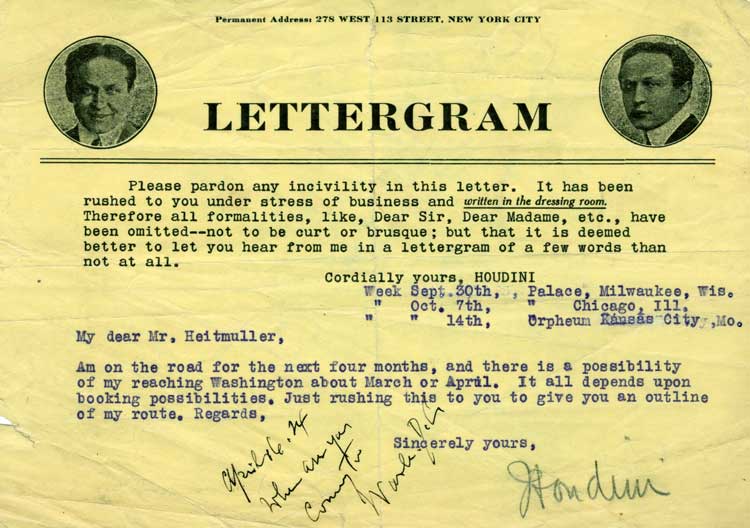
The letter is written on the magician’s personal “Lettergram” form that featured two portraits of Harry at the top. It was written in Milwaukee on September 20, 1923. Houdini’s pictorial Lettergram began with a printed message reading, “Please pardon any incivility in this letter. It has been rushed to you under stress of business and written in the dressing room. Therefore all formalities like Dear Sir, Dear Madame. etc. have been omitted, not to be curt or brusque; but that it is deemed better to let you hear from me in a lettergram of a few words than not at all.” The Lettergram was sent to Anton Heitmuller, a Washington businessman who billed himself as “Specializing in Selling Collections of Autographs, Manuscripts, Historical Broadsides and Curios”.

large_Houdini-telegram
Houdini lettergram to Anton Heitmuller.

Heitmuller was peddling artifacts related to John Wilkes Booth along with a collection of items of Dr. Samuel Mudd, who was imprisoned for treating Booth’s broken leg after the assassination. Heitmuller saw a promotional opportunity for both he and Houdini in showing these materials; Houdini showed some interest but being at the height of his career, found it hard to find time to get to Washington to see the artifacts. Houdini’s typed letter reads, “I am on the road for the next four months, and there is a possibility of my reaching Washington about March or April. It all depends upon booking possibilities. Just rushing this to you to give you an outline of my route.” The note was signed in pencil by Houdini. Whether or not the meeting, let alone a purchase, ever took place is unknown, but the lettergram illustrates Houdini’s desire to acquire Lincolnania and the lengths he would go to find it.
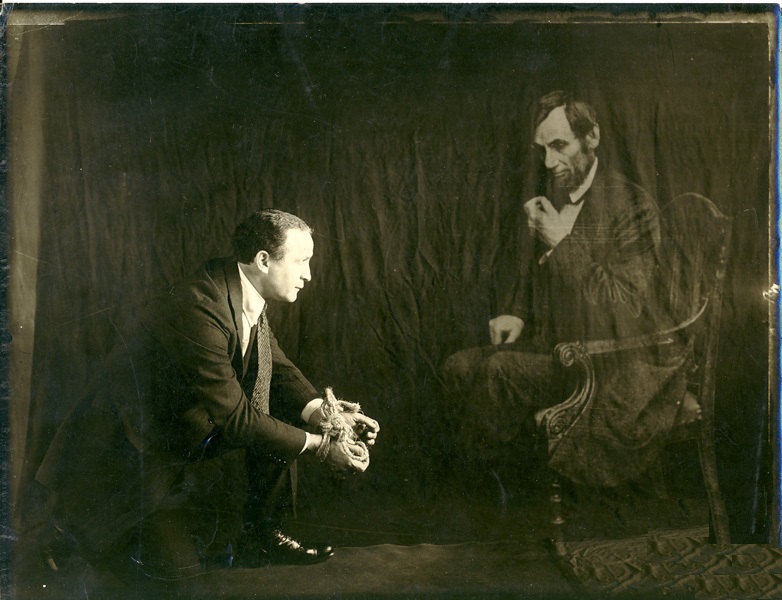
Houdini became a friendly acquaintance of Abraham Lincoln’s son Robert Todd Lincoln. In one instance, a spirit medium claimed to possess authentic spirit photographs of Abraham Lincoln. Houdini sent copies of the photos to Robert Todd Lincoln and debunked them by proving that the images were manipulated from known photos of his father taken while Mr. Lincoln was still very much alive. To further prove his point, Houdini produced photos of himself alongside Mr. Lincoln.
houdini-lincolnOn Feb. 13, 1924, a day after the 115th anniversary of Abraham Lincoln’s birth, Houdini typed out a letter to Mary Edwards Lincoln Brown, the grand-daughter of Ninian and Elizabeth Edwards, Mary Lincoln’s sister. The letter, written from the dressing room of the State Lake Theatre in Chicago, Illinois, reads: “My dear Mrs. Brown: Enclosed you will find a Spirit Photograph of your renowned ancestor, and although the Theomonistic Society in Washington, D.C. claim that it is a genuine spirit photograph, as I made this one, you have my word for it, that it is only a trick effect. Mrs. Houdini joins me in sending you kindest regards, Sincerely yours, Houdini.”
M2014.128.703.27_150415-P1Furthermore, Houdini also produced ‘fake spirit messages’ from Lincoln during his lectures to debunk spiritualism. Many spiritualists attempted to back up their fake photos and messages by claiming that Abraham Lincoln himself was a devoted spiritualist who had held seances in the White House. As proof, they cited a piece of British sheet music, published while Lincoln was President, which portrayed Honest Abe holding a candle while violins and tambourines flew about his head. The piece of music was called The Dark Séance Polka and the caption below the illustration of the president read “Abraham Lincoln and the Spiritualists”.
Actually it was Mary Lincoln who consulted a series of mediums in a desperate attempt to contact their dead son Willie, who died in the White House. Houdini naturally pointed out that President Lincoln was in attendance for only one such “call to the dead” and then solely to support his grieving wife. After the seance, Lincoln gently guided Mary over to a window that looked out over Washington and pointed to the lunatic asylum with a warning that if she didn’t stop this foolishness, she would end up there.

cookehoudinicrop
Houdini and Magician Harry Cooke.

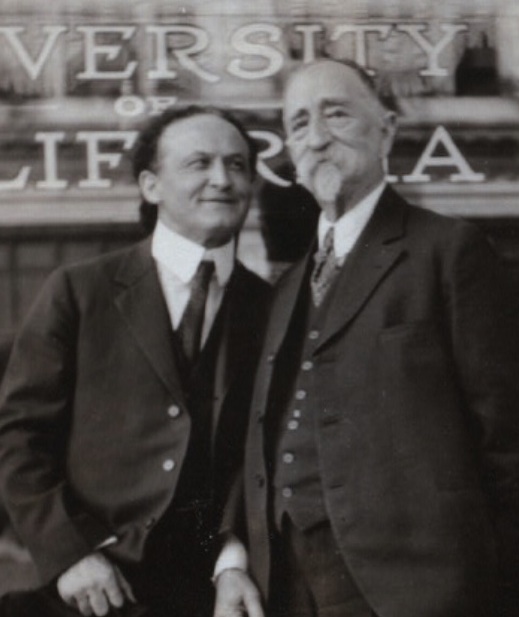
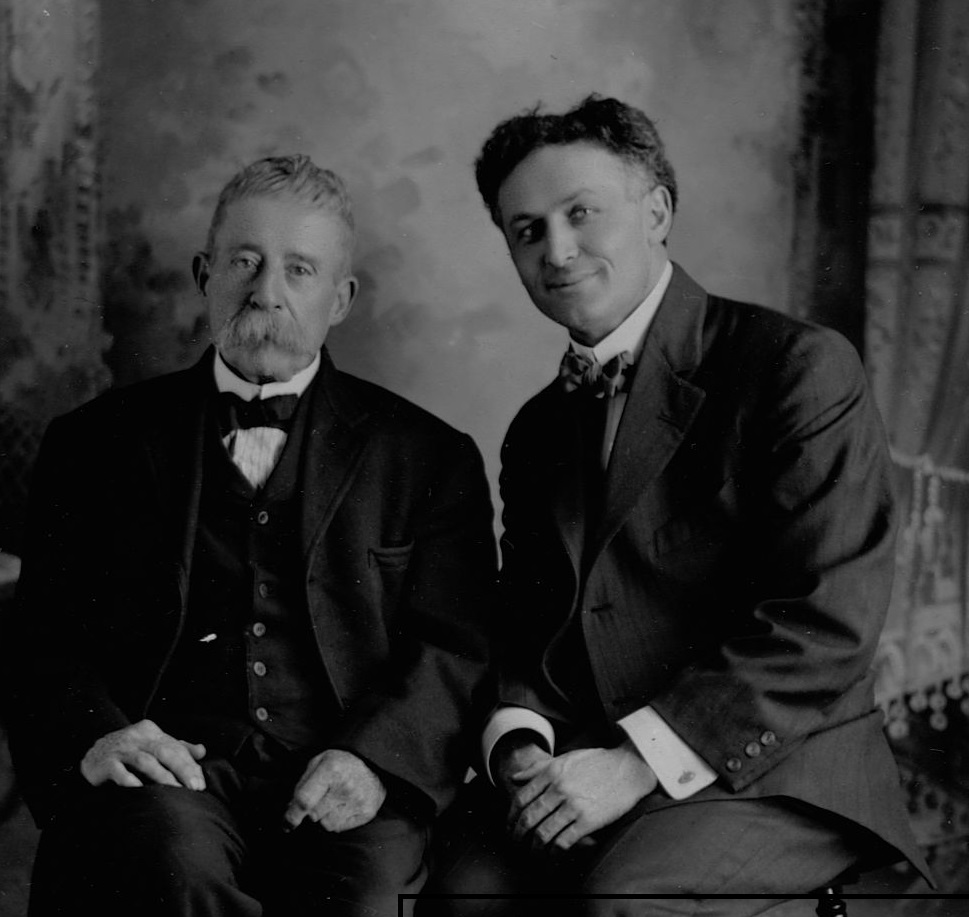
Clues to Houdini’s admiration of Abraham Lincoln can also be found in a couple of the magicians he associated with. One was a former Civil War veteran named Harry Cooke who first took up magic as a means to entertain his fellow soldiers in camp. Legend claims that Cooke once showed Lincoln an escape from a piece of rope and the president was so impressed he put him to work as a Spy for the Union Army. Cooke kept a two dollar bill given him by Mr. Lincoln on another occasion when he was performing before the president and his cabinet. Amazingly Cooke was also present in Ford’s Theatre the night Lincoln was assassinated. Harry Cooke and Harry Houdini knew each other well and Houdini considered the elder magician as an early mentor. Many historians credit Cooke as being the first escape artist in America. Houdini, of course, became America’s greatest escape artist.

gettyimages-640462245-2048x2048
Magician Signor Biltz and Harry Houdini.

One final connection between Houdini and Lincoln is magician Signor Blitz. During the Civil War, Blitz performed at hundreds of Union Army Hospitals. His act was made up of several parts, including magic, ventriloquism, plate spinning and the command of trained birds. Blitz was apparently one of the first performers to use a dummy during his ventriloquism thereby setting the stage for future generations. His favorite trick was the Bullet Catching act (snaring a gun fired bullet between his teeth). However, a number of close calls persuaded the magician to remove it from his show. The final straw was when an audience member took out a six shooter and yelled “if you can catch one, you can call all of them!”. Fortunately, Blitz was able to stop the man from shooting.

Mary,_Willie,_and_Tad_Lincoln,_c1860
Mary Lincoln with her sons Willie (left) and Tad (right).

Blitz once performed at a July 4th function where Lincoln and his son Tad were present. The incident took place near the Summer White House on the grounds of the Old Soldier’s Home in the Rock Creek section of DC, today it is known as Lincoln’s Cottage. Lincoln often used the cottage during the summer months to escape the brutal foggy bottom heat of the Executive Mansion. In early July of 1863, President Lincoln took a break from his duties to watch a rehearsal of the upcoming July 4th parade. Numerous people stood along the street watching the rehearsal, among them Signor Blitz.
The sly magician reached out and produced a bird from the hair of one of the girls in the parade. The rehearsal parade came to a sudden stop and now all eyes were on Blitz. Thinking fast on his feet, the magician quickly produced an egg from the mouth of a child standing nearby. Blitz had no idea that the child was none other than the President’s son, Tad Lincoln. Blitz was soon formally introduced to the President and one of the most remarkable impromptu conversations of the Civil War ensued. Lincoln surprised the magician by saying,”Why, of course, it’s Signor Blitz, one of the most famous men in America. How many children have you made happy, Signor Blitz?” The magician answered “Thousands and tens of thousands”. The President then dolefully replied, “While I fear that I have made thousands and tens of thousands unhappy. But it is for each of us to do his duty in this world and I am trying to do mine.”

GettyImages-3289809-a657de2e32f3403983ec0e2c18a30595
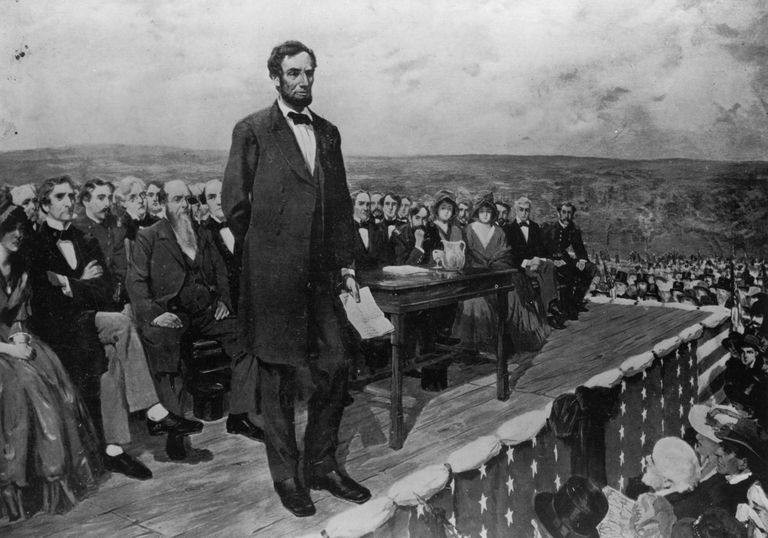
Abraham Lincoln at Gettysburg.

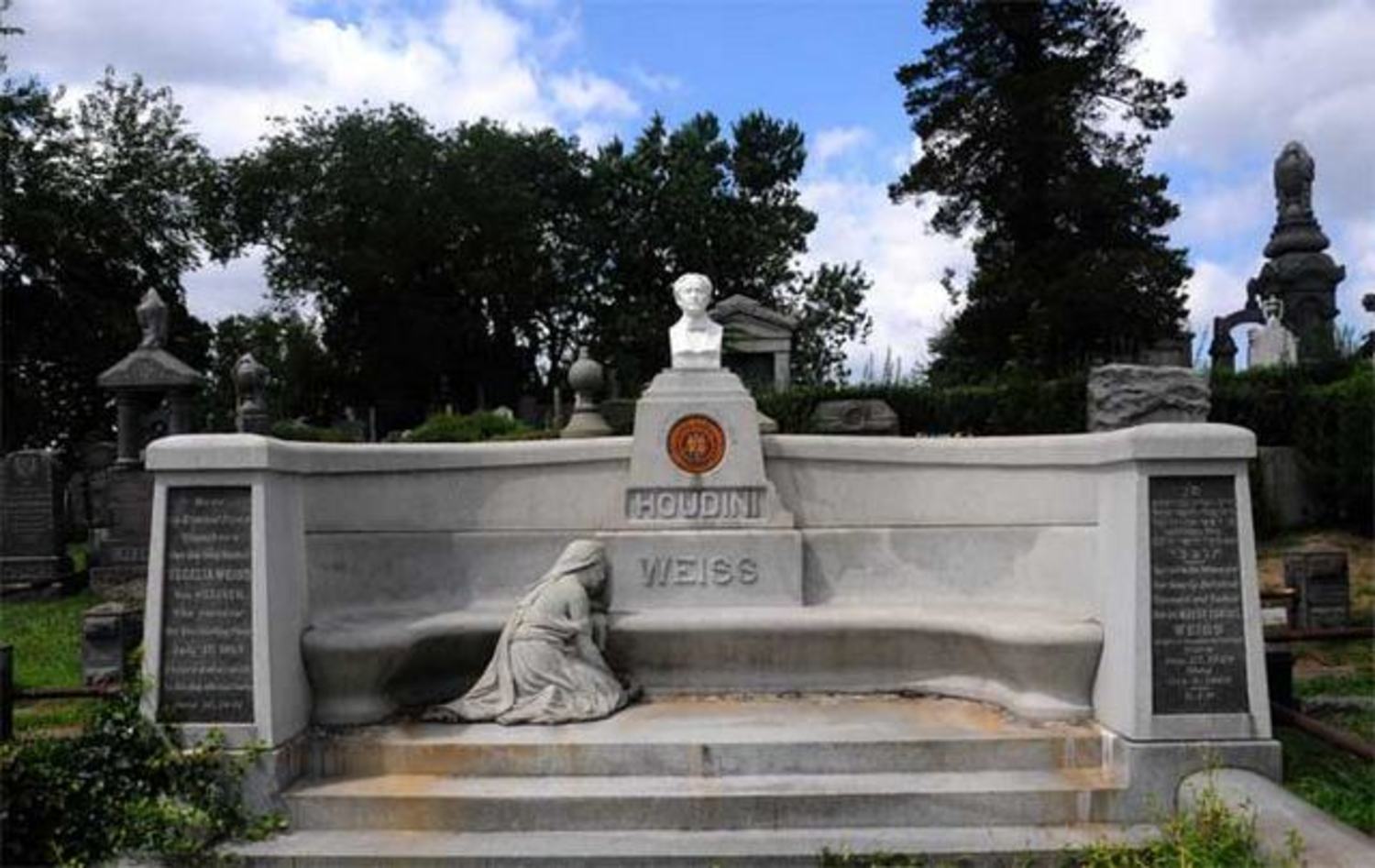
This exchange took place just as the Battle of Gettysburg was winding down. Lincoln had not yet heard news about the outcome of the battle. What neither knew was the Union victory at Gettysburg, combined with the siege conclusion at Vicksburg, had just turned the tide of the war for the Union. Of course, Houdini was keenly aware of the connection between Blitz and Lincoln. After Harry Houdini died on October 31, 1926 in Detroit, Michigan, he was buried in Machpelah Cemetery in New York City. About a hundred yards away is the grave of Signor Blitz.


8c18f758-f81d-47c7-baf6-79179cfca475_2x
Harry Houdini grave at Machpelah Cemetery in New York City.

33153031_123267268002
Signor Biltz grave at Machpelah Cemetery in New York City.