Abe Lincoln, Assassinations, candy, food, Museums, National Park Service, Politics, Pop Culture, Presidents

Osborn H. Oldroyd’s Greatest Fear.

Original Publish Date March 6, 2025.

https://weeklyview.net/2025/03/06/osborn-h-oldroyds-greatest-fear/
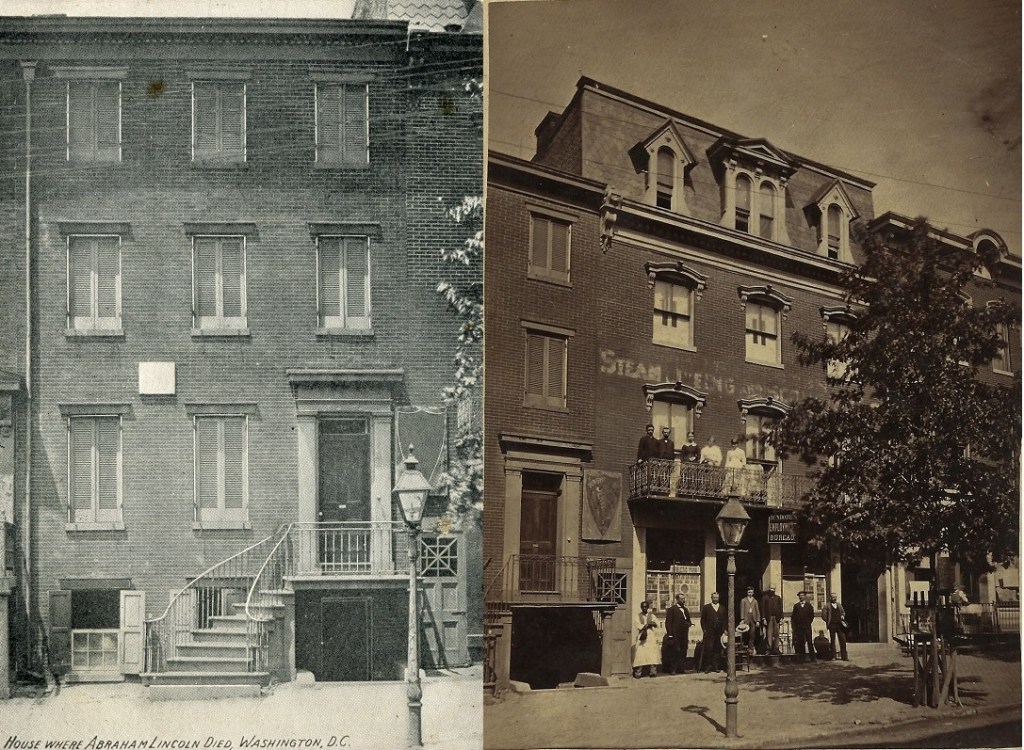
House Where Lincoln Died and the Logan Cafe next door in the 1880s.

My wife and I recently traveled to Springfield, Illinois for a book release event (actually two books). One book on Springfield’s greatest living Lincoln historian, Dr. Wayne C. “Doc” Temple, and the other on my muse for the past fifteen years, Osborn H. Oldroyd. I have fairly worn out my family, friends, and readers with the exploits of Oldroyd over the years. He has been the subject of two of my books and a bevy of my articles. Oldroyd was the first great Lincoln collector. He exhibited his collection in Lincoln’s Springfield home and then in the House Where Lincoln Died in Washington DC from 1883 to 1926. Oldroyd’s collection survives and forms much of the objects in Ford’s Theatre today.
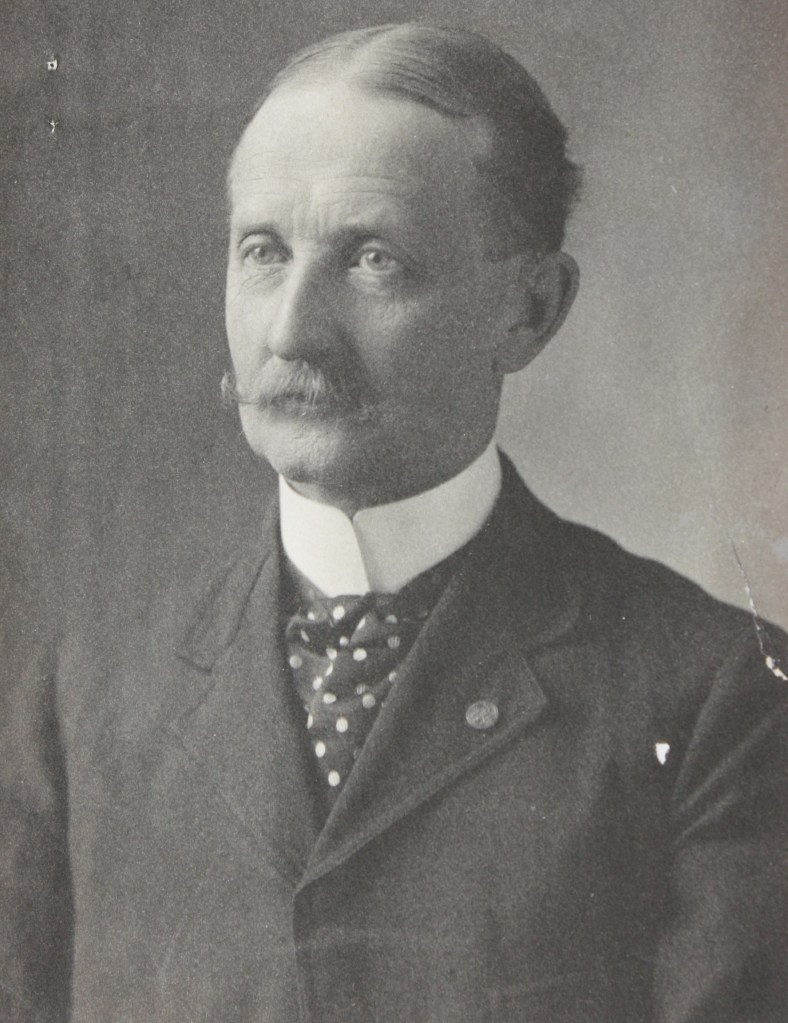
Osborn H. Oldroyd 1880s.

For this trip, we traveled up from the south to Springfield through parts of northwest Kentucky and southeast Missouri. What struck us most were the conditions of the small towns we drove through. Today many of these little burgs and boroughs are in sad shape, littered by once majestic brick buildings featuring the names of the merchants that built them above the doorways, eaves, and peaks of their frontispieces in a valiant last stand. Most had boarded-up windows and doors and some with ghost signs of products and services that disappeared generations ago.

They are tightly packed and many share common walls. We were amazed how many of them have caved-in or worse, burnt down. The caved-in buildings are the work of Father Time and Mother Nature, but the burnt ones look as if the fires were extinguished just recently. My wife deduces that these are likely the result of the many meth labs that blight these long-forgotten, empty buildings. Indeed, a little research reveals that these rural areas do lead the league in these hastily constructed, outlaw drug factories.
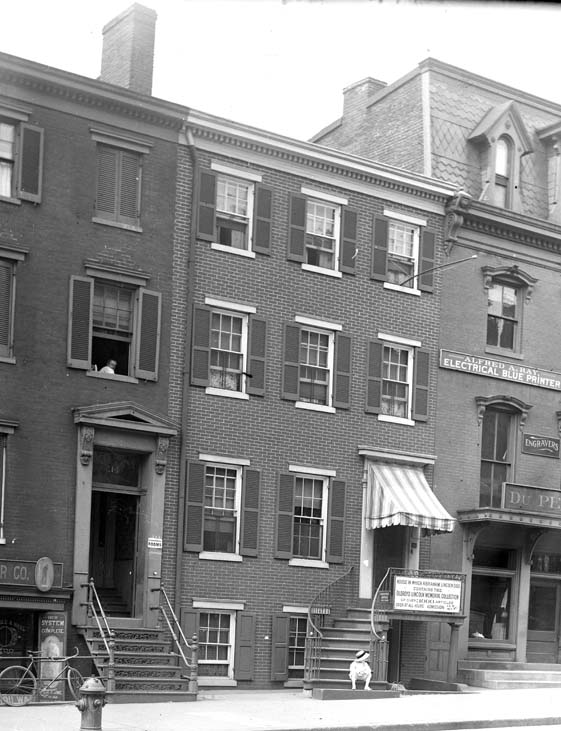
Oldroyd’s Museum before World War I.

Of course, that got me thinking about Oldroyd’s museum. Oldroyd lobbied for decades to have his collection purchased by the U.S. government and preserved for future generations to explore. The Feds eventually purchased it in 1926 for $50,000 (around $900,000 today). For over half a century while assembling his collection, Oldroyd had one great fear: Fire. Visiting the House Where Lincoln Died today, the building remains unique in size and architecture compared to those around it. In Oldroyd’s day, smoking cigars, pipes, and cigarettes indoors was as prevalent as carrying cell phones and water bottles are today. The threat of fire was very real for Oldroyd.
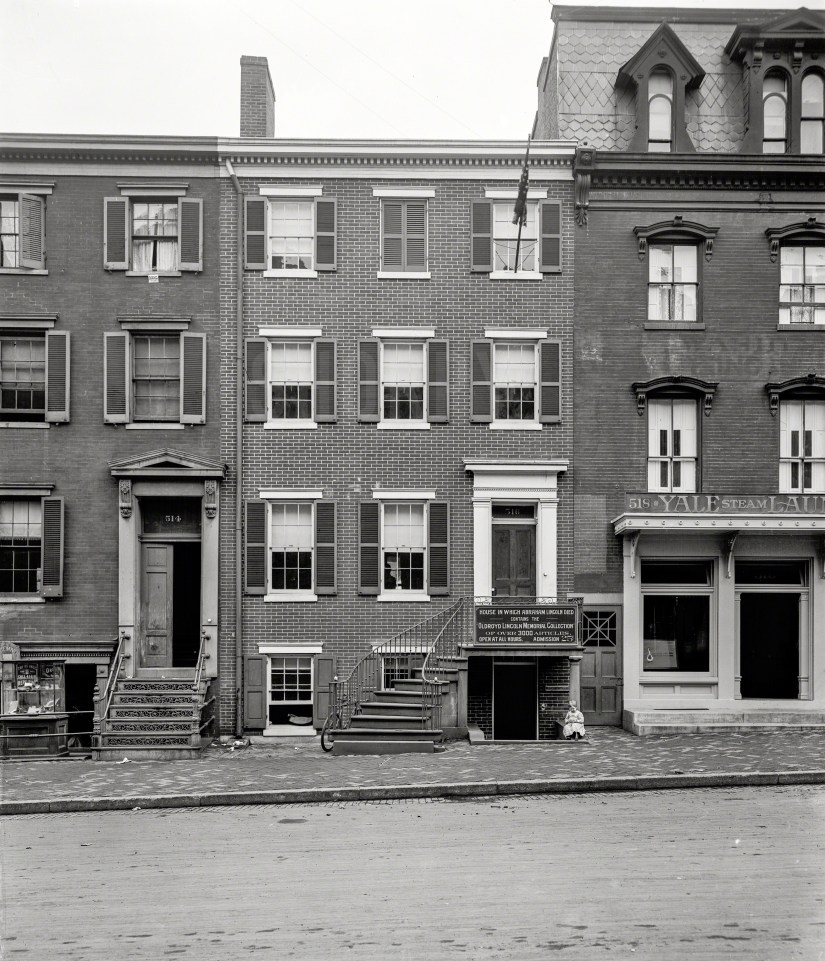
Cramped 10th Street with Oldroyd’s Museum in Center.

The March 20, 1903, Huntington Indiana Weekly Herald ran an article titled “A Visit to the Lincoln Museum in Washington City.” After describing the relics in the collection, columnist H.S. Butler states, “It is hoped the next Congress will purchase this collection and care for it. Mr. Oldroyd is not a man of means such as would enable him to do all he would like, and it seems to me a little short of criminal to expose such valuable relics, impossible to replace, to the great risk of fire. I understand Congressman [Charles] Landis, of Indiana, is trying to get the collection stored in the new Congressional Library, in itself the handsomest structure, interiorly, in Washington. I hope that his brother, the congressman from the Eleventh District [Frederick Landis], will lend his influence to Senators [Charles] Fairbanks and [Albert] Beveridge to urge forward the same end.”
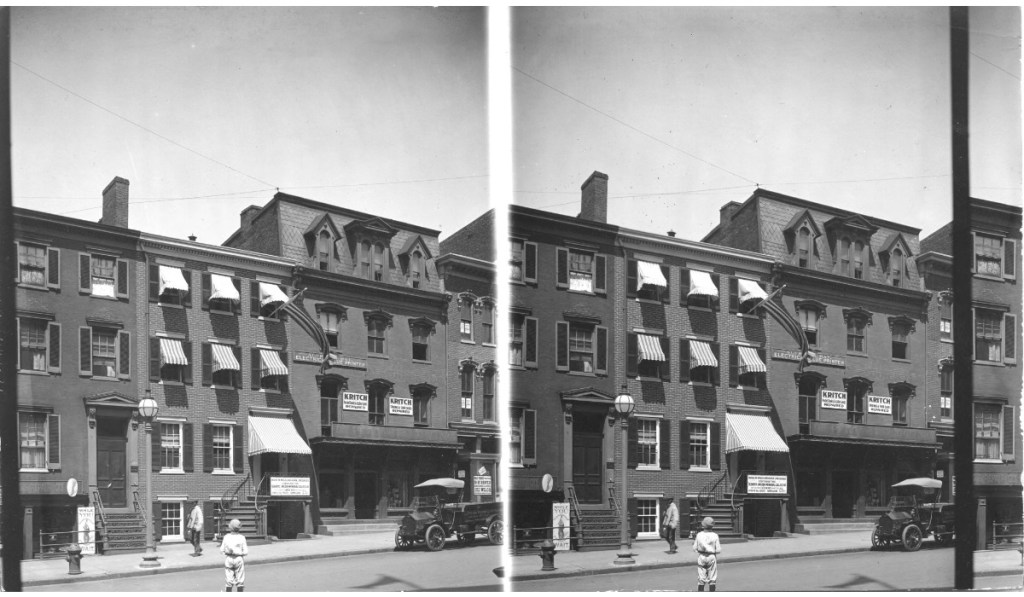
Stereoview of the HWLD with Kritch sign in place next door.

Fifteen years later, the Topeka State Journal described an event that fueled Oldroyd’s concern. “May 21 [1918]-a few days ago the Negro cook in the kitchen of a dairy lunch spilled some fat on the fire and the resulting blaze was extinguished with some difficulty. The unique feature of this trifling accident was that, had the blaze gotten beyond control, it would probably have destroyed a neighboring house in which is the greatest collection in the world of relics, manuscripts, and books bearing upon the life and death of Abraham Lincoln…Sixty feet away from the room in which Lincoln died are three kitchens of restaurants and a hotel. More than one recent fire scare has caused alarm over the danger that threatens these relics.”
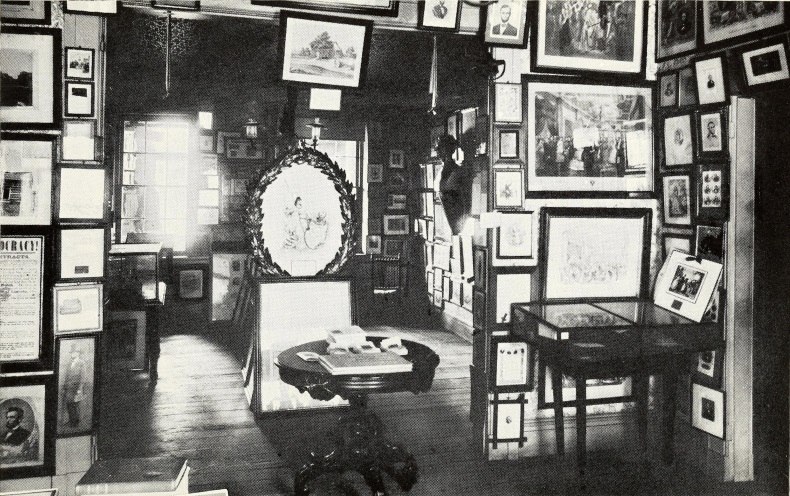
Interior of Oldroyd’s crowded museum.

The February 11, 1922, Dearborn [Michigan] Independent reported, “A vagrant spark, a carelessly tossed cigarette or cigar stub, an exposed electric wire might at any time mean the destruction of the collection and the building which, of course, is itself a sacred bit of Lincolniana.” The January 21, 1924, Daily Advocate of Belleville, Ill. reported “The collection is contained in a small and overcrowded room of the house opposite Ford’s Theatre, with two restaurants across a narrow alleyway constituting a constant fire menace…it is likely that the U.S. Government will request that the Illinois Historical Society return the bed in which Lincoln died, that it may again be placed in the room it occupied on that fateful night and the entire setting restored.” Due to that unresolved fire threat the bed was never returned and is today on display at the Chicago History Museum. A 1924 Christmas day article in the Washington Standard 1924 described, “There are a number of restaurants in the block at the rear, and once an oil supply house did business close at hand. On two occasions there have been fires in the neighborhood.”
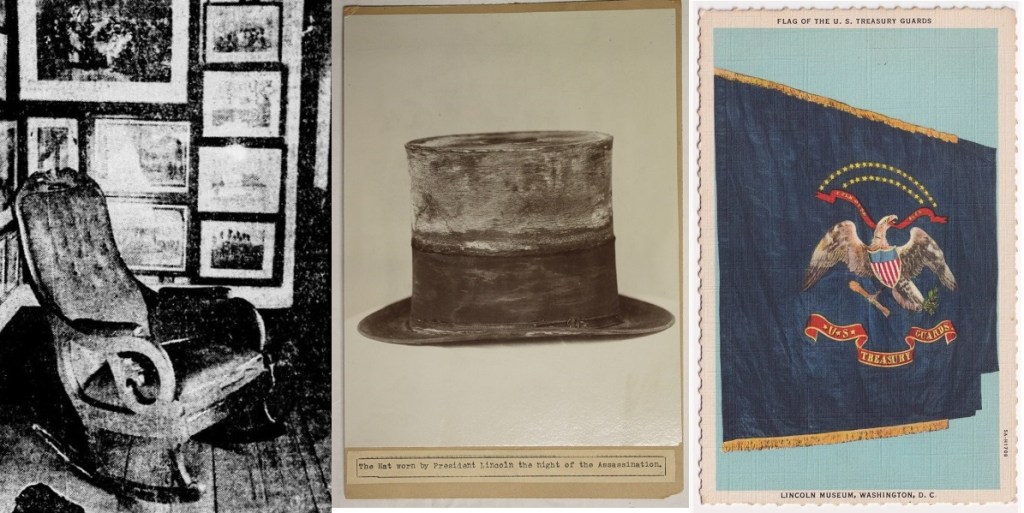
The Lincoln Rocker, Top Hat, & Treasury Guard Flag from Oldroyd’s Museum.

The July 6, 1926, Indianapolis News speculated, “The government will add to the collection the high silk hat Lincoln wore to the theatre that fatal night, the chair in which he sat in the presidential box, and the flag in which Booth’s foot caught. The flag now hangs in the treasury, while the hat and chair are in storage. These articles formerly were in the Oldroyd collection, but after a fire in the neighborhood some years ago, officials of the government took them back, fearing that they might be destroyed.” The February 18, 1927, Greenfield [Indiana] Reporter stated, “The plan proposed by Senator Watson, of Indiana, and Rep. Rathbone of Illinois, is to remodel the building to protect it against the danger of fire and the ravages of age. They would…place in it the famous Oldroyd collection of Lincoln relics.” Fire remained a nightmare for Oldroyd right up to the day he died on October 8, 1930.
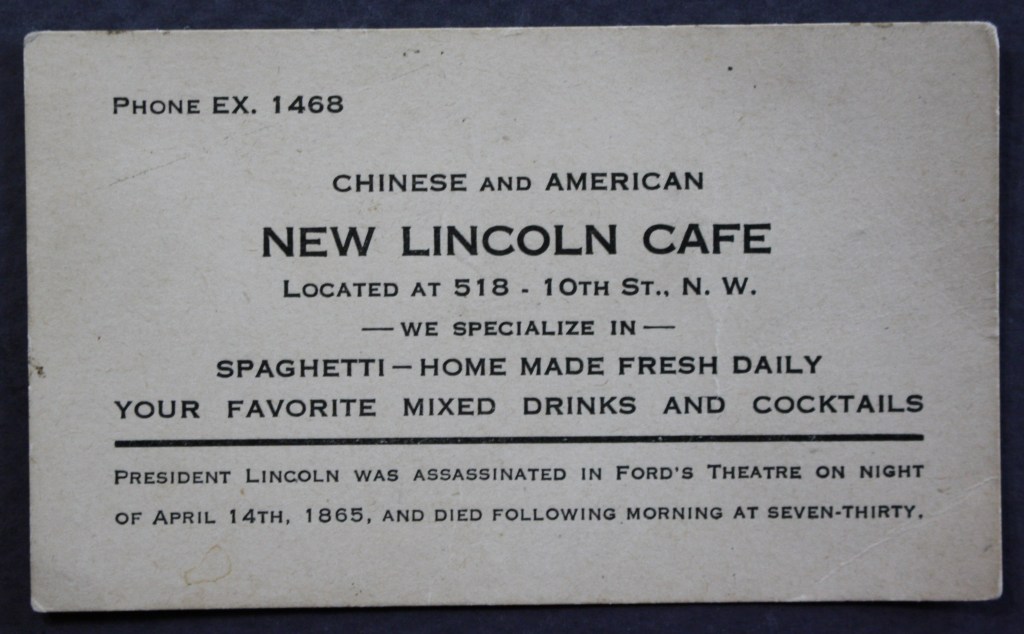
Ironically, after that book signing I found myself browsing the bookstore. I found there a 2 1/2” x 4” business card from the New Lincoln Cafe in the adjoining building to the north of Oldroyd’s Museum (at 516 10th St. NW). Putting aside the fact that I have a personal affinity for old business cards, the item called out to me and made me wonder about the businesses that had been neighbors to this hallowed spot over the generations.
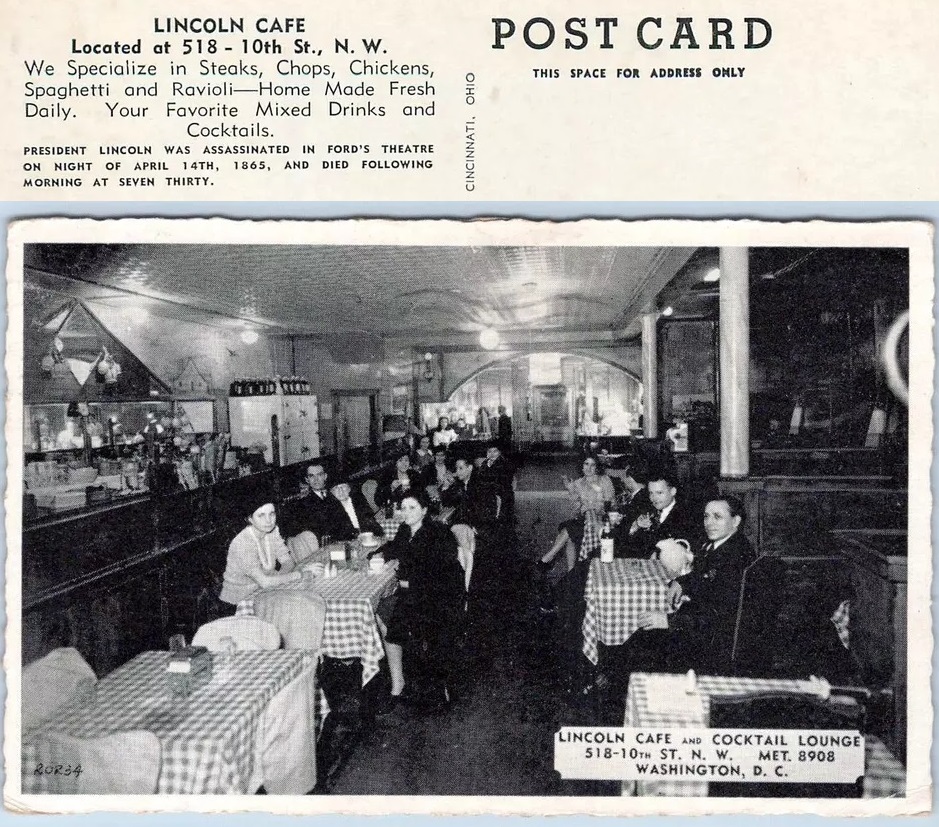
Postcard with an interior view of the Lincoln Cafe.

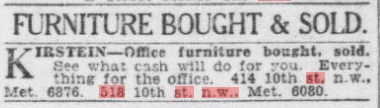
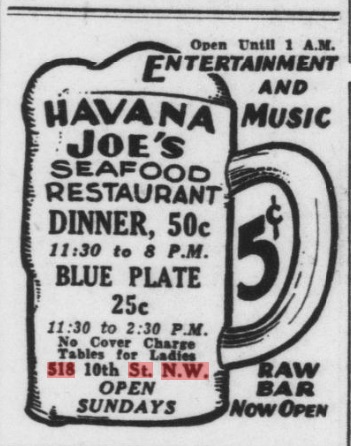
The card reads: “Chinese and American New Lincoln Cafe. Located at 518 10th St., N.W. Phone EX. 1468. We Specialize In Spaghetti-Home Made Fresh Daily. Your Favorite Mixed Drinks And Cocktails. President Lincoln Was Assassinated In Ford’s Theatre On Night Of April 14th, 1865, And Died Following Morning At Seven-Thirty.” A check of the records indicates that this restaurant remained next to the museum from the late 1930s to the early 1960s. This was just one of the businesses to call that space home over the generations.
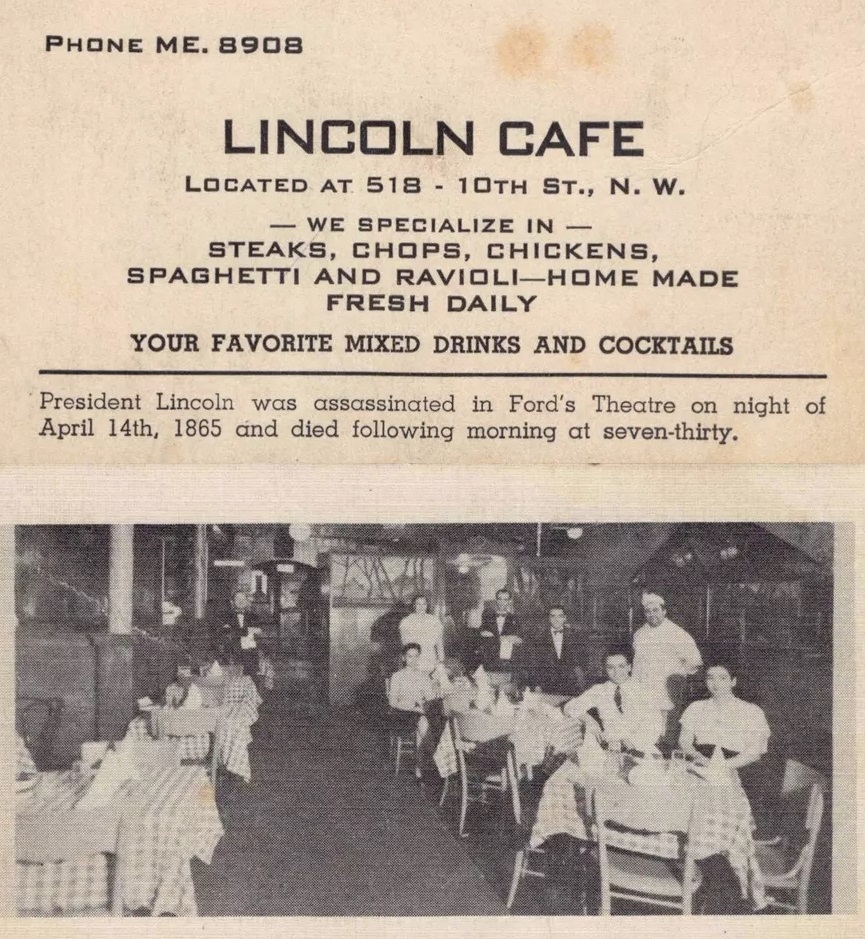
Another view of the interior of the Lincoln Cafe.

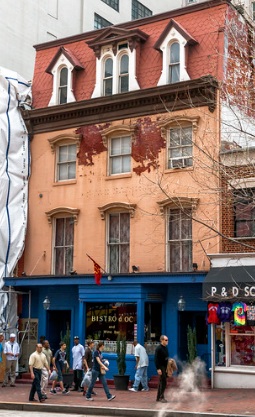
Located in the Penn Quarter section of DC, the building was built sometime between 1865 to 1873. It envelopes the entire north side and part of the northwest back of the HWLD. It is 4 stories tall and features 11,904 square feet of retail space. One of the earliest storefronts to appear there was Dundore’s Employment Bureau which served D.C. during the 1870-90s. Ironically, when Dundore’s moved three blocks south to 717 M Street NW, the agency regularly advertised jobs at businesses occupying their old address for generations to come. Above the Dundore agency was Mrs. A. Whiting’s Millinery, which created specialty hats for women. The Washington Evening Star touted Mrs. Whiting’s “Millinery Steam Dyeing and Scouring” business for their “Imported Hats and Bonnets”. A 3rd-floor hand-painted sign on the bricks of the building advertising Whiting’s remained for years after the business vacated the premises, creating a “ghost sign” visible for many years as it slowly faded from view.
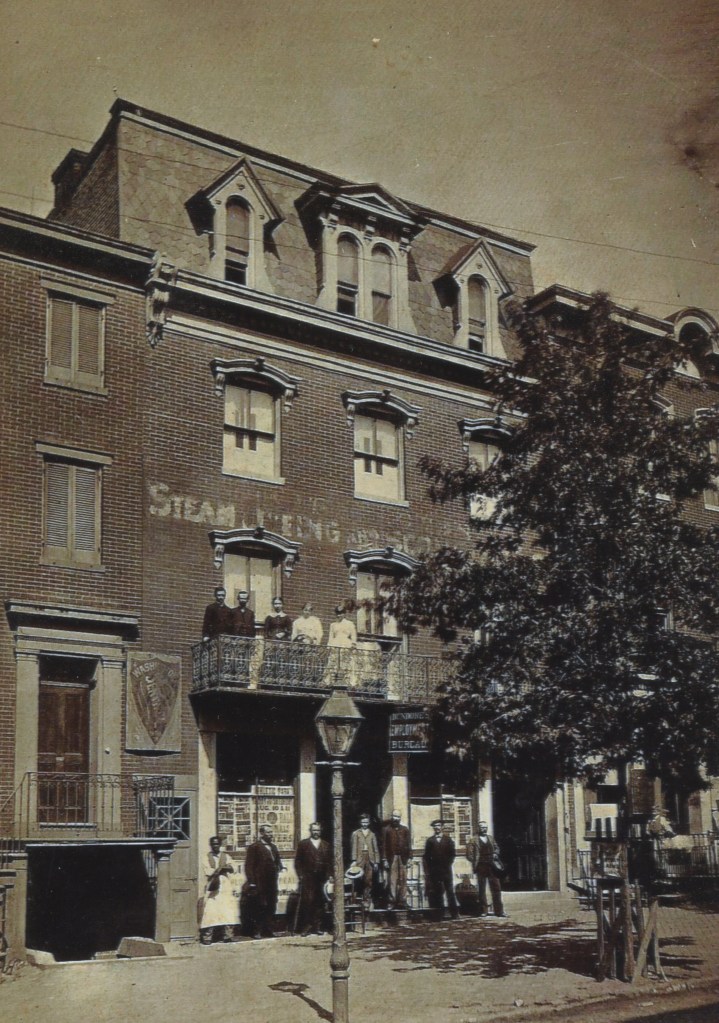
Photo of 516 W. 10th St. with Whiting’s ghost sign visible and Dundore’s Employment signs in windows.

The Forsyth Cafe seems to have been the first bistro to pop up next to the Oldroyd Museum. In late February/March 1885 (in the leadup to Grover Cleveland’s first Presidential Inauguration), DC’s Critic and Record newspaper’s ad for the cafe decries, “Yes, One Dollar is cheap for the Inauguration supper, but what about those excellent meals at the Forsythe Cafe for 15 Cents?” The Forsyth continued to advertise their meals from 15 to 50 cents but by late 1886, they were gone, replaced by the Logan Cafe. The Logan offered 15 and 25-cent breakfasts, “Big” 10-cent lunches, and elaborate 4-course dinners of Roast beef, stuffed veal, lamb stew, & oysters. Proprietor W.E. Logan’s claim to fame was “the best coffee to be had in the city, made in French-drip Glass-Lined Urn” and “Special Dining Rooms for Ladies-Polite waiters in attendance” and his menus warned “No Liquors” served.
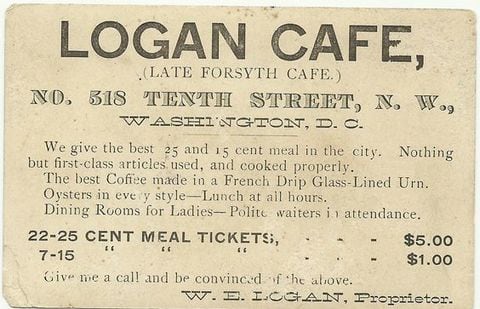
Business card from the Logan Cafe (Late Forsyth Cafe).

The June 4, 1887, Critic and Record reported on a “friendly scuffle” at the Logan between two “colored” employees when cook Charles Sail tripped waiter William Butler who hit his head on the edge of a table and died the next morning at Freedman’s Hospital. The men were described as best friends and the death was deemed an accident. By late 1887, the Logan disappears from the newspapers. From 1897 to 1897, the building was home to the Yale Laundry. The Jan. 7, 1897, DC Times Herald reported on an event that likely added to Oldroyd’s anxiety. The article, titled “Laundry is Looted” details a break-in next door to the museum during which a couple of safecrackers got away with $85 cash including an 1883 $5 gold piece.
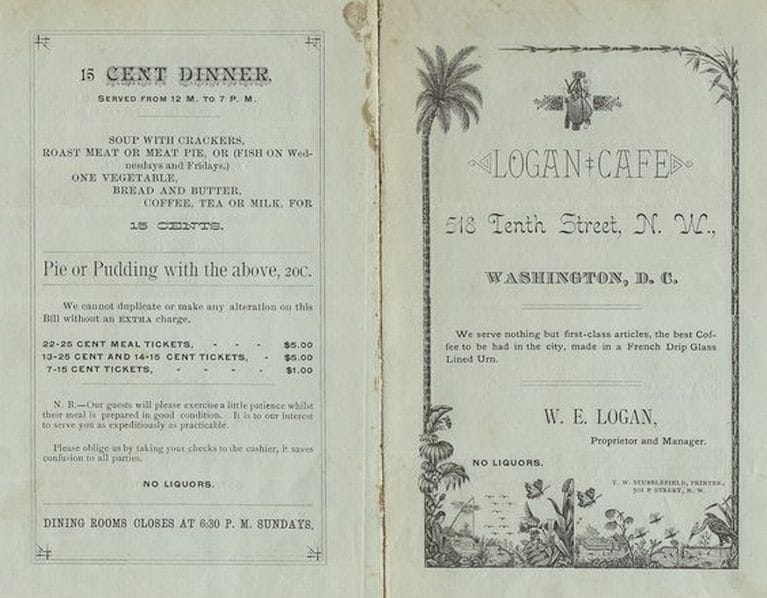
Logan Cafe Menu.

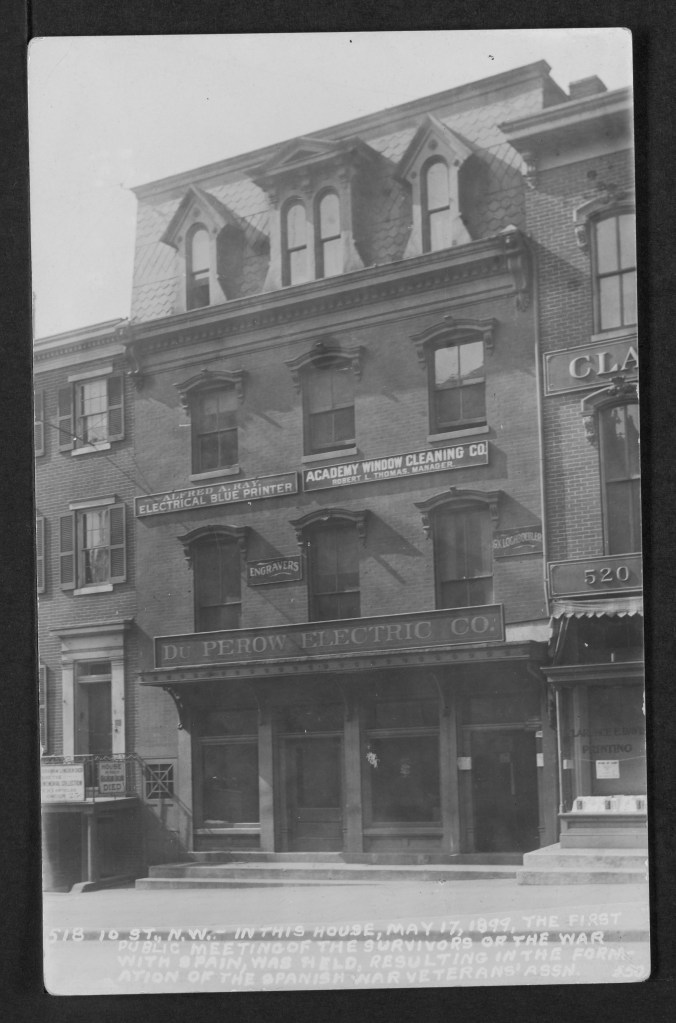
A real photo postcard in the collection of the District of Columbia Public Library pictures the building during Yale Laundry’s tenure captioned, “In this house the first public meeting of the survivors of the war with Spain, was held on May 17, 1899, resulting in the formation of the Spanish War Veterans’ Association.” The Dec. 1, 1900, Washington Star notes the addition of Harry Clemons Miller’s “Teacher of Piano” Studio and by 1903, the “Yale Steam Laundry” appeared in the DC newspapers at the address.
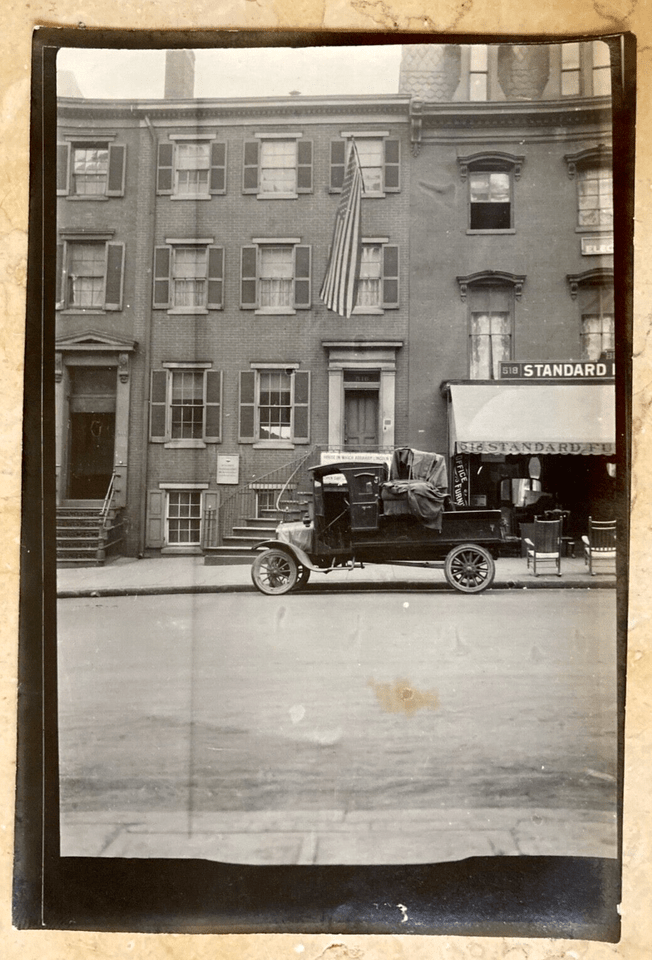
Furniture Truck Blocking Front of Oldroyd’s Museum.

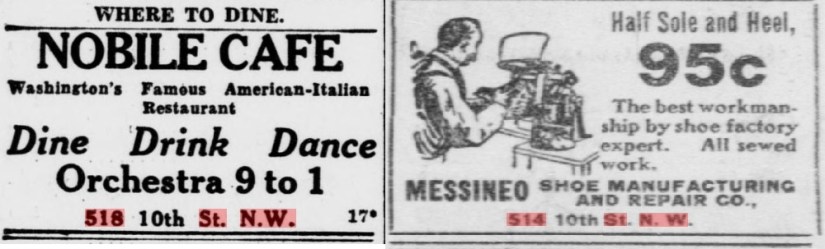
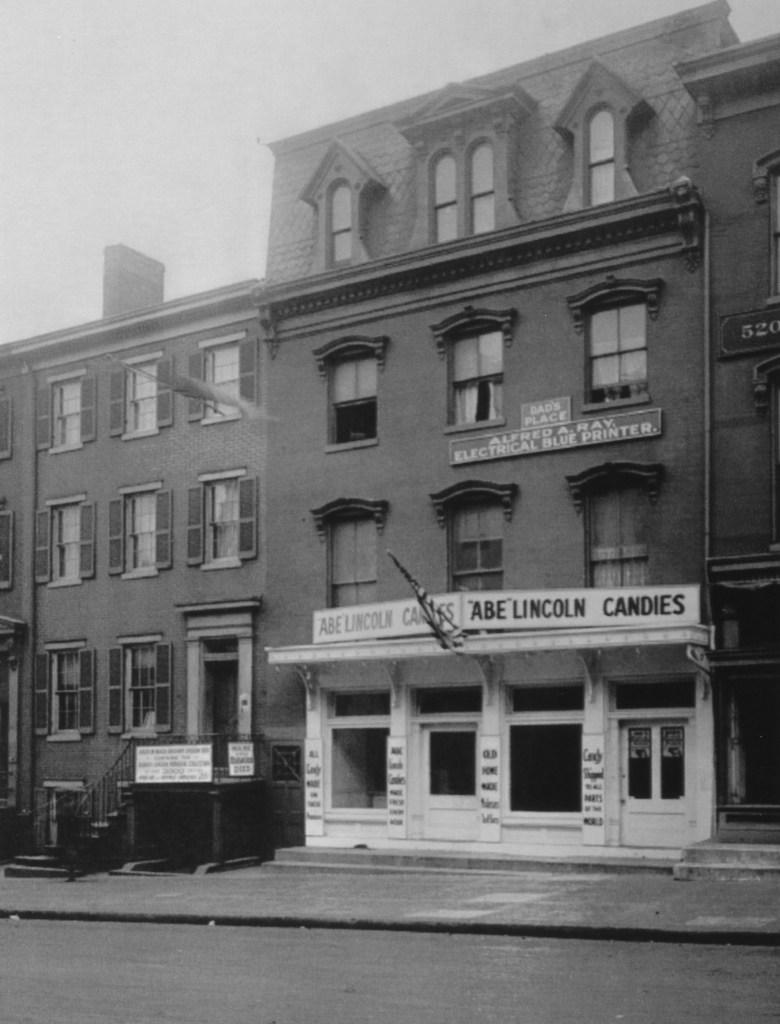
In 1909, Du Perow Electric Co. (AKA as “Du Pe”) and partner Alfred A. Ray “Electrical Blueprints” occupied the building. A window cleaning company occupied room # 9 and a leather goods store was located there during this same period. By 1912, the storefront was occupied by the Standard Furniture Co. At least one photo survives presenting an amusing scene of a furniture truck blocking the entrance to Oldroyd’s museum. Amusing to the viewer today but most assuredly not to the museum curator back in the day. Eventually, the restaurants, bars, and cafes that worried Oldroyd began to come and go, among them, the Lincoln Cafe & Cocktail Lounge, whose sign was dominated by the words “Beer Wine.” It appears that during the 1920-50s, a Pontiac, DeSoto, Plymouth Motor Car dealer known as “News & Company” kept an office in the building, with the car lot and gas station across the street.
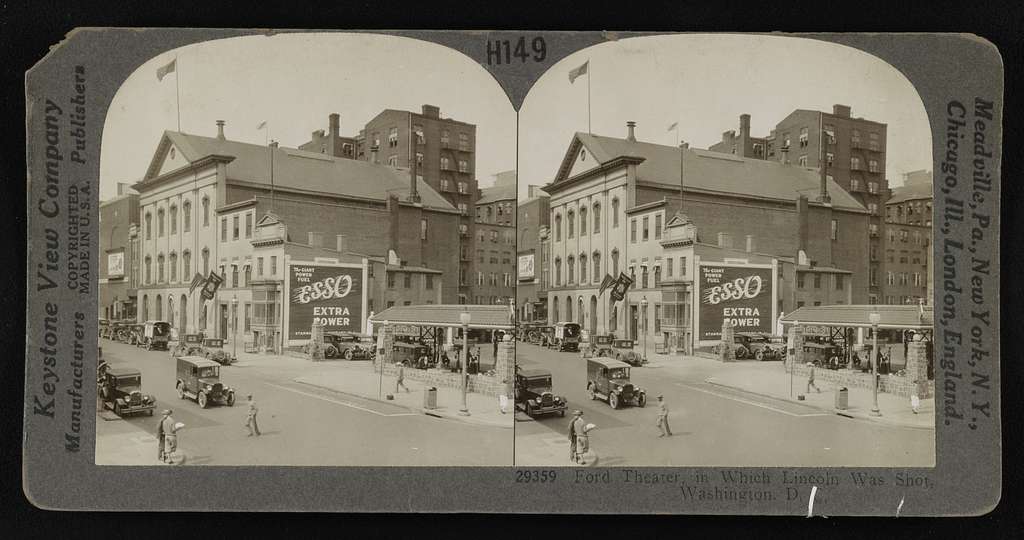
Esso Gas Station Next to Ford’s Theatre and across from the House Where Lincoln Died.
The Abe Lincoln Candy Store Nextdoor to the HWLD.

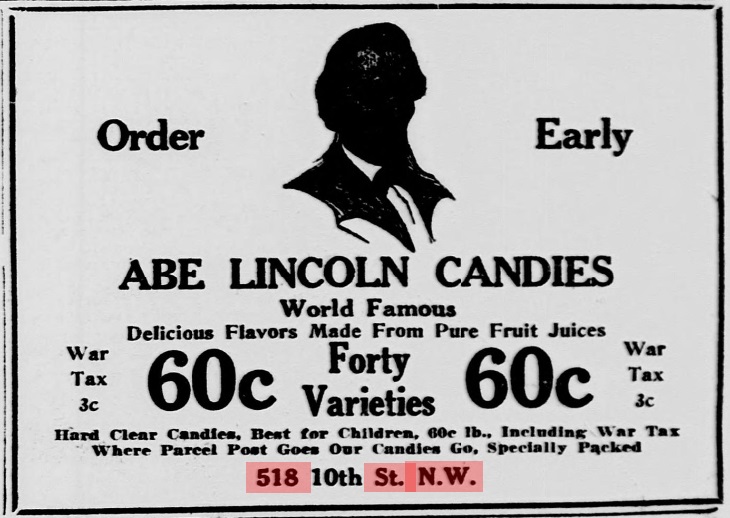
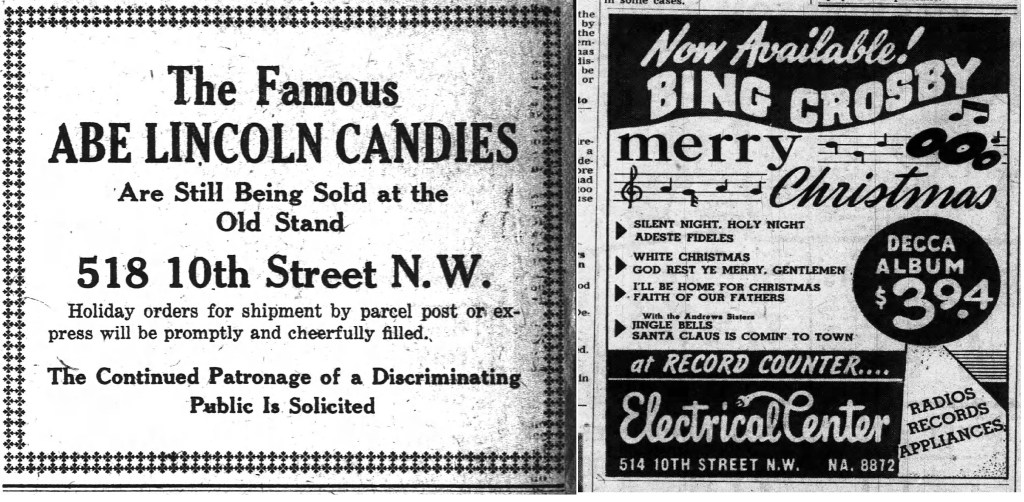
Old-timers remember a long-term tenant known as “Abe Lincoln Candies” that occupied the space from the 1950-70s. Other recent tenants included Abe’s Cafe & Gift Shop, Bistro d’Oc and Wine Bar, Jemal’s 10th Street Bistro, Mike Baker’s 10th St Grill, and the I Love DC gift store, and last year, The Inauguration-Make America Great Again Store, who one Yelp reviewer complained was crowded with outdated, sketchy clothing and that “they make u give them a good review before they give u a refund kinda scummy.”
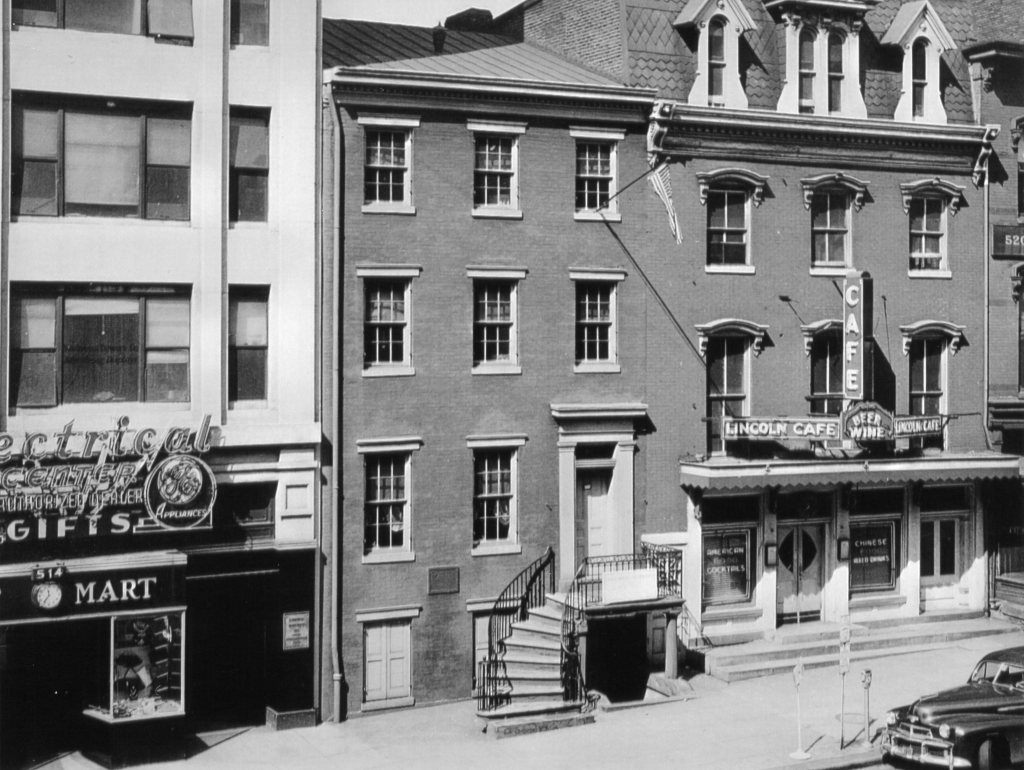
View of the new high-rise building at 514 Tenth St. NW.

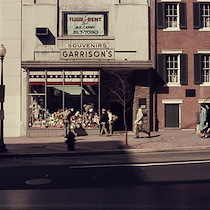
As for the building on the opposite side of Oldroyd’s museum at 514 Tenth St. NW, it remained a residence until 1922 when a $55,000, 10-story concrete & steel building with steam heat and a flat slag roof was built. Designed by architect Charles Gregg and built by Joseph Gant, the sky-scraper, known as the Lincoln Building, dwarfed the Oldroyd Museum. It was home to several businesses, including the Electrical Center (selling General Electric TVs, radios, and appliances) and the Garrison Toy & Novelty Co, its modern construction alleviated any concern of fire.
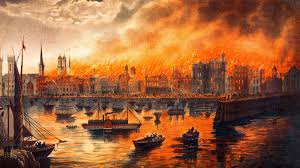
The Great Chicago Fire of 1871.

It must be noted that many great collections of Lincolniana fell victim to fire in the century and a half after Lincoln’s death. The Great Chicago Fire of 1871 consumed many Lincoln objects, documents, and personal furniture that had been removed from the Springfield home after the President’s departure to Washington DC. On June 15, 1906, Major William Harrison Lambert (1842-1912), recipient of the Congressional Medal of Honor and one of the Lincoln “Big Five” collectors, lost much of his collection in a fire at his West Johnson St. home in Germantown, Pa. Among the items lost were a bookcase, table, and chair from Lincoln’s Springfield law office and the chairs from Lincoln’s White House library. The threat of fire was a constant waking nightmare in Oldroyd’s life. While he did his best to control what went on inside his museum, he had no control over what happened outside. His life’s work of collecting precious Lincoln objects, over 3,500 at last count, could be gone in the flash of a pan.

ADDITIONAL IMAGES.
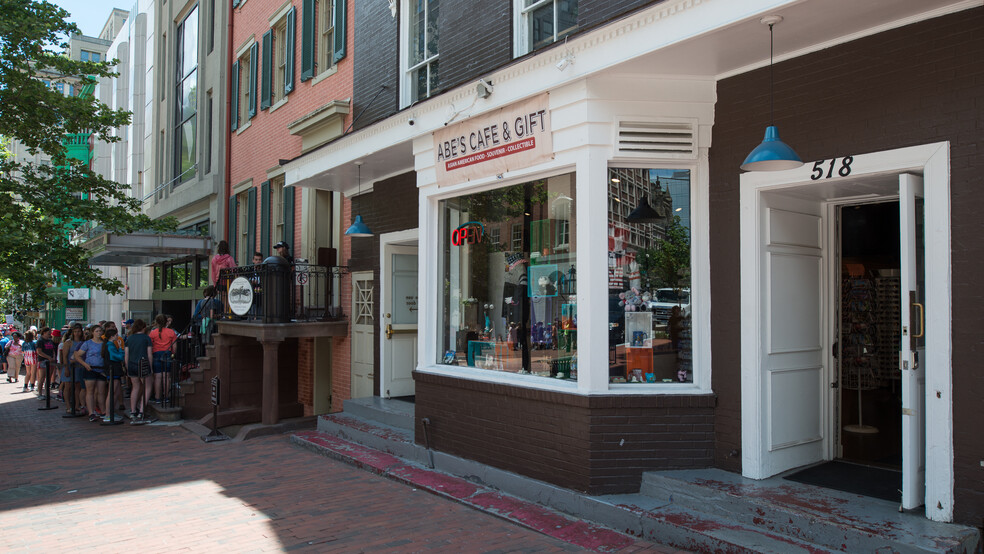
Abe’s Cafe & Gift Shop.
Bistro d’Oc and Wine Bar.
Garrison Toy & Novelty Company at 514 10th Street NW.

food, Politics

Elwood’s Airport Restaurant. The world’s only fly-in / drive-in.

Original publish date March 24, 2022. https://weeklyview.net/2022/03/24/elwoods-airport-restaurant-the-worlds-only-fly-in-drive-in/

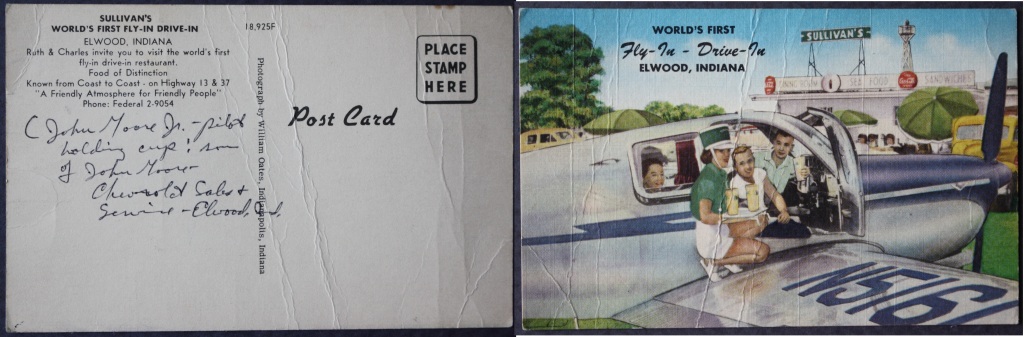
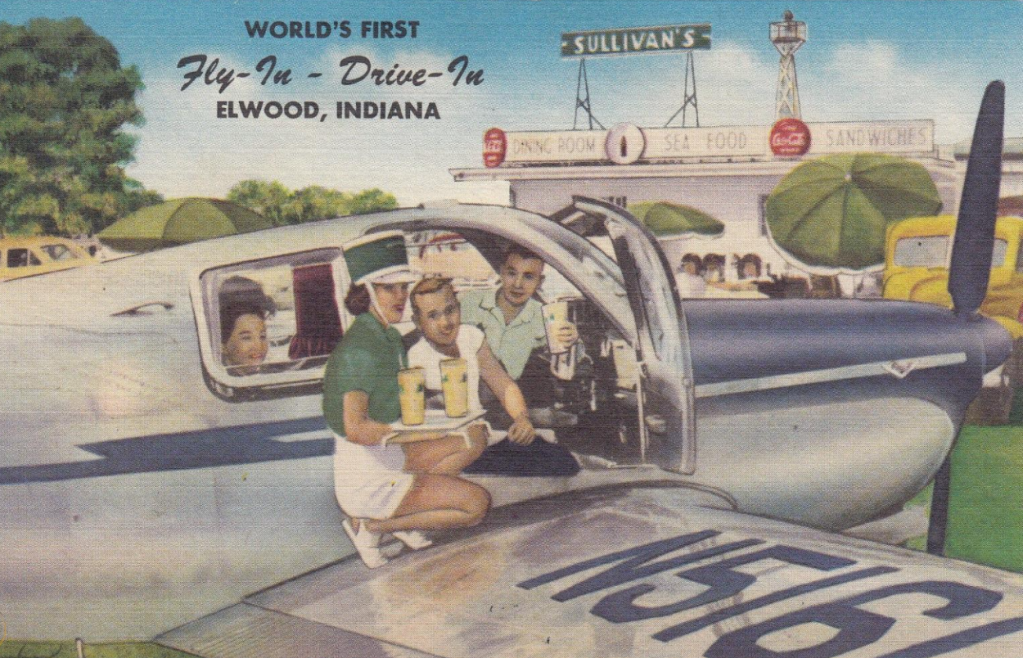
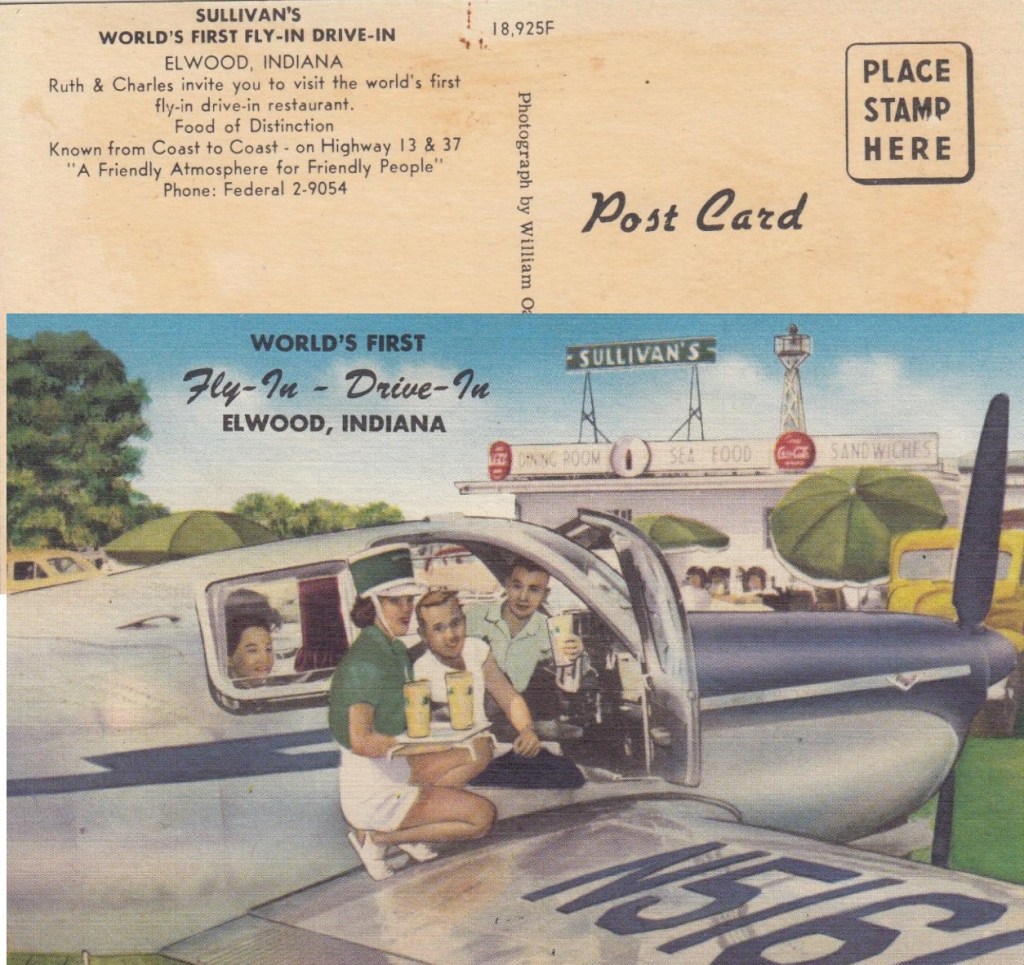
The author’s recent antique show find produced this postcard with the caption: “John Moore, Jr.-pilot holding cup, son of John Moore Chevrolet Sales + Service, Elwood, Ind.” written in vintage ink.

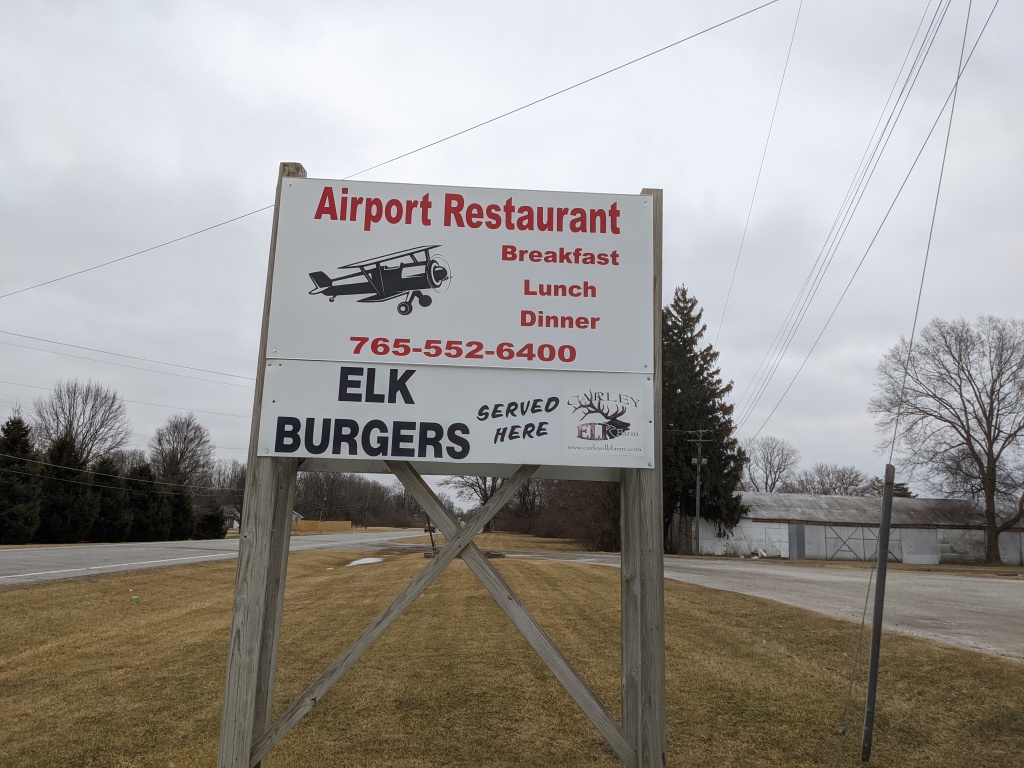
A couple of weeks ago, my wife Rhonda and I drove about 40 miles north of Irvington to Elwood to visit the world’s first (and only) fly-in drive-in restaurant. Resting just northeast of the intersection of Indiana 37 and 13, the Airport Restaurant is located at 10130 State Road 37 on what was once the Elwood Airport. The planes are long gone, and diners no longer rub elbows with pilots, but the Airport Restaurant is still the place where all the locals eat.

The airport was founded just after World War II by Elwood residents Don and Georgia Orbaugh. It featured two grass runways, measuring 2,243 feet and 2,076 feet. The sod landing strips accommodated single-engine planes and their specialty was known as the $100 hamburger. The restaurant did not charge $100 for burgers, but for pilots, that’s what they became. “By the time you get in your airplane, fill it up with gas, and fly a 100 miles, it’s a $100 hamburger,” the old pilot’s joke went. Don and Georgia Orbaugh owned and operated the airport for 56 years before it passed to daughters Ann Brewer and Donna Ewing.

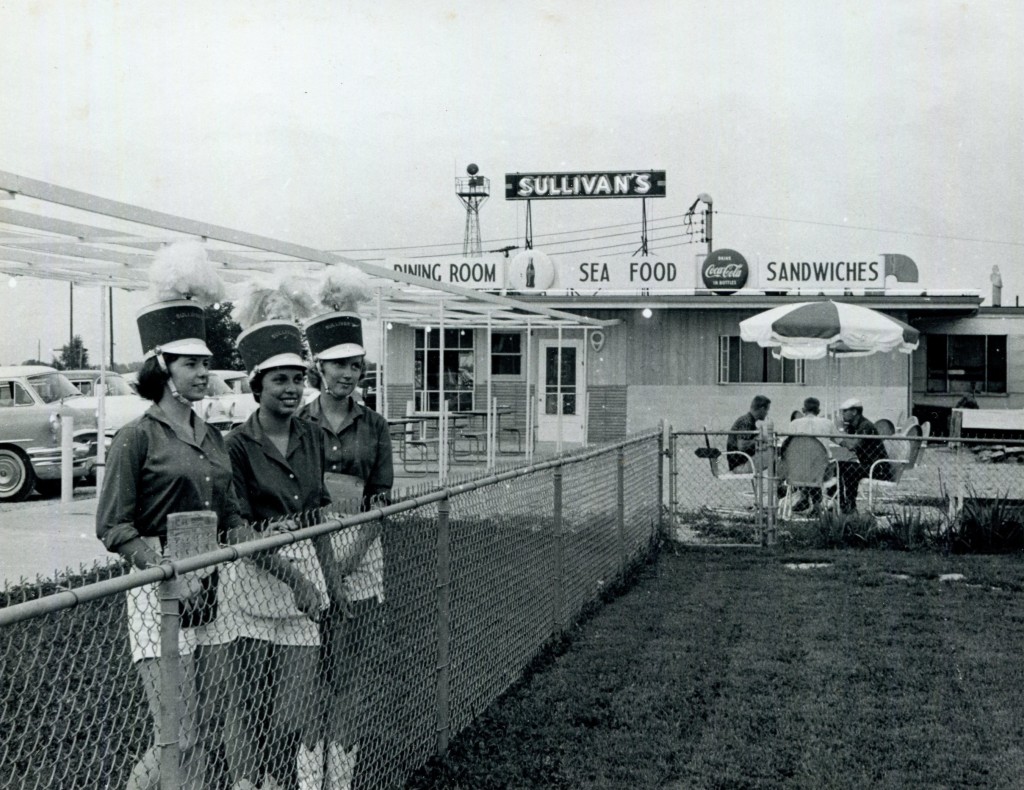
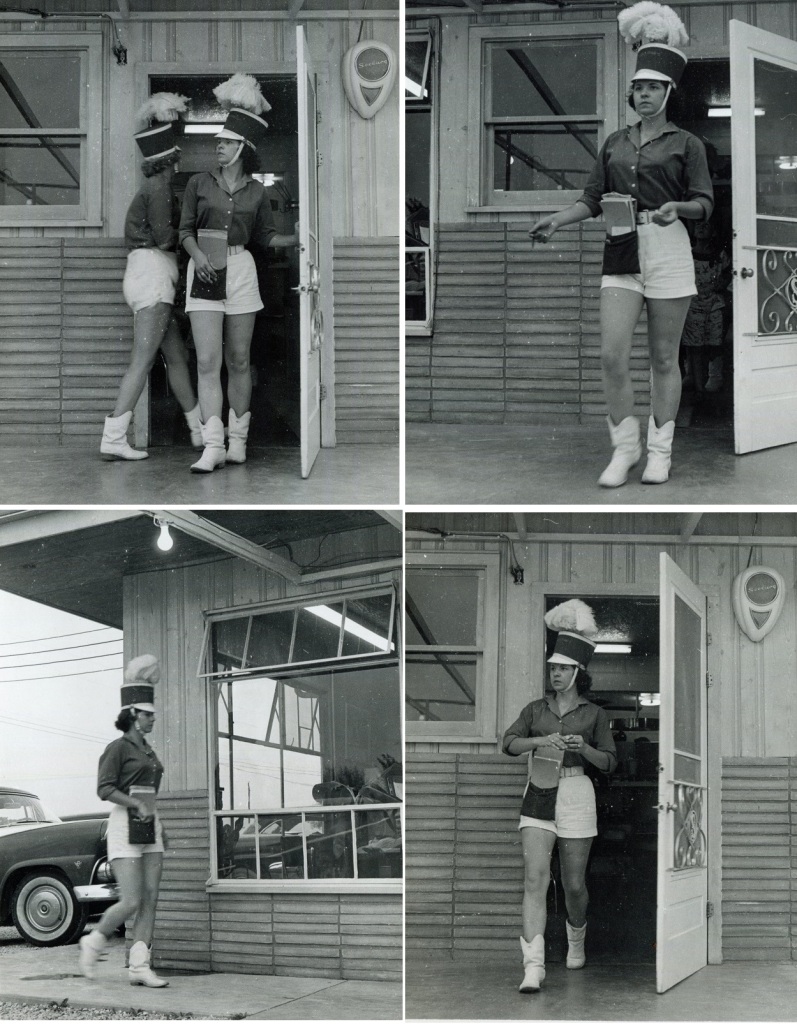
The uniformed carhops at Sullivans Airport Restaurant in Elwood, Indiana.

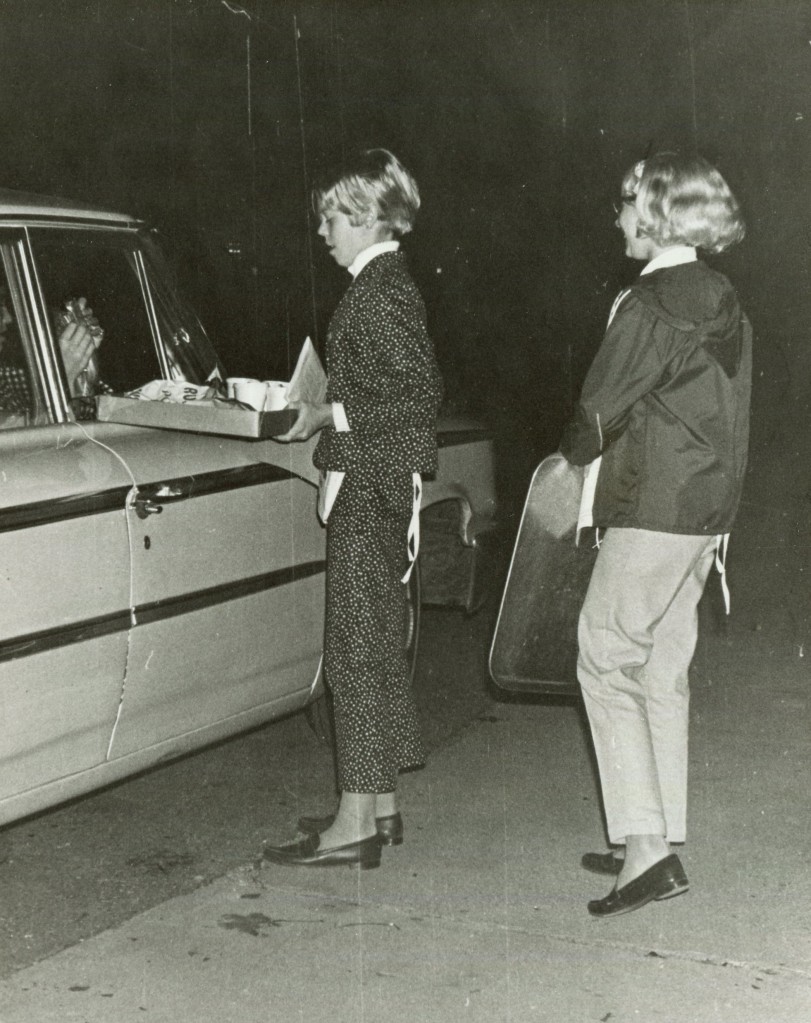
In 1952, “Sullivan’s Airport Restaurant” gained statewide attention when it opened an ice cream shack staffed by pretty young carhops. By 1953, a dining room was added to the shack, and young girls wearing tiny green uniforms with boxy marching band hats served curbside customers in their cars and pilots in their planes. Truth be told, the airport was really a “touch-and-go” facility where pilots practiced their landings and takeoffs. Most pilots only flew into the airport to visit the restaurant and ogle the carhops. By the end of the 50s, the novelty was over. There are a few photos (and at least one postcard) surviving of the Airport Restaurant during its heyday. The photos show the young waitresses in their carhop uniforms and the postcard pictures one of them standing on the wing of an airplane serving food to the pilots inside the cockpit.

Civilian employees serving customers in cars at Sullivan’s Airport Restaurant in Elwood, Indiana.
The carhops at Sullivan’s Airport Restaurant in Elwood, Indiana.

Al Swineforth, the current owner of the Airport Restaurant, has a long history in the restaurant business. “I moved to Elwood in 1970. I was a General Manager for Darden Foods in Anderson for 22 years when I retired,” he stated. For those who don’t know, Darden’s family of restaurants features some of the most recognizable and successful brands in full-service dining — Olive Garden, LongHorn Steakhouse, and Cheddar’s to name a few — serving more than 320 million guests annually in over 1,800 restaurants located across North America. Al smiled wryly, then said, “The day I retired, I was driving north on 13 when I stopped at 37 and saw the old Wheeler’s truck stop. I stayed retired for a total of four hours.”

The author with Holly Fettig and Al Swineforth.

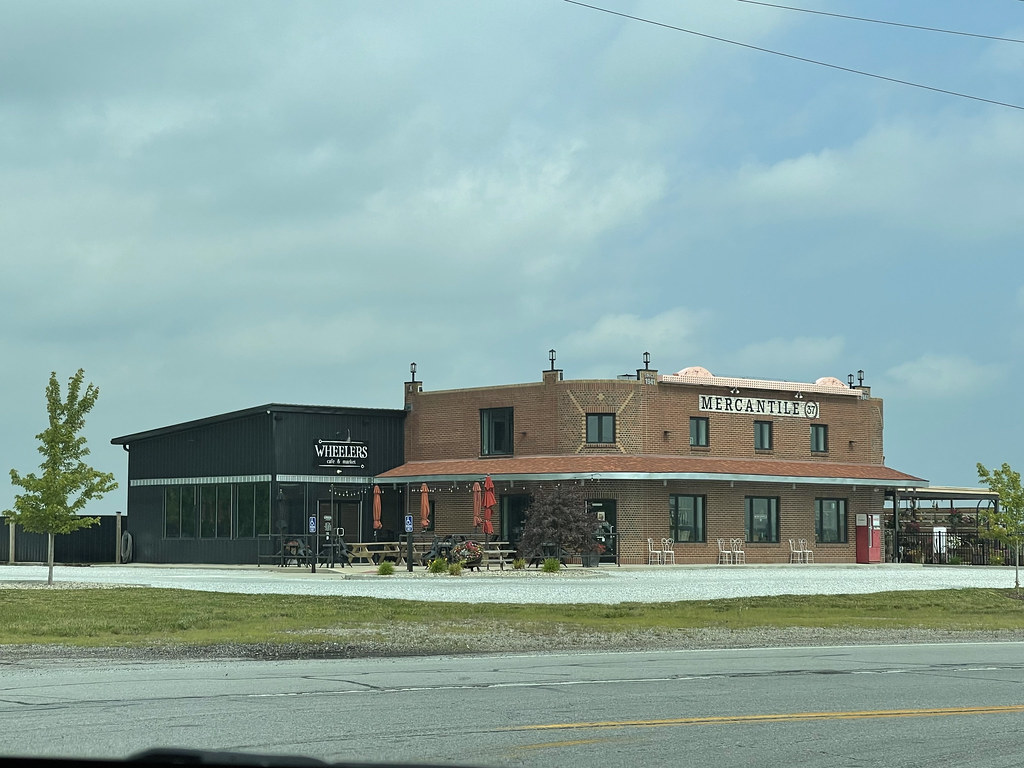
Anyone who has ever driven through northern Hamilton County on State Road 37 knows the old “Wheelers” building. The truck stop opened in 1940 as  “Scotty’s Inn.” This was back when SR 37 was the main route between Fort Wayne and Indy, so Scotty’s became a well-known stop for truckers, local farmers, and travelers alike. It featured gas pumps, a restaurant on the main floor, and “tourist rooms” upstairs. Swineforth reopened the restaurant after it sat derelict for many years following a devastating kitchen fire in the 1970s.

Wheeler’s Restaurant & Mercantile on State Road 37 today.

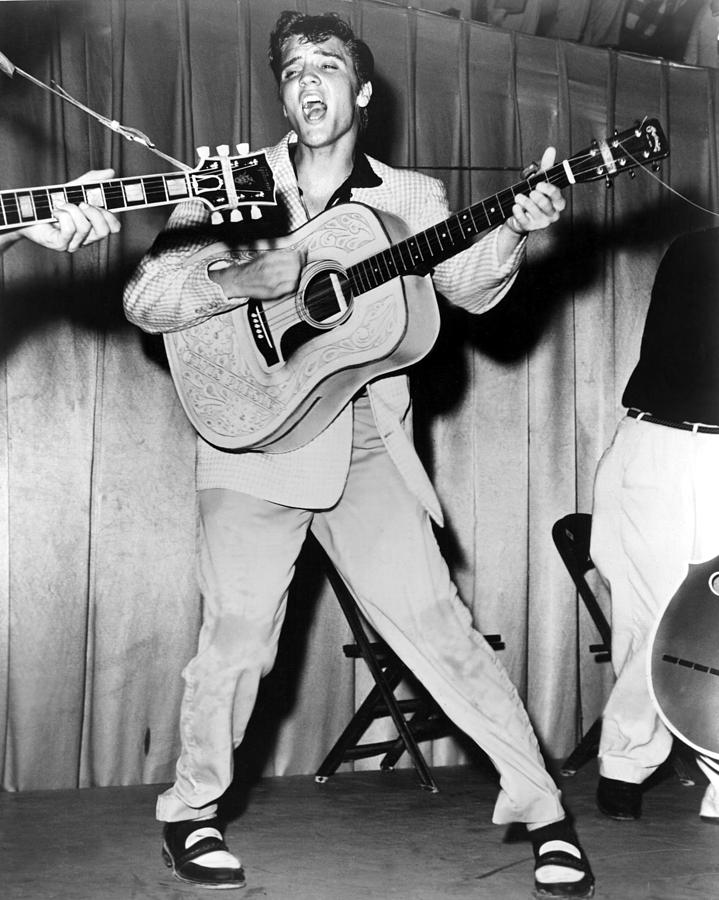
Swineforth recalled that the place was a mess when he took it over. “Oh the stories that building could tell,” he said. “Those rooms upstairs were rented to truckers by the hour,” he whispered with a wink. “You know, Elvis Presley came through there once back in the 1950s.” Swineforth ran his restaurant from 1993 to 1999 before the ancient infrastructure finally forced him to shut it down. The building remained vacant for nearly two decades before it reopened in 2018 as Mercantile 37.

Indiana Governor Frank O’Bannon.

After Swineforth closed his restaurant at the old Wheelers, he landed in Elwood. “I rent the building from the Orbaugh daughters. I own the name and everything within these walls, but the 74-acre airport property remains in the Orbaugh family,” Al noted. “Every Governor since Otis Bowen has stopped in here. Well, except Evan Bayh, he was never here. Mike Pence came in here all the time before he became Vice-President.” Al said, “He used to hold meetings right over there at that corner table.” Swineforth recalls one Governor’s visit in particular. “Frank O’Bannon came in here once for a meet-and-greet. We were running planes then and there were a couple of pilots in here. The Governor’s bodyguards went out and pulled the car up to leave and while they were gone the Governor said that he’d really like to take a plane ride. Pilot John Ward told him his plane was right outside and the Governor took off out the back door and was circling the runways within minutes.” Al closed by saying, “When those bodyguards came back in to get him, you should have seen the looks on their faces when I pointed to the sky and told them ‘there he goes.’ You couldn’t get away with that nowadays.”

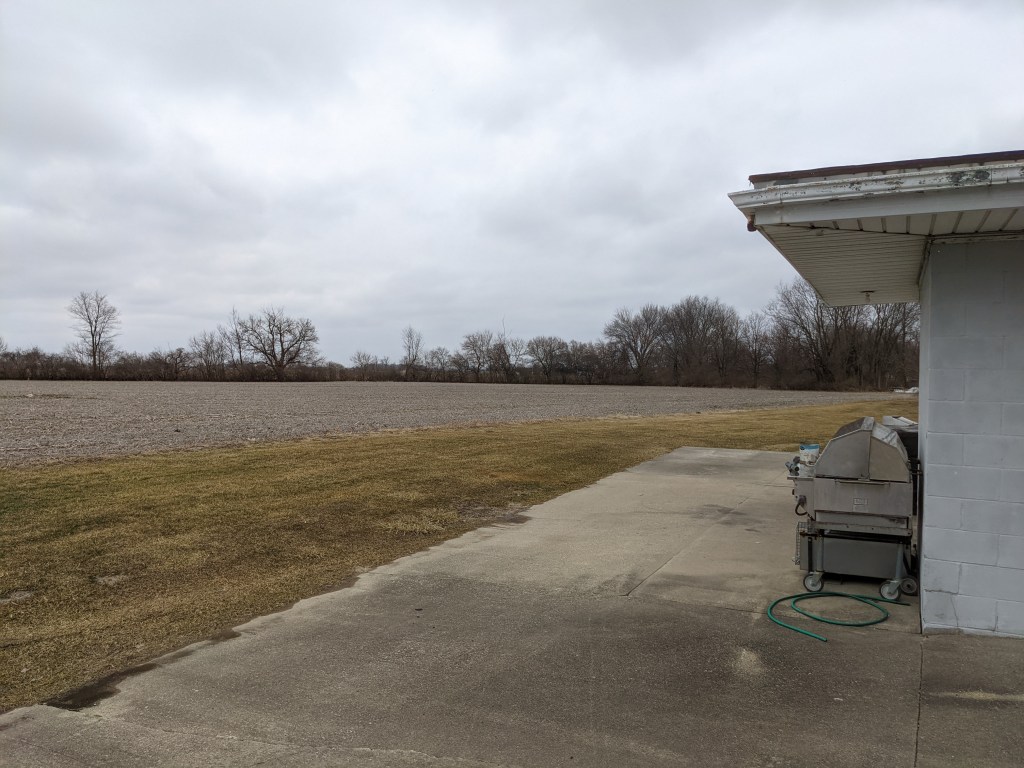
The old runways are a farm field behind the restaurant today.
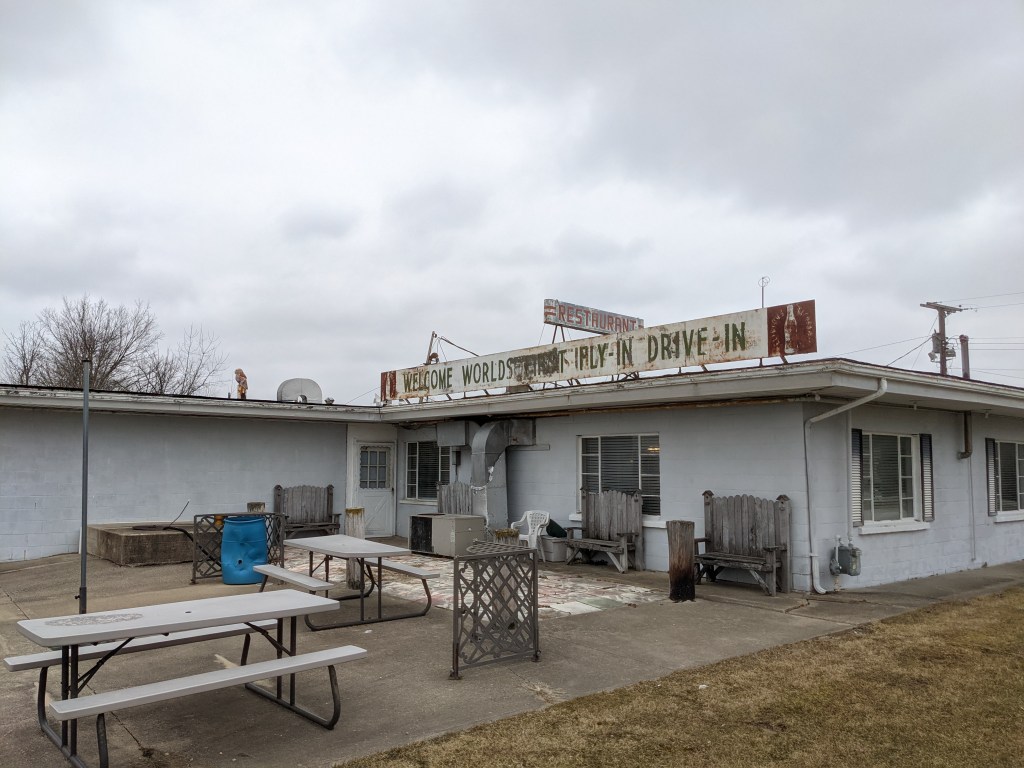
Back of the restaurant today.
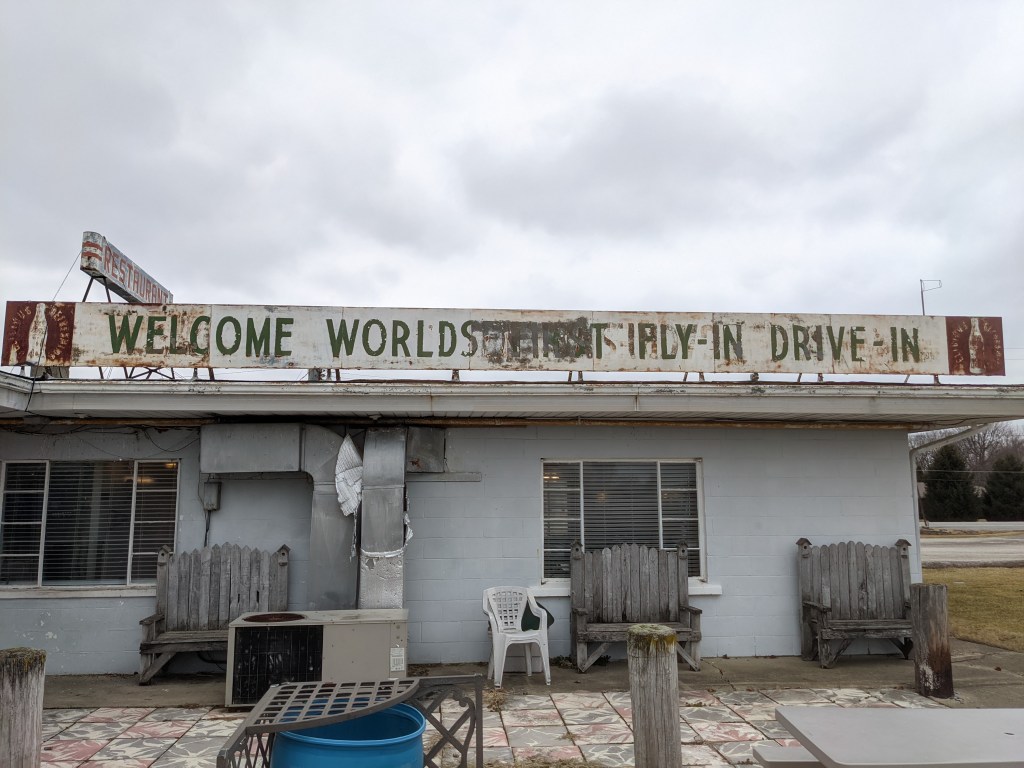
The original welcome sign for the restaurant as seen from the back patio.

The airport closed for good on September 1, 2008. The former runways were leased to a local farmer, who has since planted them in crops. Statistics from the previous year showed that the airport had 2,604 general aviation aircraft operations, an average of 217 per month. When I asked him how it affected his business, Al replied, “I lost $100,000 overnight.” That wasn’t the only calamity Swineforth had to weather. Like most restaurants, the COVID-19 pandemic nearly devastated the Airport Restaurant. “We never closed during COVID,” he stated. “Oh we shuttered the dining room but we were open for curbside and delivery.” It might surprise some to learn that Swineforth thinks the pandemic actually helped his business. “The community really came through for us. I think they appreciated that we never closed. Our business picked up after we reopened.”

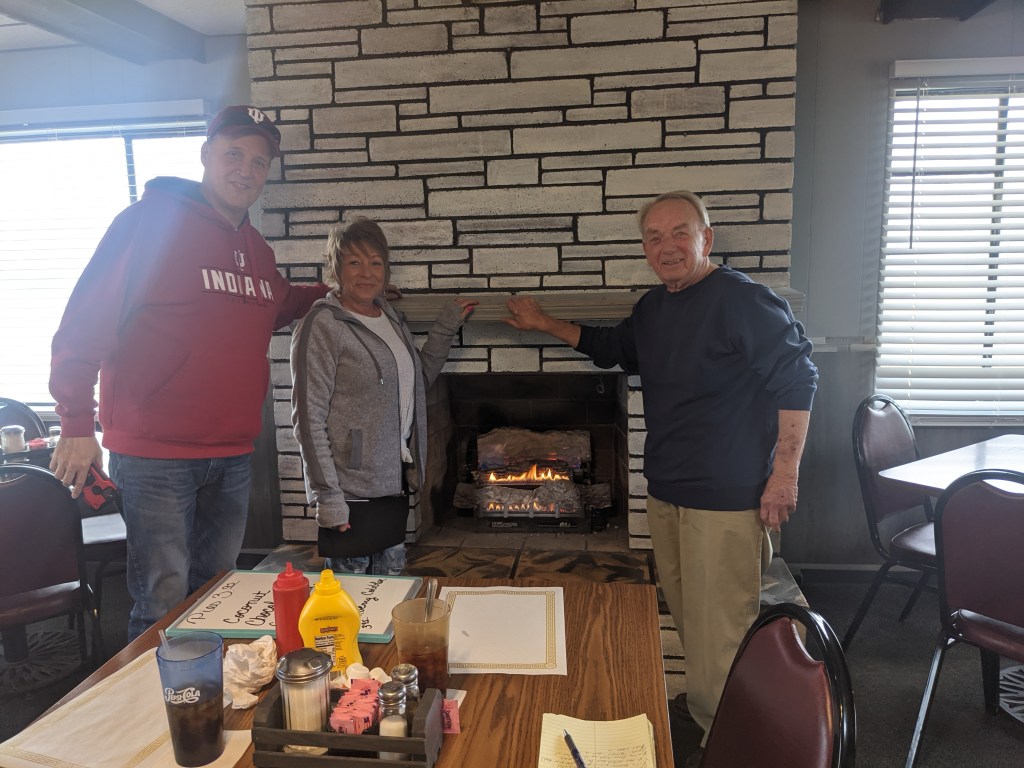
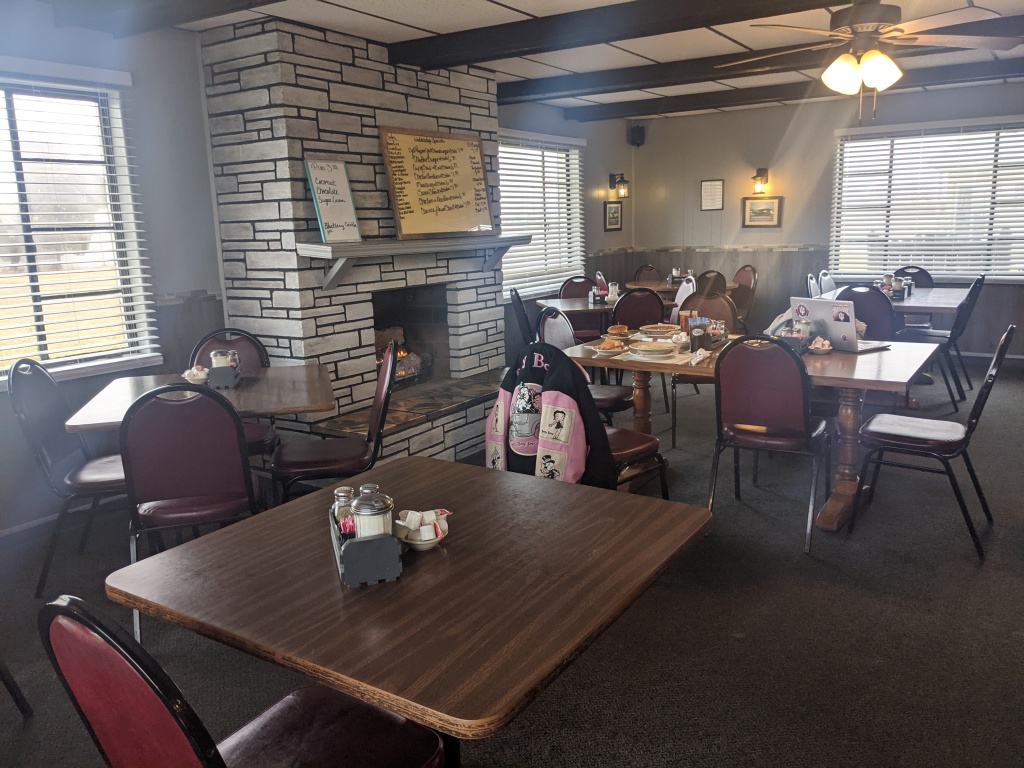
I visited the Airport Restaurant on a weekday and was immediately greeted by owner Al Swineforth. Al insisted that we have lunch before we sat down to chat, his treat. We were seated in the dining room right next to the fireplace. Our waitress Holly Fettig greeted us warmly and informed us that she had worked there since she was 18 years old. “My mom worked here for a few years before I started,” Holly said. “I’ve been here for over 25 years now.” I question that statement because she looks like she would still get carded in any bar she found herself in today.

Elwood’s Airport Inn Menu.

The menu is full of so many different dishes that it is hard to zero in on any one particular selection. The restaurant fare runs the gamut from Hoosier staples like grilled tenderloins, onion rings, fried green tomatoes, and double-decker hamburgers to steak, chicken and noodles, or fish dinners. Holly informed us that they are “famous for our elk burgers.” Rhonda had broccoli cheddar soup and a grilled ham & cheese sandwich and I opted for a giant hamburger, fries, and chili. Next time, I’m trying that elk burger. We were not disappointed. The restaurant serves breakfast, lunch, and dinner with homemade pies also available.

The author’s mother-in-law Kathy Hudson.

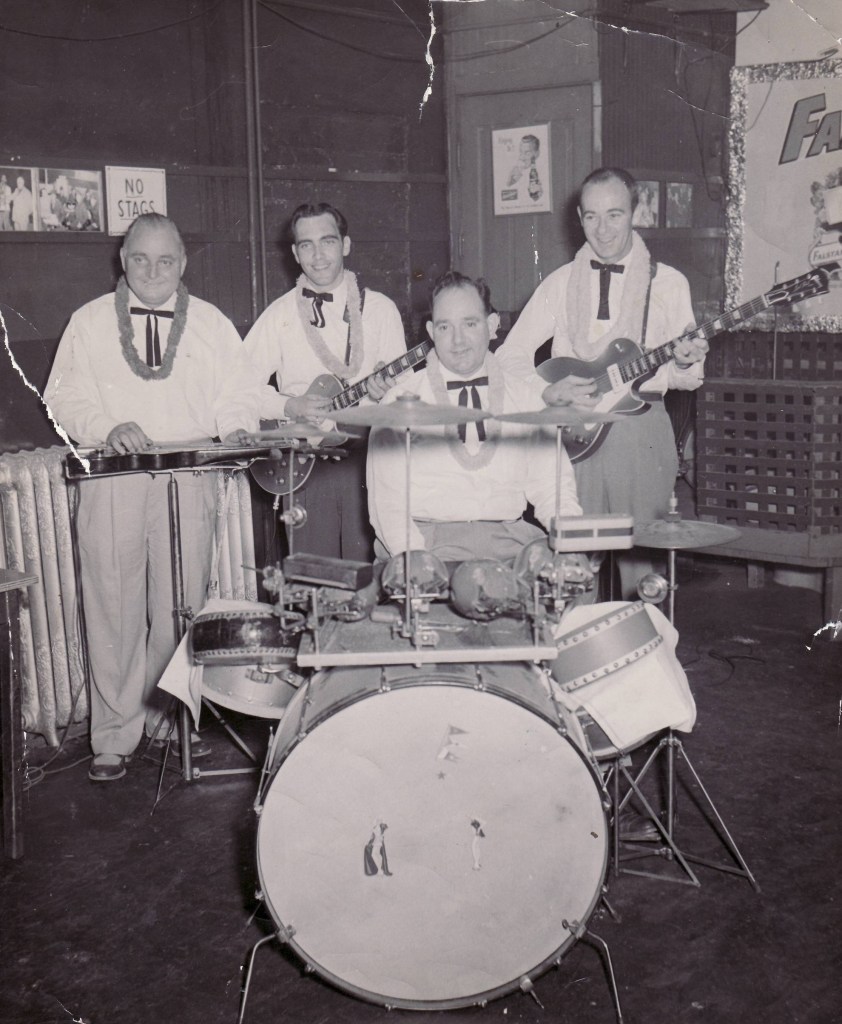
After lunch, we sat down with Al and Holly and explained the reason for our visit. Turns out that the restaurant has a family connection. My mother-in-law, Kathy Hudson, worked at the restaurant in 1968 at a time when it was being managed by my wife’s great-grandfather, Virgil Edgar Musick. Rhonda’s dad, Ron Musick, has told us for years about his grandfather and his restaurant and recalled helping with the bookkeeping when he was in high school. “The restaurant was called Musick’s Airport Restaurant back then. Granddad was a musician. He played slide guitar in a band along with running the restaurant.” Ronnie said, “Seemed like he was playing on the radio every weekend on WOWO up in Fort Wayne. He backed up some pretty big-name musicians in his day.”

Virgil Musick on slide guitar standing at left.

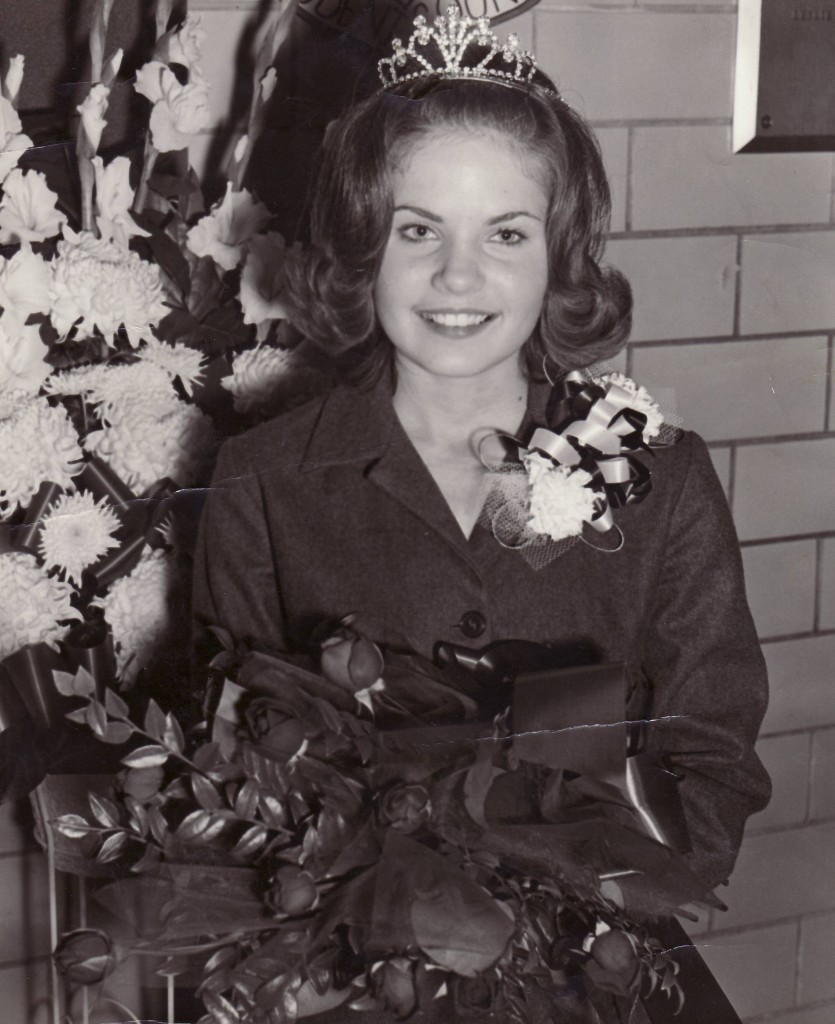
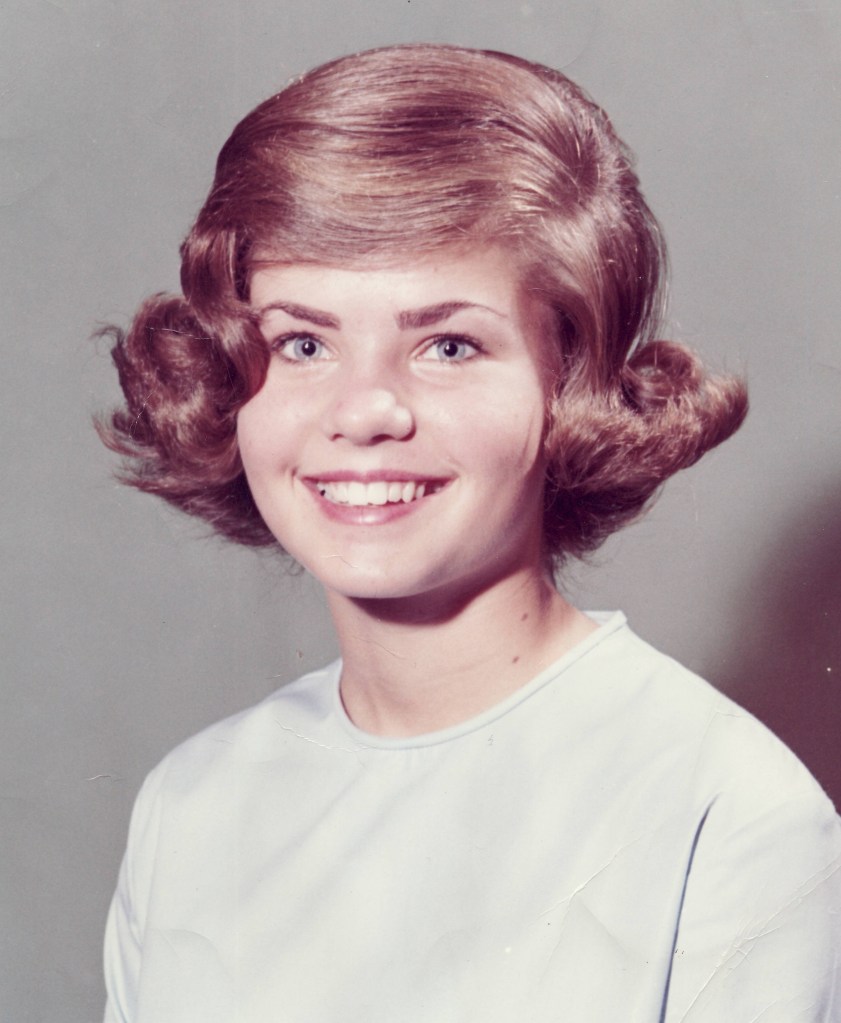
Kathy told us that she was working as a waitress there when Bobby Kennedy’s campaign flew into Elwood in May of 1968. “I don’t remember Bobby being there, but his advance guys were there, all dressed up in suits and dark sunglasses. They asked me if I wanted to go for an airplane ride and I told them, ‘Well, only if my husband can come along.’ The advance men told her, ‘Sure, he can sit on the wing.’ Did I mention that Kathy, former homecoming queen at Anderson Highland High School back in 1964, is quite the looker? The fireplace table was important because Rhonda’s only memory of the restaurant centers around a photo of her and grandmother Nina Pace standing in front of it. Rhonda told Al, “But I remember it as red brick, not white.” Al explained, “Yes it was red but we painted it white when we remodeled the place several years ago.”

The author’s father-in-law Ron Musick at left.

The planes don’t come here anymore and the runways were plowed over years ago. However, evidence of the airport survives in the many pictures of planes, parked on the grassy runways, taken back in the 1960s and 70s that now line the walls of the restaurant. My father-in-law, Keith Hudson, remembered tooling around Elwood back when it was a working airport. “We used to cut through here by driving up the runway back then. I still eat there from time to time.” When I mentioned Hud’s name to Al, he said, “Oh yeah, I know Keith from Bernie’s bar in Frankton.” Turns out that before he ran the Airport Restaurant, Virgil Musick ran the 128-club in Frankton. Seems like Al Swineforth knows everyone in Madison County. And as for those shortcuts through a working airport runway, don’t worry Hud, I think the statute of limitations has run on that by now.

Looking at Kathy, it is easy to understand how she drew the attention of RFK’s security detail in 1968.
The dining room of the Airport Restaurant in Elwood, Indiana as it appears today.

food, Indianapolis, Pop Culture, Uncategorized

Beef Manhattan: Born in Irvington?

Original Publish Date March 14, 2024 https://weeklyview.net/2024/03/14/beef-manhattan-born-in-irvington/

Okay, okay, not likely…but possible. No one really knows EXACTLY where the Beef Manhattan was born, but most culinary historians agree that the dish (a diagonally cut roast beef sandwich split butterfly fashion with a generous scoop of mashed potatoes resting between the two halves and the whole shebang swimming in a pool of brown beef gravy) came from the eastside of Indianapolis.

Legend claims the Beef Manhattan was born at the Naval Air Warfare Center, a former US Navy facility located at Arlington Avenue and East 21st Street in Warren Township, a stone’s throw from Irvington. The knife and fork-plated comfort food was (allegedly) the brainchild of Manhattan-trained cooks working at the factory during World War II. Faced with an overage of Hoosier staples (meat, potatoes, & bread) these crafty Hell’s Kitchen food slingers came up with a plan.

A poor man’s version of the dish had been making the rounds of Manhattan (the most densely populated and smallest of the five boroughs of New York City) for generations. The difference was, that the first version contained mysterious New York City street meat, rolls, not bread, potatoes, and no gravy. We do not know the name of the chef (or chefs) who created it or, for that matter, the date the dish first showed up in the cafeteria of the Naval Ordnance Plant. But, the best guess is that the Beef Manhattan made its debut in the winter of 1942.

Ratheon-300x136
Naval Ordinance Plant in Indianapolis.

The plant opened that year, covering 1,000,000 square feet and employing 3,000 workers in avionics research and development. Construction began in 1941 and the plant became fully operational in 1943. The “NOP-I”, as it was known locally, was one of five inland sites selected in July 1940 by the US Department of the Navy Bureau of Ordnance for the manufacture of naval ordnance. The other plants were in Canton, Ohio; Center Line, Michigan; Louisville, Kentucky; and Macon, Georgia. The government-owned, contractor-operated (GOCO) plant was built for $13.5 million ($255 million in 2024 dollars) and the plant manufactured Norden bombsights until September 1945.

After World War II, the plant was renamed the Naval Avionics Center, where employees designed and built prototype avionics, including “electronic countermeasures, missile guidance technologies, and guided bombs.” In 1992, the facility changed its name to the Naval Air Warfare Center Aircraft Division. The site was closed in 1996 on the recommendation of the 1995 Base Realignment and Closure Commission at which time it transferred ownership to Hughes Electronics Corporation. In 1997, it was the “largest full-scale privatization of a military facility in U.S. history” at the time. Eventually, the company was acquired and renamed the Raytheon Analysis & Test Laboratory. As of 2022, the facility is privately owned by Vertex Aerospace and employs about 600.

While those are the facts about the origin of place for the Beef Manhattan, determining where it first hit the streets of Indianapolis is a little bit more speculative. The riddle begins with the name itself. It is a misnomer. The dish is one of two Manhattan-named staples with no ties to New York City other than a space on the menu. The other, Manhattan clam chowder, originated in Rhode Island. Sure, New York City can claim many different foods created within its five boroughs: Eggs Benedict & the Waldorf salad (Midtown), Chicken & Waffles (Harlem), The Reuben (Manhattan), and the Cronut (So-Ho), but the Beef Manhattan is pure Hoosier.

There are different variations. One calls for shredded, pot-roast style beef on two slices of white bread, mashed potatoes on the side, with a layer of brown gravy poured over all. While another insists that the mashed potatoes are placed on top of the sliced, but unseparated, sandwich which is then drowned in brown gravy. Some versions call for diagonal slices, others conventional center-sliced bread. Another variation is Turkey Manhattan, which substitutes turkey for roast beef, but that is an obvious imposter. And, although the dish is named after Manhattan, if you were to order it in a Gotham City restaurant, you’re likely to be served a cocktail (whiskey, sweet vermouth, bitters, and a maraschino cherry garnish). Beef Manhattan is unknown there, instead such dishes are usually called “open-face sandwiches” in the Big Apple.

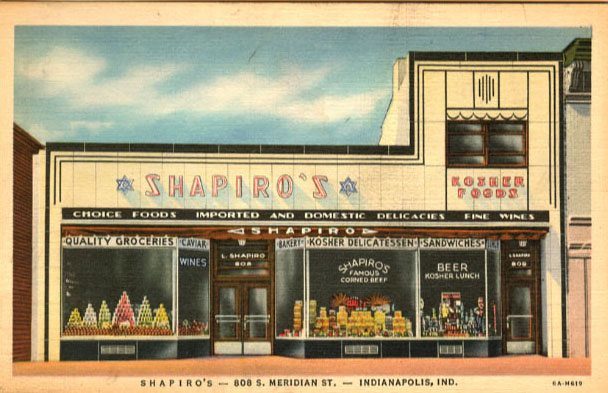
Should you Google it, you are likely to see that the dish was first served under the name “Beef Manhattan” in a now-defunct Indianapolis deli in the late 1940s, and shortly after its introduction, it became a Hoosier staple. But, nobody seems to know exactly which Indianapolis Deli was the first to put it on the menu. However, there are a few likely suspects. The natural choice would seem to be Shapiro’s. Their website states that restaurant namesakes, Louis and Rebecca Shapiro, arrived in the Hoosier state around 1900 after fleeing Russia due to anti-Semite persecution which included vandalism to their family grocery store in Odessa, Ukraine. They sold sugar and flour from a pushcart on the streets of Indianapolis for two years while saving up money to open their deli at Shapiro’s 808 South Meridian in 1905.

Shapiro's

So, Shapiro’s certainly fits the bill timewise, appearing on the scene a generation before the birth of the Beef Manhattan. Shapiro’s is the sentimental favorite for sure. And it has an Irvington tie-in too. In 1925, during the reign of terror by the Ku Klux Klan in Indiana, Shapiro’s thumbed their nose at Klansman/Governor (and Irvington resident) Ed Jackson by redecorating their storefront in an art-deco style dominated by a huge Star of David for all to see. But officially, “Shapiro’s Kosher Deli” didn’t open until 1945, three years after the dish was invented.

Likewise, the Hook’s Drug Company opened a new drugstore and soda fountain at the corner of 22nd and Meridian Streets on Feb. 17, 1940, to serve hungry Hoosiers. Hook’s restaurant featured a new stainless steel soda fountain perfectly designed to serve Beef Manhattans. A contemporary news article described Hook’s as having “year-round air conditioning” and as “the last word in efficiency and beauty. The floor behind the fountain is depressed to a level so that the customer is sitting in the same comfortable position as at his own dining table. The fountain is provided with a system of sterilization which makes it sanitary for refreshments and luncheons. The cooking equipment is electrical.” Hook’s advertised heavily in the 1940s but never mentioned the Beef Manhattan in those ads. The dish did not appear in Hook’s ads until the 1950s.

The best bet (at least of this reporter) is that the Beef Manhattan most likely appeared first as a menu selection somewhere on Illinois Street. There were at least three delis operating on Illinois Street in 1942, including Brownie’s Kosher Deli at 3826 N. Illinois, Fox Delicatessen at 19 S. Illinois, and Henry Dobrowitz & Sons Kosher Meats and Delicatessen at 1002 S. Illinois. Someday, somewhere, a better Circle-city researcher than me will pinpoint the exact location but until then, I’m content to let it remain a mystery.


Choosing instead to revisit Shapiro’s version of the “Hot Beef Manhattan” in my daydreams. It consists of 2 slices of white bread, not cheap squishy white bread, but good firm white bread with some heft to it, cut diagonally and spread out on the plate like a poker hand, a layer of handmade mashed potatoes binds them together, and forms the foundation for a generous portion of thin-sliced tender beef, brisket I’m guessing. The meat mound is topped with more mashed potatoes and covered with enough gravy to float a kayak. Not that better than bouillon gravy stuff that somehow smacks of chemicals to me, but rather, real gravy made from the constant stirring of the collected juices of meats roasting. To those haughty Food Network snobs, the Beef Manhattan looks like a failure pile on a sadness plate, but Hoosiers know it is delicious.

Typically, Indianapolis sees 29 days a year where the thermometer doesn’t rise above 32 °F, and for five months a year, we’re shivering below the fifties. So, knowing that, is it that hard to understand why the Beef Manhattan remains so popular in Indiana? I mean, no one eats a tenderloin to get warm. And while the Beef Manhattan most likely wasn’t born in Irvington, it did originate on the east side of Indianapolis and Irvingtonians can fairly claim to be among the first wave of devotees.

food, Health & Medicine, Medicine, Pop Culture, Uncategorized

When it rains, it pours.

Morton's article image

Original publish date:  July 2, 2020

It is summertime in Indianapolis and once again, Hoosier eyes cast skyward as they ask, “When is it gonna rain?” Recently, I stumbled across an old brochure from Morton’s salt that was handed out at the 1933-34 Chicago World’s Fair. The brochure features the logo of a little umbrella-carrying girl walking with a cardboard can of salt tucked under her arm, the salt pouring out of the spout as she walks beneath the raindrops, blissfully unaware. The brochure notes that “One-third of our weather is rainy!” and offers “100 ways to predict rain, compliments of Morton’s Salt” and closes with the familiar slogan “When it rains it pours.”
The brochure opens to a list of 100 of “Mother Nature’s Weather Signs” and notes that these “time-tested” signs of rain are not “mere superstitions” and that “back of every sign is a common-sense explanation.” “For instance, fish leap from water and birds skim close to the ground just before a rain in order to catch insects forced down by the moisture in the air. Smoke hangs low before rainy weather because held down by nature; a cow attempts to scratch its ears because flies are more troublesome when rain is approaching, and shoe strings become difficult to untie because moisture-laden air has caused them to swell.” The brochure urges its reader to “memorize as many as you can so that you can surprise your friends by accurately predicting rain even though the sun may be shining brightly.”
So here you go, get ready to amaze your friends with these 100 ways to predict rain, as seen through the eyes of Great Depression corporate America. After each assertion, simply add the dictum; “look for, expect, or followed” by rain.
x rainbow rainWhen animals huddle together in open fields…when ants travel in straight lines (or are unusually active)…when the “Northern Lights” are visible in the sky…when bats cry much, or attempt to fly into the house…when more bees enter than leave the hive (every notice that bees never get caught in a shower?)…when distant bells sound close…when birds skim close to the ground…when boiling water evaporates more rapidly than usual…when dead branches fall to the ground in calm weather…when bubbles rise from marshy ground or appear on pools of stagnant water…
There is almost always a calm before a rainstorm…Camphor gum dissolved in a bottle of alcohol forms feathery crystals before a rain (Camphor gum was a farmhouse staple back in the day with many uses)…when canaries dress (oil) their feathers, or are wakeful at night…when cats sneeze, lie with their heads on the floor, or wipe themselves behind the ears…when many centipedes are seen…when your chairs begin to creak…when chickens huddle together outside the hen house instead of going in to roost (hence the old adage, “If fowls roll in the sand, rain is at hand”) …when distant objects look close (hence the saying, “The farther the sight, the nearer the rain”)…heavy clouds in the west and cloud streamers pointing upward… when a clover contracts its leaves…
z coffeeeIf coffee bubbles cling to the cup instead of floating in the center…when corns are more painful than usual… when cottonwood trees turn the undersides of their leaves upward…when a cow thumps its ribs, or attempts to scratch its ear, with its tail…when crabs leave the water and remain on land… when cream or milk sours during the night…an old adage states that a new (crescent) moon with horns tilting downward can’t hold water so…when crickets chirp loudly and more persistently than usual… when crows caw loudly and continuously or when a crow is seen flying alone… when curly hair becomes more unruly than usual…
When dandelions close their blossoms…complete absence of dew in the morning… when dogs eat grass or are uneasy and change position while lying down…when a donkey scratches itself against a wall…when doors stick in fair weather… when ducks quack unusually loud… when dust whirls around the street… ringing in the ears is seen as a warning… when worms appear in large numbers on the surface of the ground…a strong east wind means rain withing a day-and-a-half.
x rain 3When grate fires crackle and throw sparks to a greater degree than usual…when fish jump from the water, or swim close to the surface…when oiled floors “sweat”…when flowers stay open all night (and some say when the fragrance is stronger)… when frogs assume a brownish hue and croak louder and longer…when there are two full moons in a single month…when geese are particularly noisy…when glow worms shine brighter…when goats bleat a great deal…
When a clear sky has a greenish hue…when seagulls fly inland…when a halo (or ring) encircles the moon, like the old saying states, “The bigger the ring, the nearer the rain”…when a hazy twilight appears during the summer…when horses sweat in the stable, sniff loudly and switch their tails violently…many flies in the house are a sure sign as are flies that bite harder and more often…when your joints appear to feel stiff… when burning lamps and lanterns sputter continuously…a great many meteors, or shooting stars, in one evening…when mice run about more than usual…
Three misty mornings in a row bring rain…A pale moon doth rain-a red moon doth blow-a white moon doth neither rain nor blow…when both pleasant and unpleasant odors are more pronounced than ordinary…whistling by parrots, which rarely whistle, is a good sign…whenever pigeons return slowly to roost…when pigs carry straw and litter in their mouth…when a man’s pipe smells stronger than usual…when pitchers and glasses “sweat”…A rainbow before noon means rain by nightfall…The ancient adage, “Morning red, of rain’s a sign; Red in the morning, sailor’s morning” translates today as “Red sky at night, sailor’s delight; Red sky at morning, sailors take warning”…
Rheumatic twinges frequently portend rain…Robins near houses, or singing on the ground…when a rooster crows at night hence the say, “If the cock goes crowing to bed, he’ll certainly rise with a watery head.”…when circus men find their ropes growing tighter…when a sheep turns its back to the wind…when shoe strings knot stick, knot and become difficult to untie…when smoke hangs close to the ground…when snails come out abundantly…when you notice your laundry soap beginning to sweat…Whenever soot falls down the chimney…
When sparrows begin to chirp louder than usual…when spiders desert their webs…when sponges do not dry out rapidly after using…when stars are unusually dim and dull or if there is a star very close to the moon…An “uneasy” stomach is a seen as a sign…when stoves and iron objects rust over night in fair weather…when heat comes suddenly…when the sun sends out shafts of light, sometimes called “the sun’s fingers”…a white, pale yellow or gray sunset, described in Poor Richard’s almanac as “If the sun should set in gray, the next will be a rainy day.”
When a bad tooth begins to act up…when the down of the thistle flies about when there is no wind…if many toadstools spring up overnight…if cellar walls “sweat”… when the temperature rises at night instead of falling…when washrags remain damp long after using…when far off factory or locomotive whistles sound as if they were only a short distance away…when windows become hard to open in fair weather…when woodpeckers are particularly noisy and building themselves shelter… If you have a wren house, you can tell whether or not it is going to rain by whether the birds stay in or out.
x rain 2And lastly, when ordinary salt begins to lump, cake and clog the saltcellar, get ready for rain. According to Morton’s, their salt is not made this way because, “When it rains it pours.” Morton’s explanation: “Because of its unique cube shaped crystals, which tumble off one another in damp weather instead of sticking together like the flake crystals of ordinary salt…every grain is usable-there are no wasteful lumps to throw away. If you have children between 6 and 18, be sure to use the iodized variety and thus protect them simple goiter.” Goiter is a swelling in the neck resulting from an enlarged thyroid gland. Before iodized salt hit the grocery shelves on May 1, 1924, iodine deficiency was the main cause of goiter in the U.S. and even though it has nothing to do with rain, I couldn’t resist throwing that last part in. So much information packed into such a little brochure.

Amusement Parks, Disney, food, Pop Culture

Disney Eats McDonald’s. PART II

Disney and Ray Kroc Part II
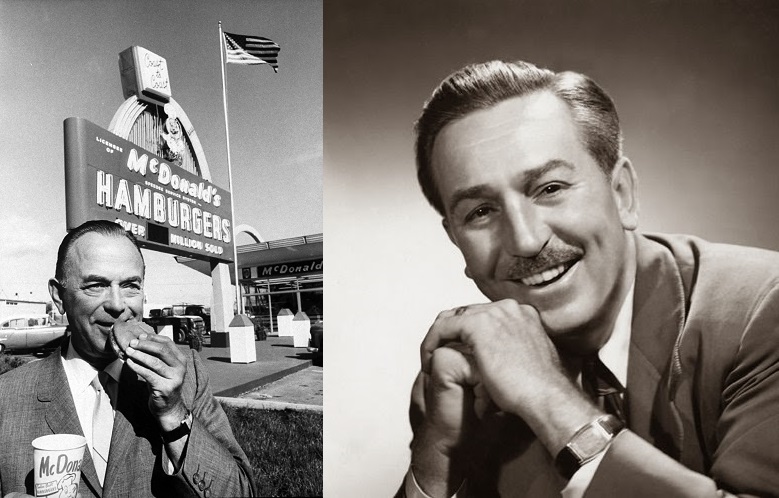
Ray Kroc & Walt Disney.

Original publish date:  January 23, 2020

Last week, In part I of this article, I discussed the relationship between two titans of Pop Culture whose brand has flourished worldwide to unprecedented levels: Walt Disney and Ray Kroc of McDonald’s. It is amazing to think that both men served in the same ambulance company at the tail end of World War I. Even more amazing to think that authors Ernest Hemingway and John Dos Passos were products of that same ambulance service. The similarities between the four men end with the close of the Great War, but Disney and Kroc would remain linked for nearly a century.
While Walt Disney was flying around the country in one of his three private airplanes searching for Disney World, meeting with executives for the 1964 New York Worlds Fair, planning movies or sporting events aboard Mickey Mouse One, he’d sometimes get a little hungry. Whenever “Uncle Walt” got that Winnie the Pooh “rumbly in the tumbly” feeling, Disney would reportedly ask, usually from the co-pilot seat: “Where are we?” The pilot would invariably reply,”We’re over Tulsa, Walt.” Or Indianapolis. Or Cleveland. Or wherever. To which Disney would cryptically reply. “Do you think there’s one down there?”

FOOD HISTORY HISTORICAL FAST FOOD BURGER HAMBURGER RESTURANT CHAIN
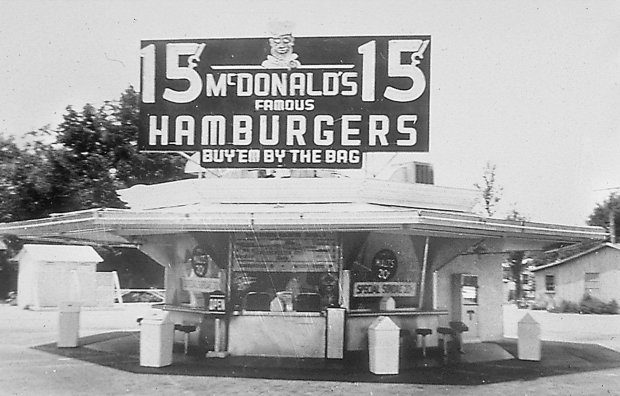
Ray Kroc’s First McDonald’s in Des Plaines, Illinois. 1955

On cue, the pilot would hand his boss a booklet listing the location of every single McDonald’s in the continental United States. If there was a McDonald’s down below in whatever city the Disney corporate plane was flying over, Walt would order the pilot to land. Once safely on the ground, Disney would call for a cab and the entire party would pile in and head out for the nearest McDonald’s to get a bite to eat. This is made all the more ironic when you consider that, as detailed in part I of this article, Ray Kroc’s pitch to place his first McDonald’s restaurant inside Walt Disney’s Disneyland was rejected in 1955. Whether Ray Kroc knew that his old war-buddy was hooked on his hamburgers is unknown, but I’d bet he’d have gotten a kick out of it were it so.

z mcds flyer
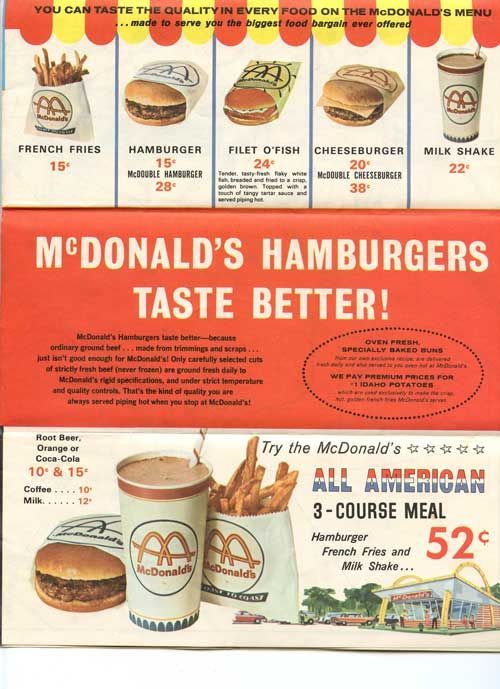
McDonald’s menu in the 1960s.

Walt Disney died on December 15, 1966. That same year, McDonald’s stock split for the very first time: 3 for 2. The year after Walt’s death, Disney stock split 2 to 1. Disney studios’ success continued that year with the groundbreaking of the Disney World theme park and addition of the Pirates of the Caribbean at Disneyland. The next few years continued the Disney shine with the Love Bug, debut of the Disneyland’s Haunted Mansion and grand opening of Disney World in Orlando. McDonald’s over that same period flourished with the introduction of the Big Mac, Quarter Pounder and television ad campaigns that boosted their brand like never before.
Fast forward to the early 1980s, McDonald’s was winning the fast food wars, having driven away most of the competition. Meanwhile, Walt Disney Productions was reeling from low theme park attendance and a string of box office flops (remember Popeye, Condorman and Return to Oz?). Suddenly Disney found itself under attack by corporate raiders like Ivan Boesky and Saul Steinberg and then nearly sold out to Coca-Cola in 1982. Disney was scrambling for someone who could come to the Magic Kingdom’s rescue. So who did Disney’s senior management approach? Uncle Walt’s old ambulance corps buddy, Ray Kroc and the McDonald’s Corporation.
z 27-Ray-Kroc-Quotes-On-Success-Wealth-AchievementBy this time, Ray Kroc was relegated to the sidelines serving in a largely ceremonial role as McDonald’s “senior chairman”. Kroc had given up day-to-day operations of McDonald’s in 1974. Ironically, the same year he bought the San Diego Padres baseball team. The Padres were scheduled to move to Washington, D.C., after the 1973 season. Legend claims that the idea to buy the team formulated in Kroc’s mind while he was reading a newspaper on his private jet. Kroc, a life-long baseball fan who was once foiled in an attempt to buy his hometown Chicago Cubs, turned to his wife Joan and said: “I think I want to buy the San Diego Padres.” Her response: “Why would you want to buy a monastery?” Five years later, frustrated with the team’s performance and league restrictions, Kroc turned the team over to his son-in-law, Ballard Smith. “There’s more future in hamburgers than baseball,” Kroc said. Ray Kroc died on January 14, 1984 and the San Diego Padres won the N.L. pennant that same year (They lost in the World Series to the Detroit Tiger 4 games to 1).
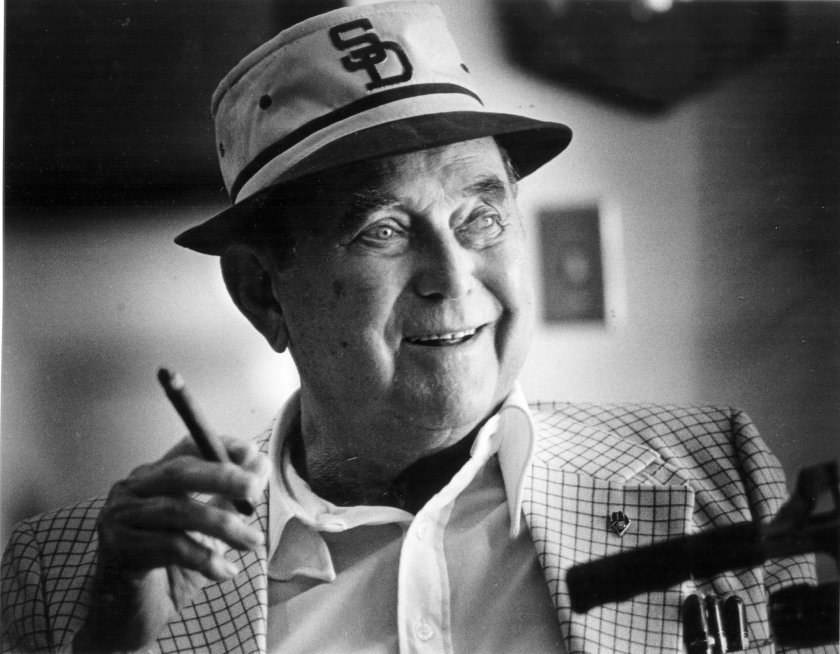
z kroc padresBy the 1980s, Disney was a corporation that seemed to be creatively exhausted. The entertainment giant was seriously out of touch with what consumers wanted to buy, what moviegoers wanted to see. McDonald’s had introduced their wildly popular “Happy Meal” nationwide in 1979. Disney saw an opportunity for revival by proposing the idea of adding Disney toys and merchandising to Happy Meals. In 1987, the first Disney Happy Meal debuted, offering toys and prizes from familiar characters like Cinderella, The Sword In The Stone, Mickey Mouse, Aladdin, Simba, Finding Nemo, Jungle Book, 101 Dalmatians, The Lion King and other classics. For a time, changing food habits, mismanagement and failure to recognize trends, placed the Disney corporation in an exposed position. Rumors circulated that the Mouse was on the brink of being swallowed up by Mickey D’s.
The relationship came to a head when McDonald’s suggested that Disney offer discounted VHS copies of classic Disney films in their restaurants. Also, as time passed, Disney wanted to emphasize healthier eating and they became concerned about McDonald’s being tied so closely to childhood obesity. The McDonald’s-Disney agreement officially expired on January 1, 2007. Over that time, as the Disney company grew into the corporate giant it is today, McDonald’s realized their mistake. For the next several years, McDonald’s tried to reestablish the relationship, with limited success.
For awhile, McDonald’s found a presence in the food and beverage locations at the Disney theme parks. One was the McDonald’s Fry Cart that opened in Magic Kingdom’s Frontierland in 1999. Since it IS Disney after all, the imagneers fitted the location with a back story. It went like this: “With the rush of prospectors passing through Frontierland in search of gold, lots of folks in town started looking for ways to cash in on all the excitement. Back in 1853, ol’ McDonald (who had a farm, ei-ei-o), a potato farmer, decided to set up his cook wagon on the hill under the big oak tree, just off the main trail.”

z mcwdw_gold2007ww
McDonald’s French Fry Cart at Disneyland.

The story continues, “Business was booming for a couple of good years, right up until the great flood of 1855. Legend has it that men disturbed the spirits of the mountain by removing gold from Big Thunder, causing all sorts of havoc from earthquakes and avalanches to storms and floods. In fact, the nearby river rose so much, the water reached right up to McDonald’s wagon on the hill. The wagon survived, but when the water receded, the wagon started to go with it. It slid down the hill, crashed through a fence (and sharp-eyed guests could see the poorly repaired fence near the cart), and got lodged in the mud down below. This didn’t stop ol’ man McDonald, though. He just laid down some planks so folks wouldn’t get their boots muddy, and he has kept right on selling his delicious French fried potatoes to this day.”
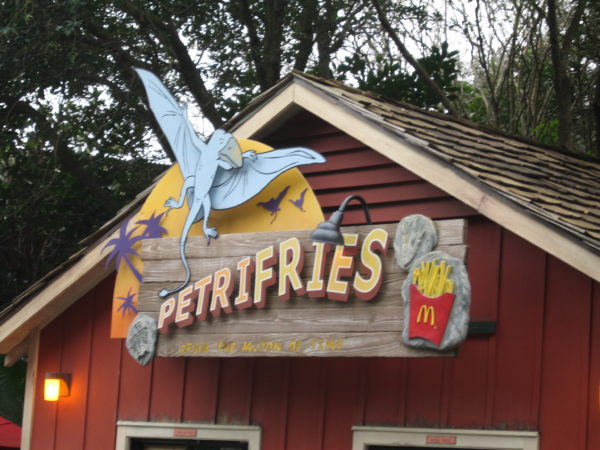
McDonald even came up with a catch phrase and posted it on the front of the wagon: “There’s gold in them thar fries!” There was also a sign placed nearby that pictured the familiar Golden Arches and proclaimed, “Same location since ’53.” The “53” was scratched out and painted over with a “55.” The McDonald’s Frontierland Fry Cart closed in late 2008. There were McDonald’s restaurants at Disney’s Animal Kingdom as well. The Boneyard, Restaurantosaurus and the “Petrifries” french fries stand which came with it’s own backstory as well. That backstory is not as interesting though as it involves a former fishing lodge where the first dinosaur fossil was found in 1947 by an unnamed amateur fossil hunter and it was hard to decipher. The Dino Institute featured a small lab, a clubhouse for student volunteers and a commissary to round out the McDonald’s connection. Although the McDonald’s french fries served there were popular with visitors, at least the few who could find it, the venue also closed.
z disney-mcdonalds-2018-03Additionally, there once was a McDonald’s at downtown Disney (before it became Disney Springs). At the Magic Kingdom, visitors could munch on french fries at the Village Fire Shoppe. At Disney’s Hollywood Studios, McDonald’s sponsored Fairfax Fries at the Sunset Ranch March. Fairfax is a reference to the street where the famous Los Angeles Farmers Market (the inspiration for the Sunset Ranch Market) is located. At Epcot, on the World Showcase promenade, is the Refreshment Port where sometimes international cast members from Canada would bring Canadian Smarties (similar to M&Ms) for the food and beverage location to make a Smarties McFlurry. The exclusive contract with Disney did not allow McDonald’s to tie in with blockbuster movies such as the Star Wars franchise even though movie studios would have preferred the tie in since McDonald’s had a higher profile and market share.
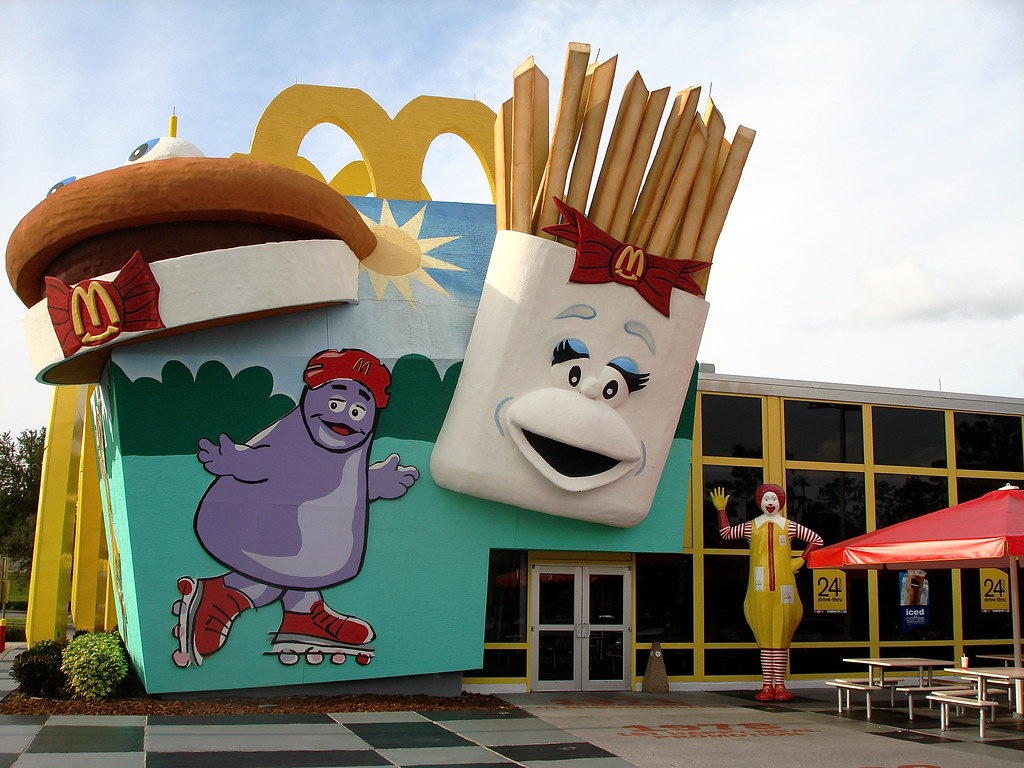
There are many Disney fans and park visitors who have fond memories of eating McDonald’s Chicken McNuggets or an Egg McMuffin during a fun day at a Disney theme park. After all, could it get any better than to receive a Disney prize in your Disney Happy Meal while on Disney property? Today, the only McDonald’s presence on Disney property is the restaurant at Disney’s All-Star sport complex hotel. Although it was briefly closed on Halloween of 2019 for renovation, it is scheduled to reopen in March of 2020. However, it is unlikely that we’ll ever see another “Hotdog-osaurus” or a “Dino-Sized Double Cheeseburger” any time soon.

DSC05673.JPG
McDonald’s at Disney’s All-Star Sports Complex.

While Disney netted more than $100 million dollars during the partnership, McDonald’s netted more than $1 billion dollars even while promoting Disney’s box office bombs. It was not unusual for a McDonald’s promotion for a film to exceed Disney’s budget for advertising the very same film. Disney got the royalties and increased advertising exposure and McDonald’s sold the food. Seems like a match made in heaven. Yeah, well, Burt Reynolds & Lonnie Anderson / Brad Pitt & Jennifer Aniston / Lee Majors & Farrah Fawcett didn’t work out either.
Both Disneyland and McDonald’s have become worldwide icons of America. Walt Disney and Ray Kroc are ranked # 9 and 10 on Baylor Univeristy’s list of Greatest American Entrepreneurs and/or Businesspeople behind Henry Ford (1), Bill Gates (2), John D. Rockefeller (3), Andrew Carnegie (4), Thomas Edison (5), Sam Walton (6), J.P. Morgan (7), G.M.’s Alfred Sloan (8). McDonald’s now operates more than 35,000 restaurants in 118 countries, serving 68 million people every day. A new branch opens every 14.5 hours, more than 75 hamburgers are sold every second and 68 million people eat something from McDonald’s each day-that’s 1% of the world’s population. McDonald’s’ estimates that one in eight American workers has been employed by the company at one stage of their careers. McDonald’s is the world’s largest distributor of toys, with the Happy Meal included in 20% of all sales.
Conversely, there are 12 Disney theme parks worldwide, welcoming 157 million visitors annually and serving a half-million guests every day. Disney has 201,000 employees, 100,000 of whom work at the two resorts in the USA. Every year, Disney World alone serves 10 million hamburgers, 6 million hot dogs, 9 million pounds of French fries, 300,000 pounds of popcorn, and 1.6 million turkey drumsticks along with 13 million bottles of water and 75 million Coca-Colas to wash them down. According to one study, Walt Disney’s logo is the fifth most recognizable logo in the world behind Starbucks (4), McDonald’s (3), Coca-Cola (2) and Nike (1).
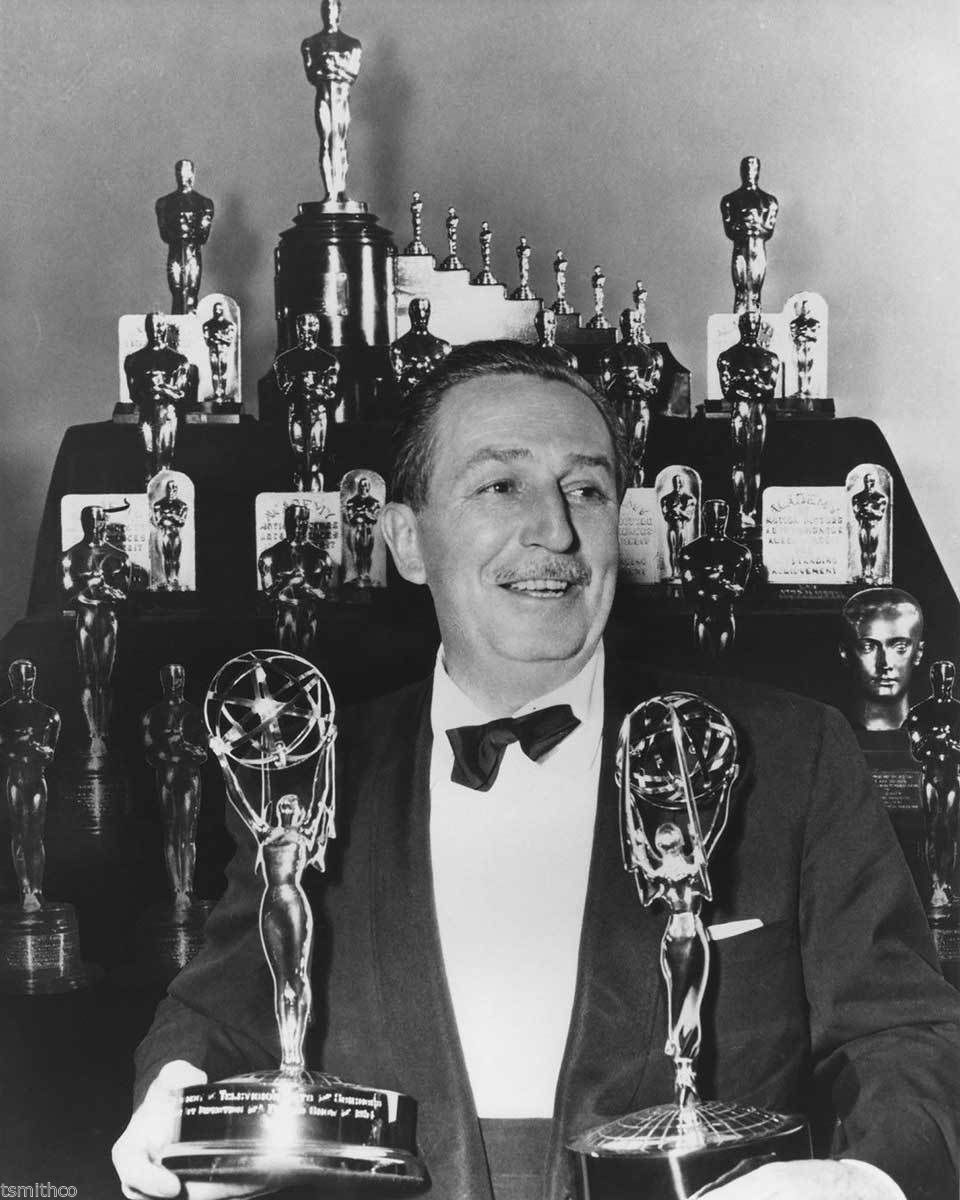
z disney awardsDuring his lifetime, Walt Disney received 59 Academy Award nominations, including 22 awards: both totals are records. Walt Disney’s net worth was equal to roughly $1 billion at the time of his death in 1966 (after adjusting for inflation). At the time of his death, Disney’s various assets were worth $100-$150 million in 1966 dollars which is the same as $750 million-$1.1 billion today. By the time of Kroc’s death in 1984, his net worth was $600 million. That’s the same as $1.4 billion after adjusting for inflation. One can only imagine how the pop culture landscape might have changed back in 1955 if those two former ambulance corps buddies had formed a partnership. But wait, would that make it Mickey D’s Mouse?