
 Original publish date: December 7, 2013
Fifty years ago this month, the death of innocence in America began. I believe its roots can be found in a single diary entry made on February 1, 1961 that reads: “Make my first request to American Embassy, Moscow for reconsidering my position, I stated “I would like to go back to U.S.” Nearly two weeks later, on February 13, 1961, the author of that diary entry officially notifies the Embassy that he wants to return to the United States. That disgruntled Cold War continental traveler was Lee Harvey Oswald, the man who killed President John F. Kennedy.
Indeed, a case can be made that the path to the death of innocence in America was paved by many events; the assassination of Abraham Lincoln, the attack on Pearl Harbor, Watergate? However it was the death of JFK that changed America forever. True, three U.S. Presidents were assassinated before Kennedy, but these murders were perpetrated by men best described as “nuts with a cause.” Oswald killed Kennedy for one reason only; fame. Lee Harvey Oswald proved once and for all that one motivated, unknown man with a gun can change history forever. That single act shattered the myth of the invincibility of power and fostered an atmosphere of mistrust of authority that survives to this day.
The assassination of Kennedy is much too complicated to sort out in this simple article and I assume that all of the facts, theories and lore are well known to my readers, so I won’t debate the particulars here. The facts are that both men are dead and both men are forever linked by this one cowardly act. Kennedy was a true American hero; an accomplished author, legendary statesman and devoted father who deserves to be remembered for the way he lived, not the tragic way he died. Oswald is an American nightmare; the product of the original dysfunctional family, a disgraced Marine, a misanthrope who craved fame so much that he didn’t care who he killed to get it. The fact that Oswald’s name is known by millions of Americans disturbs me, but would delight the assassin immeasurably today.
Controversy followed Lee Harvey Oswald for all of his life and doesn’t appear to be waning nearly fifty years after he pulled the trigger. He very publicly supported Fidel Castro’s rise to power in the late 1950s. He defected to Communist Russia at the height of the Cold War in 1960. He changed his mind and returned to the United States, with a Russian bride, in 1961. He tried to kill right-wing Major General Edwin Walker in April of 1963. He killed millionaire President John F. Kennedy with a $ 20 mail order rifle in November of 1963. He was killed two days later in what was the first televised murder in the history of our country. For the next 3 decades he was the central figure in countless conspiracy theories revolving around the death of the President. His body was exhumed in 1981 when rumors persisted that he was not the corpse buried in his own grave. And most recently, his coffin was auctioned for @ $ 87,500 by a California auction house.
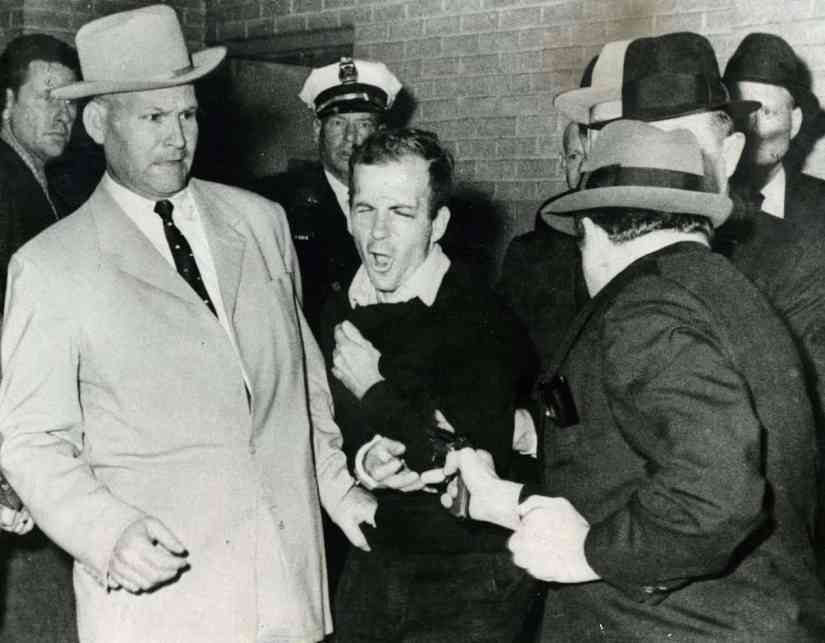
 Lee Harvey Oswald assassinated John F. Kennedy on November 22, 1963 by firearm from the sixth floor of the Texas schoolbook depository in Dallas, Texas. Later that day, Oswald murdered Dallas police officer J. D. Tippit by shooting him four times on a Dallas street approximately 40 minutes after Kennedy. He was arrested while seated in the Texas Theatre a short time later and taken into police custody. On Sunday, November 24 Oswald was being led through the basement of Police Headquarters on his way to the county jail when, at 11:21 a.m., Dallas strip-club operator Jack Ruby stepped from the crowd and shot Oswald in the abdomen. Oswald died at 1:07 p.m. at Parkland Memorial Hospital-the same hospital where Kennedy had died two days earlier. A network television camera was broadcasting the transfer live and millions witnessed the shooting as it happened. After autopsy Oswald was buried in Fort Worth’s Rose Hill Memorial Burial Park.
In 1981, with widow Marina Oswald’s support, the grave was opened to test a theory from a conspiracy book alleging that during Oswald’s stay in the Soviet Union he was replaced with a Soviet double. The rumor claimed that it was this double, not Oswald, who killed Kennedy and who is buried in Oswald’s grave. The author charged that the remains, if exhumed, would prove it when a surgical scar Oswald was known to carry would not be found. Robert Oswald (brother of Lee Oswald) obtained a temporary restraining order halting the exhumation. Marina filed suit against Robert to allow the exhumation to proceed. Two days later citing emotional and financial burdens, Robert withdrew his opposition to the exhumation.
Backhoes began the process with the onset of sufficient daylight at about 6:30 am Central time on October 4th. The initial plan called for the removal of the entire concrete vault containing the casket. When the excavated vault was found to be cracked it was immediately obvious that the casket and body had suffered extensive water damage. The casket cover was noted to be severely weakened and one section had fallen in, actually exposing the remains to onlookers.
The casket was then covered by a cardboard lid and carefully slid onto a wooden platform placed in the trench alongside the coffin. The entire platform was then raised and placed in a waiting hearse for the trip to nearby Baylor University. The excavation took about two and a half hours, by which time the small crowd had turned into a large one including the morbidly curious and several members of the news media.
The remains arrived at Baylor and the examination began at 10:00 am. The casket was opened and it was obvious that the water that had so damaged the coffin had caused marked decomposition of the body as well. The exposed ribs crumbled with only mild pressure and the beige viscera bag containing the organs (placed in the bag after the original ’63 autopsy) was in full view.
Mortician Paul Groody, who had embalmed and buried Oswald in 1963, remained in the examination room long enough to identify the remains as those he had worked with. First, he observed rings on the hands of the body that were placed there by Marina Oswald. The rings, a gold wedding band and a red stone ring, were the same and seemed to be in the same position as he remembered. Secondly, Groody recognized the aforementioned viscera bag that was not in common use in 1963. Finally, Groody noticed that the clothes were those that he had placed on Oswald before he was laid to rest. After making his identification, Groody promptly left the examination room.
The identification would be made primarily using dental records. However, the team was aware of the craniotomy procedure performed on the skull of the deceased that would provide convincing proof of the identity of the corpse. The head was removed from the body in order to facilitate the examination by an incision near the second cervical vertebral interspace. The autopsy saw cut was indeed present providing the first confirmation of Oswald’s craniotomy procedure.
The teeth were cleaned and photographs and x-rays taken. Two forensic odontologists then charted the complete dentition independently and dental casts were made and a positive dental identification of Lee Harvey Oswald was therefore made. A news conference was held at about 3:00 pm to announce, “We… have concluded beyond any doubt, and I mean beyond any doubt, that the individual buried under the name of Lee Harvey Oswald in Rose Hill Cemetery is in fact Lee Harvey Oswald.”
Perhaps unsurprisingly, in the decades that followed, conspiracy pundits raised identity questions based on the condition of the burial vault and coffin, claiming both had been tampered with, questioned the autopsy craniotomy with the charge that the head had been replaced, and questioned the identification by dental records after it was pointed out that Oswald had lost a front tooth during a high school fight (there is a photo of him in class with a gap-tooth smile, and many classmates remember the fight and the missing tooth) and that the exhumed skull had a full set of natural front teeth. However, Marina had made it clear to the media that she considered the exhumation issue closed.
The murder of John F. Kennedy proved once and for all that a disgruntled, motivated mental defective like Oswald can change the world by a singular cowardly act and bask, however briefly, in the reflected spotlight of their unwitting victim. In some circles, Lee Harvey Oswald has become a sympathetic figure. In truth, he’s a stone cold killer who ruined many lives.
Why do I feel it necessary to delve into the gory details of Oswald’s exhumation and subsequent body defilation? Because, for years I’ve watched film clips of a beloved President’s assassination being played and replayed on television and in movies, undoubtedly at times within eye-shot of his friends, family and loved ones, and I object. I think for once, the wages of Oswald’s crime should be made clear. Lee Harvey Oswald does not rest in peace.
 Original publish date: November 5, 2014
 Alan E. Hunter