
Original publish date: December 5, 2019
Politics. No matter where you go, you can’t escape it. No doubt last week Thanksgiving tables all across the Hoosier state either artfully dodged or spiritedly discussed politics in one form or another. Luckily, if you don’t like the political situation in this country, you can do your part to change it by exercising your right to vote. But what about the influence wielded by those most powerful “influencers” who never ran for office nor received a single vote? I’m not talking about the Kardashians, Oprah, Ellen or Taylor Swift. They may influence style and pop culture, but they do not steer public policy.

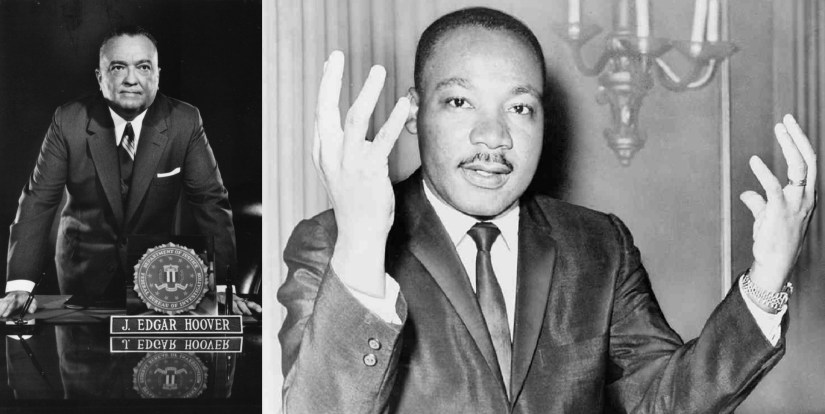
An argument could be made that today we are living within the most powerful unelected government in history of the United States. I would imagine that the average citizen could name more unelected policy influencers than they could legislators. Doubt that? Names like Buffet, Gates, Zuckerberg, the Koch Brothers, Limbaugh, Hannity, Maher, O’Reilly, Soros, Bezos, Musk ring a bell? However, any child of the sixties would counter those examples with names like Dylan, Lennon, Leary, Ali, Malcolm X, and Chavez. The difference is that today’s policy influencers attempt change through money while baby boomer influencers attempted change through ideals. In the case of the sixties, the two most powerful unelected influencers came from opposite ends of the spectrum. They were FBI leader J. Edgar Hoover and Civil Rights leader Dr. Martin Luther King, Jr.
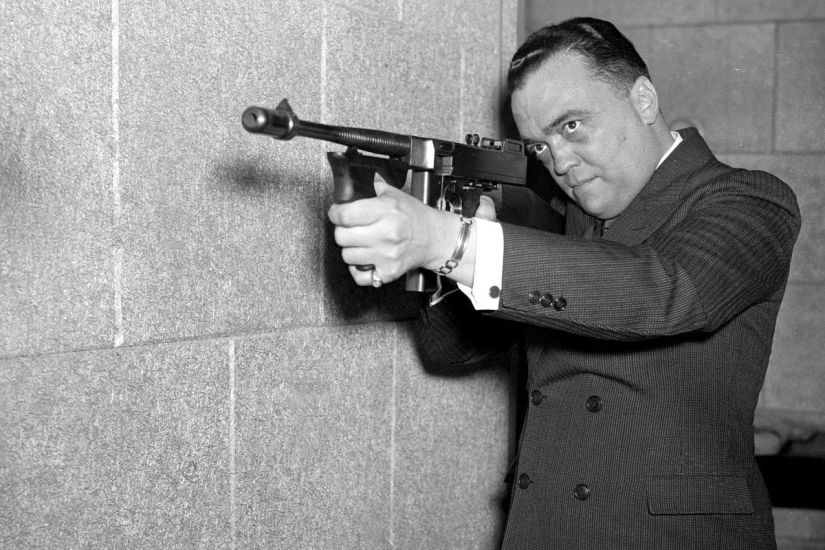
Although J. Edgar Hoover was never elected to any office, for decades, he was every bit as powerful as any person in the country. Hoover’s power emanated from his leadership of the FBI but was enhanced by his ready use of blackmail and, ironically, other criminal practices to stay in power. Since his death in 1972, Hoover’s legacy remains in conflict. Hoover’s critics say he harassed civil rights leaders, discriminated against gays (particularly federal workers) and gathered incriminating evidence to blackmail political figures; friend and foe. While his supporters point to Hoover’s modernization of law enforcement methods, his standardization of the the FBI’s fingerprint database and for bringing forensic science into criminal investigations as his legacy.
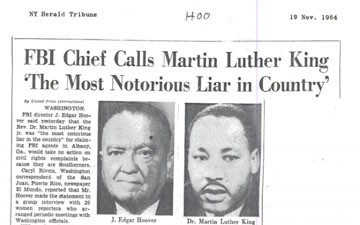
During a three week period 55 years ago, the dichotomy of the Hoover-King affair was defined. On Nov. 18, 1964, Hoover told a gathering of women reporters, “In my opinion, Dr. Martin Luther King is the most notorious liar in the country.” Hoover’s statement was in response to Dr. King’s suggestion that the F.B.I. was not doing enough to protect Freedom Riders fighting Jim Crow racism in the South. That “Freedom Summer” campaign to get African Americans to register to vote was marred by violence, including the killings of three civil rights workers in Mississippi.
Hoover’s comments prompted a request by Dr. King for a meeting with the Director. “I was appalled and surprised at your reported statement maligning my integrity,” King wrote in a telegram to Hoover. “What motivated such an irresponsible accusation is a mystery to me.” King turned the tables on the Director by telling reporters: “I cannot conceive of Mr. Hoover making a statement like this without being under extreme pressure….I have nothing but sympathy for this man who has served his country so well.” In contrast, privately Hoover called King “the burrhead” and “a tom cat with degenerate sexual urges.”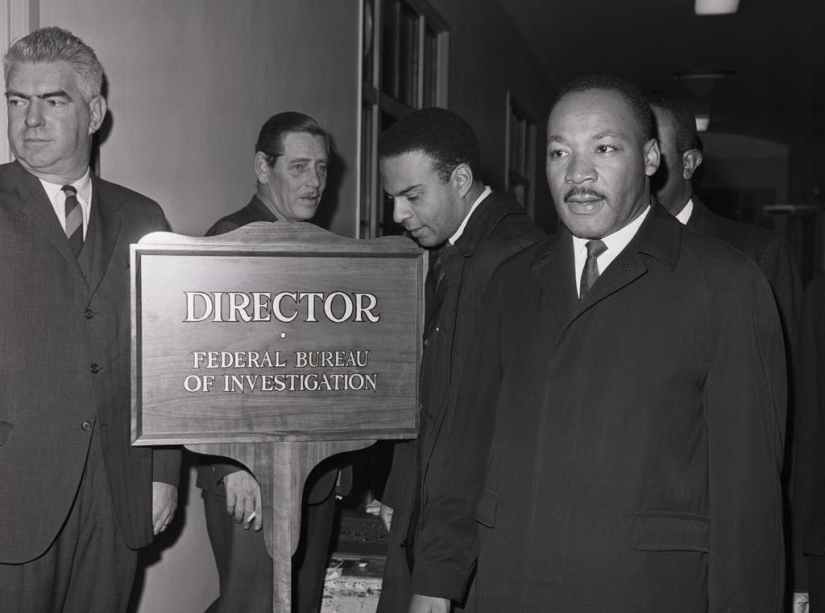
But before that meeting could be arranged, FBI assistant director and head of the Domestic Intelligence Division at the time, William C. Sullivan, sent an anonymous letter to King, threatening to make public the civil rights leader’s sex life. Hence known colloquially as the “suicide letter” for its suggestion that King kill himself to avoid the embarrassing revelations, it is unknown whether the letter was sent at Hoover’s direction. However, a full and uncensored copy can be found in Hoover’s confidential files at the National Archives. The letter dictated: “There is only one way out for you. You better take it before your filthy, abnormal, fraudulent self is bared to the nation”.
On Dec. 1st, Dr. King meets with J. Edgar Hoover to discuss the perceived slander campaign by the Director. Hoover later told Time magazine, “I held him in complete contempt…First I felt I shouldn’t see him, but then I thought he might become a martyr if I didn’t.” Hoover hated King for several reasons, first, because he believed King was a Communist, but also for King’s criticism of the FBI for failing to solve civil rights-related crimes. And, as Wm. Sullivan wrote in his memoir, “Hoover was opposed to change, to the civil rights movement, and to blacks.”
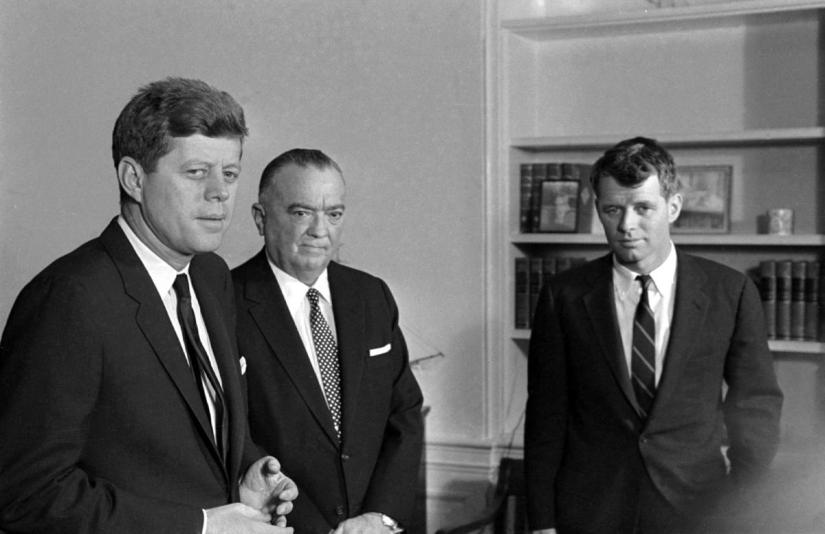
In 1963 Hoover used the King Communist accusation to convince Attorney General Robert Kennedy to allow the FBI tap King’s phones and bug his hotel rooms. Although Kennedy only gave written approval for “limited wiretapping” of Dr. King’s phones “on a trial basis, for a month or so”, Hoover extended the clearance so his men were “unshackled” to look for evidence in any areas of King’s life they deemed worthy. The bugs revealed that King was having extramarital affairs, which disgusted Hoover, a lifelong bachelor whose own sexuality remains a mystery. The bug also picked up King describing Hoover as, “old and senile.” Hoover shared his tapes of King’s sexual romps with President Lyndon Johnson, who then allegedly played them for his aides. Hoover also directed his assistants to leak the details of King’s sex life to reporters. A tape was also sent anonymously to King’s wife Coretta.
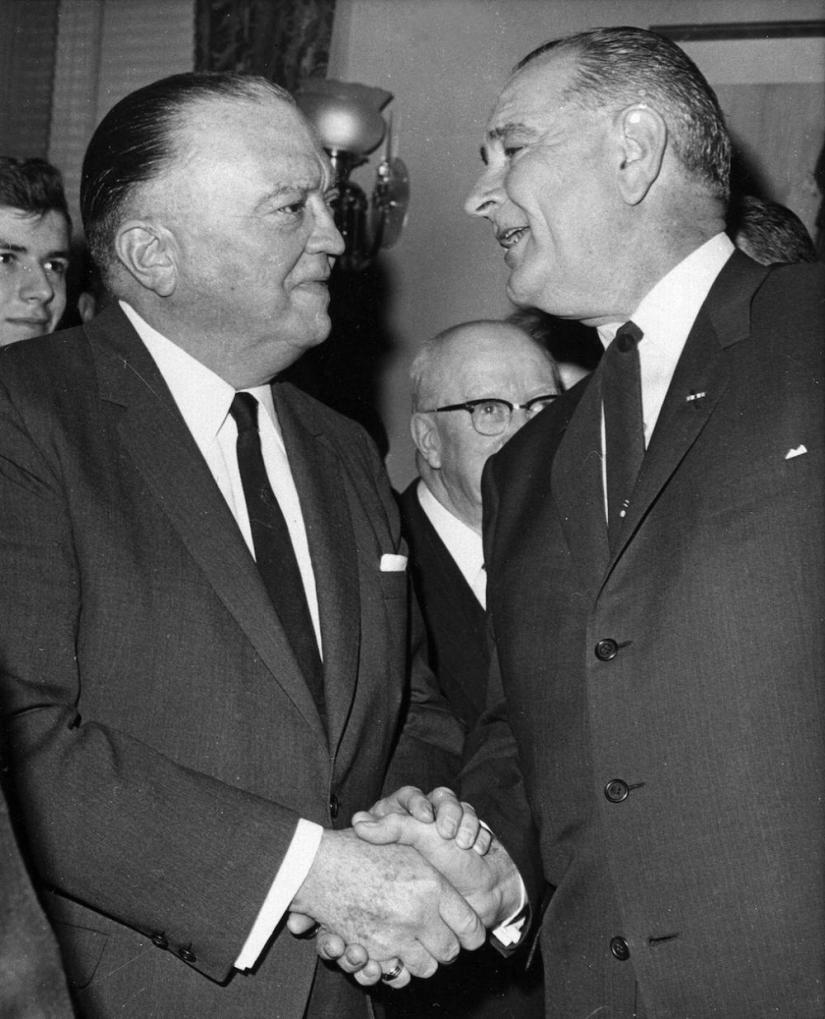
Around Thanksgiving, Newsweek reported that President Johnson had decided to “find a new chief of the FBI.” FBI agent Sullivan wrote that it was “Johnson who ordered Hoover to meet with King and patch things up.” Hoover ordered his aide Cartha DeLoach, “Make sure the meeting is in my office. And no press. Do you hear me, no press!” While DeLoach followed orders no-one informed Dr. King’s aides, and when the civil rights leader arrived at Hoover’s office, there was a mob of reporters waiting outside.
The 69-year-old Hoover met with the 35-year-old Dr. King and his aides, Ralph Abernathy and Andrew Young. “I’m grateful for the opportunity to meet with you,” King said. He told Hoover that he appreciated the work the FBI had done in civil rights cases and said that while “Many Negroes have complained that the FBI has been ineffective but I, myself discount such criticism. And I want to assure you that I have been seriously misquoted in the matter of slurs against the FBI.” Dr. King’s statement took about two minutes. After which, Hoover spoke without stopping for the better part of an hour extolling the virtues of the FBI and denouncing the communists. Meanwhile, America’s greatest Civil Rights orator sat quietly and listened.
During the meeting, Hoover was asked why the FBI didn’t have more black agents. “The problem is, we require not only a college diploma, but in most cases an advanced degree,” Hoover said. “We won’t water down our qualifications because of the color of a person’s skin.” The meeting ended without addressing the issues that had prompted the meeting. “We never got around to discussing the ‘most notorious liar’ business. Nor did we even get to mention the FBI surveillance,” Andrew Young later wrote in his memoir. “In fact, nothing happened except that Hoover rambled on and on about the virtues of the FBI.”
 In 1970, two years after King’s assassination, Hoover told a Time reporter. “King was very suave and smooth. He sat right there where you’re sitting and said he never criticized the FBI. I said, ‘Mr. King’-I never called him reverend- ‘stop right there. You’re lying….If you ever say anything that’s a lie again, I’ll brand you a liar again.’ Strange to say, he never attacked the Bureau again for as long as he lived.” Nobody else present that day remembered that confrontation-not Young, not Abernathy, not even Deputy Director Deke DeLoach, who was taking notes that afternoon.
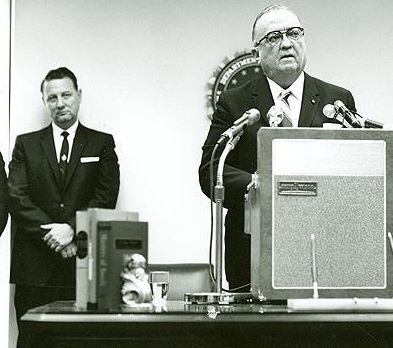
In the years after that meeting, Hoover tasked several FBI agents to 24-hour monitoring of the activities of Dr. King. The FBI Director directed his agents to set up wiretaps, monitor travel, conduct surveillance, and record all of King’s activities- including those he met with, what they discussed, how long they stayed, and how often they interacted- in an attempt to discredit or charge him with something.
President Truman once said, “We want no Gestapo or secret police. The FBI is tending in that direction.” J. Edgar Hoover used his power to further his own agenda and secure his position as leader of the most powerful law enforcement agency in the country. And black people were a favorite target of Hoover’s FBI. Legal scholar Randall Kennedy said that Hoover “viewed protest against white domination as tending toward treason.” This view of the world led Hoover to align himself with all of the forces of racial oppression, but he may have done his greatest damage not through action, but through inaction. He relentlessly pursued high profile targets like the Black Panthers, but neglected to protect the basic human rights of “ordinary” black citizens.
Because Hoover hated communists as much as he hated black people, he often equated one with the other, claiming that the civil rights movement was a tool of the communist party. Make no mistake about it though, J. Edgar Hoover’s enemies list did not end with Dr. Martin Luther King, Jr.. The great crime fighting G-man’s other targets included Ralph Abernathy, Muhammad Ali, James Baldwin, H. Rap Brown, Stokely Carmichael, Eldridge Cleaver, Tom Hayden, Ernest Hemingway, Abbie Hoffman, Malcolm X, and Huey P. Newton and wiretappings and illegal break-ins of the Southern Christian Leadership Conference that King headed.
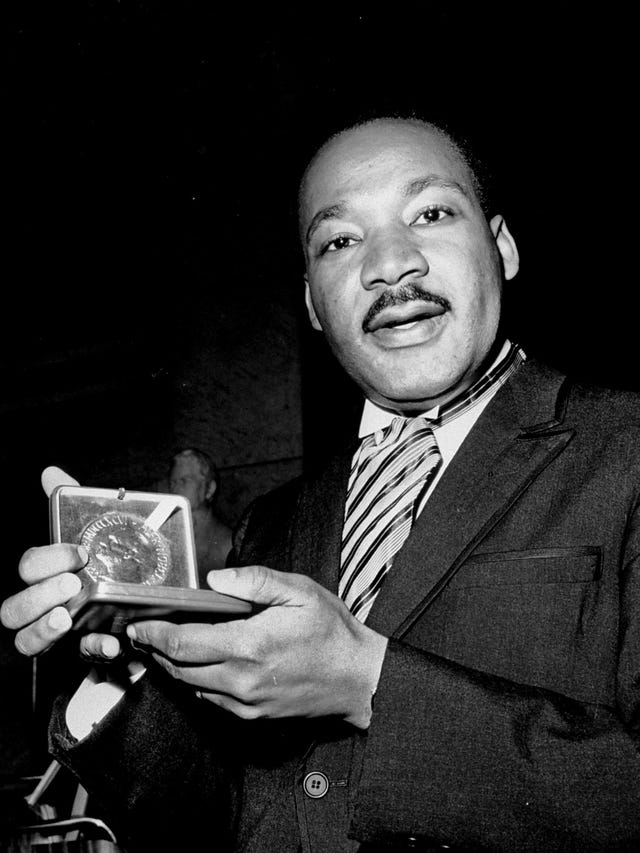
While the Hoover-King meeting was deemed unremarkable and went mostly unnoticed by the American press, it was viewed otherwise by the citizens of the world at large. On Dec. 10th, 1964 the Nobel Peace Prize was awarded to Dr Martin Luther King Jr., making him the youngest winner of the prestigious award. Officially, it was awarded to him for leading nonviolent resistance to racial prejudice in the U.S. At Dr. King’s acceptance speech in Oslo, he remarked, “I accept the Nobel Prize for Peace at a moment when 22 million Negroes of the United States of America are engaged in a creative battle to end the long night of racial injustice…I accept this award today with an abiding faith in America and an audacious faith in the future of mankind. I refuse to accept despair as the final response to the ambiguities of history…I believe that unarmed truth and unconditional love will have the final word in reality…I believe that wounded justice, lying prostrate on the blood-flowing streets of our nations, can be lifted from this dust of shame to reign supreme among the children of men…I still believe that We Shall overcome!”
After King accepted the Nobel Peace Prize, Hoover wrote his reaction on a news clipping: “King could well qualify for the ‘top alley cat’ prize.” And even by 1969, a year after Dr. King’s death, FBI efforts to discredit the Civil Rights leader had not slackened. The Bureau furnished ammunition to opponents that enabled attacks on King’s memory, and tried to block efforts to honor the slain leader. The campaign to tarnish Dr. King’s legacy persisted until Hoover’s death in 1972.
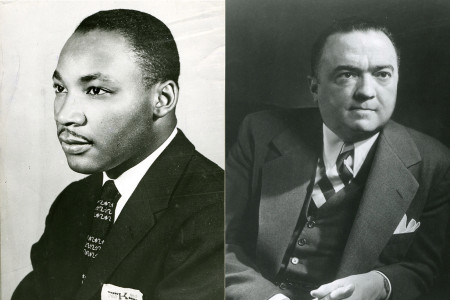
Hoover’s meeting with Dr. King 55 years ago did nothing to enhance his personal legacy. Today, he is remembered as a cross-dressing closet homosexual suffering from paranoid delusions. But could self-loathing also qualify as a symptom of Hoover’s obsession of Dr. King, the Civil Rights movement and personal persecution of the black race?
In his 1993 book “Official and Confidential” author Anthony Summers said that ,in some black communities in the East, he discovered that it was generally believed J. Edgar Hoover had black roots and was even referred to as a “soul brother” in some circles. Writer Gore Vidal, a contemporary of the Director who grew up in Washington, D.C. in the 1930s also said in an interview: “It was always said in my family and around the city that Hoover was mulatto. And that he came from a family that passed.”
So, as you contemplate the many layers of political intrigue addressed in this article and populating the headlines, airwaves and social media today, keep in mind that things may not always appear as they seem. As the Wizard of Oz himself, Frank Morgan said way back in 1939. “Pay no attention to that man behind the curtain!” Oftentimes it is the legacy that reveals the real truths of an age or era. And that legacy can only be accurately deciphered through the lens of time.
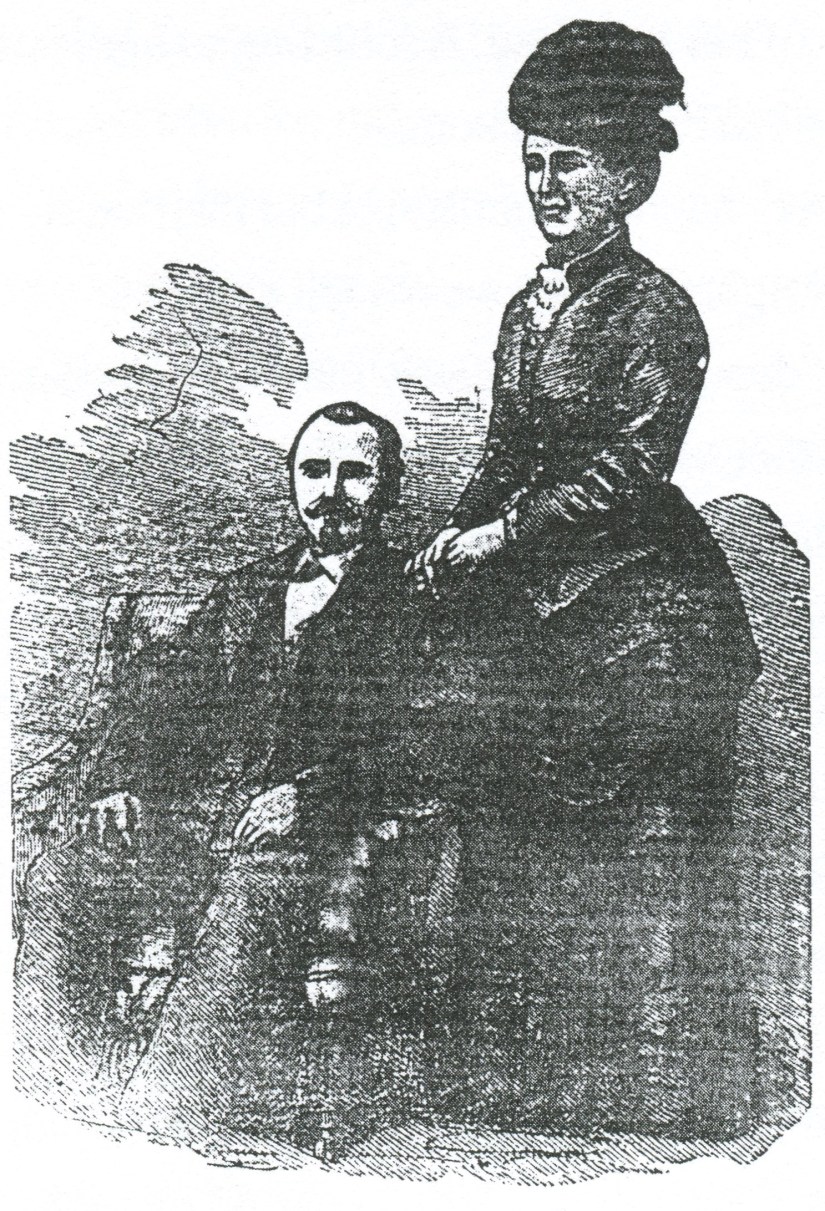
 If he was fearful, Joseph Brown did not show it as he sat down for what would be his last meal. At 5:30 PM, Mary Brown sent her two older children to the Smith’s, neighbors whose home was frequently visited by Wade, the children and Mary Brown. Mary instructed the children that she would come to get them after dinner and that Wade would play fiddle that evening to entertain at the Smith home. During the course of the evening, Wade asked Brown to borrow his buggy. He stated that he wanted to sell a horse to Irvington’s Dr. long. Brown agreed. As dinner ended, Brown went into the front yard to work on an ax handle. Wade was hitching the horse to the buggy.
 The investigation by Coroner George Wishard, namesake of today’s Wishard Hospital, was thorough and damning to Wade. During his investigation at the Brown farm, Wishard “found a board, probably a small kneading tray, hidden away under the shed… Which is bespattered with blood.” Signs of a violent struggle and blood were found in the yard. The mountain of evidence was building against Wade. But did he act alone? Or was “Bloody Mary” Brown, as one of the contemporary newspapers dubbed her, more involved than she claimed?

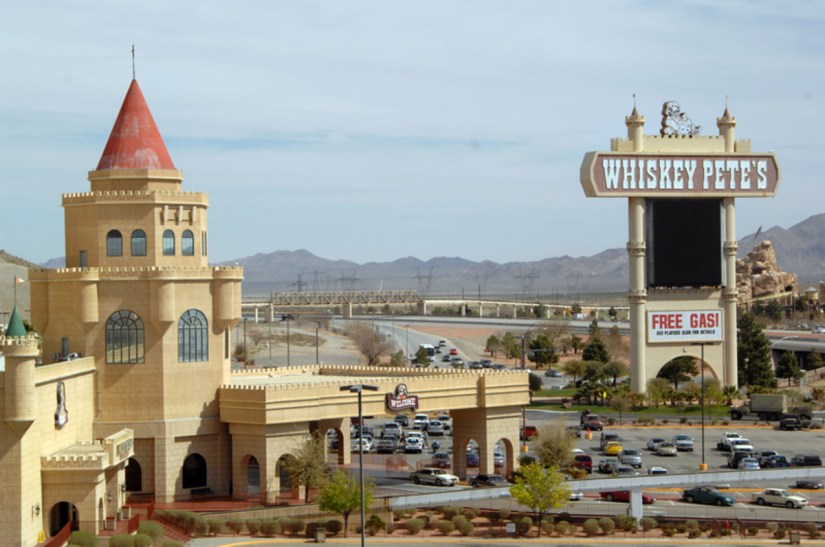 One of those “must see” old timey casinos is located about 30 miles southwest of the Vegas strip in a desert town called Primm, Nevada not far from the California border. Known as “Whiskey Pete’s”, the casino covers 35,000 square feet, has 777 rooms, a large swimming pool, gift shop and four restaurants. The casino is named after gas station owner Pete MacIntyre. “Whiskey Pete” had a difficult time making ends meet selling gas, so he resorted to bootlegging and an idea was born. When Whiskey Pete died in 1933, he was secretly buried standing up with a bottle of whiskey in his hands so he could watch over the area. Decades later, his unmarked grave was accidentally exhumed by workers building a connecting bridge from Whiskey Pete’s to Buffalo Bill’s (on the other side of I-15). According to legend, the body was reburied in one of the caves where Pete once cooked up his moonshine.
 Oh, I forgot to mention that Whiskey Pete’s is also home to the Bonnie and Clyde death car. As detailed in part III of this series, the car has had a long strange trip to Primm. The bullet-ridden car toured carnivals, amusement parks, flea markets, and state fairs for decades before being permanently parked on the plush carpet between the main cashier cage and a lifesize caged effigy of Whiskey Pete himself. According to the “Roadside America” website, “For a time it was in the Museum of Antique Autos in Princeton, Massachusetts, then in the 1970s it was at a Nevada race track where people could sit in it for a dollar. A decade later it was in a Las Vegas car museum; a decade after that it was in a casino near the California / Nevada state line. It was then moved to a different casino on the other side of the freeway, then it went on tour to other casinos in Iowa, Missouri, and northern Nevada.
  Complicating matters was the existence of at least a half-dozen fake Death Cars and the Death Car from the 1967 Bonnie and Clyde movie (which was in Louisiana and then Washington, DC, but now is in Tennessee).” Just in case of any remaining confusion, the Primm car is accompanied by a bullet riddled sign reading: “Yes, this is the original, authentic Bonnie and Clyde death car” (in all caps for emphasis).
 The walls surrounding the death car are festooned with authentic newspapers detailing the outlaw lover’s demise and letters vouching to the vehicle’s authenticity. Cases contain other Bonnie and Clyde relics like a belt given by Clyde to his sister and classic candid photos of the star-crossed lovers and their families.
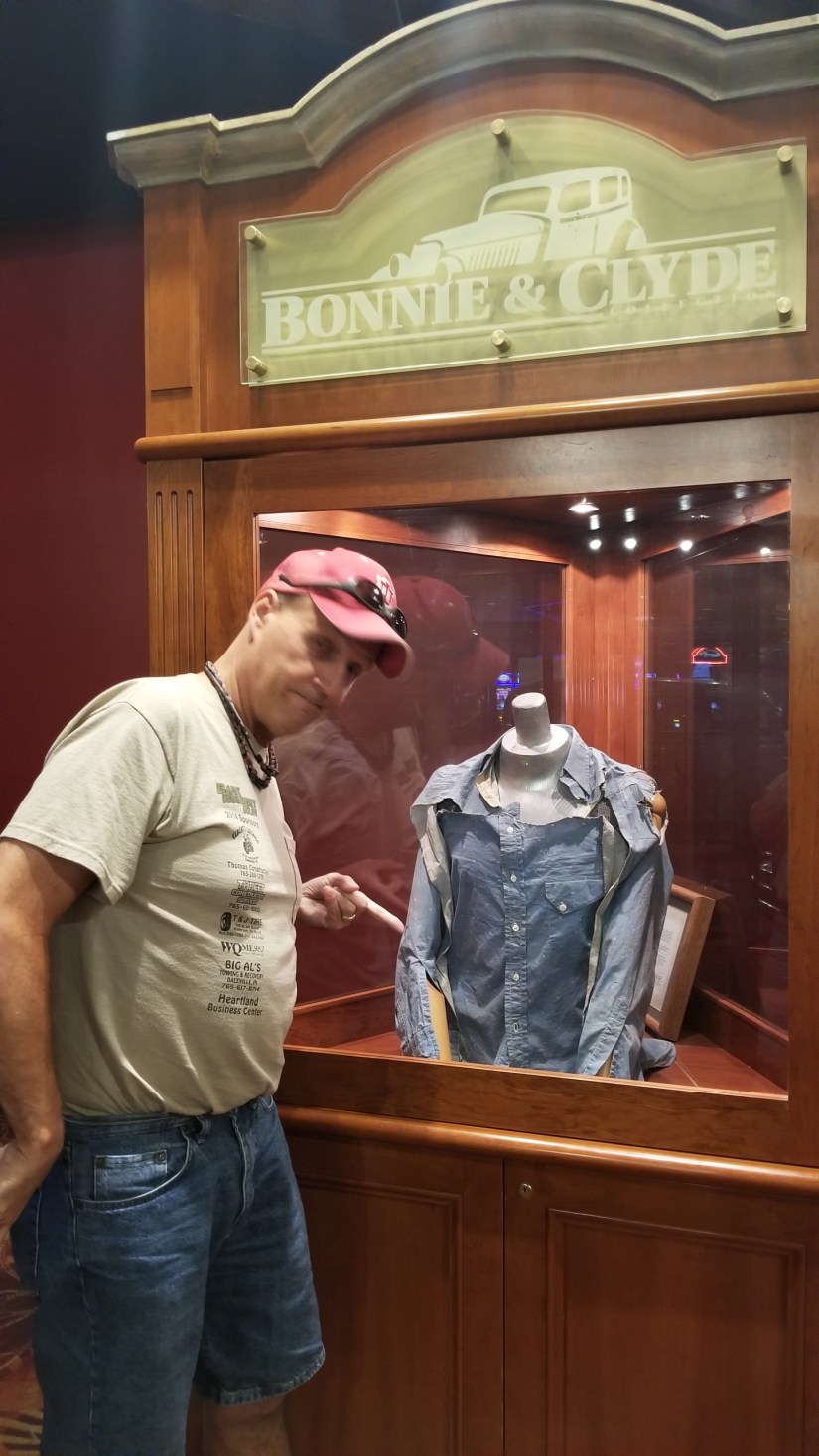
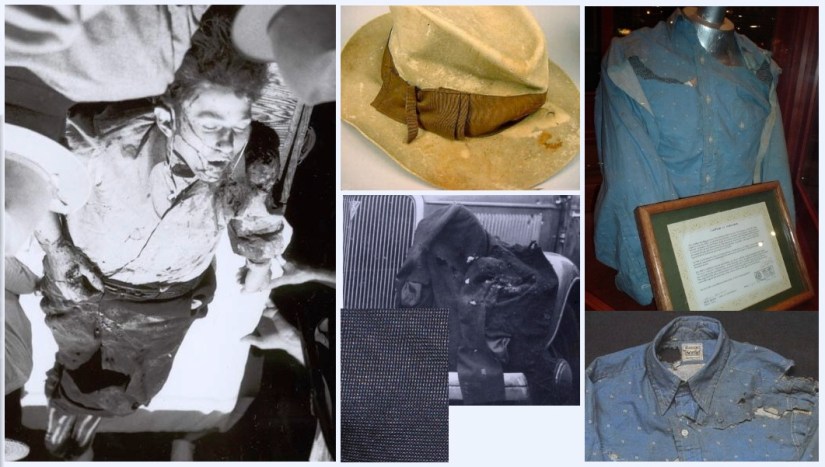 A movie, obviously created many years ago, recreates the event using newsreel footage, landscape photography and contemporary interviews with family members and eyewitnesses. Here, it is revealed that the shirt was found, decades after the outlaw’s death, secreted away in a sealed metal box along with Clyde’s hat. The film itself has become a piece of Americana and the images of Bonnie’s torn and tattered body left twitching in the car, resting silently mere yards away, are equally breathtaking. Nearby, although not nearly as shocking as the Bonnie and Clyde death car, another bullet-scarred automobile is on display. This one first belonged to gangster Dutch Schultz and later, Al Capone. Signs around the car proclaim that the doors are filled with lead and, judging by the pockmarks of the bullets denting the exterior, it is true. Although, like every casino, Whiskey Pete’s job remains separating gamblers from their money, both cars are on display 24 hours a day for free.
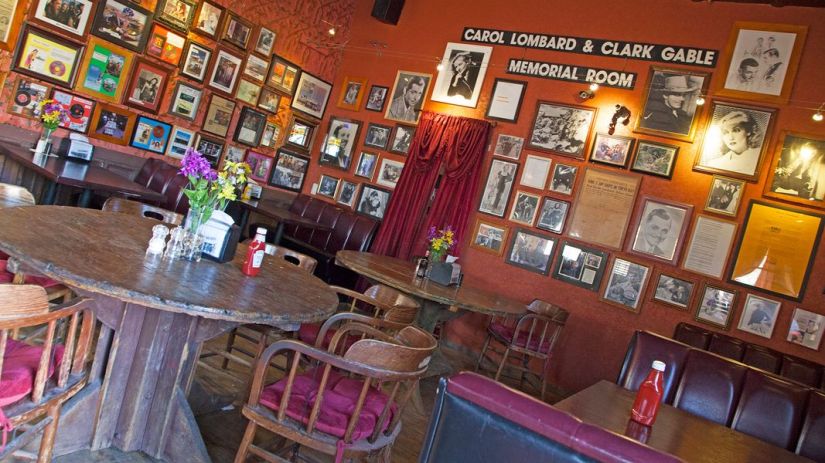 The interior of the Pioneer Saloon remains unchanged. It is easy to imagine Gone with the Wind star Gable drowning his sorrows at a rickety table or bracing himself against the cowboy bar and it’s brass boot rail. Ask and the bartender will point out the cigarette burn holes in the bar caused by Gable when he passed out from a mixture of grief and alcohol during his somber vigil. The tin ceiling remains as do the ancient celing fans (it gets HOT in the desert) and the walls are peppered with bullet holes left by cowboys who rode off into the sunset generations ago. The bar’s backroom is a shrine to the Lombard / Gable tragedy but sadly most of the relics on display there are modern photocopies and recreations. Locals claim that Carole Lombard’s ghost haunts the saloon in a desperate attempt to contact her grieving husband. The saloon is also reportedly haunted by the ghost of an old “Miner 49er” who appears drinking alone at the far end of the bar before vanishing into thin air. Millennials flock to the bar as the birthplace of the game “Fallout: New Vegas” which also has a small shrine located there.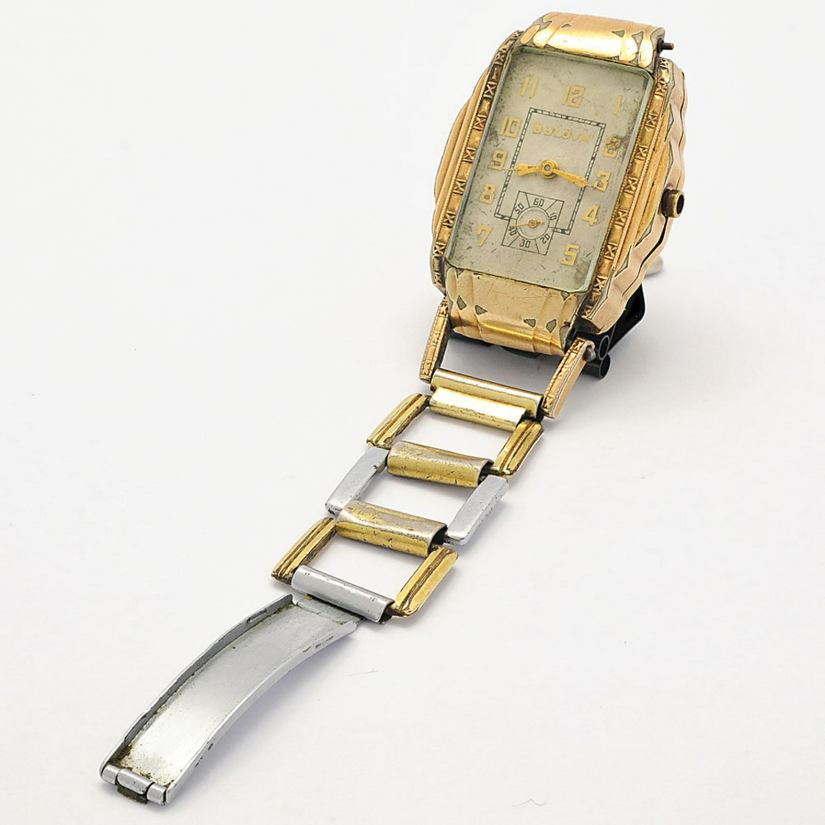

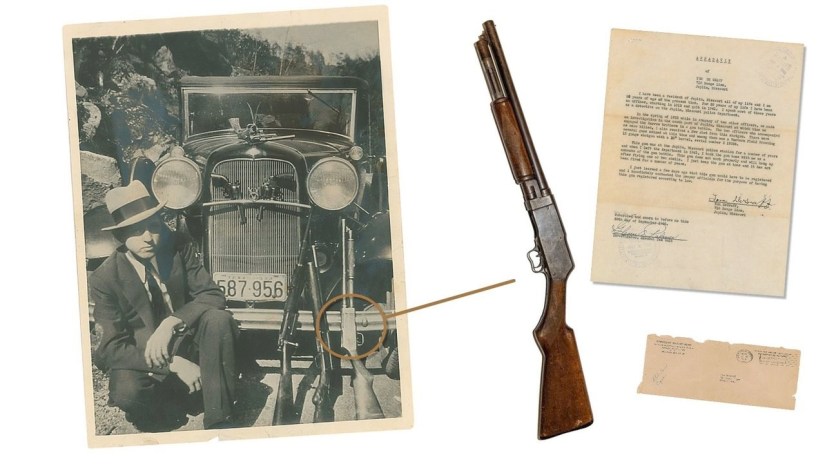


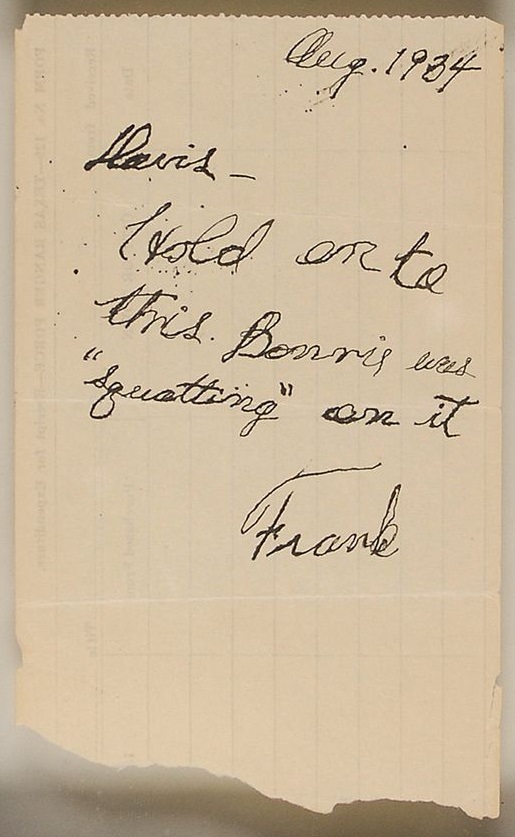


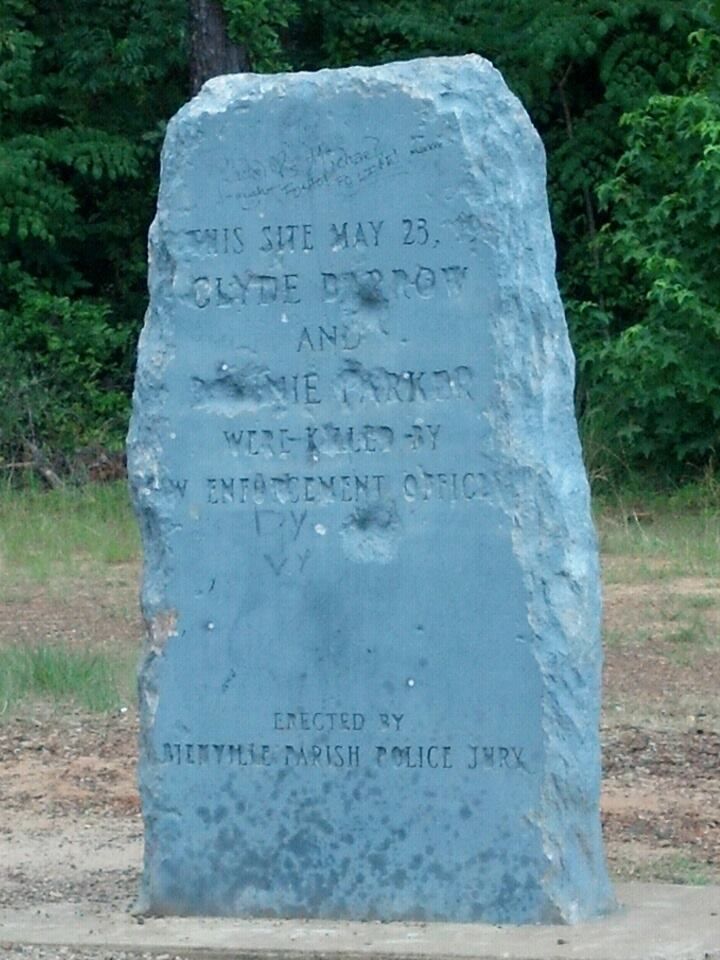
 During the Great Depression, some viewed the duo as near folk heroes, like Robin Hood and Maid Marian. And, although Hoosier outlaw John Dillinger reportedly once told a reporter that Bonnie and Clyde were “a couple of punks”, he and his fellow gang member Pretty Boy Floyd reportedly sent flowers to their funeral homes. The Barrow gang killed a total of 13 people, including nine police officers. They finally met their match on May 23, 1934, when six police officers ambushed them and shot some 130 rounds into the car. Dillinger outlasted Bonnie and Clyde by about two months – he met his maker on July 22, 1934. Truth is, proceeds from auctions of items associated with these outlaws over the past two decades (which number in the millions of dollars) far outdistance the proceeds of all of their robberies combined.
 For my part, when we told our 25-year-old son about our anniversary trip to Las Vegas, he remained nonplussed by saying, “I would only want to go out there to see a town called Primm.” To which we said “been there, done that.” His reply, “I’d also like to go to a little town called Good Springs.” We answered, “Been there too.” He concluded by saying he’d like to see an old dive bar named the “Pioneer Saloon.” He was shocked when we said we went there too. Of course, the reason he wants to venture out there is video game related, not history related. Nonetheless, he was chagrined by our answers. I guess we old folks aren’t so square after all.



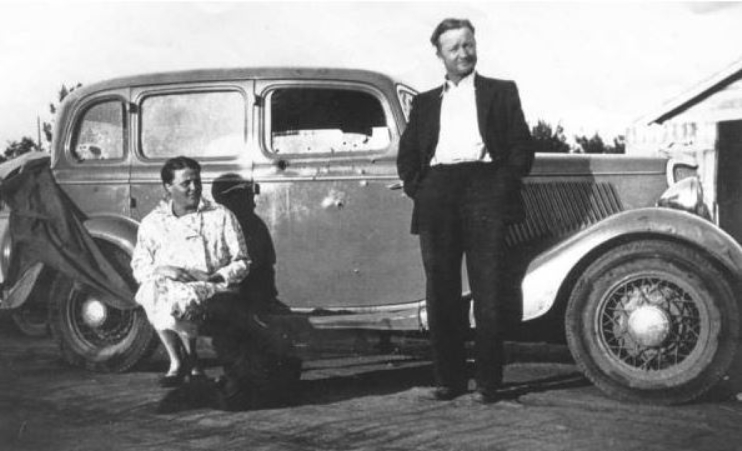
 She called the police and reported the car as stolen. According to the police report, shortly after one o’clock, neighbors saw a man and a woman circling the block in a Plymouth coupe. Later the mystery couple returned, this time with a man riding on the right running board. He jumped off, climbed into the Warren’s car, started it, backed out of the driveway, and sped away. The Warrens wouldn’t see their new Ford for three months.
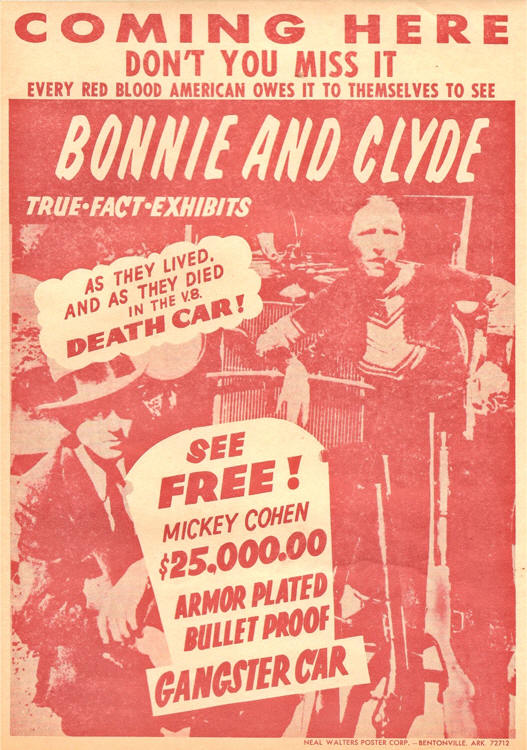 Ruth then rented the death car to carnival operator Charles Stanley, who exhibited it on the Hennies Brothers Midways in his 1939 crime show. Stanley displayed the car outside of his tent and charged admission to see the film of the actual ambush on the inside. Eventually, multiple bullet-riddled 1934 Ford Fordor sedans began appearing on the county fair and carnival circuit over the next few years, all claiming to be the actual death car. The various owners sometimes vigorously defended their claims, too, casting doubt on the authenticity of the real death car. Aside from the damage to historical accuracy, the frauds cut into the revenue generated by Ruth Warren as the death car toured the country.
 After Ruth divorced her husband Jesse, she kept the title to the car and sold it to Stanley for $3,500.The car was then exhibited at Coney Island amusement park in Cincinnati from 1940-1960. After World War II, memories faded and interest waned in the “Public Enemies” Era, pushing the car further-and-further into obscurity. In a 1960 issue of Billboard magazine, Stanley offered the Bonnie and Clyde Death Car for sale. Ted Toddy purchased the car in 1960 for $14,500. The car then sat in a warehouse for years until the popularity of the 1967 movie “Bonnie & Clyde” brought it out of retirement.

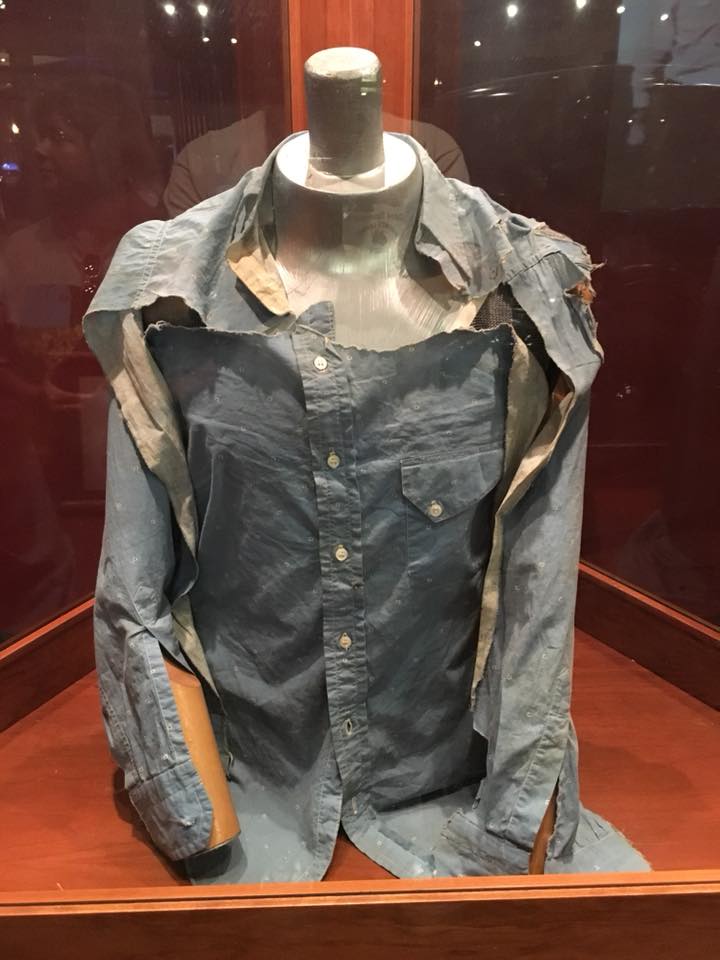

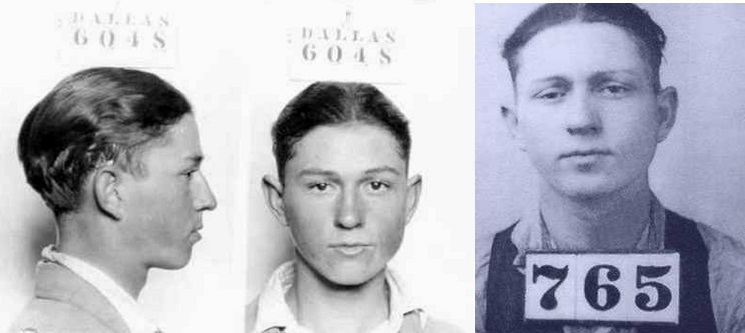
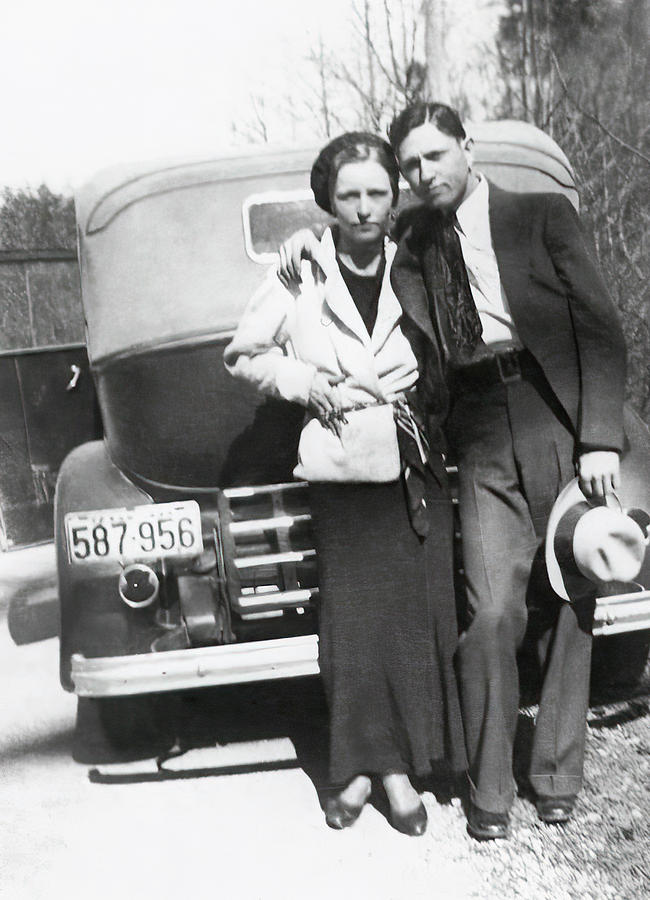
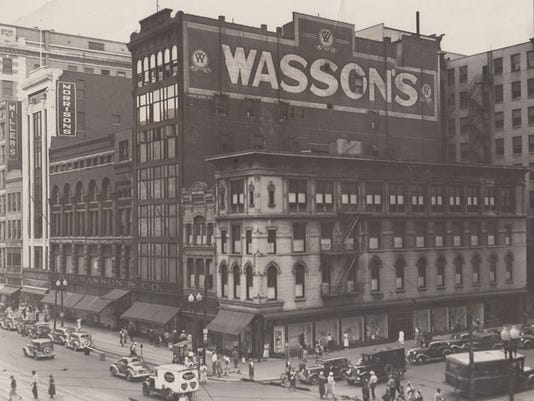
 Clyde was wearing a size 14-32 western style shirt of light blue cotton print with “one patch pocket and pearl buttons” when he was shot to death near Gibsland, Louisiana. The neck label on the shirt reads: “Wasson V Towne shirt/Indianapolis”. The shirt was removed from Clyde Barrow’s body by the coroner who performed the autopsy. Hit by over twenty rounds (Including buckshot), Clyde’s bullet-riddled body slumped against the shattered steering wheel, his 12-gauge shotgun, damaged by the gun fire, slid to the floorboard beside him. Bonnie, with a half-eaten sandwich and magazine at her side, was also struck over twenty times. Both of the star crossed lovers died instantly.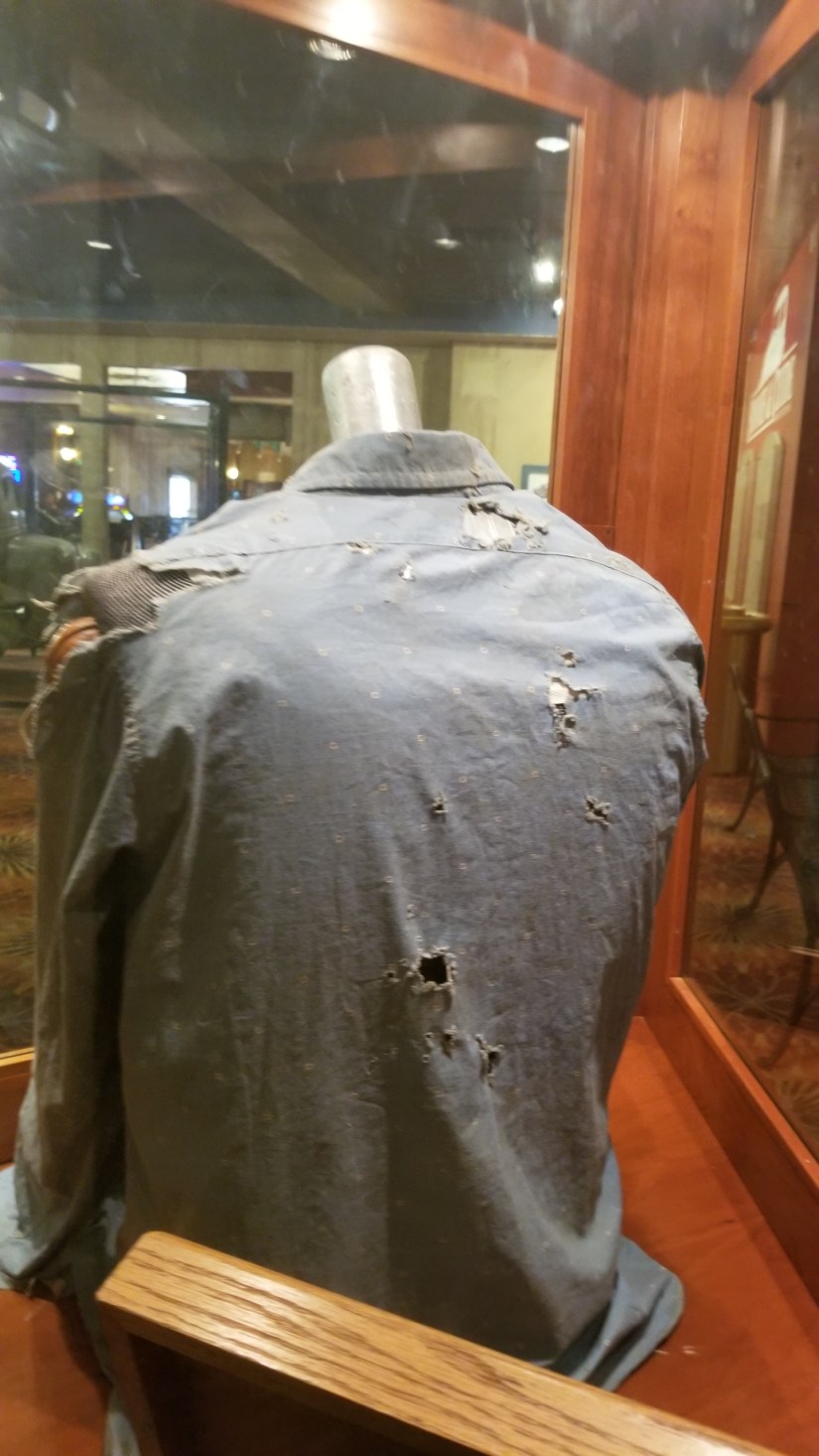
 Alan E. Hunter