Abe Lincoln, Creepy history, Pop Culture

Abraham Lincoln Parenting Skills. Part II.

ln0106_family_i52457_0946dfb2a7Original publish date:  June 10, 2013

Last week, I pondered the parenting skills of our sixteenth President Abraham Lincoln. Coming to the conclusion that I probably wouldn’t want to sit next to Abe and Mary’s kids on an airplane. Witnesses, acquaintances and close friends often remarked, sometimes frankly, other times temperately, that the Lincoln boys were “active.” I ended part one with a great quote from First Lady Jacqueline Kennedy about parenting: “If you bungle raising your children, I don’t think whatever else you do well matters very much.”
Like many a late stage baby-boomer, I realize that I have a fascination with historical celebrity nurtured by mass media that began at a young age. Part of that fascination revolves around the children of famous or noteworthy people, especially when it goes bad. I suppose there is comfort in knowing that rain also falls on the child of privilege as equally as it falls in our own lives. Regardless, there is a morbid fascination with parenting gone bad.
As a kid in Indianapolis, the Vietnam war was very real to me. I had neighbors, family members and school chums touched by the rigors brought on during that useless Southeast Asia debacle. Of course there were the outlandish rumors that passed through the school halls (Leave it to Beaver star Jerry Mathers dying in Vietnam prominent among them) but one rumor I can vividly recall was that Sean Flynn was missing. The son of famous swashbuckling actor and legendary playboy, Erroll Flynn, Sean was an actor turned freelance photojournalist who disappeared on April 16, 1970 while on assignment for Time magazine in Vietnam.
316310_506868396047614_471481590_nSean Leslie Flynn, born May 31, 1971, made some forgettable films during his short movie career including the regrettable remake of his father’s classic “Captain Blood” featuring the predictable title “Son of Captain Blood”. When he “retired” from acting, Flynn signed a contract with Time Magazine. In a search for exceptional images, he attached himself to Special Forces units and even irregulars operating in remote areas.
On April 6, 1970, while traveling by motorcycle in Cambodia, Flynn and Dana Stone (on assignment for Time magazine and CBS News respectively) were captured by communist guerrillas at a roadblock on Highway One. They were never seen again and their bodies have never been found. Although it is known that they were captured by Vietnamese Communist forces, it is believed that they died in the hands of rogue “hostile” forces. Citing various government sources, the current consensus is that he (or they) were held captive for over a year before they were killed by Khmer Rouge in June 1971.
Sean Flynn’s plight has often been sited as the inspiration for the “Russian Roulette” sequences in the 1978 film, “The Deer Hunter” with Christopher Walken winning an Oscar for portraying the character based on Flynn. Flynn’s mother, actress Lili Damita, spent an enormous amount of money searching for her son, with no success. In 1984 she had him declared legally dead. By this time, Sean’s dad, Erroll Flynn, had been dead for 25 years. Erroll Flynn’s life was the stuff of legend and his son’s mysterious disappearance brought the war home to young men all over the country in a way that olive clad casualty statistics just couldn’t convey.
One other disappearance that I wasn’t around to hear about firsthand, but do remember hearing about for years afterward, was the strange case of Michael Rockefeller. The youngest son of New York Governor, U.S. Vice-President & multi-time Republican Presidential candidate Nelson Rockefeller, Michael Clark Rockefeller, was a fourth generation member of the Rockefeller family who had only recently graduated from college. After attending The Buckley School in New York, Rockefeller graduated from Harvard University cum laude in 1960, served for six months as a private in the U.S. Army, then went on an expedition for Harvard’s Peabody Museum of Archaeology and Ethnology to study the Dani tribe of western New Guinea.
The expedition produced Dead Birds, a documentary film, 3,500 photographs, and many anthropological artifacts that are now part of the Michael C. Rockefeller collection at the Metropolitan Museum of Art in New York City. The Peabody Museum exhibits the pictures taken by Rockefeller during that first New Guinea expedition. After returning home with the Peabody expedition, Rockefeller returned to New Guinea to study the Asmat tribe and collect primitive art. “It’s the desire to do something adventurous,” he explained, “at a time when frontiers, in the real sense of the word, are disappearing.” There was one tiny detail that Michael should have taken into consideration though. The Asmats were known headhunters.
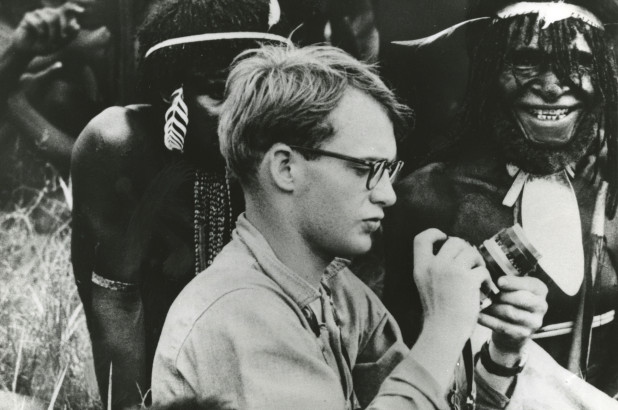
untitled-9On November 17, 1961, Rockefeller and Dutch anthropologist René Wassing were in a 40-foot dugout canoe about three miles from shore when their double pontoon boat was swamped and overturned into the Arafura Sea. Their two local guides swam for help and told the Anglos to stay put, for obvious reasons. After drifting for some time in the rolling waters off the coast of New Guinea, Rockefeller said to Wassing “I think I can make it”. Michael estimated that the catamaran boat was five miles from the shore. The current was against him, and he risked a confrontation with a shark or crocodile, but perhaps because he was a Rockefeller, the fabled family of industrialists, philanthropists and politicians, he decided to swim for it. Later it was determined that the capsized boat was closer to twelve miles off shore when Michael pushed off.
Wassing, a poor swimmer, had decided to stay with the overturned boat, and he tried to persuade the stubborn Rockefeller against his plan. Rockefeller “Jerry-rigged” a life preserver by lashing together two empty gas cans. He stripped down to his underwear and tied his eyeglasses to his head with twine. He took a few deep breaths before paddling toward the forbidding mangrove swamps that lined the southwest coast of the world’s second-largest island. Wassing watched the swimming figure slowly disappear into the watery horizon. The Dutchman was rescued just nine hours later.
Michael Rockefeller was never seen or heard from again. The news that the great-grandson of John D. Rockefeller, founder of Standard Oil Co., was big news around the world. Upon hearing the news, Governor Rockefeller and Michael’s twin sister Mary rushed to New Guinea followed closely by a hoard of over 100 journalists. They searched frantically for 10 days at what the press called “the end of the earth, where Stone Age cultures had survived”. Finally, Nelson Rockefeller held a press conference to say that he had reached the conclusion that his son had died at sea before reaching shore.
In time, news of the disappearance of the youngest Rockefeller faded from the newspaper headlines and Michael joined the pantheon of missing persons that included Amelia Earhart, Jimmy Hoffa and D.B. Cooper. As with each of the other lost luminaries, various theories about Michael Rockefeller’s fate have surfaced over the years. Did he die from exposure, exhaustion or drowning? Did he decide to go native and lose himself in the jungles of New Guinea? Was he eaten by a shark or a saltwater crocodile? Or, in the most sensational speculative twist, was he a pale human trophy for New Guinean headhunters?
Headhunting and cannibalism were still present in some areas of Asmat in 1961. The Asmats MOA included stripping their trophy heads to the bone, bleaching them in the sun, and covering the skulls with painted depictions of the battle at which the victim fell. The size and climate of the huge island, slightly larger than Texas, did not aid Michael’s rescue efforts. A tropical rain forest, it has relentless heat and humidity and swarming insects. The coast is lined with swamps that are nearly impossible to navigate, and the interior jungles are dark and largely impassable. The island, due north of Australia and known as Dutch New Guinea, got its name from a Spanish explorer who saw a resemblance between the natives there and those of the Guinea, West Africa.
To support the death by cannibalism theory, researchers note that several leaders of Otsjanep village, where Rockefeller likely would have arrived had he made it to shore, were killed by a Dutch patrol in 1958, and thus would have been seeking revenge against someone from the “white tribe.” Cannibalism and headhunting in Asmat culture was viewed as an eye-for-an-eye revenge cycle, and it is possible that Rockefeller found himself the unlucky victim of such a cycle started by the Dutch patrol. The Rockefeller family believes that Michael either drowned or was attacked by a shark or crocodile. Rockefeller’s body was never found. He was declared legally dead in 1964.
Regardless, the Michael Rockefeller and Sean Flynn sagas are just a couple examples of the many tragic aspects of parenting that all parents must consider at the end of the day. The internet is full of accounts of missing children and adults. The news of these tragedies often gets lost in the headlines of the day. The best that we can hope for is to never be visited by such an unanswerable parental dilemma in our lifetimes. But for most of us, stories like this are always in the back of our minds. Regardless of our level of parental aptitude.
Creepy history, Ghosts, Witches

Witch Marks.

w1Original publish date:  July 14, 2010

In the spirit of the approaching Halloween season, I’d like to share a story with you that combines many of the elements that peak my curiosity and fuel my passion for history and folklore. Recently, transplanted British antique dealer and collector Rick McMullen traveled back to his motherland in search of merchandise to sell in his shop or add to his home, which he describes as “virtually architecturally antique.”

Rick journeyed to an antique fair near Lincolnshire County in the Midlands of Great Britain where he found a curious large hand-carved oak panel. The 200 pound panel stood over 7 feet tall and was over 4 feet wide and was made in the “Carolean” style dating to sometime in the 1600’s. He had the panel shipped back to the states along with a Gothic-Victorian Era staircase and a 16th century oak timber frame with the intentions of incorporating all of them into his Virginia home.

However, it was that panel that made Rick’s mind race. What was it? What would he do with it? Where did it come from? When Rick’s wife saw the panel, she thought it might make a good headboard for a bed, but Rick quickly nixed that idea. Instead, the panel was set aside for future consideration while ongoing remodeling projects took precedence. There it would rest in peace until one fateful October evening when Rick was watching the history Channel and he saw something that seemed “hauntingly” familiar.

w2He was watching a documentary about witches and soon a segment flashed across the screen that told about the superstitious markings made by ancient people used to ward off witchcraft. The program talked about an English estate called “Kew Palace”, built in 1631. The owners were particularly superstitious, and believed that evil influences or witches could enter the house disguised as cats or frogs and cast spells on people while they slept. To ward this off, the original carpenters who made the roof carved special secret signs near windows, doors, fireplaces and other vulnerable places, to protect themselves from evil. ( Other ways of protecting a house included hiding old shoes, mummified cats and kittens under the floorboards, or ‘urine bottles’ filled with hair and nail-clippings in special, secret cavities.)
Rick immediately realized that he’d seen these very same markings before but couldn’t remember where. He searched his home and inventory looking for something that might jog his memory. He was about to give up when it came to him. It was the panel.

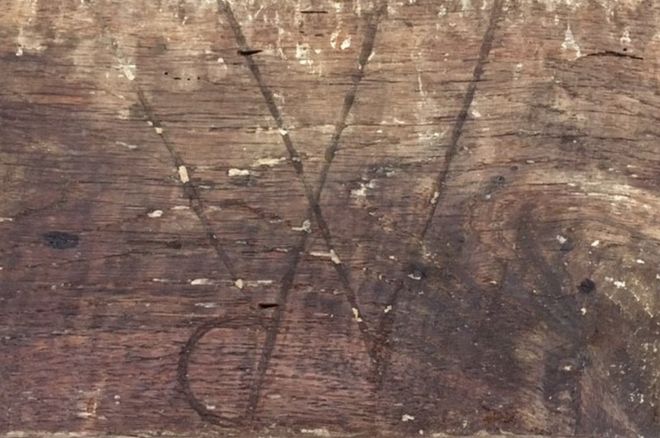
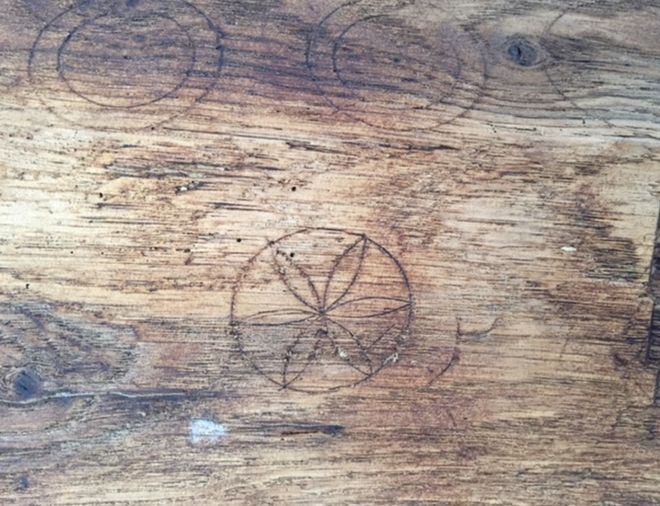
He turned the panel around and discovered about 40 hand carved figures and markings. These hand-cut marks varied in design and structure from interlaced V’s that more closely resemble fancy old English W’s to numerour carved daisy wheels. McMullen learned that these marks were called “ritual marks” or “apotropais”, a Greek word meaning “Intended to ward off evil” and were an important part of the folklore of Great Britain from the 15th to the 17th centuries. They were designed to keep witches, evil spirits and things that go bump in the night out of the home.

Among the Ancient Greeks the doorways and windows of buildings were felt to be particularly vulnerable to evil. On churches and castles, gargoyles or other grotesque faces and figures would be carved to frighten away witches and other malign influences. Those other openings, fireplaces or chimneys, may also have been carved. Rather than figural carvings, these seem to have been random simple geometric or letter carvings.

Contrary to what you may think, these ritual marks were not displayed prominently in the British Isles. It might make sense to put them over doors and above windows, but they were most often secreted away in hidden places to prevent a witch seeing and combating them. There is evidence of these “witches signs” appearing in churches, homes and other stone buildings all over the British Isles dating back to the late Medieval, Jacobean and Carolean Eras.

w3Rick has no idea where the panel originally came from but he suspects that the symbols were cut into the item by the resident family before being affixed as a softening decoration to an ancient stone wall. That way the marks would be unseen by the casual observer, presumed witch or evil spirit, but still provide protection for the family at the same time. Rick quickly discovered that there has been little formal study of these “witches signs” and historians have offered little support to his theories, choosing instead to dismiss them as silly superstitions.

Rick McMullen surmises that the two sets of deeply carved double V’s invoke the protection of holy Mary, “Virgin os Virgins” and mother of Jesus Christ. He believes that the carved daisy wheels, one of which is 18 inches in diameter, represent the “circle of life” with the petals overlapping each other to effectively become one.

McMullen admits that his theories are based on the scant available research and conjecture on the subject. “It’s quite bizarre,” he says. “But I believe it’s the only one in America…to my knowledge, these ritual marks predate Jamestown (1607, the first English settlement in the United States) and by the 17th century, it’s believed the marks were no longer used.”

However, the tradition can still be found in the often grotesque exaggerated faces carved into pumpkin jack-o-lanterns displayed each Halloween on porches and in windows of houses all over central Indiana. These cute childish symbols of Halloween were originally designed to avert evil and ward off the souls of the dead and other dangerous spirits walking the earth at that time.  Today, carved pumpkins are considered to be a wholesome part of the Halloween season shared by children and their parents in kitchens all over the state. A far cry from the origin of the mysterious ancient cravings known as “witch marks.”

Assassinations, Creepy history, John F. Kennedy, Pop Culture

Lee Harvey Oswald and the death of Innocence. Part II

781_1026023017Original publish date:  December 14, 2013

It was Monday November 24, 1963 and recently widowed Marina and the rest of the family were watching the John F. Kennedy funeral in a Fort Worth, Texas motel. Marina wanted to keep watching it, but the family said it was time to leave for nearby Rose Hill Cemetery. When they arrived, the small party drove straight to the chapel, expecting that their loved one would be buried in a religious service. But the chapel was empty. Instead, she was told to expect a brief service at the gravesite.
The 22-year-old widow made her way to section 17 of Shannon Rose Hill Memorial Park, a lonely, sparsely populated plot of Texas real estate where even the grass struggled to survive. A hole was waiting there with a handful of empty chairs waiting alongside. Only a few people were there to watch as the casket was lowered into the ground. Reporters who were covering the funeral carried the casket from the hearse to the graveside. Reporters? The casket contained the remains of 24-year-old Lee Harvey Oswald, the murderer of President John F. Kennedy and Dallas police officer J.D. Tippitt.
The dead man’s wife, Marina, felt humiliated that her husband was denied a religious ceremony. She was ashamed that no friends were present to act as pallbearers for her beloved Lee. Instead reporters, there for a story, were pressed into service to carry the dead man to his final resting place. This sad Texas spectacle was in sharp contrast to the ceremony taking place at the same time some 35 miles away in Dallas. The funeral of Officer Tippit at the Laurel Land Memorial Park cemetery included posthumous awards of valor and accolades from all over the nation. The lavish state funeral of President John F. Kennedy in full swing some 1,360 miles away in the Nation’s Capitol included accolades from all over the world.
Oswald’s funeral time, date and location were kept a closely guarded secret during its preparations in order to keep the morbidly curious away. To further insure that the services would not be disturbed, Oswald’s funeral was held at the same time as JFK’s because the family and officials from the funeral home knew that at that time everyone would be attending the president’s funeral.781_132829300087
On December 16, 2010, the original coffin of assassin Lee Harvey Oswald sold for $87,469 (which includes a 20 percent buyers’ fee) in an online auction at a California auction house. The starter bid was $1,000 and bidding ended when one of two top buyers dropped out around 10 p.m. The auction described the macabre relic as: “Original pine coffin that held the body of Lee Harvey Oswald from his burial on 25 November 1963 until his exhumation on 4 October 1981. At the time, conspiracy theories swirled over who was actually buried in the coffin.The coffin’s wood exterior was very soft from moisture damage, and had dark areas of discoloration. Visible along the sides were the tarnished original metallic ornamentation. The interior of the casket also showed splotchy dark discoloration and moisture-softening of the wood. A portion of the original fabric that lined the top of the casket had fallen upon the decomposed remains. Oswald’s remains were transported back to Rose Hill Cemetery for re-interment in a new casket and vault. The original deteriorated coffin offered here, measures 80″ long x 24″ deep, with the thickness of the sides of the casket approximately one inch. Sitting on wood crate which measures 84″ x 24″. Accompanied by a Letter of Authenticity by Funeral Director Allen Baumgardner, who assisted at the original embalming of Lee Harvey Oswald and later purchased the Miller Funeral Home along with all of its property.”
Because water had got into a cracked burial vault and damaged the original coffin, the funeral home swapped it with the family for a new one and Oswald’s body was reburied in another casket. The original casket was heavily water damaged and whats left of its metal ornamentation is rusted and parts of it, including the roof, have rotted extensively. Its satin lining has long since disintegrated but the coffin still contains shredded newspapers and other padding material left from its manufacture. Baumgardner, one of the funeral directors who participated in that autopsy kept the casket because no one seemed interested in it at the time, The Dallas Morning News reported. Baumgardner was a 21-year-old funeral home assistant when Oswald was shot to death, “I’ve never seen so many security police and FBI and Secret Service and news media just everywhere,” he recalled. The mortician kept it in storage in his Fort Worth funeral home for three decades. But Baumgardner, now 68, decided last month to sell it. “None of us is going to be around forever,” he said.
The auction also included instruments used to embalm Oswald, the 1963 funeral home log book, ( On Page 525 are the details of the original $573.50 mortuary fee and $135 cemetery plot. Oswald’s coffin cost $300, and the leaky vault that enclosed it was $200), an Easter card he sent to his brother and a section of the car seat the President Kennedy was sitting on when he was shot described as “A chilling relic…section of the seat upon which he and First Lady Jacqueline Kennedy sat…Light blue leather seat section which composed the main portion of the bench seat and clearly shows rust-colored staining consistent with long-dried blood…Accompanied by a letter of provenance on White House letterhead by White House Technical Service Rep. F. Vaughn Ferguson. Ferguson, whose involvement with the limousine before and after the shooting is well-documented, writes in part: “…Four days after the assassination the White House upholsterer and I removed this leather at the White House. The light blue leather is from the center of the rear seat…The spots on the leather are the dried blood of our beloved President John F. Kennedy.” The first draft of Oswald’s death certificate is for sale too. It was redone after the justice of the peace hastily wrote “Shot by Jack Rubenstein” in the space listing “How Injury Occurred” and someone pointed out that Ruby had not yet been convicted of the killing.
Although the auction is over and your chance to participate is lost, never fear. For if you want a chance to experience any left over “bad vibes” of Lee Harvey Oswald, you can always travel to Ft. Worth and try to locate the final resting place of the enigmatic Marine assassin. Just keep in mind, its not easy. True Oswald is buried in section 17 of east Ft. Worth’s Rose Hill cemetery (7301 East Lancaster Avenue) once you get there, don’t expect any help from the cemetery staff. The workers are not allowed to divulge the location of Oswald’s grave. The general manager at Rose Hill confirms that curiosity-seekers are not told how to find his grave at the sprawling cemetery, out of respect for his relatives. Another reason for the secrecy might be found in the current marker atop the dead assassin’s body that is inscribed simply “Oswald.” The current rose colored granite stone replaces the stolen original tombstone, which gave Oswald’s full name and birth-death dates.
If you find Oswald’s marker, you’d never realize that his controversial mother Marguerite, who died Jan. 17, 1981, is buried next to him on the left in an unmarked grave. However, the first thing you’ll notice is the stone marker that rests just inches to the left of Oswald inscribed simply “Nick Beef”. For years, veteran journalists, scholars and members of the entertainment world who have studied the assassination, knew nothing about the “Nick Beef” mystery. Who is it? What does it mean? Why is it so close to the Oswald stone? No-one knew.
d12508937307b3a2fe6c2cc97a868177The mysterious stone was first noticed in 1998 and soon after word of the “Nick Beef” stone got out prompting would be grave hunters to ask the staff for directions to that stone, knowing that was the surest way to find Oswald’s. But nowadays, the staff is wise to that ploy and they won’t tell people where Nick Beef’s grave is either. But the question remains, who is / was Nick Beef?
On holidays, when the cemetery is covered with flowers from loved ones, both of these plots typically remain barren. However, they remain free of ornamentation for two very different reasons. It can be argued that no single gravesite in the country holds more secrets than Lee Harvey Oswald’s. Whatever secrets Oswald knew, he certainly took them to the grave with him. But Nick Beef’s grave holds a secret too: it’s empty. Ask the black suits at the cemetery office, and they’ll tell you that Nick Beef is the stage name of a comedian who bought the plot and had a headstone with that name installed. As part of his act, he reportedly told fans that if they wanted to find Oswald’s grave at Rose Hill…just ask for Nick Beef and you’ll find Oswald.
However, the employees can’t tell you anymore about Nick Beef than I’ve told you here, in fact they will often teasingly mislead you by claiming that Mr. Beef is a disc jockey. If you find the Oswald grave and its “Beef” neighbor on your own and return to the office to confront the workers who routinely tell visitors asking for Mr. Beef’s grave by saying “They have no record of any such person”, the office workers explain their dissemination of misinformation with , “I did not lie. You asked me where Nick Beef is buried, and I told you truthfully that no Nick Beef is buried here. That stone marks a cenotaph (A monument erected in honor of a dead person whose remains lie elsewhere).”
Internet searches and computerized property records suggest only one vague possibility – that a “Nick Beef” might have lived in a high-rise apartment complex in New York during the mid to late 1990s. The spot is in Manhattan’s trendy West Village, known for its nightspots, and comedy clubs. But there is no phone number for a “Nick Beef,” and several residents of the complex said they do not remember a neighbor by such a name. However, the Comedy Cellar, one of New York’s most established stage-comedy clubs, whose featured entertainers have included Robin Williams, Jerry Seinfeld and Chris Rock, is located only a block away. But, after that, the “Nick Beef” trail turns cold.
After you have found Lee Harvey Oswald’s Gravesite you can exit Rose Hill Memorial Burial Park and head west on Lancaster Avenue. A couple blocks before you reach the 820 Freeway, on the right side of the road, in the Urban Village of Handley, you will find The Ozzie Rabbit Lodge. Ozzie Rabbit was Oswald’s nickname while in the army.
If you’re looking for a bright spot in the Oswald family tragedy, believe it or not, a few can be found. His brother, Robert, lives in Wichita Falls Texas and according to the funeral home paid the total cost of $710.00 for the burial of his brother. He believes that Lee was guilty of JFK’s murder and blames his mother as the main reason his brother went bad. Robert has lived a model life and has made a few media appearances recently. Despite the stigma of being the brother of an assassin, he maintains a quiet dignity that has earned him the admiration of many. Lee’s half-brother John is deceased.
Lee’s daughters, June and Rachael took the name of their stepfather, Ken Porter, in 1965. This helped them to maintain a slight anonymity while growing up in Texas. According to a 1995 article, June keeps a low profile and uses her married name in an effort to protect her own children from the controversy. She manages to keep a sense of humor and mentioned that she enjoyed the “second spitter” episode of Seinfeld, which parodies the Single Bullet theory. In 1995 it was reported that Rachael worked for seven years as a waitress while putting herself through nursing school. She seemed to be the more conspiracy-oriented of the two daughters and enjoyed meeting Oliver Stone during the making of his film “JFK”.
Marina, the widow of Lee Harvey Oswald, has changed her beliefs about the assassination several times over the years and is often described as being influenced by whatever book or theory is in vogue at the time. In 1965 she married Kenneth Jess Porter, with whom she has a grown son. The couple divorced on October 11, 1974. She has lived in Dallas for many years, and has appeared in numerous documentaries on the Kennedy assassination. In recent years she has expressed the view that Oswald was innocent in the assassination, though she has never recanted any of her Warren Commission testimony. In April 1996 she wrote : “At the time of the assassination of this great president whom I loved, I was misled by the “evidence” presented to me by government authorities and I assisted in the conviction of Lee Harvey Oswald as the assassin. From the new information now available, I am now convinced that he was an FBI informant and believe that he did not kill President Kennedy.”
John Kennedy’s assassination was the death of innocence. After that, the shock, sorrow and overwhelming bewilderment of unexpected celebrity death no longer surprised us. JFK’s was the first American tragedy covered from start to finish by every available media, but most especially television. During that extended weekend of unabated grief, the main players visited us in our living rooms. We could feel the events as they unfolded as if they were happening to our friends, neighbors, or relatives. We would find out in short order that it was sadly all too true. And we would never trust again

Assassinations, Auctions, Creepy history, Criminals, John F. Kennedy, Politics

Lee Harvey Oswald and the death of Innocence. Part I

oswaldshot1Original publish date:   December 7, 2013

Fifty years ago this month, the death of innocence in America began. I believe its roots can be found in a single diary entry made on February 1, 1961 that reads: “Make my first request to American Embassy, Moscow for reconsidering my position, I stated “I would like to go back to U.S.” Nearly two weeks later, on February 13, 1961, the author of that diary entry officially notifies the Embassy that he wants to return to the United States. That disgruntled Cold War continental traveler was Lee Harvey Oswald, the man who killed President John F. Kennedy.
Indeed, a case can be made that the path to the death of innocence in America was paved by many events; the assassination of Abraham Lincoln, the attack on Pearl Harbor, Watergate? However it was the death of JFK that changed America forever. True, three U.S. Presidents were assassinated before Kennedy, but these murders were perpetrated by men best described as “nuts with a cause.” Oswald killed Kennedy for one reason only; fame. Lee Harvey Oswald proved once and for all that one motivated, unknown man with a gun can change history forever. That single act shattered the myth of the invincibility of power and fostered an atmosphere of mistrust of authority that survives to this day.
The assassination of Kennedy is much too complicated to sort out in this simple article and I assume that all of the facts, theories and lore are well known to my readers, so I won’t debate the particulars here. The facts are that both men are dead and both men are forever linked by this one cowardly act. Kennedy was a true American hero; an accomplished author, legendary statesman and devoted father who deserves to be remembered for the way he lived, not the tragic way he died. Oswald is an American nightmare; the product of the original dysfunctional family, a disgraced Marine, a misanthrope who craved fame so much that he didn’t care who he killed to get it. The fact that Oswald’s name is known by millions of Americans disturbs me, but would delight the assassin immeasurably today.
Controversy followed Lee Harvey Oswald for all of his life and doesn’t appear to be waning nearly fifty years after he pulled the trigger. He very publicly supported Fidel Castro’s rise to power in the late 1950s. He defected to Communist Russia at the height of the Cold War in 1960. He changed his mind and returned to the United States, with a Russian bride, in 1961. He tried to kill right-wing Major General Edwin Walker in April of 1963. He killed millionaire President John F. Kennedy with a $ 20 mail order rifle in November of 1963. He was killed two days later in what was the first televised murder in the history of our country. For the next 3 decades he was the central figure in countless conspiracy theories revolving around the death of the President. His body was exhumed in 1981 when rumors persisted that he was not the corpse buried in his own grave. And most recently, his coffin was auctioned for @ $ 87,500 by a California auction house.

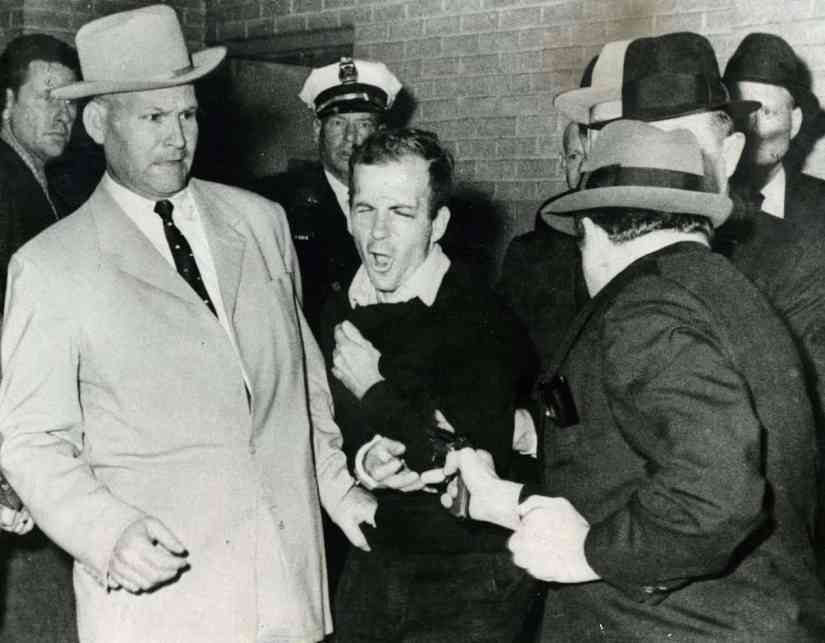
For saleLee Harvey Oswald assassinated John F. Kennedy on November 22, 1963 by firearm from the sixth floor of the Texas schoolbook depository in Dallas, Texas. Later that day, Oswald murdered Dallas police officer J. D. Tippit by shooting him four times on a Dallas street approximately 40 minutes after Kennedy. He was arrested while seated in the Texas Theatre a short time later and taken into police custody. On Sunday, November 24 Oswald was being led through the basement of Police Headquarters on his way to the county jail when, at 11:21 a.m., Dallas strip-club operator Jack Ruby stepped from the crowd and shot Oswald in the abdomen. Oswald died at 1:07 p.m. at Parkland Memorial Hospital-the same hospital where Kennedy had died two days earlier. A network television camera was broadcasting the transfer live and millions witnessed the shooting as it happened. After autopsy Oswald was buried in Fort Worth’s Rose Hill Memorial Burial Park.
In 1981, with widow Marina Oswald’s support, the grave was opened to test a theory from a conspiracy book alleging that during Oswald’s stay in the Soviet Union he was replaced with a Soviet double. The rumor claimed that it was this double, not Oswald, who killed Kennedy and who is buried in Oswald’s grave. The author charged that the remains, if exhumed, would prove it when a surgical scar Oswald was known to carry would not be found. Robert Oswald (brother of Lee Oswald) obtained a temporary restraining order halting the exhumation. Marina filed suit against Robert to allow the exhumation to proceed. Two days later citing emotional and financial burdens, Robert withdrew his opposition to the exhumation.
Backhoes began the process with the onset of sufficient daylight at about 6:30 am Central time on October 4th. The initial plan called for the removal of the entire concrete vault containing the casket. When the excavated vault was found to be cracked it was immediately obvious that the casket and body had suffered extensive water damage. The casket cover was noted to be severely weakened and one section had fallen in, actually exposing the remains to onlookers.
The casket was then covered by a cardboard lid and carefully slid onto a wooden platform placed in the trench alongside the coffin. The entire platform was then raised and placed in a waiting hearse for the trip to nearby Baylor University. The excavation took about two and a half hours, by which time the small crowd had turned into a large one including the morbidly curious and several members of the news media.
The remains arrived at Baylor and the examination began at 10:00 am. The casket was opened and it was obvious that the water that had so damaged the coffin had caused marked decomposition of the body as well. The exposed ribs crumbled with only mild pressure and the beige viscera bag containing the organs (placed in the bag after the original ’63 autopsy) was in full view.
Mortician Paul Groody, who had embalmed and buried Oswald in 1963, remained in the examination room long enough to identify the remains as those he had worked with. First, he observed rings on the hands of the body that were placed there by Marina Oswald. The rings, a gold wedding band and a red stone ring, were the same and seemed to be in the same position as he remembered. Secondly, Groody recognized the aforementioned viscera bag that was not in common use in 1963. Finally, Groody noticed that the clothes were those that he had placed on Oswald before he was laid to rest. After making his identification, Groody promptly left the examination room.
The identification would be made primarily using dental records. However, the team was aware of the craniotomy procedure performed on the skull of the deceased that would provide convincing proof of the identity of the corpse. The head was removed from the body in order to facilitate the examination by an incision near the second cervical vertebral interspace. The autopsy saw cut was indeed present providing the first confirmation of Oswald’s craniotomy procedure.
The teeth were cleaned and photographs and x-rays taken. Two forensic odontologists then charted the complete dentition independently and dental casts were made and a positive dental identification of Lee Harvey Oswald was therefore made. A news conference was held at about 3:00 pm to announce, “We… have concluded beyond any doubt, and I mean beyond any doubt, that the individual buried under the name of Lee Harvey Oswald in Rose Hill Cemetery is in fact Lee Harvey Oswald.”
Perhaps unsurprisingly, in the decades that followed, conspiracy pundits raised identity questions based on the condition of the burial vault and coffin, claiming both had been tampered with, questioned the autopsy craniotomy with the charge that the head had been replaced, and questioned the identification by dental records after it was pointed out that Oswald had lost a front tooth during a high school fight (there is a photo of him in class with a gap-tooth smile, and many classmates remember the fight and the missing tooth) and that the exhumed skull had a full set of natural front teeth. However, Marina had made it clear to the media that she considered the exhumation issue closed.
The murder of John F. Kennedy proved once and for all that a disgruntled, motivated mental defective like Oswald can change the world by a singular cowardly act and bask, however briefly, in the reflected spotlight of their unwitting victim. In some circles, Lee Harvey Oswald has become a sympathetic figure. In truth, he’s a stone cold killer who ruined many lives.
Why do I feel it necessary to delve into the gory details of Oswald’s exhumation and subsequent body defilation? Because, for years I’ve watched film clips of a beloved President’s assassination being played and replayed on television and in movies, undoubtedly at times within eye-shot of his friends, family and loved ones, and I object. I think for once, the wages of Oswald’s crime should be made clear. Lee Harvey Oswald does not rest in peace.

Creepy history, Medicine

The last of the Radium Girls.

Radium girls             Original publish date:  January 2, 2015

2014 has come and gone and along with it, the passing of many notables whose time on this earth has run out. Lost among them is a woman you may have never heard of. Mae Keane died this year. She was the last of the radium girls.
On December 21, 1898, Marie and Pierre Curie discovered the radioactive element radium after extracting it from uraninite. Five years after that, they won a Nobel Prize in physics for their discovery, making her the first woman to win one. She went on to win a second Nobel Prize in 1911; this time in chemistry, for isolating radium, making her the first person to win two.
Radium was soon all the rage: bottled radium water was used as a health tonic, radium filled facial creams were used to “rejuvenate the skin”; the Radium Institute in New York City was giving radium injections to all who could pay for them; some toothpastes started to include Radium; high-end spas began adding radium to the water of their pools and some hospitals were using radium as a treatment for those who had cancer after it was observed that exposing tumors to radium salts would shrink them. Although the latter sounds admirably feasible, the former should sound shocking when you consider that radium is highly radioactive.
Additionally, it was found that when radium salts were mixed with zinc sulfide and a glue agent, the result was a glow-in-the-dark paint. During World War I the advent of trench warfare necessitated the invention of many things. Trenches were dark, damp and dirty. A single match lit by a soldier hunkered down in a pitch dark trench might be the spark to draw enough enemy fire to wipe out an entire company of soldiers. Time dragged on endlessly; when you couldn’t see your own hand in front of your face, you had no hope of seeing the hands of a clock face.
Not only were soldiers crawling and wading around in the mud unable to see their watch dials at night, their pocket watches weren’t suitable for this environment. Soon, watchmakers created men’s watches with straps designed to be worn on a wrist rather than placed in a pocket. Before the great war, wrist watches were primarily worn only by women, with men favoring pocket watches. By November of 1915, British soldiers were putting dots of radium paint next to the hour numerals to make them visible at night. The dimness of the glow was beneficial as they could tell the time without giving away their position.
Of course, at this time, the dangers of radioactivity were not fully understood. Enter Mary “Mae” O’Donnell Keane and the radium girls. In the early 1920s, the hot new gadget was a wristwatch with a glow-in-the-dark dial. Their ads extolled “the magic of radium!” And according to some, radium was magic. Salesmen promised that it could extend your life, pump up your sex drive and make women more beautiful. Doctors used it to treat everything from colds to cancer. In the Roaring Twenties, women earned the right to vote, got the urge to smoke and marched to work in factories alongside their male counterparts.
Young women ranging in age from the mid teens to the early 20’s were employed to apply the paint to clock dials and watch faces. The job was promoted as ideally suited for delicate female hands. The work was easy, the wages high and most dial painters were typically single and living with their parents. Over the first 10 years about 4000 women were employed at 3 locations: Orange, NJ, Waterbury, CT and Ottawa, IL.
The first dial painters came from the china painting industry. These seasoned workers used a technique called lip-pointing which involved wetting their camel hair paintbrushes between the lips to bring it to a sharper point. The practice was passed on to the radium painting industry whose products required fine brush work. In 1924, 18-year-old Mae Keane was hired at the U.S. Radium Corporation factory in Waterbury Connecticut. The pay was $18 a week for a 40-hour work week, and 8 cents a dial. A pretty good salary for a woman back then.
Twelve numbers per watch, 200 watches per day-and with every glowing digit, the radium girls swallowed a little bit more poison. Mae said that on her very first day, she decided that she didn’t like the taste of the gritty radium paint. “I wouldn’t put the brush in my mouth,” she recalled years later. During breaks and at lunchtime, it was a popular pastime of the radium girls to paint comic faces on each other, then turn out the lights for a laugh. “The girls sneaked the radium out of the factory to paint their toe nails and teeth to make them glow,” Keane said.
Mae couldn’t remember what led her to work at the watch & clock factory but did remember that she disliked the work more than she liked the paycheck. Luckily, she was not as fast as her supervisor wanted her to be. “I made 62 cents one day,” Keane once said, which translates to a high of 8 watches in a day. “That’s when my boss came to me and said I better find another job.” That poor performance probably saved her life. She worked in the dial painting room for eight to nine weeks, then transferred to another job at the company. “I often wish I had met him after to thank him,” Keane said, “because I would have been like the rest of them.”
The dial painters would become some of the earliest victims of radioactive poisoning. By the late-1920s, they were falling ill by the dozens, afflicted with horrific diseases. The radium they had swallowed was now slowly eating their bones away from the inside out. “We were young,” Mae told The Hartford Courant in 2004. “We didn’t know anything about the paint. I don’t think the bosses even knew it was poison. The foreman would tell us it was very expensive, and to be careful. We had no idea. But when they did find out, they hid it.”
Reports of maladies afflicting the radium girls began to bubble up to the surface. Dial painters began to suffer from a variety of illnesses, often crippling and frequently fatal as a result of ingesting radium paint. One account describes a woman (Frances Splettstocher) visiting her dentist to have a tooth pulled only to have her entire jaw yanked out in the process. Soon, her gums and cheek rotted away, ultimately resulting in a hole in her cheek. Her health continued to deteriorate and she was dead within the month.
Other radium girls had their legs snap underneath them and more still had their spines collapse. Dozens of women died, many while still in their 20s. Ingested radium is known to deposit permanently in bone structures damaging bone marrow. In all, by 1927, more than 50 women had died as a result of radium paint poisoning. Many of them developed cancerous tumors, honeycombed and fragile bones, and suffered painful amputations. At a factory in New Jersey, 5 of the women sued the U.S. Radium Corporation for poisoning. The trial would have a profound impact on workplace regulations.
Ironically, many in these factory towns blamed the women for the loss of jobs during the Great Depression. Furthermore, it would be discovered that U.S. Radium had paid off doctors and dentists to claim the girls were suffering from the sexually transmitted disease syphilis (often having this listed as the cause of death when the girls died), with the hope that it would not only shield the corporation from litigation, but also sully the girls’ reputations.
At every turn U.S. Radium sought to delay the trial as much as possible with the hope that all the women in the case would die before an outcome could be reached (in fact all five of the original radium girls were dead by the mid-1930s). With the company asking for delay after delay, the trial crawled along at a painful pace. Marie Curie herself chimed in on the issue, but had little comfort to give the radium girls by stating, “I would be only too happy to give any aid that I could, [but] there is absolutely no means of destroying the substance once it enters the human body.” Curie herself would die on July 4th, 1934 from leukemia; likely caused by her long term exposure to radium.
By the time the girls finally got a chance to testify in January of 1928, none of them were able to raise their arms to take the oath, and two were bedridden. After their testimonies, the case was once again postponed for a few months for no good reason. The case was settled in the fall of 1928, before it could be deliberated by the jury, and the settlement for each of the radium girls was $10,000 ($135,000 in 2014 dollars) and a $600 per year annuity while they lived, and all medical and legal expenses would also be paid by the company. Many of the victims would ultimately end up using the money to pay for their own funerals. The lawsuit and resulting publicity was a factor in the establishment of occupational disease labor law. Most importantly, the trial proved that the injuries suffered by the radium girls were completely preventable.
As part of the settlement, the girls agreed not to hold U.S. Radium liable for their health problems. So what was U.S. Radium’s official position in the aftermath? They stated they didn’t settle because they were wrong, but rather because the public was biased against them and they couldn’t have received a fair trial. U.S. Radium’s president, Clarence Lee, stated: “We unfortunately gave work to a great many people who were physically unfit to procure employment in other lines of industry. Cripples and persons similarly incapacitated were engaged. What was then considered an act of kindness on our part has since been turned against us.”
But these radium town’s plight didn’t end when the case was settled in court. The chemical element found its way into the soil and groundwater, contaminating residential and commercial properties around the towns. The dangers of radium no longer was isolated to those who worked in the radium dial plant, it now threatened the populace. The factory sites became EPA Superfund cleanup sites in the 1980s. The plight of the radium girls was now known to, and shared by, everyone.
But Mae Keane was a proud survivor. Over the years, she had some health problems: she developed numerous skin ailments and eye problems, suffered from migraines and had two bouts with cancer. “The doctor wanted to give me chemotherapy,” Keane said. “I told him ‘no.'” Keane lost all of her teeth in her 30s and suffered pain in her gums until the day she died. “I was left with different things, but I lived through them. You just don’t know what to blame,” she said. The only prescription medication she ever took was to control her blood pressure. Despite her ailments, Mae admitted, “I was one of the fortunate ones.”
Keane, a Red Sox fan, was once asked about her secret to longevity. “I’m lazy,” Keane said, adding she never smoked, loved to walk and dance, and enjoyed caramel candy, chocolate and an occasional apricot sour or Bailey’s Irish Cream. “I didn’t get old until I was 98,” she once said.” She was 107 when she died on March 1 in Middlebury, CT.; the last living participant in one of the darkest moments in American industrial history.