animals, Dogs, Pop Culture

Bobbie the wonder dog.

Bobbie_Wonder_Dog_3Original publish date:  December 24, 2017

I can’t think of a better way to kick off 2018 than with a good old fashioned dog story. The story of Bobbie the wonder dog. Bobbie’s “tail” begins during a family visit to Wolcott, Indiana. This tiny town of 1,000 owes its genesis to being the last stop of the Pan Handle Route railroad back in 1861. Wolcott is located halfway between Indianapolis and Chicago on I-65, not far from Indiana Beach. Bobbie the wonder dog is by far the most famous subject to ever come out of Wolcott; literally.
Mr. and Mrs. Frank Brazier, along with their daughters Nova and Leona, were on a 2,500 mile family car trip from their Silverton, Oregon home to Wolcott in the summer of 1923. Joining the family was their 3-year-old bobtailed Scotch Collie / English Shepherd mix dog, whom the girls had named Bobbie. The dog made the cross country journey riding on the running board or atop the luggage of the family touring car.
The family had left Indiana and moved West to Oregon to work outdoors in the hop fields of the Beaver State. At the time, Oregon led the world in hops with more than 34,000 acres in production. Hops are responsible for the pleasing flavors in beer produced by the plant’s flower known as the hop cone. It looks like a pinecone, but is smaller with soft overlaying petals. Hops provide beer with it’s bitter flavor and distinctive aroma. The hop plants rise in mid-March, harvest begins in August and ends in October. The family planned to wrap up their trip and return home in time for harvest. Bobbie had other plans.
On August 15, 1923, Mr. Brazier headed down to the filling station to get the car “tanked up” with gas. As usual, Bobbie rode shotgun on the trip. As Frank went inside to pay, he heard the dog yelp. He rushed out just in time to see Bobbie, in Frank’s words, “run around the corner of the building with three or four snarling curs at his heels.” (Cur being an ancient term used to describe the lowest class of mixed-breed dog) Bobbie had a history of chasing after rabbits and squirrels but always found his way back home.
Thinking Bobbie would take care of himself as usual, Frank left for home expecting to find the dog there upon return. After a couple hours with no Bobbie, the Brazier’s began to get anxious. Bobbie always responded to the sound of the car horn so Frank drove slowly all around town, honking at frequent intervals. Bobbie never appeared. It was midnight before Frank gave up. The next morning, Frank got busy on the phone calling everyone in and around Wolcott, but no one had seen their beloved family pet. The weekly paper even ran an ad asking for information on the lost dog.
The Brazier family remained in Indiana for an additional three weeks looking for any sign of Bobbie, with no luck. Heartsick at their loss, the family gave up the search and headed toward home, leaving word that if the dog turned up the family would have him shipped back to Oregon. Fall turned to winter, the holidays came and went without beloved Bobbie to share the season. The family adjusted to life without the family dog, resigning themselves to the fact that they would never see Bobbie again.
Exactly six months passed. On February 15, 1924, little Nova and a friend were walking down a street in Silverton when she stopped dead in her tracks, gasped and seized her friend by the arm. She suddenly exclaimed, “Oh! look! Isn’t that Bobbie?” Nova was pointing at a shaggy, ragged looking dog as it walked out of a nearby woods in her direction. Nova screamed out “Bobbie” and in moments the dog began leaping up again and again to cover her face with kisses. Bobbie was making half-strangled, sobbing sounds of relief peppered with soft whimpers of joy. He was skinny, footsore, and wearing an unfamiliar collar, but it was Bobbie, sure enough, and his actions proved that he was happy to be home again.
The pads on Bobbie’s feet were worn to the bone causing the Brazier family to wonder, did he walk the entire 2,551 mile distance back to Silverton on his own? Yes indeed, Bobbie had traveled an average of 14 miles per day over plains, desert and mountain terrain to make it back home.
How did the family know that this mutt was truly their Bobbie? When only two months old, Bobbie was kicked in the head by a horse. This left a scar over the dog’s eye. On another occasion, the dog was asleep in the hops field when a passing tractor ran over his leg. The ground was soft and deeply cultivated, which fortunately kept him from serious injury, but the accident left another scar. His third identifiable scar came from an encounter with an angry gopher. While digging furiously in a hillside trying to get at the varmint, he broke off parts of two teeth. All of which helped the family identify the pooch as their beloved Bobbie.
According to Frank Brazier, “Poor Bob was almost all in. For three days he did little but eat and sleep. He would roll over on his back and hold up his pads, fixing us with his eyes to tell us how sore his feet were. His toe-nails were down to the quick, his eyes inflamed, his coat uneven and matted, and his whole bearing that of an animal which has been through a grilling experience. When he first came back he would eat little hut raw meat, showing that he had depended for sustenance chiefly on his own catches of rabbits or prairie fowl.”
After his return to Silverton, Bobbie experienced a meteoric rise to fame. The local paper, the Silverton Appeal, published the story of Bobbie’s cross-country trek, and it quickly spread to newspapers across the country. Soon Silverton was flooded with hundreds of letters from people simply addressed to “Bobbie, the Wonder Dog” or “Silverton’s Bobbie.”
He was the subject of newspaper articles including Ripley’s Believe It or Not!, books and a movie. Bobbie played himself in the 1924 silent film “The Call of the West”. He received more fan mail than President Calvin Coolidge and Harry Houdini combined. He was honored with a jewel-studded harness and collar, medals, ribbons and keys to cities. Frank said, “His dog sense and his love for us led him over three thousand miles, across river and prairie, through towns and wilderness, straight to his own folks…we have had many letters from persons who saw him at different stages of his journey. He would turn up at some house where we had stopped or some town we had passed through, his eyes half closed and red with strain, his feet bleeding, ravenously hungry, so tired he was ready to drop. Some friend of dogs would feed and doctor him and he would rest for a while, but just as soon as he could, he would be up and away again. We are told he was always looking for someone and always in a hurry.”
Mr. Brazier said, “He received presents almost daily, with requests for his picture; has had columns and columns of newspaper stories printed about him, and his photograph has appeared so many times that we have had to get a special scrapbook for all the articles and pictures.” The Oregon Humane Society, at first skeptical of the story, interviewed enough people along Bobbie’s route to confirm that the determined dog had indeed traveled a circuitous 2,800 mile route in the dead of winter to return home. He was the guest of honor at the Portland Realty Board’s Home Show where over 40,000 people stood in line to pet him, and where he received a deluxe dog house a special gift.
Bobbie’s miniature bungalow weighed 900 pounds, had eight glass windows shaded by silk curtains and featured every convenience a well-traveled dog could wish for. The house was on exhibition all week and the show concluded with a formal ceremony where Bobbie was presented with the deed to his domicile. Probably the best gift of all, from Bobbie’s perspective, was a local leash-law exemption that allowed him to roam Silverton freely for the rest of his days.
Upon his death in 1927, Bobbie was buried with honors at the Oregon Humane Society in Portland some 50 miles away from his hometown. Portland Mayor George Baker gave the eulogy. Rin Tin Tin, a German shepherd who was a Hollywood film star, laid a wreath at his grave. Bobbie’s grave is sheltered by the ornate red and white dog house he received at the Portland Home Show. Later, so many people visited the gravesite that the gravestone had to be moved outside of the house for better viewing. Officials feared that the prized doghouse would be destroyed by curious, well-meaning visitors.
Unlike other famous animals of that era, Bobbie was not stuffed after death. This initially limited his potential as a tourist attraction but is seen as a blessing by animal activists today. Later, the Humane Society Headquarters expanded and closed off the cemetery behind a fence, which meant that Bobbie’s grave could only be reached by walking through the building during regular business hours. It just didn’t seem right for the wayfaring dog turned populist hero to be fenced in forever.
In 2012, a grassroots movement was started by Silvertonian’s to remove Bobbie’s remains from Portland for reburial in Silverton. The movement failed and Bobbie’s bones remain nestled securely in the state’s largest city. Nevertheless, Silverton keeps Bobbie’s memory alive by hosting an annual Pet Parade. The first ever was led by his son, and current ones are led by winners of an annual Bobbie the wonder dog Lookalike contest.
Bobbie the wonder dog’s legend was seen as a perfect reason to visit Silverton and failure to move the loyal pup’s bones did not deter the grassroots effort to honor him. In Silverton, a 70-foot-long mural of his life was painted on a wall facing the busiest street in town. At one end, a life-size statue of Bobbie sits on a square of astroturf. Today, the spot has become THE picture spot for selfie lovers in Silverton. Next to the statue is a replica of Bobbie’s fancy dog house.
Bobbie the wonder dog’s story is a reminder of the special place animals and pets have in people’s lives. After all, where would we be without our pet’s?

food, Pop Culture

Tim Hortons.

Tim Horton imageOriginal publish date:  February 15, 2015
So, my fellow donut devotee, you say you’re tired of seeing the object of your desire maligned in the media? Tired of hearing about another donut shop biting the dust? Missing Saps, Roselyn, Krispy Kreme? Did you shed a tear when the bulldozers knocked down the old Crawford’s Bakery at 16th and Capitol last week? Cheer up, you’ve still got Dunkin Donuts to soothe your cravings. And there’s always the new kid on the block from up north, Tim Hortons. But what do we really know about this Canadian upstart dealer of dainty Danish dunker delicacies?
If you’re a hockey fan, you already know where I’m heading. But if you don’t know a hockey puck from a Hostess Ding-Dong, hang on and let me tell you about a man named Miles Gilbert Horton, better known as Tim. Born on January 12, 1930, Horton was one of the greatest Canadian hockey players to ever lace up the blades and take the ice. A defenseman for 24 seasons in the NHL, he played for the Toronto Maple Leafs, New York Rangers, Pittsburgh Penguins, and Buffalo Sabres. From 1950 to 1974, Horton was known by his peers as the strongest man in the game.
Horton was named as an NHL first team All-Star in 1964, 1968, and 1969 and as a second team All-Star in 1954, 1963, and 1967. He was on 4 Stanley Cup Championship teams in 1961–62, 1962–63, 1963–64 & 1966–67. He was inducted into the Hockey Hall of Fame in 1977, the Buffalo Sabres Hall of Fame in 1982 and the team retired his uniform number 2 in 1996. Horton was ranked number 43 on The Hockey News list of the 100 Greatest Hockey Players in 1998. Chicago Blackhawks winger Bobby Hull, himself a mountain of a man, declared, “There were defensemen you had to fear because they were vicious and would slam you into the boards from behind. But you respected Tim Horton because he didn’t need that type of intimidation. He used his tremendous strength and talent to keep you in check.” In a fight, Horton’s trademark move was to immobilize players with a crushing bear hug, which considering his tremendous strength, was probably a blessing in disguise.
Playing in his first NHL game on March 26, 1950, Horton remained a Leaf until 1970. Between February 11, 1961, and February 4, 1968, Horton appeared in 486 consecutive regular-season games; an NHL record for consecutive games by a defensemen for the next four decades. Horton was also a successful businessman whose business ventures included a hamburger restaurant and Studebaker auto dealership in Toronto. But today the bruising NHL defenseman is best known as the founder of the Tim Hortons donut chain. He opened his first Donut Shop in Hamilton, Ontario in 1964. By 1967, Tim Hortons had become a multi-million dollar franchise system. But Horton’s first love was hockey.
In spite of his age (42) and advancing nearsightedness, the Buffalo Sabres signed Horton to a contract in 1972. His superior play helped the Sabres to their first ever playoff appearance in 1973. As a reward, the team signed Horton to a contract extension in the off-season. Sabres GM, Punch Imlach, Horton’s former boss at the Toronto Maple Leafs, gave the aging defenseman a brand new 1974 Ford De Tomaso Pantera Italian-made sportscar as an enticement to return to the team for one more season.
Early in the morning of February 21, 1974 Horton was heading home to Buffalo after a game against his former team at Maple Leaf Gardens the night before. Although the Sabres usually traveled together by bus, Horton made the 100 mile trip alone in his Pantera. The day before the game, Horton had taken a puck in the jaw during practice. His face was swollen and bruised, but true to form, he still wanted to play. With his family and many friends in the crowd at the Gardens, he skated for two periods before leaving the game shortly into the third period. The Sabres lost the game 4-2, and despite sitting out the third period and playing with a jaw and ankle injury, Horton was selected one of the game’s three stars. After the game, Horton met up with his business partner, Ron Joyce, at the Donut company office in Oakville.
“Tim was sitting in our office, his coat on, an ice pack wrapped around his jaw, his driver’s gloves on,” Joyce recalled in 1994. “He was sitting in the dark with his feet up on the table, with a vodka and soda in his hand.” Joyce also claimed that his friend didn’t consume enough to get drunk. Around 3 a.m., Horton called his wife, Lori, and his brother, Gerry. Horton and Joyce talked until about 4 a.m., then Tim left. Joyce later claimed that he saw Horton take a handful of painkillers before he drove off in the Pantera.
Mr. Joyce wasn’t the only one to see the Pantera zoom off on the Queen Elizabeth Highway. A little after 4:00 a.m., a motorist alerted police to a sports car driving dangerously at a speed estimated at 110 miles per hour. Thirty minutes later, Ontario Police Officer Mike Gula observed a speeding vehicle traveling Niagara-bound on the QEW. Gula activated his siren and attempted to pursue Horton’s vehicle, but the office later told the media, “I was doing over 100, but I lost sight. I never got close. A few minutes later, I came on the accident scene.”
As Horton passed a curve at Ontario Street while approaching the Lake Street exit in St. Catharines, he lost control and drove into the center grass median. The tire caught a sewer drain and flipped several times before coming to a stop on its roof in the opposite lanes. Not wearing a seat-belt, Horton was ejected 200 feet away from the car. Mr. Horton’s body was found on the grass of the median according to the diagram included with the report. He was pronounced dead at St. Catharines General Hospital. While the EMT’s worked on the body, investigators combed the scene of the accident. Extra police cruisers were brought in to keep passing motorists from stopping to gawk or hunt for souvenirs.
The police report lists items found at the crash scene: six eight-track stereo cassettes, a set of keys, a package of Old Port Cigars, and a black suitcase with “Tim Horton” tooled into the leather. Police found more personal items, too, including a pair of horn-rimmed glasses, a wallet and a stack of credit cards, $205 in cash, a gold ring, a Waltham jewel watch and two Buffalo Sabres paychecks totaling $1,792.
The Pantera itself was totaled; its front hood crushed, tie rods snapped and tires deflated. Once valued at over $17,000, the vehicle was now worth about $500 as scrap. There was no official public inquiry, and his autopsy was not made public. Police would not state if Horton was driving drunk. Keep in mind that back in 1974, sadly, the stigma against drunk driving was not the same as it is today. The Canadian Transportation Department later launched an investigation to find out why the right front door opened during the crash, allowing for “ejection of the driver.” But the department never issued a report. It is widely believed that doctors eschewed an inquest in order to leave hockey hero Horton’s legacy untarnished.
Horton left behind a wife and four daughters. Following Horton’s death, Ron Joyce offered Horton’s widow Lori $1 million for her shares in the chain, which back then was 40 stores. Accepting his offer, Mr. Joyce became sole owner. Lori died in 2000 at the age of 68. By 2013, Mr. Joyce had expanded the chain to nearly 4,600 stores in Canada alone. Joyce’s son, Ron Joyce, Jr., is married to Horton’s eldest daughter.
On Feb. 21, 2004, 31 years after Horton’s death, the autopsy was made public (with witness statements redacted). The report revealed that Horton’s blood alcohol level was twice the legal limit, and that a 40-ounce bottle of Smirnoff Vodka, with its top broken off, was found among the crash debris. Somewhere at the scene, police also found six tablets: two orange and four green. Another green pill was found in Mr. Horton’s pocket. The drugs turned out to Dexedrine and Dexamyl. Traces of Dexamyl were later found in his blood. The autopsy report found no painkillers in Horton’s body. The car was found to be in good working order. There was nothing to suggest Horton was evading police, or that he even knew police were in pursuit.
The first page of the post mortem report notes that the body on the exam table was “the famous hockey player on the team of Buffalo Sabres.” The details of the paperwork contained statistics that read like a hockey card: length: 5’9″; weight: 210 lbs; and “apparent age,” 44. The report notes that Horton was wearing a brown checked topcoat, a yellow sports coat, a yellow shirt, brown boots and brown pants.
On the second page, the report revealed the grim injuries sustained by Horton as he was flung out of the car: “Extensive crush fractures of multiple bones at the vault of the skull and base of skull;” “fracture dislocation (neck);” “multiple fractures left ribs;” “internal bleeding chest,” and “bleeding on surface of brain and meninges (following head injury).” Ironically, though the report notes massive head injuries, the pathologist found no sign of a jaw fracture. Apparently, the puck that hit Mr. Horton and caused him such pain hadn’t broken the bone. But the report did reveal what killed the previously invincible hockey superstar; a broken neck and a crushed skull.
Tim Horton’s death certificate can be reduced to a single handwritten line: “lost control of car at high speed.” Horton was buried at York Cemetery in Toronto. It seemed that Horton had lived his life by the axium, “Live fast, die young and leave a good looking corpse.” His death must be viewed in the context of his Era. In 1974, drinking and driving was not subject to the kind of moral condemnation that quite rightly attaches to it today. The drugs found on him and in his system were quite common for athletes back in the day. Most likely the 44-year-old Horton was taking speed to stay competitive in the NHL. After all, he was playing against younger, faster players who weren’t even born his rookie year.
Many wondered why the bruising, muscular Horton would have been taking Dexamyl, a drug most commonly marketed in the 1970s to busy housewives trying to lose weight. It was briefly in vogue with celebrities like author Ayn Rand and pop artist Andy Warhol before its addictive qualities were fully known. The pills, called “purple hearts” on the street, turned up regularly on the party scene back in the day. In a 1977 lawsuit against the Toronto Argonauts and Ottawa Rough Riders football teams, a player claimed he was fed Dexamyl and other stimulants by team doctors to improve his performance. That case was settled out of court.
Most Tim Hortons customers have no idea that Horton was a bruising blue-liner in the last glory days of the Maple Leafs. If there is any irony in the premature end of Horton’s life on a dark Canadian highway, it is surely that the name of Canada’s most famous drunk driver now adorns hundreds of donut shops where so many late-night drivers stop for coffee to stay awake. But that doesn’t matter much for those seeking crullers, maple dips or an old fashioned. But when you think of it, a double chocolate donut does kind of resemble a hockey puck and might be a fitting tribute to the greatest defenseman to ever wear a Maple Leafs jersey. And you thought Tim Horton was just a donut.

Pop Culture

Plunk Your Magic Twanger Froggy!

6260-2      Original publish date:  February 22, 2016
To say that my dad’s sense of humor was dry would be like saying water is wet. Every Saturday morning for a half dozen years or so, I met my dad at Pleasant Run golf course for 18 holes of golf. Robert Eugene Hunter was an Arsenal Technical Graduate and all-city center on the Tech Titans football team in the early 1950s. 1954 maybe? I’m surprised I can’t remember the year date because he never lost an opportunity to tell me all about. Now that I’m older and a parent myself, I know that dad’s do that sort of thing. Seems he was always getting things wrong: tv & movie titles, people and place names, year dates, directions. After awhile, I learned to tune most of that stuff out. He died in 1997.
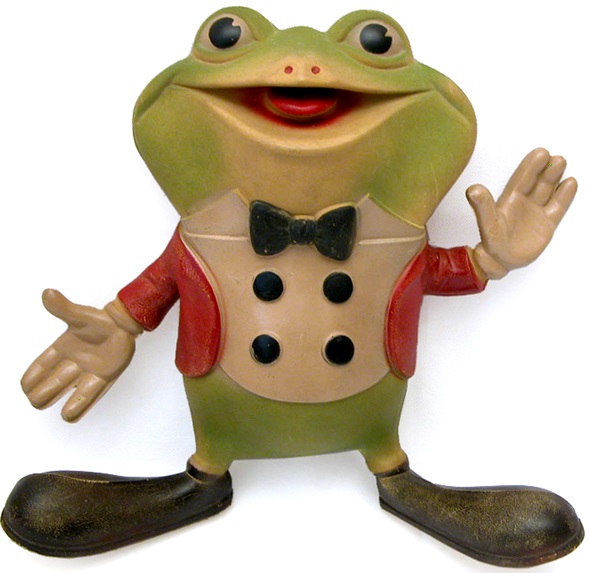
Last week, my wife and I were out searching an antique mall on a cabin fever diversion when we came upon something that looked very familiar to me. It was a little 6″ tall soft rubber frog in a waist coat and bow tie posed with his arms outstretched and his mouth agape. I turned it over and saw that it was dated 1948 and made by the Rempel rubber company out of Akron, Ohio. It also had the trademark of J. Ed McDonnell on the back. I held it up turned to my wife and exclaimed, “Hey Rhonda, its froggy!”
During those Saturday golf outings, whenever I made an extraordinary shot (which was in my opinion more often than not wink, wink) my dad would yell out “Plunk yer magic twanger froggy”. I recall once, while hitting my second fairway shot on the par 4 hole number 4, I hit the metal guardrail that runs alongside Arlington Avenue on the fly and the ball miraculously back towards the green about a foot from the hole. Sure enough, dad yelled out that line and I finally asked him what the heck he was talking about.
Just so happens, we were stacked up on the hole 5 tee waiting for the fairway to clear, so he explained what the saying meant. He told me that it was a line uttered on the “Smilin’ Ed’s show” children’s radio (and later TV) show by a character named “Froggy the Gremlin.” Dad said Froggy was terrifying. “He would appear in a puff of smoke, and grumble in a low, gravely voice, ‘Hiya kids, Hiya! Hiya! Hiya!'” Apparently Froggy was a trouble-maker with no respect for adults known for pulling pranks, practical jokes and generally disrupting the show and presentations of other guests. Dad said that Smilin’ Ed would always call out “Plunk your magic twanger, Froggy” to make him appear.
I really hadn’t thought much about those days until I found Froggy in that antique mall. Although I often found myself using the expression whenever I thought it appropriate to do so, which always elicited quizzical looks from my wife and kids. Knowing my dad’s penchant for getting things wrong, I went home and googled Froggy the Gremlin and was astonished to find that my dad’s recollection was bang on.
According to Wikipedia, “Froggy the Gremlin was a character created by Smilin’ Ed McConnell and brought to radio in the 1940s and television in 1950s on the Smilin’ Ed’s Gang show. Froggy was a troublemaker. Disrespectful of adult authority figures, Froggy played practical jokes and disrupted the presentations of other guests. If a guest were to demonstrate how to paint a wall, they might say, “And now I’m going to take this can of paint…” Froggy would chime in, “And dump it over my head.” And the confused guest would proceed to do so. On radio and the early TV shows, Froggy’s voice was frequently supplied by Arch (“Archie”) Presby, who was also the program’s announcer.”
Smilin’ Ed was born James McConnell in Atlanta, Georgia in 1882. The son of a minister, McConnell began to sing at age three and soon learned how to play drums and the piano before he started school. He was an athletic teenager and later became a professional boxer before enlisting in the US Army during World War I. According to an NBC press release, “A troop train on which he was traveling was wrecked in Arkansas by a German sympathizer and Ed wound up in a river. When he was pulled out, an Army surgeon pronounced him dead, but a buddy finally revived Ed with artificial respiration.”
After leaving the Army, McConnell was a barnstorming gospel singer and sometime evangelist. He got his big break on an Atlanta radio station in 1922 when the scheduled performer failed to show up. He married in 1928, and four years later joined the CBS network. In 1936, McConnell starred on the Acme Sunshine Melodies radio show on WMAQ in Chicago. The Sunday afternoon program was sponsored by Acme White Lead and Color Works. In 1937, he moved to NBC as their “Sunshine Melody Man,” offering hymns and uplifting messages in his rich, distinctive baritone voice.
But McDonnell’s biggest break came in 1944 when he invented Froggy and became known as “Smilin’ Ed” and hooked Buster Brown shoes as his title sponsor. By 1948, 145 ABC stations were subscribing to his “Smilin’ Ed’s Buster Brown Gang” program. Smilin’ Ed’s humor, songs, and music transformed Buster Brown from a dated comic strip character into one of the most widely recognized advertising mascots in the country. The show aired on NBC radio every Saturday morning at 11:30 through April 11, 1953.
The show opened with an adventure story and was peppered throughout by ads for Buster Brown shoes. In between songs and stories, Froggy would magically appear, laughing, hopping from side to side, to sing a song in his low, gruff, Popeye-like croak or annoy regular guests like Shortfellow the Poet or Alkali Pete the Cowboy.
A character named Midnight the Cat spoke a few lines every show and Smilin’ Ed would sing a novelty song or two. Midnight was voiced by the legendary June Foray whose name might not ring a bell, but the characters she supplied voices for surely do. They include Rocket J. Squirrel, Natasha Fatale and Sweet Nell (Bullwinkle & Friends), Cindy Lou Who (The Grinch), Betty Rubble (Flintstones), Jokey Smurf, Granny (Tweety Bird) and the voice of Mattel’s original Chatty Cathy doll. Smilin’ Ed not only promoted Buster Brown shoes but also the comic books that featured little storie involving the “Buster Brown Gang” of Midnight, Squeaky and Froggy.
In 1950, Smilin’ Ed brought Froggy and the whole gang to television in shows that were some of the earliest to be filmed in color. He cut the mold for a long line of children’s television’s jolly fat men to follow; six feet tall and weighing over 250 pounds. Smilin’ Ed McConnell died of a heart attack on July 23, 1954 at Newport Beach, California. King of the cowboys Roy Rogers’ sidekick Andy Devine took over the show. Ironically it is “Andy’s Gang” that most people now remember.
But who was Froggy the Gremlin? Was he a ghost, a creature from outer space, a leprechaun or maybe a short human with an oversized frog’s head? He was dressed in a smart looking red jacket, white shirt and black tie, but he wore no pants. Was he a frog that became a gremlin? A gremlin that had become a frog? And where exactly was his “twanger” and how did he “plunk” it? Nobody really knew much about the magical, mysterious Froggy the Gremlin, but he managed to make my dad shudder a full generation after he left the air. So, Plunk Your Magic Twanger, Froggy and rock on!

food, Pop Culture

Piggly Wiggly.

676030070cd7dd24fd9fe2d2ab789ec2Original publish date:  November 15, 2017
It’s Thanksgiving week in Indianapolis and all over the Circle City, Hoosiers are heading to grocery stores to buy turkey and all the trimmings. No doubt families will be bouncing words back-and-forth to each other off their big screen TVs with belts loosened and feet propped up on recliner footrests all over town. The TV will most likely be tuned to either the news or to football. This holiday, I decided to write about an eccentric American businessman who covers both subjects. Clarence Saunders, the man who brought us the Piggly Wiggly grocery store chain, might be the most interesting man you’ve never heard of.
Clarence Saunders was born on August 9, 1881 to an impoverished family in Amherst County Virginia. An area located inside the birthplace triangle of Jack Daniels, the Confederacy, and Thomas Jefferson. Saunders would absorb the ideas of that region: the good, the bad, and the ugly. One of those ideas would change the world, another would banish him from the hall of immortals and the last would ruin him.
Saunders left school at 14 to clerk in a Clarksville, Tennessee grocery store. By the age of 19, he had graduated to salesman for a wholesale grocer. In 1902 he moved to Memphis where he formed a grocery wholesale cooperative. On September 6, 1916, Saunders launched the self-service revolution in the United States by opening the first self-service Piggly Wiggly store, at 79 Jefferson Street in Memphis, Tennessee. With its characteristic entrance turnstile, customers selected goods for themselves right off the shelves and paid in cash. Before the Piggly Wiggly, products were placed on shelves behind glass counters, dry goods were weighed out from large barrels by store employees and bills were settled with credit or barter arrangements. The concept of the “Self-Serving Store” was patented by Saunders in 1917.
Saunders’ simple plan revolutionized the idea of the common supermarket. His Piggly Wiggly store removed unnecessary clerks, created elaborate aisle displays and rearranged the store requiring customers to view all of the merchandise. Just like today, a shopper picked up a basket (though Piggly Wiggly’s were made of wood, not plastic) and went through the store to purchase everything. Ever wonder why bread, meat, milk and eggs are always in the BACK of the store? You can thank Clarence Saunders and Piggly Wiggly for adding those extra steps to your fit bits. And then, after customers walked to the back of the store to check off their shopping lists, the cash registers are located at the front of the store. Brilliant.
To say that Clarence Saunders was unconventional would be like saying water is wet. For the store’s openings, Saunders held a beauty contest that he advertised in local newspapers. At the door, Saunders shook hands and gave flowers and balloons to the children as they entered to the raucous sounds of a Dixieland band. Newspaper reporters posed as contest judges by awarding five and ten dollar gold coins to every woman, while supplies lasted. Saunders was quoted at that first store opening as saying, “One day Memphis shall be proud of Piggly Wiggly… And it shall be said by all men… That the Piggly Wigglies shall multiply and replenish the earth with more and cleaner things to eat.”
As for the name Piggly Wiggly, nobody knows for sure and Clarence Saunders never explained its origin. One story says that, while riding a train, he looked out his window and saw several little pigs struggling to get under a fence, which prompted him to think of the catchy name. Another explanation states that when Saunders was once asked why he had chosen such an unusual name, he slyly replied, ‘So people will ask that very question.’”
The store’s format was drastically different from its competitors but soon became the standard for the modern supermarket. By 1922, six years after opening the first store, Piggly Wiggly had grown into 1,200 stores in 29 states. Around this same time, Saunders began construction of a pink marble mansion in Memphis that could make Elvis Presley blush. Saunders franchised his concept and soon listed Piggly Wiggly on the New York Stock Exchange. It was heady air for a poor kid from the backwoods of Virginia. Though his model quickly took off, he wasn’t at the helm for very long.
Then, in early 1923, a group of franchised Piggly Wiggly stores in New York State failed. Merrill Lynch and other Wall Street speculators viewed the failure as an opportunity and attempted a hostile takeover on Piggly Wiggly stock. With a loan of $10 million from a number of Southern bankers, plus a bit of his own money, Saunders counteracted by buying a large amount of his company’s stock in hopes of driving up the price. He flamboyantly declared his intent in newspaper ads. Saunders bought Piggly Wiggly stock until he had orders for 196,000 of the 200,000 outstanding shares. The firm’s share price went from $39 in late 1922 to $124 by March 20, 1923. The New York Stock Exchange declared that Saunders had cornered the market and the price was ultimately driven back down. Saunders had to sell his stock at a loss, costing him $3 million and forcing him into bankruptcy. Saunders’ financial woes meant that he had no further association with his Piggly Wiggly brainchild.
Because of this financial reversal, Saunders was forced to sell his unfinished Memphis mansion, nicknamed the Pink Palace, to the city. It eventually became the city’s historical and natural history museum. Today, the Pink Palace includes a scale model of that first Piggly Wiggly store inside, complete with 2¢ packets of Kellogg’s Cornflakes and 8¢ cans of Campbell’s Soup.
Although no longer at the helm of Piggly Wiggly, Saunders wasn’t done redesigning the grocery store business. He went on to create a new grocery store chain, which he named the “Clarence Saunders Sole Owner of My Name Stores” chain in 1928. The chain, known by locals as “Sole Owner” stores, flourished. Within a year there were 675 stores operating with annual sales of $60 million in 1929. It was during this last year of the Roaring Twenties when Saunders saw perhaps his greatest opportunity slip through his hands.
In 1929, to promote his newest grocery venture, Saunders purchased a professional football team. The team practices must have been quite a sight with the team owner dressed in his business suit catching punts alongside his players on the gridiron. He named his new team “The Clarence Saunders Sole Owner of My Name Tigers”, but fans just called them “The Tigers.” In 1929, the National Football League was in its 10th year and consisted of 12 teams, including the Chicago Bears and Green Bay Packers. Although the NFL played a regular season capped by a championship game, they were also free to play teams outside of the league. These games earned the individual NFL teams much needed extra money.
The Tigers played a 12 game season with all but one game in Memphis. During the 1929 season, the Tigers played pro teams like the Nashvile O. Geny Greenies, St. Louis Trojans and Hominy Indians (who were all Native Americans from Oklahoma). One of the teams Saunders brought to Memphis was a team called the Notre Dame All Stars. The four players photographed on horseback were not part of Knute Rockne’s Notre Dame Fighting Irish, but it didn’t matter to Saunders, they added pizzazz to the game and made an eye catching promotional photo. Saunders used his newspaper grocery store ads to promote his football team. Newspaper stories about his team brought more attention to his grocery business.
In addition, Saunders lured two NFL teams to play in Memphis. The Chicago Bears were first to appear, followed by the World Champion Green Bay Packers. On November 23, Saunders hosted the Chicago Bears who were led by their Hall of Fame player/coach George Halas and superstar Red Grange. A crowd of 6,500 crammed into Hodges stadium to watch the game. At one point in the third quarter, the Tigers closed to within 1 point, but the Bears scored three touchdowns in the fourth quarter to win 39-19.
On December 15, the week after the NFL season ended, the Green Bay Packers, undefeated NFL champions, came to town for what they expected to be an easy exhibition game. After all, opponents had scored only three touchdowns against the Pack all season. The 12-0-1 Packers were led by their Hall of Fame player/coach Curly Lambeau, Johnny “Blood” McNally, Cal Hubbard, and Mike Michalske. 8000 fans jammed Hodges stadium and the sidelines. The Memphis fans watched the Tigers manhandle the Packers with a 20 -0 lead going into the fourth quarter. The Packers avoided total humiliation by scoring in the final minutes but were shocked by a 20-6 loss.
Saunders’ Tigers were no slackers. The team included many players who had some prior success on college teams. He increased the talent level with Larry Bettencourt and Ken Strong both members of the College Football Hall of Fame. The next year the NFL extended an invitation to Saunders to join the league. Saunders, a brilliant but highly eccentric micromanager, insisted that all team decisions pass through him even though the team had a business manager and a coach. One of the decisions included putting his oldest son into one of the games during the 1929 season. Legend states that Saunders didn’t join the NFL because he did not like to travel to other cities for away games.
Saunders promised an even better season for 1930. However the Sole Owner chain went into bankruptcy in 1930, a victim of The Great Depression and the football team folded. Conversely, Piggly Wiggly rolled on and by 1932, the chain had grown to 2,660 stores earning over $180 million annually. Today the Green Bay Packers are worth over $ 2 billion and the Bears are worth $ 1.5 billion. However, Grocery Store innovator and would be NFL-owner Clarence Saunders was not done yet.
In 1937 Saunders designed and constructed a prototype of a fully automated store he called the “Keedoozle” (pronounced “Key Does All”). His automated store’s design contained very large vending machines with merchandise displayed as single units within a glass cabinet with a keyhole beneath. Customers entering the store were given a small pistol-like key that they placed in the keyhole below the goods they wished to buy. The quantity desired was determined by the number of times they pulled the key’s trigger. This action, recorded on punched tape, activated back office machinery to assemble the order, which was then dispatched to the checkout on a conveyor belt. On reaching the checkout, the customer’s tape was run through a reader to produce the bill, their groceries were boxed and waiting. This system eliminated the need for shopping carts, decreased space requirements, reduced labor needed to stock shelves, and cut customers’ time at checkout.
Saunders Keedoozle was abandoned after the US entered World War II. In 1948, a new and improved version of the self service store opened at twelve locations but the Keedoozle closed forever in 1949. Right up until the time of his death on September 23, 1953, Saunders was developing plans for another automatic store system called the “Foodelectric.” The concept is a clear predecessor to today’s self checkout lanes. Saunders described it as follows: “The store operates so automatically that the customer can collect her groceries herself, wrap them and act as her own cashier. It eliminates the checkout crush, cuts overhead expenses and enables a small staff to handle a tremendous volume… I can handle a $2 million volume with only eight employees.” The store, which was to be located two blocks from the first Piggly Wiggly store in downtown Memphis, never opened.
Saunders had a reputation for brilliance, contrariness, and eccentricity. His death came just as the full impact of his “better idea” for grocery merchandising was becoming apparent; his creative genius was decades ahead of his time. However, his innovations were not only limited to grocery stores and football. Although Saunders never ran for public office, he was one of the first to use his position as a business owner to campaign for a political candidate. He stumped for Tennessee candidates through his grocery store’s newspaper ads. His ads swayed Tennessee Senatorial and Gubernatorial campaigns for at least 4 cycles in the 1920-30s Era.
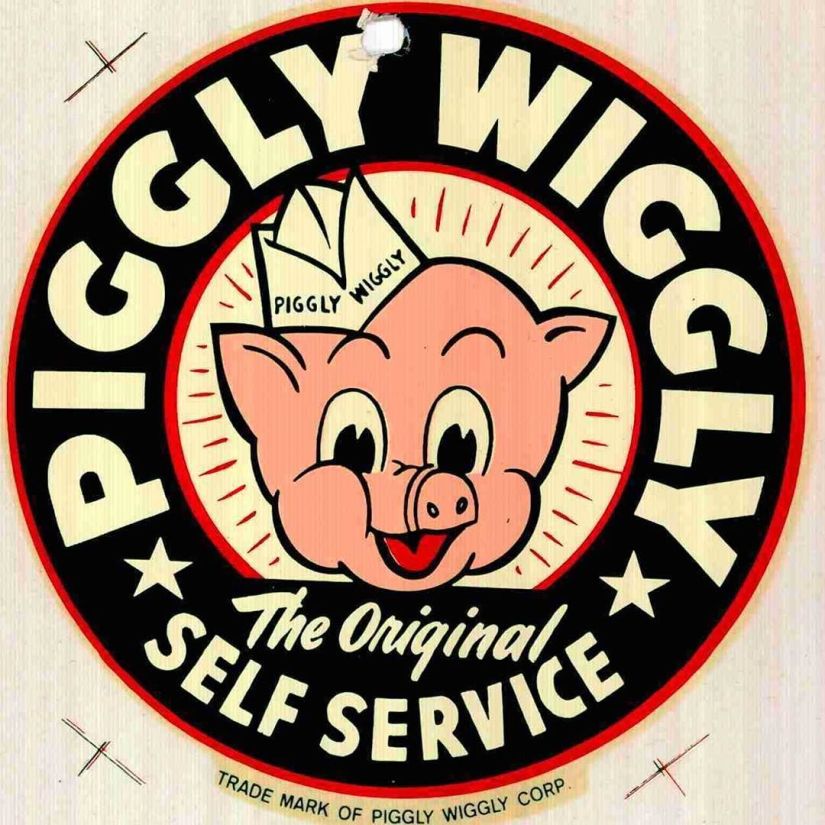
One last innovation goes mostly uncredited and is often misidentified. It is the Piggy Wiggly logo. For generations, people wondered why Warner Brothers never sued Piggly Wiggly for their logo. After all, it seems to be an obvious rip-off of Porky Pig. Well, truth is, Piggly Wiggly opened their first store in 1916, and they have used their anthropomorphic pig with a sales cap logo right from the beginning. Porky Pig wasn’t drawn till 1935.
Clarence Saunders’ Piggly Wiggly Self-serve grocery store concept saved shoppers time, money and made the trip to the grocery more enjoyable for generations to come. Today, according to its website, the Piggly Wiggly chain has more than 530 stores serving 17 states. Its founding is one of the stranger stories in the history of retail. And its founder, Clarence Saunders, was clearly something out of the ordinary.

Baseball, Indianapolis, Weekly Column

The Day Babe Ruth Came To Indianapolis.

Babe Ruth - Older  Original publish date:        August 24, 2015
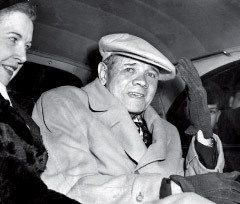
All through the summer of 1946, the mighty Babe Ruth had a severe pain over his left eye that would not go away. At first he thought it was a sinus infection, then a toothache. Whatever it was, it wasn’t getting any better. It eventually caused so much pain that Ruth admitted himself to a New York hospital on November 26. By then the entire left side of his face was swollen, his left eye closed shut, and he couldn’t eat solid food. Doctors removed three bad teeth, then pumped the Bambino full of penicillin and other drugs. By Christmas, Ruth was still in pain and back in the hospital.
Babe Ruth had cancer but the doctors never told him. They had discovered a malignant growth wrapped like a vine around a major artery in the left side of his neck. In the operation that followed, nerves were cut and the artery tied off. Not all of the cancer could be removed. Babe’s wife Claire said she was eventually told, but Babe remained in the dark until the very end. The surgery was on January 5, 1947. In the month that followed, Babe remained confined to the hospital in a state of near constant pain and depression. His hair began to fall out and he lost a lot of weight (estimated at between 80 to 128 pounds). It seemed that the Babe was just waiting to die.
Thousands of telegrams poured in every week from former teammates , sports luminaries (Connie Mack and Jack Dempsey among them), and average everyday fans. Claire read as many of letters as she could out loud to the Babe. On February 6 he celebrated his 52nd birthday in the hospital with Claire, Julia, and their dog, Pal. On February 15, Ruth left the hospital and wept unashamedly as he saw the throngs of admirers gathered outside as he was led to a waiting car. His natty camel’s hair overcoat and matching cap couldn’t hide the fact that Babe Ruth was a shadow of his former self.
Although weak and sickly, Ruth instinctively knew that he was back in the public eye. Extremely conscious of his debt to the “kids of America,” to whose loyal support he attributed his success, Ruth decided to apply himself to child welfare programs after his discharge from the hospital. He was engaged by the Ford Motor Company as a consultant in connection with its participation in the American Legion junior baseball program. In May, 1947, he established and made the first contribution to the Babe Ruth Foundation. Inc., an organization whose name soon became synonymous with youth baseball.
The ravages of his illness left little of Ruth’s once robust physique. The Babe now appeared gaunt, bent and vulnerable. His once resonant voice reduced to only a rasping whisper. The Mighty Ruth continued to astound his physicians by tackling his new job with all his old-time vigor. “They call me a consultant,” said Ruth, “but I want to tell you that I plan to work hard at this job-just as hard as my health permits. The possibilities are unlimited and I won’t be happy until we have every boy in America between the ages of 6 and 16 wearing a glove and swinging a bat.” He logged more then 50,000 miles in support of the program, appearing on diamonds all over the USA in front of thousands of youths.
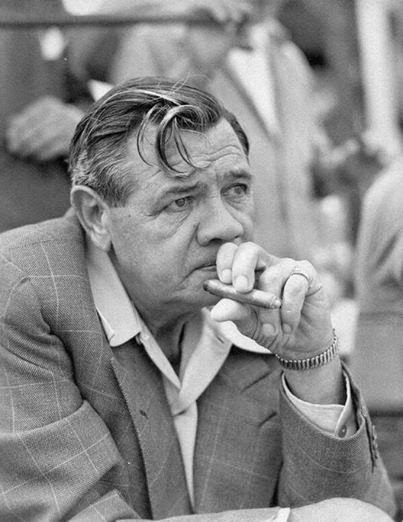
Treatment with an experimental drug beginning in late June improved Ruth’s health tremendously. Throughout that summer of 1947 Ruth became the official ambassador of the American Legion baseball program. One of his stops while on the “American Legion Goodwill Tour” that summer was at the original Victory Field home of the Indianapolis Indians on 16th Street. Ruth appeared at the August 5, 1947 American Legion Junior All-Star game. The Sultan of Swat appeared on the field, shook hands with players and coaches and posed with local youngsters. He signed autographs for the fans and each All-Star player received an autographed baseball from Ruth. Two of the players in that game were future big leaguers Don Zimmer and Jim Frey representing the Robert E. Bentley Post # 50 out of Cincinnati.
The Indianapolis news reported: “Ruth thrilled the crowd when he was introduced during the intermission between the Legion game and the Indianapolis Indians’ game with Milwaukee. Ruth sat through the Legion game and several innings of the Indians game, but his ill health began to take its toll and he had to leave. Earlier in the day, he conducted an hour-long press conference, a pair of radio broadcasts and attended a luncheon in his honor. Once a hefty 278 pounds, Ruth’s weight had dropped to 193. He was coming off an illness that almost cost him his life and had just undergone a blood transfusion three days prior.”
The news spoke to one of the kids after the game about meeting the Babe, “His voice was deep and raspy, he coughed quite a bit, but it was the thrill of a lifetime.” said the unnamed player. The young athlete was surprised to see the once robust Ruth in such failing health, but impressed that he would spend time with them. Babe Ruth breezed through Indianapolis like an aging movie star unveiling their star on the Hollywood walk-of-fame. He was gone as fast as he came. It would be nearly 40 years after Ruth’s visit before my dad, Robert E. Hunter Arsenal Tech class of 1954, sat beside me at old Victory Field and dreamily stated, “You know I was here when Babe Ruth came through in 1947. I was selling peanuts here in the grandstands.” Strangely, he could rattle off the names of all those Pittsburgh Pirates minor league players on that team but couldn’t recall much about the Babe’s visit that day.
Ford renewed Ruth’s contract in early 1948, “not only because he was an inspiration to every American boy but because of the excellent results of his efforts last season.” The ex-slugger’s salary was not revealed but Ford announced that it “ranks him high on the list of baseball’s top money-earners.” As long as his strength permitted, Ruth continued to make appearances on behalf of the Junior Baseball program. It was to be only a momentary reprieve. At his last appearance in June 1948, before 16,000 youngsters in St. Louis, he was too weak to wave a bat for photographers.
The remaining piece of the tumor was growing, and soon morphine was the only thing that could stop the discomfort. Babe still tried to live his normal life of golf outings and devouring steaks, but now the drives fell far short off the tee and the meat had to be served chopped up for him. Soon even biting down on the white of an egg caused excruciating pain for the once mighty “Sultan of Swat.” Despite the pain, Babe wrote in the closing of his autobiography “The Babe Ruth Story” that hopeful summer of 1947: “I’ve got to stick around a long, long time. For above everything else, I want to be a part of and help the development of the greatest game God ever saw fit to let men invent-Baseball.”
Ruth bravely attended the Dodgers-Yankees World Series that fall and in December dressed up as Santa Claus to entertain young polio victims. Babe may not have known or wanted to believe it, but his own time was growing short. On July 26, the Ruth’s went to the New York City premiere of “The Babe Ruth Story”, but as his daughter Julia Ruth Stevens recalled, “he was so sick and so medicated that I’m not even sure he knew where he was.”
Babe Ruth -Babe and Claire left shortly after the picture started and checked into Memorial Hospital for the last time. Babe Ruth struggled to answer letters and meet with visitors right up until August 15, 1948, barely a year after he graced the diamond of Victory Field in Indianapolis. Babe Ruth died in his sleep at 8:01 p.m. on the evening of on Aug. 16,1948. His last conscious act was to autograph a copy of his autobiography for one of his nurses. It was only after the great man’s death that the newspapers announced the cause of death as “throat cancer”.
A long line of mourners encircled Yankee Stadium to pay their respects as Ruth’s body lay in state. During the next two-days, more than 100,000 passed his open casket inside the ballpark. They were men, women, and children of all races and ages; from uniformed Little Leaguers to old men in derby hats. The crowd of worshipful mourners rivaled only the display of grief for President Franklin D. Roosevelt in 1945. Vendors sold hot dogs and photographs of the Babe to those waiting their turn in line. As crass as that might sound, the Babe would have loved it.