Civil War, Gettysburg, Politics

General James Longstreet at Gettysburg. Part I.

James_Longstreet
General James Longstreet

Original publish date:  June 8, 2018

Visiting Gettysburg has been a constant in my life for nearly 30 years now. If you are a fan of American history, there is no better place for you than Gettysburg. Although it’s been 155 years since the last shots were fired, the landscape of Gettysburg is ever changing and the battle goes on. In the three decades since I first visited the Borough, (in Pennsylvania, they are called Boroughs, not towns) I’ve seen battles over towers, casinos, cycloramas, visitor centers, hotels, railroads, Harley Davidson’s and monuments. And the one thing I’ve learned from all of them is that there’s always a story behind the story.
This is a story about a General, a monument, an artist and one of the most interesting women you’ve never heard of. And, like the battlefield itself, this is a story of duty, devotion, romance and controversy. Confederate General James Longstreet is a name familiar to all students of the Civil War. Longstreet, born January 8, 1821, looms large among the luminaries of the Lost Cause of the Confederacy but most likely not in the way you might think. The Lost Cause was a misguided Victorian Era view of the war that downplayed slavery and lionized the Confederate military resulting in a movement to glorify the Confederate cause as a heroic one against great odds despite its defeat. The ideology continues with the modern day Confederate monument debate I’ve written about in past columns.

lee-and-longstreet-10709161246_9f5baf6452_o
Generals Robert E. Lee and James Longstreet at Gettysburg.

Longstreet was the principal subordinate to General Robert E. Lee, who called him his “Old War Horse.” He served under Lee as a corps commander in the venerable Army of Northern Virginia, participating in many of the most famous battles of the Civiil War. Longstreet’s most controversial service was at the Battle of Gettysburg in July 1863, where he openly disagreed with General Lee on the tactics used in attacks on Union forces, most notably, the devastation of Pickett’s Charge.
A month after Gettysburg, Longstreet requested and received a transfer to the Western Theatre just in time for the Battle of Chickamauga. Despite the ineptitude of Commanding General Braxton Bragg, Chickamauga became the greatest Confederate victory in the Western Theater and Longstreet deserved and received a good portion of the credit. Longstreet’s enmity towards Bragg ultimately resulted in his return to Lee’s army in Virginia where he soon found himself squared up against his best friend on the Union side, Ulysses S. Grant. Both men served together during the War with Mexico and both served as best man for their weddings. The two men were so close that Longstreet called Grant “Sam” and Grant called Longstreet “Pete”. As further proof of the strong connection between the Generals, Grant married Longstreet’s fourth cousin, Julia Dent, on August 22, 1848.

jUhz9f0
General James Longstreet

When Longstreet found out that Grant had been elevated to command of the entire Union Army, he told his fellow officers that “he will fight us every day and every hour until the end of the war.” Longstreet’s attack in the Battle of the Wilderness (May 6, 1864) helped save the Confederate Army from defeat in his first battle back with Lee’s army, but it nearly killed him. The General was wounded during the battle when he was accidentally shot by his own men while reconnoitering between lines. The friendly fire incident took place about 4 miles away from the place where Rebel General Stonewall Jackson suffered the same fate a year earlier.
A bullet passed through Longstreet’s shoulder, severing nerves, and tearing a gash in his throat. General Micah Jenkins, who was riding alongside Longstreet, was also shot and died from his wounds. Longstreet’s wound caused him to miss the rest of the 1864 spring and summer campaign, He rejoined Lee in October 1864 and served admirably during the Siege of Petersburg, the defense of the capital of Richmond, and the surrender at Appomattox. As Lee considered surrender, Longstreet told his commander that he though his friend Grant would treat them fairly, but added, “General, if he does not give us good terms, come back and let us fight it out.” General James Longstreet was a man of contradictions whose story was about to get way more contradictory.

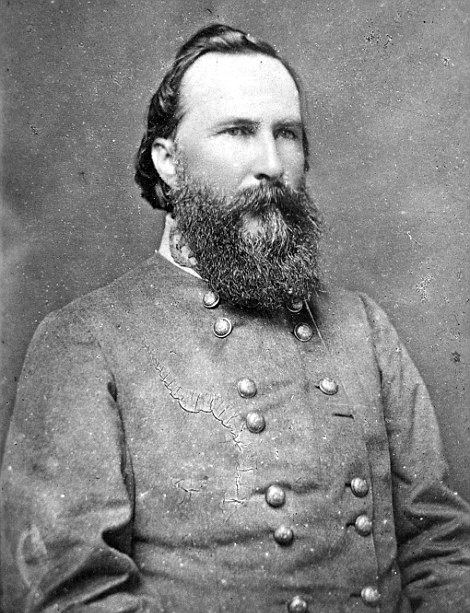
495px-General_James_Longstreet
General James Longstreet Circa 1866

After the close of the Civil War, Longstreet angered his former countrymen by daring to criticize Robert E. Lee, campaigning for Ulysses S Grant and assimilating to life in the Union. In Southern eyes, Longstreet committed blasphemy for critical comments he wrote in his memoirs about General Lee’s wartime performance, by joining Lincoln’s Republican Party and voting for U.S. Grant (twice!) and for accepting work as a diplomat, civil servant, and administrator in the reunified Federal Government of the United States.
However, anti-Longstreet feelings were not just limited to his fellow countrymen. When the “Reconstructed Rebel” applied for a pardon from President Andrew Johnson he was refused, despite a personal endorsement from Union Army General-in-Chief Ulysses S. Grant. Johnson reportedly told Longstreet in a meeting: “There are three persons of the South who can never receive amnesty: Mr. Davis, General Lee, and yourself. You have given the Union cause too much trouble.” Luckily for Longstreet, the Radical Republicans in the US Congress hated Johnson more than Johnson hated Longstreet and they restored the General his rights of American citizenship in June of 1868.

ooa90271f9
General James Longstreet Circa 1876

Leaders of the Lost Cause movement cited Longstreet’s actions at Gettysburg as the main reason for the Confederacy’s loss of the war. When Grant appointed Longstreet as surveyor of customs in New Orleans in 1868, his old friend General D.H. Hill said: “Our scalawag is the local leper of the community.” When Northerners moved South for financial gain, they were called Carpetbaggers, Hill wrote that Longstreet “is a native, which is so much the worse.”
In 1868, the Republican governor of Louisiana appointed Longstreet the adjutant general of the state militia and by 1872 he became a major general in command of all militia and state police forces within the city of New Orleans. Longstreet continued his role as an anathema to his former Confederate colleagues when he led African-American militia against an armed force of 8,400 members of the anti-Reconstruction White League at the Battle of Liberty Place in New Orleans in 1874. Longstreet commanded a force of 3,600 Metropolitan Police, city policemen, and African-American militia troops, armed with two Gatling guns and a battery of artillery.
The White League charged, causing many of Longstreet’s men to flee or surrender, the General rode to meet the protesters but was pulled from his horse, shot by a spent bullet, and taken prisoner. Federal troops were sent by President Grant to restore order. There were casualties of 38 killed and 79 wounded. Longstreet’s role in this racial battle sealed his fate among his former countrymen. This sad episode ended his political career and he went into semi-retirement on a 65-acre farm near Gainesville, where he raised turkeys and planted orchards and vineyards on terraced ground that his neighbors derisively named “Gettysburg.” A devastating fire on April 9, 1889 (the 24th anniversary of Lee’s surrender at Appomattox) destroyed his house and most of his possessions, including his personal Civil War documents and memorabilia.
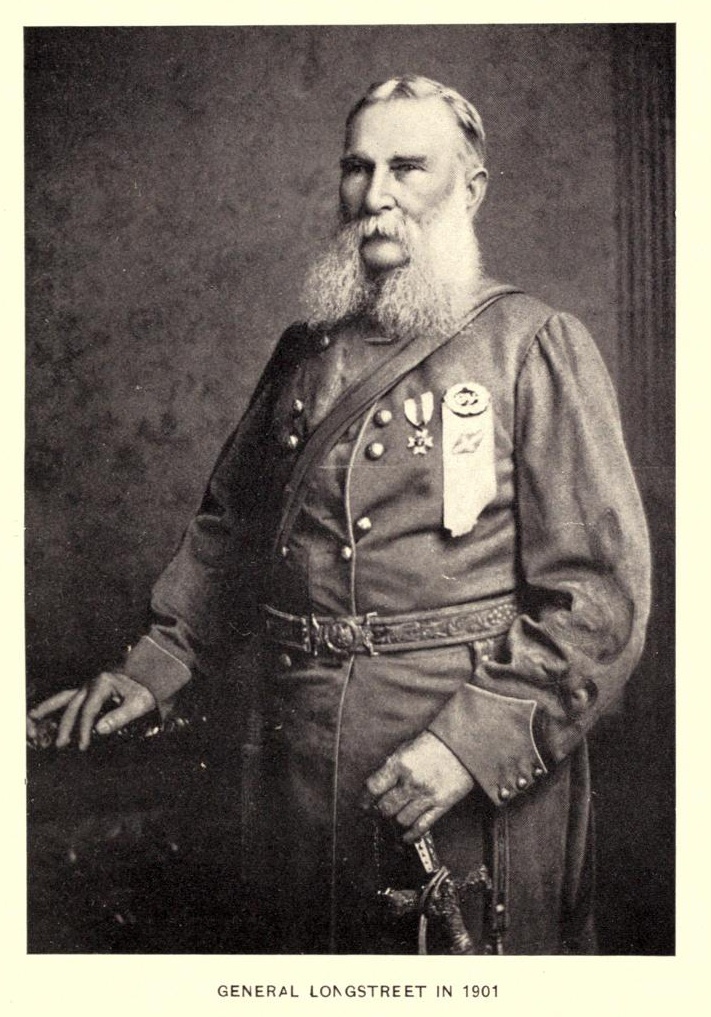
General-LongstreetThe attacks on Longstreet began in earnest on January 19, 1872, the anniversary of Robert E. Lee’s birth and less than two years after Lee died. In a speech at Washington College, former Rebel General Jubal Early exonerated Lee for the defeat at Gettysburg: Early said Longstreet was late. Early claimed Longstreet’s delay on the second day somehow led to the debacle on the third. The following year at the same venue, Lee’s artillery chief William N. Pendleton, charged that Longstreet disobeyed an explicit order to attack at sunrise on July 2. Although both allegations were false, Longstreet failed to rebuke them publicly for three years. The delay damaged his reputation, and by 1875, the Lost Cause mythology had taken root.

1264pre_60f10a35e87b603
General George Pickett

Perhaps the most astonishing of these Longstreet attacks came from a very unexpected source. The widow of his friend George Pickett. Longstreet and Pickett had enjoyed a long, close association stretching all the way back to their service together in the Mexican War and their association to West Point. Longstreet served with distinction in the Mexican–American War alongside many of the men he would find himself fighting with (and against) at Gettysburg. In the Battle of Chapultepec on September 12, 1847, he was wounded in the thigh while charging up the hill with his regimental colors. As he fell, he handed the flag to his friend, Lt. George E. Pickett, who carried it on to the summit.
In the winter of 1862, during a scarlet fever epidemic in Richmond, Virginia, three of the four Longstreet children (Mary Anne, James and Augustus Baldwin) died within eight days. The blow was almost too much for Longstreet. An aide noted that his “grief was very deep,” while others commented on his change in personality. Because the Longstreets’ were too grief-stricken, it was General George Pickett (and his 16 year-old future bride LaSalle Corbell) who made the burial arrangements. Pickett shared Longstreet’s condemnation of Robert E. Lee’s actions at Gettysburg openly stating “that old man (Lee) had my Division slaughtered.”
Pickett went on to a less than stellar financial career in the insurance business and never forgave Lee for destroying his division (and career). He lived the final years of his life quietly and modestly, farming and battling declining health. Pickett rarely spoke publicly about his war experiences and died on July 30, 1875, at the age of fifty. After Pickett’s death in 1875 Pickett’s third wife LaSalle began to write and lecture about her famous husband. While her general husband had spent his last years brooding about the disastrous charge that bore his name, his financially burdened widow decided to make the most of an opportunity.
In an attempt to revitalize his memory, she traveled around the country lecturing about her famous husband in an attempt to transform him into the hero of Gettysburg by way of the Lost Cause. Often, Pickett’s enhancement came at the cost of Longstreet’s reputation. It is ironic that Pickett should benefit at the expense of his friend and mentor, James Longstreet. Her tales of her husband’s life & times were highly romanticized and exaggerated making it hard to separate fact from fiction.
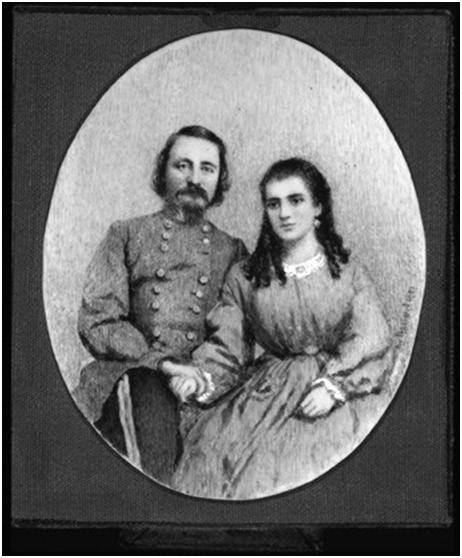
george_pickett
General George Pickett and LaSalle Corbell Pickett 

LaSalle Corbell Pickett authored the celebratory history “Pickett and His Men” (1913), which historians claim was plagiarized, and two collections of wartime letters (1913, 1928), which historians claimed were fabricated. Nevertheless, her image of her husband at the moment his charge began—”gallant and graceful as a knight of chivalry riding to a tournament,” whose “long, dark, auburn-tinted hair floated backward in the wind like a soft veil as he went on down the slope of death”—has stuck in the American imagination. And her letters have been cited in works as diverse as Michael Shaara’s Pulitzer Prize–winning novel “The Killer Angels” (1974) and Ken Burns’s documentary “The Civil War” (1990).
It would take a century of slow reassessment by Civil War historians to restore General James Longstreet’s reputation. Michael Shaara’s 1974 novel The Killer Angels, based largely on Longstreet’s memoirs and later made into the film “Gettysburg”, helped restore Longstreet’s reputation. Military historians now consider Longstreet among the war’s most gifted tactical commanders on either side of the Civil War. Part of that reassessment is due and owing to a child bride, a gifted artist and one of Gettysburg National Battlefield’s newest monuments.
NEXT WEEK: PART II of General James Longstreet at Gettysburg.

Indianapolis, Natural Disasters

Indianapolis, Indiana: The Great Flood of 1913. Part II.

Damage at Indianapolis, Indiana, March 27

Original publish date:  March 20, 2013

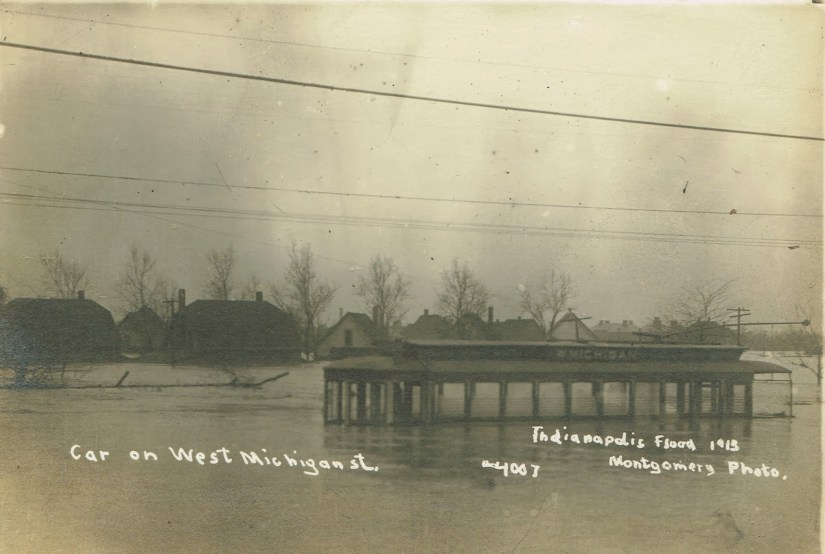
Last week, we left Greenfield a century ago; March 25th, 1913, underwater. The “Black Night of Terror”, the “March Flood”, the “Great Flood of 1913” had come and gone through the Hancock County seat leaving devastation in its wake. And it was headed straight for Indianapolis. On Tuesday the National Weather Bureau sent out the following warning: “Below Indianapolis the river will rise rapidly and the public should prepare for higher stages than have been experienced for many years. Every precaution should be taken by those living along the lower course of he river, as the rise will be unusually rapid and will reach a point several feet above the danger line.” Late that Tuesday morning, the first levee failed, flooding Indianapolis via the White River and Eagle Creek.
Fortunately, most Hoosiers heeded the warnings, gathered their families, belongings and pets and fled to higher ground, saving countless lives. Witnesses on the west side of Indianapolis claimed they saw a wall of water more than two stories high when the White River levee burst at Morris Street. Indianapolis’s tranquil Eagle Creek, normally sixty-foot-wide at best, spread to an angry class five rapid half a mile wide. Astonished bystanders watched as the White River tore through its levees at many points. Around noon on Tuesday, Fall Creek jumped its banks, flooding a large part of the city’s north side residential district, ending streetcar service and putting the water works and other public utilities out of commission. Many families living in homes in the danger zones packed valuables into wagons and carried furniture up to the second floors and attics of their homes.

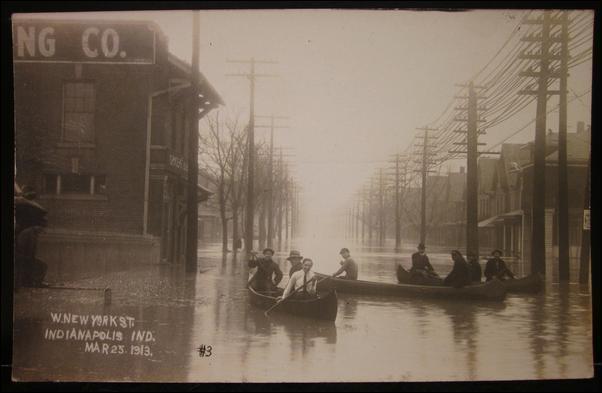
W-New-York
By 3 p.m. the muddy water was beginning to trickle down the levee. Whenever a leak appeared, a brace of men rushed over to plug it using bags of sand and bales of straw jammed in place by telephone poles. Around 4 p.m., as the men were busy shoring up the levee north of the Morris Street bridge, water unexpectedly broke through the sandbags piled on the other end of the bridge at the western corner of Morris and Drover streets. The break, not a massive wall of water as some claimed, but rather a steady flow as if a massive spigot had been opened allowing thousands of gallons of water to pour through the breach while gradually enlarging the opening as each frantic moment trickled past. Now, people abandoned their wagons and tied what valuables and food they could gather into bundles, grabbed their children, and began to flee across the Morris Street Bridge. The evacuation proceeded in agonizing slow motion; the water first rising past their ankles, then up to their knees, finally settling around their waists.
Still, the White River kept rising. By 6 p.m. the river burst through the base of the levee about four hundred feet upriver of the bridge. By early evening, Indianapolis was flooded east of Harding Street, in some places the water cresting as high as 15 feet. By Wednesday, the Washington Street Bridge was destroyed, cutting the main artery between the Circle City and all points West and taking the railroad tracks with it. The recently created suburb of West Indianapolis and valley of West New York Street were the hardest hit areas; a region principally populated by railroad and stockyard workers. Created as one of the cities first suburbs, the southwest annex was roughly bounded by the White River to the east, the Pennsylvania Railroad line to the north, Eagle Creek to the west, and Raymond Street to the south. The residents never knew what hit them.

CCI01232014
The first floor of the newly opened St. Vincents hospital at Fall Creek and Illinois flooded and Sister Mary Joseph and her staff moved their patients to the second and third floors for safety. Articles titled “$500,000 Loss at Peru,” “Over the Muncie Levee,” “Boats in Carmel Streets,” “Danville Cars Stopped,” “Bloomington is Cut Off, ” and “Shelbyville Levee Breaks” appeared on a single page of The Indianapolis News Wednesday edition. The flood crested in Indianapolis on the morning of Thursday, March 26th. As the water receded, the damage was unveiled and the residents were left to comb over the debris of the worst flood the state ever saw. A six-square mile area was destroyed displacing 4,000 Hoosier families. Because of the early warning, the loss of life was tallied at five known fatalities, however witness stories swear that total had to be much higher.
It was Easter week and Indianapolis was not alone in their soggy sorrow. Levees burst all around the state-on the Mississinewa River in Marion, on the White River in Muncie, on the Wabash River in Lafayette, and on the Ohio River in Lawrenceburg-flooding the cities they were supposed to protect. In the southern part of Kokomo, Wildcat Creek flooded over its levee to saturate city streets with eight feet of water. Thousands of telephone and telegraph poles and wires were downed by the flood making an organized relief effort nearly impossible. To obtain the necessary food, shelter, and medical supplies for the injured and suddenly homeless, Governor Sam Ralston appealed for help to cities around Indiana as well as to other states. Donations of money, blankets, food, and even coffins poured in just as quickly as the water poured out.

Interurban
Indianapolis was not only the geographical center of the Midwest’s monumental winter storm system in March of 1913,with a population of 235,000, it was also the single largest city affected by the natural calamity. So what kind of storm caused the Great Flood of 1913? It began like any other normal Midwestern winter storm, but soon developed special characteristics conducive to flooding. A strong Canadian high with its accompanying windstorm stalled off Bermuda, thus halting the normal eastward travel of its trailing low bringing all the rain. Then another Canadian high moved in from the west, squeezing the low into a long, low-pressure trough between the two highs, its center stretching diagonally from southern Illinois, across southern and middle Indiana, and across northern Ohio. Up that diagonal path, at least two lows moved in fast succession, the rain of one merging together into the next. But nothing in the weather observations or theories of the day prepared the U.S. Weather Service, or any other body, for the unprecedented volume of water that fell out of the sky during those four days of March 1913.
Regardless of how the flood waters had arrived, and receded, perhaps the true horror of the Great Flood of 1913 was the aftermath. The flood waters were now stagnant pools of sick water filled with raw sewage, rotting food, dead pets and livestock, bugs, snakes, and disease carrying rodents. Day after day, Hoosiers were bombarded with newspaper headlines warning of looting and arrests, water borne disease wielding parasites, guards posted to keep away opportunistic invaders, health agencies warning of the dangers to unsuspecting children and dangerous siphons caused by clogged drains. For a time, the city was under siege. Luckily, the flood brought about changes in national weather forecasting by identifying the presence of stalled lows as the major factor in localized flooding, local government with the passage of stricter code enforcement in response to the flood’s aftermath, and the resurgence of the Red Cross as a National relief agency. Statewide, more than 90 people drowned and at least 180 bridges were destroyed when up to 11 inches of rain fell across the state in a five-day period. Could it happen again? Sure, but until that day, the Great Flood of 1913 remains our state’s worst ever.

Natural Disasters

Greenfield, Indiana: The Great Flood of 1913. Part I.

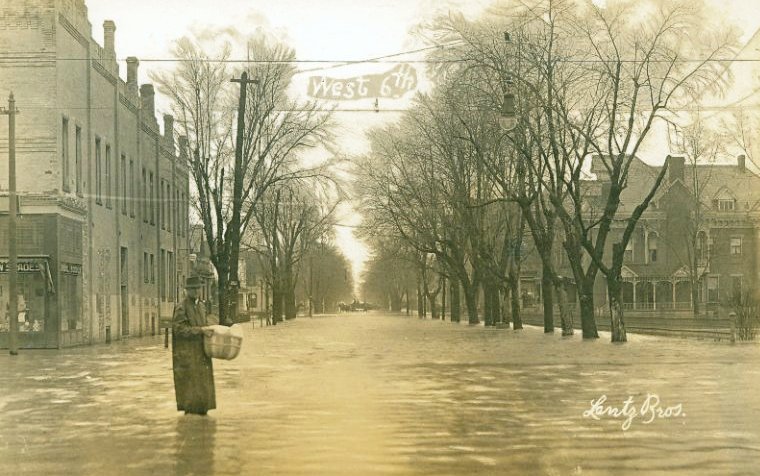
West 6th Street Greenfield
West 6th Street in Greenfield.

Original publish date:  March 13, 2013

Oh, how it rained. For 48 straight hours, it rained. Martha Duncan stood on the porch of her house, located on the north side of Fourth Street between State and Pennsylvania, wondering if it was ever going to stop. It was Monday March 24th, 1913 in Greenfield, Indiana, nearly 60 degrees outside and the normally shallow waters of nearby Potts Ditch were creeping closer-and-closer by the minute. By eleven o’clock that night, she was moving furniture and rolling up carpet. By one o’clock the water was within a few inches of the floor. She managed to save everything but her piano before the Fourth Street bridge over Potts Ditch was swept off its moorings and floated downstream.
On State Street, the large front yard of the John Ward Walker home, known as “Walker’s Hill”, was now a lake. Walker was a prominent local merchant and one of the founders of the Greenfield Banking Company in 1871. The Vawter and Selman homes, properties adjoining Potts Ditch, had to be evacuated and were quickly overtaken by flood waters. The Selman barn looked like an island in the newly created waterway.
5da12361953aa3af095f669da2d333fa--catherine-ohara-indianaOne hundred years ago this week, the great flood of 1913, or “March Flood” to locals, became the worst flood in Indiana history. In Greenfield, James Whitcomb Riley’s storied Brandywine Creek flowed over the National Road like a raging river; it’s branches, like Potts Ditch, spread water through town ripping away all but one bridge, the East South Street bridge, the town’s newest created just the year before.
In March of 1913, Greenfield was a small agricultural community located at the headwaters of the White River’s East Fork. The news of the year was the purchase of a 156-acre tract of land one mile west of Greenfield by the Eli Lilly Biological Laboratories. In time, Spanish-style structures would start popping up all over the property. When completed, the snow-white, red-tile roofed buildings awaited the arrival of test animals to be quartered within them in preparation for the manufacture of antitoxins and vaccines. In the original buildings, there would be space for 30 horses, 18 calves, 3,000 guinea pigs, 500 rabbits and many other small animals. Eventually, the site would grow until it had 70 buildings on 800 acres. Soon, by late 1913, immunization of horses and calves would begin.
But on March 24, 1913, the flood was the big news in Hancock County. Greenfield residents stayed up all that Monday night to watch as the river steadily breached it’s banks. In 1913 farmers pastured their cattle in many places along the town’s waterways and undoubtedly many were lost in the rushing torrents. With every passing hour, the Brandywine rose higher and higher as the rain mercilessly poured down. A little past eleven o’clock on that “Black Night of Terror”, a train passed over the Brandywine via the Pennsylvania Railroad Bridge. A short time after the caboose crossed safely over, a lone watchman held his red lantern over the chasm now formed in the dark void where the bridge had stood just moments earlier. The bridge had been carried away by the raging flood waters.
8375267920_792941f501_bThe rain did not stop until 5:30 a.m.. Tuesday, March 25th, but the Brandywine continued to rise perilously minute by minute until it crested at 6:30 a.m.. The arch bridge at Fifth Street was now underwater and the flood poured over it, flooding barns and chicken houses between Fifth and State streets. The employees of the four-story Columbia Hotel, built in 1885 at 118 East Main Street and considered the town’s most luxurious, were now furiously bailing water out of the basement while pacifying nervous guests. The newly built Greenfield Hotel and nearby Hinchman wagon store were dealing similarly. Soon, Bert Orr’s grocery, the Monger garage, the Clayton & Davis cement works and the South Street Methodist Church (now the Trinity Park Methodist Church) were soaking in muddy water.
Although the new East South street bridge survived the floods, it was for a time under more than a foot of water. According to the April 3, 1913 “Greenfield Republican” newspaper, 25-year town resident John Mulvihill said that he’d never seen the water so high. Mulvihill pointed to a corn crib in the Henry Fry barn on East Main Street that had been built above all previous high water marks that was now underwater. Another local farmer, J.P. Knight, whose farm was on the banks of the Brandywine south of the National Road, said he lost all of the grain stored in his barn and a pile of gravel worth an estimated $ 300 when both were washed away downstream.
The railcars on the Terre Haute, Indianapolis and Evansville railroad, known popularly as the “Interurban line”, now lay stranded at different points along the road between Greenfield and Richmond. In addition, the traction line bridges were washed out at many points. Travel, phone service and mail delivery ceased and for awhile, Greenfield was cut off from the outside world. To make matters worse, just hours after the rain stopped, the temperature dropped by over 20 degrees and it began to snow. By the 27th, two days after the devastating flood waters ceased, there was 1.5 inches of snow on the ground in Greenfield.
An estimated 5 to 8 inches of rain fell in a 48 hour period. It was late March in Indiana. The winter of 1913 had been particularly harsh in the Hoosier state. The Spring thaw was slow in coming and the water that rained down on Greenfield that weekend fell on frozen earth with no place to go. No place to go but downstream; to Indianapolis.

NEXT WEEK- PART II

Politics

Otis Cox. Auditing a lifetime of public service.

Otis article
Otis E. Cox-Indiana State Auditor from 1982 to 1986.

Original publish date:  August 30, 2012

I received a phone call from an old friend the other day with some shocking news. One of my heroes and mentors in life, former Indiana State Auditor Otis E. Cox, called to tell me that he and his lovely wife Pat were moving from Anderson to Fishers. You may wonder, why is THAT shocking? Well, its shocking to me because Otis E. Cox is as much a part of Anderson as the Wigwam gym (home of all those great Anderson Indians basketball teams), Gene’s root beer stand (home of the Spanish Dog with cheese) and Lemon Drop drive-in (home of the legendary onion burger). Otis Cox might as well be “Mr. Anderson,” at least in my mind. No matter where I go or who I meet, seems everyone has ties of some sort to Anderson.

Otis and Pat have lived in Anderson all of their lives. Otis for 71 years and Pat for considerably less than that. He graduated from Anderson high school and followed that up by graduating from the General Motors Institute (now known as Kettering University). Otis, a Democrat, was elected Madison County auditor in 1976 and again in 1980. He was then elected State Auditor in 1981 serving in that post from December 1,1982 to November 30, 1986. Upon leaving office in 1986, Otis went back to his hometown and ran for Mayor of Anderson in 1987 losing by a  mere 94 votes. An astonishingly thin margin in a city of 60,000+, but Otis, true to his humble personality, eschewed a recount on the grounds that “the people had spoken.” Otis would win re-election to the post of Madison County Auditor in 1992, a generation after first attaining the post in 1976. In 1996 and 2000, Otis served as a Madison County Commissioner before retiring in 2004.

IMG_0935
I wore this back in 1982 campaigning with Otis in what seemed like every county in Indiana. Lots of miles, lots of heat and lots of rain on this thing.

I first met Otis as a young collector of political memorabilia just barely after I got my driver’s license. He was always honest, patient and kind with this tinhorn, just learning the ropes of collecting history and participating in the Indiana political process. When he was elected State Auditor, Otis kindly appointed me as one of his deputies at the Indiana Statehouse. A post I held from 1982 to 1985. At that time, Otis E. Cox was 4th in line of succession to the Governor’s seat and the highest ranking Democrat in the state.

Otis counted among his deputy auditors; Mary Moriarty (Adams)-District 17 City Councilwoman, Nancy Michael-former 44th district State Representative and Mayor of Green Castle, & Ed Mahern-longtime 97th district State Representative who holds the singular distinction of being the very first babyboomer born in Indianapolis (arriving two seconds after Midnight on Jan. 1, 1946). Otis Cox helped mold the future of Indianapolis politics for decades to come and his strength of leadership resonates in the Capitol City to this very day. During all those years in office in the State Capitol, Otis dutifully went home each night to Anderson in Madison County.

I drove up to Madison County last week to sit and reminisce with Otis and Pat about old times, politics and their next move in life. Otis is what most would call a loyal “Yellow Dog Democrat”, a political term applied to that part of the electorate who vote solely for Democratic candidates. It is believed that the term originated in the South after Republican president Abraham Lincoln led the Union against the Confederacy to describe those voters who would “vote for a yellow dog before they would vote for any Republican”. The term is now used to describe any Democrat who will vote a straight party ticket under any circumstances.

PO-dukakis-bentsen-button_busy_beaver_button_museumI often tell friends that I won my wife Rhonda’s heart back in 1988 when I walked into her store wearing a Dukakis / Bentsen for President campaign pin during the election. She gasped and asked me, “Where did you get that?” to which I reached into my pocket, pulled an identical pin out and presented it to her. Pat tells a similar story about meeting Otis for the first time in the early 1960s. “He walked up to me and asked me if I voted for John F. Kennedy” to which I answered “No.”  He asked me “Well, why not?” and I said, “because I wasn’t old enough.” From that point on, the pair were inseparable while working for LBJ, RFK, McGovern culminating with Otis himself being swept into office with the Jimmy Carter election in 1976.

The Cox’s fondly recall that 1976 election, Otis’ first, with several humorous stories about the role Anderson and the state of Indiana played in the Carter victory. “In 1976, there were several people running for the Democratic nomination. Hubert Humphrey, Sargent Shriver, George Wallace, Walter Mondale, Scoop Jackson, Fred Harris, Robert Byrd, Lloyd Bentsen, Birch Bayh, and of course, Jimmy Carter. ” Otis says, “They were all planning to come to Indiana for the primary, back then the Indiana primary really meant something, not like today. All of the candidates advance people were frantically calling Madison County Democrats to find places for these guys to stay. Everyone chose a candidate and Jimmy Carter was the last on the list. A friend of ours took the Carter’s in, (much to the later chagrin of all who’d chosen another candidate), and you know, Jimmy Carter stayed friends with them for decades afterwards. Even invited them to their home in Plains, Georgia whenever the couple traveled down to Florida.”


s-l225
Jimmy Carter-Larry Conrad-Otis Cox 1976 campaign pins.

Otis was a delegate to the Democratic National Conventions in 1976, 1980 & 1984. I asked him about the upcoming conventions to which he replied, “It’s not the same today as it was back then. There are no races anymore. Everything is decided before the convention. It’s more of a formality now than a real convention. In 1980 we had the Carter versus Ted Kennedy fight at the DNC and in 1984 there was the Mondale versus Jesse Jackson delegate fight. Gary Hart was still mixing into that convention as well.” Otis says, “Now its all cut and dried. The Republicans won’t even seat the two delegates pledged to Ron Paul at their convention this week.”

I asked Otis about his time as State Auditor. He smiles that trusting smile that helped sweep him into office back in 1982 and replies simply, “I enjoyed the time I spent there.” When asked if he’d run for office again, he flatly says, “No” then stops and reflects a moment before adding, “Well, if I were twenty years younger, sure.” He talks about the changes he’s seen in the political system during his lifetime of public service. Otis is startled today by the lack of cooperation between members of opposing parties at every level of government. “When I was in the State Auditor’s office both parties worked together, they strive for it. Even though I was the lone Democrat, the other offices bent over backwards to help me. Especially the Governor’s office, whatever we needed, they provided. No questions asked. Mind you, this was on a daily basis. You just don’t see that today at any level.” remarks Otis.

I asked the former State Auditor and his bride how they felt about leaving the only place they’ve ever called home. After all, the Cox’s are moving from a county that many consider to be one of the state’s most economically depressed to a county that is often ranked as one of the most prosperous in the nation. After all, Madison County’s unemployment rate at is nearly 2 points higher than the national average, job growth is 6% lower than the national average, individual income is over $5,000 less than the national average and median household income is over $ 14,000 less than the national average. On the other hand, Hamilton County’s unemployment rate at is nearly 2 1/2 points lower than the national average, job growth is nearly 1% higher than the national average, individual income is over $ 10,000 more than the national average and median household income is a staggering $ 30,000 above than the national average. Although separated by an insignificant distance, that’s a significant lifestyle change.

“Well, we’re not really leaving Madison County,” Pat says “Our friends are here, our bank is here and our doctors are here.” Pat volunteers her time at St. John’s hospital in Anderson (where both of my children and my wife were born). She donates her time making floral arrangements for the patients and plans to continue her duties there. “It’s actually about the same commute for me, 15-20 minutes depending on traffic,” Pat says “Traffic can be bad, but I’m going the opposite direction. I’m going out of Hamilton County when everyone else is coming in.”

Otis Cox will always retain his love for Madison County but laments the loss of industry to the city and county of his birth. “Sadly, the manufacturing industry is gone and I don’t see it coming back.” he says. The automotive industry has a long association with the city; at one time employing some 25,000 auto workers in nearly twenty different General Motors affiliated plants located all around Anderson, trailing only Flint, Michigan in that regard.  Pat chimes in, “We just lost the Emge meat packing plant (on west 8th street), it’s so sad.”  Ever the optimist and booster for his birth county, Otis points out, “But things are looking up, we got the Nestlé’s plant and 300 new jobs a few years back.”

Otis and Pat are moving to be closer to their adult kids, Angie and Chris, who live in the Noblesville / Fishers area. The Cox’s are moving to Britton Falls, a Del Webb adult resort community for ages 55-and-over located near Hamilton Southeastern High School in Fishers. Otis proudly chirps, “It’s just like going on a vacation.” He looks forward to no more yard work and no more stairs in their new ranch style home. He continues, “But Anderson will always be home. I will miss Anderson.”

I asked Otis if he had any regrets from his decades of public service. He pauses, leans back in his chair, places his fingertips together with his index fingers brushing the tip of his nose as his thumbs gently touch his chin, “Yes, I had one regret.” he replies. “When I was commissioner, I was always sorry that I couldn’t get a couple roundabouts built in Anderson at places I felt needed them. But you know, now that I’m spending so much time in Hamilton County (which has well over 100 roundabouts) I’m getting sick of seeing them.” followed by a hearty laugh from the man who was once the most powerful Democrat in the State of Indiana. Well, Otis, if that’s your only regret from all those years of public service, I’d say you’ve served your city, county, and state well. Enjoy your retirement my friend, you’ve earned it.

Indianapolis, Pop Culture

Sky Dancers Betty and Benny Fox.

Betty & Benny Fox
Sky Dancers Betty and Benny Fox. in Indianapolis.

Original publish date:   July 23, 2012

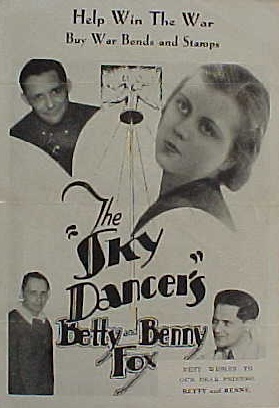
Recently, I was sorting through an old box of paper purchased at an antique show in Indianapolis some time ago. I ran across an interesting little leaflet from the 1940s World War II Era that piqued my interest. The flyer pictured a pretty young blonde haired woman in the foreground surrounded by 3 images of a dapper looking man. It reads, “Help win the War. Buy War Bonds and Stamps. The Sky Dancers Betty and Benny Fox. Best wishes to our dear friends. Betty and Benny.”
I have an abiding affection for wartime homefront items and often find myself lamenting that I was born too late. As I looked closer at the brochure, I noticed that there seemed to be an image of the duo standing atop the Indiana Soldiers and Sailors Monument “ghosted” into the background. Naturally, my curiosity shifted into overdrive and I had to know what this all meant.

abc_gma_nik_wallenda_5_jt_120616_wmain
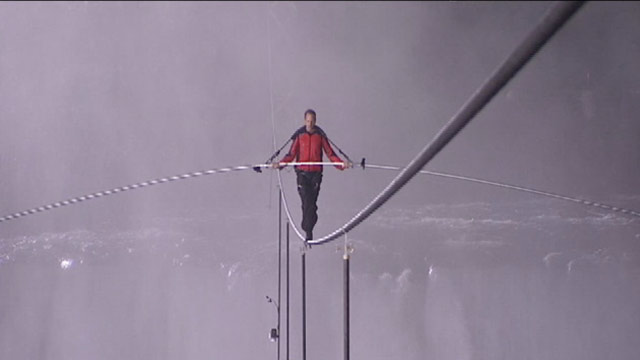
Nik Wallenda over Niagara Falls.

As I pondered the significance of this little piece of paper, a news report fluttered across my TV screen about a dispute between the City of Niagara Falls, N.Y. and tightrope walker Nik Wallenda. It seems that Nik Wallenda promised the city that his recent tightrope walk across Niagara Falls would bring much needed publicity and generate untold millions to this struggling community in upstate New York. Wallenda’s June 15 crossing went off without a hitch physically, but the city is now looking to the daredevil to pay about $25,000 in unpaid overtime bills for police officers and firefighters.
As I looked away from the television to the flyer in my hands, it suddenly hit me like the cold light of dawn, Betty and Benny Fox were barnstorming daredevils! This flyer must have been created for a visit to Indianapolis and a planned stunt involving our cities most identifiable landmark. I did a quick internet search but could find no record of the duo ever coming to Indianapolis. However my suspicions were confirmed when it was revealed that Betty and Benny were in fact high wire aerial artists.
Sky Dancers Betty and Benny Fox.

a125062a250c2e41ce0ea941cda8f4ff
Sky Dancers Betty and Benny Fox.

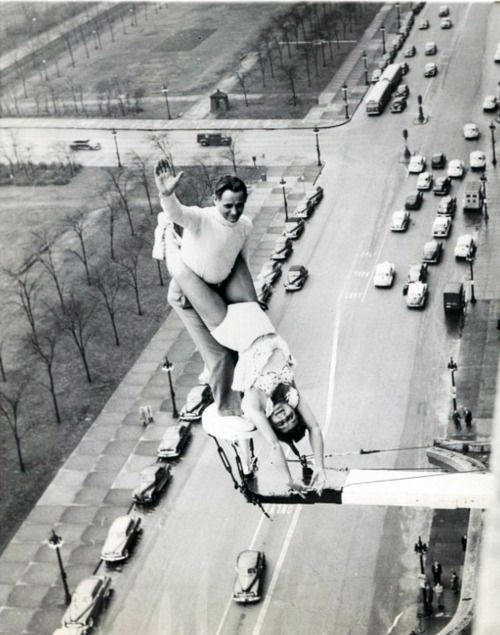
Benny and Betty Fox, the famous death defying sky dancers pictured on the flyer, were billed as a brother and sister act but they were not related. And Betty was not always the same person nor was she actually named Betty. Benny chose the name for his partner because he liked the sound of it. (That explains why Betty is pictured only once and Benny is pictured three times.) Whoever she was, she was willing to put her life in Benny’s hands while they danced on an 18-inch wide disc affixed to the top of a pole extending 100 feet up in the air.
Contemporary newspaper articles claimed that Benny had been born into a circus family, known as the “Flying Foxes”, near Berlin, Germany. Another article from the 1950s stated that Benny was part of an international circus family, either of Lithuanian or Polish, and lived with his family in Flushing, N.Y. According to that article, “For a time it was feared, because of Benny’s small stature, that he would not be able to carry on for the “Flying Foxes,” but Benny’s father, who was old school, said “I will build him in body, mind and strength.” And that he did.

Benny and Betty Fox (2)
Benny and Benny Fox pose for a photo, October 6, 1937.

A little research reveals that the Betty from the brochure was the very first one; Nano Clifford, Benny’s wife, who quit the act in 1945 to raise their children. No wonder, she must have been exhausted after a 22-month tour in World War II performing for troops at 187 hospitals in Europe. The next Betty’s real name was Clara, who worked with Benny for a few years until she gained weight, (Benny claimed anything over 120 pounds was too heavy for skydancing), she was replaced by yet another Betty, whose real name was Alice. Undoubtedly, there were many other Betty’s because Benny performed well into the 1970s. But those “Betty’s” are lost to history.
The duo’s most documented performance took place 3 hours to the west of our city in Springfield, Illinois. On October 6, 1937, they did six performances throughout the day from the roof of a building at 313 S. Sixth Street. The last performance at 8 p.m. was lit by four powerful floodlights. It seems that the couple were hired by the Illinois State Journal newspaper and the perch upon which they performed was atop the Journal building itself. The stunt was arranged and staged by the paper in hopes of boosting lagging circulation numbers. The act proved so successful that the daredevil duo was asked back to the land of Lincoln in 1946.
The newspaper reported that the streets below the Journal building were packed shoulder-to-shoulder with anxious spectators watching the duo as they danced, whirled, stood on their hands, and performed acrobatics that evening. “Streets, windows, roofs and fire escapes all through the downtown area were jammed for the night show.” The Journal estimated the crowd at 100,000, but that figure seems improbable at best.
The crowd stared in disbelief when the aerial artists pulled off their “death whirl,” which had Betty face down with her legs clasped around Benny’s waist while he swirled her “around and around” on the small disc. The crowd cheered with approval as the couple danced the Charleston & the Lindy Hop atop their beach ball sized disc 100 feet off the ground with no fear. According to the Journal, “the blindfolded waltz, fast fox trots and Charlestons at the afternoon shows drew a great round of applause, but that became a mere whisper in comparison to the ovation which greeted them at the conclusion of the death whirl.”

56508920f723e2ef382f4827c3504865
Sky Dancers Betty and Benny Fox.

Benny’s loudest cheers came when he stood upside down on his hands for 30 seconds. The couple’s most daring stunt involved Betty, supported by Benny, bending over the edge of the platform backwards to pick up a handkerchief 3 feet below the 18-inch disc. The act concluded with Benny calling down to the crowd that Betty had fainted. The drama built at a frenzied pace until Betty was revived and waved to the anxious crowds below.
During pre-publicity for the event, the newspaper ramped up the drama by explaining that a physician and two nurses would be on the roof of the building during all performances should the couple miss a step in their dangerous setup. “An ambulance will wait at the curb to rush them to the hospital if Death fails to take his expected holiday.”
Apparently, although I had never heard of them before picking up this flyer, Betty and Benny Fox were the bomb back in the day. They toured Europe pretty extensively during the War and the other cities besides Lincoln’s hometown that I could find reports of their shows include: the Westin Hotel in Detroit, the Morning Call Newspaper building in Allentown, Pa., the Sheraton Hotel in Chicago and The Mint Hotel in Las Vegas. However, despite the flyer, I can’t find a record of the daredevil duo ever passing through our fair city.
It seems that, as the Great Depression dragged on, Betty and Benny Fox were just one of many traveling sideshow acts whose outlandish feats of stamina, spectacular stunts and bizarre competitions were popular entertainment. As dance marathons and flagpole sitting became passé, slowly fading from the headlines, and as the Roaring Twenties came to a crashing end, Betty and Benny skipped from town-to-town to entertain the saddened masses, starved for free entertainment.

Nik Wallenda
Nik Wallenda waves to tourists in Niagara Falls, N.Y., May 2, 2012. 

Which brings us back to Mr. Wallenda, a seventh-generation circus performer, and the claim that he owes money to the city that he promised his high-wire act would help revitalize. City officials say Mr. Wallenda’s team took advantage of their hospitality. Mr. Wallenda says he was stabbed in the back. Mr. Wallenda’s 1,800-foot crossing transfixed a national television audience and generated a wave of publicity that the falls had not experienced in decades. It seemed like a particular coup for the economically depressed American side of the falls, creating an instant hero and a point of pride for a city that has lost more than half its population in the last half century. Now the City of Niagara Falls is not so sure. Mr. Wallenda, for his part, said he had been hoping to open a Wallenda-themed exhibition (perhaps someday a full-scale museum) in Niagara Falls, N.Y. But he suggested he might have to rethink the location. I wonder what Betty and Benny Fox would think?