

Original publish date: June 22, 2015
Reissue date: May 2, 2019
Last week, we once again visited the famous “Paul is Dead” rumor that haunted the Beatles rock band for many years. Obviously, the rumor that Paul McCartney died in a November 1966 car accident was just a rumor, to many Beatlemaniacs during the final years of the turbulent sixties decade, it was very real. It had become a national pastime to search for clues to Paul’s death in the music and artwork produced by the band. The albums Sgt. Pepper’s Lonely Hearts Club Band and Magical Mystery tour were allegedly rife with references to Sir Paul’s demise.
The band’s next album, a self-titled work known as “The White Album”, was released on November 22, 1968, prophetically 5-years to the day after the assassination of President John F. Kennedy. The death reference is not overstated, as soon, the “Paul is Dead” theorists would dissect the music and its accompanying poster for further clues of McCartney’s death. The death connection continued as, in time, the album would be blamed for inspiring Charles Manson and his “family” during their murder spree. Much of which was aimed at the music industry itself through the Beach Boys drummer Dennis Wilson and the band’s record producer Terry Melcher. But that’s another story.
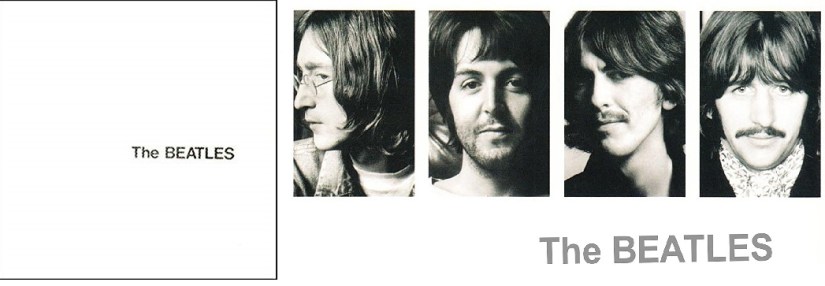 The stark snow white album cover was seen as an obvious reference to the white light of heaven, where Paul was supposed to be at its release. But it was the poster issued inside the white album (a collage featuring a number of random images of the Fab Four) that came under the scrutiny of those looking for “Paul is Dead” clues. In the lower right hand corner of the poster (page 7 of the CD booklet) is a grainy B&W photo of Paul dancing. Upon close examination, a pair of ghostly hands can be seen reaching toward Paul from behind.
In the lower left hand corner of the poster (page 18 of the CD booklet) is a cold war inspired passport photograph of Paul in disguise. Conspiracy theorists suggested that this image was actually of Paul’s replacement in the band, William Campbell Shears, taken prior to the plastic surgery that made him look more the “the late” Paul McCartney.
In the upper left hand corner of the poster (page 3 of the CD booklet) is a picture of Paul with his head partially submerged in a bathtub. The position of Paul’s head and the suds around him suggest the grisly accident scene of his fatal accident or perhaps the aftermath in the morgue. One version of the “Paul is dead” story claims that Paul left the recording studio after arguing with drummer Ringo Starr. In his song “Don’t Pass Me By”, Ringo is said to express his regret at the tragic turn of events after Paul’s angry departure from the studio: “I listen for your footsteps coming up the drive…I listen for your footsteps but they don’t arrive.” At the end of “While My Guitar Gently Weeps”, George Harrison is thought to moan the words “Paul, Paul”.
 The song “Glass Onion” makes a number of references to Beatle songs and events. John mentions “The Fool on the Hill” and states, “I tell you man he living there still” thought by some to symbolize heaven. However, perhaps the most intriguing line in the song is “Well here’s another clue for you all…The walrus was Paul.” Seen as a final bow to his fallen bandmate and co-songwriter. Some sources have suggested that the phrase “goo goo g’joob” is from Finnegans Wake by James Joyce (Alas, the phrase “googoo goosth” is the closest Joyce gets in th book.) Never fear, the “Paul is Dead” rumorists claim that “goo goo g’joob” are the last words uttered by Humpty Dumpty before his fall. A fall that cracked his head open, much like Paul’s supposed fatal car accident.
Further proof is said to be found in the odd conclusion to “Cry Baby Cry” as Paul asks “Can you take me where I came from? Can you take me back?” Not necessarily as much for what those lines are supposed to mean, but rather that the song leads into “Revolution 9”, the most analyzed of all “White album” tracks by “Paul is Dead” clue seekers.
 Revolution 9 was an innovative sound collage that, quite frankly, soared over most listener‘s heads. Later transcripts of the dialog heard early in the song reveals two men who can be heard saying “I know all about it George. I’m sorry. Will you forgive me? Yes.” Theorists claimed that this was John talking with George Martin about the secret placement of clues on Beatles records. However, the biggest clue to Paul’s death on the track is the title itself, whose repeated phrase “Number 9” is said to sound like “turn me on, dead man” when played backwards. A dark recall to the line “I’d love to turn you on” from “A Day in the Life”.
The sound collage of “Revolution 9” is said to contain a recreation of Paul’s fatal car accident. At one point listeners hear car horns, followed by a car crash, and concluding with the crackling sounds of a fire burning. When played backwards theorists claim the statement “Let me out! There were two. There are none now.” can be plainly heard. Most astonishingly, “Paul id Dead” devotees swear that, when played normally, the following disjointed lines can be heard throughout the song: “he hit a pole. We better get him to see a surgeon. So anyhow he went to a dentist instead. They gave him a pair of teeth that weren’t any good at all…So my wings are broken and so is my hair… I’m not in the mood for words… Find the night watchman… A fine natural imbalance… He must have got it in the shoulder blades… Take this brother, may it serve you well…” The final line marking Paul’s passing of the torch to his replacement William Campbell Shears.
 Ardent believers believed that other “Backwards” clues could be found on the track “I’m so tired / Blackbird” when some random mumbling is heard that they believe sounds like John and Yoko right after the abrupt ending of “I’m So Tired” and before the beginning of the next song, “Blackbird“. This passage makes no sense when played forwards. However, when played backwards, they believe that you can hear John say, “Paul is a dead man. Miss him. Miss him. MISS HIM!” John Lennon was said to be expressing his grief over Paul’s death in this line of the song followed by the very next line on the record, sung by Paul, “Blackbird singing in the dead of night”, that mentions death.
Ten months later, on September 17, 1969, an article titled “Is Beatle Paul McCartney Dead?” was published in the student newspaper of Iowa’s Drake University. Soon, the “Paul is Dead” story went viral. Almost immediately, other articles followed claiming that clues to McCartney’s death could be found among the lyrics and album covers of The Beatles’ recordings. Clue hunting proved infectious and for a couple of months in late 1969 it became an international phenomenon. Just in time for the Beatles’ next album, Abbey Road. Guess what? The clues continued and soon, Paul McCartney himself would finally be heard from.
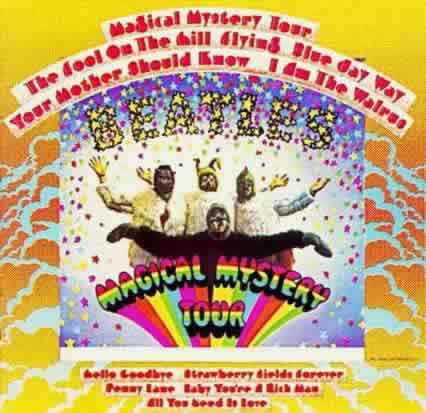
 Magical Mystery Tour was released on December 8, 1967. After the success of Sgt. Pepper’s, Paul McCartney wanted to create a film based upon The Beatles and their music. The film was to be unscripted and would “star” various “ordinary” people who were to travel the countryside on a bus and experience “magical” adventures on film. The Magical Mystery Tour film was made and included six new Beatles songs. The film was universally panned and largely forgotten, but the resulting album / soundtrack is considered a classic. Produced by George Martin, Magical Mystery Tour was packaged by Capitol records as a full LP with a 24-page companion picture booklet.

 On page 23, the Beatles are all wearing stark white tuxedos with carnations in the lapels. Paul’s flower is black while the other Beatles have red flowers. Years later, Paul denied that the black carnation had any significance at all; “I was wearing a black flower because they ran out of red ones.”
 And on the final page of the photo booklet, once again, a hand appears over Paul’s head. Although this instance of a hand over Paul’s head isn’t nearly as dramatic as the Sgt. Pepper’s cover photo because several people have their hands raised above their heads in this picture. But it certainly did nothing to ease the conspiracies.
 However, there is one compelling image in the pages of the pictorial book that, when analyzed, virtually screamed out to all those looking for signs of death in the Beatles’ works to substantiate the rumors of Paul’s premature passing. On page 8 of the booklet, a dining scene, at the left of the image (but on the right as the image is rotated one turn clockwise), with a little imagination, you can see a skull in this picture. It occupies the left side of the picture, with the beret of the person seated at the table forming the eye and the hair of the woman seated next to him the mouth. Like a “Magic Eye” painting, once you’ve accepted it as a skull, it’s easy to see the damage to the top of the head. This grisly image suggests the damage to Paul’s head as a result of his car crash. The fact that this picture, unlike all of the other images in the booklet, does not appear in the movie again only encouraged the “Paul is Dead” crowd as proof of his passing.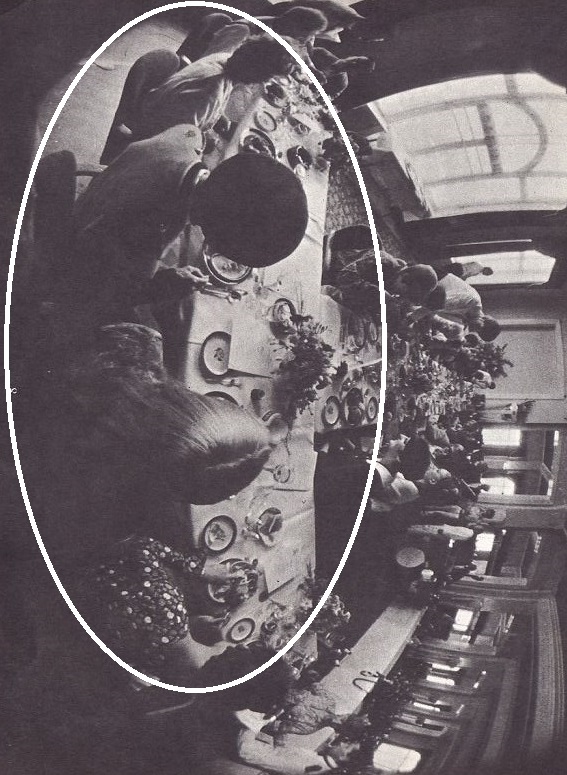
 Theorists would claim a connection between Paul’s supposed Walrus costume and the death rumor, but the real controversy revolved around the word “Beatles” above the lad’s heads that purportedly reveal a secret phone number. As Rolling Stone famously pointed out, it’s not exactly clear what that phone number is supposed to be. Depending on whom you ask it could be read as “231-7438, 834-7135, 536-0195, 510-6643, 546-3663, 624-7125, no telling what city, maybe London.” If you turn the album cover upside down and hold it in front of a mirror you can see the numbers 8341735, which is a stretch because the threes, the seven and the five are backwards. If you simply hold the album cover upside-down, the numbers could be 5371438. Of course, there is no area code. The rumor claimed that when this number was dialed, the caller would receive information about Paul’s death, or the person would be able to take a trip to “Magical Beatle Mystery Island”, or maybe even speak to Paul in the hereafter. Stories circulated about the strange responses callers were receiving from the voices on the other end of the phone line. Later it was discovered that one of the phone numbers belonged to a journalist who was nearly driven crazy by the numerous phone calls from people hoping to connect with the late Paul McCartney.
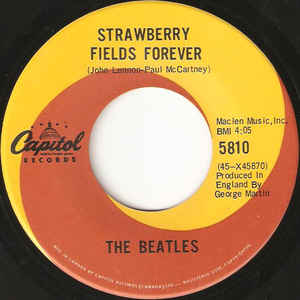 But it was the music contained on the album that offered the clue seekers the most tantalizing hints at Paul’s demise. One of the best known “Paul is dead” audio clues comes at the end of “Strawberry Fields Forever”. As the song fades out for the second time, John allegedly says “I buried Paul.”‘ This audio clue can be heard more clearly when the record is played at 45 rpm as John’s voice is slowed down to a virtual crawl. Years later, John admitted that he was really saying “cranberry sauce,” which became evident on the “take 7 and edit piece” version of the song that appeared on Anthology II in 1996. Paul explained “That’s John’s humor. John would say something totally out of sync, like ‘cranberry sauce.’ If you don’t realize that John’s apt to say something like ‘cranberry sauce’ when he feels like it, then you start to hear a funny little word there, and you think aha!”
 The album, movie and pictorial booklet are arguably the most ambitious effort ever attempted by the Fab Four. Completed at a time when the Beatles were still having fun, but questioning their viability at the same time. Although they saw themselves as a rock band, their fans were looking at them as modern day prophets. Undoubtedly, this view was responsible in large part for the devastation perceived by the “Paul is Dead” rumors that continued to swirl around the band. The band’s next effort, “The White Album”, would do nothing to help end the controversy.
 During that last tour, the airplane they were traveling in was shot at as they landed in Texas, and a prankster threw a firecracker at the stage during their Memphis show which everyone thought at first was a gunshot. The Beatles were burnt out and the band had had enough. The band’s attitude and message became darker and soon, concerts became dangerous as the Beatles’ started to receive death threats after some comments made by John Lennon at a press conference that year. John’s quote “the Beatles are bigger than Jesus” was taken out of context and according to John Lennon, “upset the very Christian KKK”. In the Philippines they unintentionally offended Imelda Marcos, a former beauty queen, by not meeting with her privately before their show. Filipino citizens took this as an excuse to rob, harass and threaten death to the Beatles. They stopped touring soon after the show at Candlestick Park in San Francisco on August 29, 1966. Less than six months later, the McCartney death rumor had reached a fever pitch worldwide and just like Paul himself, it refused to die.


 On the inside photo, Paul is wearing a patch on his band uniform with the letters “O.P.D.” that theorists interpreted as “Officially Pronounced Dead.” According to tradition, this British Police jargon “O.P.D.” phrase is the equivalent of American police forces use of “D.O.A.” (Dead On Arrival). (Much later, in a Life magazine article Paul stated, “It is all bloody stupid. I picked up the O.P.D. badge in Canada. It was a police badge. Perhaps it means Ontario Police Department or something.” Actually, the badge Paul was wearing reads “O.P.P.”, which stands for the Ontario Provincial Police. The angle of the photograph makes the final “P” look like a “D”.)
 Furthermore, the three black buttons on the waist above the tail of Paul’s coat are supposed to represent the mourning of the remaining Beatles. Although John, Paul and George were all about the same height (Ringo, much shorter), in the gatefold photo, Paul appears taller than the other Beatles, suggesting that he is ascending to the heavens. Another clue points out that next to Paul’s head are the words “WITHOUT YOU” from the song title “Within You Without You”.
 Regardless, the album did nothing to quell the rumor that “Paul was Dead.” The Beatles, who were by this time totally fed up with dealing with the press, did little to dissuade the discussion of demise. Some pundits have speculated over the years that the entire affair was a ploy by the Beatles’ and their management designed to sell more albums. Which makes sense when you consider that the McCartney death rumor would continue to swirl around future album releases by the Fab Four in the coming years.
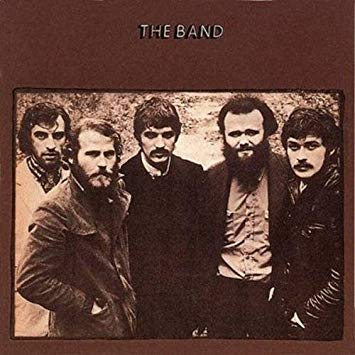


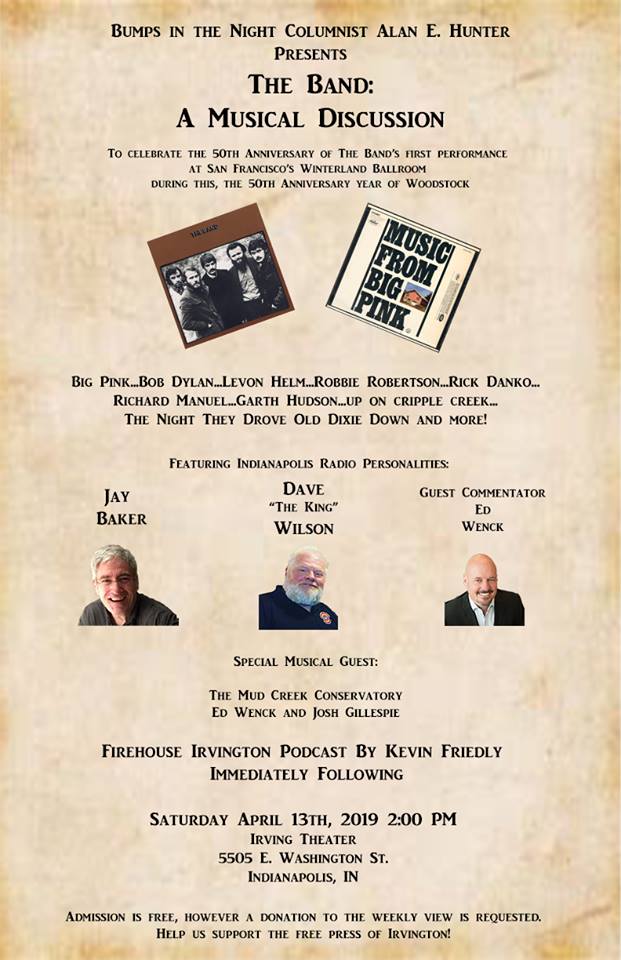
 The Band was born only after the near fatal motorcycle accident involving the world’s most famous electric folksinger changed their direction. And, although The Band’s first album “Music From Big Pink” debuted on July 1st, 1968, the band from West Saugerties, New York did not perform live until the spring of 1969 a continent away in San Francisco. The album was created start to finish in two weeks time with no overdubbing, unheard of for its day. What’s more, The Band very nearly didn’t take the stage at all; saved only after legendary promoter Bill Graham picked a hypnotist out of a bay area phonebook to right the ship. The little-known stories of these great incidents will be discussed this Saturday.
 To understand The Band, one must also understand the era into which it was born. Big Pink’s 1968 debut was also the year of student protests against the Vietnam War, Martin Luther King and Robert F Kennedy’s assassination, riots at the Democratic National Convention in Chicago, Black Panther demonstrations, feminists protesting the Miss America pageant in Atlantic City, Apollo 7 and 8’s moon landing rehearsal flights, Charles Manson gathering his cult members at Spahn Ranch and Nixon’s nomination for president. To many, America was coming apart at the seams and the divide between generations had never seemed wider. This band, formed out of a classically trained musician, a teenaged alcoholic, a butche’rs apprentice, a Jewish Native American grifter and a veteran performer from the Mississippi Delta, stepped forward to bridge the gap.
 While considered the fathers of the history conscious “Americana” music movement, make no mistake about it, these guys were quintessential rock and rollers. Fast cars, fast women, and fast times punctuated the lives of each member of The Band. They started in the age of rockabilly, while Elvis Presley was still shaking things, up and finished at the dawn of hip-hop. They crossed paths with Hollywood movie stars, gangsters and presidents. Eric Clapton, Van Morrison, Dr. John, Sonny Boy Williamson, Muddy Waters, Conway Twitty, Tiny Tim, Jack Ruby, Martin Scorsese and Jimmy Carter all play a part in the story of these four Canadians and one self-described “cracker” from Arkansas to create a mystique that still surrounds them today, long after three out of the five band members have passed.
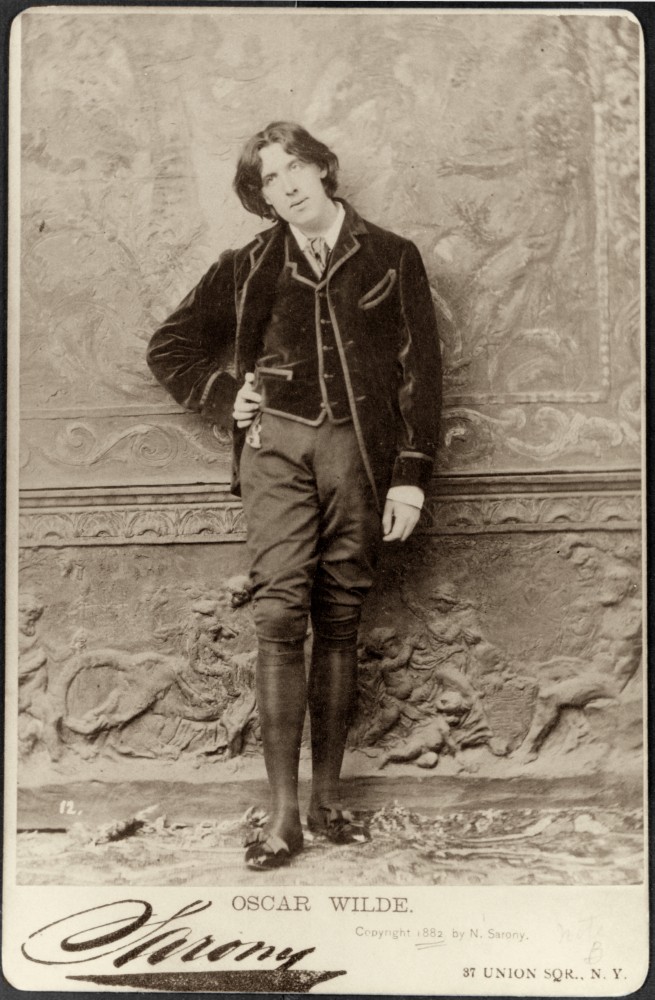


 No less than five separate newspaper columns excoriated Wilde or his performance. The Indianapolis Journal newspaper said “We have grown sunflowers for many a year, suddenly, we are told there is a beauty in them our eyes have never been able to see. And hundreds of youths are smitten with the love of the helianthus. Alackaday! We must have our farces and our clowns. What fool next?” Soon, gaggles of admiring young men sporting sunflowers in their velvet lapels formed clubs known as “sunflower boys” to sit front and center at Wilde’s appearances. At Wilde’s other appearances, so many young street toughs interrupted Wilde’s shows that he sent advance notice to Denver that he would no longer act the gentleman and that he was “practicing with my new revolver by shooting at sparrows on telegraph wires from my car. My aim is as lethal as lighting. — O. Wilde.”

 On his 1882 lecture tour of America drank elderberry wine with Walt Whitman in Camden (of whom he said, “I have the kiss of Walt Whitman still on my lips.”), conversed chillily with Henry James in Washington (who called Wilde “the most gruesome object I ever saw”), lectured in Saint Joseph, Missouri (two weeks after the death of Jesse James), called on an elderly Jefferson Davis at his Mississippi plantation (of whom Wilde inexplicably remarked, “The principles for which Jefferson Davis and the South went to war cannot suffer defeat.”), and fell prey to a con-man in New York’s Tenderloin (he lost $ 5,000 to legendary Gotham City conman Hungry Joe Lewis in a rigged Bunco game).
 Alan E. Hunter