Auctions, Music, Pop Culture, The Beatles

John Lennon’s tooth and doodles.

John LennonTooth-sign

Original publish date: November 17, 2011            Reissue date: June 20, 2019

The last couple of weeks have witnessed yet another sign of the staying power of the Beatles as a couple of items hit the auction block at two different auction houses in Great Britain. One of them is historically significant while the other is slightly creepy.
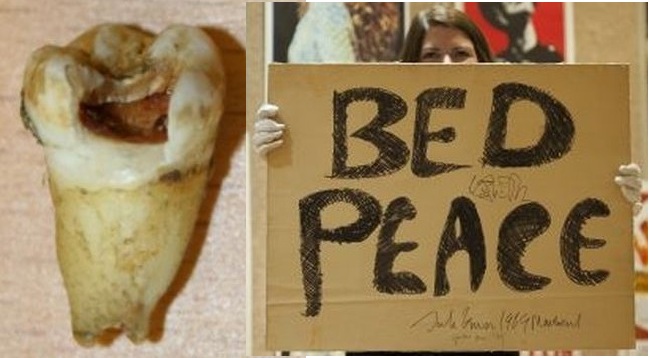
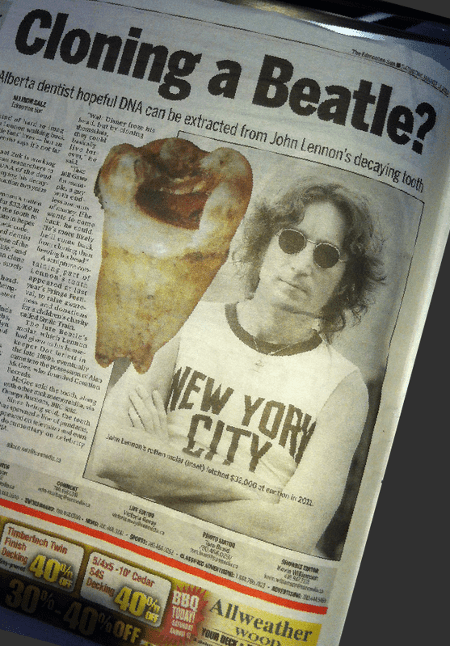
On Saturday November 5th, the tooth fairy was denied when a tooth belonging to former Beatle John Lennon was sold by Omega Auction House in Cheshire England. (Admit it, an image of Austin Powers saying “Yeah, baby” just flashed through your mind.) Americans have long parodied the English and their bad teeth. The thought of actually paying money for the tooth of anyone, let alone a Beatle, may repulse and revile you. However, 49-year-old dentist Michael Zuk from Calgary, Alberta, Canada thought enough of the relic to plunk down $ 31,200 to own it.

z WEB_LennonsTooth
Dentist Michael Zuk.

Zuk, a crusading whistle-blowing dentist and author of the 2010 book, “Confessions of a Former Cosmetic Dentist”, has practiced dentistry in the Canadian town of Red Deer for 25 years. He admitted he hoped the high profile tooth purchase might draw attention to his book. He said Lennon’s tooth is another example of how even celebrity’s teeth can be imperfect. “It’s visibly rotten and contains a large hole, Zuk said, adding it’s likely a second or third molar from the lower part of Lennon’s mouth. I’m guessing Lennon may have had an acid reflux problem caused by the rock star lifestyle.” says Dr. Zuk. “That’s my speculation, he had a stomach problem that caused a massive cavity.” Zuk said. The Doctor says he’s already making plans to take it on tour and show it off at dental schools worldwide. He added it could be used for future research. “The nerve of the tooth is dried up and inside,” he said. “But that’s where DNA would be if in the future people are interested in trying to clone John Lennon.”
z lennon tooth 2The molar, slightly yellowed with heavy coffee stains and a large cavity, was given to Dorothy “Dot” Jarlett, John Lennon’s housekeeper for half-a-decade. The story goes that one day Lennon encountered the housekeeper in the kitchen of his Kenwood home in Weybridge, Surrey. John, having just returned home from a trip to the dentist, gave Dot the tooth wrapped in a piece of paper and asked her to dispose of it for him. Then John paused for a moment and suggested that Dot give it to her daughter as a souvenir, since she was such a huge Beatles fan. Dot Jarlett’s daughter cherished the sacred relic and when she married a Canadian, she brought her Beatle biting bicuspid into the marital union. The tooth has been “living” in Canada for all but a couple of the last 45 years.
Dot Jarlett, who was employed by Lennon from 1964 to 1968, developed a warm relationship with John. Lennon’s mother died in an automobile accident less than a decade before when Lennon was just 17-years-old. He was in his mid-twenties and Dot was in her mid-forties during their association. Undoubtedly, Dot filled a void in Lennon’s life as a much needed maternal figure during her employ, thus strengthening the connection between the two. Dot’s son Barry told BBC News, “He treated her like family because he didn’t really have a very big family and he really looked after my mum. He used to call her Aunty Dot.”
z Clone-a-BeatleWhile “Aunty Dot” is selling the tooth, she plans to keep a leather wallet and a pearl necklace Lennon gave to her after returning from a concert tour of Japan. Lennon gave the Jarlett family many gifts over the years. A few years ago, Dot sold the jacket worn by John on the “Rubber Soul” album cover, also given to her by Lennon. Dot, who is now 90-years-old, said it was the right time to pass it on rather than to risk the tooth getting lost. Auction house experts have determined that the tooth is too fragile to conduct a DNA test but they have no doubt about its authenticity and point to the impeccable provenance that accompanies it.
Of course, this isn’t the first Rock-N-Roll body part to be sold at auction. In 2009, a clump of hair trimmed from Elvis Presley’s head after he famously joined the Army in 1958 sold for $18,300 at Chicago’s Leslie Hindman auction house. Lennon, who was a huge fan of the King, would be pleased to share that stage.
Less sensational, but undoubtedly more historically significant, 10 days later on Tuesday November 16, 2011, a placard for John Lennon and Yoko Ono’s 1969 “Bed-In for Peace” sold for $155,892 by Christie’s International auction house in London. The winning bid for this anti-Vietnam War movement relic came from an unidentified phone bidder. The handwritten cardboard rectangular sign featured the slogan: “BED PEACE” and could be seen behind John & Yoko in the window directly behind them when they spent seven days occupying rooms in the Queen Elizabeth Hotel in Montreal, Canada.
z 2-2-31The Montreal bed-in came two months after the couple’s honeymoon bed-in in Amsterdam and was their take on a sit-in. Lennon’s idea was for protesters to stay in bed and grow their hair rather than doing anything violent. The couple opened their hotel room door to the world’s media and spoke to journalists, politicians and artists trying to promote the idea of peace in the world. They also found time to record the anthem Give Peace a Chance. Many artworks and placards were created over the week and were moved around and given away but the Bed Peace sign was a constant.
The placard, signed and dated by the couple, was acquired by a sound engineer who attended the event. He passed it on to a colleague, whose family kept the relic safe ever since. The message “BED PEACE” was scrawled in black ink on a piece of plain manila colored foam board. The two words were outlined and then colored in with black felt tip by John Lennon himself. John and Yoko produced many artworks during the event but this was one of only two kept prominently above the bed (The other was a sign that read “Hair Peace”). Many were moved around the room and some were given away to friends and fans. However, the sign sold at the Christie’s auction was displayed in the window of the Montreal hotel room (Suite 1742) for the couple’s entire stay. It can be seen in nearly every picture taken of the pajama-bathrobe clad couple as they called for an end to the Vietnam War. The sign includes John’s self doodled mini-portrait of the newlyweds and is signed by both Lennon and Ono.
z Bed-In_for_Peace_Amsterdam_1969_-_John_Lennon__Yoko_Ono_13The sign is not the only item from the Montreal “Bed-In” to be auctioned by the famed auction house recently. On July 10, 2008, Lennon’s hand-written lyrics for “Give Peace a Chance” sold for $800,000 at Christie’s. When Lennon gave teenager Gail Renard his scribbled lyrics to “Give Peace a Chance” in 1969, he told her to hold on to the cue card. “It will be worth something someday,” predicted Lennon. She did, and it was.
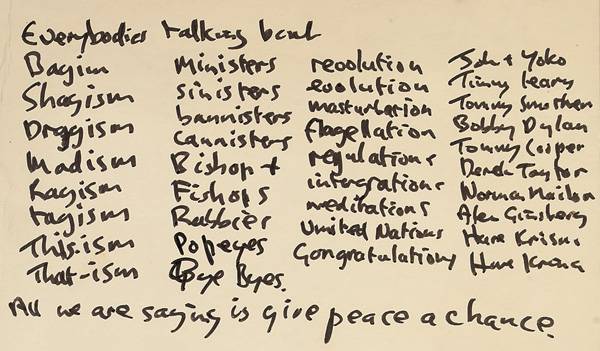
Renard, a teenage fan who sneaked past security guards, was among the first to arrive. She befriended Lennon, helped look after Ono’s young daughter, Kyoto, and made copies of the song Lennon wrote during the “bed-in” so their friends could read the lyrics and record it in the room. “It was a bit ‘Mission Impossible,'” Renard recalled. “It was back up back staircases and fire escapes and waiting until the security guard — until nature called — and the moment he went away, running in, knocking on the door, and Yoko answered, and I said, ‘Could we have an interview for a school magazine?’ and she said, ‘Yes’! ” They were wonderful. We were lucky. It was before the world’s press got in, and they had just arrived, and John was very tired and hungry, and they couldn’t get room service yet, and I had a Hershey bar in my handbag, and I said, ‘Would you like a chocolate bar?’ And he went, ‘Yes, please.’ And we bonded over a Hershey bar! … He was a lovely man.”

z SD_SD200810487494522AR
John Lennon’s handwritten lyrics to “Give Peace a Chance.”

The lyrics, she added, were “on my wall originally, but then somebody pointed out, ‘Is it really wise keeping it on your wall”‘ And it became a responsibility, because it had to go into a vault and things, and I thought, ‘It should be enjoyed. It has to be enjoyed and seen, and remember why John wrote it in the first place. John and Yoko did it for love and peace.'” Renard, now a British-based TV writer and presenter, developed a lifelong friendship with Lennon, who helped launch her journalism career by placing an article she wrote about the bed-in in the Beatles Monthly magazine. The actual recording of “Give Peace a Chance” took about five minutes. It became a worldwide hit after it was touched up in the studio. A number of famous guests, including Timothy Leary, Allen Ginsberg and Tommy Smothers, sang on the record, which went to No. 14 on the Billboard charts. The song is a simple, casual affair recorded without any of the Beatles’ typically high level of musicianship and artistry, but the phrase “Give Peace a Chance” has entered the popular lexicon, surviving long after Lennon’s death in 1980.
Who’d have thought that a cue card, a sign or a tooth could be worth so much money? There was no such thing as rock memorabilia back in 1969. Who could have predicted what a big business Rock-N-Roll would become? zbe4c8532446775cb45446b70adfe80f0

Abe Lincoln, Presidents

Robert Todd Lincoln checks in.

http://weeklyview.net/2019/06/13/robert-todd-lincoln-checks-in/Robert Todd Lincoln ‎February ‎25, ‎2011 photo

Original publish date:  February 25, 2011  /  Reissue date June 13, 2019

Anyone who reads my column regularly knows that I have a love of odd, unusual history relics, ghost stories and collectibles. I spend a lot of time at antique shows, flea markets, libraries and historic buildings and about once a year, I stumble across something that speaks to me and ultimately reveals a deeper story than I ever imagined. I recently acquired an item, and a story, that I’d like to share with you. It is a personal check dated December 17, 1920 from the New York City bank account of Robert Todd Lincoln, the only surviving child of our 16th President, Abraham Lincoln.
Finding a cancelled check from a long forgotten bank account of a dead celebrity is not as rare as it sounds. There exists a thriving underground market of dealers in checks and official documents from famous, or infamous, personalities from every field you can imagine. Think of it, most people save their old checks and if you’re a collector, what better way to authenticate a signature than on a check?
As with most Hoosiers, I share a certain fascination with Abraham Lincoln and the many sites, stories and memorabilia associated with him. I have long tried to decipher the complicated relationship between Robert Todd Lincoln and his parents. Aside from being Mr. and Mrs. Lincoln’s oldest son, Robert Todd Lincoln (August 1, 1843 – July 26, 1926) was an accomplished lawyer, US Ambassador and Secretary of War for Presidents Garfield and Arthur. In fact, most historians consider Lincoln to be our country’s second most effective Secretary of War behind only Jefferson Davis. Yes the same Jefferson Davis who opposed his father during the American Civil War as President of the Confederacy.
Robert Lincoln studied at Harvard University from 1861 to 1864 and much to the embarrassment of his father, Mary Lincoln prevented her son from joining the Union Army until shortly before the war’s conclusion in 1865. He briefly held the rank of captain, serving in the last weeks as part of General Ulysses S. Grant’s immediate staff and never saw actual combat. He was in the room at Appomattox when Lee surrendered.
Lincoln’s distant relationship with his father was due in part to the fact that Abraham Lincoln spent months on the judicial circuit during Robert’s formative years growing up in Springfield and later Robert was away at college when his father attained the White House. Although Abe was proud of Robert and thought him bright, the two lacked the same strong bond Father Abraham had with Bob’s younger brothers, Willie and Tad. There can be no doubt that Robert deeply admired his father and he wept openly at his deathbed.

z abraham-lincoln-family-4
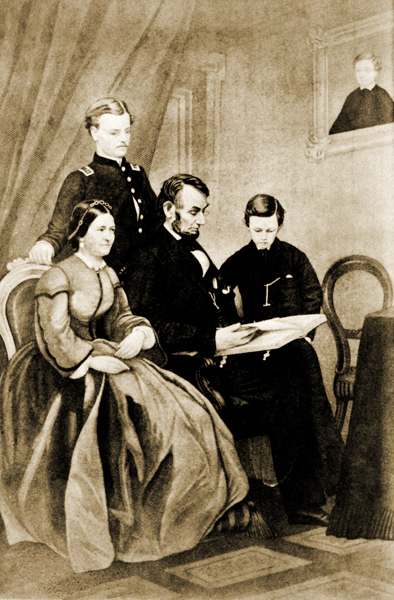
Mary, Robert, Abraham and Tad Lincoln.

Following his father’s assassination, in April 1865, Robert moved with his mother and brother Tad to Chicago, where Robert completed his law studies at the University of Chicago. Robert was admitted to the bar on February 25, 1867. In 1868, Robert Lincoln married Mary Eunice Harlan, the daughter of Iowa Senator James Harlan, a close friend of Abraham Lincoln. Senator Harlan is perhaps remembered for an 1865 incident as Secretary of the Interior under President Andrew Johnson, when he found a copy of Leaves of Grass on Clerk Walt Whitman’s desk (left there as the poet was making revisions) and found it to be morally offensive. “I will not have the author of that book in this Department”, he said. “If the President of the United States should order his reinstatement, I would resign sooner than I would put him back.” Robert and Mary had two daughters and one son: Mary “Mamie” Lincoln, Abraham Lincoln II (nicknamed “Jack”) and Jessie Harlan Lincoln.
After his father’s assassination, Robert’s life continued to be connected to sadness and tragedy. After all, Robert was invited to accompany his parents to the Ford’s Theatre but declined (citing what we would today call “Jet Lag” from his trip home from the war front) and instead he went to bed early at the White House. He was informed of the shooting just before midnight and was at his father’s bedside when he died. No doubt, the decision not to accompany his parents haunted him for the rest of his life. Not only for the supposed inability to protect his father, but also for the prospect that he too might have died in the attack.

z family-d
Mary, Willie, Robert, Tad and Abraham Lincoln.

In 1875, perhaps rashly and ill-advised, Robert had his mother Mary committed to a psychiatric hospital in Batavia, Illinois. Mary’s eccentric behavior has been well documented. Nevertheless, Robert tasted the sting of public criticism and rebuke for the first time in his young life. The incident led to a profound estrangement between Bob and his mother and the two never fully reconciled.
Coincidentally Robert was was just a few feet away when President James Garfield was shot by Charles Guiteau at the Sixth Street Train Station in Washington, D.C. on July 2, 1881. Lincoln was serving as Garfield’s Secretary of War at the time and cradled the President’s body on the railroad platform as medical personnel arrived on scene. Later, on September 6, 1901, at President William McKinley’s invitation, Lincoln was at the Pan-American Exposition in Buffalo, New York, where the President was shot by Leon Czolgosz. From then on, Lincoln would politely refuse all Presidential invitations with the comment “No, I’m not going, and they’d better not ask me, because there is a certain fatality about presidential functions when I am present.” However, he did attend the dedication of the Lincoln Memorial in 1922 in the presence of President Warren G. Harding. Harding was dead within a year.
Lincoln’s son Abraham Lincoln II , aka “Jack”, died in London at the age of 16 from blood poisoning after a freak infection set in following surgery to lance a boil under his arm. Jack was originally buried in the Lincoln Tomb in Springfield, Ill. but his mother (coincidentally named Mary) had Jack’s remains dug up and re-interred at Arlington National Cemetery after her husband Robert died in 1926. The cycle of sadness followed Robert after his death as Jack’s body was removed from the President’s tomb, where it had rested near his illustrious grandfather for 40 years, and removed to Arlington. Robert himself had expressed his intentions to be buried next to his father and son in Springfield, but for unknown reasons, his wife changed the plans. The empty crypts of both men can be found in the President’s tomb in Springfield to this very day. As a final irony, Jack’s name was not added to his father’s Arlington memorial until 1976.

z rtlw
Lincoln’s great-grandchildren Robert Todd Lincoln (Bud) Beckwith and Mary “Peggy Lincoln Beckwith.

Of Robert’s remaining children, Jessie Harlan Lincoln Beckwith (1875–1948) had two children, Mary (“Peggy”) Lincoln Beckwith [1898 – 1975] and Robert (“Bud”) Todd Lincoln Beckwith (1904–1985). Robert’s other daughter, Mary (“Mamie”)Todd Lincoln (1869–1938) had one son, Lincoln Isham (1892–1971). Isham married but never had children. Peggy, who was rumored to be a lesbian because she smoked cigars and wore men’s pants, also never married or had children. Her brother Bud married three times but had no heirs.
That is where my personal story begins. As it happens, the 1920 Robert Todd Lincoln check that I purchased was also signed by Bud. This intrigued me as I knew little or nothing of Bud Beckwith and wondered why the check would be signed by both men.
Bud was an attorney and self described “playboy” who often listed his profession as “gentleman farmer of independent means” rather than lawyer. He served in the Coast Guard during World War II, which resulted in a lasting hobby of boating and sailing. To say that “Bud” Beckwith was eccentric is like saying water is wet.
At some point, Bud Beckwith realized that he was the last heir to the Lincoln name, the last direct link to the martyred President. In this role, he realized he was now the repository of the everyday Lincoln papers and mundane family belongings perhaps unworthy of museum stewardship but valuable just the same. Among those were the cancelled checks of his grandfather. Bud decided to forever link his name with that of his illustrious namesake by counter signing some of the checks that were left to him with his full name, “Robert Todd Lincoln Beckwith” beside the fountain pen signature of “Robert Todd Lincoln”. He would sometimes send these checks out to autograph collectors who wrote asking for signed mementos from Bud or his family.

z 72efa08e8681e1e4b9c84cae004e68d2
Brentano’s Bookstore as Robert Todd Lincoln would have known it.

My check was written by the son of President Abraham Lincoln on December 17, 1920. It was made out to “Brentano’s” bookstore in New York City for nine dollars and seventy cents. It is easy to imagine Secretary Lincoln walking into Brentano’s on that Friday evening one week before Christmas before heading back to his estate, “Hildene”, in Manchester Center, Vermont. Was he buying books to give away as Christmas presents or to read on the 4 hour train ride home to Hildene? Perhaps he was buying books about his father?

z 3535d93939d5ac4322c85c5d8bd3a7ed
Brentano’s Bookstore Scene from Seinfeld

And Brentano’s? Well, if you are a fan of the “Seinfeld” TV show, you know Brentano’s. It was the setting for the 1998 episode titled, “The Bookstore” in which George is accused of taking an expensive art book into the bathroom causing the book to become forever “flagged” as unreturnable. Jerry also catches his Uncle Leo shoplifting in the store. As you can imagine, pop culture fanatic that I am, I was thrilled to establish my own personal link between Abe Lincoln and the iconic computer age television sitcom.

Z RTLW Ike
Dwight “Ike” Eisenhower and Robert Todd Lincoln “Bud” Beckwith.

The last living person with a direct link to President Abraham Lincoln, Robert’s namesake grandson Robert Todd Lincoln Beckwith, aka “Bud”, died alone in a nursing home in Saluda, Virginia (about 45 miles from the Confederate Capitol of Richmond) at the age of 81 on December 24, 1985 at around 6:05 pm. Nearly 65 years to the day after my check was signed. History lives my friends. You can touch it, dream about it and in many cases buy it and make it your own. My suggestion? Go and visit your local antique store, there are many fine shops and malls around Irvington, the Indianapolis eastside and all the way out to Greenfield and beyond on the Historic National Road. You just never know what you might find. History awaits you.

Creepy history, Criminals

The life (and death) of John Dillinger’s Red Hamilton. Part II

Red Hamilton 2
John “Red” Hamilton

Original publish date:  May 23, 2019

The Dillinger gang was speeding towards Chicago underworld “fixer”, Dr. Joseph Moran. During World War I, Moran served honorably as a pilot in the Army Signal Corps raising to the rank of lieutenant. His addiction to alcohol eventually gained him an unscrupulous reputation as the windy city’s best “pin artist” (someone who performed illegal abortions). In 1928 he was sentenced to 10 years in prison after one of his patients died. He lost his medical license and was released after serving only two years. He became well known for his plastic surgery skills, particularly for his ability to obliterate fingerprints, and was most often associated with the Ma Barker and Dillinger gangs. It was Moran who removed five bullets and stitched up Red Hamilton after a previous shootout, hitting Dillinger up for a cool $ 5,000 for his handiwork.
But now, the silver dollar sized wound in Red’s back was festering and oozing. The bullet had lodged in Red’s lung and was already stinking of gangrene. The shady Moran refused to treat Hamilton at any price, likely because he knew that Hamilton’s wound was mortal. Moran directed the gang to take their dying compadre to Elmer’s Tavern in Bensenville and let him die there. Before the year is out Doc Moran will mysteriously vanish from the face of the earth.

Red Hamilton 4
Hamilton spent a few days at Elmer’s, every hour in excruciating pain, but he simply refused to die. Finally, Dillinger took him to a Barker-Karpis gang safe house in Aurora that was being rented by Dillinger / Barker gang associate Volney Davis and his girlfriend, Edna “Rabbits” Murray. For the next three days, Dillinger, Van Meter, Davis, and Doc Barker stood watch as Hamilton slowly died. Edna took care of Red as best she could, but, ravaged with gangrene, Hamilton finally died on Thursday, April 26. On Friday night, the men took the body to a gravel pit in Oswego, Illinois, for disposal. Laid in a shallow grave, to hinder identification by the authorities, Hamilton’s right hand is cut off (presumably discarded elsewhere) and ten cans of lye are poured over his face and body by Dillinger who reportedly said, “Red, old pal, I hate to do this, but I know you’d do the same for me” as he emptied each can of it’s contents. After the grave was filled in, a roll of rusted barb wire was placed over it as a makeshift marker. Red Hamilton was left there to rest in peace – but not for long.
On May 19th authorities, unaware that Hamilton had died almost three weeks prior, indicted him on charges of harboring fugitives. Hamilton’s sister was convicted of the same charge, and served a short prison stint. Since Hamilton had been reported killed on other occasions, the FBI continued searching, refusing to believe reports of Red’s demise until the body was found. When Red’s grave was discovered on August 28, 1935, there wasn’t much left of him. The corpse was missing a hand and was so damaged by the lye that it could only be identified by some strands of hair and a belt size. Ultimately, only Hamilton’s dental records from the Indiana state penitentiary confirmed the identity. The FBI claimed that a couple of molars with distinct fillings matched Red’s prison x-rays.

z Volney_Davis
Volney Davis

It was not until Volney Davis was arrested, escaped, and rearrested that FBI agents learned the fate of Red Hamilton. At least, Red’s demise from the outlaw perspective. However, legend tells many different tales about the fate of Red Hamilton. What was left of the body that was removed from the gravel pit and reburied in the Oswego cemetery. The funeral service was paid for by Hamilton’s sister from Michigan. Like many fellow outlaws (John Dillinger, Billy the Kid, John Wilkes Booth, Butch and Sundance) most of the rumors claimed that Red was not dead, while other rumors never questioned Red’s fate, but rather the disposition of his mortal remains. One rumor claimed that he had been buried in the sand of the Indiana dunes. Another that he had been dropped into an abandoned mine shaft in Wisconsin.
Red’s fate remained in question long after Dillinger’s death in an alley outside the Biograph theatre in Chicago on July 22. Even before the body was found, the FBI had been receiving reports from police and public claiming that Hamilton was still alive and hiding out in northern Indiana. When interrogated by the FBI, Dillinger’s girlfriend Polly Hamilton (no relation to Red) claimed that Anna Sage told her that Red was alive and being treated for a “badly infected wound” by Dr. Harold Cassidy.
Dr. Harold Bernard Cassidy was the plastic surgeon who had famously performed surgery on John Dillinger’s face. It was Cassidy who injected the overdose of anesthetic which nearly killed Dillinger, who swallowed his tongue. However, the surgery was a success and Dillinger gave him $500 for his troubles. In 1933 Cassidy was arrested and charged with harboring a fugitive. He was given a suspended sentence in exchange for testimony against Dillinger. He served as a physician on Indian reservations and during World War II rose to the rank of Major in the Pacific. After the war he came back to Chicago, suffered a nervous breakdown, and shot himself in the head in front of his sister and mother on July 30, 1946.

z image025
THE NEW YORK TIMES, August 29, 1935

Over the years, the FBI received numerous tips from people claiming to have seen or heard from Hamilton. Red’s nephew Bruce swore that he had visited his uncle in Ontario, Canada (Red’s birthplace) long after Red’s reported death. Nevertheless, no hard evidence for Hamilton’s survival has ever been discovered. FBI director J. Edgar Hoover officially marked Red’s fate as “case closed” in 1935. In typical Hoover style, the Director trumpeted the belated discovery of the last member of the Dillinger gang to every newspaper in the country. However, underworld rumors persisted that Red had recovered from his wound and was alive and well and living north of border after retiring from a life of crime. Supposedly, Red outlived John Dillinger, Homer Van Meter, and Baby Face Nelson (all killed in violent shootouts) and lived out his life working as an electrician and handy man.

z c6dfdf95105b3ef048ca7c69601aa840
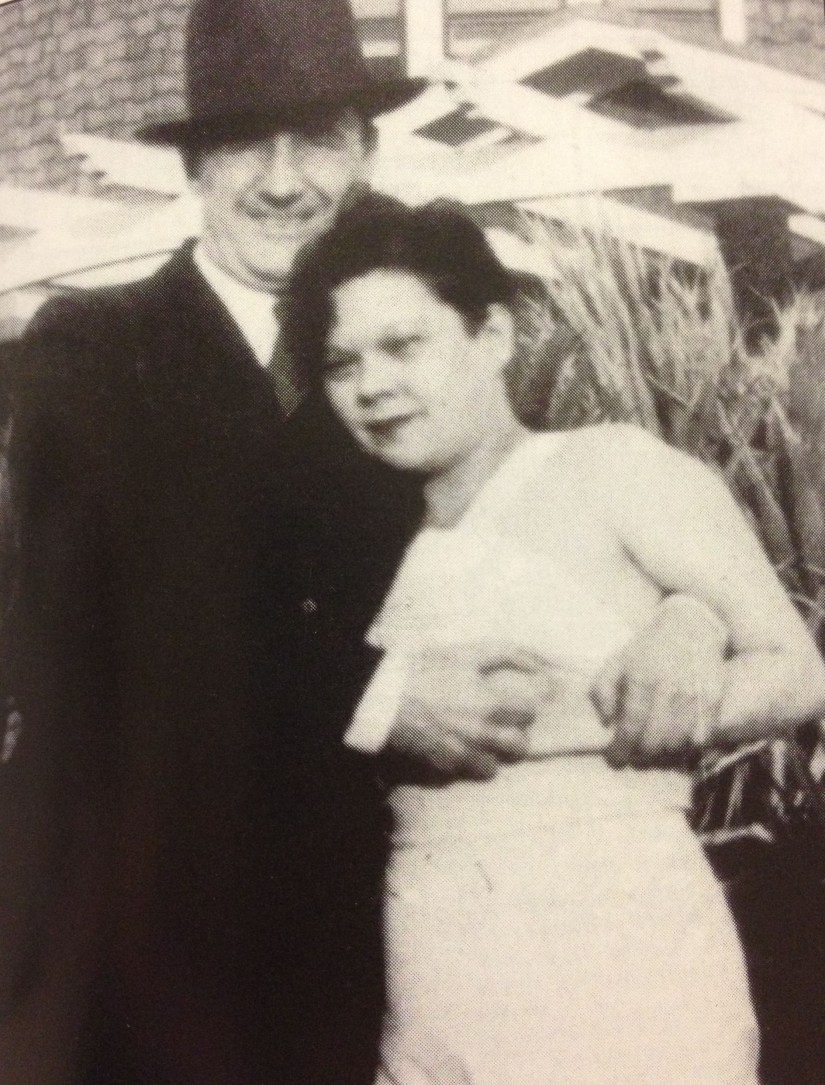
 John “Red” Hamilton and his girlfriend Patricia Cherrington

Reports claiming that Hamilton was still alive continued flowing in to the FBI on the regular, but, by Hoover’s directive, they were disregarded. Most were written off as mistaken identity. However, one survives that sounds particularly convincing. The letter, found in the files of the FBI, is dated August 24, 1936, a year after Red’s body was found. It was sent by a former inmate known as “Happy” who knew some of the gang members, as well as Dillinger’s attorney, Louis Piquett. It is believed that “Happy” may have been an associate of Dillinger named Fred Meyers, from Chicago.
The letter read: “Dear Sir: Will you kindly advise how much you will guarantee in cash for secret and confidential information about the movements of John Hamilton? There are three people who know that he is still living and happen to know the details concerning him. If interested please make offer through personal column of Chicago Tribune as follows, HAP * Will buy ,000 bushels, meaning of course that many thousand dollars for this information and place ED after the word bushels. If this offer is OK you will be supplied with an amazing detail report on his present physical condition and movements. Money must be on deposit at your Chicago Office but will not have to be paid until this man is captured or killed or both. This information must be kept strictly confidential between you and I and must be kept out of the newspapers except code transmissions between you and I. I am a hardworking electrician and took considerable time and money to get this data and do not want to risk my life for the deal. Everything will be handled by correspondence and code in the Chicago Tribune. If your offer is accepted, I will make you proposals which must be guaranteed by you as a strictly gentlemen’s agreement.”

z image030
THE NEW YORK TIMES, August 29, 1935

There is no evidence that J. Edgar Hoover ever saw it or whether there was ever a follow-up. By then, the FBI claimed that Hamilton’s dead body had been found and identified and that Hoover had won the national “War on Crime”, thereby securing his position as Director for the next four decades. But could the letter have been true? Red’s nephew, Bruce Hamilton certainly believed it was. Years later, he described a family trip to Michigan to visit his “dead” uncle Red in 1945. The trip took the family to Sault Sainte Marie on the Canadian border to the home of John Hamilton’s sister, Anna. Wilton and his wife, Harriet, their older son Douglas, their daughter, Jane Margaret, and 15-year-old Bruce, all met the man known as John “Red” Hamilton. Wilton told his wife and children not to discuss the trip with anyone.
The trip to the Upper P resulted in the collection of a large amount of money that had been stashed away by the Dillinger gang. The loot’s whereabouts were known only by the gang’s last surviving member: Red Hamilton. As evidence, crime buffs and conspiracy theorists note that the impoverished Hamilton family suddenly came into thousands of dollars in cash years after Red’s “death”. After that 1945 trip, Bruce’s father Wilton paid off the mortgage on the family home in South Bend, bought a new house, and purchased the family’s first new car. Around this same time, Hamilton’s brother, Foye, recently released from prison, also came into a great deal of money. He used it to build a machine shop in Rockford, Illinois, and he also purchased Turtle Island in the Great Lakes area near Sault Sainte Marie, as well as boats and a seaplane to get to and from the island. Bruce suspected that a large cabin on the island provided a hiding place for his uncle John. The family claimed that the outlaw survived into the 1970s, vacationing numerous times with his family over the years.
According to a March, 2007 article in the South Bend Tribune, Bruce (then living in Shiprock,N.M.) believed “the wounded Hamilton, after stopping in Aurora and then Chicago (where the FBI originally believed he had died), was patched up by Dr. Cassidy and then went into hiding with his brother, Sylvester, in East Gary, Indiana. Dillinger then returned to Aurora, while Sylvester took Red to the home of William Hamilton, Bruce’s grandfather, in South Bend. William helped get him to a hideout previously used by the Dillinger gang, a nearby place called Rum Village Woods. Hamilton recuperated well enough to go to work as an electrician at a family-owned bowling alley in South Bend in 1936 and 1937.” Bruce also said that over the years, his great-uncle Red occasionally slipped over the border to rob a bank or two until he “got tired of being shot at.” According to Bruce’s elderly aunt, Red later moved to Canada and died in the 1970s.
But if Red Hamilton didn’t die in Aurora in 1934, then whose body was found in that barbed wire covered grave in 1935? Rumor says it was Dr. Joseph Moran, who disappeared shortly after refusing to treat Red’s wound in Chicago. Hoover directed his agents to continue searching for Moran for months after he vanished. Hoover eventually declared that Moran had been killed and dumped in Lake Michigan. Alvin “Creepy” Karpis, of the Ma Barker gang admitted that Moran had been murdered and his body buried, but he never said where.

z sk
Author Stephen King.

In 2001, Jack “Red” Hamilton rocketed to pop culture immortality when he became the subject of a short story by horror author Stephen King. “The Death of Jack Hamilton” was originally published in the 2001 Christmas issue of The New Yorker magazine. In 2002, it was published in King’s collection Everything’s Eventual. The true crime story is based on the death of Red Hamilton and is written as a first-person narrative, told by Homer Van Meter, who relays the slow, painful death of his fellow gangmember. In King’s story, Van Meter spares no detail in relating how Red lapsed into dementia before his agonizing, but merciful death.
Yet another account can be found that ties the mysterious Red Hamilton to Irvington while at the same time claiming John Dillinger survived as well. The anonymous writer relates, “I knew the remaining members of the White Cap Gang in Indianapolis. In the late fifties I was told the same story you have from his nephew. He recuperated in South Bend and went to his sister in Sault Sainte Marie. Later Red moved to a new place on the Canadian side. The fellows I knew had regular communication with him. Dillinger was still sending him letters and current photos of himself. As far as I know these are the only two members of the gang to have survived. I did see such a letter and photo that Tubby Toms brought to the house for verification after Dillinger had sent it to the Indianapolis Star. They told Toms that they weren’t sure of the ID of the man in the picture but laughed like crazy when he left. They knew both Dillinger and Hamilton where alive at that time and their respective location. Toms showed me the rabbits foot Dillinger gave him. It was small. Every one was so crooked that none of the official stories was true.” In June of 1933, John Dillinger and the White Cap gang robbed the Haag’s drug store / soda fountain on the Northwest corner of Washington and Audubon in Irvington. You can’t make this stuff up folks.

z dufours
Dufours restaurant site of former Haag’s drug store / soda fountain.
Creepy history, Criminals

The life (and death) of John Dillinger’s Red Hamilton. Part I

Red Hamilton 1
John “Red” Hamilton

Original publish date:  May 16, 2019

The Dillinger Gang: Baby Face Nelson, Handsome Harry Pierpont, Red Hamilton and of course, public enemy number one, John Dillinger himself. All wickedly infamous names from the annals of crime. But, only one of them was memorialized by the master of American horror Stephen King. That distinction goes to John “Red” Hamilton, the gang member more remembered for the way he died than the way he lived. And of course, he has Indiana ties that stretch all the way to Irvington.

z The Notorious John Dillinger (18)
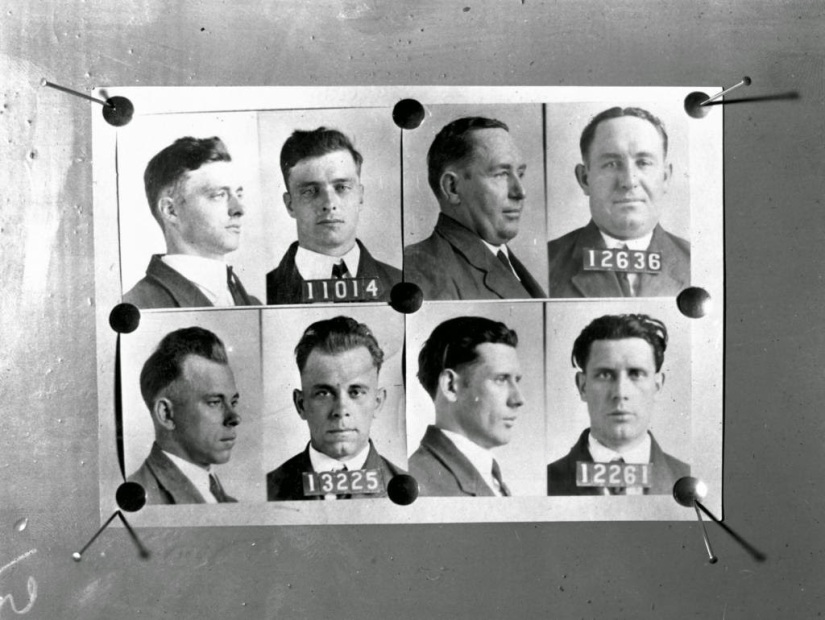
From top left, are Harry Pierpont (11014), Charles Makley (12636), John Dillinger (13225), and Russell Clark (12261).

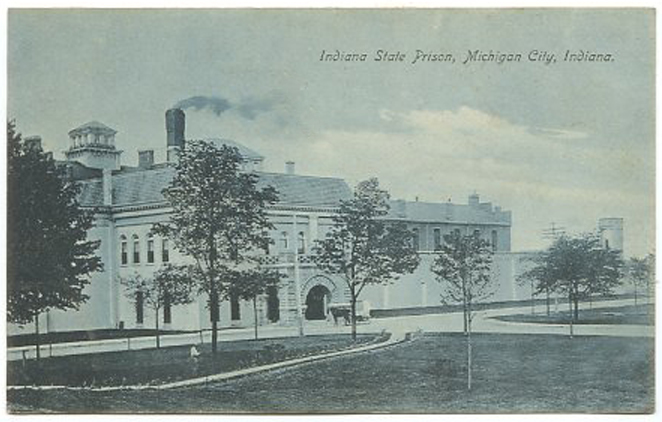
Like most gangsters, little is known about the early life of Red Hamilton. He was born on January 27, 1899 to an Irish-Canadian father from Ontario and a German-American mother from New York. He earned the nickname “Three-Finger Jack” after the loss of two fingers on his right hand in a sledding accident after the budding outlaw came too close to a passing train as a youngster. He really doesn’t appear on the radar screen until, at the age of 28, he lucked into meeting John Dillinger while serving time at the Indiana State Prison in Michigan City. On March 16, 1927, he had been convicted of robbing a gas station in St. Joseph, Indiana, and sentenced to 25 years. While incarcerated, Hamilton became friends with a bevy of bank robbers, including John Dillinger, Russell Clark, Charles Makley, Harry Pierpont, and Homer Van Meter – the men who would go on to comprise the original Dillinger gang.

z mc
Indiana State Prison in Michigan City.

Michigan City might as well have been called “Bank Robber’s University” as these young outlaws studied at the feet of fellow inmates like Herman “Baron” Lamm, the bank robber who came up with the idea of meticulously casing a bank before robbing it. a method that became known as the “Lamm Technique” and inspiration for the term “on the Lamm.” Dillinger was paroled in May 1933 and, using a list that had been compiled by Hamilton and Pierpont, he began robbing banks to finance the escape. In September of that same year, fulfilling a promise to his “cellies”, he managed to get a barrel filled with guns smuggled into the penitentiary and a total of 10 armed men, including z lammHamilton, escaped out the main gate of Indiana State Prison.
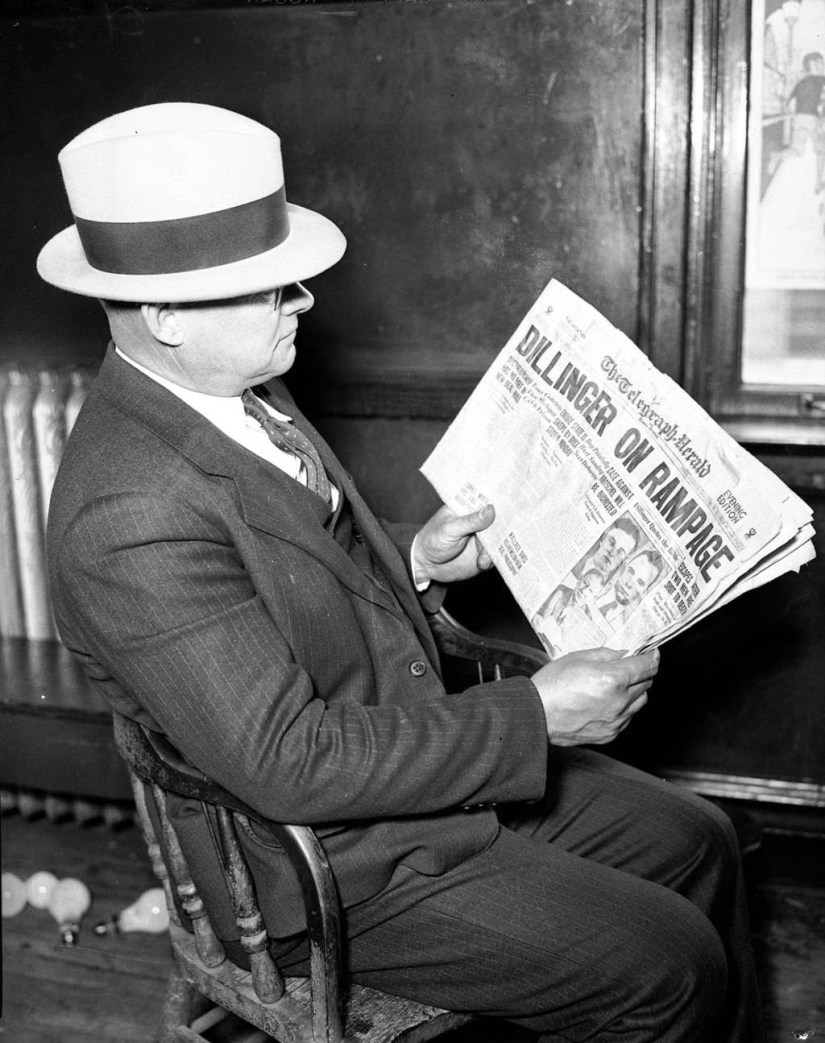
Soon afterwards, Dillinger was arrested for bank robbery and was being held at the Allen County jail in Lima, Ohio. Determined to free Dillinger, on October 3, 1933, the gang robbed the First National Bank of St. Mary’s, Ohio, escaping with $14,000 to fund the escape. Nine days later, Hamilton, Makley, Pierpont, Clark, and Ed Shouse walked into the Lima jail to “spring” their pal John Dillinger. Red Hamilton remained outside as lookout and did not enter the building and did not participate in Makley and Pierpont’s murder of Sheriff Jess Sarber.
z The Notorious John Dillinger (2)On December 13, 1933, the Dillinger gang robbed a Chicago bank, netting a reported $50,000. Afterwards, the gang went down to Daytona Beach, Florida for a time and then went west to Tucson. Hamilton, however, decided to go to Chicago instead, where, on December 13, 1933, he took part in the robbery of a local bank. The next day, Hamilton left his car at a Chicago garage for some body work, the garage’s mechanic called police reporting it as a “gangster car”. Hamilton returned to pick up the car and found police detective, William Shanley and two other officers waiting for him. He opened fire, killing Shanley, and escaped from the other two officers. Red’s incident led to the Chicago Police Department forming a special forty man “Dillinger Squad”. A month later, on January 15, 1934, Hamilton and Dillinger robbed the First National Bank in East Chicago, Indiana, for $20,376. During the heist, police officer William O’Malley was shot dead. Dillinger was officially charged with the murder, but several witnesses ID’d Hamilton as the shooter. By the end of the year, Hamilton found himself ranked third on Indiana’s list of “public enemies”, behind circle-city natives Dillinger and Pierpont.
john-hamilton-2During the robbery, Hamilton was shot twice and left in the care of his girlfriend Pat Cherrington and underworld physician Joseph Moran, while Dillinger and the others headed to Tucson where they were apprehended by the authorities. Afterwards, for a short time, the fugitive Hamilton shot to the top of the public enemies list. There he remained until Dillinger, using a wooden gun, escaped from the Crown Point jail. Afterwards, Dillinger formed a new gang consisting of Hamilton, Homer Van Meter, Tommy Carroll, Eddie Green, and Baby Face Nelson.
On March 6, three days after Dillinger’s Crown Point escape, the gang robbed the Security National Bank & Trust Company in Sioux Falls, South Dakota. In the chaotic robbery, motorcycle cop Hale Keith was severely wounded after Nelson maniacally shot him down through a plate glass window.
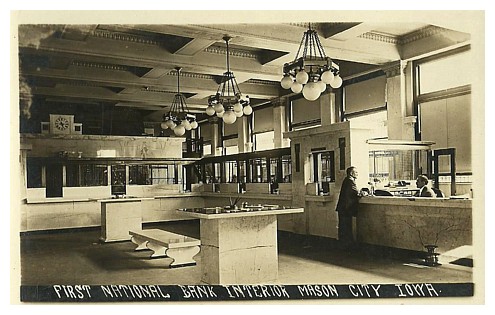
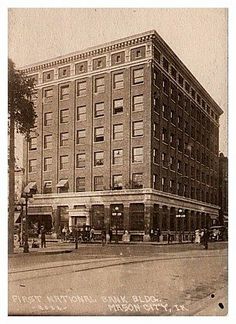
A week later, on March 13, 1934. the gang robbed the First National Bank in Mason City, Iowa, which allegedly had over $240,000 in its vault. During the robbery, Baby Face Nelson stayed with the getaway car while the rest of the gang ran into one problem after another inside the bank. When the bank president saw Van Meter walk in carrying a machine gun, he thought that a “crazy man was on the loose.” He ran into his office and bolted the door. Van Meter fired a number of shots through the door to no avail. He soon turned his attention to helping his cohorts clean out the teller drawers.

z 1stnatlbankinter
First National Bank in Mason City, Iowa in 1934.

A guard in a special steel cage above the lobby fired a tear gas shell at the bandits which was answered by a machine gun blast of several bullets, a few of which clipped the retreating guard. Meantime, a female customer ran out of the bank and down the alley outside, where she ran directly into lookout Baby Face Nelson, who promptly sent her back into the bank. Red Hamilton was dealing with problems of his own. The bank’s cashier had locked himself in the vault. Hamilton ordered the cashier to start passing money through a slot in the door and the cashier began passing out stacks of one-dollar bills.
An elderly judge spotted the bandits on the street below from his third-floor office and took a shot at John Dillinger, winging him on the arm, Dillinger whirled around and fired a burst from his Tommy gun. The bullets bounced off the front of the building and the old judge ducked away unhurt. Dillinger decided it was time to skedaddle and he sent Van Meter inside to get the others. Hamilton was still dealing with the cashier. Red could see the stacks of larger bills on the shelves inside the vault but the cashier continued to load stacks of one-dollar bills into the bandit’s bag. When Van Meter told him to scram, the enraged Hamilton complained that the take was only about $20,000 and that there was over $200,000 still sitting on the shelves! Later, Hamilton said he should have shot the man just for spite.

z mason
First National Bank in Mason City, Iowa

As Hamilton ran out of the bank, the officer in the gun cage started shooting again, wounding Hamilton in the shoulder. The gang forced 20 hostages to stand on the running boards, fenders and hood of the getaway car, serving as human shields and drove slowly away. The police were unable to shoot, so they followed at a distance. Once out of town, Baby Face Nelson jumped out of the car and fired his Tommy gun towards the cop car, finally forcing them to turn back. Eventually, Dillinger dropped off the hostages unharmed. What should have been a prosperous raid had netted the outlaws a disappointing $52,000.


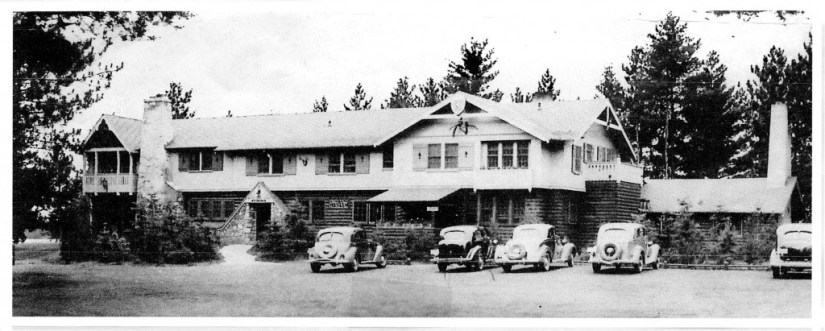
After first stopping in St. Paul, Minnesota, the Dillinger gang fled to the Little Bohemia resort near Rhinelander, Wisconsin to nurse their wounds and lay low. It was a remote fishing camp that was not due to open until May and would make the perfect place to hide out for a time. On April 22, Melvin Purvis’ FBI, tipped off by a friend of Little Bohemia’s owner, raided the place. Purvis moved dozens of agents from Chicago and St. Paul to the forests of Wisconsin. Unfortunately, all did not go as planned: the agents mistakenly opened fire on a car containing three innocent CCC workers, thinking they were outlaws. The gang escaped by jumping from a second floor window in the back of the lodge onto a mound of frozen snow, before Dillinger, Hamilton and Van Meter eventually stole a car and drove away.

z l_ca3e94882ca5bc465bf13b1324d69af5
Little Bohemia Lodge Manitowish Wisconsin.

Van Meter was driving, Dillinger in the center and Red Hamilton in the passenger seat. The rumble seat was empty and, using a crafty outlaw tactic, the gang left the seat back open to block the aim of any pursuing lawmen. The car raced down Wisconsin Route 46, across the Mississippi River, and into Minnesota back towards St. Paul. Minnesota law enforcement spotted their Wisconsin license plates on a bridge at Hastings, 15 miles out of St. Paul. One of the deputies leaned out the window with a .30-30 rifle and fired at one of the car’s rear tires. The slug tore through the rear seat, narrowly missed Dillinger, and plowed into Hamilton’s back. Red screamed in agony and slammed against the car’s dashboard.
z carDillinger smashed out the window and returned fire with his .45, shattering the windshield of the police car and nearly killing the pursuing officer. A running gun battle ensued as the two cars traded 40 or 50 rounds for the next 50 miles or so, before the outlaws finally losing the pursuing patrolmen. With Hamilton losing blood from the massive hole in his back, Dillinger told Van Meter to head to Chicago and find a doctor for his friend. But first, they needed a faster, less bullet-riddled car. Van Meter cut off a 1934 Ford V8 Deluxe containing power company manager Roy Francis, his wife, Sybil, and their 19-month-old son, Robert.
The family was ordered out of the car to watch as the bandits tossed their arsenal into the Francis family vehicle. While the bloodied Hamilton limped painfully inside, Dillinger ordered the Francis family to pile in as well. Sybil Francis recognized Public Enemy Number One right away, but Dillinger flashed that famous smile and said, “Don’t worry about the kid. We like kids.” The outlaws even treat the couple to a soda pop when a stop is made to fill up the Ford. The family was dropped off safely a few miles outside of Mendota, Minnesota with one whale of a story to tell. The outlaws continued on toward Chicago in search of a “friendly” doctor to fix Red Hamilton. And here is where the story gets interesting.

Criminals, Indianapolis, Irvington Ghost Tours

IRVINGTON’S LINK TO THE FORMATION OF THE F.B.I.

Holmes-Dillinger

Original publish date:  January 19, 2009

Reissue date: June 6, 2019

This article originally ran in the January 19, 2009 edition of the Eastside Voice. I spent this past weekend with the Great-great-grandson of H.H. Holmes, “Bloodstains” author Jeff Mudgett, and the film crew from Travel Channel’s “Ghost Adventures” series. We gathered to tape a show inside the home where Holmes committed one of his most heinous crimes: the murder of 10-year-old Howard Pitezel. For that reason, I thought this might be a perfect time to revisit one of the few positive aspects of that crime and highlight Irvington’s role in the saga of Federal law enforcement in this country. While the society has faded away, the meeting place has closed its doors and the article’s agent provocateur has become a fellow columnist, the subject matter retains its relevance a decade later.

Z Holmes Irvington
H.H. Holmes murdering 10-year-old Howard Pitezel in Irvington.

During the inaugural meeting of the “Ichabod Crane Society of things that go bump in the night” at Book Mamas in Irvington held Saturday January 17 2009, I learned something interesting I’d like to share with you. One of the guests, Irvingtonian Steve Nicewanger asked me if I was aware that Irvington had a connection to the formation of the Federal Bureau of Investigation. Steve informed me that the F.B.I. had been formed to track down one of Irvington’s most infamous figures, America’s first serial killer Dr. H.H. Holmes. Holmes was alleged to have killed over 200 people in Chicago in 1893. His story is well documented and his spirit is rumored to still haunt the Irvington bungalow where he murdered and desecrated the body of a 10 year old boy named Howard Pitezel. Holmes came through Irvington in the autumn of 1894 while being chased by a dogged Pinkerton Detective named Frank Geyer. I thought I had researched the Holmes saga pretty thoroughly, but I must admit that I had never heard of this possible connection. I was intrigued by the thought of it.
z john-dillinger-wanted-posteI have always attributed the genesis of the F.B.I. to another infamous Hoosier with Irvington ties, John Dillinger, who robbed an Irvington drug store and soda fountain in the summer of 1933. The building still stands and is home today to DuFours restaurant on the northwest corner of Washington and Audubon (now the Lincoln Square Pancake House). At the time, Dillinger allegedly lived on a property known as “Rickett’s Farm” near the Kile Oak in Irvington. I knew that J. Edgar Hoover, the man most people credit with forming the present day F.B.I., was a little known Washington D.C. bureaucrat until Dillinger came along. Hoover made his reputation by expanding the law enforcement powers of his obscure bureau to track down Dillinger. Dillinger became the bureau’s first “Public Enemy # 1” on June 22,1934, which ironically was John’s 31st birthday. Hoover’s G-men would kill Dillinger barely a month later outside of Chicago’s Biograph Theatre on July 23, 1934. Hoover would display Dillinger’s death mask on the wall outside of his office for the next 40 years.
Intrigued by Mr. Nicewanger’s statement, I immediately began research to see if indeed this connection could be made. Sure enough, it’s true…at least in theory. Quoting the Bureau’s official website; “The FBI originated from a force of Special Agents created in 1908 by Attorney General Charles Bonaparte during the Presidency of Theodore Roosevelt. The two men first met when they both spoke at a meeting of the Baltimore Civil Service Reform Association. Roosevelt, then Civil Service Commissioner, boasted of his reforms in federal law enforcement. It was 1892, a time when law enforcement was often political rather than professional…Roosevelt and Bonaparte both were “Progressives.” They shared the conviction that efficiency and expertise, not political connections, should determine who could best serve in government.”

z tr
Benjamin Harrison

A young Teddy Roosevelt campaigned in the Midwest for Benjamin Harrison in the 1888 presidential election, including many stump speeches here in the Hoosier state. As a reward, President Harrison appointed Roosevelt to the United States Civil Service Commission, where he served until 1895. It was during this time that H.H.Holmes was fast becoming America’s version of “Jack the Ripper”. As he fled Chicago in 1894, Holmes used the inability of local law enforcement agencies to communicate with each other to evade prosecution. During this period, the Bureau was a branch of the “Secret Service” staffed by former “Pinkertons” from the legendary detective agency founded by Allen Pinkerton. Upon Pinkerton’s death in 1884, the Pinkertons were mostly known as thugs whose job it was to break up early labor union rallies and for their role in the hounding of Butch Cassidy’s Wild Bunch. Holmes would be captured and hung in Philadelphia on May 7, 1896. The ability of Holmes to evade capture while his heinous crimes were reported on the front pages of newspapers across America would lead to the conversation of a unified national law enforcement reporting and evidence gathering agency by Roosevelt and others.

z Harrison
Benjamin Harrison

Harrison’s career ended with his defeat to Grover Cleveland in 1892. Ironically, one of the first things he did after leaving office was to visit the World’s Columbian Exposition in Chicago in June 1893, an event closely associated with H.H. Holmes. As Harrison’s career waned, Roosevelt’s career was catching fire. From his post on the US Civil Service Commission, Teddy became President of the New York City Board of Police Commissioners, then Assistant Secretary of the Navy, Governor of New York and Vice-President of the United States. Theodore Roosevelt became President of the United States in 1901, five years later, Teddy dedicated Fort Benjamin Harrison in the former president’s honor in 1906.
Shortly before Fort Ben’s dedication, Roosevelt appointed Bonaparte Attorney General.

z Teddy-Roosevelt-Charles-Bonaparte
Teddy Roosevelt and Attorney General Charles Bonaparte

In 1908, Bonaparte applied their shared philosophy from 1892 to form the Department of Justice by creating a corps of Special Agents. It had neither a name nor an officially designated leader other than the Attorney General. Yet, these former detectives and Secret Service men were the forerunners of the FBI. In the forty years between Holmes in 1893 and Dillinger in 1933, the bureau would slowly expand it’s law enforcement responsibilities. If the 1893 Bureau had encountered the evil Dr. Holmes, the best they could do would have been to gather information to assist in his arrest. In 1933, the Bureau’s powers had been expanded to the point of using deadly force upon first contact with John Dillinger.

z Hoover
J. Edgar Hoover

So an insightful comment by Irvingtonian Steve Nicewanger provoked research that would once again perfectly illustrate the uniqueness of the Eastside Indianapolis community known as Irvington. Reminding us that three separate personalities with fleeting ties to the Irvington community; a serial killer, a bank robber and a U.S. President would contribute to the founding of the most powerful law enforcement agency the world has ever known. Today’s F.B.I.