Music

Jim Croce. The Day the Music Died… for me.

Jim-Croce-r01Original publish date:  September 18, 2013

But February made me shiver~With every paper I’d deliver~Bad news on the doorstep~I couldn’t take one more step~I can’t remember if I cried~When I read about his widowed bride~But something touched me deep inside~The day the music died~Bye-bye, Miss American Pie~Drove my Chevy to the levy~But the levy was dry~And them good old boys were drinking whiskey and rye~Singing this’ll be the day that I die.

I don’t know what that song means to you, but for me, it brings back a sad memory from my childhood. I know why it was written. Although Don McLean has never clearly defined the meaning of the song, he dedicated the album to Buddy Holly. And though it is clearly an homage to Buddy Holly, Richie Valens and the Big Bopper, none of the artists are mentioned by name in the song. When asked to decipher the lyrics, McLean explained, “You will find many interpretations of my lyrics but none of them by me…They’re beyond analysis. They’re poetry…Sorry to leave you all on your own like this but long ago I realized that songwriters should make their statements and move on, maintaining a dignified silence.”

The song was released in 1971 and eventually rose to number-one on the U.S. charts, where it remained for four weeks in 1972. It is generally considered to be one of the finest rock / pop songs ever written and anyone born before 1980 can sign the song word-for-word. It’s one of those songs that if most people were awakened at 3 in the morning and asked to sing it, they could.
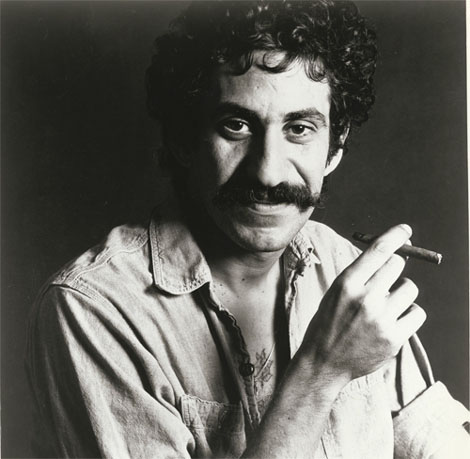
JimCroce1973To me, it reminds me of a day 40 years ago this week, September 20, 1973. The day Jim Croce died. Like McLean in 1959, I was a paperboy in 1973 and I discovered the news by cutting open my stack of newspapers in preparation for fold-and-deliver. As fate would have it, the news came across the AM radio at exactly the same I was opening my stack. I don’t consider myself a die-hard Jim Croce fan. I listen to his songs occasionally and still believe that “Bad, Bad Leroy Brown” ranks with Mclean’s “American Pie” as one of the greatest American pop songs ever written, but that’s about it. Still, I can remember the moment of that tragic discovery as if it happened yesterday.

It seemed to me that Croce’s death was not unlike a Greek tragedy. Here was a man who, but all accounts, was a very nice guy. Everyone who knew him, liked him. He had worked hard for a decade to become an overnight sensation and died tragically just as he was reaching the top. Being the morose child I was and the nostalgic person I have become, I couldn’t help but wonder what might have been had Croce lived. With his natural ability to spin a phrase within a musical story, there can be little doubt that we lost many classic songs when that plane went down. Keep in mind, I’m still mad at John Belushi for checking out too soon. Although I love John Candy, Belushi would have owned that Uncle Buck movie. But that’s ANOTHER story.

Croce’s death was a blow to me. True, it came after the deaths of Jimi Hendrix, Janis Joplin, Jim Morrison, Duane Allman and Gram Parsons (who died the day before Croce’s death), but these deaths seemed almost predictable. After all, the string of “death by lifestyle” in the music business stretches all the way back to Hank Williams, Brian Jones, Robert Johnson and Frankie Lyman. But Croce’s sudden passing, like Holly/Valens/Richardson a generation before and Otis Redding contemporarily, was different. Sudden, shocking, unexpected, undeserved perhaps?

Jim Croce’s life story can’t help but bring a smile to anyone who hears it. He was born in South Philly on January 10, 1943. Jimmy took a strong interest in music and by age five, he had learned his first song on the accordion: “Lady of Spain.” Croce did not take music seriously until he studied at Villanova, where he formed bands and performed at fraternity parties, coffee houses, and universities around Philadelphia, playing “anything that the people wanted to hear: blues, rock, acappella, railroad music… anything.” Croce’s band was chosen for a foreign exchange tour of Africa, Middle East, and Yugoslavia. He later said, “we just ate what the people ate, lived in the woods, and played our songs. Of course they didn’t speak English over there but if you mean what you’re singing, people understand.” Croce met his future wife Ingrid Jacobson at a “hootenanny” at the Philadelphia Convention Hall, where he was judging a contest.

From the mid-1960s to early 1970s, Croce performed with his wife as a duo. At first, their performances included covers by Gordon Lightfoot, Joan Baez, and Woody Guthrie, but in time they began writing their own music. Croce and Ingrid married in 1966, and Jim converted to Judaism, as his wife was Jewish. This in spite of the fact that he was generally anti-organized religion.

He enlisted in the Army National Guard that same year to avoid being drafted and deployed to Vietnam. Jim served on active duty for four months, leaving just a week after his honeymoon. Croce, who was not good with authority, had to go through basic training twice. He said he would be prepared if “there’s ever a war where we have to defend ourselves with mops”.

In 1968, the Croces’ moved to New York City, settling in the Bronx, where they recorded their first album with Capitol Records. During the next two years, they drove more than 300,000 miles, playing small clubs and college concerts promoting their album.
Becoming disillusioned by the music business and New York City, they sold all but one guitar to pay the rent and returned to the Pennsylvania countryside, settling in an old farm in Lyndell. Croce got a job driving trucks and working construction to pay the bills. All the while Jim continued to write songs, many featuring the characters he met at local bars, truck stops and jobsites.

The couple returned to Philadelphia and Croce decided to be “serious” about becoming a productive member of society. He landed a job at a Philadelphia R&B AM radio station, WHAT, where he translated commercials into “soul”. “I’d sell airtime to Bronco’s Poolroom and then write the spot: “You wanna be cool, and you wanna shoot pool… dig it.” See what I mean? Croce’s story brings a smile to your face.

In 1972, Croce signed a three-record deal with ABC Records and released two albums, “You Don’t Mess Around with Jim” and “Life and Times”. The singles “You Don’t Mess Around with Jim”, “Operator (That’s Not the Way It Feels)”, and “Time in a Bottle” received heavy airplay and “Bad, Bad Leroy Brown” hit No. 1 on the American charts in July of 1973. By then, the Croces’ had again relocated to San Diego, California.

As his career picked up, Croce began touring the country performing gigs in large coffee houses, on college campuses, and at folk festivals. The music business in 1973 was by no means the mega-millions business to has become today and the Croce’s financial situation remained dire. The record company had fronted him the money to record the album, and much of the money the album earned went to repay that advance. In February 1973, Croce traveled to Europe playing concerts in London, Paris, and Amsterdam to rave reviews. Croce also began appearing on television, principally Don Kirshner’s Rock Concert and The Midnight Special, which he co-hosted. Croce finished recording the album “I Got a Name” one week before his death. After nonstop touring, Croce grew increasingly homesick, and decided to take a break from music and settle down with his wife and infant son after his “Life and Times” tour was completed.
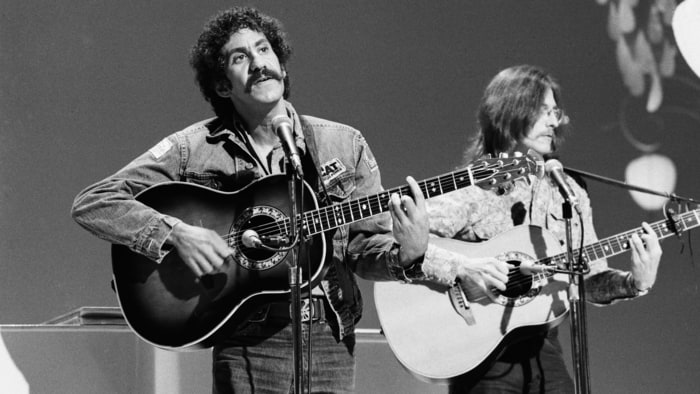
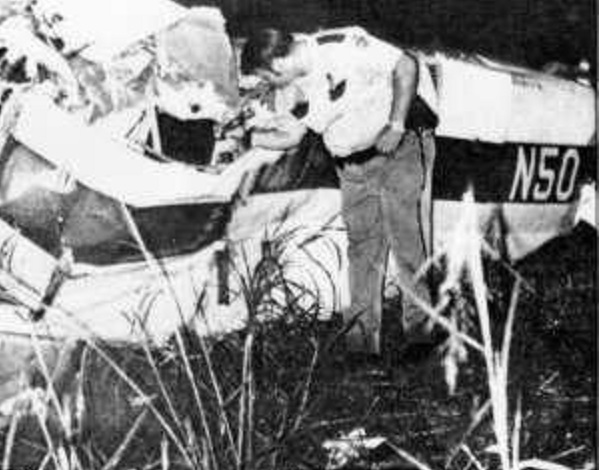
rs-183425-144972709On Thursday, September 19, 1973, Croce’s single “I Got a Name” was released. The next day, after a gig at Northwestern State University’s Prather Coliseum, Jim Croce and five others boarded a chartered Beechcraft E18S twin-engine airplane taking off from the Natchitoches Regional Airport in Natchitoches, Louisiana. The group included musician, songwriter Maury Muehleisen, an artist best known for his live accompaniment with, and strong influence on, the Jim Croce sound. Along with comic George Stevens, Croce’s opening act, manager and booking agent Kenneth D. Cortose, road manager Dennis Rast, and pilot Robert N. Elliott. Croce was flying to Sherman, Texas, for a gig at Austin College.

At 10:45 pm, less than an hour after Croce walked off the stage, the plane crashed after take off. Everyone on board was killed instantly. The plane traveled an estimated 250 yards south of the runway rising some 30 feet in the air before clipping a tree. Investigators said the tree, a large pecan, was the only tree for hundreds of yards. The weather was dark, but with a clear sky, calm winds, and over five miles of visibility with light haze. At the time of the crash, Sheriff Sam James said. “For some reason they didn’t gain altitude fast enough. It flipped, landed upright and was turned completely around.” The pilot, was thrown clear of the wreckage. The other victims were found in the plane.

The official report from the NTSB listed the probable cause as the pilot’s failure to see and avoid obstructions due to pilot physical impairment and fog obstructing vision. The 57-year-old charter pilot suffered from severe coronary artery disease and had run three miles to the airport from a motel. He had an ATP Certificate, 14,290 hours total flight time and 2,190 hours in the Beech 18 type. A later investigation placed sole blame for the accident on pilot error due to his downwind takeoff into a “black hole”.

The album “I Got a Name” was released on December 1, 1973. The posthumous release included three hits: “Workin’ at the Car Wash Blues”, “I’ll Have to Say I Love You in a Song”, and the title song. The album reached No. 2 and “I’ll Have to Say I Love You in a Song” reached No. 9 on the singles chart. The news of the singer’s death sparked a renewed interest in Croce’s previous albums. Consequently, three months later on December 29, 1973, “Time in a Bottle”, originally released on Croce’s first album the year before, hit number one. It became the third posthumous chart-topping song of the rock era following Otis Redding’s “Dock of the Bay” and Janis Joplin’s “Me and Bobby McGee”. A greatest hits package entitled Photographs & Memories was released in 1974.

Jim Croce was buried at Haym Salomon Memorial Park in Frazer, Pennsylvania just outside of Philadelphia. A letter Jim had written to his wife Ingrid arrived after his death. In that poignant letter Croce stated his intention to quit music and stick to writing short stories and movie scripts as a career. In essence, Jim intended to withdraw from public life to spend more time with his wife and unborn child. The song “Time in a Bottle”, which hit number one after Jimmy died, was written for his then-unborn son, A. J. Croce. How can you not be touched by such a story? This week, kiss your wife or significant other. Hug or call your kid. And in short, enjoy life for a moment. If not for yourself, do it for Jim.
Assassinations, Politics

Richard Lawrence and Old Hickory. Andrew Jackson Assassination Attempt.

Jackson attempt January 30 photo                                                   Original publish date:  January 24, 2014
Who is Richard Lawrence and why should you care? In the next few minutes, I’ll introduce you to him, but as for caring, I’ll leave that up to you. Richard Lawrence was a house painter by trade. More importantly, he was the first known person to attempt to assassinate a President of the United States. Still doesn’t ring a bell? Don’t feel bad, the attempt came 179 years ago this week and the President in question was “Old Hickory”, Andrew Jackson.                                                                                                                                                                 

President Andrew Jackson did not know him, which comes as no surprise when you realize that, at the time of the assassination attempt Lawrence did not even know himself. He believed himself to be King Richard III of England who died some 350 years before. Lawrence was born in England sometime around 1800-1801. His family emigrated to America when he was 12 years old and settled in Virginia near Washington, D.C. Lawrence’s childhood and early adult years were apparently normal.                                                                         

Until January 30, 1835, when Lawrence attempted to shoot Jackson outside the United States Capitol, his life was an unremarkable one. Most of what we know of him comes from testimony at his trial. He was described by relatives and acquaintances as a “relatively fine young boy…” who was “reserved in his manner; but industrious and of good moral habits.” Historians speculate that exposure to chemicals contained in the house paints may have fried his brain.
Jackson-Assassination-attempt-Granger-1200X480In November 1832, Lawrence announced to his family that he was returning to England. He left Washington, D.C. only to return a month later claiming that he decided not to go because it was too cold. Within weeks, he changed his mind and told friends & family that he was returning to England to study landscape painting. Lawrence left once again and got as far as Philadelphia before returning home. He told his family that the U.S. government had prevented him from traveling abroad and barred his planned return to England. He further claimed that while in Philadelphia, he read several newspaper stories about himself that were critical of his travel plans and his character. Lawrence told his family that he had no choice but to return to Washington, D.C. until such time as he could afford to hire his own ship and captain and sail away to England.
Oh yeah, he also quit his job. When questioned by his sister and brother-in-law with whom he was living, Lawrence stated that he did not need to work because the U.S. government owed him a large sum of money. Lawrence, now claiming to be King Richard III of England, believed he was owed money on two English estates that he owned. In time, Lawrence became convinced that President Jackson’s opposition to the establishment of a national bank was delaying payment on this imagined debt. He felt that if Jackson was no longer in office, Vice President Martin Van Buren would establish a national bank and allow Congress to pay him the money for his English estate claims.

Lawrence’s personality and outward appearance changed dramatically around this point. The once conservatively dressed Lawrence began buying expensive, flamboyant clothing which he changed three or four times a day. Lawrence also took to standing in the doorway of his home for hours staring blankly out into the street. Neighborhood children would jokingly address him as “King Richard”. This typically pleased Lawrence who failed to realize the children were making fun of him. He also became paranoid and hostile towards others. On one occasion, he threatened to kill a maid who he thought was laughing at him.

Lawrence also began verbally and physically abusing his family, mainly his sisters, over imagined slights. In one instance, he threatened to hit his sister with a paperweight because he believed she had been talking about him. At Lawrence’s trial, witnesses described the bizarre behavior he exhibited during this time. Several people testified that Lawrence would engage in nonsensical conversations with himself while others claimed he was prone to laughing and cursing fits.
In the weeks leading up to the assassination attempt, Lawrence began stalking Andrew Jackson. Witnesses often saw Lawrence sitting in his paint shop muttering to himself about President Jackson. On the day of the attempt, he was seen sitting in his shop reading a book and laughing. Lawrence suddenly got up and left the shop with a smile stating, “I’ll be damned if I don’t do it.”
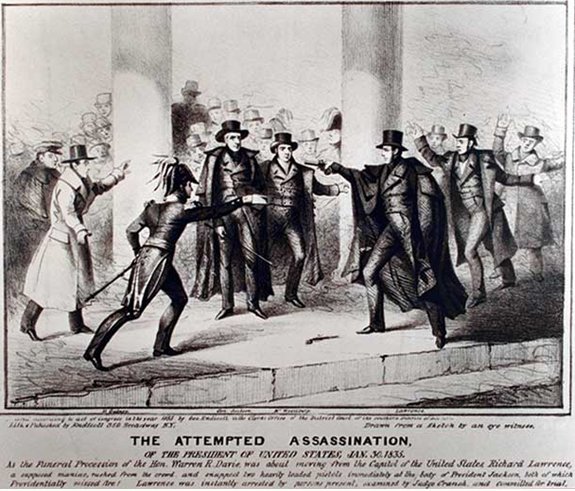
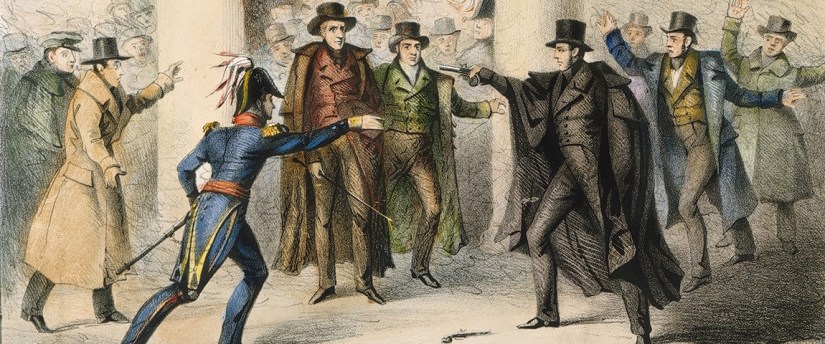
On January 30, Jackson was attending the funeral of South Carolina congressman Warren R. Davis at the U.S. Capitol. Lawrence’s plan was to shoot Jackson as he entered the service but he was unable to get close enough to the President. However, as Jackson left the funeral, Lawrence positioned himself aside a pillar on the East Portico that Jackson would soon pass by. As Jackson passed, the slender man with a thick black beard stepped from behind the pillar, pointed a one shot Derringer pistol at Jackson’s heart from six feet away, and pulled the trigger. A shot was heard, but the bullet never left the chamber.

It was later determined that the percussion cap exploded, but the bullet did not discharge. Now, the deranged house painter found himself face-to-face with a formidable opponent. While everyone else ducked and covered, the enraged Jackson headed straight toward his attacker while raising his walking cane to throttle his attacker. Lawrence dropped the first gun, immediately pulled out a second gun, and again fired at the President’s heart. This time Lawrence squeezed the trigger at point-blank range, but it also misfired. This second shot reportedly went off like the first, with a loud bang, but again no bullet exited the chamber.
Jackson’s aides quickly wrestled Lawrence away from the president, leaving Jackson unharmed. It was probably a good thing for Lawrence that the sides pulled the hero of the battle of New Orleans off of him. Andrew Jackson is said to have killed 13 men in duels and had 3 bullets in his body to prove it. Ironically, one of those who rushed to the President’s aid that day was Congressman Davy Crockett, a staunch political enemy of Jackson, who nevertheless helped restrain the would-be assassin. Crockett later said. “I wanted to see the damnedest villain in the world and now I have seen him!” Witnesses claim that Jackson had to be pulled off of his attacker again and again as he continued to beat him with his hickory cane even after Lawrence was down and completely subdued. Witnesses claimed that Jackson was shouting “Let me alone! Let me alone! I know where this came from!”

Years earlier Jackson had advised a young man on how to wield a cane in combat. He warned that “a cane swung at head level was easy to deflect; rather one should take the stick so [held like a spear] and punch him in the stomach.” He described having once fought a man that way in Tennessee: “Sir, it doubled him up. He fell at my feet, and I stamped on him.” Richard Lawrence later told investigators that the only time he ever felt genuine fear was when he saw the 67-year-old President charge at him.

Needless to say, Jackson didn’t take kindly to this assassination attempt, but instead of getting angry, he got paranoid. At the time, Jackson’s Democrats and the Whigs were locked in a battle over Jackson’s attempt to dismantle the Bank of the United States. Old Hickory was not alone in his paranoia as his vice president, Martin Van Buren, thereafter carried two loaded pistols with him when visiting the Senate. Although Lawrence was found to be a mentally unstable individual with no connections to Jackson or his political rivals, to his dying day, Jackson believed that Lawrence had been hired by his Whig Party opponents to assassinate him.

Jackson also suspected a former friend and supporter turned adversary, Senator George Poindexter of Mississippi, to be involved in the murder for hire. He had hired Lawrence to paint his house just a few months before. Poindexter was unable to convince the voters back home in Mississippi that he was not involved in the plot. When his constituents left, many of his biggest supporters withdrew their support and he was unable to get re-elected. Jackson believed Senator John C. Calhoun was the main person behind the attempt, prompting Calhoun to make a statement on the U.S. Senate floor disavowing connection to the attack. Oddly, nobody ever denied Lawrence’s involvement in a plot, including the gunman himself.
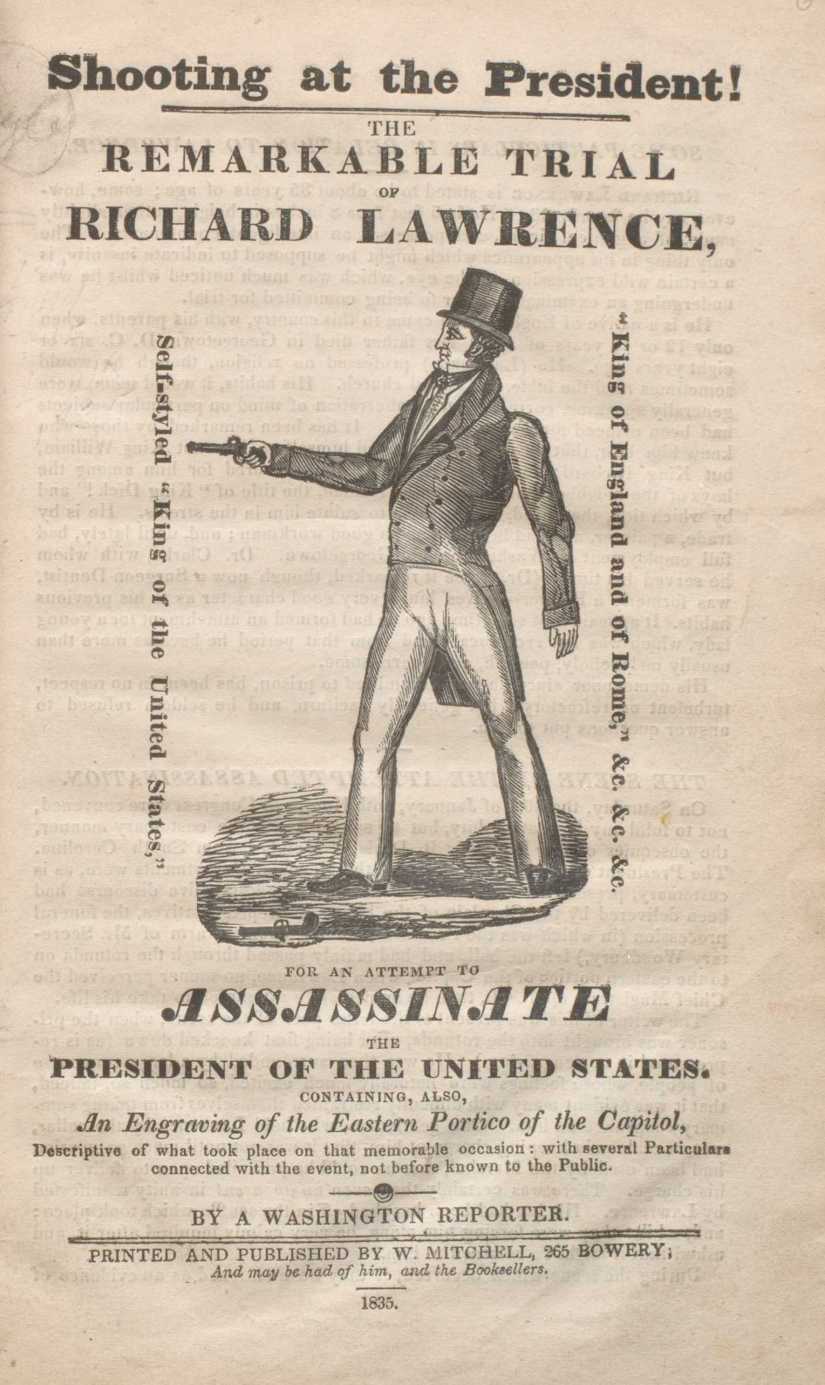
ShootingatthePresidentTheRemarkableTrialofRichardLawrenceLawrence was brought to trial on April 11, 1835, at the District of Columbia City Hall. The prosecuting attorney was Francis Scott Key, author of the Star Spangled Banner. After only five minutes of deliberation, the jury found Lawrence “not guilty by reason of insanity.” In the years following his conviction, Lawrence was held by several institutions and hospitals. In 1855, he was committed to the newly opened Government Hospital for the Insane (later renamed St. Elizabeth’s Hospital) in Washington, D.C. There he remained until his death on June 13, 1861, almost 16 years to the day after his nemesis, Andrew Jackson, died on June 8, 1845.
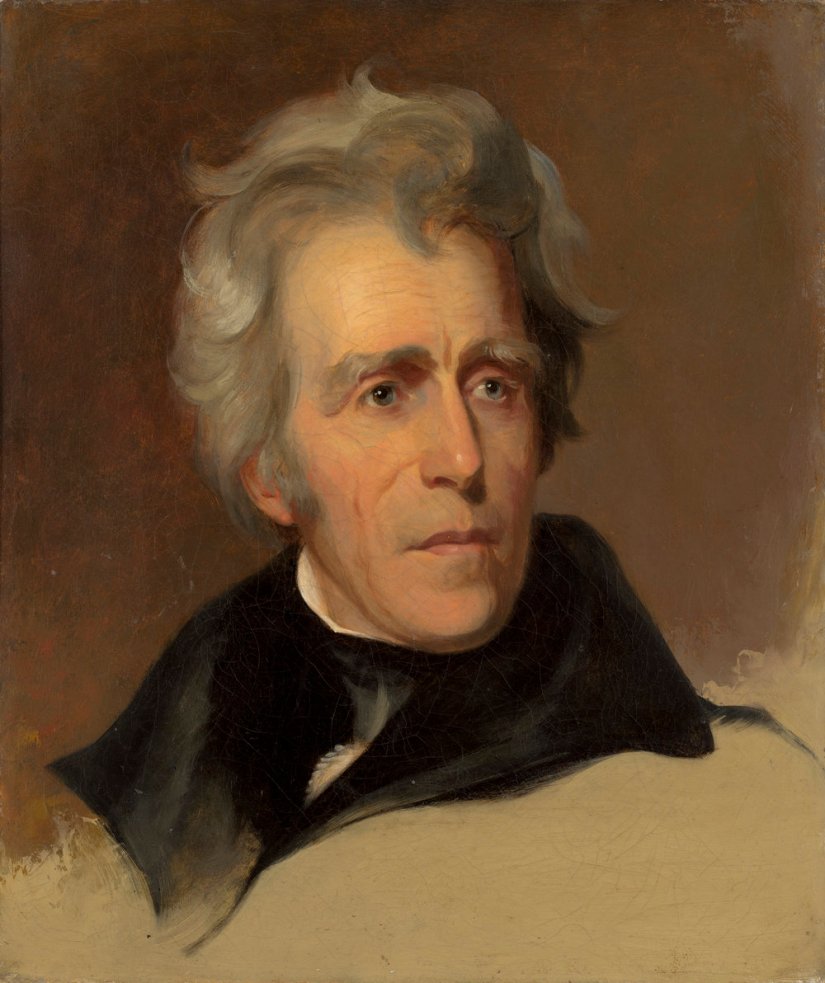
Strangely enough, not only was Andrew Jackson our country’s first commander in chief to be chased by a nut with a gun, he was also the first president to be attacked physically. A year and a half before Lawrence jumped from behind that pillar to fire upon his president, Jackson ordered the dismissal of Robert B. Randolph from the Navy for embezzlement. On May 6, 1833, Jackson sailed on USS Cygnet to Fredericksburg, Virginia, where he was to lay the cornerstone of a monument near the grave of Mary Ball Washington, George Washington’s mother. During a stopover near Alexandria, Randolph appeared and struck the President, drawing a trickle of blood from the President’s mouth. Jackson was seated behind a table at the time, which no doubt lessened the affect of the attack (for both Jackson and his assailant). Randolph fled the scene chased by several members of Jackson’s party, including the well-known writer Washington Irving. Randolph ended up getting away scot-free when Jackson decided not to press charges.

While the finest doctors in Washington were busy listening to Lawrence’s claim to be the king of England, the police were testing “his majesty’s” misfired pistols. They worked perfectly. Astonished witnesses watched as bullets once intended for the President now plowed through inch-thick wood planks at 30 paces. It was later determined that the weapons Lawrence had chosen were known for being vulnerable to moisture and the weather on that date was extremely humid and damp. A century later, Smithsonian researchers conducted a study of Lawrence’s derringers, during which both guns discharged properly on the test’s first try. It was later determined that the odds of both guns misfiring during the assassination attempt were one in 125,000.

Many of Jackson’s contemporaries believed that Old Hickory had been protected by the same “Divine Providence” that protected the fledgling nation. This national pride was a large part of the Jacksonian cultural myth fueling American “Manifest Destiny” expansion in the 1830s. Senator Thomas Hart Benton, who had also once shot at Jackson himself, reflected that “two pistols-so well loaded, so coolly handled, and which afterward fired with such readiness, force, and precision-missing fire, each in its turn when leveled eight feet at the President’s heart . . . made a deep impression upon the public feeling, and irresistibly carried many minds to the belief in a superintending Providence.” To many Americans, Jackson’s survival could be nothing but the work of a higher power.
A13734.jpgIronically, after the attack, Jackson returned by carriage to the White House and got back to business immediately. Several concerned citizens rushed to the President only to find him “calm, cool, and collected as if nothing had happened.” Another visitor arrived an hour later to find Jackson bouncing a child playfully on his knee while discussing the incident with General Winfield Scott. That evening, a thunderstorm swept the D.C. area blanketing the Capitol in thunder, lightning, and sheets of rain. Conversely, most Washingtonians never realized the storm they had just averted. Had those pistols met their mark, a literal firestorm would have swept our young nation. Eventually, the incident fed the legend that became Old Hickory. Love him or hate him, there are no gray areas with Andrew Jackson. He was a true American original.

ABA-American Basketball Association, Indianapolis

Indiana Pacers Slick Leonard in Irvington

Leonard Original publish date:     November 1, 2013

Slick; a nickname that conjures up images of loud suits, a big smile and winning basketball. Bobby “Slick” Leonard is Indiana Pacers basketball, period. His trademark phrase (seriously he trademarked it), “Boom Baby”, sums up Slick’s personality better in two words better than anything I’ll write in this article. Everyone remembers Slick’s drive to lead the Indiana Pacers to greatness during the ABA Championship years. Most remember Slick’s stewardship of the Pacers during the team’s fledgling first seasons in the NBA. But many have forgotten just how great a player he was. In high school, college and the NBA, Slick was a solid star and a force to be reckoned with on the court.

William Robert “Slick” Leonard was born in Terre Haute on July 17, 1932. It was a Sunday and I suspect that somewhere nearby there must have been an old lace-up basketball swishing through a net at the exact moment he greeted this world because his would become the most basketball blessed life of that Hoosier generation. He would grow to become an impressive 6’3″ 185 lb guard for the “Black Cats” of Terre Haute Gerstmeyer High School where he was alternate on the 1950 Indiana all-star team. He would also excel as a tennis player, winning the state tennis championship as a senior.

Slick was heavily recruited by Indiana colleges, including Notre Dame, but finally landed with the Indiana University Hoosiers. As an aside, many of you know I collect oddball things. One of those “things” is a handwritten letter from a very young Bobby Leonard on the letterhead of the Central Hotel in “Terry Hot” in 1950. The letter was written to legendary Notre Dame football star & 3-time All-American basketball star Ed “Moose” Krause who had just taken over the job of Athletic Director for the Irish.

Knowing that Slick would become a hoops legend at I.U. makes the letter all the more interesting. It reads: “Dear Mr. Krause, I definitely would like to go to college, but I do not think I am financially able, I have had several letters from other schools, but it has always been my desire to attend Notre Dame. I like your set-up of not having co-eds as it gives the boys more time to attend to their studies. My grades were not so good during my first years in high school, but after I began to apply myself I have attained a “B” average. I will send you a copy of my grades as soon as possible. Sincerely, Bob Leonard”. The letter includes a separate sheet detailing his classes (Psychology, Print Shop, Sociology, Spanish, etc.) and, more importantly, his high school average and record for the Black Cats.

In spite of this letter’s intent, Slick became a star for Branch McCracken’s Hurryin Hoosiers squad. He captained two Big Ten championship teams and the 1953 NCAA championship team. Slick hit the game winning free throws that gave Indiana the victory over Phog Allen’s heavily favored Kansas Jayhawks team. Leonard was the Most Valuable Player for I.U. in 1952 and an All-Big Ten and All-American player in 1953 and 1954. As a sophomore he was MVP of the East-West college all-star game in Gotham Cities’ Madison Square Garden. The first player inducted into the Indiana University Sports Hall of Fame? Bob Leonard.

He was selected with the first pick of the second round of the 1954 NBA Draft. He spent the bulk of his seven-year professional playing career with the Lakers (four years in Minneapolis and the first year after the move to Los Angeles). He got the nickname “Slick” from a former Lakers teammate with a colorful nickname of his own, “Hot Rod” Hundley. After Bobby won a game of gin by blitzing a team truck driver after a game, Hundley said. “Boy, you sure are slick” and the name stuck. He spent his last two years with the Chicago Packers/Zephyrs, his final season as a player / coach. The team moved to Baltimore in 1964 where Slick coached them for one more year. For his seven years in the pros, Leonard earned less money overall than current Pacers shooting guard Paul George makes in one game.

In 1968, Leonard became the coach of the upstart ABA’s Pacers. He was “the coach” for the next 12 years including the first four in the NBA. Some of that time Slick also served as general manager. Leonard led the Pacers to three ABA championships before the ABA-NBA merger in June 1976. In the 8-year history of the ABA, Slick led the team to the Championship finals in 5 of those 8 seasons; the team never missed the playoffs.
Those 3 Championships are still to this day the only titles won by the Indiana Pacers. Although the NBA Pacers struggled during Slick’s tenure as coach, that was no reflection on this man’s ability. Speaking as a rabid fan who observed those early years, Slick never had a chance. Pacers management nearly gutted the team to meet the financial burdens imposed by the merger and never gave Slick the personnel to put together a winning team during those early NBA years.

I have a personal connection to those ABA teams, although it came long after that cork popped on the last bottle of locker room champagne. I organized and planned the ABA reunion in August of 1997 at the old Hoosier Dome. Former Pacers legend Bob Netolicky and team President Dick Tinkham steered the players and owners while my wife Rhonda & I handled many of the details. During that reunion, I witnessed firsthand how much the players loved and respected Bobby “Slick” Leonard. Not only Pacers players, but players from all around the league. I heard more than one millionaire ABA team owner present at that reunion claim that it was Slick and those great ABA Pacers teams that held that league together and brought it credibility.

Slick was the last Pacers coach at the State Fairgrounds Coliseum and the first coach at Market Square Arena. A good illustration of Bobby Leonard’s impact on Hoosier hoops, during the last practice at Market Square Arena after the players had left the floor, then Pacers coach Larry Bird asked for Slick to come out on the court. The legendary duo stood alone on the court in the house that Slick’s teams built. As the workers stood outside the perimeter poised and ready to tear up the floor, Larry legend threw a bounce pass to Slick and said, “I want you to take the last shot here.“ Of course, he made it.

Documantarian Ted Green, friend and subject of past columns, plans to follow-up to his popular film of last year, “Undefeated: The Roger Brown story” with a film about Bobby “Slick” Leonard titled “Bobby ‘Slick’ Leonard: Heart of a Hoosier”. I was honored to assist in a small way with that production and equally proud of Ted’s newest venture. Green, whose previous documentaries profiled John Wooden, Indiana war veterans and Indianapolis’ climb from sleepy “Naptown” to a Super Bowl site, believes that a film about Slick is the next natural step.

“Hoosiers forget what a great player Slick was. They remember him as a coach, but he was a helluva player. He has done basically everything there is to do in basketball and at all levels, and he did most of it right here.” says Green “Plus, I don’t think a lot of people are fully aware of the amazing contributions he’s made to the game beyond his success with the Pacers. That’s one of my goals with this film, to illuminate his remarkable run from the beginning, show people stuff they don’t know, and hopefully open some eyes nationally. I’ve already discovered a lot of things that I believe will do that.”

Knowing Ted, the project promises to be just as colorful as Slick himself. Although Slick is one of only five individuals in Pacers history to have a banner raised in his honor,Ted believes he deserves more. Green, who told me last year that he believes Slick has a very good chance of being the next ABA inductee to the James Naismith Basketball Hall of Fame in Springfield, Massachusetts, hopes to finish the film in time for a March madness release. Keep in mind, Ted released his film on Pacer’s star Roger Brown BEFORE the “Rajah” was elected to the Hall of Fame and his film on Slick could be just as timely.
I feel a kindred spirit in Ted Green. As Hoosiers become more-and-more familiar with his work, they quickly realize that Green gets more in depth on his subjects than anyone else. Ted, who calls this trait his “sickness”, will most certainly tell us things about Slick that we never knew about. Nobody digs deeper than Ted Green. “This will be my most extensively researched film yet. As a competitive journalist I want to play it a little close to the vest, but I can say that I’ve made several discoveries that I think will surprise even people who know Bob well, and will definitely open eyes nationally to the incredible impact on his sport that this man has had.” says Ted.

As for Slick’s shot at the Hall of Fame, Ted says, “I think there’s little doubt that Slick will get in someday, and like a lot of people around here, I’m hopeful that it’ll happen in the next class. Unfortunately, I don’t think that’s a lock — the fact that we’ve had two ABA Pacers back-to-back in Mel and Roger could factor against Slick as well as George McGinnis, who’s also deserving. But if you look solely at impact, at winning and losing, at what the person meant to the league, I think Slick has to be next.”

Now 81 years old, Leonard returned to Terre Haute twice to drive filmmaker Green through the neighborhoods where he grew up. Together they visited the old Gerstmeyer gym, now incorporated into the Terre Haute Boys and Girls Club, where Green surprised Leonard with impromptu visits by longtime friends including former prep school teammates the “Gerstmeyer Twins” Harley and Arley Andrews. Green filmed slick rolling through town, reminiscing about selling ice cream at Union Depot and of sneaking into the old Indiana State Teachers College gym in the late 1940s to watch Coach John Wooden drill the Sycamore players through basketball practices. Green is still in production and is looking for photographs not only of Bobby Leonard in his youthful days and his Gerstmeyer teams, but also of city scenes from the 1930s, ’40s and ’50s. If you can help, contact me and I’ll pass it on to Ted.

Leonard returned to the Pacers in 1985 as a color commentator, first for television, then on radio. He is in his 24th year as a Pacers broadcaster. Modern fans know him for his phrase “Boom, baby!”, which he shouts exuberantly after every successful three-point shot. Bobby “Slick” Leonard is the common thread running through Indiana’s accepted pastime and next week, you have the chance to meet him.

Bobby Leonard has written a new book, “Boom, Baby!: My Basketball Life in Indiana”, and he will recount many of these stories personally next Thursday evening in Irvington. Slick is coming to Bookmamas at 6 p.m. on Thursday, November 14 to give a short talk and sign copies of his new memoir.

Leonard, in typical heartfelt modesty, has repeatedly said that his exclusion from the Hall of Fame doesn’t bother him. His focus has always been on getting “his guys” there instead. Mel Daniels got into the Hall in 2012 (alongside NBA Pacers icon Reggie Miller) and Roger Brown made it posthumously in 2013. Slick’s guys have made it, and with this class coming up, I hope that he makes it too. Come out to Bookmamas next Thursday and discuss it with Slick yourself. Tell them Al sent ya.

Ghosts, Irvington Ghost Tours, Pop Culture

Ghosts of the Vinton House. Cambridge City, Indiana

Vinton HouseOriginal publish date:  September 2, 2013
If you’re looking for something to do this weekend and want to get out of town for the day, I have a suggestion for you. Pack up the spouse, the kids, friend or significant other and head out to Cambridge City, 45 minutes east of Indy, for Canal Days festivities on the Historic National Road. Canal Days is a street festival in an old canal town that features some of the best antiquing and specialty shopping in the state. I’ll even take you on a ghost tour if you wish (there are 2 different tours this Saturday night) where you can visit one of Indiana’s most haunted antique malls, the Vinton House.
Canal Days is always held on the first weekend after Labor Day and I’ve led ghost tours in this community for nearly a decade. Similar to the Irvington ghost walk, Cambridge City tours begin at 6:00 PM for the west side of town and then again at 8:30 for the east side of town. The east side tour concludes near midnight in the abandoned Capitol Hill cemetery. The old cemetery, whose last burial took place in 1931, is the beneficiary of the tour with 100% of the proceeds going to it’s preservation. The one element that the tours have in common, along with the Lincoln Ghost train of course, is the Vinton House.
The Vinton House was the oldest continuously operating Hotel in Indiana until it closed in 1981. During it’s lifetime, aside from being a prominent landmark on the National Road, the hotel saw it’s fair share of famous guests including Henry Clay, Governor Oliver P. Morton and Irvington’s own George Washington Julian. One longtime rumor claims that Abraham Lincoln himself stayed at the Inn while traveling through Indiana in the 1840s campaigning for fellow Whig Party candidates. This legend, although unsubstantiated, is so persistent that one of the guest rooms was actually named “The Lincoln Room” by the hotel’s last owner.
For over a decade the Vinton House, located at 20 West Main Street in Cambridge, has been re-energized as an antique mall. Over those 10 years, the Vinton House has gained a strong reputation for carrying one of the best selections of country antiques and primitives in the Midwest. Add to that mix the town’s other fine established shops and malls like Building 125, the National Road Antique Mall and the Hole-in-the-wall, to name only a few, and you have some of the finest antiquing in the state all within a 2-block stretch known as “Antique Alley”.
The Vinton House was saved from demolition in the 1990s by members of Cambridge City’s historic preservation group (known as Western Wayne Heritage, Inc.) when the group purchased the famous old hotel and began renovations that continue to this day. Built in the 1840s at the intersection of the newly opened Whitewater Canal and the National Road, Aaron Reisor opened the opulent three-story hotel alongside the Canal bank. Although the Canal is long gone, it’s route can be easily traced by looking at the building’s west side.
The Vinton House is named for longtime owner Elbridge Vinton, who ran it from Antebellum times to Teddy Roosevelt’s Progressive Era. After Elbridge’s death in 1908, his daughters ran the hotel until the Great Depression. During that near three-quarter century, the old hotel has seen innumerable comings-and-goings. It seems that many of those old guests, along with Elbridge himself, have never left the building. Contrary to what you may think, the ghosts of the Vinton House are not a modern day phenomenon. The wayward spirits of residents past date back as far as the World War II Era while the building was still an active hotel.
These wayward spirits were first brought to my attention by April Riggle, a dear friend and the previous manager of the antique mall. April, who unexpectedly passed away at age 43 in 2009, was very sensitive to the old inn’s spectral visitors and had many encounters during her many years at the Vinton House. The ghosts would most often manifest by the sounds of furniture scooting across the floor in the second floor “Lincoln Room” directly above the checkout counter. These sounds were heard when April was alone in the locked building after all guests and fellow employees had left for the day.
In time, these scratching and scooting sounds were being picked up on the security cameras within the building. When April, or other witnesses, would ascend the stairs to investigate the strange sounds, they could find nothing there. However, customers in the mall often asked the staff who the people dressed in period clothes were and remark about the strong smell of cigar smoke or alcohol that would accompany these sightings upstairs. Of course, upon closer examination, there was never anyone there to account for them.
This year, after we were kindly asked to resurrect the ghost tours after a 3-year hiatus, I visited the Vinton House to get reacquainted with the old building. Danny and Tammy Hall now manage the mall and, with an assist from daughter Lacy, work tirelessly to keep it’s shelves and cases full of high quality antiques and collectibles. “We get people in here all the time asking us about the ghosts and the tours” says Tammy. “But I’ve been in here at all hours of the night and day and have yet to experience anything.”
Danny, one of the area’s most experienced and seasoned pickers, echoes his wife’s sentiment. “I’ve been working in old buildings, barns and houses since I was a little kid and although I’ve found myself in the pitch dark going nose-to-nose with angry possum’s and raccoon’s, I’ve never seen a ghost.”
The couple walked me around the old building showing me the many improvements that have been made since my last visit. I asked Tammy if she shared the same passion for antiques as her husband does and she quickly answered yes. Danny, who I have personally run into on several occasions over the years at area antique shows lit only by the light of a flashlight before the show actually opens (an old pickers trick), has one of the keenest eyes in the region. “I get my biggest thrill cleaning and presenting the items he brings home to place around the mall” says Tammy. “But I’m ready to go at 2:30 AM if need be.”
Tammy has repainted nearly every square inch of the antique mall. Her attention to detail and sharp decorator’s eye can be witnessed in every room. Western Wayne has established a fine museum on the third floor that tells the story of the town, hotel and canal in meticulous detail. But, unlike many antique malls, the sales floor of the Vinton House “Ain’t No Museum.” Although many of the pieces in the mall are museum quality, the prices are affordable and the selection is widely varied. I have personally watched as a friend bought an old 19th century horse buggy and a casket (it was empty, don’t worry) on a single visit from Danny. A testament to the fact that you never know what you’re going to find there.
Cambridge City ghost tours always start in the cellar of the Vinton House, a long abandoned brick-lined space that was originally at Canal level. Segregated from the upper class guest rooms of the hotel, it’s history involved drinking, gambling and nefarious ventures during it’s century-and-a-half lifetime. The room is off limits to the public (except for ghost tour night) and always kept locked. This day was no exception. We entered the space for a quick survey in preparation for this Saturday night’s tours.
As we walked and talked, I explained what might be expected on tour night and told a couple of the cellar’s ghost stories to the couple (they had never heard them before). As we prepared to exit the cellar, this “Para-normally Challenged” couple stopped and shined a flashlight on a curious formation in the dirt at our feet. “That’s new. That wasn’t here the last time,” Danny said. Tammy agreed as we examined an area on the dirt floor where the sandy soil had been piled up carefully, by purposeful hands, with a central brick acting as a prominent fortress atop the mound complete with a small 8-to-10 inch tree twig flagpole rising from the center hole. The spooky looking little formation was not created by accident. “Leave that there, untouched.” I said, “I think people are gonna want to see that Saturday Night.”
See for yourself this Saturday September 7th (2013). Come spend the day at Cambridge City’s Canal Days celebration and stay for the ghost tours. First tour departs at 6:00 and the last tour at 8:30. It promises to be a ghostly good time.

Indianapolis, Politics

Caroline Harrison-Indianapolis loses a First Lady.

death-at-white-houseOriginal publish date:                 October 20 2013

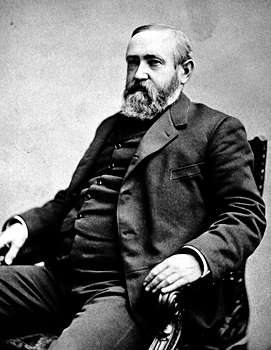
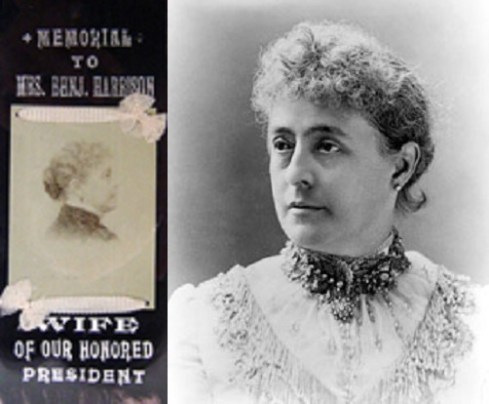
121 years ago this Friday, America lost it’s first lady, Benjamin Harrison lost a wife and two weeks later, he lost the Presidential election. Caroline Scott and Benjamin Harrison were married on October 20, 1853. The newlyweds lived at the Harrison family home at North Bend, Ohio for the first year until Benjamin completed his law studies aand they moved to Indianapolis and set up his first practice.
During the first few years of their marriage, the couple rarely spent time together, as Benjamin worked to establish his law practice and became active in fraternal organizations to help build a network. In 1854, their first child Russell Benjamin Harrison was born. Not long after, a fire destroyed the Harrison home and all their belongings. Benjamin took a job handling cases for a local law firm and the family managed to recover financially. In 1858, Caroline gave birth to Mary Scott Harrison. In 1861 she gave birth to a second daughter, who died soon after birth.
While Benjamin Harrison’s star rose rapidly in his profession, Caroline cared for their children and was active in the First Presbyterian Church and Indianapolis orphans’ home. Benjamin’s long hours at the law office and his pursuit of a living drove a wedge between the young couple and although Caroline did not complain, the strain showed.
At the onset of the Civil War, both Harrisons sought to help in the war effort. Caroline joined Indianapolis groups that raised money for supplies to help care for wounded soldiers. In 1862, when President Abraham Lincoln issued a call for more troops, Benjamin recruited a regiment of over 1,000 men from Indiana. When the regiment left to join the Union Army at Louisville, Kentucky, Harrison was promoted to the rank of colonel, and his regiment was commissioned as the 70th Indiana Infantry.
In May 1864, the 70th Indiana regiment joined General William Tecumseh Sherman’s Atlanta Campaign and moved to the front lines, and Harrison was promoted to command the 1st Brigade of the 1st Division of the XX Corps. Harrison’s brigade participated in the brutal Battle of Nashville in December 1864, considered by historians to be the “Gettysburg of the West”. On March 22, 1865, Harrison earned a promotion to the rank of brigadier general.
The horrors of the Civil War taught General Harrison what was really important in his life and the tone of his letters to Caroline during the war are filled with a deep passionate tone. When he returned home, she would never again reproach him for neglect. His law practice and his fame grew, and he became a political force.
71035-004-D5F69C40After the war, Benjamin Harrison spent the next decade practicing law and getting involved in politics. He ran for governor of Indiana in 1876, but lost. The Harrison home on North Delaware Street was built in 1874-75, and soon became a center of political activity. Her husband’s election to the Senate in 1880 brought Caroline to Washington, DC, but a serious fall on an icy sidewalk that year undermined her health. In 1883, she had surgery in New York that required a lengthy period of recovery. She had also suffered from respiratory problems since a bout with pneumonia in her youth, and did not participate much in Washington’s winter social season.
In the fall of 1887 Harrison was nominated for President by the Republican Party. In the campaign, Caroline was a definite asset. Her natural charm and open manner offset her husband’s chilly reserve (He often wore gloves to protect him from infection from others, and it bothered him to shake the hands of White House visitors), and the press loved her. In November 1888, Harrison defeated the incumbent Grover Cleveland.
Caroline Harrison was 56 years old when she became first lady. Historians regard her as one of our most underrated First Ladies who, in contrast to her husband’s conservative policies, was earnestly devoted to women’s rights. She became known for her many “firsts” as First Lady. Caroline was the first first lady to deliver a speech she had written herself after she became the first president of the Daughters of the American Revolution.
Caroline’s sister died in early December 1889 at the executive mansion and Mrs. Harrison decided to have the funeral in the east room of the White House. It would be the first funeral in that room since Abraham Lincoln in 1865. In spite of the family tragedy, Caroline went ahead with her plans to raise the first Christmas tree in the White House that same month. She had John Phillip Sousa and the Marine Band play and, for the first time since Sarah Polk was First Lady, there was dancing in the White House.
Perhaps her biggest first came when she had electricity installed in the White House, even though she was terrified by the new technology. Seems that President Benjamin Harrison received a shock from an Edison dc current light switch, after which his family feared touching the switches. Mrs Harrison rarely operated the light switches herself, choosing instead to sleep with the lights on when neither she nor her husband were willing to touch them for fear of electrocution. Servants were often made to turn the lights on and off for the Harrison family.
Caroline_Harrison_cph.3b20942The First Lady was noted for her elegant White House receptions and dinners, but she is most remembered for her efforts to refurbish the dilapidated White House. She was horrified at the filth and clutter and thought the White House was beneath the dignity of the Presidency, describing it as “rat-infested and filthy.” She brought in ferrets to eat the rats, and lobbied to have the White House torn down and replaced with a more regal Executive Mansion. Instead the old building was refurbished from basement to attic, including a new heating system and a second bathroom. The old, sagging worn-out floors were replaced.
She hated the crowded living area and the tourists made it impossible to use the first floor. In 1889 Caroline Harrison found fault with the “circus atmosphere” in the mansion when she found visitors wandering uninvited into the family quarters. Harrison complained about the lack of privacy on the White House grounds, saying, “The White House is an office and a home combined. An evil combination.” She was the first to suggest the addition of office space to the Executive Mansion when she made up very detailed plans to add an East and a West Wing so that the original mansion could be used for entertaining and the family’s living area. Caroline Harrison’s plan was the first to move the office spaces out of the house.
As she worked to remodel the White House, Caroline was careful to inventory the contents of every room. She cataloged the mansion’s furniture, pictures and decorative objects, working to preserve those that had historical value. Caroline unearthed the chinaware of former presidential administrations found hidden away in closets and unused attic and basement spaces. She personally cleaned, repaired and identified which pieces belonged to which past President. She used their items to create a popular museum display case that remains in the White House to this day.
Artistically talented, Caroline taught classes in painting to anyone who wanted to learn and became the first First Lady to design her own White House china. She wanted new china that would be “symbolic and meaningful to Americans.” The first lady placed the Coat of Arms of the United States in the center ringed by a goldenrod and corn motif etched in gold around a wide outer band of blue. The corn represents Mrs. Harrison’s home state of Indiana and 44 stars, one for each state in the Union at the time, made up the inner border.
In the winter of 1891-1892 while she tried to fulfill her social obligations, Mrs.Harrison was frequently ill with bouts of bronchial infections. In March of 1892 she developed catarrhal pneumonia, followed by hemorrhaging of the lungs and was moved to a three-bedroom cottage on Loon Lake in the Adirondack Mountains in July. Following a brief rally, her doctors diagnosed her condition as tuberculosis, which at the time had no known cure or treatment other than rest and good nutrition. Although she briefly recovered at the mountain retreat, she suffered a setback in September and asked to be returned to the White House.
On September 20, she returned to her favorite pale green and silver bedroom in the White House. It was sometimes used as a music room, furnished in pale green plush. One account states that Mrs. Harrison’s bedroom was: “Daintily appointed in pale green and silver, it stands just as Mrs. Harrison left it, and like the rest of the beautified White House, is a memorial to her refined and artistic taste.” Caroline must have been fond of the pale green palate as many of the multi-colored fabric pieces are done in green tones.
Caroline did not live to see her husband’s defeat for a second term as President. On October 25, 1892, Caroline died at the age of sixty of Typhoid fever. It was an election year, and out of respect for the president’s lady, after her death neither Harrison nor Cleveland actively campaigned for the presidency. Two weeks following her death, Harrison lost his bid for reelection. Daughter Mary Harrison McKee was already living at the White House with her family, and she took up the responsibilities of first lady for the last few months of Harrison’s term.
After private services were held in the East Room, the family brought her back to Indianapolis for interment. An official funeral service was held at the First Presbyterian Church. After the service, the cortege proceeded past the Harrison’s Delaware Street home before going on to Crown Hill Cemetery for burial.
Caroline Harrison’s legacy has proved to be historically important. The current architectural plan of the White House, in particular the East and West Wing, reflects the plan suggested by her in 1889, and the White House china room is certainly a testament to her historical sensitivity in rescuing, repairing and identifying artifacts from previous administrations. Caroline Harrison was not able to use the china she had ordered. She died before it was delivered. It arrived at the White House in December of 1892.
You can honor Caroline Harrison’s memory with a visit to the Benjamin Harrison Presidential Site at 1230 North Delaware Street. The home offers tours daily. Another option, perhaps more consistent with the season, would be to visit her final resting place at Crown Hill Cemetery at 3402 Boulevard Place. Tour Guide and historian Tom Davis will be reprising his popular “Skeletons in the closet” tours (there are 2 different) on October 24, 25, 26 and November 2. Check their web site for specifics. Although I don’t think Caroline’s gravesite is particularly featured on Tom’s tours, I’m pretty sure he’ll take you there if you were to ask him. After all, Tom knows where all the bodies are buried.