Abe Lincoln, Civil War, Museums, World War II

Obituary for Wayne C. “Doc” Temple”

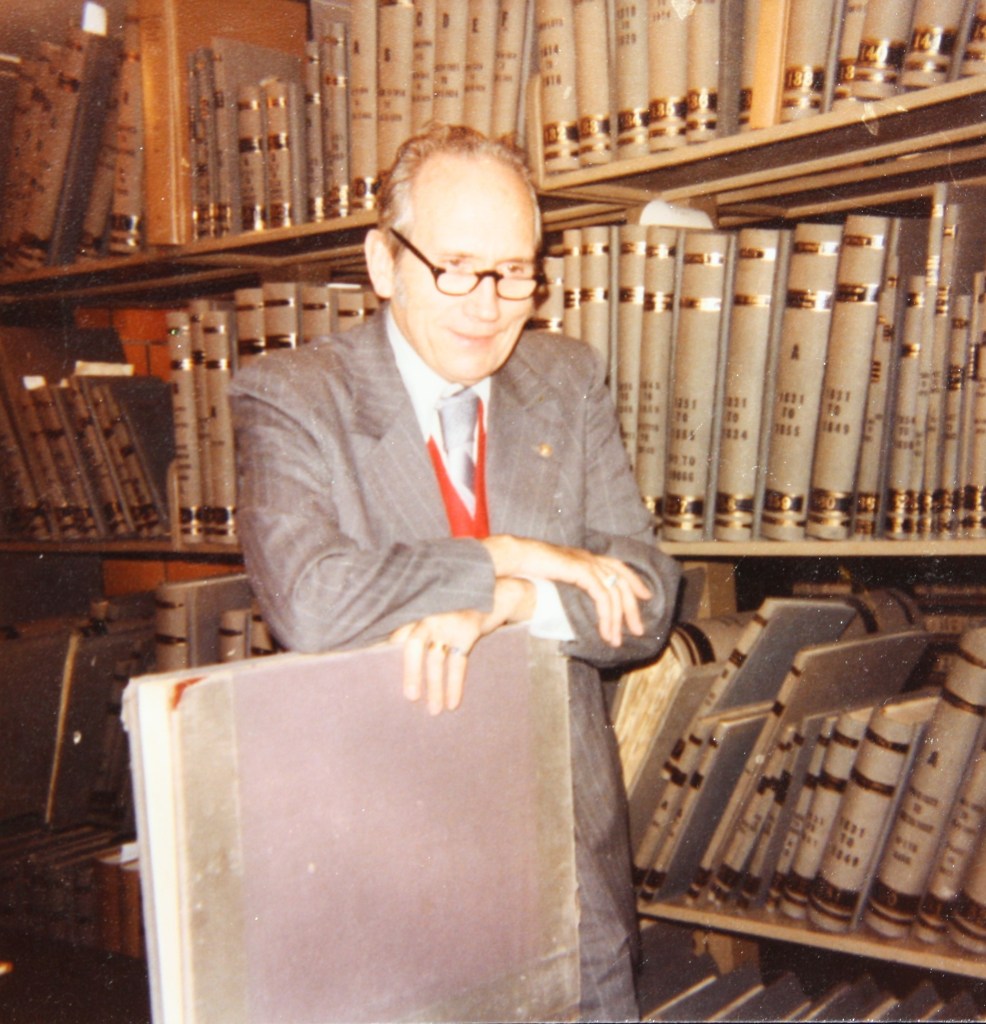
Wayne C. “Doc” Temple at his post of 56 years & 7 months in the Illinois State Archives Springfield, Illinois.

Doc Temple’s century of service is complete, his earthly journey concluded, and he has embarked on the most anticipated trip of his long and happy life, carried on the wings of cardinals to reunite in heaven with his beloved wife Sunderine. Doc’s life, by his own admission, was a dream come true. Born in Ohio’s fields of plenty, Doc was an old soul from the start. With nary a penny in his pocket, at the age of five he carried an old broken pocket watch and chain found abandoned in a farmer’s field as part of his daily attire. He turned that love of timepieces into the preeminent collection of Illinois Watch Company pocket watches known in the state. Governors, senators, congressmen, generals, scholars, and friends today carry an “A. Lincoln” or “Bunn Special” pocket watch with them today, courtesy of Wayne C. Temple. Other creatures received his bounty, too: he fed the cardinals outside his home on Fourth Street Court assiduously and considered every red bird that benefited from his efforts as an earthly manifestation of his wife Sandy, reminding him, over the past three years, that she stood with open arms on the rainbow bridge, awaiting his arrival.
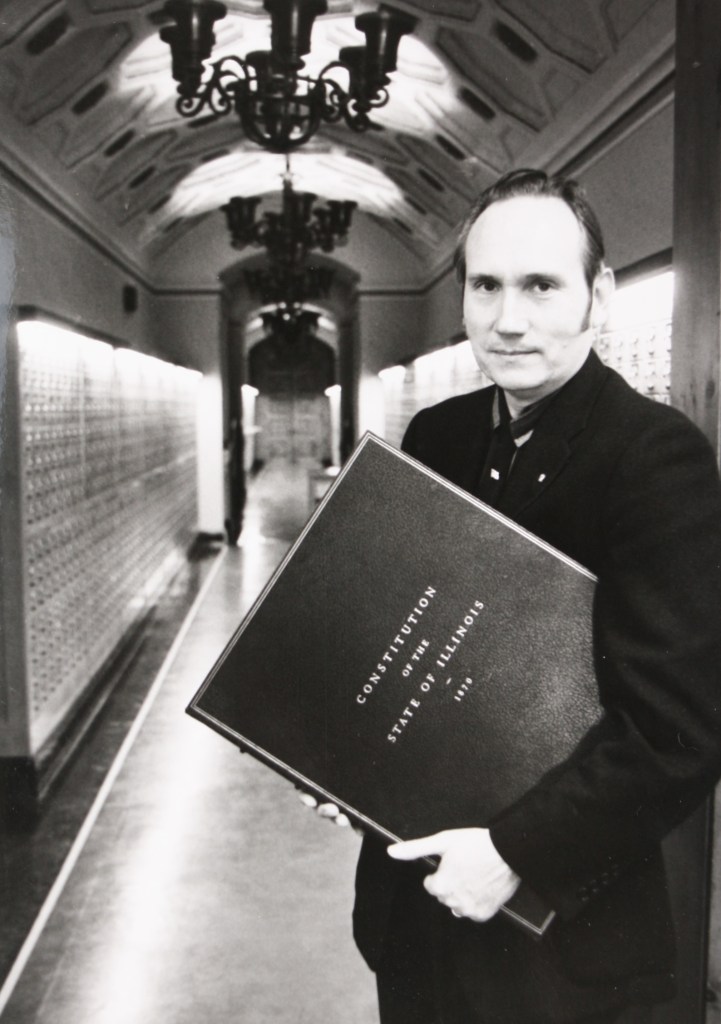
Doc holding the Illinois State Constitution at the archives.

While historians know that Doc was chosen as one of the top 150 graduates of all time from the University of Illinois during its sesquicentennial year of 2017, not many realize that Doc was also an accomplished poet, living his life with poetry in his soul. He sprouted as a poor Ohio farm boy with an unquenchable thirst for history, education, and life, with his first love the English language.  He put that adoration for the printed word to good use in elocution contests and essays that were the first signs of his innate talent. From those humble beginnings, Doc served his country in Europe, slept on castle floors, befriended a General named Eisenhower who would soon become President, and drank the wine of emperors gifted to him by grateful war-torn communities that he literally brought back to life with his engineering skills. Of course, Doc shared Napoleon’s wine with his battle buddies. Doc’s flame burned brighter than any other historian in Illinois’s history, and the prowess of his Lincoln scholarship was unchallenged for half a century. He spent a career burning holes in the pages of others’ older history by his meticulous research, yet Doc’s flame always warmed, never burned those around him. He was quick to share information with all who sought his advice. Whether you were a budding scholar, land surveyor, dentist (yes, Doc was an honorary dentist), lawyer, politician, historical enthusiast, tourist, or student, Doc always had time to lend a hand in the most generous fashion. He never concerned himself about attribution or credit; his mantra was always “Get the information out there.”  Some of it was new information, too: Each year he wrote Sandy an original poem, in rhyme, for her birthday or anniversary.
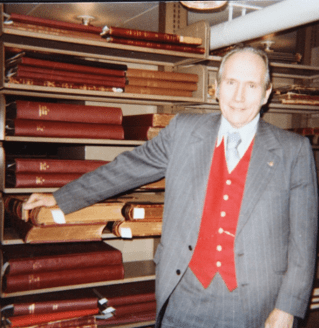
Doc Temple at work in the archives.

Although Doc stood front and center for every important Illinois event, commemoration, or big reveal for the past seven decades, you’d never know it by his demeanor. If he wasn’t on the dais, he was in the front row. During his career in the Archives, he was just as excited to meet Hoss Cartwright’s school teacher as he was to meet the Vice-President of the United States. Doc’s presence will be sorely missed, his record of 54 years, 7 months service to the state of Illinois may never be surpassed, and his space in the Lincoln field will remain unfilled. His passing came with typical military precision, bisecting the clock at precisely 1230 hours, the hands on the clock in an upswing, moving up, not down, on the final day of March. Doc’s transition occurred exactly at the conclusion of his life’s seasonal winter to burst forth to the heavenly spring we all hope awaits our final journey. Doc would remind us all, with a wink and a smile, that he also waited until after the St. Louis Cardinals home opener had arrived.
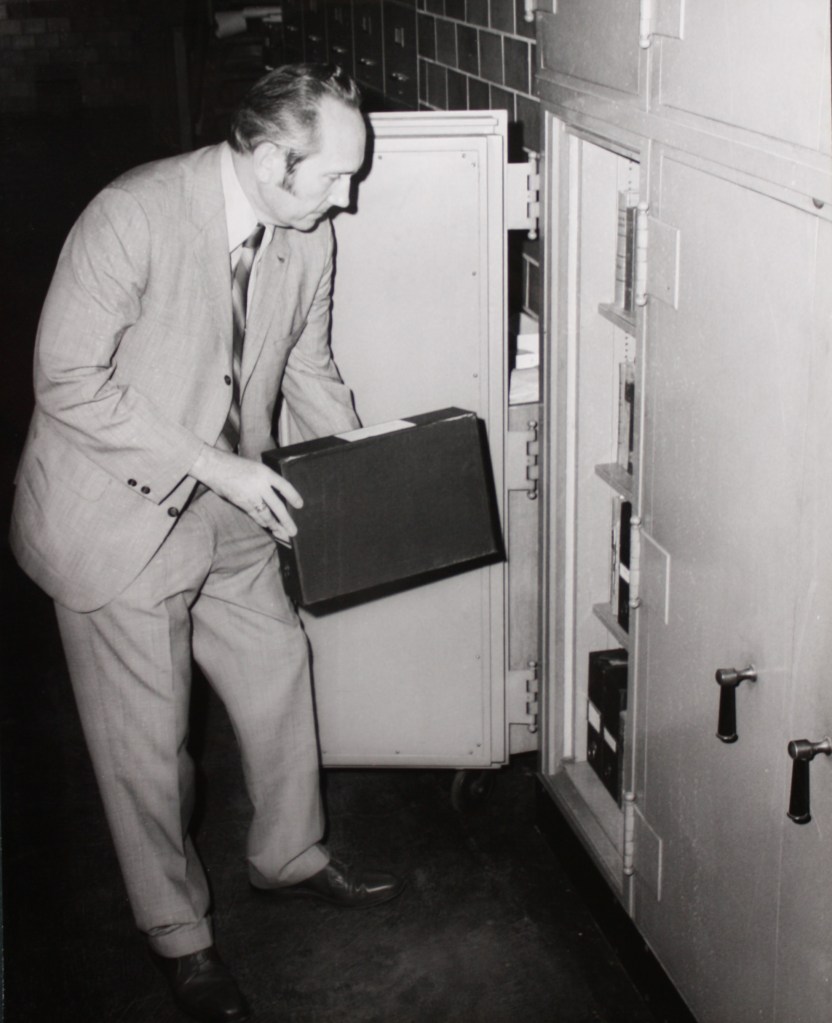
Doc Temple in the safe at the archives.

Wayne Calhoun Temple, the dean of Lincoln studies and for half a century the mainstay of the Illinois State Archives, died peacefully on March 31, 2025, at a care facility in Chatham, Illinois.  Devoted friends Teena Groves and Sharon Miller were present Wayne Calhoun Temple, the dean of Lincoln studies and for half a century the mainstay of the Illinois State Archives, died peacefully on March 31, 2025, at a care facility in Chatham, Illinois.  Devoted friends Teena Groves and Sharon Miller were present and biographer Alan E. Hunter was on the phone with them at the time of his passing. He was predeceased by his beloved wife Sandy (2022), and by his parents Howard (1971) and Ruby (1978) Temple, of Richwood, Ohio.. He was predeceased by his beloved wife Sandy (2022), and by his parents Howard (1972) and Ruby (1977) Temple, of Richwood, Ohio.
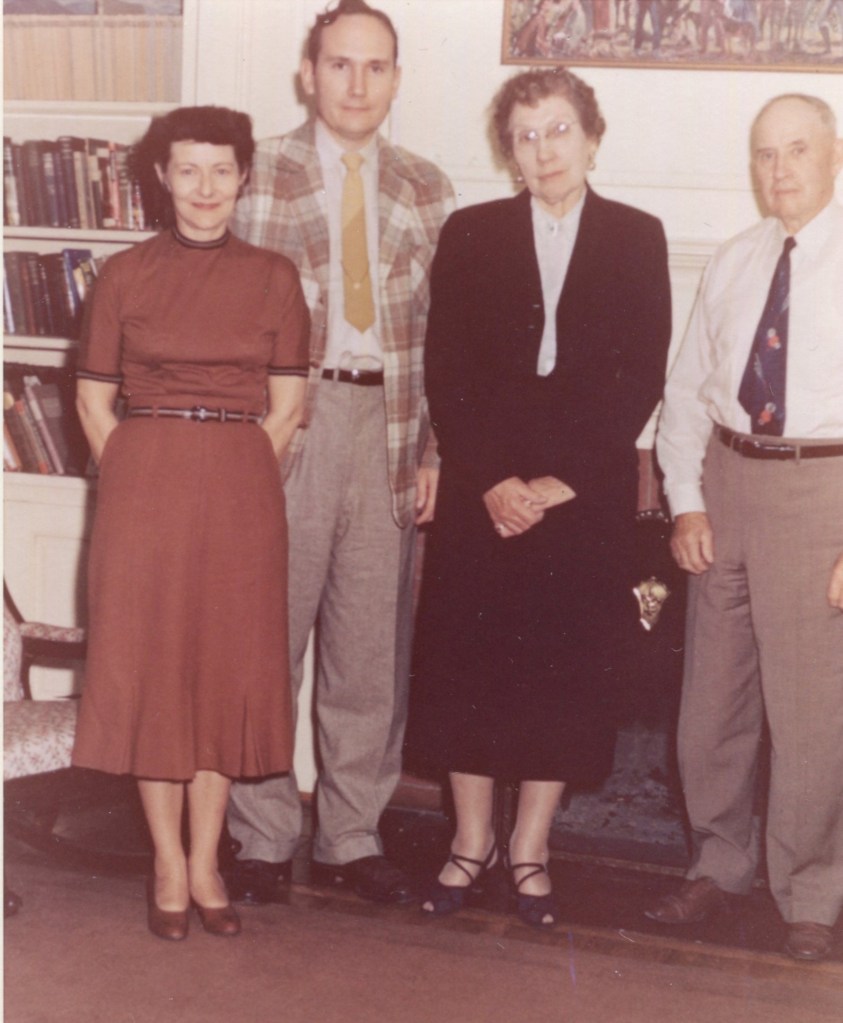
Loi & Doc with his parents Roby & Howard Temple.

Temple, known to all for 60 years as “Doc,” was born on a small family farm two miles east of Richwood (about 40 miles north of Columbus), on Feb. 5, 1924. He liked to note that he shared a birthday with Lincoln’s mother, Nancy Hanks Lincoln.  He was an only child. From his mother, a teacher, he learned literature, history, and music; from his father, he learned how to ride, how to shoot, how to plant and reap. An oft-repeated story is how at age 9 years he encouraged his parents to go see the fair in Chicago in 1933 as they wished. He persuaded them that he’d be fine and he was – he had the horse, the cart, and the rifle.
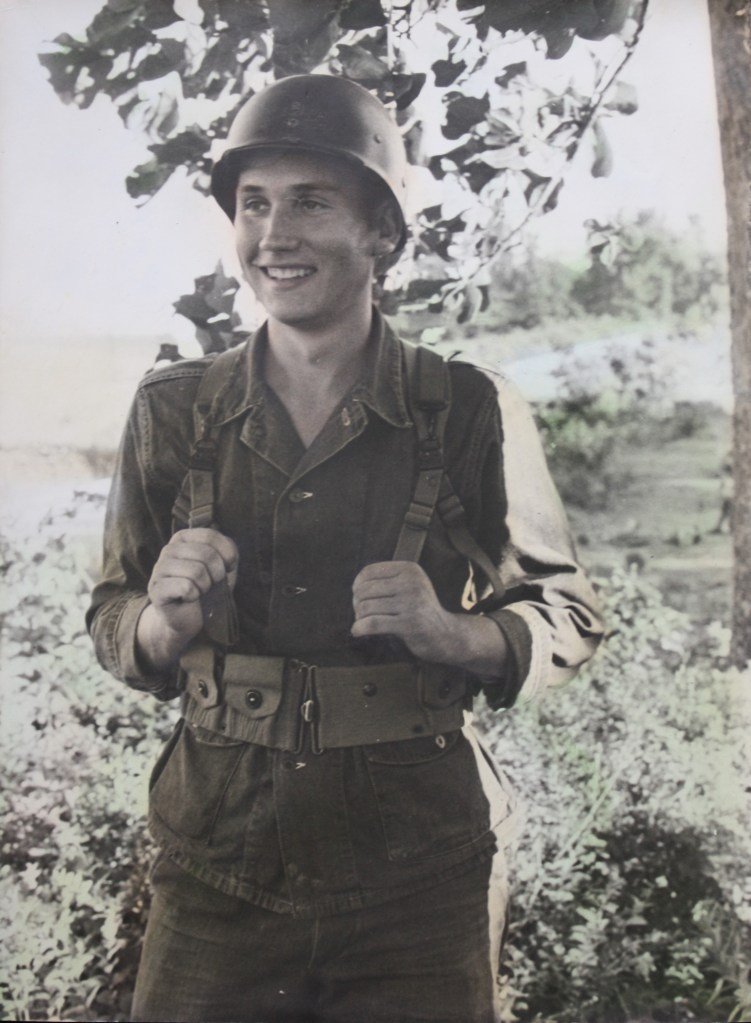
Doc Temple World War II.

After a one-room-schoolhouse start, in high school he was valedictorian and ran on a championship 1,500-yard 4-man relay team. He played clarinet in a traveling band of adult men. In 1941, he entered Ohio State University on a football scholarship, intending to study chemistry. He was soon drafted into the Army Air Corps and sent to Urbana, Illinois, for training as an engineer. He and his mates were sent to North Carolina for special training; then to Kansas for ordnance production.
He spent 1945-46 in Europe, and at age 21 as a Tec 5 in the Signal Corps (grade of a sergeant), he helped install new airfields and radio communications, some of it personally for General-in-Chief Eisenhower.  Many more details are found in Alan E. Hunter’s remarkable oral-history-as-life-study, Thursdays with Doc (2025), copies of which Temple signed in his last months of life.
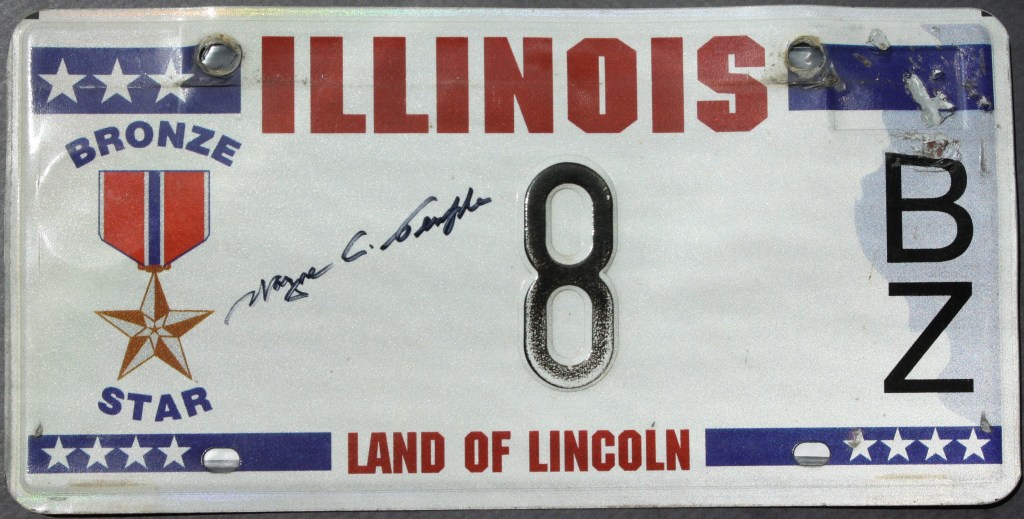
Doc’s Bronze Star license plate.

He was awarded the Bronze Star for his one-man battle with a Luftwaffe pilot who strafed their camp on the Franco-German border in the last weeks of the war.  While others dove for the ditch, Doc used his favorite weapon, the Thompson submachine gun, to fire upward at the plane. “Did you hit him?” Doc was later asked. “I don’t know, but he didn’t come back.”
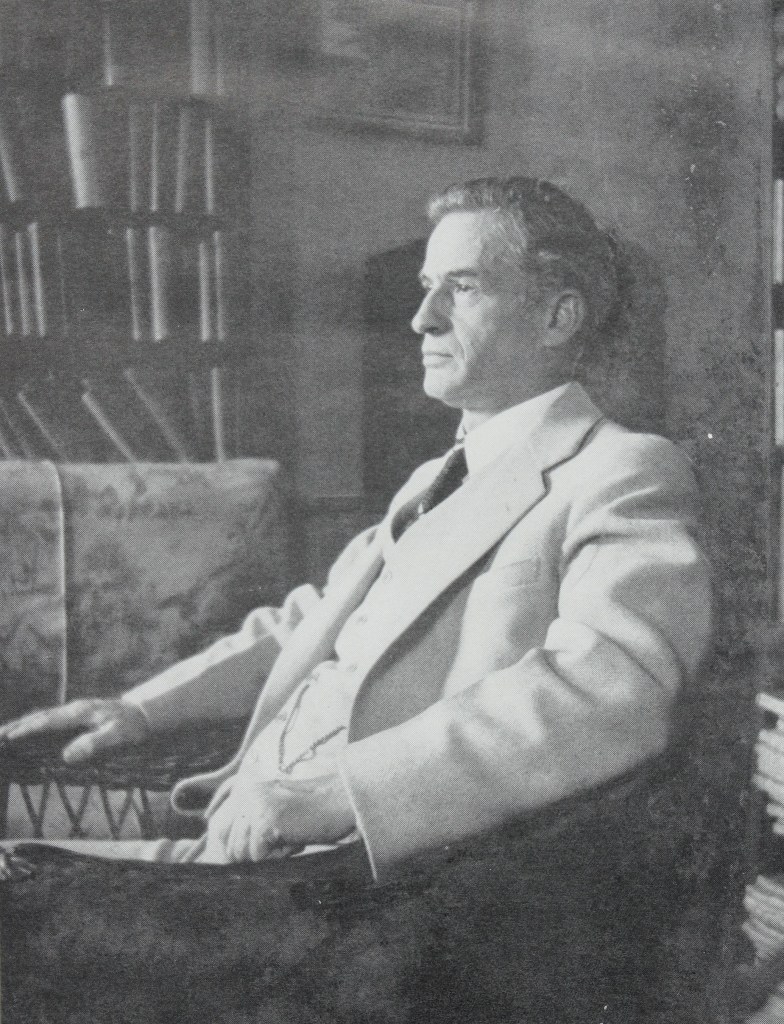
James Garfield Randall Univ. of Illinois.

After the war he returned to the U. of Illinois, earning a war-interrupted B.A. in History and English. Here, he was discovered by Prof. James G. Randall, the first academic historian of Lincoln, and became his graduate student and research assistant until “Jim’s” death in 1953. Temple helped him write vol. 3 of the tetralogy Lincoln the President (1945-55) and rough out vol. 4 although a more senior scholar got credit as co-author. Temple also helped Ruth Randall with her popular and “junior” histories about the Lincolns and women of the Civil War era, and corresponded with her until her death in 1971.
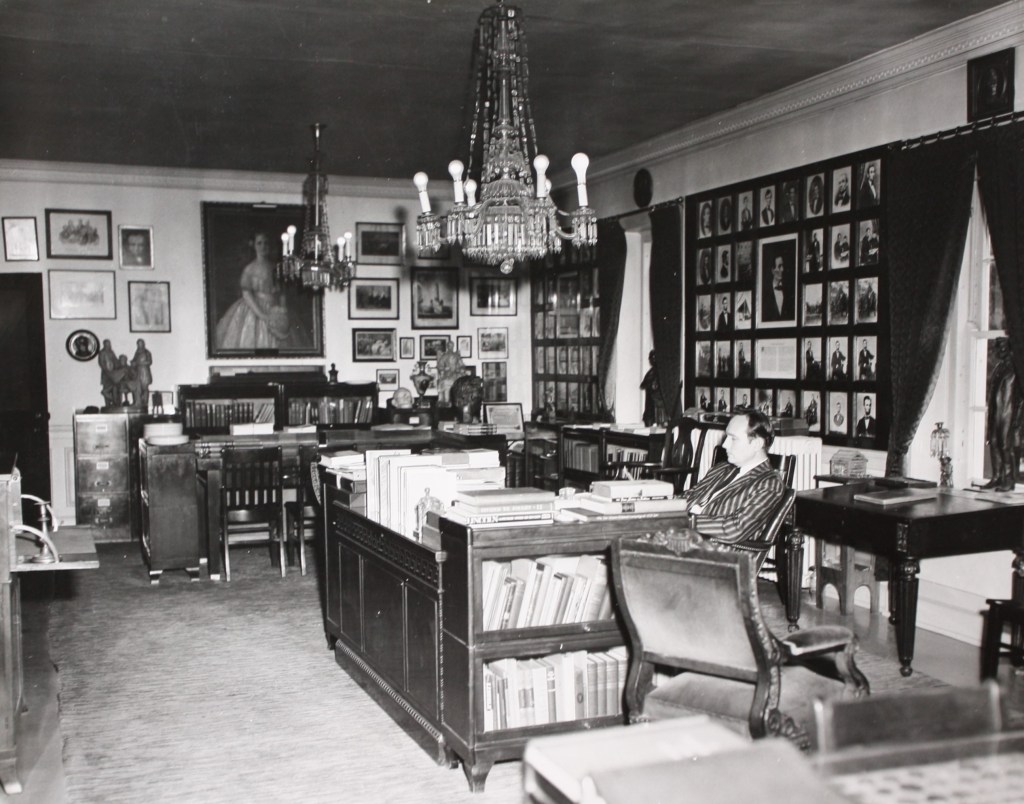
Doc in his office, the “Lincoln Room”, at Lincoln Memorial University Harrogate, Tennessee.

His first book was commissioned and remunerated handsomely by Thorne Deuel of the Illinois State Museum, on Indian Villages of the Illinois Country (1958), still considered a model of research and analysis. From there Temple took his wife Lois McDonald Temple to Lincoln Memorial University, Harrogate, Tennessee, to head up the history department. They remained in touch for decades with some of the young women who assisted in the department. He edited The Lincoln Herald there, making it the best periodical in the field, and remained as editor till the mid-1970s, long after the Illinois State Archives in 1964 brought him on staff. For decades before his retirement there in 2016 he was permanent Chief Deputy Director. (Lois died in 1978; Doc and Sandy met and married in 1979.) He no longer taught classrooms, helping instead an average of 150 people per month for a half-century who called, wrote, or walked in with questions at the Archives – in addition to speaking and writing publicly more than most fulltime professors. Land surveying, one of Temple’s many skills, proved invaluable for the dozen survey questions a month on that topic, alongside tracing the course of legislative bills old or new, gubernatorial proclamations, or judicial rulings. He mastered the use of old registers, microfilm, and the typewriter, but never took to computers. Nine secretaries of State, of both parties, kept Temple on, recognizing his value to the state and to the public; tech-savvy assistants like his friend Teena Groves made the office efficient, complementing Doc’s top-notch research work.
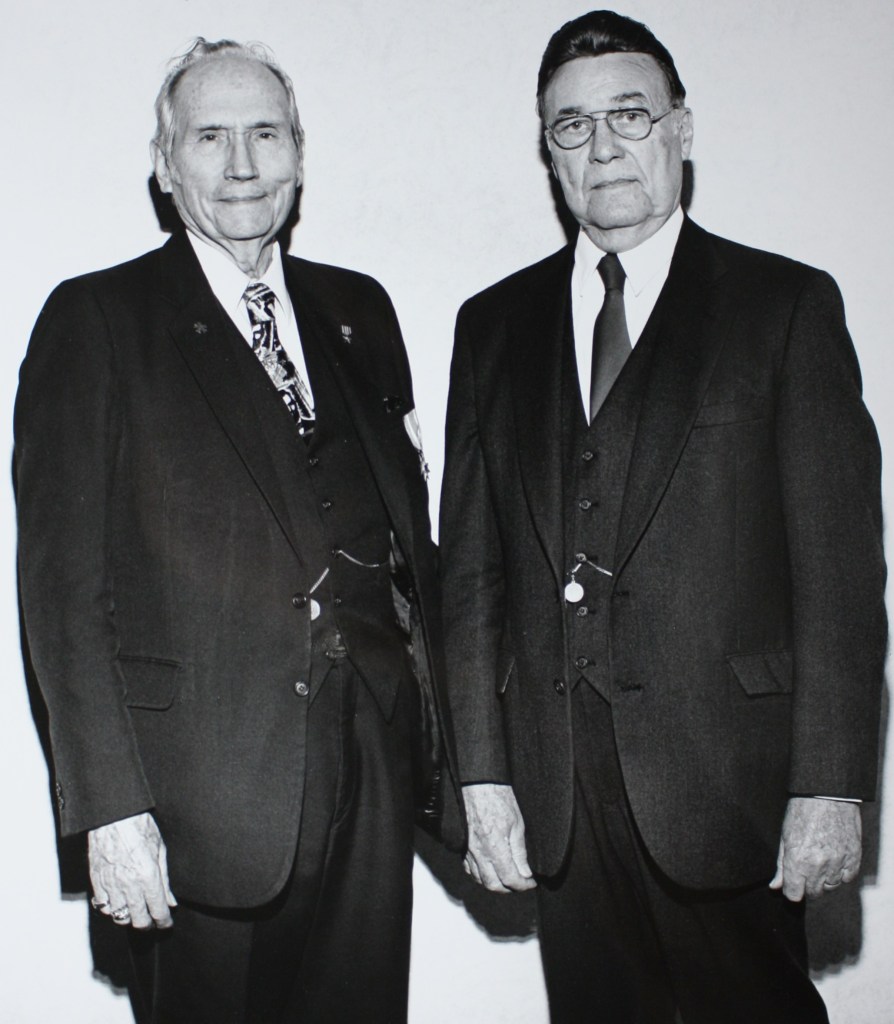
Doc with his longtime friend,
Dayton Ohio artist Lloyd Ostendorf.

At the popular level he engaged artist Lloyd Ostendorf to illustrate the Lincoln Herald with Temple’s precise historical notes on people’s heights, demeanor, clothing, armaments, supported by background architecture and horsetack, for the best historic illustrations of any American’s circle of friends and colleagues.  These scenes were set in dozens of Illinois cities and towns around the legal or political circuit, plus Lincoln’s White House years. Supporting local-history projects with Phil Wagner, John Eden of Athens, the Masonic Lodge, and towns themselves, Temple also helped re-create dramatic moments of the past.  The Lincoln Academy of Illinois made him a Regent in the 1960s with a nomination by a governor from each party, and he was elected a Laureate in 2009, the highest honor in the State’s gift.  Helping in 1969 to reactivate the 114th Illinois Volunteer Infantry of the Civil War era, he rose in its ranks from Lt. Col. to full General, presiding at dozens of ceremonies.  Nationally he was a member of the U.S. Civil War Centennial Commission (1960-1965); was invited to recite the Gettysburg Address on the steps of the Lincoln Memorial with President Nixon and other officials present in 1971, then to speak to the Senate about the Lincoln boys’ Scottish-born tutor Alexander Williamson; and in 1988 was present for the commissioning of the aircraft carrier U.S.S. Abraham Lincoln. Privately and at work he was asked to weigh in on the authenticity of dozens of Lincoln documents owned by private collectors.
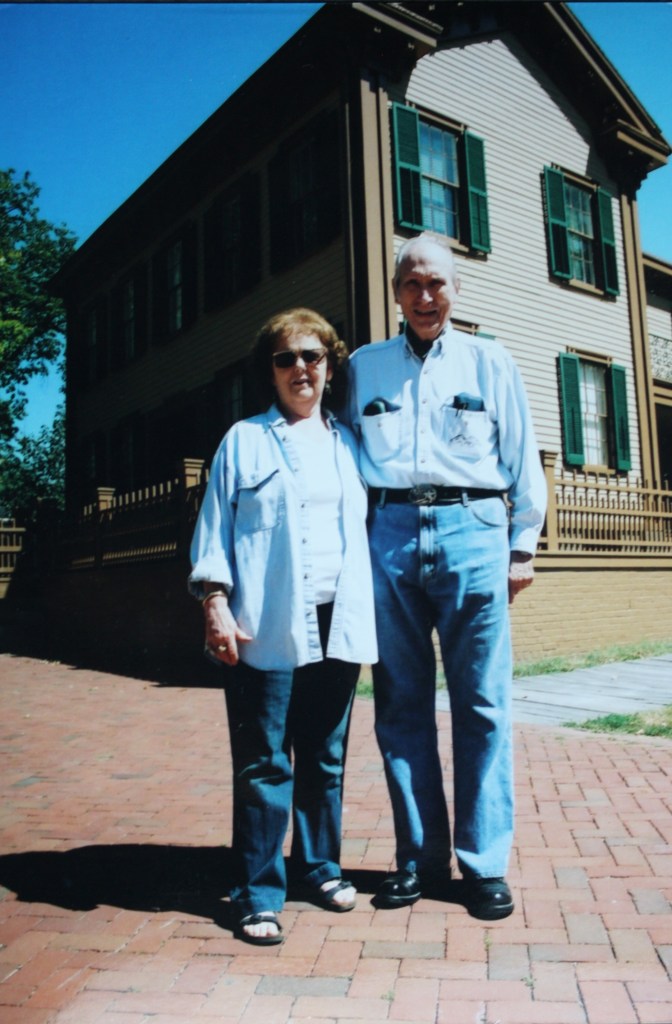
Sandy & Doc Temple in front of the Abraham Lincoln Home Springfield.

Temple’s published works remain the testament to his great energies and skill.  With wife Sunderine, a.k.a. Sandy, who for 40 years was a head docent at the Old State Capitol, he wrote Illinois’ Fifth Capitol: The House that Lincoln Built and Caused to Be Rebuilt (1837-1865) (1988), the standard work on its initiation, contracts, costs, furnishing, refurbishing, and historic moments such as Lincoln’s “House Divided” speech in 1858. In like vein he wrote up the Lincoln Home, in By Square and Compasses (1984; updated 2002). For shorter works he found or recovered the stories of people high and low, including Mariah Vance, the Lincolns’ African-American laundress; Barbara Dinkel, a German-born widow down the block; two Portuguese immigrants nearby; Robert Lincoln’s ability to play the piano; and father Abraham’s formal commission as an Illinois militia officer after the Black Hawk War of 1832, which he maintained throughout his life by attending the annual muster.  C. C. Brown, namesake of the oldest continuous business in Illinois – the law firm Brown, Hay, & Stephens (est. 1828) — offered some thoughts on working with Lincoln which Temple found and turned into a booklet in 1963.   Probably his most enduring book will be Abraham Lincoln: From Skeptic to Prophet (1995), on the religious views, which Temple called not merely a religious study but “really a biography of the Lincoln family.” Lincoln’s many connections to Pike County introduced a book about the area’s Civil War record; his trip through the Great Lakes in 1849 gave rise to a booklet about the Illinois & Michigan Canal and Lincoln’s patented invention. Some of the best of Temple’s 500 to 600 articles are being collected into a book edited by Steven Rogstad.
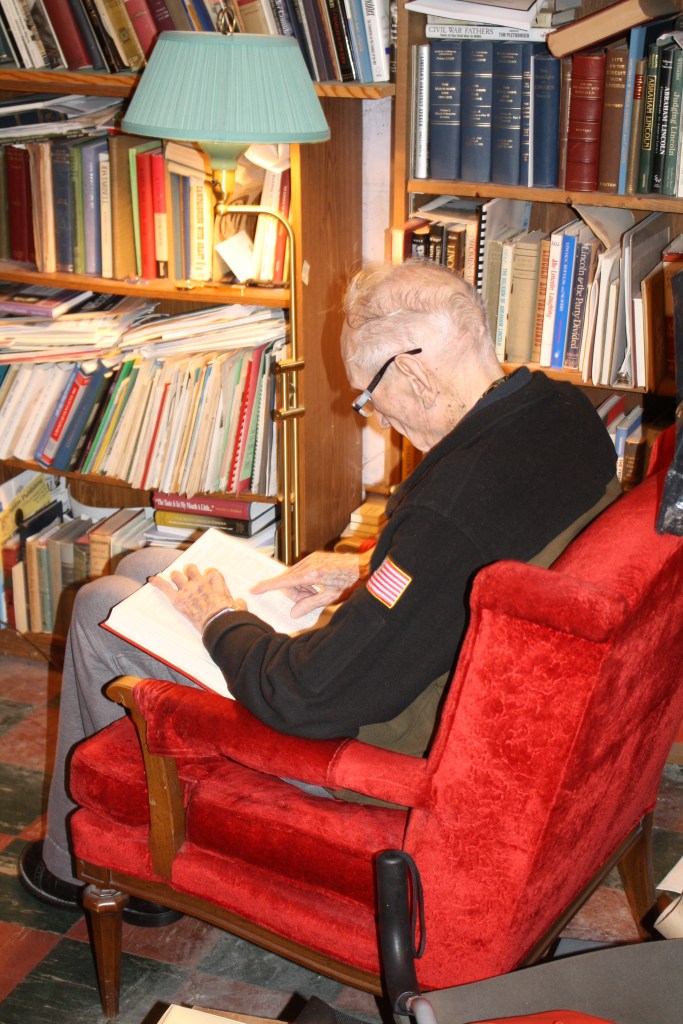
Doc at work in his basement library.

Personally Temple was highly generous, helping Sandy’s distant family when in need, serving as an Elder and teacher at the First Presbyterian Church, and endowing the UI Urbana History Dept. with funds from his estate. On behalf of wife Lois’s nephew, Temple headed a Boy Scout troop in town.  Doc gave his father’s canful of ancient Indian artifacts dug from the Ohio farm to the public library in Richwood, Ohio, as one of his last acts, though he could have sold them for many thousands of dollars. When Temple learned that his barber, a father of five, could not afford to send his bright youngest son to college, Temple spoke to Congressman Paul Findley, who got the young man appointed to the Academy at West Point, and a successful military career was launched.  Temple’s collection of 3,000 books is bound for UI Springfield’s Lincoln Studies Center, while his fine collection of artworks as well as personal papers will go to the Presidential Library and Museum.

Doc Temple and the author in their first meeting back in February of 2011.

In the opinion of the person who succeeds Temple as the dean of Lincoln historians, Prof. Michael Burlingame of UI Springfield, Doc “displayed an uncanny ability to unearth new information about Lincoln through painstaking research … For over eight decades, he tenaciously filled many niches in the Lincoln story.” His neighbor of 43 years, Sharon Miller, said, “Doc was simply a wonderful man. But he missed Sandy too much to keep going.”
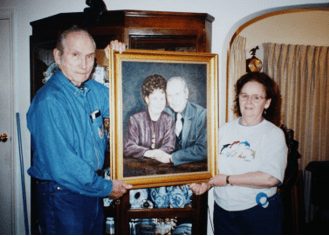
Doc and Sandy in their home holding Lloyd Ostendorf’s painting of the couple.

A memorial service will be held on Thursday, April 10th, at 10:00 a.m. at Staab Funeral Home, S. 5th St. in Springfield.  Burial will take place at 1:00 p.m. at Camp Butler National Cemetery, next to Sandy temple’s gravesite. A reception at the St. Paul’s #500 A.F. & A.M. Lodge on Rickard Drive will follow.
Abe Lincoln, Art, Museums, Presidents

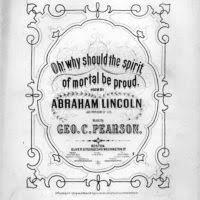
Abraham Lincoln’s Favorite Poem.

Original publish date October 19, 2023. https://weeklyview.net/2023/10/19/abraham-lincolns-favorite-poem/

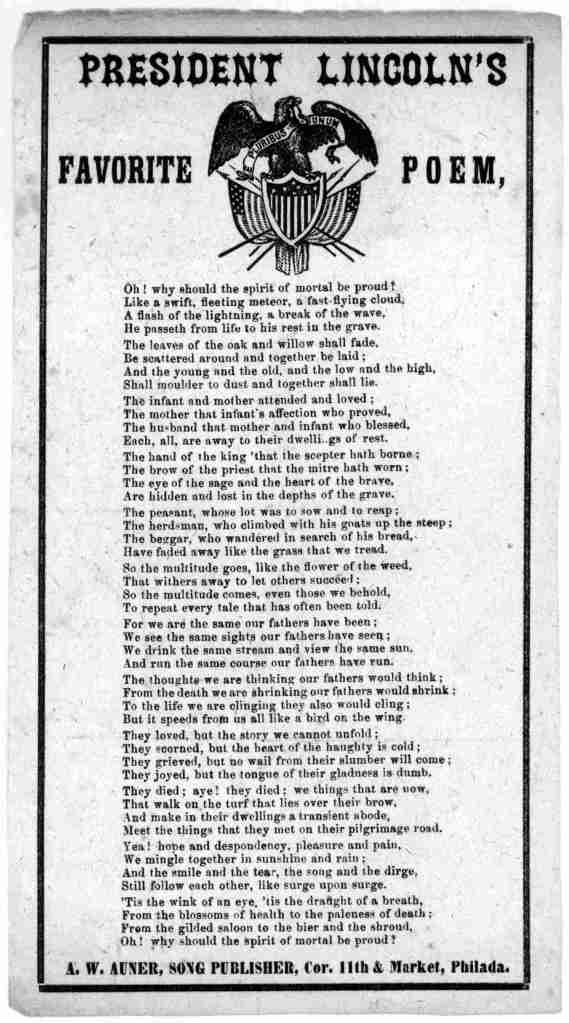
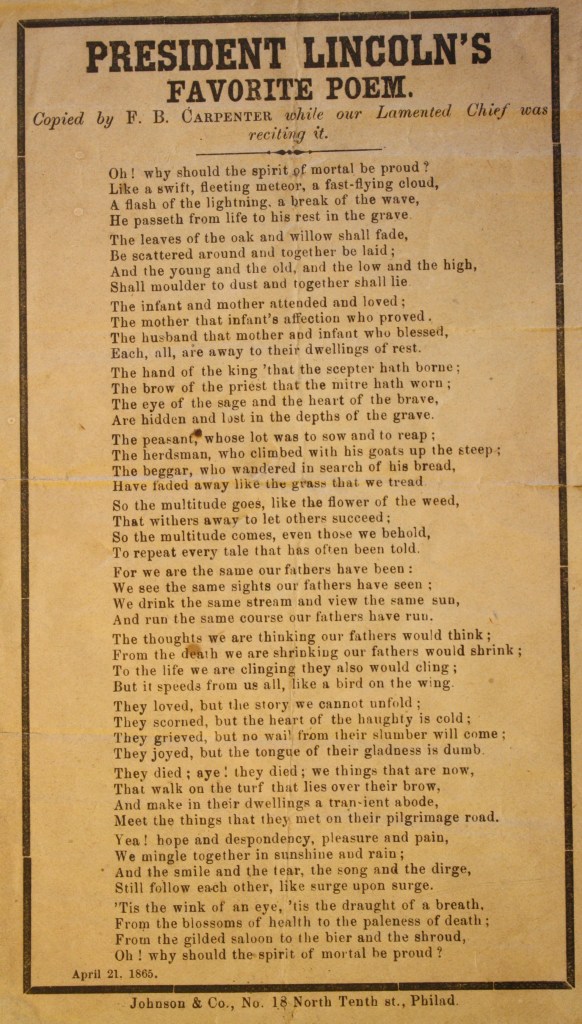
This was once displayed in Osborn H. Oldroyd’s museum inside the Lincoln Home in Springfield, Illinois. The poem was read aloud on the 15th anniversary of the President’s death, April 15, 1880, at the first memorial service at Lincoln’s Tomb ceremony by Mrs. Edward S. Johnson (wife of Lincoln Guard of Honor member and second Lincoln Tomb custodian Major Edward S. Johnson). Undoubtedly this leaflet was handed out at that ceremony on that day as a souvenir. It is titled “President Lincoln’s Favorite Poem. Copied by F.B. Carpenter while our Lamented Chief was reciting it.”

During the month of October in Irvington, I am near-constantly surrounded by reminders of the dead. While Irvington celebrates Halloween with little door-knocking ghosties and goblins gliding from door to door in search of treats, it does nothing to dispel the fact that Halloween revolves around the spirits of the dearly departed. I write often about Abraham Lincoln, but seldom about Lincoln and Halloween. I thought it might be a good time to examine a mysterious poem that fits the season and has often been referred to as Lincoln’s favorite.

Lincoln developed his lifelong love of poetry while a boy in Southern Indiana. Although by his own admission, Lincoln got his education “by littles” and the total time spent in a classroom by the young rail-splitter amounted to less than a year, he devoured the poetry found in the four school readers historians attribute to his early years in the Hoosier state. Many of those poems were about death. John Goldsmith’s 1766 poem, An Elegy On The Death Of A Mad Dog, Edgar Allan Poe’s 1845 poem The Raven, Oliver Wendell Holmes’ 1831 poem The Last Leaf, and Thomas Gray’s 1751 poem Elegy Written in a Country Churchyard. And of course, Lincoln’s love of William Shakespeare is widely known.

These poets in particular capture the gloomy, melancholic poetry of which Lincoln was so fond of as a young man. Lincoln, a capable amateur poet himself, memorized the poems he cherished, reciting them to friends and inserting them in conversations and speeches throughout his life. His favorite poem, which he recited so often that people suspected he was its author, was William Knox’s “Mortality,” alternately known as “O, Why should the Spirit of Mortal be Proud!” Lincoln often opined to friends (and at least once in a letter) that he, “would give all I am worth, and go in debt, to be able to write so fine a piece as I think that is.”

The poem was cut from a newspaper and given to Lincoln by Dr. Jason Duncan in New Salem, Illinois. At the time, its author was anonymous, and attribution was unknown. On at least a few occasions, having committed it to memory, Lincoln wrote the Mortality poem out longhand and sent it to friends, always noting that “I am not the author.” He would spend twenty years searching for the poet. Aptly for the season, one stormy night in the White House, Lincoln recited the poem for a small group of friends including a congressman, an army chaplain, and an actor, noting that the “poem was his constant companion” and that it crossed his mind whenever he sought “relief from his almost constant anxiety.”

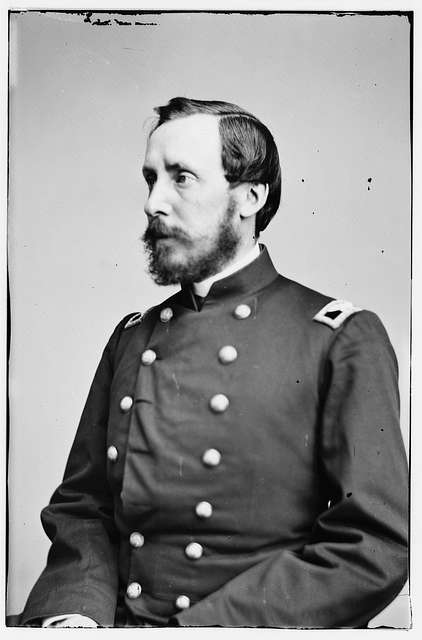
General James Grant Wilson (1832-1914)

When the group departed, Lincoln requested that his guests help to discover who had written it. “Its author has been greatly my benefactor, and I would be glad to name him when I speak of the poem…that I may treasure it as a memorial of a dear friend.” Union General James Grant Wilson (1832-1914) would ultimately inform the President that the poem was written by an obscure Scottish poet named William Knox (1789-1825). The poem was first published in his 1824 book Songs of Israel. After Lincoln’s death, the poem experienced a resurgence in popularity.

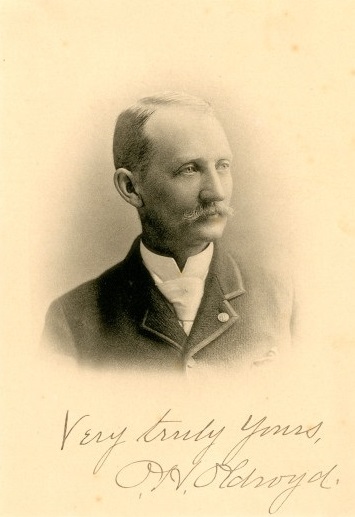
Osborn H. Oldroyd.

On April 15, 1880, on the 15th anniversary of the President’s death, the poem was read aloud by Mrs. Edward S. Johnson (wife of Lincoln Guard of Honor member and second Lincoln tomb custodian Major Edward S. Johnson) during a ceremony at the tomb in Springfield. A leaflet, handed out at that ceremony and found in my collection, was saved by Lincoln collector and personal muse Osborn H. Oldroyd and displayed in his collection in the Lincoln home for years. It remains important to the Oldroyd story as the impetus for his personal resolve to build a Lincoln Museum of his own.

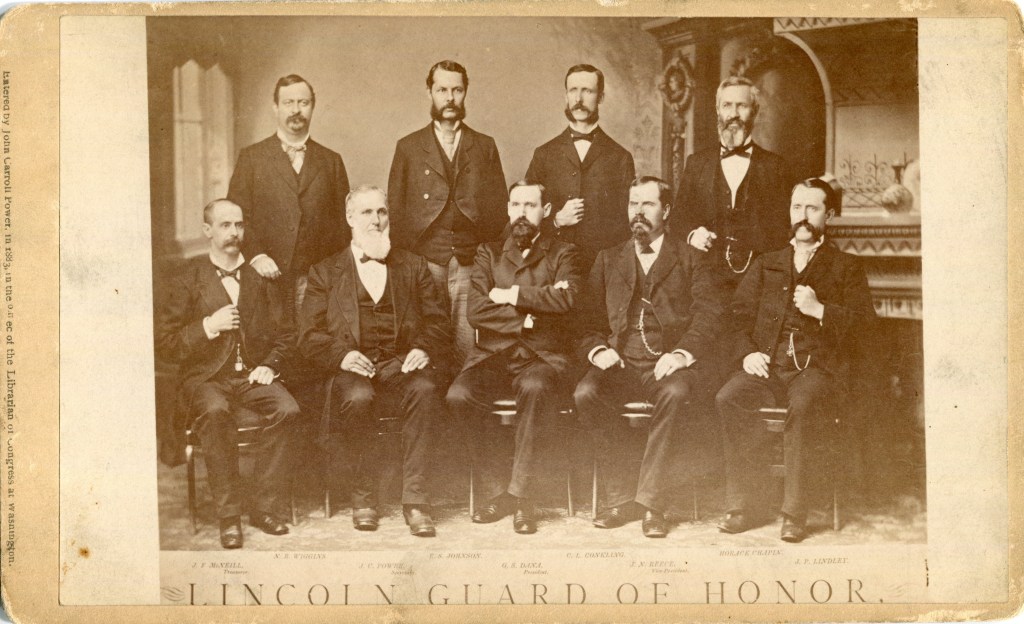
Lincoln Tomb Guard of Honor. John Carroll Power seated front row second from left.

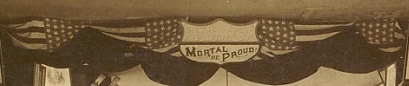
At that time the tomb’s Memorial Hall housed a small exhibit of Lincoln artifacts gathered by custodian John Carroll Power (a subject of my past columns). At that event, Oldroyd decided that his collection might be a bigger deal than he thought it was. “As I gazed on the…resting place of him whom I had learned to love in my boyhood years, I fell to wondering whether it might not be possible for me to contribute my might toward adding luster to the fame of this great product of American institutions,” wrote Oldroyd. It was after gazing upon those priceless Lincoln relics at the tomb that Oldroyd resolved to build a Memorial Hall in Springfield to display his own collection of Lincoln memorabilia. For a decade (1883 to 1893) that museum occupied the front parlors of the only home Abraham Lincoln ever owned at 8th and Jackson. The divider between those two rooms was adorned by a shield-shaped, flag-draped wooden motif adorned with the title “O, Why should the Spirit of Mortal be Proud!” Oldroyd made sure that every visitor to his museum was aware of the poem’s significance in the Lincoln chronology while surreptitiously causing each visitor to cast their eyes towards the heavens to receive the message.

Oldroyd’s Springfield Museum.
A stanza from the poem fashioned into a plaque hangs above the door in the above photo.

The poem is written in Quatrain form with an A-A-B-B rhyme scheme, or clerihew, with all of the dominant words highlighted by the rhyme. The poem resounded in Lincoln’s mind like an echo, its pauses, and connotations framing the beat of the poem. The poem causes its reader to reflect on the inevitable continuity of life; Life is short so why sweat the small stuff? We are but insignificant players in a much grander scheme, so do all you can while you’re here. Here, submitted for your approval in the spirit of Halloween, is Abraham Lincoln’s favorite poem in its entirety.

“O why should the spirit of mortal be proud! Like a fast-flitting meteor, a fast-flying cloud, A flash of the lightning, a break of the wave-He passes from life to his rest in the grave. The leaves of the oak and the willow shall fade, Be scattered around and together be laid; As the young and the old, and the low and the high, Shall moulder to dust, and together shall lie. The child that a mother attended and loved, The mother that infant’s affection that proved, The husband that mother and infant that blest, Each-all are away to their dwelling of rest. The maid on whose cheek, on whose brow, in whose eye, Shone beauty and pleasure-her triumphs are by: And the memory of those that beloved her and praised, And alike from the minds of the living erased. The hand of the king that the sceptre hath borne, The brow of the priest that the mitre hath worn, The eye of the sage, and the heart of the brave, Are hidden and lost in the depths of the grave.”

“The peasant whose lot was to sow and to reap, The herdsman who climbed with his goats to the steep, The beggar that wandered in search of his bread, Have faded away like the grass that we tread. The saint that enjoyed the communion of Heaven, The sinner that dared to remain unforgiven, The wise and the foolish, the guilty and just, Have quietly mingled their bones in the dust. So the multitude goes-like the flower and the weed, That wither away to let others succeed; So the multitude comes-even those we behold, To repeat every tale that hath often been told. For we are the same things that our fathers have been, We see the same sights that our fathers have seen, We drink the same stream, and we feel the same sun, And we run the same course that our fathers have run.”

“The thoughts we are thinking our fathers would think, From the death we are shrinking from they too would shrink, To the life we are clinging to, they too would cling-But it speeds from the earth like a bird on the wing. They loved-but their story we cannot unfold; They scorned-but the heart of the haughty is cold; They grieved-but no wail from their slumbers may come; They joyed-but the voice of their gladness is dumb. They died-ay, they died! and we, things that are now, Who walk on the turf that lies over their brow, Who make in their dwellings a transient abode, Meet the changes they met on their pilgrimage road. Yea, hope and despondence, and pleasure and pain, Are mingled together like sunshine and rain: And the smile and the tear, and the song and the dirge, Still follow each other like surge upon surge. ‘Tis the twink of an eye, ’tis the draught of a breath, From the blossom of health to the paleness of death, From the gilded saloon to the bier and the shroud-O why should the spirit of mortal be proud!”

Memento homo (remember you are only a man).

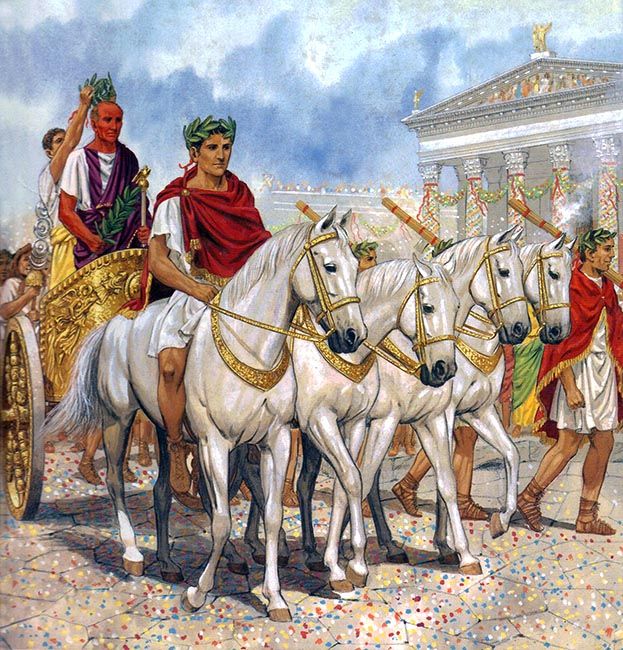
So what is the takeaway? Why should you be so proud of what you have, when all you have is so little in the bigger picture? The theme is one of life and death. A bleak and somber contrast reminds us that life is short, and in Lincoln’s case, fame is fleeting. Auriga, the slave charged with accompanying Roman Generals and Emperors through the streets of Rome after triumph in battle, often whispered the phrase Memento homo (remember you are only a man) while holding the golden crown inches above their heads. From a young age, Lincoln was well acquainted with the idea of mortality. So it comes as no surprise that he adored that poem. But it isn’t all gloom and doom. Within its stanzas are found muted messages of hope and the promise that it is not too late for society to change its ways by following in the footsteps of our ancestors. Reading this poem, one experiences the same feeling of reflection as Lincoln did. It explains how, during his entire lifetime, The Great Emancipator remained penitent and humble by simply following the lessons of this poem.

Abe Lincoln, Uncategorized

BOOK LAUNCH ANNOUNCEMENT! SUNDAY FEBRUARY 16, 2025 10 AM (CST) SPRINGFIELD, ILLINOIS.

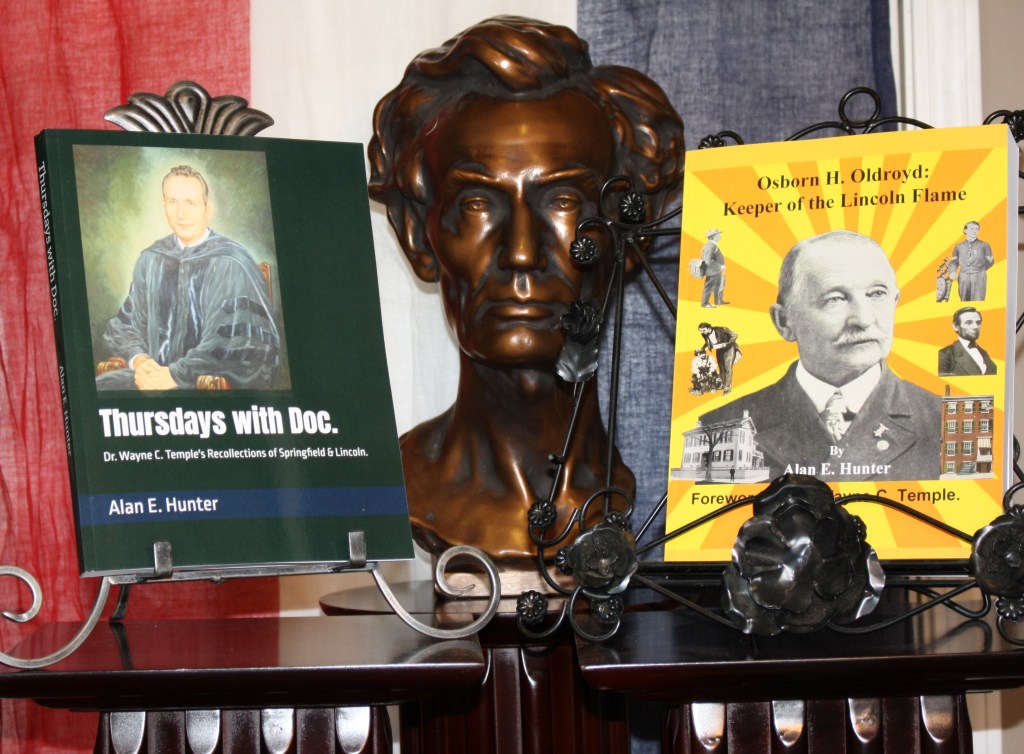
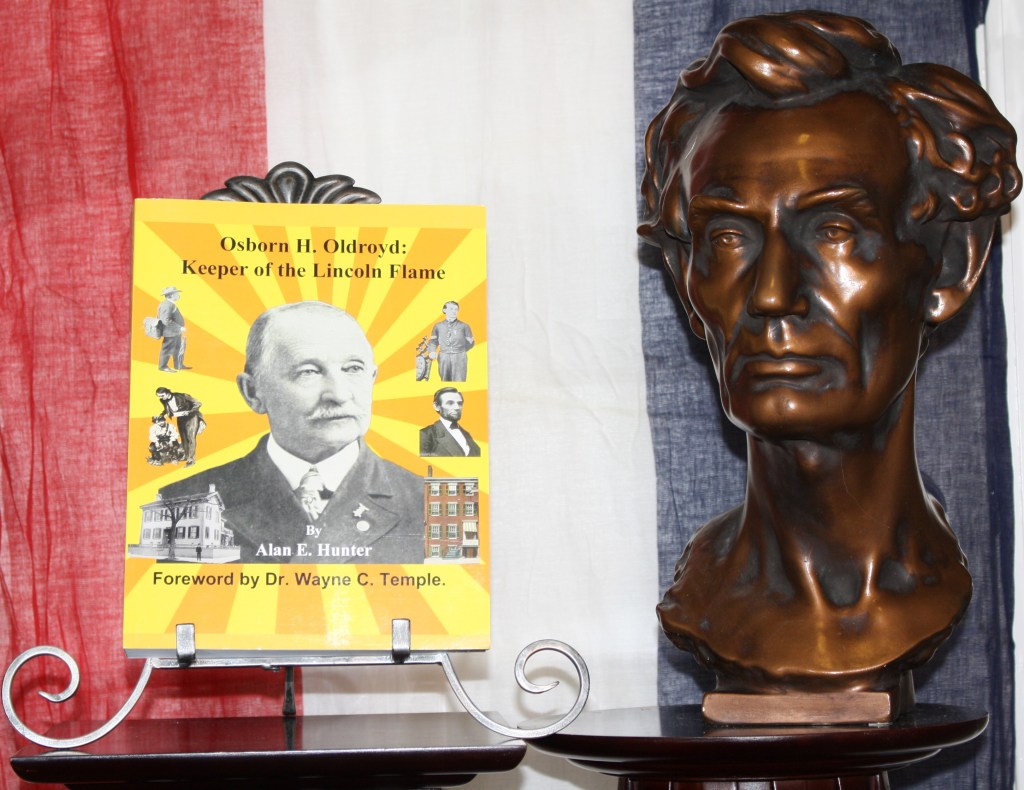
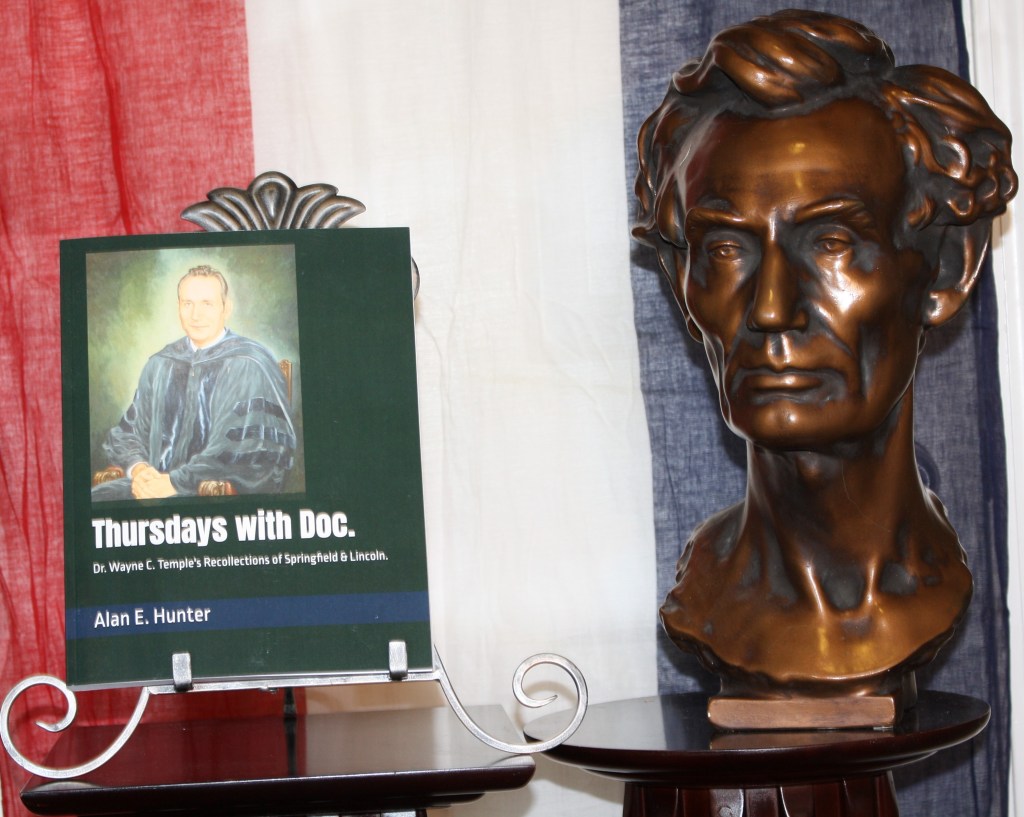
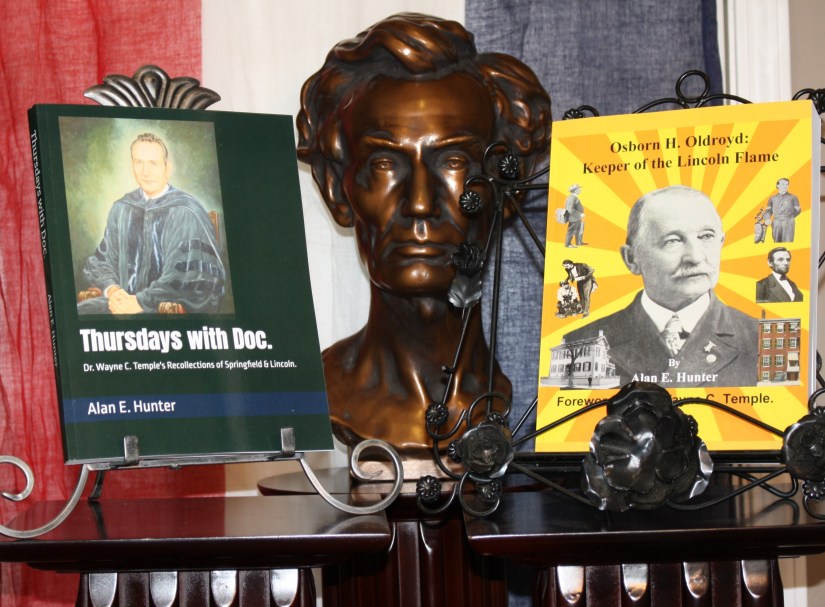
On Sunday, February 16th, 2025, the official book launch for both of my latest books, Thursdays with Doc. Dr. Wayne C. Temple’s Recollections of Springfield & Lincoln and Osborn H. Oldroyd: Keeper of the Lincoln Flame, will be held in Springfield, Illinois. 10:00 am (Central Standard Time) at Books on the Square 427 E. Washington St. Springfield, IL 62701. (217) 965-5443
https://www.booksonthesquare.com/

bksonsqr@royell.net 

The author will speak about Doc and Oldroyd, their connection to each other, and Springfield, the day after the Abraham Lincoln 216th Birthday Event: Symposium & Banquet in that historic building across from the Old State Capitol Building where Lincoln served. A book signing will follow the talk. All purchases of Doc’s book that day will include a limited edition, hand-numbered bookplate signed by Doc, Dr. James Cornelius, and the author.

Osborn H. Oldroyd devoted his life to acquiring everything relating to Abraham Lincoln. For nearly half his life, Osborn Oldroyd made his home and displayed his collection in two houses directly associated with the 16th President: the Lincoln Homestead in Springfield, Illinois, and the House Where Lincoln Died in Washington, D.C., a feat that will never be surpassed. Oldroyd guarded a gateway between two worlds. On one side was the world of the now and on the other, the world of the past. When Lincoln passed from life to history, the nation’s grief gave way to reverence; sorrow gave way to esteem. Oldroyd, the loyal log cabin Republican and veteran soldier, did his best to ensure no one forgot. Oldroyd had the institutional memory gained from walking in Lincoln’s footsteps, talking with Lincoln’s contemporaries, and examining the objects associated with his idol. Oldroyd was never trained as a curator. He was a born collector whose experience in handling and researching objects while building his personal collection was his curatorial education. His ability to recount the story behind the object and inject it with enthusiasm, humor, and believability, made him a folk hero to the common man. Just as Oldroyd’s museums can be considered the first of their kind in American museum history, Oldroyd himself can be labeled as America’s first folk curator. To the collection and study of Lincoln, Osborn Oldroyd’s name is unavoidable, particularly in the study of his assassination. It could easily be said that without the efforts of Osborn H. Oldroyd, we may have lost the Lincoln Home in Springfield, the House Where Lincoln Died, and Ford’s Theatre itself. Oldroyd’s obsessive, idiosyncratic devotion to Abraham Lincoln brought the martyred President down from the fog of intellectualism and back to earth for everyone to rediscover in object form. Oldroyd was the last of his kind and the first of another. He arrives by adoration and departs by dedication, opening doors for every Lincoln collector, admirer, and scholar that followed. Born in an age of covered wagons and canals, Oldroyd lived to see the age of the automobile and the airplane. And, thanks mainly to Osborn Oldroyd, visitors to the Petersen house today can walk through the first floor, down the long hallway to stand inside the tiny, dimly-lit otherwise insignificant room with the slanted ceiling where the last, best hope of a nation was lost.

KA series of informal discussions with Springfield Illinois Lincoln scholar and author Dr. Wayne C. Temple, known affectionately as “Doc”. Who, for over 56 years, worked for nine different Illinois Secretaries of State and ten different Governors representing both parties, a remarkable feat of its own. It is a record unlikely to be equaled. Doc was with the Illinois State Archives from 1964 to 2016, much of that time as the Chief Deputy Director. Before that, Doc was editor-in-chief of the Lincoln Herald and in charge of the Dept. of Lincolniana at Lincoln Memorial University in Harrogate, Tennessee from 1958 to 1964, remaining in that position remotely from Springfield until 1973. Doc was an honorary member of the Lincoln Sesquicentennial Commission, 1959-1960, and served on the advisory council of the  United States Civil War Centennial Commission, 1960-1966. Doc served in the U.S. Army from 1943 to 1946, and during that time he helped to establish General Dwight D. “Ike” Eisenhower’s communications in Europe. Doc has authored over 20 books, mostly on Lincoln, and has written over 600 articles, poems, reviews, and papers during his career. Doc graduated from the University of Illinois in 1949, studying under his mentor J.G. Randall, the “Dean of Lincoln Scholars.” Doc’s accomplishments are well covered in this volume. This book spans almost three years of interviews with Doc, James Cornelius (former Curator of the Abraham Lincoln Presidential Library and Museum), and author/newspaper columnist Alan E. Hunter. The topics cover Abraham Lincoln, the little-known history and colorful personalities of Springfield, Illinois, the Indigenous Peoples of Illinois, and the life and times of Springfield’s preeminent Lincoln scholar. Now over 100 years old, Dr. Wayne C. Temple has seen it all.

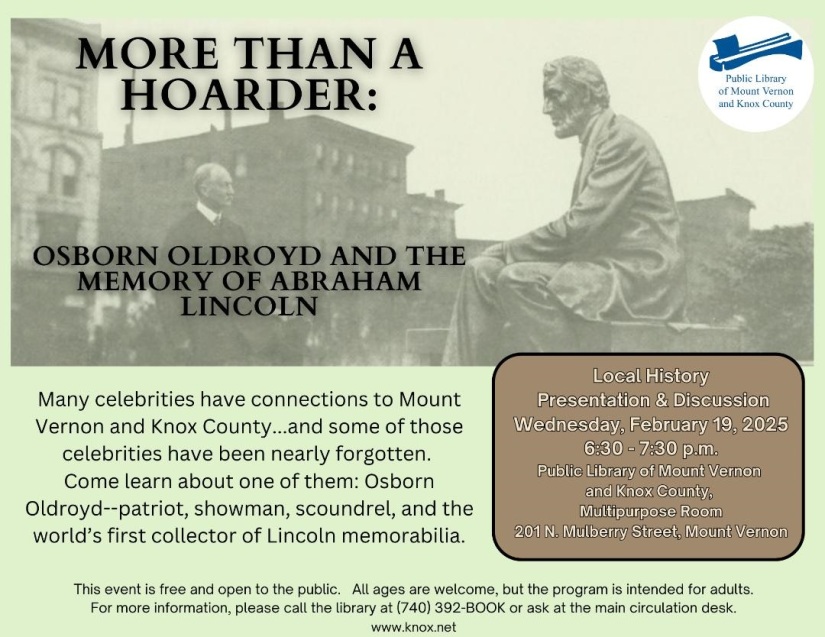
I was just informed & consulted about an upcoming program at the Knox County Public Library in Mt. Vernon, Ohio (Osborn H. Oldroyd’s birthplace). They have promised not to play up the “scoundrel” angle. The word is getting out!

Abe Lincoln, Museums

The big reveal of Springfield, Illinois Abraham Lincoln scholar Wayne C. “Doc” Temple’s collection of Native American Indian Artifacts at the Richwood, Ohio History Museum.

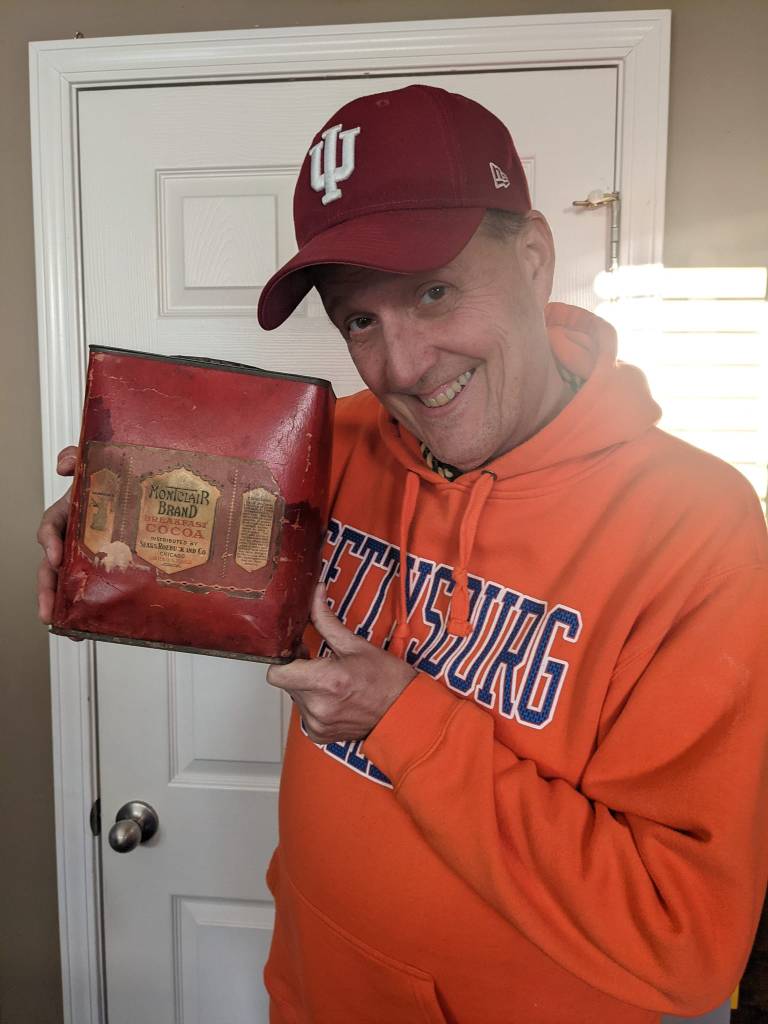
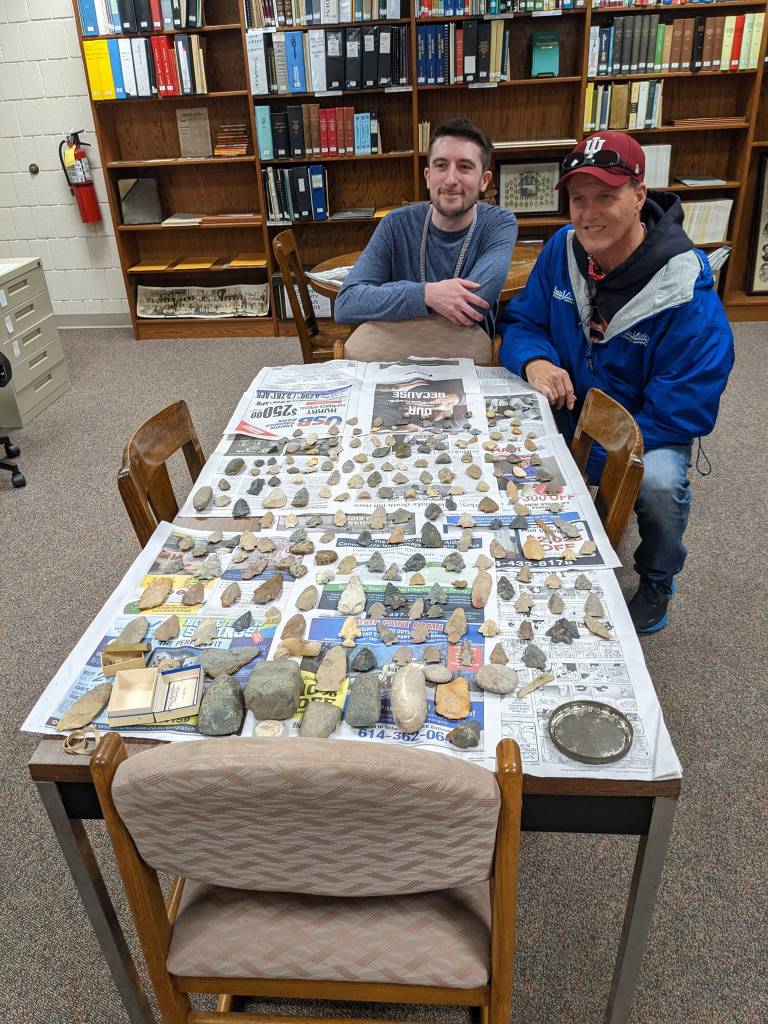
On Thursday, March 9, 2023, I visited the Richwood, Ohio History museum and library with my wife Rhonda S. Hunter. We dropped off the Temple family collection of Native American Indian artifacts collected over the course of at least two decades from @1900 past World War I. The compilation, contained in an old can of Cocoa, had not seen the light of day for nearly a century. Doc, Springfield Illinois’ premiere Abraham Lincoln scholar for over 60 years, also wrote the definitive book on the subject in 1966, Indian Villages of the Illinois Country: Historic Tribes, and several scholarly articles and papers on the subject for the University of Illinois. The artifacts were dug in the farm fields in and around Richwood Ohio so it seemed fitting that Doc’s collection go back to their place of origin. We were as happy to deliver them as the museum officials were to receive them.

Doc’s arrowhead collection had been stored in this cocoa box for a century.
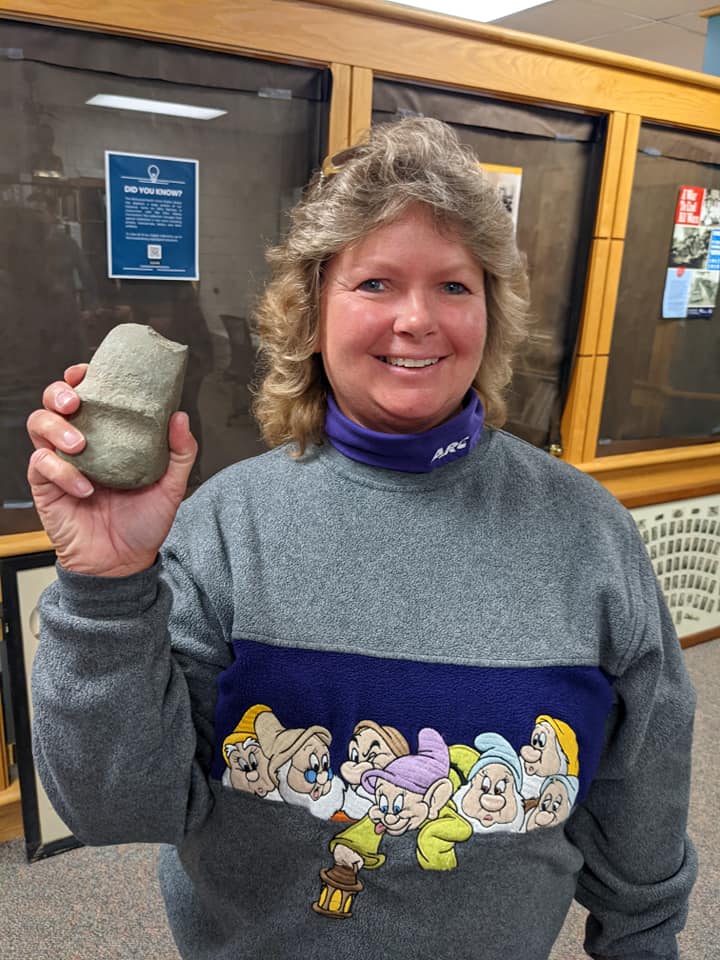
Rhonda Hunter with the piece from the collection that Doc recalled specifically. I believe it is a hammer or tomahawk head.
Richwood Museum staffer Dustin Lowe and Alana E. Hunter with Doc’s collection.