
Originally Published in December 2011. Republish Date December 21, 2023.
https://weeklyview.net/2023/12/21/james-dean-in-gettysburg/
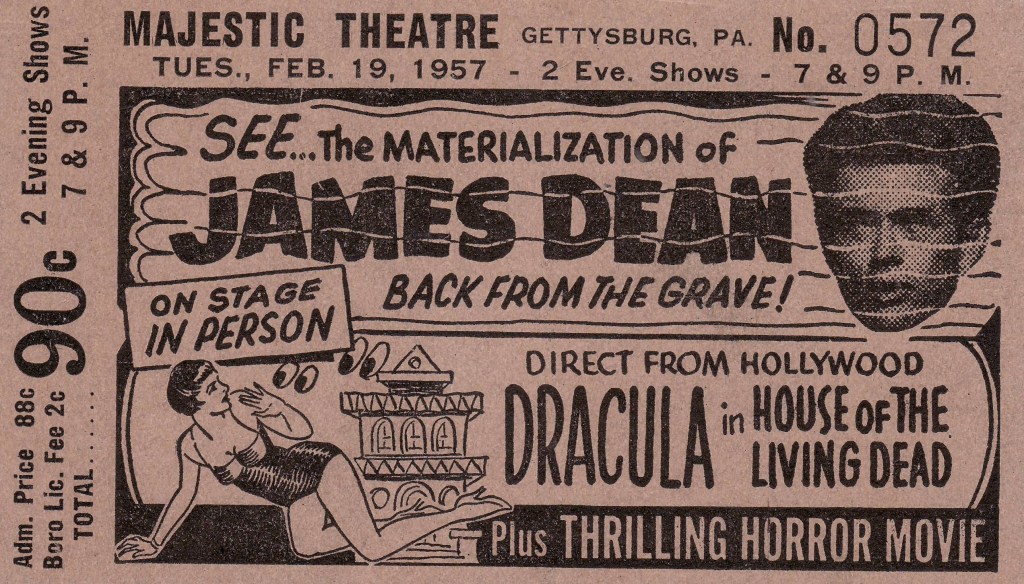
There is an item on my office desk that calls to me every time my mind wanders, I’m gathering my thoughts, or most often, while I’m waiting for a document to load on the computer. It’s a ticket stub, smaller than an index card, from a Tuesday, February 19, 1957, double feature movie at the Majestic Theatre in Gettysburg, Pennsylvania. I bought the ticket in an antique mall just off the Gettysburg town square while on a trip with friends to the famous Civil War battlefield this past Spring. Native Hoosier that I am, my heart jumps a little whenever I see something with an Indiana connection so far away from home.
The ticket is for a movie touted as being “Direct from Hollywood” (Where else would it be from in 1957?) called “Dracula in House of the Living Dead”. The ticket features the cartoon image of a young woman on her hands and knees crawling away from a house whose disembodied eyes follow her, and oh yeah, she’s in a skimpy bathing suit. I’m not an expert on Dracula movies, but my guess is that this movie was just a rehash of an old well-known film with a brand new title designed to lure unsuspecting people into the theatre believing they were seeing a new release. A despicable practice common amongst studios back in the 1950s Era.
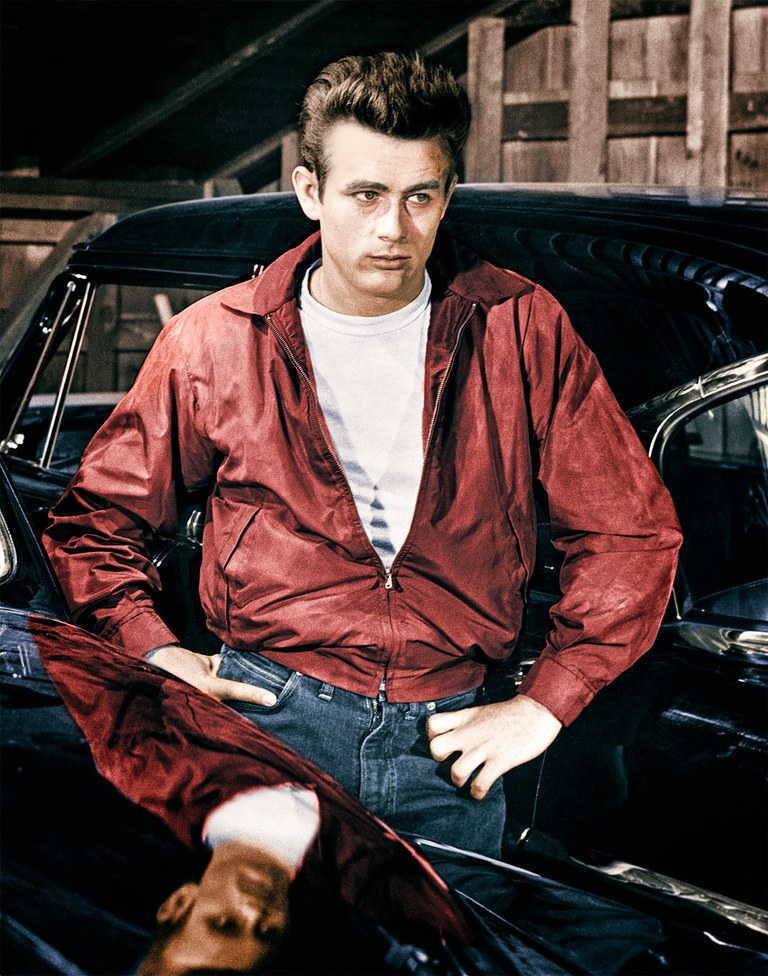
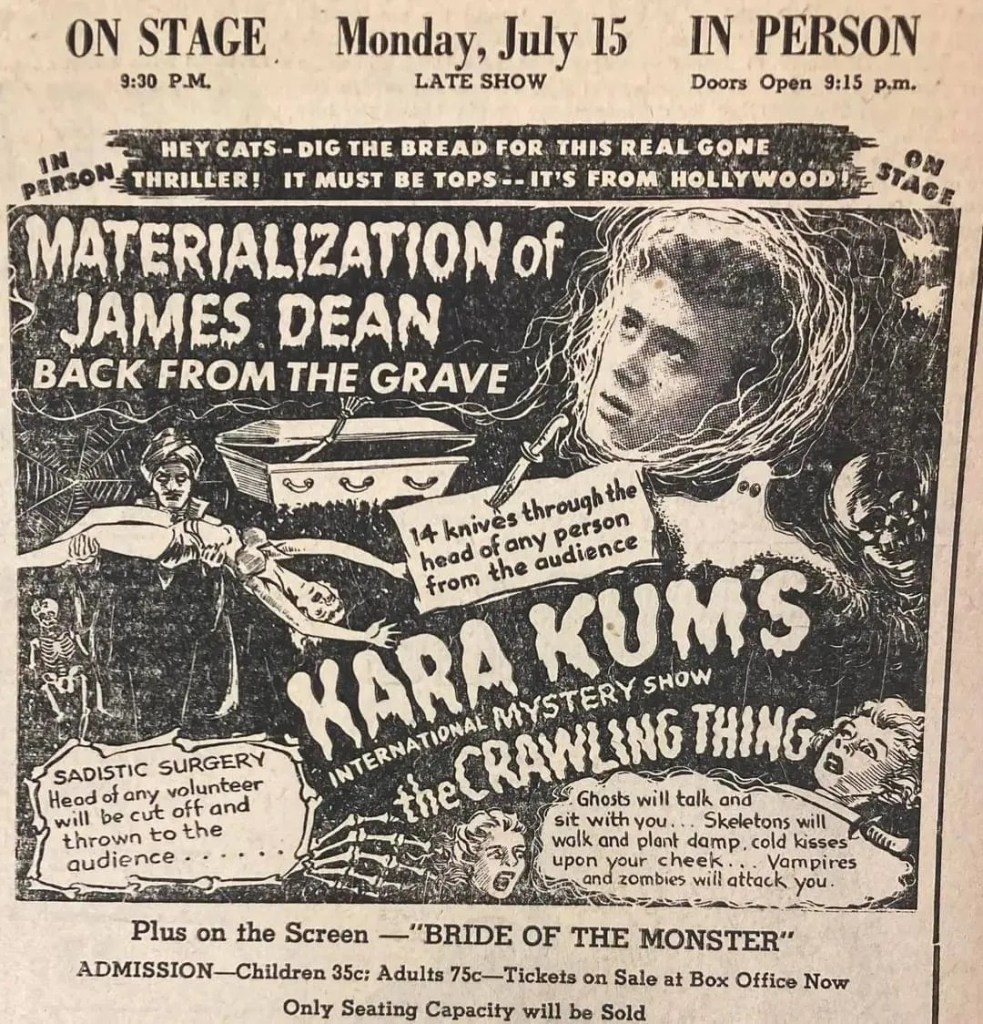
While the Dracula ticket and its promise of an additional unannounced “Thrilling Horror Movie”, were intriguing to be sure, they were not the reason for my purchase. Above the terror-stricken swimsuit-clad woman, there was an eerie floating head of someone very familiar to me and many of my fellow Hoosier baby boomers. It was Fairmount’s own James Dean. The printed promise near his image read: “See…the materialization of James Dean BACK FROM THE GRAVE!” On Stage in Person” Cool, James Dean in Gettysburg, why that’s so…Wait, that’s…impossible. James Dean died in a car crash on September 30, 1956, and this ticket is dated after Valentine’s Day of 1957! How could that be?
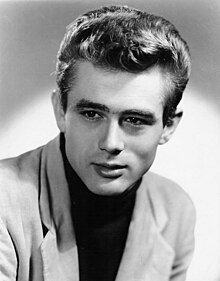
After a few minutes, I realized that this surely must be one of the earliest attempts at the exploitation of a dead celebrity ever attempted. Today, Hollywood barely waits for the body to get cold before cranking out biopics and making cable movies about dead celebrities. Anna Nicole-Smith, Heath Ledger, and Michael Jackson are recent examples. But in 1957 Gettysburg, really? One can only imagine the theatre owner dreaming up this stunt to draw a crowd, finding a good looking blonde haired kid from nearby Gettysburg College, paying him a small fee, and instructing him to walk out on stage wearing blue jeans, a white t-shirt, a red cloth jacket, and sunglasses before exiting speedily amid the gasps, squeals and screams of the frenzied teens in attendance.
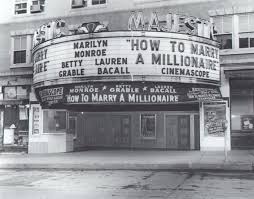
Did I mention that the Majestic Theatre is built so close to the historic Lincoln train depot station that you can almost touch it? The very same train depot where Lincoln arrived the night before he delivered his incomparable Gettysburg Address on the battlefield, on November 18, 1863. A spot many consider to be hallowed ground. But how could this be? Was this an isolated incident of gross exploitation or part of a larger movement? A little research reveals that shortly after James Dean’s death on a lonely California highway, a “James Dean Lives” cult was born.
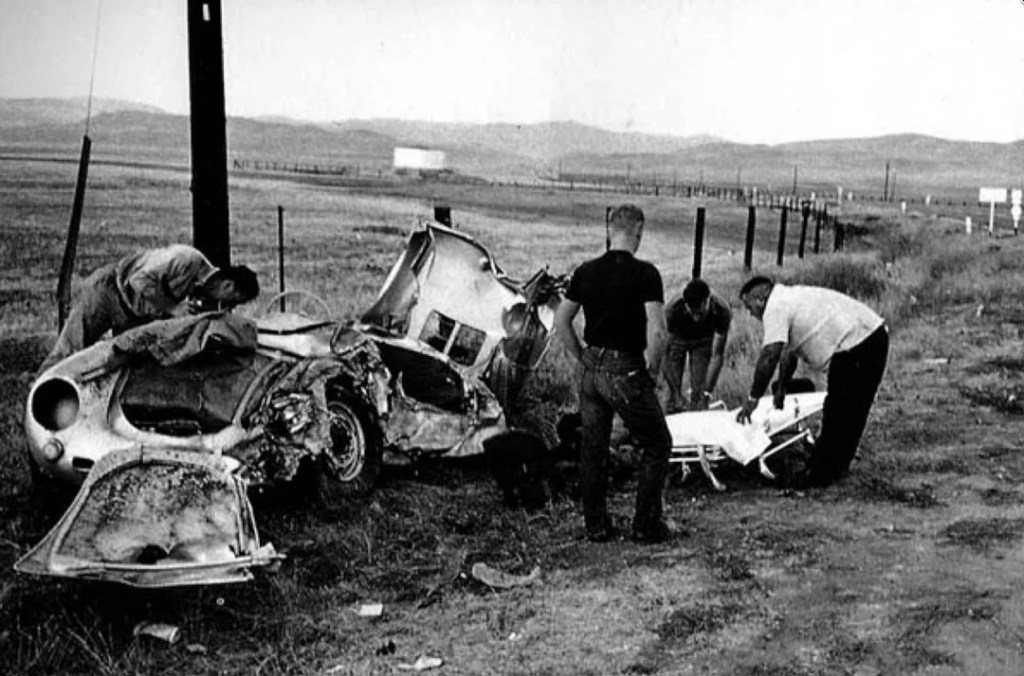
The first indication that the “James Dean Lives” cult was getting out of hand appeared in January of 1956, just three months after Dean died on the last day of September of 1955. Since October, Warner Brothers studio had been deluged with frantic fan letters expressing shock and disbelief that the teen idol was really dead. The letters continued to flow into the studio past Thanksgiving, but by December, the letter stream dramatically increased, both in volume and in spiritual tone. It now seemed that fans didn’t believe Jimmy was gone at all. New rumors claimed that he was being kept alive in a California nursing home and that the studios were stalling for time, just waiting for his recovery and a comeback. Hollywood Gossip columnist Walter Winchell printed the rumor that Dean was disfigured but still alive in his column. Other stories insisted that it wasn’t Dean at all who died in the car wreck, but rather a hitchhiker. Still more farfetched was the rumor that the actor was in hiding learning to operate his artificial limbs or that he had been placed in a sanitarium to recover. Three thousand letters came in during January and increased so steadily that by July, that number had increased to seven thousand. By the first anniversary of his death, Warner Brothers had received over fifty thousand fan letters from all over the world.
However, some of the “Mass hysteria” attributed to the “James Dean Lives” rumors can be rationally explained away. Much of this fan mail came from remote regions of South America, Australia, and Western Europe. While these areas still received the movies, albeit posthumously, they did not receive much news and were most likely unaware that James Dean was dead. Many times, these letters were addressed simply to: “James Dean Warner Brothers Studios Burbank California USA” and contained notes that read “Dear James Dean-I love your movies. Will you send me a picture?” That first year, the studio obliged and sent out the photos as requested, which undoubtedly did little to quell the rumors.
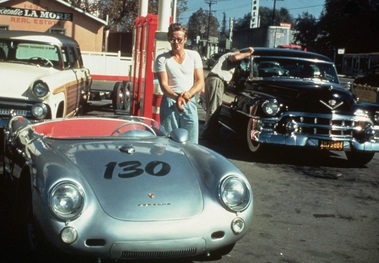
But that didn’t explain all of the letters. From the day of his death, it seemed that young people would not let Dean die. Warner Brothers hired a special fan mail agency, the first of its kind in Hollywood, to deal with the deluge of mail that poured into the studio addressed to the dead star. Mattson’s, a Hollywood clothing shop, received hundreds of orders for red jackets identical to the one Dean had worn in Rebel Without a Cause. Griffith Park, where pivotal scenes from the movie were shot, became a tourist attraction overnight. Fans lined up inside the Observatory, hoping for a chance to sit in the same seat Dean had occupied in the film.
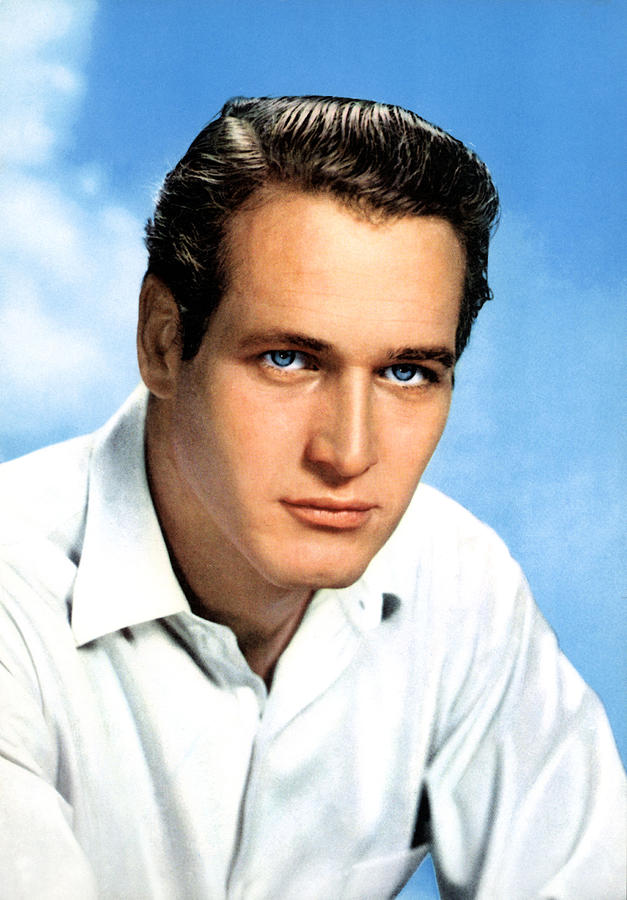
Although today’s generations might not be familiar with James Dean, over the years, an impressive list of actors and performers have claimed to have been influenced by him, including Bob Dylan, Al Pacino, Martin Sheen, and the late Jim Morrison, poet and lead singer for the Doors. Humphrey Bogart, who outlived Dean by two years and also knew a thing or two about cool, once said: “Dean died at just the right time. He left behind a legend. If he had lived, he’d never have been able to live up to his publicity.” Eventually, the realization that James Dean was gone set in. The world of cool moved on to others like Elvis Presley, The Beatles, Terre Haute’s own Steve McQueen, and Paul Newman, to name just a few. The Paul Newman comparison is not a random one. Not only will readers of my column recognize my admiration for Newman, but they might also be surprised by the ethereal connection between Newman and Dean.
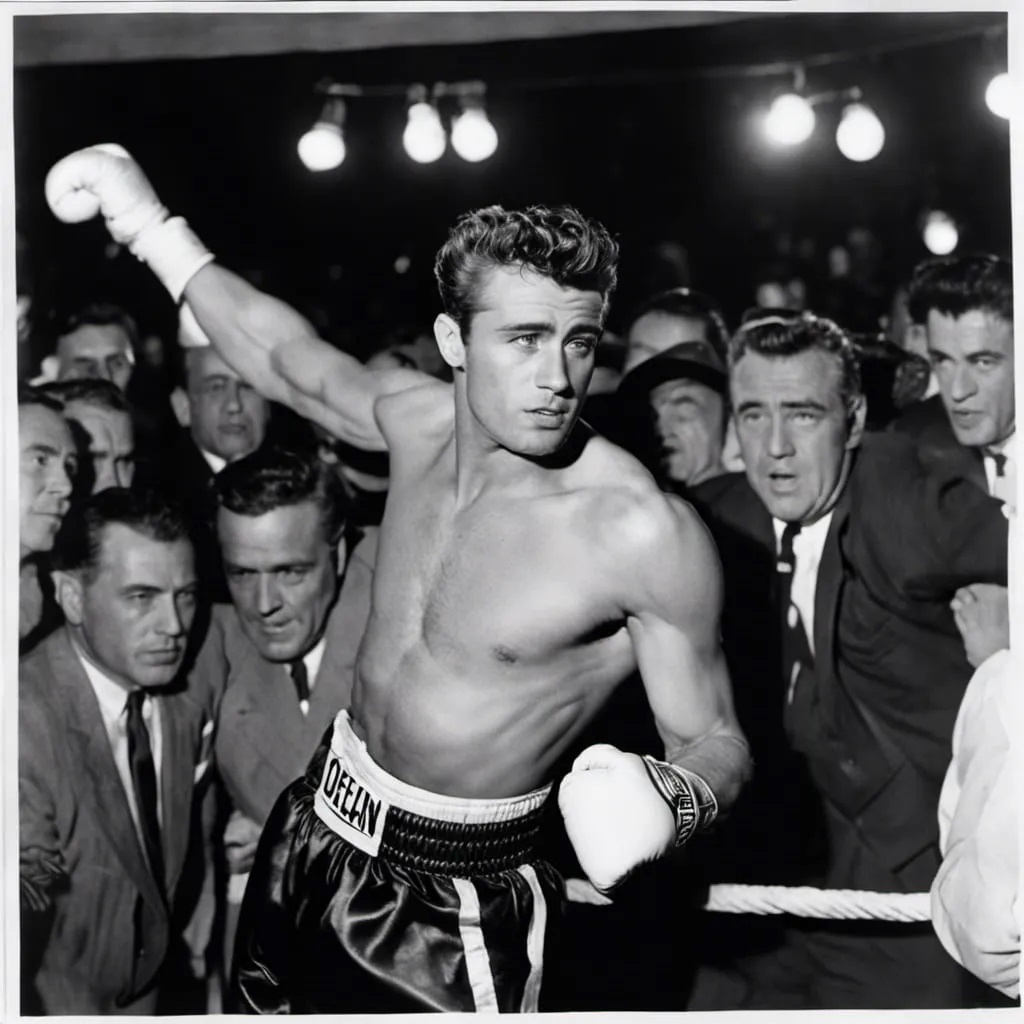
James Dean’s final screen test for East of Eden (1955) was shot with Paul Newman, who also was in the final running for the role of Dean’s character Cal’s fraternal twin brother Aron. At the time of his death, Dean was signed to star as the lead (as Boxer Rocky Graziano) in the 1956 MGM movie “Somebody Up There Likes Me” and the 1958 Warner Brothers movie “The Left Handed Gun” (as Billy the Kid). Both roles subsequently were taken by Paul Newman and both helped make him a star. Some film experts have claimed that Newman’s career may never have gotten off the ground at all if Dean had lived. Both young actors often competed for the same roles and there just weren’t enough scripts to go around. When Dean died, he was signed to play in “The Battler” on the “Playwrights ’56” television series. The role went instead to Paul Newman. To further illustrate the Dean-Newman connection, Jimmy was the front-runner to star alongside Elizabeth Taylor in Cat on a Hot Tin Roof (Released in 1958), when he died, the role went to Paul Newman. The role earned Newman an Academy Award nomination and established Newman as a star once and for all.
The two megastars mug for the camera for a few seconds when Dean says to Newman, “Kiss Me” to which the older Newman replies “Can’t here.” Watch closely and you’ll see that Newman is sweating profussely under his armpits. More importantly, the clip instantly transports the viewer back to a time before James Dean climbed into the driver’s seat of his Porsche Spider and rode towards the California horizon, and immortality.
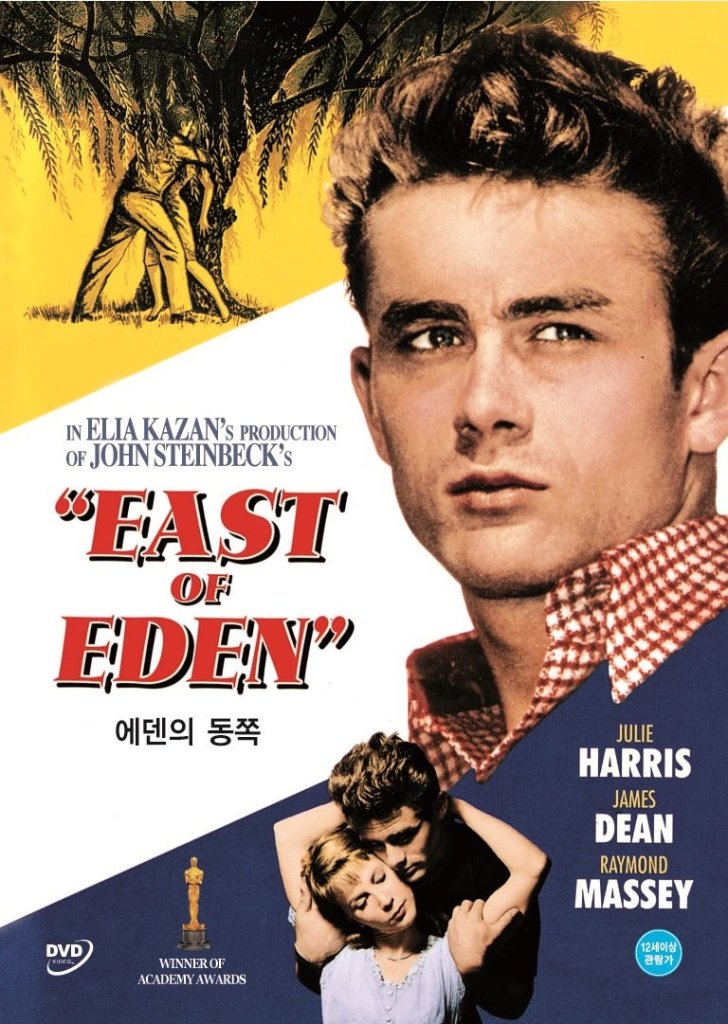
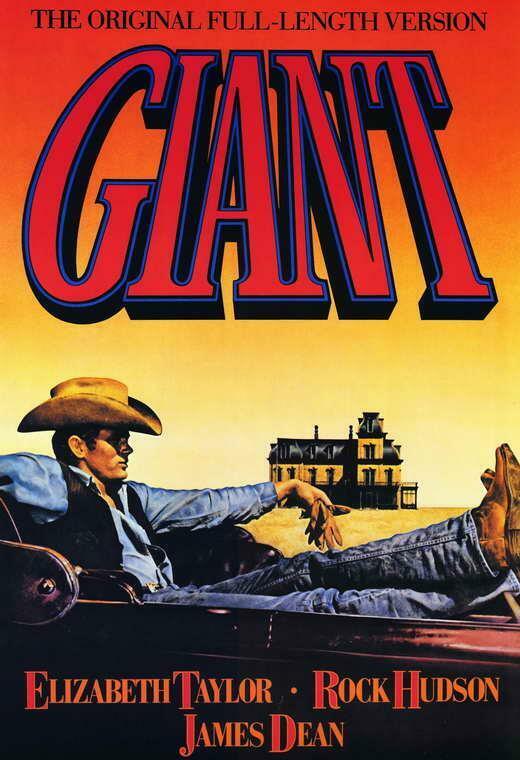
Just before his death, Dean’s agent, Jane Deacy, negotiated a 9-picture deal over 6 years with Warner Bros. worth $900,000. In 1956, Dean became the first actor to receive an Academy Award nomination posthumously, for his role in East of Eden (1955). He did not win. A year later, in 1957 Jimmy was nominated for his second Oscar for “Giant”, thereby becoming the only actor in history to receive more than one Oscar nomination posthumously. James Dean was nominated for Academy Awards in two-thirds of his films, a record which will probably never be bettered.
 Alan E. Hunter