
Original publish date May 22, 2025.
https://weeklyview.net/2025/05/22/the-hilton-sisters-vaudevilles-beautiful-siamese-twins/
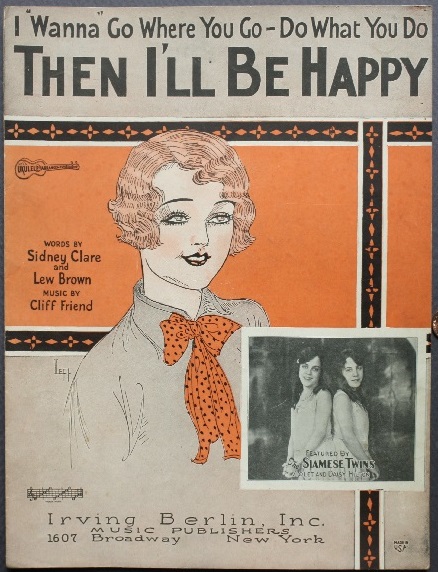
I recently ran across a five-dollar box of sheet music at an antique show. It seems like nobody wants sheet music anymore. I suppose, like recipe books, almanacs, TV guides, and car manuals, they are seen as obsolete nowadays. It turned out to be a fun, if not very valuable, box of paper. One was from the 1952 Marilyn Monroe film Niagara, along with a bunch of 1920s-40s songbooks and “how to” manuals for the Hawaiian guitar. The one that caught my eye was a piece of ukulele sheet music for the 1925 Irving Berlin song “I Wanna Go Where You Go—Do What You Do. Then I’ll Be Happy,” performed by a pair of lovely young ladies known as the “Hilton Sisters.” These beautiful young girls are pictured side by side on the cover in a pose that suggests that they were joined at the hip. A closer examination reveals a caption proclaiming the duo as a pair of conjoined “Siamese Twins,” and it turns out, during the Vaudeville era, Daisy and Violet Hilton were the biggest stars of their day.
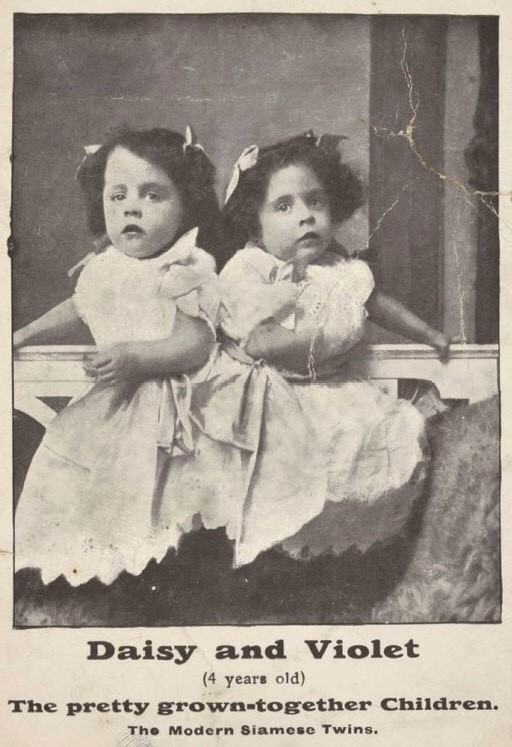
Daisy and Violet Hilton were born on February 5, 1908, in Brighton, Sussex, England, birthplace of authors Charles Dickens and Rudyard Kipling. The twins were born to an unmarried barmaid named Kate Skinner. After seeing her babies, Kate was horrified, thinking that her children’s birth defects were a punishment from God for her unmarried status. She refused to look at them, let alone hold them, so she sold the girls to the midwife who had delivered them, Mary Hilton. Hilton looked at those baby girls and saw dollar signs. Hilton immediately began displaying the girls in the backroom of the Queen’s Arms pub on George Street, which she ran with her husband. As they grew, she taught the girls how to sing, dance, and play musical instruments. The Hilton sisters toured first in Britain in 1911 (aged three) as “The Double Bosses” and from then on, the twins were on the road touring the United Kingdom, Europe, and Australia. The twins were the first set of conjoined twins born in Britain to survive more than a few weeks. The girls were connected at the hip and pelvis by a fleshy appendage and shared no organs. Doctors stated that they could have easily been separated at an early age and would have lived independent lives. But the girls were seen as piggybanks in those formative years, so “fixing” them would kill the golden goose.
In 1913, rebranded as the “Famous Brighton United Twins”, they toured Australia, where they made their debut at Luna Park in Melbourne on Friday the 13th of December, 1912. Despite a massive advertising campaign, the novelty of their act quickly wore off. The show closed after only a week, and the twins, their mother Mary, and sister Edith were abandoned down under by the show’s promoter. Somewhere along the line, the Hilton family came into contact with Myer Myers, a traveling circus balloon and candy seller. Myers formed a romantic interest in the twins’ older sister Edith, and the couple was married. The marriage was not based on love, it was based on financial gain. While the twins were fond of their older sister, they never liked Myer.
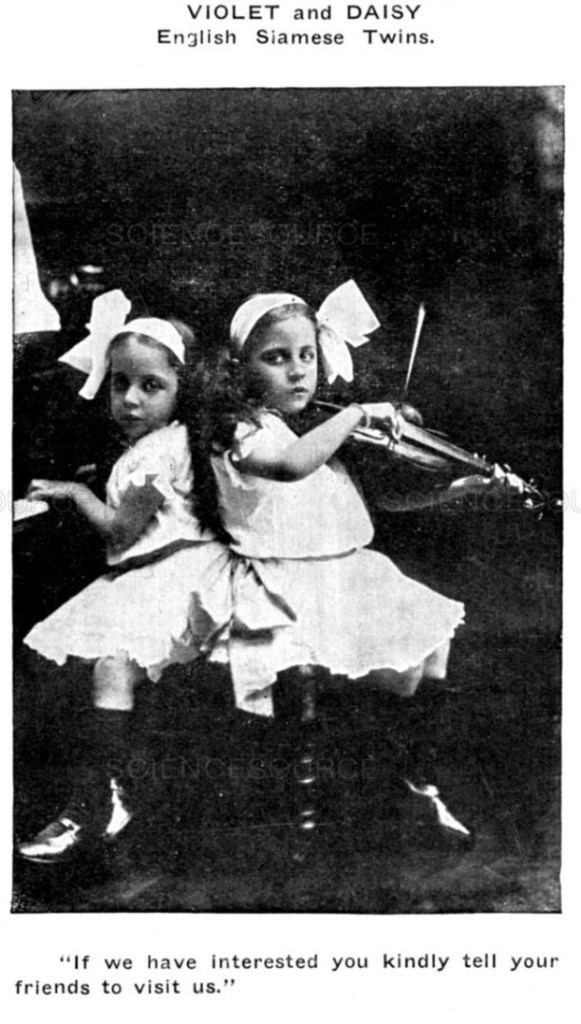
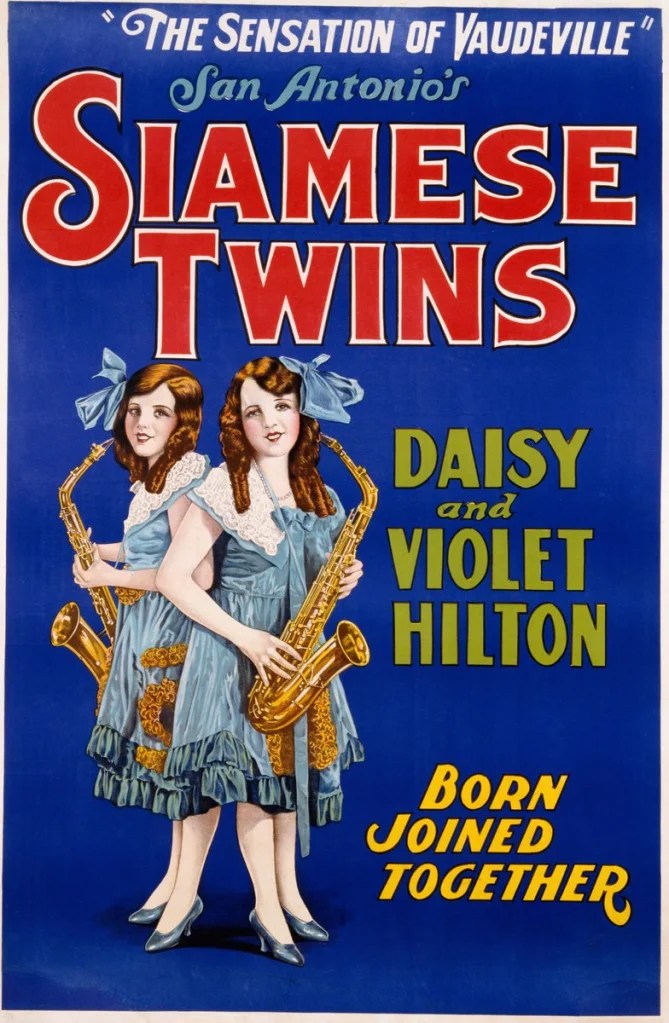
In June 1916, Myer brought the girls to the United States via San Francisco. But immigration officials had never seen anything like Violet & Daisy before, so they were detained and quarantined at Angel Island (next to Alcatraz) in the San Francisco Bay for months until they were finally cleared for entry. By 1918, the 10-year-olds were traveling the Orpheum Circuit of Vaudeville Theatres across the country. The adorable little girls were extremely popular, although still categorized as medical oddities and relegated to the sideshow carnival “Freak Show” class. But the Hilton sisters were different, they weren’t just an act, they were talented. The girls were trained in singing and dancing and eventually learned to play the piano, violin, and saxophone. The twins made huge amounts of money in Vaudeville, but regardless of who was managing them, they retained very little of it.
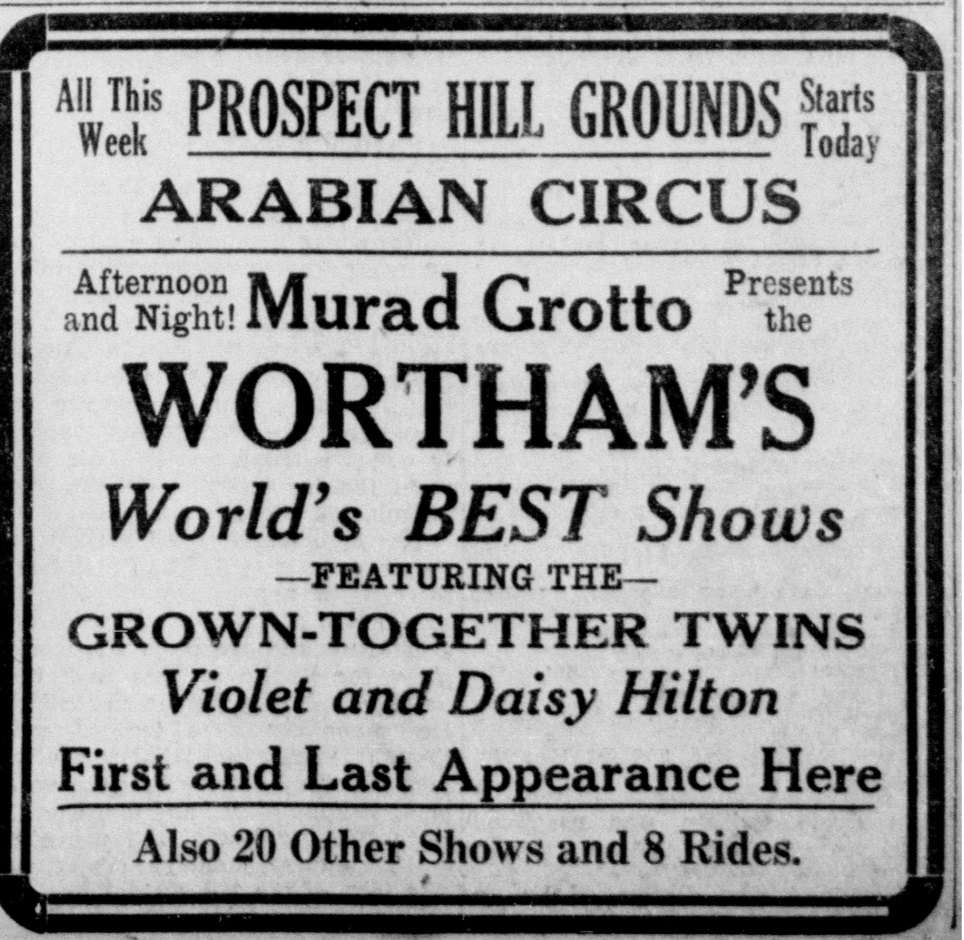
Throughout their lives, Violet and Daisy often voiced their dislike of Myer Myers and how he exerted complete control over every aspect of their lives. Myers insisted that the twins call him “Sir,” that the girls sleep in the same bedroom with their parents, and when they were not performing in the circus, that they spend their days doing school lessons and practicing their musical instruments. The twins were also forbidden to play with other children. Myer Myers promoted the twins unscrupulously and toured them mercilessly. In time, the twins became the star attraction of the “Great Wortham Show”, a traveling carnival that toured the United States. People around the country flocked to see these beautiful, mysterious young girls. In 1917, while performing at the San Jacinto Fiesta in San Antonio, Myers built a castle-like pavilion directly across from the Alamo. Now, every visitor to the shrine of Texas independence made the trip across the street to see the twins. Myers continued to tour the twins across the USA, and whenever he entered a city or town, he ensured that the first stop was a visit to the mayor or, if it was a state capital, the governor.
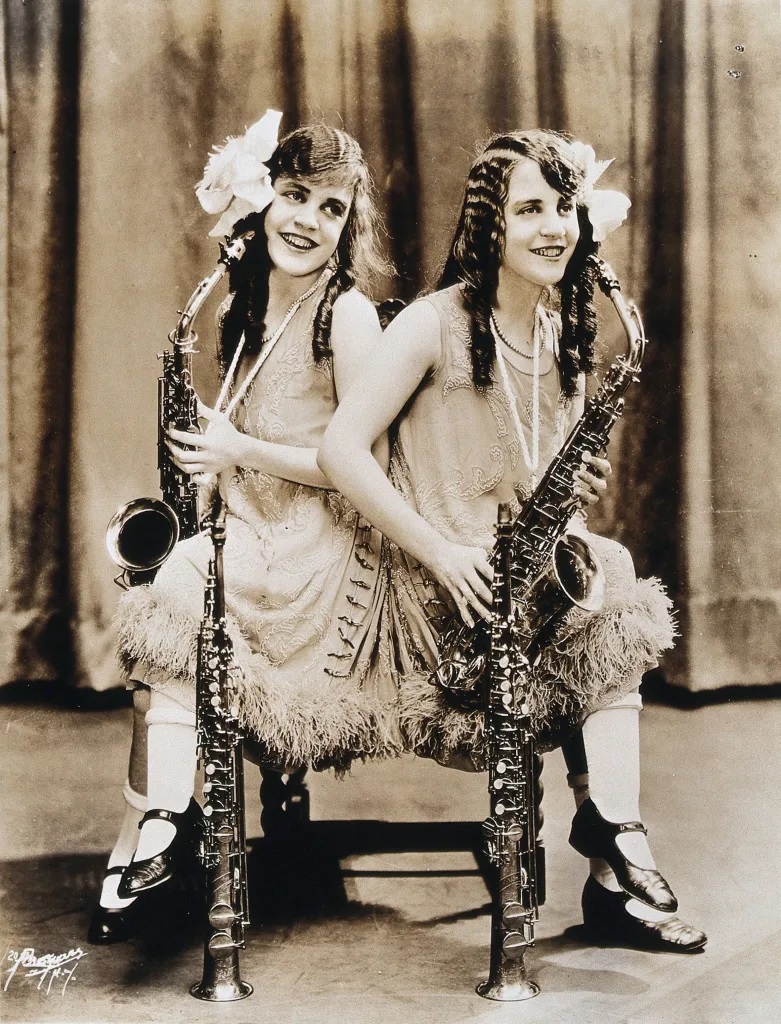
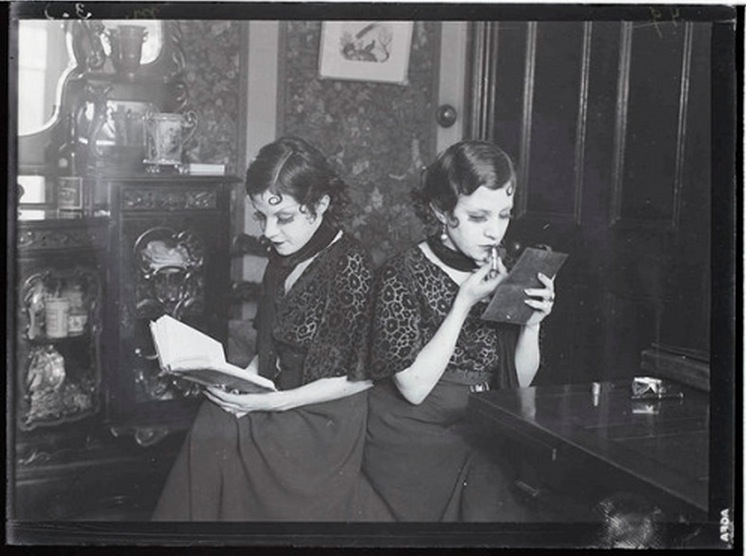
The Hilton Sisters exploded onto the American scene at precisely the right time, for the years between World War I and World War II were considered the heyday of vaudeville side shows. On stage, the adorable twin girls sang, danced, and played saxophone & piano. They were exhibited as children as sideshow curiosities, but now they toured the United States in vaudeville theatres and American burlesque circuits in the 1920s and 1930s. Myers reinvented the twins’ biographies, saying their “Mother died at their birth and their father, a soldier, was killed a short time afterward in an accident. Firmly joined together at the base of their spines, the Hilton girls present a curious spectacle, especially so as the odd grafting of nature has materialized into a seemingly uncomfortable back-to-back, half-diagonal position. Despite this, the girls move about with an ease and freedom and movement that is nothing less than astonishing.”
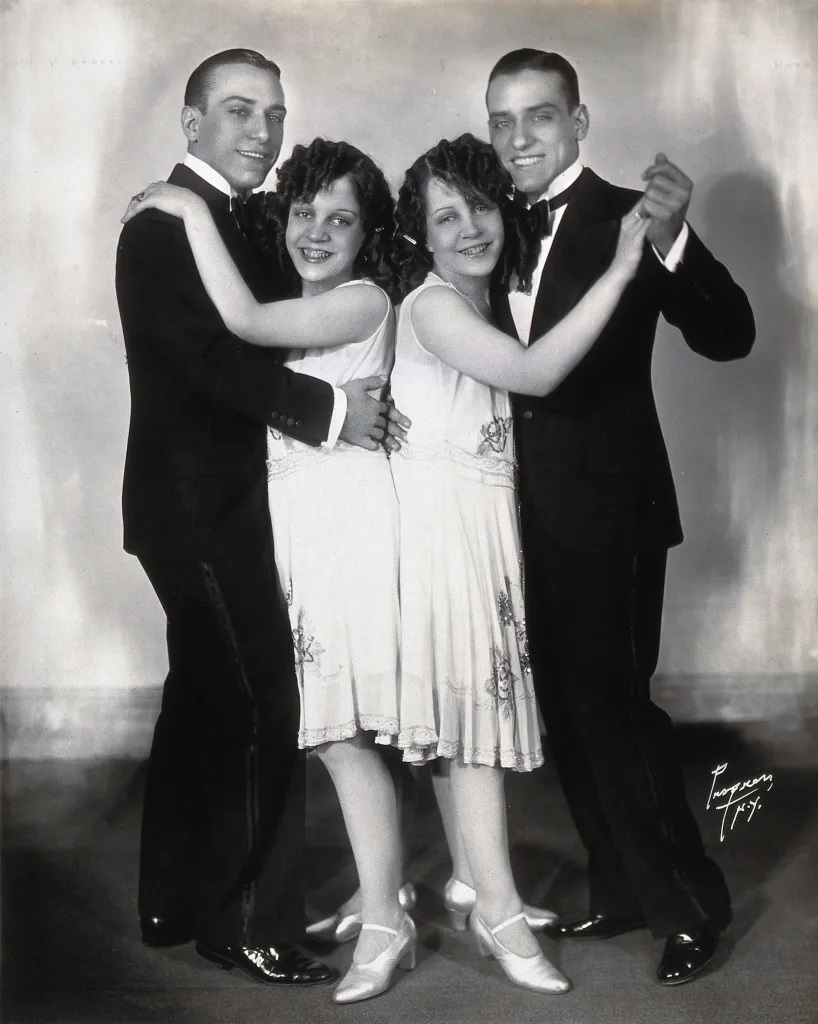
The Indianapolis News for Saturday, March 28, 1925, touted the twins’ first appearance at the Globe Theatre, reporting that the performance got out of hand. Their appearance caused traffic jams, and police were called to control the lines of rowdy curiosity seekers on the streets outside trying to get into the theater. During their act, the girls sang songs, played music, and always concluded in the same fashion: a waltz. Two young men were waiting in the wings offstage. On cue, the men would glide out and dance with the sisters in rythm to an orchestra posed behind them. One of those young men was an unknown vaudevillian named Lester Townsend, soon to be known to the world as Bob Hope. In 1926, the sisters teamed up with up-and-coming comedian Bob Hope, who formed a new vaudeville act he called “Dancemedians.”
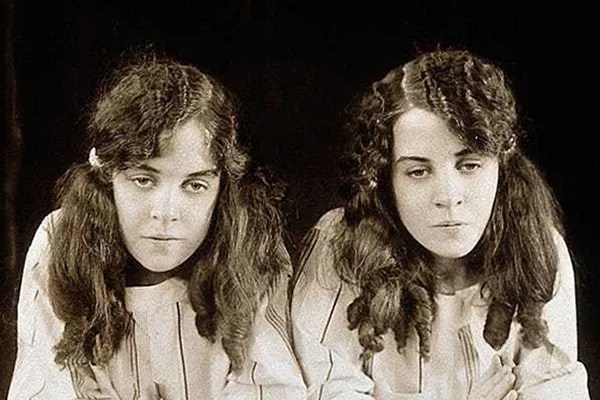
The twins appeared onstage with other luminaries like George Burns & his wife Gracie Allen, Sophie Tucker, and Charlie Chaplin. The Twins’ songwriter during their vaudeville years was Bart Howard (then known as Howard Joseph Gustafson), who wrote “Fly Me To The Moon.” That same Star newspaper article reported that the girls were like any other pair of sisters. Sometimes they would fight, and one sister would not speak to the other for days offstage. The article noted that the “girl’s fingerprints were different, one would read while the other slept, one sister may prick her finger, but the other is unaware of it, but,if one has a headache, the other will feel it. Daisy sews, but Violet is not particularly fond of sewing. Daisy enjoys housework while Violet prefers to arrange the furniture and decorate the house. There seemed to be a subtle telepathy between the twins.”
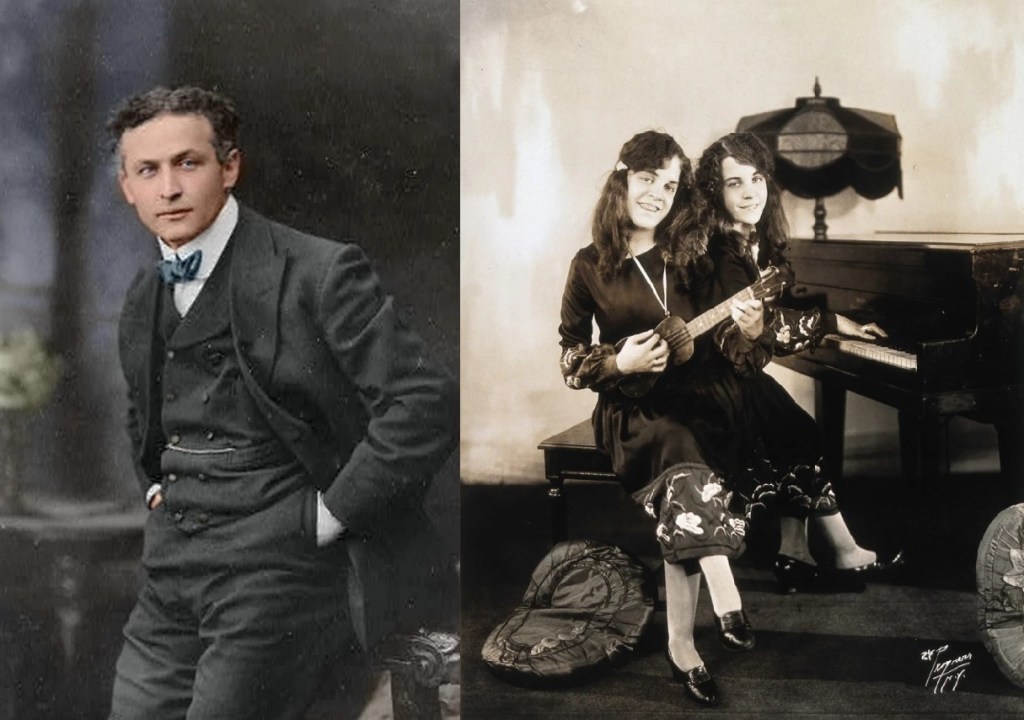
Throughout the 1920s, the twins earned $5,000 per week for 44 weeks on the Orpheum Circuit, over $91,000 weekly in today’s money. They were the highest-paid vaudeville act in America. Myer Myers was their manager, and the girls never saw a dime of that money. The Hilton Sisters were befriended by escapologist Harry Houdini, who taught them how to “mentally separate from each other.” Learning of the twins’ disadvantageous financial arrangement with Myer Myers, Houdini strongly advised the girls to emancipate themselves from their legal guardians and hit the road on their own. In his book Very Special People, author Frederick Drimmer quoted Houdini as telling the twins, “You must learn to forget your physical link. Put it out of your mind. Work at developing mental independence from each other.” Houdini died on Halloween night of 1926 and was never able to help the twins achieve that goal in his lifetime. The girls appeared in Indianapolis many times during their career. Indianapolis had a strong vaudeville, burlesque, and theatre district. The Hilton Sisters appeared at the Lyric Theatre on March 6, 1928, and again on September 6, 1928. Before that appearance, Chicago Commissioner of Health Herman Bundersen declared them healthy and described them as: “Two souls with but a single thought.” While the girls received a clean bill of health, both physically and spiritually, could the same be said of their industry?
PART II
The Hilton Sisters-Vaudeville’s Beautiful Siamese Twins.
Original publish date May 29, 2025.
https://weeklyview.net/2025/05/29/the-hilton-sisters-vaudevilles-beautiful-siamese-twins-part-2/
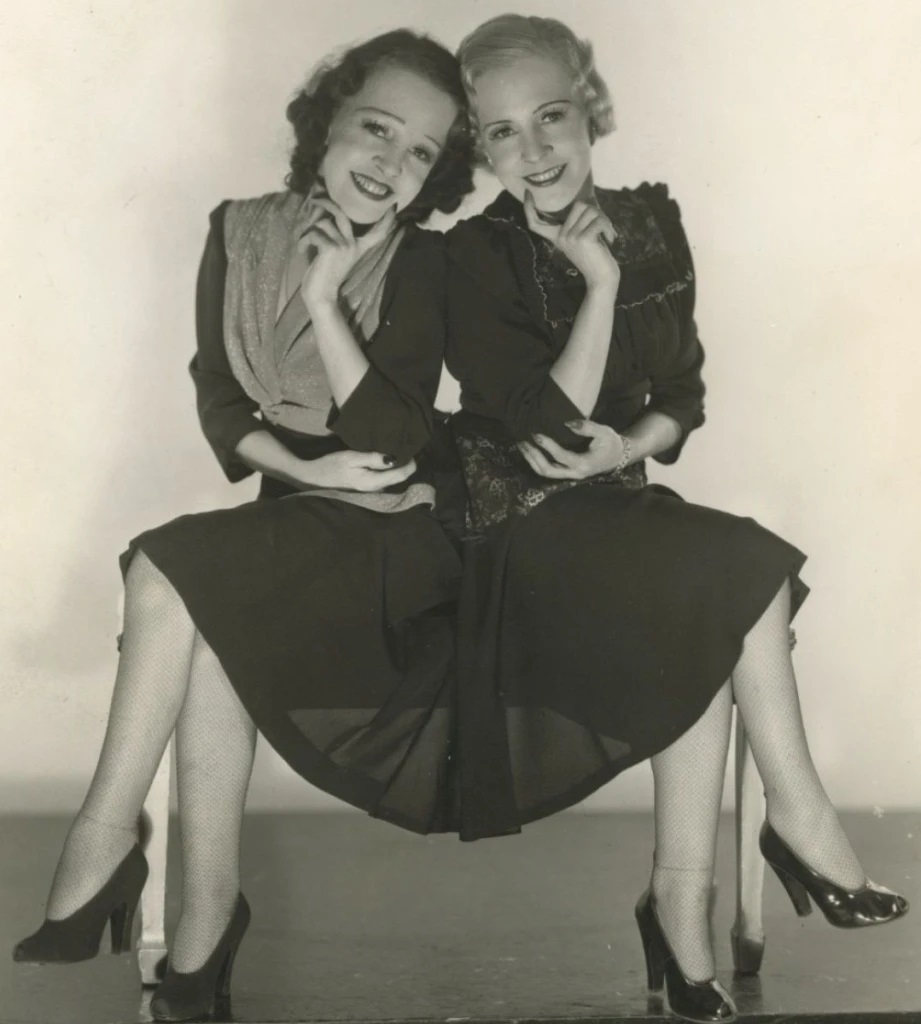
In the Roaring Twenties, the Hilton Sisters were the darlings of Vaudeville. That circuit ran straight through the heart of Indianapolis. Violet and Daisy Hilton were conjoined twins who were abandoned by a single mother and sold to a Brighton, Sussex, England, saloon matron who subjected them to years of exploitation, only to be adopted by a corrupt manager on the fringes of the sideshow circus & show-business circuits. Despite those obstacles, the twins managed to strike out on their own and become hugely successful stars of stage, vaudeville, and film in the United States.

These personal appearances would most often last for a week or more. Since the Hilton Sisters traveled 52 weeks a year, wherever they laid their suitcase was their home. Five years after his death, their mentor Harry Houdini’s wish for the sisters was realized. The Indianapolis Times of Saturday, April 25, 1931, reported “Verdict Frees Siamese Twins From Bondage. Texas Pair Wins $99,000 in ruling releasing them from Guardian.” The sensational trial made headlines all over the country. After the verdict, the girls told reporters, “It is so wonderful to be free to go wherever we please, choose our own friends, and appear in public as humans rather than as freaks.” However, even though the twins received a boatload of money (over $1.8 million in today’s world), the rigid structure of Myer Myers disappeared, and the girls ran through that money in a relatively short time.
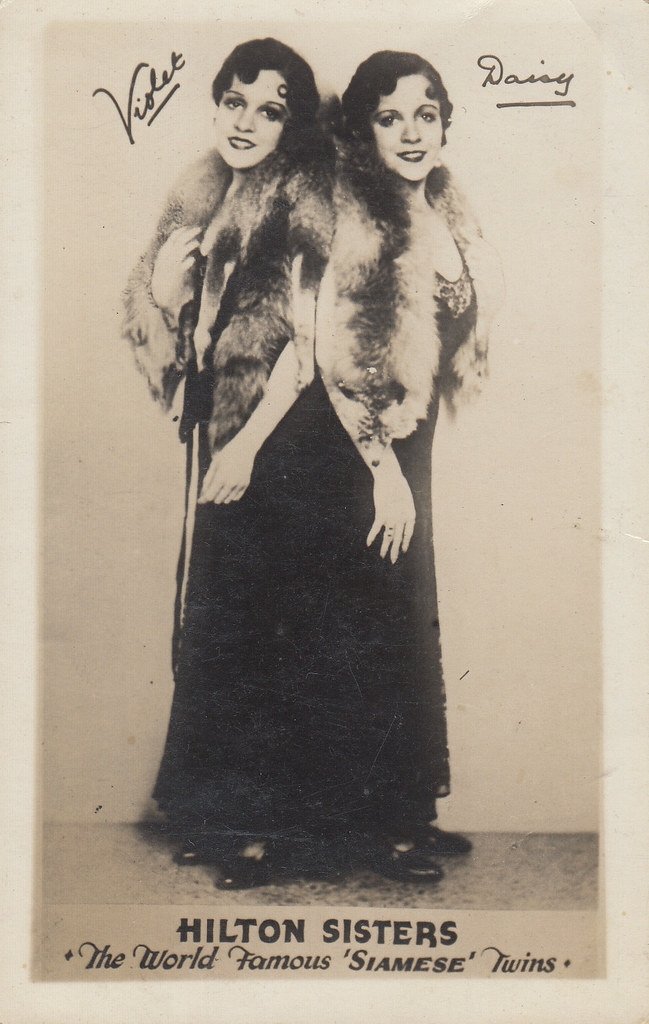
The twins, now aged 24, appeared in the 1932 exploitation movie “Freaks”, which led to another promotonal appearance at the Lyric theatre in Indianapolis (June to July 1932). The Indianapolis Times of July 31, 1932, reported: “The Hilton Sisters, Siamese Twins, were seen going into a subway station recently and a crowd of nearly one hundred people followed them to see if they would pay one fare or two. They paid two.” “We may seem like one, but everything costs us for two,” Daisy explained. “We pay insurance for two, but could only collect for one. The only bargain we get is our weight for a penny.” (For the record, the twins stood four feet six inches tall and weighed 166 pounds, or 83 pounds each.)
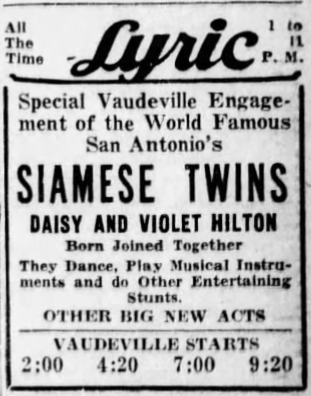
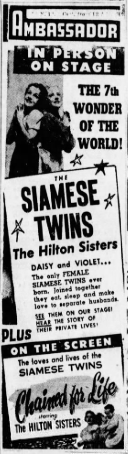
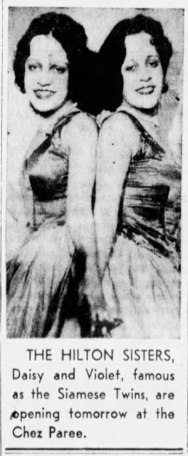
The twins came back to the Circle City in May to June 1936, at the “Chez Paree nightclub downstairs at the Apollo Theatre”, Dec 22-28, 1946, at the “Murat Theatre”, March 26, 1947 at the “Fox Burlesk Theatre”, and from May to June, 1952 at the “Ambassador Theatre.” These appearances all coincided with the slow downward spiral of the Hilton Sisters’ career. The first talkie movie (Al Jolson’s The Jazz Singer on Oct. 27, 1927) signaled the end of the Vaudeville Era.
During those years, as Great Depression Era America watched these unique beauties mature to adulthood, the Hilton Sisters remained in the news. The twins resumed their vaudeville careers as “The Hilton Sisters’ Revue”. Daisy dyed her hair blonde, and they began to wear different outfits to distinguish each other. After vaudeville lost popularity, the sisters performed at burlesque venues. But Burlesque reviews were risque, and while the attending patrons were interested in women, they were not necessarily interested in women wearing clothing, talented or not.
After gaining independence from Myer Myers, the Hiltons sailed to the UK, where they spent most of 1933, returning to the States in October 1933. Violet began a relationship with musician Maurice Lambert, and they applied in 21 states for a marriage license, but were always refused. The Indianapolis Star Fri, Jul 06, 1934, reported on the prospect of marriage: “The very idea is quite immoral and indecent. No, there is no law against it, but it just seems indecent.” Maurice grew tired of the newsreel life and one day, simply walked away from the relationship. Afterward, Violet became briefly engaged to Jewish boxer Harry Mason, who later went on to have a relationship with Daisy. In 1936, Violet married actor James Moore at the Cotton Bowl during the Texas Centennial Exposition as a publicity stunt. The marriage lasted ten years on paper, but the couple never lived as husband and wife. It was discovered that Jim Moore was gay, so the marriage was eventually annulled.
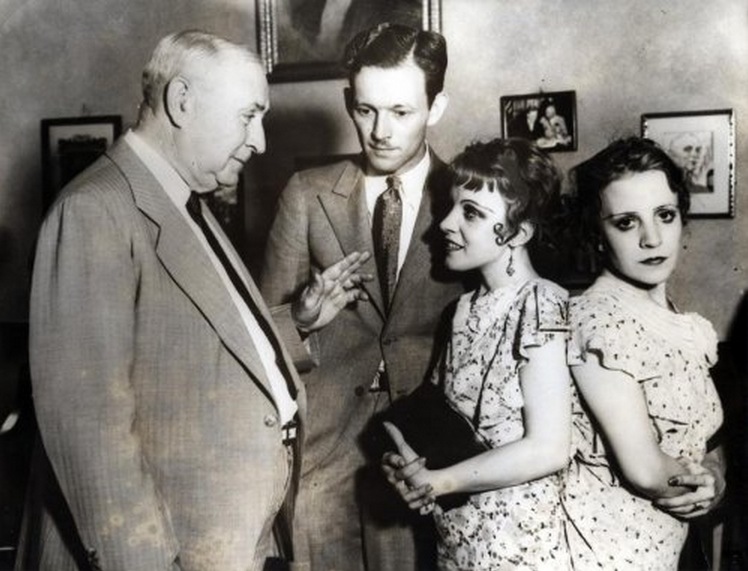
At the time of Violet’s wedding, the press noted that Daisy was visibly pregnant. Daisy gave birth, but the child, a boy, was put up for adoption immediately. In 1941, Daisy married Harold Estep, better known as dancer Buddy Sawyer. The marriage lasted ten days when it was discovered that Buddy, like Violet’s husband Jim Moore, was gay.
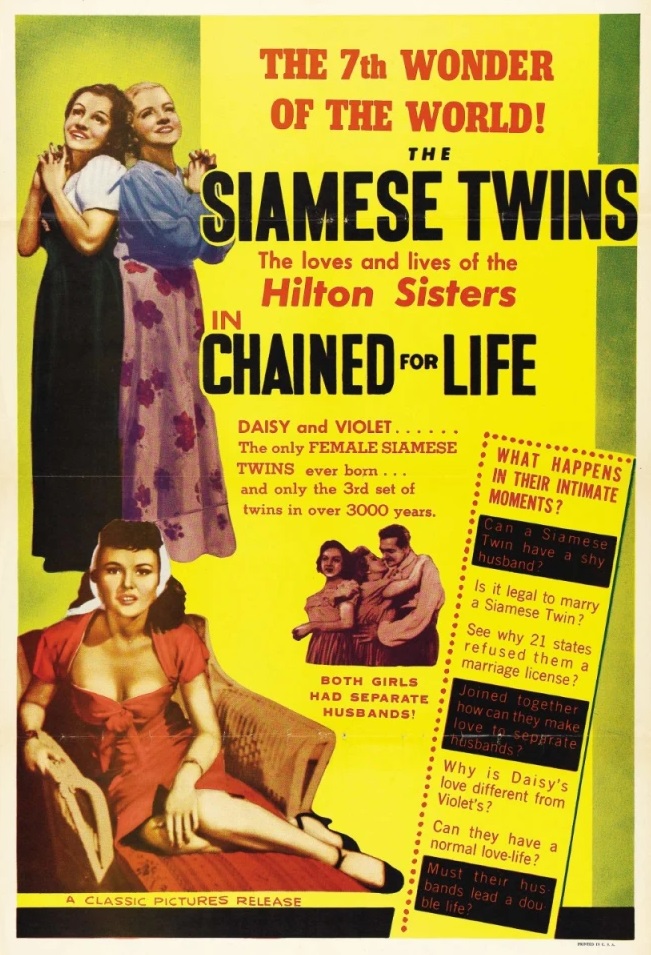
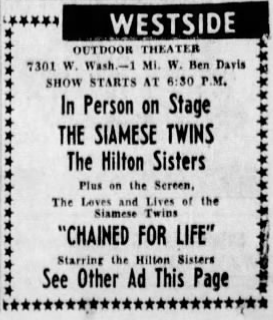
In 1952, the twins starred in a second film, Chained for Life, an exploitation film loosely based on their lives. The film’s producer ran off with all the money and left the Hilton Sisters holding the bag. They paid the bills out of their own pockets and undertook a grueling series of personal appearances at double-bill screenings of their two films in theatres and drive-ins across the country. Sadly, the entertainment world had moved on, and few people were interested in the aging vaudevillians, curiously conjoined or not. Afterwards, their popularity faded, and they struggled to make a living in show business. Violet once told a reporter, ‘We fooled ourselves that by entertaining others we were making ourselves happy.’
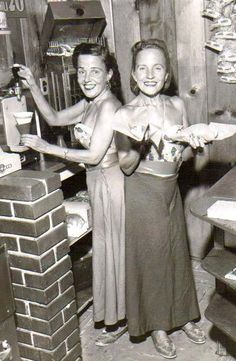
The Hiltons’ last public appearance was in 1961 at a drive-in theater in Charlotte, North Carolina. Without warning, their tour manager abandoned them there with no means of transportation or income. Charles Reid, owner of the Park-N-Shop grocery store in Charlotte, hired the twins for a commercial advertising “Twin-pack” potato chips. Afterward, they applied for a job at the store, stating they would work for one salary if necessary. Reid, ever the savvy businessman, realized he was getting four hands on one body and hired them as produce handlers and checkout girls. He paid them each a salary. The twins worked at a specially designed and constructed checkout station that looked no different than the others. The only way anyone would know the difference was if they looked back over their shoulder as they walked out the door.

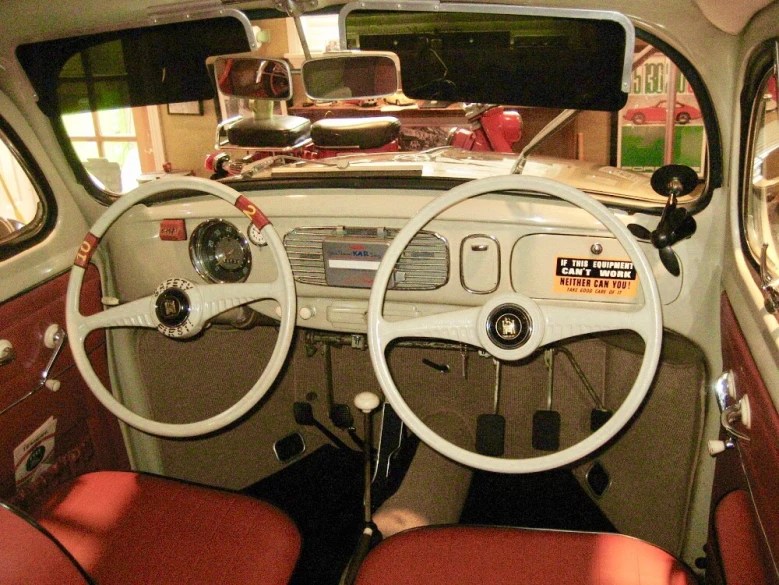
The Hiltons rented a small two-bedroom home courtesy of Purcell United Methodist and settled into a quiet life centered around work and church. Daisy learned how to drive a car because she was the twin who could sit in the left-hand driver’s seat. Later, the twins bought a former driving instructor’s car with dual controls, so Violet could also drive.
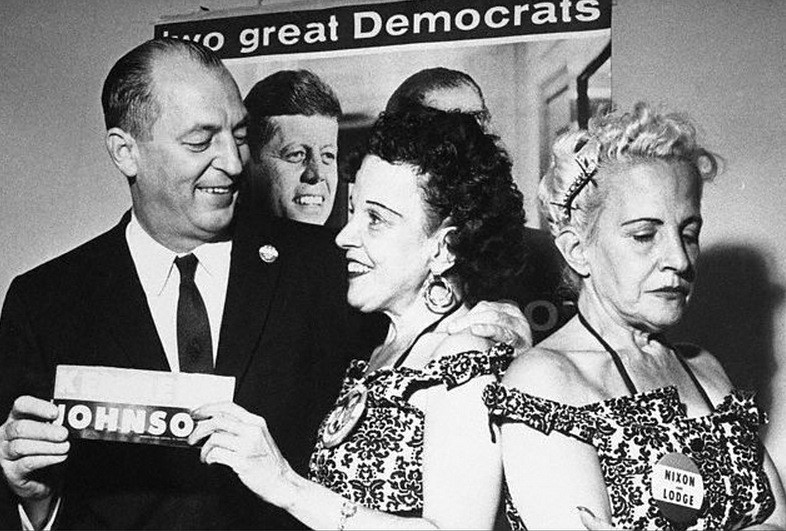
Violet and Daisy had very different political views: Violet was a staunch Democrat, while Daisy supported the Republican Party. During the holidays, they remembered fellow employees and favorite customers with small, inexpensive Christmas gifts. One neighbor recalled that the girls had a phone booth installed in the home to allow for private conversations for each twin when needed and that the twins kept an array of purses around the house, each one containing two or three dollars for cab fare. Later in life, a doctor visited them and declared that they could be separated if they so desired, but they said no. Daisy contracted Hong Kong flu, but Violet refused medical intervention.
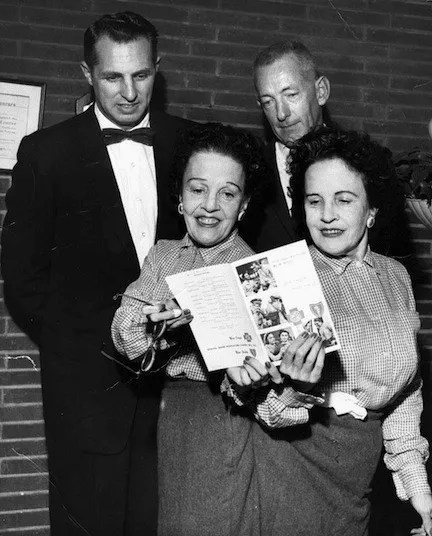
On January 4, 1969, after failing to report to work and unable to reach them by telephone, the store manager called the police to investigate. The twins were found dead in their home, victims of the Hong Kong flu. Their bodies were found on the heat grate in the hallway. Daisy’s decomposition was worse than Violet’s, which presents a nightmare scenario. The autopsy determined that Daisy died first and Violet died two to four days later. It was speculated that during those final few days, freezing cold from the Hong Kong flu, Violet dragged her sister to the heat grate and slumped to the floor where she drank heavily and chain-smoked cigarettes while waiting for the end to come. The house was adorned by carefully wrapped Christmas presents, all identified and tagged to go to their friends. They had spent every second of their lives together and had made a pact that they were going out together.
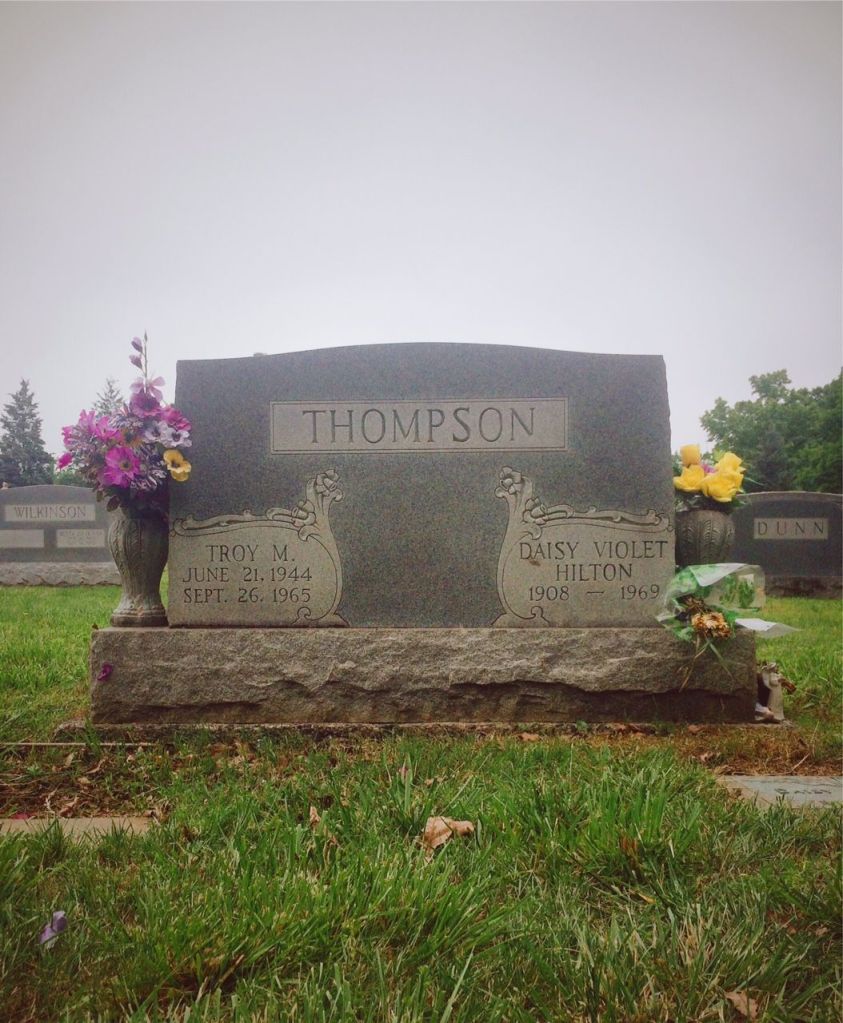
The Hilton Sisters were buried together in one casket in a donated plot at Forest Lawn Cemetery in Charlotte, NC. At their funeral service, the Reverend Jon Sills said, as he stood next to the sisters’ wide coffin: “Daisy and Violet Hilton were in show business for all but the last half dozen years of their life. In the end, though, they were cast aside by the glittery and glamorous world they had been part of for so long. In the end, it was only ordinary people who showed they cared about them.”
In May 2018, it was announced that Brighton and Hove City Council in Sussex, England, and the current owner of the house in which the twins were born had agreed that a commemorative plaque could be erected at the property. On May 26, 2022, a commemorative blue plaque was unveiled at 18 Riley Road, dedicated to them. Additionally, the Brighton & Hove Bus and Coach Co. honored the twins by naming a bus after them. Upon their death in 1969, Mrs. Luther E. Mason, a longtime friend of the twins and secretary to the lawyer who represented them at their trial, said that they wanted nothing more than to “live normally.”
 Alan E. Hunter