Hollywood, Music, Pop Culture, Weekly Column

Paul Bearer and the Morticians-An Indiana Garage Band Story.

Part I

Original Publish Date September 18, 2025.
https://weeklyview.net/2025/09/18/paul-bearer-and-the-morticians-an-indiana-garage-band-story-part-1/

As many of you who have read my columns over the past two decades will recall, I am a collector. Many of my columns center around collectibles, some valuable, some historic, and some for sheer folly with no lasting value other than a momentary nostalgic smile. I often visit regular antique shows, events, and roadside markets looking for whatever I can find. I recently visited a regular haunt and once again found my hands inside of boxes containing an assortment of papers and bric-a-brac from a lifetime ago. Sometimes, I run across something serendipitously, as if it was placed there specifically for me to find; one step away from the trash heap.

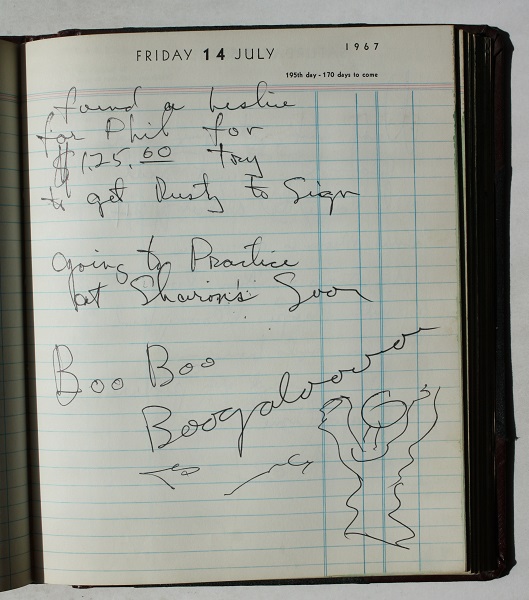
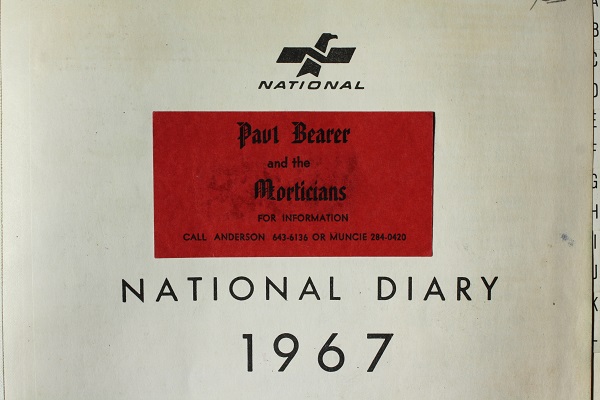
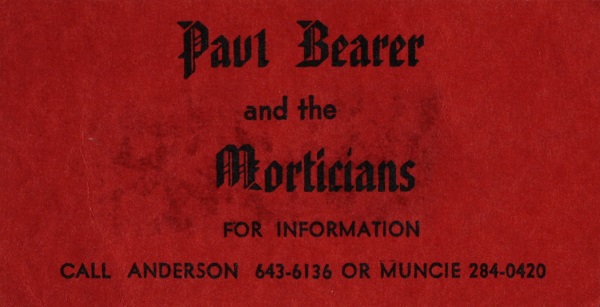
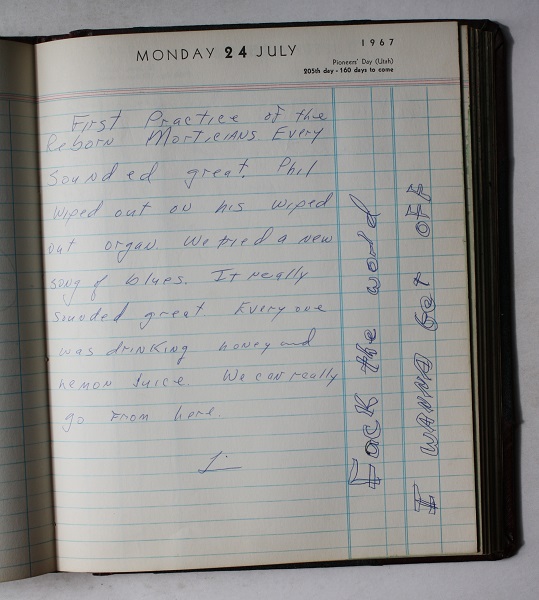
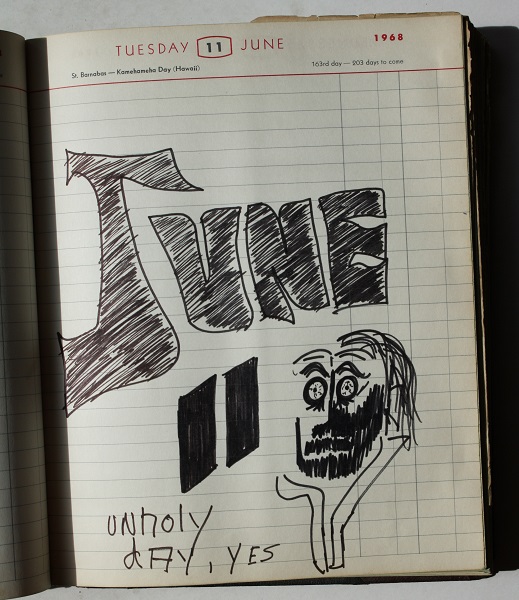
In this box, there were two 8×10 thick & heavy leather-bound books, each titled “National Diary”, although they have 1967 & 1968 cover dates, I believe they’re from 1968 & 1969 (likely a frugal “clearance” purchase by a struggling band not hung up on the concept of time, man). When I opened the initial book, the first thing I saw was a bright red business card pasted to the top of this page, emblazoned “Paul Bearer and the Morticians” with Anderson & Muncie, Indiana phone numbers inset. I quickly flipped through the first few pages to see what it was, as a wide-eyed smile slowly crept across my face. Not the best poker face, I told myself as I slammed the book closed and decided that these were going home with me. There they sat beside my “writing chair” waiting for me to devour them. Life gets in the way sometimes, so it took me a minute to get there. Oh, I would occasionally pick one of them up, flip through the pages, and whet my curiosity whistle, until I finally had a day to devote to a full read.
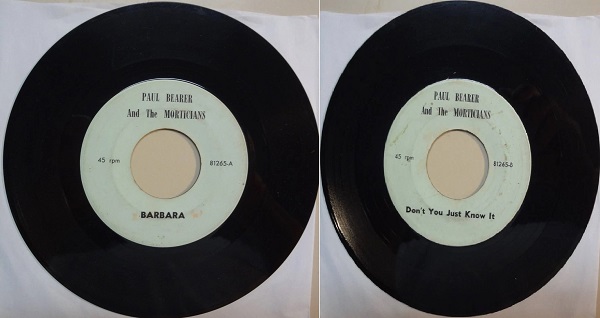
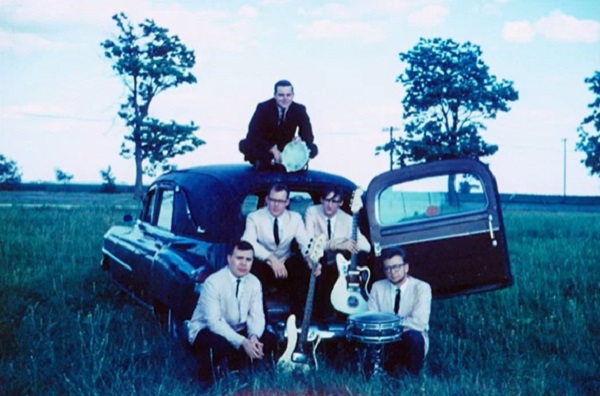
Turns out, what I had accidentally stumbled over was a day-by-day accounting of an Indiana garage band as detailed by one of its members, Larry Scherer, aka Paul Bearer himself! Larry Phillip Scherer was born Sept. 19, 1946, in Anderson and passed away on Jan. 23, 2004, in Greenfield. By all accounts, while growing up, Larry lived an ideal Hoosier childhood. He was active in Cub Scouts and Boy Scouts and played football and Little League baseball. He graduated from Anderson High School in 1964 and later earned his BA and MA in Counseling Psychology from Ball State University. He was the lead singer of the band, Paul Bearer and the Morticians. Not a lot is known about this band. A few references can be found on the net, including a 45 rpm single and a single publicity shot of the 5-man band posed around a hearse in a cemetery surrounded by their instruments. The single’s A-side is a song called “Barbara,” and the B-side is “Don’t You Just Know It.”

Each book begins & ends with a calendar page, both jumbled by hurried circles, arrows, and scribbles denoting sporadic gigs every week. Flipping through the pages, one can almost feel the high hopes of the band melting away during those first formative winter months. The entry for January 1 notes that the band took some publicity photos, which must have boosted their hopeful confidence immensely. Then reality sets in. The pages from January to February are filled with depressing notations of inactivity: “Nothing” and “Nada” on nearly every page, like a road to nowhere. Around Valentine’s Day, things were looking up, but not musically. Feb. 10, “Went to see Paul Revere + the Raiders-they were great-got a tip at where they were staying + buzzed out there. Holiday Inn-Got all their autographs…Jack talked to Mark Lindsay…We should have some great pictures.” On Feb. 17th, “Played at McPherson’s Dance Inn [in Anderson] over 300 showed up, we made $100 clear (about $1,000 today)…Thank God…we each got about $14 per man.”
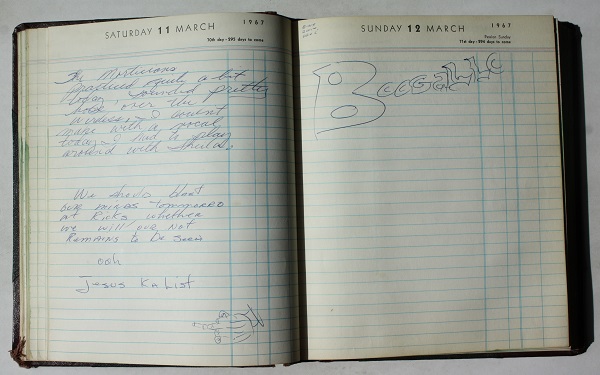
Bolstered by this modest success, the boys begin to practice regularly on original compositions (Town of Evil) and covers (Cream’s “Sunshine of Your Love” and “Outside Woman Blues”) in preparation for a desired gig at a “Hullabaloo”. A Hullabaloo was the franchise name for teen dance clubs spinning off the popular NBC musical variety show of that era. The TV series originated in London and was hosted by The Beatles’ manager Brian Epstein before hopping across the pond to America.
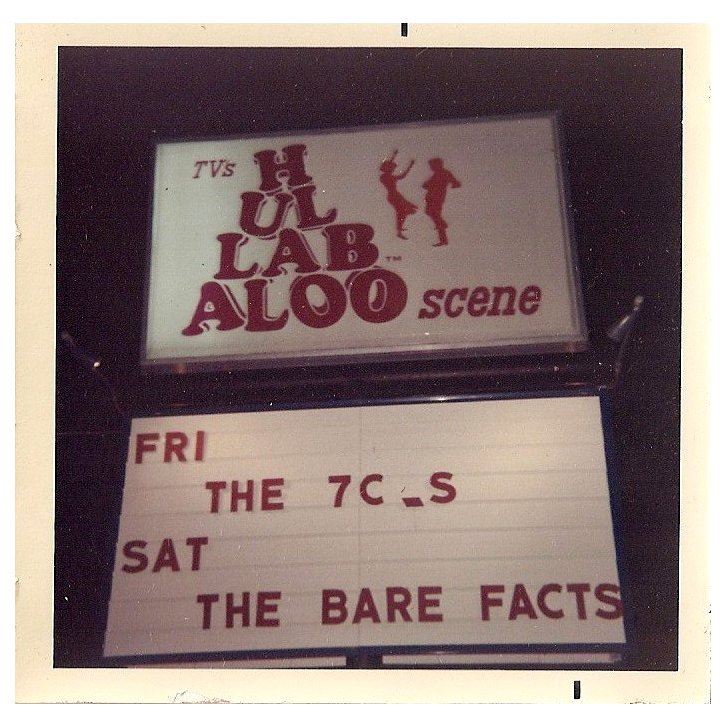
These trademarked “Hullabaloo” nightclubs were usually found near colleges (Ball State, IU, Purdue, Notre Dame, etc.) and larger high schools. On Feb. 27, the band played the Conservation Club in Anderson and received $140. “[We] sounded like a professional group, surprised everyone but me…First time we used Saxophone-sounded real good-going to use it a helluva lot more.” The success of that gig led to an audition for the Teen Time Lounge in Hartford City. March 3: “Notified to play Teen Time Palace…Sounded Great. KIds ate us up. Nothing much happened except some clown busted a $200 glass door. Some girl asked for autographs.” The band was paid $75 and by now Paul Bearer and the Morticians had a set list of 41 songs: “35 good ones-6 stand bys” including covers of the Rolling Stones “Under My Thumb”, Junior Walker’s “Pucker Up Buttercup”, Spencer Davis Group’s “Gimme Some Lovin”, and Wilson Pickett’s “In The Midnight Hour.”
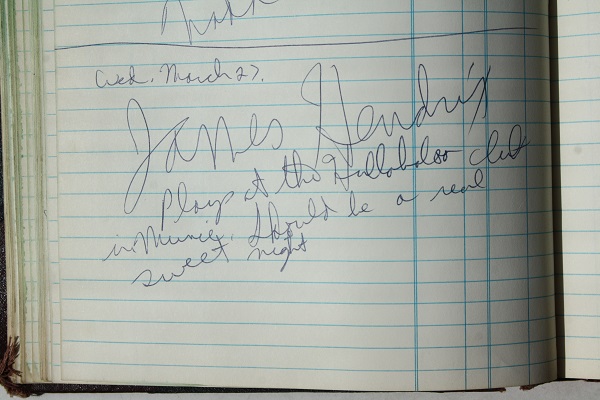
By mid-March, the band was looking ahead to a gig at Anderson’s Peppermint Lounge. March 15, “Tim came over to get some money to finish the coffin-Paid $5.” The Morticians were paid $115; by the time they left the stage, the boys made $7 each after expenses. On March 22, the band hoped to land a $125 gig at the Hullabaloo in Muncie. March 27 entry reads: “James Hendrix plays at the Hullabaloo Club in Muncie.
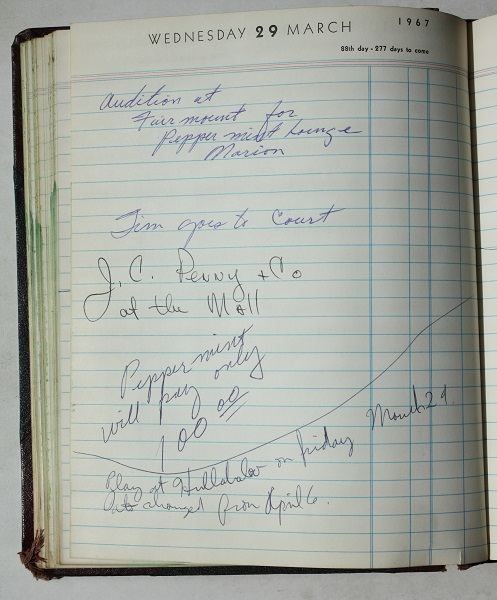
Should be a real sweet night.” The very next night, the Morticians take the stage. The band is fielding inquiries for gigs at Rensselaer ($115 payout), Hartford City ($50), Fairmount ($100), and Lapel ($85). April 1: “Best critics in Anderson-my friends-said we were whats happening-I agree!! The guys sounded great. I know we can make it to the top-just a matter of time—is on my side, yes it is.” On April 5, the Morticians book a gig to play at the Hullabaloo Club in Dayton, Ohio: for $150. On April 8, the boys again played for Anderson’s Conservation Club. “Blast it was too!! The band finally hit what its worth-a cool 40 beans apiece!! There were 267 kids there-about half sniffen glue-haha. Split the profit.”
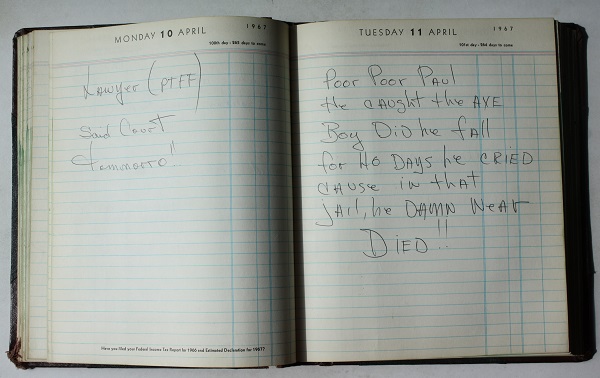
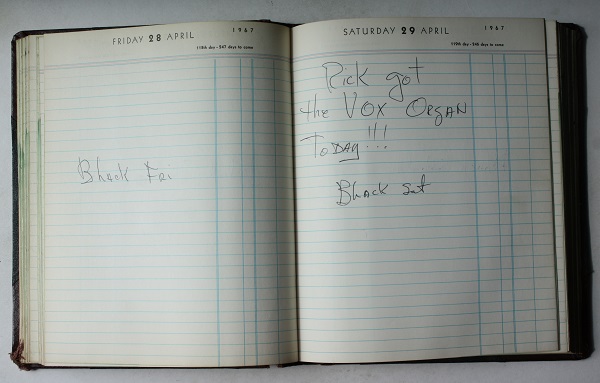
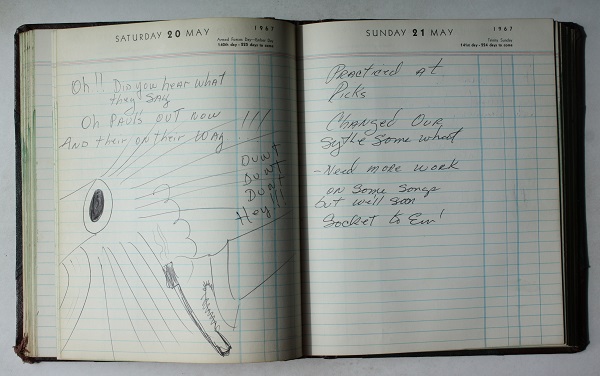
On April 11th, the diary lyrically notes, “Poor, Poor Paul. He caught the axe. Boy, did he fall. For 40 days he cried cause in that jail, he damn near died!!” For the next 40 pages, every day is denoted as “Black Monday, Black Tuesday, Black Wednesday, etc.” On May 20, another lyric, “Oh!! Did you hear what they say. Oh Paul’s out now, and their on their way. Dunt Dunt Dunt Hey!!”
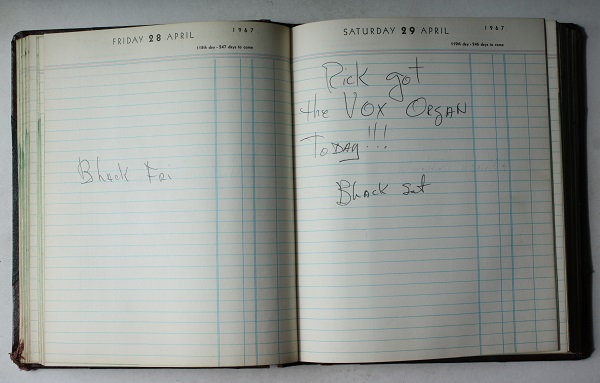
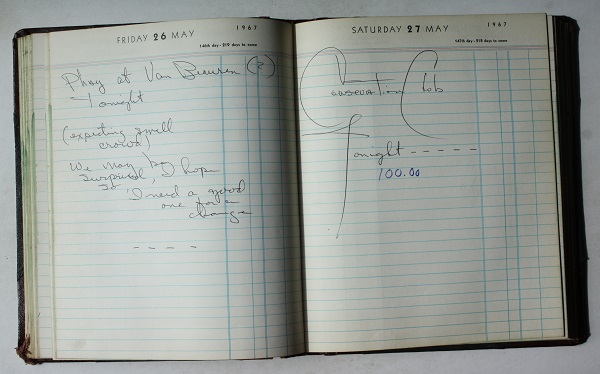
The band starts up again, practicing regularly at “Rick’s”. May 21: “[We] need more work. Changed out style somewhat on some songs but we’ll soon socket to em!” May 26th “Play at Van Buren tonight. (expecting small crowd) We may be surprised, I hope so. I need a good one for a change.”

May 27, “Conservation Club Tonight $100.” On June 5th, the band joins the American Federation of Musicians for $102.50. June 29th, “Practiced at Rick’s house + thusly decided to kick out Rick. One Mortician is buried.” July 7, “Found the band outfits at a Brand X store in Indianapolis. Sweet as hell for a mere 5 beans.” August 6, “Got our publicity pictures taken today at the graveyard in back of North Drive Inn [Anderson] 14 in all. Two sets of clothes. Outta be cold, cold shake cool. Blimey Govnor.” The entry on August 8 is actually the handwritten lyrics to a song: “There is a man from L.A., That is hard to understand. People tell me he’s an uncertain kind. In California where kids blow their mind. He has come to Hoosierland to waste his time. There are two things that he loves, an old truck and a jail to sleep. Some call him little Bo-peep. Since coming to the Midwest, he is always losing his job, because of this he can’t afford my little nest. Maybe someday he’ll be persuaded to stay around, he’ll be downgraded. No home to go to weep or food to eat. This is a man from L.A. who sleeps in the hay. He is a different brand, but now a lighting man.”
August 14th, another song, not much better than the first: “Hey Baby, why don’t you love me anymore. Hey Baby, I been here all alone eh. You know I love you, But you don’t realize, you will love me, when I look in your eyes. Oh, you got to love me, baby, then love me all the time. In the morning, in the evening, in the summer, in the winter, you gotta love me. Hey baby, I’ll buy a house + settle down. Hey, ask your mom, tell her I love you. If there’s any doubt, Baby believe me, everything I say is true. If you don’t love me, I’ll try to be true. You got to love me in the bathroom, in the kitchen, in the basement, in the sink, in the backyard. You gotta love me.” August 17, “Practided! Worked on a couple new songs. Two friends of Phil’s who own the Acid Land nightclub came to watch us. Played a lot of Psychedelic stuff.” August “Paul went to labor at the Delco Remy Salt Pits…Won’t last long.” September 3: “Played at Greenfield. 87 people showed up. We made $38. Each got $7. Tim + Phil conspired to leave us-formed the Liverwurst Steel Convention [band].” By mid-month, the Morticians were practicing new songs, mostly by The Who: “Whiskey Man” & “Pictures of Lily”.
The band booked a Sept. 30th gig for $125 at McKay’s Drive-In nightclub known as the “Psycadelic Sounds at The Place” on Highway 67 in Fortville, after which they were signed as the “House Band”. October 1st, “Played at Fortville, made $2 per. If fortune doesn’t straighten up, we’re going to drop McKay. Not enough crowd…Learned two more songs: “I Need You”-By The Beatles + “Tired Of Waiting For You”-Kinks.” Oct. 18th: “We really psyched out on Fortville. I can’t explain. Had Better Be Ready.” Oct. 21: “Fortville-Decisive Performance-To Play or Not to Play. GLOOM. We psyched them out but only less than 60 showed. Getting tired of McKay’s.” Nov. 4, “Dance scheduled for McKay’s but he screwed us up again + cancelled the dance cause his roof wasn’t fixed.” Nov. 8, “We play at the Beeson Clubhouse Country Club [in Winchester] on Saturday Next. Nice Place. We get $75. Auditioned for the Hullabaloo Club in Muncie tonight. They thought we were BEAUTIFUL!! They dug the Jimi Hendrix stuff we played.” Nov. 11: “McKay’s Drive In. This could be it. McKay cancelled again-who cares??? We played at Beeson’s Clubhouse in Winchester, Indiana tonight. $75.” Nov. 15: “We found out the WHO will be in Muncie on Thanksgiving night + there’s a chance we might play alongside them. It may all depend on our performance at the barn Saturday night.” Nov. 23-Thanksgiving day. “The Who played at the new barn. All of us went to see them-they were greater than ever. We got to talk to Pete Townshend a little bit-he was really cool. Mike got some great pictures.”
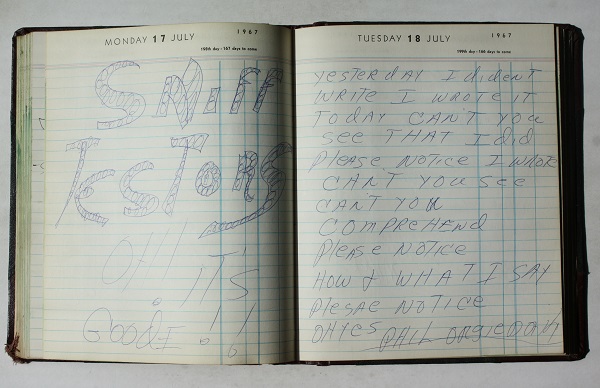
By December, the Morticians set list included 39 songs including JImi Hendrix “Hey Joe” (which they performed twice back-to-back), “Give me some lovin'”, “I can’t explain”, “Mickey’s Monkee”, “Bring it on home to me”, “Louis Louis”, “Money”, “Little Latin Lupe Lu”, “Hold On”, “We gotta get out of this place”, “Purple Haze”, “Fire”, “Foxey Lady”, “MIdnight Hour”, “The Letter”, “House of the Rising Sun”, “I’ve been loving you too long”, “Lady Jane”, and an intriguing original song titled “Ban the Egg.” On Christmas Eve, the boys “Played at Winchester for $75. The crowd dug us bad. Michael Eddie screwed up Purple Haze 3 times that night-Used Pete Townshend’s guitar strap.” The Morticians practiced but did not gig for the remainder of the year, resulting in the Dec. 31st entry: “A very dull New Year’s Eve Indeed.” Year-end receipts totaled $1899.50 (just under $20,000 today), averaging out to $70.70 per gig. Split between a rotating lineup of five musicians per night, it doesn’t take a mathlete to figure out that none of these guys could quite their day jobs.

Paul Bearer and the Morticians-An Indiana Garage Band Story.

Part II
Original Publish Date September 18, 2025.

https://weeklyview.net/2025/09/25/paul-bearer-and-the-morticians-an-indiana-garage-band-story-part-2/

In part I of this article, I detailed one of my latest “Finds”, a 1968 diary from the leader of a 1960s Anderson, Indiana garage band known as “Paul Bearer and the Morticians.” I love that it landed in my lap just before the official spooky season in Irvington commences. I wanted to share it with you, the readers, because I thought that it might stir the chords of mystic memory for other Circle City hippy kids like myself.
Jan. 13 [1969]: Played at the Loft in Muncie for a mere $75. A real good crowd showed up + there were only a few meager fights. Jan. 25: “Conservation Club [Anderson]- “Not too good of a crowd. We only made $47.50.” Jan. 27: “We played at Winchester, Ind. for $85. That’s all I’m going to say!!” On Feb. 17th, “Played at McPherson’s Dance Inn [in Anderson] over 300 showed up we made $100 clear (about $1,000 today)…Each Poison (sic) got $14 apiece.” By March, the band was looking more official than before. This second diary book includes a few of the original typed contracts between the venues and the band, all signed by Larry Scherer as the band’s representative. March 15th, 1968, is for a gig at Rensselaer High School for $115. The diary entry reads: “It was a hick dance at a school, but they liked us. Wild night in the motel there-almost got kicked out. We also had a lot of car trouble-flat tire, breakdown, etc etc.” Another contract is for the Muncie Hullabaloo Club on Kilgore near Yorktown. It netted $125 for the band and stipulates that a fee of $25 “per half hour late starting” will be enforced. The band played two sets for a “real good crowd. Our first set was a little ill, but we smoked on in the second + third. We wiped a*s on Foxey Lady.”
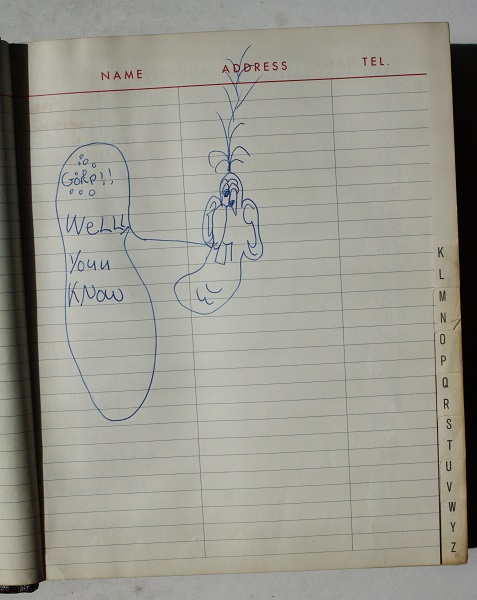
The May 1st entry finds an interesting partial lyric composition: “Wednesday, such a mellow day. Blowing wind + the children play!! I see the glowing sun shining down, I feel the pain and I wear a frown. It can’t be a dream, It’s not what it seems. But I am dying now.” In the Spring of 1968, the band was carving out its own identity, trying hard not to be just another cover band, by writing and practicing original compositions. Their set list now included seven new songs: “Rize Up”, “Charlotte”, “Fool of Cotton”, “Dance the form Evil”, “Turn on Green”, “Impression in F”, and their newest song, “Good Things for our Minds”. May 4th’s entry announced that the Morticians would be playing a gig at the Hullabaloo Club in Muncie alongside the British pop group, The Cryin’ Shames, who had a minor hit with the remake of the 1961 song “Please Stay” by The Drifters. The Drifters’ claim to fame (and ultimate demise) came when they turned down a managerial offer from Brian Epstein, manager of The Beatles. The April 15th entry describes, “We play the first set + they play the second, we play the third + they play fourth. We’re supposed to use our equipment and they theirs. We will definitely have to completely wipe them out. We will increase their draw by 200 people. There’ll be a lot of people discussing recording records etc. It should prove to be a very exciting evening.”
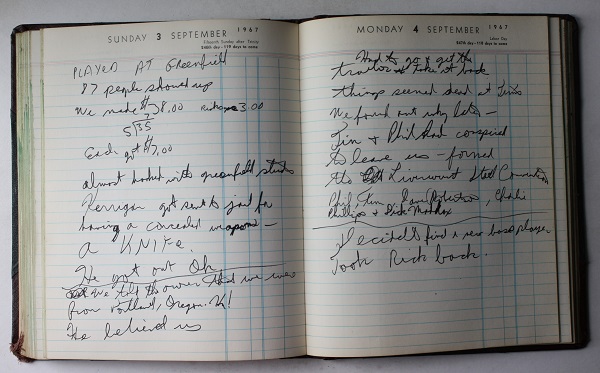
May 13 entry: “Started tonight playing the Sugar Cube for $100 [per night]. Tired as hell afterwards!” The Sugar Cube nightclub was located close to Marhofers Meat Packing Co. on Granville Avenue in Muncie. The Morticians gigged at the Sugar Cube from May 13th to the 18th for a whopping $400 paycheck! Paul Bearer and the Morticians played the “In Club” in Van Wert, Ohio for $125. May 25th: “Jack quit the band. We have to look for a new drummer-probably get Roy Buckner.” May 31, the band played a show at the Youth Center in Syracuse, IN. for $125 payday. “There were a lot of teeny boppers there that dug us bad. We will definitely go back later this summer.” By June, the band was adding more original songs to their setlist: “Manic Depression”, “Little Miss (Over)”, “Come on in”, “Talk Talk”, “You Don’t Know Like I Know”, and “When I Was Young”. June 15: “McPherson’s probably for $150…The clown only went $130.” June 21, the boys played the YMCA in Peru, In. for $150. During a dry spell for the band, one entry reads: “Went to the fabulous Anderson Fair (cow dung everywhere) + then bopped over to Phillips Swimming Hole in Muncie-It was real coooool man.” Muncie’s Phillips public swimming pool opened in 1922 and was closed in 1961 and thereafter used for training by the Muncie fire department.
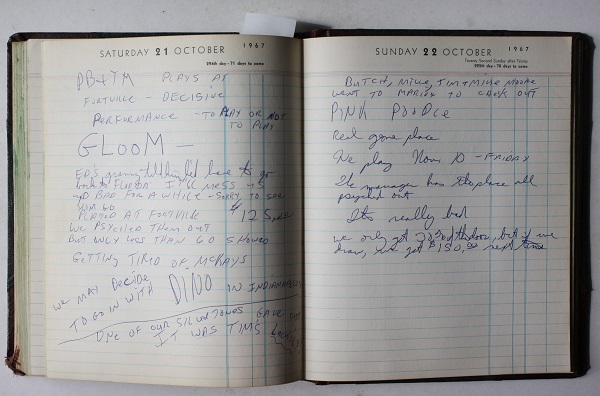
July 5th, 1968, finds the band playing “The Hub” in Celina, Ohio, for $125. “We didn’t get a good reaction at first, but the third set was real good. Wiped up with Purple Haze, Fire, Foxey Lady, + You Know. I would go to Russia, Vietnam, Belgium, France, The Congo, Brazil, but NOT THE HUB.” A month later (August 3rd), a diary entry reads: “There was an atomic attack on Celina, Ohio today. Luckily, no one was saved. Praise Allah.” July 6: “Found out The Who are back in the United States for a 9-week tour. They’ll def. pass thru here. The Fab Beach Boys are in town along with the Union Gap + The Human Beings.” July 11, the band is playing at the Honeywell Pool in Wabash, In, for $150. Two days later, they are playing in Shelbyville for $150. “We def. will not play for less than $150 beans from now on. $25 raise when we cut the record. They bought us on our gimmick-Dry Ice- fog during our performance.” Despite that entry, days later, on June 21st, the band was once again appearing at the Hullabaloo in Muncie for a $130 payday. In the end, the band netted $57 and paid out $15 per band member. August 8: “Rick quit the band, supposedly, then came crawling back 3 days later, acting like it was all a gag! HAR.”
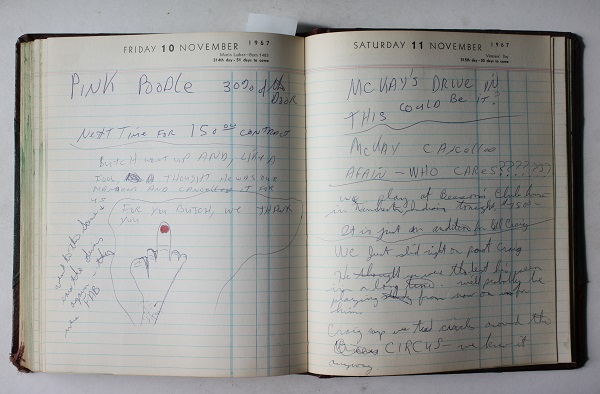
August 9th, 1968, finds the band playing at Jefferson Landing, 127 E. Main St. in Crawfordsville for $150.”It was a real sweet place, but NOBODY showed up-cause it’s Tuesday, no doubt. We got a real good report from here though.” Five days later, the Morticians were once again playing The Place in Fortville for $150. “We finally are going back to play at Fortville once more. It will really bring back old memories. Har de Har de Har!!! All they could say was that it was too loud.” On August 25, Paul Bearer and the Morticians played the Indiana State Fair [likely a warmup for The Cowsills]: “They were really digging our music.” Sept. 3rd finds the band playing a dance at the Bridge Vu Theatre in Valparaiso, IN,. for $175. October 4, 1968: “Today is the 2nd anniversary of PB + M. Ain’t you proud? I found a super contact: Jeff Beck. He is supposed to speak at the Gent tomorrow.” Oct. 12th finds the band playing a Halloween party at the Kendallville Youth Center in Kendallville, IN., for $175. “Everything was going great, until old nag (blind) started raising the roof because she thought we were a bunch of maniacs, how right she was! The kids dug us so much, they clapped after every song.” The show went over so well, the band was asked to play again the next night. On Oct. 25th, the band played the Sigma Phi Epsilon frat house at Ball State in Muncie for $100. Immediately following the show, the band drove straight to New York to see Steppenwolf. On Nov. 6, the band was playing a show at “The Anchor” in Findlay, Ohio, for $125. Nov. 8, 1968: “Went to Indianapolis + saw Canned Heat + Iron Butterfly-Boy were they great. Worth every minute, they were.”

Nov. 11, the band booked a $150 gig at the Purity Inn on High Street in Oxford, Ohio. “They said we were too loud. We won’t go back def. The acoustics were totalled. We each got 20 beans apiece tonight.” Nov. 20, the band played the armory in Crawfordsville, IN., for $175. “We turned WAY DOWN but don’t know if they liked us or not. We split the diff. + each for 30 Beans.” Nov. 30 the band was once again playing the Hullabaloo in Muncie for $135. Dec. 2nd, the band played the Sigma Pi House at Purdue University for $125. “They seemed to like us quite well + I think we did one of our better gigs. They really dug it bad.” The gigs were getting fewer and farther between now and the diary entries ceased until December 29, 1968. “Played at the Muncie Haullabaloo Club today for a measly $43.57, which was 50% of the door-WOW! We’ll probably be playing there steady at jam sessions on Sundays-NO CONTRACT yet.”
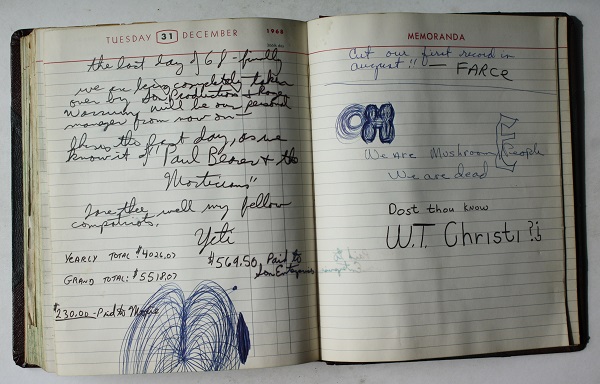
Two days later, on New Year’s Eve, 1968, the diary reads: “The last day of ’68-finally. We are being completely taken over by Son Productions. This is the last day, as we know it of Paul Bearer + the Morticians. Fare thee well, my fellow compatriots.” The annual tally for 1968 totalled $5,518.07, or just over $50,000 in today’s money. The memoranda section of the diary reads: “Cut our first record in August!!-FARCE. We Are Mushroom People. We Are Dead.”
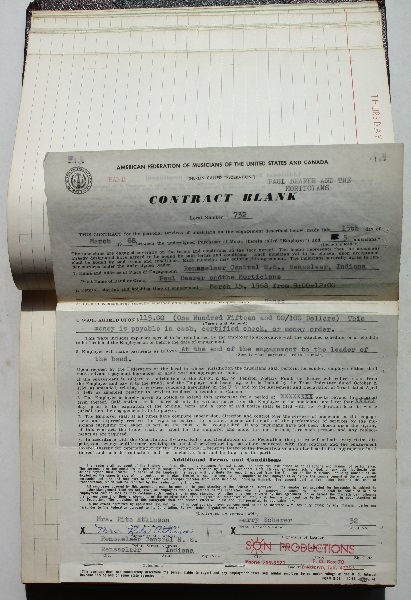
As hard as it is to find detailed information on Paul Bearer and the Morticians, it is even harder to find info on Son Records. Initial information can be found on the band’s contracts, where Larry Scherer signs as the legal representative of “Son Productions P.O. Box 78 Yorktown, Ind. 47396 (Phone) 759-9371”. One article found in the August 1, 1968, Muncie Star newspaper, notes that Son Records founder, Roger Warrum, was born in Shelbyville, attended Mount Comfort schools, graduated from Ball State University, lived in Greenfield, and settled in Anderson. Warrum had a band, The Glass Museum, and also brokered the Jimi Hendrix Concert in Muncie at the Hullabaloo Club. He formed “Son Productions” (named to honor his son Jeffrey Scott) in late 1966 and was described as the “founder-manager-chief worker” for the licensed music booking agency. The company logo incorporated sun rays jutting out of the “o” in “Son”. Warrum made his office inside the Muncie Hullabaloo building, booking bands in Indiana, Eastern Michigan, Ohio, and Kentucky. He opened a branch in Valparaiso to serve the Chicagoland & Greater Michigan, Illinois, and Wisconsin regions. The article states that Warrum planned to open more branches in Bloomington (in October) and Michigan (in January). Warrum only booked union bands and notes, “Paul Bearer and the Morticians came back [to the Muncie Hullabaloo] three times before they had a big enough, good enough sound to make the circuit.” Roger J. Warrum would go on to a successful Insurance career in Anderson, where he was elected to the City Council. He died in Hudson, Ohio in 2009 at the age of 63.
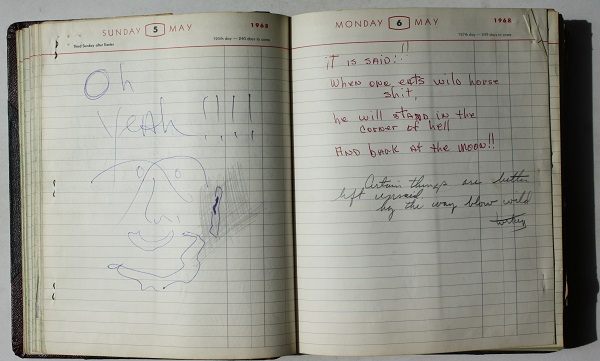
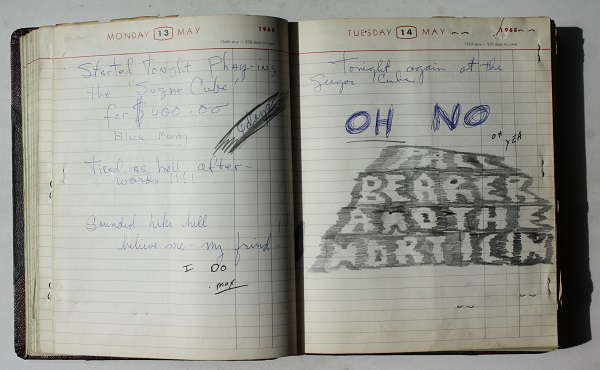
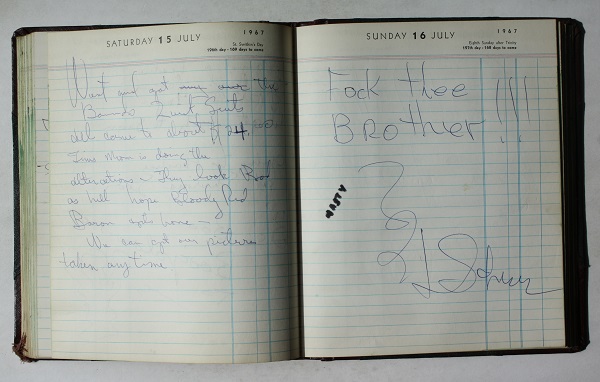
As detailed in Part I of this series, the diarist of these books, Larry Scherer (Paul Bearer himself), died at his home in Greenfield on Jan. 23, 2004, following a brief illness. After the band broke up, Larry taught school in Broxton, GA, and was Teacher of the Year three times. He relocated to Anderson in 1978 and was employed by Madison County Employment & Training Administration as an Assessment Testing Counselor and the Director of Weatherization. Larry was the owner/operator of his business as a General Construction Contractor. As for the rest of the band, Vic Burnett was the guitarist, organist, vocalist, and songwriter, and Jim Shannon was the bassist for the band. Jim Shannon’s signature appears in the diary with a comic profane inscription. Other names appearing on the pages of the diary include Tim Connelly, Jack McCleese, Phil Daily, Rick Thompson, Mike Ford, Chris Wisehart, Michael Eddie, Dave Robertson, Charlie Phillips, Dick Maddox, Steve Whitesell, Ed Wyatt (from Florida), Mike Moore, and Gary Rinker. It should be assumed that these men were members of, or closely associated with, the band.

Despite their hopes of becoming a headliner band, Paul Bearer and the Morticians were little more than a hobby, which they all hoped would turn into something bigger but never did. A thread on the net can be found from Chris Shannon (relative of bassist Jim Shannon) stating that “Paul Bearer and the Morticians made an appearance via satellite on either the Jerry Lewis Telethon or Dick Clark’s American Bandstand. Any time they played in public, the street would be packed with people listening to them play. They were hot, man!” I have spent the last month trying to connect with any family members of the men who created this band, including Chris Shannon, to no avail. So, Chris, if you’re out there, I’d love to hear from you and learn more about Paul Bearer and the Morticians. So, there you have it, the little-known story of a typical 1960s Indiana garage band.
Art, Indianapolis, World War II

Nazi Ideology on the Eastside; a Continuance.

Original publish date June 19, 2025.

https://weeklyview.net/2025/06/19/nazi-ideology-on-the-eastside-a-contnuance/

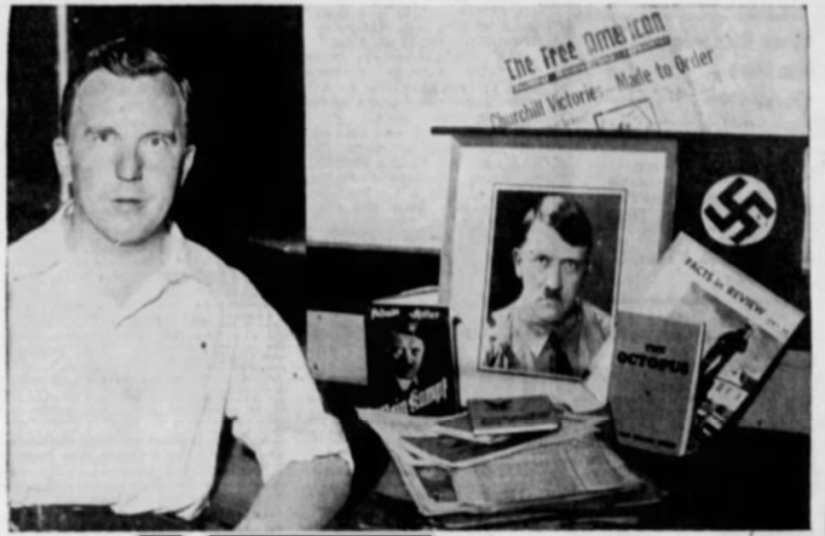
Last March, I wrote a two-part article on Eastsider Charles Soltau, the “Nazi at Arsenal Tech”. This Saturday (June 21st) at noon, I will revisit those articles on Nelson Price’s “Hoosier History Live” radio show WICR 88.7 FM. Nelson, a longtime friend of Irvington, has a personal connection to that story, which he will share for the first time ever during that broadcast. As it happens, weeks after that article appeared, quite by accident, I ran across a few documents that spoke directly to that time in Indianapolis history.

Card # 1

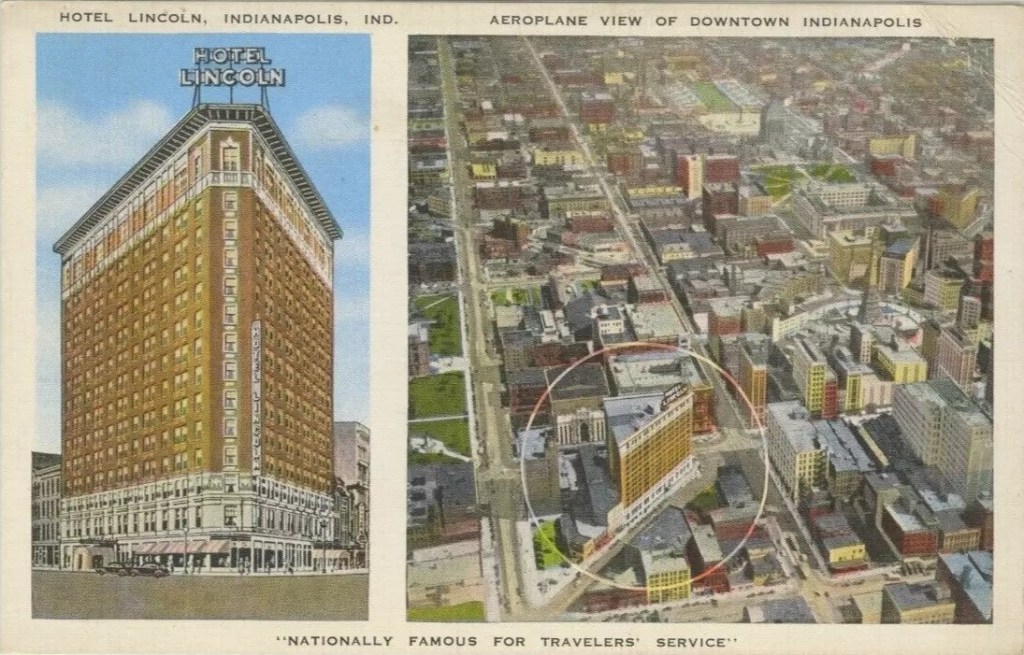
While perusing a few boxes of vintage paper at a roadside antiques market, I found a pair of cards from February 1938, advertising one of the first 35 mm camera photo exhibitions in Indianapolis at the Hotel Lincoln. The Hotel Lincoln, built in 1918, was a triangular flat-iron building located on the corner of West Washington St. and Kentucky Ave. The hotel was named in honor of Abraham Lincoln, who made a speech from the balcony of the Bates House across the street in 1861. Afterwards, that block became known as “Lincoln Square.” The Hotel displayed a bust of Abraham Lincoln on a marble column in its lobby for decades. The Lincoln was a popular convention center and was once the tallest flat-iron building in the city. The Lincoln was the site of the arrest of musician Ray Charles (a subject covered in depth in one of my past columns). It also served as the headquarters for Robert Kennedy and his campaign staff, who leased the entire eleventh floor of the hotel during the 1968 Indiana primary. The Lincoln was intentionally imploded in April of 1973.

Hotel Lincoln Postcard.

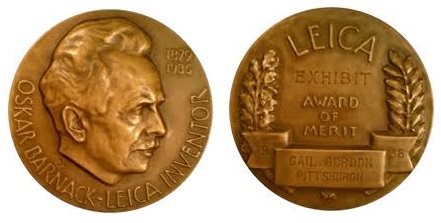
It was the Hotel Lincoln’s history that originally piqued my interest. The front of each card read, “You are invited to attend the Fourth International Leica Exhibit on display in the Hotel Lincoln, Parlor A, Mezzanine Floor, Indianapolis, Ind., from February 23 to 26 [1938], inclusive. Hours: 11 A.M. to 9 P.M. (on February 26, the exhibit will close at 5 P.M.) More than 200 outstanding Leica pictures will be on display, representing the use of the camera in various fields…Candid, Amateur, Commercial, Press and Scientific Photography. Do not fail to view this show which represents the progress in miniature camera photography throughout the year. Illustrated Leica Demonstration will be given at the American United Life Insurance Co., Auditorium, Indianapolis, February 24, 8:30 P.M. by Mrs. Anton F. Baumann. ADMISSION FREE. E. Leitz, Inc. New York, N.Y.” Research reveals that the winner of the contest was W.R. Henkel, who resided at 2936 E. Washington Street. Henkel received the Oscar Barnak Medal, named for the inventor of the Leica camera.

Oscar Barnak Leica Exhibition Medal.

The Leica was the first practical 35 mm camera designed specifically to use standard 35 mm film. The first 35 mm film Leica prototypes were built by Oskar Barnack at Ernst Leitz Optische Werke, Wetzlar, in 1913. Some sources say the original Leica was intended as a compact camera for landscape photography, particularly during mountain hikes, but other sources indicate the camera was intended for test exposures with 35mm motion picture film. Leica was noteworthy for its progressive labor policies which encouraged the retention of skilled workers, many of whom were Jewish. Ernst Leitz II, who began managing the company in 1920, responded to the election of Hitler in 1933 by helping Jews to leave Germany, by “assigning” hundreds (many of whom were not actual employees) to overseas sales offices where they were helped to find jobs. The effort intensified after Kristallnacht in 1938, until the borders were closed in September 1939. The extent of what came to be known as the “Leica Freedom Train” only became public after his death, well after the war.

Card # 2

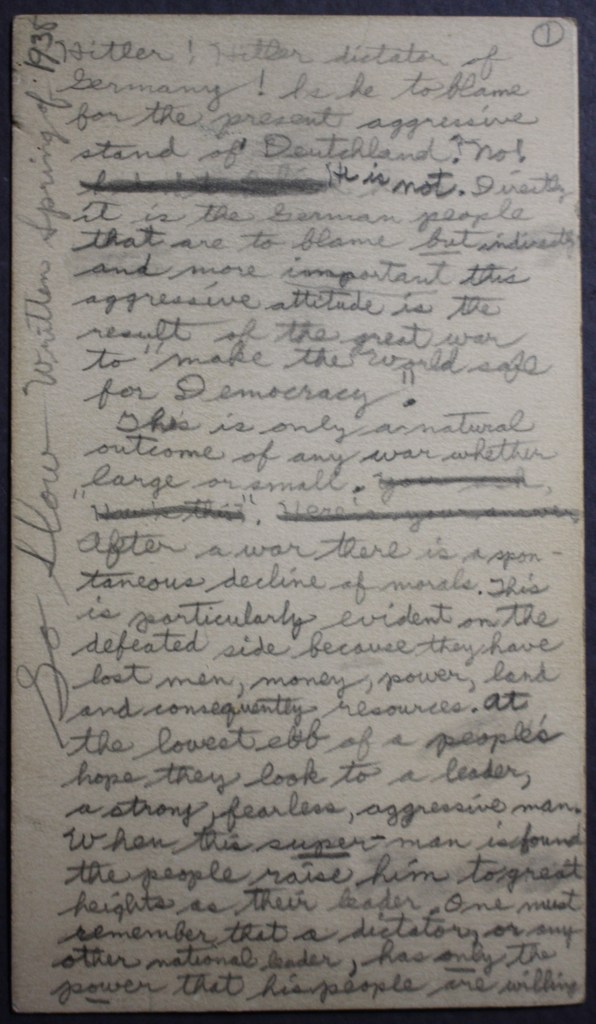
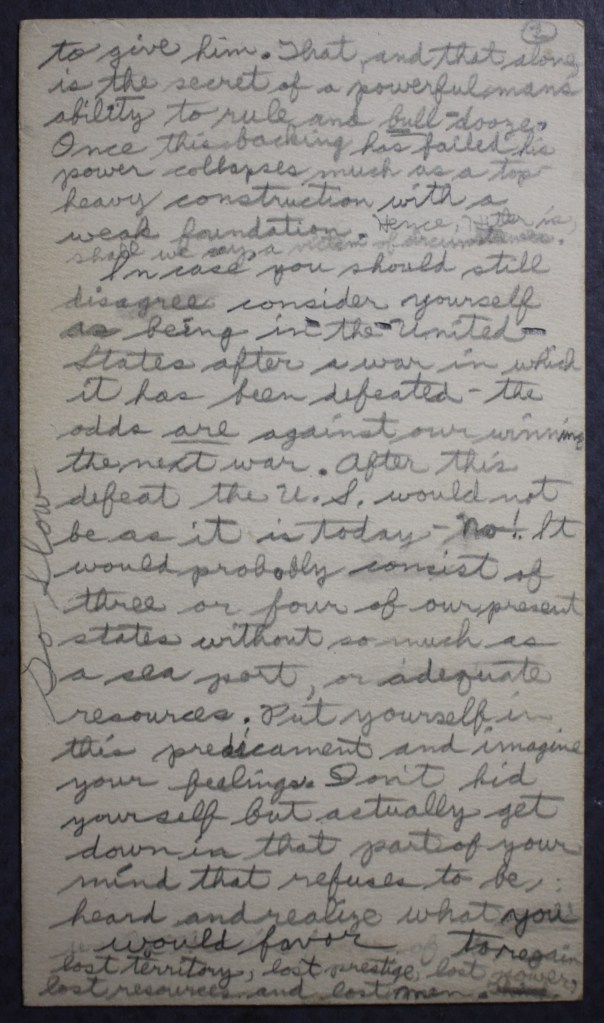
While my interest was drawn to the printed text, it was the handwritten pencil notations on the back of the cards that sparked that purchase. The cards contained a contemporary essay about the political atmosphere in the Circle City less than a month after the Soltau family’s Nazi incident. Written in pencil, the cards, numbered 1 and 2, read: “Hitler! Hitler Dictator of Germany! Is he to blame for the present aggressive stand of Deutchland? No! He is not. Directly, it is the German people that are to blame but additionally and more importantly, this aggressive attitude is the result of the great war to “make the world safe for Democracy!!” This is only a natural outcome of any war, whether large or small. After a war there is a spontaneous decline of morals. This is particularly evident on the defeated side because they have lost men, money, power, land, and consequently, resources. At the lowest ebb of a people’s hope they look to a leader, a strong, fearless, aggressive man. When this superman is found, the people raise him to great heights as their leader. One must remember that a dictator, or any other national leader, has only the power that his people are willing to give him. That, and that alone, is the secret of a powerful man’s ability to rule and bulldoze. Once the backing has failed, his power collapses much as a top-heavy construction with a weak foundation. Hence, Hitler is, shall we say, a victim of circumstance. In case you should still disagree, consider yourself as being in the United States after a war in which it has been defeated; the odds are against ever winning the next war. After this defeat the U.S. would not be as it is today. It would probably consist of three or four of our present states without so much as a seaport or adequate resources. Put yourself in this predicament and imagine your feelings. Don’t kid yourself but actually get down in that part of your mind that refuses to be heard and realize what you would favor to regain lost territory, lost prestige, lost power, lost resources, and lost men.”

Card # 3

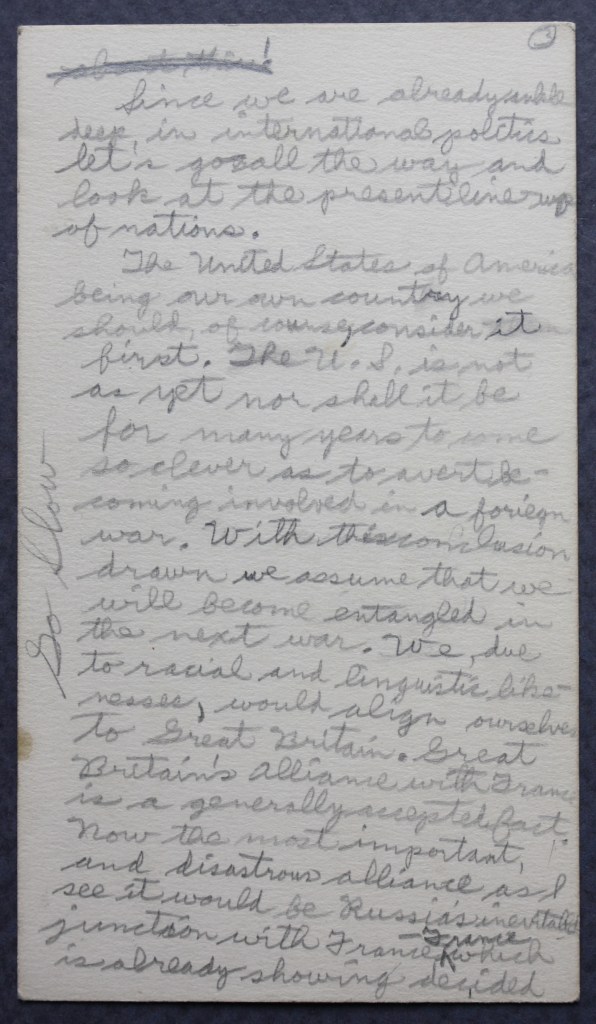
The next week, I revisited that roadside market. Lo and behold, the same dealer was there, and he brought more boxes of paper. I found two more of those cards, numbered 3 & 7, with more of that essay featured on the reverse. “Since we are already ankle deep in international politics, let’s go all the way and look at the present lineup of nations. The United States of America, being our own country, we should, of course, consider it first. The U.S. is not as yet, nor shall it be for many years to come so clever as to ever become involved in a foreign war. With this conclusion drawn, we assume that we will become entangled in the next war. We, due to racial and linguistic likenesses, would align ourselves to Great Britain. Great Britain’s alliance with France ia a generally accepted fact . Now the most important and, disastrous as I see it, would be Russia’s inevitable junction with France, which is already showing decided…Couldn’t we be a little more consistent one way or the other?”

Card # 7

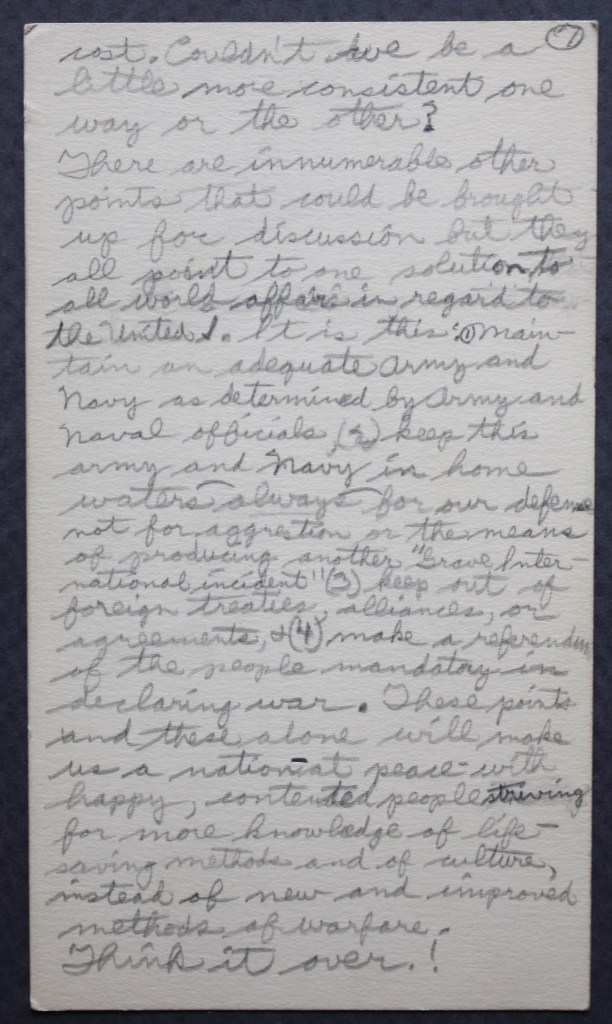
There are innumerable other points that could be brought up for discussion, but they all point to one solution to all world affairs in regard to the United States. (1) It is this: maintain an adequate army and navy as determined by Army and Navy officials. (2) Keep this army and navy in home waters always for our defense and not aggression or the means of producing another “Grave international incident.” (3) Keep out of foreign treaties, alliances, or agreements. (4) Make a referendum of the people mandatory in declaring war. These points, and these alone, will make us a nation at peace with happy, interested people striving for more knowledge of lifesaving methods and of culture, instead of new and improved methods of warfare. Think it over!”

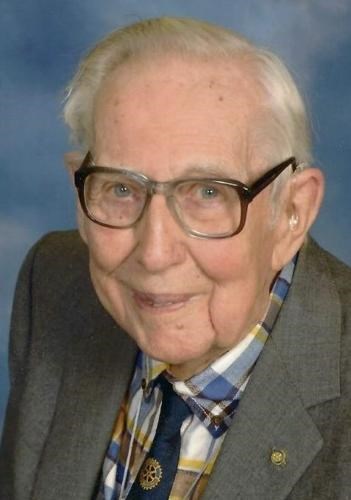
Robert W. Shoemaker, Jr. (1921-2022)

All four of these cards were authored (and signed) by Bob Shoemaker, Jr. of Anderson, IN. Robert W. Shoemaker, Jr. (1921-2022) Bob was born in New Philadelphia, Ohio, the only child of Robert W. Shoemaker, Sr. (1898-1968) and Irene English Shoemaker (1900-1988). The family moved to Anderson in 1935. Shortly after settling in Indiana, Bob became a Boy Scout. While attending the 1937 National Boy Scout Jamboree in Washington DC, Bob received his Eagle Scout award. It is likely that the seeds of this essay were planted when he sailed to Europe to participate in the 1937 World Jamboree in the Netherlands. Here, young Bobby Shoemaker witnessed the changes taking place in Hitler’s Germany firsthand. After graduating from Anderson High School in 1939, Bob enrolled in Harvard College and was on course to graduate with the Class of 1943 when the war came calling. Among Bob’s hobbies and interests were amateur radio, reading, history, and photography. Through slides, home movies, and videos, Bob compiled a remarkable visual history of his life and the life of his family from the 1920s to the current century. His many slides and movies taken during the 1937 Jamboree trips provide a fascinating glimpse of life in Washington DC, and Europe before the tragic onset of World War II. It was that love of photography that drew Bob to that Leica Exhibit at the Hotel Lincoln in Indianapolis back in 1938.

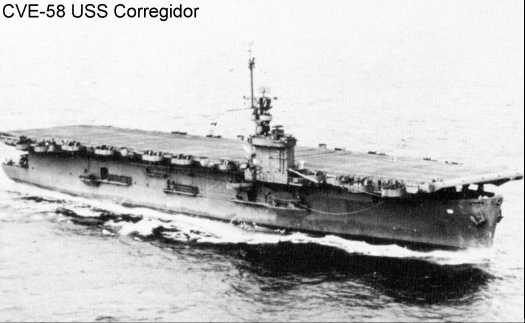
Bob was commissioned as an ensign in the U.S. Naval Reserve in 1942 and attended officers’ training programs in the Bronx, NY, and Washington, D.C, before being assigned to the Naval Mine Warfare Test Station at Solomons Island, MD, where he served as Naval personnel officer. After requesting a shipboard assignment, Bob was transferred to the Pacific for duty aboard the escort aircraft carrier U.S.S. Corregidor (CVE-58) as Lieutenant Junior Grade and Signal Officer until the ship’s decommissioning after the war in 1946. After World War II, Bob earned two graduate degrees from Harvard: an MBA and a Bachelor of Arts Degree in Government in 1947. Upon his return to Anderson in 1947, Bob remained active in the U.S. Naval Reserve Division 9-31. In 1949, Bob and his parents purchased Short Printing, Inc., then located on 20th Street near Fairview Street in Anderson. He successfully operated the business as President for almost five decades, which included building a larger one on Madison Avenue in 1961 and changing the name to Business Printing, Inc. He retired and sold the business in 2000. Bob was a Scoutmaster and Skipper of a Sea Scout ship in Anderson. He also held a variety of district and council leadership positions in Scouting for many years.

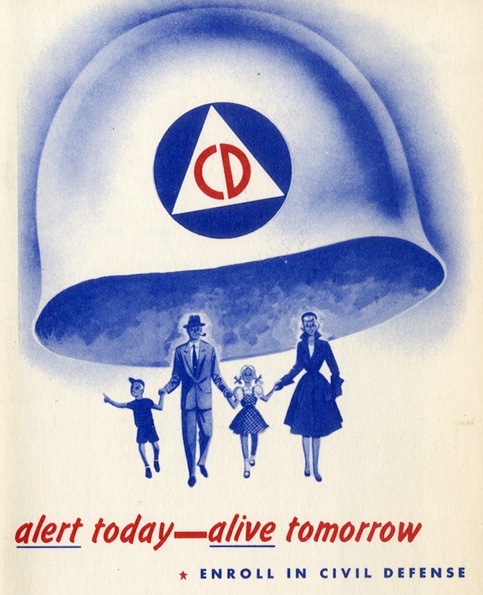
In 1946, Bob obtained his amateur radio license, and in 1952, he was asked to organize amateur radio communications for the Madison County Civil Defense, which led to his appointment as County Civil Defense Director, a position he held for 12 years. This period witnessed rising tensions with the Soviet Union and the threat of nuclear attacks, including the 1962 Cuban Missile Crisis. As CD Director, Bob gave many educational slide presentations regarding proper preparations in the face of nuclear threats, oversaw the selection and stocking of emergency fallout shelters throughout the county, and helped organize the conversion of the old Lindbergh School north of town into a CD emergency command headquarters. His slide show included photos taken in his capacity as an official observer at the Yucca Flats, Nevada, nuclear test in 1955. Later, Bob was invited by NASA to Cape Canaveral to observe the launch of Apollo 8, which carried astronauts into orbit around the moon for the first time, and the Apollo 15 moon mission launch. As a seven-decade member and officer of the Rotary Club, Bob secured NASA astronaut Al Worden, command module pilot for Apollo 15 and one of 24 people to have flown to the Moon, as a special speaker for the Madison County Rotary Club in 1971.

Arsenal Tech’s Nazi Charles Soltau.

When Bob Anderson Jr.’s life is measured against that of his “peer,” Arsenal Tech grad Charles Soltau, it is easy to see that while both shared the same isolationist mentality as young men, one chose to follow that Nazi ideology of Adolf Hitler and the other followed that of Uncle Sam. Soltau faded into the obscurity that Gnaw Bone, Indiana, maintains to this day. Anderson became a public-spirited pillar of Madison County society whose shadow is still cast in that community — proving that idealogy comes and goes with the flow of generations. What often sounds like an attractive idea can easily morph into an unexpectedly bad outcome. Mark Twain is often quoted as having said, “History doesn’t repeat itself, but it often rhymes,” and, if so, it applies today.

I will be talking about this series of articles with Nelson Price on his radio show “Hoosier History Live” this Saturday June 21, 2025 noon to 1 (ET) on WICR 88.7 fm, or stream on phone at WICR HD1. See the link below.

https://www.facebook.com/www.hoosierhistorylive.org

Abe Lincoln, Civil War, Presidents, Travel

A Hoosier Wedding in Lincoln’s White House.

https://weeklyview.net/2020/06/11/a-hoosier-wedding-in-lincolns-white-house/

Lincoln White House Wedding photo

Original publish date:  June 11, 2020. 

Sometimes, I need to dig up a historical story for no other reason than I need a smile. And nothing makes me smile more than sharing a story with an Indiana connection. A story that many of you have never heard before. A story that might just make you smile. This is the story of Abraham Lincoln, the Civil War, and a White House wedding. The only wedding to take place during Lincoln’s time in the White House.
In March of 1862, a 19-year-old Mount Sidney, Virginia, woman named Elizabeth Amanda Sheets wanted to marry a 28-year-old farmhand living in the same town named James Chandler, a native of Bowling Green, Kentucky. The problem was, Elizabeth’s parents disapproved of the engagement, let alone a wedding, to the much older man, so the couple decided to elope. After several months of a secret courtship, the young couple obtained a marriage license and boarded a stagecoach bound for Harper’s Ferry to get hitched.
125 miles later, as they approached the outskirts of the town, they were turned away because of the build-up of Federal forces there readying themselves for the soon-to-begin military campaign in the Shenandoah Valley. With no other options, they traveled on by stage, 63 miles away to Washington, D.C., a city neither was familiar with.
And so it was that this couple from the Rebel state of Virginia found themselves in the Union Capitol of Washington at the height of the Civil War. Luckily for them, during the war between the states, D.C. was the equivalent of Las Vegas. The stagecoach driver informed the couple that they could be married in any public building there. What’s more, the driver suggested they go and knock on the door of the White House and ask “Honest Abe” to marry them.
It sounded like a good idea to the starstruck couple, so they traveled hand-in-hand to the Executive Mansion to be joined in holy matrimony in the grandest of styles. While walking towards the White House, they asked a man who was coming towards them if it was true that they could get married there. The stranger replied that he did not know, pointed towards the front door, and told them to knock and ask for themselves.

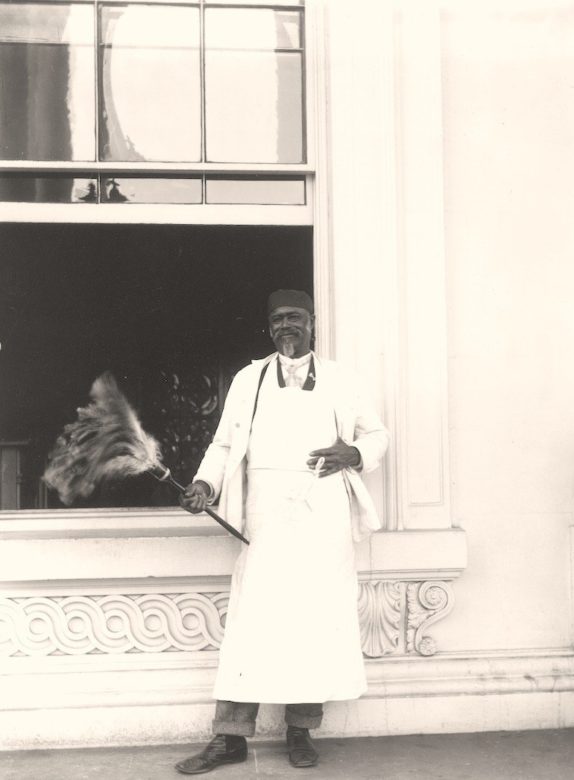
Jeremiah “Jerry” Smith
White House Doorman Jeremiah Smith.

Tradition states that the door was answered by President Lincoln’s legendary doorman, Jeremiah Smith, a subject of past columns. Further tradition states that after President Lincoln heard of a young couple seeking some place to be married, he took them to the East Room and summoned a Baptist minister. The White House Historical Association reports that “a group of women then entered the room, along with First Lady Mary Todd Lincoln, to serve as witnesses for the ceremony. After the minister announced their marital status, the president and first lady shook their hands, served an elegant dinner, and invited the newlyweds to spend the night.”
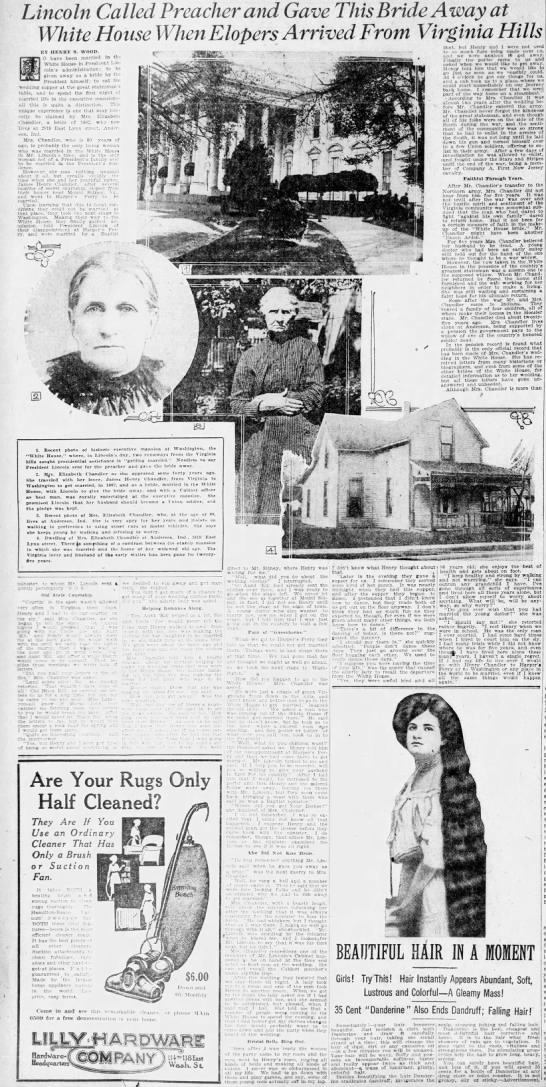
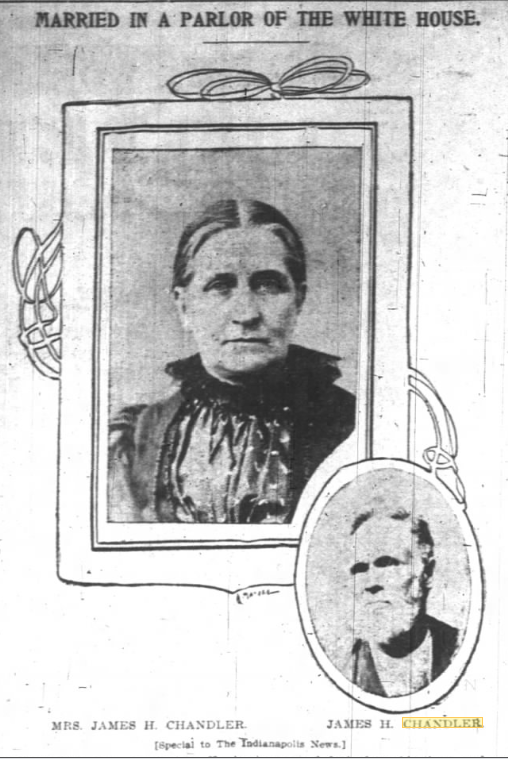
Thus, again according to the White House Historical Association, “Abraham Lincoln was credited with seeing to the marriage in the White House of a couple he did not know.” The incident first surfaced in the September 27, 1901 Indianapolis News in a story headlined “Married in a Parlor of the White House” less than two weeks after the assassination of President William McKinley. Then, as now, I’m guessing the world was in need of a little good news.
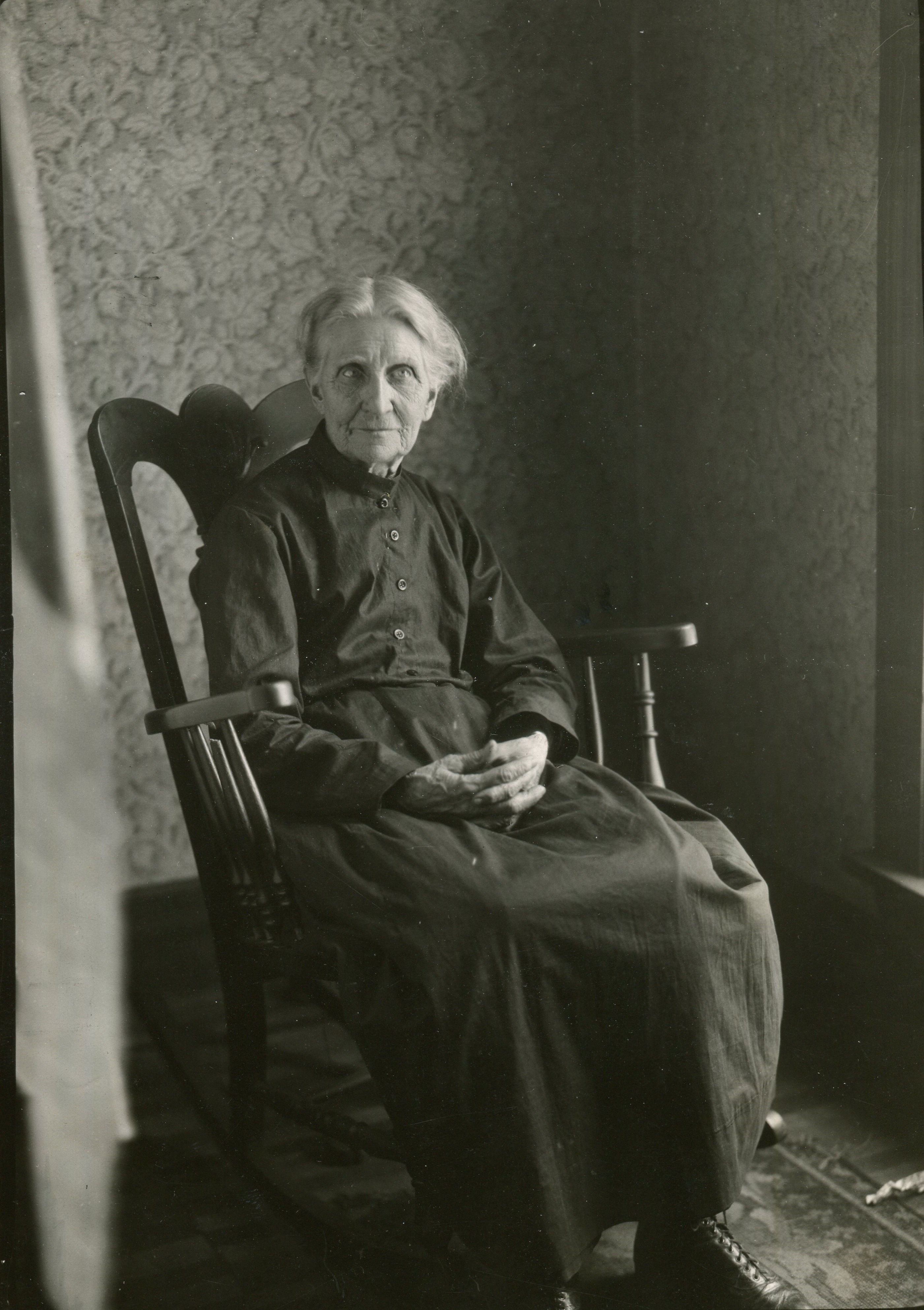
The 57-year-old widow, now known as Elizabeth Chandler, was living a quiet life in Anderson, Indiana; her husband James Henry Chandler having died six years earlier on Sept. 19, 1895, at the age of 61. The article recorded widow Chandler’s remarks about her White House wedding 44 years earlier made during a family dinner held in her honor at Rochester, Indiana. According to Mrs. Chandler, President Lincoln “shared in the happiness of the couple by suddenly finding it possible to have a wedding in the White House.”

White House Wedding Chandler
Screenshot (156)

The article understates the obvious by noting, “inasmuch as she is probably the only woman living in Indiana who has the distinction of having been a White House bride… Mrs. Chandler does not regard the circumstances of the wedding as being anything out of the ordinary so far as she is concerned.” The story broke “like a romantic picture out of the past” in newspapers all over the state and was soon picked up nationally. Over the next three decades, widow Chandler’s story proved irresistible whenever there was a wedding in the White House or an important Lincoln anniversary. On February 17, 1906 (a few days after Abraham Lincoln’s 97th birthday) the Indianapolis News ran the story on the day President Teddy Roosevelt’s outspoken daughter Alice married Ohio Congressman Nicholas Longworth at the White House. The story reemerged in 1909, the 100th anniversary of the birth of Abraham Lincoln, and again in November 1913 as President Woodrow Wilson’s daughter Jessie prepared to marry Francis Sayre.
While it is difficult to prove whether the wedding actually took place, each succeeding story contained more details about the event. Elizabeth later recalled how President Abraham Lincoln led the couple up the stairs of the White House and into a big room all draped with flags. Elizabeth said she recognized the president because she had seen his picture. The young bride remembered that Lincoln summoned a messenger and, upon his arrival, the messenger and the groom left the room while Elizabeth remained with the president. Lincoln spoke to her about the war and asked whether she would be willing for her husband to fight for his country. When Lincoln noted that talk of war upset her, he changed the subject and began telling the blushing bride jokes and tall tales.
z inaugural-receptionAfter the minister’s arrived, Lincoln rang a bell and then led the wedding party into a big room, Elizabeth recalled. The president stood alongside the minister and not only did he give the bride away but also acted as the groom’s best man. Elizabeth recalled how he smiled throughout the ceremony. She stated that a Cabinet member stood up with them, but couldn’t recall his name or that of the minister. Mr. and Mrs. Lincoln were the first to shake the newlyweds’ hands. Elizabeth’s most vivid recollection of the nuptials was how scared she was. The president chatted with them awhile and then returned to his office with the unnamed Cabinet member. Elizabeth had worn a plain white cashmere dress for the ceremony. Afterwards, the couple was taken to separate rooms in the White House to change clothes, where Elizabeth changed into a navy blue cashmere dress.
According to the White House Historical Association, “a social function was being held at the White House that evening and when those present learned there were newlyweds in the house, they came ringing bells and compelled the couple to come and and join the party. The couple were greeted with handshakes and questions about where they were from and where they were going.” Elizabeth recalled that all of the guests were Northerners, and being a Virginian, she didn’t how nice Northerners were until that night. The newlywed described how she and her new husband hardly got a chance to speak during the evening because of the constant requests for her to dance the Virginia Reel.
After the party, the newlyweds were invited to a fine dinner in a room with the longest table she had ever seen. Elizabeth recalled that a hot punch was served and how everybody would stand up and drink while someone said something. The dinner lasted until the early hours of the morning. Because of the late hour and inclement weather, Elizabeth recalled that President and Mrs. Lincoln would not allow the couple to leave and insisted they stay the night. The next day, armed with a pass signed by the President himself, Mr. and Mrs. Chandler went up the Potomac River to Harper’s Ferry. From there they returned to Mount Sidney to deliver the news to the parents that they’d just got “married in the White House.”
After their fairy tale wedding in the White House, James and Elizabeth Chandler moved to a farmhouse in Augusta County, Virginia, near Mount Sidney. The couple’s home was in the heart of the Shenandoah Valley and in the path of Stonewall Jackson’s Valley Campaign. In a move that would have certainly dismayed their wedding host, 28-year-old James Henry Chandler joined the Rebel Army, enlisting as a private in the 52nd Virginia Infantry Regiment at nearby Mount Meridian on June 15, 1862. The regiment, organized the previous August, was made up of mostly Augusta County men. Perhaps because James was never paid his promised enlistment bounty, he remained in the Confederate service for only a month before going AWOL on July 17, 1862.
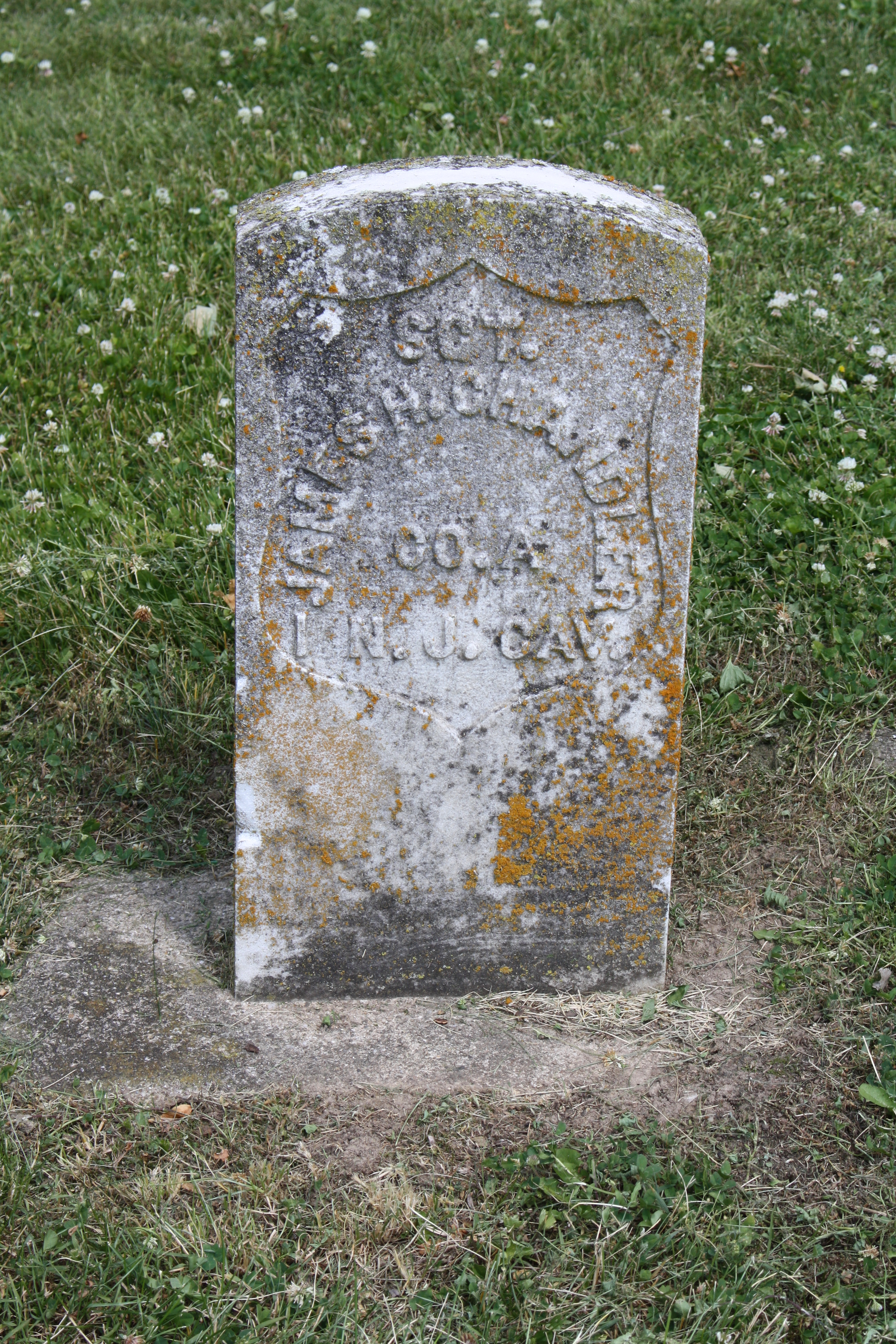
Chandler returned to the regiment May 23, 1863, where he remained until Oct. 14, 1863, when he was captured at the Battle of Bristoe Station, Virginia. Many years later, Elizabeth said her husband surrendered and asked permission to fight in Lincoln’s army. POW James Chandler was sent north to Washington and after some explanation and investigation, permission was granted. James took the oath of allegiance to the United States government on Dec. 13, 1863. Sixteen days later on Dec. 29, he enrolled as a private in Co. A, 1st New Jersey Cavalry. The following day he was mustered into Federal service under the name James Grimes.

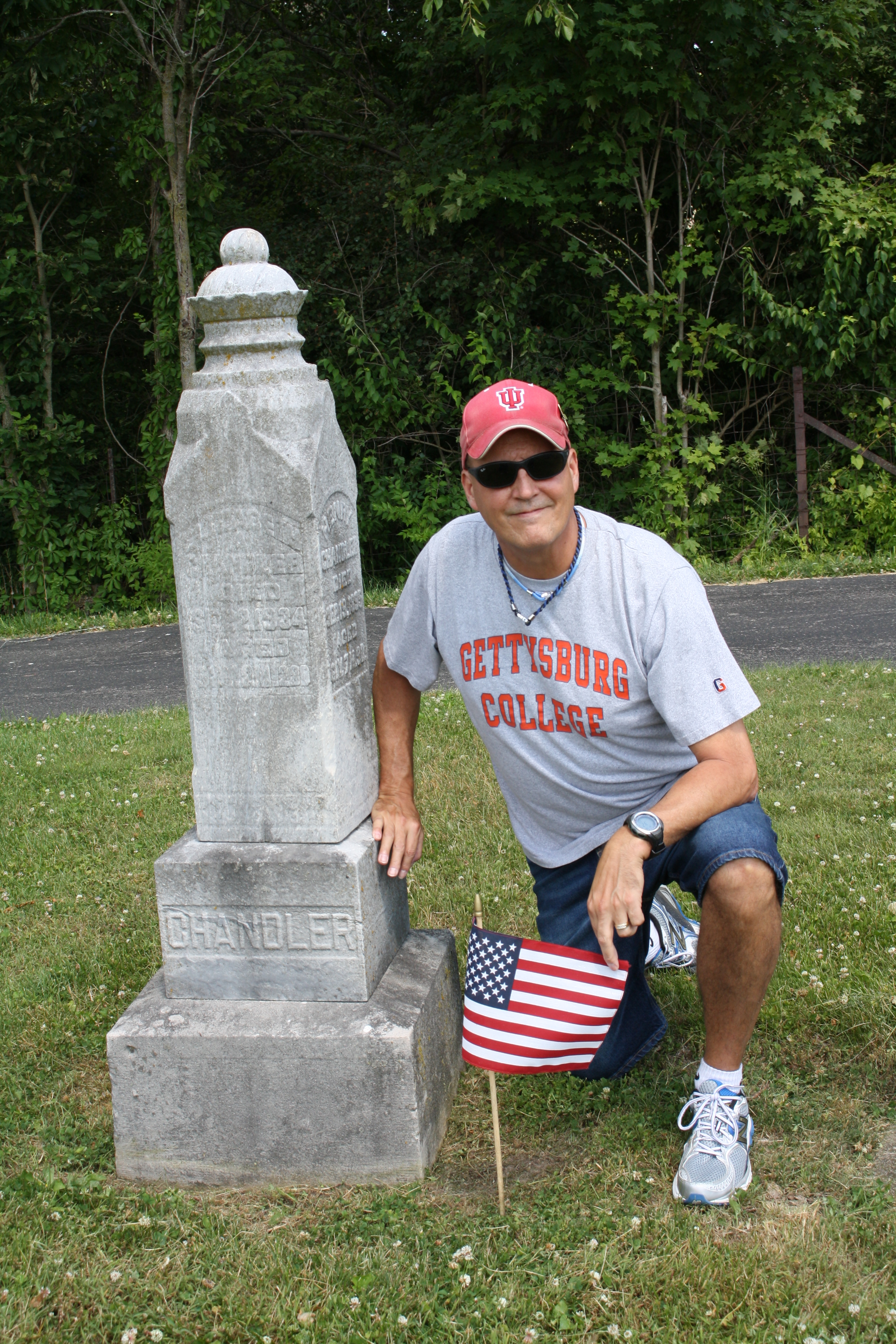
Elizabeth Chapman Grave 2
James Chandler’s Grave at Miller Cemetery Middletown,Indiana. 6/16/20. (Author’s Photo)

As a Federal soldier, James was promoted to the rank of corporal Nov. 1, 1864, and then sergeant June 1, 1865. At war’s end, Chandler was mustered out of service on July 24, 1865, but apparently did not return home for quite some time afterwards. Mrs. Chandler stated that, from the time he left the Confederate army in October 1863, she did not hear from him for five years and thought him among the dead. When he finally returned, he found his Virginia home intact and his wife working for a neighbor, awaiting his return. Likely because of the stigma associated with switching sides during the rebellion, the couple relocated to Henry County, Indiana. In 1868, the first of their five children was born. Census data reveals that the Chandlers were living in Jefferson Township in 1870 but by 1880 had moved to Fall Creek Township where they established a farm.

Elizabeth Chapman House 6
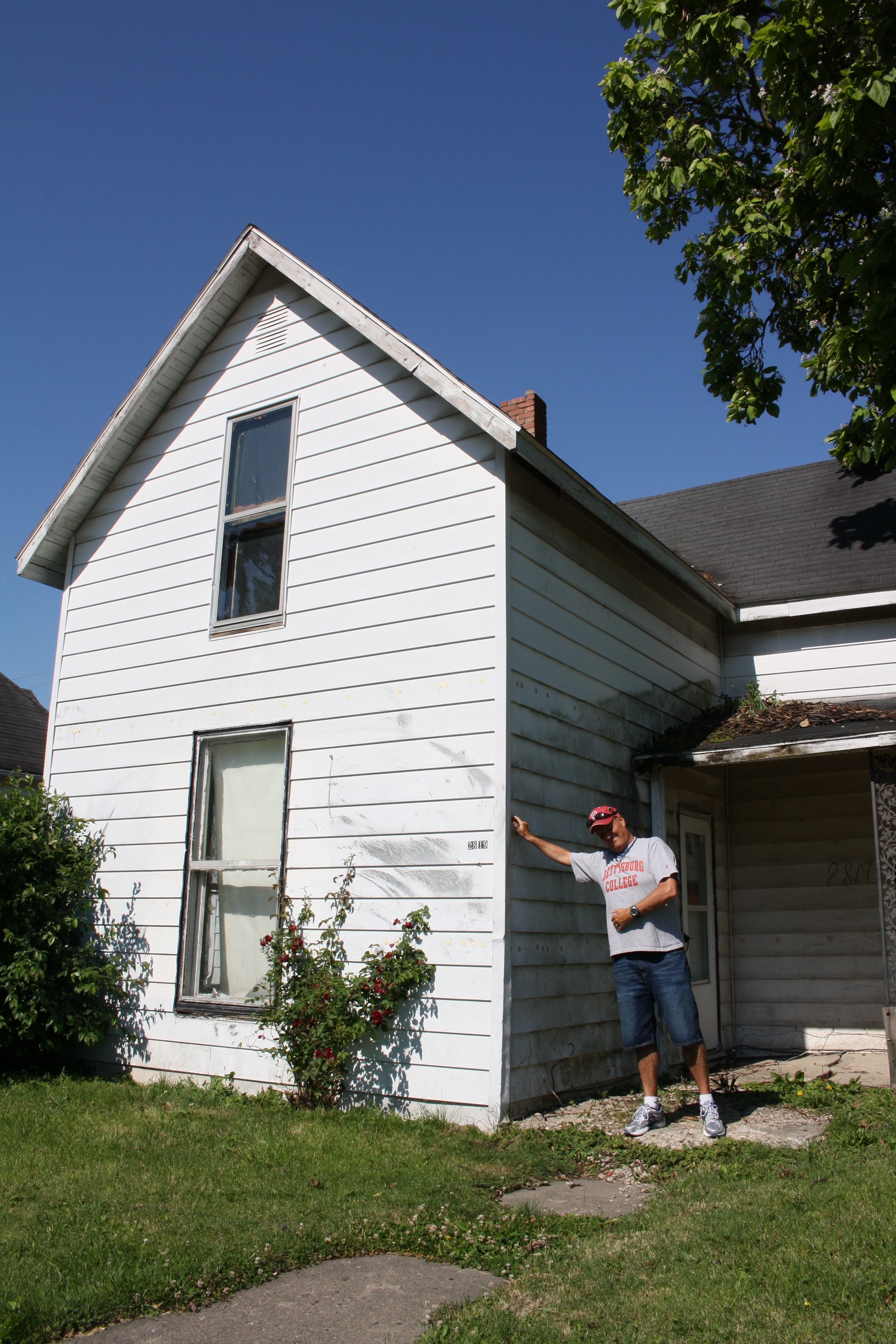
The author at Elizabeth Chandler’s House- 2819 E. Lynn St. Anderson, Indiana. 6/16/20. 

After James Henry’s death in 1895, Elizabeth moved to a little unpainted house at 2819 E. Lynn St. in Anderson (the home still stands). She was living there when her White House wedding and Lincoln connection was revealed in 1901 and remained in the home until her death in the home at the age of 92 on Sept. 2, 1934. Elizabeth and James Chandler are buried on the east side of Miller Cemetery in Middletown, Indiana. It should be noted that the only couple ever married in Lincoln’s White House are surrounded by the graves of 15 former Confederate soldiers, the largest gathering of former Rebel soldiers in any cemetery in Indiana.

Elizabeth Chapman Grave 7
The Author at Elizabeth Chandler’s Grave at Miller Cemetery Middletown, Indiana. 6/16/20.

Officially, there have been either 17 or 19 weddings conducted in the White House depending upon which source you use. These include nine presidential children and one president, Grover Cleveland. Because the Chandlers were not related to any of the official families and it was hastily arranged, the Chandler wedding does not register among the official records. However, the wedding date is contained in James Henry Chandler’s papers issued by the Pension Department. Following her husband’s death, Elizabeth was granted a Federal pension as a soldier’s widow by virtue of James’ service in the Civil War. However, those records do not note Chandler’s singular status as the only soldier who fought for both sides who could claim President Abraham Lincoln as his best man.

Politics

Otis Cox. Auditing a lifetime of public service.

Otis article
Otis E. Cox-Indiana State Auditor from 1982 to 1986.

Original publish date:  August 30, 2012

I received a phone call from an old friend the other day with some shocking news. One of my heroes and mentors in life, former Indiana State Auditor Otis E. Cox, called to tell me that he and his lovely wife Pat were moving from Anderson to Fishers. You may wonder, why is THAT shocking? Well, its shocking to me because Otis E. Cox is as much a part of Anderson as the Wigwam gym (home of all those great Anderson Indians basketball teams), Gene’s root beer stand (home of the Spanish Dog with cheese) and Lemon Drop drive-in (home of the legendary onion burger). Otis Cox might as well be “Mr. Anderson,” at least in my mind. No matter where I go or who I meet, seems everyone has ties of some sort to Anderson.

Otis and Pat have lived in Anderson all of their lives. Otis for 71 years and Pat for considerably less than that. He graduated from Anderson high school and followed that up by graduating from the General Motors Institute (now known as Kettering University). Otis, a Democrat, was elected Madison County auditor in 1976 and again in 1980. He was then elected State Auditor in 1981 serving in that post from December 1,1982 to November 30, 1986. Upon leaving office in 1986, Otis went back to his hometown and ran for Mayor of Anderson in 1987 losing by a  mere 94 votes. An astonishingly thin margin in a city of 60,000+, but Otis, true to his humble personality, eschewed a recount on the grounds that “the people had spoken.” Otis would win re-election to the post of Madison County Auditor in 1992, a generation after first attaining the post in 1976. In 1996 and 2000, Otis served as a Madison County Commissioner before retiring in 2004.

IMG_0935
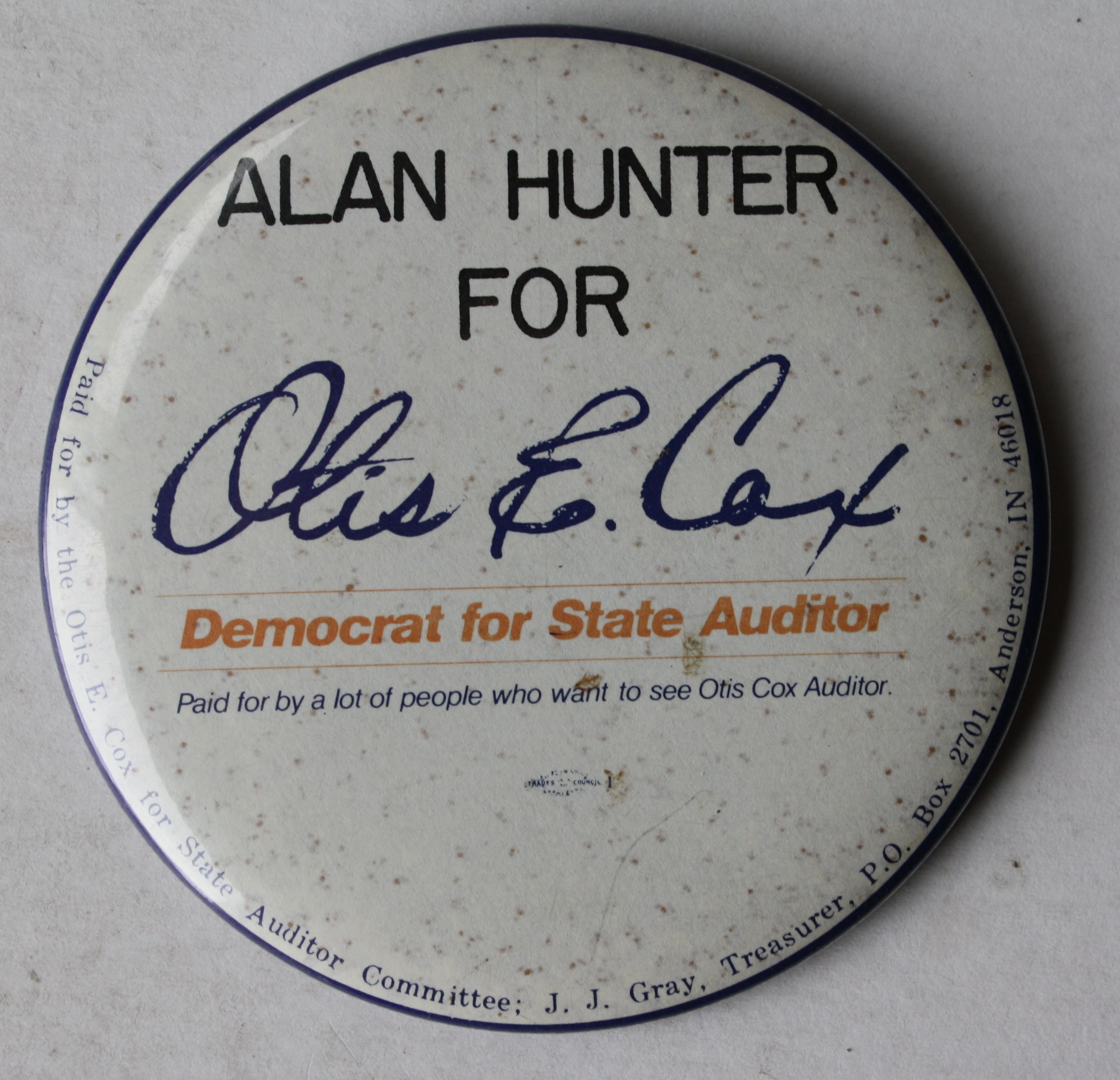
I wore this back in 1982 campaigning with Otis in what seemed like every county in Indiana. Lots of miles, lots of heat and lots of rain on this thing.

I first met Otis as a young collector of political memorabilia just barely after I got my driver’s license. He was always honest, patient and kind with this tinhorn, just learning the ropes of collecting history and participating in the Indiana political process. When he was elected State Auditor, Otis kindly appointed me as one of his deputies at the Indiana Statehouse. A post I held from 1982 to 1985. At that time, Otis E. Cox was 4th in line of succession to the Governor’s seat and the highest ranking Democrat in the state.

Otis counted among his deputy auditors; Mary Moriarty (Adams)-District 17 City Councilwoman, Nancy Michael-former 44th district State Representative and Mayor of Green Castle, & Ed Mahern-longtime 97th district State Representative who holds the singular distinction of being the very first babyboomer born in Indianapolis (arriving two seconds after Midnight on Jan. 1, 1946). Otis Cox helped mold the future of Indianapolis politics for decades to come and his strength of leadership resonates in the Capitol City to this very day. During all those years in office in the State Capitol, Otis dutifully went home each night to Anderson in Madison County.

I drove up to Madison County last week to sit and reminisce with Otis and Pat about old times, politics and their next move in life. Otis is what most would call a loyal “Yellow Dog Democrat”, a political term applied to that part of the electorate who vote solely for Democratic candidates. It is believed that the term originated in the South after Republican president Abraham Lincoln led the Union against the Confederacy to describe those voters who would “vote for a yellow dog before they would vote for any Republican”. The term is now used to describe any Democrat who will vote a straight party ticket under any circumstances.

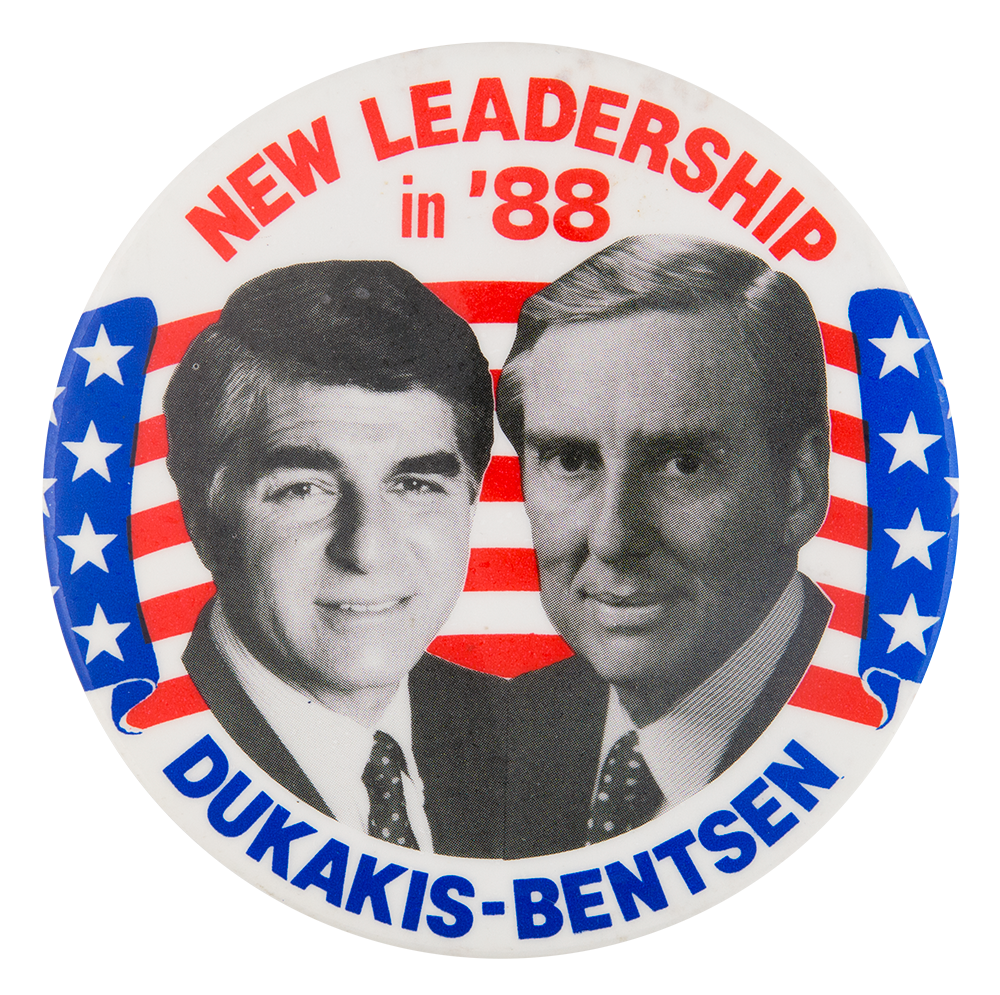
PO-dukakis-bentsen-button_busy_beaver_button_museumI often tell friends that I won my wife Rhonda’s heart back in 1988 when I walked into her store wearing a Dukakis / Bentsen for President campaign pin during the election. She gasped and asked me, “Where did you get that?” to which I reached into my pocket, pulled an identical pin out and presented it to her. Pat tells a similar story about meeting Otis for the first time in the early 1960s. “He walked up to me and asked me if I voted for John F. Kennedy” to which I answered “No.”  He asked me “Well, why not?” and I said, “because I wasn’t old enough.” From that point on, the pair were inseparable while working for LBJ, RFK, McGovern culminating with Otis himself being swept into office with the Jimmy Carter election in 1976.
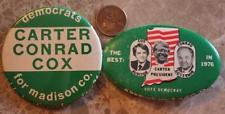
The Cox’s fondly recall that 1976 election, Otis’ first, with several humorous stories about the role Anderson and the state of Indiana played in the Carter victory. “In 1976, there were several people running for the Democratic nomination. Hubert Humphrey, Sargent Shriver, George Wallace, Walter Mondale, Scoop Jackson, Fred Harris, Robert Byrd, Lloyd Bentsen, Birch Bayh, and of course, Jimmy Carter. ” Otis says, “They were all planning to come to Indiana for the primary, back then the Indiana primary really meant something, not like today. All of the candidates advance people were frantically calling Madison County Democrats to find places for these guys to stay. Everyone chose a candidate and Jimmy Carter was the last on the list. A friend of ours took the Carter’s in, (much to the later chagrin of all who’d chosen another candidate), and you know, Jimmy Carter stayed friends with them for decades afterwards. Even invited them to their home in Plains, Georgia whenever the couple traveled down to Florida.”


s-l225
Jimmy Carter-Larry Conrad-Otis Cox 1976 campaign pins.

Otis was a delegate to the Democratic National Conventions in 1976, 1980 & 1984. I asked him about the upcoming conventions to which he replied, “It’s not the same today as it was back then. There are no races anymore. Everything is decided before the convention. It’s more of a formality now than a real convention. In 1980 we had the Carter versus Ted Kennedy fight at the DNC and in 1984 there was the Mondale versus Jesse Jackson delegate fight. Gary Hart was still mixing into that convention as well.” Otis says, “Now its all cut and dried. The Republicans won’t even seat the two delegates pledged to Ron Paul at their convention this week.”

I asked Otis about his time as State Auditor. He smiles that trusting smile that helped sweep him into office back in 1982 and replies simply, “I enjoyed the time I spent there.” When asked if he’d run for office again, he flatly says, “No” then stops and reflects a moment before adding, “Well, if I were twenty years younger, sure.” He talks about the changes he’s seen in the political system during his lifetime of public service. Otis is startled today by the lack of cooperation between members of opposing parties at every level of government. “When I was in the State Auditor’s office both parties worked together, they strive for it. Even though I was the lone Democrat, the other offices bent over backwards to help me. Especially the Governor’s office, whatever we needed, they provided. No questions asked. Mind you, this was on a daily basis. You just don’t see that today at any level.” remarks Otis.

I asked the former State Auditor and his bride how they felt about leaving the only place they’ve ever called home. After all, the Cox’s are moving from a county that many consider to be one of the state’s most economically depressed to a county that is often ranked as one of the most prosperous in the nation. After all, Madison County’s unemployment rate at is nearly 2 points higher than the national average, job growth is 6% lower than the national average, individual income is over $5,000 less than the national average and median household income is over $ 14,000 less than the national average. On the other hand, Hamilton County’s unemployment rate at is nearly 2 1/2 points lower than the national average, job growth is nearly 1% higher than the national average, individual income is over $ 10,000 more than the national average and median household income is a staggering $ 30,000 above than the national average. Although separated by an insignificant distance, that’s a significant lifestyle change.

“Well, we’re not really leaving Madison County,” Pat says “Our friends are here, our bank is here and our doctors are here.” Pat volunteers her time at St. John’s hospital in Anderson (where both of my children and my wife were born). She donates her time making floral arrangements for the patients and plans to continue her duties there. “It’s actually about the same commute for me, 15-20 minutes depending on traffic,” Pat says “Traffic can be bad, but I’m going the opposite direction. I’m going out of Hamilton County when everyone else is coming in.”

Otis Cox will always retain his love for Madison County but laments the loss of industry to the city and county of his birth. “Sadly, the manufacturing industry is gone and I don’t see it coming back.” he says. The automotive industry has a long association with the city; at one time employing some 25,000 auto workers in nearly twenty different General Motors affiliated plants located all around Anderson, trailing only Flint, Michigan in that regard.  Pat chimes in, “We just lost the Emge meat packing plant (on west 8th street), it’s so sad.”  Ever the optimist and booster for his birth county, Otis points out, “But things are looking up, we got the Nestlé’s plant and 300 new jobs a few years back.”

Otis and Pat are moving to be closer to their adult kids, Angie and Chris, who live in the Noblesville / Fishers area. The Cox’s are moving to Britton Falls, a Del Webb adult resort community for ages 55-and-over located near Hamilton Southeastern High School in Fishers. Otis proudly chirps, “It’s just like going on a vacation.” He looks forward to no more yard work and no more stairs in their new ranch style home. He continues, “But Anderson will always be home. I will miss Anderson.”

I asked Otis if he had any regrets from his decades of public service. He pauses, leans back in his chair, places his fingertips together with his index fingers brushing the tip of his nose as his thumbs gently touch his chin, “Yes, I had one regret.” he replies. “When I was commissioner, I was always sorry that I couldn’t get a couple roundabouts built in Anderson at places I felt needed them. But you know, now that I’m spending so much time in Hamilton County (which has well over 100 roundabouts) I’m getting sick of seeing them.” followed by a hearty laugh from the man who was once the most powerful Democrat in the State of Indiana. Well, Otis, if that’s your only regret from all those years of public service, I’d say you’ve served your city, county, and state well. Enjoy your retirement my friend, you’ve earned it.