Creepy history, Ghosts, Indianapolis, Irvington Ghost Tours, Weekly Column

The Ghosts of Playground Productions in Irvington.

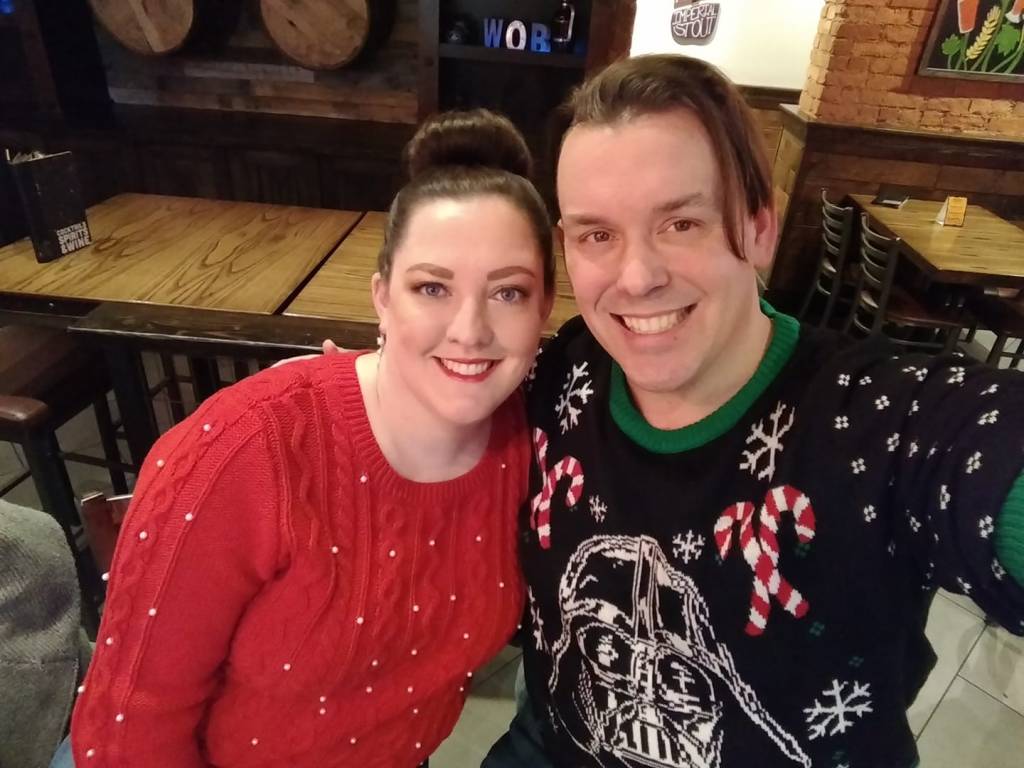
Andrea and Adam Long of Playground Productions.

Original publish date October 16, 2025.

https://weeklyview.net/2025/10/16/the-ghosts-of-playground-productions-in-irvington/

One of the enjoyable aspects of leading ghost tours in Irvington every October is hearing the new ghost stories and spooky tales associated with the buildings we pass along the route. For the past few years, Adam Long and his wife, Andrea, have allowed the tours access to their building, Playground Productions Studio at 5529 N. Bonna Ave., as a jumping-off point to rest and recover after tours. Some of you may know Adam by his stage name, Adam Riviere, a homage to his mother’s whose maiden name. Most importantly, the studio hosts the crew from the Magick Candle every Friday and Saturday night during October for psychic readings for our tour guests and visitors, with the proceeds going to fund the food bank at Gaia Works (6125 E. Washington St.).
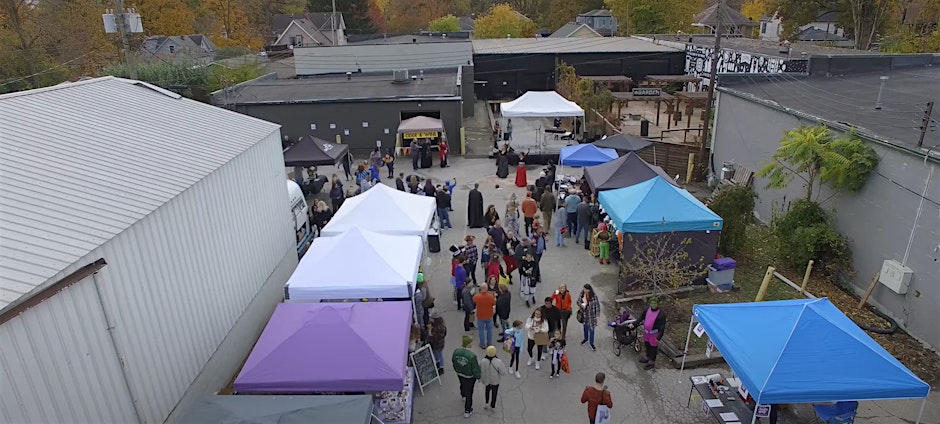
Playground Productions Studio at 5529 N. Bonna Ave. during the Halloween Festival.

Adam graduated from Martinsville High School, studied at Butler University, and attended IUPUI for his graduate work. Adam is an accomplished musician and an artist in his own right. Andrea, originally from London, Kentucky, graduated from North Laurel High School there and from IUPUI in Indianapolis. Andrea is quiet, but when she talks, she speaks with an easy southern drawl that somehow soothes the listener’s ears. As I write this, the couple is celebrating their eleventh wedding anniversary. Adam and Andrea were married in 2014, but have been together since 2008. I first met Adam over a decade ago, when he was a guest on one of my ghost tours. After hearing the Abraham Lincoln ghost train story, which concludes each tour, Adam was sprung. He later informed me that the story resonated with him so deeply that he commissioned an artist friend to create a painting of the ethereal visage for display in his studio office. It comes as no surprise that Adam’s studio is located along the historic corridor of the railroad tracks upon which Lincoln’s funeral train traveled back on April 30, 1865.
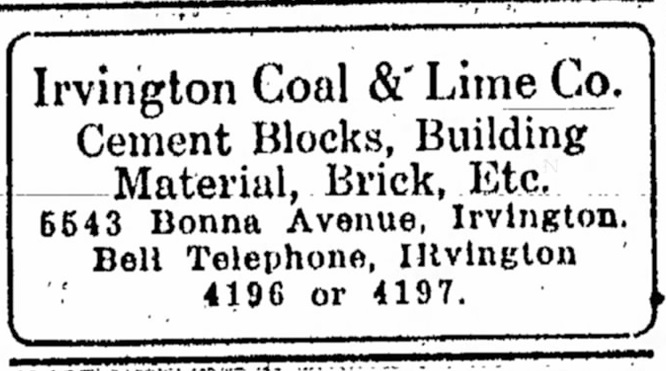
Indianapolis Star Sunday December 25, 1921.

Adam’s studio has an interesting history. Adam stated, “It was originally the Coal & Lime Company in Irvington. That was why they wanted to call this area the Coal Yard district, because this is the spot where the trucks would come and pick up the coal to deliver to the areas close by.” The name is a bit of a misnomer, however. While it is true that the company sold “Hoosier Red Pepper Coal” harvested “clean” and “hand picked” from “Indiana’s Richest Coal Mines,” contrary to it’s strict definition, the company specialized in providing hydrated mason’s lime used in the manufacture of common bedrock building materials like glazed tile, fire brick, cement blocks, and common bricks.
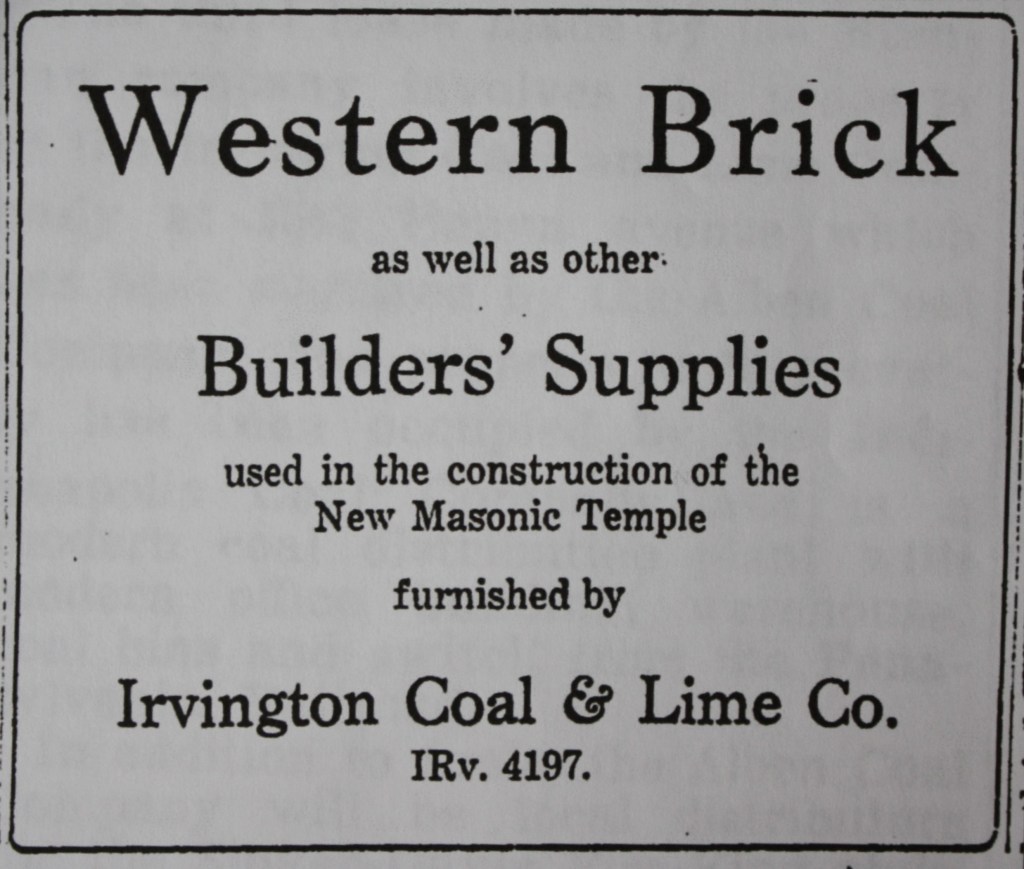
August 3rd, 1922, Indianapolis Star ad.
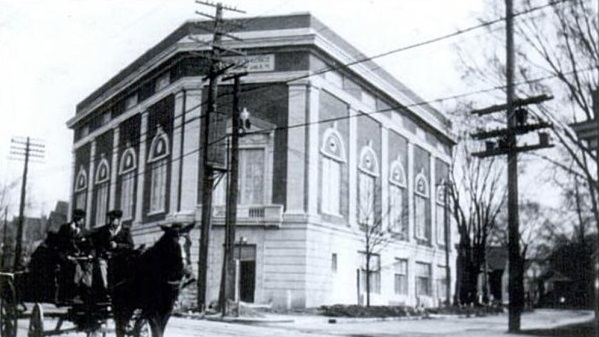
Irvington Masonic Lodge 666 in 1922.

On August 3rd, 1922, an ad on page 10 of the Indianapolis Star boasted that the Irvington Coal & Lime Company supplied the “Western Brick as well as other builder’s supplies used in the construction of the new Masonic Temple,” a.k.a. Irvington Masonic Lodge 666, whose cornerstone was laid the year before. Adam was quick to point out to visitors to the property that a portion of the foundation for the old brick factory remains in place several yards away from his studio entrance. Adam informed, “In the early 1950s, a company called Foamcraft bought the building.”
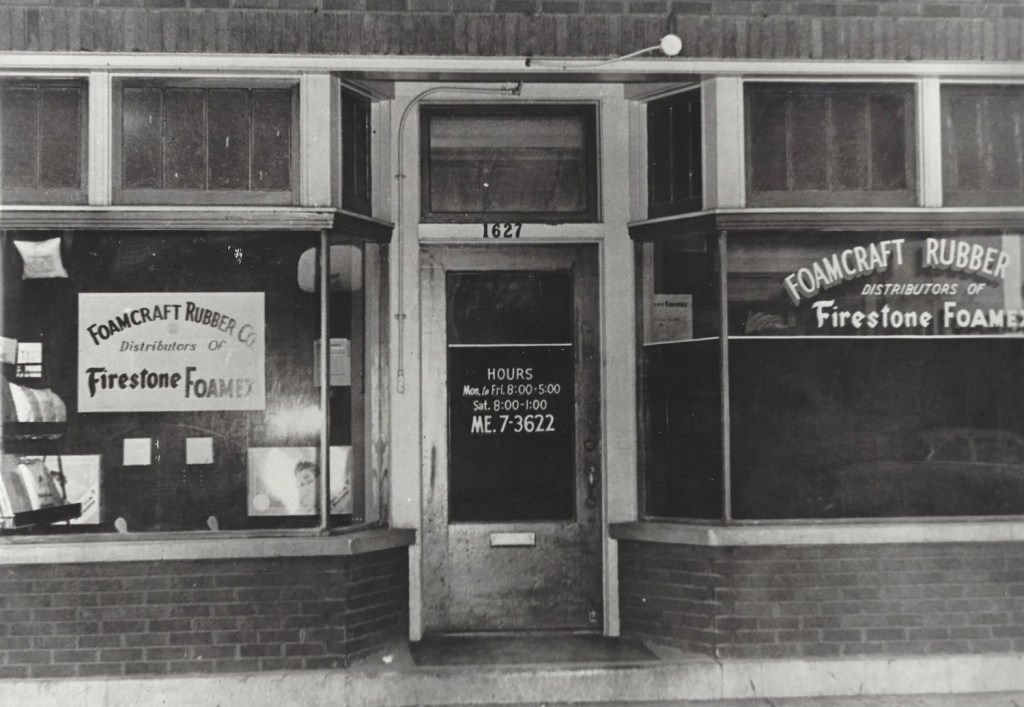
Foamcraft with Firestone ad.

Foamcraft still exists. According to their website, “In 1952, Robert T. Elliott, the founder of our company, started the Foamcraft Rubber Company. As a District Sales Manager for the Firestone Tire and Rubber Company, he was responsible for helping to start several foam rubber distributors. Foamcraft was his special passion, though, and in founding our company, he set a foundation for business integrity and dedication to service, as well as a vision to develop long-term relationships with our customers.” Foamcraft makes specialized cushioning used in furniture, beds, minivans, boats, and other products. The company buys large blocks of foam rubber called “Buns” or “Blocks” and cuts them to smaller sizes and shapes as needed by their customers. It was, and remains, a family-run operation with a very high-tenured workforce staffed by generations of families working “cutting foam” for a variety of customer products. The company boasts a 99.9% on-time production and delivery reputation.
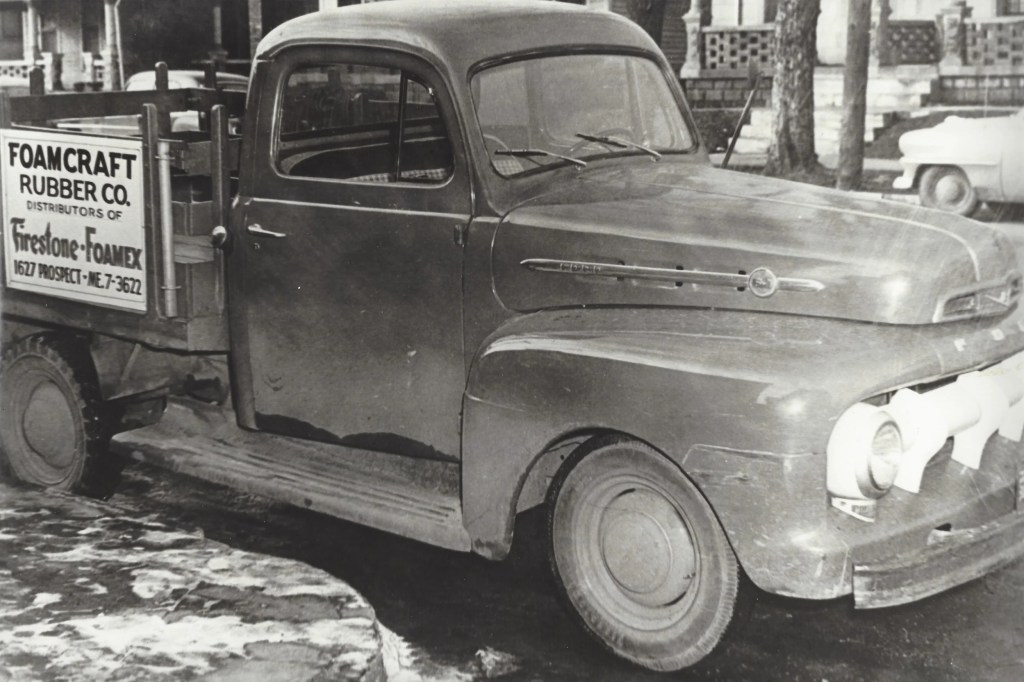
Foamcraft Truck in 1952.

Elliott opened his Irvington foam factory on Bonna Avenue in 1957, and it remained there for the next 44 years. Foamcraft briefly relocated in 2001 to a leased building on Post Road before moving to a much larger facility in Greenfield in 2016, where it remains today. Company headquarters are located at 9230 Harrison Park Ct. in between the Fort Benjamin branch library and Peyton Manning Children’s Hospital in Lawrence. Foamcraft also has a manufacturing facility in Elkhart. They never forgot their ties to Irvington, though. Employees referred to the old 20,000 square foot factory, made up of several buildings, simply as the “Bonna.” According to their Web site, employees remember the Bonna facility as “dark and spread out with rooms everywhere. It was sort of claustrophobic with low ceilings, and we worked elbow-to-elbow. It had slippery floors throughout the facility, which sometimes required us to spread sand or sawdust in certain areas.” Despite the distinctly ominous Irvington location’s appearance, inside and out, Foamcraft’s employees described the working atmosphere as “Valhalla.”
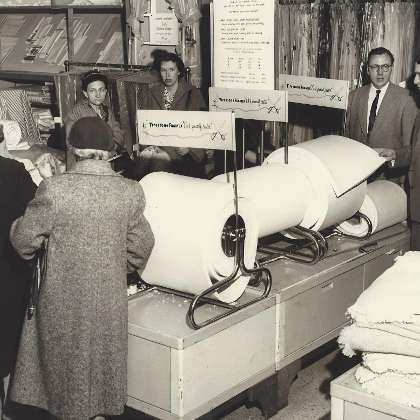
Foamcraft Interior 1950s Era.

One former employee, Jim Quakenbush, recalls that Foamcraft Inc. “ was located on Bonna Ave. just east of Ritter Ave. I worked there for two summers, unloading railroad cars in 1970 & 1971. I have fond memories of working there. Rob Elliott, whose father owned the company, worked with me unloading train cars full of large refrigerator-sized foam rubber “buns”. I think Rob became the CEO and may still be. The warehouse building still stands, but the office building is gone. The railroad track is gone. I really enjoyed the people. My supervisor was Dave Fisher. Great guy. Don Scruggs was a truck driver, funny as hell. Larry Harding worked with me. [The] Sewing department had Ursie Hert, Ralph Wainwright, from Jamaica. Clayton Sneed was a saw operator. Paul was an autistic laborer who used to irritate Ralph. I laughed so hard listening to them argue back and forth. All in good fun. Good memories.”
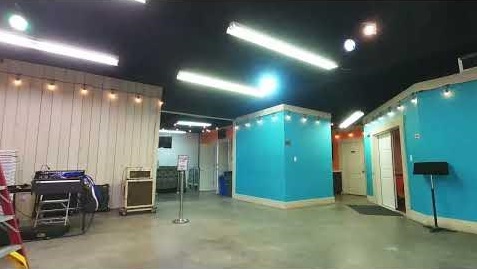
Interior of Playground Productions Studio.

The old Foamcraft building has quite a history to it, and apparently, a few ghosts as well. Adam recalled, “When I first moved in here, while I locked up at night, stepping out the door, there was a feeling. It wasn’t really ominous, but it definitely gave you a creepy feeling. “ When asked if he feels a presence in the building, Adam stated, “Yes, sometimes when I’m alone in the building, I can hear sharp knocks on the wood in the studio. When I check, nothing is there to explain it.” Adam and Andrea say they don’t ever feel uncomfortable in their building, and they don’t think there is any dark energy connected to their workspace. “We just take it as it comes, we’re used to it now.”
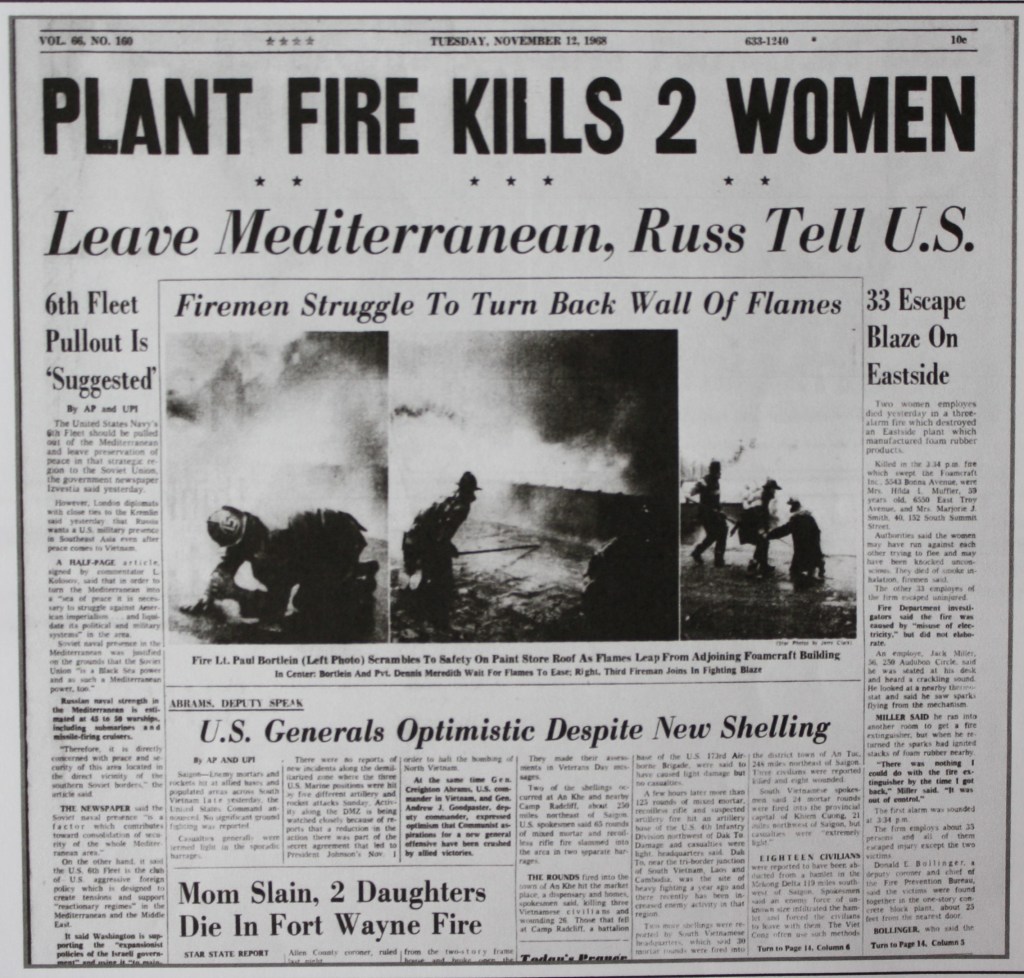
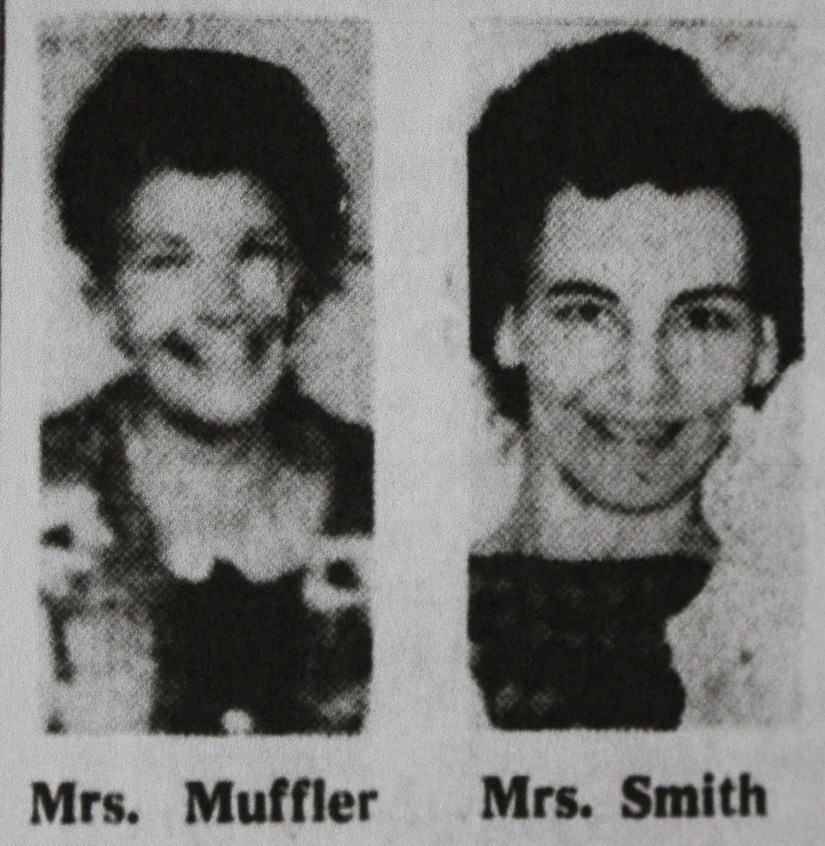
The factory site was visited by tragedy in the autumn of 1968. The front page of the November 12, 1968, Indy News announced “Plant Fire Kills Two Women. 33 Escape Blaze on Eastside.” At 3:34 in the afternoon, firefighters responded to a three-alarm fire at the Foamcraft factory plant. Mrs. Hilda F. Muffler, 59, of 6550 East Troy Avenue, and Mrs. Marjorie J. Smith, 40, of 152 South Summit Street, were killed in the blaze. Mrs. Muffler was employed as a seamstress, and Mrs. Smith as a cutter. Authorities theorized that the two women may have collided and been knocked unconscious during the frenzy to escape the fire. The women died of smoke inhalation and heat. According to the article, Fire Department investigators said the fire was caused by ‘misuse of electricity,’ but did not elaborate.
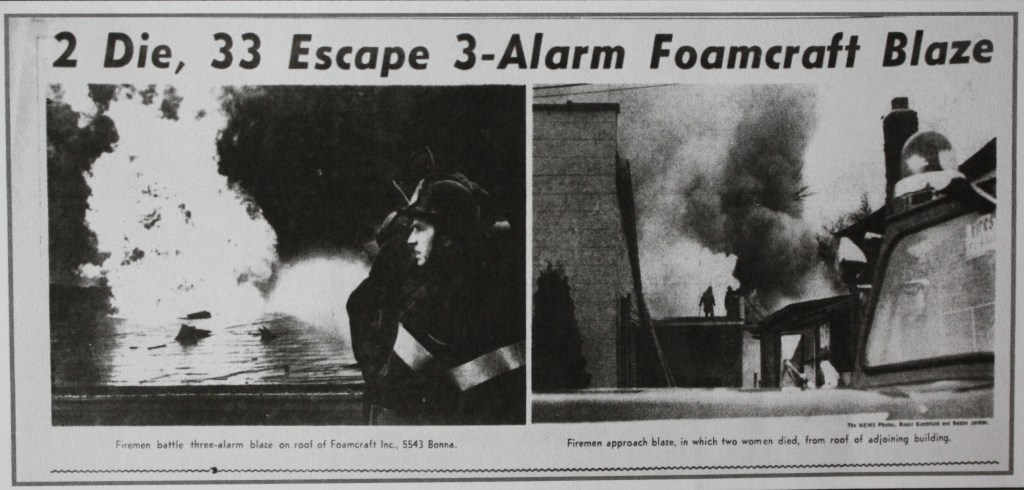
The article further reports, “An employee, Jack Miller, 56, 250 Audubon Circle, said he was seated at his desk and heard a crackling sound. He looked at a nearby thermostat and said he saw sparks flying from the mechanism. Miller said he ran into another room to get a fire extinguisher, but when he returned, the sparks had ignited stacks of latex foam rubber nearby. There was nothing I could do with the fire extinguisher by the time I got back. It was out of control.” Another Star article quotes Miller as saying he saw a “flash of lightning” come from the wall thermostat and strike a pile of foam. Deputy Marion County Coroner and chief of the fire prevention bureau, Donald E. Bollinger, said the victim’s bodies suffered no burns and were found lying face down perpendicular,  one atop the other, in the one-story concrete block plant. The women were found within 4 feet of an office door and only 8 feet from the nearest exit door.
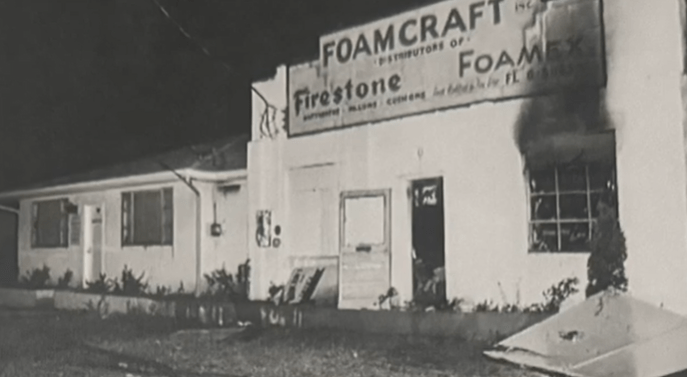
Foamcraft Building Exit Door After The Fire in 1968.

They were discovered to be some 70 feet from the nearest fire damage about 25 minutes after the first alarm had sounded. Other employees challenged the notion that the women panicked trying to escape. Bollinger later theorized that since Mrs. Smith’s coat was found lying next to her body, the women may have attempted to reach a restroom to retrieve their coats and purses before being overcome by smoke.
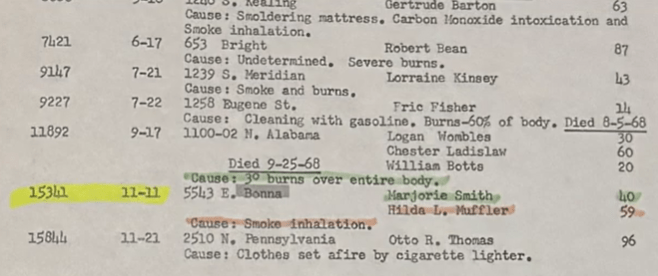
Coroner’s Report From the Foamcraft Fire.

The fire was spectacular, with flames shooting over 100 feet high in the sky, and the massive plumes of heavy black smoke could be seen from all over the city of Indianapolis. The high-intensity heat hampered firefighters’ efforts to extinguish it quickly. The first alarm came at 3:34, the second at 3:44, and the third at 4:42 pm. Emergency first responders arrived quickly with over 20 pieces of firefighting equipment and 65 firefighters. John T. O’Brien, owner of the Bonna Printing Company at 5543 Bonna Avenue, reported that his adjacent building suffered only minor smoke and water damage during the conflagration. Other adjacent businesses, Krauter Equipment Company & the Firestone Tire & Rubber Company, also reported minor damage. At 12:17 am, the blaze briefly reignited, and firemen were again called to extinguish the flames. That second fire had ignited beneath the collapsed roof of the factory and was brought under control at 1:17 am.
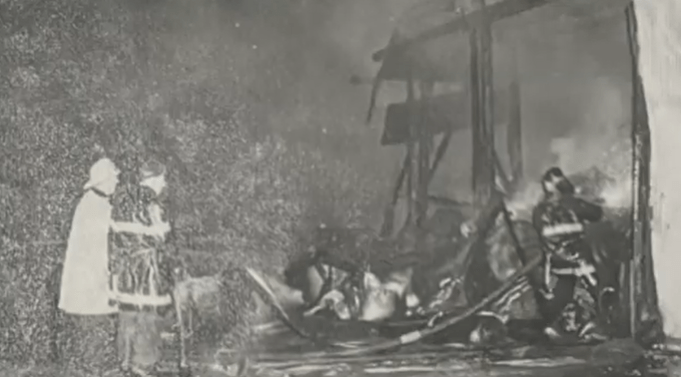
Foamcraft Fire.

The Foamcraft building was destroyed in the inferno. Investigators determined the fire started along the north wall of the “blackened pillow room” on the northeast corner of the building. Deputy Chief Bollinger later speculated that the fire could have been prevented if the wall receptacle box, which contained the mechanism controlling the heating blowers, had been properly covered. One unnamed employee told Bollinger that he tried to make a metal cover for the box the week before the blaze, but was shocked during the attempted installation and was unable to do so. That same employee said that he had informed company officials of the problem, but it had not been fixed yet.

Learning that Adam and Andrea’s building may have a resident ghost, one could believe that the spirits of Playgorund Productions Studio are those of the tragic victims of the Foamcraft factory fire from 1968, but that does not appear to be the case. Tim Poynter, intuitive psychic empath who has worked with me on the tours for decades and now spends every October Friday and Saturday night in the building, admits that he encounters those spirits regularly, “But they aren’t necessarily attached to the building. They seem to be just passing through. Sometimes the tour guests bring them, and at other times, they are brought in by the readers.” Likewise, longtime tour volunteer Cindy Adkins, who was featured as a psychic intuitive in an episode of Zak Bagans’ Ghost Adventures in 2019, does not feel a resident ghost in the building. “They’re not in here permanently. I don’t feel them inside, but I do think some spirits are roaming around outside the building.” said Cindy. Indeed, it should be noted that the spot where the two employees died is located outside the studio, about 20-30 yards northwest of the door.
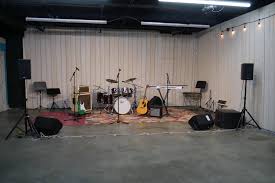
Inside Stage at Playground Studios.

Today, Playground Productions Studio is a far cry from the old, dark, and spooky, chopped-up Foamcraft factory. The working studio is now full of light and texture. Walls are constructed of a naturally grounded hardwood facia and are peppered by soft blankets buffering any echoes and sounds that might affect the recording work. The artists, bands, and performers who regularly work or visit the Playground are joyful and carefree whenever there is an event or party going on. Knowing the depth of feeling that former Foamcraft employees have for the old “Bonna” location, it is easy to imagine that if there are spirits hovering around the property, inside or out, they do so with mirth and glee.

https://www.linkedin.com/posts/foamcraft-inc-_the-story-of-foamcraft-inc-activity-7089985534889975808-y92J/
Foamcraft has created a fantastic, informative, and historical video with scenes shot at the old factory on Bonna. It can be found on the Web at: https://www.linkedin.com/posts/foamcraft-inc-_the-story-of-foamcraft-inc-activity-7089985534889975808-y92J/
Hollywood, Music, Pop Culture, Weekly Column

Paul Bearer and the Morticians-An Indiana Garage Band Story.

Part I

Original Publish Date September 18, 2025.

https://weeklyview.net/2025/09/18/paul-bearer-and-the-morticians-an-indiana-garage-band-story-part-1/
As many of you who have read my columns over the past two decades will recall, I am a collector. Many of my columns center around collectibles, some valuable, some historic, and some for sheer folly with no lasting value other than a momentary nostalgic smile. I often visit regular antique shows, events, and roadside markets looking for whatever I can find. I recently visited a regular haunt and once again found my hands inside of boxes containing an assortment of papers and bric-a-brac from a lifetime ago. Sometimes, I run across something serendipitously, as if it was placed there specifically for me to find; one step away from the trash heap.

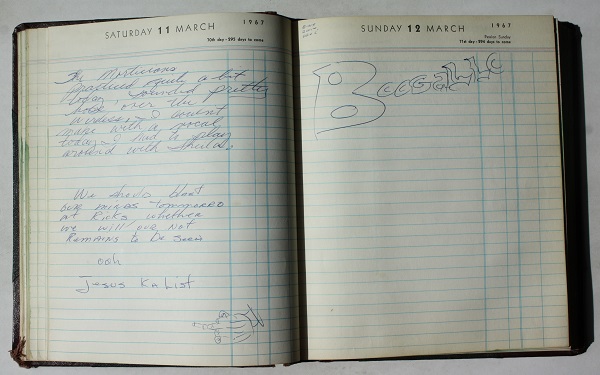
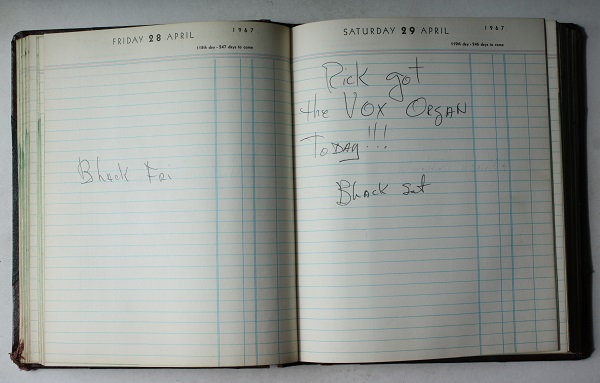
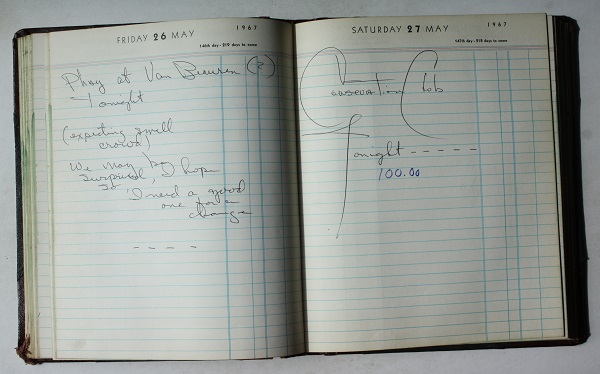
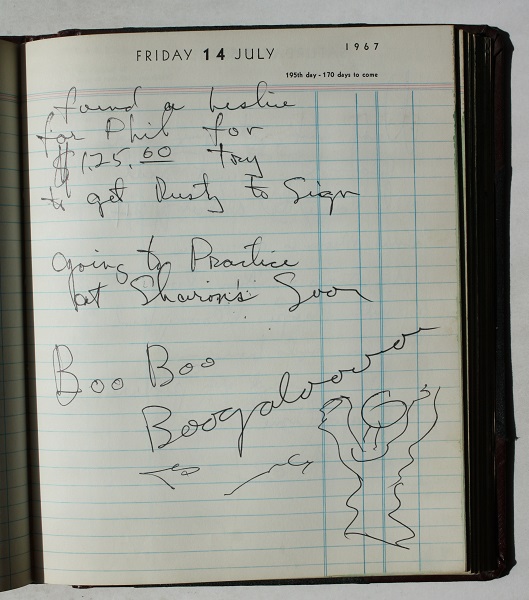
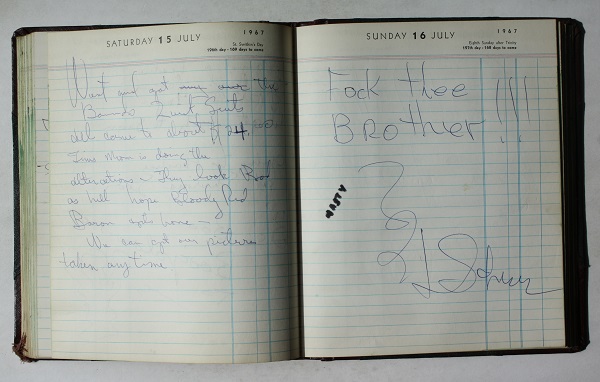
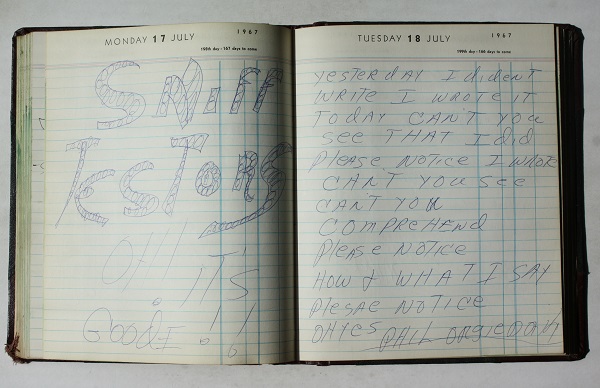
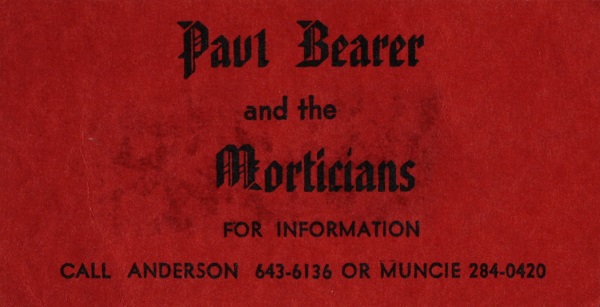
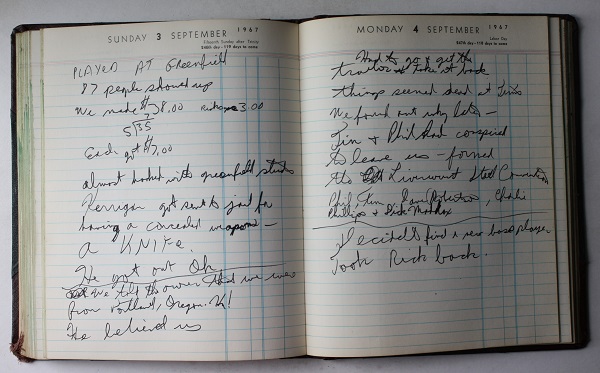
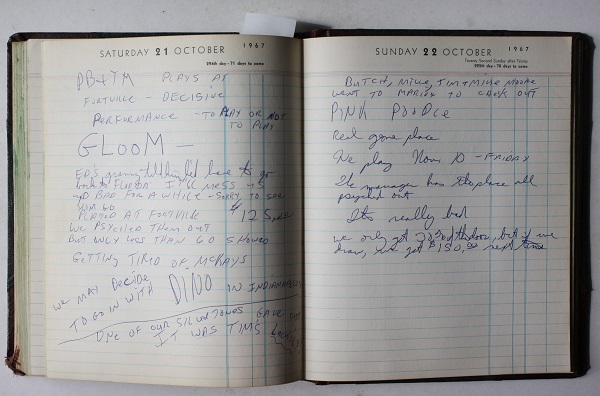
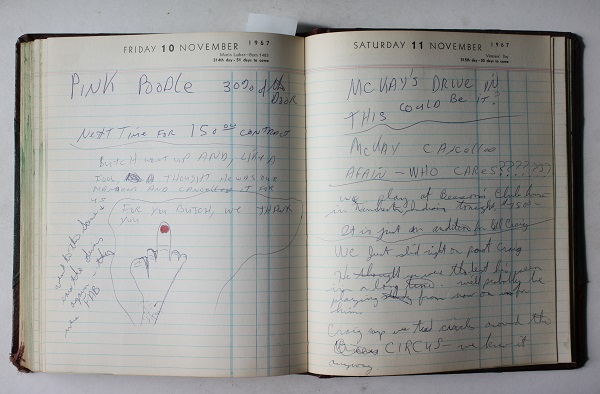
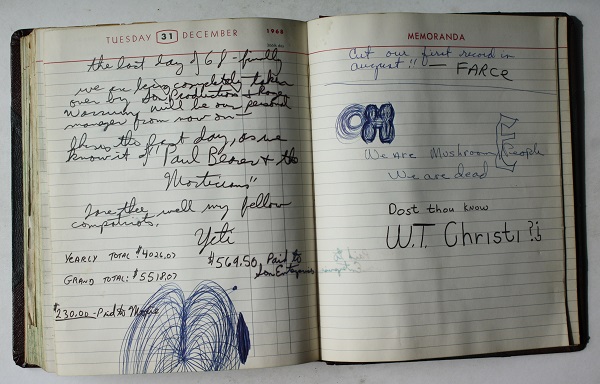
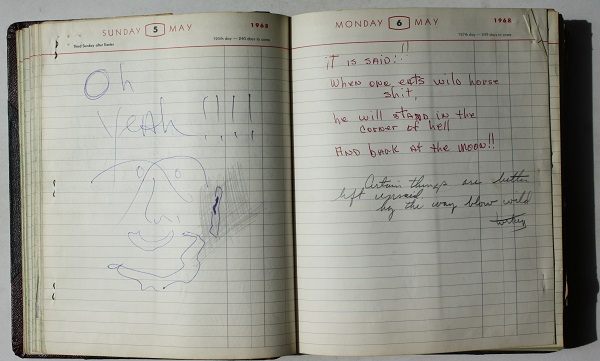
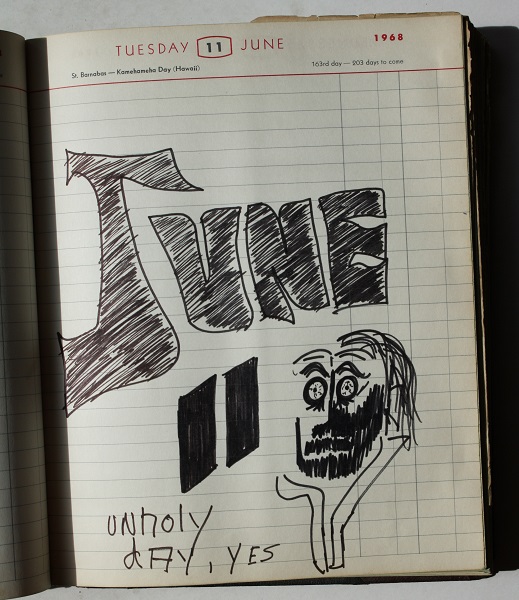
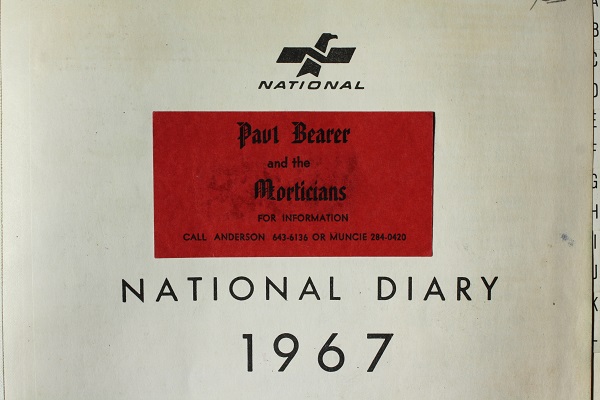
In this box, there were two 8×10 thick & heavy leather-bound books, each titled “National Diary”, although they have 1967 & 1968 cover dates, I believe they’re from 1968 & 1969 (likely a frugal “clearance” purchase by a struggling band not hung up on the concept of time, man). When I opened the initial book, the first thing I saw was a bright red business card pasted to the top of this page, emblazoned “Paul Bearer and the Morticians” with Anderson & Muncie, Indiana phone numbers inset. I quickly flipped through the first few pages to see what it was, as a wide-eyed smile slowly crept across my face. Not the best poker face, I told myself as I slammed the book closed and decided that these were going home with me. There they sat beside my “writing chair” waiting for me to devour them. Life gets in the way sometimes, so it took me a minute to get there. Oh, I would occasionally pick one of them up, flip through the pages, and whet my curiosity whistle, until I finally had a day to devote to a full read.

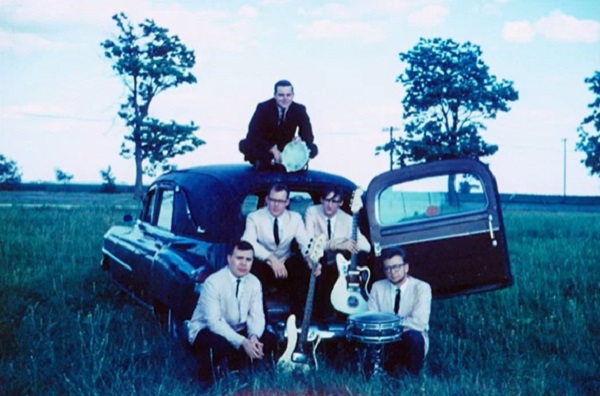
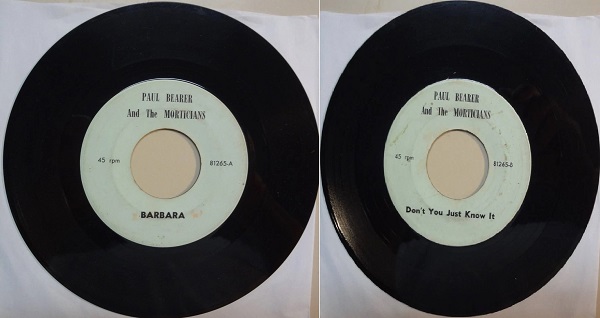
Turns out, what I had accidentally stumbled over was a day-by-day accounting of an Indiana garage band as detailed by one of its members, Larry Scherer, aka Paul Bearer himself! Larry Phillip Scherer was born Sept. 19, 1946, in Anderson and passed away on Jan. 23, 2004, in Greenfield. By all accounts, while growing up, Larry lived an ideal Hoosier childhood. He was active in Cub Scouts and Boy Scouts and played football and Little League baseball. He graduated from Anderson High School in 1964 and later earned his BA and MA in Counseling Psychology from Ball State University. He was the lead singer of the band, Paul Bearer and the Morticians. Not a lot is known about this band. A few references can be found on the net, including a 45 rpm single and a single publicity shot of the 5-man band posed around a hearse in a cemetery surrounded by their instruments. The single’s A-side is a song called “Barbara,” and the B-side is “Don’t You Just Know It.”

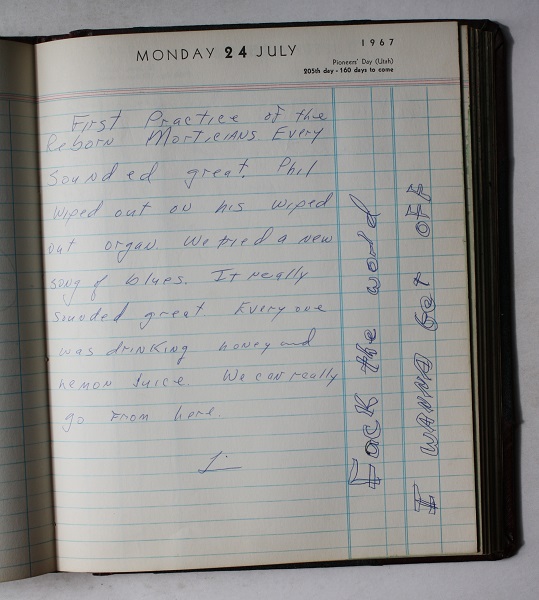
Each book begins & ends with a calendar page, both jumbled by hurried circles, arrows, and scribbles denoting sporadic gigs every week. Flipping through the pages, one can almost feel the high hopes of the band melting away during those first formative winter months. The entry for January 1 notes that the band took some publicity photos, which must have boosted their hopeful confidence immensely. Then reality sets in. The pages from January to February are filled with depressing notations of inactivity: “Nothing” and “Nada” on nearly every page, like a road to nowhere. Around Valentine’s Day, things were looking up, but not musically. Feb. 10, “Went to see Paul Revere + the Raiders-they were great-got a tip at where they were staying + buzzed out there. Holiday Inn-Got all their autographs…Jack talked to Mark Lindsay…We should have some great pictures.” On Feb. 17th, “Played at McPherson’s Dance Inn [in Anderson] over 300 showed up, we made $100 clear (about $1,000 today)…Thank God…we each got about $14 per man.”

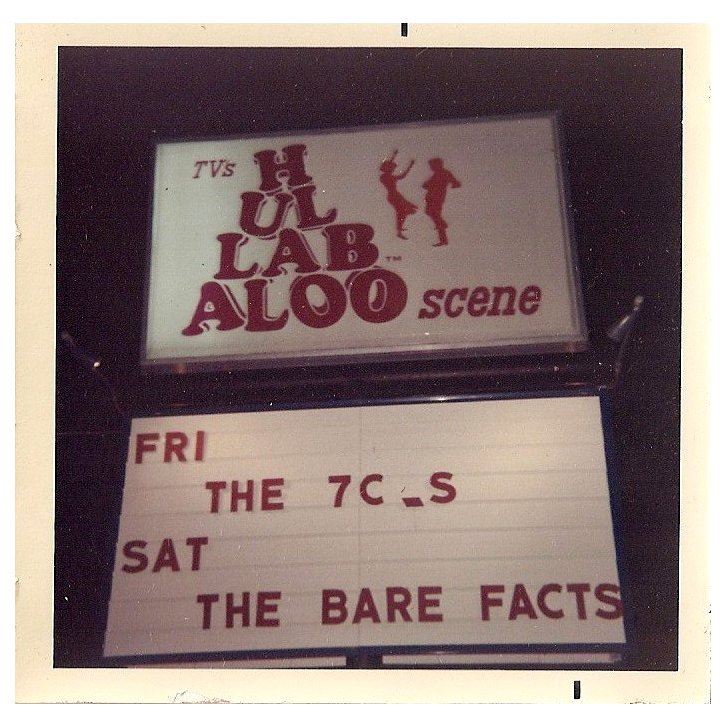
Bolstered by this modest success, the boys begin to practice regularly on original compositions (Town of Evil) and covers (Cream’s “Sunshine of Your Love” and “Outside Woman Blues”) in preparation for a desired gig at a “Hullabaloo”. A Hullabaloo was the franchise name for teen dance clubs spinning off the popular NBC musical variety show of that era. The TV series originated in London and was hosted by The Beatles’ manager Brian Epstein before hopping across the pond to America.

These trademarked “Hullabaloo” nightclubs were usually found near colleges (Ball State, IU, Purdue, Notre Dame, etc.) and larger high schools. On Feb. 27, the band played the Conservation Club in Anderson and received $140. “[We] sounded like a professional group, surprised everyone but me…First time we used Saxophone-sounded real good-going to use it a helluva lot more.” The success of that gig led to an audition for the Teen Time Lounge in Hartford City. March 3: “Notified to play Teen Time Palace…Sounded Great. KIds ate us up. Nothing much happened except some clown busted a $200 glass door. Some girl asked for autographs.” The band was paid $75 and by now Paul Bearer and the Morticians had a set list of 41 songs: “35 good ones-6 stand bys” including covers of the Rolling Stones “Under My Thumb”, Junior Walker’s “Pucker Up Buttercup”, Spencer Davis Group’s “Gimme Some Lovin”, and Wilson Pickett’s “In The Midnight Hour.”

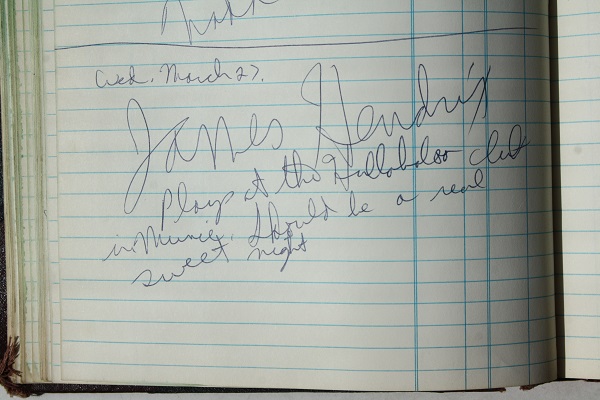
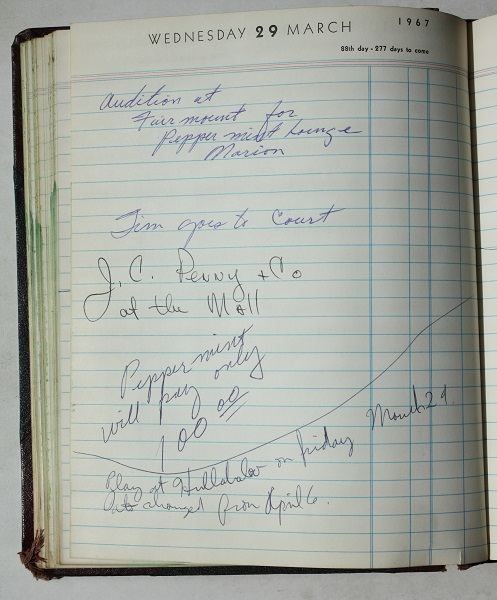
By mid-March, the band was looking ahead to a gig at Anderson’s Peppermint Lounge. March 15, “Tim came over to get some money to finish the coffin-Paid $5.” The Morticians were paid $115; by the time they left the stage, the boys made $7 each after expenses. On March 22, the band hoped to land a $125 gig at the Hullabaloo in Muncie. March 27 entry reads: “James Hendrix plays at the Hullabaloo Club in Muncie.

Should be a real sweet night.” The very next night, the Morticians take the stage. The band is fielding inquiries for gigs at Rensselaer ($115 payout), Hartford City ($50), Fairmount ($100), and Lapel ($85). April 1: “Best critics in Anderson-my friends-said we were whats happening-I agree!! The guys sounded great. I know we can make it to the top-just a matter of time—is on my side, yes it is.” On April 5, the Morticians book a gig to play at the Hullabaloo Club in Dayton, Ohio: for $150. On April 8, the boys again played for Anderson’s Conservation Club. “Blast it was too!! The band finally hit what its worth-a cool 40 beans apiece!! There were 267 kids there-about half sniffen glue-haha. Split the profit.”

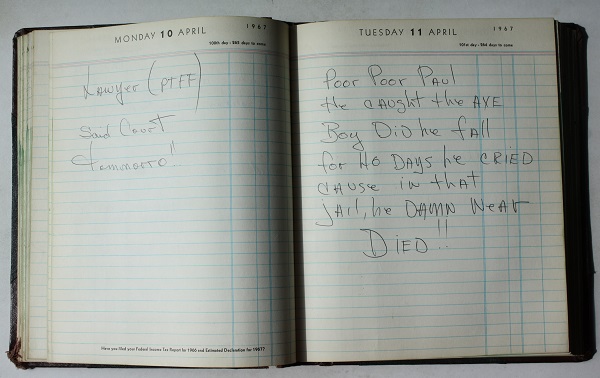
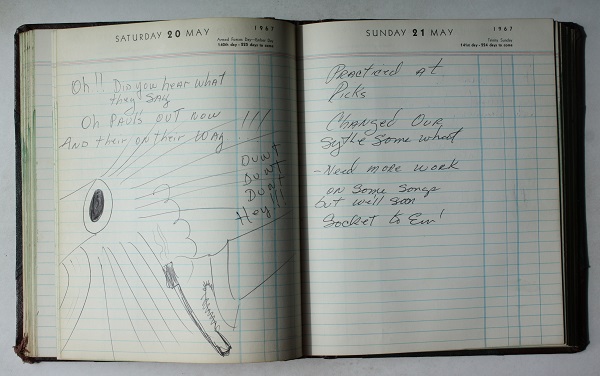
On April 11th, the diary lyrically notes, “Poor, Poor Paul. He caught the axe. Boy, did he fall. For 40 days he cried cause in that jail, he damn near died!!” For the next 40 pages, every day is denoted as “Black Monday, Black Tuesday, Black Wednesday, etc.” On May 20, another lyric, “Oh!! Did you hear what they say. Oh Paul’s out now, and their on their way. Dunt Dunt Dunt Hey!!”

The band starts up again, practicing regularly at “Rick’s”. May 21: “[We] need more work. Changed out style somewhat on some songs but we’ll soon socket to em!” May 26th “Play at Van Buren tonight. (expecting small crowd) We may be surprised, I hope so. I need a good one for a change.”

May 27, “Conservation Club Tonight $100.” On June 5th, the band joins the American Federation of Musicians for $102.50. June 29th, “Practiced at Rick’s house + thusly decided to kick out Rick. One Mortician is buried.” July 7, “Found the band outfits at a Brand X store in Indianapolis. Sweet as hell for a mere 5 beans.” August 6, “Got our publicity pictures taken today at the graveyard in back of North Drive Inn [Anderson] 14 in all. Two sets of clothes. Outta be cold, cold shake cool. Blimey Govnor.” The entry on August 8 is actually the handwritten lyrics to a song: “There is a man from L.A., That is hard to understand. People tell me he’s an uncertain kind. In California where kids blow their mind. He has come to Hoosierland to waste his time. There are two things that he loves, an old truck and a jail to sleep. Some call him little Bo-peep. Since coming to the Midwest, he is always losing his job, because of this he can’t afford my little nest. Maybe someday he’ll be persuaded to stay around, he’ll be downgraded. No home to go to weep or food to eat. This is a man from L.A. who sleeps in the hay. He is a different brand, but now a lighting man.”

August 14th, another song, not much better than the first: “Hey Baby, why don’t you love me anymore. Hey Baby, I been here all alone eh. You know I love you, But you don’t realize, you will love me, when I look in your eyes. Oh, you got to love me, baby, then love me all the time. In the morning, in the evening, in the summer, in the winter, you gotta love me. Hey baby, I’ll buy a house + settle down. Hey, ask your mom, tell her I love you. If there’s any doubt, Baby believe me, everything I say is true. If you don’t love me, I’ll try to be true. You got to love me in the bathroom, in the kitchen, in the basement, in the sink, in the backyard. You gotta love me.” August 17, “Practided! Worked on a couple new songs. Two friends of Phil’s who own the Acid Land nightclub came to watch us. Played a lot of Psychedelic stuff.” August “Paul went to labor at the Delco Remy Salt Pits…Won’t last long.” September 3: “Played at Greenfield. 87 people showed up. We made $38. Each got $7. Tim + Phil conspired to leave us-formed the Liverwurst Steel Convention [band].” By mid-month, the Morticians were practicing new songs, mostly by The Who: “Whiskey Man” & “Pictures of Lily”.

The band booked a Sept. 30th gig for $125 at McKay’s Drive-In nightclub known as the “Psycadelic Sounds at The Place” on Highway 67 in Fortville, after which they were signed as the “House Band”. October 1st, “Played at Fortville, made $2 per. If fortune doesn’t straighten up, we’re going to drop McKay. Not enough crowd…Learned two more songs: “I Need You”-By The Beatles + “Tired Of Waiting For You”-Kinks.” Oct. 18th: “We really psyched out on Fortville. I can’t explain. Had Better Be Ready.” Oct. 21: “Fortville-Decisive Performance-To Play or Not to Play. GLOOM. We psyched them out but only less than 60 showed. Getting tired of McKay’s.” Nov. 4, “Dance scheduled for McKay’s but he screwed us up again + cancelled the dance cause his roof wasn’t fixed.” Nov. 8, “We play at the Beeson Clubhouse Country Club [in Winchester] on Saturday Next. Nice Place. We get $75. Auditioned for the Hullabaloo Club in Muncie tonight. They thought we were BEAUTIFUL!! They dug the Jimi Hendrix stuff we played.” Nov. 11: “McKay’s Drive In. This could be it. McKay cancelled again-who cares??? We played at Beeson’s Clubhouse in Winchester, Indiana tonight. $75.” Nov. 15: “We found out the WHO will be in Muncie on Thanksgiving night + there’s a chance we might play alongside them. It may all depend on our performance at the barn Saturday night.” Nov. 23-Thanksgiving day. “The Who played at the new barn. All of us went to see them-they were greater than ever. We got to talk to Pete Townshend a little bit-he was really cool. Mike got some great pictures.”

By December, the Morticians set list included 39 songs including JImi Hendrix “Hey Joe” (which they performed twice back-to-back), “Give me some lovin'”, “I can’t explain”, “Mickey’s Monkee”, “Bring it on home to me”, “Louis Louis”, “Money”, “Little Latin Lupe Lu”, “Hold On”, “We gotta get out of this place”, “Purple Haze”, “Fire”, “Foxey Lady”, “MIdnight Hour”, “The Letter”, “House of the Rising Sun”, “I’ve been loving you too long”, “Lady Jane”, and an intriguing original song titled “Ban the Egg.” On Christmas Eve, the boys “Played at Winchester for $75. The crowd dug us bad. Michael Eddie screwed up Purple Haze 3 times that night-Used Pete Townshend’s guitar strap.” The Morticians practiced but did not gig for the remainder of the year, resulting in the Dec. 31st entry: “A very dull New Year’s Eve Indeed.” Year-end receipts totaled $1899.50 (just under $20,000 today), averaging out to $70.70 per gig. Split between a rotating lineup of five musicians per night, it doesn’t take a mathlete to figure out that none of these guys could quite their day jobs.

Paul Bearer and the Morticians-An Indiana Garage Band Story.

Part II

Original Publish Date September 18, 2025.

https://weeklyview.net/2025/09/25/paul-bearer-and-the-morticians-an-indiana-garage-band-story-part-2/

In part I of this article, I detailed one of my latest “Finds”, a 1968 diary from the leader of a 1960s Anderson, Indiana garage band known as “Paul Bearer and the Morticians.” I love that it landed in my lap just before the official spooky season in Irvington commences. I wanted to share it with you, the readers, because I thought that it might stir the chords of mystic memory for other Circle City hippy kids like myself.

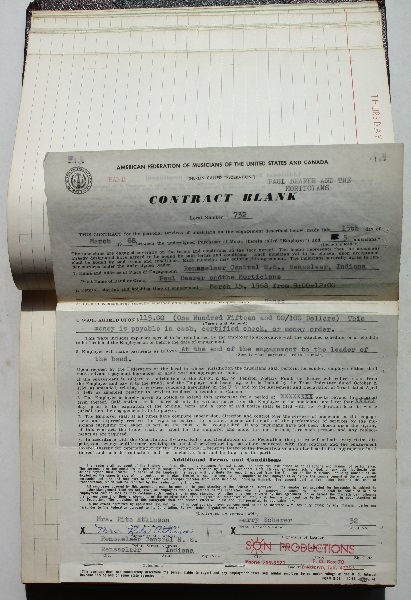
Jan. 13 [1969]: Played at the Loft in Muncie for a mere $75. A real good crowd showed up + there were only a few meager fights. Jan. 25: “Conservation Club [Anderson]- “Not too good of a crowd. We only made $47.50.” Jan. 27: “We played at Winchester, Ind. for $85. That’s all I’m going to say!!” On Feb. 17th, “Played at McPherson’s Dance Inn [in Anderson] over 300 showed up we made $100 clear (about $1,000 today)…Each Poison (sic) got $14 apiece.” By March, the band was looking more official than before. This second diary book includes a few of the original typed contracts between the venues and the band, all signed by Larry Scherer as the band’s representative. March 15th, 1968, is for a gig at Rensselaer High School for $115. The diary entry reads: “It was a hick dance at a school, but they liked us. Wild night in the motel there-almost got kicked out. We also had a lot of car trouble-flat tire, breakdown, etc etc.” Another contract is for the Muncie Hullabaloo Club on Kilgore near Yorktown. It netted $125 for the band and stipulates that a fee of $25 “per half hour late starting” will be enforced. The band played two sets for a “real good crowd. Our first set was a little ill, but we smoked on in the second + third. We wiped a*s on Foxey Lady.”

The May 1st entry finds an interesting partial lyric composition: “Wednesday, such a mellow day. Blowing wind + the children play!! I see the glowing sun shining down, I feel the pain and I wear a frown. It can’t be a dream, It’s not what it seems. But I am dying now.” In the Spring of 1968, the band was carving out its own identity, trying hard not to be just another cover band, by writing and practicing original compositions. Their set list now included seven new songs: “Rize Up”, “Charlotte”, “Fool of Cotton”, “Dance the form Evil”, “Turn on Green”, “Impression in F”, and their newest song, “Good Things for our Minds”. May 4th’s entry announced that the Morticians would be playing a gig at the Hullabaloo Club in Muncie alongside the British pop group, The Cryin’ Shames, who had a minor hit with the remake of the 1961 song “Please Stay” by The Drifters. The Drifters’ claim to fame (and ultimate demise) came when they turned down a managerial offer from Brian Epstein, manager of The Beatles. The April 15th entry describes, “We play the first set + they play the second, we play the third + they play fourth. We’re supposed to use our equipment and they theirs. We will definitely have to completely wipe them out. We will increase their draw by 200 people. There’ll be a lot of people discussing recording records etc. It should prove to be a very exciting evening.”

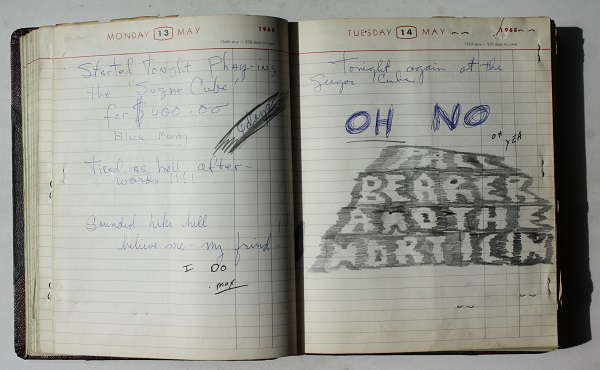
May 13 entry: “Started tonight playing the Sugar Cube for $100 [per night]. Tired as hell afterwards!” The Sugar Cube nightclub was located close to Marhofers Meat Packing Co. on Granville Avenue in Muncie. The Morticians gigged at the Sugar Cube from May 13th to the 18th for a whopping $400 paycheck! Paul Bearer and the Morticians played the “In Club” in Van Wert, Ohio for $125. May 25th: “Jack quit the band. We have to look for a new drummer-probably get Roy Buckner.” May 31, the band played a show at the Youth Center in Syracuse, IN. for $125 payday. “There were a lot of teeny boppers there that dug us bad. We will definitely go back later this summer.” By June, the band was adding more original songs to their setlist: “Manic Depression”, “Little Miss (Over)”, “Come on in”, “Talk Talk”, “You Don’t Know Like I Know”, and “When I Was Young”. June 15: “McPherson’s probably for $150…The clown only went $130.” June 21, the boys played the YMCA in Peru, In. for $150. During a dry spell for the band, one entry reads: “Went to the fabulous Anderson Fair (cow dung everywhere) + then bopped over to Phillips Swimming Hole in Muncie-It was real coooool man.” Muncie’s Phillips public swimming pool opened in 1922 and was closed in 1961 and thereafter used for training by the Muncie fire department.

July 5th, 1968, finds the band playing “The Hub” in Celina, Ohio, for $125. “We didn’t get a good reaction at first, but the third set was real good. Wiped up with Purple Haze, Fire, Foxey Lady, + You Know. I would go to Russia, Vietnam, Belgium, France, The Congo, Brazil, but NOT THE HUB.” A month later (August 3rd), a diary entry reads: “There was an atomic attack on Celina, Ohio today. Luckily, no one was saved. Praise Allah.” July 6: “Found out The Who are back in the United States for a 9-week tour. They’ll def. pass thru here. The Fab Beach Boys are in town along with the Union Gap + The Human Beings.” July 11, the band is playing at the Honeywell Pool in Wabash, In, for $150. Two days later, they are playing in Shelbyville for $150. “We def. will not play for less than $150 beans from now on. $25 raise when we cut the record. They bought us on our gimmick-Dry Ice- fog during our performance.” Despite that entry, days later, on June 21st, the band was once again appearing at the Hullabaloo in Muncie for a $130 payday. In the end, the band netted $57 and paid out $15 per band member. August 8: “Rick quit the band, supposedly, then came crawling back 3 days later, acting like it was all a gag! HAR.”

August 9th, 1968, finds the band playing at Jefferson Landing, 127 E. Main St. in Crawfordsville for $150.”It was a real sweet place, but NOBODY showed up-cause it’s Tuesday, no doubt. We got a real good report from here though.” Five days later, the Morticians were once again playing The Place in Fortville for $150. “We finally are going back to play at Fortville once more. It will really bring back old memories. Har de Har de Har!!! All they could say was that it was too loud.” On August 25, Paul Bearer and the Morticians played the Indiana State Fair [likely a warmup for The Cowsills]: “They were really digging our music.” Sept. 3rd finds the band playing a dance at the Bridge Vu Theatre in Valparaiso, IN,. for $175. October 4, 1968: “Today is the 2nd anniversary of PB + M. Ain’t you proud? I found a super contact: Jeff Beck. He is supposed to speak at the Gent tomorrow.” Oct. 12th finds the band playing a Halloween party at the Kendallville Youth Center in Kendallville, IN., for $175. “Everything was going great, until old nag (blind) started raising the roof because she thought we were a bunch of maniacs, how right she was! The kids dug us so much, they clapped after every song.” The show went over so well, the band was asked to play again the next night. On Oct. 25th, the band played the Sigma Phi Epsilon frat house at Ball State in Muncie for $100. Immediately following the show, the band drove straight to New York to see Steppenwolf. On Nov. 6, the band was playing a show at “The Anchor” in Findlay, Ohio, for $125. Nov. 8, 1968: “Went to Indianapolis + saw Canned Heat + Iron Butterfly-Boy were they great. Worth every minute, they were.”

Nov. 11, the band booked a $150 gig at the Purity Inn on High Street in Oxford, Ohio. “They said we were too loud. We won’t go back def. The acoustics were totalled. We each got 20 beans apiece tonight.” Nov. 20, the band played the armory in Crawfordsville, IN., for $175. “We turned WAY DOWN but don’t know if they liked us or not. We split the diff. + each for 30 Beans.” Nov. 30 the band was once again playing the Hullabaloo in Muncie for $135. Dec. 2nd, the band played the Sigma Pi House at Purdue University for $125. “They seemed to like us quite well + I think we did one of our better gigs. They really dug it bad.” The gigs were getting fewer and farther between now and the diary entries ceased until December 29, 1968. “Played at the Muncie Haullabaloo Club today for a measly $43.57, which was 50% of the door-WOW! We’ll probably be playing there steady at jam sessions on Sundays-NO CONTRACT yet.”

Two days later, on New Year’s Eve, 1968, the diary reads: “The last day of ’68-finally. We are being completely taken over by Son Productions. This is the last day, as we know it of Paul Bearer + the Morticians. Fare thee well, my fellow compatriots.” The annual tally for 1968 totalled $5,518.07, or just over $50,000 in today’s money. The memoranda section of the diary reads: “Cut our first record in August!!-FARCE. We Are Mushroom People. We Are Dead.”

As hard as it is to find detailed information on Paul Bearer and the Morticians, it is even harder to find info on Son Records. Initial information can be found on the band’s contracts, where Larry Scherer signs as the legal representative of “Son Productions P.O. Box 78 Yorktown, Ind. 47396 (Phone) 759-9371”. One article found in the August 1, 1968, Muncie Star newspaper, notes that Son Records founder, Roger Warrum, was born in Shelbyville, attended Mount Comfort schools, graduated from Ball State University, lived in Greenfield, and settled in Anderson. Warrum had a band, The Glass Museum, and also brokered the Jimi Hendrix Concert in Muncie at the Hullabaloo Club. He formed “Son Productions” (named to honor his son Jeffrey Scott) in late 1966 and was described as the “founder-manager-chief worker” for the licensed music booking agency. The company logo incorporated sun rays jutting out of the “o” in “Son”. Warrum made his office inside the Muncie Hullabaloo building, booking bands in Indiana, Eastern Michigan, Ohio, and Kentucky. He opened a branch in Valparaiso to serve the Chicagoland & Greater Michigan, Illinois, and Wisconsin regions. The article states that Warrum planned to open more branches in Bloomington (in October) and Michigan (in January). Warrum only booked union bands and notes, “Paul Bearer and the Morticians came back [to the Muncie Hullabaloo] three times before they had a big enough, good enough sound to make the circuit.” Roger J. Warrum would go on to a successful Insurance career in Anderson, where he was elected to the City Council. He died in Hudson, Ohio in 2009 at the age of 63.

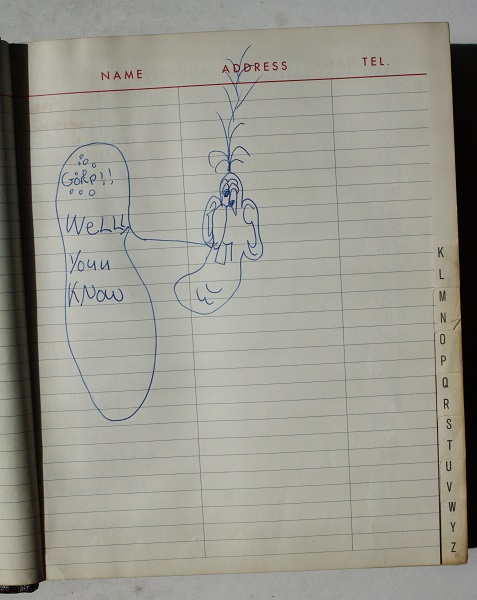
As detailed in Part I of this series, the diarist of these books, Larry Scherer (Paul Bearer himself), died at his home in Greenfield on Jan. 23, 2004, following a brief illness. After the band broke up, Larry taught school in Broxton, GA, and was Teacher of the Year three times. He relocated to Anderson in 1978 and was employed by Madison County Employment & Training Administration as an Assessment Testing Counselor and the Director of Weatherization. Larry was the owner/operator of his business as a General Construction Contractor. As for the rest of the band, Vic Burnett was the guitarist, organist, vocalist, and songwriter, and Jim Shannon was the bassist for the band. Jim Shannon’s signature appears in the diary with a comic profane inscription. Other names appearing on the pages of the diary include Tim Connelly, Jack McCleese, Phil Daily, Rick Thompson, Mike Ford, Chris Wisehart, Michael Eddie, Dave Robertson, Charlie Phillips, Dick Maddox, Steve Whitesell, Ed Wyatt (from Florida), Mike Moore, and Gary Rinker. It should be assumed that these men were members of, or closely associated with, the band.

Despite their hopes of becoming a headliner band, Paul Bearer and the Morticians were little more than a hobby, which they all hoped would turn into something bigger but never did. A thread on the net can be found from Chris Shannon (relative of bassist Jim Shannon) stating that “Paul Bearer and the Morticians made an appearance via satellite on either the Jerry Lewis Telethon or Dick Clark’s American Bandstand. Any time they played in public, the street would be packed with people listening to them play. They were hot, man!” I have spent the last month trying to connect with any family members of the men who created this band, including Chris Shannon, to no avail. So, Chris, if you’re out there, I’d love to hear from you and learn more about Paul Bearer and the Morticians. So, there you have it, the little-known story of a typical 1960s Indiana garage band.

Creepy history, Indianapolis, Politics, Weekly Column

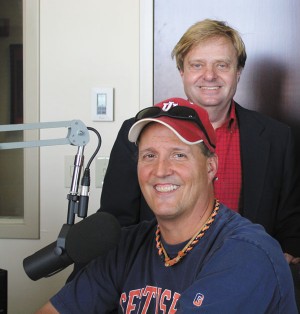
Nazi’s in Irvington radio show. “Hoosier History Live hosted by Nelson Price” June 21 (2025) on WICR-FM 88.7.

Here is the radio show companion to my March 13th & 20th and June 19, 2025 articles in the Weekly View newspaper, all of which are available to read on this site.

Creepy history, Gettysburg, Hollywood, Pop Culture, Weekly Column

James Dean in Gettysburg.

Originally Published in December 2011. Republish Date December 21, 2023.

https://weeklyview.net/2023/12/21/james-dean-in-gettysburg/

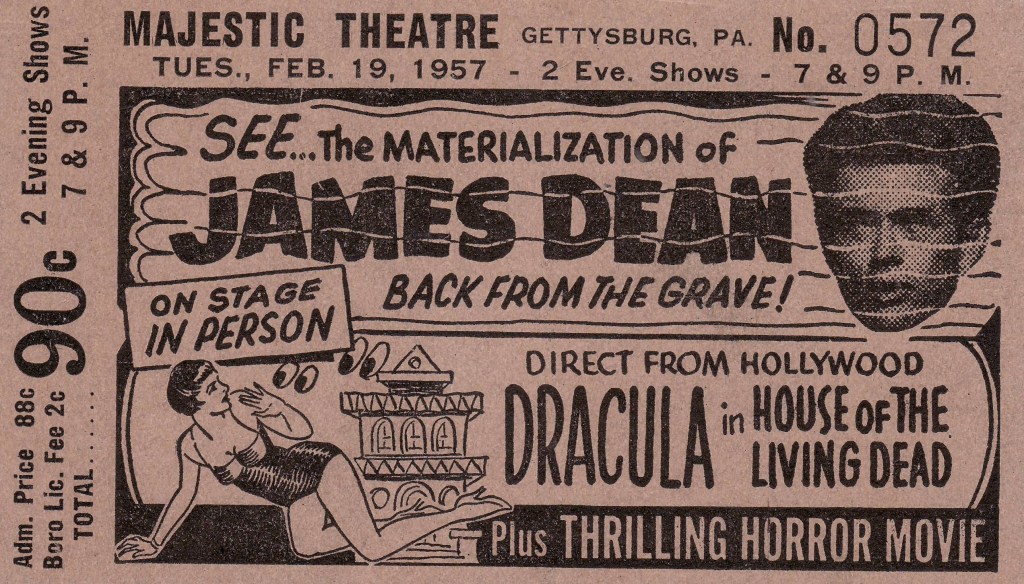
There is an item on my office desk that calls to me every time my mind wanders, I’m gathering my thoughts, or most often, while I’m waiting for a document to load on the computer. It’s a ticket stub, smaller than an index card, from a Tuesday, February 19, 1957, double feature movie at the Majestic Theatre in Gettysburg, Pennsylvania. I bought the ticket in an antique mall just off the Gettysburg town square while on a trip with friends to the famous Civil War battlefield this past Spring. Native Hoosier that I am, my heart jumps a little whenever I see something with an Indiana connection so far away from home.

The ticket is for a movie touted as being “Direct from Hollywood” (Where else would it be from in 1957?) called “Dracula in House of the Living Dead”. The ticket features the cartoon image of a young woman on her hands and knees crawling away from a house whose disembodied eyes follow her, and oh yeah, she’s in a skimpy bathing suit. I’m not an expert on Dracula movies, but my guess is that this movie was just a rehash of an old well-known film with a brand new title designed to lure unsuspecting people into the theatre believing they were seeing a new release. A despicable practice common amongst studios back in the 1950s Era.

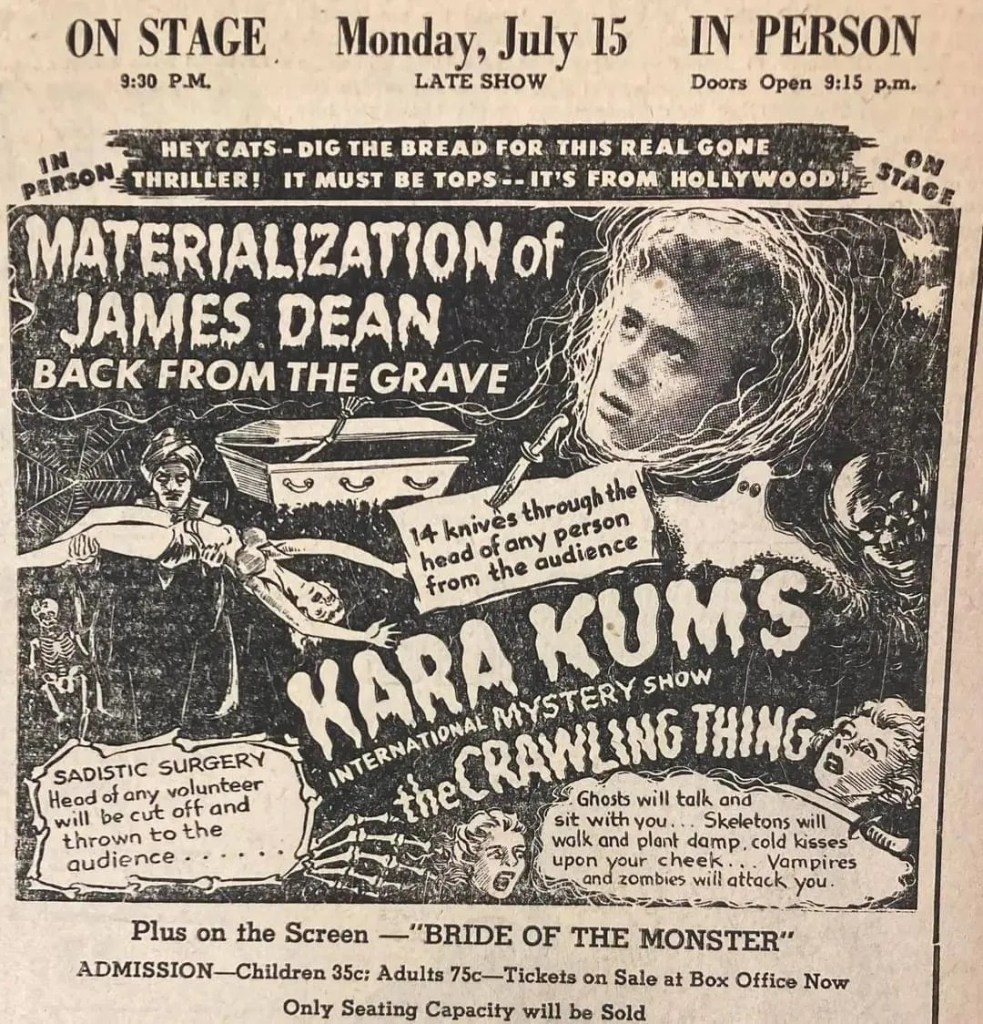
While the Dracula ticket and its promise of an additional unannounced “Thrilling Horror Movie”, were intriguing to be sure, they were not the reason for my purchase. Above the terror-stricken swimsuit-clad woman, there was an eerie floating head of someone very familiar to me and many of my fellow Hoosier baby boomers. It was Fairmount’s own James Dean. The printed promise near his image read: “See…the materialization of James Dean BACK FROM THE GRAVE!” On Stage in Person” Cool, James Dean in Gettysburg, why that’s so…Wait, that’s…impossible. James Dean died in a car crash on September 30, 1956, and this ticket is dated after Valentine’s Day of 1957! How could that be?

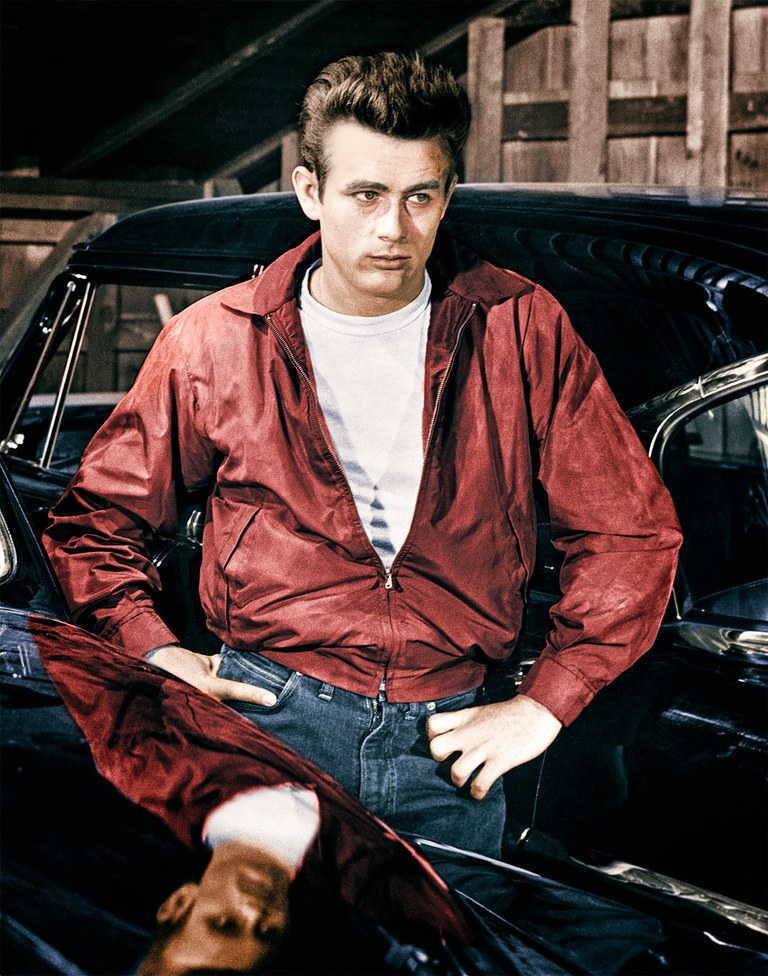
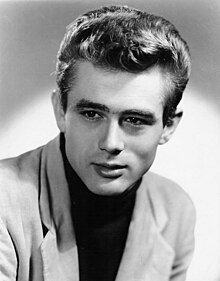
James Dean.

After a few minutes, I realized that this surely must be one of the earliest attempts at the exploitation of a dead celebrity ever attempted. Today, Hollywood barely waits for the body to get cold before cranking out biopics and making cable movies about dead celebrities. Anna Nicole-Smith, Heath Ledger, and Michael Jackson are recent examples. But in 1957 Gettysburg, really? One can only imagine the theatre owner dreaming up this stunt to draw a crowd, finding a good looking blonde haired kid from nearby Gettysburg College, paying him a small fee, and instructing him to walk out on stage wearing blue jeans, a white t-shirt, a red cloth jacket, and sunglasses before exiting speedily amid the gasps, squeals and screams of the frenzied teens in attendance.

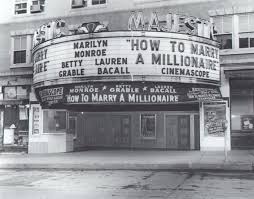
Gettysburg’s Majestic Theatre in 1953.

Did I mention that the Majestic Theatre is built so close to the historic Lincoln train depot station that you can almost touch it? The very same train depot where Lincoln arrived the night before he delivered his incomparable Gettysburg Address on the battlefield, on November 18, 1863. A spot many consider to be hallowed ground. But how could this be? Was this an isolated incident of gross exploitation or part of a larger movement? A little research reveals that shortly after James Dean’s death on a lonely California highway, a “James Dean Lives” cult was born.

Brochure/leaflet from Magician Kara Kum’s conjuring of James Dean.

The first indication that the “James Dean Lives” cult was getting out of hand appeared in January of 1956, just three months after Dean died on the last day of September of 1955. Since October, Warner Brothers studio had been deluged with frantic fan letters expressing shock and disbelief that the teen idol was really dead. The letters continued to flow into the studio past Thanksgiving, but by December, the letter stream dramatically increased, both in volume and in spiritual tone. It now seemed that fans didn’t believe Jimmy was gone at all. New rumors claimed that he was being kept alive in a California nursing home and that the studios were stalling for time, just waiting for his recovery and a comeback. Hollywood Gossip columnist Walter Winchell printed the rumor that Dean was disfigured but still alive in his column. Other stories insisted that it wasn’t Dean at all who died in the car wreck, but rather a hitchhiker. Still more farfetched was the rumor that the actor was in hiding learning to operate his artificial limbs or that he had been placed in a sanitarium to recover. Three thousand letters came in during January and increased so steadily that by July, that number had increased to seven thousand. By the first anniversary of his death, Warner Brothers had received over fifty thousand fan letters from all over the world.

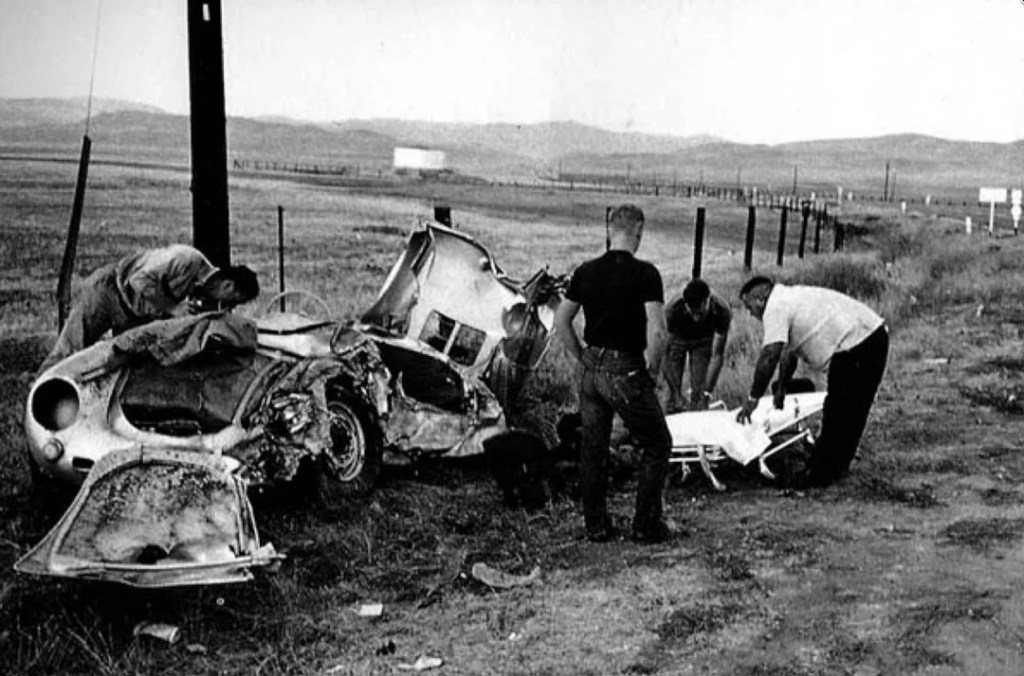
The automobile crash that killed James Dean on Sept. 30, 1955, in Cholame, California.

However, some of the “Mass hysteria” attributed to the “James Dean Lives” rumors can be rationally explained away. Much of this fan mail came from remote regions of South America, Australia, and Western Europe. While these areas still received the movies, albeit posthumously, they did not receive much news and were most likely unaware that James Dean was dead. Many times, these letters were addressed simply to: “James Dean Warner Brothers Studios Burbank California USA” and contained notes that read “Dear James Dean-I love your movies. Will you send me a picture?” That first year, the studio obliged and sent out the photos as requested, which undoubtedly did little to quell the rumors.

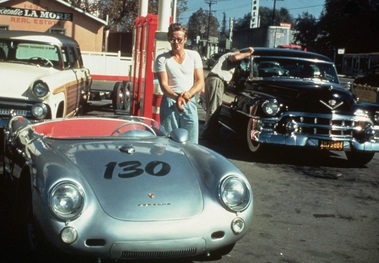
James Dean next to his Porsche 550, a few hours before his death.

But that didn’t explain all of the letters. From the day of his death, it seemed that young people would not let Dean die. Warner Brothers hired a special fan mail agency, the first of its kind in Hollywood, to deal with the deluge of mail that poured into the studio addressed to the dead star. Mattson’s, a Hollywood clothing shop, received hundreds of orders for red jackets identical to the one Dean had worn in Rebel Without a Cause. Griffith Park, where pivotal scenes from the movie were shot, became a tourist attraction overnight. Fans lined up inside the Observatory, hoping for a chance to sit in the same seat Dean had occupied in the film.

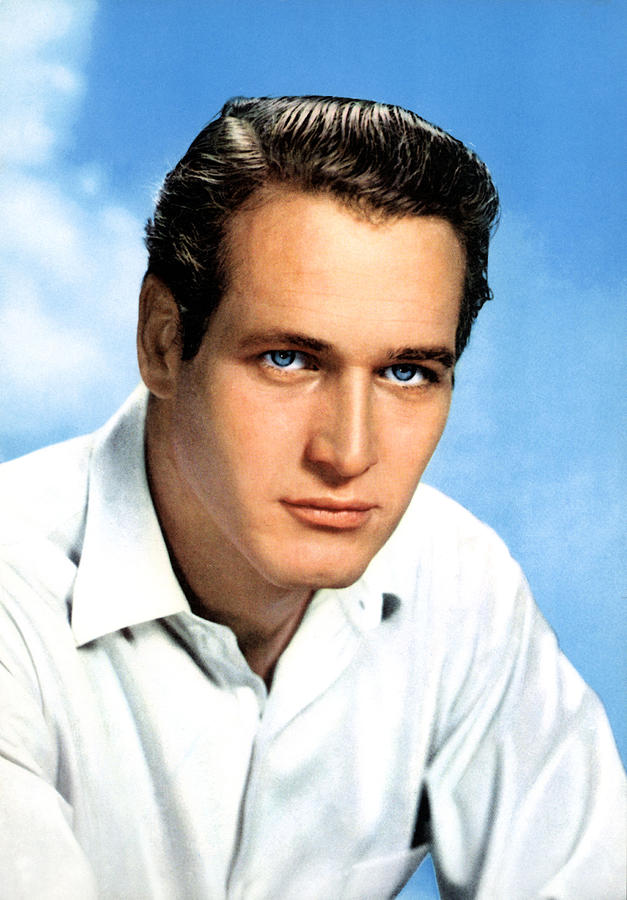
Paul Newman 1950s.

Although today’s generations might not be familiar with James Dean, over the years, an impressive list of actors and performers have claimed to have been influenced by him, including Bob Dylan, Al Pacino, Martin Sheen, and the late Jim Morrison, poet and lead singer for the Doors. Humphrey Bogart, who outlived Dean by two years and also knew a thing or two about cool, once said: “Dean died at just the right time. He left behind a legend. If he had lived, he’d never have been able to live up to his publicity.” Eventually, the realization that James Dean was gone set in. The world of cool moved on to others like Elvis Presley, The Beatles, Terre Haute’s own Steve McQueen, and Paul Newman, to name just a few. The Paul Newman comparison is not a random one. Not only will readers of my column recognize my admiration for Newman, but they might also be surprised by the ethereal connection between Newman and Dean.

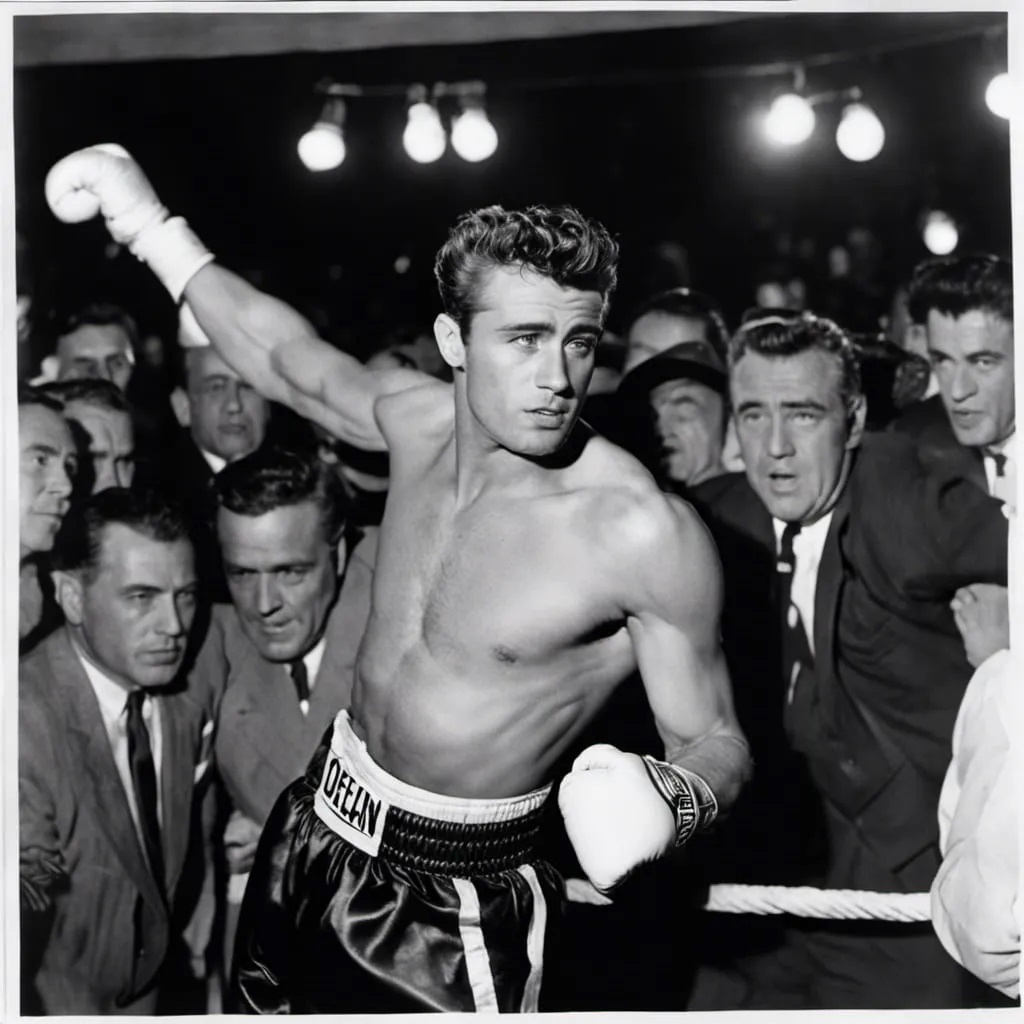
Fantasy photo of James Dean as Rocky Graziano.

James Dean’s final screen test for East of Eden (1955) was shot with Paul Newman, who also was in the final running for the role of Dean’s character Cal’s fraternal twin brother Aron. At the time of his death, Dean was signed to star as the lead (as Boxer Rocky Graziano) in the 1956 MGM movie “Somebody Up There Likes Me” and the 1958 Warner Brothers movie “The Left Handed Gun” (as Billy the Kid). Both roles subsequently were taken by Paul Newman and both helped make him a star. Some film experts have claimed that Newman’s career may never have gotten off the ground at all if Dean had lived. Both young actors often competed for the same roles and there just weren’t enough scripts to go around. When Dean died, he was signed to play in “The Battler” on the “Playwrights ’56” television series. The role went instead to Paul Newman. To further illustrate the Dean-Newman connection, Jimmy was the front-runner to star alongside Elizabeth Taylor in Cat on a Hot Tin Roof (Released in 1958), when he died, the role went to Paul Newman. The role earned Newman an Academy Award nomination and established Newman as a star once and for all.

The two megastars mug for the camera for a few seconds when Dean says to Newman, “Kiss Me” to which the older Newman replies “Can’t here.” Watch closely and you’ll see that Newman is sweating profussely under his armpits. More importantly, the clip instantly transports the viewer back to a time before James Dean climbed into the driver’s seat of his Porsche Spider and rode towards the California horizon, and immortality.

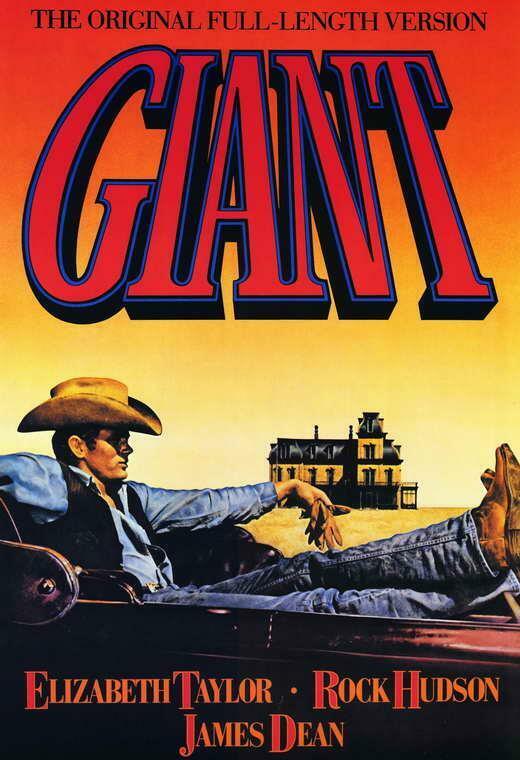
Just before his death, Dean’s agent, Jane Deacy, negotiated a 9-picture deal over 6 years with Warner Bros. worth $900,000. In 1956, Dean became the first actor to receive an Academy Award nomination posthumously, for his role in East of Eden (1955). He did not win. A year later, in 1957 Jimmy was nominated for his second Oscar for “Giant”, thereby becoming the only actor in history to receive more than one Oscar nomination posthumously. James Dean was nominated for Academy Awards in two-thirds of his films, a record which will probably never be bettered.

Creepy history, Health & Medicine, Medicine, Weekly Column

The Last of the Radium Girls

Original Publish Date January 2105. Republished January 2, 2025.

https://weeklyview.net/2025/01/02/the-last-of-the-radium-girls-2/

The year 2014 has come and gone, and along with it, the passing of many notables whose time on this earth has run out. Lost among them is a woman you may have never heard of. Mae Keane died this year. She was the last of the radium girls.

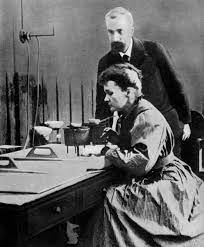
Marie and Pierre Curie.

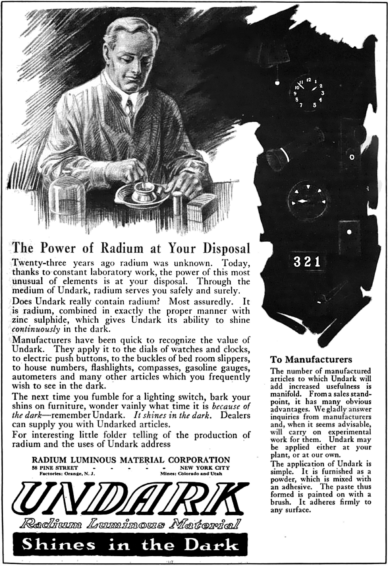
Radium was soon all the rage: bottled Radium water was used as a health tonic, Radium-filled facial creams were used to “rejuvenate the skin”; the Radium Institute in New York City was giving Radium injections to all who could pay for them; some toothpaste started to include Radium; high-end spas began adding radium to the water of their pools and some hospitals were using Radium as a treatment for those who had cancer after it was observed that exposing tumors to Radium salts would shrink them. Although the latter sounds admirably feasible, the former should sound shocking when you consider that radium is highly radioactive.

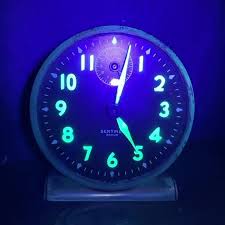
Radium Clock.

Additionally, it was found that when Radium salts were mixed with zinc sulfide and a glue agent, the result was a glow-in-the-dark paint. During World War I the advent of trench warfare necessitated the invention of many things. The trenches were dark, damp, and dirty. A single match lit by a soldier hunkered down in a pitch-dark trench might be the spark to draw enough enemy fire to wipe out an entire company of soldiers. Time dragged on endlessly; when you couldn’t see your own hand in front of your face, you had no hope of seeing the hands of a clock face.

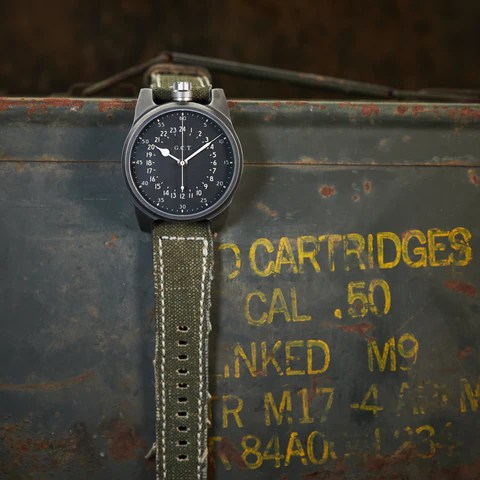
Not only were soldiers crawling and wading around in the mud unable to see their watch dials at night, their pocket watches weren’t suitable for this environment. Soon, watchmakers created men’s watches with straps designed to be worn on a wrist rather than placed in a pocket. Before the Great War, wristwatches were primarily worn only by women, with men favoring pocket watches. By November 1915, British soldiers were putting dots of Radium paint next to the hour numerals to make them visible at night. The dimness of the glow was beneficial as they could tell the time without giving away their position.

1921 Magazine ad for Radium.

Of course, at this time, the dangers of radioactivity were not fully understood. Enter Mary “Mae” O’Donnell Keane and the Radium girls. In the early 1920s, the hot new gadget was a wristwatch with a glow-in-the-dark dial. Their ads extolled “the magic of Radium!” And according to some, Radium was magic. Salesmen promised that it could extend your life, pump up your sex drive, and make women more beautiful. Doctors used it to treat everything from colds to cancer. In the Roaring Twenties, women earned the right to vote, got the urge to smoke, and marched to work in factories alongside their male counterparts.

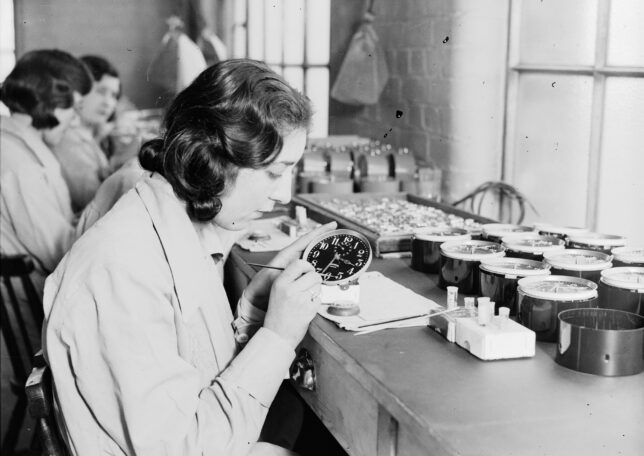
Radium Girls painting an Ingersoll clock face in 1932.

Young women ranging in age from the mid-teens to the early 20s were employed to apply the paint to clock dials and watch faces. The job was promoted as ideally suited for delicate female hands. The work was easy, the wages high and most dial painters were typically single and living with their parents. Over the first 10 years, about 4,000 women were employed at 3 locations: Orange, New Jersey, Waterbury, Connecticut, and Ottawa, Illinois.

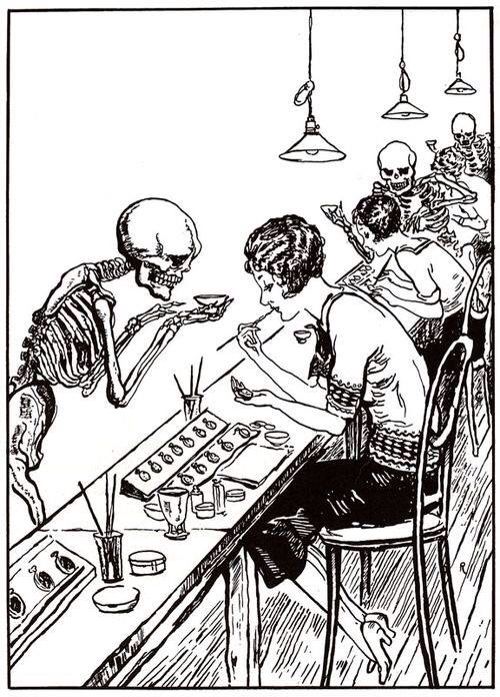
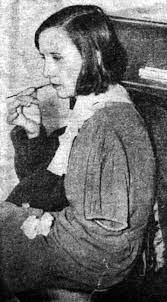
Workers would often lick the paintbrush to achieve a finer point — directly ingesting the Radium. 

The first dial painters came from the china painting industry. These seasoned workers used a technique called lip-pointing which involved wetting their camel hair paintbrushes between their lips to bring it to a sharper point. The practice was passed on to the Radium painting industry whose products required fine brushwork. In 1924, 18-year-old Mae Keane was hired at the U.S. Radium Corporation factory in Waterbury Connecticut. The pay was $18 a week for a 40-hour work week, and 8 cents a dial — a pretty good salary for a woman back then.

Twelve numbers per watch, 200 watches per day — and with every glowing digit, the Radium girls swallowed a little bit more poison. Mae said that on her very first day, she decided that she didn’t like the taste of the gritty Radium paint. “I wouldn’t put the brush in my mouth,” she recalled years later. During breaks and at lunchtime, it was a popular pastime of the Radium girls to paint comic faces on each other, and then turn out the lights for a laugh. “The girls sneaked the Radium out of the factory to paint their toenails and teeth to make them glow,” Keane said.

Mae Keane.

Mae couldn’t remember what led her to work at the watch & clock factory but did remember that she disliked the work more than she liked the paycheck. Luckily, she was not as fast as her supervisor wanted her to be. “I made 62 cents one day,” Keane once said, which translates to a high of 8 watches per day. “That’s when my boss came to me and said I better find another job.” That poor performance probably saved her life. She worked in the dial painting room for eight to nine weeks, then transferred to another job at the company. “I often wish I had met him after to thank him,” Keane said, “because I would have been like the rest of them.”

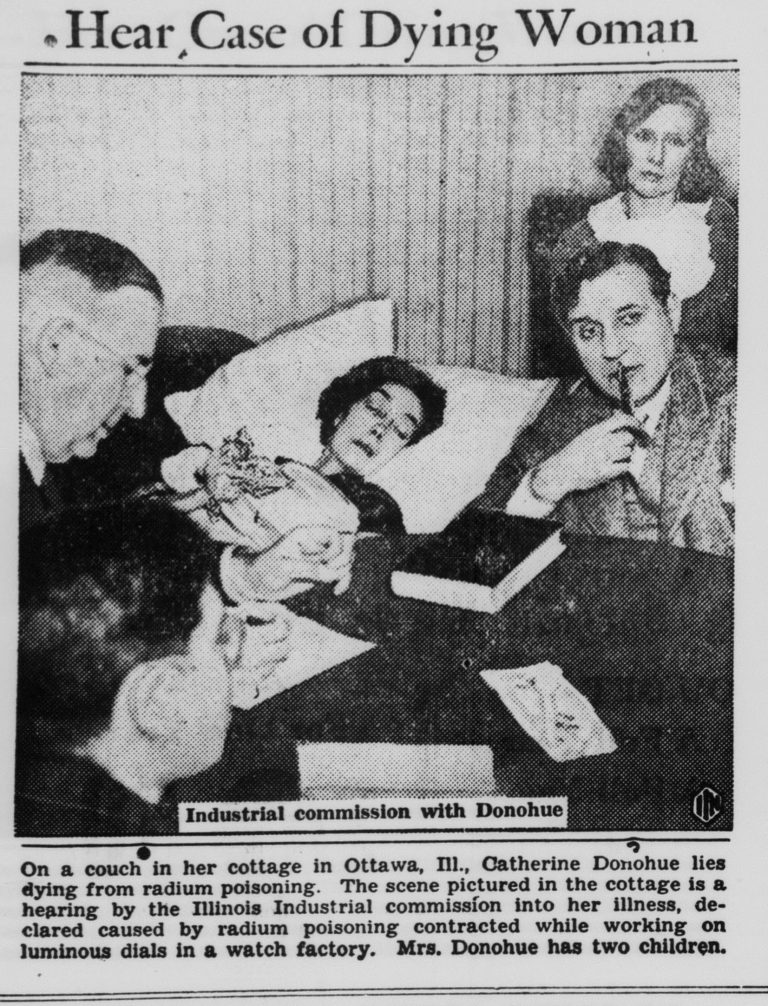
Worcester Democrat and the Ledger-Enterprise (Pocomoke City, MD), March 4, 1938, p. 9.

The dial painters would become some of the earliest victims of radioactive poisoning. By the late 1920s, they were falling ill by the dozens, afflicted with horrific diseases. The Radium they had swallowed was now slowly eating their bones away from the inside out. “We were young,” Mae told The Hartford Courant in 2004. “We didn’t know anything about the paint. I don’t think the bosses even knew it was poison. The foreman would tell us it was very expensive, and to be careful. We had no idea. But when they did find out, they hid it.”

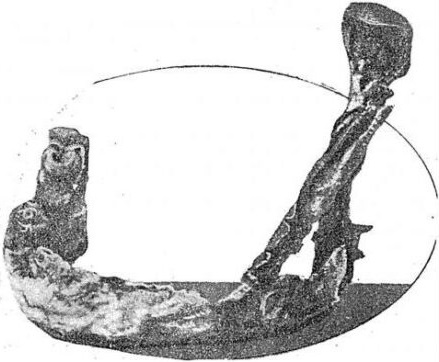
Reports of maladies afflicting the Radium girls began to bubble up to the surface. Dial painters began to suffer from a variety of illnesses, often crippling and frequently fatal as a result of ingesting Radium paint. One account describes a woman (Frances Splettstocher) visiting her dentist to have a tooth pulled only to have her entire jaw yanked out in the process. Soon, her gums and cheek rotted away, ultimately resulting in a hole in her cheek. Her health continued to deteriorate and she died within the month.

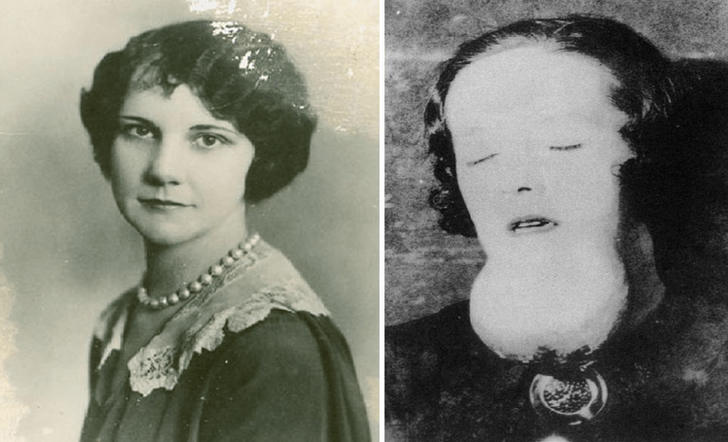
Radium Girl Grace Fryer before and after suffering from radium-induced sarcoma.

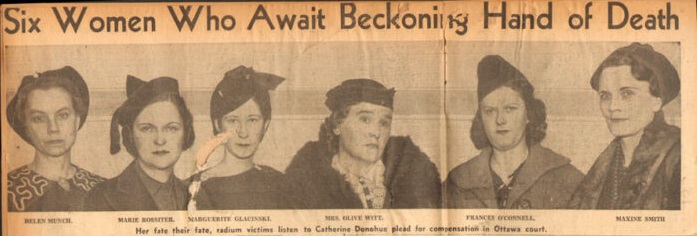
Other radium girls had their legs snap underneath them and more still had their spines collapse. Dozens of women died, many while still in their 20s. Ingested Radium is known to deposit permanently in bone structures damaging bone marrow. In all, by 1927, more than 50 women had died as a result of Radium paint poisoning. Many of them developed cancerous tumors, honeycombed and fragile bones, and suffered painful amputations. At a factory in New Jersey, five of the women sued the U.S. Radium Corporation for poisoning. The trial would have a profound impact on workplace regulations.

Radium Girl Mollie Maggia’s Radioactive Jawbone After Removal.

Ironically, many in these factory towns blamed the women for the loss of jobs during the Great Depression. Furthermore, it would be discovered that U.S. Radium had paid off doctors and dentists to claim the girls were suffering from the sexually transmitted disease syphilis (often having this listed as the cause of death when the girls died), with the hope that it would not only shield the corporation from litigation but also sully the girls’ reputations.

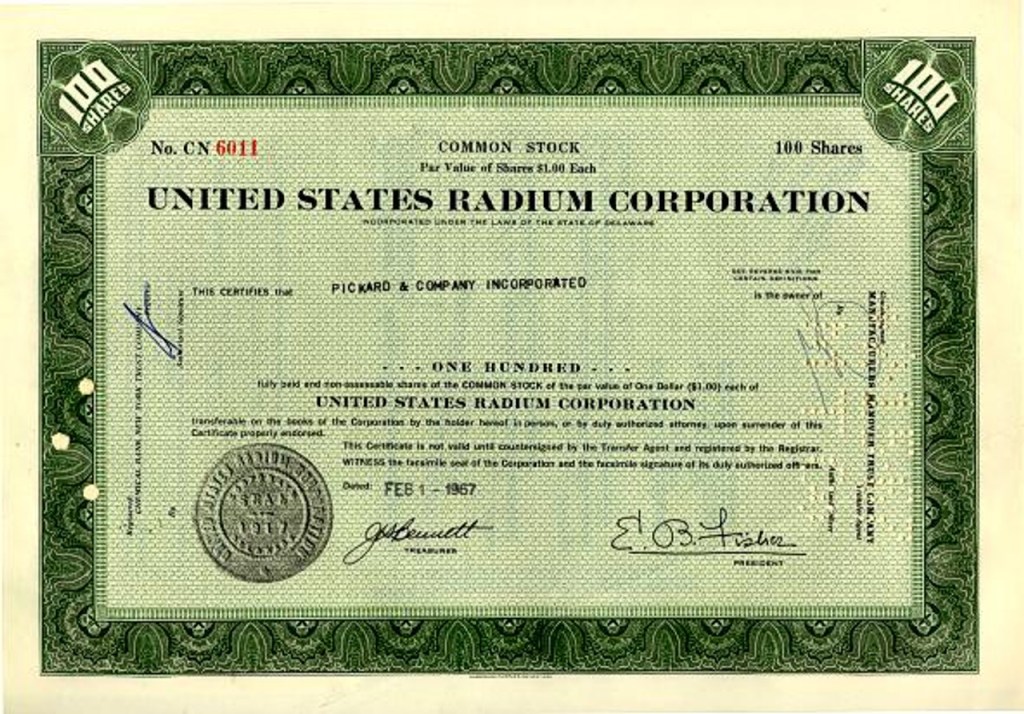
U.S. Radium Corp. Stock Certificate.

At every turn, U.S. Radium sought to delay the trial as much as possible with the hope that all the women in the case would die before an outcome could be reached (in fact all five of the original Radium girls were dead by the mid-1930s). With the company asking for delay after delay, the trial crawled along at a painful pace. Marie Curie herself chimed in on the issue, but had little comfort to give the radium girls by stating, “I would be only too happy to give any aid that I could, [but] there is absolutely no means of destroying the substance once it enters the human body.” Curie herself would die on July 4th, 1934 from leukemia; likely caused by her long-term exposure to Radium.

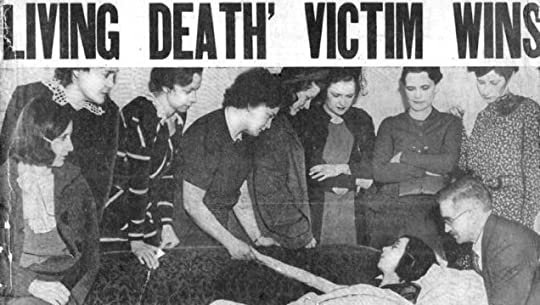
By the time the girls finally got a chance to testify in January of 1928, none of them were able to raise their arms to take the oath, and two were bedridden. After their testimonies, the case was once again postponed for a few months for no good reason. The case was settled in the fall of 1928 before it could be deliberated by the jury, and the settlement for each of the Radium girls was $10,000 ($135,000 in 2014 dollars) and a $600 per year annuity while they lived, and all medical and legal expenses would also be paid by the company. Many of the victims would ultimately end up using the money to pay for their own funerals. The lawsuit and resulting publicity were a factor in the establishment of occupational disease labor laws. Most importantly, the trial proved that the injuries suffered by the radium girls were completely preventable.

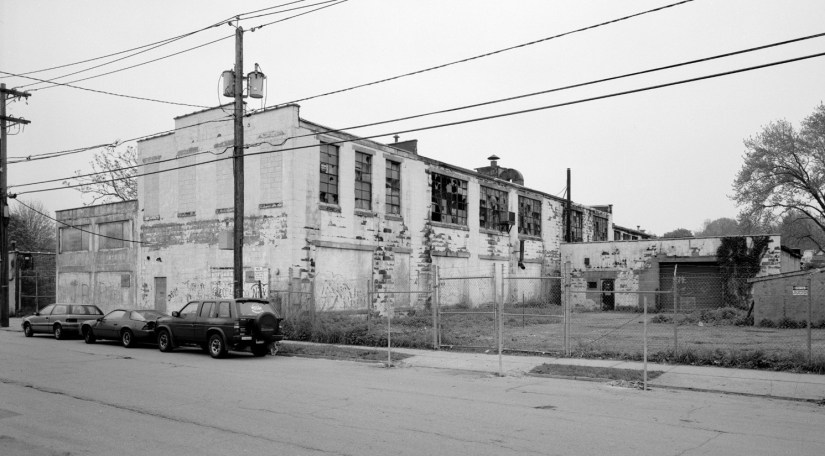
Abandoned U.S. Radium Corp. building at the southwest corner of High and Alden Streets in Orange, New Jersey.

As part of the settlement, the girls agreed not to hold U.S. Radium liable for their health problems. So what was U.S. Radium’s official position in the aftermath? They stated they didn’t settle because they were wrong, but rather because the public was biased against them and they couldn’t have received a fair trial. U.S. Radium’s president, Clarence Lee, stated: “We unfortunately gave work to a great many people who were physically unfit to procure employment in other lines of industry. Cripples and persons similarly incapacitated were engaged. What was then considered an act of kindness on our part has since been turned against us.”

But these Radium towns’ plight didn’t end when the case was settled in court. The chemical element found its way into the soil and groundwater, contaminating residential and commercial properties around the towns. The dangers of Radium no longer was isolated to those who worked in the Radium dial plant, it now threatened the populace. The factory sites became EPA Superfund cleanup sites in the 1980s. The plight of the Radium girls was now known to, and shared by, everyone.

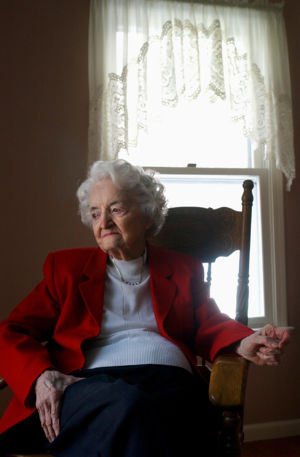
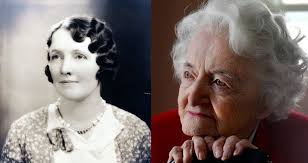
Mary “Mae” (O’Donnell) Keane (1906 – 2014)

But Mae Keane was a proud survivor. Over the years, she had some health problems: she developed numerous skin ailments and eye problems, suffered from migraines, and had two bouts with cancer. “The doctor wanted to give me chemotherapy,” Keane said. “I told him ‘no.’” Keane lost all of her teeth in her 30s and suffered pain in her gums until the day she died. “I was left with different things, but I lived through them. You just don’t know what to blame,” she said. The only prescription medication she ever took was to control her blood pressure. Despite her ailments, Mae admitted, “I was one of the fortunate ones.”

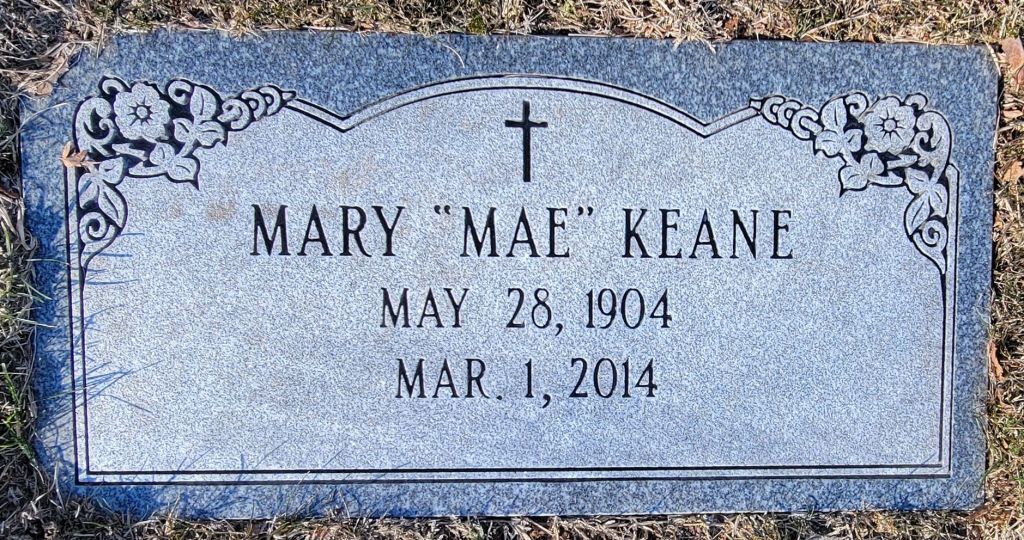
Keane, a Red Sox fan, was once asked about her secret to longevity. “I’m lazy,” Keane said, adding she never smoked, loved to walk and dance, and enjoyed caramel candy, chocolate, and an occasional apricot sour or Bailey’s Irish Cream. “I didn’t get old until I was 98,” she once said.” She was 107 when she died on March 1 in Middlebury, Connecticut; the last living participant in one of the darkest moments in American industrial history.