Civil War, Uncategorized

Where did you go Ambrose Bierce?

Original publish date September 26, 2024. https://weeklyview.net/2024/09/26/where-did-you-go-ambrose-bierce/
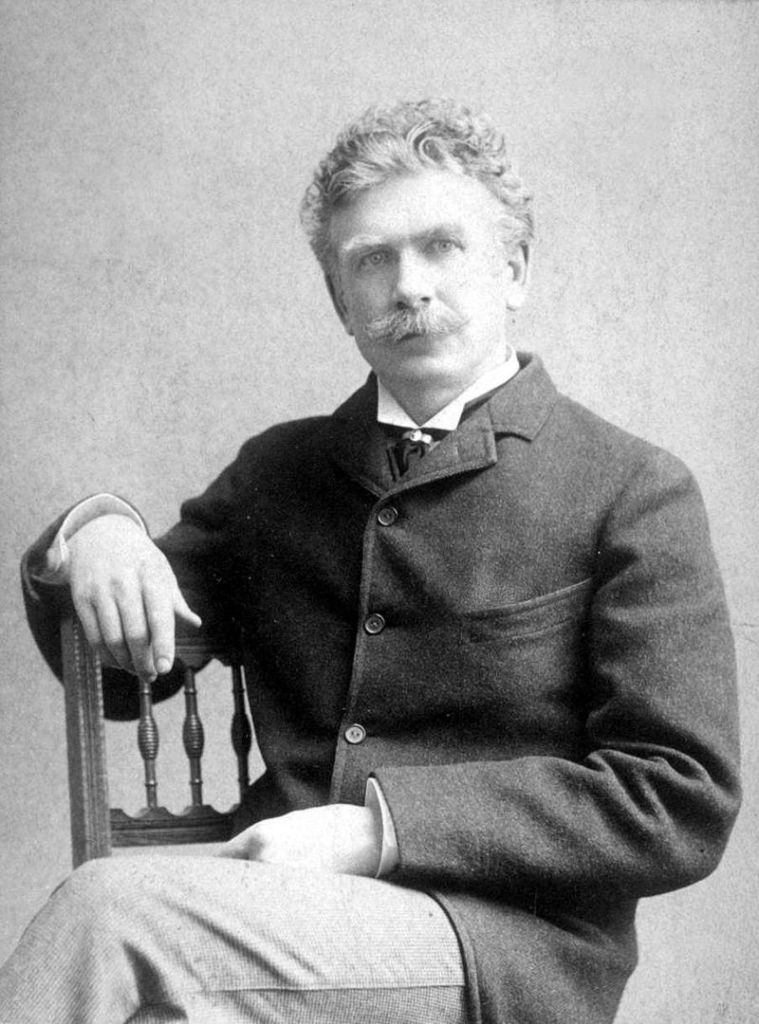
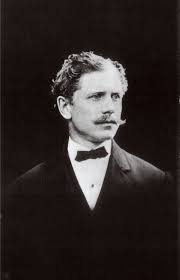
Ambrose Bierce 1892.

110 years ago last week, one of the most famous journalists you’ve never heard of disappeared from the face of the earth. Sometime between September 18-24, 1914, Ambrose Gwinnett Bierce was reported missing. And of course, he had Hoosier ties. Less than two weeks after the start of the Civil War, Bierce enlisted with the 9th Indiana on April 24, 1861, in Elkhart, Indiana. Bierce was born in a log cabin at Horse Cave Creek in Meigs County, Ohio, on June 24, 1842. Horse Cave Creek, “a religious settlement” southeast of Columbus, Ohio, is long gone. Bierce was the tenth of thirteen children, all of whom were given names by their father beginning with the letter “A”. As a child, Bierce moved from the Appalachian foothills of southeastern Ohio to the lake country of northern Indiana. His parents were a poor but literary couple who instilled in him a deep love for books and writing. Bierce grew up in Kosciusko County, Indiana, attending high school at the county seat in Warsaw. He left home in 1857 at age 15 to become a “printer’s devil” at a small abolitionist newspaper in Warsaw: the Northern Indianan. A printer’s devil was an indentured servant who performed many thankless tasks, including mixing tubs of ink and fetching type. Bierce was in good company: Benjamin Franklin, Walt Whitman, Bret Harte, and Mark Twain were all printer’s devils.
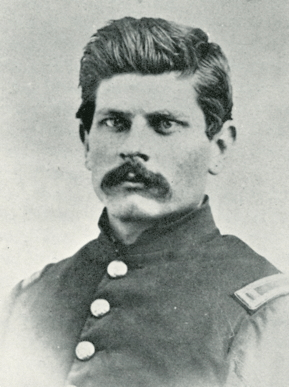
Lt. Ambrose Bierce 9th Indiana.

While with the 9th Indiana, Bierce served in Western Virginia and was present at the Battle of Philippi (the first organized land action of the war in June of 1861). Bierce received his first media attention for his daring rescue, under fire, of a gravely wounded comrade at the Battle of Rich Mountain. Later, he fought at the Battle of Shiloh (April 1862), which he would write about in the memoir “What I Saw of Shiloh”. Within two years Bierce was serving on the staff of General Wm. Hazen. Here he became known to leading generals such as George H. Thomas and Oliver O. Howard, both of whom recommended him for admission to West Point in May 1864. General William T. Sherman also endorsed his application for admission. In June 1864, Bierce sustained a traumatic brain injury at the Battle of Kennesaw Mountain and spent the rest of the summer on furlough. By the end of the war, Bierce rejoined Gen. Hazen to inspect military outposts across the Great Plains, ending in San Francisco, where he was awarded the rank of brevet major before resigning from the Army.
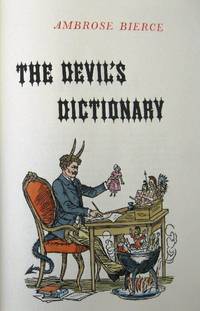
The Devil’s Dictionary 1881.

Bierce remained in San Francisco for many years, becoming famous as a contributor or editor of newspapers and periodicals. He eventually graduated to the historical novels he is most remembered for today. His book The Devil’s Dictionary was named one of “The 100 Greatest Masterpieces of American Literature” by the American Revolution Bicentennial Administration. The book first took form as a serialized newspaper column before being published as a book. The book contains satirical definitions of English words that lampoon political double-talk. The book was volume seven of a twelve-volume set called “The Collected Works of Ambrose Bierce” published from 1909 to 1912. Bierce was a pioneer in realist fiction, his horror writing prowess rivaled Edgar Allan Poe, and his satire equals his peer, Mark Twain. Bierce’s sharp tongue and penchant for biting social criticism and satire often placed him at odds with his publisher William Randolph Hearst. His poetry could be equally caustic as when one of his poems about the assassination of William McKinley in 1901 sparked a national outcry.
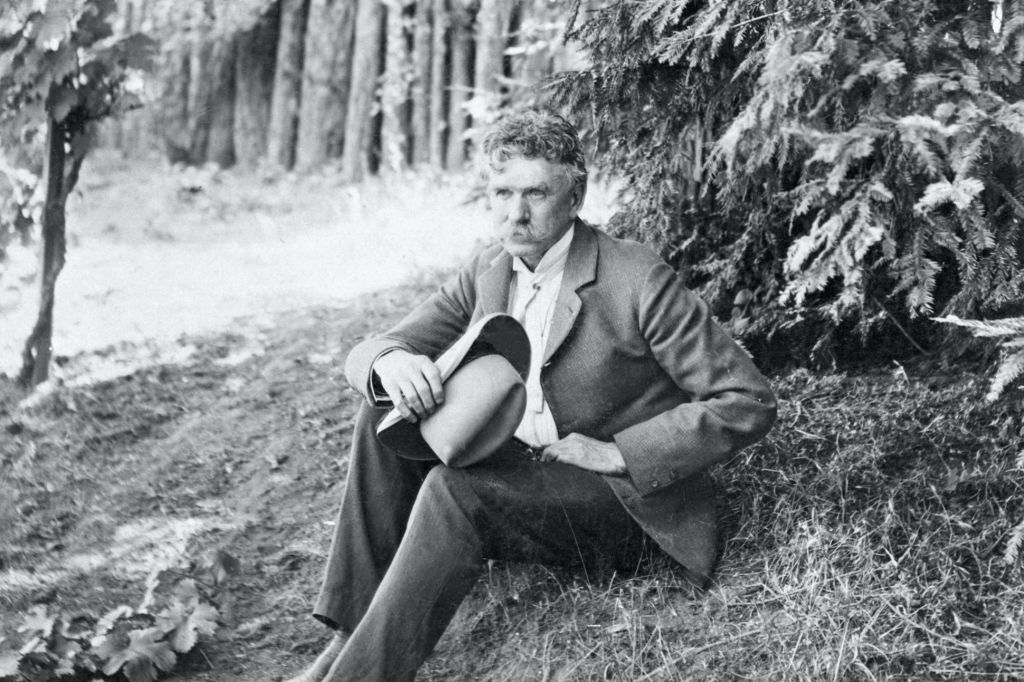
Ambrose Bierce.

Bierce’s most notable work came at the close of the Gilded Age. From 1888 to 1891 he wrote a rapid succession of short stories centering around the inscrutability of the universe and the absurdity of death. Many of those realistic themes came from the terrible things Bierce had seen on the battlefield. His collection of 25 war stories including “An Occurrence at Owl Creek Bridge”, “A Horseman in the Sky”, “One of the Missing”, and “Chickamauga” has been called “the greatest anti-war document in American literature”. Nothing infuriated Bierce more than hearing grandiose accounts of honor and glory of war from people who’d never seen or experienced it personally. His psychological horror story “An Occurrence at Owl Creek Bridge” has been described as “one of the most famous and frequently anthologized stories in American literature”, and his book “Tales of Soldiers and Civilians” was named by the Grolier Club one of the 100 most influential American books printed before 1900. Ernest Hemingway and Stephen King were among the many he influenced.
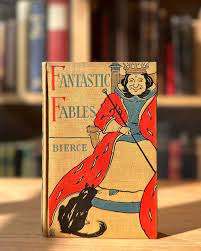
Bierce’s Fantastic Fables 1899.

BIerce’s “Fantastic Fables” book and his many ghost stories were the precursors of the grotesquerie that became a more common genre in the 20th century. Bierce liked nothing better than to shock his audience by challenging their minds on the way to a surprise ending. No better example can be found than his “An Occurrence at Owl Creek Bridge”. Written in 1890 and set during the Civil War, the short story climaxes when Peyton Farquhar, a wealthy Alabama planter and slave owner, is about to be executed by hanging from a railroad bridge as a company of Union infantrymen guards the bridge to carry out the sentence. In his final moments, Farquhar thinks of his wife and children but is suddenly distracted by an unbearably loud clanging. It is the ticking of his watch. He ponders the possibility of unfreeing his hands and jumping from the bridge to swim to safety, but the soldiers drop him off the bridge before he can act on the idea.
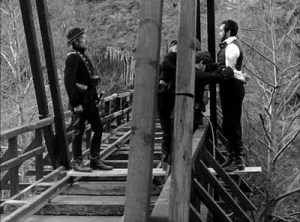
A scene from “An Occurrence at Owl Creek Bridge”

Farquhar flashes back to a time when he and his wife are relaxing at home one evening as a Rebel soldier rides up to the gate and tells Farquhar that Union troops have seized the Owl Creek railroad bridge. The soldier suggests that Farquhar might be able to burn the bridge down if he can slip past its guards. The soldier is in reality a Union scout setting a trap for Farquhar knowing that any civilian caught committing such an act will be hanged as a spy. Farquhar snaps back to the present and falls into the creek after the rope around his neck breaks. He frees his hands, pulls the noose off, and rises to the surface to begin his escape. He dodges, dives, and swims downstream to avoid rifle and cannon fire. Once out of range, he begins the frantic 30-mile journey back home. While Farquhar walks through endless forests day and night, he begins to hallucinate, seeing strange constellations and hearing whispered voices in an unknown language. He trudges on, driven by the thought of his wife and children despite the pain of his ordeal. The next morning he arrives at the gate to his plantation and rushes forward to embrace his wife, but before he touches her, he feels a heavy blow upon the back of his neck. There is a loud noise and a flash of white and “then all is darkness and silence!” Bierce reveals that Farquhar never escaped at all. His escape was an imagination, his journey home a momentary ripple in time experienced during the moment between his drop from the bridge and the noose breaking his neck.
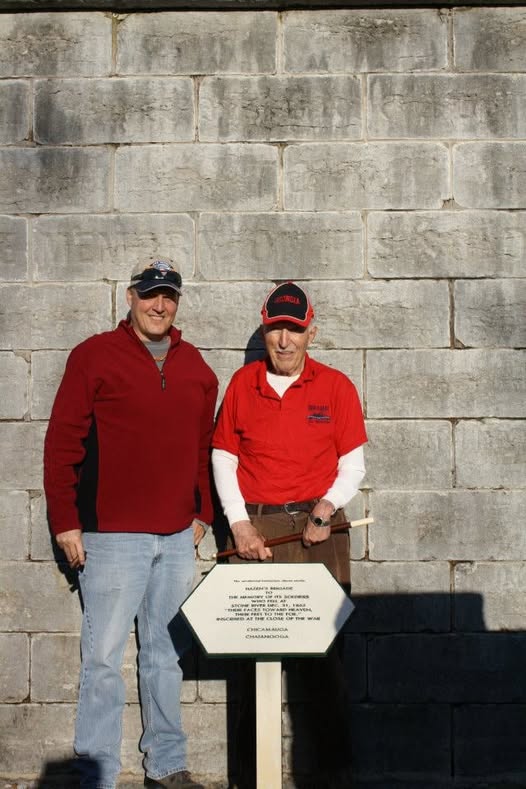
Alan E. Hunter & Edd Bearrs.

Bierce continued writing and pushing the outside of the envelope for the rest of his life. Since much of Bierce’s writing centered on the Civil War, about a decade ago I asked National Parks Historian Emeritus Ed Bearrs about Bierce. I was sharing a beer with Mr. Bearrs in a hotel bar just after touring the Stone’s River battlefield between Murfreesboro and Nashville, Tennessee. Mr. Bearrs, who passed in 2020, was a man of few words. In this instance, he paused before answering, taking a pull from his bottle of Budweiser beer, and said, “What do I think of Ambrose Bierce? I think he was a grade-A Bull-sh_ _ artist.” Which elicited laughter from me and the few others at the table.
Ambrose Bierce.

In 1913, at age seventy-one, he left Washington, D.C. to tour his old familiar Civil War battlefields. Within a short time, Bierce changed his mind and decided to chase Pancho Villa’s army to gain first-hand experience of the Mexican Revolution. Bierce traveled to Mexico to witness (and some say become a part of) the revolution. By December he had passed through Louisiana and Texas, entering Mexico via El Paso. In Ciudad Juárez he joined Pancho Villa’s army as an observer, and in that role, he witnessed the Battle of Tierra Blanca. It was reported that Bierce accompanied Villa’s army as far as the city of Chihuahua. His last known communication with the world was a letter he wrote there to Blanche Partington, a close friend, dated December 26, 1913. After closing this letter by saying, “As to me, I leave here tomorrow for an unknown destination.” And that was the last anyone ever heard of Ambrose Bierce. He vanished without a trace, one of the most famous disappearances in American literary history. No one knows where, when, or under what circumstances he met his end.
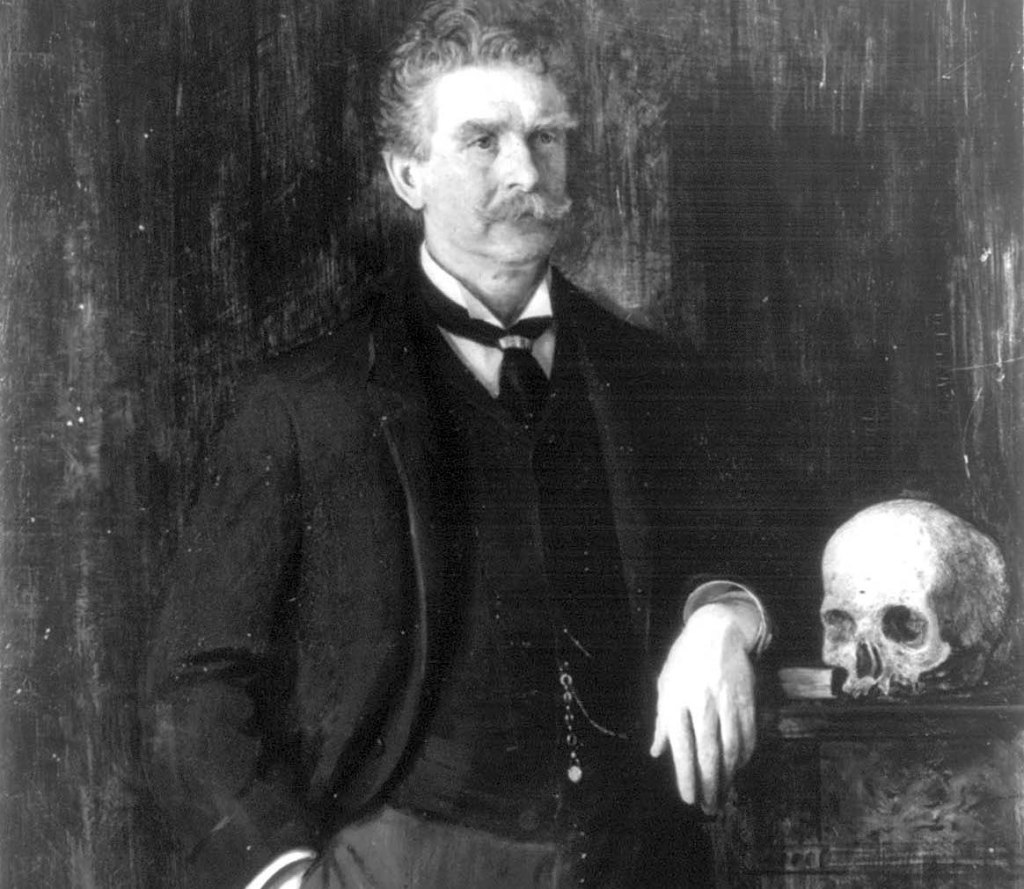
The U.S. consular opened an official investigation into the disappearance of one of its citizens. Some of Villa’s men were questioned but they all gave contradictory accounts. Local legend, documented by priest James Lienert, states that Bierce was executed by firing squad in the cemetery of the town of Sierra Mojada, Coahuila. Bierce’s ultimate fate remains a mystery. He wrote in one of his final letters: “Good-bye. If you hear of my being stood up against a Mexican stone wall and shot to rags, please know that I think it is a pretty good way to depart this life. It beats old age, disease, or falling down the cellar stairs. To be a Gringo in Mexico–ah, that is euthanasia!” His body was never recovered.
Abe Lincoln, Uncategorized

BOOK LAUNCH ANNOUNCEMENT! SUNDAY FEBRUARY 16, 2025 10 AM (CST) SPRINGFIELD, ILLINOIS.

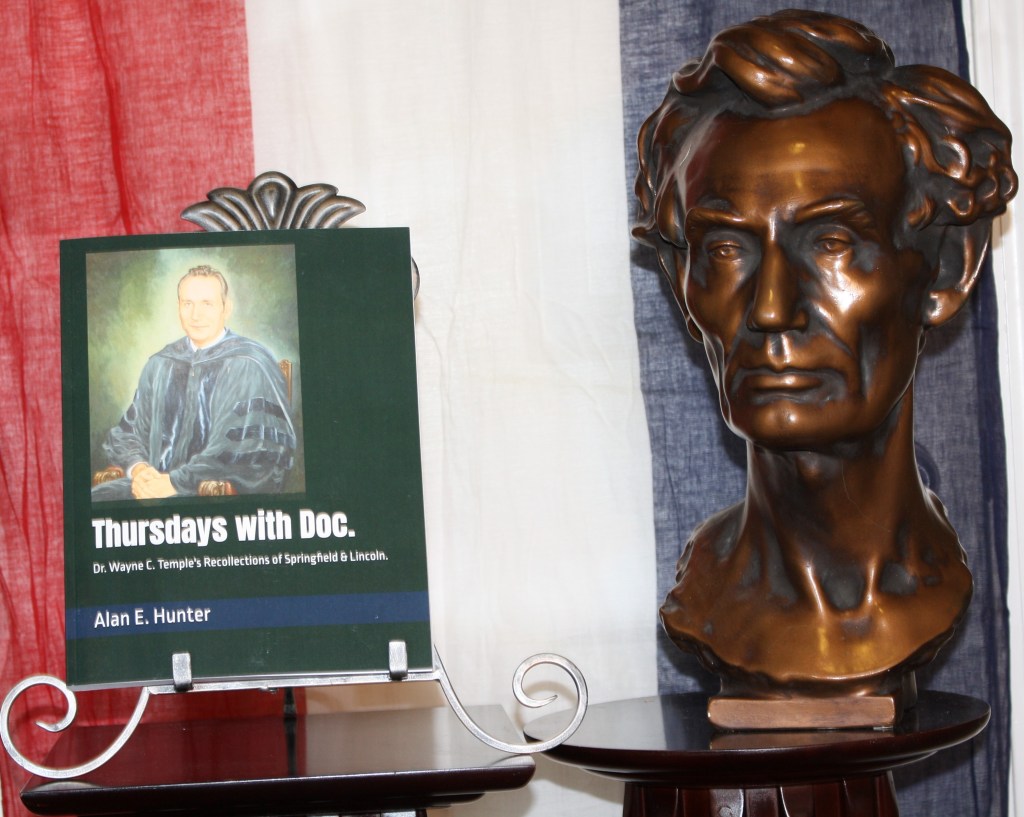
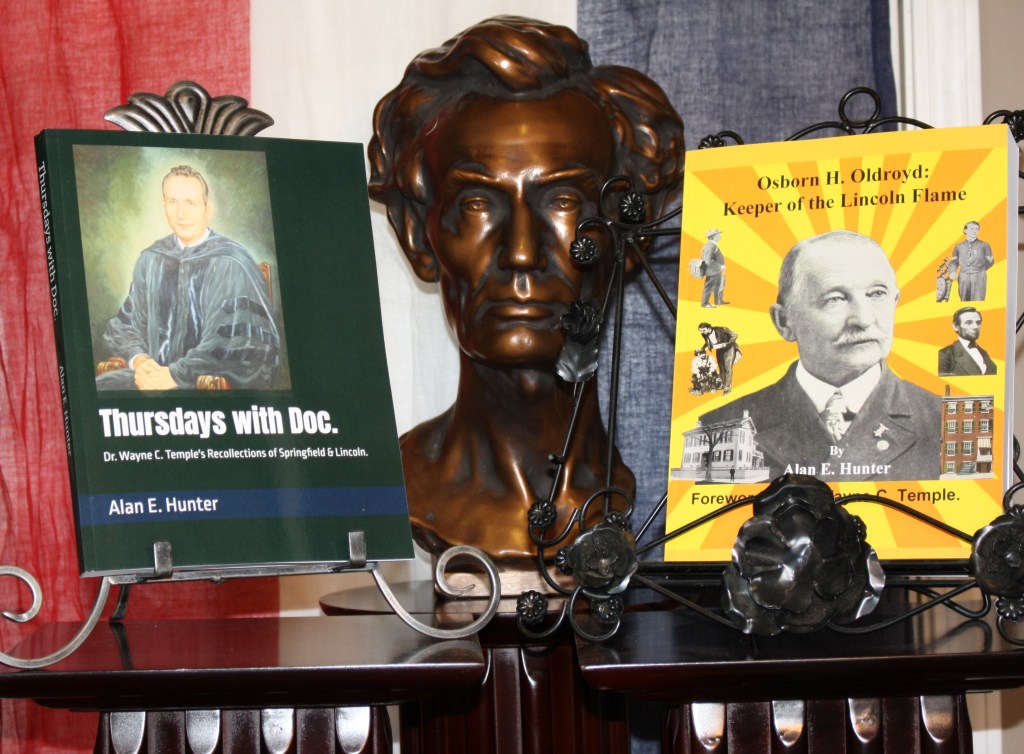
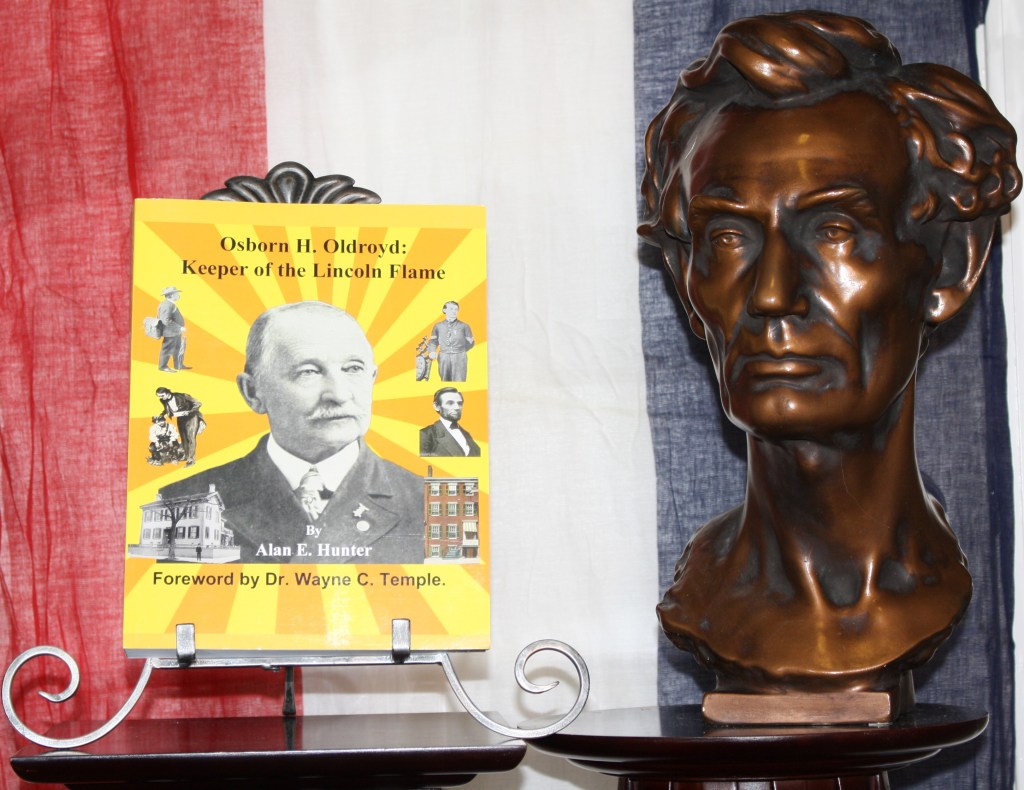
On Sunday, February 16th, 2025, the official book launch for both of my latest books, Thursdays with Doc. Dr. Wayne C. Temple’s Recollections of Springfield & Lincoln and Osborn H. Oldroyd: Keeper of the Lincoln Flame, will be held in Springfield, Illinois. 10:00 am (Central Standard Time) at Books on the Square 427 E. Washington St. Springfield, IL 62701. (217) 965-5443
https://www.booksonthesquare.com/

bksonsqr@royell.net 

The author will speak about Doc and Oldroyd, their connection to each other, and Springfield, the day after the Abraham Lincoln 216th Birthday Event: Symposium & Banquet in that historic building across from the Old State Capitol Building where Lincoln served. A book signing will follow the talk. All purchases of Doc’s book that day will include a limited edition, hand-numbered bookplate signed by Doc, Dr. James Cornelius, and the author.

Osborn H. Oldroyd devoted his life to acquiring everything relating to Abraham Lincoln. For nearly half his life, Osborn Oldroyd made his home and displayed his collection in two houses directly associated with the 16th President: the Lincoln Homestead in Springfield, Illinois, and the House Where Lincoln Died in Washington, D.C., a feat that will never be surpassed. Oldroyd guarded a gateway between two worlds. On one side was the world of the now and on the other, the world of the past. When Lincoln passed from life to history, the nation’s grief gave way to reverence; sorrow gave way to esteem. Oldroyd, the loyal log cabin Republican and veteran soldier, did his best to ensure no one forgot. Oldroyd had the institutional memory gained from walking in Lincoln’s footsteps, talking with Lincoln’s contemporaries, and examining the objects associated with his idol. Oldroyd was never trained as a curator. He was a born collector whose experience in handling and researching objects while building his personal collection was his curatorial education. His ability to recount the story behind the object and inject it with enthusiasm, humor, and believability, made him a folk hero to the common man. Just as Oldroyd’s museums can be considered the first of their kind in American museum history, Oldroyd himself can be labeled as America’s first folk curator. To the collection and study of Lincoln, Osborn Oldroyd’s name is unavoidable, particularly in the study of his assassination. It could easily be said that without the efforts of Osborn H. Oldroyd, we may have lost the Lincoln Home in Springfield, the House Where Lincoln Died, and Ford’s Theatre itself. Oldroyd’s obsessive, idiosyncratic devotion to Abraham Lincoln brought the martyred President down from the fog of intellectualism and back to earth for everyone to rediscover in object form. Oldroyd was the last of his kind and the first of another. He arrives by adoration and departs by dedication, opening doors for every Lincoln collector, admirer, and scholar that followed. Born in an age of covered wagons and canals, Oldroyd lived to see the age of the automobile and the airplane. And, thanks mainly to Osborn Oldroyd, visitors to the Petersen house today can walk through the first floor, down the long hallway to stand inside the tiny, dimly-lit otherwise insignificant room with the slanted ceiling where the last, best hope of a nation was lost.

KA series of informal discussions with Springfield Illinois Lincoln scholar and author Dr. Wayne C. Temple, known affectionately as “Doc”. Who, for over 56 years, worked for nine different Illinois Secretaries of State and ten different Governors representing both parties, a remarkable feat of its own. It is a record unlikely to be equaled. Doc was with the Illinois State Archives from 1964 to 2016, much of that time as the Chief Deputy Director. Before that, Doc was editor-in-chief of the Lincoln Herald and in charge of the Dept. of Lincolniana at Lincoln Memorial University in Harrogate, Tennessee from 1958 to 1964, remaining in that position remotely from Springfield until 1973. Doc was an honorary member of the Lincoln Sesquicentennial Commission, 1959-1960, and served on the advisory council of the  United States Civil War Centennial Commission, 1960-1966. Doc served in the U.S. Army from 1943 to 1946, and during that time he helped to establish General Dwight D. “Ike” Eisenhower’s communications in Europe. Doc has authored over 20 books, mostly on Lincoln, and has written over 600 articles, poems, reviews, and papers during his career. Doc graduated from the University of Illinois in 1949, studying under his mentor J.G. Randall, the “Dean of Lincoln Scholars.” Doc’s accomplishments are well covered in this volume. This book spans almost three years of interviews with Doc, James Cornelius (former Curator of the Abraham Lincoln Presidential Library and Museum), and author/newspaper columnist Alan E. Hunter. The topics cover Abraham Lincoln, the little-known history and colorful personalities of Springfield, Illinois, the Indigenous Peoples of Illinois, and the life and times of Springfield’s preeminent Lincoln scholar. Now over 100 years old, Dr. Wayne C. Temple has seen it all.

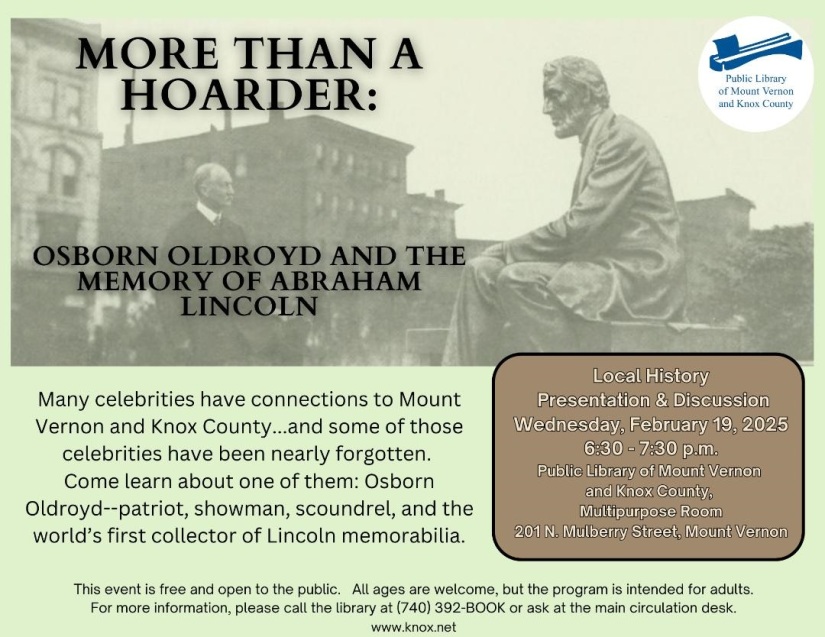
I was just informed & consulted about an upcoming program at the Knox County Public Library in Mt. Vernon, Ohio (Osborn H. Oldroyd’s birthplace). They have promised not to play up the “scoundrel” angle. The word is getting out!

food, Indianapolis, Pop Culture, Uncategorized

Beef Manhattan: Born in Irvington?

Original Publish Date March 14, 2024 https://weeklyview.net/2024/03/14/beef-manhattan-born-in-irvington/

Okay, okay, not likely…but possible. No one really knows EXACTLY where the Beef Manhattan was born, but most culinary historians agree that the dish (a diagonally cut roast beef sandwich split butterfly fashion with a generous scoop of mashed potatoes resting between the two halves and the whole shebang swimming in a pool of brown beef gravy) came from the eastside of Indianapolis.

Legend claims the Beef Manhattan was born at the Naval Air Warfare Center, a former US Navy facility located at Arlington Avenue and East 21st Street in Warren Township, a stone’s throw from Irvington. The knife and fork-plated comfort food was (allegedly) the brainchild of Manhattan-trained cooks working at the factory during World War II. Faced with an overage of Hoosier staples (meat, potatoes, & bread) these crafty Hell’s Kitchen food slingers came up with a plan.

A poor man’s version of the dish had been making the rounds of Manhattan (the most densely populated and smallest of the five boroughs of New York City) for generations. The difference was, that the first version contained mysterious New York City street meat, rolls, not bread, potatoes, and no gravy. We do not know the name of the chef (or chefs) who created it or, for that matter, the date the dish first showed up in the cafeteria of the Naval Ordnance Plant. But, the best guess is that the Beef Manhattan made its debut in the winter of 1942.

Ratheon-300x136
Naval Ordinance Plant in Indianapolis.

The plant opened that year, covering 1,000,000 square feet and employing 3,000 workers in avionics research and development. Construction began in 1941 and the plant became fully operational in 1943. The “NOP-I”, as it was known locally, was one of five inland sites selected in July 1940 by the US Department of the Navy Bureau of Ordnance for the manufacture of naval ordnance. The other plants were in Canton, Ohio; Center Line, Michigan; Louisville, Kentucky; and Macon, Georgia. The government-owned, contractor-operated (GOCO) plant was built for $13.5 million ($255 million in 2024 dollars) and the plant manufactured Norden bombsights until September 1945.

After World War II, the plant was renamed the Naval Avionics Center, where employees designed and built prototype avionics, including “electronic countermeasures, missile guidance technologies, and guided bombs.” In 1992, the facility changed its name to the Naval Air Warfare Center Aircraft Division. The site was closed in 1996 on the recommendation of the 1995 Base Realignment and Closure Commission at which time it transferred ownership to Hughes Electronics Corporation. In 1997, it was the “largest full-scale privatization of a military facility in U.S. history” at the time. Eventually, the company was acquired and renamed the Raytheon Analysis & Test Laboratory. As of 2022, the facility is privately owned by Vertex Aerospace and employs about 600.

While those are the facts about the origin of place for the Beef Manhattan, determining where it first hit the streets of Indianapolis is a little bit more speculative. The riddle begins with the name itself. It is a misnomer. The dish is one of two Manhattan-named staples with no ties to New York City other than a space on the menu. The other, Manhattan clam chowder, originated in Rhode Island. Sure, New York City can claim many different foods created within its five boroughs: Eggs Benedict & the Waldorf salad (Midtown), Chicken & Waffles (Harlem), The Reuben (Manhattan), and the Cronut (So-Ho), but the Beef Manhattan is pure Hoosier.

There are different variations. One calls for shredded, pot-roast style beef on two slices of white bread, mashed potatoes on the side, with a layer of brown gravy poured over all. While another insists that the mashed potatoes are placed on top of the sliced, but unseparated, sandwich which is then drowned in brown gravy. Some versions call for diagonal slices, others conventional center-sliced bread. Another variation is Turkey Manhattan, which substitutes turkey for roast beef, but that is an obvious imposter. And, although the dish is named after Manhattan, if you were to order it in a Gotham City restaurant, you’re likely to be served a cocktail (whiskey, sweet vermouth, bitters, and a maraschino cherry garnish). Beef Manhattan is unknown there, instead such dishes are usually called “open-face sandwiches” in the Big Apple.

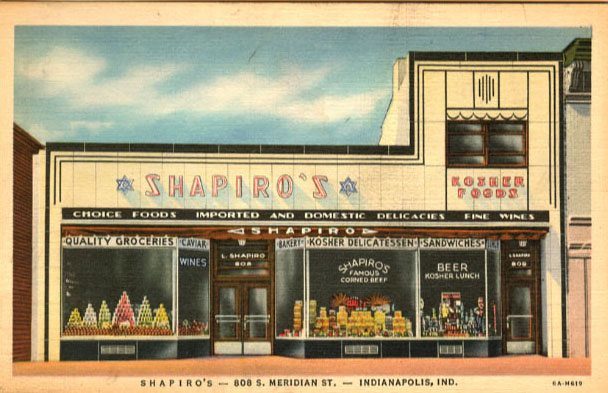
Should you Google it, you are likely to see that the dish was first served under the name “Beef Manhattan” in a now-defunct Indianapolis deli in the late 1940s, and shortly after its introduction, it became a Hoosier staple. But, nobody seems to know exactly which Indianapolis Deli was the first to put it on the menu. However, there are a few likely suspects. The natural choice would seem to be Shapiro’s. Their website states that restaurant namesakes, Louis and Rebecca Shapiro, arrived in the Hoosier state around 1900 after fleeing Russia due to anti-Semite persecution which included vandalism to their family grocery store in Odessa, Ukraine. They sold sugar and flour from a pushcart on the streets of Indianapolis for two years while saving up money to open their deli at Shapiro’s 808 South Meridian in 1905.

Shapiro's

So, Shapiro’s certainly fits the bill timewise, appearing on the scene a generation before the birth of the Beef Manhattan. Shapiro’s is the sentimental favorite for sure. And it has an Irvington tie-in too. In 1925, during the reign of terror by the Ku Klux Klan in Indiana, Shapiro’s thumbed their nose at Klansman/Governor (and Irvington resident) Ed Jackson by redecorating their storefront in an art-deco style dominated by a huge Star of David for all to see. But officially, “Shapiro’s Kosher Deli” didn’t open until 1945, three years after the dish was invented.

Likewise, the Hook’s Drug Company opened a new drugstore and soda fountain at the corner of 22nd and Meridian Streets on Feb. 17, 1940, to serve hungry Hoosiers. Hook’s restaurant featured a new stainless steel soda fountain perfectly designed to serve Beef Manhattans. A contemporary news article described Hook’s as having “year-round air conditioning” and as “the last word in efficiency and beauty. The floor behind the fountain is depressed to a level so that the customer is sitting in the same comfortable position as at his own dining table. The fountain is provided with a system of sterilization which makes it sanitary for refreshments and luncheons. The cooking equipment is electrical.” Hook’s advertised heavily in the 1940s but never mentioned the Beef Manhattan in those ads. The dish did not appear in Hook’s ads until the 1950s.

The best bet (at least of this reporter) is that the Beef Manhattan most likely appeared first as a menu selection somewhere on Illinois Street. There were at least three delis operating on Illinois Street in 1942, including Brownie’s Kosher Deli at 3826 N. Illinois, Fox Delicatessen at 19 S. Illinois, and Henry Dobrowitz & Sons Kosher Meats and Delicatessen at 1002 S. Illinois. Someday, somewhere, a better Circle-city researcher than me will pinpoint the exact location but until then, I’m content to let it remain a mystery.


Choosing instead to revisit Shapiro’s version of the “Hot Beef Manhattan” in my daydreams. It consists of 2 slices of white bread, not cheap squishy white bread, but good firm white bread with some heft to it, cut diagonally and spread out on the plate like a poker hand, a layer of handmade mashed potatoes binds them together, and forms the foundation for a generous portion of thin-sliced tender beef, brisket I’m guessing. The meat mound is topped with more mashed potatoes and covered with enough gravy to float a kayak. Not that better than bouillon gravy stuff that somehow smacks of chemicals to me, but rather, real gravy made from the constant stirring of the collected juices of meats roasting. To those haughty Food Network snobs, the Beef Manhattan looks like a failure pile on a sadness plate, but Hoosiers know it is delicious.

Typically, Indianapolis sees 29 days a year where the thermometer doesn’t rise above 32 °F, and for five months a year, we’re shivering below the fifties. So, knowing that, is it that hard to understand why the Beef Manhattan remains so popular in Indiana? I mean, no one eats a tenderloin to get warm. And while the Beef Manhattan most likely wasn’t born in Irvington, it did originate on the east side of Indianapolis and Irvingtonians can fairly claim to be among the first wave of devotees.

food, Health & Medicine, Medicine, Pop Culture, Uncategorized

When it rains, it pours.

Morton's article image

Original publish date:  July 2, 2020

It is summertime in Indianapolis and once again, Hoosier eyes cast skyward as they ask, “When is it gonna rain?” Recently, I stumbled across an old brochure from Morton’s salt that was handed out at the 1933-34 Chicago World’s Fair. The brochure features the logo of a little umbrella-carrying girl walking with a cardboard can of salt tucked under her arm, the salt pouring out of the spout as she walks beneath the raindrops, blissfully unaware. The brochure notes that “One-third of our weather is rainy!” and offers “100 ways to predict rain, compliments of Morton’s Salt” and closes with the familiar slogan “When it rains it pours.”
The brochure opens to a list of 100 of “Mother Nature’s Weather Signs” and notes that these “time-tested” signs of rain are not “mere superstitions” and that “back of every sign is a common-sense explanation.” “For instance, fish leap from water and birds skim close to the ground just before a rain in order to catch insects forced down by the moisture in the air. Smoke hangs low before rainy weather because held down by nature; a cow attempts to scratch its ears because flies are more troublesome when rain is approaching, and shoe strings become difficult to untie because moisture-laden air has caused them to swell.” The brochure urges its reader to “memorize as many as you can so that you can surprise your friends by accurately predicting rain even though the sun may be shining brightly.”
So here you go, get ready to amaze your friends with these 100 ways to predict rain, as seen through the eyes of Great Depression corporate America. After each assertion, simply add the dictum; “look for, expect, or followed” by rain.
x rainbow rainWhen animals huddle together in open fields…when ants travel in straight lines (or are unusually active)…when the “Northern Lights” are visible in the sky…when bats cry much, or attempt to fly into the house…when more bees enter than leave the hive (every notice that bees never get caught in a shower?)…when distant bells sound close…when birds skim close to the ground…when boiling water evaporates more rapidly than usual…when dead branches fall to the ground in calm weather…when bubbles rise from marshy ground or appear on pools of stagnant water…
There is almost always a calm before a rainstorm…Camphor gum dissolved in a bottle of alcohol forms feathery crystals before a rain (Camphor gum was a farmhouse staple back in the day with many uses)…when canaries dress (oil) their feathers, or are wakeful at night…when cats sneeze, lie with their heads on the floor, or wipe themselves behind the ears…when many centipedes are seen…when your chairs begin to creak…when chickens huddle together outside the hen house instead of going in to roost (hence the old adage, “If fowls roll in the sand, rain is at hand”) …when distant objects look close (hence the saying, “The farther the sight, the nearer the rain”)…heavy clouds in the west and cloud streamers pointing upward… when a clover contracts its leaves…
z coffeeeIf coffee bubbles cling to the cup instead of floating in the center…when corns are more painful than usual… when cottonwood trees turn the undersides of their leaves upward…when a cow thumps its ribs, or attempts to scratch its ear, with its tail…when crabs leave the water and remain on land… when cream or milk sours during the night…an old adage states that a new (crescent) moon with horns tilting downward can’t hold water so…when crickets chirp loudly and more persistently than usual… when crows caw loudly and continuously or when a crow is seen flying alone… when curly hair becomes more unruly than usual…
When dandelions close their blossoms…complete absence of dew in the morning… when dogs eat grass or are uneasy and change position while lying down…when a donkey scratches itself against a wall…when doors stick in fair weather… when ducks quack unusually loud… when dust whirls around the street… ringing in the ears is seen as a warning… when worms appear in large numbers on the surface of the ground…a strong east wind means rain withing a day-and-a-half.
x rain 3When grate fires crackle and throw sparks to a greater degree than usual…when fish jump from the water, or swim close to the surface…when oiled floors “sweat”…when flowers stay open all night (and some say when the fragrance is stronger)… when frogs assume a brownish hue and croak louder and longer…when there are two full moons in a single month…when geese are particularly noisy…when glow worms shine brighter…when goats bleat a great deal…
When a clear sky has a greenish hue…when seagulls fly inland…when a halo (or ring) encircles the moon, like the old saying states, “The bigger the ring, the nearer the rain”…when a hazy twilight appears during the summer…when horses sweat in the stable, sniff loudly and switch their tails violently…many flies in the house are a sure sign as are flies that bite harder and more often…when your joints appear to feel stiff… when burning lamps and lanterns sputter continuously…a great many meteors, or shooting stars, in one evening…when mice run about more than usual…
Three misty mornings in a row bring rain…A pale moon doth rain-a red moon doth blow-a white moon doth neither rain nor blow…when both pleasant and unpleasant odors are more pronounced than ordinary…whistling by parrots, which rarely whistle, is a good sign…whenever pigeons return slowly to roost…when pigs carry straw and litter in their mouth…when a man’s pipe smells stronger than usual…when pitchers and glasses “sweat”…A rainbow before noon means rain by nightfall…The ancient adage, “Morning red, of rain’s a sign; Red in the morning, sailor’s morning” translates today as “Red sky at night, sailor’s delight; Red sky at morning, sailors take warning”…
Rheumatic twinges frequently portend rain…Robins near houses, or singing on the ground…when a rooster crows at night hence the say, “If the cock goes crowing to bed, he’ll certainly rise with a watery head.”…when circus men find their ropes growing tighter…when a sheep turns its back to the wind…when shoe strings knot stick, knot and become difficult to untie…when smoke hangs close to the ground…when snails come out abundantly…when you notice your laundry soap beginning to sweat…Whenever soot falls down the chimney…
When sparrows begin to chirp louder than usual…when spiders desert their webs…when sponges do not dry out rapidly after using…when stars are unusually dim and dull or if there is a star very close to the moon…An “uneasy” stomach is a seen as a sign…when stoves and iron objects rust over night in fair weather…when heat comes suddenly…when the sun sends out shafts of light, sometimes called “the sun’s fingers”…a white, pale yellow or gray sunset, described in Poor Richard’s almanac as “If the sun should set in gray, the next will be a rainy day.”
When a bad tooth begins to act up…when the down of the thistle flies about when there is no wind…if many toadstools spring up overnight…if cellar walls “sweat”… when the temperature rises at night instead of falling…when washrags remain damp long after using…when far off factory or locomotive whistles sound as if they were only a short distance away…when windows become hard to open in fair weather…when woodpeckers are particularly noisy and building themselves shelter… If you have a wren house, you can tell whether or not it is going to rain by whether the birds stay in or out.
x rain 2And lastly, when ordinary salt begins to lump, cake and clog the saltcellar, get ready for rain. According to Morton’s, their salt is not made this way because, “When it rains it pours.” Morton’s explanation: “Because of its unique cube shaped crystals, which tumble off one another in damp weather instead of sticking together like the flake crystals of ordinary salt…every grain is usable-there are no wasteful lumps to throw away. If you have children between 6 and 18, be sure to use the iodized variety and thus protect them simple goiter.” Goiter is a swelling in the neck resulting from an enlarged thyroid gland. Before iodized salt hit the grocery shelves on May 1, 1924, iodine deficiency was the main cause of goiter in the U.S. and even though it has nothing to do with rain, I couldn’t resist throwing that last part in. So much information packed into such a little brochure.