food, Pop Culture

Piggly Wiggly.

676030070cd7dd24fd9fe2d2ab789ec2Original publish date:  November 15, 2017

It’s Thanksgiving week in Indianapolis and all over the Circle City, Hoosiers are heading to grocery stores to buy turkey and all the trimmings. No doubt families will be bouncing words back-and-forth to each other off their big screen TVs with belts loosened and feet propped up on recliner footrests all over town. The TV will most likely be tuned to either the news or to football. This holiday, I decided to write about an eccentric American businessman who covers both subjects. Clarence Saunders, the man who brought us the Piggly Wiggly grocery store chain, might be the most interesting man you’ve never heard of.
Clarence Saunders was born on August 9, 1881 to an impoverished family in Amherst County Virginia. An area located inside the birthplace triangle of Jack Daniels, the Confederacy, and Thomas Jefferson. Saunders would absorb the ideas of that region: the good, the bad, and the ugly. One of those ideas would change the world, another would banish him from the hall of immortals and the last would ruin him.
Saunders left school at 14 to clerk in a Clarksville, Tennessee grocery store. By the age of 19, he had graduated to salesman for a wholesale grocer. In 1902 he moved to Memphis where he formed a grocery wholesale cooperative. On September 6, 1916, Saunders launched the self-service revolution in the United States by opening the first self-service Piggly Wiggly store, at 79 Jefferson Street in Memphis, Tennessee. With its characteristic entrance turnstile, customers selected goods for themselves right off the shelves and paid in cash. Before the Piggly Wiggly, products were placed on shelves behind glass counters, dry goods were weighed out from large barrels by store employees and bills were settled with credit or barter arrangements. The concept of the “Self-Serving Store” was patented by Saunders in 1917.
Saunders’ simple plan revolutionized the idea of the common supermarket. His Piggly Wiggly store removed unnecessary clerks, created elaborate aisle displays and rearranged the store requiring customers to view all of the merchandise. Just like today, a shopper picked up a basket (though Piggly Wiggly’s were made of wood, not plastic) and went through the store to purchase everything. Ever wonder why bread, meat, milk and eggs are always in the BACK of the store? You can thank Clarence Saunders and Piggly Wiggly for adding those extra steps to your fit bits. And then, after customers walked to the back of the store to check off their shopping lists, the cash registers are located at the front of the store. Brilliant.
To say that Clarence Saunders was unconventional would be like saying water is wet. For the store’s openings, Saunders held a beauty contest that he advertised in local newspapers. At the door, Saunders shook hands and gave flowers and balloons to the children as they entered to the raucous sounds of a Dixieland band. Newspaper reporters posed as contest judges by awarding five and ten dollar gold coins to every woman, while supplies lasted. Saunders was quoted at that first store opening as saying, “One day Memphis shall be proud of Piggly Wiggly… And it shall be said by all men… That the Piggly Wigglies shall multiply and replenish the earth with more and cleaner things to eat.”
As for the name Piggly Wiggly, nobody knows for sure and Clarence Saunders never explained its origin. One story says that, while riding a train, he looked out his window and saw several little pigs struggling to get under a fence, which prompted him to think of the catchy name. Another explanation states that when Saunders was once asked why he had chosen such an unusual name, he slyly replied, ‘So people will ask that very question.’”
The store’s format was drastically different from its competitors but soon became the standard for the modern supermarket. By 1922, six years after opening the first store, Piggly Wiggly had grown into 1,200 stores in 29 states. Around this same time, Saunders began construction of a pink marble mansion in Memphis that could make Elvis Presley blush. Saunders franchised his concept and soon listed Piggly Wiggly on the New York Stock Exchange. It was heady air for a poor kid from the backwoods of Virginia. Though his model quickly took off, he wasn’t at the helm for very long.
Then, in early 1923, a group of franchised Piggly Wiggly stores in New York State failed. Merrill Lynch and other Wall Street speculators viewed the failure as an opportunity and attempted a hostile takeover on Piggly Wiggly stock. With a loan of $10 million from a number of Southern bankers, plus a bit of his own money, Saunders counteracted by buying a large amount of his company’s stock in hopes of driving up the price. He flamboyantly declared his intent in newspaper ads. Saunders bought Piggly Wiggly stock until he had orders for 196,000 of the 200,000 outstanding shares. The firm’s share price went from $39 in late 1922 to $124 by March 20, 1923. The New York Stock Exchange declared that Saunders had cornered the market and the price was ultimately driven back down. Saunders had to sell his stock at a loss, costing him $3 million and forcing him into bankruptcy. Saunders’ financial woes meant that he had no further association with his Piggly Wiggly brainchild.
Because of this financial reversal, Saunders was forced to sell his unfinished Memphis mansion, nicknamed the Pink Palace, to the city. It eventually became the city’s historical and natural history museum. Today, the Pink Palace includes a scale model of that first Piggly Wiggly store inside, complete with 2¢ packets of Kellogg’s Cornflakes and 8¢ cans of Campbell’s Soup.
Although no longer at the helm of Piggly Wiggly, Saunders wasn’t done redesigning the grocery store business. He went on to create a new grocery store chain, which he named the “Clarence Saunders Sole Owner of My Name Stores” chain in 1928. The chain, known by locals as “Sole Owner” stores, flourished. Within a year there were 675 stores operating with annual sales of $60 million in 1929. It was during this last year of the Roaring Twenties when Saunders saw perhaps his greatest opportunity slip through his hands.
In 1929, to promote his newest grocery venture, Saunders purchased a professional football team. The team practices must have been quite a sight with the team owner dressed in his business suit catching punts alongside his players on the gridiron. He named his new team “The Clarence Saunders Sole Owner of My Name Tigers”, but fans just called them “The Tigers.” In 1929, the National Football League was in its 10th year and consisted of 12 teams, including the Chicago Bears and Green Bay Packers. Although the NFL played a regular season capped by a championship game, they were also free to play teams outside of the league. These games earned the individual NFL teams much needed extra money.
The Tigers played a 12 game season with all but one game in Memphis. During the 1929 season, the Tigers played pro teams like the Nashvile O. Geny Greenies, St. Louis Trojans and Hominy Indians (who were all Native Americans from Oklahoma). One of the teams Saunders brought to Memphis was a team called the Notre Dame All Stars. The four players photographed on horseback were not part of Knute Rockne’s Notre Dame Fighting Irish, but it didn’t matter to Saunders, they added pizzazz to the game and made an eye catching promotional photo. Saunders used his newspaper grocery store ads to promote his football team. Newspaper stories about his team brought more attention to his grocery business.
In addition, Saunders lured two NFL teams to play in Memphis. The Chicago Bears were first to appear, followed by the World Champion Green Bay Packers. On November 23, Saunders hosted the Chicago Bears who were led by their Hall of Fame player/coach George Halas and superstar Red Grange. A crowd of 6,500 crammed into Hodges stadium to watch the game. At one point in the third quarter, the Tigers closed to within 1 point, but the Bears scored three touchdowns in the fourth quarter to win 39-19.
On December 15, the week after the NFL season ended, the Green Bay Packers, undefeated NFL champions, came to town for what they expected to be an easy exhibition game. After all, opponents had scored only three touchdowns against the Pack all season. The 12-0-1 Packers were led by their Hall of Fame player/coach Curly Lambeau, Johnny “Blood” McNally, Cal Hubbard, and Mike Michalske. 8000 fans jammed Hodges stadium and the sidelines. The Memphis fans watched the Tigers manhandle the Packers with a 20 -0 lead going into the fourth quarter. The Packers avoided total humiliation by scoring in the final minutes but were shocked by a 20-6 loss.
Saunders’ Tigers were no slackers. The team included many players who had some prior success on college teams. He increased the talent level with Larry Bettencourt and Ken Strong both members of the College Football Hall of Fame. The next year the NFL extended an invitation to Saunders to join the league. Saunders, a brilliant but highly eccentric micromanager, insisted that all team decisions pass through him even though the team had a business manager and a coach. One of the decisions included putting his oldest son into one of the games during the 1929 season. Legend states that Saunders didn’t join the NFL because he did not like to travel to other cities for away games.
Saunders promised an even better season for 1930. However the Sole Owner chain went into bankruptcy in 1930, a victim of The Great Depression and the football team folded. Conversely, Piggly Wiggly rolled on and by 1932, the chain had grown to 2,660 stores earning over $180 million annually. Today the Green Bay Packers are worth over $ 2 billion and the Bears are worth $ 1.5 billion. However, Grocery Store innovator and would be NFL-owner Clarence Saunders was not done yet.
In 1937 Saunders designed and constructed a prototype of a fully automated store he called the “Keedoozle” (pronounced “Key Does All”). His automated store’s design contained very large vending machines with merchandise displayed as single units within a glass cabinet with a keyhole beneath. Customers entering the store were given a small pistol-like key that they placed in the keyhole below the goods they wished to buy. The quantity desired was determined by the number of times they pulled the key’s trigger. This action, recorded on punched tape, activated back office machinery to assemble the order, which was then dispatched to the checkout on a conveyor belt. On reaching the checkout, the customer’s tape was run through a reader to produce the bill, their groceries were boxed and waiting. This system eliminated the need for shopping carts, decreased space requirements, reduced labor needed to stock shelves, and cut customers’ time at checkout.
Saunders Keedoozle was abandoned after the US entered World War II. In 1948, a new and improved version of the self service store opened at twelve locations but the Keedoozle closed forever in 1949. Right up until the time of his death on September 23, 1953, Saunders was developing plans for another automatic store system called the “Foodelectric.” The concept is a clear predecessor to today’s self checkout lanes. Saunders described it as follows: “The store operates so automatically that the customer can collect her groceries herself, wrap them and act as her own cashier. It eliminates the checkout crush, cuts overhead expenses and enables a small staff to handle a tremendous volume… I can handle a $2 million volume with only eight employees.” The store, which was to be located two blocks from the first Piggly Wiggly store in downtown Memphis, never opened.
Saunders had a reputation for brilliance, contrariness, and eccentricity. His death came just as the full impact of his “better idea” for grocery merchandising was becoming apparent; his creative genius was decades ahead of his time. However, his innovations were not only limited to grocery stores and football. Although Saunders never ran for public office, he was one of the first to use his position as a business owner to campaign for a political candidate. He stumped for Tennessee candidates through his grocery store’s newspaper ads. His ads swayed Tennessee Senatorial and Gubernatorial campaigns for at least 4 cycles in the 1920-30s Era.
One last innovation goes mostly uncredited and is often misidentified. It is the Piggy Wiggly logo. For generations, people wondered why Warner Brothers never sued Piggly Wiggly for their logo. After all, it seems to be an obvious rip-off of Porky Pig. Well, truth is, Piggly Wiggly opened their first store in 1916, and they have used their anthropomorphic pig with a sales cap logo right from the beginning. Porky Pig wasn’t drawn till 1935.
Clarence Saunders’ Piggly Wiggly Self-serve grocery store concept saved shoppers time, money and made the trip to the grocery more enjoyable for generations to come. Today, according to its website, the Piggly Wiggly chain has more than 530 stores serving 17 states. Its founding is one of the stranger stories in the history of retail. And its founder, Clarence Saunders, was clearly something out of the ordinary.
candy, Pop Culture

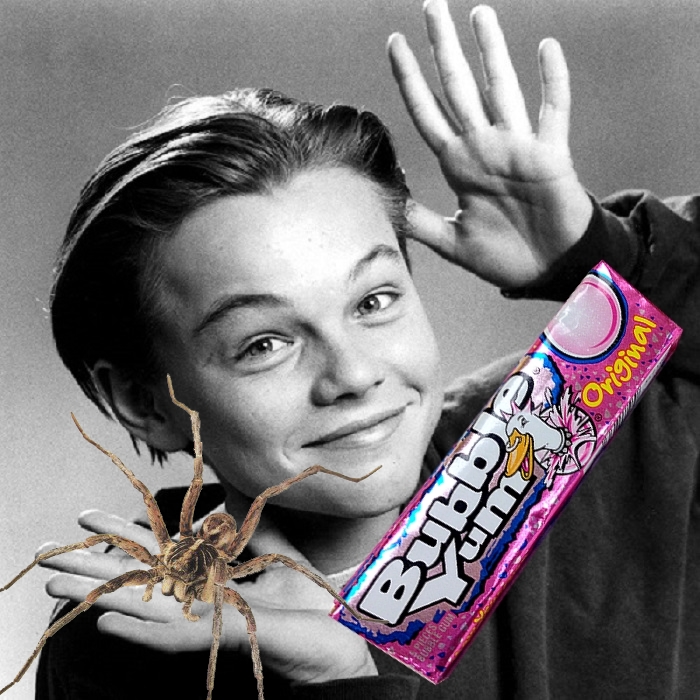
Bubble Yum, Spider Eggs and Leonardo DiCaprio.

leonardo-dicaprio-bubble yum spiderOriginal publish date:  September 12, 2016
I began working on this article Sunday night. It was the 15th anniversary of 9/11 and I’d been watching stories about our shared national tragedy all day long. While cloaked in that veil of sadness I realized my article deadline was already 3 days past and I couldn’t think of anything to write about. I needed a smile. So I thought I’d try and dig up something that was borderline nonsense, certainly not news, but might just make you smile.
40 years ago, Bubble Yum officially made it’s Hoosier debut. Some websites claim it came out in 1975, but 1976 is the first year I recall being able to buy it in Indianapolis, so I’m going with that. Just in case you forgot, Bubble Yum (created by LifeSavers) was the very first soft bubble gum ever created. It was an instant hit and sales quickly shot through the roof. Before 1976, bubble gum was hard and often took jaws of steel to work it into bubble-blowing shape. Before 1976, we didn’t question the laws of the gum universe. Bazooka, Wrigley’s, Fruit Stripe, Dubble Bubble, Dentyne, Chiclets, Beechies, Trident, Razzles, Juicy Fruit, Joe Blo, Topps baseball card gum; we didn’t care, we just chewed away in blissful ignorance.
What is bubble gum, how does it work and how the heck did it ever catch on? Well, the bubble part should be pretty self explanatory. The gum base is what gives it that bounce-back texture that makes it fun to chew. Gum base often contains polyethylene, a long molecule that’s also used to make plastic bottles and plastic bags. As you can imagine, each company keeps their special recipe a secret. What we do know is that all gum bases are made of three main ingredients : Resin is the main substance you chew, wax softens the gum and Elastomer adds flexibility. Elastomer is a big fancy word for “rubber”.
Don’t let those three ingredients scare you, despite what you might’ve been told growing up, if you swallow a piece of gum it’s highly unlikely to end up stuck in your stomach for seven years. Even though gum base is indigestible, it passes through the digestive system harmlessly and is eliminated from the body alongside other foods.
The best chewing gum brands infuse sweetener and flavoring into the gum base so that the flavor is released more slowly. As you chew, the sweetener and flavoring dissolve in your saliva and spreads over your tongue. Eventually most of the sweetener and flavoring disappear and the flavor fades away. Gum base does not dissolve in saliva, so you lose the flavor, but not the gum. But why do we chew gum? Bubble gum satisfies the natural human impulse to chew. Some people chew to relieve stress, others to combat bad breath or aid digestion, but most do it just because they enjoy the taste.
Northern Europeans were chewing birch bark tar 9,000 years ago, not only for enjoyment but also for medicinal purposes and to relieve toothaches. The ancient Maya chewed sap from the sapodilla tree, a substance called chicle, as a way to quench thirst or fight hunger. The Aztecs also chewed chicle but only kids and single women were allowed to chew it in public. Married women and widows could chew it privately to freshen their breath, while men could chew it in secret to clean their teeth. In North America, the Indians chewed spruce tree resin and passed the habit along to the European settlers who followed.
Bubble Yum represented a real breakthrough, a gum that was ready for bubble blowing almost immediately after you popped it in your mouth. Each package contained five individually wrapped rectangular pieces of gum, each piece contains about 25 calories. At first, Bubble Yum was available in both the original variety and a luscious grape version. Both versions were a huge success right out of the gate, and naturally, they spawned more and more flavors over the years: Orange, Wild Cherry, Spearmint, Wild Strawberry, Sour Apple Berry, Rockin’ Rasberry, Yellin’ Melons, Bananaberry Split, Wet N’ Wild Watermelon, Hawaiian Fruit Punch, Cotton Candy, Checker Mint, Sour Cherry and Chocolate among others.
300 million packs were sold in its first 15 months on the market, so much that production couldn’t keep up with demand. Bubble Yum became an instant sensation. The standard pre-mastication routine among early Bubble Yum users was to squish a block of Bubble Yum between your fingers before chewing. Hey, in pre-microchip days, we had to take our fun wherever we could find it. “Why is it so chewy?” was the question of the day during that Bicentennial year. It didn’t take long for kids to invent a nefarious answer.
In the Spring of 1977, rumors began to spread that the gum’s soft, chewable secret was that the gum was made out of spider eggs. Soon, the urban legend was the viral topic in classrooms and playgrounds nationwide.

A less well-circulated rumor dating from the same period claimed that Bubble Yum also caused cancer. Tall tales about a girl waking up with webs all over her face or nine youngsters dying after swallowing the gum spread quickly among kids and were naturally taken as gospel. The fact that there were little granules of sugar that you could feel with your tongue didn’t help quell the rumors.
To combat the panic and halt the dive in Bubble Yum sales, the Life Savers Company embarked on a $100,000 advertising campaign of full-page rebuttal ads printed in prominent U.S. newspapers from coast-to-coast. Each ad began with the headline “Somebody is Telling Very Bad Lies About a Very Good Product.” Life Savers’ president William Mack Morris told People Magazine that, “Fighting the rumor was like punching air.”
Within 10 days of that first public whisper, company surveys showed that “well over half” of the children in the New York area had heard the rumor. It spread like wildfire from bus stop to lunchroom among schoolkids of all ages. Of course it wasn’t true. So despite quick efforts by the folks at Life Savers to dispel the myth, the story still took awhile to die. After all, it made for great sandlot conversation guaranteed to make any girl’s pigtails curl. Eventually, the story faded away and sales again began to soar. Bubble Yum sales soon surpassed the venerated Life Savers candy to become the most popular bubble gum brand on the market.
Although still a closely guarded corporate secret, speculation persists that Bubble Yum’s secret softening ingredient is lanolin, a waxy substance derived from sheep wool. While not necessarily dangerous to your health, chewing on lanolin does not exactly sound appetizing. Bubble Yum chose Floyd D. Duck, an anthropomorphic punk-style duck character, as their official mascot, which somehow doesn’t help subdue that unsavory image. Nabisco bought Life Savers in 1981, and The Hershey Company acquired the brand in 2000.
Bubble Yum quickly spawned other versions of soft bubble gum. By 1977, Bubblicious, made by Cadbury, hit store shelves, followed by Hubba Bubba in 1979, and Big League Chew in 1980. The era of soft bubble gum had arrived and we owe it all to Bubble Yum’s successful war against the imaginary reproductive habits of spiders through colorful urban legends. Today, soft & chewy gum is sold in a variety of shapes and flavors. Although, sadly, Willy Wonka’s three-course dinner chewing gum, said to taste like tomato soup, roast beef and blueberry pie, is unlikely to become a reality in our lifetime. Bubble Yum is not likely to disappear from store shelves anytime soon.
The United States is among the top three countries with the highest rates of chewing gum consumption worldwide. In the US, 59 percent of people chew gum, surpassed only by Iran (82 percent) and Saudi Arabia (79 percent). A primary reason why the Middle East has more gum chewers than the US is because chewing gum is often given out by merchants in place of small change. Seems like Bubble Yum’s appeal is not limited to our shores alone. Perhaps that is why an original first-generation unopened pack of Strawberry Stripe Bubble Yum from 1976 sold for $ 482 on eBay a few years ago. So check those telephone drawers, tackle boxes and catch-all bins, your pack-rat tendencies might actually pay off for a change.
One last tidbit from the way-back machine before I close. How many of you remember the Hollywood heart throb who started his career as a TV commercial pitchman for Bubble Yum? Today he’s a Hollywood A-lister and recent Oscar winner, but in 1988 Leonardo DiCaprio was a fresh-faced 14-year-old teenager pitchin’ Bubble Yum to the masses. Leo, then sporting a thick mop of blonde hair, wears a tie and checkered shirt as he blows pink bubbles for the camera. Little Leo dances to a giant Boom Box and touts “Big Mouth Bustin’ Bubble Yum” to a generation of teeny-boppers on the small screen. Those teeny-boppers undoubtedly have teeny-boppers of their own now. Google it and you’ll see, it’s worth a giggle.

food, Pop Culture

The Franken Berry Scare.

Frankenberry Original publish date:  February 13, 2017

February 1972 was a busy and historic month. The Winter Olympics opened in Sapporo, Japan. The FCC created cable television as we first knew it. David Bowie introduced his “Ziggy Stardust” alter-ego during his world concert tour. Richard M. Nixon became the first U.S, President to visit the People’s Republic of China. Pink Floyd performed The Dark Side of the Moon one year before the album was released. The EPA first required that unleaded gasoline be made available at all gas stations. And little kids all over America were pooping pink.
Hospitals all over the country were being inundated by hundreds of panicked mothers rushing their children to emergency rooms and doctor’s offices for fear of internal bleeding. What did all of these kids have in common? They all loved Franken Berry cereal. But wait, General Mills debuted their classic line of monster cereals on Halloween of 1971. So why was this perceived medical malady cropping up now? Seems that four months after that first box rolled off the assembly line, General Mills changed the recipe.
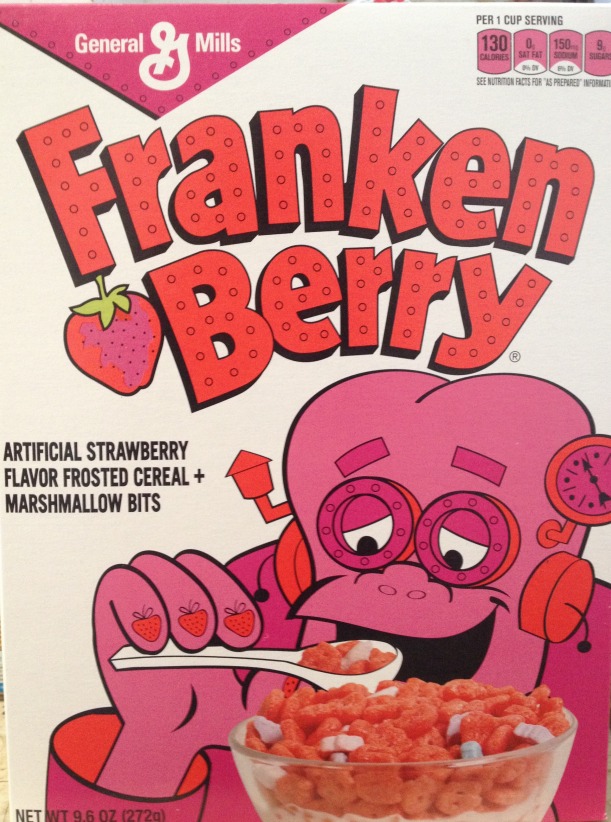
The first two cereals in the line were Count Chocula (the chocolate-flavored cereal was originally called “Dr. Count Chocula”) and the strawberry-flavored Franken Berry. With porthole-rimmed eyes, antenna ears and a pressure gauge sticking out of a big marshmallow head, the most shocking thing about Franken Berry was its hot pink complexion. General Mills created their monster cereals to piggyback on the success of Lucky Charms. These new character cereals contained marshmallow-studded grain puffs pitched by slightly spooky mascots involved in a wacky rivalry.
“Don’t be scared,” Count Chocula would say in his best Bela Lugosi accent while popping out of his cardboard box coffin. “I’m the super-sweet monster with the super-sweet new cereal!” Enter Franken Berry: “Piffle!” he yells, in a thinly masked accent of Boris Karloff. “Here’s the super-sweet new cereal.” It made for a tough choice to be sure and those catchy Saturday morning TV commercials sealed the deal. Monster Cereal commercials, alongside Burger Chef and Jeff and fellow cereal mascots Quisp and Quake, became much anticipated and nearly as popular as the cartoons themselves. Scores of sugar-fueled kids fondly remember those animated TV commercials nearly 50 years after they first aired.
But what about that February 1972 recipe change? Evidently someone in the General Mills merchandising department thought that the cereal didn’t match it’s mascot: it wasn’t pink enough. So Amaranth, a crimson food dye named after a South American grain (comparable to rice or corn) whose origins go back 8,000 years. It was a staple food of the Aztecs used as an integral part of religious ceremonies until being banned by the conquistadors upon their conquest of the Aztec nation. After that, Amaranth grew wild and soon became viewed as little more than a weed.
That is until 1878 when Amaranth was first synthesized by liquefaction and found to be a powerful bright red coloring agent that held it’s hue and was fade resistant. In 1906, Congress passed the Pure Food and Drug Act, the first legislation for food colors. They deemed seven colors suitable for use in food: orange, erythrosine, ponceu 3R, amaranth, indigotin, naphthol yellow, and light green. Amaranth became the 20th century’s most widely used food coloring. A cheap, tasteless substance, only a very small amount of the dye was necessary to lend flaming color to foods and makeup. By the 1970s, Amaranth dye could be found in $10 billion worth of comestibles and cosmetics including soft drinks, candy, make-up, hot dogs, ice cream, and processed fruits.
If you are a late-stage Baby Boomer or a Millennial who can remember eating Franken Berry as a kid, you may be wondering why all the fuss about Amaranth? Well, most Americans know Amaranth by another name: Red Dye Number 2. In 1938, Congress passed the Federal Food, Drug, and Cosmetic Act which gave these colors numbers instead of chemical names and Red Dye No. 2 was born. During the monster cereal “Red Scare”, medical personnel came up with a term for this marshmallow malady: they began calling it “Franken Berry Stool.” Turns out, Red Dye No. 2 is an indigestible pigment that can’t be broken down or absorbed by the body. So, just like a penny or a cherry pit, it comes out looking the same way it went in.
A 1971 report surfaced claiming that Russian scientists discovered that Red Dye No. 2 caused cancer in female lab rats. Panic ensued and, despite assurances from the medical community that the pink poo was totally harmless, the US Government reluctantly stepped into the fray. As reports of Frankenberry Stool Syndrome continued, the media went on a frenzy, denouncing the dye as a carcinogenic, tumor-inducing agent. Americans, already on edge from a Swine Flu scare a few months earlier, were on red alert. February 1972 was the height of the Cold War. Nixon’s trip to Communist Red China notwithstanding, the US was hyper-sensitive to anything coming out of the Soviet Union and when the source of the study was considered, the red potty hysteria slowly tapered off.
An article in the February 1972 edition of “Pediatrics” magazine (The Official Journal of the American Academy of Pediatrics), cited the case of a 12-year-old boy from Maryland whose “chief complaint was passing red stools for 2 days that were somewhat loose and unassociated with abdominal pain or other symptoms.” According to the case report, this particular kid had an adventurous history of eating things he shouldn’t, citing that on two separate occasions, he ate (and then threw up) coffee grounds. So when the child started pooping pink, his mom became convinced he had eaten something that was causing internal bleeding. She took him to the hospital where he stayed for the next four days.
His 1972 case study, titled “Benign Red Pigmentation of Stool Resulting from Food Coloring in a New Breakfast Cereal (The Franken Berry Stool)”, stated that the “stool had no abnormal odor but looked like strawberry ice cream.” When questioned, the mother revealed that the child had eaten bowls of Franken Berry cereal in the days before his hospitalization. After two days in the hospital, his red storm symptoms had subsided and, based on his mother’s information, the doctors did a little experiment. After letting the boy’s digestive system clear itself, they fed him four bowls of Franken Berry cereal over the next two days, he passed bright pink stools. But other than the startling pink hue, there were no other symptoms. Doctors sent the boy home, where the mother found his sister, the lucky beneficiary of that leftover box of Franken Berry cereal, also pooping pink.
The report further stated: “It has long been known that certain drugs and foods can cause alteration in the color of stools. These alterations in color may be of concern to parents and physicians unless recognized. The following case is presented as yet another example of a product which may alter stool color. The breakfast cereal under discussion has only been on the market a few weeks and physicians should be aware of its potential for producing reddish stools.” The report concluded, “Physical examination upon admission revealed in no acute distress and with normal vital signs…Physical examination was otherwise unremarkable.”
The Red Dye No. 2 fervor had a ripple effect. Mars candy removed their red M&M’s from their product bags for nearly a decade after the Franken Berry stool scare, even though Mars didn’t even use Red No. 2; according to mms.com. “However, to avoid consumer confusion, the red candies were pulled from the color mix.” Suddenly, hundreds of brands began recalling their Red No.2-infused products: hot dogs were pulled from grocery aisles, dog food was discarded in droves, ice cream treats were left to melt in landfills — and the red M&M disappeared. As for their part, General Mills switched to the less crimson colored Red Dye No. 40 (aka Allura Red) for use in their monster cereals.
Despite the temporary (and perhaps media driven) hysteria brought on by Franken Berry Stool Syndrome, in December of 1972, General Mills introduced Boo-Berry, the world’s first blueberry flavored cereal. Boo-Berry, used Blue No. 1 (a dye currently banned elsewhere in the world) which turned children’s potty piles green. Apparently, green stool seemed less life-threatening than the reddish hue caused by Franken Berry. Fruit Brute debuted a year later. Fruit Brute was discontinued by 1983 and replaced in 1988 by Fruity Yummy Mummy, which also had a short life as it was also dropped in 1993.
The Franken Berry Stool Scare can be found referenced in Stephen King’s 1981 novel “Cujo” as “Red Razberry Zingers”, but for most, it exists only as a vague memory. Another cereal stool scare occurred when Post’s Smurfberry Crunch Cereal was released in 1982 and was found to turn kid’s poop blue-thereby creating the ultimate Smurfs experience. However, Post changed the formula and re-released the cereal in 1987 as Magic Berries Cereal. Almost fifty years later, the exuberantly silly monster cereal mascots have survived and are on their way to pop culture immortality. Franken Berry, Boo Berry and Count Chocula can be found on bobblehead dolls, toy cars, t-shirts, pillows and even adult-sized Halloween costumes. The cereal itself can still be found as well, but they are most prominent during the Halloween season.
Oh, evidently if you find yourself traveling to the East Coast this Spring, you may well encounter a Frankenberry of a different color. According to the website mynamestats.com, there are an estimated 446 people in the United States named Frankenberry. The state with the most Frankenberry’s is Maryland where 103 people have this name, followed by West Virginia which claims 1.97 persons in every 100,000 residents with the name. In this case, according to the website, the Frankenberry population in the United States is 100.0% white. Well, so much for the Red Scare.