Criminals, Museums, National Park Service, Pop Culture, Travel

A Hoosier Guard on Alcatraz PART III

Albright Part III
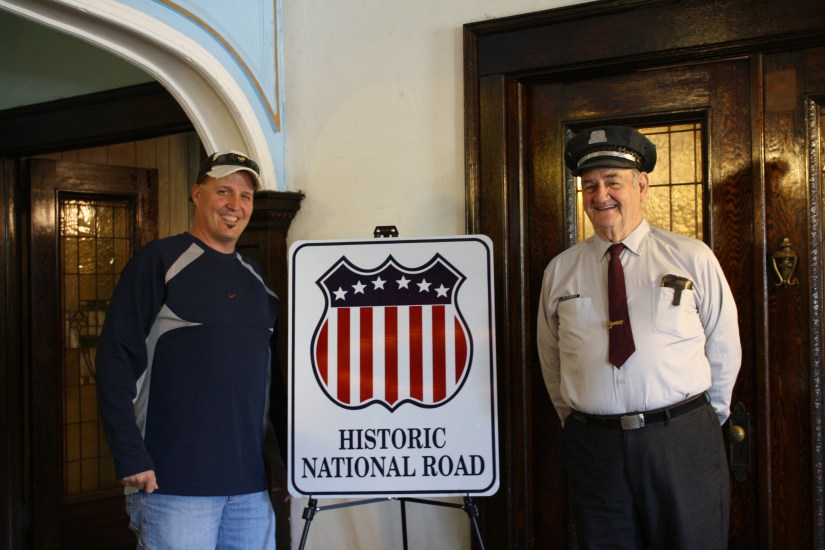
The author and Jim Albright-Indiana National Road Meeting at Brazil Lodge in 2010.

Original publish date:  July 23, 2020

Jim Albright was on duty the night the most famous escape from Alcatraz took place. On June 11, 1962, Frank Morris, Clarence Anglin and his brother John escaped through a hole in the back of their cells, the details of which were chronicled in Clint Eastwood’s 1979 film, “Escape From Alcatraz.” Albright recalled the escape in his 2008 book, “Last Guard Out. A Riveting Account By The Last Guard To Leave Alcatraz” (available at Amazon), “The movie showed them escaping off Broadway and that is not correct. In real life they escaped off Seedy Avenue (outside of B Block).” Jim also points out that the movie showed Eastwood stealing a pair of fingernail clippers off the Warden’s desk, “This would not have been necessary as each inmate was issued a pair when they first arrive at the prison.”

z 1962-Alcatraz-prison-break-1249788
The Anglin Brothers, Morris & a dummy head.

On the night of the escape, Jim recalled, “I had been over in town playing ball and I stepped in a gopher hole and twisted my knee, so they give me some crutches. The next morning (after the escape was discovered), I’m crutching up the hill when I run into the Lieutenant and he says ‘we got some missing’ and orders me to watch the back of the cell house.” Later, Jim went inside the cellhouse to “see what was going on.” He looked in Anglin’s cell and saw the false head. “They got dummy heads up there now that look like I made them. The dummy head I saw that morning looked very real. They did a good job, in fact, when I saw it I thought I had the wrong cell, it looked that real.”
Also in his book, Jim vividly remembers the events leading up to the bustout (“I told them those blankets should not be there”), the escape (“After the escape I was placed on roof detail after night fell, with a pistol and flashlight. I couldn’t flash very often because of limited mobility with crutches.”) and the aftermath (“The inmates had a field day teasing, laughing, comments, etc., toward the guards in the immediate time after the escape.”). “John Anglin was the older brother and John worked for me in the clothing room, so I knew John real well,” Jim believes, “I strongly feel the Anglin brothers probably killed (Frank) Morris to lesson the weight of the raft, and they in turn drowned and washed out to sea…I think about it even after all these years and realize that I too was a part of all of this.” The after effects are still visible. Several times during the story, Jim would stop, shake his head, and say “Them damn blankets.”
Likewise, Cathy recalls the escape from her unique perspective. “I was downstairs with the kids visiting with Betty Miller and we heard this alarm go off. Well, that means you don’t leave where you’re at and I’m down there and I’ve got two kids in diapers and didn’t have any extra diapers so we used towels for diapers until I could go. They searched Betty’s place and then they searched my apartment. But as far as being afraid, I never was, I really felt safer there than I did some other places.”

z 14492243666_6a483a88fc_c
Tom Reeves, Jr.’s reconstructed water tower on Alcatraz.

When I asked Jim about the current trend of tearing down monuments, he recalled the Native American Indian occupation of Alcatraz that took place from 1969 to 1971, years after the Albrights’ left the island. “When the original water tower was replaced after it was rusting away and pieces were falling off of it, they hired a guy, a former kid named Tom Reeves, Jr. who was teenager living on the island when I was there, his dad worked in the hospital as an MTA, his stepmom worked in town as a nurse.” the old guard chuckles as a memory bubbles up, “Tom had a little scheme going when he was in high school, everybody wanted to go to Alcatraz. All of his buddies, everybody in the school wanted to go to Alcatraz. Tom would say ‘I will take you to Alcatraz for two bucks’ so he’d get 3 or 4 guys, get two bucks a piece, bring ’em over and show ’em the island and take ’em back. The Warden found out about it and he wasn’t happy.”

IMG_0117
Cathy and Jim Albright.

After the laughter died down, Jim continued, “Tom grew up and became an engineer. He has an office in San Francisco, Seattle and somewhere in Hawaii, he was that big. So he engineered the repair of that water tower to make it look just as it did when we were there so that it would hold up. And it looked like new. And then they went and put Indian Graffiti back on it. And I asked (National Park Service Ranger) John Cantwell why they did that and Cantwell’s answer was, ‘Jim, love it or hate it, that is part of our history.'” Jim points out that Reeves, Jr. and his company restored the water tower and helped preserve several of the decaying buildings, including the steel tie-rods used to shore up the Warden’s House that was burnt during the Indian occupation, “at no charge, he did all that for free, he didn’t charge ’em a dime.” Jim and the Alcatraz alumni association wanted to place a plaque near the water tower thanking Reeves, Jr., as a former resident and benefactor, but the Park Service wouldn’t let them.
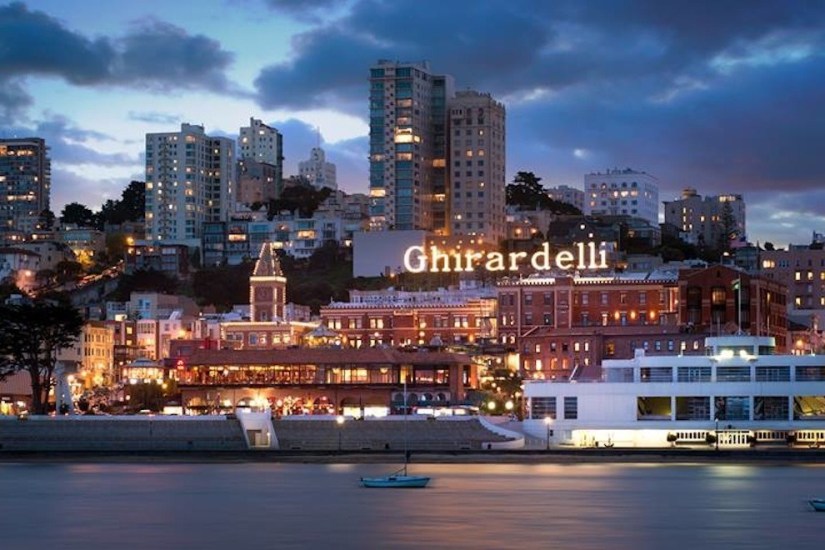
z Ghiradeli_54_990x660Jim’s recollections about his time on the island are limitless, he can affirm or deny legends about the island with ease. He relates details as if they happened yesterday. “The best cell placement on the island was the second tier because you could look out to see and hear San Francisco. On New Years especially, you could hear the parties and watch the party boats go past. When I was there, Ghiardelli Chocolate factory was still operational and you could smell that chocolate cooking when the breeze was just right.” He continues, “Al, you’ll like this, when I was in the tower, if one of those boats got too close to the island, I’d warn them with a bullhorn and if they didn’t listen, I could fire a shot across their bow. They moved then,” says the veteran guard. The prisoners were aware of the rumor that the island was patrolled by sharks, “Well the prisoners heard the rumor that the guards went down and caught all the sharks and cut the left fin off to make them swim in a circle around the island and we guards didn’t do anything to change their mind.”
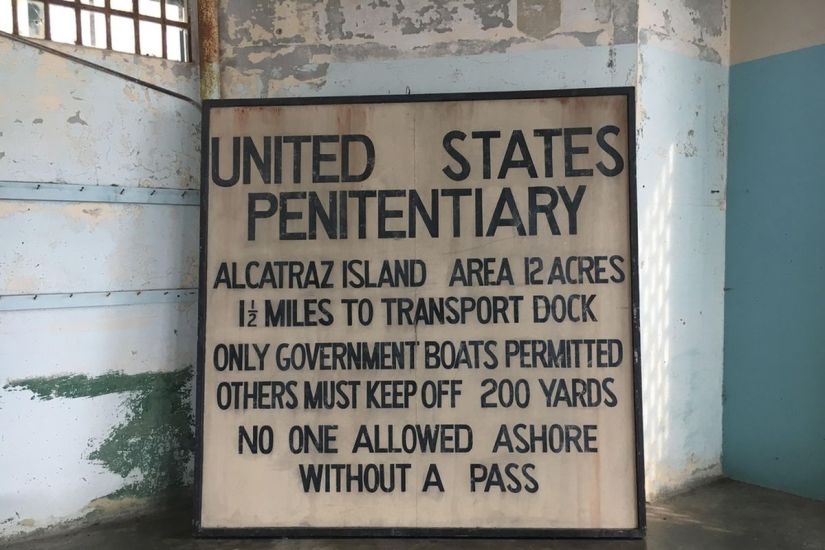
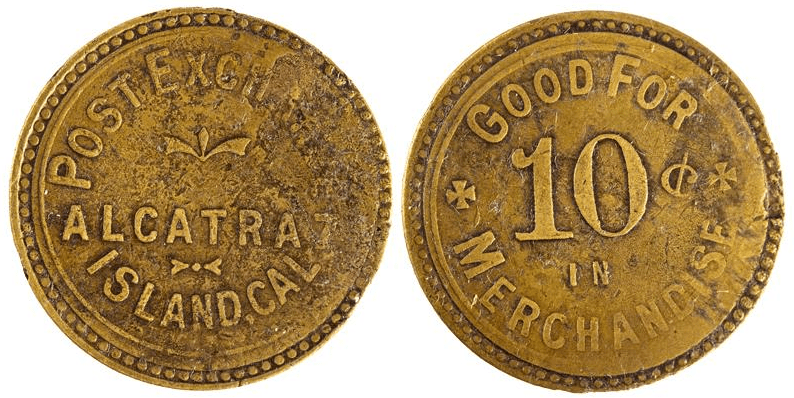
z shutterstock_743324311.0Jim recalls patrolling the perimeter of the island and occasionally finding relics left over by military personnel during the time Alcatraz was in operation as a military fort guarding the bay from the Civil War up into World War II. Jim would see the old tokens gleaming in the moonlite at water’s edge, “I found script, I guess you’d call it. I think I’ve still got a dime, a fifty cent piece and a quarter around here somewhere.” He continues, “the guys would fish, there was a bout a half a dozen of them, down below the industries building. When you were dock and patrolman, there was a list, when you walked into the dock office, and when you saw the stripe bass running, you looked on that list and you’d call those guys who wanted to fish, anytime day or night, and you could make another round and when yo came back there could be anywhere from ten to thirty guys down there fishing. They made a Formica chute where they’d filet them right there on the spot and give the scraps to the seagulls. Quite often, you could help yourself to as many filets as you wanted. The head chef loved it cause they’d catch enough to feed the whole main line of prisoners.” I asked Jim if he ate the same meals the convicts ate. “When I first started there, I went thru the line and took my food back to a table in the kitchen. then they built us an officer’s dining room upstairs. The food was good.” Jim says the Alcatraz convicts, “had the best food in the prison service. Good food keeps trouble down.”
Screenshot (163)
Alcatraz “script” tokens.

Cathy chuckles as she recalls Blackie Audett (a longtime convict who worked in the kitchen). “Whenever I baked cookies, I’d lay them out on the window sill to cool. Every time I baked cookies, there would be 3 or 4 officers, I counted 10 one time, that would knock on the door and say, ‘Hey you’re making cookies, I want a few.’ And I asked Jim how did they know? Well, come to find out, that Blackie Audett could look out of that dining room window into my kitchen and see my cookies. Well, that scared the heck out of me. I wondered if he can see in the kitchen window, can he see into the living room window or the bedroom window.” Jim, forever on guard, says, “Yeah, Blackie was there (incarcerated) three times.” Jim also confirms another bit of trivia from Clint Eastwood’s movie, “We had a guy named Ianelli. He was a weightlifter and he had muscles on top of his muscles. I always shook him down extra special and teased him that he was getting lax. They called him Wolf.” Albright confirms that Wolf was a sexual predator as portrayed in the movie and recalled that Wolf was after a young inmate named Robbins who worked back in the “dishtray room”. Jim recalls Wolf was after “Robbie”. “One day Robbie got a pipe and came up behind Wolf hit in the back of the head and damn near killed him. If he (Wolf) had not been in such good shape he would have died. He was sent to our hospital upstairs and brought him about a third of the way back before they shipped him to our medical hospital in Springfield, Missouri. I don’t know if he’s still alive or not but he sure was never the same.”

519kJvKIU8L._SL500_

Criminals, Indianapolis, Museums, National Park Service, Pop Culture, Travel

A Hoosier Guard on Alcatraz PART II

Albright Part II
Cathy and Jim Albright

Original publish date:  July 16, 2020

A couple of weeks ago, with Covid-19 restrictions finally easing up, I traveled west on the National Road to Terre Haute with my wife Rhonda and friends Kris and Roger Branch to see a couple of Hoosier legends that I hadn’t seen in almost a decade. Jim and Cathy Albright welcomed our little band of intrepid historians into their home to catch up and listen to stories as only they could tell them. Jim was the last guard off the Island prison in San Francisco Bay known as Alcatraz. No, it doesn’t mean that Jim was the last man to board the final boat off the island when it closed on March 21, 1963, rather, Jim and his wife Cathy remained living on Alcatraz for weeks after it’s closing. As detailed in part one of this series last week, when the prison closed, the Albright’s daughter Donna Sue was only 11 days old and suffering from a foot abnormality that required surgery. The child could not be moved in her fragile condition, so the family remained on the island for 3 more months before leaving on June 22, 1963.
Social distancing guidelines and masks in place, we sat down for a talk about “The Rock.” Ironically, the couple celebrated their 65th anniversary in April during Indiana’s stay at home lockdown period. And Jim Albright knows a thing or tow about lockdown. On their 60th anniversary the couple renewed their vows on Alcatraz, “The biggest surprise I had when we got remarried out there was that she said yes the second time,” Jim says with a smile. Cathy recalls that she can still gaze up at their old apartment in Building 64 and see the curtains she made hanging in the window, although, “You can’t go into the building now, the floors and stairs are all falling apart and it’s not safe,” Cathy says.

7z 583471-Building-64-at-Alcatraz-0
Building 64 at Alcatraz.

From time-to-time, the couple still visit different civic organizations and talk about their years at Alcatraz. “You name the organization, we’ve spoken to ’em.” Jim says, “We have been going back to Alcatraz every year in August for a long time now. (Cathy recalls that first visit was on the 35th anniversary of the prison’s closing-“to the day”-she says) We take the train out but we are going to cancel this year because of the virus.” Jim recalled his first visit to his old island home so many years ago, “John Cantwell (NPS Ranger) offered to escort us around the island and it turned out to be a six-and-a-half hour tour.” To which Cathy laughs and says, “That’s because you were talking so much.” Jim’s recall of events on the island is remarkable. During that first tour, Jim shared details which Ranger Cantwell had never heard before. According to the former guard, Cantwell remarked, “Jim, we’ve had a lot of guys come back here, but they don’t remember the things that you do.” Jim continued, “That’s because wherever I went on the island, and we went EVERYWHERE; the east gun gallery, up on the roof, the old officer’s dining room, every time that I go somewhere, when I step in it seems to trigger something, and I remember…”

Z Industries
The New Industries Building at Alcatraz.

Cantwell took them to the old Industries building where there were “Great big, probably 8 foot by 10 foot, photographs of the prison and Jim was in several of them, so that was neat to go see that.” Jim says with a chuckle. Cathy adds, “He says he remembers stuff all the time, brings it up, he used to be able to tell you every inmate that was in there when he was there…their name, number, where they worked, where they lived.” Jim chimes in, “But I can’t anymore. It’s all gotten away. When I went there on August 24, 1959, that was my original starting date, and the low number of the inmates at that time was a guy named Clark, number 242, and of course when I left, 1576, Frank Weatherman was the high number. So we had not quite that many inmates cause if you came back, you got another number, I can think of one inmate who was there three different times under three different numbers. I come in August of 1959 and left the island June 22 of ’63.”
I asked Jim if he still had relics and souvenirs from his time as a guard and he shared that he still had his uniform but not the jacket. “I had to turn that in. I don’t know why, I was the only one left on the island and I shoulda kept it.” To which Cathy replied, “Then he found out later that they took all of those coats and stuff like that and dumped it out in the bay.” Jim adds, “Lt. Robbins came on the boat with a whole box of keys and dumped ’em into the bay. Fortunately, I was working the control center when it closed up so I have a key to the main gate. Being in the right place at the right time…I’ve also got a key to the main visiting room.”

z jimalbright-955ad39abb04a0cb2b7d719ff432ce79bb5acecc-s800-c85
Jim Albright leading the “last line” of prisoners out of Alcatraz.

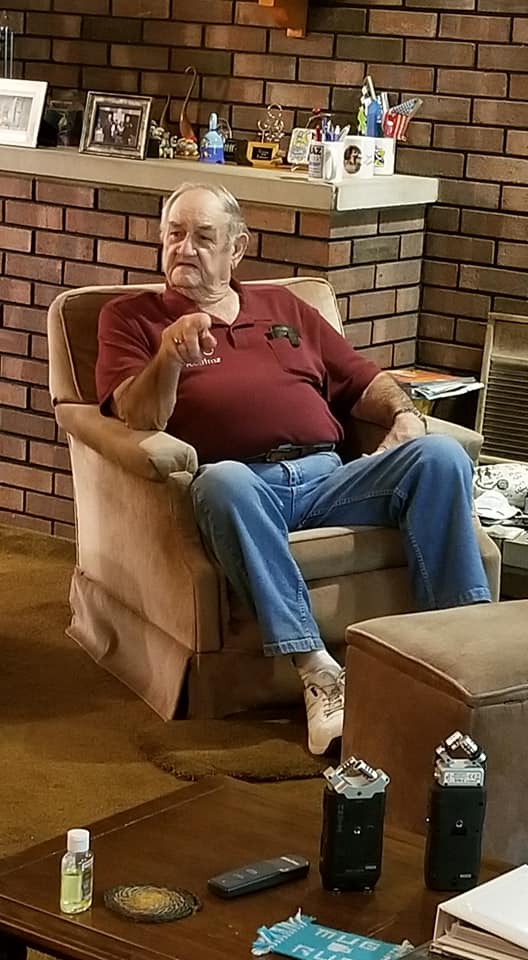
And, since we we all seated in the Albright’s living room, I recalled that Jim had once told me that they also bought much of the de-accessioned furniture from Alcatraz. Cathy giggles as Jim reveals that the chair he is seated in, and that from which Kris was filming from, were all once located in the furnished apartments for guards and officials on the island. Jim points out, “that magazine rack, is off the island.” Cathy reports, “We bought most of it out of the warden’s house, they were selling it, when they closed the island, you could go up there and buy it and we did.” Cathy notes that the furniture is marked with a small metal tag reading “USP Alcatraz Survey” on the bottom. Jim further reports, “that tag has a number stamped on it and they had a book that they could tell exactly what that was and where it was.” He points over his shoulder and states, “That one bedroom down there, most of the furniture is Alcatraz, two or three items in our bedroom are all Alcatraz, the dining room table and chairs, a couple items out here and on the back porch. Red Ball moving company came to the island moved it for us. Everything had to go by barge over to Fort Mason”

Albright Part IIa
Jim Albright seated in one of the original Alcatraz chairs.

Jim recalls that his duties were light during the three months he remained on Alcatraz as the last guard. “There were others there, we weren’t alone on the island. There was a caretaker, a few maintenance workers and the lighthouse operators. I still spent my time patrolling the island with my bullhorn cause everybody wanted to board that island so I ran around yelling ‘you gotta stay off, this is Government property.'” When Jim left Alcatraz, he went to Marion, Illinois. “That was one of the seven places,” Cathy replies. The couple settled in Terre Haute and Jim retired here. “Three miles from my door to the prison gate. Last April I’m retired 35 years and I enjoy every minute of it.” he states. When I asked if his Alcatraz service helped him later on in his career, Jim said, “Because I had worked at Alcatraz, they didn’t even question what I did or how I did it. You know, it really helped as I went to different places.”

z e781c1fb6b8525d77dcfd9980ae80dfd
The Warden’s house on Alcatraz as it once looked (right) and as it looks today (left).

I asked how Alcatraz compared to other duty, especially considering that the guards lived with their families alongside the prisoners. Cathy replied, “Well, we could go anywhere but ‘up top’ that’s what we called where the cellhouse was located. The only time we ever went up there was when the warden’s wife had a party and then we were escorted up there and when the party was done, we were escorted back down.” Cathy further stated that the families could travel into San Francisco whenever they wanted. “When we’d go to the grocery store, if they found out we were from Alcatraz, people would just back away from you. They had a big park there and our son would want to go so I’d let him run all over there. When the women found out that we lived on Alcatraz, he couldn’t play with them anymore. The kids didn’t care what the moms said, they’d just play, you know.” Jim recalls, “there was like twelve boats a day” going into San Francisco, “somewhere around here I still have the boat schedule. The last boat ran back at 12:20 am for the guys working midnight shift, if you missed that boat, you were in town all night.”

519kJvKIU8L._SL500_

Criminals, Indianapolis, National Park Service, Pop Culture, Travel

A Hoosier Guard on Alcatraz Part I

Albright-Cantwell-Hunter
NPS Ranger John Cantwell and the author with Jim and Cathy Albright at Alcatraz fpr the 75th anniversary of the prison’s opening on August 11, 2009.

Original publish date:  October 23, 2009                Reissue date:  July 9, 2020


This column was first published 11 years ago. Last weekend, I traveled to Terre Haute to check on it’s subject. Next, week, in Parts 2, 3 & 4, I will bring you up to speed on Jim Albright, the last guard to leave the notorious San Francisco Bay island prison know as “The Rock.”

Alcatraz Federal Penitentiary opened 75 years ago on August 11, 1934. I covered my visit to the “The Rock” in an earlier “Eastside Voice” article. As I stood on the same Alcatraz boat dock that received the likes of Al “Scarface” Capone, George “Machine Gun” Kelly, Alvin “Creepy” Karpis, and Robert Stroud aka “The Birdman of Alcatraz” my attention was caught by a distinguished looking gentleman with what appeared to be a uniform draped over his arm and an Alcatraz prison guard hat in his hand. I asked one of the Park Rangers standing near me what the story was and he identified the man as a former Alcatraz guard from Terre Haute, Indiana and realizing that I was on the island for a story on an Indianapolis inmate, he followed that up with, “Oh yeah, you might want to talk to him. He was the last guard off the island.” I barely heard the last line as I was race walking across the dock towards him.

            As soon as I approached, the man saw my Indiana University hat and immediately extended his hand in a friendly greeting. “Indiana, huh? I’m from Terre Haute” he said, “I’m Jim Albright and I was here for 4 years until the prison closed in 1963.”  He went on to tell me that he gained a unique designation as the last guard off the island when he and his family left on June 22, 1963, over 3 months AFTER the prison closed on March 21, 1963. At that moment, the V.I.P. tram arrived to escort Jim and his lovely wife Catherine up the winding 130 foot hill that covers a steep quarter mile series of roads up to the cell house where Jim was here to sign copies of his book’ “Last Guard Out“.  You can imagine my distress at having just heard and comprehended this tasty nugget as the tram was pulling away. Just as I was contemplating the idea of chasing after the tram to complete the interview, I was whisked away into the bowels of building 64 under the old officer’s quarters that act as the backdrop for arrival.

z EBT-L-ALCATRAZ-0813-10
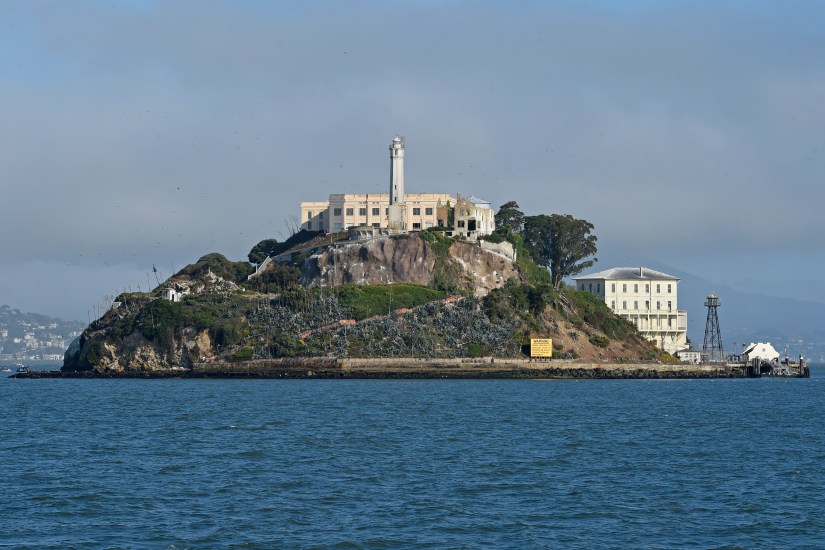
Alcatraz Island.

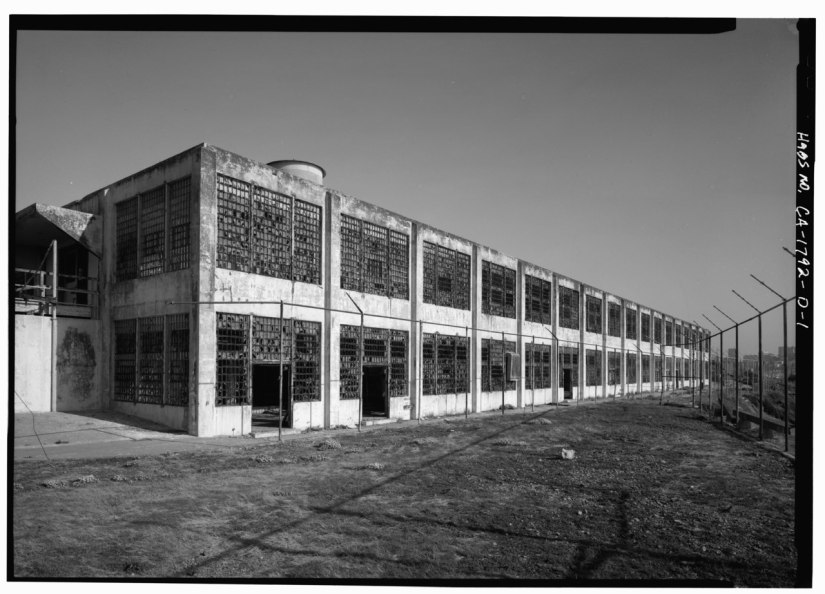
            Here I awaited Alcatraz park ranger John Cantwell in what once was a gun port of old “Fortress Alcatraz” with the gun ports still plainly visible in the walls. The building now acts as the Ranger’s research station and library. Cantwell graciously answered all of my questions and then led me on a tour of several areas that are strictly off limits to the general public. A dedicated public servant and a true asset to the National Park Service, Cantwell then took me up to meet up again with Jim and his wife Cathy who were busily autographing copies of the book for guests on the island in the huge new bookstore humorously referred to as the “Alcatraz Wal-Mart” by island employees. It’s interesting to note that the bookstore is located in the basement below the old kitchen, an area previously off limits to visitors probably best remembered by true Alcatraz buffs as the area where inmate / author Jim Quilllen attempted his breakout through the tunnel housing the steam pipes for the cell house. Jim greeted me wearing his original Alcatraz guard’s uniform from head to toe and looking pretty sharp I must say. I don’t know about you, but I don’t think I could fit into the same clothes I wore 20 years ago, let alone 50 years after I wore them.

            Jim and Cathy had driven across country from Terre Haute to San Francisco with their nine grandchildren in tow (complete with sleeping bags & luggage) to attend the 75th anniversary celebration on “The Rock“. The grandkids got the thrill of a lifetime when the whole family spent the night in the cells on “D block” together with the other guests and families attending the official ceremonies. With a sparkle in his eye, Jim told how he made sure the family slept in the cells on the middle tier of D block because “that’s the only tier that you can see all of the San Francisco shoreline from.” He paused for a moment to make sure that I knew it was the first time he’d ever slept in a cell. Jim lamented how he sometimes runs into young people who have never heard of Alcatraz, which is hard to imagine.

            In between autographs, Jim told me the story of his time on Alcatraz. He proudly pointed out that he was hired as a guard 50 years ago that very month (August 1959) as a 24 year old Iowa farm boy with no previous law enforcement experience. He was loading milk cans for Sealtest Dairy in Denver, Colorado when his corrections officer brother-in-law asked if he had ever considered a change of career. Alcatraz sounded a lot more exciting than milk cans, so in 1956 Jim, Cathy and their son Kenneth packed everything they owned into the back of a 1956 Chevy Nomad and drove out to the city by the bay. Jim took one look at the fog covered rock in the middle of San Francisco Bay and wondered what they had gotten themselves into. He was proud of the fact that both of his daughters, Vicki Lynn (Harland) and Donna Sue (Hinzman) were born on the island and their birth certificates list “Alcatraz” as their place of birth.

Albright-Hunters
The author, Jim Albright & Addison Hunter at Alcatraz.

            As Jim signed books, took pictures with guests and chatted with fans, I was able to talk to Cathy about her time on the Island. Most people unfamiliar with Alcatraz do not realize that the families of the guards lived on the island alongside the inmates; although Catherine pointed out that they rarely came into contact with each other. “There were 3 inmates that worked in the mess hall and from our windows we could see the 5 inmates that worked on the dock, but that was about it. Of course, there were no women employed on the island. The only women here were housewives and mothers.” she said. When asked what, if anything, made Alcatraz special, Catherine replied that it was the feeling of “Community” that she remembers most. Everyone knew everyone and there was always someone willing to help whenever you needed it. She remembers that she had one of the girls at 3 am and before she could pack an overnight bag for her trip to the hospital, 2 neighbors were in the apartment to help.

The Albrights remembered that the island had its own grocery store, bowling alley and movie theatre with a new movie showing every Sunday night. Jim & Cathy lived in an apartment in San Francisco for the first 6 weeks while waiting for housing to open up on the island, Cathy remembers that it was hard to find housing in the city by the bay as most apartments would allow pets, but no children. Someone had told the Albrights that the apartments on the island were furnished, so the family sold all of their furniture only to find that, when they moved in, the rooms were bare. Jim smiles broadly when he recalls that rent on the island apartment was $ 27.50 per month and included laundry, dry cleaning and utilities. Along with his uniform, Jim brought along several artifacts from his years on Alcatraz including his 1959 ID card, whistle, leather key strap, Alcatraz key “chit” tag that was exchanged for cell door keys and perhaps most interesting a couple of shiny brass Post / PX / Store tokens from the old military post years. Jim recalled how the launch boat used to dock on the west side of the island where he found the tokens shining in the moonlight in about 6 inches of water near the dock one night.

519kJvKIU8L._SL500_
Jim Albright’s Book.

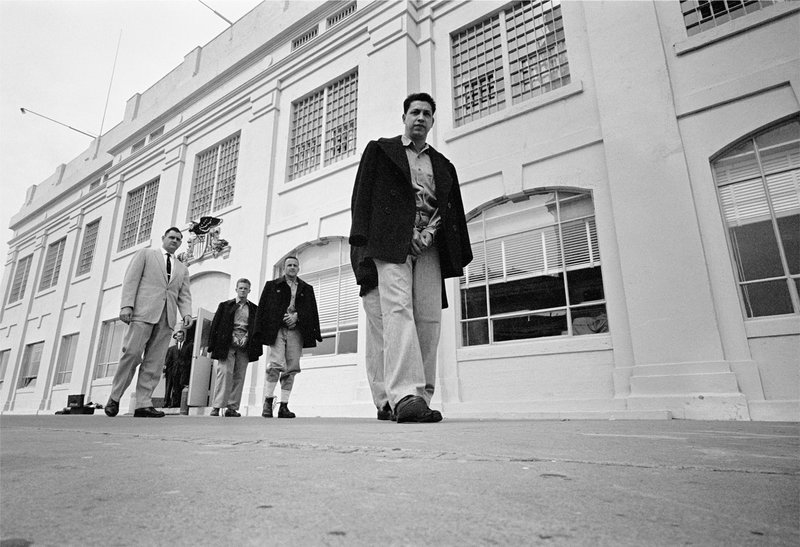
            Jim then told me the story of how he gained the designation as Alcatraz Island’s “Last Guard Out“. When the prison closed on March 21, 1963, the Albright’s daughter Donna Sue was only 11 days old and suffering from a foot abnormality that required surgery. The child could not be moved in her fragile condition, so the family remained on the island for 3 more months before leaving on June 22, 1963. The Albrights were the only family left on the island aside from a night watchman and a handful of government workers left behind to remove any useful equipment that could be transferred to other prisons or facilities. In late June of 1963, Jim was one of 10 Alcatraz guards handpicked by the Warden to be transferred to the new “Supermax” prison in Marion, Illinois which was built to replace “The Rock“.

            I asked Jim if being known as a former Alcatraz guard carried any weight at other facilities and he quickly replied “Oh, yes. With both guards AND Prisoners.” He remembered how he went from Alcatraz, which had 1 guard for every 3 inmates, to Marion where he worked alone from Midnight to 6 am watching 212 inmates armed only with a telephone in a prison so new that it had no doors on the cells and the containment fence that was supposed to surround the prison was incomplete. “That’s when the Alcatraz reputation made a difference. The inmates just didn’t mess with that.” He said. After Marion, Jim worked for a time at the Federal Prison in Petersburg, Virginia. Jim and Cathy Albright were transferred to the Federal Prison in Terre Haute, Indiana in 1972 and, aside from 4 years spent at a Milan, Michigan facility (1979 to 1983), they’ve been Hoosiers ever since. Jim retired as a Terre Haute Federal Prison guard in 1985.

            It was on a visit to Alcatraz Island in 1998 that Jim’s identity as an Alcatraz treasure was discovered. Jim was visiting “The Rock” as a tourist with his family, having purchased a ticket just like everyone else to visit his old home and workplace. Ranger John Cantwell asked the crowd if there were anyone present with a connection to the island and Jim, humble as always, didn’t say anything. It was Jim’s brother-in-law, John Peters, who finally spoke up to reveal Jim’s past as an Island guard. For years, everyone who knew Jim’s story urged him to write a book, now Ranger Cantwell himself contributed his voice to those urgings. The end result is the 2008 book “Last Guard Out –A riveting account by the last guard to leave Alcatraz” covering Jim Albright’s years of service on “The Rock.”

In case you’re wondering, yes I bought one and gleefully asked Jim & Cathy to sign my copy and date it on that historic 75th anniversary day. Now you will have the same opportunity as I did to meet and talk with Jim and Cathy Albright right here in Irvington. The Albrights will be in Irvington for the Halloween festival, signing copies of his book “Last Guard Out” at Book Mamas book store located at 9 South Johnson Avenue in Irvington from 3 PM to 4 PM on Saturday October 31. Don’t miss this opportunity to meet a true Hoosier legend.

The book’s a great read made even better now that I know the author and his wife. Of course, I would not be true to the “spirit” of this column if I didn’t ask Jim about the ghosts of Alcatraz. Jim thought for a moment and said, “You know, I worked on this Island for 4 years at all hours of the night and day. Midnight, 3 am, 4 am, every possible time slot and I never heard anything that I could call a ghost.” It does make me wonder though, what do you think those 9 grandkids who spent the night in Alcatraz’s legendary spooky cells of D block would say if I asked them the same thing?


Abe Lincoln, National Park Service, Presidents

Abraham Lincoln Dies in Indiana.

Lincoln in Indiana photo

Original publish date:  February 13, 2020

“In his 10th year he was kicked by a horse, and apparently killed for a time.” The words were Abraham Lincoln’s. He was describing his boyhood in the hills of southern Indiana. Although much has been written about Abraham Lincoln’s life, his time as a Hoosier has been woefully neglected. Lincoln’s family moved to Indiana in 1816, when Lincoln was seven years old. Multiple noteworthy events in Lincoln’s life occurred during his time in Indiana. The most important of these was the death of his mother, Nancy Hanks, who died of “milk sickness” from drinking poisonous cows’ milk on October 5, 1818.
Her death was a tragedy Lincoln never got over, however her death resulted in a “rebirth” of sorts when the young railsplitter’s father Thomas married Sarah Bush Johnston of Kentucky in December 1819. Lincoln’s stepmother moved into the family’s Pigeon Creek cabin, bringing with her three children (two girls and one boy). More importantly Sarah brought with her the attention and educational encouragement that young Abraham Lincoln craved and was lacking from his relationship with his father. Lincoln attended school sporadically in present-day Spencer County during the years 1820-24 where he learned to read and write.
On January 20, 1828, Lincoln’s sister Sarah passed away while delivering a stillborn child and both were buried in the Pigeon Creek Baptist Church Cemetery attached to the church the Lincoln family attended, and in which Abraham worked as a janitor for a short time. Perhaps the most significant theological event in Lincoln’s life occurred while he was a Hoosier. In December of 1828 he and his friend Allen Gentry embarked on a trip to New Orleans down the Mississippi River where Lincoln witnessed a slave auction, after which Lincoln said, “If I ever get a chance to hit that thing (slavery), I’ll hit it hard.” Also during those formative years in Indiana, Lincoln worked as a store clerk and met lawyers like John Pritcher, who he borrowed law books from. On March 1, 1830, the Lincolns packed up and moved to Illinois.

z scripps
Scripps Original letter to Lincoln.

When Lincoln ran for President in 1860, John Locke Scripps, senior editor of the Chicago Press and Tribune, asked the candidate for an autobiography. This third-person account, the longest of his autobiographies, offers fascinating details about his early years told in the folksy, homespun style only Lincoln could relay. In this autobiography Lincoln refers to himself alternatively as ‘A’ or ‘Mr. L.’ It is remarkably brief about certain periods of his life, including his years spent in Indiana “A. now thinks that the aggregate of all his schooling did not amount to one year. He was never in a college or Academy as a student; and never inside of a college or academy building till since he had a law-license. What he has in the way of education, he has picked up.’”
Although historians, beginning with biographer Carl Sandburg, love to weave homespun stories about Lincoln into nearly every written account of the 16th President’s life, Lincoln himself was ashamed of the poverty of those early days spent in the Hoosier state and was uncomfortable talking about his life before Springfield. When Scripps interviewed him in 1860, Lincoln explained “Why Scripps, it is a great piece of folly to attempt to make anything out of my early life. It can all be condensed into a single sentence and that sentence you will find in Gray’s Elegy; ‘The short and simple annals of the poor.’ That’s my life, and that’s all you or anyone else can make of it.’”

z 34566
Scripps Chicago Tribune Biography.

But what about Lincoln’s statement that he was, “apparently killed for a time”? Well, as you might expect, there is more to the story. Like many a Hoosier farm boy in 1818 frontier Indiana, Lincoln the boy was assigned certain chores perhaps better suited for a man. One of those chores was to deliver corn to Gordon’s gristmill located about two miles from the Lincoln cabin. Abraham rode one of Thomas’ horses to the mill with the sack of corn for grinding stowed safely behind the saddle. Upon his arrival the young railsplitter found a considerable line of others waiting their turn at the wheel. Gordon’s gristmill utilized a horse engine as the power source, but the mill could also be powered by dogs, donkeys, oxen or humans. Watching the horses slowly go round and round, young Lincoln remarked that “my dog could eat the meal as fast as the mill could grind it.”
z horse millEventually it was Abraham’s turn to hitch his old mare to the gristmill’s arm. As he tediously walked his horse round and round, he grew impatient at having wasted most of the morning already. He began to apply a hickory switch to the beast’s behind while shouting, “Git up, you old hussy; git up, you old hussy” to keep his horse moving at an accelerated pace. This tactic worked for a short time until the horse had had enough and, just as his young master clucked out the words “Git up”, the horse kicked backwards and hit the boy in the head with a rear hoof. Lincoln was knocked off his feet and into the air, landing some distance away where he came to rest bruised and bloodied. Noah Gordon rushed to the aid of the unconscious young man. Realizing the seriousness of the situation, Gordon picked the boy up and brought him in to his house, placing him on a nearby bed.

z 9a02e410581fb8ed0f4421e10404f724Meanwhile, Dave Turnham, who had come to the mill with Abraham, ran the two miles to get Abraham’s father. Thomas Lincoln rushed to his wagon and lit out to the scene. The elder Lincoln, seeing his son’s grave condition, hauled the injured boy home and put him to bed where the young man remained prone and unconscious all night. Neighbors from the small, close knit community, including mill owner Noah Gordon, gathered at the Lincoln cabin believing Thomas Lincoln’s boy was close to death. The next morning one witness jumped from their seat, pointed and shouted, “Look he’s coming straight back from the dead!” Abraham was shaking and jerking from head to toe when he opened his eyes and finished his cadence from the day before by shouting “You old hussy”.
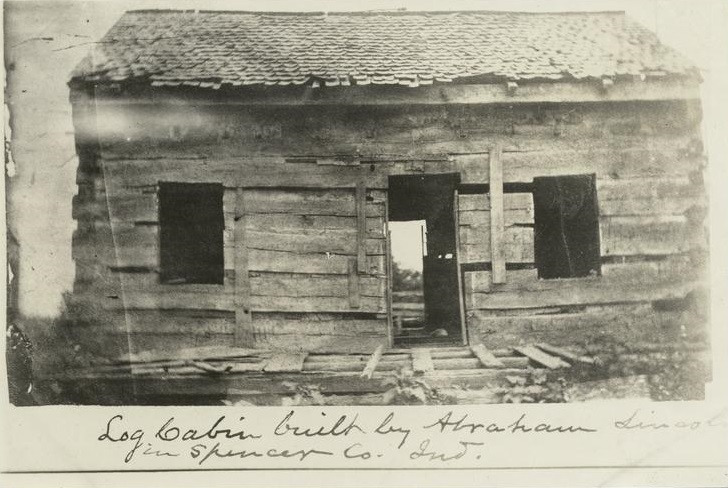
After the family relocated to Illinois, settling in Macon County, 10 miles west of Decatur, Abraham became increasingly distant from Thomas and those low days in Indiana. In 1831, as Thomas established a new homestead in Coles County, Illinois, Abraham left home for New Salem, where he lived for six years. Leaving his “Angel Mother”, his only sister, his only niece or nephew, and that ornery mule far behind him. But, according to most historians, that angry mule kick stayed with him for the rest of his life.
Edward J. Kempf, an accomplished neurologist and psychiatrist, theorized in his 1965 book, “Abraham Lincoln’s Philosophy of Common Sense”, that the incident caused cerebral damage and contributed to the “melancholy” Lincoln felt throughout his life. The book featured numerous “psychobiographies” of many great figures, including Lincoln. Kempf’s study brought unusual expertise to the subject and is among the best works of its genre. Kempf’s hypothesis was based on what generations of artists, sculptors and photographers already knew; that Abraham Lincoln’s face had a good side and a bad side.
z cabinLincoln’s contemporaries noticed that at times his left eye drifted upward independently of his right eye, a condition doctors diagnosed as “strabismus” but more derisively known as “Lazy Eye”. The resulting affliction results in the eyes failure to properly align with each other when looking straight ahead, particularly when trying to focus on an object. As proof, experts point to the best surviving evidence; two life masks of Lincoln. One a beardless portrait made in April of 1860 and the other, a bearded image made in February of 1865. Laser scans of both masks reveal an unusual degree of facial asymmetry. In short, the left side of Lincoln’s face was much smaller than the right, resulting in the double diagnosis of “hemifacial microsomia” compounded by “strabismus”. The defects join a long list of posthumously diagnosed ailments including smallpox, heart disease, bi-polar disorder and depression that doctors claimed afflicted Lincoln.
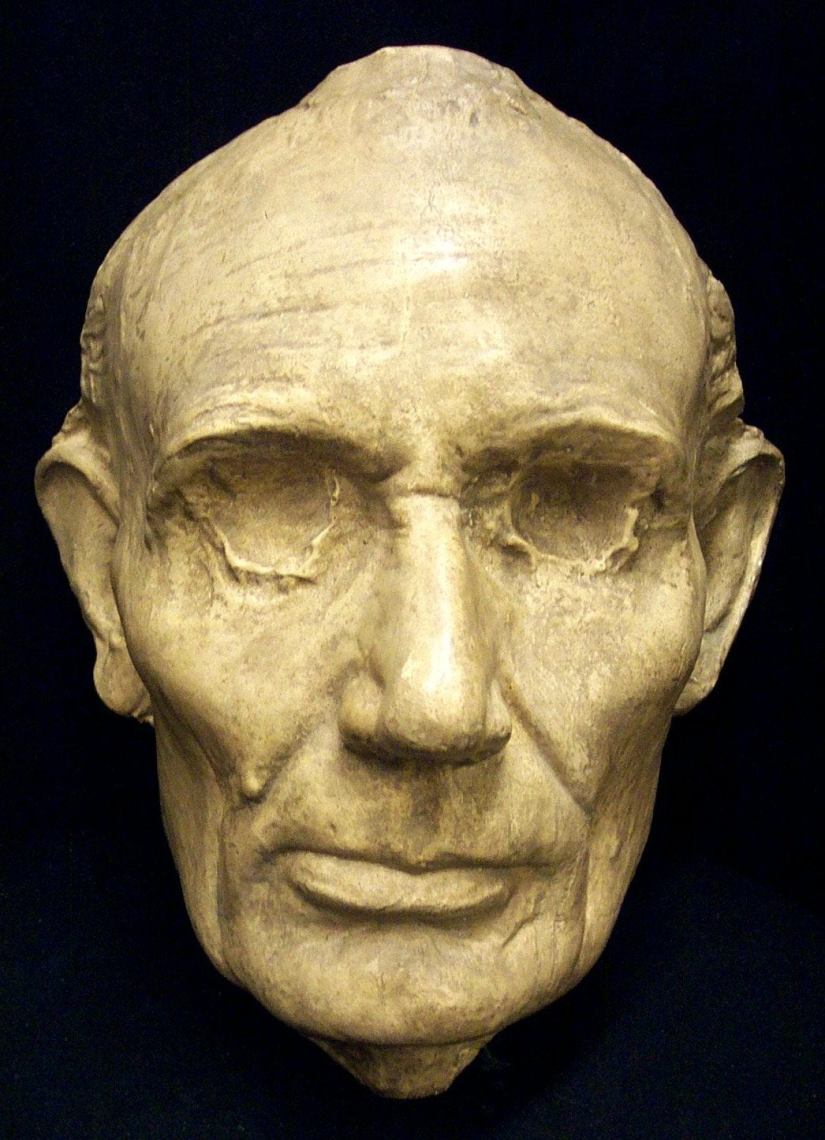
Lincoln’s case can be identified by the bony ridge over his deep-set left eye, which was rounder and thinner than the right side. In life, Lincoln’s appearance was mocked by friend and foe alike. In 1862, author Nathaniel Hawthorne, a Lincoln admirer, noted the president’s “homely sagacity” and his “sallow, queer, sagacious visage.” A description considered so disrespectful and inflammatory that it was deleted by Hawthorne’s Atlantic Monthly magazine editor. The strongest evidence for the “case of Lincoln’s lopsided face” can be found in the iconic November 1863 Alexander Gardner photograph taken shortly before the Gettysburg Address.
z lincmaskAccording to a cadre of modern day medical historians, Gardner’s photo is worth a thousand words. Although modern neurologists admit that a positive diagnosis would require a complete examination of the living Lincoln, photographic evidence strongly supports their theory. The mule kick to the forehead undoubtedly fractured the skull at the point of impact, the size and depth of the depression attesting to the incident’s severity. In addition, the nerves behind the left eye were damaged by the violent snapping of the head and neck backward. That whiplash also caused several small hemorrhages in the brainstem resulting in the permanent ocular and facial effects and was likely responsible for Lincoln’s high pitched, rasping voice.
Other symptoms included Lincoln’s tendency to lapse into a lower conscious state of mental detachment, occasional bouts of sadness and melancholy, accentuated by a near constant gloomy facial expression. These symptoms were described by contemporaries and friends as “ugly and stupid looking”, “dull,” “sad and abstract,” “detached” and “withdrawn.” In those rare moments of joy, humor and happiness, Lincoln’s facial expression turned on a dime from dull indifference to animated interest and boisterous laughter, which doctors point to as a further sign of brain injury.
z lincoln boyYet another after effect of that boyhood mulekick was noticed by Josiah Crawford, a neighbor from Gentryville, Ind. who employed the boy Lincoln, loaned him books for study. Gentry liked to playfully needle the young railsplitter about the way he “stuck out” his lower lip while in deep concentration. When 35-year-old Lincoln returned to to make a speech in southern Indiana in 1844 for Henry Clay, Crawford noticed Abe’s lower lip still protruded abnormally. When Crawford asked what books he consulted before making the speech, Lincoln replied humorously, “I haven’t any. Sticking out my lip is all I need.”
The study of Lincoln’s alleged malady through photos began when many who knew the martyred President were still alive. In 1914, Dr. S. Mitchell found “evidence of left hyperphoria” and suggested that “the corrugations of his brow and crow’s feet at each corner of the eyes showed that he habitually used auxiliary facial muscles to support the external muscles of the eyes in the work for visual coordination.” In 1932, ophthalmologist Dr. W. H. Crisp observed that “Fullface photographs show an upward deviation of the left eye, great enough to produce a lack of fusion of its images with the right eye. The two eyes did not work together, possibly as a result of a vertical strabismus of the left.” And in 1948, Dr. K. C. Wold suggested that the “diplopia was caused by a decoordination of the external muscles of the left eye which was inherently connected in some way with the other facial asymmetries. No physician of record, in so far as I know, has offered an explanation of the nervous origin and nature of the asymmetrical functioning of the left facial and ocular muscles, although some of the nervous effects of eyestrain have been discussed.”
Perhaps due to that mule kick, Lincoln’s adult years were filled with nervous attacks, characterized by eyestrain and headache with nausea and indigestion, so severe that often he became unable to work and had to lie down with a cold compress over his eyes. He had couches in his law office, at home, and in the White House, for this purpose. Mount Rushmore sculptor Gutzon Borglum unknowingly described the disparity of Lincoln’s face for posterity. Before creating the great marble head of Lincoln in the Capitol rotunda at Washington (and also located at the entrance to the tomb in Springfield) Borglum made meticulous comparative measurements of all known photographs, life paintings and masks of Lincoln before attempting his sculpture.

z lincoln-bust-by-borglum-500-wide
Gutzon Borglum’s Lincoln.

The Danish-American Borglum later gave careful interpretations of the relative meanings of the right and left sides of his face as indicated by its lines and measurements detailing that he saw greater strength of function on the right side rather than the left. The sculptor determined that the lines around the right eye revealed that it was more active, more dominant, and that Lincoln “naturally thought and planned with the visualized imagery of this eye.” The lines around Lincoln’s mouth on the right side indicated that “he smiled very, very often when his nature took no part in it.”
Borglum also noticed that the tip of Lincoln’s nose pointed slightly to the right and the left eye was “wide open” and out of focus, “indecisive,” “noncommittal and dreamy.” The left side of the face seemed “primitive,” “immature” and “unfinished.” Its weak expression was “sad and undetermined” in contrast to the determined strength of the right side. The left brow was “anxious, ever slightly elevated and concerned.” Written on his face was “humor, pathos, half-smile, half-sadness; half-anger, half-forgiveness, half-determination, half-pause; …. a dual Nature struggling with a dual problem delivering a single result.” Borglum’s description of Lincoln’s face is most noteworthy because he made no attempt to find a medical determination to explain why the left side was characterless, weak and undeveloped and the right side expressed the real personality and state of mind of Lincoln.
One final symptom of that childhood mule kick was noted by many biographers and contemporaries (like Ward Lamon and Noah Brooks) over the years. Mr. Lincoln spoke often of several impressive mystifying episodes he experienced as “double visions” that all had superstitious meanings for him. These dreamstate visions were welcomed by the President, who believed them to be good luck omens foretelling good news. That is all but his last vision that foretold of a death in the White House; the death of the President by an assassin’s bullet. A bullet that came to rest behind Abraham Lincoln’s left eye. The very same eye which that errant mule kick at an Indiana gristmill cast toward the heavens nearly fifty years before.

Abe Lincoln, Assassinations, Civil War, Museums, National Park Service, Politics, Presidents

Lewis Gardner Reynolds, Carnation Day & Abraham Lincoln. PART II

Carnation Day Part II
Lewis Gardner Reynolds in the House Where Lincoln Died.

Original publish date:  February 6, 2020

https://weeklyview.net/2020/02/06/lewis-gardner-reynolds-carnation-day-abraham-lincoln-part-2/

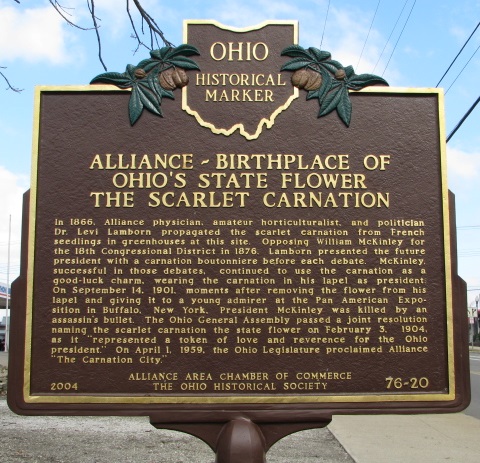
Last week the oft-forgotten holiday known as “Carnation Day” was detailed in Part I of this series. The holiday, today observed mostly only in Ohio, was created to commemorate assassinated President William McKinley on his birthday (January 29) by wearing his favorite flower, a red carnation, to honor him. The formal recognition of the holiday was due largely to the efforts of a man named Lewis Gardner Reynolds from Richmond, Indiana. In 1903, Reynolds formed the Carnation League of America to establish the custom of observing the McKinley floral holiday. That alone might be enough for most historical resumes, but not for Mr. Reynolds. Among this (and other noteworthy achievements) it should be noted that Reynolds was the last person to meet the living Abraham Lincoln.

z 1064_112582

Mr. Reynolds was born at Bellefontaine, Ohio on June 28, 1858, and grew up in Dayton, Ohio. In Dayton, he worked for his father at the Reynolds & Reynolds Co., manufacturing notebooks and other school supplies. Later he started his own company, manufacturing paper cartons, and served for 10 years as a member of the school board of that city. While in Ohio, Mr. Reynolds came to know many American leaders, including President McKinley, Theodore Roosevelt, and Ohio politicos Myron T. Herrick, and Mark Hannah. In 1896 he married Miss Jeanette Lytle in Dayton. She died in 1903 and in 1909 he married Mary V. Williams of Richmond, Indiana. The couple relocated to Richmond and during World War I, Reynolds was prominent in organizing Liberty Loan drives for the war effort.

z tr
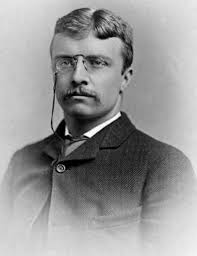
Teddy Roosevelt

Upon the death of Teddy Roosevelt on January 6, 1919, Lewis G. Reynolds was made chairman of the Wayne County Theodore Roosevelt Memorial Committee. Reynolds led Indiana’s fundraising plans to honor Roosevelt with monuments in Washington D.C., the national shrine at Oyster Bay, Long Island, restoration of his birthplace at No. 28 West Twenty-Second Street in New York City, and lastly, through an endowment fund, “to perpetuate Colonel Roosevelt’s ideals of courageous Americanism.” The next year, Reynolds traveled to Indianapolis for a speech to the Indiana General Assembly advocating for the construction of the World War Memorial in the capital of the Hoosier state. Thanks in part to his efforts, the resolution was adopted, the memorial built.

After World War I Reynolds led the European Relief Commission, in particular the Wayne County Council headquartered at 1000 Main Street in Richmond. The January 11, 1921 issue of the Richmond Palladium noted, “Lewis G. Reynolds today received the following telegram: “Congratulations on dignified and successful manner in which you are conducting campaign for European relief. The American people are thoroughly aroused to the appealing need of this great mercy call. The need is great. The call urgent. Let mercy impel us to give relief to the starving children of Europe. Herbert Hoover.”

z osborn-oldroyd
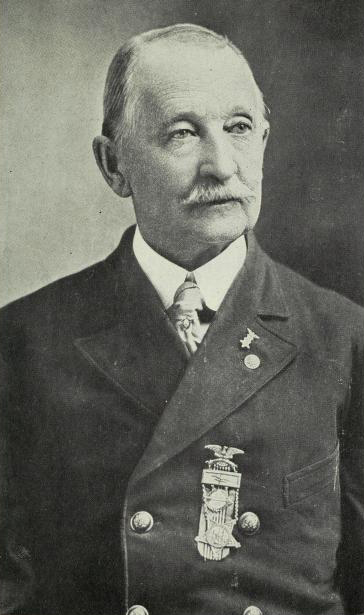
Osborn H. Oldroyd

After Osborn H. Oldroyd, the first Lincoln museum curator, sold his collection to the US government in 1926, Reynolds was called to Washington by Col. U.S. Grant, III to take charge of the Oldroyd collection. Ironically, the Reynolds family moved from their house on North Tenth Street in Richmond to their new house on Tenth Street Northwest in Washington D.C.: The House Where Lincoln Died.
A year before Oldroyd’s death, the two old friends were profiled together one final time in the February 12, 1929, Battle Creek Enquirer. “Two men who spend most of their time in the house where Abraham Lincoln died are probably more interested in the anniversary of his birth than anyone else in the country. They are Osborn Oldroyd, aged 87, who has spent 65 years collecting mementos and documents relating to the life of Lincoln, and Lewis Gardner Reynolds, 71, who sat on Lincoln’s knee as a little boy of six…Mr. Reynolds in the last year has shown 20,000 persons from all over the world through the room where Lincoln died.”

So not only was Mr. Reynolds in charge of the world’s largest Lincoln object collection contained within the house where the sixteenth president died, but he could now also entertain visitors with the story of how he, as a six-year-old child, once sat upon Abraham Lincoln’s knee in the White House. In 1929, while the Nation celebrated the 120th anniversary of the Great Emancipator’s birth, Mr. Reynolds recalled that meeting to a local Washington D.C. newspaper reporter. Although not positive about the exact date, Mr. Reynolds said he felt reasonably sure that it was June 28, 1864, his sixth birthday, when the memorable event occurred.

Lewis G Reynolds age 6
6-year-old Lewis G. Reynolds.

“Father, (Lucius Delmar Reynolds 1835-1913), a captain of one of the companies of the Treasury Guards, was to have a conference with his Commander-in-Chief, and I accompanied him,” Mr. Reynolds said. “While they were discussing the matter of the conference, which lasted nearly an hour, the President picked me up, set me on his knee, and I can feel yet the gentle stroke of that big firm hand as he stroked my head, like the halo of a great benediction. I almost remember his voice. Toward the end of the conference Mr. Lincoln carried me to one of the large windows overlooking the Potomac River, rested me on the deep window seat and stood there with one arm about me while pointing out to the captain some points of vantage he wished him to be familiar with…I saw President Lincoln scores of times,” Mr. Reynolds says, “as father’s duties took him frequently to the Executive Mansion, and he often took me with him. But I recall being actually on Lincoln’s lap and in his arms but once.”
In 1928 Reynolds authored a leaflet titled: “A Wonderful Hour with Abraham Lincoln” which he handed out to friends and special guests visiting the museum. While the leaflet ostensibly tells the story of his encounter with Lincoln, it also offers more details. “The very earliest recollection I have of anything is intimately connected with the Civil War…We removed to Washington and resided there from 1862 to 1866. Father was chief of one of the many bureaus of the treasury department. All the clerks and higher officials of the department were organized into military companies, known collectively as “The Treasury Guards.” They were intensely drilled by officers of the regular army, and as well-equipped as the soldiers in the field, except that they were not uniformed. They represented a potential army of nearly 2,000 men. Their military duties were to be, in case of an emergency, to protect the Treasury Department and the Executive Mansion, nearby. Father was made captain of one of these companies, and to his command was assigned the protection of the White House, and the President. Upon that fact rests my story.”

z img132The Reynolds leaflet further reveals,”Father and mother were at Ford’s Theatre the night of the assassination, and although it was late when they returned home, the general excitement of the night had reached our neighborhood. The newsboys shrill cries of “Extra! Extra! President Lincoln Shot” had awakened everybody in the boarding house. I, too, was awake. Young as I was, I realized what dreadful thing had happened, and I lay wide-eyed in my little trundle bed while father and mother related to the others their personal story of the tragedy. Father, accompanied by several of the men guests, went back to the scene and did not return until after the fateful hour of 7:22 the next morning. I remember as clearly as though it were of yesterday, wearing a wide band of black around the sleeve of my bright plaid jacket, and, carried in father’s arms, of passing the somber catafalque in the rotunda of the Capitol, which inclosed (sic) all that was mortal of the beloved Lincoln. A few weeks later I witnessed the Grand Review of the Army – that wonderful spectacle of the returning boys in blue – which took several days in its passing.”
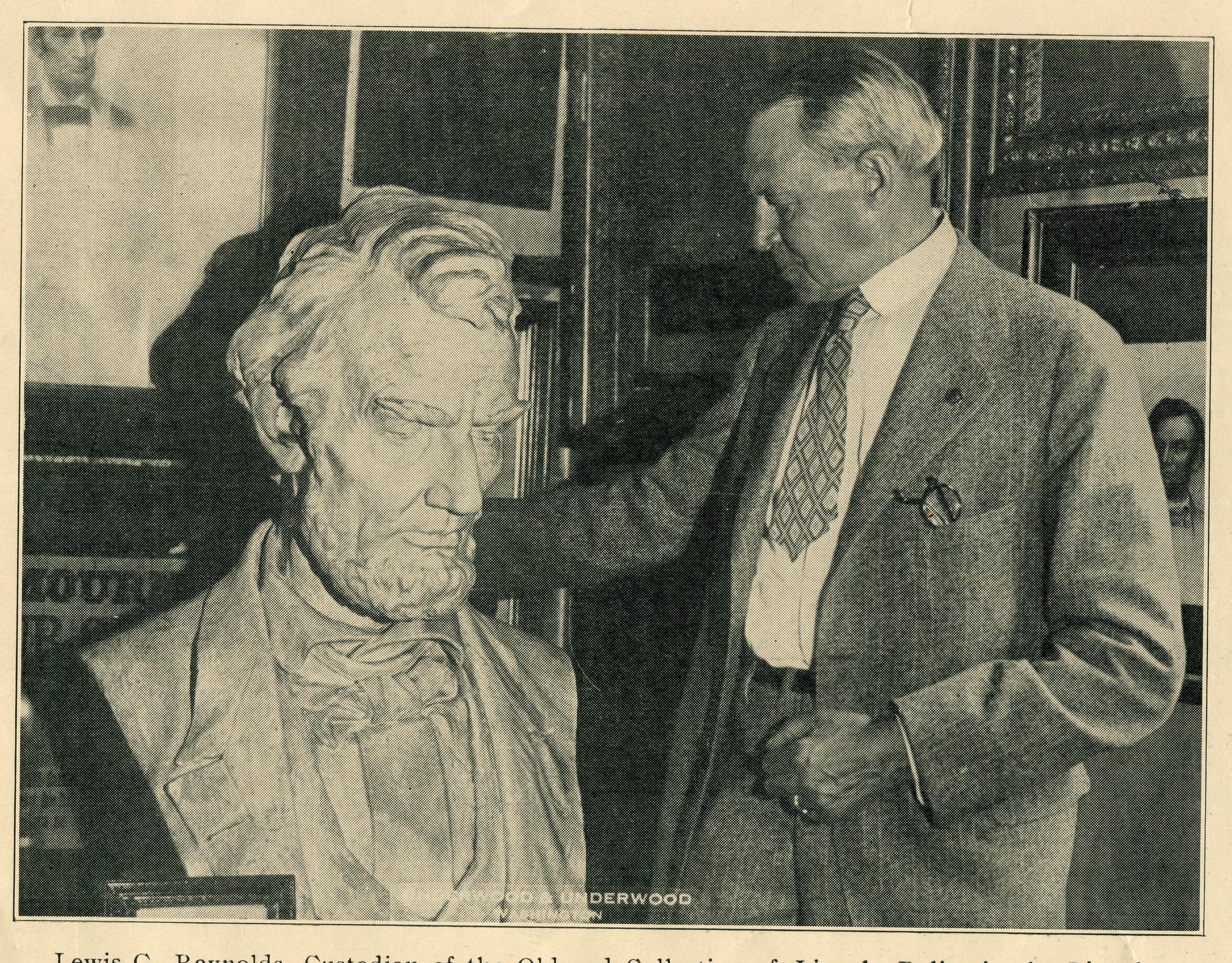
z img132a
Lewis Gardner Reynolds in the House Where Lincoln Died.

On February 5, 1931, a story and photo of Lewis G. Reynolds appeared in newspapers all around the world. Mr. Reynolds was pictured standing on the spot where Lincoln died and speaking into a CBS radio microphone. The article details the radio address commemorating Lincoln’s upcoming birthday titled, “A World Tour of the Lincoln Museum”. It read in part, “In telling of the Lincoln Museum and the relics it contains, Reynolds said no story of it would be complete without reference to Col. O.H. Oldroyd to whom the world is indebted for the collection. ‘A monument should be erected to that man,’ he declared.”

A 83 R 1
Lewis G. Reynolds-Osborn Oldroyd & Abraham Lincoln.

Mr. Reynolds supervised the removal of the Oldroyd collection out of the House Where Lincoln Died and into Ford’s Theatre across the street. It began on December 8, 1931, and by New Year’s Day of 1932, Oldroyd’s collection had been fully moved into the newly repurposed Ford’s Theatre. The Oldroyd collection officially opened in its new location at 2:00 P.M. on February 12, 1932. In an article for the Washington Sunday Star magazine on February 12, 1933, Reynolds states, “Twenty-five thousand one hundred and eighty-one persons have visited the Lincoln house since it was open to the public and the number will increase from month to month as the rehabilitation of the shrine becomes more widely known.”

Mr. Reynolds continued in charge of the Lincoln Memorial collection until 1936 when he retired after suffering a stroke. He returned to his home at 39 North Tenth Street in Richmond to convalesce but never worked again. Custodian Reynolds met a sad and untimely end. On August 21, 1940, police and fire were called to the Reynolds home at 39 North Tenth Street where, upon entry, Reynolds was found seated in an invalid’s chair seriously burned. His clothing caught fire when the tip of a lighted match ignited his clothing while his nurse, Mrs. Anna Farlowe, was in the kitchen preparing his evening meal. Investigators believed the accident took place while Reynolds was trying to light his pipe. His wife Mary, who heard his screams for help, rushed to his aid, and with Mrs. Farlowe, succeeded in putting out the fire with blankets. Mr. Reynolds was taken to a nearby hospital by ambulance and both women were treated for severe burns on their hands. Lewis G. Reynolds died in Reid Memorial Hospital in Richmond; He was 82 years old. Mr. Reynolds was survived by his widow, Mary V. Reynolds; and two daughters. Mrs. Horace Huffman. Dayton, Ohio, Mrs. John W. Clements, of Richmond; a stepson, Edward B. Williams, of Richmond; 10 grandchildren and one great-grandchild.

A 82 R1Two decades later, in 1960, the Richmond Palladium-Item newspaper profiled the widow of the former curator, offering new insight. The article is titled: “Local Woman Conducted Tours In House Where Lincoln Died.” It reveals, “Mrs. Reynolds and her husband lived on the second floor of the house at 516 Tenth Street, Washington, DC, at the time Mr. Reynolds was curator of the Oldroyd Lincoln Memorial collection. This was from 1928 through 1936. “I never heard anyone ask Mr. Reynolds a question about Mr. Lincoln he could not answer,” Mrs. Reynolds recalls. Her husband acquired the job as curator when he heard Oldroyd wanted to retire… “I have had visitors say to me doesn’t it give you a creepy feeling?” (sleeping in the house where Lincoln died.) Her answer was always “No.” To the reporter, she said, “I never had a creepy feeling. When I thought about it, it was just a feeling of awe and reverence.” Mr. Reynolds described the collection via radio from the Petersen house several times.

Finally, the article makes note of the widow Reynolds’s role at the House Where Lincoln Died. “Mrs. Reynolds read the Lincoln Library in the Oldroyd collection. In her study of history and Lincoln material, she qualified herself to talk with visitors on Lincolniana. “I met most interesting people,” Mrs. Reynolds said, “I often took them through the rooms…even the people from the South were pleasant. It was a wonderful experience.”

Lewis G Reynolds Feb. 12, 1929
Lewis Gardner Reynolds

Lewis Gardner Reynolds accomplished more in his 82 years than most could ever dream of. When he died in 1940, Abraham Lincoln had transcended into secular sainthood and Reynolds was the last tangible connection to the mortal Lincoln. Not only was Lewis Gardner Reynolds the last to encounter the living Lincoln, the Reynolds family (following the Petersons, the Schades, and the Oldroyds) were the last to reside in the House Where Lincoln Died. And of course, he was a Hoosier.