Indianapolis, Politics

Teddy Roosevelt’s emergency at St. Vincent’s Hospital in Indianapolis.

Teddy NoblesvilleOriginal publish date:  June 26, 2014

Editor’s note: Columnist Al Hunter will join author Ray Boomhower on Nelson Price’s “Hoosier History Live!” radio show on WICR-FM (88.7) this Saturday July 5th (2014) at noon. The topic of the show will be Presidential visits to Indiana. 

Teddy Roosevelt was in a tight spot in 1902. Barely a year after being catapulted into the Presidency by the assassination of William McKinley at the Buffalo, New York Pan-American Expo on September 6, 1901, T.R. was facing a revolt in his own party. Midwest Republicans were challenging the GOP on their position with tariffs, monopolistic practices and isolationism. Teddy, at the suggestion of his closest advisers, decided to make an eighteen-day tour of the Heartland to quell the uprising with a series of major speeches. After an early September east coast swing, President Roosevelt once again boarded his private train car “Columbia” for a trip to Ohio, Michigan and Indiana.
On September 3, 1902, while on a scheduled stop in Pittsfield, Massachusetts for a speech, T.R. decided that it was a beautiful day for a carriage ride to see the town. Teddy boarded a landau carriage along with Massachusetts governor Winthrop M. Crane and his private secretary George B. Cortelyou. An FBI agent, William Craig, was driving the team of horses. As in most American cities, a streetcar track ran straight down the middle of the street. Agent Craig carefully steered the President’s open-top carriage alongside the track. The trolleys had been ordered not to run that morning to ensure the safety of the town’s most famous visitor.
Teddy - CopySuddenly, as the carriage topped Howard’s Hill, a screeching sound was heard behind them. Great God! A trolley was seen wildly careening down the hill towards them. In a flash, it slammed into the carriage, throwing the president and his secretary out and onto the street’s grassy berm. The President’s face was bloodied and his leg injured, but in true Roosevelt style, T.R. brushed off his own injuries and rushed to the aid of his horribly injured bodyguard. But it was too late, FBI agent Craig was crushed to death under the wheels of the electric streetcar.
The fair-haired, blue-eyed Craig was born in Scotland in November 1855. Standing 6 foot 4, weighing 260 pounds, he was a giant of man. He spent 12 years in the British military before moving to Chicago’s South Side and joining the Secret Service in 1900. He was a favorite of Teddy Roosevelt. The President said: “The man who was killed was one of whom I was fond and whom I greatly prized for his loyalty and faithfulness.” William Craig was the first agent of the United States Secret Service killed in the line of duty. Officials declared that if the trolley had hit the carriage just two inches to the right the president and his secretary would also have died.
TeddyThe accident was never explained. Rumor was that passengers on the trolley paid the driver to follow the carriage in hopes of glimpsing the Rough Rider himself. Still others speculated that it was another Presidential assassination attempt. The driver of the trolley was sent to jail for six months. The President continued his trip and was able to keep his speaking engagements over the next few days. The now lame President stood and shook hands at a pace of fifty-two hands per minute for three hours at a time at most of these engagements. All the while, Teddy’s leg silently throbbed with pain.
The train left New York on September 20 for his eighteen day speaking tour of the Midwest. At his first stop in Cincinnati, T.R. delivered his planned speech but found that standing was becoming a problem. From Cincinnati the presidential entourage departed for Detroit. Here Roosevelt began quietly complaining about pain in his left leg. The first public indication that there might be something amiss came when T.R. was uncharacteristically unresponsive to questions from the Detroit press pool about the Anthracite Coal strike. He abruptly left the impromptu press conference, retired to the Hotel Cadillac and went to bed.
The next day, he attended a reunion of Spanish American War vets in that city. Although this was Teddy’s forte and these were “his” people, he arrived late and gave a short, labored speech. Instead of his trademark toothy grin, The President grimaced, gasped for breath between sentences and sweated profusely. After his brief address, Teddy stood for 4 hours as the parade of old veterans slowly passed in front of the reviewing stand. By the time the parade ended, Teddy Roosevelt looked like he had been “rode hard and put up wet.”
Teddy Tipton 1By the time of his first stop in Indiana, on Tuesday September 23rd, it was apparent that something was wrong with the trust busting chief executive. It was pouring rain as Teddy addressed the crowd in Logansport with a speech he had planned to deliver in Indianapolis. This speech was supposed to change the position of the presidency on national issues. The town had prepared for the Presidential visit by erecting a large platform at the corner of Seventh and Broadway in front of the High School (today aptly known as the “Roosevelt Building”). At the depot, the Elks Band was waiting to lead the procession of carriages for the special guests’ trip to the courthouse. As the parade moved up Market to Ninth Street, the skies opened and it started to rain. A local skating rink had been decorated as an alternate place for Roosevelt to speak, but Teddy insisted on speaking in the rain.
The crowd of 5,000 enthusiastically cheered their speaker as he took the stand. T.R. looked out across the sea of umbrellas and announced that he could speak in the rain only if the crowd would put their umbrellas down to hear him. The umbrellas were sheathed and Teddy presented his twenty-seven minute speech outlining the issues that troubled his administration. It seemed as though every policeman in Cass County was present and surrounding the stage, watching the crowd intently. Teddy hushed the adoring masses by imploring his countrymen that “Beneficiaries of the new prosperity must look to themselves, rather than government, for the advancement of their welfare.” Teddy Roosevelt, perhaps the most “individual” President this country has ever seen, stressed the word “individual” again and again in his speech. To the rousing cheers of the gathered crowd, Roosevelt awkwardly limped back into the train for the journey to Indianapolis.
Teddy Noblesville 1The Logansport stop must have recharged Roosevelt’s batteries as the train made a stop in Tipton where Teddy addressed another adoring crowd on the courthouse square. Next came Noblesville, where 6000 people packed the courthouse lawn to hear the young lion speak. Keep in mind the population of Noblesville was less than 4,000 people at the time. Here, Roosevelt told the crowd “We war not on industrial organizations, but on the evil in them.”
Immediately after the Noblesville speech, Roosevelt had to be assisted down off the stage onto the street as by now he was having a tough time walking. From here, the schedule called for speeches at the Columbia Club and Tomlinson Hall in Indianapolis. Telegrams were sent from the Noblesville train Station to the Columbia Club on Monument Circle stating that the president was ill. Four surgeons were waiting to check the president before he stepped out to greet the Indianapolis crowd. T.R. struggled through a few comments to the enthusiastic crowd but it was apparent that something was quite wrong. His impromptu remarks were cut short as aides rushed Teddy out to a carriage that rushed him to St. Vincent’s Hospital.
Upon arriving at the hospital, Roosevelt refused any anesthetic for the operation on his infected leg. He joked good naturedly with the surgeons “Gentlemen, you are formal! I see you have your gloves on!” T.R. removed his left shoe and his pants, revealing a golfball sized lump three quarters of the way down his shin. As he lay down on the operating table, Teddy remarked, “I guess I can stand the pain.” The attending surgeon picked, cut and scraped at the lump until the infection slowly began to ooze forth. As the doctor went deep inside the pustule, Roosevelt groaned lowly and asked for a glass of water. It took three separate aspirations before the wound was completely cleaned.
At five o’clock Cortelyou issued a statement that the operation was a success and that the President was now resting comfortably with his leg in a sling. At 7:30, a heavily sedated Theodore Roosevelt was carried out of the hospital, lying stiff on a stretcher, his ashen face shining in the glare of the streetlamps. Hoosiers, gathered on the sidewalks outside of the hospital, removed their hats as the President passed. At 8 pm, the Presidential Train left for Washington. The rest of his trip was cancelled. The fear of blood poisoning, although minimized by White House officials, was a very real concern. Later, Roosevelt had another operation to reopen the wound and scrape the bone to remove any infection. Once again, T.R. insisted that no anesthetic be administered. Yep, Theodore Roosevelt was one tough fellow and he proved it right here in Indianapolis.

ABA-American Basketball Association, Indianapolis

Indiana Pacers Slick Leonard in Irvington

Leonard Original publish date:     November 1, 2013
Slick; a nickname that conjures up images of loud suits, a big smile and winning basketball. Bobby “Slick” Leonard is Indiana Pacers basketball, period. His trademark phrase (seriously he trademarked it), “Boom Baby”, sums up Slick’s personality better in two words better than anything I’ll write in this article. Everyone remembers Slick’s drive to lead the Indiana Pacers to greatness during the ABA Championship years. Most remember Slick’s stewardship of the Pacers during the team’s fledgling first seasons in the NBA. But many have forgotten just how great a player he was. In high school, college and the NBA, Slick was a solid star and a force to be reckoned with on the court.

William Robert “Slick” Leonard was born in Terre Haute on July 17, 1932. It was a Sunday and I suspect that somewhere nearby there must have been an old lace-up basketball swishing through a net at the exact moment he greeted this world because his would become the most basketball blessed life of that Hoosier generation. He would grow to become an impressive 6’3″ 185 lb guard for the “Black Cats” of Terre Haute Gerstmeyer High School where he was alternate on the 1950 Indiana all-star team. He would also excel as a tennis player, winning the state tennis championship as a senior.

Slick was heavily recruited by Indiana colleges, including Notre Dame, but finally landed with the Indiana University Hoosiers. As an aside, many of you know I collect oddball things. One of those “things” is a handwritten letter from a very young Bobby Leonard on the letterhead of the Central Hotel in “Terry Hot” in 1950. The letter was written to legendary Notre Dame football star & 3-time All-American basketball star Ed “Moose” Krause who had just taken over the job of Athletic Director for the Irish.

Knowing that Slick would become a hoops legend at I.U. makes the letter all the more interesting. It reads: “Dear Mr. Krause, I definitely would like to go to college, but I do not think I am financially able, I have had several letters from other schools, but it has always been my desire to attend Notre Dame. I like your set-up of not having co-eds as it gives the boys more time to attend to their studies. My grades were not so good during my first years in high school, but after I began to apply myself I have attained a “B” average. I will send you a copy of my grades as soon as possible. Sincerely, Bob Leonard”. The letter includes a separate sheet detailing his classes (Psychology, Print Shop, Sociology, Spanish, etc.) and, more importantly, his high school average and record for the Black Cats.

In spite of this letter’s intent, Slick became a star for Branch McCracken’s Hurryin Hoosiers squad. He captained two Big Ten championship teams and the 1953 NCAA championship team. Slick hit the game winning free throws that gave Indiana the victory over Phog Allen’s heavily favored Kansas Jayhawks team. Leonard was the Most Valuable Player for I.U. in 1952 and an All-Big Ten and All-American player in 1953 and 1954. As a sophomore he was MVP of the East-West college all-star game in Gotham Cities’ Madison Square Garden. The first player inducted into the Indiana University Sports Hall of Fame? Bob Leonard.

He was selected with the first pick of the second round of the 1954 NBA Draft. He spent the bulk of his seven-year professional playing career with the Lakers (four years in Minneapolis and the first year after the move to Los Angeles). He got the nickname “Slick” from a former Lakers teammate with a colorful nickname of his own, “Hot Rod” Hundley. After Bobby won a game of gin by blitzing a team truck driver after a game, Hundley said. “Boy, you sure are slick” and the name stuck. He spent his last two years with the Chicago Packers/Zephyrs, his final season as a player / coach. The team moved to Baltimore in 1964 where Slick coached them for one more year. For his seven years in the pros, Leonard earned less money overall than current Pacers shooting guard Paul George makes in one game.

In 1968, Leonard became the coach of the upstart ABA’s Pacers. He was “the coach” for the next 12 years including the first four in the NBA. Some of that time Slick also served as general manager. Leonard led the Pacers to three ABA championships before the ABA-NBA merger in June 1976. In the 8-year history of the ABA, Slick led the team to the Championship finals in 5 of those 8 seasons; the team never missed the playoffs.
Those 3 Championships are still to this day the only titles won by the Indiana Pacers. Although the NBA Pacers struggled during Slick’s tenure as coach, that was no reflection on this man’s ability. Speaking as a rabid fan who observed those early years, Slick never had a chance. Pacers management nearly gutted the team to meet the financial burdens imposed by the merger and never gave Slick the personnel to put together a winning team during those early NBA years.

I have a personal connection to those ABA teams, although it came long after that cork popped on the last bottle of locker room champagne. I organized and planned the ABA reunion in August of 1997 at the old Hoosier Dome. Former Pacers legend Bob Netolicky and team President Dick Tinkham steered the players and owners while my wife Rhonda & I handled many of the details. During that reunion, I witnessed firsthand how much the players loved and respected Bobby “Slick” Leonard. Not only Pacers players, but players from all around the league. I heard more than one millionaire ABA team owner present at that reunion claim that it was Slick and those great ABA Pacers teams that held that league together and brought it credibility.

Slick was the last Pacers coach at the State Fairgrounds Coliseum and the first coach at Market Square Arena. A good illustration of Bobby Leonard’s impact on Hoosier hoops, during the last practice at Market Square Arena after the players had left the floor, then Pacers coach Larry Bird asked for Slick to come out on the court. The legendary duo stood alone on the court in the house that Slick’s teams built. As the workers stood outside the perimeter poised and ready to tear up the floor, Larry legend threw a bounce pass to Slick and said, “I want you to take the last shot here.“ Of course, he made it.

Documantarian Ted Green, friend and subject of past columns, plans to follow-up to his popular film of last year, “Undefeated: The Roger Brown story” with a film about Bobby “Slick” Leonard titled “Bobby ‘Slick’ Leonard: Heart of a Hoosier”. I was honored to assist in a small way with that production and equally proud of Ted’s newest venture. Green, whose previous documentaries profiled John Wooden, Indiana war veterans and Indianapolis’ climb from sleepy “Naptown” to a Super Bowl site, believes that a film about Slick is the next natural step.

“Hoosiers forget what a great player Slick was. They remember him as a coach, but he was a helluva player. He has done basically everything there is to do in basketball and at all levels, and he did most of it right here.” says Green “Plus, I don’t think a lot of people are fully aware of the amazing contributions he’s made to the game beyond his success with the Pacers. That’s one of my goals with this film, to illuminate his remarkable run from the beginning, show people stuff they don’t know, and hopefully open some eyes nationally. I’ve already discovered a lot of things that I believe will do that.”

Knowing Ted, the project promises to be just as colorful as Slick himself. Although Slick is one of only five individuals in Pacers history to have a banner raised in his honor,Ted believes he deserves more. Green, who told me last year that he believes Slick has a very good chance of being the next ABA inductee to the James Naismith Basketball Hall of Fame in Springfield, Massachusetts, hopes to finish the film in time for a March madness release. Keep in mind, Ted released his film on Pacer’s star Roger Brown BEFORE the “Rajah” was elected to the Hall of Fame and his film on Slick could be just as timely.
I feel a kindred spirit in Ted Green. As Hoosiers become more-and-more familiar with his work, they quickly realize that Green gets more in depth on his subjects than anyone else. Ted, who calls this trait his “sickness”, will most certainly tell us things about Slick that we never knew about. Nobody digs deeper than Ted Green. “This will be my most extensively researched film yet. As a competitive journalist I want to play it a little close to the vest, but I can say that I’ve made several discoveries that I think will surprise even people who know Bob well, and will definitely open eyes nationally to the incredible impact on his sport that this man has had.” says Ted.

As for Slick’s shot at the Hall of Fame, Ted says, “I think there’s little doubt that Slick will get in someday, and like a lot of people around here, I’m hopeful that it’ll happen in the next class. Unfortunately, I don’t think that’s a lock — the fact that we’ve had two ABA Pacers back-to-back in Mel and Roger could factor against Slick as well as George McGinnis, who’s also deserving. But if you look solely at impact, at winning and losing, at what the person meant to the league, I think Slick has to be next.”

Now 81 years old, Leonard returned to Terre Haute twice to drive filmmaker Green through the neighborhoods where he grew up. Together they visited the old Gerstmeyer gym, now incorporated into the Terre Haute Boys and Girls Club, where Green surprised Leonard with impromptu visits by longtime friends including former prep school teammates the “Gerstmeyer Twins” Harley and Arley Andrews. Green filmed slick rolling through town, reminiscing about selling ice cream at Union Depot and of sneaking into the old Indiana State Teachers College gym in the late 1940s to watch Coach John Wooden drill the Sycamore players through basketball practices. Green is still in production and is looking for photographs not only of Bobby Leonard in his youthful days and his Gerstmeyer teams, but also of city scenes from the 1930s, ’40s and ’50s. If you can help, contact me and I’ll pass it on to Ted.

Leonard returned to the Pacers in 1985 as a color commentator, first for television, then on radio. He is in his 24th year as a Pacers broadcaster. Modern fans know him for his phrase “Boom, baby!”, which he shouts exuberantly after every successful three-point shot. Bobby “Slick” Leonard is the common thread running through Indiana’s accepted pastime and next week, you have the chance to meet him.

Bobby Leonard has written a new book, “Boom, Baby!: My Basketball Life in Indiana”, and he will recount many of these stories personally next Thursday evening in Irvington. Slick is coming to Bookmamas at 6 p.m. on Thursday, November 14 to give a short talk and sign copies of his new memoir.

Leonard, in typical heartfelt modesty, has repeatedly said that his exclusion from the Hall of Fame doesn’t bother him. His focus has always been on getting “his guys” there instead. Mel Daniels got into the Hall in 2012 (alongside NBA Pacers icon Reggie Miller) and Roger Brown made it posthumously in 2013. Slick’s guys have made it, and with this class coming up, I hope that he makes it too. Come out to Bookmamas next Thursday and discuss it with Slick yourself. Tell them Al sent ya.

Indianapolis, Politics

Caroline Harrison-Indianapolis loses a First Lady.

death-at-white-houseOriginal publish date:                 October 20 2013

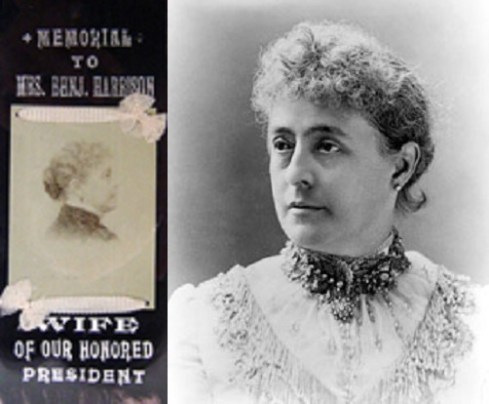
121 years ago this Friday, America lost it’s first lady, Benjamin Harrison lost a wife and two weeks later, he lost the Presidential election. Caroline Scott and Benjamin Harrison were married on October 20, 1853. The newlyweds lived at the Harrison family home at North Bend, Ohio for the first year until Benjamin completed his law studies aand they moved to Indianapolis and set up his first practice.
During the first few years of their marriage, the couple rarely spent time together, as Benjamin worked to establish his law practice and became active in fraternal organizations to help build a network. In 1854, their first child Russell Benjamin Harrison was born. Not long after, a fire destroyed the Harrison home and all their belongings. Benjamin took a job handling cases for a local law firm and the family managed to recover financially. In 1858, Caroline gave birth to Mary Scott Harrison. In 1861 she gave birth to a second daughter, who died soon after birth.
While Benjamin Harrison’s star rose rapidly in his profession, Caroline cared for their children and was active in the First Presbyterian Church and Indianapolis orphans’ home. Benjamin’s long hours at the law office and his pursuit of a living drove a wedge between the young couple and although Caroline did not complain, the strain showed.
At the onset of the Civil War, both Harrisons sought to help in the war effort. Caroline joined Indianapolis groups that raised money for supplies to help care for wounded soldiers. In 1862, when President Abraham Lincoln issued a call for more troops, Benjamin recruited a regiment of over 1,000 men from Indiana. When the regiment left to join the Union Army at Louisville, Kentucky, Harrison was promoted to the rank of colonel, and his regiment was commissioned as the 70th Indiana Infantry.
In May 1864, the 70th Indiana regiment joined General William Tecumseh Sherman’s Atlanta Campaign and moved to the front lines, and Harrison was promoted to command the 1st Brigade of the 1st Division of the XX Corps. Harrison’s brigade participated in the brutal Battle of Nashville in December 1864, considered by historians to be the “Gettysburg of the West”. On March 22, 1865, Harrison earned a promotion to the rank of brigadier general.
The horrors of the Civil War taught General Harrison what was really important in his life and the tone of his letters to Caroline during the war are filled with a deep passionate tone. When he returned home, she would never again reproach him for neglect. His law practice and his fame grew, and he became a political force.
71035-004-D5F69C40After the war, Benjamin Harrison spent the next decade practicing law and getting involved in politics. He ran for governor of Indiana in 1876, but lost. The Harrison home on North Delaware Street was built in 1874-75, and soon became a center of political activity. Her husband’s election to the Senate in 1880 brought Caroline to Washington, DC, but a serious fall on an icy sidewalk that year undermined her health. In 1883, she had surgery in New York that required a lengthy period of recovery. She had also suffered from respiratory problems since a bout with pneumonia in her youth, and did not participate much in Washington’s winter social season.
In the fall of 1887 Harrison was nominated for President by the Republican Party. In the campaign, Caroline was a definite asset. Her natural charm and open manner offset her husband’s chilly reserve (He often wore gloves to protect him from infection from others, and it bothered him to shake the hands of White House visitors), and the press loved her. In November 1888, Harrison defeated the incumbent Grover Cleveland.
Caroline Harrison was 56 years old when she became first lady. Historians regard her as one of our most underrated First Ladies who, in contrast to her husband’s conservative policies, was earnestly devoted to women’s rights. She became known for her many “firsts” as First Lady. Caroline was the first first lady to deliver a speech she had written herself after she became the first president of the Daughters of the American Revolution.
Caroline’s sister died in early December 1889 at the executive mansion and Mrs. Harrison decided to have the funeral in the east room of the White House. It would be the first funeral in that room since Abraham Lincoln in 1865. In spite of the family tragedy, Caroline went ahead with her plans to raise the first Christmas tree in the White House that same month. She had John Phillip Sousa and the Marine Band play and, for the first time since Sarah Polk was First Lady, there was dancing in the White House.
Perhaps her biggest first came when she had electricity installed in the White House, even though she was terrified by the new technology. Seems that President Benjamin Harrison received a shock from an Edison dc current light switch, after which his family feared touching the switches. Mrs Harrison rarely operated the light switches herself, choosing instead to sleep with the lights on when neither she nor her husband were willing to touch them for fear of electrocution. Servants were often made to turn the lights on and off for the Harrison family.
Caroline_Harrison_cph.3b20942The First Lady was noted for her elegant White House receptions and dinners, but she is most remembered for her efforts to refurbish the dilapidated White House. She was horrified at the filth and clutter and thought the White House was beneath the dignity of the Presidency, describing it as “rat-infested and filthy.” She brought in ferrets to eat the rats, and lobbied to have the White House torn down and replaced with a more regal Executive Mansion. Instead the old building was refurbished from basement to attic, including a new heating system and a second bathroom. The old, sagging worn-out floors were replaced.
She hated the crowded living area and the tourists made it impossible to use the first floor. In 1889 Caroline Harrison found fault with the “circus atmosphere” in the mansion when she found visitors wandering uninvited into the family quarters. Harrison complained about the lack of privacy on the White House grounds, saying, “The White House is an office and a home combined. An evil combination.” She was the first to suggest the addition of office space to the Executive Mansion when she made up very detailed plans to add an East and a West Wing so that the original mansion could be used for entertaining and the family’s living area. Caroline Harrison’s plan was the first to move the office spaces out of the house.
As she worked to remodel the White House, Caroline was careful to inventory the contents of every room. She cataloged the mansion’s furniture, pictures and decorative objects, working to preserve those that had historical value. Caroline unearthed the chinaware of former presidential administrations found hidden away in closets and unused attic and basement spaces. She personally cleaned, repaired and identified which pieces belonged to which past President. She used their items to create a popular museum display case that remains in the White House to this day.
Artistically talented, Caroline taught classes in painting to anyone who wanted to learn and became the first First Lady to design her own White House china. She wanted new china that would be “symbolic and meaningful to Americans.” The first lady placed the Coat of Arms of the United States in the center ringed by a goldenrod and corn motif etched in gold around a wide outer band of blue. The corn represents Mrs. Harrison’s home state of Indiana and 44 stars, one for each state in the Union at the time, made up the inner border.
In the winter of 1891-1892 while she tried to fulfill her social obligations, Mrs.Harrison was frequently ill with bouts of bronchial infections. In March of 1892 she developed catarrhal pneumonia, followed by hemorrhaging of the lungs and was moved to a three-bedroom cottage on Loon Lake in the Adirondack Mountains in July. Following a brief rally, her doctors diagnosed her condition as tuberculosis, which at the time had no known cure or treatment other than rest and good nutrition. Although she briefly recovered at the mountain retreat, she suffered a setback in September and asked to be returned to the White House.
On September 20, she returned to her favorite pale green and silver bedroom in the White House. It was sometimes used as a music room, furnished in pale green plush. One account states that Mrs. Harrison’s bedroom was: “Daintily appointed in pale green and silver, it stands just as Mrs. Harrison left it, and like the rest of the beautified White House, is a memorial to her refined and artistic taste.” Caroline must have been fond of the pale green palate as many of the multi-colored fabric pieces are done in green tones.
Caroline did not live to see her husband’s defeat for a second term as President. On October 25, 1892, Caroline died at the age of sixty of Typhoid fever. It was an election year, and out of respect for the president’s lady, after her death neither Harrison nor Cleveland actively campaigned for the presidency. Two weeks following her death, Harrison lost his bid for reelection. Daughter Mary Harrison McKee was already living at the White House with her family, and she took up the responsibilities of first lady for the last few months of Harrison’s term.
After private services were held in the East Room, the family brought her back to Indianapolis for interment. An official funeral service was held at the First Presbyterian Church. After the service, the cortege proceeded past the Harrison’s Delaware Street home before going on to Crown Hill Cemetery for burial.
Caroline Harrison’s legacy has proved to be historically important. The current architectural plan of the White House, in particular the East and West Wing, reflects the plan suggested by her in 1889, and the White House china room is certainly a testament to her historical sensitivity in rescuing, repairing and identifying artifacts from previous administrations. Caroline Harrison was not able to use the china she had ordered. She died before it was delivered. It arrived at the White House in December of 1892.
You can honor Caroline Harrison’s memory with a visit to the Benjamin Harrison Presidential Site at 1230 North Delaware Street. The home offers tours daily. Another option, perhaps more consistent with the season, would be to visit her final resting place at Crown Hill Cemetery at 3402 Boulevard Place. Tour Guide and historian Tom Davis will be reprising his popular “Skeletons in the closet” tours (there are 2 different) on October 24, 25, 26 and November 2. Check their web site for specifics. Although I don’t think Caroline’s gravesite is particularly featured on Tom’s tours, I’m pretty sure he’ll take you there if you were to ask him. After all, Tom knows where all the bodies are buried.

Indianapolis, Music, Pop Culture

Busted-The 1961 Heroin arrest of Ray Charles in Indianapolis.

Charles_Ray_arrested_in_Indianapolis_Nov_1961_AP_PhotoOriginal publish date:  November 19, 2008
Located on the “point” of Washington Street and Kentucky Avenue, the Downtown Sheraton-Lincoln Hotel was the place to stay for “anyone who was anyone” visiting the Circle City during the tumultuous sixties. The Sheraton-Lincoln’s Rail Splitter restaurant and Cole Porter ballroom hosted celebrities by the score and became the epicenter of Robert F. Kennedy’s 1968 Hoosier Presidential primary campaign victory. Located on the “point” of Washington Street and Kentucky Avenue, the Downtown Sheraton-Lincoln Hotel was the place to stay for “anyone who was anyone” visiting the Circle City during the tumultuous sixties. The Sheraton-Lincoln’s Rail Splitter restaurant and Cole Porter ballroom hosted celebrities by the score and became the epicenter of Robert F. Kennedy’s 1968 Hoosier Presidential primary campaign victory.  The Hotel Lincoln was built in 1918 and designed by famed Indianapolis architects, Rubush and Hunter, the same firm that created the Madame C.J. Walker theatre, Columbia Club and old City Hall among others. The hotel, named after Abraham Lincoln, was the tallest flatiron building ever built in Indianapolis. It was acquired by Sheraton Hotels in 1955 and became known as the Sheraton-Lincoln Hotel. This four-corner intersection, obliterated in the early 1970s, was known as Lincoln Square in honor of Mr. Lincoln’s 1861 speech from the balcony of the Bates House across the street. A bust of Abraham Lincoln stood on a marble column in the lobby of the hotel for generations.

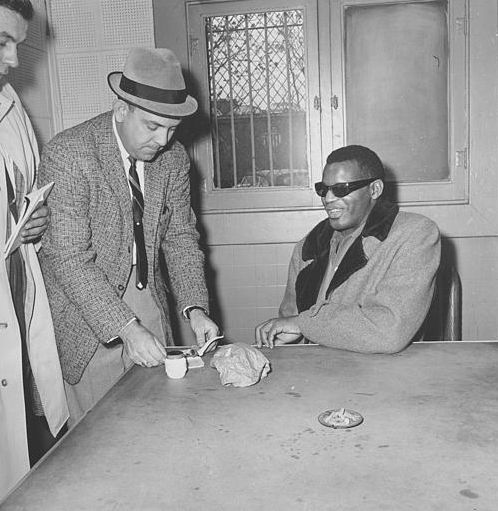
On Sunday November 12, 1961, Ray Charles checked in to the Downtown Sheraton-Lincoln Hotel. Ironically, his band spent the night in the Claypool Hotel across the street at Washington and Illinois Streets; the spot where Lincoln delivered his speech. That night, Ray got a call from a man whom he did not know. This man called with an offer to sell Ray drugs. Charles told him to come on over, and after which, the musician purchased weed and a dozen $ 3 capsules of heroin.

The next day, Ray and his band traveled to Anderson for a concert at the “Wigwam”, the new high school gym. After the show ended, they all headed back to Indianapolis. The bandmates got Ray to his room and left to see Aretha Franklin perform at the Pink Poodle at 252 North Capitol Ave. By all indications, Ray Charles stayed behind and got high.

The next morning, Tuesday November 14, 1961, at 9:00 am, Ray was awakened by a knock on the door. At first he ignored it but the knocking soon turned to pounding. Ray asked, “Who is it?”…”Western Union” was the reply. Still half asleep and dressed only in his underwear, Ray felt his way through the room and cautiously opened the door. Suddenly, two IPD detectives, William Owen and Robert Keithly, rushed in announcing that they had received an anonymous tip from a local drug dealer that there were illegal drugs in the room.

A search quickly found what they were looking for, Ray’s leather zippered “fix” bag. The detectives discovered 10 empty capsules, each containing heroin residue and a hypodermic needle. A closer search found a cold cream jar filled with marijuana they new would be there. They charged Ray with a violation of the 1935 Indiana Narcotics act and for being a “common addict”, a charge designed more to humiliate Ray than to punish him. When the narcs pulled up Ray’s sleeves, they discovered what they described in court as “the worst track marks they’d ever seen.”

The officers led Ray out to the waiting police car and quickly took him to police headquarters a short distance away. There they fingerprinted and photographed their celebrity prisoner and brazenly let the press in to take pictures of the humiliated and confused musician. If you google the pictures taken that day, you’ll see Ray at his lowest. Ray Charles, the greatest R & B musician of all time, broke down that day. Although blind, Ray new instinctively what was going on. At first, he could only hear the familiar sound of one camera shutter clicking.

Then, as police let reporters in, he could hear the pop of flash bulbs snapping. He could feel the warmth of the flashes on his face followed by the clatter of the bulbs hitting the floor after being ejected. Ray must have felt like a man in a foxhole with bullets crashing all around. Ray’s soft sobbing soon broke into full- throated crying. The reporters yelled out questions at the helpless young man. “How did you get started on drugs, Ray?”

“I started using stuff when I was 16” Ray said as the tears rolled down from under the dark glasses hiding his eyes. “When I first started in show business. Then I had to have more and more.” Apparently ashamed by his statement and situation, he started to cry even heavier now saying “I don’t know what to do about my wife and kids. I’ve got a month’s work to do and I have to do it.” Then Ray stumbled back to the old excuses all junkies use; “I really need help. Nobody can lick this by themselves. I’ll go to Lexington (narcotics hospital). It might do me some good. I guess I’ve always wanted to go, but it was easier to go the other way. A guy who lives in the dark has to have something to keep him going. The grind is just too much.”

On drugs in the music industry, Ray said, “Believe me, there are a lot bigger guys than me who are hooked a lot worse.” Then Ray regained some of his old fire as he talked about the informant who turned him in, “Whoever he was, it was a dirty trick for him to pull.” Unbelievably, a reporter asked Ray if he’d like to see his kids using drugs. Ray began to cry again and said, “It’s a rotten business.”

Luckily the sideshow lasted only a few hours. Ray was released on $ 130 cash bond the next morning. As Ray left the jail, he covered his head with his overcoat from reporters. Ray left for a gig in Evansville that night, hoping to put the Indianapolis nightmare far behind him. Ray’s bandmates heard the news of Ray’s arrest on the radio that same morning. As they poured out into the hallways to talk about the situation, Ray came walking in. “Let’s get outta here, man.” was all he said. They quickly packed their gear and started out on the 2 hour trip to Southern Indiana.

At the Evansville concert that night, reporters swarmed over Ray backstage just before the show. Frustrated, Ray jumped up and down with his fists clenched as if he were skipping rope. Sometimes he squatted so low that it seemed he would tip over backwards. Ray claimed it was the result of nerves and lack of sleep. He regained his composure and patiently answered the inevitable questions hurled at him by reporters. No, he had no idea how much money he’d spent on drugs in his lifetime, “That’s like asking how much you spend on cigarettes.” Ray claimed that he’d been misquoted and that he hadn’t been an addict since age 16, “It ain’t been that long, not near that long.” When asked what he planned to tell the judge the next morning back in Indianapolis, Ray said, “I’ll deny everything, you can quote me.”

News of the arrest spread fast, especially in the black press. As Ray arrived at Municipal Court for his scheduled appearance before Judge Ernie S. Burke, a huge mob of fans, reporters, television cameras and radio news crews were waiting for him. They jammed the halls of the courthouse, causing enough of a spectacle that Judge Burke threatened loudly to clear the courtroom and the building. Wisely, Judge Burke dropped the “common addict” charge and set Ray’s trial date on the drug possession charge for January 4, 1962, releasing Ray on $ 1,000 bond. As Ray left the courtroom, he told reporters, “I don’t feel up to answering questions about my life or this event.” then left Indiana for Nashville, Tennessee. The controversy followed Ray for the rest of the tour. Ed Sullivan immediately canceled an appearance by Ray on his popular TV show and several concert venues canceled Ray’s scheduled gigs. But it was nothing compared to the carnival atmosphere he’d experienced in Indianapolis.

Ray Charles would return to Indianapolis twice more in 1962 to clear up the drug bust. On January 9, 1962 Ray made his first appearance in court to answer the charges. He sat uncomfortably in a courtroom packed with media and fans, at times gently rocking back and forth with his head bowed and his hands tucked between his knees. Ray’s lawyer spent this session attacking the police for entering Ray’s room under false pretenses and with no warrant. Three weeks later, Ray returned for a 5 minute session as Judge Burke ruled the police search illegal and dismissed the charges. Even though Ray was a celebrity, he still had the same constitutional rights as every american citizen. Ray left the Hoosier courtroom for the last time with a general “No comment” to the press. Ironically, at the time of his Indianapolis arrest, Ray’s single “Hit the Road Jack” was in the top ten of the Billboard charts. When he returned in January of 1962, Ray’s single “Unchain my heart” was in Billboard’s top ten.

In 1964 he was arrested again for possession of marijuana and heroin. Following a self-imposed stay at St. Francis Hospital in Lynwood, California, where he kicked his drug habit “in 96 hours” (the total treatment took 3 to 4 months, though), Charles received five years probation. Charles reappeared in the charts in 1966 with a series of hits composed by the relatively unknown team of Ashford & Simpson. Ironically one of those hits was the song “Let’s Go Get Stoned”, which became his first number-one R&B hit in many years.

“Brother Ray” Charles pioneered the soul music genre by combining rhythm and blues and gospel styles like no one before or since. Frank Sinatra called Ray Charles “the only true genius in show business.”  In 2002, Rolling Stone ranked Charles number ten on its list of the “100 Greatest Artists of All Time”, and second on their 2008 list of the “100 Greatest Singers of All Time” behind only Aretha Franklin and just ahead of Elvis Presley. On June 10, 2004, at the age of 73, Ray Charles died of complications resulting from acute liver disease at his home in Beverly Hills surrounded by family and friends.

Ray’s arrest became a footnote in the pop culture history of Indianapolis. But what became of the Downtown Sheraton-Lincoln Hotel? The hotel was demolished in April of 1973. It marked the first time that controlled dynamite was used to raze a building in Indiana. Public officials were reluctant to allow dynamite rather than the traditional wrecking ball, but the promise of saving both time and money tipped the scales. The exact time was kept a secret and the surrounding area was cordoned off for blocks. Over 200 spectators gathered to witness the building fall to the ground. Today, the Hyatt Regency stands where the Sheraton-Lincoln once  was.

The Hyatt was built with a triangular shape to pay homage to the angling street and flatiron building that once stood on the site. The building opened in 1977 and it’s circular upper floor houses the Eagle’s Nest, a rotating restaurant. One of the most prominent features of the Eagle’s Nest is a piano bar. On the weekends, guests are entertained with songs from the american songbook. No doubt, Ray Charles tunes are among them. It just goes to show you, what goes around, comes around.

Indianapolis, Pop Culture

Thomas Edison in Indianapolis.

thomas-edisonOriginal publish date:  June 7, 2013

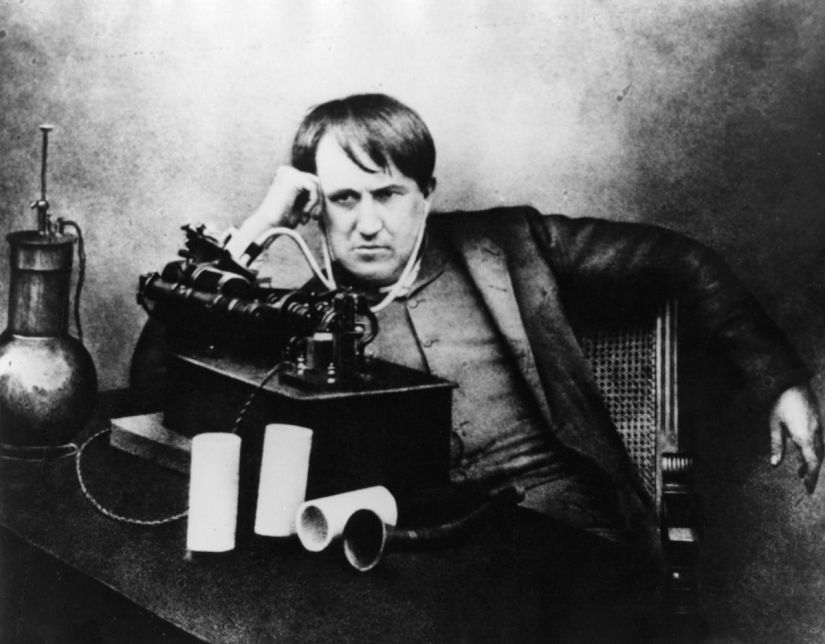
The most famous and prolific inventor of all time, Thomas Alva Edison died over 85 years ago. His tremendous influence on modern life remains unchallenged by any other American, living or dead. Edison’s inventions include the light bulb, the phonograph, the motion picture camera, and vast improvements on the telegraph and telephone. In his 84 years, he acquired an astounding 1,093 patents, a record that eclipses all other inventors. It is a tribute to his genius as an inventor, businessman, and promoter that many believe we owe our way of life to his ideas. But, did you know that what Edison himself considered his first invention was created right here in Indianapolis?

Thomas Alva Edison was born on February 11, 1847, in Milan, Ohio. Known as “Al” in his youth, Edison was the youngest, and sickliest, of seven children, only four of which survived to adulthood. In search of a better life for his family, Edison’s father Sam moved to Port Huron, Michigan, in 1854, where he worked in the lumber business.
“Al” was a poor student fascinated with mechanical things and chemical experiments instead of book learning. When a schoolmaster called Edison “addled,” his furious mother took him out of the school and began to home school the young inventor. Edison said many years later, “My mother was the making of me. She was so true, so sure of me, and I felt I had some one to live for, some one I must not disappoint.”
The home schooling schedule made his life more flexible and, like most boys of his day, Edison began working at the age of 11. His first job was helping in the family garden, but as “hoeing corn in a hot sun is unattractive,” he found other work when the opportunity arose. That opportunity came in late 1859 when the Grand Trunk Railroad was extended through Port Huron to Detroit. Edison talked his way into a job as a “candy butcher,” selling candy, newspapers, and magazines to the passengers. In that position he soon showed an entrepreneurial flair. While he was away working on the train, he employed boys to sell vegetables and magazines in Port Huron for him. With that money, he bought a printing press, which he used to start up the Grand Trunk Herald, the first newspaper published on a train. He wrote the articles and printed and sold the newspapers to passengers on the train. He spent his free time reading scientific books and technical manuals, most left behind by the passengers on the trains. In fact, passengers would often leave their reading materials behind and Al would resell them to the next group of travelers over-and-over again.
During layovers in the “Motor City”, Edison continued his education by visiting the Detroit Public Library to consult science books before returning to the train to perform chemistry experiments in the baggage car. That is, until an accidental fire forced him to stop his on board experiments. In 1859 12-year-old Edison lost almost all his hearing. Several theories have been advanced as to what caused his hearing loss. Some attribute it to the aftereffects of scarlet fever contracted as a child. Edison himself blamed it on a conductor who lifted the lad by his ears after that fire in the baggage car. However, he never let his disability discourage him. Instead, since it made it easier for him to concentrate on his experiments and research, he treated it as an asset.
No doubt his hearing loss caused Edison to retreat more into reading and personal solitude. Along the way, he picked up the rudiments of telegraphy. His first big break came quite by accident, literally. In 1862, 15-year-old Edison rescued the toddler son of telegraph operator James MacKenzie from the path of a rolling freight car. MacKenzie rewarded him by giving him lessons. After practicing intensively all summer, Edison took a part-time telegraph job in Port Huron.
The Civil War was raging, and when the battle of Shiloh was reported in the Detroit Free Press in early April 1862, Edison talked the editor into giving him extra copies on credit and then telegraphed the headlines ahead to the train’s scheduled stops. The crowds were so large and the demand for the papers so great that he steadily increased the price at each station, selling all the papers at a handsome profit. It is clear that young Al learned a valuable lesson about the power of the telegraph and the press. He learned quickly that knowledge was power and power was money. By the time he was sixteen, Edison was proficient enough to work as a telegrapher full time.
Within a year Edison had embarked on a four-year stint as an itinerant telegrapher, a path followed by many ambitious, technically oriented young men. During those years he advanced to the front rank of telegraphers, becoming an expert receiver known for his clear, rapid handwriting. His proficiency elevated Edison to the upper echelon of elite press-wire operators, the men who handled the lengthy, important news dispatches. A highly esteemed, much desired position during the Civil War. Although still a teenager, he mixed and mingled with much older journalists and editors, frequenting their offices and engaging in their conversations that would often last into the wee hours of the morning. Some of his fellow operators would become newspaper reporters and Al’s close association with them them would, in time, help push Edison into the public eye.
Edison worked in many of the larger cities of the Midwest, then considered to be the epicenter of cutting edge technical advances in the United States. Like all operators, Edison had to maintain his instruments and the batteries that powered the lines. He studied them and thought about ways to improve them, experimenting with discarded, outdated and broken instruments. He purchased a small lathe and some other tools. For two months in early 1864, Edison had become a “tramp telegrapher”, the term used to describe a young “gun for hire” telegraph operator in search of the highest bidder. He worked in Fort Wayne before moving to Indianapolis in the Fall-Winter of 1864.
For a few months in 1864, the Indianapolis Union Station Depot was the place of employment for the young inventor. Thomas Edison arrived in the Hoosier Capitol City as a seventeen-and-a-half year old second-class telegraph operator for Western Union. He had bounced along, moving through larger and larger cities, using his telegraphing jobs mostly as laboratories for his experiments. He usually left these jobs in a hurry after being dismissed when the budding inventor became distracted and failed to send and receive messages properly. The fact that he had no trouble landing jobs in new cities speaks to the demand for telegraphers during wartime.
The telegraph revolutionized communications in the United States and the job of telegraph operator became one of the highest paid new professions. Young Edison imagined a life of glamorous freedom and excitement. In truth, most of the men who actually made their living this way, although highly skilled, were undisciplined with a variety of problems, unhappy home lives and physical detriments, usually alcoholism.
Edison, on the other hand, was greatly helped by his experience as a telegrapher. He used the long stretches of solitude and inactivity between messages to think and tinker with his experiments. Not unlike the modern day computer programmer, the telegraph operator’s job involved challenges, problem solving, and innovation. And in Indianapolis, Edison was first introduced to Western Union, a company whose ruthless bargaining, price cuts, and slash-and-burn business tactics eventually made them the top telegraph service in the U.S. Edison picked up many successful business practices from Western Union and, in time, would become known for his own ruthless tactics.
It was at Union Station that he developed his first invention, which he called the “automatic repeater telegraph”, a device used to record incoming telegraph signals and replay them at any desired rate. This allowed him to transcribe the often rapid-fire messages sent via the news wires. This skill meant a higher pay grade for him.
The legend surrounding Edison’s end of tenure at Indianapolis Union Station is told in many forms and fashions, making it hard to separate fact from fiction. A thumbnail version might go like this: It was November 8, 1864. Abraham Lincoln was being challenged for a second term by the flamboyant Union General whom Lincoln had hired, and fired, twice during the Civil War, George McClellan, a Democrat. The outcome was far from certain and northerners perched on the edge of their seats waiting to hear the results of this important wartime election. State-by-state the votes were counted and the telegraph wires were hot with returns.
Young Edison thought this would be the perfect time to unwrap, uncoil and unleash his new invention, which he named the “Morse repeater.” The invention consisted of two separate telegraph machines that Al had “jerry-rigged” together, one to transcribe the message and the other to save it. The device slowed down the incoming messages so transcribing operators could process the content more precisely. The machine worked fine, at first. Things quickly broke down and soon, quite literally, sparks began to fly. Seems the results were coming in too fast for even two machines to keep track of. Edison’s boss was infuriated by what he viewed as yet another Cockamamie gadget and reportedly fired the young inventor on the spot. Edison packed up his supplies and quickly moved to Cincinnati where he soon developed a more successful data storage device. Eventually, this device would become known by all as the phonograph.
At one time, Union Station once had a plaque somewhere inside it’s walls honoring Edison’s brief service in our city. But I have been unable to confirm that it still exists. Seems that the plaque, like Edison’s time in the Circle City, has been lost and forgotten.