
Creepy history, Ghosts, Indianapolis, Irvington Ghost Tours, Weekly Column

The Ghosts of Playground Productions in Irvington.

Andrea and Adam Long of Playground Productions.

Original publish date October 16, 2025.

https://weeklyview.net/2025/10/16/the-ghosts-of-playground-productions-in-irvington/

One of the enjoyable aspects of leading ghost tours in Irvington every October is hearing the new ghost stories and spooky tales associated with the buildings we pass along the route. For the past few years, Adam Long and his wife, Andrea, have allowed the tours access to their building, Playground Productions Studio at 5529 N. Bonna Ave., as a jumping-off point to rest and recover after tours. Some of you may know Adam by his stage name, Adam Riviere, a homage to his mother’s whose maiden name. Most importantly, the studio hosts the crew from the Magick Candle every Friday and Saturday night during October for psychic readings for our tour guests and visitors, with the proceeds going to fund the food bank at Gaia Works (6125 E. Washington St.).

Playground Productions Studio at 5529 N. Bonna Ave. during the Halloween Festival.

Adam graduated from Martinsville High School, studied at Butler University, and attended IUPUI for his graduate work. Adam is an accomplished musician and an artist in his own right. Andrea, originally from London, Kentucky, graduated from North Laurel High School there and from IUPUI in Indianapolis. Andrea is quiet, but when she talks, she speaks with an easy southern drawl that somehow soothes the listener’s ears. As I write this, the couple is celebrating their eleventh wedding anniversary. Adam and Andrea were married in 2014, but have been together since 2008. I first met Adam over a decade ago, when he was a guest on one of my ghost tours. After hearing the Abraham Lincoln ghost train story, which concludes each tour, Adam was sprung. He later informed me that the story resonated with him so deeply that he commissioned an artist friend to create a painting of the ethereal visage for display in his studio office. It comes as no surprise that Adam’s studio is located along the historic corridor of the railroad tracks upon which Lincoln’s funeral train traveled back on April 30, 1865.
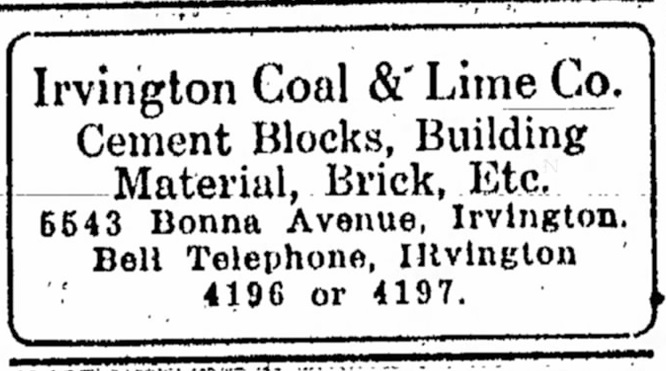
Indianapolis Star Sunday December 25, 1921.

Adam’s studio has an interesting history. Adam stated, “It was originally the Coal & Lime Company in Irvington. That was why they wanted to call this area the Coal Yard district, because this is the spot where the trucks would come and pick up the coal to deliver to the areas close by.” The name is a bit of a misnomer, however. While it is true that the company sold “Hoosier Red Pepper Coal” harvested “clean” and “hand picked” from “Indiana’s Richest Coal Mines,” contrary to it’s strict definition, the company specialized in providing hydrated mason’s lime used in the manufacture of common bedrock building materials like glazed tile, fire brick, cement blocks, and common bricks.

August 3rd, 1922, Indianapolis Star ad.
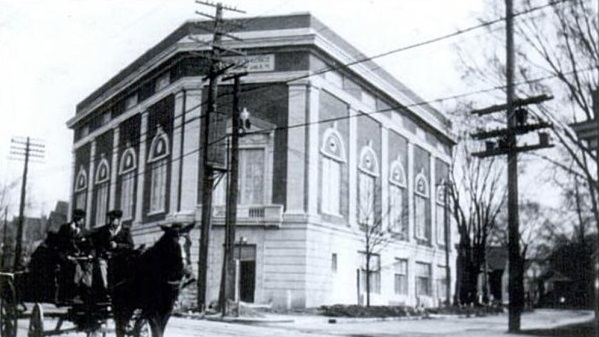
Irvington Masonic Lodge 666 in 1922.

On August 3rd, 1922, an ad on page 10 of the Indianapolis Star boasted that the Irvington Coal & Lime Company supplied the “Western Brick as well as other builder’s supplies used in the construction of the new Masonic Temple,” a.k.a. Irvington Masonic Lodge 666, whose cornerstone was laid the year before. Adam was quick to point out to visitors to the property that a portion of the foundation for the old brick factory remains in place several yards away from his studio entrance. Adam informed, “In the early 1950s, a company called Foamcraft bought the building.”
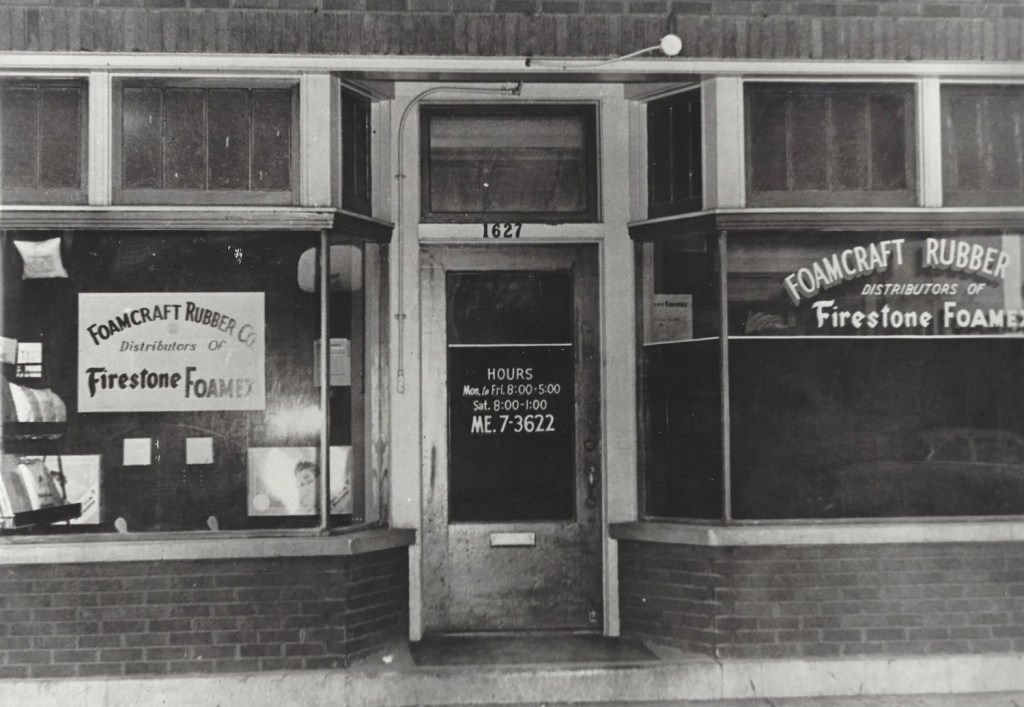
Foamcraft with Firestone ad.

Foamcraft still exists. According to their website, “In 1952, Robert T. Elliott, the founder of our company, started the Foamcraft Rubber Company. As a District Sales Manager for the Firestone Tire and Rubber Company, he was responsible for helping to start several foam rubber distributors. Foamcraft was his special passion, though, and in founding our company, he set a foundation for business integrity and dedication to service, as well as a vision to develop long-term relationships with our customers.” Foamcraft makes specialized cushioning used in furniture, beds, minivans, boats, and other products. The company buys large blocks of foam rubber called “Buns” or “Blocks” and cuts them to smaller sizes and shapes as needed by their customers. It was, and remains, a family-run operation with a very high-tenured workforce staffed by generations of families working “cutting foam” for a variety of customer products. The company boasts a 99.9% on-time production and delivery reputation.
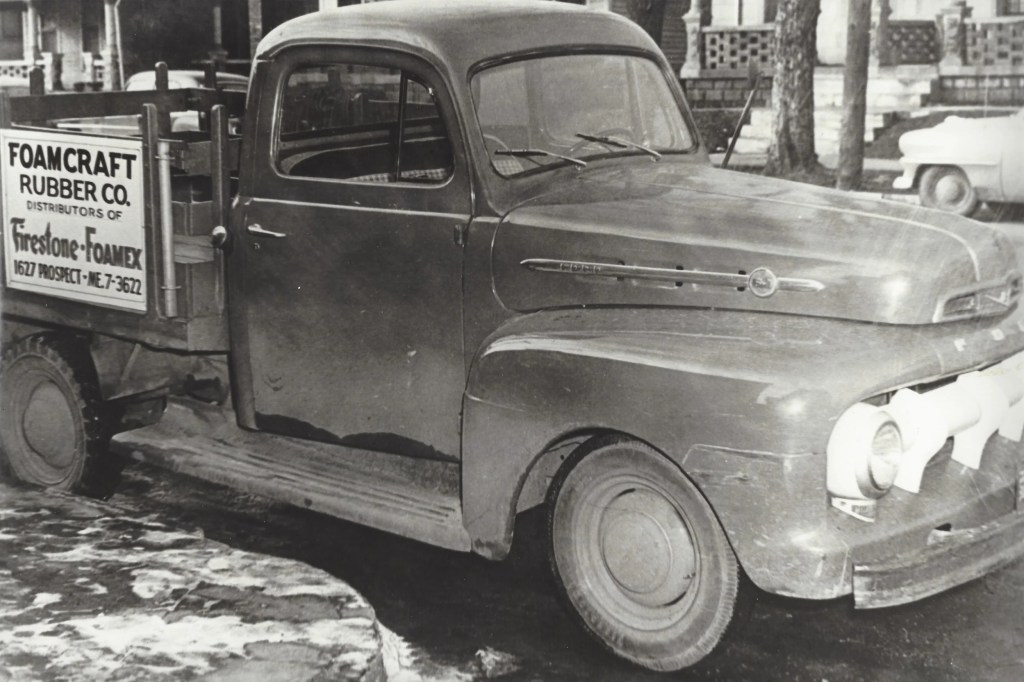
Foamcraft Truck in 1952.

Elliott opened his Irvington foam factory on Bonna Avenue in 1957, and it remained there for the next 44 years. Foamcraft briefly relocated in 2001 to a leased building on Post Road before moving to a much larger facility in Greenfield in 2016, where it remains today. Company headquarters are located at 9230 Harrison Park Ct. in between the Fort Benjamin branch library and Peyton Manning Children’s Hospital in Lawrence. Foamcraft also has a manufacturing facility in Elkhart. They never forgot their ties to Irvington, though. Employees referred to the old 20,000 square foot factory, made up of several buildings, simply as the “Bonna.” According to their Web site, employees remember the Bonna facility as “dark and spread out with rooms everywhere. It was sort of claustrophobic with low ceilings, and we worked elbow-to-elbow. It had slippery floors throughout the facility, which sometimes required us to spread sand or sawdust in certain areas.” Despite the distinctly ominous Irvington location’s appearance, inside and out, Foamcraft’s employees described the working atmosphere as “Valhalla.”
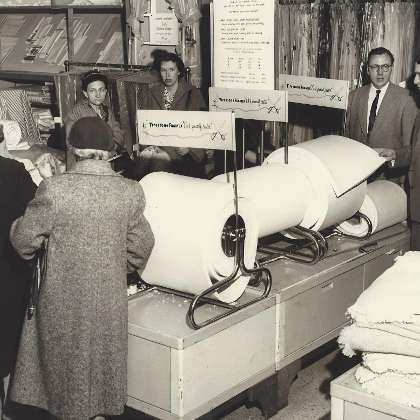
Foamcraft Interior 1950s Era.

One former employee, Jim Quakenbush, recalls that Foamcraft Inc. “ was located on Bonna Ave. just east of Ritter Ave. I worked there for two summers, unloading railroad cars in 1970 & 1971. I have fond memories of working there. Rob Elliott, whose father owned the company, worked with me unloading train cars full of large refrigerator-sized foam rubber “buns”. I think Rob became the CEO and may still be. The warehouse building still stands, but the office building is gone. The railroad track is gone. I really enjoyed the people. My supervisor was Dave Fisher. Great guy. Don Scruggs was a truck driver, funny as hell. Larry Harding worked with me. [The] Sewing department had Ursie Hert, Ralph Wainwright, from Jamaica. Clayton Sneed was a saw operator. Paul was an autistic laborer who used to irritate Ralph. I laughed so hard listening to them argue back and forth. All in good fun. Good memories.”

Interior of Playground Productions Studio.

The old Foamcraft building has quite a history to it, and apparently, a few ghosts as well. Adam recalled, “When I first moved in here, while I locked up at night, stepping out the door, there was a feeling. It wasn’t really ominous, but it definitely gave you a creepy feeling. “ When asked if he feels a presence in the building, Adam stated, “Yes, sometimes when I’m alone in the building, I can hear sharp knocks on the wood in the studio. When I check, nothing is there to explain it.” Adam and Andrea say they don’t ever feel uncomfortable in their building, and they don’t think there is any dark energy connected to their workspace. “We just take it as it comes, we’re used to it now.”
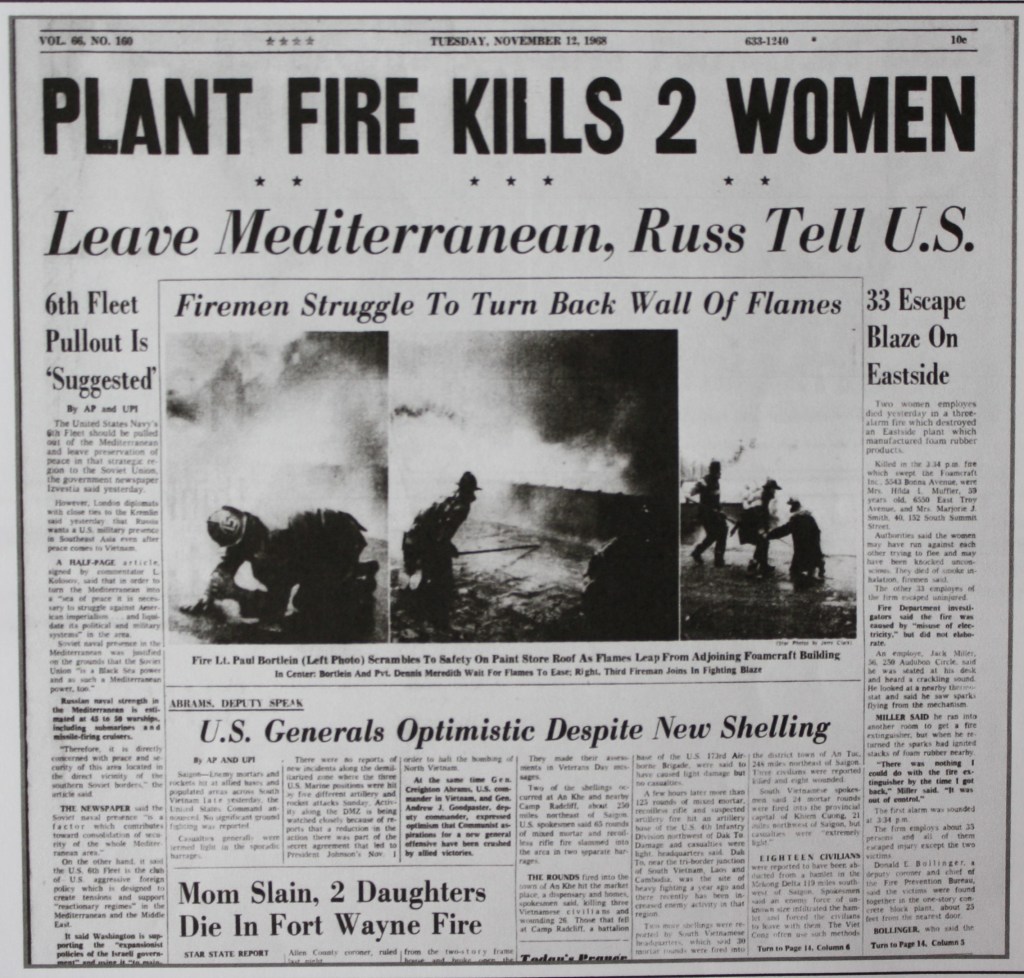
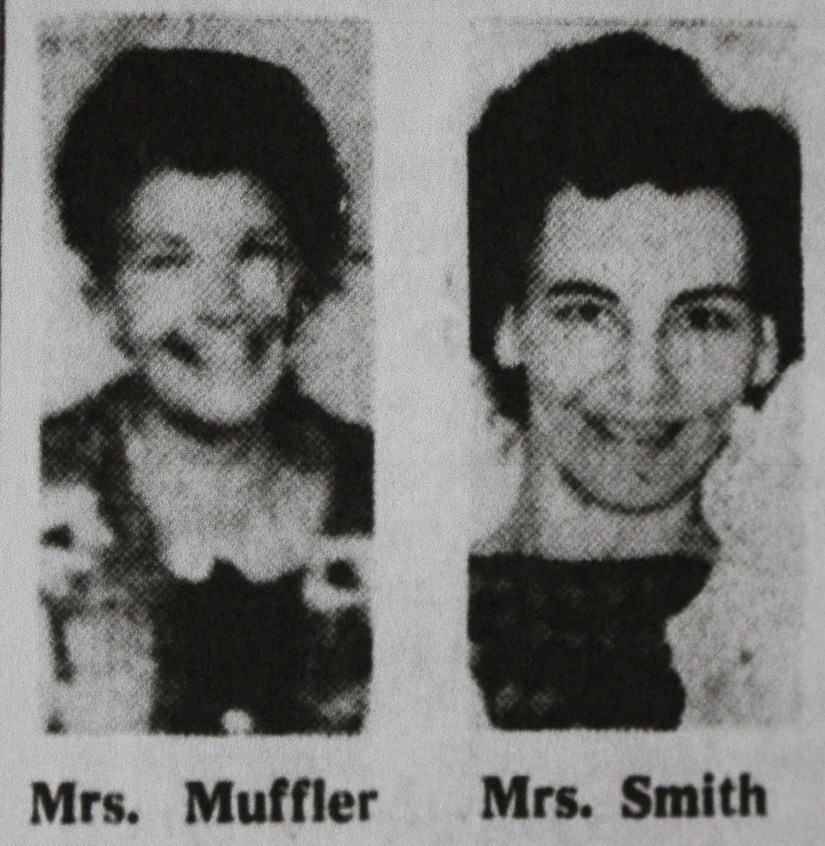
The factory site was visited by tragedy in the autumn of 1968. The front page of the November 12, 1968, Indy News announced “Plant Fire Kills Two Women. 33 Escape Blaze on Eastside.” At 3:34 in the afternoon, firefighters responded to a three-alarm fire at the Foamcraft factory plant. Mrs. Hilda F. Muffler, 59, of 6550 East Troy Avenue, and Mrs. Marjorie J. Smith, 40, of 152 South Summit Street, were killed in the blaze. Mrs. Muffler was employed as a seamstress, and Mrs. Smith as a cutter. Authorities theorized that the two women may have collided and been knocked unconscious during the frenzy to escape the fire. The women died of smoke inhalation and heat. According to the article, Fire Department investigators said the fire was caused by ‘misuse of electricity,’ but did not elaborate.
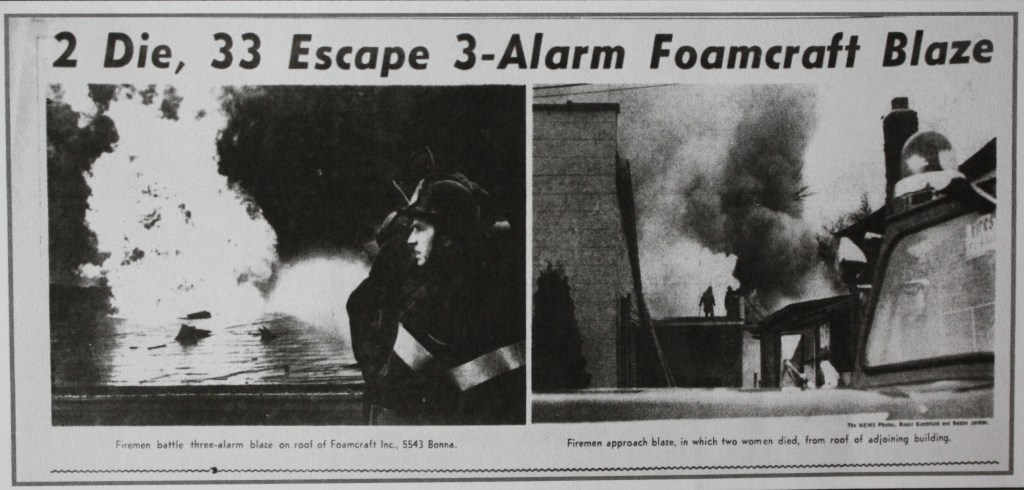
The article further reports, “An employee, Jack Miller, 56, 250 Audubon Circle, said he was seated at his desk and heard a crackling sound. He looked at a nearby thermostat and said he saw sparks flying from the mechanism. Miller said he ran into another room to get a fire extinguisher, but when he returned, the sparks had ignited stacks of latex foam rubber nearby. There was nothing I could do with the fire extinguisher by the time I got back. It was out of control.” Another Star article quotes Miller as saying he saw a “flash of lightning” come from the wall thermostat and strike a pile of foam. Deputy Marion County Coroner and chief of the fire prevention bureau, Donald E. Bollinger, said the victim’s bodies suffered no burns and were found lying face down perpendicular,  one atop the other, in the one-story concrete block plant. The women were found within 4 feet of an office door and only 8 feet from the nearest exit door.
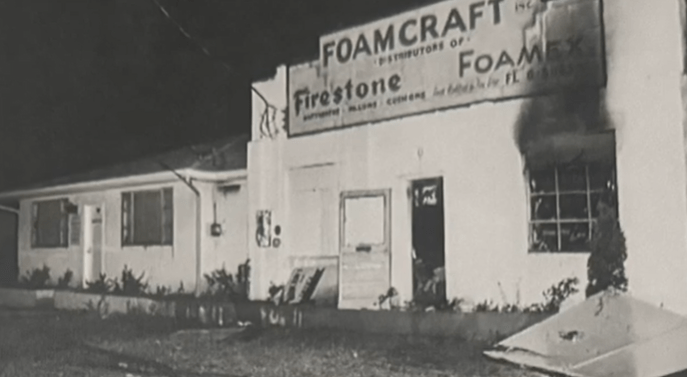
Foamcraft Building Exit Door After The Fire in 1968.

They were discovered to be some 70 feet from the nearest fire damage about 25 minutes after the first alarm had sounded. Other employees challenged the notion that the women panicked trying to escape. Bollinger later theorized that since Mrs. Smith’s coat was found lying next to her body, the women may have attempted to reach a restroom to retrieve their coats and purses before being overcome by smoke.
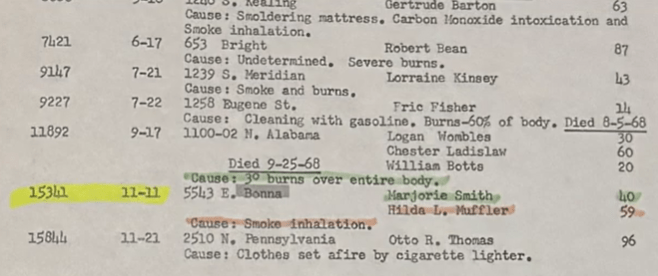
Coroner’s Report From the Foamcraft Fire.

The fire was spectacular, with flames shooting over 100 feet high in the sky, and the massive plumes of heavy black smoke could be seen from all over the city of Indianapolis. The high-intensity heat hampered firefighters’ efforts to extinguish it quickly. The first alarm came at 3:34, the second at 3:44, and the third at 4:42 pm. Emergency first responders arrived quickly with over 20 pieces of firefighting equipment and 65 firefighters. John T. O’Brien, owner of the Bonna Printing Company at 5543 Bonna Avenue, reported that his adjacent building suffered only minor smoke and water damage during the conflagration. Other adjacent businesses, Krauter Equipment Company & the Firestone Tire & Rubber Company, also reported minor damage. At 12:17 am, the blaze briefly reignited, and firemen were again called to extinguish the flames. That second fire had ignited beneath the collapsed roof of the factory and was brought under control at 1:17 am.
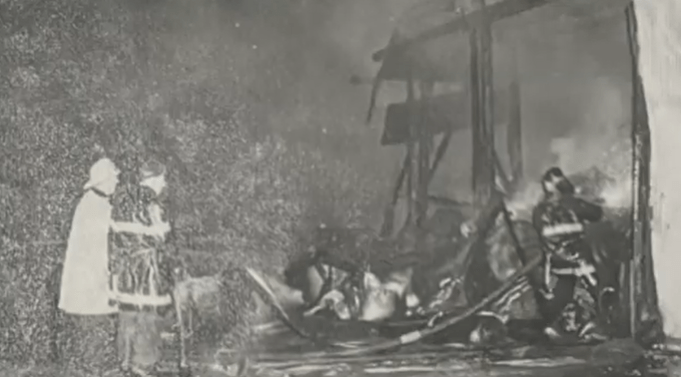
Foamcraft Fire.

The Foamcraft building was destroyed in the inferno. Investigators determined the fire started along the north wall of the “blackened pillow room” on the northeast corner of the building. Deputy Chief Bollinger later speculated that the fire could have been prevented if the wall receptacle box, which contained the mechanism controlling the heating blowers, had been properly covered. One unnamed employee told Bollinger that he tried to make a metal cover for the box the week before the blaze, but was shocked during the attempted installation and was unable to do so. That same employee said that he had informed company officials of the problem, but it had not been fixed yet.

Learning that Adam and Andrea’s building may have a resident ghost, one could believe that the spirits of Playgorund Productions Studio are those of the tragic victims of the Foamcraft factory fire from 1968, but that does not appear to be the case. Tim Poynter, intuitive psychic empath who has worked with me on the tours for decades and now spends every October Friday and Saturday night in the building, admits that he encounters those spirits regularly, “But they aren’t necessarily attached to the building. They seem to be just passing through. Sometimes the tour guests bring them, and at other times, they are brought in by the readers.” Likewise, longtime tour volunteer Cindy Adkins, who was featured as a psychic intuitive in an episode of Zak Bagans’ Ghost Adventures in 2019, does not feel a resident ghost in the building. “They’re not in here permanently. I don’t feel them inside, but I do think some spirits are roaming around outside the building.” said Cindy. Indeed, it should be noted that the spot where the two employees died is located outside the studio, about 20-30 yards northwest of the door.

Inside Stage at Playground Studios.

Today, Playground Productions Studio is a far cry from the old, dark, and spooky, chopped-up Foamcraft factory. The working studio is now full of light and texture. Walls are constructed of a naturally grounded hardwood facia and are peppered by soft blankets buffering any echoes and sounds that might affect the recording work. The artists, bands, and performers who regularly work or visit the Playground are joyful and carefree whenever there is an event or party going on. Knowing the depth of feeling that former Foamcraft employees have for the old “Bonna” location, it is easy to imagine that if there are spirits hovering around the property, inside or out, they do so with mirth and glee.

https://www.linkedin.com/posts/foamcraft-inc-_the-story-of-foamcraft-inc-activity-7089985534889975808-y92J/


Foamcraft has created a fantastic, informative, and historical video with scenes shot at the old factory on Bonna. It can be found on the Web at: https://www.linkedin.com/posts/foamcraft-inc-_the-story-of-foamcraft-inc-activity-7089985534889975808-y92J/

Creepy history, Indianapolis, Politics, Weekly Column

Nazi’s in Irvington radio show. “Hoosier History Live hosted by Nelson Price” June 21 (2025) on WICR-FM 88.7.

Here is the radio show companion to my March 13th & 20th and June 19, 2025 articles in the Weekly View newspaper, all of which are available to read on this site.

Art, Indianapolis, World War II

Nazi Ideology on the Eastside; a Continuance.

Original publish date June 19, 2025.

https://weeklyview.net/2025/06/19/nazi-ideology-on-the-eastside-a-contnuance/
Last March, I wrote a two-part article on Eastsider Charles Soltau, the “Nazi at Arsenal Tech”. This Saturday (June 21st) at noon, I will revisit those articles on Nelson Price’s “Hoosier History Live” radio show WICR 88.7 FM. Nelson, a longtime friend of Irvington, has a personal connection to that story, which he will share for the first time ever during that broadcast. As it happens, weeks after that article appeared, quite by accident, I ran across a few documents that spoke directly to that time in Indianapolis history.

Card # 1

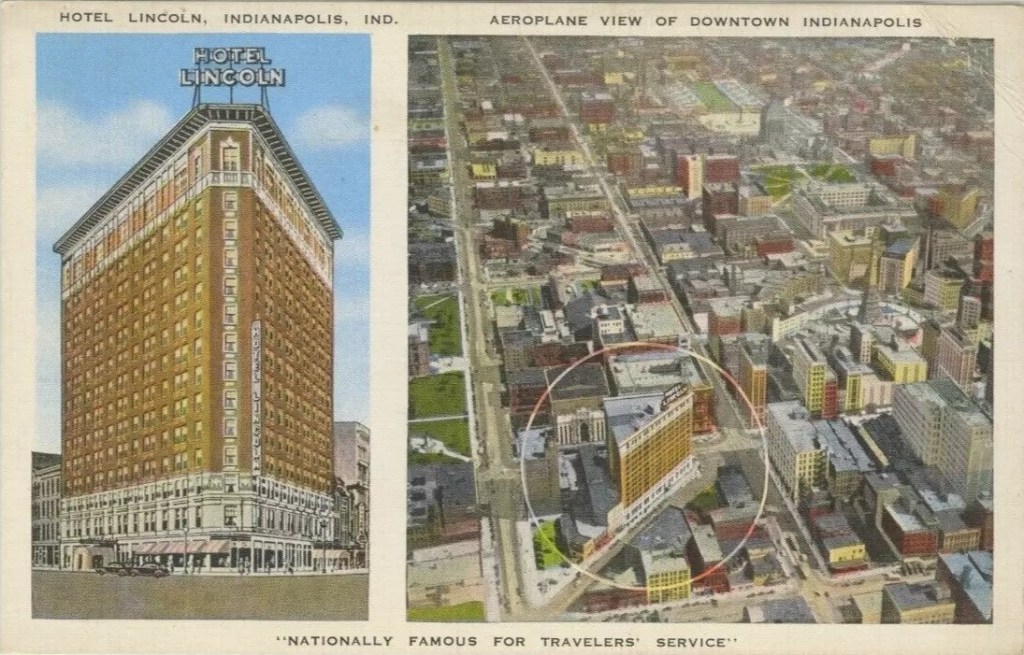
While perusing a few boxes of vintage paper at a roadside antiques market, I found a pair of cards from February 1938, advertising one of the first 35 mm camera photo exhibitions in Indianapolis at the Hotel Lincoln. The Hotel Lincoln, built in 1918, was a triangular flat-iron building located on the corner of West Washington St. and Kentucky Ave. The hotel was named in honor of Abraham Lincoln, who made a speech from the balcony of the Bates House across the street in 1861. Afterwards, that block became known as “Lincoln Square.” The Hotel displayed a bust of Abraham Lincoln on a marble column in its lobby for decades. The Lincoln was a popular convention center and was once the tallest flat-iron building in the city. The Lincoln was the site of the arrest of musician Ray Charles (a subject covered in depth in one of my past columns). It also served as the headquarters for Robert Kennedy and his campaign staff, who leased the entire eleventh floor of the hotel during the 1968 Indiana primary. The Lincoln was intentionally imploded in April of 1973.

Hotel Lincoln Postcard.

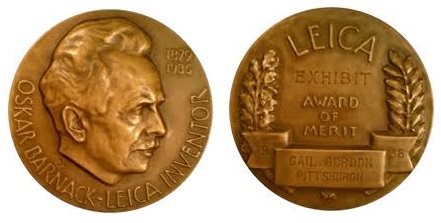
It was the Hotel Lincoln’s history that originally piqued my interest. The front of each card read, “You are invited to attend the Fourth International Leica Exhibit on display in the Hotel Lincoln, Parlor A, Mezzanine Floor, Indianapolis, Ind., from February 23 to 26 [1938], inclusive. Hours: 11 A.M. to 9 P.M. (on February 26, the exhibit will close at 5 P.M.) More than 200 outstanding Leica pictures will be on display, representing the use of the camera in various fields…Candid, Amateur, Commercial, Press and Scientific Photography. Do not fail to view this show which represents the progress in miniature camera photography throughout the year. Illustrated Leica Demonstration will be given at the American United Life Insurance Co., Auditorium, Indianapolis, February 24, 8:30 P.M. by Mrs. Anton F. Baumann. ADMISSION FREE. E. Leitz, Inc. New York, N.Y.” Research reveals that the winner of the contest was W.R. Henkel, who resided at 2936 E. Washington Street. Henkel received the Oscar Barnak Medal, named for the inventor of the Leica camera.

Oscar Barnak Leica Exhibition Medal.

The Leica was the first practical 35 mm camera designed specifically to use standard 35 mm film. The first 35 mm film Leica prototypes were built by Oskar Barnack at Ernst Leitz Optische Werke, Wetzlar, in 1913. Some sources say the original Leica was intended as a compact camera for landscape photography, particularly during mountain hikes, but other sources indicate the camera was intended for test exposures with 35mm motion picture film. Leica was noteworthy for its progressive labor policies which encouraged the retention of skilled workers, many of whom were Jewish. Ernst Leitz II, who began managing the company in 1920, responded to the election of Hitler in 1933 by helping Jews to leave Germany, by “assigning” hundreds (many of whom were not actual employees) to overseas sales offices where they were helped to find jobs. The effort intensified after Kristallnacht in 1938, until the borders were closed in September 1939. The extent of what came to be known as the “Leica Freedom Train” only became public after his death, well after the war.

Card # 2

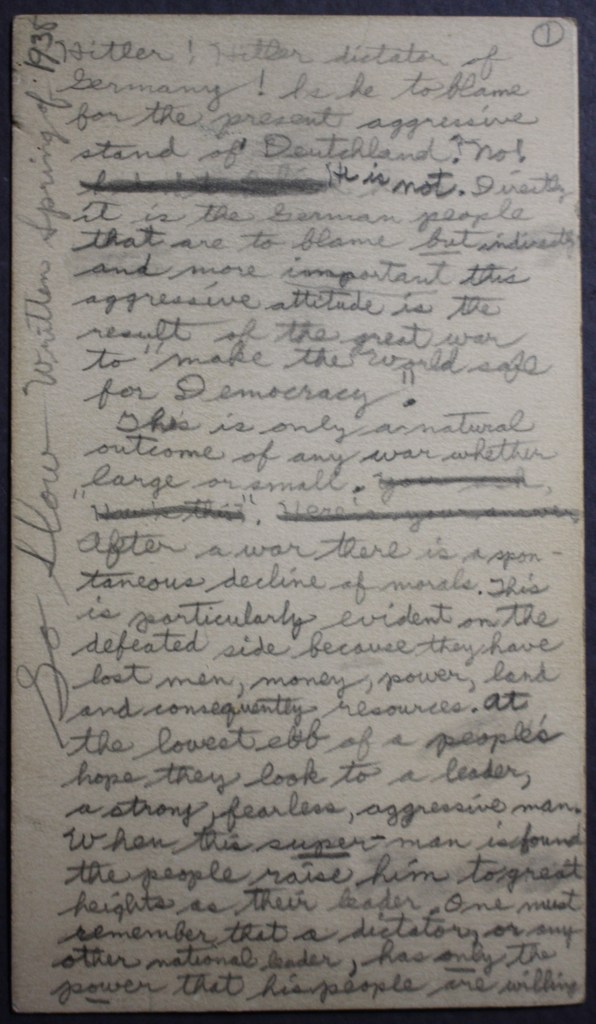
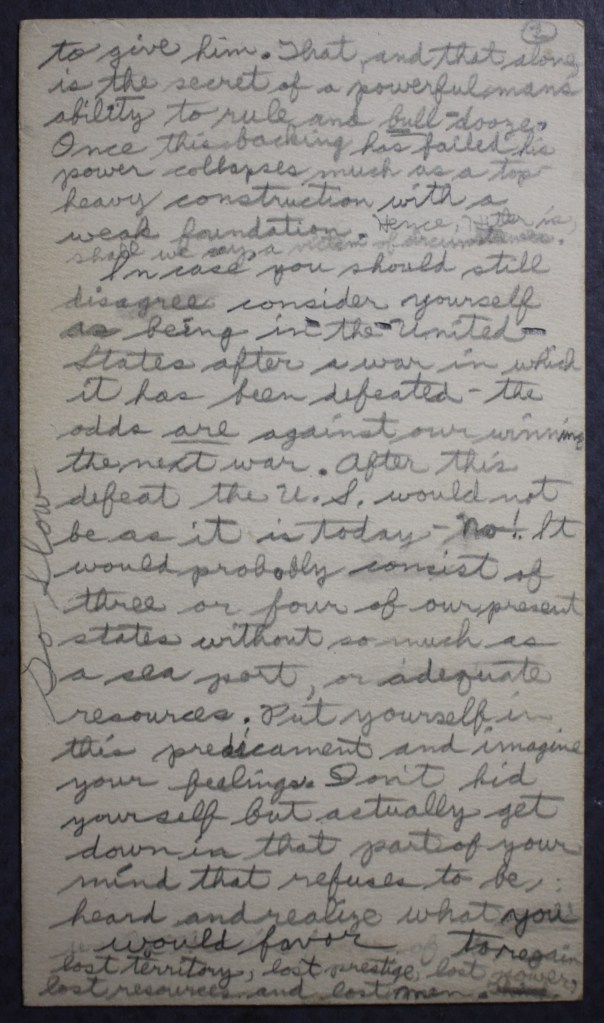
While my interest was drawn to the printed text, it was the handwritten pencil notations on the back of the cards that sparked that purchase. The cards contained a contemporary essay about the political atmosphere in the Circle City less than a month after the Soltau family’s Nazi incident. Written in pencil, the cards, numbered 1 and 2, read: “Hitler! Hitler Dictator of Germany! Is he to blame for the present aggressive stand of Deutchland? No! He is not. Directly, it is the German people that are to blame but additionally and more importantly, this aggressive attitude is the result of the great war to “make the world safe for Democracy!!” This is only a natural outcome of any war, whether large or small. After a war there is a spontaneous decline of morals. This is particularly evident on the defeated side because they have lost men, money, power, land, and consequently, resources. At the lowest ebb of a people’s hope they look to a leader, a strong, fearless, aggressive man. When this superman is found, the people raise him to great heights as their leader. One must remember that a dictator, or any other national leader, has only the power that his people are willing to give him. That, and that alone, is the secret of a powerful man’s ability to rule and bulldoze. Once the backing has failed, his power collapses much as a top-heavy construction with a weak foundation. Hence, Hitler is, shall we say, a victim of circumstance. In case you should still disagree, consider yourself as being in the United States after a war in which it has been defeated; the odds are against ever winning the next war. After this defeat the U.S. would not be as it is today. It would probably consist of three or four of our present states without so much as a seaport or adequate resources. Put yourself in this predicament and imagine your feelings. Don’t kid yourself but actually get down in that part of your mind that refuses to be heard and realize what you would favor to regain lost territory, lost prestige, lost power, lost resources, and lost men.”

Card # 3

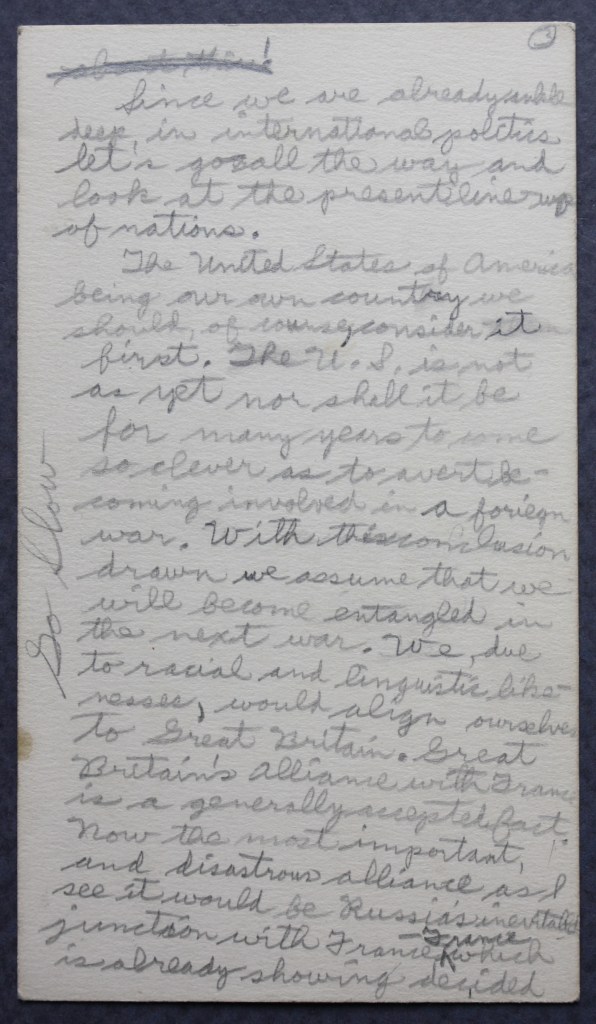
The next week, I revisited that roadside market. Lo and behold, the same dealer was there, and he brought more boxes of paper. I found two more of those cards, numbered 3 & 7, with more of that essay featured on the reverse. “Since we are already ankle deep in international politics, let’s go all the way and look at the present lineup of nations. The United States of America, being our own country, we should, of course, consider it first. The U.S. is not as yet, nor shall it be for many years to come so clever as to ever become involved in a foreign war. With this conclusion drawn, we assume that we will become entangled in the next war. We, due to racial and linguistic likenesses, would align ourselves to Great Britain. Great Britain’s alliance with France ia a generally accepted fact . Now the most important and, disastrous as I see it, would be Russia’s inevitable junction with France, which is already showing decided…Couldn’t we be a little more consistent one way or the other?”

Card # 7

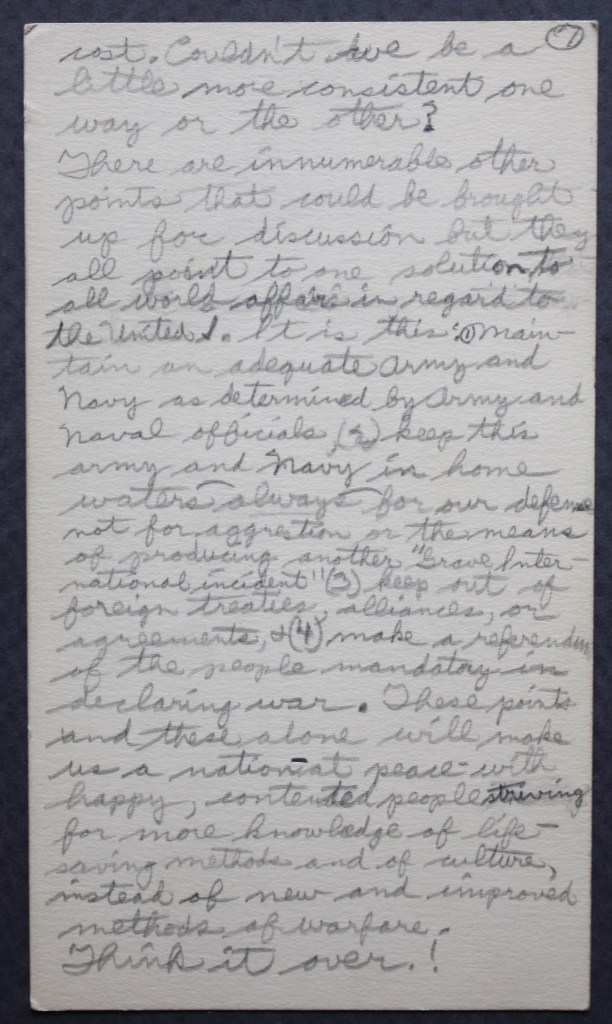
There are innumerable other points that could be brought up for discussion, but they all point to one solution to all world affairs in regard to the United States. (1) It is this: maintain an adequate army and navy as determined by Army and Navy officials. (2) Keep this army and navy in home waters always for our defense and not aggression or the means of producing another “Grave international incident.” (3) Keep out of foreign treaties, alliances, or agreements. (4) Make a referendum of the people mandatory in declaring war. These points, and these alone, will make us a nation at peace with happy, interested people striving for more knowledge of lifesaving methods and of culture, instead of new and improved methods of warfare. Think it over!”

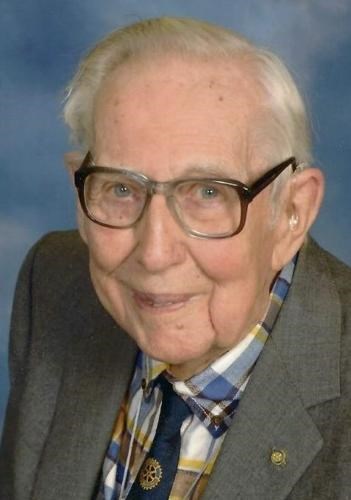
Robert W. Shoemaker, Jr. (1921-2022)

All four of these cards were authored (and signed) by Bob Shoemaker, Jr. of Anderson, IN. Robert W. Shoemaker, Jr. (1921-2022) Bob was born in New Philadelphia, Ohio, the only child of Robert W. Shoemaker, Sr. (1898-1968) and Irene English Shoemaker (1900-1988). The family moved to Anderson in 1935. Shortly after settling in Indiana, Bob became a Boy Scout. While attending the 1937 National Boy Scout Jamboree in Washington DC, Bob received his Eagle Scout award. It is likely that the seeds of this essay were planted when he sailed to Europe to participate in the 1937 World Jamboree in the Netherlands. Here, young Bobby Shoemaker witnessed the changes taking place in Hitler’s Germany firsthand. After graduating from Anderson High School in 1939, Bob enrolled in Harvard College and was on course to graduate with the Class of 1943 when the war came calling. Among Bob’s hobbies and interests were amateur radio, reading, history, and photography. Through slides, home movies, and videos, Bob compiled a remarkable visual history of his life and the life of his family from the 1920s to the current century. His many slides and movies taken during the 1937 Jamboree trips provide a fascinating glimpse of life in Washington DC, and Europe before the tragic onset of World War II. It was that love of photography that drew Bob to that Leica Exhibit at the Hotel Lincoln in Indianapolis back in 1938.

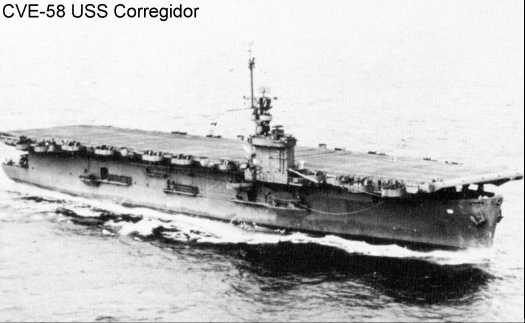
Bob was commissioned as an ensign in the U.S. Naval Reserve in 1942 and attended officers’ training programs in the Bronx, NY, and Washington, D.C, before being assigned to the Naval Mine Warfare Test Station at Solomons Island, MD, where he served as Naval personnel officer. After requesting a shipboard assignment, Bob was transferred to the Pacific for duty aboard the escort aircraft carrier U.S.S. Corregidor (CVE-58) as Lieutenant Junior Grade and Signal Officer until the ship’s decommissioning after the war in 1946. After World War II, Bob earned two graduate degrees from Harvard: an MBA and a Bachelor of Arts Degree in Government in 1947. Upon his return to Anderson in 1947, Bob remained active in the U.S. Naval Reserve Division 9-31. In 1949, Bob and his parents purchased Short Printing, Inc., then located on 20th Street near Fairview Street in Anderson. He successfully operated the business as President for almost five decades, which included building a larger one on Madison Avenue in 1961 and changing the name to Business Printing, Inc. He retired and sold the business in 2000. Bob was a Scoutmaster and Skipper of a Sea Scout ship in Anderson. He also held a variety of district and council leadership positions in Scouting for many years.

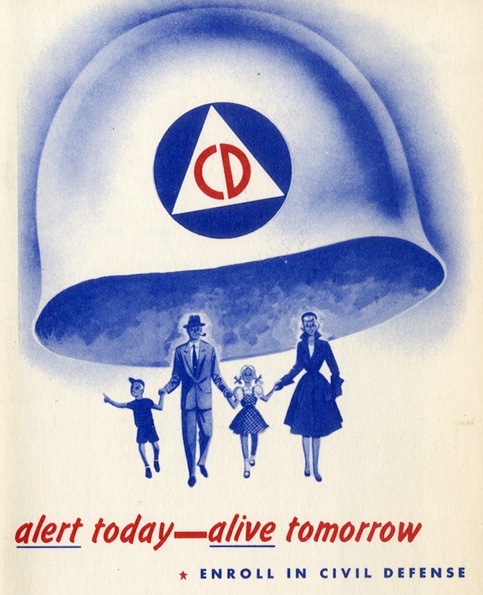
In 1946, Bob obtained his amateur radio license, and in 1952, he was asked to organize amateur radio communications for the Madison County Civil Defense, which led to his appointment as County Civil Defense Director, a position he held for 12 years. This period witnessed rising tensions with the Soviet Union and the threat of nuclear attacks, including the 1962 Cuban Missile Crisis. As CD Director, Bob gave many educational slide presentations regarding proper preparations in the face of nuclear threats, oversaw the selection and stocking of emergency fallout shelters throughout the county, and helped organize the conversion of the old Lindbergh School north of town into a CD emergency command headquarters. His slide show included photos taken in his capacity as an official observer at the Yucca Flats, Nevada, nuclear test in 1955. Later, Bob was invited by NASA to Cape Canaveral to observe the launch of Apollo 8, which carried astronauts into orbit around the moon for the first time, and the Apollo 15 moon mission launch. As a seven-decade member and officer of the Rotary Club, Bob secured NASA astronaut Al Worden, command module pilot for Apollo 15 and one of 24 people to have flown to the Moon, as a special speaker for the Madison County Rotary Club in 1971.

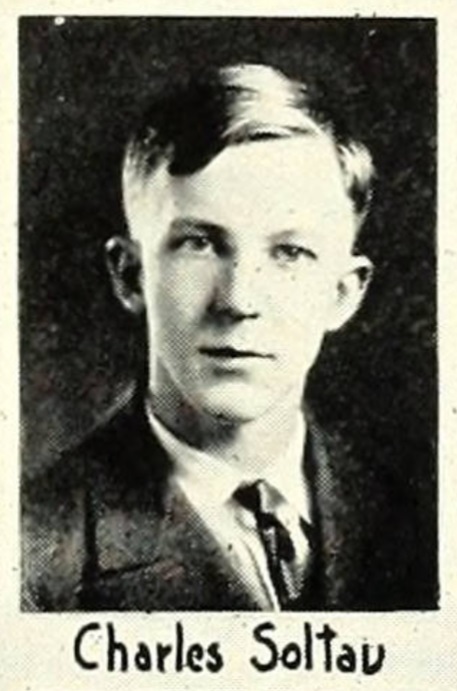
Arsenal Tech’s Nazi Charles Soltau.

When Bob Anderson Jr.’s life is measured against that of his “peer,” Arsenal Tech grad Charles Soltau, it is easy to see that while both shared the same isolationist mentality as young men, one chose to follow that Nazi ideology of Adolf Hitler and the other followed that of Uncle Sam. Soltau faded into the obscurity that Gnaw Bone, Indiana, maintains to this day. Anderson became a public-spirited pillar of Madison County society whose shadow is still cast in that community — proving that idealogy comes and goes with the flow of generations. What often sounds like an attractive idea can easily morph into an unexpectedly bad outcome. Mark Twain is often quoted as having said, “History doesn’t repeat itself, but it often rhymes,” and, if so, it applies today.

I will be talking about this series of articles with Nelson Price on his radio show “Hoosier History Live” this Saturday June 21, 2025 noon to 1 (ET) on WICR 88.7 fm, or stream on phone at WICR HD1. See the link below.

https://www.facebook.com/www.hoosierhistorylive.org

Creepy history, Health & Medicine, Indianapolis, Medicine

The Hilton Sisters-Vaudeville’s Beautiful Siamese Twins. PART I

Original publish date May 22, 2025.

https://weeklyview.net/2025/05/22/the-hilton-sisters-vaudevilles-beautiful-siamese-twins/

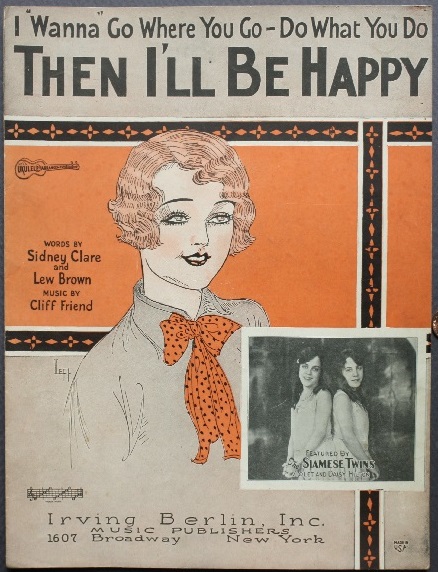
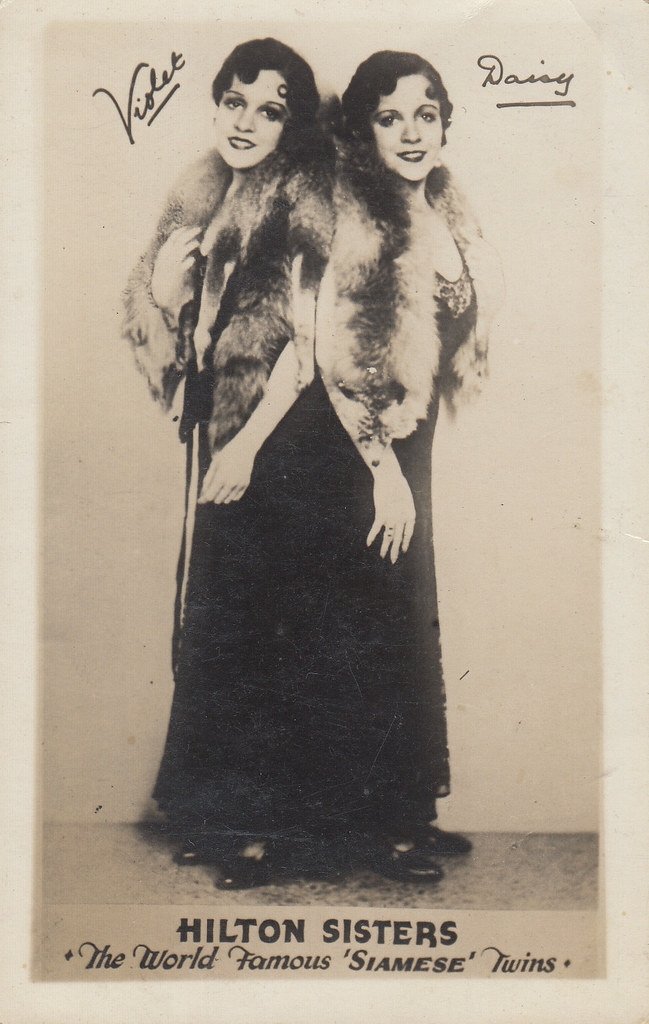
The Hilton Sisters Sheet Music.

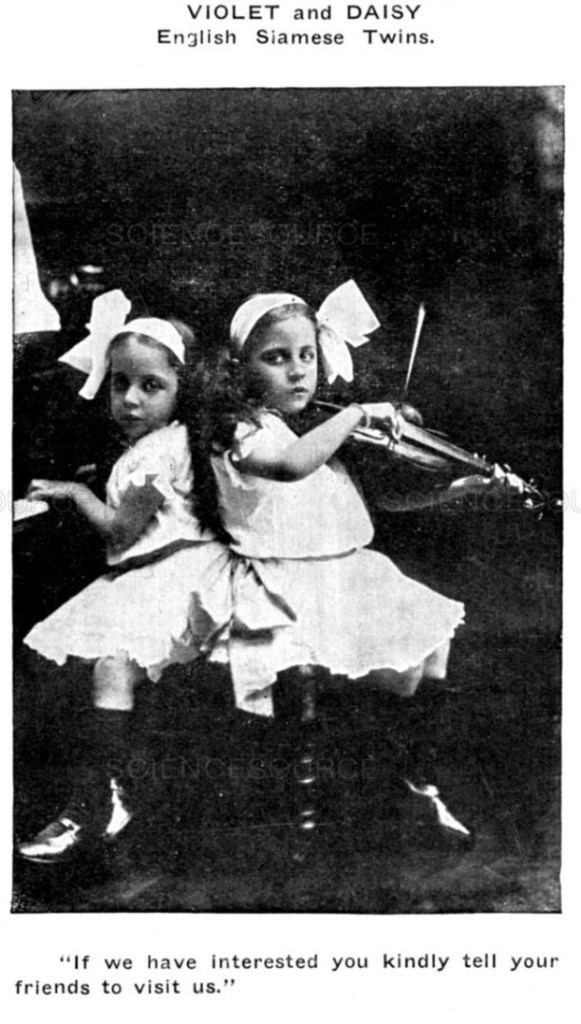
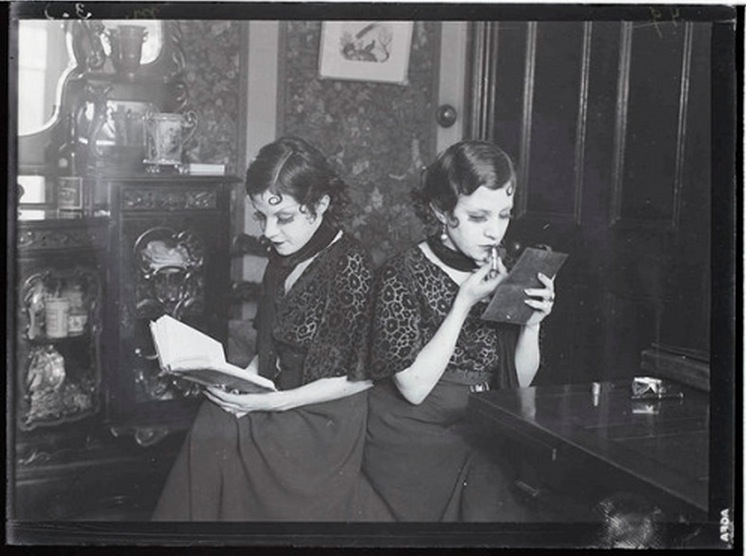
I recently ran across a five-dollar box of sheet music at an antique show. It seems like nobody wants sheet music anymore. I suppose, like recipe books, almanacs, TV guides, and car manuals, they are seen as obsolete nowadays. It turned out to be a fun, if not very valuable, box of paper. One was from the 1952 Marilyn Monroe film Niagara, along with a bunch of 1920s-40s songbooks and “how to” manuals for the Hawaiian guitar. The one that caught my eye was a piece of ukulele sheet music for the 1925 Irving Berlin song “I Wanna Go Where You Go—Do What You Do. Then I’ll Be Happy,” performed by a pair of lovely young ladies known as the “Hilton Sisters.” These beautiful young girls are pictured side by side on the cover in a pose that suggests that they were joined at the hip. A closer examination reveals a caption proclaiming the duo as a pair of conjoined “Siamese Twins,” and it turns out, during the Vaudeville era, Daisy and Violet Hilton were the biggest stars of their day.

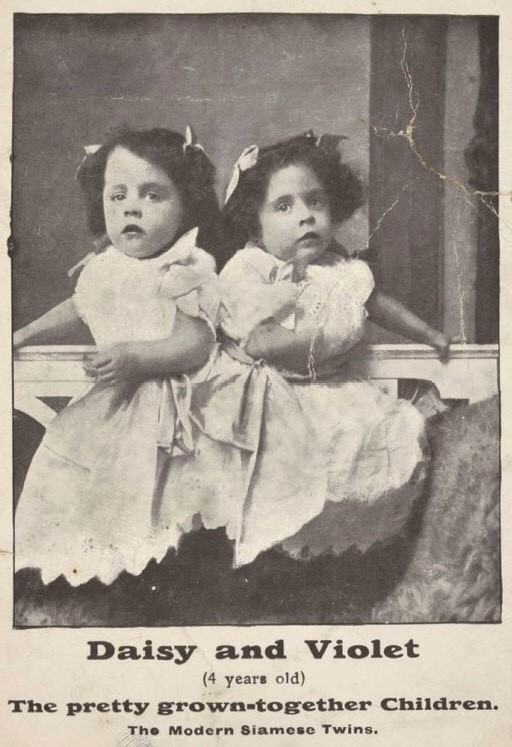
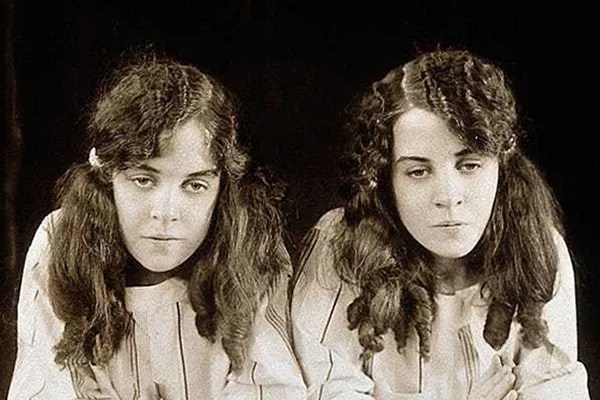
Daisy and Violet Hilton were born on February 5, 1908, in Brighton, Sussex, England, birthplace of authors Charles Dickens and Rudyard Kipling. The twins were born to an unmarried barmaid named Kate Skinner. After seeing her babies, Kate was horrified, thinking that her children’s birth defects were a punishment from God for her unmarried status. She refused to look at them, let alone hold them, so she sold the girls to the midwife who had delivered them, Mary Hilton. Hilton looked at those baby girls and saw dollar signs. Hilton immediately began displaying the girls in the backroom of the Queen’s Arms pub on George Street, which she ran with her husband. As they grew, she taught the girls how to sing, dance, and play musical instruments. The Hilton sisters toured first in Britain in 1911 (aged three) as “The Double Bosses” and from then on, the twins were on the road touring the United Kingdom, Europe, and Australia. The twins were the first set of conjoined twins born in Britain to survive more than a few weeks. The girls were connected at the hip and pelvis by a fleshy appendage and shared no organs. Doctors stated that they could have easily been separated at an early age and would have lived independent lives. But the girls were seen as piggybanks in those formative years, so “fixing” them would kill the golden goose.

In 1913, rebranded as the “Famous Brighton United Twins”, they toured Australia, where they made their debut at Luna Park in Melbourne on Friday the 13th of December, 1912. Despite a massive advertising campaign, the novelty of their act quickly wore off. The show closed after only a week, and the twins, their mother Mary, and sister Edith were abandoned down under by the show’s promoter. Somewhere along the line, the Hilton family came into contact with Myer Myers, a traveling circus balloon and candy seller. Myers formed a romantic interest in the twins’ older sister Edith, and the couple was married. The marriage was not based on love, it was based on financial gain. While the twins were fond of their older sister, they never liked Myer.

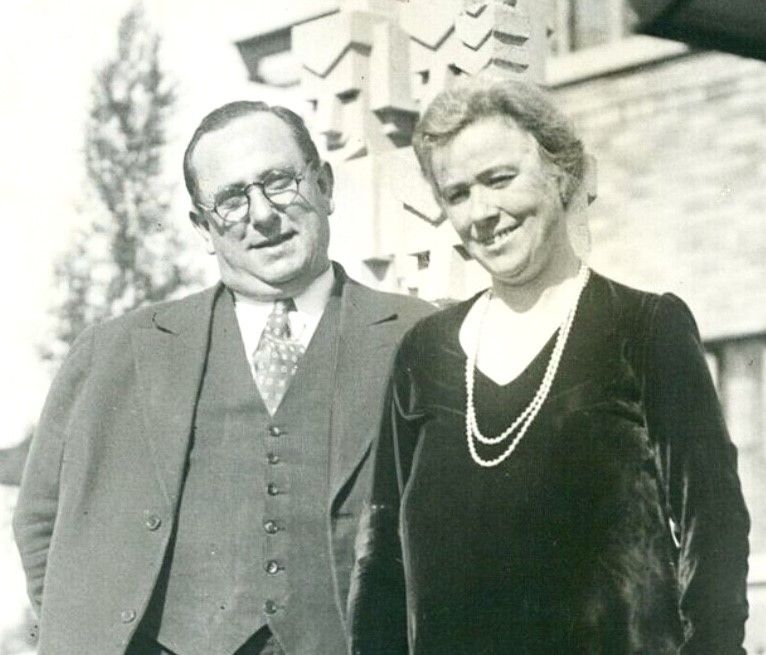
Myer & Edith Myers.

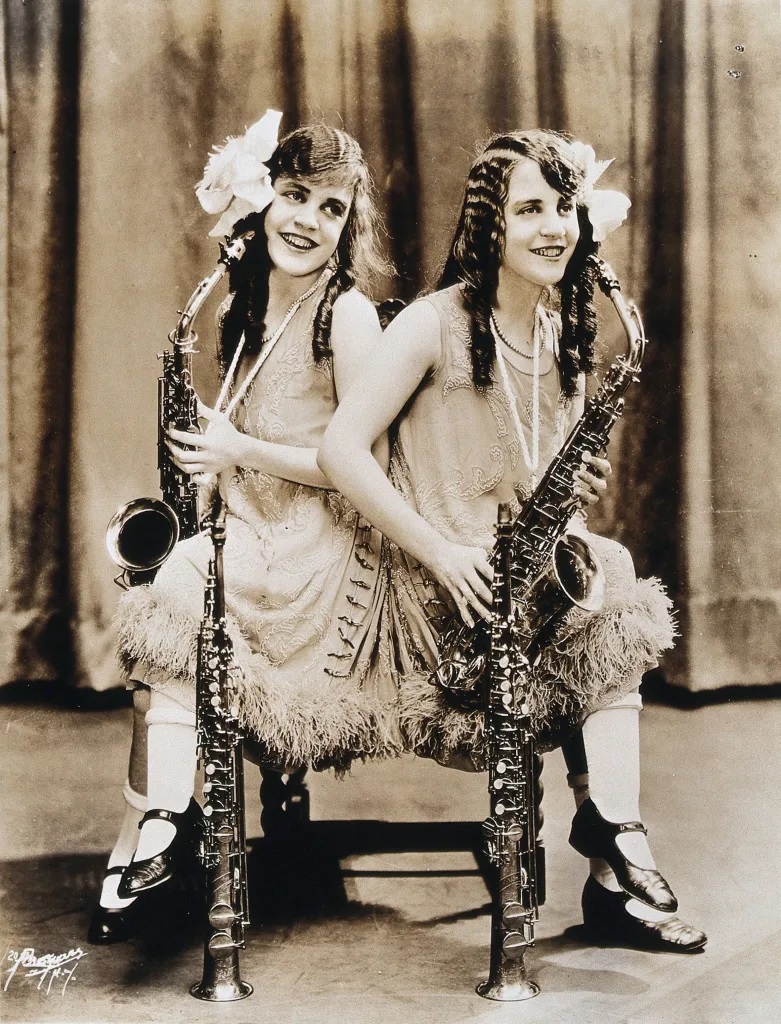
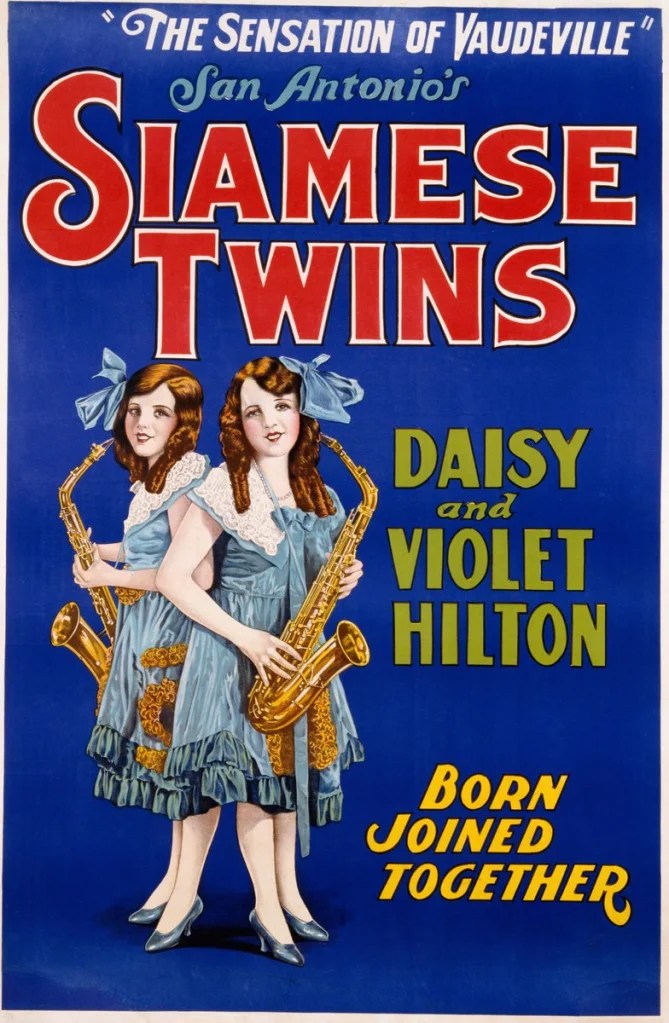
In June 1916, Myer brought the girls to the United States via San Francisco. But immigration officials had never seen anything like Violet & Daisy before, so they were detained and quarantined at Angel Island (next to Alcatraz) in the San Francisco Bay for months until they were finally cleared for entry. By 1918, the 10-year-olds were traveling the Orpheum Circuit of Vaudeville Theatres across the country. The adorable little girls were extremely popular, although still categorized as medical oddities and relegated to the sideshow carnival “Freak Show” class. But the Hilton sisters were different, they weren’t just an act, they were talented. The girls were trained in singing and dancing and eventually learned to play the piano, violin, and saxophone. The twins made huge amounts of money in Vaudeville, but regardless of who was managing them, they retained very little of it.

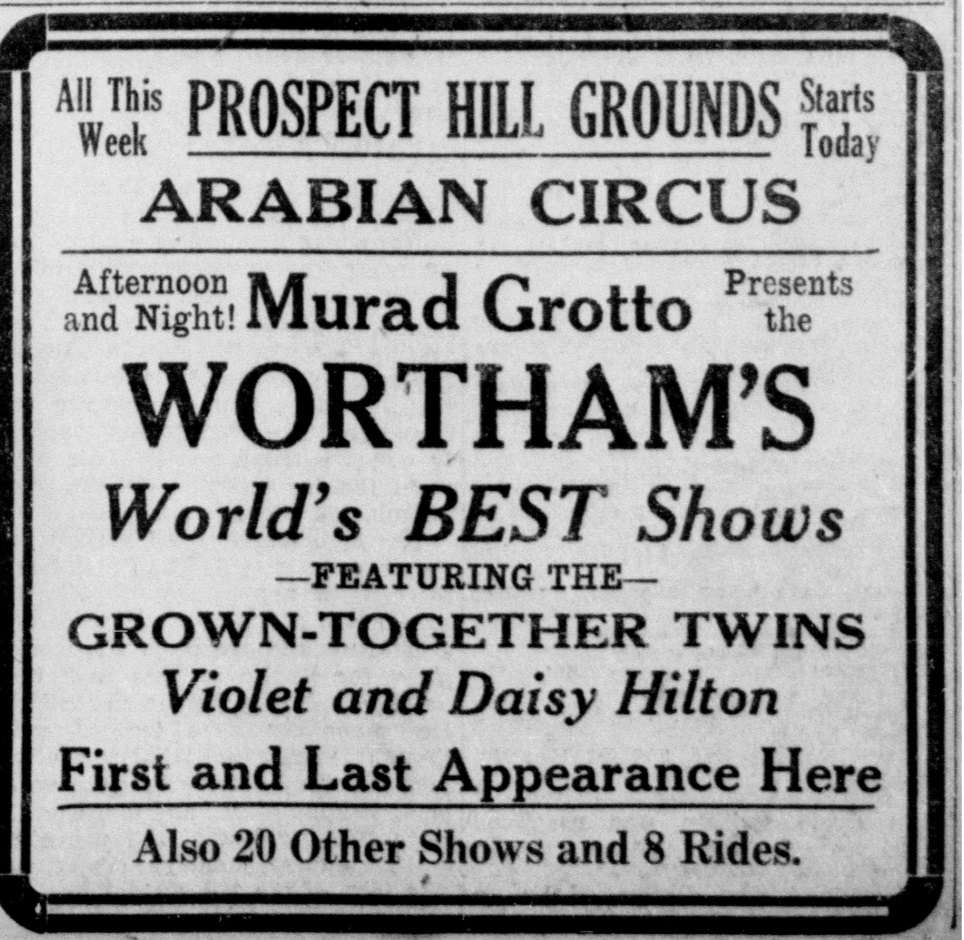
Throughout their lives, Violet and Daisy often voiced their dislike of Myer Myers and how he exerted complete control over every aspect of their lives. Myers insisted that the twins call him “Sir,” that the girls sleep in the same bedroom with their parents, and when they were not performing in the circus, that they spend their days doing school lessons and practicing their musical instruments. The twins were also forbidden to play with other children. Myer Myers promoted the twins unscrupulously and toured them mercilessly. In time, the twins became the star attraction of the “Great Wortham Show”, a traveling carnival that toured the United States. People around the country flocked to see these beautiful, mysterious young girls. In 1917, while performing at the San Jacinto Fiesta in San Antonio, Myers built a castle-like pavilion directly across from the Alamo. Now, every visitor to the shrine of Texas independence made the trip across the street to see the twins. Myers continued to tour the twins across the USA, and whenever he entered a city or town, he ensured that the first stop was a visit to the mayor or, if it was a state capital, the governor.

The Hilton Sisters exploded onto the American scene at precisely the right time, for the years between World War I and World War II were considered the heyday of vaudeville side shows. On stage, the adorable twin girls sang, danced, and played saxophone & piano. They were exhibited as children as sideshow curiosities, but now they toured the United States in vaudeville theatres and American burlesque circuits in the 1920s and 1930s. Myers reinvented the twins’ biographies, saying their “Mother died at their birth and their father, a soldier, was killed a short time afterward in an accident. Firmly joined together at the base of their spines, the Hilton girls present a curious spectacle, especially so as the odd grafting of nature has materialized into a seemingly uncomfortable back-to-back, half-diagonal position. Despite this, the girls move about with an ease and freedom and movement that is nothing less than astonishing.”

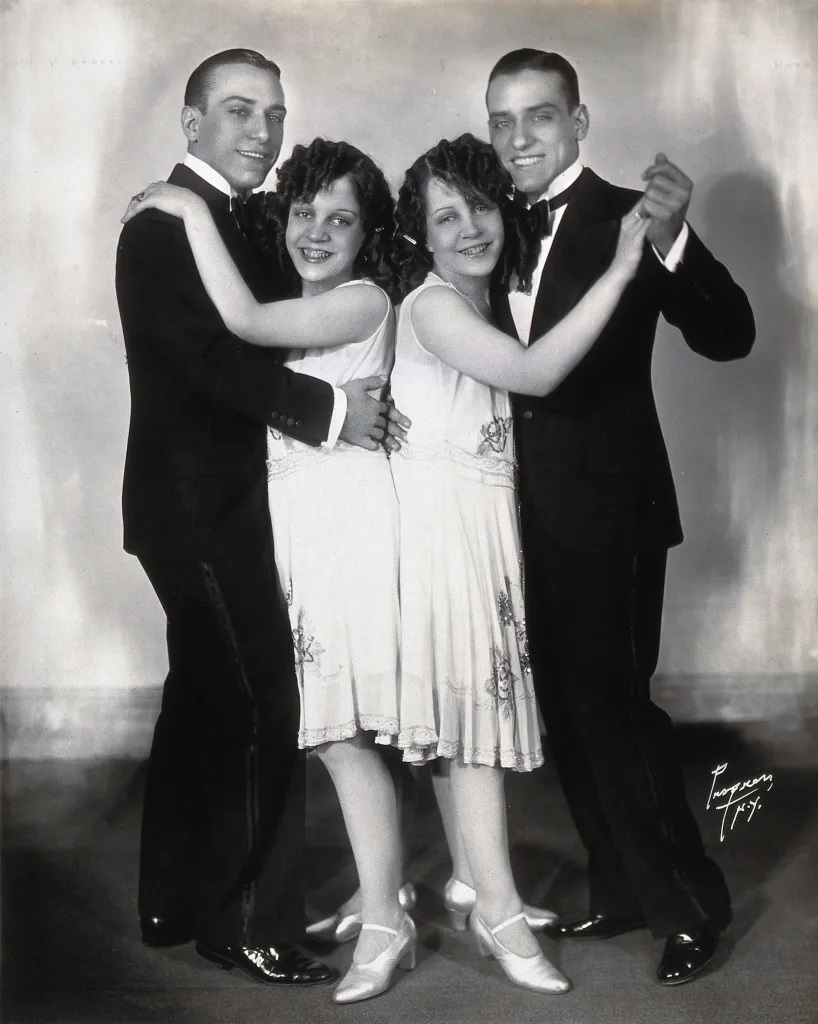
The Indianapolis News for Saturday, March 28, 1925, touted the twins’ first appearance at the Globe Theatre, reporting that the performance got out of hand. Their appearance caused traffic jams, and police were called to control the lines of rowdy curiosity seekers on the streets outside trying to get into the theater. During their act, the girls sang songs, played music, and always concluded in the same fashion: a waltz. Two young men were waiting in the wings offstage. On cue, the men would glide out and dance with the sisters in rythm to an orchestra posed behind them. One of those young men was an unknown vaudevillian named Lester Townsend, soon to be known to the world as Bob Hope. In 1926, the sisters teamed up with up-and-coming comedian Bob Hope, who formed a new vaudeville act he called “Dancemedians.”

The twins appeared onstage with other luminaries like George Burns & his wife Gracie Allen, Sophie Tucker, and Charlie Chaplin. The Twins’ songwriter during their vaudeville years was Bart Howard (then known as Howard Joseph Gustafson), who wrote “Fly Me To The Moon.” That same Star newspaper article reported that the girls were like any other pair of sisters. Sometimes they would fight, and one sister would not speak to the other for days offstage. The article noted that the “girl’s fingerprints were different, one would read while the other slept, one sister may prick her finger, but the other is unaware of it, but,if one has a headache, the other will feel it. Daisy sews, but Violet is not particularly fond of sewing. Daisy enjoys housework while Violet prefers to arrange the furniture and decorate the house. There seemed to be a subtle telepathy between the twins.”

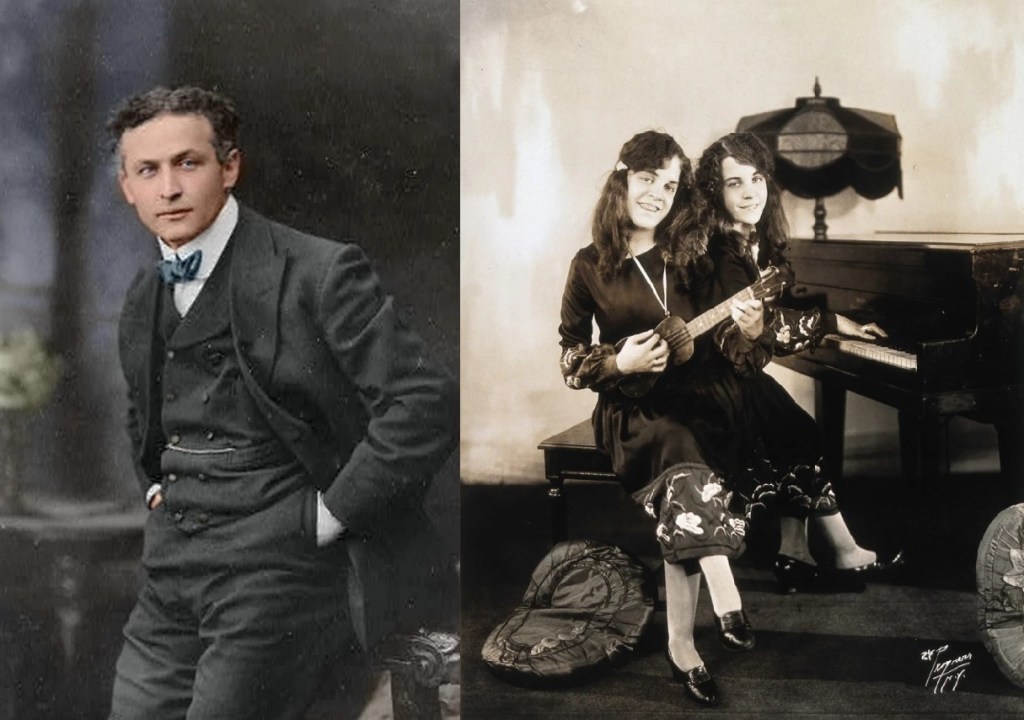
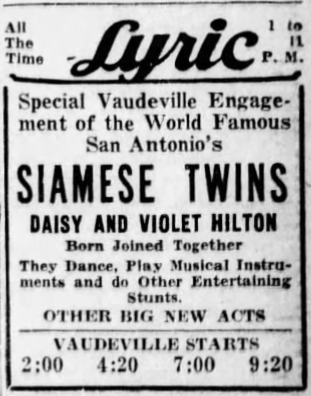
Throughout the 1920s, the twins earned $5,000 per week for 44 weeks on the Orpheum Circuit, over $91,000 weekly in today’s money. They were the highest-paid vaudeville act in America. Myer Myers was their manager, and the girls never saw a dime of that money. The Hilton Sisters were befriended by escapologist Harry Houdini, who taught them how to “mentally separate from each other.” Learning of the twins’ disadvantageous financial arrangement with Myer Myers, Houdini strongly advised the girls to emancipate themselves from their legal guardians and hit the road on their own. In his book Very Special People, author Frederick Drimmer quoted Houdini as telling the twins, “You must learn to forget your physical link. Put it out of your mind. Work at developing mental independence from each other.” Houdini died on Halloween night of 1926 and was never able to help the twins achieve that goal in his lifetime. The girls appeared in Indianapolis many times during their career. Indianapolis had a strong vaudeville, burlesque, and theatre district. The Hilton Sisters appeared at the Lyric Theatre on March 6, 1928, and again on September 6, 1928. Before that appearance, Chicago Commissioner of Health Herman Bundersen declared them healthy and described them as: “Two souls with but a single thought.” While the girls received a clean bill of health, both physically and spiritually, could the same be said of their industry?

PART II

The Hilton Sisters-Vaudeville’s Beautiful Siamese Twins.

Original publish date May 29, 2025.

https://weeklyview.net/2025/05/29/the-hilton-sisters-vaudevilles-beautiful-siamese-twins-part-2/

Violet and Daisy Hilton.

In the Roaring Twenties, the Hilton Sisters were the darlings of Vaudeville. That circuit ran straight through the heart of Indianapolis. Violet and Daisy Hilton were conjoined twins who were abandoned by a single mother and sold to a Brighton, Sussex, England, saloon matron who subjected them to years of exploitation, only to be adopted by a corrupt manager on the fringes of the sideshow circus & show-business circuits. Despite those obstacles, the twins managed to strike out on their own and become hugely successful stars of stage, vaudeville, and film in the United States.

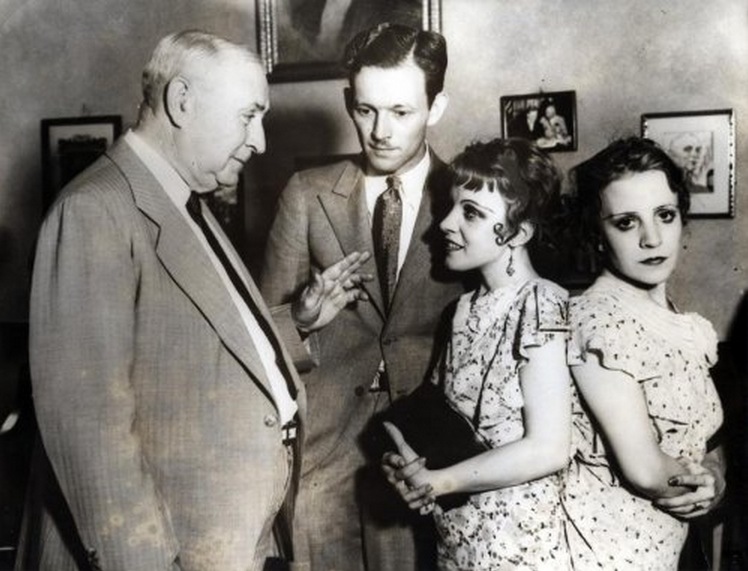
Lawyer Martin J. Arnold with Violet and Daisy Hilton after emancipation.

These personal appearances would most often last for a week or more. Since the Hilton Sisters traveled 52 weeks a year, wherever they laid their suitcase was their home. Five years after his death, their mentor Harry Houdini’s wish for the sisters was realized. The Indianapolis Times of Saturday, April 25, 1931, reported “Verdict Frees Siamese Twins From Bondage. Texas Pair Wins $99,000 in ruling releasing them from Guardian.” The sensational trial made headlines all over the country. After the verdict, the girls told reporters, “It is so wonderful to be free to go wherever we please, choose our own friends, and appear in public as humans rather than as freaks.” However, even though the twins received a boatload of money (over $1.8 million in today’s world), the rigid structure of Myer Myers disappeared, and the girls ran through that money in a relatively short time.

The twins, now aged 24, appeared in the 1932 exploitation movie “Freaks”, which led to another promotonal appearance at the Lyric theatre in Indianapolis (June to July 1932). The Indianapolis Times of July 31, 1932, reported: “The Hilton Sisters, Siamese Twins, were seen going into a subway station recently and a crowd of nearly one hundred people followed them to see if they would pay one fare or two. They paid two.” “We may seem like one, but everything costs us for two,” Daisy explained. “We pay insurance for two, but could only collect for one. The only bargain we get is our weight for a penny.” (For the record, the twins stood four feet six inches tall and weighed 166 pounds, or 83 pounds each.)

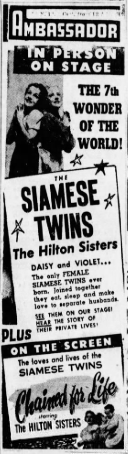
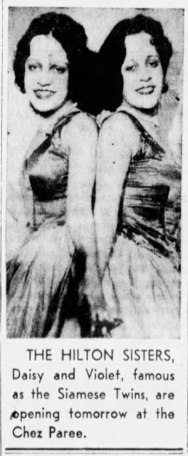
The twins came back to the Circle City in May to June 1936, at the “Chez Paree nightclub downstairs at the Apollo Theatre”, Dec 22-28, 1946, at the “Murat Theatre”, March 26, 1947 at the “Fox Burlesk Theatre”, and from May to June, 1952 at the “Ambassador Theatre.” These appearances all coincided with the slow downward spiral of the Hilton Sisters’ career. The first talkie movie (Al Jolson’s The Jazz Singer on Oct. 27, 1927) signaled the end of the Vaudeville Era.

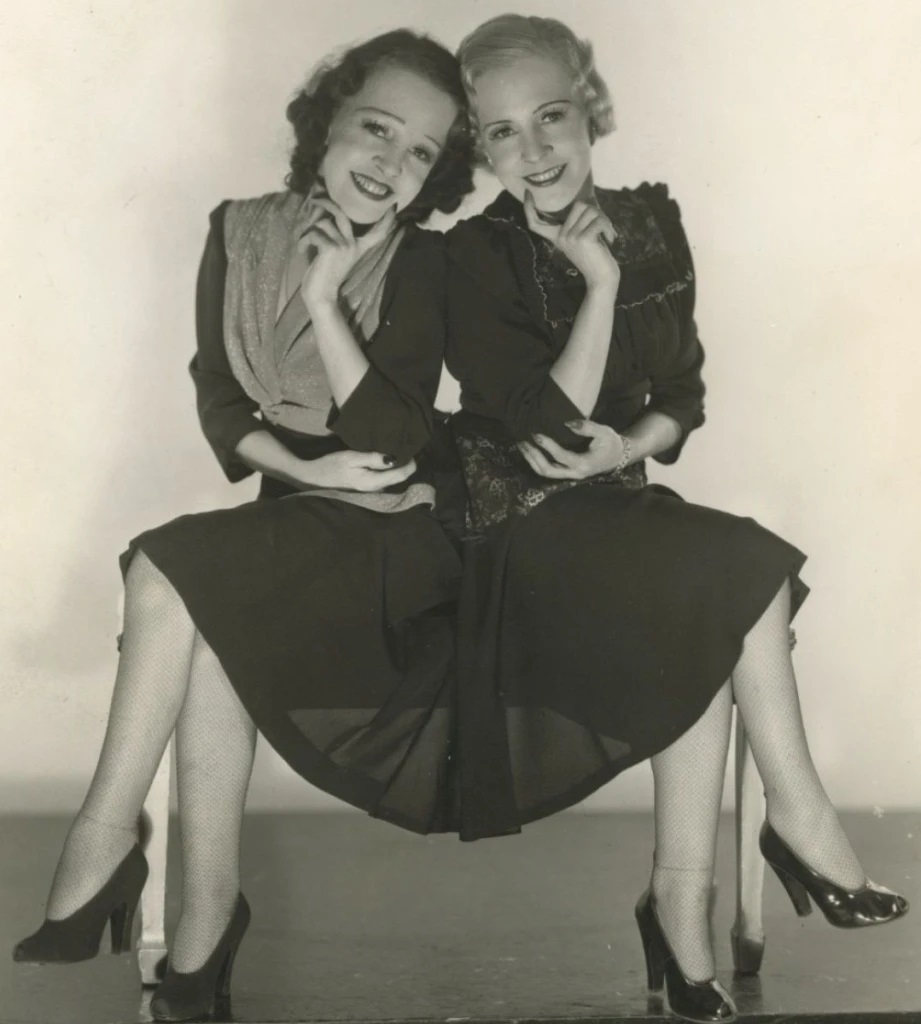
During those years, as Great Depression Era America watched these unique beauties mature to adulthood, the Hilton Sisters remained in the news. The twins resumed their vaudeville careers as “The Hilton Sisters’ Revue”. Daisy dyed her hair blonde, and they began to wear different outfits to distinguish each other. After vaudeville lost popularity, the sisters performed at burlesque venues. But Burlesque reviews were risque, and while the attending patrons were interested in women, they were not necessarily interested in women wearing clothing, talented or not.

After gaining independence from Myer Myers, the Hiltons sailed to the UK, where they spent most of 1933, returning to the States in October 1933. Violet began a relationship with musician Maurice Lambert, and they applied in 21 states for a marriage license, but were always refused. The Indianapolis Star Fri, Jul 06, 1934, reported on the prospect of marriage: “The very idea is quite immoral and indecent. No, there is no law against it, but it just seems indecent.” Maurice grew tired of the newsreel life and one day, simply walked away from the relationship. Afterward, Violet became briefly engaged to Jewish boxer Harry Mason, who later went on to have a relationship with Daisy. In 1936, Violet married actor James Moore at the Cotton Bowl during the Texas Centennial Exposition as a publicity stunt. The marriage lasted ten years on paper, but the couple never lived as husband and wife. It was discovered that Jim Moore was gay, so the marriage was eventually annulled.

Cook County Illinois Clerk Robert Sweitzer. informs Violet and Maurice Lambert that they can not get married.

At the time of Violet’s wedding, the press noted that Daisy was visibly pregnant. Daisy gave birth, but the child, a boy, was put up for adoption immediately. In 1941, Daisy married Harold Estep, better known as dancer Buddy Sawyer. The marriage lasted ten days when it was discovered that Buddy, like Violet’s husband Jim Moore, was gay.

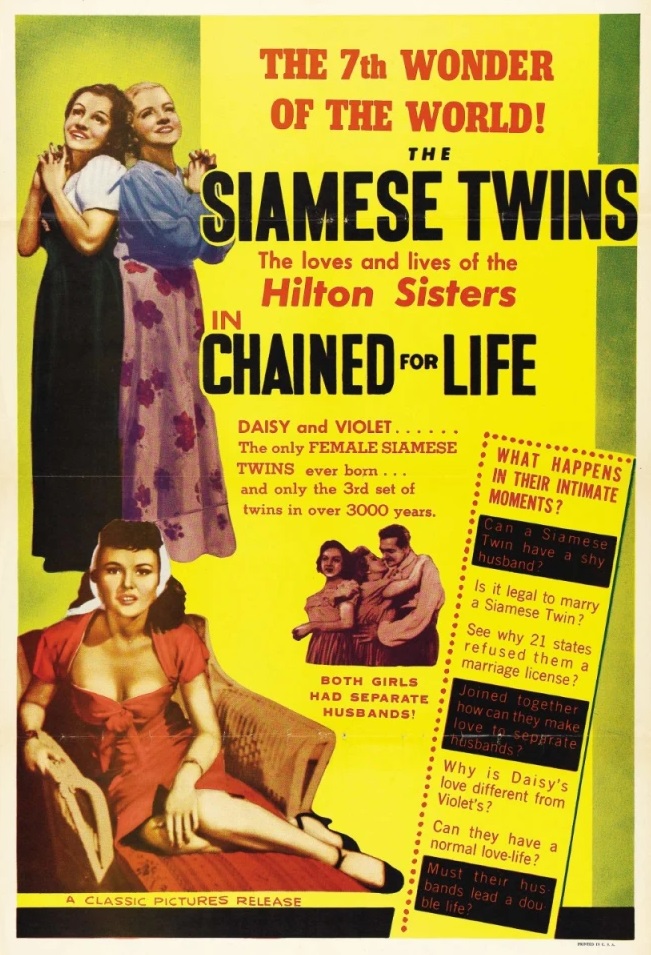
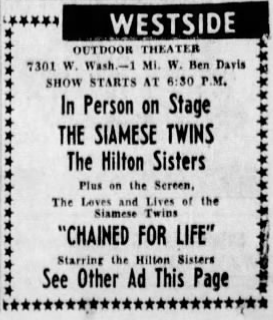
In 1952, the twins starred in a second film, Chained for Life, an exploitation film loosely based on their lives. The film’s producer ran off with all the money and left the Hilton Sisters holding the bag. They paid the bills out of their own pockets and undertook a grueling series of personal appearances at double-bill screenings of their two films in theatres and drive-ins across the country. Sadly, the entertainment world had moved on, and few people were interested in the aging vaudevillians, curiously conjoined or not. Afterwards, their popularity faded, and they struggled to make a living in show business. Violet once told a reporter, ‘We fooled ourselves that by entertaining others we were making ourselves happy.’

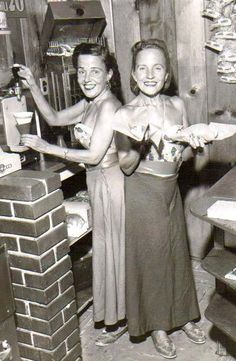
The Hiltons’ last public appearance was in 1961 at a drive-in theater in Charlotte, North Carolina. Without warning, their tour manager abandoned them there with no means of transportation or income. Charles Reid, owner of the Park-N-Shop grocery store in Charlotte, hired the twins for a commercial advertising “Twin-pack” potato chips. Afterward, they applied for a job at the store, stating they would work for one salary if necessary. Reid, ever the savvy businessman, realized he was getting four hands on one body and hired them as produce handlers and checkout girls. He paid them each a salary. The twins worked at a specially designed and constructed checkout station that looked no different than the others. The only way anyone would know the difference was if they looked back over their shoulder as they walked out the door.

The Hiltons rented a small two-bedroom home courtesy of Purcell United Methodist and settled into a quiet life centered around work and church. Daisy learned how to drive a car because she was the twin who could sit in the left-hand driver’s seat. Later, the twins bought a former driving instructor’s car with dual controls, so Violet could also drive.

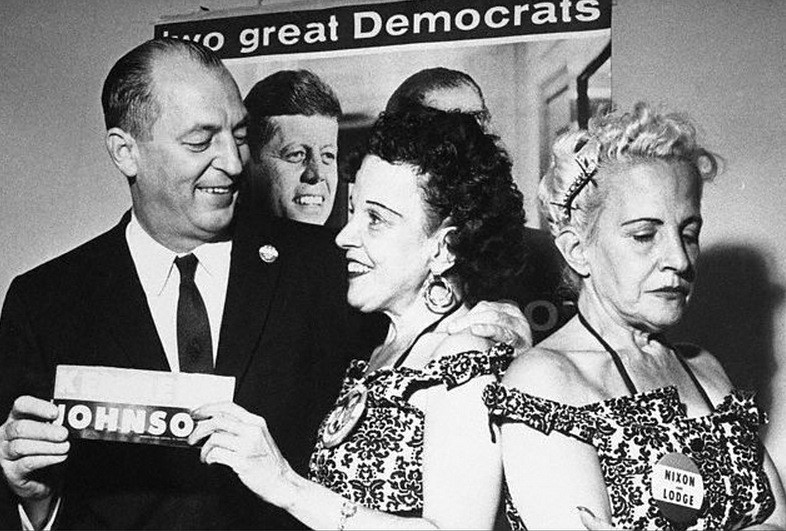
Violet, the Democrat, under a John F. Kennedy for President poster, while her sister Daisy frowns while wearing a Nixon / Lodge campaign pin.

Violet and Daisy had very different political views: Violet was a staunch Democrat, while Daisy supported the Republican Party. During the holidays, they remembered fellow employees and favorite customers with small, inexpensive Christmas gifts. One neighbor recalled that the girls had a phone booth installed in the home to allow for private conversations for each twin when needed and that the twins kept an array of purses around the house, each one containing two or three dollars for cab fare. Later in life, a doctor visited them and declared that they could be separated if they so desired, but they said no. Daisy contracted Hong Kong flu, but Violet refused medical intervention.

Charles Reid (LEFT) With the Hilton Twins.

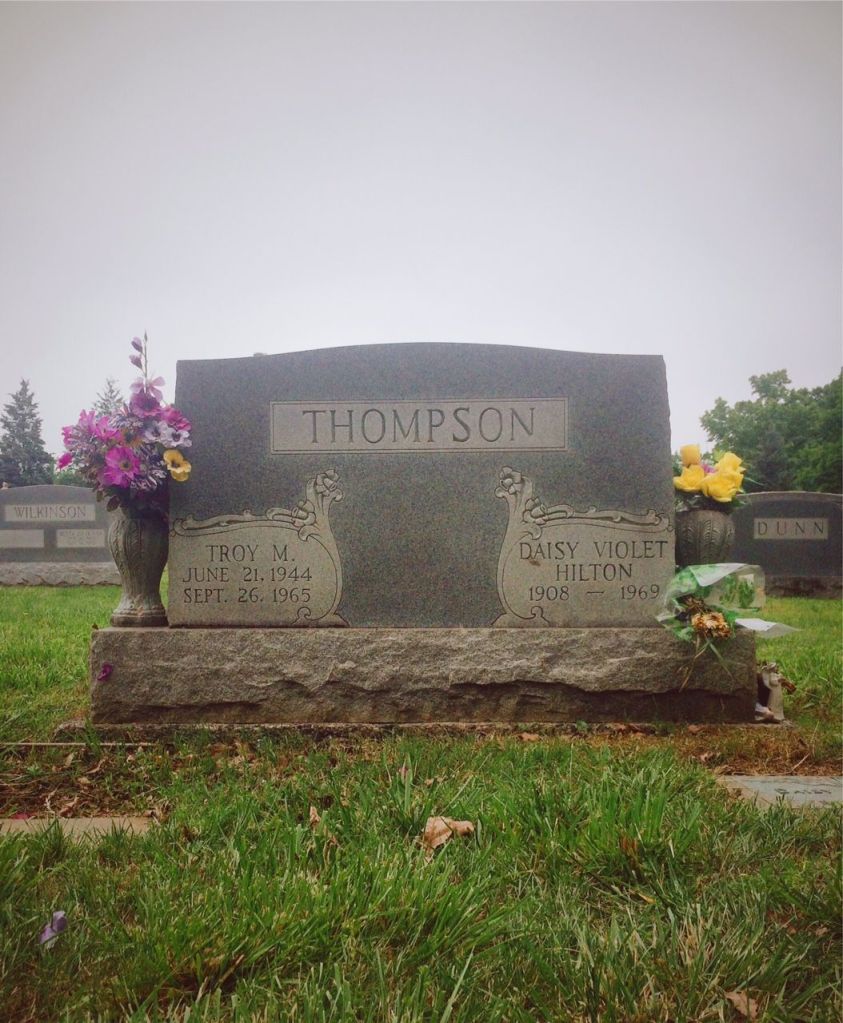
On January 4, 1969, after failing to report to work and unable to reach them by telephone, the store manager called the police to investigate. The twins were found dead in their home, victims of the Hong Kong flu. Their bodies were found on the heat grate in the hallway. Daisy’s decomposition was worse than Violet’s, which presents a nightmare scenario. The autopsy determined that Daisy died first and Violet died two to four days later. It was speculated that during those final few days, freezing cold from the Hong Kong flu, Violet dragged her sister to the heat grate and slumped to the floor where she drank heavily and chain-smoked cigarettes while waiting for the end to come. The house was adorned by carefully wrapped Christmas presents, all identified and tagged to go to their friends. They had spent every second of their lives together and had made a pact that they were going out together.

The Hilton Sisters were buried together in one casket in a donated plot at Forest Lawn Cemetery in Charlotte, NC. At their funeral service, the Reverend Jon Sills said, as he stood next to the sisters’ wide coffin: “Daisy and Violet Hilton were in show business for all but the last half dozen years of their life. In the end, though, they were cast aside by the glittery and glamorous world they had been part of for so long. In the end, it was only ordinary people who showed they cared about them.”

In May 2018, it was announced that Brighton and Hove City Council in Sussex, England, and the current owner of the house in which the twins were born had agreed that a commemorative plaque could be erected at the property. On May 26, 2022, a commemorative blue plaque was unveiled at 18 Riley Road, dedicated to them. Additionally, the Brighton & Hove Bus and Coach Co. honored the twins by naming a bus after them. Upon their death in 1969, Mrs. Luther E. Mason, a longtime friend of the twins and secretary to the lawyer who represented them at their trial, said that they wanted nothing more than to “live normally.”

Creepy history, Indianapolis, Pop Culture

Nazi’s at Arsenal Tech…What?

Part I

https://weeklyview.net/2025/03/13/nazis-at-arsenal-tech-what-part-1/

Original publish date March 13, 2025.

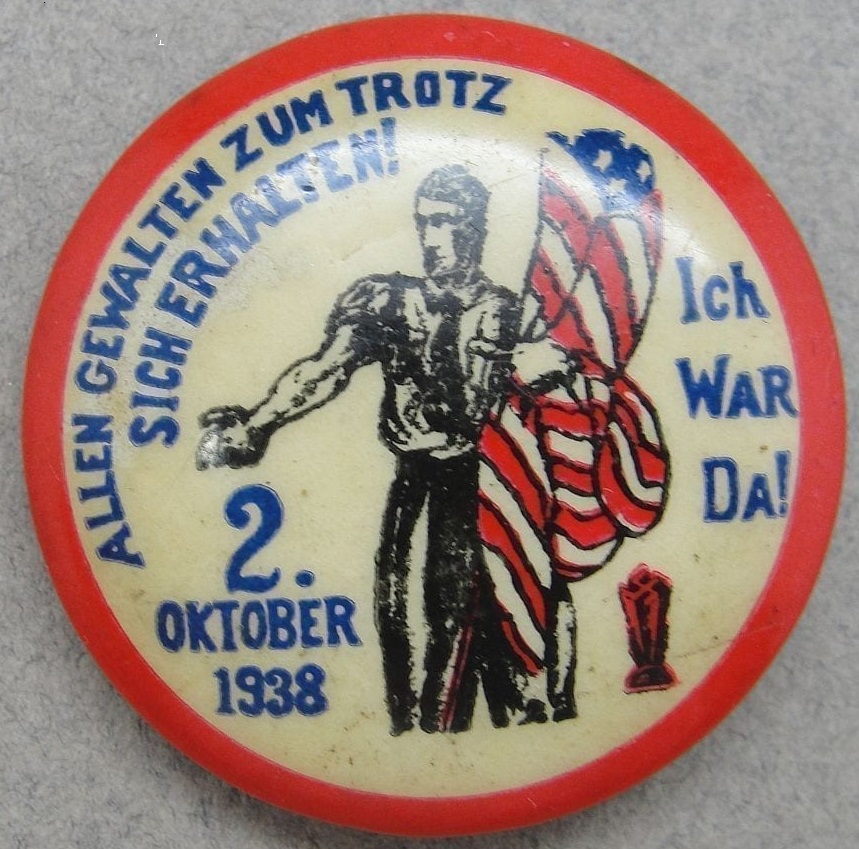
It’s true. In the years leading up to World War II, there was at least one eastside Indianapolis family openly identifying with the American Nazi Party. And three of those proud young Nazis graduated from Arsenal Technical High School. It all came to a head 87 years ago this Saturday when the Soltau home on North Summitt Street (where the La Parada Mexican restaurant now stands) came under attack by an angry mob of Circle City citizens seeking to enact their own “Night of Broken Glass” on March 15, 1938, seven months before Adolph Hitler’s Kristallnacht in Berlin, Germany in November of that same year. In March of 1938, Indianapolis newspapers were dominated by reports of German Wehrmarcht invaders poised at the gate, prepared to annex Austria into a “greater German Reich” and threatening the entire Western European theatre. Those same front pages reported on an organization of Hoosier ethnic Germans who were resolutely pro-Nazi, vehemently anti-Communist, deeply anti-Semitic, and staunchly American isolationists. In 1938, an estimated 25,000 Americans were members of this German American Bund. Indianapolis boosters hoped to swell that number by appealing to the large German immigrant community by advocating “clean American nationalism against Communist international outlawry.”

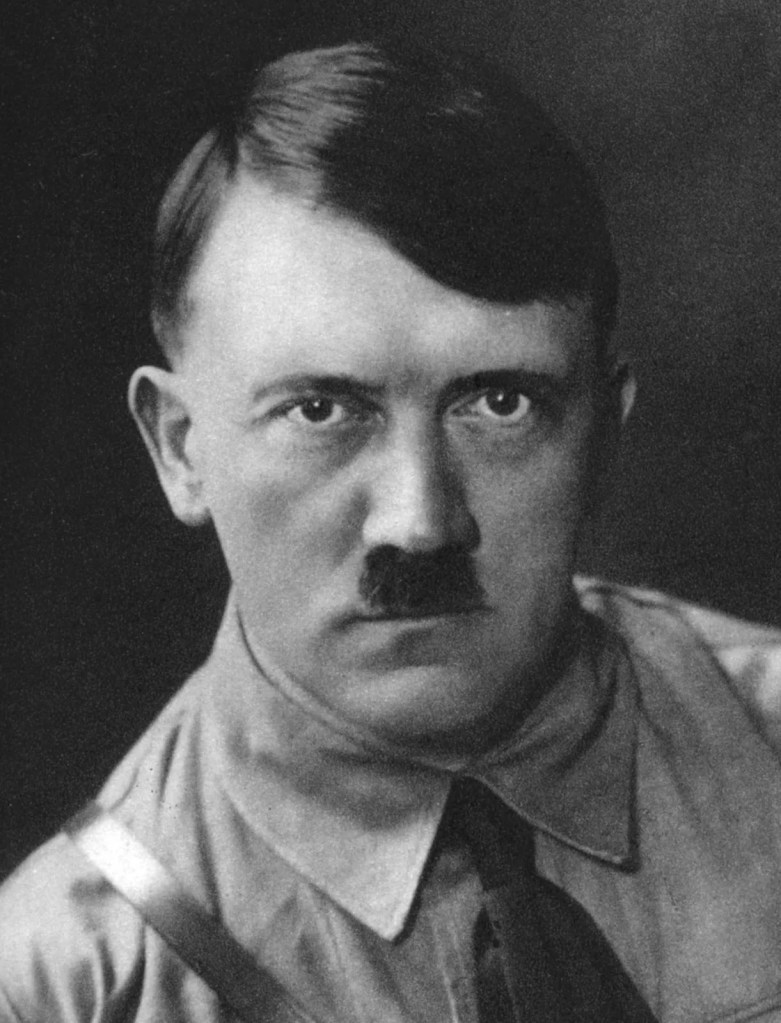
Adolph Hitler.

However, the German-American Bund secured very few Hoosier followers and gained little sympathy for their cause. Indiana had a well-deserved reputation for xenophobia and white nationalism that is most clearly reflected in the Ku Klux Klan’s ascent to power just over a decade before. The number of Hoosiers in league with the German-American Bund was certainly much smaller than the number of members of the 1920s KKK. Still it was committed to many of the same ideological issues as the Klan. Its history confirms the complex range of xenophobic sentiments simmering in the 20th-century Circle City.

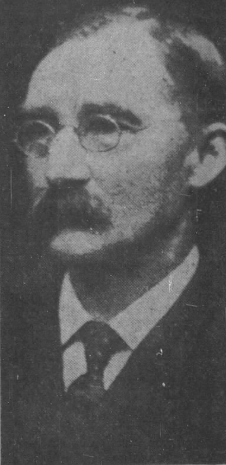
John A. Soltau

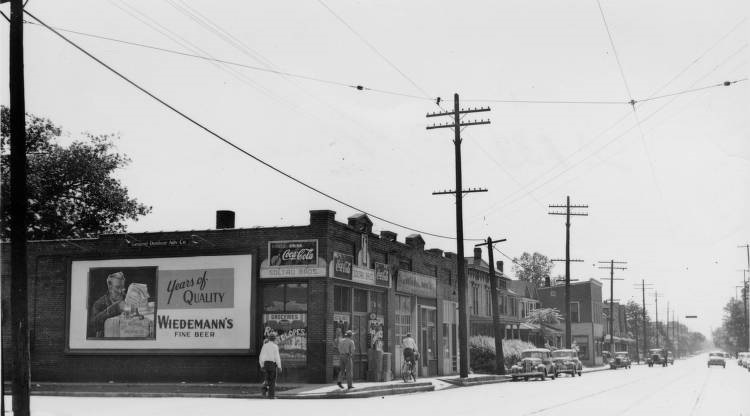
The Soltau family was closely associated with Indianapolis, particularly the east side and Irvington. John Albert Soltau (1847-1938) was a German immigrant who founded the first grocery chain in Indianapolis, the Minnesota Grocery Company. Soltau arrived here in 1873 at the age of 10. After marrying Miss Elizabeth Koehler (1851-1920), Soltau opened the first of what would become a chain of twelve grocery stores at 208 North Davidson Street. The couple had five children: William, Edward, James, John, and Benjamin. The elder Soltau remained in the grocery business for over fifty years. Three of his sons joined him, managing stores of their own. Mr. Soltau was a member of the First Evangelical Church near Lockerbie Square (where New York crosses East Street). The family residence was located at 837 Middle Drive in Woodruff Place.

Edward B. and John H. Soltau grocery store at 2133 E. Michigan Street in Indianapolis.
837 Woodruff Place Middle Dr, Indianapolis

In 1894, John was a Republican Ward delegate in Indianapolis. In 1902, he was an unsuccessful candidate for Marion County Recorder on the Prohibition ticket, and in 1916, he was a delegate to the national Prohibition Party convention. His long adherence to the temperance cause smacks of social conservativism, but offers no clear evidence for why his family embraced the Nazi ideology. Hoosier Prohibitionists allied themselves with the Klan’s cause in the 1920s, and in 1923, John’s brother James Garfield Soltau (1881-1932) was identified as one of the first 12,208 Ku Klux Klan members in Indianapolis. John died of “uremia and carcinoma of the prostate” on July 18, 1938, and is buried alongside his wife, Elizabeth, at Crown Hill Cemetery in Indianapolis.

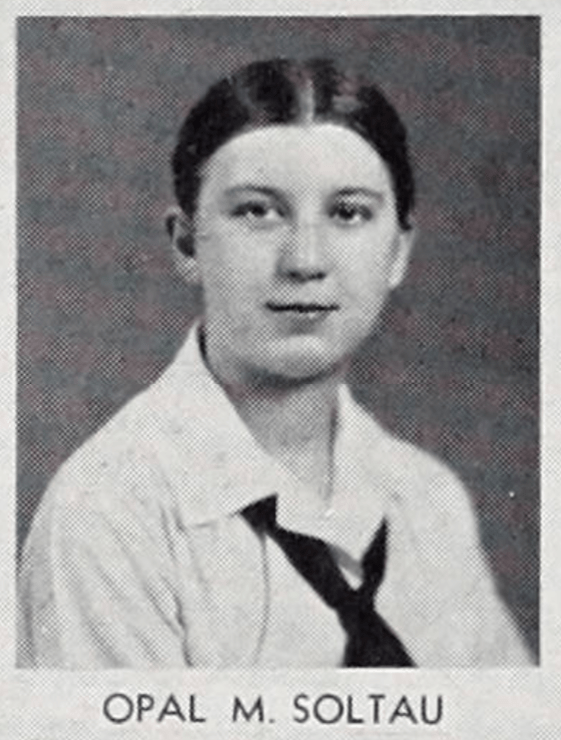
Opal’s Tech Yearbook Photo 1938.

John’s eldest son, William Soltau, was a realtor who operated his agency in room 202 of the Inland Building at 160 East Market Street in the city for a quarter century. William and his wife Laura E. (Hansing) Soltau (1879-1943) were the parents of three children: Pearl Brilliance Soltau (1905-1968), Charles William Soltau (1909-1971), and Opal Margaret Soltau (1920-2008). All three children graduated from Arsenal Technical High School, Pearl, in 1922, Charles in 1926, and Opal in 1938. Pearl graduated from Butler University in 1925, Charles from Purdue in 1931 (with honors and a perfect 6.5 GPA), and Opal attended Butler University until at least 1940. The Soltau’s moved to 339 North Summit Street in 1916 and while the Soltau family was residing under that roof, it appears that all five were emersed in and sympathetic to the Nazi cause.

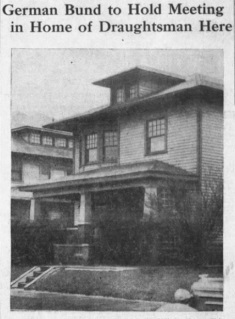
The Soltau Home Indianapolis.

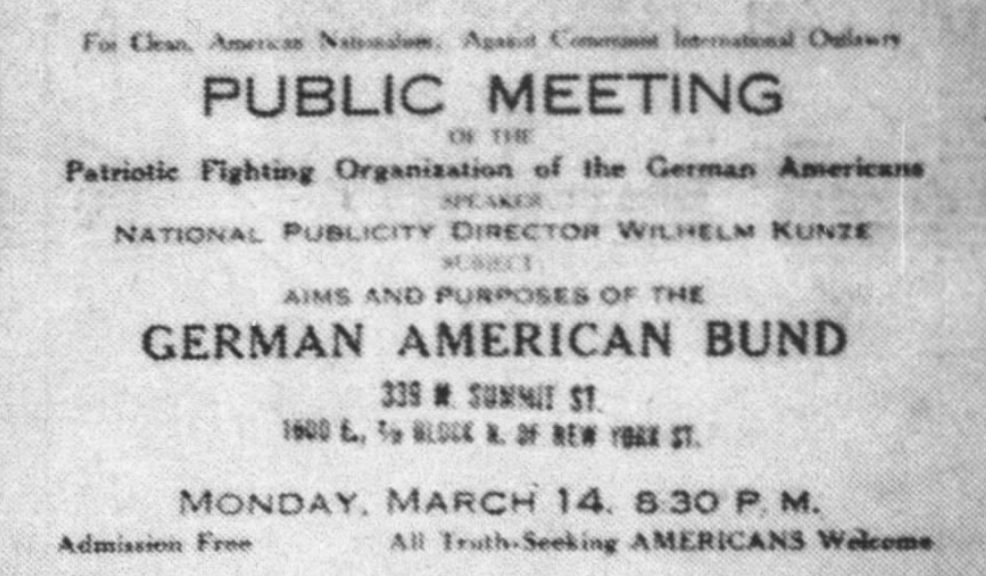
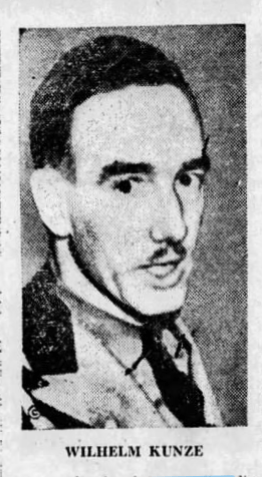
The front page of the March 9, 1938, Indianapolis News ran a photo of the Soltau House with a notice that a meeting of the German American Bund, described as a “Patriotic Fighting Organization of the German Americans”, was to be held there. Regardless, the Soltau family denied that a meeting was to be held in their home. The next day, the news ran a copy of the invitation with the address of the home and the announcement that Wilhelm Kunze, National Publicity Director of the Bund, would be the speaker and that admission was free and open to the public, especially to “All Truth-Seeking Americans”. Again, the family denied that Kunze was in the city at all, let alone scheduled to appear at the house. Kunze was fresh off his January 1938 appearance in a March of Time newsreel that the Library of Congress called “the first commercially released anti-Nazi American motion picture.” The News article announced the meeting’s date as Monday, March 14, at 8:30 pm.

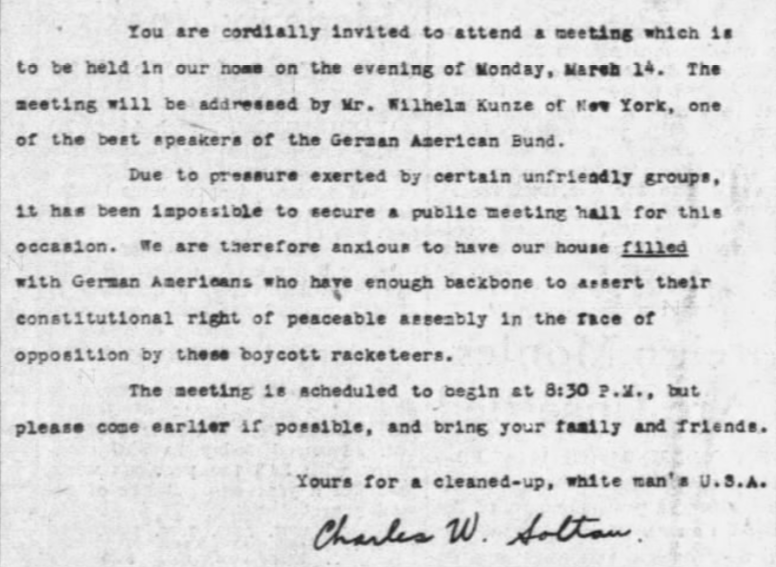
Charles Soltau’s Letter.

Hoosiers were shocked. After all, in February, the Athenaeum, the Liederkranz Hall (1417 E. Washington St.), and the Syrian-American Brotherhood Hall (2245 East Riverside) had all canceled the Bund’s reservation and refused to host the event. On February 25th the Indianapolis Star identified “an American-born Nazi agent…born in Indiana” attempted to secure a venue “to organize Brown Shirt Nazi units in Indianapolis.” That local organizer was revealed as Charles W. Soltau from the near-Eastside. Charles wrote a letter to the Star complaining that “the German-American Bund has been accused, maligned and condemned without a trial” and suggested that the Bund’s right to meet had been undermined by “Jewish business interests”, arguing that “a certain powerful minority group, which seems to have gained almost complete control of the press, fears the effect of public enlightment.(sic)” Charles further declared that the Soltau family was “anxious to have our house filled with German-Americans who have enough backbone to assert their constitutional right of peaceable assembly in the face of opposition by these boycott racketeers.” He closed his letter as “Yours for a cleaned-up, white man’s U.S.A. Charles Soltau.” Shortly after that revelation, 27-year-old Soltau announced that the meeting was called off.

Indianapolis News Notice March 10, 1938.

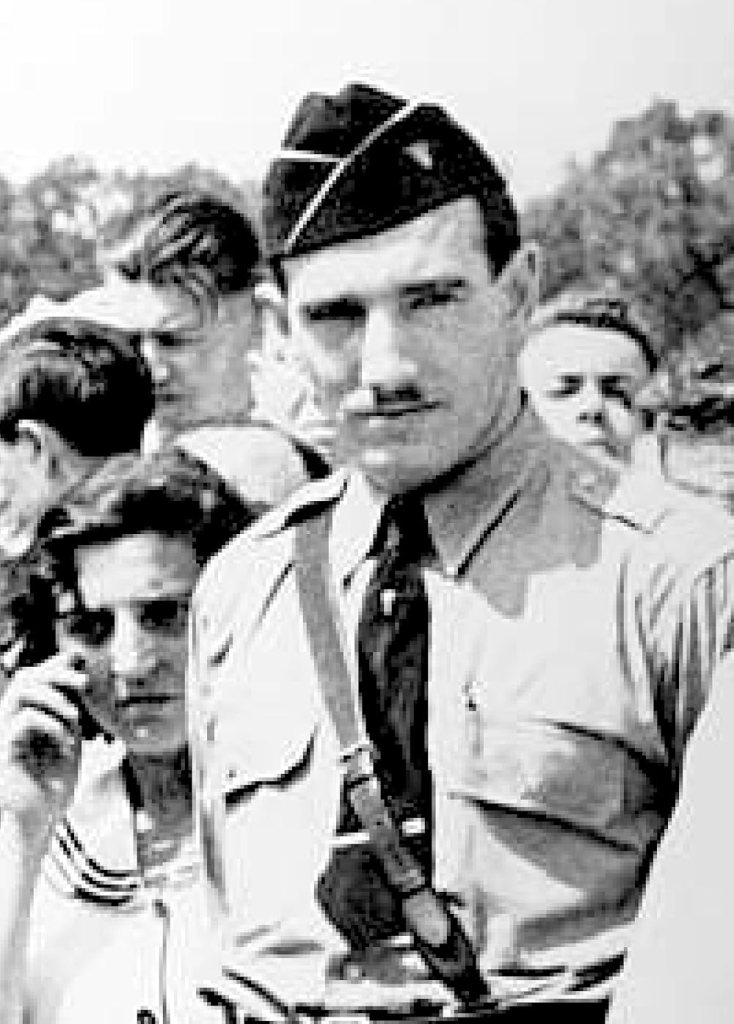
The front page of the March 15, 1938, Indianapolis Star reported, “Rocks hurled through the windows at the home of William A. Soltau, 339 North Summit Street, broke up an organization meeting of the Indianapolis affiliate of the Nazi Amerika Deutschen Volksbundes (German American bund) late last night.” William Albert Soltau (1875-1950) called the police for help after it was learned that Gerhard Wilhelm “Fritz” Kunze (1882-1958) and a small entourage had joined the Soltau family for dinner earlier that evening. Fritz Kuhn, often referred to as the “American Führer”, was the leader of the fledgling German-American Bund (Federation). Fearing for his dinner guests’ safety, Soltau asked police to escort Kunze and his guests to safety. Although Kunze refused to divulge his identity to any of the officers present, his “tooth-brush mustache”, proper Sturmabteilung brownshirt, and swastika tie-clasp made the physical connection to German Chancellor Adolph Hitler unmistakable.

Fritz Kunze 1938.

When escorted from the home, Kunze declared to the officers and crowd gathered on the sidewalk, “I am a guest of Mr. Soltau, and he does not want my name known.” Kunze eventually admitted his identity to the police after they discovered the Bund application blanks Kunze held in his hands, wrapped up in a newspaper. An Indianapolis News article claimed that visible through the broken windows were, “Fifteen chairs had been arranged around a dining room table, and on it were application blanks for Bund membership.” The article noted that the “photographer for the Associated Press was ordered off the Soltau property by a man who carried a gun.” Soltau repeated his denials that a Bund meeting had been held in his home, claiming it was just “a few guests in for dinner.” The shades of the house were drawn, and a police squad car remained in front of the house from dusk to 10:30 pm when the officers went off duty. At 10:43 pm, a barrage of rocks crashed through the north windows of the Soltau house. Cars buzzed Summit Street for days afterward as curious motorists drove past the Soltau home and a near-constant gang of 40 or 50 youngsters “milled in the neighborhood”. Further exacerbating the situation, on July 18, 1938, just 4 months after the attack at his son’s home, family patriarch and Indianapolis grocery chain magnate John Albert Soltau died at age 90. Over the years, the elder Soltau and his son had purchased 4 tracts of land totaling 234 acres along State Road 46 in Gnaw Bone, 8 miles east of Nashville in Brown County. Newspapers speculated that the land was to be used as a Bund camp for Nazi activities, but the Soltau’s denied it.


Next Week: Part II: Nazi’s at Arsenal Tech…What?

Nazi’s at Arsenal Tech…What?

Part II

https://weeklyview.net/2025/03/20/nazis-at-arsenal-tech-what-part-2/

Original publish date March 20, 2025.

Charles Soltau.

On March 15, 1938, an eastside Indianapolis house was rocked (quite literally) by an angry crowd after the city learned about a formational meeting of the German-American Bund, an organization formed to follow the ideals and edicts of Adolph Hitler’s Nazi party. The Soltau family, who lived at 339 North Summit Street, welcomed a controversial visitor to their home, a German transplant named Fritz Kunze. The Nazi’s visit was greeted by Circle-City residents hurling rocks through the front windows of the Soltau home. Gerhard Wilhelm Kunze was the Bund’s publicity director who invented derogatory names for people (Franklin D. Rosenfeld) and programs (The Jew Deal) he disapproved of while extolling Jim Crow laws, warned against immigrants, and advocated for the Chinese Exclusion Act. Fritz warned white Americans: “You, Aryan, Nordic, and Christians…wake up” and “demand our government be returned to the people who founded it…It has always been very much American to protect the Aryan character of this nation.”

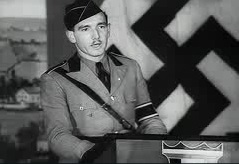
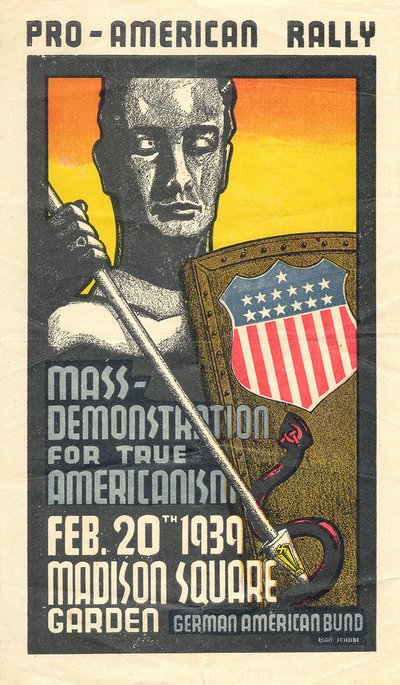
Wilhelm Kunze German American Bund Rally.1938.
Gerhard Wilhelm Kunze.

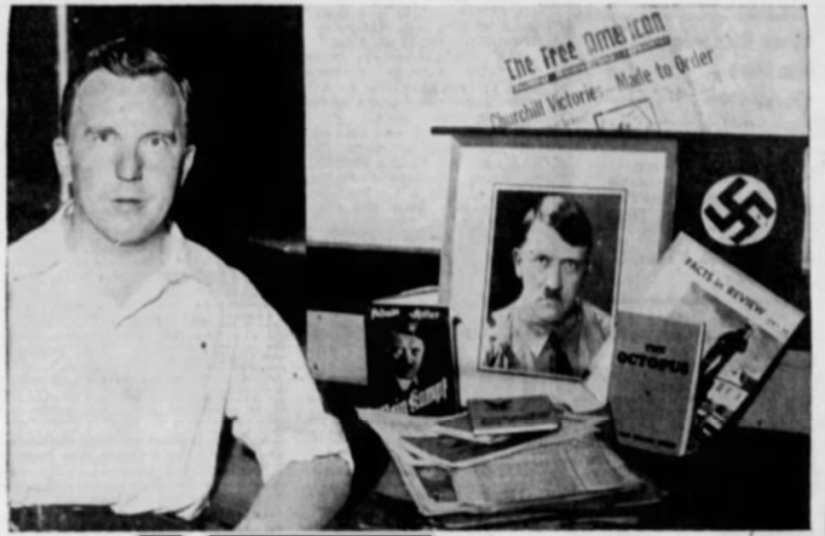
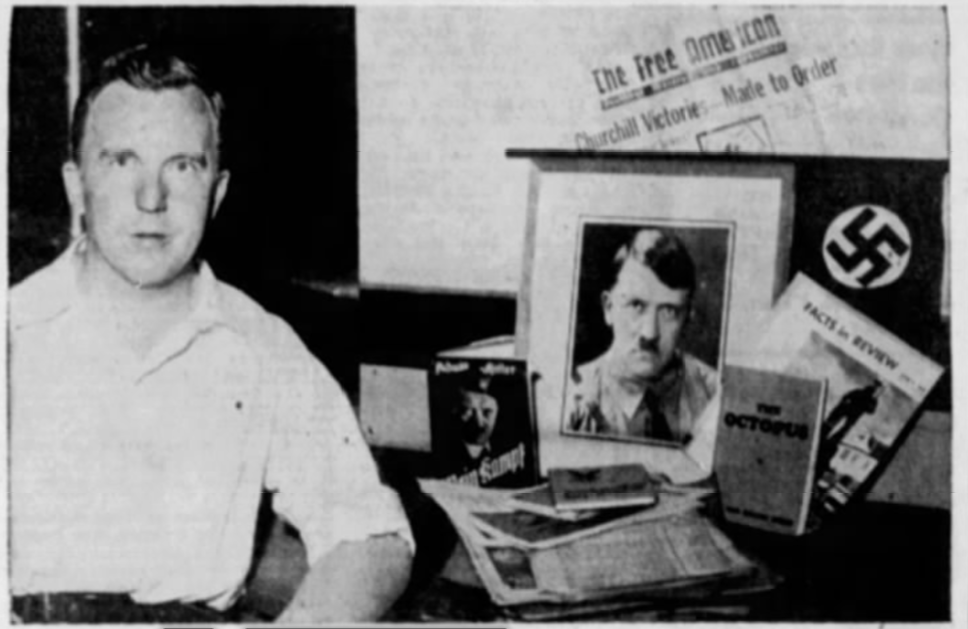
Despite the Eastside Indianapolis Nazi recruitment session debacle, the Soltau family stayed committed to Nazi ideology. In November 1938, Charles and his youngest sister, Opal, fresh off her graduation from Tech High School, returned from a Bund indoctrination trip to Germany. Some of these trips included meetings with Joseph Goebbels, Heinrich Himmler, and Hitler himself. Whether the siblings were in the Rhineland to attend a German youth camp or to enjoy a post-graduation vacation is unknown. While 18-year-old Opal fit the profile, Charles was almost 30 and may have aged out of that group. They left Hamburg on November 3rd, arriving back in New York on the 11th. The Soltau family quietly supported the Bund cause by subscribing to The Free American newsletter and other Nazi propaganda publications including a liturgy of anti-Semitic tracts like The Protocols of the Elders of Zion and Hitler’s Mein Kampf manifesto. A November 1941 FBI investigation identified the Soltau family as 4 of 38 stockholders in the Press (The publishing house had issued 5000 shares of preferred stock at $10 a share in 1937). The FBI noted that the Soltau family were the only stockholders from Indiana. While the Free American had local news columns in Fort Wayne and South Bend, there were none in Indianapolis.

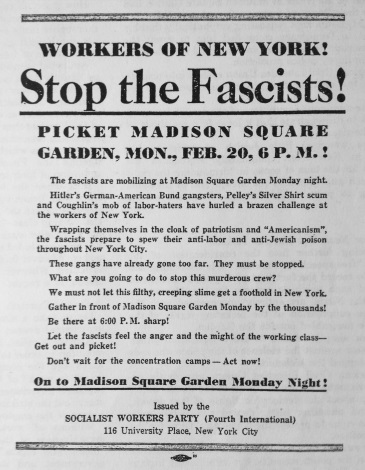
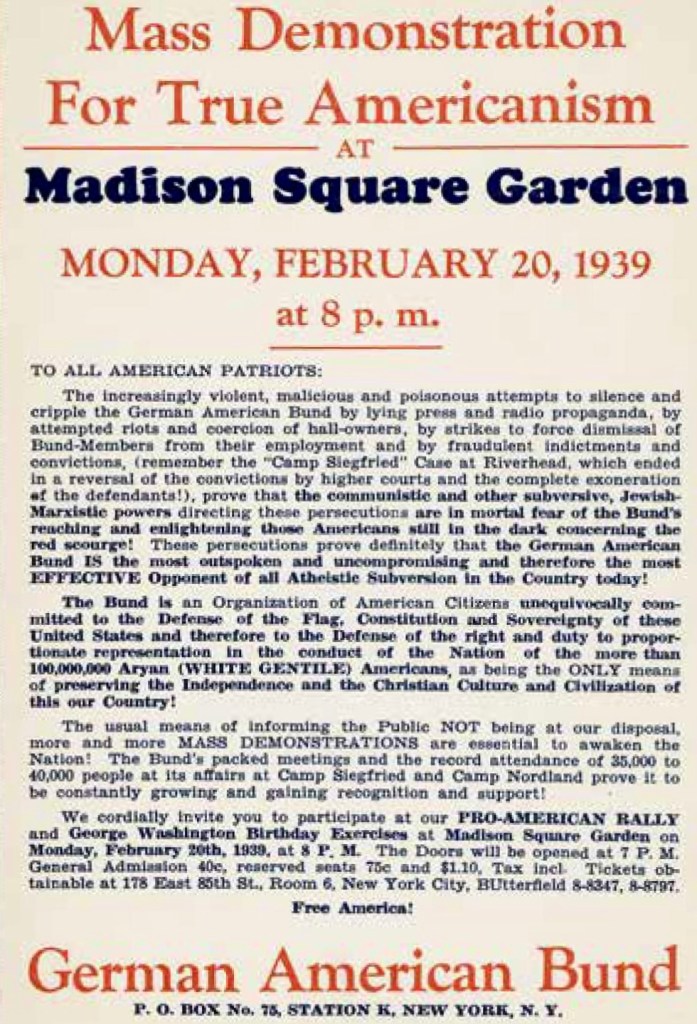
The German-American Bund was at its zenith in 1938-39, but after 20,000 people attended a Bund rally at Madison Square Garden in February 1939, New York City Mayor Fiorello La Guardia instigated a series of investigations that would ultimately bring them down. In September 1939, after the Nazis invaded Poland the FBI and federal government went after the Bund. Fritz Kunze was detained by the South Bend Police on May 12, 1941.

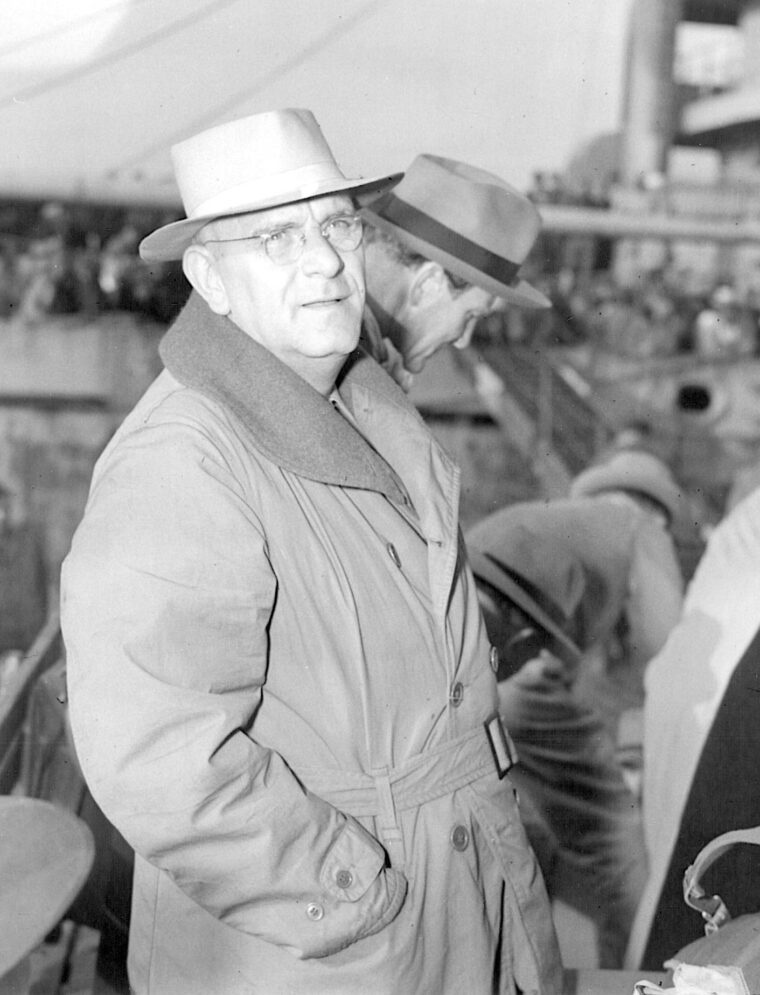
Kunze upon deportation in 1945.

In the inventory of Kunze’s papers confiscated by the Police were cards with the names and addresses of Bund members, including the Soltau family, the only members from Indiana. Kunze was charged with espionage, and in November 1941, just a month before Pearl Harbor, he fled to Mexico, hoping to escape to Germany. Kunze was captured by the Feds in Mexico in June 1942 and sent to jail for espionage, where he spent the rest of the war. The German-American Bund disbanded officially immediately after Pearl Harbor. Regardless, some Bund members had their American citizenship revoked and were deported, while others were prosecuted for refusing to register for the draft. Kunze was eventually deported himself in 1945.

In September 1940, when the draft began, the Bund instructed its members to boycott registration, and soon, former Bundist members began to be prosecuted by the Selective Service System for failure to register. 33-year-old Hoosier Charles William Soltau was among those who refused to report for induction. In August 1942, draft dodger Soltau was arrested, and his home was raided by US Marshals who discovered a large cache of Nazi propaganda there. It included issues of The Free American, a portrait of Hitler, Swastika banners, and Nazi memorabilia. In a four-page letter to President Franklin D. Roosevelt, Soltau argued that “in all my association with the German-American Bund I never was guilty of any subversive activity.” After spending a couple of nights in jail, Soltau posted a $5000 cash bond. When he appeared in court in November, he argued that, “My conscience will not permit me to bear arms against the German people.” He informed the court that “This war is a war of aggression by the United States against the Germans. I am a man of German blood, and I don’t think it is right or fair or just for a man of German blood to bear arms against the German people.” It took the jury six minutes to deliberate and deliver a five-year sentence to Soltau. Judge Robert C. Baltzell concluded that “I have never seen a more contemptuous fellow in this court,” and “I am going to do all I can to see that you serve as much [time] as possible.” In December 1943, while serving his sentence at the Federal Correctional Institute in Milan, Michigan federal prison, Soltau’s mother Laura died. Charles was released in 1946, and with his sisters, Opal and Pearl, he moved to their secluded Brown County property near Gnaw Bone.

Charles Soltau 1942.

Their father, William Albert Soltau, died there on October 6, 1950, at age 75. His funeral service was held at Shirley Brothers Central Chapel in Irvington, and he is buried at Memorial Park Cemetery on Washington Street alongside his brothers, whose funeral services were also held at Shirley Brothers. At least one brother, Benjamin Harrison “Ben” (1889-1963), was a member of Irvington Masonic Lodge 666, and another, James Garfield Soltau (1881-1932), was an admitted member of the KKK. The Soltau siblings quietly left Indianapolis and moved to Gnaw Bone, where they lived together in Brown County for the remainder of their lives, and none of the three ever married. The siblings started with three goats in 1952, and by 1962, their “trip” (or tribe) had reached 44 head, so they created Pleasant Valley Goat Farm on their 200-acre Gnaw Bone property. The family sold goat’s milk and yogurt in local farm markets. Pearl Soltau also moonlighted as an accountant for a local hosiery mill, preparing tax returns on the farm. After a two-year illness, Pearl died at the Gnaw Bone farm in May 1968 at the age of 62. Charles died there on July 5, 1971, at age 61. Although Charles’s membership in the “German-American National Congress” was mentioned in his obit, Pearl betrayed no history of continued xenophobic activism after the war. Both are buried at Henderson Cemetery in Gnaw Bone.

Charles Soltau 1942.

However, the youngest sibling, Opal, remained committed to neo-Nazi causes for more than a half-century after the war. Even after the deaths of her siblings, Opal continued to agitate for unpopular political causes. Opal had been a standout at Arsenal Tech High School. She was a straight-A Honor Roll Student and received the scholarship medal from the Tech faculty in 1938. In the 1980s, Opal Soltau was accused of mailing neo-Nazi propaganda from the post office in Nashville, In. In September 1996, Opal sold her parcel of 120 acres in Brown County and by January 1997, she had moved to Nebraska. That same month, she became a Director for the National Socialist German Workers’ Party-Overseas Organization. Opal Soltau died in Lincoln in August 2008 and is presumed buried there. No one knows how the pilot light of Nazi fervor was lit in the Soltau family and, for that matter, how it burned out of control within the hearts and minds of these three Arsenal Tech graduates. Political ideology grows unchecked when surrounded only by like-minded individuals living in a silo of misinformation. Sometimes, it is the better part of valor to explore divergent opinions. The flame of Nazism burns through everything it touches. Characterized by extreme nationalism and steered by blind faith in misguided authoritarianism, its victims don’t realize what has happened until it’s too late. And by then, no matter what, they will never admit that they were ever wrong in the first place.

For a more thorough study of the Soltau family, I recommend the blog Nazis in the Heartland: The German-American Bund in Indianapolis by the late Paul R. Mullins (1962-2023), Anthropology Professor at IU Indianapolis (formerly IUPUI).